The Torah introduces the ner tamid, the eternal light that was present in the Mishkan, the portable sanctuary. In every synagogue across the world, you will find a ner tamid—a light that connects us to the original ner tamid mentioned in the book of Shemot.
The sages spend an ample time discussing the eternal light. What does it mean to have a light that continuously burns? Rashi explains that a continuously burning light occurs when one begins igniting the flame and only retreats after witnessing the flame existing on its own. A light that is sourced from another but learns how to exist on its own.
The ner tamid is a constant reminder to recognize those people in our lives who enable us to grow and thrive. We walk through this world a compilation of memories, lessons, experiences and sparks that fuel our every step. While it may look like we live and breathe on our own, our light is sourced from both those that come before us and those in this world that inspire us to shine with a unique brightness and beauty.
May our light radiate…a light from the past that will fuel generations to come.
Shabbat Shalom
Rabbi Nicole Guzik is senior rabbi at Sinai Temple. She can be reached at her Facebook page at Rabbi Nicole Guzik or on Instagram @rabbiguzik. For more writings, visit Rabbi Guzik’s blog section from Sinai Temple’s website.
As I was preparing to leave the house earlier this week, my four-year-old son, Eli, ran up to me saying, “Daddy, this is a piece of mail for you. Open it up.” Inside was a note with a picture. Eli shared, “This note says that Zachary Shapiro is so special.”
As my heart melted, I thought deeply. How awesome to carry a note reminding me that I am special.
Judaism teaches that we actually carry two notes each day. One note says, “The world was created for me.” The other says, “I am but dust and ashes.” Those two notes are meant to balance our daily perspective.
While I really like this concept of balance, I’ll stick with Eli’s note. I’ll add that we all have the opportunity to embrace that we are all uniquely created. We are all in God’s divine image. We are all, indeed, special.
In that moment in time when you might be feeling less than whole, know that you are special. And if you ever are in doubt – write your own note and carry it with you as a daily reminder.
“Jewish food differs in any region,” chef, writer and podcast host Sonya Sanford told the Journal. “That’s because of what’s available to people and what the cultural trends are.”
For instance, on the East Coast, and in many other places in American Jewish food culture, everyone prefers cold, smoked Nova lox.
“In the Pacific Northwest, hot, smoked lox are more dominant because indigenous people were hot smoking fish,” said Sanford, “That kind of firmer, flakier, usually heavily spiced seasoned fish is very popular, and salmon is incredibly central to Pacific Northwest Jewish food.”
Sanford, who has been studying cuisine in the diaspora for more than 15 years, is author of “Braids: Recipes From My Pacific Northwest Jewish Kitchen.”
The child of Ukrainian immigrants, who left during the Cold War, Sanford grew up in Seattle and is the first born American in her family. Sanford explains that Jews have been in the Northwest since the mid 1800s, and have been a small, meaningful community there for more than 100 years. It’s uniquely mixed with Sephardic and Ashkenazi backgrounds.
“I had this understanding that food travels to new places and emerges as something new,” she said. “That was always something I was curious about.”
As an “immigrant kid,” Sanford was expected to be a lawyer, doctor or academic. She ended up working in the television industry after college.
“At some point my love of food became really strong and through a series of unpredictable events, I became a personal chef in Hollywood,” she said.
That led to a career in food media, producing cooking shows, food styling, catering and pop-ups in Los Angeles. Sanford eventually returned to the Northwest to open her first restaurant, a Pacific Northwest Jewish Deli.
Although Sanford loved Los Angeles for its food culture, its produce and her friendships there, she missed home and always knew she’d come back.
“Upon returning, all those parts of me that I’d always carried with me started to blossom more,” she said.
Sanford opened her Jewish deli, six months before Covid began, which was unfortunate timing. They were hitting their stride as the pandemic hit, and tried to keep it going for another six months.
“After it ended, so many people kept asking me for recipes, kept wanting to share food or asked me if I would start another restaurant or catering. and I just couldn’t do that,” she said.
Six months after her restaurant closed, Sanford started writing “Braids.” Her goal with the restaurant was to create community and connections, share stories around these foods and make people feel safe, nourished and cared for. She hoped her book would do that, as well.
For a taste of a classic Jewish recipe with a northwest element, try Sanford’s marionberry rugelach. Recipe is below.
“They’re a really simple rugelach recipe with a cream cheese dough, and they’re just so beautiful,” Sanford said. “Marionberries are … a little bit of a mix between a blackberry and a raspberry, but I think that’s too simplistic of a description, and in Rugulach they’re just such a wonderful filling.”
Sanford’s rugelach is made with marionberry jam or preserves, which is available in stores and online. The recipe, however, can be used with whatever flavor jam or preserves you like.
“That’s definitely a recipe that I feel like anyone can make, and it can turn out beautifully and deliciously,” Sanford said.
Learn more at Sonyasanford.com and follow her on Instagram @sonyamichellesanford.
1 cup (2 sticks /226 grams) unsalted butter, at room temperature
8 ounces (226 grams) cream cheese, at room temperature
½ teaspoon kosher salt
2 cups all-purpose flour
For the sweet berry filling:
⅔ cup marionberry jam, or substitute with jam of your choice
⅔ cup sugar mixed with 1 Tablespoon of ground cinnamon
For the glaze:
1 large egg yolk
1 teaspoon water
Turbinado/Raw sugar for a sweet topping
In a stand mixer with a paddle attachment, or in a large bowl using a hand mixer, beat the butter, cream cheese, and salt together until they are light and fluffy, on medium speed for about 2-3 minutes.
Add the flour to the butter and cream cheese mixture, and mix on medium-low until the flour is just incorporated. Be careful not to overmix.
Transfer the dough onto a clean surface and divide the dough into 3 equal pieces. Form each piece into a disc and wrap the dough tightly in plastic wrap or beeswax wrap. Let the dough chill for at least 2 hours, and up to 2 days.
Line 3 large baking sheets with parchment paper or Silpats. Preheat the oven to 350°F.
On a lightly floured surface, roll out the first disc of dough into a 12-14-inch circle. Do not worry if the circle is uneven or if the edges aren’t perfect.
Spread 2-3 tablespoons of jam onto the dough using an offset spatula or spoon; make sure the jam is in an even thin layer, too much jam will result in a leaky mess. Sprinkle 2-3 tablespoons of cinnamon sugar on top of the jam.
Cut your circle into 16 even triangular wedges, like you would cut a pizza. Roll up each rugelach from the outside-in (wide end towards the point), and place them on the baking sheet. Repeat the process with the remaining dough.
Ideally, put the cookies into the freezer for 15 minutes before baking. They can also be frozen for up to 2 months at this stage. Before baking, brush each with the egg wash and sprinkle with a little turbinado or raw sugar and/or flake salt.
Bake for 20-25 min, or until golden brown all over. Transfer to cooling racks. These cookies will store in an airtight container at room temperature for up to 5 days.
Notes
*To make these cookies gluten-free, substitute the all-purpose flour with a gluten-free 1:1 mix.
*I do not recommend substituting vegan cream cheese or vegan butter. This recipe simply works best with dairy products.
Debra Eckerling is a writer for the Jewish Journal and the host of “Taste Buds with Deb.” Subscribe on YouTube or your favorite podcast platform.Email Debra: tastebuds@jewishjournal.com.
The Jewish world is changing quickly. Today, young Jews exhibit greater diversity, are less bound by traditional denominational affiliations, and embrace a wide range of personal practices and interpretations of what it means to be Jewish. To not only endure but flourish, Jewish institutions must adapt fundamentally to engage with Jews wherever they may be, both geographically and spiritually.
This week, American Jewish University completed the sale of its Sunny & Isadore Familian Campus in Bel Air to the Milken Community School – a move that positions us to be a local and national leader for this new Jewish world. We have offloaded the enormous fixed costs of operating a facility—including skyrocketing sums for insurance, security, and utilities—to focus our resources on programs that can most effectively serve the Jewish community now and in the future.
The proceeds of the sale allow us to strengthen and expand programs that demonstrate extraordinary growth at a time when so much of the Jewish discussion is focused on decline and retrenchment. For instance, our Miller Introduction to Judaism Program offers one of the most popular paths to conversion in the world and shares Jewish knowledge with Jews and non-Jews alike. By making the program largely online, we will be able to reach 900 people this year – nearly three times the amount served before the pandemic. The same course is taught in person at dozens of locations across the country and, increasingly, around the world.
Similarly, a few years ago, we recognized a great need to train more high-quality early childhood Jewish education teachers. These educators are not only critical for supporting the development of healthy and Jewishly connected children but, as the Federation’s study of Jewish Los Angeles noted, the schools they teach in are also often the gateways for young families to join synagogues and become involved in Jewish life. In the last few years, we have built a suite of fully online certificate and degree programs at the bachelor’s, master’s, and doctoral levels that now serve 100 students, who are often concurrently serving as Jewish education administrators and teachers, across the country. Within three years, we are projecting to reach 175 students – and the School is expected to continue growing from there.
Finally, we continue to reinvent adult education for those hungry to learn more about Judaism. In the last four years, we have had more than 150,000 registrations for our online programs. We are also bringing in-person education to Jews across the city rather than expecting people to travel to Bel Air—a location that can be inconvenient for many Los Angelenos. Recently, we hosted a program with Rabbi Sharon Brous in Hancock Park. We will soon have a program with feminist Letty Cottin Pogrebin at the Los Angeles LGBT Center talking about her book Shanda and one with Rabbi Shai Held discussing his new book, Judaism is about Love in another LA neighborhood.
AJU’s programs are not going exclusively online. We are retaining the 2,700-acre Brandeis Bardin Campus in Simi Valley that houses our much-beloved. Camp Alonim, the distinguished Ziering Brandeis Camp Institute (BCI), and a conference center. In addition, the Ziegler School of Rabbinic Studies will soon complete its move to its new home at 350 S. Beverly (at the corner of Olympic), enabling in-person training of future Jewish leaders in the heart of Jewish Los Angeles. This new location will also enable AJU to provide in-person adult education in a convenient setting. Finally, AJU will continue to operate the Community Mikvah on the Familian Campus, which provides all Jews with a critical ritual and spiritual space.
The investor Ray Dalio famously said, “Evolve or die. This evolutionary cycle is not just for people but for countries, companies, economies—for everything.” That attitude is common in business, where companies move, split up, and merge on a regular basis. However, there is often an expectation in the non-profit, education, and Jewish worlds that institutions created one way will remain the same forever. The world has not ever favored that kind of stasis. The 21st century, given seismic changes in technology and demography, will be particularly punishing to those who do not adapt.
AJU is not resisting the winds of change but embracing the new world. The sale of our Bel Air campus will allow us to serve the Jewish community of today and, critically, the Jewish communities of future generations. Given all the heartache and sadness in the world today, that is a cause for celebration.
Jeffrey Herbst is President of American Jewish University.
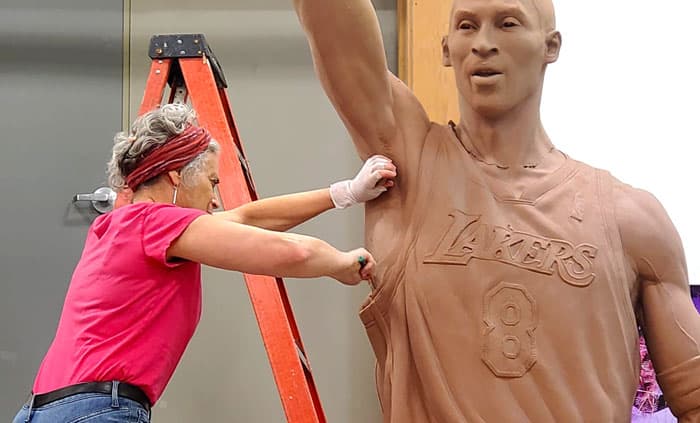
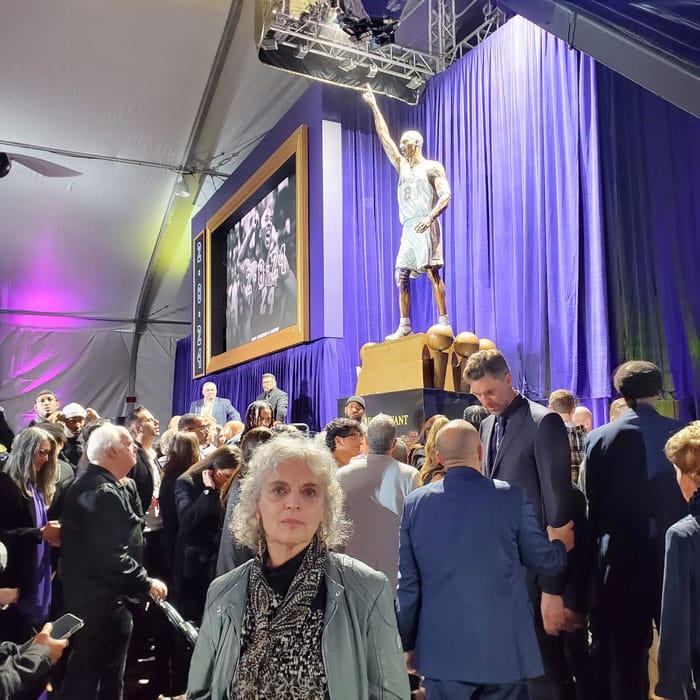
As the lakers unveiled the much-anticipated statue of Kobe Bryant, there was one person whose heart beat faster than perhaps anyone else present: artist Julie Rotblatt-Amrany. Commissioned five years ago to immortalize the beloved Lakers player, Rotblatt-Amrany watched the crowd around her, curious about their reaction.
”When they saw his face and the figure, they were like, ‘Wow.’ The reality of it all sank in. The place was packed with people and suddenly everything went quiet.” —Julie Rotblatt-Amrany
“In that moment, there was total silence and the realization that he was gone,” Rotblatt-Amrany told the Jewish Journal in an interview shortly after the ceremony at the Crypto.com Arena Star Plaza on Feb. 8. “When they saw his face and the figure, they were like, ‘Wow.’ The reality of it all sank in. The place was packed with people and suddenly everything went quiet.”
Artist Julie Rotblatt-Amrany at the unveiling event of Kobe Bryant statue
This wasn’t Rotblatt-Amrany’s first creation for the Lakers. Alongside her husband, Omri Amrany, also a sculptor, she has made sculptures of Kareem Abdul-Jabbar, Shaquille O’Neal and Lakers owner Jerry Bass for the team.
She received the commission for the Bryant statue, “Black Mamba,” shortly before Bryant’s tragic death in January 2020. Rotblatt-Amrany was still in the process of sketching and designing the statue when news broke of the plane crash in Calabasas, where Bryant, his daughter Gianna and seven others lost their lives.
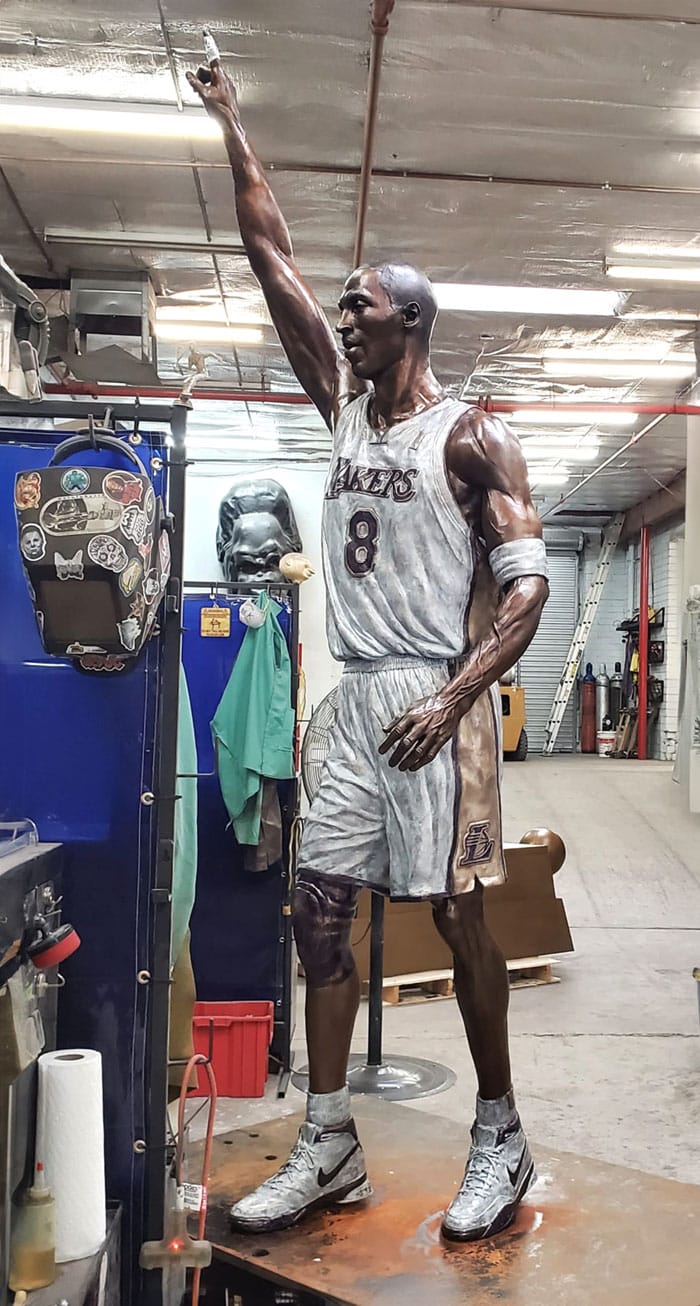
Bryant could have chosen any monumental moment from his career to immortalize in a sculpture, but he chose one that was deeply sentimental for him. It depicts a high point in his career when, wearing jersey no. 8, he points his finger to the sky after scoring 81 points against the Toronto Raptors on Jan. 22, 2006. It remains the second-most points scored in a single NBA game.
“For the record, Kobe picked the pose you’re about to see, so if anyone has any issue with it, tough s—,” Bryant’s widow, Vanessa Bryant, said. She added, “this moment isn’t just for Kobe, but it’s for all of you that have been rooting for him all of these years.”
Rotblatt-Amrany spoke with Bryant at the event and “she was all smiles and very happy with the piece … It gave me a very warm feeling that I pleased her and the Lakers.”
This wasn’t the first time they had met; Vanessa traveled to the artist’s studio in Illinois when the statue was nearly completed. “She visited when the piece was about 95% finished, and we spent three hours together. She wanted to make some tweaks to the face and requested that he appear a bit slimmer, reminiscent of his younger self, so I made those adjustments.” Rotblatt-Amrany incorporated the tattoo on Kobe’s front arm featuring the names of Kobe and Vanessa’s four daughters, while Vanessa’s name adorned the back of his arm.
Rotblatt-Amrany and her husband, Omri, who was born in Kibbutz Ashdot Ya’akov, were married in Israel and relocated to the U.S. with their son when he was just a baby. They established their studio, the Fine Arts Studio of Rotblatt-Amrany, in the Chicago suburb of Highwood, Illinois, where they have trained numerous sculptors over the years, including their son, Itamar Amrany, who is also a talented sculptor.
Among their larger-than-life sculptures, at Crypto.com you can find the monument celebrating the Los Angeles Kings’ Stanley Cup win, and sculptures of Gordie Howe, Gayle Sayers and Michael Jordan can be seen around the country. The 4,000-pound bronze statue of Bryant stands at an impressive 19 feet tall, making it the largest of the seven statues they created for the Lakers, towering three feet above Kareem Abdul-Jabbar and two feet taller than Magic Johnson.
During the unveiling, it was announced that the Lakers had commissioned two additional statues, one depicting Kobe with his daughter Gianna, and another featuring Kobe’s jersey no. 24. Rotblatt-Amrany will be working on the latter.
I’m a Jewish cadet at the United States Military Academy at West Point. We exist and we’ve been here since the beginning. This is our story.
I’m your average American Jew. My father is an Iranian immigrant and my mother’s family fled the pogroms of Eastern Europe. I had my bar mitzvah, traveled to Israel, was dragged by my parents to synagogue for the High Holy Days and observed the occasional Shabbat. My Yom Kippur fast never lasted more than a few hours and our Passover seders always took too long.
I always saw myself as an American soldier and wanted to go to West Point. My application was rejected so I went to University of Arizona, where I majored in Arabic and Political Science while doing Army ROTC. Every Shabbat I joined other Jewish students at the Chabad just down the street from my apartment for Rabbi Yossi Winner’s Shabbat extravaganzas. But my heart remained set on West Point. Eventually I was accepted and left Arizona. It took saying goodbye for me appreciate it.
In June, 2022, I drove with my parents to West Point, the real-life Hogwarts I’d call home for four years. I was one of the 1,209 admitted students in the class of 2026 arriving for six weeks of cadet basic training. Despite two years at Arizona, all transfer students start over.
The next day I met some of my future classmates, but felt strange without knowing why. While talking with my parents, I realized that for the first time in my life I was a Jew out of place. Nobody I’d met was Jewish and some had never even met a Jew. I longed for connection; I needed my people.
Leave a task to a Jewish mother. Fifteen minutes later my mother called the West Point Jewish chaplain, Cantor (Maj.) David Frommer, and five minutes later, he called me. I didn’t know it at the time, but this exceptional human being would change my life. Chaplain Frommer talked about the Jewish community’s energy and the weekly Shabbat services, Tuesday Torah studies, High Holy Day services, Birthright trips, Passover seders, Hillel club, and Jewish choir. We had everything, even a Jewish chapel which I visited the next day.
It was beautiful. Engraved on the wall outside were the words of Isaiah 32:17 “For the work of righteousness shall be peace,” a reminder of what we fight for. Chaplain Frommer welcomed me and gave me a tour. He showed me the wall with every known Jewish graduate’s name, the first being Simeon Magruder Levy in the first class of 1802. There is a memorial wall with every Jewish graduate killed in action, a Holocaust Torah, a Medal of Honor wall with every Jewish Medal of Honor recipient, a library, a kosher kitchen, and a spectacular sanctuary.
The Chapel is the legacy of Jewish grads who wanted the dedicated Jewish prayer space they never had. As cadets, they were forced to attend Christian services every Sunday and were tired of hauling their mobile ark to the fourth-floor chemistry laboratory on Shabbat. They started the West Point Jewish Chapel Fund which raised millions to build the chapel in 1984 and still supports Jewish life at the Academy today.
On Sunday our cadre called out worship options. When they called Jewish services, five of us stepped forward. Upon arriving at the chapel, we discovered something glorious: food. Chaplain Frommer yelled at us, but it was to make sure we took seconds … A U.S. Army officer and former IDF infantryman, he was our leader. We loved him.
The next Sunday about 15 people came forward. I was surprised we had so many Jews in basic training. The third Sunday 50 people stepped forward, at which point I caught on. The Jewish Chapel was the only religious service serving food. Through that food we built a community that was Jewish but open to all. Many weren’t Jewish, but they loved the welcoming environment, and we loved having them.
Being Jewish at West Point is wonderful. We’re a small community, 136 of 4,400, but we’re responsible for representing our people. Many cadets never met a Jew before West Point; our job is to introduce ourselves, ensuring all cadets know that as future Army officers, we will have a Jewish soldier who, like all soldiers, is entitled to excellent leadership.
Simultaneously we have an unspoken duty to dispel notions within the Jewish community that Jews don’t serve. We do and we have since the beginning. Francis Salvador, a Sephardic Jew known as the “Paul Revere of the South,” was the first Jew elected to public office in the Colonies and the first Jew killed in the Revolutionary War. Simeon Magruder Levy, part of West Point’s first class, served in the Indian Wars. Benjamin B. Levy of the New York infantry earned the Medal of Honor in the Civil War. Hungarian-born Tibor “Ted” Rubin, survivor of Mauthausen concentration camp, emigrated to the United States and tried enlisting in the Army to repay his new country. He failed his English test and was barred, but eventually made it and fought in the Korean War. His commander, a ruthless antisemite, sent Rubin on the most dangerous missions but he always survived. Rubin single-handedly defended a hill from North Korean soldiers and spent 30 months in a brutal Chinese prisoner-of-war camp. His commanders rejected his Medal of Honor nomination because Rubin was a Jew, but 55 years later he received the medal from President George W. Bush. Did you know that 550,000 Jews served in the U.S. military in World War II or that Col. David “Mickey” Marcus (class of 1924), a distinguished American paratrooper, volunteered in the 1948 War of Independence, becoming Israel’s first general? He died in that war. Our history is glorious.
One name you’ll never hear is Moses Casper, my great-grandfather. He came from a shtetl in Poland, escaping pogroms. He enlisted in the U.S. Army in World War I, where he was a machine gunner in the 81st Infantry Division. Like Rubin, Moses endured horrible antisemitism in the Army, but he was determined to serve his new country. Moses fought through gas attacks and trench charges and was part of the largest operation in American military history, the Meuse-Argonne Offensive. He once told my grandmother a war story where he saw his two best friends were dead. He always asked: “Why did I survive?” War is hell.
The next time you ask a Jewish servicemember, “What’s a nice Jewish boy or girl like you doing in the military?” just remember … We’ve been fighting for this country since our Revolution, we belong here, and we will continue to serve.
I love being a Jew at West Point. I never expected I’d develop my identity deeper here than anywhere else. We proudly serve the people of the United States, and we have a duty to our community. So, the next time you ask a Jewish servicemember, “What’s a nice Jewish boy or girl like you doing in the military?” just remember … We’ve been fighting for this country since our Revolution, we belong here, and we will continue to serve. Forever.
Am Yisrael Chai.
The views expressed herein are those of the author and do not reflect the position of the United States Military Academy, the Department of the Army, or the Department of Defense.
Aidan D. Djavadi is a cadet at the U.S. Military Academy at West Point.
I’m a first-year Jewish student at UC Berkeley School of Law and far from the first to note antisemitism lurking within our student body. Even the constitutional law professor and Dean of UC Berkeley School of Law, Erwin Chemerinsky, felt compelled to address antisemitism in an October Los Angeles Times op-ed. But in our community’s rush to stamp out this pervasive hatred, some organizations have adopted a tactic that is unproductive, childish and wasteful of resources. I speak of the Accuracy in Media truck campaign. These trucks are parked near campus and display both students’ sensitive personal information and their loathsome online statements against Israel and the Jewish people. I have no sympathy for those who wish us harm, but I find this to be a bad tactic.
I won’t make a value judgement on the tactic of doxing. I leave that to more informed voices in our public discourse than mine.
For months, in between classes I rush to the Berkeley Law quiet room, set up for those who need a space for meditation or midday prayers. I pick up the Hillel siddur while a classmate lays down a prayer rug for Asr (the late afternoon prayer in Islam). These unguarded moments, before and after our encounter with G-d, could be a space for us to speak openly as men in an otherwise suffocating national political climate.
It could be a time to build trust, a time to correct lies and errors that give otherwise decent people repugnant views on Jews and Israel. But he demurs, afraid that his words will land his face on a truck and name on an online list. He’s afraid of telling me his sincere beliefs and I lose my chance to privately challenge his views in a lasting way. Instead, his assumptions and views are reinforced by hateful voices on social media that spew the blood libel.
I cannot change his mind, or anyone else’s, if they cannot trust me with their real thoughts. Only after their guard is down can I change the narrative on Israel’s war against Hamas. Other Jewish students have voiced similar missed chances, with the Accuracy in Media truck frustrating our efforts.
To the critical observer, it is as if we had to call in our mother to handle our bullies, rather than engage with them ourselves on our own terms.
The consequences don’t end there. The truck makes our Jewish law student community out to be children, seemingly afraid of the other students. To the critical observer, it is as if we had to call in our mother to handle our bullies, rather than engage with them ourselves on our own terms.
To the financial backers and supporters of the Accuracy in Media trucks: Many Jewish young adults aspiring to legal careers will be receiving admissions letters from law schools in the coming weeks. Many will contemplate accepting Berkeley Law. The institution boasts leading research in law and technology, high clerkship opportunities and an unmatched record of public service. All these draws will be weighed against a virulent reputation of antisemitism, likely resulting in lower Jewish enrollment
But this doesn’t have to be the trade-off that future students make. As it stands, I am the only Jewish law student with a kippah. Many other politically engaged, religious, traditional Jewish students who applied in last year’s admissions cycle refused to come here, citing antisemitism. Their fear is self-fulfilling, as Jewish voices in class and in campus politics are drowned out as their numbers dwindle. To those who care about antisemitism on this campus and in the leadership of the infamous nine student groups that banned Zionist speakers, an answer lies in many more involved Jewish students actually being here. So why not exchange these expensive trucks and loud campaigns for a more subtle, lasting impact? Why not sponsor a series of scholarships to make the admissions offer to Berkeley Law a more attractive choice to prospective students? We can either surrender these centers of higher education or recommit to American institutions.
Hundreds of Jewish and non-Jewish faculty signed a letter condemning Hamas. Berkeley Law has the only year-round kosher dining hall among the UC system and two separate Orthodox institutions to learn Torah, not to mention Hillel. This place can be a Mecca for Jewish students. All it takes is a well-funded push.
Jacob Shofet is a first-year law student at UC Berkeley.
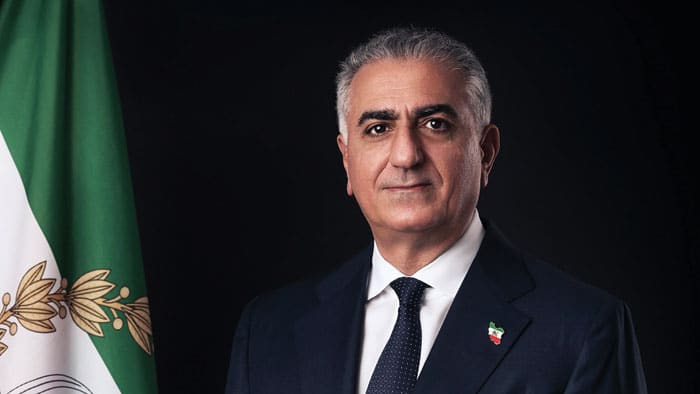
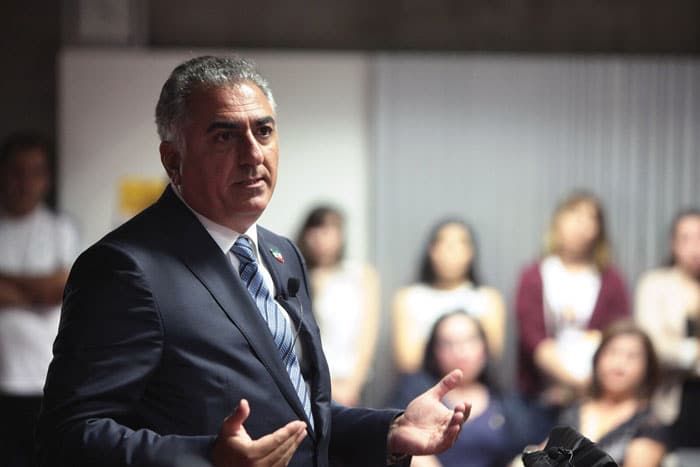
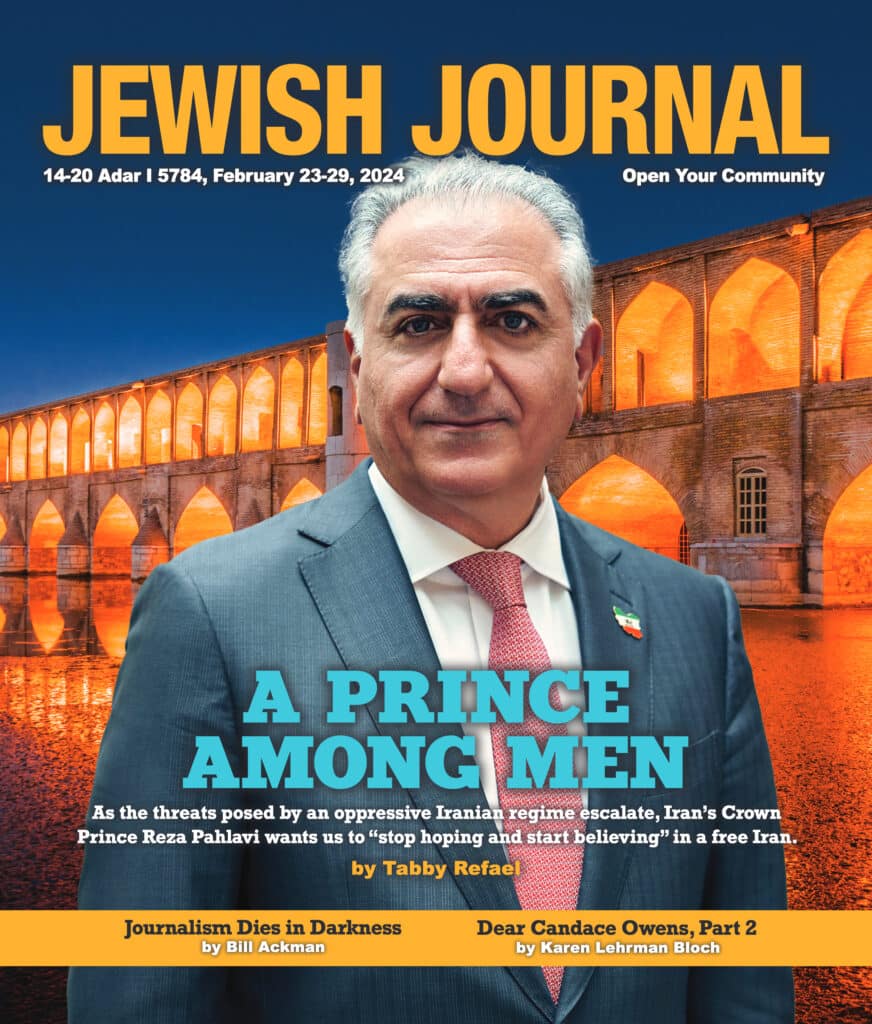
His Excellency Reza Pahlavi, the Crown Prince of Iran, shook my hand and awaited my questions in the sitting room at a suite in a West L.A.hotel, as guards stood watch at the door. His red, white and green lapel pin, in the shape of Iran, with the imperial emblem of a lion and a sun at its center, shone like a small jewel in an otherwise innocuous meeting space.
Dressed in a crisp, dark gray suit, everything about Pahlavi, from his subtle mannerisms to his stately posture and his tone of voice, evoke quiet regality and masculine grace. In a word, the man, whom millions still regard as best-suited to lead a free Iran, is princely.
I, on the other hand, reverted to a proverbial peasant as I realized that meeting Pahlavi completed a symbolic circle in my own story of escape from my former homeland. Speaking with the crown prince offered me a semblance of healing; the magic of Pahlavi is that he is recognized as a vital Iranian leader (albeit in exile), but is not a member of the brutal regime that has terrorized so many for over four decades. Pahlavi’s subtle habit of using phrases such as “my country” in referring to a state currently run by fanatic clerics endears millions of Iranians in the diaspora to remember that Iran is still, in many ways, our country as well.
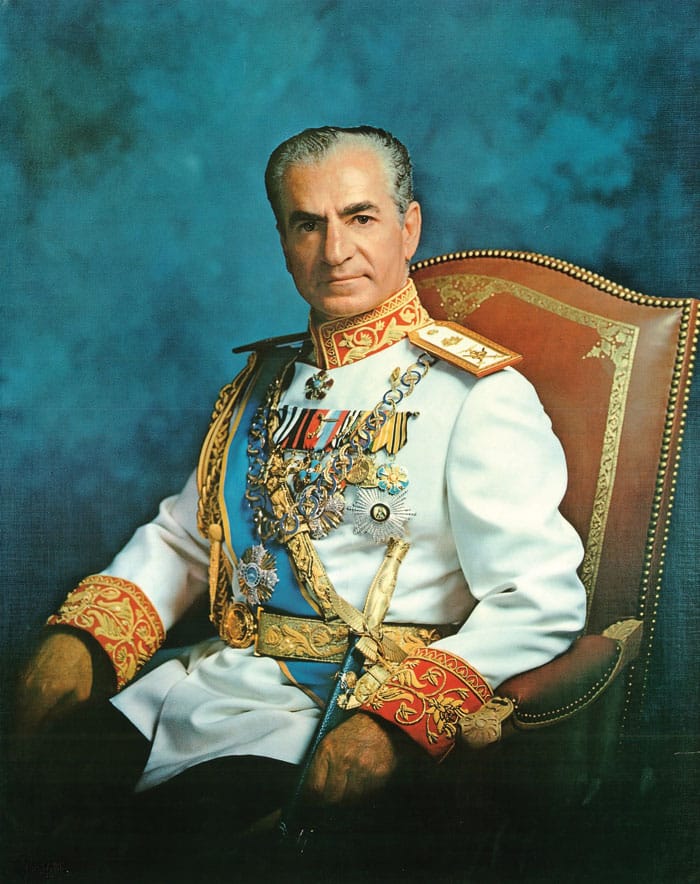
Shah Mohammad Reza Pahlavi, 1973 Ghazarians/Wikimedia Commons/Public Domain
And as our interview progressed, I realized that I carried the pride and pain of generations of family members with me to that well-secured hotel room. That may have explained why, at the conclusion of our interview, I informed Pahlavi that my “Nanechi,” a colloquial term of affection for my late paternal grandmother that loosely translates to “Little Mama,” would have been proud of me for having sat down with the crown prince. Pahlavi, in all his regal decorum, smiled endearingly; in his decades-long role as the exiled heir to the Iranian throne and the seeming savior of many who dream of a democratic and secular Iran, he has seen and heard it all.
There is a subtle surreality in meeting a man who is the grandson of the legendary Reza Shah (who reigned in Iran from 1925 to 1941), credited with modernizing Iran to the degree that he was often compared to Turkey’s Mustafa Kemal Atatürk, and would have been crowned king in Iran in 1980, after the death of his father, Mohammad Reza Pahlavi, had the Islamic revolution not swept Iran in the late 1970s. Yes, Pahlavi was destined to be king, though he has long maintained that a post-regime Iran should be a democracy, whether it will be a republic or a constitutional monarchy.
It is worth asking how many descendants of pivotal, 20th-century leaders in the Middle East are wholly active and committed to the betterment of their homelands today, particularly from exile. Turkey’s Atatürk left no biological descendants, and the descendants of Egypt’s Anwar Sadat, while still expressing support of his vision for Middle East peace as private citizens, have not and will not lead Egypt. And while powerful leaders who sought nothing close to regional peace or modernization, such as Syria’s late Hafez al-Assad, may have produced an heir who currently rules the country, it is hardly a secret that Bashar al-Assad has managed to wreak utter havoc upon his homeland. Among the descendants of former giants of the Middle East, Iran’s Pahlavi, who currently resides in Virginia, stands seemingly alone.
A LITTLE GIRL’S ENVY
I had seen photos of Pahlavi, his late father, Shah Mohammad Reza Pahlavi (known as the Shah of Iran), and his resplendent mother, Empress Farah. Long before I was born, my mother had affectionately cut out magazine clippings of the Iranian royal family — her king and queen — and saved them in a special album. After the Islamic Revolution of 1979 that ousted the Shah and his family and turned the country into an official Shiite theocracy run by an anti-Western and antisemitic cleric named Ayatollah Ruhollah Khomeini, the contents of that album became a liability. In the late 1980s, my mother begged me to not reveal to teachers and classmates that we were in possession of dozens of magazine clippings dating back to the late 1960s and 1970s featuring images of a bejeweled king and his stunning queen, who surely would have been executed had they remained in Iran after the revolution. Today, I realize that, as a teenager, my mother had excitedly searched for photos of the royal family the way teens worldwide pored over magazines in search of images of the Beatles.
Most little girls envy their mothers’ clothing and accessories, but as a six-year-old in post-revolutionary Iran, I envied neither my mother’s fabulous dresses, which she wore beneath her mandatory manteau (a long coat that, by law, had to cover her posterior), nor the heirloom necklaces that draped her elegant neck, which were always covered by her mandatory hijab (Islamic head covering). My compulsory hijab often matched my mother’s, though my head scarves also included fabrics laden with drawings of flowers.
No, I did not envy my mother’s dresses nor her jewelry; as a little girl in post-revolutionary Iran, I was plagued by relentless envy of my mother’s former governmental system. Why had my mother enjoyed a king, a queen and princes and princesses, but, having been born in the 1980s, I was subjected to the merciless power of an Islamist cleric who assumed the title of “Supreme Leader’” and who, along with his cronies, undid nearly all of the Shah’s historic efforts towards modernization? The Pahlavi dynasty was not without its fair share of criticism, but had it continued, Iran would have been on track to becoming the Japan of the Middle East; instead, it became the world’s leading state sponsor of terrorism, with an inflation rate of over 47% last year.
Screenshot from YouTube
TURNING BACK HOME
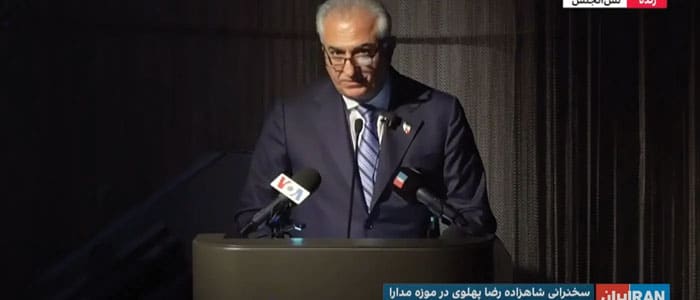
On January 30, the night before our interview was scheduled, Pahlavi delivered historic remarks at the Museum of Tolerance at the Simon Wiesenthal Center in West Los Angeles. The invite-only event, which was organized by George Haroonian, a tireless Iranian American Jewish activist and founder of notoantisemitism.org, which educates Persian-language readers worldwide about Iranian antisemitism, also featured a candid conversation with Rabbi Abraham Cooper, associate dean and director of Global Social Action Agenda for the Simon Wiesenthal Center.
As he entered the auditorium, the crown prince was greeted by exuberant shouts of “Javid Shah! Javid Shah!” (“Immortal King”). Some of the over 200 attendees, most of whom were Iranian Jews, told me that they still remembered the day when, in October 1960, Pahlavi was born and pre-revolutionary Iran erupted into celebrations as an heir to the throne was finally produced.
Seventeen-and-a-half years later, as an Imperial Iranian Air Force cadet, he would leave Iran to continue pilot training at an air force base in Texas. The following year, his entire world would change as the previously unimaginable unfolded: The Shah would leave the country; Iran’s military would be unable to quell a national revolution whose seeds had been planted by both the West and a Shiite cleric in exile and a powerful theocracy would soon arise in the Middle East. On Feb. 1, 1979, Ayatollah Khomeini reentered Iran after a fifteen-year exile and the Islamic Republic of Iran that we know today was born.
Exactly 45 years later, at a historic talk at the Museum of Tolerance, Pahlavi repeatedly condemned Western “appeasement” of the regime, but began his remarks by specifically addressing the Iranian Jewish community in the diaspora. “When you see all of the hatred, and it feels like you have nowhere to turn and no place to call home, remember that you are part of the Iranian nation,” he said. “We, your fellow compatriots, share with you this home.”
Comparing the human rights abuses Hamas’ captives have suffered to what the ayatollahs have unleashed against Iranian citizens, including violence against women, Pahlavi stated, “When it feels like you have nowhere to turn, you can always turn home. And know that for anyone who seeks to divide us, Iranian from Iranian, as a secular democratic nation, we shall never permit it.”
“Home” is a complicated term for both the crown prince and his family, as well as for the millions of Iranians in diaspora communities all over the world. Pahlavi knows as well as anyone that there is no returning home until the regime changes. Such a feat would not only free nearly 88 million Iranians, but usher in an extraordinary new era of peace in the Middle East, precisely because it would leave Hamas, Hezbollah, the Houthis in Yemen and other fanatic terrorists in the region without funding, training or support. Among anti-regime circles outside of Iran, a name has already been suggested for a future peace deal between Israel and a new Iran: the Cyrus Accords.
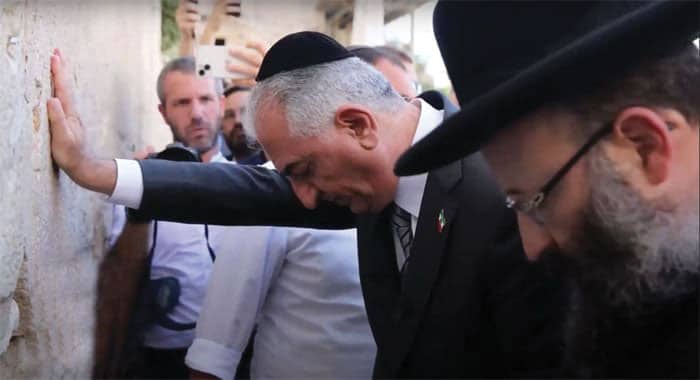
In April 2023, Pahlavi and his wife, Princess Yasmine, made a historic visit to Israel, arriving for the Jewish state’s official Yom Hashoah (Holocaust Remembrance Day) commemoration. Seemingly everywhere the royal couple went, the old, Iranian Imperial National Anthem was played, and the trip included many hugs and flowers from Israelis. After a visit to Yad Vashem Holocaust Remembrance Center and the Western Wall, Pahlavi coupled two of the world’s most enduring ancient communities — Jews and Persians — by invoking the name of the Zoroastrian founder of the Persian Empire. He tweeted, “2,500 years ago, Cyrus the Great liberated the Jewish people from captivity and helped them rebuild their Temple in Jerusalem. It is with profound awe that I visit the Western Wall of that Temple and pray for the day when the good people of Iran and Israel can renew our historic friendship.”
A SHARED FATE
Pahlavi and I sat down for an interview just days after three American troops were killed and over 30 injured in a drone attack by Iranian-backed militias, prompting even greater escalation between the United States and Iran in the wake of Iran-backed Houthi attacks against commercial vessels in the Red Sea. In early February, the U.S. responded to the attack in Jordan by conducting strikes on over 85 targets in Iraq and Syria that were linked to Iran. Weeks earlier, Iran had amped up its satellite and rocket programs by successfully launching the Soraya satellite with a three-stage rocket. The launch prompted worldwide concerns that the regime was testing whether it could outfit ballistic missiles with nuclear weapons, as part of the Iranian Revolutionary Guards Corps (IRCG) space program. Iran was also engaged in a series of tit-for-tat attacks against Pakistan.
But given that the regime helped Hamas plan and execute the Oct. 7 massacres, I began the interview with Pahlavi by discussing Israel. The following has been condensed and edited for clarity and space.
Jewish Journal: We know that there is a difference between hearing that another country is under attack, without having visited there and established a personal connection, versus having seen that country with our own eyes. How did your first-time visit to Israel last April personalize the tragedy of Oct. 7 for you?
Crown Prince Reza Pahlavi: Well, the first victims of this regime are Iranians, in terms of [the regime] immediately bringing in an element of despising and hatred, calling America “The Great Satan” and Israel “The Little Satan.” So the immediate consequences were that Iranians were the first hostages of this regime, and the Jews and Israelis have been the immediate follow-up victims. It puts us on the same road. So there’s a commonality of being hurt by it, which leads to the combination of the solution to it.
JJ: Can you elaborate on that solution?
“No countries are more tied, in their fates being sealed with one another, than Israel and Iran are right now.”
RP: No countries are more tied, in their fates being sealed with one another, than Israel and Iran are right now. Over 40 years of the Islamic Republic has proven time and again why the relationship is so vital in terms of strategic interests. What is important is not so far as the 21st century right now, and how we look at things in the modern era, but when you think about the biblical relationship and how unique that is. I don’t think there are any two countries on the planet that go back more than 25 centuries [as do Iranians and Jews].
At a time when half of the world wasn’t even on the map, that’s very important. Of course, you detect that. You sense how Iranians are in pain when they hear about the young [Israeli] women being first raped and then executed. You see, this massacre was based on complete hatred. And when you see these images, there is so much empathy. Of course, I was there [in Israel last April]. I talked to average people on the streets.
JJ: What messages did Israelis convey to you?
RP: I heard their sentiments and how they viewed a different world. Clearly, that affected me very much in the sense that now, we can understand the importance of standing up to the common enemy that we have, because as long as they are around, we will not see a moment of tranquility that’s conducive to peace. As long as they have warmongers sabotaging every aspect of bringing normalcy and cooperation, what do we expect? Iran knowingly supported the Oct. 7 massacre because they wanted to sabotage the Abraham Accords, but the regime is not the people. One of the reasons I wanted to go there [Israel] was to tell not just Israelis, not just Jews, but the whole world that we [Iranians], as the children of Cyrus the Great, have a completely different outlook about how the region can be, especially the relationship between my country and Israel, and what will be in the future. It is totally the opposite of what this regime has been trying to portray.
JJ: During your visit to Israel last April, you also met Rabbi Leo Dee, who lost his wife and two of his daughters, Maia and Rina, in a terrorist attack that same month. Can you tell readers about that interaction?
RP: There wasn’t much of a chance to have a discussion because we were there to offer our sympathies during a mourning ceremony. He was very much touched by my appearance because we were there, showing our sympathy for a victim and his family for such an atrocious attack, which was totally unjustifiable. But it humanizes the entire element, that beyond politics or the antagonism of this group or that group, on a human level, we’re all the same. It doesn’t matter what faith or what ethnicity we are. It was a human rights issue, first and foremost.
“We are neither in a war of civilizations nor a war of cultures; we are in a war of values.”
Of course, sometimes, tragedy occurs, but it only brings more importance to this value system. We are neither in a war of civilizations nor a war of cultures; we are in a war of values. Values such as human rights, liberty and non-discrimination of any form. That’s where we stand. As opposed to those who do discriminate against women, against ethnicities. That’s the contrast. That’s why Iranians have shown so much solidarity in recent months with Israel, more than ever before.
We need to make sure that those who claim they are supporting human rights or social justice align themselves on the right side of history. Here, you have a nation taken hostage by a regime for 45 years, and it’s not only repressed its own citizenry at home, but it’s brought violence and radicalism, and everything they do via their proxies in the region. So we are in this fight of values, what this regime stands for, and its sinister objectives, with those who share the same principles [as us]. We need to therefore be in solidarity, confronting this common enemy.
JJ: We know that many in Iran support freedom and view Israelis as their brethren, but how do you respond to Iranians who still consider Jews and Israelis as enemies?
RP: There are some who are committed to conflict; they are actually warmongers. When Jewish people say “L’Chaim,” what does that mean?
JJ: It means “To life.”
RP: And it means “we value life.” We value life. You look at Iranian poetry and culture, it’s also a celebration of life. But these people celebrate martyrdom. They actually encourage what we say in Farsi as “azah-daree” (“to be in mourning”). How much is that contrast, that negative darkness, of celebrating martyrdom as opposed to celebrating life?
JJ: The youngest person to have lived in a free Iran would be 45 years old today, old enough to have been an infant just before the 1979 revolution. Are you concerned that almost a half-century of regime propaganda and darkness have somehow created a wedge between the Iranian people and the history that you want them to embrace — the history of a time dating back to Persian civilization and Cyrus the Great?
RP: I remember a Turkish journalist who interviewed me a couple of decades ago who told me back then, “I think you Iranians are coming out at the other end of the tunnel. We [Turks] are just beginning to enter it,” in the sense of direct experimentation with a religious dictatorship, and the consequences of that. That was 20 years ago, when you did not have Instagram, TikTok or any of that. If you look at today’s Gen Z [in Iran] now, what’s happening is not so much what they remember from history, even though they are doing their own due diligence in research.
Even in modern days, when you look at where Iran was headed, it could have been by now the Japan of the Middle East; instead, it is the North Korea [of the region]. As I said last night [at the Museum of Tolerance], is it because we lacked resources or ingenuity and talent? It’s just a system that has been so poisonous and so negative.
We can realize our full potential yet again. But we are not doing this at all. There are Muslim countries that can come together, and we don’t need to look at it from the point of view of a zero-sum. It’s not that my gain is your loss. It should be a win-win approach. That mentality is beginning to instill itself.
JJ: Are such messages being conveyed to you by the people of Iran?
RP: In a lot of the DMs (direct messages) I get to my Instagram account, the younger generations keep saying that we have never witnessed that [older] Iran, but we have fallen in love with it. They have looked at the contrast; they see that sense of nationalism and patriotism that’s in the best interest of the nation, as opposed to the regime that lets people starve on the street. But the minute the regime gets more money, it spends it on the proxies that are going to attack Israel.
The generation of today, I think, is different from previous generations, because one thing that separates today’s Gen Z is that their predecessors, in the last 30 years, were trapped into the narrative of [former Iranian president Mohammad] Khatami and [former Iranian president Hassan] Rouhani and thought, “Let’s give reform a chance,” even though student leaders were being thrown off of the rooftops of dorms. And the world was fooled by the “reforms” as well.
“This generation isn’t buying into the narrative of giving reform a chance anymore. They are recognizing that their fate depends on this regime ending.”
Whereas today, people are beginning to point to the root cause of the problem being the [1979] revolution itself. That is a major shift and a revision of looking at the problem. This generation isn’t buying into the narrative of giving reform a chance anymore. They are recognizing that their fate depends on this regime ending. Common phrases I now see include “What did we give and what did we get in return?” [referring to ousting the Shah].
“The passage of time is like stepping away from a mountain. You cannot sense the magnitude of this mountain if you are at the foothills.”
The passage of time is like stepping away from a mountain. You cannot sense the magnitude of this mountain if you are at the foothills. But if you are 10 or 20 kilometers away, then you can see the whole mountain. Sometimes, it takes time for people to get a wider perspective of history. At the moment, they may not realize it. I speak with younger generations of Iranians in the diaspora, and if they know something [about pre-revolutionary Iran], it’s because their parents passed it on to them.
But the tools and data now exist that weren’t available to people before. In this modern age of communication, information and social media, we can no longer feign ignorance because it’s a matter of looking in the right direction. I’m optimistic about Iran’s future. I always say, “You can awaken those who are actually sleeping, but you cannot awaken those who pretend to be asleep.”
JJ: Last night, you repeatedly urged for the need to support the people of Iran, including assisting them financially if they engage in nationwide strikes against the regime. But we both know that this regime wants to stay in power, and has billions invested in maintaining that power and the infrastructure it has created for itself. The regime is not leaving without a fight. How do you maintain your belief that the regime can actually be removed by the will of the people, rather than by force or violence?
RP: Because I think that like any giant, there is, at some point, an Achilles’ heel. If you hit them somewhere that they have no remedy for, that’s where they lose. The first element in the strategy is to at least equal the playing field. That means if there’s a policy from a foreign government’s standpoint to address maximum support, including of course the private sector and the diaspora, you can increase the chances of success because you incentivize the people, because now they know that they have more means to challenge the regime.
“I never believed that the violent scenario of [regime] change is the ultimate solution, because you have to find a way to use means that justify the ends.”
I never believed that the violent scenario of [regime] change, by means of conflict and confrontation, is the ultimate solution, because you have to find a way to use means that justify the ends. I always had certain red lights that at least I am committed to.
I’ve been a student of Gene Sharp and the nonviolent civil disobedience movement, and I know people sometimes say that this regime is merciless. But I say, no. There has to be, at some point, a difference between us and them. Part of the reason you create the incentives for elements that may be right now in no man’s land, but they want out. I know there are members in the [Iranian] military and paramilitary forces that the bulk of them don’t believe in this system.
But they have to get their paycheck at the end of the day. You have to offer them an exit strategy. You have to be able to say that post-regime, they’re not going to be sent home; there’ll be a place for them. Sure, there are some who are really guilty in terms of the heinous crimes they have committed and they have to be answerable to Iran. There has to be some level of closure.
We need to understand that when we talk about regime change, that doesn’t mean that everyone in a post has to vacate it. I think that 80% of the existing bureaucracy will remain during the transition, because the country has to still operate.
JJ: What about the Iranian Revolutionary Guard Corps (IRGC), that is dangerously fanaticized, wealthy and powerful?
RP: I come from the viewpoint that you should not give them an excuse, in the sense that they will feel targeted, that they have no place to run; that they have to stand where they are, and justify even more repression, as opposed to “We are offering you a way out, side with the people, become their shield, come back to society.” I’m not naive, in the sense of thinking that they will all do that. But like everything else, you minimize the casualties.
We understand that in order to succeed, we have to overthrow this regime. But in the period of post-regime, you have to have a policy of national reconciliation and amnesty. That vicious cycle of “entegham” (“revenge”) is not part of my mentality. Rather than “entegham,” the best revenge is to be successful in our campaign, to actually bring in those values that were lost with this regime. To bring back equality. To bring back the family laws, the first laws that Khomeini eliminated, paving the way for the first victims of the regime to have been Iranian women.
Isn’t this the best way of proving ourselves right? But it’s based on reconciliation, on learning from our past. So we can respond to that Turkish journalist 20 years ago about where we are now.
You asked me about the Iranian people. When 9/11 happened, in most of the cities in the Middle East, half of the countries that were supposedly American allies were celebrating the al-Qaeda attack. The only [Muslim-majority] country where the people stood in candlelight vigil and sympathy were the Iranians. This is consistent with support that we see from Iran to the Israeli people, that is consistent with where the people [of Iran] stand, as opposed to the regime. The world needs to know that.
JJ: Did your late father offer you advice about statecraft and leading a nation?
Speaking at an event hosted by the Center for Political Thought & Leadership at Arizona State University in Tempe, Arizona. Photo by Gage Skidmore/ Creative Commons Attribution-Share Alike 2.0 Generic license.
RP: You’re not the only one asking this question. I’ve often been asked this question. The truth is that at the time I left Iran, I was only 17-and-a-half, I don’t recall ever having an opportunity to discuss that level of guideline with him. We never had those kinds of conversations. And right after my family left Iran and I regrouped with them, during our exile steps, his illness and state of mind was such that there was not so much of an opportunity to leave me with some kind of a roadmap. But I can tell you one thing: My father said, “The way that I had to operate was different from what my father [Reza Shah] did,” meaning my grandfather.
“My father said, ‘I am doing all this so that my son and his generation will inherit a different Iran, which will be very different from what I had to do in my timeframe.’”
My father said, “I am doing all this so that my son and his generation will inherit a different Iran, which will be very different from what I had to do in my timeframe.” So it’s not necessarily by having heard any advice, but by understanding that each era and circumstances requires its own way of seeing things. That’s a little bit the way I see myself generationally-speaking.
My grandfather took over at the time that Iran was in complete disarray. It was an underdeveloped country, run by the mullahs, we had no modern institutions of any kind. He had to bring in a centralized government, a modern army, you name it, just to begin to establish the status of a modern state. And as you know, he was very impressed by what Kemal Atatürk was doing next door in Turkey.
That was the pre-Second World War era. So my father stepped in right in the thick of it, towards the end of the war, and then, it became a matter of education, modernization, infrastructure-building and so on.
I think that my generation [had I led Iran] would have been challenged mostly by the following period: Now that we have the economic and development aspects of things, what about liberalization? We never came to that because we were going in that direction, but it was preempted by the revolution.
So where do we pick up where we left off? And in the meantime, what have we learned? And that’s not just me, Reza Pahlavi saying this. At my age, they call me “Father” now.
“Today’s Gen Z [in Iran] calls me ‘pedar [‘father’], which is very touching.”
Today’s Gen Z [in Iran] calls me “pedar” [“father”], which is very touching. But it also shows that at some point, you have to pass the torch to the next generation, and that’s the evolution of things. In that sense, I get much more direction from what the people want because no matter how you want to decide things or establish a viewpoint, the people have to stand to benefit from it. They have to buy into that vision.
And today, one thing that I have noticed is that most people say, “Now, we understand what he [the Shah] was trying to do. At the time, we didn’t.” So it’s important to make sure that from the get-go, people immediately understand what needs to be done, not 40 years later.
JJ: If you were afforded a chance to fly from Dulles Airport tomorrow and arrive in a free Iran, where would be the first destination that you would feel a personal obligation to visit?
RP: Clearly, it would be the most impoverished or afflicted areas of the country. The Baluchestan region is probably the first that comes to mind. Part of the reason for my trip to Israel was to talk about the water crisis. And as you know, water is one of the most important challenges that we face as a nation [in Iran]. We have to address it. There are areas in our country where the ground has been petrified. Even if you try to rehydrate it, you can’t, meaning that now, you have sand dunes that are beginning to engulf certain villages in that region, forcing relocation. Where would they go?
That’s why I’m bringing with me a whole host of experts. I would like to be able to do that, to tell the nation, “Listen, we are not only talking about motherhood and apple pie only. We can always talk about liberty, human rights and democracy. Of course, that goes without saying. But then, what’s our plan for recovery? What is the role of the diaspora? How many entrepreneurs can bring in new technologies and investments? What are the experts going to do about our environment? If we want to develop an industry of tourism, we cannot show them a whole bunch of dried-up lakes and polluted waters, can we?
How can legal experts talk about transitional justice right after the change of regime? How many economists are working with the short-term, first 100 days of the interim government and what needs to be done? It’s a whole package.
And whatever I end up doing, in terms of contributing to that, to bringing the cavalry to help, it’s understanding what challenges our country faces and bringing as many experts as we can to address these areas. It’s really a distribution of tasks; it’s not just one addressing the political element.
Most importantly, have the citizenry participated in that process, so they understand every aspect of that roadmap to recovery? I think that’s the difference of moving the needle from hope to belief. I want to tell them: It can be done. We have more than a critical mass to start. I really believe that.
Iran’s Crown Prince, Reza Pahlavi, during a speech at the Simon Wiesenthal Center’s Museum of Tolerance in Los Angeles on Jan. 30, 2024
Address by His Excellency Reza Pahlavi Museum of Tolerance, January 30, 2024
Ladies and gentlemen, good evening. I’d like to thank Chairman Cooper, the Simon Wiesenthal Center, No to Antisemitism, and the Museum of Tolerance for their invitation. I am glad to be back at the museum for this important conversation. Only days after International Holocaust Memorial Day, I am pleased to be here with leaders of the Jewish community and particularly our Iranian Jewish compatriots.
Just four months removed from the massacre of Oct. 7th, we need not be reminded of the continued bloodlust that, astoundingly, many still have for the Jewish people. But walking through these halls is a particularly stark reminder of the grave crime perpetrated by a diabolical regime that the West tried to appease. That appeasement came at the cost of six million Jewish lives, untold innocent civilians, and millions of young military personnel. Regrettably we see that in many circles, the appeasement of bloodthirsty tyrants continues on as a justifiable policy option.
As more innocent people continue to lose their lives to the forces of hatred, allow me to speak in particular to the Iranian Jewish community. For more than four decades, this regime has specifically targeted you, your leaders, and your community. That continues today.
I know you are feeling immense and indescribable pain. I know you have had friends and loved ones stolen from you. I know this pain because I, too, have lived similar personal loss and grief.
You’re looking for answers. You’re looking for solace. You’re looking for peace.
Tonight I am here to remind you that, while many in the world turn their backs on the victims of terrorism and on the Jewish people, the Iranian nation is turning towards you in embrace.
When you see posters with the names of hostages being torn down in cities around the world, remember that Iranians — just as they did after the Sept. 11th attacks — are demonstrating their sympathy and solidarity with the victims and hostages.
When you see the Star of David burned, remember that Iranians refuse to desecrate it and instead hold it high alongside our eternal Lion and Sun flag.
When you see the rape of female prisoners defined as “resistance,” remember that Iranians know the truth because they too suffered the very same fate in the Islamic Republic’s prisons.
When you see all of the hatred, and it feels like you have nowhere to turn and no place to call home, remember that you are part of the Iranian nation. We, your fellow compatriots, share with you this home.
When it feels like you have nowhere to turn, you can always turn home. And know that for anyone who seeks to divide us, Iranian from Iranian, as a secular democratic nation, we shall never permit it.
We extend this same welcome to our non-Iranian Jewish friends. Iranians stand with you in this dark moment. Because even though we don’t share the same nationality, we have a shared biblical history. We Iranians have not forgotten it.
In your rallies across the world, you have seen Iranians standing alongside you and even standing up for you, inspired by the legacy of Cyrus the Great.
Upon my return from Israel last year, speaking to the Anti-Defamation League, I said that just as Cyrus helped liberate the Jewish people from Babylon and aided them in rebuilding their temple, we Iranians, too, have a temple. But an evil, anti-Iranian regime has occupied it and has taken its people hostage.
Iran is our temple. And my friends, we are facing a common enemy.
Indeed, this evil regime is waging war on both of our great nations, Iran and Israel. And just like it did to the last diabolical regime the West tried to appease, this feckless policy is leading to more devastation and destruction across our region. From Hamas and Islamic Jihad in Gaza, to Hezbollah in Lebanon, to the Houthis in Yemen, to militias in Syria and Iraq, our entire region is paying the price for this policy of appeasement. From the refusal to enforce sanctions, to paying ransom for hostage-taking, this policy is not weakening the Islamic Republic, it is incentivizing and emboldening it.
By now it should be clear to all what has long been clear to Iranians: The Islamic Republic is the eye of the octopus controlling all of these tentacles.
Attempting to appease this Goliath is futile. After 40 years, the time has come to give David a chance.
My friends, the people of Iran are the Davids of our time and they are rising up, not only for their own sake but for that of the entire Middle East and the entire world. Despite more than four decades under this regime’s reign of terror, they are not backing down. Indeed, they are doubling down in their fight for their liberation.
The Islamic Republic must go and the liberation army is the millions of Iranians on the streets, paying for their freedom and for peace in the region with their lives. Let us ensure that if they are to make the ultimate sacrifice, they achieve their lofty goals. We can do that by supporting them in their battle, not by sitting on the sidelines.
In more than four decades, I have not sat on the sidelines waiting for miracles. And for many years, it was a lonely path, before today’s courageous Gen-Z on Iran’s streets were even born. But I knew the time would come — and now it has.
“I believe that, just as Iranians of all faiths lived peacefully alongside one another before the revolution, only to see their lives shattered and disrupted, once free we shall once again be a nation committed to respecting and upholding the fundamental freedoms and rights of all our citizens.”
I knew this time would come because I had more than hope — I had belief. Belief in our nation and belief in our people’s resolve. I believe that, just as Iranians of all faiths lived peacefully alongside one another before the revolution, only to see their lives shattered and disrupted, once free we shall once again be a nation committed to respecting and upholding the fundamental freedoms and rights of all our citizens.
In light of such readiness, the world, particularly those whose vital interests depend on fundamental change in Iran, must seize this moment and maximize our chance of success by giving us their full support. I count on you, members of the diaspora, and all friends of Iran, to join us in this campaign for liberation.
Thank you.
Tabby Refael is an award-winning writer, speaker and weekly columnist for The Jewish Journal of Greater Los Angeles. Follow her on X/Twitter and Instagram @TabbyRefael
This is a challenging time for the world. There is a multi-year war going on between Russia and Ukraine; an ideological war enveloping the border from Texas to California; and a seemingly never-ending war between Republicans and Democrats. However, nowhere is the impact of worldwide conflict more prevalent than within the Jewish community. Back in our homeland, there are battles raging between Israel and Hamas. Here in the United States, there is no escaping the cultural divides at American universities and on the streets of our cities and towns.It is a time when every Jew — no matter how religious or how secular — is really contemplating what it means to be Jewish.
So when I was selected as a delegate to go to Buenos Aires, Argentina to play tennis and represent my country in the Pan-American Maccabi Games — or the “Jewish Olympics” as it is known — I was a little bit wary about jumping in. On top of the challenges of flaring antisemitism, Argentina had recently elected Javier Milei, a political outsider who was planning to make some hard and unpopular choices in an aim to make the country more economically stable. Needless to say, I was not 100% sure this was the best time to play abroad in a Jewish event.
I do feel connected to the Jewish community, but here in West Los Angeles that community is completely integrated into the community at large. Yes, I did have a bat mitzvah, but no, I do not go to temple for services very often (if ever). And as far as the tennis part goes, I had some serious reservations about how well I would play, having never played tennis on red clay before (and I am hardly the best on hard courts at home). I was also facing a five-hour time difference, playing with a team I had never met, and playing against opponents who speak a totally different language. That said, my parents have always told me that you don’t always get to choose when your opportunities come to you but when they do, it is on you to make the most of them. So I went to Argentina. And I am so glad I did.
Buenos Aires has the largest Jewish population in South America, meaning I didn’t feel isolated or out of place, despite the language barriers I may have faced.
During my ten short days in the land of “La Albiceleste’” (the white and sky blue), I met other athletes like me. I had never been in a space with so many Jewish people before — 4,200 to be exact. I overheard girls talking about Hanukkah and my initial reaction was to say “Wait, you celebrate Hanukkah too?” In a time of such hardship and conflict for the Jewish people and Israel, it has never felt more important to represent my culture. Buenos Aires has the largest Jewish population in South America, meaning I didn’t feel isolated or out of place, despite the language barriers I may have faced (my very limited Spanish vocabulary got me nowhere). I was given the opportunity to compete against tennis players from all over the world, and while I may not have won a gold medal (but I did make the semifinals in doubles), I made lifelong friends and incredible memories I would not be able to even fathom had I not gone. Even better, I got to do it all during summer … in December!
While I did enjoy playing my favorite sport and meeting very interesting people, my favorite part was trading clothes with people from other countries. When an athlete first gets accepted to the games, they get a 16-pound duffel bag in the mail full of uniforms, hats, pins, and more. At the closing ceremonies, every country gathers together and trades with each other all of their own country’s gear. I traded all my pins for new ones: Australian koalas, Brazilian flags, Argentinian and Mexican flags, and so much more. I traded my USA pullover for an Australian quarter-zip, and my tennis tank topfor an Argentinian jersey. I was able to meet new people AND exchange uniforms.
I think it all really clicked when I had the opportunity to walk through an arena full of people to show off the USA. As I felt the bright lights and listened to the crowd cheering, it dawned on me that I could be a proud American, supporter of Israel, and Jew all at once. As an added bonus, at the end of this celebration we got to listen to the new president of Argentina speak. As mentioned, the country is in a state of transition — he had been in office for 15 days before I arrived. I found it so interesting to see such a transition, looking at the old architecture and history of such a culturally rich country, and inspired by the new developments that the president was planning to make in the days ahead.
It made me want to figure out how I could do the same for Israel, be a part of the next phase of the Jewish community, carrying our people into the future. While the trip didn’t inspire me to want to start going to weekly Shabbat services, it did inspire me to continue representing my country and my culture in a positive way. My way.
Parker Keston is a 16-year-old junior at Archer School for Girls.




 Sanford, who has been studying cuisine in the diaspora for more than 15 years, is author of “Braids: Recipes From My Pacific Northwest Jewish Kitchen.”

 This wasn’t the first time they had met; Vanessa traveled to the artist’s studio in Illinois when the statue was nearly completed. “She visited when the piece was about 95% finished, and we spent three hours together. She wanted to make some tweaks to the face and requested that he appear a bit slimmer, reminiscent of his younger self, so I made those adjustments.” Rotblatt-Amrany incorporated the tattoo on Kobe’s front arm featuring the names of Kobe and Vanessa’s four daughters, while Vanessa’s name adorned the back of his arm.