fbpx

February 22, 2024

The Jewish Story Doesn’t Fit on a Smartphone: We Must Reclaim It

Antisemitism is everywhere. Jewish communities are targeted. Israel is “villainous.”

 The prevailing winds of the world appear to be against us. It seems impossible to open the newspaper without reading about another tragedy in Israel or a burgeoning threat to the Diasporic Jewish community. 

 There are many ways to combat these in the public square. But how? And, what exactly can we do? For ourselves, for our children, for our children’s children? There is but one answer. We must educate ourselves and our children. We must reinforce the next generation’s Judaism. Bolster their heritage. Deepen their faith. And solidify their trust, knowledge, and confidence in who we are as a people.

We must write our story. Because if we don’t, others will continue to write it for us.

Children, teenagers, and even college students are learning a “Judaism” and an Israel that only exists on smartphone screens.

 But our story does not fit on a screen, our history is not 75 years old. Our story is millennia. Our children deserve the wisdom and teachings of their grandparents. And the resilience of collective Jewish ancestors. 

Only when our children are filled with the knowledge, conviction, and poise to push against narratives that don’t hold water, will we be able to breathe easy.

What do Jewish teenagers learn about our history in public and secular independent schools across the country? That Israel is to blame for Oct. 7. Or that Israel doesn’t even exist. And even with the best of intentions, they’ll learn about tragedy, the Holocaust, pogroms, and oppression. These are events worth learning, no doubt. But is that all there is to learn about the Jewish people? With this as the sole story of Judaism, it’s no wonder that young Jewish Americans often have a distorted view, not only of Israel, but also of Judaism. We’re greater than our oppression, we cannot frame our story through the lens of victimhood, and it’s time to reimagine the impact of the story we tell about ourselves. 

In the same way that Zionist founders created a new version of the “Hebrew Man” and a modern Hebrew language, we need a new version of the educated “Jew.”

We are a diverse people. We are a people born of tragedy, as well as triumph. In this age, when it seems that everywhere we look, others are working to define who we are, who we aren’t, what Israel is, what it isn’t … our children must be prepared and confident in their own Judaism. In their own Zionism. In the objective history of the Jewish people. Only then will the loud, critical voices dissipate and disappear. 

Judaism is family. And it’s tradition. And it’s religion and culture.  And it’s pride, happiness, and a love of life.  And it’s generosity, and justice, and strength, and peace, and autonomy. We are a people of the word “and.”

The pressures facing the next generation of American Jews are not new. Assimilation. Secularization. Intermarriage. Politics. For decades, rabbis and Jewish leaders have warned that “this will be the last Jewish generation in America.” While this warning has proved, at this point, to be feckless, our goals should be grander. Our vision bolder.

We must think about what we want the next generation of Jews in America to look like, to know, and to value.

We must think about what we want the next generation of Jews in America to look like, to know, and to value. How they should be prepared, equipped with Jewish wisdom, learned in our history, steeped in custom, and comfortable in ritual. 

The tides are against us. Social media, disinformation, the 24-hour news cycle, domineering political trends, and peer pressure on Israel all pose threats to young Jews in America. 

So, what does a robust Jewish education look like?

It tells our story.

At de Toledo High School, we validate the merits of tradition in a modern world. The ever-present internal struggle between tradition and progress is a defining element of Judaism. Within religion and culture, our people have grappled with this paradox for centuries. We must grapple with it once again. We’ve ceded too much for the sake of modern expedience and acceptance. It’s not that we can’t change. It’s that there’s an inherent and vital value to the way we’ve done things for centuries. The world moves faster than ever. And without our feet on the ground and roots deep into the earth, we feel unmoored. The next generation deserves a binding element to their lives. A Jewish education creates that security.

It builds community.

We live in an era of social atomization. Smartphones, news feeds, algorithms, emails, and text messages. We have more ways to communicate than ever before. Yet we’re also lonelier than we’ve ever been. This paradox of choice comes at a cost. It impedes the power of intimate conversation — with a parent, a friend, a teacher, a rabbi, a mentor. A Jewish education and a Jewish life provide the infrastructure to solve this epidemic of loneliness. Do we regularly invite friends for Shabbat? Do we offer strangers a seat at our Seder table? Are we personally grappling with the world’s challenges … or do we merely post our thoughts into the algorithmic abyss? Our tradition offers myriad ways of connecting and creating community. Is the next generation being given the tools to see the depth and breadth of our communities? A firm footing in Jewish community will help guide the next generation. Its connectivity and its timelessness help mitigate the pressures to live lives “online” instead of in-person. 

It imparts our forebears values, wisdom, and insight on navigating adversity.

We should not be naïve. Since Oct. 7, the challenge for American Jews has never been clearer. We are no longer on solid footing in America. Despite the magnitude of this challenge, the opportunity is great. Jewish wisdom, deeply rooted in centuries of tradition, provides a compass for navigating this tumultuous sea change. In a world where values feel transient, the teachings of Judaism offer a stabilizing force, grounding individuals in principles that have withstood the test of time. By preserving and passing down this wisdom, we ensure the continued impact of a legacy that has shaped ethical minds and compassionate hearts for generations.

At the core of Jewish wisdom lies a commitment to compassion, tolerance and understanding. In a world marked by division, the teachings of Judaism emphasize the inherent dignity of every individual. By embracing these values, we foster an environment where diverse perspectives are not only acknowledged but celebrated. Jewish wisdom encourages dialogue, learning, and a genuine appreciation for the richness that diversity brings to our collective human experience.

Throughout history, the Jewish people have faced adversity with remarkable resilience. This resilience is not solely a product of circumstance but is deeply rooted in the wisdom derived from centuries of overcoming challenges. By tapping into this reservoir of fortitude and teaching it to our children, we can find inspiration and strength and foster a spirit of resilience that transcends our modern world.


 Mark Shpall is Head of School of de Toledo High school.

The Jewish Story Doesn’t Fit on a Smartphone: We Must Reclaim It Read More »

From Loneliness to Fulfillment

It was a humid Saturday night in New York City in August of 2010. My new boyfriend, Daniel, was on a month-long comedy tour of South Africa, and I was walking to the subway after hanging out with my friend in Midwood, Brooklyn. Though she lived in a religious Jewish neighborhood, she was a secular Jew, so we spent the day shopping and eating sushi.

As I was heading home, I felt depressed and lonely – like the city was caving in on me, like I was lost. I liked seeing my friend, but the fun didn’t last after we said goodbye. I thought about how I wouldn’t be able to sleep that night, how I wanted so badly for Daniel to come home already.

And then, I passed an Orthodox Jewish man with a long beard and a black hat walking down the street. He was holding pizza boxes, and smiled as his four little children giggled and ran around him. 

“What a nice way to spend a Saturday night,” I thought. 

I hoped that one day, I could have something like that: spending time with my own children, eating pizza and having fun with them on a Saturday night. 

I hadn’t yet begun my conversion process, but I knew that prioritizing my family would be a key part of my life if I were to become an Orthodox Jew. 

Growing up, I didn’t have that strong family life at home. My mom and dad got divorced when I was five years old. After they split up, my mom became a nurse and often had to work 16-hour shifts, which meant that I’d be home with a babysitter on Saturday nights. When I got older, I spent Saturday nights by myself, watching movies and eating a large pizza all on my own. I’d try to fill the loneliness in my soul with food. I’d feel good for about ten minutes, and then more depressed than ever once I realized it didn’t work.

This pattern continued into my college years, when my roommates would go home on the weekend and I’d be alone in my apartment, eating pizza and watching whatever was on TV, wishing I had someone to hang out with. Those moments were the hardest, the ones where I couldn’t easily distract myself, where I’d contemplate what I was doing with my life and the meaning of it and why I was put on this earth. 

There had to be more to life than this, I thought.

When I started going to my local Chabad with Daniel for Friday night dinner and learning about Judaism, I suddenly found that purpose. I was here for a reason. I had a special mission to carry out, which was to do good in the world and follow in the ways of Hashem and the Torah. 

A real game changer for me was keeping Shabbat. In the past, I spent Saturdays listless, going to the grocery store or wandering around New York City until I got lost or just feeling bored because I had so much free time and no idea what to do with myself.

Shabbat gave me a much-needed break from technology and precious time with other people, where I could build real connections and feel fulfilled. I could hand my worries over to Hashem on this day and relinquish control for once.

Shabbat gave me a much-needed break from technology and precious time with other people, where I could build real connections and feel fulfilled. I could hand my worries over to Hashem on this day and relinquish control for once. I could just be.

That good feeling from Shabbat carried over into Saturday night and the entire week. It centered me.

This past week, I reflected on my journey over the past 14 years. It was a Saturday night, and I was at the local kosher pizza shop, picking up a pizza for my daughters, my husband and me. I realized: I had manifested my dream. 

As we sat around eating pizza and watching “Mary Poppins,” I thanked Hashem for this tremendous blessing. I was no longer lonely, no longer searching.

Instead, I felt happy, I felt satisfied and I felt fulfilled. 

Baruch Hashem.

What gives your life purpose and meaning? Email me: Kylieol@JewishJournal.com.


Kylie Ora Lobell is the Community Editor of the Jewish Journal.

From Loneliness to Fulfillment Read More »

I’ll Be Out in an Hour

A very prominent Rabbi who loves ice cubes found it hard to justify the extra money to get a fridge with a built-in ice cube maker when his old fridge went kerplunk. To him, it seemed like an extravagance. After phoning the head Rabbi of Antarctica, the Antarctica Rabbi ruled that he should get the ice cube maker. The Rabbi said the built-in would also help to keep Shalom Bayit (peace in the marriage). He said he knew of a couple where the husband kept forgetting to fill the ice tray and she divorced him. Two months later, the Antarctica Rabbi became lunch for a local walrus when he entered the ocean for his daily mikvah. 

We are blessed to live in an age where the purchase of an occasional extravagance can make our lives so much more pleasant. 

When Abraham Lincoln was growing up, if at night he needed to go potty, even if it was 10 below zero, he had to make the trek 50 or so feet outdoors to the outhouse. The outhouse was the size of a box a new refrigerator comes in. Back then, going out at night meant taking your life in your hands. The woods were teaming with grizzlies, mountain lions and snakes, to name a few. Lincoln lived at a time when, even if you had money, there were few excesses to purchase to make your life more bearable. 

I am not a big excess guy. But occasionally, I will get the urge to go wild. Thirty years ago, I had a steam room put into my home bathroom and installed one in every house I’ve since lived in. I still use it practically every day. 

My recent new purchase is my second big bathroom extravagance. To be transparent, I need to tell you that I did not first consult a rabbi before placing this order.

I have two friends who recently installed a Toto Washlet Electric Toilet in their homes. These are rich people who can afford to flush money down the toilet. Hearing their praises of the Toto, I knew I had to get one. 

The Toto is life-changing. It is the Dom Perignon Rose Gold Methuselah of toilets. Your timeworn ice-cold plastic/wood/porcelain seat is now an artifact compared to this baby. Finally the word “restroom” makes sense. This turns your everyday bodily function into a mini vacation to the Caribbean. Sitting on this thing is like flying first class. It’s my new office.

I don’t have time to go into all its functions because I must get back there and finish reading Ulysses, which I started this morning. I would have finished all 772 pages in one sitting, but I am an unhurried reader.  But here are a few:

The seat warmer has three functions. They are low, medium, and burnt toast. When people over at my house come out of my bathroom after a session, they smile like they just hit the lottery. And they love sharing their experience.

There is the warm water bidet function that you can choose between oscillating or pulsating modes adjustable in five different positions. Importantly it would help if you remembered to turn the bidet off; otherwise, it’s like the fountain outside The Bellagio in Las Vegas. 

My favorite is the fan that dries you by blowing warm air. Need I say more without crossing the line?

I’m being honest when I tell you that you never want to leave this thing. If Jewish scholars of the third and sixth centuries CE had the Toto, there would be no Talmud.

One function I chose not to include is the automatic lid that goes up and down when you enter the bathroom. Who am I, King Salman of Saudi Arabia that I need the thing to bow to me?  

One function I chose not to include is the automatic lid that goes up and down when you enter the bathroom. Who am I, King Salman of Saudi Arabia that I need the thing to bow to me?  Although in some circles, it is called a throne.

This is as close to going back to the womb as possible. The water heater can reach temperatures ranging from 86 to 104 degrees. Perhaps one day if it’s meant to be, Toto will attach an icemaker, so a person doesn’t have to keep running into the kitchen for more ice cubes.  If you ring my doorbell and I don’t answer, you will know exactly where I am.


Mark Schiff is a comedian, actor and writer, and host of the ‘You Don’t Know Schiff’ podcast. His new book is “Why Not? Lessons on Comedy, Courage and Chutzpah.”

I’ll Be Out in an Hour Read More »

The Power of Pink— Cherry Tomato Tartlets

Last Thursday morning, at Trader Joe’s on La Cienega, I was being my usual ridiculous self. I had two carts — one for Shabbat food for my home and one for a grazing table for the Sephardic Spice Girls Sharsheret Pink Challah Bake at Kahal Joseph Congregation. As I was crisscrossing the aisles, checking the shopping list Rachel had made for me and going over the mental check list in my very porous brain, I saw a beautiful blonde lady following me with her eyes. After crossing paths several times, she came up to me and said “Are you the Rabbi’s sister?” 

Yes, I answered. “I’m coming to your event tonight,” she said. Then a cloud came over her face. “My sister Eti was a breast cancer survivor for four decades. Then it came back. She had just celebrated her 70th birthday. And now I am in the Shloshim for her.” 

We both started crying. I always cry when other people cry. And two perfect strangers hugged each other in front of the leftover Valentines Day display on a bright, sunny February day. 

Unfortunately, this Pink Challah Bake already felt really significant to me. I have too many young friends who have battled this disease. I have too many friends whose mothers are battling this disease, right now. And too many friends who have lost their mothers to breast and ovarian cancer. 

Sharsheret is a cause dear to our hearts and Rachel and I have had the honor of partnering with Sharsheret over the years, from doing a healthy cooking demo for Sharsheret in the Kitchen to running a pink hamantaschen bake, buying their Thanksgiving pies, hosting a Just the Girls cancer awareness talk at Beth Jacob and participating in their big annual fundraiser the Sharsheret West Coast Dash, a 5K, 10K and a Family Fun Race.

How can we not support an organization that helps raise awareness for a disease that disproportionately affects our community?

How can we not support an organization that helps raise awareness for a disease that disproportionately affects our community?

Jessica Jablon, our friend from Sharsheret, spoke about all the services that this national non-profit organization provides to Jewish and non-Jewish people facing breast and ovarian cancer. Including genetic counseling, mental health care, emotional support, peer support and financial subsidies. It’s a long list of services, all of them crucial. 

Fellow Shalhevet parent and renowned oncologist Dr. Noam Drazin spoke about the higher incidence of the BRCA gene mutation in the Jewish community and how it puts our population at increased risk for breast and ovarian cancers, prostate cancer and melanoma. He generously answered all the questions of his curious audience. The key takeaway from his litany of statistics and the risks was his message of hope — early detection is key to better outcome and survival. 

Our group of bakers came together to say Tehillim for the i’lui neshama of Suzie’s beloved sister, as well as the safety of the soldiers of Tzahal and the release of the hostages. Suzie, Rachel and I hugged again. Hopefully, we healed a tiny bit of her pain. 

—Sharon 

I always get a little nervous when Sharon and I do these live events. It’s a lot of work to set up and invariably, we always forget one thing or another. Luckily, we have amazing volunteers (a shout-out to Rafi, Maurice and Penina!) who make sure everything is perfect. 

In the past, we have worked with super-talented Chef Tomer of MBT Events at OBKLA (he even catered the bar mitzvah of Sharon’s nephew Erez at Seventh Place). He graciously offered to help us with this event. Tomer showed up with trays of food that he generously donated — mouthwatering crispy fried beef rolls with an Asian dipping sauce, cherry tomato tartlets and irresistibly cute, brightly colored sprinkle cake pops wrapped in plastic with a pretty gold bow. He helped us arrange the perfect graze table. And he even scooped out the seven cups of flour for each of our bakers. Follow him on Instagram @madebytomer. 

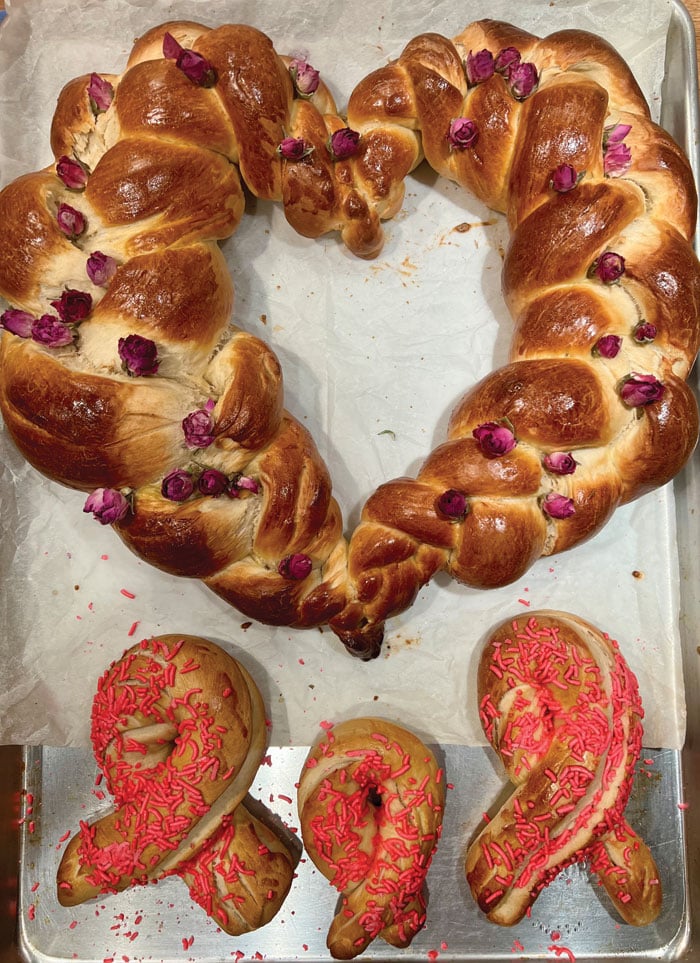
Baking challah is something I love to do. I love to be creative with my dough and to think of new designs that have special meaning. For this Pink Bake, I braided a big, beautiful heart challah and decorated it with pretty little dried pink roses. I sprinkled pink sugar crystals on “pink ribbon” challahs. And I made a huge batch of dough, so that we could say the bracha of hafrashat challah. There was such tremendous love and energy in the room when Rabbanit Bracha Halevy (Sharon’s sister-in-law) recited the bracha for cxhallah and the Tehillim. 

This week we share Chef Tomer’s bright, cheery recipe for Cherry Tomato Tartlets. The acidic pop of the cherry tomatoes contrasts deliciously with the herby umami of the almond basil pesto. Nothing compares to flaky, crispy puff pastry. This dish just feels celebratory. 

It is always wonderful to be with our friends and to meet new people at our classes. It is a valuable reminder that sharing joy doubles our happiness. 

With our prayers for good health and an urgent reminder to show yourself some love and schedule that mammogram. 

—Rachel 

Cherry Tomato Tartlets

1 package frozen puff pastry squares, defrosted
Filling
1/4 cup extra virgin olive oil
1 medium onion, finely diced
Salt and pepper, to taste
10 oz cherry tomatoes, halved
1 egg, beaten

Preheat oven to 350°F.
In a medium skillet, warm oil over medium heat. Add onions, salt and pepper, then sauté until slightly golden, about 5 minutes.
Place puff pastry squares on a floured work surface.
Cut out an L shape along one side, then cut an L shape on the opposite corner. Then place one over the other to crisscross, so that the twist is formed.
Place sautéed onions in the center of the pastry twist. Then add the tomatoes.
Lightly brush sides with egg wash.
Place on a parchment lined baking sheet and bake for 25 minutes until golden in color.
Drizzle with almond pesto and balsamic glaze.
Garnish with fresh pomegranate.

Almond Pesto
1/2 cup extra virgin olive oil
3 bunches fresh basil
1 cup roasted almonds
4 cloves garlic
Salt and pepper

Place all the ingredients in food processor and blend until the paste has a thick consistency.
Note: fresh pesto can be stored in the refrigerator in a tightly sealed glass jar for up to one month.


Rachel Sheff and Sharon Gomperts have been friends since high school. They love cooking and sharing recipes. They have collaborated on Sephardic Educational Center projects and community cooking classes. Follow them on Instagram @sephardicspicegirls and on Facebook at Sephardic Spice SEC Food.

The Power of Pink— Cherry Tomato Tartlets Read More »

Rabbis of LA | Rabbi Abraham Lieberman: Finding a Home as a Teacher

When Rabbi Abraham Lieberman entered Brooklyn College, he knew he was sure of his goal: He was going to be a psychiatrist. Informed this would require 16 years of schooling, he immediately said, “No way.” A friend suggested, ““Do the next best thing. Be a psychologist.”“ That idea resonated with Lieberman, but “for a whole bunch of reasons, I was disappointed.” 

While he was figuring out his next career move, a friend who was teaching at a Jewish day school on Long Island was planning a brief trip to Israel. He asked Lieberman to sub for him while he was gone. “My friend said he would be gone for a few weeks,” Lieberman said. “He said the school told him if he found a sub, he’d get his job back when he returned. If not, there would be a job opening.” That he had never taught before wouldn’t be a problem. 

Once inside the classroom though, Lieberman found an immediate home. “That experience changed everything,” he said. He immediately forgot about psychology and decided he was going to be a teacher.

“When they get it, the light bulb comes through the eyes.  … I thought, this is what I want to do. So this is what I did.” 

Decades later, Rabbi Lieberman’s achievements stand nearly as tall as his multi-story, 13,000-volume Jewish library. It is a monument to his lifetime of teaching Torah to teenagers and, time permitting, engaging in research by plunging centuries deep into Jewish history. What about the classroom that caught the rabbi’s attention? What drew him was “the sparkle in the eyes of the students who realized how wonderful Torah could be,” he said. “This experience spoke to me. I said ‘Wow! This is good stuff.’” Telling the story, Lieberman’s face lit up, the memory still sparking joy. “The sparkle in the students made an impression,” he said. “They got it. I knew they got it. I was like, whoa! When they get it, the light bulb comes through the eyes. They have it.” From that point on, there was no doubt in his mind. “I thought, this is what I want to do. So this is what I did.”

He has never regretted his career decision, he said. In fact, Lieberman sees a “total link” between teaching and psychology. “You are engaging with people, and you do listen and hear what they are dealing with, the empathy of what students are going through. I guess the reason I wanted to do psychology was because I wanted to be around people. It really works.” Widely regarded as an expert on Jewish history, Rabbi Lieberman led two girls’ Jewish high schools – including YULA – before joining the Shalhevet faculty in 2017. He has invested most of his professional life teaching young women. “Teaching young women has been a privilege,” he said. Had his friends’ views prevailed, it might not have turned out this way. When Lieberman started teaching girls, some of them turned up their noses. “They said ‘Teaching girls? Don’t you want to…?’ I answered ‘No, let’s try this out.’”

He loved it. “Teaching girls was an eye-opener because I never – coming from an all-boys school, only having a brother and not sisters … Suddenly seeing how young women think, and their much earlier maturity in life” took the young rabbi by surprise. Speaking frankly, he said, “young women mature much earlier. The ninth-grade young woman tends to have more depth than a boy who is still trying to figure it out at that stage. The boys come to it a little later.”

What would God’s explanation for that be? The rabbi turned to a quote from the Talmud: “More understanding was given to women than to men.” He said it can be called women’s intuition. “They are much more practical,” Lieberman said. “They are more likely to see a problem for what it is – without veering off into different thoughts.” Asked if he teaches boys and girls any differently, the rabbi said he does not see a difference … except for, perhaps, one. Teaching girls, he said, requires “a drop more of practicality.” By way of explanation, he said “if a boy asks a question, depending on his background, I start saying ‘Well, in Rashi, one opinion says this and one opinion says that.’” But girls, he said, “understand that I am generalizing. They will say, ‘I understand there are disagreements, but, practically, what do I need to do?’ “The girls will say, ‘This rabbi said … That rabbi said … But give it to me straight.’”

When asked how much has changed in learning by boys or girls over the decades, he insisted “the environment around us changes tremendously,” but the human spirit never changes. It stays. I think from the beginning of time, from Adam and Eve. We still have egos. We still are jealous. We still deal with developing character, trying to be a better person. That never changes.”

Given the sweeping changes across American society – and the world – throughout his career, Lieberman theorizes that girls and boys have been equally affected. One example, he said is “the advent of technology. A cell phone has become the greatest gift we have,” the rabbi said. “I can access music, Torah learning. It’s at my fingertips. Yet it also can be a most destructive instrument because I can ruin someone’s life in a second by spreading what they call fake news.“ One of the greatest life challenges for the teenagers he’s currently teaching is, “How do they engage in a good, proper way and not waste time by using it in a negative way? While the texts have remained constant, the question is, how do you take that text and put it both in their hearts and in their minds?’” 

Fast Takes with Rabbi Lieberman

Jewish Journal: What Torah figure do you most admire?

Rabbi Lieberman: One is the Jewish philosopher Philo and then the son of Maimonides, Avraham ben ha-Rambam, a physician who led the Jewish community of Egypt. Oh, the empathy he had for his patients.

J.J.: What do you do to relax?

Rabbi Lieberman: (Gazing at the volumes high above him) Any one of these books.

J.J. Your favorite Jewish food?

Rabbi Lieberman: There’s nothing like it. My wife’s overnight potato kugel.

Rabbis of LA | Rabbi Abraham Lieberman: Finding a Home as a Teacher Read More »

Table for Five: Tetzaveh

One verse, five voices. Edited by Nina Litvak and Salvador Litvak, the Accidental Talmudist

Next you shall instruct all who are skillful, whom I have endowed with the gift of skill, to make Aaron’s vestments, for consecrating him to serve Me as priest.

– Ex. 28:3


Miriam Mill-Kreisman
President, The Tzaddik Foundation

What an incredibly profound parsha!

In a single sentence, the essence of our existence is encapsulated, revealing the profound connection between all that we possess and the divine source — Hashem. This revelation carries a deeply humbling message. We know of great biblical figures such as Moshe, Aaron, Yosef, Betzalel, and Daniel, who credit Hashem with the abilities that spiraled them to greatness. This parsha extends this concept to every individual, regardless of whether their names are etched in history. It beckons everyone to recognize that their unique talents are divine gifts, bestowed upon them by Hashem’s benevolence. 

The desire for recognition is universal. For once I would just love to hear the contemporary icons of success, be they Grammy, Emmy, or Super Bowl superstars, express gratitude to G-d for their extraordinary talents as the norm and not the exception. Imagine a world where acknowledgment of Divine endowment precedes accolades and where these talents are channeled toward serving Hashem. This parsha, in essence, becomes the quintessential mission statement for every Jew, asserting that each person is blessed with unique gifts to use to illuminate the world, infusing it with the light of life by the teachings of the Torah — the guide to a meaningful and purposeful existence. It emphasizes the responsibility we all share in contributing to the greater luminosity within our individual spheres, thus fulfilling the divine purpose set forth by Hashem.


Abe Mezrich
Author, “Words for a Dazzling Firmament”/ abemezrich.substack.com

Now the skillful and gifted, and not anyone else, will tailor the vestments in which Aaron will serve. This is after everyone — all the wide masses — are called to donate the materials for those vestments, the colored threads and dazzling jewels. 

The masses will keep donating even after the skilled artisans are well underway, and nobody needs materials anymore, and the artisans and Moses will ask everyone to stop giving. Later Moses will erect the Mishkan, but at the moment that God’s Glory descends, Moses will not be able to enter. And Aaron and his sons will wear the vestments to serve in the Mishkan where even the artisans will not be allowed to go. 

Nobody can inhabit the world they’ve made. 

Of course this is a tragic story. But can’t it also be a beautiful one? Beautiful the way parenting is beautiful, and the way certain kinds of progress can be beautiful. We can’t inhabit the world we’ve made because we’ve succeeded, because we’ve elevated the world so much, because we’ve given to a world that’s now holy and amazing beyond our wildest dreams.


Rabbi Chaim Tureff
Rav Beit Sefer at Pressman Academy and author of “Recovery in the Torah”

Anyone bound for greatness has a list of people along the way who helped get them where they are. Prominence does not happen overnight. One does not become a world leader, surgeon, star athlete, or a top-notch educator by oneself. Even Moses, the greatest prophet of all time, had Miriam, Yocheved, Yitro and others that helped him along the way. 

The commentaries note that those who made the priestly garments needed to have spiritual awareness of what they were doing. Meaning if they didn’t, Aaron’s garments would have been unfit for use and unable to facilitate his service as the Kohen Gadol. Each step along the way towards greatness has someone that helps move the person forward. 

As an educator, I have taught over 1,000 students. For those that become successful, I, along with a slew of educators, role models, and family members play a role. I think that the Torah is teaching us a lesson in this parsha about Hakarat Ha’Tov (gratitude). Many people who become successful forget how they got to where they are. They feel that their hard work and talents are self-sustained. They obviously play an important role, but it is not a solo act. One who has gratitude not only demonstrates a holy attribute, but scientific studies show that people who practice gratitude have more optimism, positive emotions, better health, fewer aches and pains and experience positive lasting effects on the brain.


Rabbi Scott N. Bolton
Congregation Or Zarua, New York, NY 

Wardrobe check: The Israeli Defense Forces’ uniforms, medical professionals’ and disaster recovery and emergency specialists’ gear, and l’tza’areinu, to our sorrow, burial shrouds ready. There are no splashy or flashy adornments on army uniforms in use just now. Nobody is peacocking on the battlefield. There are no precious stones, but there are Hebrew letters like those that were written along the tzitz, the special headwear of the Kohen HaGadol. Even though the writing is the acronym tzaddik/hey/lamed, TZAHAL, Tzava Hagana L’Yisrael [Israeli Defense Forces] the Hebrew letters shine forth the same message that was on the Koheinic headgear: Kodesh L’Hashem, holy to God — and to us. 

Today people of skill are making the protective vests, uniforms and helmets for our soldiers, rescue workers, medical professionals and nation-builders. As I write from New York during a fashion week that saw the triumphant return of couture clothing and garments printed by 3D machines, I cannot help but contrast the simple shrouds too many of which have had to be used since Oct. 7. Rabban Gamliel of the Second Temple era saw how we were burdened by runaway spending on burials. He asked to be buried in simple, linen garments. To this day we use tachrichim, simple linen shrouds that affirm everyone’s humanity and holiness. People of incredible skill tie special knots during the purification ritual of tahara, a priestly, dignifying ritual. As we dress in appropriate wear for the holy tasks we seek to accomplish in life, we also dignify our beloved with pants, shirts, and wrappings for their journeys beyond. 


Niva Taylor
Freelance Writer

The Torah defines skill here with distinct phraseology. One might imagine that artisans appointed to weave the glorious priestly vestments would have received years of training in the intricacies of this delicate craft. But the quality G-d is seeking here is intangible; it’s an internal attribute that could never be quantified on any resume. G-d commands Moshe to instruct all those who are “wise of heart” to create the garments Aharon and his sons would wear to serve Him. 

What does it mean to be wise of heart? Someone who lives with constant awareness, or awe of G-d, is said to possess this lofty trait, according to the Netziv’s 19th century commentary, Haamek Davar. Beyond this requisite spiritual awareness, these craftsmen were to engage in their holy endeavor lishma, for its own sake, without any extraneous motivations, Rabbeinu Bachya (circa 1300 C.E.) explains. As they wove, they would be suffused with Divine purpose, understanding that their work would enable the Kohanim to achieve atonement for Klal Yisrael. 

Today we cannot grasp the elevated work with which these artisans were tasked. But by finding the lishma in our own daily functions, we can acquire some measure of wise-heartedness, too. Driving carpool, cooking a meal, putting in hours at the office, and even getting a good night’s sleep can become holy work when we understand Who we are serving and what He wants of us. Like these holy artisans, each of us, in our own way, can bring glory to His Name.

Table for Five: Tetzaveh Read More »