fbpx

December 14, 2023

Review of ‘The Genius of Israel: The Surprising Resilience of a Divided Nation in a Turbulent World’

Israel keeps breaking all the rules. 

As a nation surrounded by enemies, beset by waves of terrorism, Israelis should all be basket cases. And yet, paradoxically, Israelis are happier, more optimistic, emotionally balanced, and physically healthier than citizens of almost every other affluent Western democracy, including such serene countries such as Sweden or Norway. They have among the world’s highest life expectancies and the lowest rates of “deaths of despair” from suicide and drug use. It is ranked as the 4th happiest country in the world, according to the Organisation for Economic Cooperation and Development (OECD).

On every metric of societal health, Israel outpaces other Western nations tracked regularly by the OECD. For example, nearly without exception a nation’s fertility falls as their wealth grows. Not so Israel, where even secular Israeli couples typically have three to four children. By dramatic margins, Israel is the youngest among affluent democracies. In 2019, Israelis’ median age was 29; Europe’s was 41.3. If present trends hold, by 2050 the average Israeli will be about twenty years younger than the average Italian, Spaniard, or German. 

“While the rest of the wealthy world will look increasingly like an old-age home, Israel will still be opening playgrounds and schools at a steady clip. Clearly, a country with more strollers than walkers has a different feel, energy, and excitement about the future,” write Dan Senor and Saul Singer in their new and fabulously well-timed book, “The Genius of Israel: The Surprising Resilience of a Divided Nation in a Turbulent World,” published November 7 by Avid Reader Press. 

Senor and Singer are authors of the 2009 bestseller “Start-Up Nation: The Story of Israel’s Economic Miracle,” and teamed up again to explore the reasons for Israel’s resilience and societal success. Despite the agonizing and fierce arguments that roiled Israel for so many months over the proposed judicial reforms, now on hold, Senor and Singer insist that what unites Israelis far outweighs what divides them. Even anti-government demonstrators invariably carried Israeli flags. It’s hard to imagine that kind of scenario in the U.S. 

The authors acknowledge the very real differences among Israeli population sectors: religious and secular, Jewish and Arab, rich and poor. Yet they present a compelling case that Israeli society succeeds where other wealthy, Western democracies flounder because of four essential strengths. 

The first is national service. Induction into the IDF isn’t only a rite of passage, it’s a “school of civic education.” Success in the IDF is based on merit and, crucially, the ability to perform well as a team. Israelis as young as 19 may become sergeants, and the leadership and maturity they learn gives them the confidence to take risks out in the world. Israelis are not afraid to try something and fail. 

Love of country in many places “is considered quaint, primitive, even immoral … To Israelis, the nation is neither abstract nor assumed,” the authors write. Knowing they will serve the nation and sacrifice years of their lives, young Israelis “gain a sense of belonging not only to a people and a project that is larger than themselves, but to a shared purpose.” 

Second, the IDF integrates at-risk youth and people who are neurodiverse, ensuring they can also benefit from that sense of purpose and belonging. For example, a special unit called Roim Rachok (“seeing into the future”) has autistic soldiers who are extraordinarily skilled in analyzing aerial and satellite photographs. Roim Rachok was spearheaded by parents of autistic teens, underscoring one of the book’s themes that Israel’s informal “hevre” (social network) framework, and easier access to people in high places, often paves the way for innovations. 

In the chapter “Uber to the Moon,” readers learn about three young engineers who managed to secure backing to develop a lunar probe, Beresheet 1, on a mission to the moon, through the Israeli nonprofit SpaceIL. In 2019, the probe successfully reached the moon but crash landed. It was still a remarkable achievement that had the entire country riveted with excitement. As if to underscore the premise of the book, the probe was sent into space with the Israeli flag on it and inscribed with the Hebrew words Am Yisrael Chai as well as the phrase, “Small country, big dreams.”  

The authors also cite Shabbat as another foundational reason for Israel’s health. Jewish family values remain powerful, and more than 70% of Jewish Israelis have a traditional Shabbat dinner each week with family and friends, often an intergenerational affair. Despite tensions between Haredi and secular communities, many Israeli families are blended religiously and ethnically. These personal connections prevent the level of intolerance so widely experienced in the U.S. among families with opposing religious and political views. Shabbat has become a bedrock of what the authors call the new “civil religion” among the secular set.  

Finally, even nonreligious commemoration days such as Yom Hazikaron and Yom HaShoah are honored by every single person in the country, one might say with religious zeal. There is universal respect in Israel for the shared story of Jewish history, particularly in the land of Israel. 

Throughout each fascinating chapter, the authors demonstrate how and why so many Israelis find life in Israel to be about something bigger than themselves. Tal Ben-Shahar, a Ph.D. in Organizational Behavior whose Harvard course on happiness has attracted many thousands of students, explained Israelis’ improbable levels of happiness this way: “There are three secrets to happiness … the first secret is reality. The second secret is reality. And the third secret to happiness, you got it — reality.” 

I asked Saul Singer, who lives in Israel, how Oct.  7 may have changed any of their perspectives. Yet despite the trauma and unspeakable losses, Singer and Senor firmly maintain  their convictions about Israeli resilience. Singer noted that a recent poll showed that 96% of Israeli Jews agree that Hamas must be toppled in Gaza, and more than half of Israeli Arabs either “strongly” or “moderately” agreed. “This is quite striking,” Singer told the Journal. “You can’t find 96% of Israeli Jews to agree on anything.” He added that Israeli Arabs are now identifying with Israel at higher rates than ever before, according to polls that have tracked this for many years.

The keys to Israeli society success are fundamentally Jewish ideas: the emphasis on “we” more than on “I.”

The keys to Israeli society success are fundamentally Jewish ideas: the emphasis on “we” more than on “I.” The understanding that we are one people with a shared and fantastic history, and the feeling of mutual responsibility and caring resulting from that awareness. At its most fraught moments, such as now, Israelis unite fiercely and movingly. Quoting author David Grossman, speaking to anti-government demonstrators on the eve of Passover, “We did not realize how deeply we belong to this state. Belonging, caring, solidarity: Words that have taken on existential dimensions and solidity as this night falls upon us. We ourselves did not imagine how much love was hidden inside us for the way of life have managed to create here in Israel.”

Anyone who has been paying attention can see that this love for Israel among its incredibly diverse population, and for one Jew for another, has been a shining light since the blackness of Oct.  7. “It’s a small country with a big story,” observed writer Micah Goodman. “Every person feels they have a role. I can shape history.”


Judy Gruen is the author of several books, including “The Skeptic and the Rabbi: Falling in Love with Faith.” Her next book, “Bylines and Blessings,” will be published in February 2024 by Koehler Books.


Review of ‘The Genius of Israel: The Surprising Resilience of a Divided Nation in a Turbulent World’ Read More »

From Darkness to Light: Finding Inspiration Amidst Adversity

The themes of Hanukkah this year could not be timelier nor more relevant: The miracle of the menorah; the victory of the few over the many and of good over evil; and the rededication of the Temple and of our religious freedom.  

Undoubtedly, these past two months have been filled with darkness for Jews around the world.  Yet, we have witnessed sources of light and inspiration which give us hope as we move forward.

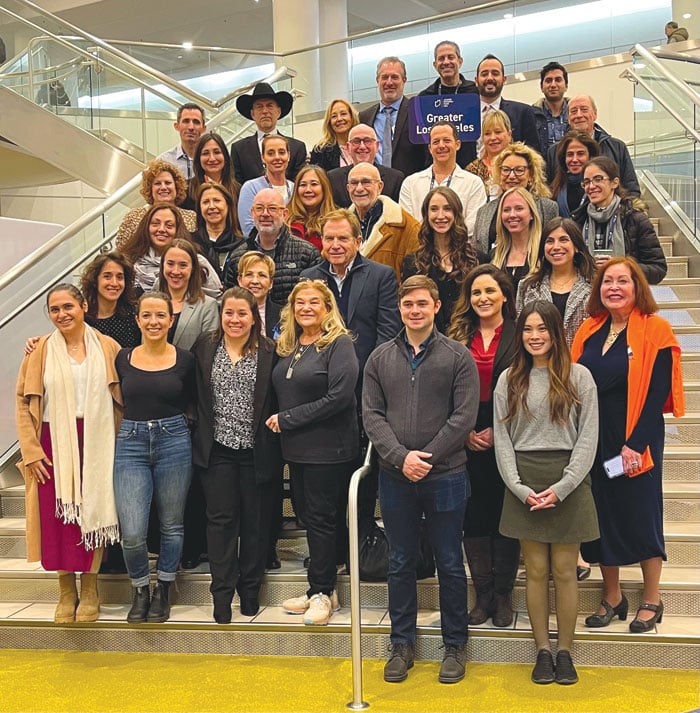
I recently traveled to Israel with a delegation of more than 20 Jewish organizational and educational leaders from North America on a two-day solidarity mission, Mishlachat Arevut (delegation of mutual responsibility). This mission, generously supported by the Jim Joseph Foundation, fostered awareness, connection, and partnership by engaging with survivors, families of victims and hostages, and communities directly affected by the horrific tragedy of Oct. 7th.   

The devastation perpetrated that day resonated deeply throughout our mission. The universal concern for hostages and the emotional roller-coaster experienced by the Israeli populace created an atmosphere of shared vulnerability among our group. This collective trauma in Israel has been further exacerbated by the loss of trust in governmental institutions, supply chain disruptions, cessation of tourism, and the looming fear and anxiety of an uncertain future. 

However, despite the emotional hurt and anxiety, the Mishlachat Arevut mission gave us a firsthand, personal view of the resilience, creativity, and collective strength of the Israeli spirit.

From the outset, I found inspiration from the immediate conversion of the protest movement into an organized, activation network of volunteers – a living, breathing testament to the adaptability and determination of the Israeli people.  

From the outset, I found inspiration from the immediate conversion of the protest movement into an organized, activation network of volunteers – a living, breathing testament to the adaptability and determination of the Israeli people.  The stories of heroism shared were not just personal narratives but living proof of the strength that emerges in times of crisis.  

I was struck by the level of creativity I witnessed in art, music, education, and cuisine which have become powerful tools for expression and healing. Acts of generosity, both small and large, painted a picture of a nation rallying together to navigate the aftermath of such a profound and devastating event.

So what comes next?  What am I bringing back to the field of Jewish camp from this experience? 

While Foundation for Jewish Camp (FJC) has several initiatives to support the field address wellness, security, and staffing, we are also focusing on refreshed Israel education, especially as we prepare this coming summer. I see three pressing areas of opportunity:

1. Witnessing the situation firsthand and engaging with Israelis in Israel allows for a deeper understanding and a more personal connection to the unfolding narrative.  I urge Jewish camp directors and educators to visit Israel before the 2024 camp season so that they can bear witness and experience their own learning, processing, and growth.  

2. Oct. 7th represents an inflection point requiring new content, strategies, and methodologies, for connecting with today’s new realities.  My colleagues on the mission have already been exploring new ways to “meet the moment,” especially with a more nuanced understanding and sensitivity to diverse perspectives many college-age students have experienced on their campuses.

3. We must continue our efforts to deepen the connection between Israel and communities in the diaspora. We are one global Jewish community – Am Echad im Lev Echad – one people with one heart. Jewish camps accomplish this each summer and we will help ensure they host even more Israeli chanichim (campers) and madrichim (counselors) for summer 2024. 

My participation on Mishlachat Arevut has left an indelible mark.  From witnessing the immediate impact of Oct. 7th on the entire population, to experiencing the resilience and creativity of the Israeli spirit, I feel the imperative for unity, courageous leadership, and transformative education.  We must adapt, collaborate, and remain deeply connected to the evolving narrative of Israel during these difficult days.

As we continue to celebrate Hanukkah, our festival of light, we hope and pray that the darkness which has filled our world these past two months will give way to even brighter light.  We must remain confident and steadfast in our unity and solidarity.  We must demonstrate our gratitude, joy, and celebration of Hanukkah by spreading more light and positivity sorely needed in our world today.


Jeremy J. Fingerman has served as CEO of Foundation for Jewish Camp (FJC) since 2010. Recently, he received the 2023 Bernard Reisman Award for Professional Excellence from Brandeis University. He may be reached at jeremy@jewishcamp.org.

From Darkness to Light: Finding Inspiration Amidst Adversity Read More »

The Heart Wants to Scream

The heart wants to scream
But it is silent
Half of it remains behind
The half not-humanitarian-enough

The heart wants to scream
But has learned that one must not speak aloud
So it whispers

A little girl longs for a bedtime story
A family hug
A father’s hand and loving smile
A mother’s gaze
But father and mother are gone.

And her room is no more
And her kindergarten is now history
And her teddy bear has disappeared
And her blankie was burnt to ashes.

She will become accustomed to the smell of her uncles and aunts.

In our thick cauldron of life
Tears of exhilaration dilute a bit
The thickness of blood that was spilled within.

And perhaps not
Perhaps it is like oil and water.
The blood spilled does not become diluted
And the tears of joy float upon the surface
And they have a place.

A Jew in his land.


Matt K. Forest, November, 2023
Translated from the Hebrew by Toby Klein Greenwald

The Heart Wants to Scream Read More »

Three Ways to Combat the Sense of Powerlessness

Many of us wring our hands in despair as we read the news from Israel and the cascade of Jew-hatred that floods our universities and our world. We sit in our homes or offices and wonder, “What can I do?” 

Yes, we donate to help the soldiers and the displaced families. We sacrifice precious peace of mind as we toss and turn. But many of us feel that, as individuals, we are powerless to make a difference. I’ve been there. But I’ve found three ways to fight back against that feeling and take back the sense that I can make a difference to the world around me.

Tell Israel’s story.

Misinformation is rampant. Educate yourself about Israel and the origins and realities of the current war. Then, in a respectful, rational way, share the story. 

Ask your unaffiliated Jewish friends and even non-Jewish friends and neighbors if they are interested in learning more about the situation in Israel. Do not send information about Israel without asking if people want to receive it. 

Educate yourself about Israel and the origins and realities of the current war. Then, in a respectful, rational way, share the story.

Engage in calm, respectful conversations about the situation in the Middle East. Remind others that Israel is the only liberal democracy in the region and that all those countries that have fallen under Iran’s shadow have devolved into depraved repression.

Gather with other Jews. 

Many liberal Jews have been shocked at how many “friends” they have lost simply by saying that the barbarous acts of Oct. 7 were wrong and that Israel deserves to live. Take the hint: Connect with your people.

Maybe you haven’t been to synagogue in a while. Maybe you don’t even know where your nearest synagogue is. It doesn’t matter. Google “synagogues near me” and you’ll find places where you can gather with your fellow Jews on Friday night, Saturday morning, or perhaps for a social event or class. 

Call and find out when the services happen and show up. At a time like this, our enemies do not care whether we are Reform, Conservative, Orthodox, or unaffiliated. We should not care either. As Jews, we share a common bond. Spending time together reinforces our knowledge that we are not alone.

Devote a mitzvah or good deed to the security of Israel and the return of the hostages. 

As the late Abraham Chaim Lapin, former Chief Rabbi of Johannesburg, and father of several prominent rabbis, said, “No effort is wasted.”  Even a small act of kindness sends shoots of healing into the world. 

The Jewish approach to saying blessings and doing mitzvot (commandments) is based on the idea that every action should be imbued with intention – the intention to praise and live in harmony with the Divine. When we perform a mitzvah, we can dedicate the power of our actions to the merit of something or someone else. 

Whether this all sounds like mumbo-jumbo to you or not, I encourage you to try doing something positive, such as doing a favor for someone you dislike, smiling when you feel like snapping, or getting up from your seat for the hundredth time to get a snack for a child or ailing loved one –  do these things and as you begin, say internally, “I dedicate any merit from this action to the return of Israeli hostages,” or “I devote the benefit of this action to the safety of the State of Israel.” You will feel more focused and powerful, and it sends positive energy toward our brothers and sisters in Israel. 

Coping with the war in Israel is a long-term project. We may welcome the return of the hostages but dread the possibility that Hamas will not be obliterated. We open the newspaper or look at our phone and feel bombarded with situations we feel we can do nothing about. But we can take back our personal power with small but significant actions. Let’s get to it!


Elizabeth Danziger is the author of four books, including “Get to the Point,” 2nd edition, which was originally published by Random House. She lives in Venice, California.

Three Ways to Combat the Sense of Powerlessness Read More »

Sinai Event Doesn’t Set Dreidel Record, but Is Nonetheless a Winner

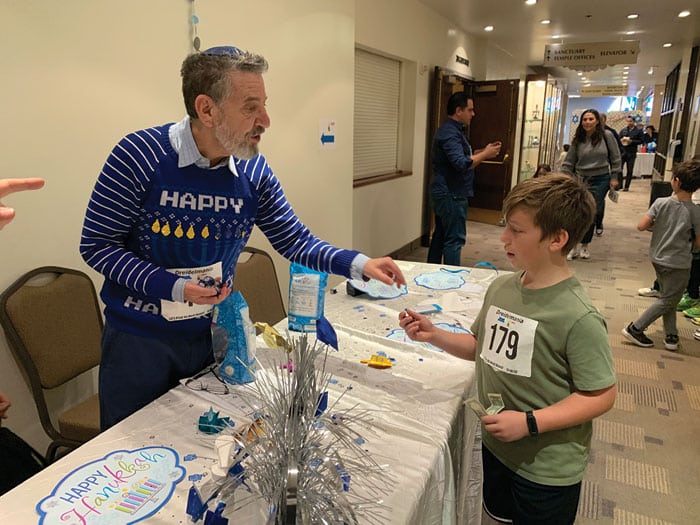
On Dec. 10, the third day of Hanukkah, Sinai Temple families, primarily from the Conservative synagogue’s religious school, came together for “Dreidelmania,” a community event that attempted to break the Guinness World Record for number of dreidels being simultaneously spun in one location for at least 10 seconds.

The current official record, according to guinessworldrecords.com, is 734 dreidels, set in Dec. 2011 by United Synagogue Youth in Philadelphia. 

The event was not an official attempt to break the Guinness record. For that to occur, a representative of Guinness would have had to been in attendance, according to event organizers. 

But that didn’t stop organizers from taking preparation for the event with the utmost seriousness. Dreidelmania Co-Chair and past Sinai Temple President Jamie Berman tested several types of dreidels and table surfaces before settling on which ones would achieve maximum spinning effectiveness.

Regarding dreidels, “Wood does better than plastic,” Berman explained to the Journal. “You also want to find one with a circular bottom.”

This marked the second “Dreidelmania” at Sinai, and its organizers considered it an unqualified success.

“It was about time we did it again,” Leslie Wachtel, the event co-chair, said.

While it was free to attend on Sunday, the synagogue sold pizza, donuts and drinks, including Maccabee Mocktails, to raise funds for Israel. Since Oct. 7, Sinai Temple has been supporting Friends of Israel Defense Forces and American Friends of Magen David Adom.

Attendees at “Dreidelmania” included Sinai’s religious school families; Sinai Akiba Academy students and their parents; as well as families not affiliated with the Westwood-based congregation’s schools.

Bringing some star power, former NBA player Enes Kanter Freedom, who has become an outspoken supporter of Israel, attended the event, and rapper Kosha Dillz, fresh off a trip to Israel, performed. His two-song set included his viral holiday hit, “The Hanukkah Song,” a hip-hop-infused remix of Adam Sandler’s classic.

Many volunteers pitched in to make the event happen. 

At the start of the day, around 11:15 a.m., each registrant was given a large number to stick to their shirt, allowing organizers to keep track of the number of spinners. It was a bit like the numbers provided to runners of a marathon — this reporter was assigned number 438 — except this activity would require decidedly less exertion than a 26-mile sprint. 

Still, as Sinai Co-Senior Rabbis Erez Sherman and Nicole Guzik led the countdown to the mass dreidel spin — “10, 9, 8 …” the husband-and-wife clergy team said in unison — the anticipation in the air was palpable as spinners, standing at long wooden tables arranged in rows in the temple hall, readied their dreidels.

And when the countdown concluded, everyone spun away.

Some 550 dreidel spinners turned out in person, along with additional virtual participants “spinning in” from Israel, Australia and even Montenegro.

Alas, Sinai came up short of the record. Some 550 dreidel spinners turned out in person, along with additional virtual participants “spinning in” from Israel, Australia and even Montenegro, but it was not enough to set a record.

Nevertheless, the event continued the synagogue’s undefeated streak of staging fun, family-friendly and festive Hanukkah events. 

“We did it to unite the community, to bring people together,” Wachtel told the Journal. “It’s a very difficult time for the community, and we wanted to spread some light in the dark times.”

And anyway, “It’s not about the record,” Wachtel’s husband, Andy, said. “It’s about the spirit.”

Sinai Event Doesn’t Set Dreidel Record, but Is Nonetheless a Winner Read More »

Milken Foundation Honors Four Outstanding Jewish Educators

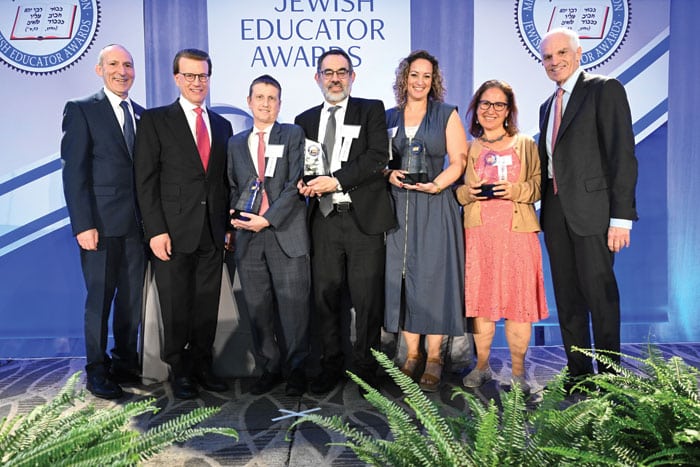
The 33rd annual Jewish Educator Awards luncheon, held at the Luxe Sunset Boulevard Hotel on Dec. 7, recognized Anna August of Sinai Akiba Academy; Sarah Shpall of Wise School; Rabbi Avraham Berman of Yavneh Hebrew Academy; and Rabbi Moshe Tropper of Emek Hebrew Academy.

Each year, the Jewish Educator Award, presented in partnership by the Milken Family Foundation (MFF) and BJE: Builders of Jewish Education, acknowledges outstanding educators at BJE-accredited Jewish day schools in Los Angeles. The four unsuspecting educators are surprised before their entire schools with individual, unrestricted Jewish Educator Awards (JEA) of $15,000.

This year’s JEA recipients were announced this past September. The luncheon formally recognized them before their colleagues and family members. 

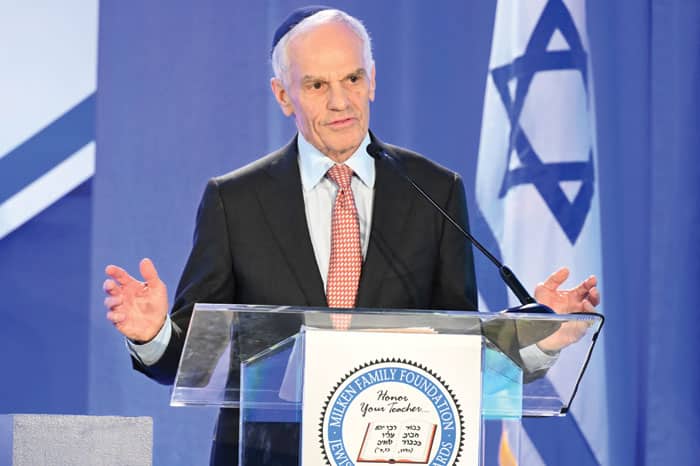
Richard Sandler

At the Luxe Hotel, speakers included Richard Sandler, executive vice president of the Milken Family Foundation, and Gil Graff, executive director of BJE. Additionally, the four recognized teachers delivered remarks about their respective careers in education. 

Tropper, a third-generation educator, demonstrated the capacity for the career at a young age — second grade, in fact. His then-teacher, who was also his mother, saw that he was more advanced than the other children in the class, so she had him serve as a mentor for his peers. 

“I always joke it was my first teaching job,” Tropper, a middle school vice principal and preparatory Talmud teacher at Emek, said to the crowd assembled in the hotel banquet room.

August, a Judaic and general studies art teacher at Sinai Akiba Academy, shared about her longtime passion for the arts. What she loves most is helping to unlock the creative potential in young artists.  

Shpall, a Wise School general studies teacher, believes her job includes modeling for her students how to excel outside the classroom.

“Everyone will read, write, add and subtract. But the way you treat and care for others is key to finding success.” – Sarah Shpall

“Everyone will read, write, add and subtract,” she said in her remarks to the day’s guests. “But the way you treat and care for others is key to finding success.”

Berman, a Judaic studies teacher at Yavneh, said the job was most rewarding when his students finally grasp the material. He recalled teaching a particularly tough text to his students, then hearing one of them remark, “Brilliant.”

“There’s nothing I can think of that’s more gratifying than hearing those words,” Berman said at the luncheon.

There are 36 BJE-accredited Jewish day schools in Los Angeles, which educate more than 10,000 students in kindergarten through 12th grade. To be eligible for the JEA, an educator must work a minimum of 15 hours per week at the K-12 level and been working a minimum of five years at a BJE-accredited school. 

The JEA aims to reward outstanding day school educators for the quality of their teaching, increase public support for day school educators and encourage qualified people to consider education as a career.

MFF, in partnership with BJE, established the JEA in 1990 as a complement to the Milken Educator Award. The latter, known as the “Oscars of Teaching,” awards exceptional teachers around the country with $25,000 individual prizes each year.

Milken Family Foundation Chairman and Co-Founder Lowell Milken was raised in the public school system in the San Fernando Valley. His teachers had a significant role in shaping him into the person he is today, he said in an interview, and launching the JEA along with the Milken Educator Award was his way of expressing gratitude. 

“I decided to create this award to bring to the attention of the public the critical role educators play, especially in our Jewish communities, where we really have a dual curriculum,” Milken told the Journal. “We’re preparing students to not only lead positive secular lives but also understand our peoples’ history, our destiny, to repair a very broken world.” 

The annual JEA luncheon gathers the entire spectrum of the Jewish world, with representatives of every denomination turning out. At the valet line after the luncheon, rubbing shoulders were Bruce Powell, who founded a pluralistic Jewish day school in West Hills, and Rabbi Dovid Tropper, whose son, Chaim, runs a yeshiva on Fairfax Avenue that blends in-person Jewish studies with online secular learning.  

“Whether you’re talking about unaffiliated Jews, Reform Jews, Conservative Jews, modern Orthodox or Orthodox, I think all of us can agree on the importance of education,” Milken told the Journal. “And that’s why this particular event every year is so heartwarming, to see the whole Jewish community come together in a very positive way, celebrating education.”

Milken Foundation Honors Four Outstanding Jewish Educators Read More »

Calls of Unity and Strength Reign Supreme at JNF-USA Conference Global Conference for Israel

From Nov. 30 through Dec. 3, over 2,500 supporters of Israel gathered at the Denver Convention Center for Jewish National Fund-USA’s annual Global Conference for Israel. In the aftermath of the Oct. 7 attacks, the speakers called for unity, inspired attendees to love their fellow Jew and encouraged them speak up for Israel even when it was difficult.

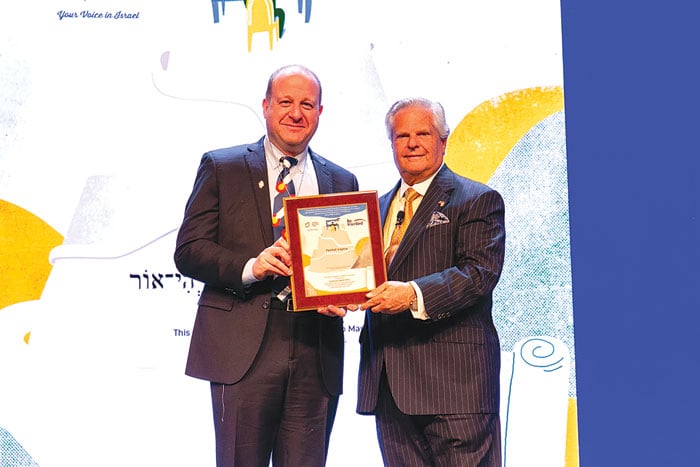
Colorado Governor Jared Polis, who is Jewish and spoke at the opening plenary, voiced his support for Israel as protestors outside the conference center banged on the windows and shouted at attendees that they were “baby killers” who “have blood on your hands.”

Polis said, “If anyone asks why the world needs a Jewish state of Israel, it’s more evident than ever before… I proudly wear with you the necklace that says, ‘Bring Them Home Now.’”  

JNF-USA President Dr. Sol Lizerbram also spoke at the opening plenary, highlighting the work JNF-USA has been doing since Oct. 7, including relocating thousands of affected Israelis in the Gaza Envelope to safer areas and sending volunteers to rebuild the country.

“We don’t just plant trees,” Lizerbram said. “We invest in infrastructure. We are the doers and the builders. That is JNF-USA.” 

Rabbi Erez Sherman of Sinai Temple of Los Angeles, who brings together cohorts of rabbinical students to learn about Israel, said kaddish for the Oct. 7 victims, inserting the names of the areas that were targeted, like Nova and the kibbutzi.

The JNF-USA conference, which included a heavy police presence and ample security measures, also featured a talk from Permanent Representative of Israel to the United Nations Gilad Erdan, who told the Jewish Journal that the U.N. is misguided. 

“The U.N. proved time and again it’s paralyzed and it’s lost its moral compass,” he said. “You could see how the leader of Iran, the Butcher of Tehran, Raisi, was accepted [and] received a red carpet treatment after his regime slaughtered thousands of women and peaceful protestors. The UN should go through a reform, but until then, the United States of America is the biggest funder of the U.N. Maybe the time has come to defund the U.N. and demand fundamental reforms.” 

Social media was a hot topic of the conference, with a panel showcasing former Republican candidate for Lieutenant Governor of California and JNF-USA supporter Ron Nehring. As Ted Cruz’s former spokesperson during the 2016 presidential campaign, he learned about how to deal with detractors. He pointed out how it used to be called the “Arab-Israeli” conflict, since the Arab nations teamed up against Israel to try to destroy it, but now it’s called the “Israeli-Palestinian” conflict to try to make Israel look bigger and cut out the legions of doom, Iran and Syria, who are also actively trying to eliminate the world’s only Jewish state.

“Don’t use their language,” he said. “Always use the vocabulary you choose … And make sure you speak towards your persuadable target audience.”

Photo by Photography G.

In a session with Geller International Fellows from Israel on Campus Coalition, Senior Fellow Tessa Veksler, student president at UC Santa Barbara, talked about what it’s like being a visibly proud, pro-Israel Jew on campus.

“We were the first student government in the nation to condemn Hamas,” she said. “I also got threats on a daily basis, students protested about me and I was told that I should be beaten in the streets.” 

Orlando Valdez III, who is not Jewish but is also in the ICC Geller Fellow program, said he – a person of color – has been called a white supremacist for supporting Israel. 

“We have demonstrations from Hillel and support systems in place for people like me who are Zionists and love the state and people of Israel,” he said.

President of the Louis D. Brandeis Center for Human Rights Under Law Alyza Lewin moderated the panel of students. She represents students who sue their schools under Title VI of the Civil Rights Act, which says that no person shall be discriminated against for their identity under any activity or program receiving federal assistance, like universities.

“It’s not a good faith political debate taking place on campuses. What’s happening is the demonization, marginalization, shunning and exclusion of Jews.”

-Alyza Lewin

“It’s not a good faith political debate taking place on campuses,” she said. “What’s happening is the demonization, marginalization, shunning and exclusion of Jews.”

On Shabbat, JNF-USA held a Shabbat dinner and services with different denominational options, along with further talks and gatherings of college students. After Shabbat, a musical Havdalah and a night of comedy featuring Alex Edelman performing his show “Just For Us” were held. Afterparties for college students and JNFutures, the young professionals group that has chapters across the U.S. and Canada, were held at the hotel directly next to the convention center, the Hyatt Regency. 

Other talks included remarks from JNF-USA CEO Russell F. Robinson, former Israeli diplomat Ido Aharoni Aronoff and President of Israel Isaac Herzog, who gave a viritual speech from Israel.

One of the most emotional moments came when filmmaker and pro-Israel influencer Yuval David gave his talk about his advocacy work. He told his audience that as the protestors yelled outside the convention center, a 70-something Jewish man was walking by, with his head down, looking dejected. David ran up to the man, locked arms with him, and said, “Head up, baby!” This instantly brightened the man’s day. David said the man told other people to keep their head up, too. 

“This conference has been such therapy I cannot even describe,” said David, who lost 32 friends on October 7. “I’ve barely been shaking hands because I’ve been hugging everyone.” 

He continued, “I am so thankful for all of you.”

Calls of Unity and Strength Reign Supreme at JNF-USA Conference Global Conference for Israel Read More »

The Miraculous Lapel Pin (and Other Tales of Wonder from the Israel-Hamas War)

The following is a work of satire. But believe me, it is nearly all inspired from real-life events, because, as the saying goes, you can’t make this stuff up. 

Jews worldwide are enjoying a sense of wonder as they describe near-miraculous incidents that are enabling them to feel safe, respected and supported during this previously-unimaginable time. Here are some of the stories the Journal has identified during the past few weeks that have left us grateful and at times, speechless.

This Latke Tastes Dry and Ironic

Hundreds of young anti-Israel Jews representing the organization If Then, When Then and How? were bewildered when, during their pre-planned Hanukkah party last week, a senior member read aloud the meaning of Hanukkah from a Google search. Attendees were shocked and confused upon discovering that the real meaning of Hanukkah, which means “dedication,” includes an inherent condemnation of assimilation and straying from the path of Jewish peoplehood and community. 

“For years, everyone in this group’s been telling me I’m like a modern-day Maccabee,” said an If Then, When Then and How? member who only identified himself as Seth. “But now, I just found out if the Maccabees were here today, they would probably think I suck. Like, really, really suck.”

Witnesses revealed that once-happy partygoers could barely swallow their latkes, donuts and Gaza-imported sheep’s milk Feta cheese once they understood that they “probably had more in common with Hellenistic Greeks than with the Jews who were fighting them.”

Witnesses revealed that once-happy partygoers could barely swallow their latkes, donuts and Gaza-imported sheep’s milk Feta cheese once they understood that they “probably had more in common with Hellenistic Greeks than with the Jews who were fighting them,” said another attendee, who told the Journal he felt compelled to punish himself by eating a Hanukkah sufganiyah, or donut, without any filling whatsoever. 

Thoughtful Tlaib

Representative Rashida Tlaib (D-Mich.) happily surprised American Jews recently when she tweeted, “Happy Hanukkah to my Jewish constituents, neighbors and friend” (the latter word was purposefully singular, as Tlaib admitted to having one Jewish friend). She continued, “I’ve always been inspired by Hanukkah. It’s a reminder that when you least expect it, miracles can happen. Miracles, like the fact that I continue to be reelected term after term.” 

A Purim Miracle

Inspired by Tlaib’s truly sincere message of love for Jews, Ayatollah Ali Khamenei, the Supreme Leader of Iran, is said to have asked his chief-of-staff to schedule a tweet directed at Jews worldwide this coming spring, with the message, “Ah Freilichen Purim!”

When Is a Die-In Not a Die-In?

Several students at Antler College in Northern Canada sustained moderate injuries when they attended a “Die-In for Palestine” on campus and described how two male students attempted to bash in attendees’ heads with a medieval flail. “These fanatics thought we were serious,” said a graduate student who co-organized the event. In an exclusive interview, the alleged perpetrators, who are freshmen, told the Journal, “It was our first ‘Die-In.’ What were we supposed to do? Plus, we thought a few Jews might show up to it.”

Spineless Leaders

West Spineless, a newly-incorporated town in eastern Minnesota, canceled its second-annual Christmas tree lighting ceremony at City Hall. In a statement, West Spineless leaders expressed fear over public safety regarding threats by four pro-Palestinian supporters that they would protest the jolly event. 

Not to be outdone, a nearby rival town named East Spineless also canceled its annual tree lighting ceremony, which dates back to the late 1800s. “We love Jesus, we really do,” said an East Spineless leader, “But we didn’t want anyone to think we’re acknowledging that Jews actually lived in Israel over 2,000 years ago. Know what I mean?” 

Residents of both towns told the Journal that next year, they will invite members of If Then, When Then and How? to teach locals about the meaning of Hanukkah and participate in a bush-lighting ceremony in a parking lot behind the sanitation department. 

A Recruitment Miracle 

After their respective presidents dodged questions regarding antisemitism during a congressional hearing, admissions representatives from Harvard, MIT and the University of Pennsylvania told the Journal they have received an unprecedented increase in applications from abroad. 

“For some reason, one day after the hearing, we received 10,000 applications from Qatar, Pakistan and Lebanon — each,” said an MIT administrator, who admitted that one applicant from Qatar submitted an application that read, “I heard you guys will let me say anything I want about Jews and Zionists, and, given my record, I think I would be a great fit for your university.”

Where Did All the Jews Go?

Libya arrested five Iranian nationals on suspicions of planning to attack Jews in the country. Libyan security officials told the Journal that one alleged Iranian agent confessed, “Tehran told us to get some Jews. How were we supposed to know there aren’t any left in Libya? Didn’t there used to be tens of thousands of them there? If anyone knows where they went, please send us their addresses.” 

The alleged operative also confessed to having first arrived in Iraq to target Jews, but to not finding any there. “There used to be over 100,000 of them in Iraq, weren’t there?” he asked. “I want to tell you … it’s very demoralizing to go around the Middle East looking for Jewish targets and the only place to find them is in the Zionist entity.” 

Upon hearing news of the man’s testimony, members of If Then, When Then and How? sent him and the remaining four Iranian operatives solidarity T-shirts that read, “My Other Shirt is in Israel-Occupied Gaza.”

Public Safety

Citing inclusivity, Schlemiel, Connecticut has banned the lighting of a giant menorah at a local park this year. “When we Googled the meaning of ‘inclusivity,’” a Schlemiel representative told the Journal, “We quickly realized we better keep Jews out of it, for everyone’s sense of safety.”

The Awe-Inspiring Lapel Pin

And finally, in Mamzer County, Minnesota (represented by Rep. Ilhan Omar), a young, Jewish barista at a local coffee shop was granted the surprise of a lifetime when he bravely decided to don an Israel lapel pin as he prepared customers’ orders. According to witnesses, pro-Palestinian protestors encircled the coffee shop with signs that read, “We Really Disagree with You, But We Still Respect Your Right to Your Views” and “This Is America. Feel Free to Express Yourself.” 

Witnesses told the Journal that several pro-Palestinian customers calmly ordered their morning cup of coffee, shook the barista’s hand and expressed messages such as, “I’d never go after you for a one-inch lapel pin” and “You’ve inspired me to wear a pin with the Palestinian flag. Thank you!” 

Flooded with joy and gratitude, the barista reportedly felt safe enough to walk outside and offer the peaceful mob free samples of seasonal, cherry-gingerbread iced coffee. 

“I don’t know if that Jew offered us cherry syrup or blood,” said one protestor, “But I love this time of year.”


Tabby Refael is an award-winning writer, speaker and civic action activist. Follow her on X/Twitter and Instagram @TabbyRefael

The Miraculous Lapel Pin (and Other Tales of Wonder from the Israel-Hamas War) Read More »

Fellow Jews: Let’s Not Talk About Israel in an Echo Chamber

Since Oct. 7, I’ve gone to a number of pro-Israel gatherings. It’s comforting to be among other Jews and feel uplifted and inspired during such a dark time. 

I know that when I attend these events, everyone has the same perspective as me. We are all deeply hurt, concerned about antisemitism and determined to unite and win this war. I sing along with “HaTikvah,” agree with every speech and cheer when people yell, “Am Yisrael Chai!”

I also think: Are we in an echo chamber? 

While these gatherings are so important, our Jewish and Israel advocacy must extend outside of our own circles. I learned this lesson when, in the aftermath of Oct. 7, my family members, who are not Jewish – I’m a convert – had a hard time understanding how scared I was. One family member told me that when she was working in a Jewish neighborhood during Rosh Hashanah, she couldn’t believe the amount of police presence that was there. “That’s the reality I deal with every day,” I told her. “Unfortunately, people hate us.”

Another family member asked me if I have any friends in Israel. “I do, but all 7 million people over there are my family members, too,” I told them.

As a convert, I understand the different mentalities people have. For instance, when I went off to college, my Middle Eastern studies professor was anti-Israel, so I became anti-Israel, too – even though I previously knew nothing about Israel and Palestine.  

He told our class that after the Holocaust, a bunch of Jewish lawyers went in and sneakily stole land from the Palestinians, and that the Israelis were oppressing the Palestinians still. I trusted and believed him, since he was in a position of authority. I never thought that a professor could be biased or lie to me. I also never connected being anti-Israel to being antisemitic.

Later, when I started dating Daniel, who is now my husband, and I learned the truth about the Israeli-Palestinian conflict, I felt so betrayed by my professor. I also realized that there are so many people out there like me, people who have absolutely no stake in the conflict but learn about it through a professor or social media or a biased news source and think it’s the truth. 

Here’s another example: Before I became Jewish, I went to Shabbat dinners at my local Chabad and Daniel’s family’s house. In those spaces, I learned the truth about Orthodox Judaism and saw just how beautiful it is. Previously, I’d only seen negative portrayals of Orthodox Jews in the media. Again, I realized that the institutions I’d trusted had deceived me. 

It’s not easy to come to this realization. You start questioning your belief system. You question your entire identity. It’s a tough reckoning that requires you to squash your ego in pursuit of the truth. You might even have to admit that you were wrong – and people don’t have an easy time doing that. They’d rather keep on lying instead of doing necessary self-reflection.

At this time, it’s so important to build bridges with people who are not part of the Jewish community.

That’s what we’re up against. And that’s why, at this time, it’s so important to build bridges with people who are not part of the Jewish community. We shouldn’t engage with radicals, but we should have meaningful conversations with level-headed people who are willing to listen to our point of view. This can be as simple as talking to people online and off, encouraging them to visit Israel or inviting someone to a Shabbat dinner. Let others see the beauty of our religion, our culture and our homeland for themselves and then decide. One thing is for sure: Creating human to human connections is what’s going to make a real difference. 

I encourage you to keep going to pro-Israel rallies and events. I encourage you to meet up with your Jewish friends. But I also want you to think about the connections you can cultivate with others outside of our community. Extend your hand to them and welcome them in. 

By uniting as a Jewish community, finding allies and knowing that Hashem is here for us, we will prevail. 

Have you advocated for Israel in unique ways? Email me: Kylieol@JewishJournal.com.


Kylie Ora Lobell is the Community Editor of the Jewish Journal.

Fellow Jews: Let’s Not Talk About Israel in an Echo Chamber Read More »

Campus Watch December 14, 2023

UPenn President Liz Magill Resigns

University of Pennsylvania (UPenn) President Elizabeth Magill resigned on Dec. 9.

UPenn Board of Trustees Chair Scott Bok, who also resigned from his position, announced that Magill’s resignation was voluntary and that Magill said in a statement, “It has been my privilege to serve as President of this remarkable institution. It has been an honor to work with our faculty, students, staff, alumni, and community members to advance Penn’s vital missions.” Magill will stay on as a tenured faculty member at Penn Carey Law School.

Magill, as well as Harvard University President Claudine Gay and MIT President Dr. Sally Kornbluth, all came under fire after they said during Dec. 6 congressional testimony that calls for genocide against Jews would depend on the context as to whether it violated university policy.

Harvard Says Claudine Gay Will Remain President

Harvard University’s governing board announced on Dec. 12 that Claudine Gay will stay on as the university’s president despite calls for her removal.

The Harvard Corporation said in a statement that “our extensive deliberations affirm our confidence that President Gay is the right leader to help our community heal and to address the very serious societal issues we are facing” and that she has the unanimous support of the board. The board noted that Gay “apologized for how she handled her congressional testimony and has committed to redoubling the University’s fight against antisemitism.”

In her apology, Gay told The Harvard Crimson that she “got caught up in what had become at that point, an extended, combative exchange about policies and procedures. What I should have had the presence of mind to do in that moment was return to my guiding truth, which is that calls for violence against our Jewish community — threats to our Jewish students — have no place at Harvard, and will never go unchallenged. Substantively, I failed to convey what is my truth.” 

NY Governor Threatens “Aggressive Enforcement” Against NY State Colleges That Fail to Take Action Against Calls for Genocide

New York Governor Kathy Hochul (D) issued a letter to New York state colleges and universities on Dec. 9 warning that her office will aggressively enforce state law against such schools that fail to crack down calls for genocide on campus.

Hochul wrote in the letter that she was “shocked” that many presidents of prestigious universities have failed “to clearly and unequivocally denounce antisemitism and calls for genocide of the Jewish people on their college campuses.” She spoke with SUNY Chancellor John King and CUNY Chancellor Felix Matos-Rodriguez, and they both assured her that calls for genocide “would lead to swift disciplinary action.”

“Failure to address such activity would constitute a violation of New York State Human Rights Law and as well as Title VI of the Civil Rights Act,” Hochul wrote. “Under Title VI, any recipient of federal funds is responsible for keeping students free from a hostile environment based upon their ethnicity or national origin – a standard that has been applied to antisemitism.” She added that “colleges and universities not in compliance with federal and state laws protecting students against discrimination can be deemed ineligible to receive state and federal funds.”

Friends Co-Star David Schwimmer Denounces “Morally Bankrupt” University Presidents

David Schwimmer, one of the co-stars of the hit sitcom “Friends,” condemned the university presidents of Penn, MIT and Harvard as being “morally bankrupt.”

In a Dec. 7 Instagram post, Schwimmer wrote that the presidents were “incapable of answering even the most direct basic ‘yes’ or ‘no’ questions” in their congressional testimony. “Watch them duck and smirk at the unbridled anti-Semitism and calls for genocide on their campuses,” he continued. “Where is the outrage among students, faculty and alumni demanding their resignations, an official apology and enforcement of the codes of conduct? Silence is complicity.”

Pro-Palestinian Columbia Student Group Holds Teach-In After University Cancels It

A pro-Palestinian student group at Columbia University’s School of Social Work held a “Significance of the October 7th Palestinian Counteroffensive” teach-in on Dec. 6 even though the university canceled it.

The Columbia Daily Spectator reported that the teach-in was held in the lobby of the Social Work building and drew counterprotesters. The pro-Palestinian group holding the teach-in, Columbia Social Workers for Palestine, told the Spectator that the school had never told them directly that the event was canceled; the school had issued a statement a couple days earlier announcing the event’s cancellation.

The school said in a statement posted to social media that “school and university administrators informed the students of the possibility of disciplinary action and urged them to disperse, which they did. The matter is under review.”

Campus Watch December 14, 2023 Read More »