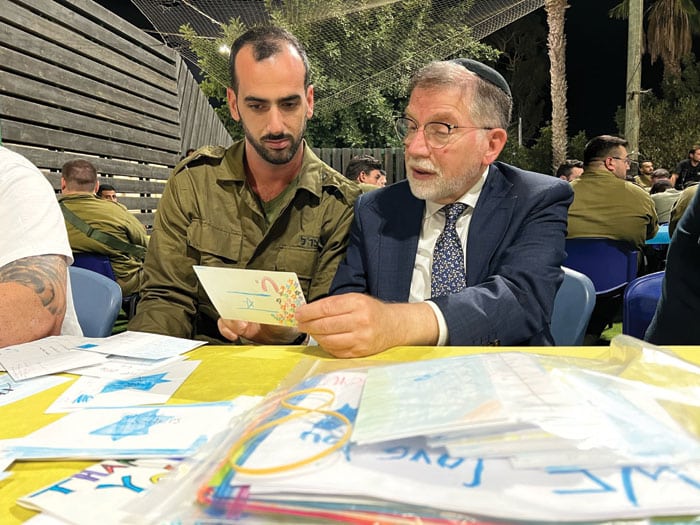
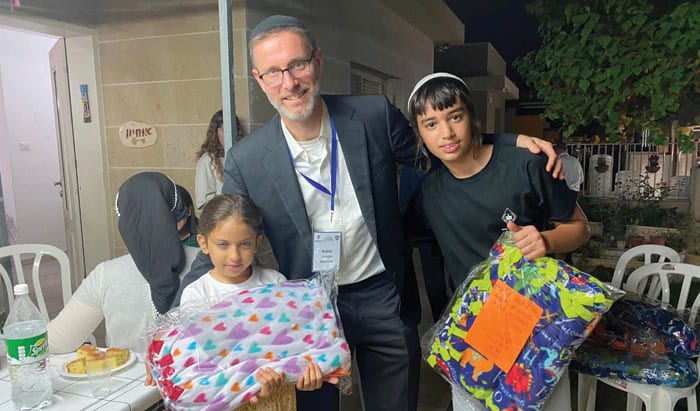
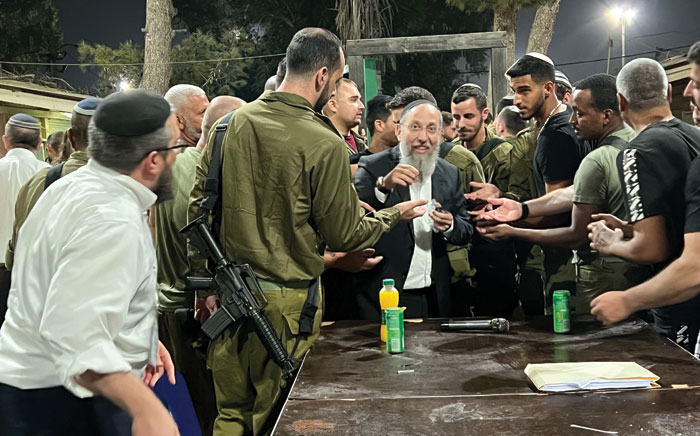
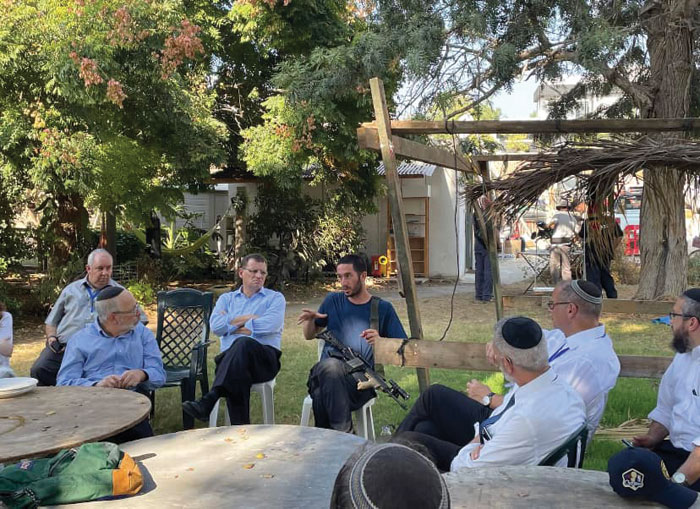
Sarah Grace Victor arrived in Jerusalem on Monday, Oct. 2. As the events chair at JNFuture’s Los Angeles Board of Directors, she was excited to tour the Gaza Envelope, where she was participating in JNF-USA’s Sukkot Day Tour.
“While I have been to Israel a few times before to work and study, I had never experienced these holidays in Israel, and I was looking forward to the joy of the celebrations,” said Victor, a lawyer who serves as regional assistant director at Alums for Campus Fairness, which addresses antisemitism and anti-Israel biases on campus. “During the days of Chol HaMoed, the Kotel, market and streets of the city were packed with people singing, dancing and praying. I remember thinking I had never seen so many people in Jerusalem.”
During her tour of the Gaza Envelope – which is made up communities about four miles from the Gaza border – Victor met with people there and learned about their lives.
“The community members spoke about how they were secure and had grown in their preparedness for dealing with terrorism from Hamas,” she said.
Just a few days after her trip, however, the October 7 massacre occurred, in the Gaza Envelope. Victor was in Jerusalem at the time.
“The sirens announcing rocket attacks pierced a pristine Shabbat morning,” she said. “I — and my neighbors — were taken aback because rockets directed at Jerusalem are not a usual occurrence, central as it is to the sacred sites of multiple religions.”
Victor started receiving messages from people back home telling her to leave Israel immediately. But she chose to stay until the day she intended to leave, which was later that week.
“I thought being physically present for each other was important at that moment.”
“I felt it was important that if I came to share in the joy of the holiday, I would also be willing to stay in solidarity for the pain we were experiencing,” Victor said. “[I] visited friends throughout the country until I flew out on Thursday. The security situation meant I had to plan this more closely, but I thought being physically present for each other was important at that moment.”
In the aftermath of October 7, JNF-USA is raising funds for the communities in the Gaza Envelope, providing services like resilience centers, animal-assisted therapy programs and family therapy sessions. For $2,500, contributors can sponsor 24 sessions for one child over the course of a year to undergo animal therapy at the Sderot Animal Therapeutic Center, and a $3,600 contribution will go towards funding 12 sessions of family therapy at the Eshkol Resilience Center, which helps children and adults overcome PTSD.
Since the day after the massacre thousands of college students on campuses across the nation have been protesting against Israel, which has kept Victor, who is not Jewish but a proud ally, busy at work.
“Over the last few weeks, we have seen campus environments inflamed with hateful antisemitic rhetoric, with Jewish students assaulted, hiding, scared for their personal safety,” she said. “Because my job is focused on addressing antisemitism, I am especially aware of the effects the terrorist attack has had on communities in the Jewish diaspora around the world.”
When Victor moved to L.A. to start her current job, she joined JNF-USA because the idea of serving unprivileged communities in Israel resonated with her. She spoke at the Breakfast for Israel last year and talked about not being Jewish but standing in solidarity. For her part, she hopes to continue to be a voice for advocacy as well as let Jewish people know she stands with them during this difficult time.
“I have been volunteering in little ways,” she said. “[I’ve been] checking up on my friends who are Jewish who feel unsafe.”
In the aftermath of the terrorist attack of 10/7, there has been understandable concern about the future of the Jewish people.
With only 16 million Jews out of a global population of 8 billion, Jews comprise one-fifth of 1% of everyone in the world.By contrast, there are roughly 2.4 billion Christians, 1.9 billion Muslims, 1.2 billion Hindus, and 500 million Buddhists.Out of every 500 people alive today, 150 are Christian, 119 are Muslim, 75 are Hindu, 31 are Buddhist, and one is Jewish.Talk about one being the loneliest number.
It is agonizing to reflect on the fact that in 1939, on the eve of the Shoah, the worldwide Jewish population was approximately 17 million, an amount demographers don’t expect us to reach again for another decade or so.If the Nazis hadn’t murdered 6 million Jews, it is estimated that there would be around 30 million Jews alive today, almost twice the actual number.
With so few of us, wouldn’t it be wise to embrace all Jews, regardless of our differences?
I certainly wasn’t raised with that perspective. There were two synagogues in my town in New Jersey. We belonged to the Conservative temple — not the Reform one.We used to say that the difference between the synagogues was that ours was for Jews.After all, the rumor went, Reform Jews didn’t even wear yarmulkes!It reminds me of the old joke about the Jewish man stranded on a desert island who builds two temples – the one he belongs to and the one he doesn’t.
Wouldn’t it be incredible if by celebrating the joy we share in our Jewishness, we could forge a more unified identity?
Jews differ widely in their level of observance, their denominational affiliation, and their ancestry. But wouldn’t it be incredible if by celebrating the joy we share in our Jewishness, we could forge a more unified identity?
Thanks to the Pew Research Center’s monumental study, “Jewish Americans in 2020,” we know a great deal about Jews in this country, home to almost half of all the Jews in the world.The breakdown in affiliation is as follows:9% Orthodox, 17% Conservative, 37% Reform, and 4% Reconstructionist or other branch, with the remaining one-third of all American Jews reporting that they do not identify with any religious denomination.
While U.S. Jews are far less likely to say that religion is important in their lives than do their Christian counterparts, the news is much more encouraging when they are asked whether “being Jewish” matters to them.Forty-two percent of American Jews report that their Jewishness is very important to them; 34% that it is somewhat important; and only 23% say it is not too, or not at all, important.The headline says it all: “To U.S. Jews, being Jewish is not just about religion.”
Then what is their Jewish identity about?Being Jewish means (in the order of reported importance): “Remembering the Holocaust,” “leading an ethical and moral life,” “working for justice and equality in society,” “being intellectually curious,” and “continuing family traditions.”
And it is worth noting that, except for the answer “continuing family traditions,” which scores much higher in level of importance for more religious Jews, what Jewishness means is not that different for those who identify with a denominational affiliation and those who do not.Jews have more in common with each other than we might imagine.
Let’s build on this foundation of shared values, and do the work necessary to make sure that all Jews feel that they are beloved members of our small but vibrant community. The Pew study discovered that only 35% of American Jewish adults say that they or someone in their household is a synagogue member, so I’m not only talking about making religious services as welcoming as possible.Jewish-themed food, film, and dance festivals; concerts, book groups, lectures, and art exhibitions; anything that brings Jews closer to one another helps ensure our collective future.
In his poem, “The Death of the Hired Man,” Robert Frost memorably wrote, “Home is the place where, when you have to go there, They have to take you in.”How wonderful it would be if Judaism were a faith that, if you are part of it, your fellow Jews will always take you in – whether you wear a yarmulke or not.
Morton Schapiro is the former president of Williams College and Northwestern University.His most recent book (with Gary Saul Morson) is “Minds Wide Shut:How the New Fundamentalisms Divide Us.”
Sometime in the late 1970s, when my wife, my older son and I lived in a Jerusalem apartment, there was a knock at the door. Expecting friends, who’d often show up without calling first, we were taken aback at seeing an ultra-Orthodox gentleman in the hallway. He pointed out, with surprise, that we didn’t have a mezuzah outside our door. Without missing a beat, I said, in Hebrew, “That’s because we’re not Jewish.” He was stunned. He stammered a bit, then left.
Of course, what I told him was not true. My wife and I are Jewish. But as secular Jews in a Jerusalem neighborhood filled with ultra-Orthodox who threw stones at our car when we drove on Shabbat, what I said was a joke laced with a bit of venom. Nevertheless, our not having a mezuzah outside our door was not an act of defiance or revenge. We were nonreligious, and it simply had never occurred to us to put up a mezuzah.
In 1981 we left Israel and moved to Los Angeles. In 1983, when my wife was pregnant with our younger son, we bought a house in the San Fernando Valley. Two months after we moved in, our younger son was born, and we arranged for the brit milah to be held at home. When I spoke with the mohel, he asked if we had a mezuzah. I told him we didn’t. He said “Oy,” and took a deep breath.
He didn’t demand or even request that we put up a mezuzah, but his ‘oy’ felt like a sigh and spoke volumes. I went to a Judaica store in Fairfax and bought a mezuzah. I asked about the proper way to install it and was given a sheet with instructions. Though I did not recite a blessing, I followed the rules for placing it at the required angle and location on our doorpost, and I felt good about it, a sense of continuity and connection. When the mohel arrived, he saw the mezuzah and smiled at me, acknowledging the mitzvah. Carefully, he placed his fingers to his lips, then touched the mezuzah with those fingers. A private rite of worship, of connection.
As we chatted with the mohel, it turned out that he had lived in Jerusalem and, miraculously, he had trained with the very same mohel who had performed the brit milah for our Jerusalem-born older son! This struck me as something more than coincidence. There was an aura of continuity and connection about it, similar to what I’d felt when nailing the mezuzah to our doorpost.
For forty years that mezuzah has been outside our front door. It’s still there, still at an angle, still containing that tiny, rolled-up biblical scroll. Each time the exterior of the house gets painted, that mezuzah is carefully removed, and then, once the paint dries, it’s put back, making sure it’s at the same location as before, and at the same angle.
Times, as we know, have changed. Over the past few weeks there’s been a dramatic rise in antisemitic acts, and some have voiced fear about showing openly that they’re Jewish.
I’ve even heard that some have removed their mezuzah so that people delivering mail or Amazon packages, or those working at the house, have no obvious clue that Jews are living there. My guess is that some who remove the mezuzah from its place outside the house then put it in a doorpost inside the house. Others, presumably, hide their mezuzahs.
We will keep our mezuzah just where it is, and it’s not because we’re proud of being Jews, or that we have a religious attachment to the words on that scroll. For us, that mezuzah represents connection and continuity.
My wife and I are not going to do either. We will keep our mezuzah just where it is, and it’s not because we’re proud of being Jews, or that we have a religious attachment to the words on that scroll.
No. For us, that mezuzah represents connection and continuity. It’s a way of saying: We’re Jews and we live here.
This is who we are.
Roberto Loiederman has written more than 100 articles for The Jewish Journal. He is co-author of “The Eagle Mutiny,” a nonfiction account of the only mutiny on an American ship in modern times.
For about 2,000 years, the Jews were exiled from the land of Israel and have been persecuted by almost every country they lived in.“The Phantom of the Opera” and “The Lion King” are never going to catch up to how long the “Kill the Jew” show has been running. This is the longest-running persecution in history.
That brings us to October 7th, 2023.The world has just experienced its single worst day of the murder of Jews since the Holocaust. This is Israel’s 9/11. I shudder to imagine what would happen if Israel did not have the IDF and America. Hamas and their other Nazi playmates would now be well on their way to cheerfully murdering 7 million more of us. By the way, it’s not just Jews they want to kill.It’s anyone who isn’t them.
Here’s the message for Hamas: This is not 2,000 years ago, 1945, or 2001. We are not going to start over again. We’ve done it too many times. Not this time. NEVER AGAIN.
Evil Hamas, you could have had a nice life, but you blew it.We watch you dance as you spill our blood. That is not a Jewish value. As you will see, we do not dance as your blood soaks the earth. God willing (and I believe He is), your days are numbered. Not even dental records will document who you were.
I am now more in love with the Jewish people than ever before. I have never seen a people anywhere pick up ash and turn it into an oasis so quickly. It’s because they have a resilience like the world has never seen. Jews choose life, not death.
I am now more in love with the Jewish people than ever before. I have never seen a people anywhere pick up ash and turn it into an oasis so quickly. It’s because they have a resilience like the world has never seen. Jews choose life, not death. The world has been trying forever to rid the earth of us. How’s that working out, world?
It’s become as clear as Fiji Water that it’s not about peace, land, jobs, hospitals, or schools that Hamas wants to build. It’s about killing Jews. They don’t care a scintilla about the Palestinian people. I care more about the Palestinians than Hamas does.
So, let me tell you why I love Jews more and more each day. Since October 7th, I have been to four rallies in support of all the people of Israel, not just the Jews. I have heard the Lt. Governor of California, the mother of a kidnapped son, Roz Rothstein of Stand with Us, Rabbi Hier and Rabbi Cooper from the Museum of Tolerance, and my Rabbi, Elazar Muskin, and many others all say the same thing: We want peace and will have it.
Why I love Jews is because, so far, not once have I heard any of the Jewish speakers call for a Jewish Holy War — never heard anyone call for the death of all the Palestinian people or call for a Jewish day of rage. I have not heard a call for revenge. What they are asking is for their soldiers and hostages to come home safely. What they are asking for is to get rid of Hamas and to stop Iran from getting the bomb.
Nobody has come over to me and whispered that they wanted to slice open the gut of a Palestinian baby or parade naked Palestinian women through the street while beating their bodies with a stick, as Hamas did. You’ve heard it before. If Jews laid down their weapons for peace, they would all be dead the next day. If Palestinians laid down their weapons, there would be peace and prosperity. Hamas will go the way of all the others that tried to get rid of the Jews. They will disappear into the sand. Let’s hope it’s sooner than later.
Avinu Malkeinu Our Father, our King, have compassion upon us, and upon our infants and children. Our Father, our King, do it for the sake of those who were slain for Your holy Name. Our Father, our King, do it for the sake of those who were slaughtered for Your Oneness. Our Father, our King, do it for the sake of those who went through fire and water for the sanctification of Your Name. Our Father, our King, avenge the spilled blood of Your servants.
Am Yisrael Chai
Mark Schiff is a comedian, actor and writer, and host of the ‘You Don’t Know Schiff’ podcast. His new book is “Why Not? Lessons on Comedy, Courage and Chutzpah.”
Columbia University announced on November 10 that the university’s Students for Justice in Palestine (SJP) and Jewish Voice for Peace (JVP) chapters have been suspended from campus.
The Columbia Daily Spectator reported that Senior Executive Vice President Gerald Rosberg told the pro-Palestinian groups in an email that the suspension was due to “repeatedly violated University policies related to holding campus events.” Rosberg pointed to a walk-out the groups held on November 9 as an example of an event that was not authorized on campus and featured “threatening rhetoric and intimidation.” He added that in order for the SJP and JVP to be reinstated to campus, they need to show “a commitment to compliance with university policies and engaging in consultations at a group leadership level with university officials.”
In a joint statement posted to social media on November 13, the Columbia SJP and JVP chapters called their suspension “an attack on free speech to distract from and enable Israel’s genocidal campaign against the Palestinian people” and accused the university of changing “event approval policies and [being] deliberately vague about these changes.”
More Than 300 UCLA Faculty Members Call on University to Denounce Anti-Israel Rallies on Campus
A letter signed by nearly 300 UCLA faculty members urges the university to denounce the various anti-Israel rallies that have occurred on campus since October 7.
The letter noted that the signatories were “horrified to see Pro-Palestinian rallies on campus in which the massacres by Hamas were celebrated, including explicit calls for violence (including chanting ‘Intifada’ or event advertisements featuring images of weapons/violence). Such celebrations create an atmosphere of fear … It is inconceivable why such celebrations are not denounced by the UCLA leadership, regardless of political views”. The atmosphere on campus, the letter continued, “results in Jewish students, staff, and faculty who are afraid to be on campus, show solidarity with Israel, or practice their freedom of religion in public.”
A university spokesperson told the Journal that the chancellor is currently working on a response to the faculty letter.
Pro-Palestinian Protesters Beat Pinata of Netanyahu at UCLA
Pro-Palestinian protesters can be seen beating a pinata with Israeli Prime Minister Benjamin Netanyahu’s face on it in a video that has gone viral on social media.
The video, which appears to be from a November 8 protest at UCLA, shows protesters chanting “Free Palestine” while the pinata is being beaten; eventually, a masked protester punches the pinata and breaks it with his knees.
Asked by the Journal to comment on the video, a university spokesperson pointed the Journal to a statement issued by Chancellor Gene Block on November 10 that stated, “At an event just this week on our campus, individuals exhibited extremely hateful behavior and used despicable Antisemitic language, which was captured on video and shared widely, frightening many within our community. While this may be protected speech under the First Amendment, it is nonetheless abhorrent and completely unacceptable. Campus officials are reviewing the actions at the event.”
One Arrested, Three Injured in Confrontation Between Pro-Palestinian Protesters, Pro-Israel Students at Concordia University
One person was reportedly arrested and three were injured in a confrontation between pro-Palestinian protesters and pro-Israel students at Canada’s Concordia University on November 8.
A series of videos of the confrontation, which happened in front of a table set up calling for Hamas to release the hostages, have gone viral on social media. The videos show the pro-Palestinian protesters chanting, “Free Palestine” and “Ceasefire Now” toward the Jewish students. One video appeared to show a female pro-Palestinian protester calling a Jewish student a “f—ing k—” and accusing the student of “pinkwashing.” Other videos appeared to show students shoving each and needing to be restrained and students in an apparent tug of war with an Israeli flag.
The Montreal Gazette reported that, according to Montreal police, a 22-year-old female student was arrested for allegedly assaulting a 54-year-old security guard; a 19-year-old security guard and 23-year-old student also sustained minor injuries in the clash, per the Gazette.
MIT Jewish Students Claim Anti-Israel Protesters “Physically Prevented” Them from Attending Class
The MIT Israel Alliance student group alleged in an open letter that anti-Israel protesters “physically prevented” them from attending class on November 9.
The letter said that the protesters blockaded the main lobby that day; the university told protesters to disperse or be suspended. The anti-Israel protesters ignored the warning, the MIT Israel Alliance group alleged. MIT President Sally Kornbluth said in a statement later in the day that the protesters who remained in the lobby “will be suspended from non-academic campus activities.” Kornbluth explained that the reason for their decision was due to “serious concerns about collateral consequences for the students, such as visa issues.”
One verse, five voices. Edited by Salvador Litvak, the Accidental Talmudist
And Isaac was forty years old when he took Rebecca the daughter of Bethuel the Aramean of Paddan-aram, the sister of Laban the Aramean, to himself for a wife.
– Gen. 25:20
Aliza Lipkin Writer and educator, Maaleh Adumim, Israel
“Isaac was forty years old when he took Rebecca, the daughter of Bethuel the Aramean of Paddan-aram.” Rashi says Paddan can be referring to the Arabic term “fadan,”, which means field. This is interesting, as upon Rebecca’s return with Eliezer to meet Isaac for the first time, she asks Eliezer, “Who is that man walking in the field towards us?” and he replied, “He is my master.” And she took her veil and covered herself.
Why would she cover herself?
Perhaps she felt God had seen and heard her innermost desires and was responding to them which induced a feeling of modesty that compelled her to cover up, much like Adam and Eve covered themselves when they realized that God saw and heard their thoughts and deeds in the Garden of Eden. Rebecca understood that God was responding to her prayers immediately when she saw Isaac for the first time. It was uncanny to her as she watched Isaac praying in the field. Rebecca must have gone out on many occasions to the fadan/field in Aram to gain respite from the house of trickery (which is the definition of Aram according to the commentaries). She fell from her camel in astonishment as this distinguished man from the house of Abraham, who stood for everything she wanted, was walking toward her. Her prayers were finally coming to fruition in the very familiar setting of the field, a place where she undoubtedly prayed many heartfelt prayers leading to that moment.
David Sacks Happy Minyan of Los Angeles
When I was growing up, my parents used to rent a cottage in Massachusetts near a small town called Padanaram. Little did I know that it was named after one of the key locations in the book of Genesis.
I wish this story had a better ending, but then again how many people grew up playing marbles in Padanaram?
Regarding our verse, why is there so much information about Rebecca’s family here, and so little about Isaac’s? The answer is, to give praise to Rebecca. Unlike Isaac, Rebecca was not raised in a righteous family. In fact, Rebecca’s brother Laban was so evil, that our mystical tradition teaches that on a soul level, he was a reincarnation of the snake from the Garden of Eden. Amazingly, that didn’t stop Rebecca from becoming one of the holiest people ever.
Building on this idea, the Talmud teaches that someone who didn’t grow up keeping mitzvahs but then returns and serves Hashem is on an even higher level than someone who’s been righteous their entire life. This can be compared to two wealthy people. One has diamonds, while the other has both diamonds and rubies and is therefore even richer. The diamonds are mitzvahs. The rubies are the mistakes the person made.
How do we turn mistakes into rubies? By uprooting our bad habits and redirecting that energy toward sanctifying Hashem’s name. Perfection is a great light. But darkness that becomes perfection is a light that shines even brighter.
It is human nature to idolize the hero, to read a story and place ourselves in the role of the warrior, the explorer, the trailblazer. In our Torah, that instinct lends itself most seamlessly to the figures of Avraham and Sarah.
With our chief patriarch and matriarch, the boxes are checked. Chosen by God. Brave and confident. And so when we study Torah, it makes sense that we want to see ourselves walking the journey of Avraham and Sarah.
And sometimes we do walk the path of the leader, the pioneer, the hero. But I think if we’re honest with ourselves, we have the opportunity to see our Jewish lives in an important and beautiful light by identifying with those whose stories might not seem as exciting or enticing.
Isaac and Rebecca are the knock-off Avraham and Sarah, the store-brand Avraham and Sarah. They don’t have many episodes or character developments that are uniquely theirs. And that is precisely what makes them vital to our national narrative. They are us. They come with baggage. They come with trauma. They come with all the things that make people … people.
Which is why we owe them our attention, why we owe them our willingness to see and to learn, and most importantly, why we owe them our love. Because to study Isaac and Rebecca is to study ourselves. And to love these imperfect and complicated ancestors of ours, is to love us, baggage and all.
Rabbi Dr. Chaim Tureff Rav Beit Sefer and author of “Recovery in the Torah”
According to our tradition, the Torah never brings up superfluous words, even if at the moment it doesn’t seem to make any sense. One might ask what is the point of bringing up Rivka’s lineage after she was to marry Yitzchak. Rashi brings up a Midrash which gives Rivka credit due to her lineage.
Midrash Rabbah notes, “She was the daughter of a wicked man, sister of a wicked man, her native place was one of wicked people, and yet she did not learn from their doings.” Rabbi Yitzchak understood the parsha from Shir HaShirim, “Like a lily among the thorns — ,” as a reference to Rivka due to her ability to overcome the adverse upbringing that she endured, like a lily among thorns.
Those that struggle with addiction and have overcome this can be seen as Rivka. Someone that was filled with a journey of challenges and difficulties and yet was able to overcome them. Although Rivka was not an addict, her perilous position in her life brought its own sense of trials and tribulations. To be able to overcome them showed an inner strength, resolve, and tenacity that is needed in this uncertain world. When a recovering addict shares their story and where they were to where they are now, it can show their character and spiritual journey. As Booker T. Washington notes, “Success is to be measured not so much by the position that one has reached in life as by the obstacles which he has overcome.”
Sara Blau Author of 29 Books
When telling a compelling story, there is a beginning, a middle, and an end, with twists and turns along the way. And when telling a story of someone’s life, the starting point one chooses to begin the narration of the story is very telling (pun intended).
In this week’s Torah Portion of Parsha Toldot, the verse begins “This is the story of Isaac, son of Abraham.” What is the starting point of Isaac’s story? Not any of the good deeds he performed in his childhood. Not the moment when Isaac was bound on the Altar at the age of 37. And not even when, as the Midrash says, Isaac ascended to the Garden of Eden for three years of his life.
The starting point of Isaac’s story is when he got married to Rebecca at the age of 40, followed by having twins at the age of 60.
The Torah is teaching a profound lesson in choosing to begin Isaac’s story at that point in time. The purpose of creation is not to be a martyr and leave this world, nor is it even to live in the Garden of Eden. The purpose of creation is to work with the world and elevate it, not escape it. G-d desires that we marry and build Jewish homes, fulfilling as many physical mitzvot as humanly possible. G-d desires to dwell down here on earth among His Chosen People, serving Him in a physical capacity, elevating the mundane into holiness.
When the Southern California delegation of eight Chabad rabbis – part of a larger Chabad group – landed in Tel Aviv on a humanitarian mission last month, Rabbi Michy Rav-Noy reacted instinctively.
“I pulled out my guitar and started singing ‘Am Yisroel Chai’ as people were deplaning,” the executive director of Friendship Place said. “Music made them so happy. People’s faces were uplifted. I even went over to Baggage Claim and played some guitar.”
For Rav-Noy, the worldwide mission of 28 Chabad rabbis, organized by Rabbi David Eliezrie of Orange County, produced a gigantic salad of conflicting feelings.
For Rav-Noy, the worldwide mission of 28 Chabad rabbis, organized by Rabbi David Eliezrie of Orange County, produced a gigantic salad of conflicting feelings.
No stranger to such emotions, for 20 years Rav-Noy has led an organization that brings together special-needs young people and teenage volunteers.
Rabbi Rav-Noy with Yaniv Ohana, who fought against 200 Hamas terrorists in Kfar Aza until he was shot in the arm. His home was burned down but his wife and children were saved.
From the first stop at a center where parents and relatives of hostages were cared for, the importance of the rabbis’ presence was undeniable. “It was apparent the most important thing was just to be there, to be ourselves, to show care and empathy and love,” Rabbi Rav-Noy said.
In addition, Rabbi Eliezrie asked everyone to raise money for the trip, to pursue contributions from their communities which would be distributed to the many Jews in need after Oct. 7. Rav-Noy, a 1992 graduate of YULA, calculated that every rabbi arrived with between $10,000 and $50,000, all of which was handed out. “Wherever we saw that there was a real need,” he said, “we distributed the money. That could also mean giving a $20 bill to a kid to make him happy.”
A memorable stop was made in Sderot in the western Negev, known as the bomb shelter capital of the world, a scant distance from Gaza. Normally a city of 40,000, it has been reduced to 5,000. “Everyone is out,” Rav-Noy said, “well, nearly. Some people just don’t want to leave – or they are too scared to leave their homes.
Chabad of Sderot is the only business in town that is open. The rabbi explained how it works in wartime: “Chabad of Sderot has been turned into a supermarket – eggs, diapers, shampoos, bread. Everything! And there is no cost. People reach out to Rabbi Asher Pizem. They tell him what they need, and he delivers it.” Not that everything goes smoothly. “Rabbi Pizem told us his greatest challenge is convincing supermarkets to send trucks down there, to deliver,” said Rav-Noy. “He has to beg. They don’t want to come down, which I understand.”
Turns out that Pizem has a menorah in front of his home, the worldwide Chabad headquarters, at 770 Eastern Parkway, in Brooklyn. The menorah is made from rockets that landed in Israel.
The visiting rabbis also noticed a sizable rocket-caused hole in the ground near a large space in a wall created by a rocket.
The Hamas terrorists don’t take any timeouts. “The craziest thing happened the day we got there,” Rabbi Rav-Noy said. “There was a swastika painted on the door of Chabad of Sderot. Somebody had put it there early in the morning.”
The rabbi was asked if he felt safe in the areas visited. “I think out of ignorance I felt relatively safe,” Rav-Noy said – until he heard from his aunt. “She told me ‘Michy, you need to all the time look. There are bad people everywhere.’ She told me, ‘Don’t walk around playing your guitar like you are not paying attention. Look.’”
The rabbi was unswerving about his mission: “I came there to make people happy.” The only time he felt vulnerable was when the rabbis were forced to hit the ground as rockets were flying overhead.
Rav-Noy said that at a lunch at Sderot, he and his colleagues raised about $25,000 for the rabbi of Sderot, and another $25,000 to $30,000 in Ashkelon, money raised from their communities. “We were conduits,” he said with a wry grin. “It was interesting to be looked at as a wealthy person.”
The three-car rabbinic caravan traveled from Sderot to Beersheba, home of Soroka Medical Center, the largest hospital in the Negev.
However, “on the way to the hospital,” Rav-Noy said, “we had to jump out of our cars and run to a shelter when a siren sounded. We had downloaded an app that lets you know when and where rockets are flying. You lie down, hands over your head. Very noisy. You have to lie there awhile to make sure shrapnel is not falling.”
Finally, Rabbi Rav-Noy related the story of a golden miracle with a sad ending.
He told of a Jew on his way to synagogue when he noticed a man with dark skin, dark beard. Just after thinking “he’s one of us,” he noticed the man had what looked like a Russian gun.
The Jew quickly reversed direction. He ran faster and faster. Suddenly, he felt a sharp pain — a gunshot — as he neared home. At closer range, he called out to his wife, “Sofia, Sofia, open the door!”
Once inside, it was obvious the shot had pierced a lung. The man started coughing blood. He thought he was going to die.
Out of nowhere, two guys began banging on the door. “We’re Jewish! We’re Jewish!” they called out. “We are here to help.”
Angels, Rabbi Rav-Noy interjected.
Sofia let them in. The two men saw her husband lying on the floor in blood. They ripped the door of a closet off its hinges to form a stretcher. They threw the victim into the car. Under gunfire — and taking hits — they drove from Sderot to Beersheba and Soroka Hospital.
Because of these two men, the victim went straight to surgery. Today he is alive and recovering. His voice rising, Rabbi Rav-Noy said “I don’t know how or why these two angels came to his house. One was named Leon. He was killed the next day because, I guess, he still was doing his safety missions.
The parents of the survivor went to Leon’s wife and told her, with gratitude, “Your husband saved my son’s life.”
Leon’s wife’s reply will not be forgotten. “Leon told me,” she said, “thatwhen the war is over, he is coming to fix the closet.”
When my cousin Dorit asked if her 15-year-old son Itay could fly from Israel to stay with us for the Summer of 2008, my answer was “Sure!” The more the merrier.
Over the years, during our visits to Israel, my son Ariel and Itay had become the best of friends.
When Itay arrived in July, it was a full house—Ariel (14), my niece Devorah (13), my nephew Yosef (9) and my daughters Gabriella (4), Alexandra (3) and newborn Shevy. My husband thought I was crazy (lucky for him that he went to work every day, lucky for me I had an amazing nanny).
Every day that summer, I would drive to Urth Caffe to fuel my addiction — a deliciously decadent Spanish latte granita with boba and whipped cream. With that strong infusion of caffeine and sugar, I was ready to be supermom.
I loved the laughter and energy of having so many children under my roof, enjoying their summer vacation. There was day camp for the little ones and days spent at the mall, at the movies and at the beach. There were fun days spent at Disneyland, Universal Studios and Knotts Berry Farm (those were the olden times when admission was still affordable).
When Itay returned to Israel, he continued putting on Tefillin every morning, just as he had in our home with Ariel. He told his parents that he wanted “kiddush” on Friday nights, so Friday night dinners with kiddush and challah became a tradition for his extended family. He and his brother Ben gradually became Shomer Shabbat and now have religious homes.
Ariel and Itay graduated high school and both drafted into the Israeli Army. Ariel was a lone soldier in a field intelligence combat unit. My cousin Dorit and her husband Eyal were a second family to him, attending every one of his beret ceremonies.
Itay became a commander in the Golani unit. In 2014, he saw fierce combat in the tunnels of Gaza. He was a hero, who pulled several wounded comrades to safety.
Whenever I would speak to Dorit during that period, she would be baking cookies to take to our boys. Itay’s favorite was a rolled cookie made with a shortbread dough and a Nutella filling.
Last week, I spoke to Dorit and she was baking those same cookies for Itay, who is stationed in the North on the border with Lebanon. She told me the last time they drove North to deliver food for the soldiers and a special delivery of Itay’s favorite cookies, they weren’t even able to see Itay.
She told me that she is dividing every night between helping her son Ben’s wife with their three boys and Itay’s wife with their two boys. She said it is terrifying to drive at night because that is when the air raid sirens sound and she is deathly afraid of the Hamas rockets.
This past Shabbat, I had an almost empty nest. Ariel is married, Gabriella is studying at Yeshiva University in New York, Alexandra is attending seminary in Jerusalem and Shevy was on a Shalhevet 10th Grade Shabbaton. Luckily, my niece Devorah and her fiancé Daniel surprised us with a visit from New York. The kids grow up too fast!
—Sharon
There is something very soothing and meditative about mixing the egg and sugar, adding oil and vanilla, then kneading in the flour and baking powder and feeling the dough come together.
Sharon and I decided we would make a batch of these very typical Israeli rolled-up cookies. There is something very soothing and meditative about mixing the egg and sugar, adding oil and vanilla, then kneading in the flour and baking powder and feeling the dough come together. It’s fun to roll out the dough (not too thin), to choose a filling (we chose Lotus Butter and semi-sweet chocolate chips). Then we carefully rolled the dough into a log and chilled it in the refrigerator before baking in a very hot oven. Once the cookie log was golden brown, we sliced it and sprinkled with a generous shower of powdery white sugar.
We made an extra loud bracha before eating these deliciously crunchy cookies.
—Rachel
Israeli Lotus and Chocolate Roll Cookie
1/3 cup avocado oil
1/3 cup sugar
1 large egg
1 tsp vanilla extract
1 1/4 cups flour
1 pinch salt
1 tsp baking powder
4 Tbsp Lotus butter
1/2 cup semi-sweet chocolate chips
In a bowl, mix together oil and sugar.
Add the egg and vanilla extract; mix well.
Add the flour, salt and baking powder.
Knead gently until the dough comes together.
Cover bowl with plastic wrap and place in the refrigerator for 15 to 20 minutes.
Preheat the oven to 400°F.
Place a long sheet of parchment paper on a workspace and lightly sprinkle with flour.
Gently roll out the dough into a rectangle.
Spread Lotus butter in the middle, leaving a 1-inch border. Sprinkle chocolate chips on top.
Using the parchment paper roll the dough from the bottom over to form a long, narrow roll.
Place the roll on a baking sheet lined with parchment paper.
Bake for 15 to 20 minutes until golden brown.
Allow to cool for one hour, then slice into half inch pieces.
Dust with powdered sugar before serving.
Store in an airtight container.
Rachel Sheff and Sharon Gomperts have been friends since high school. They love cooking and sharing recipes. They have collaborated on Sephardic Educational Center projects and community cooking classes. Follow them on Instagram @sephardicspicegirls and on Facebook at Sephardic Spice SEC Food.
Rabbi Elazar Muskin, Rabbi Jason Weiner and Rabbi Yosef Kanefsky, three Los Angeles rabbis, were at the Shura Rabbinic Army Base in central Israel, looking at rows of containers full of dead bodies from the October 7 massacre.
“While we were standing there, they opened the containers, and the smell overtook us,” said Muskin. “It was so heart wrenching to see what this really meant.”
While Jewish law requires that dead bodies be buried within 24 hours, these bodies had been sitting in freezers in containers for weeks. They had still not been identified, even with teams of rabbis and experts on the scene night and day, using every method possible to determine who was killed.
“They were distraught that they could not identify every body, while families are waiting to find out,” said Muskin, senior rabbi at Young Israel of Century City. “No money is spared.”
Muskin, Weiner and Kanefsky were part of a Rabbinical Council of America (RCA) mission to Israel and were joined by a small group of other rabbis from across the United States. The RCA’s missions – which take place every week – aim to show America’s solidarity with Israelis during this difficult time. The groups are intentionally small, with only 10 to 15 rabbis on each trip, so that Israel has continuous and ongoing support.
“I love Israel. It seemed like a meaningful thing to be able to do.” – Rabbi Jason Weiner
Rabbi Weiner with children receiving blankets. Their father was murdered in Ofakim on Oct. 7 (Courtesy Rabbi Jason Weiner)
“We want to be doing something for Israel,” said Weiner, who is senior rabbi and director of the Spiritual Care Department at Cedars-Sinai Medical Center and rabbi of Knesset Israel Synagogue of Beverlywood. “I had heard Israelis say how much it means to them when Americans show up in solidarity. I love Israel. It seemed like a meaningful thing to be able to do.”
Weiner posted daily updates of the trip on his social media pages, showing the rabbis traveling throughout the country and interacting with survivors of the attack, soldiers, fellow rabbis and civilians.
A Heartbreaking and Memorable Mission
The first full day in Israel was spent in Jerusalem, where Muskin, Weiner and Kanefsky, senior rabbi at B’nai David-Judea Congregation, prayed at the Kotel and shopped, supporting the tourist economy, which has been suffering since the attacks.
“Happy to report that [the Kotel is] packed at 5:30 a.m.,” Weiner posted that day online. “Everything seems normal here (other than the sign indicating where to go in case of incoming missiles, and perhaps the intensity of the prayers). It’s so good to be here and to see the resilience of the Jewish people.”
The rabbis went to Hadassah Medical Center in Jerusalem, where they visited with patients, including solders, who were injured. The hospital had set up an entire underground hospital in preparation for any type of scenario.
“There was so much overlap between what I experienced at Cedars-Sinai during COVID and what Hadassah is experiencing now with the overflow of patients,” Weiner said. “Except at Hadassah, it’s so much harder, because they are also being bombed at the same time.”
After seeing the hospital, the rabbis traveled to the Shura Rabbinic Army base, where they saw the containers of bodies and met with members of the IDF’s rabbinate. They are currently taking care of burying the soldiers and civilians.
“We said Tehillim and a memorial for the dead as we stood there,” said Muskin. “It was the most meaningful expression of prayer I’ve had throughout this war. We are constantly saying Tehillim in shul morning and evening. But standing there, it was a totally different reality.”
According to Muskin, the army base was remodeled recently, and the rabbis don’t normally perform this kind of work. One rabbi Muskin met told him his sole job was to kasher the camp once a year before Pesach.
“Now, he’s identifying dead bodies and burying them,” said Muskin.
To ensure that the rabbis have support, the government has sent in a group of army psychologists.
“After listening to one of the rabbis for 15 minutes, the psychologist said, ‘I can’t anymore. You’re breaking me.’” – Rabbi Elazar Muskin
“After listening to one of the rabbis for 15 minutes, the psychologist said, ‘I can’t anymore. You’re breaking me,’” said Muskin. “He couldn’t help because it was so overwhelming.”
Weiner said, “The military rabbis who work on that base asked us to include them in our prayers for the sick – not because they got injured on the job, but because the prayer for the sick includesaa prayer for a ‘healing of the soul.’”
While at the base, the rabbis heard and felt the loud booms of missiles being intercepted by the Iron Dome in the sky above them.
“We were hearing explosions the whole time,” said Weiner. “A few of them were really loud and they shook the whole place. The people there didn’t even flinch. They said they were used to it.”
Warehouse full of Torah scrolls that are being prepared to go into battle (Photo courtesy Rabbi Jason Weiner)
Also on the base was a warehouse full of 1,000 Torah scrolls, which Muskin said was the largest in the world. The scrolls, which are going into battle with the soldiers, are constantly being checked by sofers to ensure they are kosher.
Additionally, religious and non-religious soldiers are asking for tzitzit to wear. They have to be custom-made to match the IDF uniforms, which are green. Initially, 60,000 tzitzit were manufactured, and they immediately went out. Another 60,000 were made and sent out. Now, they’re onto a third round to keep up with the demand.
“I talked to a rabbi there and asked him if he was surprised that people were turning to religion,” Weiner said. “He told me it wasn’t about turning to religion in a hard time. It’s about our identity, our core of who we are as Jews. We were attacked as Jews. People say we are fighting to stay Jewish and have a Jewish state. The attitude is, if I am Jewish, I want to practice Jewish customs.”
Yeshivat Sha’alvim was the next stop on the mission. It had taken in an entire displaced yeshiva from Sderot, and students greeted the rabbis by singing, dancing and jumping up and down.
“They were so appreciative we visited,” said Weiner. “It was so nice to see what their communities were doing to rebuild.”
However, while at the yeshiva, one encounter with a student left Weiner distraught.
The student was shocked that American Jews were visiting Israel.
“Why?” Weiner asked.
“I saw the video of the American Jews marching against Israel in the Capitol,” he said. “I thought you didn’t support us.”
Weiner assured him that this was a fringe group of Jews and that most American Jews are supportive.
“It’s important for us to send supplies, advocate for Israel and attend events and rallies that will get a lot of media attention,” Weiner said. “That’s something these kids will see. That’s something that will go a long way.”
After leaving the yeshiva, Weiner, Muskin and Kanefsky headed south to meet with survivors of an attack on Zikim Kibbutz, which is on the northern border of Gaza. They talked with members of the volunteer security team, who managed to protect the kibbutz when the terrorists tried to attack it.
One man recalled his experience: the day of the massacre, men in IDF uniforms approached him, and he felt something was off. Then, one of them took out a rocket launcher and aimed it at him, and he immediately recognized that the IDF wouldn’t do that. He took out his gun and shot all of the attackers, protecting his kibbutz.
When Kanefsky heard this story, he was inspired by the man’s resiliency after experiencing such trauma.
Rabbi Yosef Rimon handing out dog tags to the soldiers with Shema Yisrael on it (Photo courtesy Rabbi Elazar Muskin)
“I was overtaken by his enduring commitment to see the kibbutz come back to life and the way in which it was so important to his concept of Zionism that it comes back to life and becomes repopulated,” he said. “He was honest about the reality that many, if not most, are going to be exceedingly hesitant to come back, given the volatility of the security situation. It would be a great triumph for the State of Israel if people were to feel secure enough to return. It remains to be seen.”
Residents of Ofakim, which is just outside of Gaza, had the same experience, but they didn’t react the same way.
“A lot of people knew something was wrong, but they didn’t shoot because these men were in IDF uniforms,” said Weiner, who went to Ofakim with his colleagues. “They trusted them until they realized it was too late.”
The terrorists killed 44 members of the Ofakim community. A woman who had lost her brother and nephew showed the rabbis the exact spot where it happened. She also explained that the previous week, every home on the block was a shiva house, and they were still crying.
Meeting with community members and survivors at Zikim kibbutz (Photo courtesy Rabbi Jason Weiner)
“The massive bullet holes still in the walls demonstrated what heavy machinery was used that day to slaughter civilians,” said Weiner.
The rabbis also saw the home of Rachel Edri, who cooked for her five Hamas captors for 20 hours until the IDF came in with drones and killed them. Rachel and her husband David ended up surviving and sharing their story.
The community of Ofakim was mourning together, but there was also an incredible sense of unity. The city was giving out free ice cream to the children, and neighbors were taking care of orphaned children and looking out for one another. One woman told Weiner, “In every generation, they rise up to kill us, and we survive. This is now the job of our generation to survive and rise to the occasion, to give to each other and to overcome adversity.”
Rabbi Doron Perez, whose one son got shot in the leg during battle and whose other son was taken hostage by Hamas, spoke to the rabbis about having emunah.
“He talked about his faith in God and the Jewish people,” said Weiner. “It’s so unbearably painful not knowing where his son was. Despite all he’s going through, he still has a positive and hopeful vision for the world.”
Weiner, Muskin and Kanefsky had the opportunity to visit an IDF army base and eat barbecue with the soldiers. There, they handed out cards from children back in the U.S. Muskin gave them over 200 cards from kids in L.A.
“One soldier said, ‘Look! An 8-year-old in LA is blessing us that we should be successful. It touched them very much.” – Rabbi Elazar Muskin
“They lapped them up, they grabbed them,” he said. “You should have seen how much the IDF soldiers wanted them. One soldier said, ‘Look! An 8-year-old in L.A. is blessing us that we should be successful!’ It touched them very much. It was the most precious item they felt they could get.”
While the rabbis were on the base, word came in that 14 IDF soldiers had been killed in Gaza.
“It was such a raw and painful feeling to be one of the first to hear about this,” Weiner said.
The next day, everyone attended the funeral of one of the soldiers, where thousands of Israelis showed up and singer Ishay Ribo started to sing – but he quickly broke down in tears and had to stop.
“We felt that this is Am Yisrael, we are part of the Jewish nation and we are comforting each other,” Weiner said. “This soldier died protecting us, and we’re showing our respect to him. I saw people there hugging who didn’t seem to know each other. I gave a soldier a hug.”
Right before the end of the trip, the rabbis made a stop at a hotel where refugees were living and prayed with them. They gave out gift cards to the people in need, especially the poor people, but ran out before everyone could get one.
“They said ‘It’s nice of you, but you being here is what matters,’” Weiner said.
What Comes Next?
Israel has not had time to properly mourn following the massacre on October 7. Weiner foresees a long road ahead for Israelis who are dealing with the emotional trauma of that day.
“People are not yet ready to talk about it,” he said. “A few said they were going to have questions but they can’t talk about it because it’s too raw. We are not at that phase yet. There is a war going on. There has been no time to mourn or grief or ask those questions.”
For Kanefsky, the trip was profound, but so is the pain.
“The sense of anguish is simply inescapable. The anxiety about what is happening in the present moment and what the ultimate outcome will be is ever present.” – Rabbi Yosef Kanefsky
“I am not coping particularly well,” he said. “The sense of anguish is simply inescapable. The anxiety about what is happening in the present moment and what the ultimate outcome will be is ever present. In my best moments I hold out the hope and prayer that in this most counterintuitive sort of way, something much, much better eventually comes out of this – much better for Israel, and for Palestinians who want to co-exist with Israel in dignity.”
As for Americans who are standing by, sometimes feeling as if they aren’t doing enough, the rabbis had some advice: keep sharing news about Israel, send charity their way and visit if at all possible.
“Visits are very welcome,” Kanefsky said. “Israelis of all stripes very much recognize and feel the solidarity of diaspora Jews who simply show up in the country and say, ‘I’m here. I am part of this story too and I am with you.’ It’s very powerful to simply to put your feet on the ground there if you’re able to. My sense also is that it seems to be good in general to donate to established organizations on the ground in Israel who make the determinations for what is needed by soldiers and displaced families.”
As for Muskin, he’s already planning to go back soon – hopefully the week of Thanksgiving – and take members of his congregation with him.
“We have to demonstrate to Israel in its darkest time that we are there for them,” he said. “We need to show them that Israel has not been abandoned by American Jewry.”
It is somewhat narcissistic to ask this question when a war is raging, and yet, it is essential, because it is a question that is truly a gate to other important questions. So let me start by telling you why I ask this question: Last Thursday, as he often does, David Suissa – the editor of the Jewish Journal – send me the digital copy of the newspaper. Intrigued by its magnificent cover I started reading it, slowly, from beginning to end.
There were many great articles in the newspaper, most of which had something to do with Israel’s war, and at some point, I realized that there are two basic approaches to writing about the war in the Jewish Journal. One is more analytical, of which there were few articles. The other one is more motivational, of which there was a lot.
Trying to be analytical is a second nature to me when I write about Israel – and I usually leave the motivational bit to other people. Not that it’s beneath me or above me to write this or that. It’s just the way I am. And in most times, I have no qualms about my tendencies.
But reading the Journal last week, I started feeling queasy. I thought my habit of being analytical is just too cold, too detached, during a time of war. Maybe, I thought, keeping my habit unchanged is in itself a sign that I haven’t yet fully digested the enormity of the events unfolding.
Many Israelis have not yet fully digested the enormity of moment, as I discovered when I asked them last week about their post-attack political views. On the one hand, almost all of them are saying that things must change, that the country is now “disillusioned.” And yet, when they are asked about their personal views, it is often the case that they haven’t changed their minds – the only change is for them to now assume that the “other side” must have recognized that they were right all along.
I’ll give one example: many right-wing Israelis currently expect the center-left to accept their long-argued position that the 2005 disengagement from Gaza was an error. Some of them, more than a few, also expect Israel to “return” to Gaza, settlements included. Of course, Israelis on the center-left, while disillusioned in their own way, do not accept this conclusion, nor wish to return to a place in which Hamas culture is the norm. Sending settlers to live inside Gaza, when Israel could not even properly guard the Kibutzim near Gaza, sounds to most of them like a terrible idea.
Last week, a famous Israeli singer-songwriter became the focus of controversy. Appearing before soldiers he sang words such as “going back to Gush Katif” – the settlement bloc that was evacuated in 2005 – as he was striving to excite his crowd before going to battle. Some commentators responded harshly, believing this to convey a dangerous message. Others were more forgiving, reminding the critics that electrifying a group of soldiers before a battle is not a political-analytical exercise. Let him sing what he needs to sing to inject courage and determination into the spines of youngsters who must risk their lives for us.
The dilemmas of the singer, of the leader, of the spokesperson, of the columnist, are not exactly the same, but the fiercer the war, the more similar they become. Is it our job to tell the story, or to help win the war? Does our job require that we be impartial, or does it require that we be partisan? Surely, this is never a binary choice. It is not a choice between telling the blunt truth and telling a complete lie. And yet, the dilemma is there. It is there when I’m on Israeli TV, talking to Israelis in Hebrew, and it is there with some nuances when I’m writing for you, Americans who live far away and still want to know what’s going on.
So here is my detached analysis: Things are complicated. Israel’s advance in Gaza seems to be well-executed, but international pressure on Israel to pause is growing, there is a worrying vagueness concerning the plans for the “day after,” and the risk of a second front in the north is becoming much higher. In fact, as I write on Tuesday, I can’t even say with confidence that as you read these lines a war in the north is still an “if” and not an “is.” When (and if) such war becomes an “is,” the northern war is going to overshadow the southern war.
And here is my motivational bit: Israel is strong and is determined to win. Israel is going to win – mainly because it has no alternative to winning. And the ultimate test for winning would be simple: Israelis must have the ability to live securely on their borders. So, if people go back to their homes on the Gaza border and the Lebanese border, Israel won. If not, we must keep the fight until they do – and we will.
(So much for an attempt at being motivational).
Something I wrote in Hebrew
Do we see real change in Haredi society’s willingness to contribute to Israel’s security because of the war?
If you’re looking at Israeli social media feeds, you won’t have to put in a lot of effort to find a post, or a photo, or a video of an ultra-Orthodox men in uniform… Some of these posts will declare that “the world is changing,” that “something is starting to move,” that “the ultra-Orthodox prove that they are part of society.” Depending on your feed, you’ll probably also come across bitter-sour messages of the opposite kind. “This is all a bluff,” “Haredis just engage in a public relations exercise,” “two weeks in the army is not real service.” Which of the two interpretations is corrct? I wish there was an answer. At this point, both are right, subject to three conditions: How optimistic you are, what your expectations are and what future developments will occur.
A week’s numbers
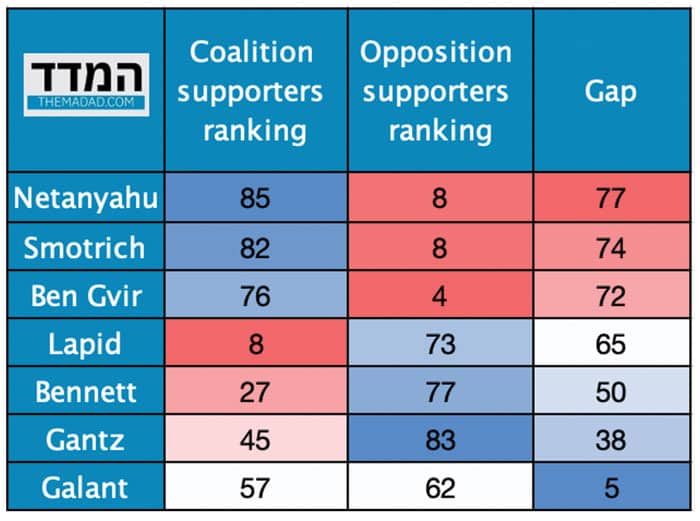
Israelis were asked: how much do you want this person as a national leader? Their responses were translated to a 1 to 100 ranking. Here’s how several notable leaders fared with coalition and opposition supporters. As you can see, some of them are more polarizing than others.
A reader’s response:
Lea Palee wrote: “I am not worried because God is on Israel’s side.” Response: I’m still worried because God was also on Israel’s side on October 7th.”
Shmuel Rosner is senior political editor. For more analysis of Israeli and international politics, visit Rosner’s Domain at jewishjournal.com/rosnersdomain.