fbpx

November 9, 2023

These Old Bones – A poem for Parsha Chayei Sarah

And Isaac and Ishmael [Abraham’s] sons buried him in the Cave of Machpelah in the field of Ephron… ~ Genesis 25:9

Wouldn’t it be nice if we met our
long lost brothers and sisters

at the cave where we buried our
oldest ancestor?

What would we say to them about
how things have turned out?

The grandfather with the open tent
surrounded by descendants

who have closed our tents
who tear down each other’s tents

who don’t remember the gifts he gave us
before we put him in this ground.

Family should never lose touch like this.
Forget what we have in common.

Forget who we have in common.
It’s time for a family reunion.

Let’s head to that old cave.
The bones of Abraham are there.

I can feel them inside my own body.
I know you have them too.


Rick Lupert, a poet, songleader and graphic designer, is the author of 27 books including “God Wrestler: A Poem for Every Torah Portion.

These Old Bones – A poem for Parsha Chayei Sarah Read More »

A Bisl Torah – Be Israel’s Blessing

The Torah teaches that Avraham was blessed in all things. However, the Torah doesn’t specify with what.

At this point in his life, Avraham was wealthy and possessed many material things. But Rebbe Nachman of Breslov suggests that being blessed has little to do with owning things. Rather, he teaches that Avraham was blessed because he finally felt at peace. Peace arrived after he was able to find a proper burial place for his beloved wife, Sarah. In other words, Avraham found peace when he chose to be a blessing for someone he loved…even if she would never know.

Today, asking someone how they are feeling is a tricky question. For many of us, we are scared and tired. Turning on the news feels risky. Who else will call for the demise of the Jews? How else will Israel be vilified in this war of her survival? Of our survival? When someone asks me how I am feeling, I usually look at their eyes and respond, “I probably feel just like you.”

I turn to our Torah for hope. Avraham finally felt at peace when engaged in hesed shel emet, in an act of loving kindness. Clergy explain at funerals that burying the dead is an act that cannot be repaid, a deed that cannot be returned.

Many of us will only feel true peace when the hostages are returned safely to their families and Hamas is completely ousted from Gaza. Yet, we can’t sit on our hands and stay immersed in our grief. Perhaps glimmers of peace will be felt when we choose to stand up, use our voice and find ways to be a blessing to our brothers and sisters in Israel. To be a blessing in ways some of them may never know.

Be a blessing by showing up.

Many in Los Angeles are going to the March on Washington on November 14th. Others are gathering with both Jews and non-Jews in an act of solidarity for Israel on November 19th at 6pm at Sinai Temple, in partnership with the Los Angeles Jewish Federation and many other communal organizations. On November 19th, elected officials and interfaith leaders will speak, reminding the world of our obligation to speak out for democracy and freedom. Join us. It is the least we can do for Israel, our beacon of light, our homeland.

Person by person…mitzvah by mitzvah…heart by heart…perhaps Israel will one day feel at peace because we stood up and chose to be a blessing.

Shabbat Shalom


Rabbi Nicole Guzik is senior rabbi at Sinai Temple. She can be reached at her Facebook page at Rabbi Nicole Guzik or on Instagram @rabbiguzik. For more writings, visit Rabbi Guzik’s blog section from Sinai Temple’s website.

A Bisl Torah – Be Israel’s Blessing Read More »

Seven Steps to Protect Jewish Students: A Follow Up Letter to Cornell Leadership

About two weeks ago, I came across a stinging letter from a Jewish parent of a Cornell freshman that captures many of the safety issues Jewish students are facing today. The letter, written by Daniel Shlufman and addressed to the Provost, started as follows:

Dear Dr. Kotlikoff:

“I am writing to you as both the father of a freshman at Cornell as well as the President of the Jewish Federation of Northern New Jersey, which is one of the largest Jewish organizations in the Northeast involved in fighting antisemitism. I attended the meeting this morning at Hillel where you addressed several hundred parents of Jewish students. I commend you for attending, speaking and listening, and for handling questions and comments from a group of scared and angry parents.

“However, I must also condemn your lack of leadership and that of the entire administration as it relates to the safety and security of the Jewish students on campus. You have tried to remain neutral to a situation where 1400 civilians were brutally butchered, beheaded, raped and burned by an organization that is considered a terrorist group by the United States. You have failed to understand the nuance between condemning Hamas (which is an undeniable evil every bit as brutal, just not as powerful, as the Nazis) and supporting rights for the Palestinian people. The Administration has allowed actions to occur on campus which support Hamas that have come very close to and may have in some cases even rose to the level of the Federal crime of assisting the work of a terrorist group. And even with that, Cornell has avoided commenting and acting to prevent harassment and intimidation on campus detailed below by falsely claiming that Cornell is not a political institution when you have commented and shown leadership when hate crimes were directed at other groups.”

I bring up that letter because this morning, I received a follow-up letter to Cornell leadership from Mr Shlufman and other signatories. We’re reprinting it in full because it contains seven compelling, concrete suggestions to protect Jewish students that can apply to any college.

Open Letter to Cornell University Board Chair, President and Provost

Dear Chair Kayser, President Pollack and Provost Kotlikoff:

We want to begin by thanking you for taking the Jewish concerns seriously by issuing more appropriate statements and laying out some concrete steps to address them. We know how committed you are to keeping the campus safe and maintaining Cornell as a special place for learning. We believe that this is possible, but not without some fundamental changes which we will briefly describe below:

1. Establishing Safe and Appropriate Manners of Protest:

The University owes a duty of care to all students. In practice this means that, though rallies are permissible, they need to be held at appropriate times, in appropriate places and in an appropriate manner.  That is, not marching throughout campus wearing masks and shouting threatening messages so that they interrupt, block and intimidate other students.  If students or staff harass, threaten or intimidate other students, there needs to be harsh, immediate and appropriate administrative and/or criminal punishment, as the case may be.  There also needs to be adequate police presence to assure that all sides are kept safe. This was not the case at the rallies so far on campus.  If necessary, the City, County and State police should be called in to keep anyone physically, psychologically and emotionally safe.

2. Guaranteeing all Students Freedom from Harassment and Intimidation.

Cornell, along with all other universities, has created “safe spaces” for microaggressions. This is all well and good, but you must take this idea and expand it to create physically safe spaces for Jewish students who are actually faced with REAL “macro” not micro- aggressions in hate speech calling for their deaths and the demise of the Jewish State with chants of “No Justice No Peace” and “From the River to the Sea.”  Any act of harassment and intimidation as well as violations of the Student Code of Conduct (as detailed in #6 below) needs to be investigated immediately and then strongly punished by expulsion and/or criminal prosecution.  And, most importantly, the “teeth” behind this policy needs to be made known unequivocally throughout the campus community.

3. Controlling Professors’ Antisemitism, Bullying and Propaganda.

Though professors have First Amendment rights to free speech at Cornell’s NYS colleges (but not at the private ones) and “Academic Freedom” at both, this should only extend so far. In protecting these rights and freedoms, the Administration must ensure that professors in their courses, classroom instruction, on campus and in online speech do not violate Cornell’s ethical and bullying policies; do not engage in harassment or intimidation which many are doing by singling out Israeli or Jewish students by making them feel uncomfortable at best and often threatened at worst which is a violation of Article VI of the Civil Rights Law.

For example, an English teacher this week asked students how they felt about the situation in the Middle East. When most indicated that they felt for the Israelis, she then gave the students information on how many Palestinians were killed and then asked them to go around again to share their feelings after knowing this, which made the Jewish students very uncomfortable.

4. Prohibiting Professors from using the University’s name and leveraging its prestige.

Professors have rights to advocate for their political positions.  However, what they cannot do without the permission of the University is to use the name/insignia of the University in their political letters, petitions and policy statements. This needs to be prohibited as frankly very few of the professors who do that have enough prestige on their own for anyone to care what they say.  It is their affiliation with the University that does this and which the University should prohibit. Moreover, while they can do it as individuals, professors have no right to advance political causes in their capacity as University employees when, for most of them, the venomous and dangerous propaganda they spew has NOTHING to do with either their academic pursuits or areas of expertise.

5. Retooling the Diversity, Equity and Inclusion (“DEI”) Department:

The DEI departments need to be retooled so that: (i) Diversity includes diversity of thought and religion not only physical characteristics or various orientations.  Also, the subjective and impossible to properly quantify concepts of “occupier vs occupied and oppressor vs oppressed” needs to be removed from consideration as a result. (ii) Equity means that Jewish students are treated the same as other maligned minorities, despite our perceived success or “whiteness” (even though more than half of Israel’s Jewish citizens are not Caucasian but Mizrahi/Sephardi or of other races), and when we constitute only about 2.5% of the US population yet are victims of 55% of the hate crimes, and (iii) Inclusion is expanded so that Jewish people are also considered as part of a persecuted group and antisemitism (as per the IHRA definition referenced in #7 below) is not permitted in the academic environment. Those who run the DEI departments need to understand all of this and also need to be held accountable for their intentional or unintentional bias against Jewish students.

6. Defunding and deauthorizing campus groups who violate the Student Code of Conduct.

Many of the student organizations that promote anti-Israel bias are not legitimate student organizations as they outwardly glorify violence, antisemitism, murder, terrorism and hate. Their rallies and slogans of “From the River to the Sea” is, in fact, a call for ethnic cleansing and eradication of Jews and of the State of Israel are clearly in violation of the Student Code of Conduct. Their words, physical intimidation, tearing down of posters; graffiti, vandalism and blocking public walkways and areas with demonstrations while shouting hateful speech are ALL violations of the below enumerated sections of the Student Code of Conduct (the “Code”)

Many of these pro-Palestinian groups engage in conduct that results in “emotional or psychological harm to a person” in violation of subsection IV.B. of the Code (Assault and Endangerment); “threatening behavior, unreasonably loud or belligerent behavior and obstruction of pedestrian traffic” in violation of subsection IV.E. (Disorderly Conduct); “disruption of the lawful exercise of others’ freedom of speech” (e.g. by removing hostage posters) and peaceful assembly (e.g. shouting at students in pro-Israel rallies and shouting down pro-Israel speakers) in violation of subsection IV.F (Disruption of University Activities) and subjecting a group to uninvited and unwelcome behaviors that are abusive, threatening, intimidating and create a hostile environment” (e.g. shouting “Death to Jews”) in violation of subsection IV.J. (Harassment).

7. Involving all the Stakeholders in Fighting Antisemitism:

As other minority communities are rightly involved in calling out and defining bias so should Jewish people as to antisemitism.

a. IHRA Definition. The International Holocaust Remembrance Alliance (IHRA) Working Definition of Antisemitism is the most widely agreed upon definition of antisemitism. Cornell should adopt, this definition which includes, inter alia, , (i) calling for the harming of Jews in the name of a radical ideology (ii) making demonizing and stereotyping allegations about Jews; (iii) denying the Jewish people the right of self-determination (e.g. claiming Israel is a racist or apartheid State); (iv) holding Jews collectively responsible for the actions of Israel; and (v) the double standard of requiring Israel to behave in a way that is not expected of any other democratic nation” (e.g. demanding a cease fire when 240 hostages are being detained by Hamas).

b. Antisemitism Action Committee. Establishing a committee of students, professors, administrators, alumni and parents to work through solutions to campus antisemitism.  This will include some of the concepts above as well as (i) Holocaust and antisemitism education for incoming freshman, student government members, professors and the DEI staff  (ii) revamping courses that are not academic exercises in the history or objectives of the Palestinian people but are excuses for the proselytizing of a political position and the destruction of the Jewish State; and (iii) empowering the committee to react swiftly in recommending appropriately strong consequences to acts of antisemitism by students and staff.

We strongly recommend that you implement all of the suggestions contained herein. Cornell has a unique opportunity to either be at the forefront of finding a solution to this problem or to continue furthering it. Thank you.

Respectfully yours,

Antisemitism Task Force,
Cornell Chapter-Alums for Campus Fairness
Misha Galperin, Parent ‘27
Mimi Klimberg, Parent ‘20, ‘26
Wendy Levitt, JGSM ‘92
Susan Portman Price, ‘90 MRP ’91, P’21
Daniel Shlufman Parent ‘27
Sarah Victor (Chair), ILR ‘1

Seven Steps to Protect Jewish Students: A Follow Up Letter to Cornell Leadership Read More »

Parsha Chayei Sarah and the Shalshelet

Conducted in synagogues all over the world, the recitation of the weekly Torah portion on Shabbat is a basic feature of Jewish communal life. There is something decidedly distinct about how we read our most ancient and holy text. The weekly portion is chanted in a special tune, guided by cantillation marks – Ta’amei HaMikra – that have been passed down for generations.

The word ta’am means both “reason” and “flavor,” and similarly, these cantillation marks serve a dual purpose. Not only do they indicate technical punctuation and emphasis, but the accompanying melody brings out the flavor of the text and can even be viewed as commentary to it.

This week we see the appearance of a rare cantillation mark known as shalshelet.

Appearing only three times in the book of Genesis, shalshelet sounds as conspicuous as it looks. Represented by a vertical zig-zag above a word, it dwells on a single syllable as it carries the voice in steady ascent and descent three times in succession. One time shalshelet appears is when Abraham’s steadfast servant Eliezer prays to God, beseeching Him to help him find a fitting wife for Isaac (Genesis 24:12). Another is when Joseph, the highest-ranking slave in Potiphar’s household, refuses the relentless advances of Potiphar’s wife (Genesis 39:8). We also see the shalshelet when Lot hesitates to leave the city of Sodom which is on the brink of destruction (Genesis 19:16).

At first glance these three episodes seem unrelated. But they are bound together by the mysterious shalshelet. What might these moments have in common? Let’s explore each a little more. In this week’s parsha Eliezer asks God for help in finding a worthy woman for Abraham’s son.

The midrash in Genesis Rabbah 59:9 explains that Eliezer famously hoped that his own daughter might marry Isaac, but Abraham had strictly instructed that he cannot marry a Canaanite woman. Thus Eliezer’s admiration for Abraham both inspired and severed his hope that his daughter might someday be a part of their national destiny. It is a bittersweet moment, and the shalshelet appears when Eliezer must prioritize loyalty to Avraham’s instructions over his own wishes.

Joseph has distinguished himself in Egypt as the head slave in Potiphar’s house when his master’s wife corners him and tries to seduce him. Refusing her means losing everything that he has gained after years of rising through the ranks. In fact, Sotah 36b relates how Joseph was on the verge of sinning with her when his father’s face appeared to him. In Nachmanides’ words, he “allowed his fear of Heaven to be greater than his fear of human beings.” Though Joseph had a million reasons to keep his head down, he stood firm in his convictions.

From these scenarios it seems that a shalshelet appears at critical junctures, when the main figure reasserts their priorities and takes stock of their lives. Let us now proceed to Lot’s hesitation. Rashi tersely explains that he did so “considering to save his money.” This shalshelet seems wildly out of place. Remember, Lot did not hesitate before leaving Abraham’s side, he did not pause before offering up his own daughters to the savage people of Sodom, he did not question or barter with the angels in order to save the city. Worried about money, as his entire world goes up in flames? For shame! But perhaps I am being too harsh; maybe this did cause Lot great anguish. Far be it from me to minimize his pain.

Nevertheless, Genesis is replete with cases of people who must summon courage and tremendous will: Avraham agrees to sacrifice his beloved son whom he was promised; Rachel gives up the man she loves to her sister Leah and Judah offers to take Benjamin place as a slave in Egypt. I can think of dozens of occasions where I would rather place a shalshelet. Not only does this example baffle us with its moral frailty, but Lot hardly does anything here at all. The verse concludes with the angels seizing him and his family members, and removing them from the city. The moment is dashed from his grasp, and the decision is made for him. Lot does not demonstrate even a shred of moral fortitude. So why would this moment be granted a shalshelet of its own?

Considering the entire episode, Lot is confusion itself. He leaves Abraham without a second thought, yet emulates him by inviting travelers into his home at risk of his own life, is then morally repugnant in his effort to protect his guests, discovers they are heavenly messengers sent to destroy the city, heeds their warning to leave, hesitates, then requests that they go to a different safe place than they planned. Worse still is the ease with which he throws his daughters at the feet of savages to appease the mob and protect his guests. His compass of morality has been so distorted by living in Sodom that his considerations in a moment of crisis seem inconceivable.

Don’t you know this city and everyone in it is doomed? Get out of there as fast as you can! Why do you linger, what can you possibly hope to salvage?

Lot’s moral confusion is absurd; it’s terrifying. But this can happen. We know it can; we see it clearly in our present moment. In our times, upstanding citizens have been justifying the terrible murder, torture, and kidnapping of our brothers and sisters in Israel. They believe they are fighting the fight of justice, and in their passion they only feed the savagery.

Shocking examples of moral equivalence are everywhere. Dostoevsky says it plainly in “The Brothers Karamazov”: “Above all, don’t lie to yourself. The man who lies to himself and listens to his own lie comes to a point that he cannot distinguish the truth within him, or around him, and so loses all respect for himself and for others. And having no respect he ceases to love.”

Through the haze of Sodom’s abject depravity and utter disregard for human life, Lot weighed and wavered, and could find only one thing worth saving: and it was not his sons-in-law who had scoffed at his warning. But, sad as this is, it is also profound, and it reveals something striking about biblical storytelling. Evidently, shalshelet does not exist to impress us with moments of grand moral fortitude. Instead we see it magnify and highlight intense moments of doubt and oscillation. Consider how it vocally tracks the decision-making process: “Is it right, is it wrong?” “Is it worth it, is it not worth it?” “Can I face others, can I face myself?” Up and down, up and down, up and down: this is where our greatest power lies, in choosing; this is what makes us human. Yosef was not “simply” good and Lot “simply” pathetic. They were complex personalities, their behavior was not set in stone.

But do not ignore the shalshelet that hangs over our generation in this moment of crisis. It is important that we feel this seesaw, that we understand it as it ascends and descends, ascends and descends, and ascends and descends once again.

The fact that this was an agonizing moment for Lot might turn our stomachs. Don’t get me wrong, I think it absolutely should. The fact that pro-Hamas college students are experiencing a genuine crisis over the issue of a brutal massacre of civilians certainly does. We should condemn their slander, and loudly. But do not ignore the shalshelet that hangs over our generation in this moment of crisis. It is important that we feel this seesaw, that we understand it as it ascends and descends, ascends and descends, and ascends and descends once again. If Hamas is Sodom, Lot is the college student who watches it all, longing to turn around. Times like these reveal the truest questions that our generation is facing, horrifying as they may be — and the squiggly line in this week’s parsha begs you not to forget it.

Shabbat Shalom.

Parsha Chayei Sarah and the Shalshelet Read More »

One Arrested, Three Injured in Confrontation Between Pro-Palestinian Protesters, Pro-Israel Students at Concordia University

One person was reportedly arrested and three were injured in a confrontation between pro-Palestinian protesters and pro-Israel students at Concordia University on Wednesday.

A series of videos of the confrontation, which happened in front of a table set up calling for Hamas to release the hostages, have gone viral on social media. The videos show the pro-Palestinian protesters chanting, “Free Palestine” and “Ceasefire Now” toward the Jewish students. One video appeared to show a female pro-Palestinian protester calling a Jewish student a “f—ing k—” and accusing the student of “pinkwashing.” Other videos appeared to show students shoving each and needing to be restrained and students in an apparent tug of war with an Israeli flag.

The Montreal Gazette reported that, according to Montreal police, a 22-year-old female student was arrested for allegedly assaulting a 54-year-old security guard; a 19-year-old security guard and 23-year-old student also sustained minor injuries in the clash, per the Gazette.

CTV News Montreal spoke to Concordia student Eitan Kovac, a witness to the clash, who said shortly after the table was set up, pro-Palestinian protesters began yelling at them. “People were seconds away from assailing others, throwing stuff,” Kovac told the outlet. “We had a few incidents where people were throwing water bottles at us or decided to come to our booth and try to remove the Israeli flag or to remove pictures or posters of children, infants, elderly or anyone in between that is currently kidnapped and in Gaza.”

The Centre for Israel and Jewish Affairs (CIJA) and Federation CJA said in a press release that the Jewish students “were pushed around, harassed and faced a barrage of hate speech, including slurs,” according to the CBC.

CTV News Montreal also spoke to a witness named Sarah Shamy, a spokesperson for the Palestinian Youth Movement but who is not a student at Concordia. Shamy told the outlet that a group selling Palestinian keffiyehs had booked a table in the same area and time as the Jewish students; she claimed that “the pro-Israel students were very hostile and were using anti-Palestinian names, they were calling people names, they were provoking students, they were getting in people’s faces.” She then alleged that pro-Palestinian students were attacked once they started chanting pro-Palestinian slogans.

A spokesperson for the university told the Journal in an email, “Pro-Israel and pro-Palestinian groups, including students but also people from outside our community, were in the Hall building today. Our Campus Safety and Prevention Services were present and as they were concerned about the safety of people there and an agent was injured, they contacted the SPVM [Montreal police] to clear demonstrators. We do not tolerate intimidation or violence on our campus and we will be looking further into today’s incident. The safety of our community is our priority.”

Concordia President and Vice Chancellor Graham Carr said in a statement on Wednesday, “Today, there were three separate incidents on campus in which violence or incitement to violence took place. These incidents violate our values, our Code of Rights and Responsibilities and, in certain cases, are unlawful. Specifically, a student group issued a social media post that could reasonably be construed as inciting violence. Second, a violent altercation involving some students and some individuals external to our community occurred on the mezzanine of the Hall building. Police were called after two members of our Campus Safety and Prevention Services team who had tried to intervene were physically attacked and an ambulance had to be called. A student was also injured.”

Carr added that swastikas were found in a university building. “The university unreservedly condemns these deplorable acts and will make every effort to identify and bring those responsible to account for their behaviour,” he said.

Carr later said in the statement, “Clearly, the events of today must force each and every one of us to reflect on what we need to do—individually and collectively–to ensure that Concordia remains an extraordinary, vibrant place of teaching, learning and research. Unfortunately, some members both inside and outside our community are deliberately abusing the privileged place that universities afford society as stewards of tolerance, open and respectful exchange. We will continue to meet with student groups and university community leaders to reinforce the importance of upholding our shared responsibilities.”

One Arrested, Three Injured in Confrontation Between Pro-Palestinian Protesters, Pro-Israel Students at Concordia University Read More »

Ghostly Observations of What’s Very Ghastly

Nightmares, panic attacks, hallucinations,

are the symptoms of P.T.S.D. of US marines who have to fire

artillery shells without personal observations

of the mortality that they have caused and are distressingly most dire.


Among the problems about which many of them will complain,

is the appearance of their victims as imaginary ghosts.

Catastrophes that the marines have caused but never seen drive them insane,

marooned in profound mental waters, far from landlubbers’ coasts.


The complications caused by current combats clearly do not differ vastly

from those in Hamlet’s rotten state of Denmark, where they were extremely ghastly.


An investigation by The New York Times https://www.nytimes.com/2023/11/05/us/us-army-marines-artillery-isis-pentagon.html found that many of the troops sent to bombard the Islamic State in 2016 and 2017 returned to the United States plagued by nightmares, panic attacks, depression and, in a few cases, hallucinations. Once-reliable Marines turned unpredictable and strange. Some are now homeless. A striking number eventually died by suicide, or tried to.

Interviews with more than 40 gun-crew veterans and their families in 16 states found that the military repeatedly struggled to determine what was wrong after the troops returned from Syria and Iraq.

All the gun crews filled out questionnaires to screen for post-traumatic stress disorder, and took tests to detect signs of traumatic brain injuries from enemy explosions. But the crews had been miles away from the front lines when they fired their long-range cannons, and most never saw direct fighting or suffered the kinds of combat injuries that the tests were designed to look for.

A few gun-crew members were eventually given diagnoses of P.T.S.D., but to the crews that didn’t make much sense. They hadn’t, in most cases, even seen the enemy.

The only thing remarkable about their deployments was the sheer number of artillery rounds they had fired…..


Gershon Hepner is a poet who has written over 25,000 poems on subjects ranging from music to literature, politics to Torah. He grew up in England and moved to Los Angeles in 1976. Using his varied interests and experiences, he has authored dozens of papers in medical and academic journals, and authored “Legal Friction: Law, Narrative, and Identity Politics in Biblical Israel.” He can be reached at gershonhepner@gmail.com.

Ghostly Observations of What’s Very Ghastly Read More »

A Moment in Time: “Capturing A Moment of Hope”

Dear all,

Every night before bed, Ron and I sing with our kids. We mix folk songs with silly songs along with Hebrew and Yiddish favorites. We never quite know what will stick.

And then this happened…. On Sunday afternoon, as our world continues to absorb the vitriol of those against Israel, Maya asked to sing “Bashana HaBa’a,” a classic Israeli song by Nurit Hirsch and Ehud Manor. The song speaks about how in the year to come, life will be exceedingly good.

As her hands swept the neck of her red ukulele, Maya’s voice sang out with conviction and vibrato. And Ron and I choked up with tears of love.

May this moment in time that Maya gifted us be a prayer to heaven that there is always hope.

With love and Shalom,

Rabbi Zach Shapiro

A Moment in Time: “Capturing A Moment of Hope” Read More »

The Kosher Kitchen Caper: Navigating the Holy Grail of Jewish Gastronomy for the Non-Observant

When you get the coveted invite to your observant relatives’ home for a meal, you might find yourself in the dietary equivalent of an escape room: the kosher kitchen. For the uninitiated, this isn’t just a place where meals are made; it’s where culinary alchemy meets Levitical law, and it’s guarded more fiercely than Grandma’s secret brisket recipe.

First, you’ll notice two sets of everything — two sinks, two dishwashers, and enough cutlery to supply a small banquet at King Solomon’s table.

First, you’ll notice two sets of everything — two sinks, two dishwashers, and enough cutlery to supply a small banquet at King Solomon’s table.

Why, you ask? One set is for meat, the other for dairy. Mixing them up could create more family drama than accidentally bringing up politics at the dinner table.

As you tiptoe around, hoping not to inadvertently cause a utensil apocalypse, you’ll realize that the word “separation” doesn’t just apply to your aunt and uncle’s assets during their (three) divorces. Meat and milk must be kept apart like feuding relatives. In fact, if they had dating profiles, meats would say, “Looking for someone who’s NOT into cheese.”

Now, let’s talk about the dishwasher. It’s like a sacred temple — you must never place meat plates where dairy ones have gone, and vice versa. Do it wrong, and you may as well have started the next family feud. The stakes are higher than a rabbi at a limbo contest.

And don’t forget the surfaces. They’re cleaned more thoroughly than a germaphobe’s doorknobs during flu season. If you spill a drop of milk on the counter, you might as well have splashed paint on a Picasso.

Even the humble oven gets in on the act. It has to be “koshered” with a self-clean cycle that could incinerate any evidence of a culinary crime scene. Your relatives might casually mention they’re “burning the oven,” which sounds alarming until you realize it’s just a deep cleanse worthy of a spa retreat for appliances.

If you’re brave enough to actually engage in food preparation, remember that there are more rules than a board game designed by a lawyer. The simple act of cutting a cucumber demands a moment of reflection: “Is this a dairy cucumber or a meat cucumber?” Yes, vegetables have identity issues in a kosher kitchen.

In this holy grail of gastronomy, labels are everything. There are little stickers and markers that make a kindergarten teacher’s supply cabinet look unorganized. And they’re color-coded with more precision than traffic lights at a four-way intersection. Blue for dairy, red for meat, green for pareve (that’s the Switzerland of kosher food — neutral).

Oh, and heaven forbid you should open the wrong refrigerator. Yes, there’s more than one, and they’re not just for stocking an apocalyptic amount of food. They separate the sacred meat from the holy dairy like a culinary Berlin Wall.

Remember, when in the kosher kitchen, you’re in a land where the chicken soup is sacred, and the cheesecake is a dairy deity. The blending of the two would be nothing short of culinary blasphemy. So, tread lightly, follow the rules, and with a bit of divine intervention, you’ll enjoy a meal that’s both delicious and halachically harmonious.

After all, it’s not about the food — it’s about the family. And nothing brings a family together like trying to explain to Uncle Bob why his innocent cheeseburger is a religious rebel. So, laugh, learn, and maybe — just maybe — try not to land yourself in kosher jail for a food faux pas. It’s all part of the great adventure of interfaith family dining!


Esther Basha is founder and director of International Torah Academy, former editor-in-chief of Piano Performer Magazine and is currently finishing her Ph.D. in Sacred Linguistics. 

The Kosher Kitchen Caper: Navigating the Holy Grail of Jewish Gastronomy for the Non-Observant Read More »

Mitch Albom’s ‘The Little Liar’

Mitch Albom’s latest novel,”The Little Liar,” is a parable, set in and around the Holocaust. It explores honesty, survival, devotion, revenge and redemption.

“It’s like my ninth novel, but it is the first story that is set during World War II,” Albom told the Journal. “Growing up Jewish, I always felt that I had an obligation at some point to add to the literature of the Holocaust.” 

He added, “We’re at that very delicate stage where people are forgetting or even worse, they’re rewriting history, and they’re trying to tell people that it didn’t happen or wasn’t as bad as people thought.”

The book, Albom explained, focuses on lying, how the truth was perverted during World War II and the costs of losing the truth to both the people who perpetuated it and their victims.

There’re so many great stories that have been done already about … and during the Holocaust. It took me a long time, and I finally found a story that I feel is original.” – Mitch Albom

“There’re so many great stories that have been done already about … and during the Holocaust,” the author, journalist, broadcaster and philanthropist said. “It took me a long time, and I finally found a story that I feel is original.” 

In “The Little Liar” Albom weaves together the stories of Nico (the title character), his brother Sebastian and their schoolmate Fannie with that of the Nazi officer who changed their lives. He not only shares how each of the children survived the war, but their journeys in the years that followed. 

The story starts in Greece, another point of originality, as many Holocaust stories take place in Poland or Germany. 

“Very few people know that Greece also was decimated by the Nazis, and that the city of Salonika, or what they call now Thessaloniki, the largest Jewish population city in all of Europe,” Albom said. “And the Nazis came in and just wiped it out.”

In the book, 11-year-old Nico, who was known for never telling a lie, gets tricked by the Nazis into convincing his Jewish friends and neighbors to get on the train to Auschwitz.  

They tell Nico that there will be jobs and homes waiting for them; everyone is going to a safe place. 

Not only does Nico believe this to be true, the Nazis tell him that if he shares this information, his family will be okay and that he’ll be reunited with them. 

“At the very end, on the last train out, [Nico] sees that the Nazis are putting his family on the train, and he goes to be with them screaming,” Albom said. “He finds out that they’ve been lying to him this whole time, and that he has inadvertently helped send everybody he’s known and loved off to their deaths.” 

On top of this, the Nazi guard who tricked Nico keeps him from getting on the train, separating him from his family. 

From that point forward, Nico no longer has the ability to speak the truth. He can only lie. 

“That changes his life, not only during the war, but for the decades that follow,” Albom said. 

“The Little Liar” comes out on November 14. The Journal spoke with the author on October 10, just three days after the massacre in Israel that incited the war. 

“They’re releasing reports of this music festival in the South, where they came in they found a tent with bodies just killed, maimed, throat slit, whatever, and lied on top of one another, which is exactly what the Nazis did,” Albom said. “When I heard [how they] stacked dozens of bodies on top of one another, having done all this research for the book, and knowing how common that was for the Nazis to use, it was bone  chilling.”

Writing and publishing a book takes years, and this kind of timing never could have been predicted. 

History teaches that if you ignore the past you are doomed to repeat it. Albom hopes ‘The Little Liar’ gets people to think, as he hopes happens with all of his work. He hopes people come away from this book with a renewed appreciation for the truth. “The Little Liar,” he said,  has overtones of today, not just with what’s happening in Israel, but the way people choose their own truths. 

“There is no universal truth. It’s just the truth that we choose to believe. … As long as we surround ourselves with like- minded people we don’t hear contrary points of view—or we cancel contrary points of view, then we’re not really being true to the truth. We’re taking the truth and filtering it through our own [lens].”

Although it has its horrific scenes, “The Little Liar” is not a negative book. “Obviously, you can’t write a book that takes place during World War II with the Holocaust without some scenes that are kind of jolting,” he said. “But I try to always provide hope and inspiration in the books that I write.”  

The book is narrated in the voice of the truth. “The truth speaks frequently about, ‘Why do you pervert me? Why do you bend me? Why do you shape me?’” Albom said. “Hitler did it, and that’s how Hitler rose to power. … And it’s being done today all over the world by people who are taking the truth and just spinning it until they get people to believe what they want to believe.”

He also hopes readers will be moved by the resilience of children and the hope they provide.  

Albom, who runs the Have Faith Mission & Orphanage in Haiti, has traveled there every month for the last 14 years. “I’m sure the kids at that orphanage inspired a lot of the characters in ‘The Little Liar.’” 

Albom wants readers to think about the truths and lies in their own life, and how much lying or falsehood is rolled into their existence. 

“I hope that if we give that a little bit more thought, and we’re a little bit more honest with one another, we’ll have a little bit more of an honest world.”

Mitch Albom’s ‘The Little Liar’ Read More »

Rabbi’s View of Israel War in First Person

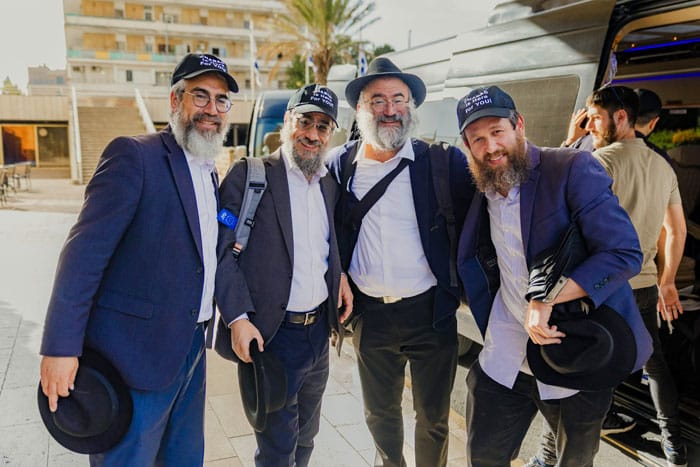
From the moment they landed in Tel Aviv on October 23, the two dozen Chabad rabbis on a humanitarian mission — bringing thousands of dollars and thousands of toys to Israel — knew they were in a war zone. 

“What made it real immediately was to hear sirens,” said Rabbi Yanky Kahn of Chabad of the Valley said. “For Americans, we think it’s a joke. ‘Oh, rockets are flying.’ We don’t realize the danger since we see it electronically on our phones.” But their message was the same at every stop: “We came here to tell you we love you. You are not alone. We care for you, and we are trying to help relieve your pain.”

When they arrived at a hospital, he saw people with no arms. No legs. “Life has changed for them, for the wives, the children, the extended family. This is real war,” he said. “People get stabbed, shot. Rockets go into homes.”

On their first day, the rabbis met with families of the hostages. Many were hanging out at a law firm. “They were full-time busy, collecting money, accepting hugs, and just saying ‘pray for our kids.’” From there the traveling rabbis went to the Western Wall with the chief rabbi of Israel and the chief rabbi of the Kotel.

Twenty-five miles east of Tel Aviv, the rabbis entered Peduel, a West Bank settlement. “We saw kids building a wall, by themselves, for protection. Like 1946. Little children, taking rock by rock, just trying to protect themselves in case someone ever does break through the gate.”

When the rabbis went to breakfast the next morning, they saw numerous women holding babies, and Rabbi Kahn began handing out money. When he walked off to different groups of adults and children, he started handing out iPads for the kids. “Some people spoke, some couldn’t speak,” he said.  They repeatedly saw houses with large rocket-caused holes. 

“Rockets, rockets, rockets falling,” Kahn said, “and you understand how people are struggling. Ashkelon is not a wealthy city. Many residents were going to stay by cousins and others.” When a woman approached the rabbis, they handed her $100. “She didn’t really want the money,” Kahn said. “She wanted food.” There is no way to measure the starvation since Oct. 7, Kahn said, “but I can tell you that we gave out a lot of money, a lot of hugs, and a lot of stuff. We tried to change the dynamics.”

Next stop was the Command Center of Ashkelon where the visitors were given a demonstration of how the military seeks to protect the populace when a rocket falls. The rabbis donated $30,000 to buy protection — in the form of helmets and vests  — for Ashkelon residents. “We gave out a lot of money,” said Rabbi Kahn. “Each place we went, we gave money.”

Sderot, a Western Negev city of 30,000 in the shadow of Gaza, was the next stop. Traveling in three vehicles, the rabbis traveled the same roads where the terrorists drove freely. Did they ever fear for their safety? “I felt safe,” Kahn said. “I wasn’t really scared because I was in Israel.” They stopped at the only store that was open, Chabad of Sderot. The Israeli rabbis hosted a food bank, and they distributed free food. 

At an IDF base, the message from the soldiers to the visiting Chabad rabbis is “We Love You.”

Rabbi Kahn met an IDF soldier who on her day off, comes to volunteer, packing and delivering food to people. Another volunteer had just lost her sister in a shooting. “These people are going through difficult times, but they still are volunteering,” Kahn said. 

But unsurprisingly, in the midst of tragedy, schoolchildren are the most obvious losers. Most, but not all, schools are shuttered. 

For the luckier youngsters, “it is how however many children will fit into a bomb shelter,” Kahn said. “A hundred want to enter, but there is only room for 20. In other cases, there only is room for eight. There are schools where they will take one group of students for half a day, and a different group for the other half of the day.”

In Beersheba, at a hospital filled with terror victims, the rabbis were shocked and saddened again to encounter what Kahn called “just regular people” suffering massive physical losses. Victims who had lost their legs in bombings were a repeated sight. 

The rabbis met a man who was driving to Mincha when Hamas struck. When he stepped out of his car to flee to shelter. “His wife was there. His kids were there. His brother was there. Now this whole extended family – their lives were changed forever because of the rockets.”

“There is more to do. Here in America, we cannot say ‘I gave $100 to charity, and I have done my part’ or ‘I bought 100 flashlights on Amazon, and I am done.’” – Rabbi Yanky Kahn

He acknowledged that war in-person “looked a lot more real than I knew before I left.” The Chabad of the Valley rabbi said the trip to the war zone “was only the beginning. There is more to do. Here in America, we cannot say ‘I gave $100 to charity, and I have done my part’ or ‘I bought 100 flashlights on Amazon, and I am done.’” This is war, he said “for every Jew around the world. It can happen in Russia. It can happen in Studio City. It is happening. We have to do a lot of prayers, and a lot of acts of goodness and kindness.”

When Rabbi Kahn walked to the Western Wall on Shabbos, he passed a scene that once would have shocked him – a hotel had become an emergency home for displaced families.  Finally, he related a scene encountered on the way back to Los Angeles. 

“We met two women from Encino where there is a kosher restaurant called Sassi. One woman was by the [music] festival with her father, a party of eight. Her father got shot.” A Druze man came by and said ‘they’re coming to shoot you, they’re coming to shoot you.’ All of them ran into a bunker. and when Hamas came, the Druze man said in Arabic to the terrorists, ‘Leave them alone. They are my family.’ He was attacked, but no one knows what ever happened to him.” About 30 people were in the bunker. “When the terrorists came, “they were shooting at everyone and throwing grenades. The woman survived by putting her father’s dead body on top of her. She took the jewelry off the dead bodies so the Arabs would not see and steal it. She told her husband to lie quietly. “She took blood from people who had been on top of her and other dead bodies and sprayed it on her. “She laid there for seven hours. Every half hour, the terrorists would come by and shoot, making sure everyone was dead. After seven hours, she heard a father calling out for his daughter. Then she knew it was safe to go out. Of the party of eight, only four survived. The woman had been shot in the leg, and when she went to a hospital, they told her they had no time to take care of her injury because it was not life threatening. She went to a different hospital.  “That woman,” Kahn said, “was the daughter of the owner of Sassi.”

Finally, the rabbi said a central lesson from the trip was “Israel’s pain is our pain.”

Rabbi’s View of Israel War in First Person Read More »