fbpx

October 28, 2023

Magen Am Offering Protection, Safety Tips to LA’s Jewish Community

Since the October 7 massacre in Israel, Magen Am USA, a nonprofit organization that trains and empowers members of the Jewish community in Los Angeles, has been busy protecting neighborhoods, communicating with LAPD and touching base with schools and synagogues to keep them safe.

“Our hearts are heavy during this challenging time, and we are keeping Israel in our prayers and close to our hearts,” said Rabbi Yossi Eilfort, founder of Magen Am. “We’re in constant communication with local law enforcement, and at this time, there is no known threat to the community. However, our guards and community leaders have been fully debriefed and are maintaining a heightened sense of awareness. We’ve taken extra measures to provide guidance and support during this horrific time for us all.”

The LAPD increased their patrol and informed Magen Am there were no direct threats, and the group met with local command staff in a few divisions in LA to help coordinate their deployment.

“Additionally, we’re proud to share that Magen Am has been added to the Sheriff’s West Hollywood station emergency plan for the Jewish community,” said Eilfort, whose team patrols the La Brea Jewish community next to West Hollywood.

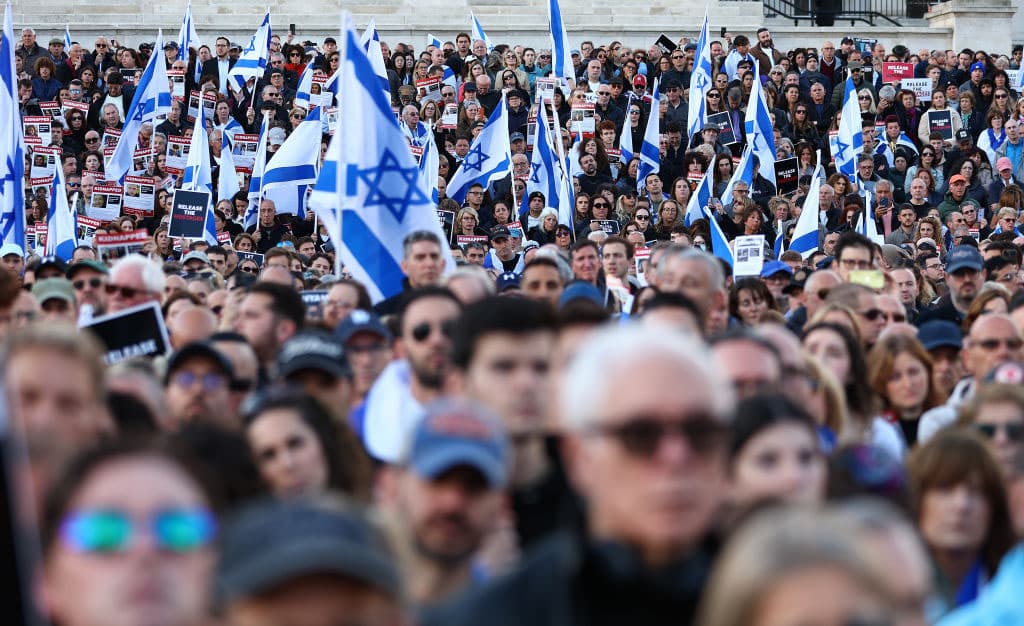
Magen Am also provided armed security at the various pro-Israel rallies and prayer gatherings throughout the city, and increased security at Jewish institutions on the Global Day of Jihad on October 13. The organization met with rabbis to discuss the community’s approach to security and halacha and it’s welcoming in more volunteers.

“We were able to secure various pro-Israel influencers following death threats, which Magen Am is reporting to its appropriate law enforcement partners,” said Eilfort. “We [also] provided practical guidance on increasing security and being more situationally aware both in person and through social media posts.”

The organization, which offers firearms training to members of the Jewish community, is giving tips to stay safe at a time when antisemitism is on the rise and pro-Palestinian protests are taking place around the world, including here in Los Angeles.

Recently, at a USC rally for Palestine, the student protestors called for the Intifada, and during the pro-Israel rally on Pico Boulevard on October 15, a hotel guest on Pico gave the crowd the middle finger. Beverly Hills Radiologist Dr. Andrew Thierry posted antisemitic tweets and was quickly fired from his job at ExpertMRI, and according to the ADL, on October 10, a person shouted, “I am Hamas” and made death threats to Jews who were standing near a kosher restaurant.

According to Eilfort, it’s crucial at this time of increased antisemitism to supervise children on the way to shul programs and school, to not congregate outside of schools and synagogues and to have guards and/or parents supervising carpool drop-offs and pickups.

It’s important to trust your gut, be aware when walking and not to use your phone or congregate in public. If someone starts up with you, or films you, don’t cower, but you also shouldn’t engage in a fight. If they are filming, film them back. And if someone drives by and shouts at you, write down a description of the car and the driver as well as the license plate number.

“We’d like for the community to be proud Jews,” said Eilfort. “Now is the time for us to be in support of one another. Keep your head held high and on a swivel. Be prepared and not paranoid. And trust your gut.”

Magen Am Offering Protection, Safety Tips to LA’s Jewish Community Read More »
When Universities “Twin” with Terror

Fatah Shabiba, the second-largest student group at An-Najah University, has been tweeting non-stop praise of the pogromists. Yet so far, the numerous Western universities and student unions that have relationships with the university have said nothing.

An-Najah is the largest university in the Palestinian Authority-governed territories. Hamas has 40 seats on its student council, Fatah Shabiba has 38. Fatah Shabiba is the student wing of Fatah, the ruling faction of the PA.

On the day of the massacres, Fatah Shabiba posted a photo of terrorists from Hamas and Fatah’s Al-Aqsa Martyrs’ Brigades together in the back of a pickup truck, apparently taking part in the invasion of Israel.

The accompanying text declared: “On the ground we stand as one, each one is defending from their stronghold, and there is no difference between two people who are defending the same homeland. May the men’s forearms be blessed, and may the result be blessed.”

The next day, October 8, Fatah Shabiba posted a photo of masked terrorists with Fatah headbands, above this caption:  “We are the proud ones, when disasters come, we stand against them like a volcano—the Al-Aqsa Martyrs’ Brigades – #The_Al-Aqsa_Flood.” The term “Al-Aqsa Flood” is the name by which Hamas calls its pogrom.

On October 10, Fatah Shabiba’s Twitter (X) account featured another photo of Fatah terrorists, with automatic rifles. The text called them “Men who loved the Al-Aqsa Mosque [and] the [Al-Aqsa Martyrs] Brigade and [the Al-Aqsa] Flood.”

Two days later, a message from Fatah Shabiba called on Arabs throughout the PA territories to “go to the points of friction with the occupation, to avenge the blood our heroic Martyrs, and to support the resistance in the proud Gaza Strip.”

(Translations courtesy of Palestinian Media Watch.)

In recent years, a number of Western universities and student unions have “twinned” with An-Najah, sponsoring joint programs and visits by faculty and students.

The list includes McGill University, in Canada; the University of Applied Sciences in Darmstadt, Germany; the University of Abertay in Dundee, England; the University of Naples Federico, in Italy; Norway’s Stavanger University; and student unions at three British universities—the University of Essex, the University of Manchester, and the London School of Economics.

What motivates Western universities to seek relationships with an institution that tolerates support for terrorism? Why haven’t any of them threatened to sever ties with An-Najah unless it shuts down Fatah Shabiba?

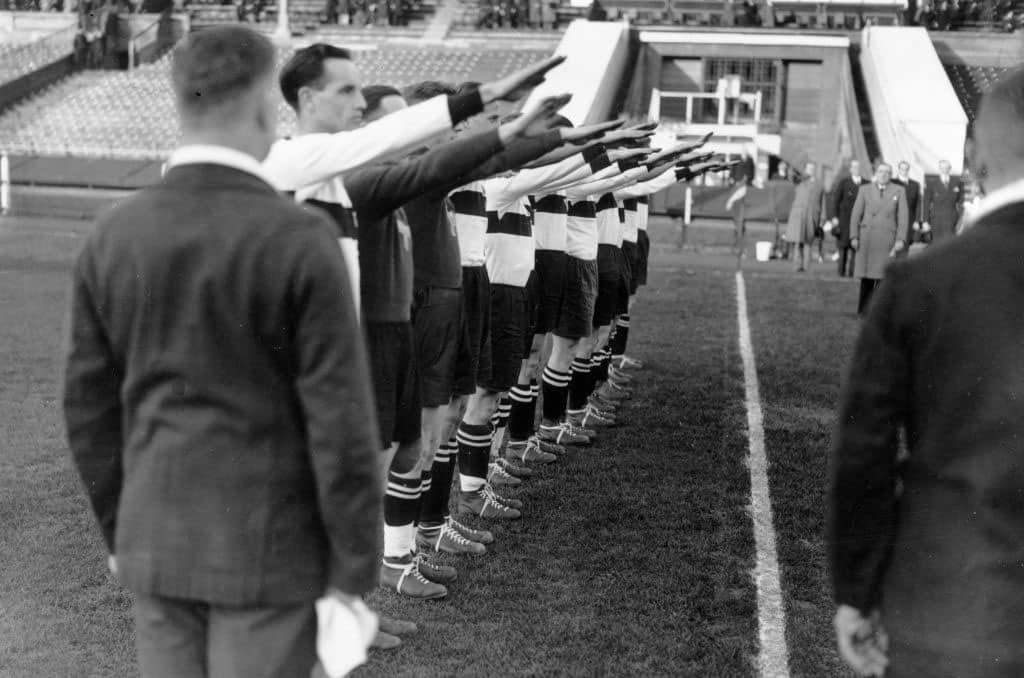
Perhaps the answer may be found in the history of American universities twinning with schools in Nazi Germany in the 1930s. Just as An-Najah craves international ties in order to soften its pro-terrorist image, the Nazis regarded relationships with U.S. universities as opportunities to improve their image abroad. The New York Times reported that one Nazi official described German exchange students as “political soldiers of the Reich.”

Many American students and faculty who visited Germany returned with friendly assessments, according to Stephen Norwood’s landmark study, The Third Reich in the Ivory Tower. Columbia University dean Thomas Alexander came back convinced that Hitler’s forced sterilization policy was a good way of “throwing out the criminals and other undesirables.” American University chancellor Joseph Gray reported that German cities were “amazingly clean” and that “everybody was working in Germany.”

The most active participants in the student exchanges with Nazi Germany were the “Seven Sisters” colleges—Barnard, Bryn Mawr, Mount Holyoke, Radcliffe, Smith, Vassar, and Wellesley. Their enthusiasm was not dampened by the Nazi regime’s oppressive policies toward German women. After visiting Germany in 1935, Barnard dean Virginia Gildersleeve called Hitler’s territorial expansion plans “legitimate” and said Nazi limits on the enrollment of women in universities were justified because some professions in Germany were overcrowded.

Vassar student Mary Ridder, who spent her junior year at the University of Munich, told her campus newspaper in 1934 that she used to think the Nazis were as bad as the Ku Klux Klan. “But while I was in Germany, I met Hitler and had a long conversation with him,” she reported. “Now I see him as a truly national person who beyond a doubt feels he is looking out for the best interests of his country.” As for Germany’s Jews, “None of the Jews who fought at the front [in World War I] have been molested,” she erroneously asserted.

Harvard accepted an invitation to take part in anniversary celebrations at the Nazi-controlled University of Heidelberg in 1936. Its president, James Conant, said “political conditions” should not be allowed to interfere in friendly relations between the two institutions.

Columbia also accepted the invitation. Its representative, Prof. Arthur Remy, declared upon his return that the event was “impressive and dignified.” He found the reception for the American delegates, hosted by Nazi propaganda minister Josef Goebbels, to be “very enjoyable.”

A number of American universities took part in the bicentennial celebration at the Nazi-controlled University of Goettingen in 1937. That event took place in “a thoroughly National Socialist atmosphere,” according to the New York Times. Among the U.S. delegates was the chairman of Cornell University’s German Department, Prof. A. B. Faust, who accepted an honorary degree and gave the Nazi salute during the ceremony.

What motivated those who befriended Nazi universities in the 1930s? Some wanted to demonstrate open-mindedness and a spirit of academic camaraderie. Some naively believed they were taking part in legitimate scholarly endeavors. And none of them showed any concern for the suffering of the Jews in Nazi Germany.

If An-Najah takes no action against Fatah Shabiba, and Western universities and student unions continue to partner with An-Najah, one may justifiably wonder whether the mindset among many in the academic world today has changed very much since the Nazi era.


Dr. Medoff is founding director of The David S. Wyman Institute for Holocaust Studies and author of more than 20 books about Jewish history and the Holocaust. His latest is America and the Holocaust: A Documentary History, published by the Jewish Publication Society & University of Nebraska Press.

When Universities “Twin” with Terror Read More »

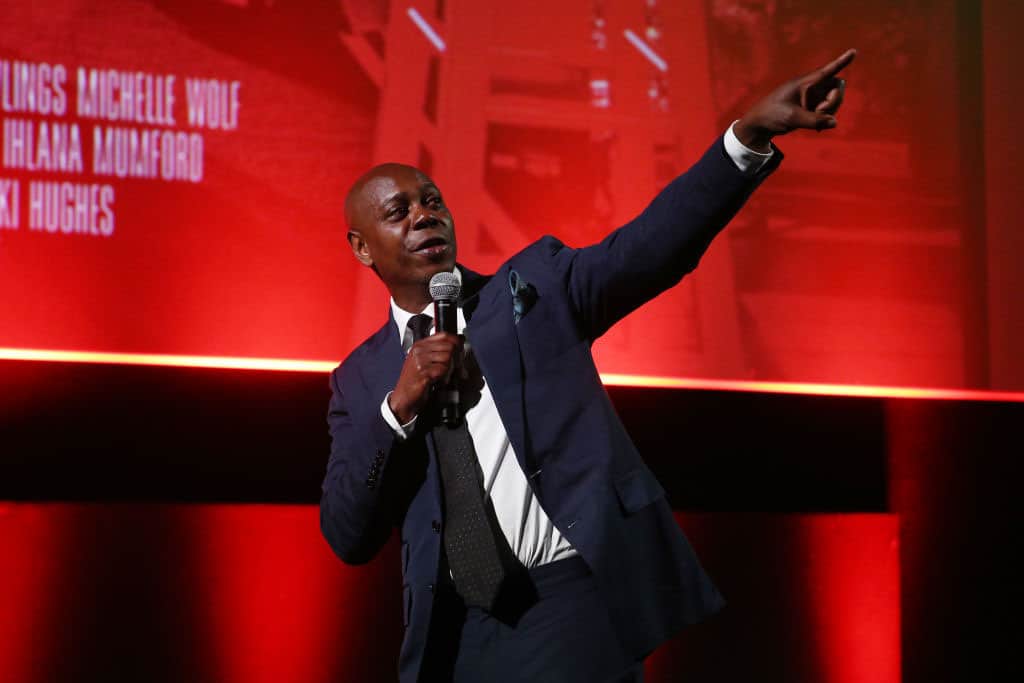
Dave Chappelle Says His Comments on Israel-Hamas War Were “Misquoted”

Dave Chappelle is now saying that he was “misquoted” in reports that he accused Israel of committing war crimes in the Gaza Strip.

The Wall Street Journal had reported that during his October 19 show in Boston, Chappelle went into an emotional rant criticizing Israel for cutting off water, electricity and fuel from the Gaza Strip and accusing the Jewish state of killing innocent civilians and committing war crimes. This reportedly prompted a walkout from some audience members. The New York Times reported that Chappelle addressed his remarks during his Wednesday show in Raleigh, North Carolina.

“I’m in trouble because the Jewish community is upset,” Chappelle said. “No matter what you read about that show in Boston, you will never see quotation marks around anything I said. They don’t know what I said. It’s all hearsay.” He added: “The other night, I said something about Palestine in Boston and got misquoted all over the world. And I will not repeat what I said.”

A female audience member then shouted, “Free Palestine!” “Please, please, miss,” replied Chappelle. “Listen. Don’t start it up or I’m going to be in the news cycle for another week. This thing that’s happening in the Middle East is bigger than everybody.” The 50-year-old comedian continued: “I understand what’s happening in Israel is a nightmare. What’s happening in Palestine is a nightmare.”

He added: “There’s only two kinds of people in the world: people who love other people and the people that have things to make them afraid to love other people. Pray for everyone in Israel. Pray for everyone in Palestine.”

The Times also reported that there was a “commotion” in the “upper level” of the arena during the show, prompting Chappelle to joke: “That still might be the Jews coming for me.” He then reportedly stretched out the word “sorry” and said, “I don’t want the Jews to know what I said.”

Chappelle addressed the Israel-Hamas war again the following night in Charlotte, according to a review from The Charlotte Observer. “As an American, I think we should all make our countrymen who are Jewish feel safe,” the Observer quoted Chappelle as saying. “We should make ’em feel safe, so that they don’t feel like they have to support the destruction of another people to be safe.” The comedian then said that “Israel and Palestine are married to one another” and “whether they like it or not, they’re gonna have to figure that s— out.”

Dave Chappelle Says His Comments on Israel-Hamas War Were “Misquoted” Read More »

How October 7 Has Reignited Jewish Peoplehood

Something noteworthy is sweeping through much of the Jewish world.

Jews have bonded over disgust.

They’re disgusted, first, by the savage murder, rape, torture, kidnapping and mutilation of more than 1400 Israelis of all ages at the hands of Hamas on October 7.

But they’re disgusted, too, by the stunning explosion of Jew-hatred around the world and on college campuses. This explosion, it must be noted, didn’t wait for Israel’s retaliation; it came immediately after the massacres.

It is this one-two punch of revulsion– for the massacres and the rise in Jew-hatred—that has ignited a level of Jewish solidarity I have rarely witnessed.

The hate we’re seeing feels so deep, so visceral, so threatening that there’s a wartime level of urgency within the Jewish community. Those marching against Jews and in support of Hamas murderers in major cities and on college campuses have shaken even the more cynical among us.

When my peace-loving college daughter hears protesters on campus yell, “We don’t want no two states, we want all of it!” she and her Jewish friends are not thinking peace—they’re thinking fear. They’re thinking the end of Israel. They’re spooked.

When my peace-loving college daughter hears protesters on campus yell, “We don’t want no two states, we want all of it!” she and her Jewish friends are not thinking peace—they’re thinking fear.

That fear is bringing them together.

The barbarians who butchered as many Jews as possible on October 7 didn’t give a hoot whether these Jews were young, old, male, female, gay, Reform, Orthodox, Haredi, Mizrachi, Ashkenazi, left, right, Likud, Labor or whatever.

For them, and for Jew-haters everywhere, every Jew is in the same boat.

“We’re all in the same boat” is precisely the electric current now coursing through Jewish veins. A global army of individual Jews and Jewish groups from across the spectrum have mobilized to help Israel any way they can, from fighting the information war on social media to raising funds for victims to organizing rallies and “bring them home” marches to taking on university leaders for not protecting Jewish students to shipping emergency supplies to Israel.

No one is worried about Jewish labels. The urgency of the moment is too great.

Critics who glibly call for a “ceasefire” misunderstand what Israelis are going through. Israel has survived for 75 years in a supremely hostile region because its sworn enemies were intimidated by Israel’s might. Wonks call it deterrence; we can also call it strategic fear.

In a Mideast jungle where the common language is force, if Israel’s enemies are no longer afraid of the Israel Defense Forces, that’s big news. The word gets out.

Oct. 7 did much to erode the fear of Israel, and the word got out.

Suddenly, the strongest army in the Middle East was humiliated. It couldn’t defend its own people against a gang of terrorists. For once it looked weak and vulnerable. The enemy smelled blood.

Israel’s harsh response in Gaza is not about vengeance. It’s about survival. It’s about regaining deterrence. Israelis know that if they can’t put fear back into their enemy’s hearts, their existence is in play. That’s why Israelis from the left and right have supported aggressive action against Hamas. It is a statement to all hostile forces in the region: We’re still that Israel you better not mess with.

Israel’s harsh response in Gaza is not about vengeance. It’s about survival. It’s about regaining deterrence.

In such a life or death situation, it’s hard for Israelis to take calls for a “ceasefire” seriously.

This existential anxiety has also touched and united the Jews of the Diaspora. We’re seeing the faces of the haters, ripping down posters of hostages and brazenly calling for the end of the Jewish state. We’re seeing the triumphant body language. We’re seeing how these haters and Hamas supporters also smell blood.

It’s not only disgust, then, that is uniting Diaspora Jewry—it’s also an existential dread. It’s a realization that the weakness Israel showed on October 7 has triggered a dangerous, long-dormant dream among our enemies that “maybe now we can finish them off.”

If this kind of shared menace doesn’t unite Jews, nothing will.

In all the darkness, though, there is an upside to this unity– it is the rekindling of Jewish peoplehood.

Jewish identity has always been multi-faceted. Judaism is a religion, a culture, a nation, a civilization, a people. By bringing Jews of all backgrounds together, the existential crisis coming out of October 7 has reminded us that we are, above all, a people.

Yes, we seem to always wait for danger to unite us. But so what? We’re only human. This is how humans react.

Perhaps because of the unprecedented horrors of October 7, the solidarity this time may be more sticky. We can only hope that our renewed sense of peoplehood will outlast this most painful of moments in our modern history. It would certainly make us stronger and less vulnerable.

If our enemies treat us as one, who are we to disagree?

How October 7 Has Reignited Jewish Peoplehood Read More »