fbpx

August 16, 2023

What’s More Powerful than Happy? How About Happy Enough?

My friend Sheila Katz, who runs The National Council of Jewish Women (NCJW), said something the other day that I can’t get out of my head.

She was reacting to the decision of a fellow progressive organization to resign from the Conference of Presidents of Major American Jewish Organizations, an umbrella group that aims to provide a unified voice for dozens of Jewish groups.

“I respect their decision,” she told JNS. She added that she “wouldn’t be upset” if the conference was more vocal about “broader issues of democracy in the U.S. and Israel,” but understands the conference’s purpose to be creating “the broadest tent possible.”

“It’s not meant to make us happy,” she said. “It’s meant to make us happy enough.”

Those are the words that stuck with me—happy enough. Katz acknowledged that she wasn’t getting everything she wanted, but that was not so bad to make her want to leave the group. She was happy enough.

As I reflected on those words, it struck me that “happy enough” tends to bring out our humanity. We recognize the reality that other people and groups have different views and agendas. We push for our agendas and truths, yes, but we don’t push so hard that it makes us want to break away.

“Happy,” on the other hand, feels more finite. We’re either happy or we’re not. We tend to go for all the marbles trying to reach that finite, elusive point. Aiming so high, however, encourages neither compromise nor gratitude.

Much of modern life sucks us into a “happy” trap. Are we happy? Are we doing everything it takes to be happy? It’s even enshrined in our Declaration of Independence—the pursuit of happiness, the implication being that we should never be satisfied until we reach that sublime state.

The catch with this fervent pursuit  of happiness is that it can make us ripe for disappointment. The very notion of being consistently happy feels delusional. Our days are filled with moments that bring us frustration, outrage and melancholy. If we judge these moments by the standard of happiness, we’re bound to see them as failures.

That sense of failure is less likely to flare up when our standard is “happy enough.” Happy enough, by definition, allows for stumbles, mistakes, even tragedies. Our expectations are aligned with reality, so we’re better able to handle the inevitable dips of life.

Aiming for happy enough is especially important in our relationships. If we don’t need to push for everything we want, we become better listeners. We embrace other truths, other needs, other agendas, enabling us to practice the healing art of compromise. By not aiming so high to satisfy our own desires, we end up elevating the happiness of others, and, in the end, it’s the relationship that wins.

This also holds true in communal life. So much of the dissension in the Jewish world is rooted in the inability or unwillingness to give an inch, as if compromise itself is a sign of weakness. In truth, it’s a sign of strength and even success. When people compromise, it’s the community that wins.

In the Garden of Eden, God told Adam, “You may enjoy the delicious fruit of all trees here, except for one.” Aiming a little too high, Adam chose the forbidden fruit. He hadn’t yet learned the lesson of gratitude– enjoying the gifts that God has given us. He wouldn’t compromise on his appetites.

It’s true that we should all have red lines that we never cross. But those sacred boundaries should be special and rare, because the fewer there are, the more they will be respected. Aiming for happy enough allows us that space to occasionally put our foot down.

With the days of Elul upon us and Rosh Hashanah around the corner, we get to look back and reflect on our actions of the past year. We might want to consider our approach to happiness. Did we aim too high for our own happiness? Did it come at the expense of others? Were there times when “happy enough” would have been more than enough?

Maybe one of the lessons from my friend Sheila Katz is that when it comes to happiness, the modest “happy enough” is often the wise course. But when it comes to things like goodness and kindness, it’s perfectly OK to go all the way.

What’s More Powerful than Happy? How About Happy Enough? Read More »
From Silos to Solidarity: Combating Antisemitism Together

By Jeffrey I. Abrams, Regional Director, ADL Los Angeles and Rabbi Noah Farkas, President and CEO, The Jewish Federation of Greater Los Angeles

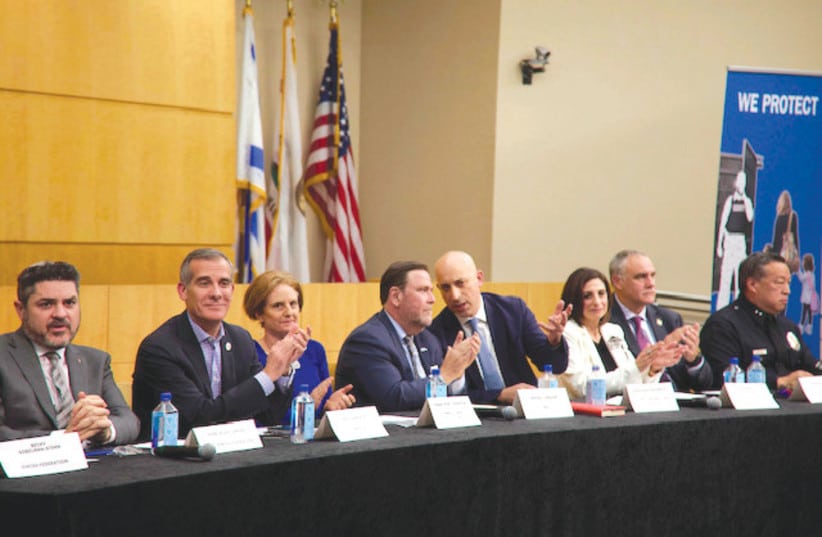
Rabbi Noah Farkas, CEO of Jewish Federation of Greater Los Angeles (left) and Jeffrey I. Abrams, Regional Director of ADL Los Angeles (fourth from left) speak at a joint briefing, addressing the surge of antisemitism in Los Angeles, November 3, 2022.

In February of this year, our Los Angeles Jewish community was gripped by a sadly familiar fear, when two identifiably Jewish men in the Orthodox neighborhood of Pico-Robertson were shot after leaving morning prayers. The suspected shooter had a history of sharing antisemitic, conspiracy-laden beliefs, and purposely sought out locations in L.A. where he knew members of the Jewish community lived, worked, and prayed.

Just two weeks ago, the FBI raided a house in Reseda and arrested an avowed white supremacist and antisemite who threatened the mass murder of Jews. They found, among other items, bomb-making materials, “ghost” guns, and 3D printers to make firearms. This suspect not only espoused his hatred of Jews; he was also building the capacity to act on his deluded schemes.

Over the last several weeks, groups of online trolls have sought to disrupt Jewish prayer services in Los Angeles and throughout the country by calling in fake bomb threats targeting synagogues, “swatting” synagogues that livestream their in-person services.

We live in difficult times. Antisemitism is no longer a marginal threat; it is a clear and present danger. For too long, Jewish leadership has tried to “go it alone.” This approach has helped no one – not our respective supporters, volunteers, and staff, not our national counterparts, and certainly not our local communities. Often, the siloed approach leads to inefficient and confusing outcomes with multiple press releases, clashing statements, and uncoordinated actions. Even more importantly, this approach can hurt the coordination of vital information between Jewish institutions and law enforcement.

The time has come to move from competition to cooperation, from silos to solidarity. We must put the dire needs of our community over the ideologies of self-promotion. Since last year, a group of organizations have formed an Antisemitism Roundtable to do just that. The Jewish Federation of Greater Los Angeles, the Anti-Defamation League (ADL), American Jewish Committee, Holocaust Museum LA, and the Board of Rabbis have met bi-monthly to build trust, mutual support, and to place the greater mission of the Jewish people at the center of our work.

Today, we are pleased to announce an outcome of these conversations when it comes to communal security. The Federation and ADL Los Angeles are launching the Southern California Jewish Security Alliance (SCJSA). We will merge ADL’s long-standing expertise on extremism and intelligence-gathering with the proficiency in training, assessments, and local intelligence monitoring of the Federation’s Community Security Initiative (CSI). ADL’s Center on Extremism will embed an intelligence analyst shared with CSI, focusing on threats in Southern California. These combined efforts will be a force-multiplier, adding strength to strength. Additionally, a third organization, Community Security Services, will join SCJSA and have an office at CSI to coordinate training of volunteers in our community to protect themselves. We hope to add additional members to the SCJSA in the weeks and months ahead.

The FBI raid in Reseda is an example of the power of collaborative information sharing. CSI’s close partnership with law enforcement led directly to the apprehension of the suspect. These relationships, which ADL and CSI have established over years of hard work, also helped to mitigate the disruption caused by internet trolls recently targeting a number of synagogues and Jewish institutions in our city.  We believe SCJSA will replicate this sort of collaboration on a broader scale.

While we are proud of the new security alliance, this is just the beginning.  In the past, we may have feared competition from one another for a limited pool of donors and influence. Now, the leadership of the Antisemitism Roundtable and the members of the SCJSA understand that speaking in unison makes our voices stronger. We encourage others to join our effort to put the community first by focusing on symbiotic outcomes. We look forward to growing our collaboration with other like-minded organizations, to create a more resilient, safe, and well-connected Jewish community.

By Jeffrey I. Abrams, Regional Director, ADL Los Angeles and Rabbi Noah Farkas, President and CEO, The Jewish Federation of Greater Los Angeles

Condemn Antisemitism Oppose Hate and Extremism Driven by Antisemitism Make Communities Safe from Antisemitism Block Antisemitism Online Act Against Global Antisemitism Teach about Antisemitism

From Silos to Solidarity: Combating Antisemitism Together Read More »

Dawn Lerman: My Fat Dad, Chicken Soup & Protein-Packed Thumb-Print Cookies

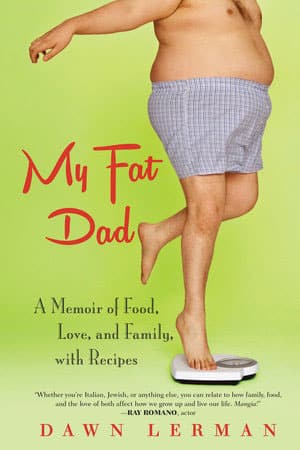
Growing up, Dawn Lerman, nutritionist and author of My Fat Dad: A Memoir of Food, Love, and Family, With Recipes.” had a variety of food influences within her own family.

Lerman describes her father, who created the slogans “Coke is It!” and “Leggo my Eggo,” as the 450-pound Don Draper from the TV show “Mad Men.” He cared in equal parts about junk food and the latest fad diet.

Her maternal grandmother, “Beauty,” was very pro-nutrition and anti-preservatives. She believed if you want to lose weight, you need to learn how to cook.

Lerman’s mother was a feminist and couldn’t care less about cooking – “It was whatever is cheap and fast,” she said. Lerman took on that role.

“Every memory from my childhood is attached to food,” Lerman told the Journal. “Whether they were good or bad, that is what I remember.”

After Lerman’s family moved from Chicago to New York for her dad’s work, Beauty would send her a recipe card and a $20 via mail each week to keep her on the healthy cooking path.

“I was only nine years old, but I had to create Weight Watcher shakes for my dad,” she said.

Lerman would try and figure out how to make them healthy. She would use milk, add ice for froth and put fresh fruit in them, too.

“It was before the days of smoothies and frappuccinos.” she said. “We used to make all that stuff before it was really trendy.”

While many people shy away from cooking – and healthy cooking to boot – Lerman says it’s easy.

“If you make something, like a soup or stew, nothing could go wrong,” she said.

Put whatever you have, whether it’s chicken broth or vegetable broth, into a pot. If you have a whole chicken, half of a chicken or a piece of chicken, toss it in. Then add vegetables, along with spices, such as dill. And cook it on the stove.

“If it looks too thick, throw in some water,” she said.

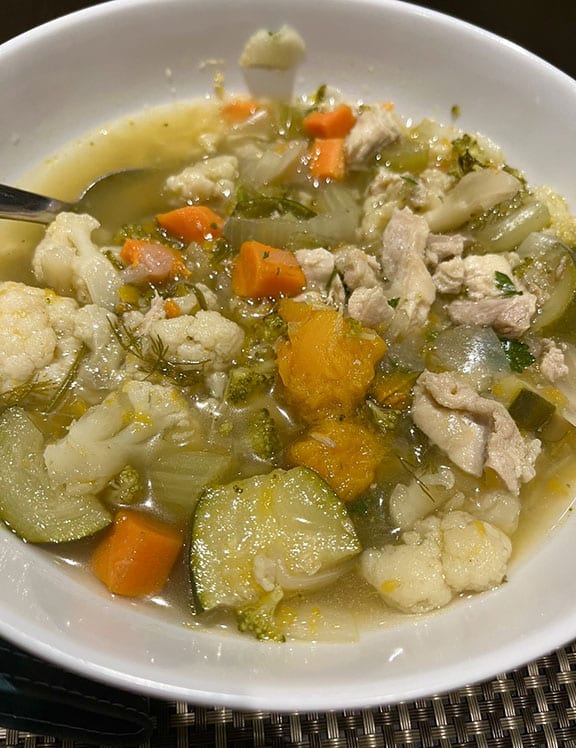
Whatever it is, you’re going to come up with an amazing soup or stew. For those who prefer a recipe, find Lerman’s chicken soup below. “My absolute favorite thing in the world is chicken soup,” she said.

Lerman is also a huge fan of breakfast for dinner and dessert for lunch.

“I’m a nutritionist, so I like every meal to have protein, fat and complex carbs,” she said.

For instance, Lerman makes pancakes with eggs, cottage cheese and oats with a little bit of vanilla.

“You basically just throw everything in the blender and then just pour it [into the frying pan]; it;s so easy,” she said. “It turns into the most delicious, decadent, protein-packed pancakes.”

She also loves to make gluten-free, protein-packed thumb-print cookies. That recipe is below too.

“Everything I make has a healthy twist,” she said.

Even as a kid, Lerman found herself giving cooking advice and offering healthy substitutes to her friend’s parents. However, it wasn’t until she had kids and her dad got sick with cancer that she went back to school and pursued it as a career.

“It was so obvious,” she said. “I’d been a nutritionist my entire life.”

When asked what she wanted people to know about cooking, Lerman referred back to her grandmother.

“Her mantra was: ‘Good food is not fast, fast food is not good and if you know how to make a pot of chicken soup, you can nourish yourself for life,’” Lerman said.

For the full conversation, listen to the podcast:

Watch the interview:

Beauty’s Sweet Potato Infused Chicken Soup

Photo by Dawn Lerman

32-ounces water (plus 10 more cups to add as the broth absorbs)

1 (3½-pound) chicken, cut into 8 pieces, most of the skin removed

4 medium carrots, peeled and cut into ¼-inch pieces

4 ribs of celery, cut into ¼-inch pieces

2 medium parsnips, peeled and cut into ¼-inch pieces

1 large sweet potato, peeled and cubed

1 medium yellow onion, quartered

Handful of fresh dill, chopped

Kosher salt and pepper to taste

Garlic powder or a couple of cloves of fresh garlic, to taste

Serve with matzah balls or for a modern low-carb take, serve it over cauliflower rice.

Place the 32 ounces of cold water in an 8-quart stockpot set over high heat and bring to a boil.

Add the chicken and cook until foam comes to the top. Spoon off the foam, reduce the heat and add the carrots, celery, parsnips, sweet potato, onion and dill. Simmer the soup for at least 2 hours and add the 10 cups of cold water, 1 cup at a time, as needed. As the soup cooks, the liquid will evaporate and the soup will thicken.

Check the soup every 30 minutes to remove any film that rises to the top. Stir in the salt, pepper, and garlic powder to taste, and remove the pot from the heat. Remove the chicken and the vegetables from the soup, and pull the chicken meat off the bones. Ladle the broth into bowls and add the desired amount of chicken and vegetables to each bowl.

Gluten-Free, Protein-Packed Thumb-Print Cookies

Photo by Dawn Lerman

8 tablespoons coconut oil or softened butter
1 egg, beaten
1 teaspoon vanilla extract
2 tablespoons almond milk
1/3 cup maple syrup
1/2 cup almond flour
1 1/4 cups oat flour (you can make your own oat flour by blending oats in a blender)
1 teaspoon flax seeds (optional)
Pinch of sea salt
Strawberry jam or preserves
Powdered sugar for dusting (optional)


Preheat the oven to 350 degrees.

In a mixing bowl, combine the oil, egg, vanilla, almond milk and maple syrup and mix well. In a separate bowl, mix together the flour, flax seeds and salt. Then combine the ingredients from both bowls and mix together with your hands, until it forms a sticky dough. If the dough feels a touch dry, you can add a splash of water to thin it. And if it feels a bit wet, you can add a touch more almond flour.

Roll the dough into balls with your hands; I like mine to be 1 1/2 to 2 inches across. Place them on a lightly greased cookie sheet, flatten them slightly with your palm, and push a thumbprint into each ball. Add a dollop of jam or preserves to the thumbprint.

Bake for 15 minutes, or until lightly brown on the bottom. Let cool and sprinkle with powdered sugar before eating.


Debra Eckerling is a writer for the Jewish Journal and the host of “Taste Buds with Deb.Subscribe on YouTube or your favorite podcast platform. Email Debra: tastebuds@jewishjournal.com.

Dawn Lerman: My Fat Dad, Chicken Soup & Protein-Packed Thumb-Print Cookies Read More »

OC Synagogue Evacuated Due to Fake Bomb Threat

A synagogue in the Orange County city of Fullerton was evacuated on August 12 due to a fake bomb threat.

City News Service (CNS) reported that Fullerton police had been notified by the Los Angeles Police Department that a bomb was going to explode in Temple Beth Tikvah; after police evacuated the temple, no explosive device was found. Fullerton police also said that the synagogue received a call from a man that was “certainly antisemitic in nature” but “did not rise to the point of being criminal in nature.”

“Sadly, this is something that many temples, many Jewish houses of worship… have to live with,” Temple Beth Tikvah Rabbi Mati Kirschenbaum told CNS.

A similar incident occurred in the San Francisco Bay Area, as on August 11 Beth Torah Jewish Temple in Fremont was evacuated over a potential bomb threat, only to find nothing suspicious inside.

The Anti-Defamation League (ADL) issued a statement on August 12 saying that at least 26 synagogues and two ADL offices have been targeted by “online trolls who swat and call in fake bomb threats targeting synagogues” these past four weekends.

The ADL also noted that the trolls “appear to be targeting synagogues that livestream their services.” According to CNS, Temple Beth Tikvah’s services on August 12 were being livestreamed on Facebook.

“The ADL Center on Extremism continues to work with law enforcement to determine the source or sources of these troubling and potentially dangerous activities,” the ADL’s statement read.

Representative Don Bacon (R-NE) posted on X, formerly known as Twitter: “These anti-Semitic attacks are totally reprehensible. I appreciate ADL working with law enforcement to solve and informing the public. I hope these criminals are found, held accountable and given the max punishment allowed.”

The Simon Wiesenthal Center similarly posted on X, “The outrageous is becoming commonplace. Acts of #Antisemitism and threats, online and in our streets have become the norm. There must be accountability for the perpetrators and Jews must secure their synagogues and schools.”

OC Synagogue Evacuated Due to Fake Bomb Threat Read More »

RFK is an Ally, not an Antisemite

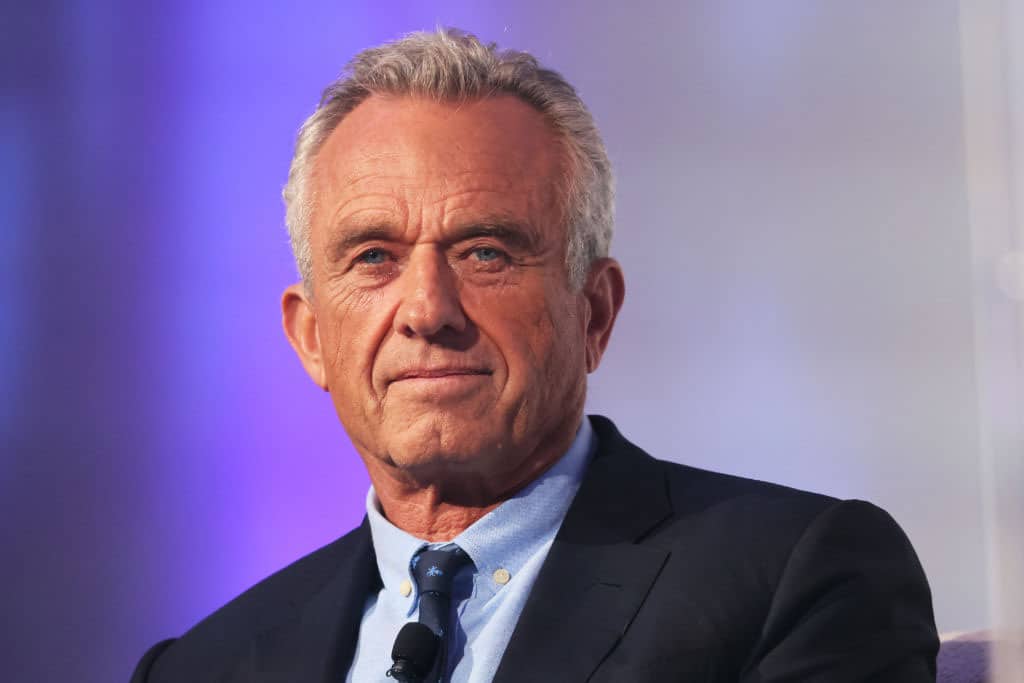
Robert F. Kennedy Jr. is not an antisemite. But Jews should not be blamed for believing he is. There have been too many accusations hurled at the Democratic presidential candidate to expect the Jewish community to thoroughly investigate each one.

But for those Jews whose interests align with RFK in other areas, such as regulatory capture, health freedom, and the fight against big tech-government collusion and corruption, determining the accuracy of such a serious allegation is obligatory. Many have taken the time to dig deeper into RFK’s seemingly distasteful comparisons to the Holocaust, his support for Sirhan Sirhan’s parole, his bizarre association with Louis Farrakhan, his praise of Roger Waters, and his latest alleged assertion that Jews were largely spared from the “ethnically-targeted” COVID-19 virus.

As is usually the case, this kind of investigation reveals far more substance than reported by the mainstream media. Ultimately, the characterization of Robert Kennedy as an antisemite lacks merit. He is, to be clear, guilty of a lack of sensitivity and subtlety, but has no masked tendencies or malicious intent when it comes to the Jews. In fact, he has been their ardent champion.

Yet Jews on both the left and right are convinced of the contrary. Take, for instance, the case of Sirhan Sirhan, the Palestinian convicted of murdering RFK’s father because of the latter’s pro-Israel politics. At least, this is the CIA’s official version of events. RFK, however, insists that Sirhan is innocent, a belief that distresses Zionist Jews who, troublingly and uncharacteristically, view this through the lens of identity politics. Sirhan is an anti-Zionist. RFK supports him. Ergo, RFK must be an anti-Zionist. But RFK, an attorney himself, approaches his father’s murder from the facts in question, consistent with his data-based iconoclasm in other areas, such as his challenging the conventional narrative that JFK was murdered by a communist sympathizer. RFK has long maintained that, in fact, Lee Harvey Oswald was a CIA operative, a position now becoming more prevalent since documents surrounding the assassination have been declassified.

Similarly, RFK has dived deep into the ballistic evidence surrounding his father’s murder and wrote a compelling article in 2021 for the San Francisco Chronicle laying out the facts of the case hidden by the CIA, which reveal that Sirhan could not have pulled the trigger that ended RFK Sr.’s life. Sirhan may have abhorrent views about the Jewish state, but RFK’s defense of him has nothing to do with those views. His defense is based on the principled belief that someone should not be convicted of a crime they did not commit.

RFK’s inclination to question institutional truths and accepted verdicts have relegated him, in certain aspects, to the fringe of society and, as a result, he has ended up rubbing elbows with others on the fringe as well. Some of these figures, like RFK himself, do not deserve to be there. Others, like Louis Farrakhan and Roger Waters, have firmly earned their place. Kennedy immediately disavowed both when becoming aware of their flagrant Jew hatred.

But why did RFK meet with Farrakhan in the first place? As one member of the Jewish community remarked, “You have to be living under a rock to not know the Nation of Islam is antisemitic.” Here is where the background substance would be narrative-busting for an agenda driven, nuance-lacking, cherry-picking media. RFK admits that he did have a vague idea that Farrakhan was a dishonorable character, though not to the extent he’s since been made aware of. But he had answered a call from the Nation of Islam to speak at an event because he was driven by the prime interest and professional focus of communicating the dangers associated with a certain type of flu vaccine that is disproportionately administered in Black communities to children. RFK’s decision to attend the event was motivated by the immediate necessity to protect a population. When pressed by Jewish activist Dov Hikind in a recent interview on whether he would do it again, RFK spoke honestly and vulnerably, saying that while he would certainly not take pictures with Farrakhan nor form any relationship with NOI members, he could not say for certain whether he would reject the invitation without further consideration.

What is clear from RFK’s answer is that he speaks from the heart and is not trying to buy votes by telling the public what they want to hear. He struggles with the tortuous task of hierarchizing conflicting values in morally ambiguous situations. And while a popular figure such as RFK should not be associating on the public stage with hate mongers like Farrakhan, the larger issue, and subtle choices he has to make in such a difficult situation, is lost on his detractors. If what is at stake here really is the physical health of a minority sub-group, and a Nation of Islam executive asked RFK to enlighten hundreds of thousands in the community in order to mitigate harm to its youth, wouldn’t it be just as morally irresponsible for RFK to reject the opportunity to do so? Good doctors don’t choose which lives to save based on the patient’s worthiness in their eyes, because their oath is to preserve life, regardless of the individual.

What is clear from RFK’s answer is that he speaks from the heart and is not trying to buy votes by telling the public what they want to hear.

Most recently, at an informal press event in Manhattan, RFK cited a study as proof of concept of the danger of bioweapons and the possibility of sinister actors using them to ethnically target opposition groups. Our scientific technology is already so sophisticated, argued RFK, that we can detect how certain viruses disparately affect populations. He pointed to a Cleveland Clinic NIH study that showed how COVID-19 was, for example, less harmful to the Chinese and Ashkenazi Jews, among other groups, due to ACE-2 receptors and TMPRSS2. Do any of us doubt that totalitarian governments would not weaponize such findings?

Critics of RFK pointed out that the paper he cited was from 2020, early on in the pandemic, and that the paper itself admits that because it didn’t actually look at which groups ended up getting COVID, its findings cannot be confirmed without further studies. In retrospect, says RFK, he regrets referencing the study at all.

But the media spun these innocent, off-the-record comments into a conspiratorial assertion that COVID-19 was deliberately targeted to spare the Jews. Although the media clearly got this wrong, the question remains: Why did RFK feel the need to mention Jews at all? There were many more groups less impacted by the virus that the study referenced, including Latinos, the Finnish, the Amish and South Asians. It is understandable that he listed the Chinese, given that the virus originated in China. But why single out the Jews? Was this a Freudian slip? A window into his unconscious mind? It could be coincidental, but that begs the question: Why always the Jews?

The reality is that RFK did not just mention the Jews. But the clip that circulated in the media was edited to show only the part of the conversation in which RFK cites Ashkenazi Jews and the Chinese. Perhaps, under the pressure of that specific moment, to illustrate his point, mentioning Jews was the easiest, most obvious grab for RFK because, unfortunately, defaulting to Jews is an age-old allowable pattern in society. None of us have the refined awareness to monitor each ripple of our human frailties. RFK, part of the collective mind, falls back on quick, often unconsidered analogies in the flow of communication. It is pragmatic, though often not the best choice, which he has since acknowledged. When there’s too much information available, it becomes overwhelming and impossible to sort, so we often resort to what is most relevant. It’s as if someone named Jackie spelled out her name and said, “J – as in ‘Jew.’” When hundreds of words are flooding through our head, a heuristic must choose one out of the deluge.

This possibility could also account for RFK’s previous comparisons to the Holocaust. It’s understandable that Jews would have a visceral defensive reaction to such comparisons. But there has to be an ability to distinguish between errant use of language related to the Holocaust and a disguised antisemitic motive, which is absent in the case of RFK. Further digging into RFK’s invocation of Anne Frank, for example, unearths its scandalous decontextualization by the legacy media and activist groups. Though his wording was, once again, far from perfect, the point he was making is prescient: In a time of widespread surveillance comprised of biomedical technology, contact tracing, digital currencies and social credit systems, none of us will be able to escape should our governments come looking for us. If the Holocaust happened today, said RFK, Anne Frank could not have gone into hiding, which is what makes this particular period in history so alarming. Is this statement antisemitic? No.

Recently, RFK was invited to participate in a session with the Zionist Organization of America, where its President, Mort Klein, confronted RFK with tough questions regarding each incident of alleged antisemitism. RFK’s transparency was admirable. His explanations cleared the deck of any legitimacy to his detractors’ claims. But Jews who are concerned primarily about antisemitism have never truly taken the time to listen to his explanations, deciding instead that there are simply too many off-color, idiosyncratic slip-ups that would serve to nullify him.

But in the case of RFK, it is imperative that we avoid participating in the grave sin of lashon harah, (the spreading of false rumors) and inaccurately mislabeling what RFK stands for. Those who are critical of him must bring the same type of critical thinking as they do with reporting and coverage of Israel to other issues. They must not be ready to fall in line and succumb to media hype because doing so means sacrificing one of the few vital allies we currently have in the Democratic party. RFK’s unwavering commitment to Israel as a Jewish state is sincere and integral to his political values. His knowledge of Jewish history and peoplehood is impressive. He has condemned congressional members of his party as antisemites and has decried the Soviet-influenced anti-Zionism within his camp. He disapproves of Biden’s carrot-and-stick threats to Israel, opposes the Iran deal, and supports Israel’s every move to defend itself against its existential enemies, which he acknowledges includes the Palestinian Authority (PA). He believes the Israeli Defense Forces to be the most ethical army in the world and understands the long history of Palestinian rejectionism and the incredible concessions that Israeli leaders, both on the left and the right, have offered in exchange for peace. He maintains that Israel is held to an unfair double standard not expected of any other nation and recognizes that “from the river to the sea” is an antisemitic dog-whistle and thus an illegitimate basis for conversation. While he would prefer some degree of land for peace, he recognizes this is an idealistic pipe dream as long as Palestinian leadership denies Israel’s right to exist as a Jewish state, targets civilians with rockets, and pays its people to murder innocent Jews. And he says confidently, despite the furious backlash from his party, that a Palestinian state has never existed and, in fact, the very name “Palestine” is an imperialist invention of the Roman Empire meant to punish its Jewish inhabitants.

Since he made the courageous choice to step out of the prevailing orthodoxy on particularly controversial issues and forge his own path, the mainstream media, democratic establishment, special interest groups, and corporate stakeholders have been determined to censure, malign and misrepresent RFK at every turn. Now, as a presidential candidate, RFK poses a similar type of threat to the political class that Trump posed. Despite amassing great wealth and being born into the elite class, he has willingly chosen to be outsider by shining a light on the unholy, totalitarian convergence between the federal government and big tech, big pharma and the nonprofit sector. No matter the attacks on him, his courage does not appear to be corruptible. He is a man of virtue who is not afraid to question the consensus and push the envelope to arrive at the hidden truth.

Still, RFK must be more thoughtful when it comes to these issues because language matters. There is no comparison to an event like the Holocaust because the mere juxtaposition invalidates the depth of the suffering perpetrated and demeans innocent victims. RFK’s unconditional support of the Jewish people is trivialized in the face of such reckless comparisons.

And with regard to speaking at a Nation of Islam event, one hopes that should another invitation be extended to him RFK would send someone in his stead if for no other reason than this: Now that he is running for President, he is more than a message. He is a symbol. He cannot afford to be naïve and overlook a person’s unseemly characteristics or a group’s long history with antisemitism or bigotry because he aligns with them on certain issues. This is a matter of refinement and tact.

RFK must tap into his inner mensch if he wants to have a chance to reverse the knee-jerk resistance from the Jewish community. Likewise, it’s time for the Jewish community to look closely at the full scope of RFK.


Karys Rhea is the associate producer of “American Thought Leaders” at The Epoch Times. She also works with Jewish Leadership Project and Baste Records.


Daniella Bloom is the National Ambassador of JEXIT (Jews Exiting the Democrats Party). She is also a licensed psychotherapist, author, keynote speaker, and mother of three.

RFK is an Ally, not an Antisemite Read More »

In First Part of American Tour, Fans Respond To Yohay Sponder

What country has the sexiest men on the planet?

Israeli comedian Yohay Sponder told the women in a sold-out crowd at Stand Up that it’s not enough to visit Israel, they need to experience Israeli men.

Sponder, who is originally from the Golan Heights, wasn’t advocating for himself. He spoke about how brave his wife was to give birth with no epidural or medication and in one of the funniest moments of the 75-minute set, he mimicked her screaming in labor.

Sponder performed at the first Chosen Comedy Festival in August 2022, and while it was clear was talented, the set was only five minutes.

At Stand Up NY, he went through a range of topics and commanded the stage, even joking about a mosquito that hounded him during his performance, as well as a sign from the wall that fell forward and tapped him on the back.

Among his best bits at Stand Up NY, he pointed out the contradiction that Jews have a tough time believing that Jesus walked on water but take a certain miracle from the story of Passover as “a solid fact.”

He also told the audience it is ironic that people have become dumber with advances in technology, namely apps that remind people to drink water.

“People get dehydrated and die, cause they didn’t have a charger,” he said, and explained why there are both positive and negative attributes effects of smoking weed.

Israel, he told the crowd, is the best country in the world, though he admitted one thing could use fixing, such as why Israeli men are always in a hurry and why people should hire Jewish lawyers.

Sponder’s performance was impressive, often getting big laughs from the crowd. His English has steadily improved and the heralded show he produces “Funny Monday” is in English, but on two or three occasions, he said a phrase in Hebrew and asked the crowd to translate. Sponder explained that while he has advanced a lot with his English skills, it’s not a big deal if he forgets a phrase here and there.

“Before, the English was an obstacle, but I’ve been doing the ‘Funny Monday’ show so it’s normal for me. “Once in a while, if I mess up a word, that can be funnier than the joke itself.” He added that there is a growing market for English comedy in Israel attracting people who have made Aliyah, tourists and Israelis as well.

His tour includes gigs in Chicago and Miami before coming back to New York to perform at The Comedy Cellar, where he will record a special on September 10.

 He is excited to return to Los Angeles to perform on August 23.

“The weather is always great, and the people are really chill.”

In First Part of American Tour, Fans Respond To Yohay Sponder Read More »

Approaching Judaism With Love

I recently watched a video of a rabbi who warned about falling into the hands of the evil Satan and the dark forces that are at work in this world. I quickly clicked off, because I don’t identify with that kind of Judaism, the kind where we focus on the ills of society and put fear above all else. Instead, I approach Judaism with love.

While every Jew should have a healthy fear of God, that fear should not be the main motivator of their observance. Serving God out of pure fear is not the way. It can make you resentful and cause you to become miserable. It may very well backfire. And it can be a stumbling block to having true faith. 

Our relationship to God is compared to that of a relationship with a father. On the one hand, you must respect your father; he can lay down the law and decide what happens when you stray from the path. On the other hand, your father is a great source of comfort and care. He brings you closer when you need it the most and is always there for you.

The rabbi knew that his guests weren’t observant, but he didn’t admonish us or tell us we were doing something wrong. Instead, he was non-judgmental when he welcomed us in.

I chose to convert to Judaism after experiencing the incredible love I felt at my local Chabad during a Friday night dinner. The rabbi knew that his guests weren’t observant, but he didn’t admonish us or tell us we were doing something wrong. Instead, he was non-judgmental when he welcomed us in, showing us the beauty of Shabbat and observing the mitzvot. I was so compelled by this rabbi’s loving attitude that I wanted to go back every week and learn more about Judaism. 

The love I felt at that Chabad house set the tone for how I observe Judaism. It was so different from the Catholicism my grandmother taught me, which, at a young age, felt very dark and scary. I was going to go to Hell if I wasn’t baptized? I was born in sin? I know today that Catholicism is not all dark, but as a child, it sure did feel heavy. I didn’t connect with that fire and brimstone aspect of it; I needed a gentler approach to faith.

Every day, I am reminded of the love God has for me, and I feel blessed and grateful. I look around and I can’t believe that I live the life I do. I truly don’t know what I did to deserve it.

What I do know is that this love is a two-way street: just look at the Shema, which commands us to love God with all our heart, with all our soul and with all our strength. It’s critical to feel that love, like the love we have for our spouses, our children, our family and our friends. But it’s also important to show that we love Him by taking action: By keeping the mitzvot, doing good deeds and fulfilling our personal mission to make the world a better place. 

God communicated His love for us by giving us His Torah, the guidebook for a meaningful life. He wants us to be joyful, and He shows us how to achieve that. When things are going wrong in my life, I believe that God is telling me something. Perhaps He’s protecting me or putting me on a better path. He’s showing me how to build up my resilience and be strong when life becomes complicated. 

But I know, above all else, that God is acting out of love. When I picture heaven, shamayim, it’s where my soul will feel everlasting warmth, as it’s finally close with God, the source of all love.

I want God to be happy with me, and I do my best when it comes to observance. But I know that if I mess up, He will still love me. As long as I try to do better the next time, try to refine my character and improve upon myself, He will be there to welcome me with open arms, to get me back to my soul’s true purpose and to be receptive to the eternal love He has to offer. 

What’s your approach to Judaism? Email me: Kylieol@JewishJournal.com.


Kylie Ora Lobell is the Community Editor of the Jewish Journal.

Approaching Judaism With Love Read More »

Lucky and Maraca

A bedridden woman in my tight knit Jewish community had an emergency.  Maraca, her small grey and white mutt, needed minor but urgent surgery on her shoulder. “Could you take care of Maraca while she heals?” she asked. 

“Sure, I can take her to my place for a couple of weeks,” I said. 

Months before I had tried to gently persuade her to let me find a loving home for Maraca. “I only trust you. I won’t give my dog to a family I don’t know,” she responded.

I wasn’t the family I had in mind. 

I had my own dog, a rather handsome, sweet, large black retriever by the name of Lucky. I lived in an apartment, and I needed another dog like a hole in the head. Gosh darn it though, even with stiches in her shoulder, Maraca was such a happy dog. I had to laugh when I looked over at her in the middle of the night and she was sprawled out on Lucky’s doggie bed like she was at the Ritz. I began to wonder if I shouldn’t just keep her. What’s one more dog, right? 

Even though Maraca was firmly in her twilight years, she would sprint to the door like a rocket to join Lucky and me on our daily walks around the Pico/Robertson area of Los Angeles. You really want to get to know your community? Get a dog. Even the homeless gentleman on my corner became acquainted with us, yelling out to me “Hey, Maraca doesn’t have her cone on anymore!”  The now three of us would greet people on their way to daven shacharit. I had three rabbis on my block alone. 

I’d bake challah for various people we’d meet on our walking adventures. That was a sight, me juggling bags of warm challah and two dogs while ducking into the Coffee Bean. More than once I’ve spilled a freshly made Mocha Ice Blended — otherwise known as a chocolate shake —  down the front of my blouse. 

In the blink of an eye, two years had passed. Then it happened. 

Lucky became ill over Shabbat. By Monday a major organ was failing. He was gone by Tuesday. The word sadness doesn’t even begin to cover it.  I walked into the Coffee Bean the day after he died and sat down. A homeless man in the neighborhood came up to me asking, “Where is …?” Mid-sentence he stopped cold, seeing the pained look on my face. There was only one reason why Lucky wasn’t with me. 

Yes, I kissed the ground that I still had Maraca, who by the way, marched right up to Lucky and kissed him on the mouth right before he died. Considering their size variance, that was no mean feat. 

I suddenly realized how much she had loved him.  

You know how I know? Maraca died within a week of him. She had staved off her own mortality by shear will and her love of Lucky. Coincidence is not in the Jewish wheelhouse. A love story was right in front of me, and I didn’t see it. 

The next morning, I laid in bed and moaned out loud. Out of desperation, I grabbed my roommate’s dog because I just had to get out of the house and … walk. I exhaled the minute my feet hit the pavement.

How do I work through this, I wondered as I headed down Olympic Blvd. How do I value life while mourning the love of someone who is no longer with me? Is a dog a someone? Through my tears, I tried to focus on celebrating the life of both dogs, the sheer joy they brought me and my community.

Admittedly, I didn’t fully appreciate the 1,095 doggie walks a year (I counted) until it was too late. Rituals create connection, and I’m determined to appreciate those connections in real time from here on out.

Admittedly, I didn’t fully appreciate the 1,095 doggie walks a year (I counted) until it was too late. Rituals create connection, and I’m determined to appreciate those connections in real time from here on out.

I had taken both dogs as a mitzvah for other people when in fact, I was the one who had received the biggest mitzvah of all.


Christine Shira Sheaks is a film producer and currently finishing her memoir, “A Wandering Shiksa.”

Lucky and Maraca Read More »

If Only the Ancient Jews Knew About Jamie Foxx

Oscar-winner Jamie Foxx recently asked his nearly 17 million Instagram followers, “They killed this dude named Jesus … what do you think they’ll do to you???! #fakefriends #fakelove.” One day later, Foxx deleted the post and wrote, “I want to apologize to the Jewish community and everyone who was offended by my post,” adding that he was “betrayed by a fake friend and that’s what I meant with ‘they’ not anything more.”

I can’t read Foxx’s mind. But since the idea that the Jews killed Jesus is one of the most publicized false truths in human history, I wasn’t surprised by how many people on social media believed he was alluding to Jews.

So let me offer a few responses to, “What do you think they’ll do to you???!” Well, for starters we’ll make you some amazing movies, shows, and works of music and art. We’ll give you and the world monotheism, then spend the rest of our born days scared of our mothers. 

So let me offer a few responses to “What do you think they’ll do to you???!”

Well, for starters we’ll make you some amazing movies, shows, and works of music and art. 

We’ll give you and the world monotheism, then spend the rest of our born days scared of our mothers. 

We’re the reason a hillbilly in rural Kentucky knows to say “Oy, vey!” and antisemites in Syria love “Fauda” (but can’t admit it). 

And, of course, we gave the world Mel Brooks. 

But let me go a step further and muse over another question: What would have happened had our ancient Jews anticipated that they would be blamed for Jesus’s death in the decades, centuries and millennia after he died? 

And then, perhaps due to having consumed a copious amount of caffeinated cardamom tea late at night, I wondered what a conversation between the 12 (Jewish) disciples would have sounded like in the days and hours before the Romans crucified Jesus. The following is not meant to offend either Christians or Jews. Crucifixion isn’t funny; it was a sign of Roman cruelty and insecurity. But what happened to Jews for two millennia after his death is another matter — one that still involves Jews today. 

A.D. 30-something

Andrew: Simon, call everyone to the table. I have terrible news. 

Simon: 

Andrew: Simon! Answer me, brother!

Simon: I told you, I go by “Peter” now. I don’t know who this “Simon” is, but “Peter” can help.

Andrew: Alright, Peter. Call everyone together at once. 

Minutes later:

Andrew: I have terrible news: Reb Yeshua has been sentenced to death by the wicked-doers, the Romans, who have wreaked havoc on us all.

Shouts and cries erupt.

John: It’s true that Reb Yeshua [Jesus] has rubbed some of our elders the wrong way, but this is a tragedy beyond description.

Philip: Woe to us all.

Bartholomew: Let them take me. Please, let them take me. 

Andrew: James, you seem to have a question?

John: Pardon me, Andrew, but which James are you referring to? James, son of Zebedee, or James, son of Alphaeus?

Andrew: Zebedee’s hand seemed to have gone up first. Yes, James? What is it?

James: My mourning has already commenced, despite the fact that our darkest hour of loss has not yet arrived. However, I cannot help but ask—

Andrew: Yes?

James: Well, it’s just that-—

Thomas: Say it, friend. And will someone please wake up Thaddaeus!

The disciples shake Thaddaeus, who expresses horror and sorrow upon hearing the news.

James: Well—I plead your forgiveness for my poorly-timed callousness—but is there any chance that we would be blamed for this?

Simon the Zealot (not to be confused with Simon, who is called Peter): Blamed for what?

James: For the death of Jesus, I’m afraid. 

The other disciples scoff and shake their heads. 

Thomas: You mean that we, disciples, would be blamed?

James: Well, not exactly, but, you know, “we.”

Thaddaeus: “We” as we, men?

James: For Pete’s sake! “We” as in “Jews”!

Peter: Please don’t request anything for my sake. I hate when people do that. And how could we be blamed for this tragedy? The traditional Jews don’t even recognize us as belonging to the Judean tribes anymore. 

James: I know, but you’ve never asked yourself whether now, or in the future, Jews would be collectively punished for something?

Andrew: To be honest, I don’t even think we’ll be around for more than a few decades more. The future, whether in 200 or 2,000 years, will belong to the Romans and their descendants. All anyone will remember about the Jews will be the Ten Commandments and that Methuselah died when he was 969.

Matthew: It’s not like we’re that popular now. And I’m noticing a lot of bad stereotypes about us. I can’t even go anywhere without someone calling me “Matthew the tax collector.”

James: What’s wrong with that? You were a tax collector before Jesus found you.

Matthew: I know, but something about that just doesn’t sit well with me. Am I the only one? Doesn’t “Matthew the tax collector,” who happens to be Jewish, sound a bit off?

Andrew: We don’t have time for this nonsense! In a few hours, our teacher and the emblem of kindness will perish. Simon, why are you eating at a time like this?

Simon: Forgive me. Passover (and Shabbat) are starting tonight and my wife prepared “healthy” matzah with what appear to be flour, water and beet juice. I wanted to taste it beforehand.

John: Is that why it looks red?

Simon: Yes. I can’t eat it. To be frank, it looks like blood. 

Philip: You’re overreacting. No one would ever accuse a Jew of using blood in their matzah. The world has not lost its mind, Simon, nor is it that bigoted. 

Bartholomew: Friends, even if the Jews were to be blamed for this terrible death, we would be immune, wouldn’t we? It’s not as if in the eyes of our enemies, “a Jew is a Jew” regardless of whether he or she strictly observes Jewish laws, is it?

The disciples shake their heads in vigorous agreement that a Jew is not a Jew. 

John: Perhaps the world will only blame Judas Iscariot.

Andrew: But he’s a Jew!

John: Oh, right. Friends, we are worrying over nothing. The Romans are the wave of the future. Maybe Jews will be blamed for a few years, but we simply won’t be around long enough to survive. If the Jews outlive the Romans and everyone else, then I predict that one day, we will also have driverless chariots and chocolate hummus. 

Clamoring and shouts of “Perish the thought!”

Andrew: We must end this idle chatter. This is a sorrowful, terrible night. 

Those were just some of the conversations produced by my imagination when I thought about whether Jews in the time of Jesus, even the rebellious ones, had an inkling about the blood libels of the Jewish future. Eventually, I decided to call it a night, but not before praying for the souls of all Jews who have perished as a result of false accusations over millennia, and asking G-d to protect us from harsh words and harsh actions today. 

As far as Jamie Foxx goes, I hope he’ll learn that when someone betrays you, best to keep other “dudes” out of it, even a “dude” named Jesus. Otherwise, what do you think he’ll do to you???!


Tabby Refael is an award-winning writer, speaker and weekly columnist for The Jewish Journal of Greater Los Angeles. Follow her on Instagram and X (Twitter sounded better) @TabbyRefael

If Only the Ancient Jews Knew About Jamie Foxx Read More »

Dealing with Anti-Israel Left

In a hyper-partisan, highly polarized red vs blue America, the politics of Israel and the Middle East in general have always been complicated. Rather than breaking down neatly along party lines, there are profound divisions within both Republican and Democratic ranks on issues relating to the U.S. role in the Middle East. We’ll discuss the intramural GOP fight at another time, but it’s beginning to look like the early action in next year’s election cycle will be in Democratic House primaries.

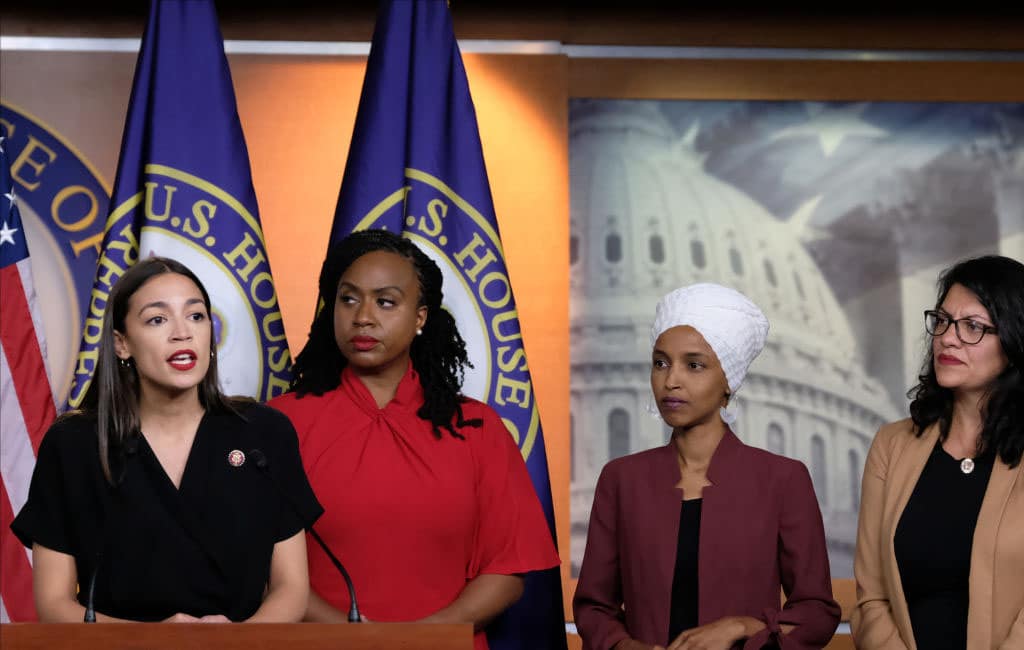
The great majority of Democrats in Congress are reliably pro-Israel. But the numbers of those who vote against the interests of the Jewish state are growing, and it appears that the American Israel Public Affairs Committee (AIPAC) has decided it’s time to push back harder. The Jewish Insider reported last week that AIPAC is escalating its efforts to take on Democratic incumbents who have stood against Israel, actively recruiting candidates to run against Representatives Ilhan Omar (D-Minn.) and Jamaal Bowman (D-N.Y.). 

In the past, AIPAC has given some support to challengers against anti-Israel officeholders, but has kept a relatively low profile to avoid becoming a target for progressive activists in those districts. But by telegraphing their intentions so early against Omar and Bowman, the pro-Israel group is making it clear that they are willing to be on the receiving end of attacks from the opposition if that’s what will be required to achieve their goals. 

The opposition is more than happy to oblige. De facto “Squad” leader Alexandria Ocasio-Cortez (D-N.Y.) sent out a fundraising appeal on Bowman’s behalf last week that featured the warning phrase, “AIPAC is at it again.” In the message, Ocasio-Cortez revisited some of the attacks she had leveled against AIPAC in the past and accused the organization of plans to “target progressive working-class candidates of color.” This fight is going to get louder and nastier in the months ahead. The result will be an even sharper divide between the Democrats’ progressive base and establishment center over the Jewish state, at a time when the Biden Administration has prioritized a possible security accord between the U.S., Saudi Arabia and Israel and as Democratic leaders try to prioritize party unity heading into next year’s elections.

Last year, AIPAC found itself in the crosshairs of many Democratic voters when its political action committee endorsed 37 Republicans who had voted against the certification of Joe Biden’s election. The organization’s leaders correctly pointed out that support for Israel is the only criterion for their endorsement and that the PAC supported roughly an equal number of candidates from both parties. Not surprisingly, an American Jewish community that votes heavily Democratic in most elections virulently expressed its unhappiness. But AIPAC’s job is to build relationships among Israel backers in both parties and they stood their ground.

But making friends represents one type of political challenge — making enemies is another. To be fair, it’s not as if AIPAC went hunting for incumbents to target for defeat. The original “Squad” has now roughly tripled in size. Nine House members voted against a resolution last month stating that “the state of Israel is not a racist or apartheid state,” which is a fairly low bar for measuring anti-Israel sentiment. Several other members have signed on to a variety of other bills that financially or rhetorically target the Jewish State. As progressives within the Democratic caucus continue to gain strength, this challenge will almost certainly increase. AIPAC’s public pushback is designed not only to discourage current members from this type of behavior, but to warn others tempted to join their ranks that the political consequences of this brand of anti-Zionism would be severe.

American Jews are well-practiced and comfortable fighting against an ultra-conservative menace. Standing up to the far left is less instinctual, but just as necessary.

Republicans have their own problems with their most ideologically extreme members, including a former president who has been soft-pedaling criticism of the Charlottesville rioters for several years. The ugly nationalism that oozes into bigotry and antisemitism on the far right is a growing threat. But American Jews are well-practiced and comfortable fighting against an ultra-conservative menace. Standing up to the far left is less instinctual, but just as necessary.


Dan Schnur is the U.S. Politics Editor for the Jewish Journal. He teaches courses in politics, communications, and leadership at UC Berkeley, USC and Pepperdine. He hosts the monthly webinar “The Dan Schnur Political Report” for the Los Angeles World Affairs Council & Town Hall. Follow Dan’s work at www.danschnurpolitics.com

Dealing with Anti-Israel Left Read More »