fbpx

July 12, 2023

Finding Meaning in Philanthropy At Every Age

In pursuit of well-rounded and meaningful lives, many of us feel the pull of home and family, career responsibilities, a sense of community, and our own health and well-being. This search for meaning – and the often-elusive steps on how to attain it – became more pronounced during the pandemic when the world was forced to “hit the pause button.” For many, it triggered a reappraisal of values, taking personal inventory of what really matters and finding a gratifying path forward.

As a career nonprofit professional, including the past 16 years with the Jewish Community Foundation of Los Angeles (The Foundation), I have the distinct opportunity to interact with hundreds of individuals and families as they discover that meaning through their philanthropic endeavors.  It occurred to me that many donors with whom I am privileged to work seem to already hold a key to fulfillment.

I was struck how these individuals – irrespective of their net worth – enjoy a meaningful life that is tethered by a shared joy of philanthropy, of giving back both their time and treasures. As Gandhi said, “The best way to find yourself is to lose yourself in the service of others.” Charitable pursuits provide these people with equilibrium, serving as a ballast between the forces that batter everyone’s lives, while bringing a sense of meaning and higher purpose.

One great misconception is that philanthropy is reserved for high-net-worth individuals. Another fallacy is that charitable involvement is a mid-to-late-life pursuit, taking shape only as estate plans and legacies come into focus. Nothing could be further from the truth. Instead, we need to embrace philanthropy as part of a lifelong journey.

Considered that way, charitable endeavors can become a manifestation and embodiment of a person’s or family’s values – something that can shape the course of their lives while bettering the world. Organized by decade, the below suggestions are meant as a guide for discovering meaning in philanthropy at every age:

Twenties. Likely still in or just out of school, the goal for individuals at this stage of life is to sample, to become acquainted with the broadest range of nonprofit causes and organizations, and to tap into personal interests. Seek organizations that may appeal; these may span social justice, arts and culture, human services, education, or something else. With obligations such as student-loan repayment and saving for the future, financial resources may be scarce, but it’s a great time to give small monthly donations and also to volunteer and give generously of your time. Many organizations have junior boards and programs to engage and train future leaders while providing social and networking opportunities with like-minded peers.

Thirties. This is, in many respects, a transformative period when careers take flight, life partnerships root, and families are started. Professional and personal obligations evolve and, as salaries and net worth rise, new financial considerations move front of mind: initial home ownership, investment and retirement planning, life insurance policies and a litany of related matters, including drafting a will. Even as greater demands are placed on thirtysomethings’ lives, their charitable commitment need not take a backseat and can play a pivotal role in a balanced, fulfilled life.

At this busy stage of life, one of the easiest ways to be philanthropic is by opening a donor-advised fund, or DAF – one of the fastest-growing giving tools in the country – essentially a charitable account at a sponsor such as The Foundation, the largest manager of such assets for Los Angeles-area Jewish philanthropists. I often refer to DAFs as the charitable-giving equivalent of a Swiss Army Knife for their utility and flexibility. Established with a modest initial donation of cash, stock or real estate, DAFs afford maximum tax advantages, with each contribution to the fund qualifying for an immediate fair-market-value deduction. They are also convenient, allowing donors to centralize their charitable giving from a single point and support the causes they care about on their own time tables while leaving the administration to others.

Forties. This is the decade when personal paths begin to diverge. For some, it is the stage when child-rearing is central to their lives. Others by choice or circumstance remain child-free and attain fulfillment through other pursuits either independently or with a partner. For those raising families, this is a time of life where we can instill values by providing children their first exposure to giving. Intergenerational philanthropy experts encourage involving offspring in age-appropriate ways, for parents to lead by example, and to make giving a collective family experience. A shared cause to which children contribute a portion of their allowances (experts espouse teaching kids the three-jar, “save-spend-give” model), volunteering together at a local nonprofit and establishing tribute funds for life cycle events (such as b’nai mitzvahs) are tried-and-true activities. As one Foundation donor expressed about inheritance: “Passing along values is more important than passing along money.”

Fifties, sixties and beyond. Even as life-expectancy rises, these are inevitably ages at which we begin to ponder our own legacies: How do I want to be remembered? How do I ensure that the causes that bring meaning to me continue to enjoy support perpetually? How can we instill the same joy and fulfillment from giving to our children and grandchildren regardless of whether their chosen causes diverge from our own?

At any stage, some will experience “liquidity events” through the sale of a business or real-estate holdings – a portion of which may enable fulfilling philanthropic ambitions. These philanthropists can elect to support their favorite causes by establishing endowment funds, building their DAFs and other means of planned giving, both during their lifetimes and as part of their estate planning. Some of my greatest professional satisfaction comes from assisting donors to create DAFs for their children and grandchildren, an increasingly popular way of involving offspring in family philanthropy . To that end, this work is often conducted in consultation with The Foundation’s Center for Designed Philanthropy whose advisory services include working with families on their multi-generational giving strategies.

Certainly, the preceding isn’t intended as a “be-all.” Instead, it should be considered a first step. Philanthropy, much like a well-lived life, is multi-faceted and deeply personal. What this can offer is a window into the virtually limitless spectrum of possibilities on how charitable giving can infuse fulfillment today and for years – if not generations – to come.


Dan Rothblatt is executive vice president of the Jewish Community Foundation of Los Angeles, which manages more than $1 billion in charitable assets for 1,400 donor families, and in 2022 directed grants of $160 million to about 2,500 nonprofit causes.

Finding Meaning in Philanthropy At Every Age Read More »

Try This One Tip to Make More Money

Would you like to make more money? Then boy, do I have a tip for you. It may sound funny at first, but trust me: It works. And no, it has nothing to do with crypto. The secret to making more money is … drumroll please … giving your money away. Specifically, you should give away at least 10% of every paycheck, after deducting taxes.

The more you give, the more you get. The more you try to help others, the more help you receive in return.

Before I started my Orthodox conversion process 13 years ago, I don’t recall giving much charity. Perhaps I donated a dollar or two at the cash register of my local grocery store, but giving was not a big part of my life.  As soon as I learned about the Torah teaching of tzedakah, of giving charity, in my conversion classes, I started giving. 

At first, it wasn’t easy. I was only earning about $150 a week back then and living in the very expensive New York City. However, after a while, I started to notice that the more I gave, the more money I earned. I was motivated to keep going. And of course, giving made me feel good, especially when I could give directly to someone who desperately needed it. 

There is a Jewish teaching that you don’t really earn money. It’s important to put in hard work and effort, or hishtadlut, but all of your money comes to you because God decided to send it. He wants to see what you do with it. The more good you do with it, the more He sends. 

With the extra money you don’t give, you can essentially spend it how you please – as long as your spending is in line with Torah values. The money you pay for Jewish school tuition, food for Shabbat or making the holidays special comes back to you as well. You may receive more than you spent in the first place. Even if we only give $5 one week, because that’s all we literally have to give, we need to give that. It can make a huge difference.

 Our purpose here on Earth is not to make a bunch of money and buy fancy cars or live in huge mansions. Those are some of those extra benefits. If we are given fancy cars or huge mansions or other luxuries, we also need to use them to do good, like hosting people for Shabbat meals or classes or singles events.

 Our true purpose here is to make each other’s lives better. Each of us is given a special gift in order to accomplish this mission. If you need help getting started with giving charity, I suggest finding a charity navigator and supporting your favorite causes. You could also see if any friends are struggling and could use some additional help. There are plenty of people who need assistance paying their sky-high medical bills or some money until they can find a job.  

If you need help getting started with giving charity, I suggest finding a charity navigator and supporting your favorite causes. You could also see if any friends are struggling and could use some additional help. 

I donate to nonprofit organizations that support the Jewish community, as well as animal rescue organizations, since I love animals. I also send money to single moms and other people who are having trouble paying for their basic necessities. In my early 20s, I was so broke that I sometimes didn’t know where my next meal was coming from, and I relied on friends to help me through those difficult times. I know how it can be a huge lifesaver.

The next time you get a paycheck, I encourage you to immediately send 10% of it to a good cause. This one small step will brighten someone else’s day, put a smile on your face and ensure you are fulfilling your personal mission to make the world a better place.  

Have an inspiring story about tzedakah? Share it with me! Email: Kylieol@JewishJournal.com. 


Kylie Ora Lobell is the Community Editor of the Jewish Journal.

Try This One Tip to Make More Money Read More »

Two Valley Synagogues Merge

Two established Conservative synagogues in the West Valley, Temple Aliyah and Shomrei Torah Synagogue, have joined to form a single community, HaMakom (The Place).

The rabbis for the two temples, Shomrei Torah’s Richard Camras and Stewart Vogel at Aliyah, talked to the Journal, explaining why the two communities located a mile-and-a-half from each other on Valley Circle Boulevard are merging, and their way forward. “Rabbi Vogel and I have talked for years about the wonderful synergy we create by being neighbors,” Camras said.

Until July 2024, the combined congregation will meet at Temple Aliyah, now called the South Campus. Shomrei Torah will be renovated and become the permanent home of the new, combined congregation. A decision will be made about the future of the Temple Aliyah property — whether to sell, develop or do something else. 

Both rabbis emphasized that the merger was a joining of equals. “Mergers usually are takeovers, senior and junior partners,” Rabbi Vogel said. “Not here. We are equal partners. Our community sees us that way, too.  A lot is predicated on the relationship Rabbi Camras and I have – one of mutual respect, trust, affection.” Vogel and Camras will be equal partners, and they will serve as co-senior rabbis.  

Both rabbis emphasized that the merger was a joining of equals. “Mergers usually are takeovers, senior and junior partners,” Rabbi Vogel said. “Not here. We are equal partners. Our community sees us that way, too.  A lot is predicated on the relationship Rabbi Camras and I have – one of mutual respect, trust, affection.”  

“We recognize the importance of re-envisioning synagogue life,” Rabbi Camras said. “To sustain any institution today, especially within the religious world, it is very complicated. The Jewish community today does not look like the Jewish communities of the 1960s and ‘70s. Declining membership is only a part of the picture. There’s social media, mobility, and people have less discretionary time to spend.”

Rabbi Vogel observed that affiliation with traditional religious communities is declining in general. Change is inevitable, he maintained. “The synagogue is the same model it was more than 100 years ago,” he said. “So we always talked about how there has to be another way to address the changing needs, as Rabbi Camras said, of the American Jewish community. What other organization/business runs the same way it did 100 years ago?” 

While the declining attendance at synagogues was one of the reasons for the two communities to join — and both congregations are competing for the same, limited audience —Camras said it’s “unfair to look at declining numbers as the primary motivation for what we want to do.”

People connect to spirit, meaning God, community and Torah, in different ways, Camras said. “Rabbi Vogel often talks about how we live in an unbundled generation. I don’t have to have cable because I can get Hulu or Amazon Prime. You can go very niche, and purchase what you want. Synagogues were one-place shopping. We were The Bundle for everything. Times have changed. You can’t do that anymore.”

“We moved away from the ‘M’ word, merger, because we wanted to build something new,” Camras explained. “When you build something new,” Vogel added, “you create community by focusing on the future rather than on what you are losing.” 

You can acknowledge the change in two ways, Rabbi Vogel said. “One is to re-envision the synagogue, and the other is to re-envision the Jewish community.  We translated it. A new iteration would be HaMakom —The Place.  The Place for what?” As if on cue, Camras jumped in, saying “it’s the Place for communal gatherings, The Place for praying, The Place for study, The Place for eating, The Place for social interaction, The Place for finding meaning,” Camras explained.  “The Place to elevate from the ordinary to the extraordinary,” he said. 

“The Place” was also chosen as the name “because we wanted to show it was time for a new synagogue vision, and for the name to reflect the need to change synagogue life,” Camras said. “It is aspirational in nature, for sure. We know the work ahead for us is complicated. We know people are used to what they know.” 

In the wake of the extended disruption caused by the COVID lockdowns, which accelerated existing trends of declining synagogue attendance across the country, this merger of two congregations is a sign of the times.

Two Valley Synagogues Merge Read More »

Zionist Rabbis Embark on an Extraordinary Journey

We just returned from a 10-day mission through the United Arab Emirates, Bahrain, and Israel: The Abraham Accords countries. As guests of their governments, this diplomatic delegation was comprised of the executive committee of the Zionist Rabbinic Coalition (ZRC), a network of rabbis from all movements and denominations in North America devoted to fostering a relationship that transcends differences over any particular policy and affirms our unbreakable bond with and support of the State of Israel.  Chaired by our founder, Rabbi Stuart Weinblatt, our delegation was comprised of 12 leaders of the ZRC — Orthodox, Conservative, and Reform — from New York, Connecticut, Massachusetts, Pennsylvania, Florida, Washington, DC, Ohio, Illinois, and California, all of us in agreement that love and support for Israel must stand as a central tenet in our rabbinate.

We are still digesting and reflecting on this incredible experience and how it has shifted our viewpoints to a certain extent.  It’s likely we will be sharing thoughts with you at our respective congregations in the future.  If you’d like to hear more, please join us at Valley Beth Shalom and Stephen Wise Temple.

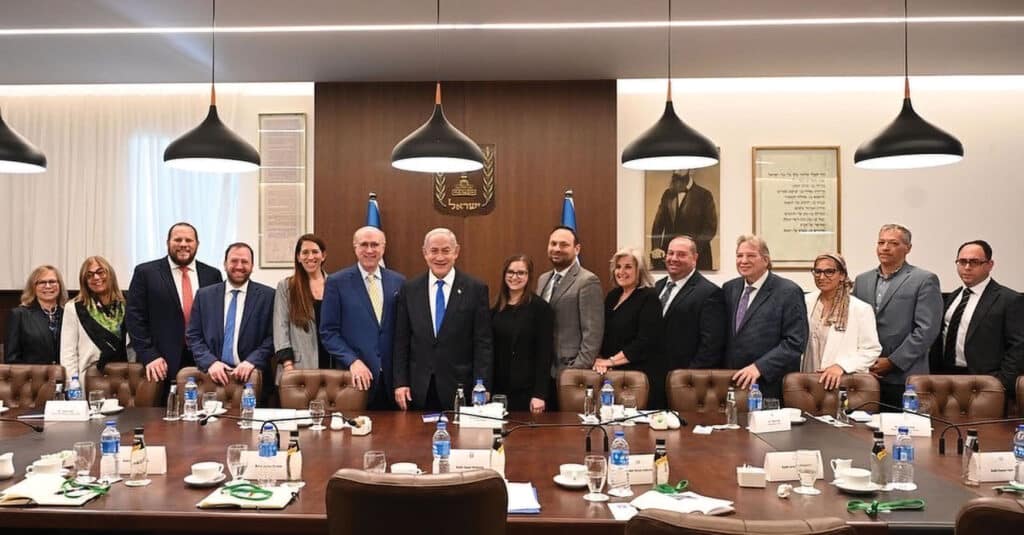
The packed itinerary of our meetings grew and intensified as the trip progressed.  In Abu Dhabi, we met with a member of the royal family, the director of the Abrahamic Family Center, and we also had a briefing with Dr. Ali Al Nuaimi, an architect of the Abraham Accords. After arriving in Dubai, we met with leaders of its growing Jewish community, and local civic and cultural leaders.  We even visited a Holocaust Gallery exhibit in Dubai.  In Bahrain, we engaged with a minister, a Jewish member of their Parliament and the Israeli Ambassador. Finally, in Israel we met with Natan Sharansky, an array of diplomats, eight Members of Knesset from across the political spectrum, culminating in a meeting and dialogue with Prime Minister Netanyahu in his cabinet room.

(From left to right) Natan Sharansky, ZRC Chair Rabbi Stuart Weinblatt, Rabbi Nolan Lebovitz, and Rabbi David Woznica in conversation.

The countries are not the same. Each one faces unique challenges: social, demographic, economic, and political.  Yet everyone shares a common value of tolerance and eagerness to engage — not only politically, but also people to people.  Representatives of all three countries shared that the Abraham Accords are not intended to resemble the peace between Israel and Egypt, or Israel and Jordan.  The Abraham Accords are supposed to spearhead a new era of peace and prosperity in the region and begin a new chapter of engagement between Muslims and Jews.  And that’s where we fit into the picture.

Our journey found a common trope in all three countries, where leaders expressed appreciation for the rabbis in the ZRC, who were willing to visit and express interest in engaging in the Abraham Accords.  Many organizations have visited the countries, such as the American Jewish Committee (AJC), Anti-Defamation League (ADL) and the American Israel Public Affairs Committee (AIPAC), but no rabbinic coalition like ours.  Supporting Israel today doesn’t only mean visiting Israel, which you should.  Supporting Israel today doesn’t only mean purchasing products of Israel, which you should. Today, supporting Israel should also include supporting her peace initiatives with neighbors in the region.

When Prime Minister Netanyahu walked into the cabinet room where our delegation was waiting, he seemed genuinely moved to see rabbis from across the religious spectrum in support of Israel.  While some of us came into the meeting with him as admirers and some as detractors, all of us shared a sense of respect for the office, appreciation for his decades of service, impressed by his command of knowledge and facts, and his ability to articulate his position within a larger historical context.

Too many rabbis today find a relationship with Israel only by criticizing her flaws. Israel and her Arab neighbors can’t fathom it. In our private meetings and meals, our younger rabbinic colleagues in the group discussed the isolating effect of openly supporting Israel in rabbinical schools in America today. In many ways, our organization presents a new vision for a Zionist spirit that unites North American Rabbis around Israel, rather than trying to fit Israel into the politics of an individual denomination. 

Our love for Israel has to be a foundational value, larger in scope than our love for any particular denomination.  As we enter a post-denominational world, we can stand at the center of a new order in which rabbis gather around identified values rather than gathering based on one’s rabbinical school ordination.

Zionism is not over because of Israel’s establishment and success over the last 75 years.  Zionism will continue to evolve to face new challenges.  Herzl could not have imagined a group of rabbis such as ours walking safely around Dubai in our kippot.  He could not have imagined Dubai.  Indeed, we could not have imagined Dubai.

There were aspects of the UAE that felt familiar.  For instance, in Dubai, Rabbi Lebovitz taught Torah at 9 am before the service and Rabbi Woznica taught after lunch.  They were similar Shabbat sessions, no matter where Jews are from — South Africa, Lebanon, Turkey, or Los Angeles — because we’re family.  There was a comfort in the connection with the local growing Jewish community.

Perhaps, just perhaps, we have helped to inspire a renewed chapter of Zionism in parts of the American rabbinate which would be good for America, good for Israel, and good for our entire people. 

And yet, naturally, aspects of the UAE and Bahrain felt foreign. The royal family and the larger government in the UAE expressed tolerance and welcomed Jews, but it’s not the liberal democracy of Israel or the United States.  The opulence felt overwhelming, or perhaps just for overwhelming for us.

The airports in Abu Dhabi and in Bahrain are sparkling clean, open and the employees are friendly.  Then, we arrived to Ben Gurion … But, it’s home.  No matter the challenge, no matter the internal strife, no matter the bad media coverage of the moment, to see the blue Star of David waving on the flag, means that we have arrived home.

In Parsha Balak, it is a foreign prophet who declares, “How goodly are your tents, O Jacob, your dwelling places, O Israel.” (Numbers 24:5).  At times it is easier to recognize the beauty of the Jewish People from an outsider’s perspective.  As lovely and welcoming as our hosts were in the UAE and Bahrain, Israel is our home.  It is for us to recognize the goodliness of Israel, the national tent of our people.

Everyone we met in Israel from the government — whether it be from the coalition or the opposition — we expressed the need for dialogue. We listened and we were heard. For we only have one goodly tent for our people, and it’s the State of Israel.

Many of us sit in our respective communities and say that if only we had the chance to speak with Israel’s leaders, then we would.  Our delegation had that opportunity, and we expressed all of our thoughts.  Our conversations were fruitful because they were grounded in Ahavat Yisrael, love of Israel, and we look forward to returning to Israel with members of our congregations. 

Perhaps, just perhaps, we have helped to inspire a renewed chapter of Zionism in parts of the American rabbinate which would be good for America, good for Israel, and good for our entire people.


Rabbi Nolan Lebovitz is the Senior Rabbi at Valley Beth Shalom in Encino, CA. Rabbi David Woznica is the Isaiah Zeldin Rabbinic Chair at Stephen Wise Temple in Los Angeles, CA.  Both rabbis serve on the Board of the Zionist Rabbinic Coalition. 

Zionist Rabbis Embark on an Extraordinary Journey Read More »

When Rights Clash

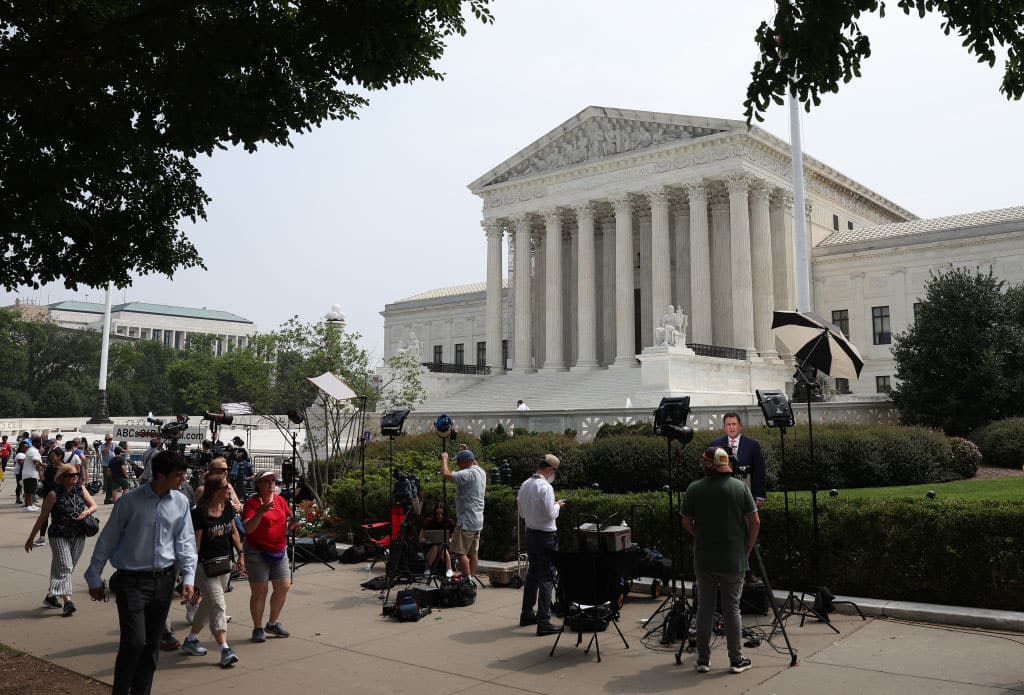
Last week, we discussed the Supreme Court’s decision to end affirmative action. But another case, in which the court ruled that a deeply religious web designer named Lorie Smith who refused to create a website for a same-sex wedding was protected by the First Amendment. is worth just as much of our time and attention.

I often turn to my Jewish heritage. to the culture and dogma of my faith, to help me navigate especially difficult policy matters. But in this case, I find that my religion pulls me in two opposite directions. The challenges the Jewish people have faced as a underrepresented minority throughout our history make me naturally inclined to stand with those facing unjust persecution. But my Judaism has also taught me to respect the religious beliefs of others, even when they differ from my own. Ultimately, I must decide whether to support those whose values are in greater need of protection – or to automatically side with those whose values I happen to share.

I’ve never liked being called a “moderate”: the term suggests someone without strong feelings or principles. But my beliefs on some matters – such as economic and national security policy — would be classified by many as fiercely conservative. On social issues such as abortion rights and immigration reform I’d be seen as committed progressive. I’m not moderate about very much at all: it’s just a lazy way for someone to average out a wide-ranging set of opinions and viewpoints.

In a similar way, my support for marriage equality springs from two very different philosophical sources. The liberal in me believes strongly in protecting LGBTQ rights: people deserve the right to the happiness that comes with a loving relationship – and the right to have that relationship recognized by the state regardless of their sexual orientation. My inner conservative recognizes the benefits for children of growing up in a two-parent household, and I see no valid argument why the gender of those two parents should be relevant to their ability to raise a child in a healthy and productive way.

My original impulse was to oppose the decision, concluding that the damage caused to a same-sex couple facing discrimination outweighed that suffered by a person of religious faith forced to implicitly endorse a practice that her faith forbids. But as is often the case, the deeper one digs, the more complicated a disagreement like this one can become, regardless of your opinion on either this particular case or the broader issue,

Smith’s attorneys told the court that she frequently provided services to LGBTQ clients.  But she felt that developing a website publicizing a same-sex marriage crossed a line from tolerating and respecting the decisions of others to actively supporting a ceremony that contradicted her beliefs. Smith’s work with members of the LGBTQ community on other projects may differentiate her decision from the civil rights era injustices in which merchants refused to allow black customers to enter their establishments or minority schoolchildren were barred from many public schools. But I still wrestle with whether that distinction is sufficient to justify this decision..

Smith had previously written a webpage outlining several topics on which she would not be comfortable working. She stated that she “will decline any request—no matter who makes it—to create content that contradicts the truths of the Bible, demeans or disparages someone, promotes atheism or gambling, endorses the taking of unborn life, incites violence, or promotes a concept of marriage that is not solely the union of one man and one woman.”

Her references to abortion and same-sex marriage understandably stand out, given the heartfelt and often wrenching debates in which our society engages on both issues. But a web designer who refused to create content that cruelly victimizes another member of the community or encouraged violence against an individual or persecuted class – to cite two of her other examples — would not be regarded so harshly.

Her mention of atheism should strike an especially deep chord with American Jews. Would a deeply observant Jewish web designer be required to create websites promoting the lack of existence of God?

Her mention of atheism should strike an especially deep chord with American Jews. Would a deeply observant Jewish web designer be required to create websites promoting the lack of existence of God? What would happen if someone who worries about the impact of the rising rates of intermarriage were asked to create a website or a wedding between a Jew and non-Jew? The competing priorities between statute and conscience clearly become much more difficult to balance when they represent our own beliefs rather than those of others.


Dan Schnur is the U.S. Politics Editor for the Jewish Journal. He teaches courses in politics, communications, and leadership at UC Berkeley, USC and Pepperdine. He hosts the monthly webinar “The Dan Schnur Political Report” for the Los Angeles World Affairs Council & Town Hall. Follow Dan’s work at www.danschnurpolitics.com

When Rights Clash Read More »

Ed Asner’s Final Role as a Holocaust Survivor Is Unforgettable

Screenwriter Gina Wendkos remembers walking in a Jewish cemetery in Hollywood when the idea for the feature film “Tiger Within” struck her.

“I wondered, if I survived the Holocaust, could I forgive,” Wendkos, who wrote the 2000 film “Coyote Ugly,” told the Journal. “If a man suffered, what would it be like afterward? I would hear people say ‘what’s the big deal with the Holocaust? People in wars die all the time.’ No this was a different horror. So, I created an imagined character.”

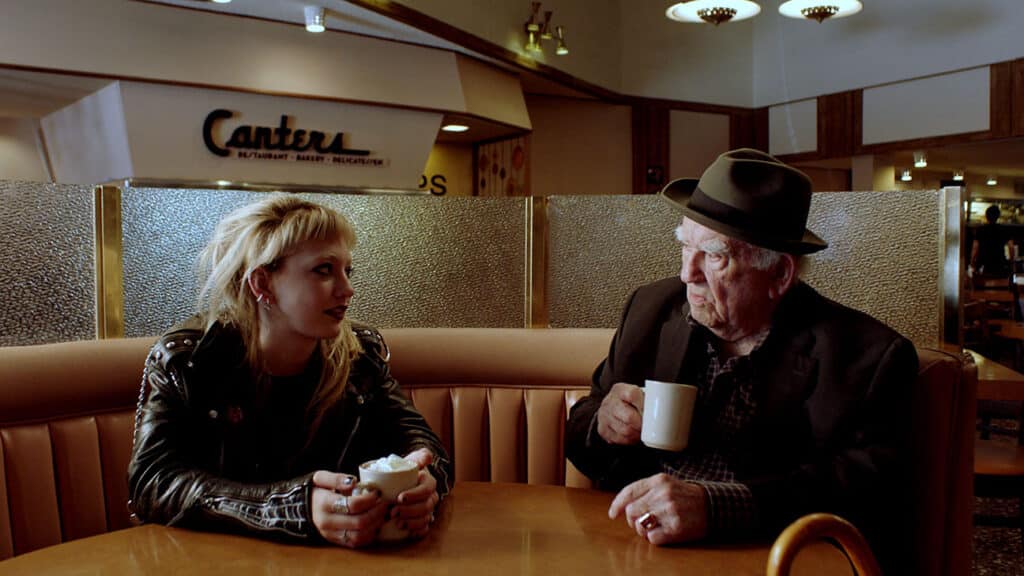
He was Samuel (Ed Asner), an elderly Holocaust survivor. While visiting his wife’s grave, he sees a teenage girl who appears upset and homeless.

She is Casey, who has a swastika on her jacket and claims that six million Jews were not killed in the Holocaust. Even though she is pretty, she’s convinced she’s ugly. Hermother appears to care more about her new boyfriend than her daughter, while her father has a new family. She works as a prostitute, and doesn’t want to be anybody’s charity case,

Samuel invites her to stay at his Los Angeles apartment. He has two conditions: She must take the swastika off her jacket and she must go to school. She agrees.

“God presented me with a challenge,” he tells her. “If I could learn to forgive you, a child in a swastika, then perhaps I could learn to forgive all before I die.”

He doesn’t judge her, though he advises her against the illegal way she makes money. It turns into a grandfather/granddaughter relationship.

Shocked at why is helping her, Samuel explains that he didn’t get to teach his own daughters to be ladies; theywere twins who died in the Holocaust.

He encourages her to reach out to her family. The film gets its title from Samuel explaining that one must embrace fear and bring the tiger inside.

Asner, an  Emmy and Golden Globe winning Jewish actor, is tough and gruff but kind. Margot Josefsohn gives a breakthrough performance as Casey, and she nails the role of an angsty teen who fears she may not find love, acceptance or a purpose. Her talent is undeniable and when she cries or when she screams it is impossible not to feel her pain. Casey’s ranting stems not from hate but from ignorance. But she’s a quick study when she has the right teacher and appreciates a person who gives her a chance when others have given up on her.

Director Rafal Zielinski said he and Wendkos had been trying to make this film for 20 years and, over the years, had approached actors such as Natalie Portman, Kirsten Stewart and Martin Landau. He was giving a ride to a friend who happened to be working with Asner, who called up the actor and put the director on the phone. Zielinski pitched the film to him and Asner told him to drop the script off by the doorstep. He did and Asner accepted the role.

“It was a kind of a miracle,” Zielinski said.

Finding the young actress was tough. He said he saw Josefsohn, then a 14-year-old who had never acted in a film, at an audition for a commercial.

“I saw her, and she hadn’t really acted before, but I noticed she had deep expressive eyes,” Zielinski said. “She was magnetic.”

The casting director wanted an 18-year-old to play a 14-year-old. Zielinski and Weendkos disagreed and knew Josefsohn would be perfect for the role.

Wendkos said she is happy the movie got made.

“There were a number of times I thought it wouldn’t happen,” Wendos said. “Everyone that saw the script loved it, but they said with an older character and a young girl, they can’t open a movie.”

The film was delayed due to the pandemic. Both said the film is especially poignant now.

“My mother really wanted this film to get made,” said Zielinski, who is from Warsaw. “She is, what you might say, a partial survivor. She was Jewish in Białystok, Poland. Her husband wasn’t Jewish. Somehow, they slipped through the cracks, and whenever the Nazis came, they would hide her in the cellars. My mother told me they would drive in one direction and Nazis took Jews away in another direction. It was terrifying and sad. She suffered a lot.”

Zielinski said she died a few months ago. Asner died in Tarzana, in 2021.

A scene where a group of skinheads vandalize a synagogue was shot in Westwood.

“I had no idea when I wrote the script what kinds of things would happen,” Wendkos said, “how antisemitism would be happening, and people would deny the Holocaust or not know about it. When I was young, I was the dumbest one, but now, I’m the smartest. It’s like everybody else took a dumb pill.”

She noted that her ex-husband told her she was the first Jew he ever met and when they were getting  divorced, her ex-mother-in-law said he should “take the Jew for all she’s worth.”

She said Asner approved Josefsohn and “the camaraderie they had in real life mimicked the warmth of the movie. He watched out for her.”

She said Asner, who was used to air-conditioned trailers, didn’t complain much because he cared about the mission of the movie, but she gave him popcorn when he was cranky.

Josefsohn, who is now 20, said she researched skinheads and the Holocaust for the role.

“I was nervous seeing the older girls at the audition,” Josefsohn told the Journal. “I’d done modeling but hadn’t acted in a film and once I learned who Ed was, I was a little intimidated because I didn’t know what to expect.”

The Santa Barbara resident said it felt very natural to act with Asner, who was kind to her.

“I think the message of the film is it’s important to let people feel the need to love and be loved,” she said.

In the movie, Casey is courted by her classmate Tony, played by Diego Josef, a cool handsome boy, who before their date tells a protective Samuel that he doesn’t have to worry … “this time.”

Casey gains confidence when Samuel buys her a beautiful dress and Samuel sees her as part of the family that was ripped away from him.

Zielenski said he interviewed a number of people about the nature of forgiveness in Los Angeles and New York City prior to making the film. He said it was an honor to direct Asner in his final film.

“He was such treasure to work with,” he said. “He was very proud of this.”

Wendkos said she does not regret casting an unknown or sticking to the vision of her script.

“She was so good we were flabbergasted,” she said of Josefsohn. “This script was something I cared a lot about and the message was important.

Asked if she plans to do more feature films, Josefsohn said it was possible and she will examine what comes next.

“Tiger Within” is a simple yet piercing film that reminds us that drowning people who say hateful things may change their tune when the tide has turned and they are safely on land. There is the realization that life can be a nightmare or a fairy tale, but most often is something in-between.

As for Zielinski, he had not expected things to change so much in the last few years.

“We are living in a very disturbing and dark time where there is misinformation and people can be easily influenced to believe incorrect things,” he said. “For this reason, this is a film I hope young people see. I hope we can turn one stone, and then another and another.”

“Tiger Within” is available to rent on ChaiFlicks, Amazon Prime and other streaming video on demand services. It is playing in select theatres including The Laemmle Town Center in Encino.

Ed Asner’s Final Role as a Holocaust Survivor Is Unforgettable Read More »

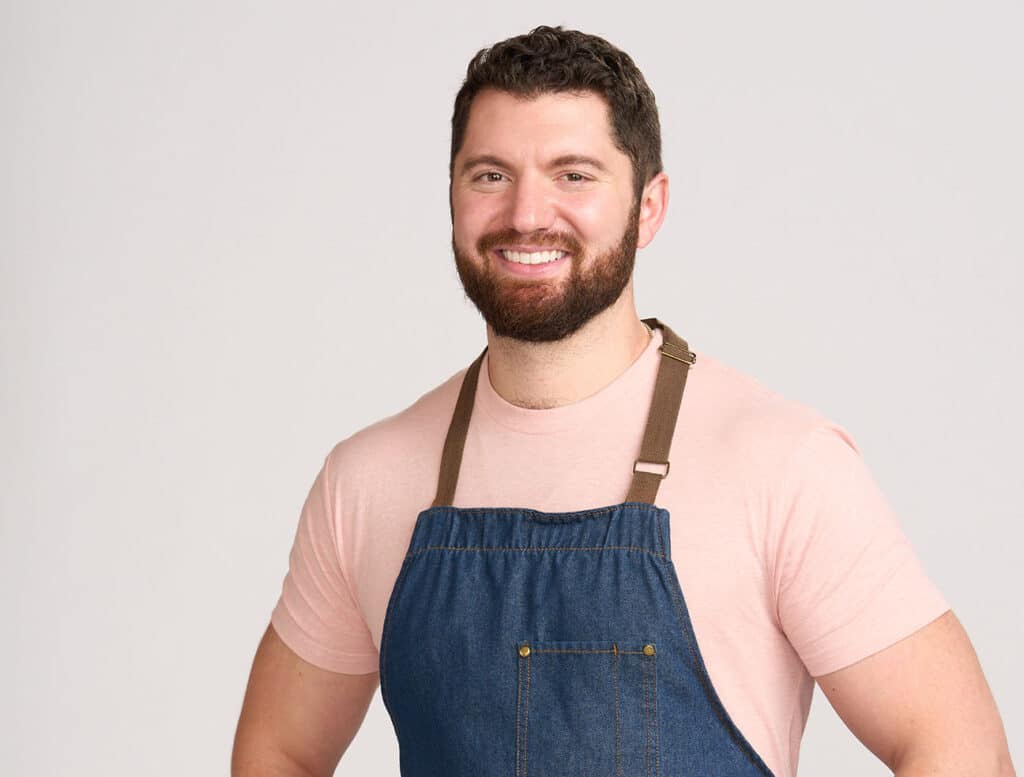
Brad Mahlof: The Great American Recipe, Chraime with Salmon and Easy Couscous

When Brad Mahlof started sharing his love of cooking – and his heritage – via Instagram, he had no expectations of where it would lead. The New York-based real-estate developer is currently appearing – and crushing it! – on the second season of “The Great American Recipe” on PBS.

“I’m not a food creator by profession, so to have this opportunity to come on a TV show and share my stories, share my food, is so surreal,” Mahlof told the Journal. “It’s been such a cool experience.”

On the show, talented home cooks from around the country showcase their signature dishes and, of course, compete to win. Unlike other programs of this type, and unlike its first season, on “The Great American Recipe,” they do not eliminate a chef each week.

“The first season of the show … every single week, the bottom person was kicked off,” Mahlof said. “I think that the producers changed the formatting this year because … they want everyone to have the full course of the season to tell their story.”

The show keeps track of their scored dishes on each episode. Then the three chefs with the highest scores will make it to the finale; one will be crowned the winner.

Mahlof says he always loved eating – “I think that’s inherent in Jewish culture” – and from a young age, started picking up the skill set to cook.

“My mom is such a good role model,” he said. “She’s always worked a full time job, and regardless of that, she’s somehow managed to have these amazing Shabbat dinners every single week. [These were] multi-course meals with 10 different entrees.”

When Mahlof was in college he started cooking big Shabbat dinners for his friends. Then, after college, he moved to the city and would do a huge, weekly Shabbat dinner with 10, 15, 20 people.

During the pandemic, Mahlof decided to create an Instagram account, to document his cooking experiences. People started following his account and, eventually, a casting person from the show reached out.

“I literally thought it was a joke, when I got a DM on Instagram, saying, ‘We think you’d be such a good fit for this show,’” he said.

Mahlof ignored it; they kept messaging him, until he finally responded.

“It was just so off my radar to ever do something like this,” Mahlof said. “But the opportunity came about, and I said, ‘Why not?’ If this is what the universe is saying, let’s go for it.”

On “The Great American Recipe” Mahlof has been able to share his Jewish culture and love of cooking. He is of Libyan Jewish descent on his father’s side; his mother’s side is Ashkenazi.

“My dad’s family moved [from Libya] to Israel, so we saw our family once a year,” Mahloff said. “There’s a little bit of a language barrier [but] there was always a bonding experience with food.”

As he has gotten older, Mahlof realized that Libyan culture is relatively unknown.

“There’s no Jews left in Libya,” he said. “All that we have left to pass down is our food. I took it upon myself to make it a passion project to record and cook these recipes, and hopefully memorialize them, so they get passed down to the next generation, and beyond.”

On the first episode of the season, Mahlof won both challenges. The recipe for his first dish, Chraime (a Libyan fish stew) with Couscous, is below.

“It’s easy to make, so it’s perfect for a weeknight dinner,” he said. “It has a lot of the flavor profiles of Libyan cuisine, so you can get a taste for it. And it’s super delicious. Once you make it, you’ll be hooked.”

Mahlof said the most surprising thing about being on the show is seeing how well he and the other contestants are able to push themselves to their limits. They’ve created a special bond; the kind of community that can only come from this kind of shared experience.

“I can go to the grocery store and get excited about some random piece of lettuce, and these are the friends that I could text about it,” he said. “This niche group of friends care about [my] little quirky behaviors of spending six hours at a grocery store, going aisle by aisle.”

Mahlof believes a cook’s journey is a constant evolution. No one starts off as an amazing cook; it takes practice, so don’t get discouraged.

“Even these recipes that now I do with my eyes closed,” he said. “I remember when I was much younger I’d call my mom every single week. ‘Mom, how do you do this?’ She had to walk me through everything, and it still didn’t come out right.”

Remember, he added, “Your food is only as good as the ingredients that you use. Definitely spend the time, spend the money, if you can, to source the best ingredients possible. And that’s going to yield the best food results.”

Learn more about Brad Mahlof and “The Great American Recipe.” Follow @CookwithBrad on Instagram.

For the full conversation, and to hear more about his cooking show experience, listen to the podcast:

Watch the interview:

Chraime with Salmon and Easy Couscous

Fish

  • 5 tablespoons vegetable oil, divided
  • 3 pounds skin-on or skinless salmon filets, cut into equal-size portions. (Find salmon that has nice fat content)
  • Kosher salt and ground black pepper to taste
  • 1 tablespoon ground caraway, plus more for sprinkling
  • 1 head garlic, cloves separated, peeled, and crushed
  • 2 tablespoons sweet paprika
  • 2 tablespoons hot paprika
  • 1 tablespoon ground cumin
  • 1 teaspoon cayenne pepper, or to taste
  • 3 tablespoons tomato paste
  • 2 cups water
  • 3 tablespoons freshly squeezed lemon juice, plus lemon wedges for serving
  • Chopped fresh cilantro, for garnis

Couscous

  • 1 (2.2-pound) bag coarse semolina, such as Stybel
  • 1 cup vegetable oil
  • 1½ tablespoons kosher salt
  • 6 cups boiling water

Directions

Heat 2 tablespoons of the oil in a large skillet over high heat. Season both sides of the salmon with salt, pepper and a pinch of caraway. Sear the fish for a minute or two on each side, until the skin is golden. Transfer the fish to a plate and wipe the skillet clean.

Heat the remaining 3 tablespoons of oil in the same skillet over medium heat. Add the garlic, both paprikas, cumin, caraway and cayenne and cook for 30 seconds, stirring constantly so that the spices don’t burn. Add the tomato paste and cook, stirring, for 1 minute. Add the water and lemon juice and bring to a simmer, stirring occasionally. Season with salt and pepper to taste.

Return the fish to the skillet, reduce the heat, and bring to a gentle simmer. Cook for about 7 minutes, until the fish is cooked through (145 degrees F).

Remove the pan from the heat and allow it to cool slightly. Sprinkle a little caraway on the fish. Serve with the pan sauce and couscous (recipe follows), garnished with cilantro and with lemon wedges for squeezing.

For the Couscous: In a large microwave-safe bowl, combine the semolina, oil, and salt. Pour the boiling water over the semolina and rake with a fork.

Cover the semolina with a clean kitchen towel and microwave for 4 minutes. Rake again, cover again, and microwave for an additional 4 minutes. Rake again, then transfer the couscous to a food processor and pulse to break apart until small and fluffy.


Debra Eckerling is a writer for the Jewish Journal and the host of “Taste Buds with Deb.Subscribe on YouTube or your favorite podcast platform. Email Debra: tastebuds@jewishjournal.com.

Brad Mahlof: The Great American Recipe, Chraime with Salmon and Easy Couscous Read More »

Shelter vs Safety: LA’s Homelessness Crisis— Part 2

Last week, I described my ambivalence toward Los Angeles, a city I still love, but where I am worried about walking or driving on the streets due to possible attacks by homeless persons.

But while I fear of such attacks, the issue of homeless encampments in my beloved city leaves me feeling sad and hopeless. 

I feel compassion for those who live in encampments, especially women. Living on the streets is the very definition of vulnerability. But I’ve also been forced to share my residential street with a homeless encampment for months. Residents have repeatedly contacted our elected officials with pleas to remove the encampment. Last Monday morning, the encampment was cleared. My neighbors and I shared our hopes that the people found housing. We were also relieved that after so many months, our sidewalk was safe and clean again. 

Then, 24 hours later, the encampment reappeared exactly where it had been. 

Perhaps the issue of encampments is rooted in a fundamental question: Whose rights come first? Those of the homeless persons, who are still human beings and possess the most basic needs for shelter and safety, or the rights of business-owners and residents, including the disabled.

Perhaps the issue of encampments is rooted in a fundamental question: Whose rights come first? Those of the homeless persons, who are still human beings and possess the most basic needs for shelter and safety, or the rights of business-owners and residents, including the disabled.

There’s a lot of Jewish wisdom to be found in the tension between compassion for the homeless and public safety for all. In Judaism, the essence of G-d itself exists in an eternal continuum between chesed (loving kindness and mercy) and gevurah (strength through judgment and enforcing limitations). Judaism understands that some situations require more chesed and others more gevurah. 

I’ve been thinking a lot about these two concepts lately, as my neighbors and I have been feeling unseen with regards to our need to live on a safe, clean, ADA-compliant street. It took a long time to have the encampment removed, and one day for it to reappear. 

Both residents and the homeless rely on our elected officials, because they are the ones with the power to do something about this. In February, Los Angeles City Council voted to impose its anti-camping law. Known as the Section 41.18 of the Los Angeles Municipal Code, it stipulates that “No person shall obstruct a street, sidewalk, or other public right-of-way” by sitting, sleeping and placing personal property within 500 feet of public spaces. The ordinance was amended to include daycare centers and schools. 

Councilmembers have the power to designate certain areas as 41.18 sites, so I reached out to several Councilmembers’ offices to learn more about this. Since taking office, Councilmember Traci Park (CD11), who represents areas including Brentwood, Mar Vista, Marina del Rey, Pacific Palisades and West LA, has designated 12 areas as 41.18 sites. The City Council’s decision to enforce 41.18 came after Park’s election. Her predecessor, Mike Bonin, refused to enforce 41.18 in District 11. Maybe Bonin’s refusal was an example of chesed gone amok. 

Councilmember Bob Blumenfield (CD3), who represents Canoga Park, Reseda, Tarzana, Winnetka, and Woodland Hills, has designated 33 areas as 41.18 sites. Representatives from both Park and Blumenfield’s offices told me that 41.18 sites are not a cure for ending homelessness, but a matter of public safety.

I reached out to Councilmember Katy Young Yaroslavsky (CD5), who represents Pico-Robertson, Fairfax, Westwood and Century City, among other areas. She has not designated any areas in her district as 41.18 sites (other City Council members have the same record), but since she is my councilmember, I wanted to ask her a few questions about encampments.


Here’s what I asked Young Yaroslavsky in an email interview:

Jewish Journal: Have you ever put forth a motion to create a 41.18 zone anywhere in your district?

Katy Young Yaroslavsky: No.

JJ: Do you believe 41.18 should be repealed? 

KYY: No, I don’t believe it should be repealed. Let me be absolutely clear that I fully support the use of 41.18 at sensitive sites such as schools and daycare centers. As a mom of three, those sites are non-negotiable and I have been consistent in that belief both in my campaign and as a Councilmember. But the fact is that 41.18 sites are not just limited to sensitive areas. Council offices have the authority to designate any public area in the city as a 41.18 zone – and they have done so, creating over 2,000 sites across the city, complicating enforcement of the ordinance.

Earlier this year, I introduced a motion to study the application, enforcement, and effectiveness of 41.18 because we need to know how this policy has been implemented in each council district, what resources are being spent, and whether enforcement is actually helping or hurting our efforts to combat homelessness in Los Angeles. Homelessness is a citywide issue that requires a comprehensive, service-led response.

By law, enforcement of 41.18 must be paired with a credible offer of housing. This motion looks at whether or not that has actually taken place, or if we are simply moving people from block to block. Before I took office, I saw the effect that 41.18 enforcement without credible offers of housing has on residential neighborhoods. Instead of only seeing unhoused people under freeways, we started to see them in residential neighborhoods and in front of  homes. Nobody wants that. But that is the reality of enforcing 41.18 without credible offers of housing.

I believe that my motion will give us the data we need to make informed decisions on how to most effectively address homelessness.

JJ: What factors would you consider in designating 41.18 zones, and is the safety of Jewish families walking on the Sabbath, and Jewish children at a multitude of Jewish schools in your district, one of these factors?

KYY: All schools in Los Angeles – including Jewish schools – are considered 41.18 zones, which I support.

[Young Yaroslavsky is referring to the fact that 41.18 is automatically applied to sites that include schools and daycare centers. But it is up to individual Councilmembers to designate other sites, whether freeway underpasses or street intersections, as 41.18 sites].

JJ: When neighborhood groups contact your office about encampments, do you actively work with agencies and law enforcement to have them removed? Is there a different process?

KYY: My dedicated team of three homeless outreach workers works with homeless service and housing providers, LAHSA (The Los Angeles Homeless Services Authority), the Mayor’s office, local institutions, and the LAPD to ensure that no encampments are located within 500 feet of any of the 41.18 school zones on La Cienega. Over the past several months, we coordinated the voluntary relocation of encampments within 500 feet of Ateret Israel preschool, Cheder Menachem (in partnership with Council District 10), Pressman Academy, and the area around Mikvah Esther. We also initiated a major sidewalk cleaning around the Mikvah following the relocation. We also worked with LADOT to resolve an encampment that was located under the Menorah Housing Foundation’s Pico Wooster Senior Housing Center. This encampment had been there for several years and posed a fire hazard for the residents. We also coordinated with LAHSA to move nearly twenty folks living in tents and RVs outside of St. Augustine Church’s school and day care center into housing. 

Broadly speaking, we want to move people living in encampments off the street and into housing as quickly as possible. The biggest obstacle is that there isn’t currently enough interim housing in the district. We are working hard to bring those beds online quickly, and will have more news in the coming weeks.


When I asked Young Yaroslavsky about the specific encampment on my street, which is occupied by a male and a female, she said that the man is a member of the local Jewish community. “We have been working with Jewish Family Services and The People’s Concern to find him housing in the area because he attends services at a local synagogue,” Young Yaroslavsky said. 

I would love to verify this information, but Young Yaroslavsky’s office did not feel comfortable sharing the name of the synagogue with me so I could follow up on this (without naming the synagogue in print). Young Yaroslavsky’s office instead offered me an interview with the man in the encampment.

I wish I could do it. Maybe another writer would interview him. But I’m deeply uncomfortable with interviewing this individual because for my neighbors, my family and I, this encampment on our residential street has been such a long-term source of pain. Maybe some would say that’s too much gevurah on my part.

This is one of the challenges of our homelessness crisis in this city: Our homeless Angelenos are human beings. We can’t become so desensitized that we completely turn our backs on them.  

But our residents are human, too, and we’re growing weary. 

I know the encampment on our street won’t last forever. Young Yaroslavsky told me that several Permanent Supportive Housing projects are opening nearby soon and she hopes “this individual will be placed into housing in the coming months.”

For the sake of both chesed and gevurah, I truly hope so.


Tabby Refael is an award-winning writer, speaker and weekly columnist for the Jewish Journal of Greater Los Angeles. Follow her on Twitter and Instagram @TabbyRefael

Shelter vs Safety: LA’s Homelessness Crisis— Part 2 Read More »

Rosner’s Domain | In Preparation for Mourning?

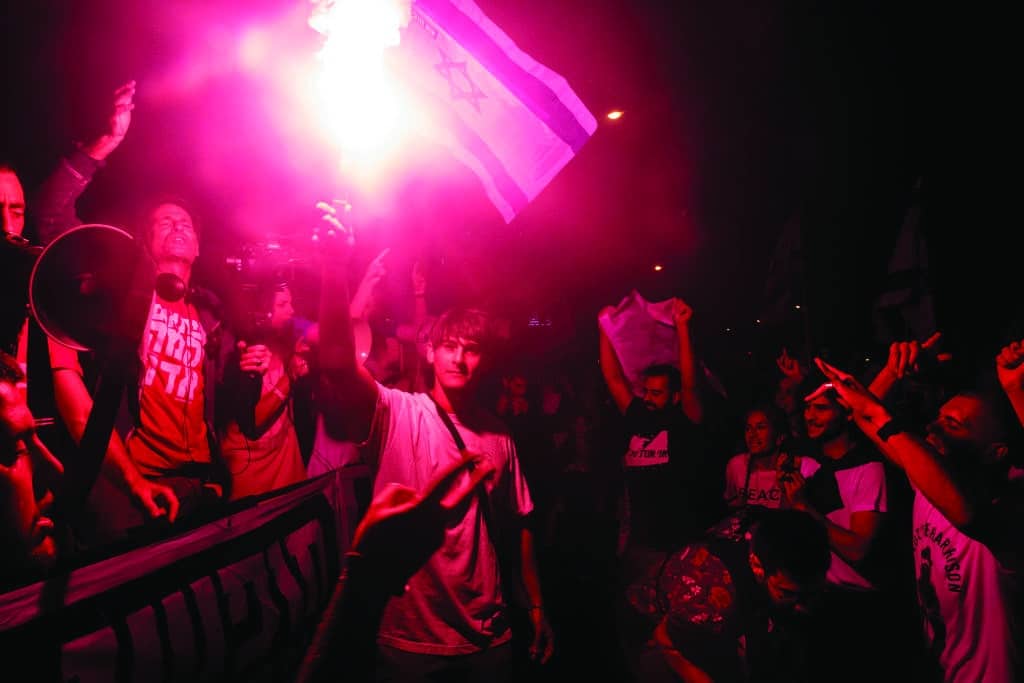
Here’s a simple, chilling question I asked Israelis this week: Have you bought a candle yet? I urged them to do it. If you’re lucky, I told them, you’ll only use it on the high holidays. But I’m afraid we might need to use it sooner. Because Israel is moving, with open eyes and no sign of retreat, on a path leading to violence.

Political violence is often a self-fulfilling prophecy. The murder of Emil Grunzweig at a Peace Now demonstration in 1983, was the violent crescendo of a tense period. The assassination of Yitzhak Rabin in 1995 was also the violent crescendo of a tense period. In hindsight, neither should have come as surprise. Only the naiveness of a younger Israel made them surprising events. We really thought we were different, when we aren’t. We are like everyone else. As tension rises, the potential for violence rises. And as I write these words, the tension in Israel is at its peak.

State officials recently asked senior Shin Bet operators whether they are keeping an eye on extremist protesters and on extremists who might want to harm protesters. They are worried, and for good reason. It is not easy to identify in advance every random place that is prone to a violent flare-up.

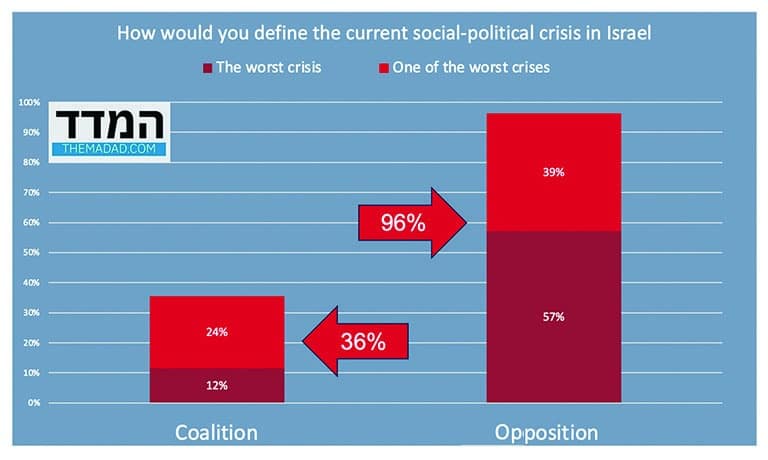
One of the main problems that brought Israel to this moment concerns the gap between two camps in assessing the severity of the crisis. More than half of the opposition’s supporters say that the crisis facing Israel is “the worst in the country’s history”, and almost 40% more call it “one of the worst in the country’s history”. Coalition supporters do not see reality that way. Of course, they do see a crisis, but only a small minority of them (12% according to data we gathered this week), believe that it is the most severe in the country’s history. It’s not that the right is taking the situation lightly. A large group agrees that this is a serious crisis. But it also insists that “there are more serious crises than this one”.

More than half of the opposition’s supporters say that the crisis facing Israel is “the worst in the country’s history” and almost 40% more call it “one of the worst in the country’s history.”

Not every severe political crisis ends in violence. But the warning signs we see this week do not leave much room for optimism. The difference in perception of the severity of the crisis leads to misunderstanding that leads to frustration, despair and a sense of urgency. Those who oppose the government find it difficult to understand why they shout, cry, demonstrate – and still the government does not listen. Supporters of the government find it difficult to understand why their opponents shout, cry, demonstrate — and insist on preventing an implementation of a decision that has a clear mandate in the Knesset.

Both sides feel that their message is not getting through. So, day by day they raise their voices and sharpen their rhetoric to make the other side listen. And still, nothing seems to work. Which may well lead to the conclusion that only a very loud noise — of sirens, of pain, of a collision, of a mob — will get their point across. 

How will this happen? The possibilities are many, which makes the danger more tangible. It can be a driver who loses patience as he is stuck in the endless traffic jams created by the protesters. It can be a police officer who has trouble controlling his nerves. It can be a demonstration that gets out of hand. It can be a loose cannon deciding to spill blood. It can happen today or tomorrow, or next week, or next month. And there will be nothing surprising about it. 

When violence breaks out, the right will accuse the left of breaking the rules and the left will accuse the right of opacity and rapacity. But the ultimate question of guilt depends to a large extent on luck: Which side is responsible for the violence? And no one should be tempted to believe that the potential for violence is to be found only on “the other side”.

Did you buy a candle? If you love Israel, keep it in a nearby place, for use in case of need. Keep it for use when the familiar ritual of grief and remorse begins. Let it burn amid the tired parade of agonizing speeches by politicians, academics, rabbis, intellectuals, artists, celebrities.

They will all say gloomily: the writing was on the wall. And no one will object, because the writing is on the wall.

They will all ask gloomily: How did we degenerate into this? And the honest answer would be: quite easily. 

Something I wrote in Hebrew

A new TV series attempts to define and describe secular Jews in Israel. Here’s what I said about it:

A large majority of the secular Jews in Israel also want Israel to be a Jewish state. In order for Israel to be a Jewish state, they need to define what is Judaism today. And  Israeli secularism has two possible paths. If secularism is simply a negation of the religious way of life, then secularism will continue to need religiosity to some extent. It will not be a viable alternative to religiosity but will simply be the less dominant Jewish group. On the other hand, if secularism is a kind of new Jewish “stream,” or a new Jewish concept, then a more interesting competition is underway. In that case, Israeli secularism presents not a negation of something but an alternative to something — a new kind of Judaism. 

A week’s numbers

Israelis can’t be convinced to compromise when such a wide difference in the perception of the severity of the crisis exists.


A reader’s response:

Abraham Koppel asked: “what do you make of Biden saying that the current Israeli government is the most extreme ever?” My response: whether he should say such thing is a question we can ask, but when it comes to the actual situation, he is evidently right. 


Shmuel Rosner is senior political editor. For more analysis of Israeli and international politics, visit Rosner’s Domain at jewishjournal.com/rosnersdomain.

Rosner’s Domain | In Preparation for Mourning? Read More »

SB_logo2

No Longer Seeing Other People ft. Ilana Dunn

Libby and Marla are back and excited about their new launch with the Jewish Journal! They give some brief intros about themselves to help their new listeners learn about who they are. They then give updates about what’s going on in their personal lives. Libby has an upcoming talk with Hadassah Magazine and Marla survived a car accident – so all good things! This week the girls are thrilled to welcome Ilana Dunn, a dating expert herself who will no longer have to deal with Schmuckboys as she recently got engaged. Ilana shares her unexpected journey into the dating podcast world and how she grew her audience. The girls discuss how they talk to their audience without revealing too many details about their dates. Ilana shares about how her and fiance first met and her connection to the Jonas Brothers which was also a big part of their relationship. Ilana also discusses where she sees her dating podcast path going now that she’s engaged. The girls also ask Ilana about her experience co-hosting a dating podcast with a guy she had previously dated. The girls discuss dating smarter and how sometimes we’re at fault for allowing ourselves to stay with people who don’t treat us right. Ilana shares about her new venture with friend Carly Silverman to help set people up in a more casual and comfortable way. After discussing dating, the girls get into Ilana’s connection to Judaism and how her identity changed when she first went off to college. She shares a funny story about convincing her mom to agree that she could marry NIck Jonas despite him not being a member of the tribe. They end with a game of Dating Do’s and Don’ts!You can find Schmuckboys on Instagram @schmuckboysofficial and Ilana Dunn @ilana.dunn and @seeingotherpeople and @itslifeinprogress. Email dating questions to schmuckboys@jewishjournal.com


No Longer Seeing Other People ft. Ilana Dunn Read More »