fbpx

June 21, 2023

While Beijing Abuses Muslims, Palestinians Woo China

When I was a pro-Israel student leader on campus, I often found myself face-to-face with anti-Israel peers who were also active in Muslim student groups. During one particularly tense anti-Israel event, one of these students looked at me and screamed, “Israel systematically targets Muslims! It’s the enemy of Muslims! And nothing you say can change my truth.”

I walked closer to him and said that I was from Iran. I then asked, “Would you and your organization co-host a ‘Free Iran’ protest with us if we planned something together? Iran kills so many Muslims. Over 70 million Muslims are held hostage there, especially women.”

He didn’t answer. So I added, “What if, for just one day, I take off my ‘pro-Israel hat’ and am just a regular Iranian? Would you protest Iran with me and other Iranian students?”

Again, silence. 

Several years later, I attended a pro-Israel counterprotest in Los Angeles. It was Spring 2012 and I was thinking a lot about Syria. So I tried to engage with an anti-Israel protestor who was holding a sign that alleged Israeli abuses against Muslims. I asked him if he would consider joining a march against Bashar al-Assad, because hundreds of thousands of Syrians were at risk of dying. 

He didn’t answer. 

I believe there are many Muslims who are horrified over the treatment of their brothers and sisters in Muslim-majority Middle Eastern countries such as Syria and Iran. But I thought about the aforementioned encounters again last week when I read that Palestinian Authority President Mahmoud Abbas was in China to meet with President Xi Jinping. This was Abbas’s fifth visit to the totalitarian country, and China and the PA signed a “strategic partnership”  during this trip.

Back in March, representatives from Iran and Saudi Arabia also met in Beijing when China brokered a diplomatic arrangement between the two states: One a Muslim theocracy whose official name is the Islamic Republic of Iran, and the other the heartland of Islam, home to the Kaaba and the holiest mosque in the world.

For years, China has been committing human rights atrocities against millions of Muslim Uyghurs in its western Xinjiang region. Now, leaders of various Muslim countries are traveling to China to speak with its head of state. 

If a Martian visited Earth, I would describe recent events to it as follows: For years, China has been committing human rights atrocities against millions of Muslim Uyghurs in its western Xinjiang region. Now, leaders of various Muslim countries are traveling to China to speak with its head of state. 

“The Muslim leaders are not happy with China’s treatment of Muslims, correct?” the Martian would rightly assume. 

“They’re perfectly happy with it.”

“So, they are not in China to discuss anything related to Chinese crimes against Muslims?”

“No. The issue didn’t even come up during the various visits,” I would say.

“Have they expressed disapproval of other countries’ treatment of Muslims in the past?”

Bingo.

At this point, the Martian would scratch its head and report back to headquarters, having learned the hard way that humans may be confusing, but their leaders are nothing if not hypocritical. 

Back in 1992, Iran, Kuwait, the United Arab Emirates and the Saudis had no qualms over supporting Bosnian Muslims during the Bosnian genocide. In 2017, when the Rohingya were being systematically annihilated in Myanmar, many Muslim countries in the Middle East responded with outrage and demanded action from an international coalition.

But now, there’s the plight of Uyghur Muslims. In 2019, 22 countries, most of them in the West, released a joint statement criticizing China for its abysmal persecution of Uyghurs and other religious minorities. This includes forced sterilization, mass surveillance, political indoctrination, extrajudicial killings, sending millions to what China calls “re-education centers,” and separating Muslim children from their families in the hope that these kids will forget about Islam. 

One day after that statement, 37 countries issued a joint statement about China as well, but with one notable difference: Their letter enthusiastically defended the country. Did I mention that nearly half of the signatories were Muslim-majority nations? The list included Syria, Qatar, Pakistan, the UAE and yes, Saudi Arabia.

Not only did these countries defend China, but also they actually claimed that Muslim Uyghurs were safe and happy. 

Happy?

As for reports of torture and detention camps, the letter claimed they were “vocational training centers.”

“I was surprised that [Muslim countries] would put it in writing and put their names on it and sign a document to actually praise China,” Azeem Ibrahim, a director at the Center for Global Policy in Washington, D.C., told CNN in 2019. “It’s one thing to keep quiet and abstain. It’s another thing to overtly support [the policies] when there was no need for them to do so.”

The reasons are not surprising: stability, economics and survival. And for the Saudis, cooperation with their biggest trading partner. Along with Egypt and the UAE, Saudi Arabia has signed a Comprehensive Strategic Partnership with China, whose huge Belt and Road Initiative (BRI) is projected to cost up to trillions of dollars. Egypt, the UAE and Saudi Arabia were even kind enough to deport Uyghurs back to China, at the country’s request. 

Nearly 150 countries are investing in Beijing’s BRI, which can best be described as a Chinese global infrastructure project. If you really want to know, my fears over the worldwide impact of the BRI sometimes keep me up at night.

Seemingly no Muslim country, including Turkey, has dared to speak out against China. That makes them, as Ibrahim told CNN, wholly “complicit” with the suffering of Uyghurs.

Seemingly no Muslim country, including Turkey, has dared to speak out against China. That makes them, as Ibrahim told CNN, wholly “complicit” with the suffering of Uyghurs. In The Guardian, Nick Cohen described their horrifying persecution as “one of the great crimes of the 21st century.” And it’s happening before our eyes. 

In countries such as Pakistan, criticizing China is considered taboo. In other places, it’s verging on blasphemy. And that’s terrifying. 

“Countries that could not tolerate [Salman] Rushdie’s magical realist novel can live with the mass sterilization of Muslim women,” Cohen wrote in 2020. “It may be a cheap point but it remains true that if a western country were to display one-tenth, one-hundredth or one-thousandth of the brutality that China is inflicting on Muslims, the global left would be burning with outrage.” 

Regarding European events, such as the outrage of Muslim-majority countries over Dutch cartoons or the Charlie Hebdo massacre in France, Cohen wrote that many Muslim leaders “will give concentration camps [in China] a conniving wink of approval, but draw the line at cartoons in a Danish newspaper.”

With Abbas’s visit to China last week, I can’t but wonder where the Palestinians fit into all this hypocrisy. Abbas’s Fatah party may be more secular, but would Hamas leaders ever join him in Beijing to sit down at the table with Israeli leaders?  After all, this is the terrorist organization whose name is an acronym for an “Islamic Resistance Movement” and was founded by a Sunni cleric. Can an “Islamic resistance movement” resist China and its torture of Muslim Uyghurs? 

It’s important to mention that China is one of Israel’s most important economic allies. But I would expect Muslim-majority countries to be the first to ask China to ease up its persecution of Uyghurs. And sadly, there seem to be more people who believe lies about Israel’s treatment of Muslims than there are those who even care about the truth when it comes to China’s abuse of Muslims. 

Amazingly, Abbas concluded his China trip last Friday by publicly supporting Chinese repression of Uyghurs and pushing back against Western ideals concerning human rights. Chinese abuses against Muslims, said Abbas, have “nothing to do with human rights and are aimed at excising extremism and opposing terrorism and separatism.” Surely, no one is more committed to opposing terrorism than the chairman of the PLO. 

If Muslim countries (and, on a micro level, leaders of Muslim organizations) haven’t supported the Uyghurs, then who has? Last week, my colleague, Karmel Melamed, reported in JNS that Uyghurs leaders expressed gratitude for the support of Jewish organizations in the U.S. and the UK. 

Melamed’s story shed light on all of the Jewish organizations that are helping the Uyghurs (and American Jewish leaders who are introducing supportive legislation, beginning in California). But after reading the story, I could only think of what Omer Kanat, co-founder and executive committee chairman of the World Uyghur Congress, told JNS. His heartbreaking entreaty was filled with inarguable emet (truth): “It’s truly shameful,” Kanat said. “Are we Uyghurs any less Muslim than other Muslims in the world?”


Tabby Refael is an award-winning writer, speaker and civic action activist. Follow her on Twitter and Instagram @tabbyrefael

While Beijing Abuses Muslims, Palestinians Woo China Read More »

Learning Torah While Caring for Others

There are no coincidences in life. On June 14th I attended a conference of Temech, an organization whose goal is to help haredi women achieve financial independence through guidance in building their businesses, but is also open to non-haredi women (as am I). They encourage networking, and just before the day ended, I asked Naomi Guez, the last person I met, what she does. It opened for me a world of chesed, kindness, and I offered to write about it. 

Guez and her husband, native Israelis, spent many years teaching in Venezuela, Argentina, and for the last 23 of their years abroad she taught in the Yeshiva of Flatbush. They recently returned to Israel and Guez’s current pet project is raising funds for the Karnei Shomron Hesder Yeshiva, which has a five-year program of study and army service; most of their students enter elite combat units, some of them are officers, in addition to contributing to the security and emergency needs of Karnei Shomron. 

But they have another mission.

The yeshiva established on its own grounds both a respite program for families of children and young people with special needs, and a residential entity for young people with disabilities.

Like some other yeshivot, this one encourages their students, both in the high school and the hesder program, to community service and volunteerism. But they have gone one step further. The yeshiva established on its own grounds both a respite program for families of children and young people with special needs, and a residential entity for young people with disabilities.

Nofshon Shomron (Holiday in the Shomron)

Every weekend, and during special holiday and vacation times, children and young adults with special needs are hosted by this program, which includes lodging, meals and activities, and offers parents and families quality time, rest and respite from the intensive care they give to their special-needs children. It is administered together with Israel’s Ministry of Social Welfare and Social Services Department.

The volunteers include graduates of the Yeshiva, youth from elsewhere, soldiers, and young women performing their Sherut Leumi (National Service). Experienced coordinators from the Yeshiva are present at all of the activities, offering professional guidance and assistance.

Once a year, a week-long summer camp, repleted with activities and attractions, is held for 70 attendants with various disabilities, accompanied by 80 volunteers. During the year there are also events such as parental bonding on Shabbat and family fun days.

In a mother’s words

I spoke with Sarah Kind. She and her husband Herzl have four children. The youngest, Yair, now 24, has special needs and cannot be on his own. He has been in the Nofshon Shomron program for the last fifteen years. Sarah calls the program, “Incredible, a blessing. Before I retired, I worked with special needs children and I heard about it from them. 

“The first time, it was hard for me to let go. But our next youngest son volunteered there and he came back and said, ‘Ima, you must send Yair there. He will have fun and you will enjoy yourselves; everyone will gain from it.’

“From the moment Yair entered the program, it has been a great relief for us. The yeshiva students are wonderful; there are no words to describe the chesed they do. Rather than going home for Shabbat, they stay with these young people 24/7, take care of them, eat with them, shower them, take care of their hygiene – they do it all, in addition to running a wonderful program of activities. And some of them are even younger than the people they are taking care of, for the boys come from both the high school yeshiva and the post-high school hesder yeshiva. They give up their Shabbat weekends and vacations to help parents and families that they don’t even know, and this is not to be taken from granted; there is no greater chesed (kindness).” 

“The first Shabbat Yair was there, I was nervous the whole Shabbat. I was afraid and kept thinking – How does he feel? Does he think we abandoned him? But Motzei Sabbat (Saturday night) he didn’t want to come home, said he wanted to go there again. It was so moving; we can’t imagine him not being in the program now.”

Sarah says passionately, “We live with these children with love because they are ours, but we also sometimes need a bit of breathing space, including the parents who sometimes need it for themselves, as a couple. We need to recharge our batteries. And Yair always needs supervision; he can’t be left alone. It is impossible to describe in simple words what this is for the families and for the parents.” 

The Shalhevet Residence

The Shalhevet Boutique Residence caters to youngsters with special needs in order to integrate them into a supportive, developmental and suitable surrounding the Kollel.

Shalhevet literally means “flame” and the name was inspired by the words of Rabbi Avraham Yitzhak HaCohen Kook, who taught that the flame of a soul rises spontaneously and it is impossible to stop its movement. 

The Residence’s staff includes a director, social worker, house mother, counselors and professional instructors who prepare the residents for an independent life. The young adults who live in the Shalhevet residence are an integral part of the social tapestry of life, and of the chevrutot (learning companions) of the Yeshiva. As part of the program, they are placed in jobs with protective employment within the community or in Sherut Leumi as contributors to the State of Israel. 

In the beginning…

Karnei Shomron Hesder Yeshiva was founded in 1980 by Rabbi Shmuel Haber and Rabbi Avraham Kurzweil. Their main vision was to prepare men with a love for Torah and a sense of responsibility to society, to become future Zionistic leaders, rabbis and educators, exemplifying “Simplicity, morality, kindness and Derech Eretz (showing respect toward others.” The Yeshiva becomes involved with every soldier who experiences challenges during his service and maintains contact with them.

It also includes a teacher certification program, a “Torah garin” – a group of their graduates and families that go into underdeveloped, disadvantaged or troubled neighborhoods and develop communities there, and a Kollel program, whose graduates are encouraged to continue their higher Torah studies while at universities or technological institutions. 

The yeshiva spokespeople say it promotes volunteering as a way of life, for students at all levels in the yeshiva and of every age. Volunteer activities include visiting patients in nursing homes and hospitals, working with disadvantaged youth, assisting new immigrants, and donating blood. Some qualify as ambulance drivers and a significant number participate in the First Response Program and deal with emergency situations arising in Karnei Shomron.

They say that their goal is to “study, perform and connect” and the proof appears to be in the caring qualities of their students and their special programs.

To quote Sarah Kind, she concludes our interview with a Hebrew quote: “Olam chesed yibaneh” – “The world is built by love.” (Psalms 89:3, translation: Professor Harold Fisch)

Indeed.


Naomi Guez will be in the U.S. from June 22. She can be reached at: naomiguez120@gmail.com or 347-993-31028. 

Toby Klein Greenwald is an award-winning journalist, theatre director and the editor-in-chief of WholeFamily.com.

Learning Torah While Caring for Others Read More »

Sinai Temple Holds Inaugural Zionist Fellowship Program for Rabbinical Students

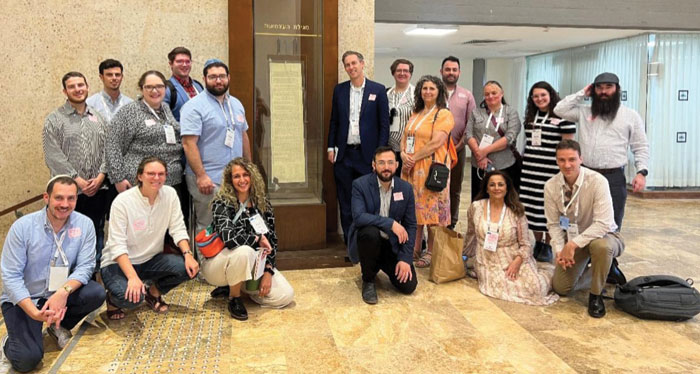
Sinai Temple recently completed a trip to Israel as part of its inaugural Zionist fellowship program to educate American rabbinical students about the history of Zionism and Israel.

The Sinai Temple Israel Center Program’s Israel trip, which ran from June 12 to 18, featured meetings with members of the Knesset from both the ruling coalition and the opposition, and hearing from Rabbi Leo Dee, whose wife and two daughters were murdered in a Palestinian terror attack. The students also heard from Efrat Mayor Oded Revivi, Times of Israel Founding Editor David Horovitz, and Palestinian activist Bassem Eid. They were given a tour of the West Bank city of Bethlehem by Palestinian journalist Rami Nazzal, and visited the Jewish settlement of Ariel in the West Bank.

According to the temple, the program was conceived in 2021 in response to a letter signed by more than 100 American rabbinical students alleging that Israel is engaging in apartheid against the Palestinians and violently abrogating human rights; some rabbis were afraid of discussing the Israeli-Palestinian conflict during sermons because they are unsure of how to respond to talking points from the anti-Israel movement.

“This new initiative will fill the educational gaps for our rabbis of tomorrow,” Rabbi Erez Sherman, incoming co-senior rabbi at Sinai Temple, said in a statement.  “As rabbis we may have differing views on specific policies, differing views is at the heart of Judaism, but ahavat Yisroel, love of Israel as the birthplace of our people and the home and safe-haven for Jewish people across the globe, is something we can all agree on.  At Sinai Temple we don’t tell people what to think.  We present them with the information and empower them to have informed discussions. Israel is an ineradicable part of our history, and it is our job as rabbis to continue this love and connection.  This new program will share facts and open this dialogue so that rabbis feel confident spreading their underlying love of Israel.” 

Sherman stressed that the fellowship program “has no political agenda … At Sinai we have hosted everyone from Bret Stephens to Bari Weiss to Mort Klein to Jeremy Ben-Ami,” adding that Sinai’s goal “is to provide a venue where Israel comes alive, where ideas are heard, challenged and contemplated, where the love of a Jewish state inspires interdenominational and interfaith connections and where Israel is a light unto the nations.

“Talking constructively about Israel and Zionism should be a must for future rabbis.  And that is why some of our seminars delve into challenging, even controversial, topics.  That is deliberate.  We want our next generation of rabbis prepared for those tough questions and eager to engage.“
– Rabbi Erez Sherman

“Talking constructively about Israel and Zionism should be a must for future rabbis.  And that is why some of our seminars delve into challenging, even controversial, topics.  That is deliberate.  We want our next generation of rabbis prepared for those tough questions and eager to engage.  Israel means Jewish people will always have a home, a place connected to God, Torah and each other.  The Sinai Temple Israel Center Rabbinical School Fellowship will teach these ideas, foster a thoughtful, engaged, robust conversation surrounding the future of the Jewish people and the land of Israel, and ultimately engage many thousands to join the conversation in the years ahead.” 

In an interview with the Journal, Sherman said that the fellowship program is a pilot program and most of the participating rabbinical students are first or second-year students. “That’s really important because even as a rabbinical student, the world sees you as a rabbi and they’re going to say, ‘So what do you think about Gaza? What do you think about the West Bank? What do you think about judicial reform?,’” Sherman said. “And so, not waiting till later  — where there are amazing fellowships that exist later in their career — we are excited to provide the foundation of that conversation of Zionism. This means the students learn what Zionist principles meant at the time of Israel’s founding and what Israel is today based on those principles.”

Angela Maddahi, a rabbinical student at American Jewish University, told the Journal the fellowship included “interesting, diverse sessions with speakers from the right and from the left about the history of Zionism, about the situation with the Palestinians … it’s been very, very special so far. I got to meet with students that I had been talking over Zoom with from all over the country, from all kinds of denominations.”

Tori Greene, a rabbinical student from Hebrew University, told the Journal, “it’s really important for me to engage with people that are not within my particular community, and this is an opportunity for me to do that in the macro and micro level, because we’re engaging with speakers who are outside of our own perspective and that kind of stuff, but even within the fellowship are the representation of the people who are a part of this are people that I wouldn’t necessarily have the opportunity to engage with. And so I’m incredibly grateful for that, because at the end of the day we’re all coming with a desire to engage in the Israel conversation and I think that that’s really important and that’s where it starts. And then we build relationships and from building relationships we are able to have more meaningful conversations and engagements and understanding each other.”

Sinai Temple Holds Inaugural Zionist Fellowship Program for Rabbinical Students Read More »

Rosner’s Domain | The 75 Riddle

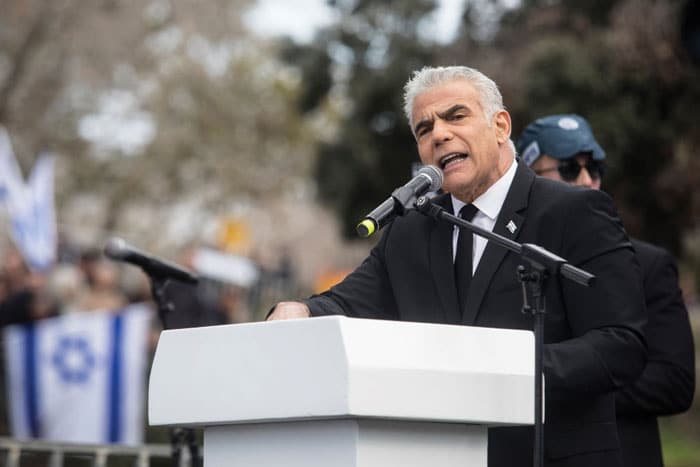
Yair Lapid, a former Prime Minister and the head of the Israeli opposition, has a new slogan: “the 75 alliance,” also called “the new Israeli alliance.” Lapid keeps repeating this phrase, so it is clear that this is a deliberate, conscious move. It is also an important, interesting, move. Lapid makes a simple basic claim: There is a large Israeli group that can agree on Israel’s main vision, and hence form a majority that could govern the country with less friction and more harmony. Who belongs to this alliance? To answer this question, we need to consider a slight and important rhetorical change Lapid has made.

Two weeks ago, Lapid explained: “In the 75th year of the state, 75% of the citizens of Israel agree on 75% of the issues … 75% are nationalist-liberals.”

Two weeks ago, Lapid explained: “In the 75th year of the state, 75% of the citizens of Israel agree on 75% of the issues… 75% are nationalist-liberals.”

But last week he spoke about “a new Israeli alliance … I call it the 75 alliance”.

The difference is subtle, and yet important. In the original presentation, Lapid was speaking about 75%. In the representation about 75 … what? It seems that now Lapid is speaking not about percentages but rather about seats in the Knesset. 75 seats in a 120 seat Knesset means 63%, not 75. 

It’s a big difference. Because while a 75% alliance is not realistic, a 63% alliance is a little less far-fetched. It won’t be easy to get the consent of 63% of the public on all issues, but there are important things that could get such a majority. Here are some examples. Most of the public, approaching Lapid’s 63%, does not think that there will be a peace agreement with the Palestinians in the next decade. A large majority agrees that the rights of the Arab minority deserve protection. A large majority agrees that the law should not be taken into one’s own hands. 

So, is there an alliance of 75? It is still far from certain, but it is a possibility that deserves to be examined. Lapid is careful to call it “liberal-nationalist.” So it is mostly Jewish, and not too rightwing. Still, identifying a group of more than 60% who will agree on most issues, and above all, who will agree sufficiently to prevent severe friction, is not a simple matter. Here’s a little exercise in numbers that explains why.

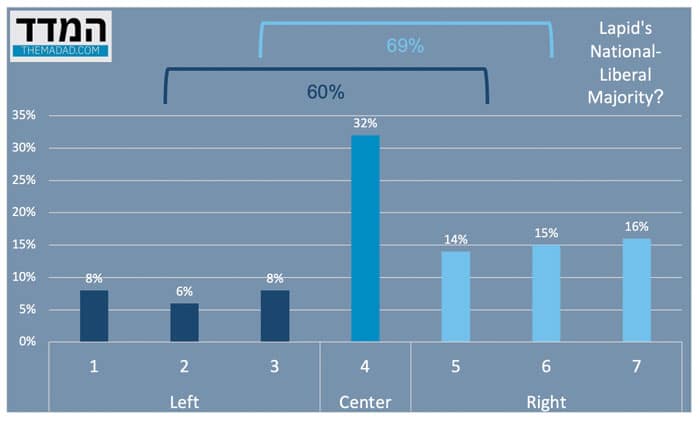
Israel’s Democracy Institute asks Israelis to rate their political positions on a scale of 1-to-7. Those who place themselves at 1 are at the far left of the political map. Those who place themselves at 7 are on the far right. We examined what Lapid’s alliance might look like by looking at this scale. Remember: the magic number is 63%.

In the graph on the right you can see there are two main options: The first, to drop the rightmost group (who answered 7) and the two leftmost groups (who answered 1 or 2). The second, to drop one on the left, and two on the right. In the first case, a larger group is obtained (almost 70%), in the second case, something a little smaller than Lapid’s prediction is obtained (a little over 60%).

Now let’s take one question and examine it on this scale. Should the state fund schools of ultra-Orthodox education that do not teach the core curriculum, such as mathematics and English? This is a convenient question, because it is completely clear how Lapid himself would answer the question. He would reply “do not need to fund.” So, we must assume that the national-liberal alliance he expects consists of those Israelis who would answer this question similarly to him. What happens when we look at this question on the 1-to-7 scale? Lapid’s options shrink to just one option. He must omit two groups on the right, and can omit just one on the left to keep a 60% group. 

Of course, the real math that’s needed to identify Lapid’s realignment is much more complex. It must involve a platform that consists of many significant questions and examines whether it is possible to identify a sufficiently significant proportion of Israelis who give similar answers to all of them. This is a test that we cannot do in this limited space. What we can do is to express a hope that Lapid has done his homework, that he knows what he is talking about — that there is, indeed, such a group. 

If there is, this could be interesting and encouraging. It has a potential to reshuffle the political map and get Israel out of a long jam. But if it’s not there, we better not to be distracted by illusions that the chances of realizing them are low. Lapid came to convince us that what we see — an Israel that is polarized — is not real. It is natural to hope that he is right. It is essential to remember that the burden of proof is on him.

Something I wrote in Hebrew

On Israel’s “book week” I wrote about a relatively new and quite visible trend: religious women reading romantic-erotic literature:

How do such books impact religious girls and women? … The peace-disturbing possibility is based on the assumption that religious women who are exposed to manifest eroticism may seek out manifest eroticism; it is based on the assumption that religious women who are exposed to sexually charged texts may be tempted into a life that does not resemble the religious ideal. But there is also another possibility. That this is not a subversive literature but rather liberating literature. For religious women who live in a tight, binding, social framework, erotic-romantic literature can be a pressure valve. Reading about one kind of life can balance the need to live another kind of life.

A week’s numbers

A new majority of national-liberal Israelis? Lapid has a fine theory, but whether it’s valid is still an open question.

A reader’s response:

Yael Azulai asks: “Are you not concerned about the coming deal with Iran?” Answer: I am. Both about having an agreement and about not having an agreement. Iran keeps moving forward while the rest of the world seems to get used to the idea of it becoming a nuclear state.


Shmuel Rosner is senior political editor. For more analysis of Israeli and international politics, visit Rosner’s Domain at jewishjournal.com/rosnersdomain.

Rosner’s Domain | The 75 Riddle Read More »