fbpx

June 21, 2023

The Saudi Arabia Two-Step

F. Scott Fitzgerald famously said that “The test of a first-rate intelligence is the ability to hold two opposed ideas in the mind at the same time, and still retain the ability to function.” I have always tried to abide by Fitzgerald’s dictum, but the current debate over U.S. and Israeli policy toward Saudi Arabia is putting my capabilities to the test. 

On one hand, we know that the Saudi leadership is a force of evil. We know that they commit horrific human rights atrocities against their own people, provide vast amounts of funding to the type of radical Islamic fundamentalists who carried out the terrorist attacks of September 11, 2001, and that they murdered an American journalist.

But we also know that the Saudis are a force for peace. We know that they are the leaders of the Middle East coalition that has developed to push back against Iranian aggressions, and we know that a partnership with Israel could be a key to not only restraining Iran but toward a broader acceptance of Israel in the Arab world.

It would be nice to be able to punish the first of those two Saudi Arabias without losing an opportunity to benefit from a relationship with the second. It would be just as comforting to partner with the second Saudi Arabia without being forced to befriend the first. But that’s not the way the world works. So the question for both the United States and Israel is whether it is better to ally ourselves with both of those Saudi Arabias, or neither.

This already difficult decision no longer exists in a vacuum. Now that China has emerged as a player in the Middle East, taking credit for brokering a treaty between Iran and Saudi Arabia and suggesting a similar role in Israeli talks with the Palestinians, the U.S. has even fewer options. Either move forward with the Saudis – even if that means providing them with enhanced military support and possibly nuclear capability – or let China further supplant the American presence in this critical part of the world.

Israel’s challenge is even more complicated. Expanding the Abraham Accords to include a normal relationship with Saudi Arabia could provide a level of security that the Jewish state has never enjoyed in its 75 years of existence. But it would also require fundamental changes to Israel’s relationship with the Palestinians, and while Saudi leaders have been vague in what those steps would entail, it’s clear that anything close to a two-state solution would cause extraordinary political upheaval within Israel.

Most of the Arab countries that comprise the anti-Iran coalition have deprioritized the Palestinian matter in recent years, which has worked to Israel’s advantage on both fronts. But if Saudi Arabia were to demand that Israel move toward some sort of peace deal with the Palestinian Authority and Hamas, Israeli leaders would be forced to decide which of these two imperatives are more important. Benjamin Netanyahu’s fragile coalition could easily rupture over this question, and the subsequent fracas could provide an opportunity for Benny Gantz-ish centrists to regain power.

But Netanyahu also knows that a Saudi peace deal could immensely boost his stature with Israeli voters and distract them from the domestic political disputes that have plagued his current term in office. He wants to be remembered as a statesman who made Israel safe: a treaty with Saudi Arabia could provide him with that legacy. But only if the voters believe that he didn’t give up too much to get the deal.

President Biden would similarly benefit from being seen as the driving force behind such a historic agreement. Biden also understands that while both Netanyahu and Saudi Crown Prince Mohammed bin Salman are more comfortable working with Republicans, it might require a Democratic president to convince his party’s congressional members to set aside their suspicions toward Saudi Arabia and give their support.

Biden, who once vowed to make Saudi Arabia a “pariah,” has apparently decided that in this instance, peace comes before human rights. Now Netanyahu faces an equally challenging decision of his own.


Dan Schnur is the U.S. Politics Editor for the Jewish Journal. He teaches courses in politics, communications, and leadership at UC Berkeley, USC and Pepperdine. He hosts the monthly webinar “The Dan Schnur Political Report” for the Los Angeles World Affairs Council & Town Hall. Follow Dan’s work at www.danschnurpolitics.com

The Saudi Arabia Two-Step Read More »

Retiring Kol Ami Rabbi Denise Eger Leads Her Farewell Shabbat Service

It’s perhaps fitting that Rabbi Denise Eger has announced her retirement. After all, she began her first pulpit position at the time of the HIV/AIDS crisis and is concluding it as the world moves on from the COVID-19 pandemic. My rabbinate, she told the Journal, was “bookended by two pandemics.”

Eger, senior founding rabbi at Kol Ami, spoke to the Journal in a phone interview ahead of her final Kabbalat Shabbat with Congregation Kol Ami. Held June 16 at the synagogue’s West Hollywood campus, the farewell service featured Eger saying goodbye to a congregation that has been her spiritual home for 30 years. There were hugs, laughs and a sense of true community among those who’ve been with Eger since the beginning as well as those who’ve joined Kol Ami more recently. 

Several of Eger’s mentors and colleagues, including Rabbis Laura Geller and Steven Jacobs and Kol Ami Board President Peter Mackler, participated in Eger’s final Shabbat service. Underscoring Eger’s longtime commitment to fostering interfaith relationships, Rev. Neil Thomas, senior pastor of Cathedral of Hope of Dallas, also took part. Wearing a yarmulke, the Christian clergy member offered a blessing for the retiring rabbi. Eger’s day-to-day responsibilities with Congregation Kol Ami conclude on June 30. On July 1, the rabbi will begin a yearlong sabbatical. She officially becomes Kol Ami’s first rabbi emerita when her retirement takes effect June 30, 2024. 

Her retirement coincides with the 30th anniversary of a congregation known for being a trail-blazing and inclusive space for the city’s Jewish and LGBTQ community.

Rabbi Barry Lutz is serving as the interim rabbi at Kol Ami while the congregation’s leadership conducts a nationwide search for Eger’s successor. While she won’t be involved in the hiring process, Eger expressed confidence the search committee tasked with appointing Kol Ami’s next permanent rabbi will find the best individual to lead the congregation into its next chapter.

“I will remain supportive of whatever direction they go in, and I will continue to offer whatever encouragement and support I can for the congregation,” Eger told the Journal.

 Before embarking on a celebrated and lengthy career in the rabbinate, Eger had different professional ambitions than the rabbinate. Raised in Memphis, Tennessee, Eger could sing, play guitar and was a song leader at a Jewish summer camp. When she was 12, she discovered the liturgical folk music of the late Debbie Friedman.

So naturally, she said, “I thought of being a cantor.”

During her sophomore year of college, she decided that the rabbinate might be a better fit, so she transferred from Memphis State University, where she was a voice major, to USC, which had a joint program of religion and Jewish studies with Hebrew Union College-Jewish Institute of Religion. Ordained at HUC-JIR in 1988, Eger then assumed her first pulpit position at Beth Chayim Chadashim, the world’s first synagogue for the LGBT community.  At the time, her role included providing services and support to those impacted by HIV/AIDS.

“I started in the rabbinate at the height of the HIV crisis,” she said. “Those were hard years.”

In 1992, she left BCC and founded Congregation Kol Ami, the first Reform community in West Hollywood. Back then, West Hollywood’s Jewish community consisted of a Chabad and Hollywood Temple Beth El, neither of which attracted gays and lesbians, despite being in a neighborhood founded by a coalition of elderly Jews, Russians and LGBT people around the issue of rent control, Eger said.

Under Eger’s leadership, Kol Ami grew into a community of 225 household-members that’s strongly committed to social justice, support for Israel and Jewish unity.

The fledgling Kol Ami congregation began with 35 people and was initially housed at the West Hollywood Presbyterian Church. “We covered their crosses, brought the Torah in every week,” Eger said. “The Torahs lived in the closet in my house.” In 2001, Kol Ami identified an empty lot, undertook a capital campaign and constructed a synagogue building, a modest campus on La Brea Avenue that continues to serve as its home today. Under Eger’s leadership, Kol Ami grew into a community of 225 household-members strongly committed to social justice, support for Israel and Jewish unity.

“We grew from a start-up congregation in 1993 into an institution that affects people’s lives,” Eger said. “We’ve done transformational work on social justice, incredible work around LGBTQ rights and marriage equality. We have a monthly support group for people with HIV/AIDS. We do interfaith work; we’re focused on food insecurity; and we have a tremendous partnership with the Hollywood Food Coalition. I’m really proud. We grew from a group of 35 people into a strong community, and that’s not so easy to do.”

While growing Kol Ami into the thriving congregation it is today, Eger’s rabbinate outside of Kol Ami and within the larger Reform movement shattered several glass ceilings. In 2009, she became the first woman and the first gay rabbi to be named the president of the Board of Rabbis of Southern California. From 2015-2017, Eger served as the president of Central Conference of American Rabbis, the Reform rabbinic professional leadership organization, the first LGBT person to hold that position.

As she begins her sabbatical, Eger is planning on spending more time with family, which includes her wife, Rabbi Eleanor Steinman, who serves at the Austin, Texas-based synagogue, Temple Beth Shalom, and is about to become the congregation’s senior rabbi, effective July 1.  

Eger will also be doing public speaking in support of her book, “Seven Principles for Living Bravely,” which she co-authored with Rev. Thomas, and plans to offer executive coaching to clergy.

When Eger founded Kol Ami as a safe place for the LGBTQ community, the Jewish world, including the Reform movement, was in a different place — significantly less inclusive of the gay and lesbian community than it is today. During her final Shabbat service, Eger addressed whether there’s still a need for Kol Ami in the current, more welcoming Reform community and what the future of Kol Ami, without its founding rabbi, might look like. 

Kol Ami, she insisted, will continue. “This temple is not about Denise Eger,” she said from the synagogue’s bimah. “We have so much to offer in creating a safe and just and holy place.” 

Retiring Kol Ami Rabbi Denise Eger Leads Her Farewell Shabbat Service Read More »

The Precious Riches of Shared Intergenerational Housing

Jewish tradition teaches “L’dor v’dor”: from generation to generation. It suggests that wisdom resides in the older generation and we pass it down to those younger than we are. But I think the truth is “generation with generation”; wisdom and connection flow in both directions. 

Here’s how I learned that. 

After my husband died, I discovered that I hated being alone. 

After my husband died, I discovered that I hated being alone. Actually the revelation came to me as an epiphany the night I came home to my empty house to discover two huge racoons in my bedroom. They had come in through the cat door. After screaming and shooing them out with a broom, I made the decision to get a roommate. So I rented a room in my home to a younger person.  

The first renter was a cello player who was here on a summer internship, and then it was a graduate student from the Zelikow School of  Jewish Nonprofit Management. In each of those cases my daughter warned me: “Mom, remember, you are looking for a friend and they are looking for a cheap place to live.” What I learned from those first experiences was that I didn’t want to just rent a room to someone. What I really wanted was to share my home, to share the food, to occasionally eat meals together, to come home on a Friday night to find younger people sitting around the Shabbat table singing, and for me to be invited to join them. I wanted for each of us to be able to invite overnight guests, and to meet each other’s friends. 

Two years ago, through a listing at my seminary, Hebrew Union College, I found my housemates, a couple who were in their fourth year of the five-year rabbinical program. When they moved in, we wrote a document that included these words:

“Abraham and Sarah began a long Jewish tradition of hosting guests openly and eagerly; so too do we want our home to be filled with joy and camaraderie. Housemates should feel free to host guests when possible. We expect that there might be familiar faces coming and going. Housemates understand this agreement as a kind of brit (covenant), illuminated by the teaching of Jewish tradition, Proverbs 24:3-4, ‘By wisdom a house is built, and by understanding it is established; by knowledge the rooms are filled with all precious and pleasant riches.’ We look forward to sharing the ‘precious and pleasant riches’ of a shared home and an evolving relationship. 

We understand a shared home to reflect shared values, interests, mutual respect, and open communication, and a place that each of us feels comfortable and at home. Makom means ‘place’ and is also a name for the Divine. We will strive to create a home that is also a sacred place.”

These riches are indeed precious. My housemates have become my friends. We celebrated their ordination as rabbis together with many members of their family from around the country, with several of them staying at our home and many others celebrating with a festive party at the house. As the time for their ordination as rabbis drew near, they wanted to help me find a new housemate, so they talked with members of the second-year class to identify the person whom they thought would be the best match. They moved out on a Sunday morning; my new housemate, a third-year student, moved in the same evening.

There are so many benefits of home sharing beyond the relatively small amount of rent that can come with it. One is the tech help that a millennial digital native can bring to most of my computer or iPhone emergencies.

There are so many benefits of home sharing beyond the relatively small amount of rent that can come with it. One is the tech help that a millennial digital native can bring to most of my computer or iPhone emergencies. Another benefit for me? My world has expanded as they have introduced me to new ideas, new technologies and new approaches to the Jewish future. And they have also benefitted by being enriched by my experience as a rabbi and teacher for over 40 years. We have read each other’s sermons, shared meals with each other’s friends, and supported each other in our projects. They will be better rabbis because of this; I have become a more engaged retired rabbi. We are all grateful for these blessings. 

There is no question that my experience is sui generis, of its own kind. But in sharing my story I have heard of so many other stories — of former academics sharing their homes with students in their communities, of older adults who have aged in place with the help of younger tenants who have become chosen family. There are now many programs advancing intergenerational home sharing. You can find them through https://nationalsharedhousing.org/program-directory/ and, no surprise, there are even apps and websites for it including: https://www.nesterly.com/about-us/ and https://www.silvernest.com/

Generations with generations, precious riches indeed.

A version of this article appeared in a publication of the American Society on Aging.


Rabbi Laura Geller is Rabbi Emerita at Temple Emanuel of Beverly Hills. She is the co-author of  “Getting Good at Getting Older: and she is the Chair of Synagogue Village Network. www.rabbilaurageller.com

The Precious Riches of Shared Intergenerational Housing Read More »

Real Life Problems: Hoarding

Long after my father died and my sister and I moved out, my mother continued to hang on to our split-level three bedroom home in suburban Montréal. I often thought that she could have bought a little more time on earth had she sold the home and rented a single floor apartment. There were six steps leading from her bedroom to the kitchen and another 16 steps to get down to the basement where the washer and dryer were installed. My mother resisted change and though the home was in need of a major upgrade and all of her original neighbors had long moved away, she hung on to the house until she collapsed of a fatal heart attack in her own bedroom. Now the burden fell on my sister and me to clean up the house and make it presentable for the next buyer. 

I had visited the house many times and I was also the designated “janitor” who looked after the place when my mother started spending winters in Florida. I had a pretty good idea of what was contained within those walls, but the sheer volume of stuff was beyond belief. My mother was a designer in the fashion industry and I think that she had a sample of every dress, blouse and suit that she ever designed. In fact, the basement was full of wall-to-wall clothing racks it looked like the clearance floor of Macy’s. She still had some of my dad’s old clothes as well as leftovers from my sister. 

There were magazines; Time, Life, Family Circle, Good Housekeeping (now that’s ironic) and Popular Science (guilty on that one). Newspapers announced the assassination of President Kennedy, the Canadian Centennial, and the first ever Montréal Expo’s home opener. Family photos, some in albums and some not, turned up in every closet. The bathroom medicine cabinets were filled with long expired drugs, lotions, boxes of Band-Aids and other medicinal products of questionable effectiveness.

One flat-screen TV from the early 2000’s was still usable, but three others were not. I found some of my father’s old Sinatra and Harry Belafonte records, which I claimed as my own. The garage contained some old rusty shovels, a dented tool box and winter tires for a 1971 Oldsmobile Delta 88. 

But most of all, there were tchotchkes. Hundreds of figurines, souvenirs, vases, bookends, stuffed animals and Jewish memorabilia found their way into every room in the house. Even though my mother wasn’t especially observant she still kept dozens of menorahs, extra mezuzahs, challah covers, wine goblets, Pesach plates and candlesticks. She had a few framed pictures of eminent rabbis though I am not sure she knew any of their names or why they were famous. 

That, dear readers, was the good stuff. She also collected pickle jars, elastic bands, and plastic containers. There were piles of papers; bills, tax notices, promotional material from real estate brokers, and stacks of grocery store flyers probably from the beginning of time.

Her pantry, fridge and freezer were overflowing with foodstuffs. As we dug deeper into the back shelves of the pantry, we found boxes and cans of foods from now defunct brands and long out of business grocery stores. We had no idea what was in the freezer as every item was covered with at least 30 layers of aluminum foil and nothing was labelled. 

We donated as much stuff as we could to local charities. My wife and kids took a few mementos to remember Bubby Sally. Before we started the clean-up, we rented one of those massive metal containers that sit in the driveway. It wasn’t long before the container was overflowing. We had to have it hauled away and order a second one. Broken furniture, incomplete sets of dishes, glasses and stained coffee mugs, luggage sets from the 1950s, musty old pillows, broken radios, lamps of all shapes and sizes, moth-eaten blankets and worn office supplies were all tossed into the waiting dumpster. 

There is no doubt that my mother was a hoarder. It was difficult for her to part with anything. She could often be heard saying “I’m not throwing it out, it just needs to be fixed.” or “You’ll see, this will come back into fashion in another year or two …” or most famously “It has sentimental value, I just can’t part with it”. That could be said about anything from a crystal chandelier to a can of sardines. The crowded house wouldn’t stop her from buying more, mostly useless stuff that required frequent dusting and other maintenance.

It took us several weeks to finally clear the house. It was sold a few weeks after that. Sometimes, a letter addressed to my late mother would be delivered to the old house. The new owner would call me and I had the very surreal experience of once again sitting at my mother’s kitchen table, but this time in a very well maintained, tchotchke-free home.

That, dear readers, is only half of the story. As I reach the tender age of 70, I realize that I have inherited some of my mother’s bad habits. My wife and I have lived in the same home for over 28 years. We raised three wonderful kids who have all moved out and made lives of their own, while leaving their clothes, toys, electronics, old iPhones, iPods, iPads and other “i”-debris behind. My wife has saved every drawing, project, composition and essay from our kids. Menorahs made of wood and wing-nuts, Seder plates made of muffin cups, tie-dyed challah covers and cardboard shofars lay in sometimes labelled bins in various rooms.

Don’t think that I am not guilty in contributing to the overflowing mountain of scrap. I collect old radios, vinyl, and Elvis memorabilia. My garage is full of old car parts, shovels, rakes and an old fashioned manual lawn-mower.

Thousands of Legos in every size, shape and color, a tube of Tinker Toys, model cars and trains, and various Barbie dolls can be found in the so-called guest room, which has become the de-facto playroom for my three-year-old grandson. Once, my wife found a handmade wooden dollhouse in a garbage bin. She made me come and pick it up so we could add it to our collection of useless junk. Don’t think that I am not guilty in contributing to the overflowing mountain of scrap. I collect old radios, vinyl, and Elvis memorabilia. My garage is full of old car parts, shovels, rakes and an old fashioned manual lawn-mower. 

Sadly, my wife and I don’t always agree on what goes and what stays. Last summer I cleaned out the garage. I put all the items that I thought were dispensable in the driveway in advance of taking them to the recycling center. When my wife came home she made me put most of the stuff back — a couple of fishing rods from her late uncle, a pair of cross-country skis and boots from the 1970s, a metal bedframe and headboard, a baby carriage, some random street signs and the rusty manual lawn-mower all went back into the garage.

Sometimes we have battles about her shoe collection that crowds her closet, the vestibule, the garage entrance and under various tables and desks. This has not been a smart move on my part, as she is quick to counter about my radios, laptop computers and other electronic paraphernalia that I refuse to part with.

As we agree to disagree, the piles keep getting larger, the crawl space, cupboards and closets get fuller and finding anything becomes a scavenger hunt. Yes, dear friends, there are courses, web sites and how-to books about attacking junk and organizing your home, but in the case of a married couple, you both need to be in the same right mind-set before you can start. 

I have a feeling that my kids will be going through the same trauma as me and my sister when my wife and I finally pack it in. They may want to get a better deal by pre-renting the containers in advance, or someone might ask “Anyone got a match?”


Paul J. Starr is a recently retired systems analyst who has lived his entire life in Montréal, Canada. On Sunday mornings he is “living the dream,” hosting a two-hour Internet radio show featuring music from the 50s and 60s called “Judy’s Diner.”

Real Life Problems: Hoarding Read More »

What Should AJU Do with Its Campus?

Nine months ago, as it aimed to sell its 22-acre Bel Air campus, American Jewish University (AJU) had a choice. It could sell to the international education company Education First (EF), or it could sell to Milken Community Schools, which already had a high school in the area and was looking to expand.

AJU went with EF, which they evidently deemed made a stronger offer. This triggered some hard feelings among members of the community who were hoping that the venerable campus — which includes a community mikveh, a Jewish library and multiple spaces honoring local donors — would stay in Jewish hands.

As I wrote at the time, “These are the most difficult columns to write, because I’m torn between two sentiments. On the one hand, I don’t want to feed communal anger; but on the other, I don’t want to dismiss it either.”

My dilemma was that it was a fait accompli. Feeding any communal anger about the sale would be like crying over spilt milk, on the eve of the High Holy Days. “Had the sale to Milken gone through,” I wrote, “this column would have turned from the hardest one to write to the easiest. Everyone loves a happy ending!”

So, when the dramatic news came out last week that the EF sale fell through, many saw it as a unique opportunity for the community to have that happy ending.

Will it happen?

Right now, things are up in the air. A lot has changed in nine months. I hear that interest from Milken has cooled, and that the real estate market has softened. If a deal with Milken is not revived, can AJU find a Jewish suitor at a mutually acceptable price? And if it can’t, then what?

For starters, it would mean AJU going back to square one with the chance to turn a temporary setback into a community victory. In the wake of the COVID lockdowns and the many conveniences that keep us cozy at home, Jews have never been more physically isolated. As I wrote last week:

“What we need now are physical spaces where we can gather in person. AJU can look at its Mulholland campus not as a giant burden but as a communal garden. What kind of creative, engaging spaces and events can it create that will get the Jews of LA to come together and reconnect?”

In its mission statement, AJU says it “advances and elevates the Jewish journey of individuals, organizations and our community through excellence in scholarship, teaching, engaged conversation, and outreach.”

That last word, outreach, is a crucial one. AJU now has an opportunity to reach out to the community and help heal some wounds. Over many decades, as AJU evolved into a bustling hub of communal activities, people throughout our community developed a deep, emotional attachment to the place. They don’t see this as “just business.”

Over many decades, as AJU evolved into a bustling hub of communal activities, people throughout our community developed a deep, emotional attachment to the place. They don’t see this as “just business.”

Either through selling or partnering or a combination of both, if AJU can take the lead to reimagine the campus to better serve the community, it will not just heal wounds but benefit all of us. I don’t pretend to know all the issues AJU is now working through; I’m sure there are plenty. I’m speaking solely as someone who represents the interest of a community which I love.

Several ideas are floating around. Beyond renewing the sale to Milken, a few readers brought up the idea of a JCC to serve both LA and the Valley. Other readers brought up the need for more senior housing. Rabbi Laura Geller shared a twist on that idea: 

“If the campus can be rebuilt as housing it should be intergenerational. Some version of a Continuing Care Community with pods for millennials with lower rents and smaller units for families with younger kids in exchange for interaction with the older adults.”

We can expect more ideas to percolate in the next few weeks and months. A key factor for any suitor will be to work closely with the neighborhood groups to get their support. 

The good news is that the community has been given a second chance, and so has AJU. As I wrote last week, “LA Jewry is now in the process of a communal conversation over the future of a magnificent space in which every member of our community has a stake.” We should support AJU’s efforts to help move this forward.

If we can come out of this difficult episode with the realization that our communal spaces belong to all of us, that will be a happy ending indeed.

What Should AJU Do with Its Campus? Read More »

I Stand With Israel Because I Stand With Peace, Prosperity and Justice for All

I am, and have always been, pro-Israel. That position is now being criticized by some of my friends on the left, who share my concerns about the military and corporate establishment. They ask how I can be skeptical about America’s involvement in foreign wars while also supporting a strong U.S.-Israel alliance.

The answer is that I support Israel because I share Israel’s values, and because a secure Israel does not require U.S. military intervention in the Middle East.

I have been involved in water issues in Israel for many years, in projects with EcoPeace Jordan Riverkeeper that bring Israelis, Palestinians and Jordanians together to protect the River Jordan and manage a scarce common resource. I have seen how the environment can be a path to partnership in the region, rather than a flashpoint of conflict.

My father, too, had a deep connection to Israel, visiting the Jewish State on the eve of independence as a journalist. He, too, saw Israel as a future ally, a beacon of liberty, and a force for stability in the region.

I also support the legitimate aspirations of the Palestinian people. These need not be mutually exclusive. Already, there are many areas of cooperation between Israelis and Palestinians that go unnoticed.

The challenge our Palestinian friends face is to decide what kind of society they wish to build. It cannot be one that replaces Israel, and it ought not be a proxy for the militant Iranian regime or overtaken by the genocidal Hamas terror group, as has happened in Gaza. Our conversation with Palestinians needs to focus on the future, not the past.

Mere criticism of Israeli policies is not antisemitic, and there are friends of Israel today, right and left, who question and challenge actions of the Israeli government, as they would any other government.

No country is perfect, and some of Israel’s more controversial policies are the outcome of conflict and genuine security threats. But if you are only critical of Israel, or judge Israel by a standard that you apply to no other nation, then you invite legitimate questions about your motives.

Some questioned my own motives when I supported Pink Floyd guitarist Roger Waters in his courage to speak out against draconian COVID policies, the persecution of Julian Assange, and the war in Ukraine. That did not mean I supported his radical stance against Israel, which I — like many fans of his music — had no knowledge of at the time. Human beings are complex, and our relationship with Israel must be mature enough to make room for that complexity — and for people to learn and grow.

The most important reality is that Israel has been the most vulnerable country in the world for much of its existence, completely surrounded by nations that unambiguously seek her destruction and extermination of her Jewish population. All this is happening just three generations after the Holocaust which saw the genocide of six million Jews, including one and half million children. Such external security threats invariably result in abridgments and, at times, even abuses of civil and human rights within. The United States grappled with similar challenges during the Second World War, leading to policies like the interment of its Japanese citizens. While I am not comparing Israel’s actions to those abuses, even friends of Israel can admit that its legitimate security threats can sometimes lead to questionable actions.

In spite of that, Israel has more freedom — for all of its citizens, Jewish and Arab — than any of the surrounding countries that Waters and others rarely criticize. Arabs in Israel have more freedoms – the freedom, for example, to openly criticize their government – than in any neighboring country.

Arabs, Christian and Muslim, serve in Israel’s government and on its Supreme Court. Can you imagine a Jew on the supreme judicial body of any Arab country?

It is also preferable to be a woman or a LGBTQ person in Israel than anywhere else in the Middle East. This month, over 150,000 people joined the Pride Parade in Tel Aviv, making it one of the largest in the world. Meanwhile, in Iran, the regime hangs gays from cherry pickers in city squares. This abominable reality should never be forgotten.

We ought to challenge our Palestinian friends to guarantee the same rights and freedoms as Israel does. The question is: “What sort of state do the Palestinians want?” Will it be a free society? Will it offer citizenship to Jews who wish to live there? Will if offer its Arab citizens the freedom to protest without fear, a free press, and unencumbered free speech? If not, why not?

In recent years, several Arab states have made peace with Israel, based on shared interests and strong U.S. support for Israel. As president, I will expand that process, and invite Palestinians to join.

Israel has sought recognition and peace since 1947, when the UN voted for the creation of both Jewish and Palestinian states to replace the British mandate. The Jewish leadership immediately accepted this two-state solution; the Arab leadership rejected it and launched a war along with a pledge of nascent Israel’s annihilation. Since that time Israeli leaders have proposed two-state solutions in 2000, 2001 and 2007. It’s time for the Palestinian leadership to recognize Israel as the nation state and homeland of the Jewish people and for the Israeli leadership to re-offer a two-state solution with safe and secure borders.

Muslims and Jews pray to the same God. Abraham is father to both faiths. It’s time we bring God back into the picture and expand the Abraham Accords throughout the region and usher in a new era of peace, prosperity and justice for all.

I Stand With Israel Because I Stand With Peace, Prosperity and Justice for All Read More »

Jewish Anti-Zionism is White Saviorism

About a year ago, the media company VICE News published a YouTube video featuring a young woman with an unsettling mask over her head to conceal her identity. When she responds to questions from the off-camera interviewer, her voice is altered to a low frequency to make her true persona truly hidden. She speaks openly and honestly about her experience as a young woman from America’s upper middle to upper class, one of many who took advantage of summer volunteer programs abroad. “Volunteer tourism is a multi-billion-dollar industry,” she says. “It sells wealthier people access to impoverished and struggling communities in exchange for a life-affirming experience. Kids [from these communities] would see vans of volunteers pull toward them and immediately rub dirt on their faces to look more appealing and in need of more help.” The young woman shares with us damning information—that of the thousands of dollars paid to participate in this trip, none of it went to the orphanage that she was under the impression she was building. And after each day of building, local construction workers would undo the progress the westerners made, considering mistakes and safety violations could not be avoided.

Many readers will know what this woman is talking about, for many have seen the photos on social media of sun-kissed Americans posing with dark-skinned children, on a retreat that they will no doubt highlight on future resumes for high-paying jobs. Some of us recognize the blatant exploitation of those living in obscene conditions as self-indulgent and unethical. But perhaps many are unaware that such an attitude, dubbed in our modern lexicon as “white saviorism,” or as a “white savior complex,” doesn’t need to express itself as Instagram hashtags in war-torn Africa, for it also manifests in less covert ways, such as within the Jewish community in regard to the Israeli-Palestinian conflict.

I would characterize the mostly diasporic Jewish attitude of anti-Zionism, the belief that the Jewish state is an immoral concept and that by way of its oppression of the Palestinian people it has lost its privilege to operate as the nation state for the Jewish people, as a form of white saviorism. To understand why, we must explore the cornerstones of Jewish anti-Zionism: the assumptions and assertions that often if not always characterize its structure.

The first cornerstone, a foundation without which Jewish anti-Zionism cannot survive, is the construction of a narrative of Zionism that follows a formula of Jewish action and Arab reaction. Take for example Itay Epstein, an Israeli who works as a senior advisor to the Norwegian Refugee Council, who several weeks ago tweeted “On this day, 56 years ago, Israel invaded – in a premeditated attack – Gaza and the West Bank. Despite subduing its Egyptian and Jordanian adversaries by the 10th of June, it has since occupied Palestinian territory with no military exigency.” Epstein here engages in historical revisionism, implying that Israel in June of 1967 attacked its Arab neighbors unprovoked—never mind the several declaratives from Arab leaders in the days prior that they would attack Israel, never mind the buildup of Arab weaponry on Israel’s borders, nor the cutting off of the highly lucrative and essential to Israel’s survival Straits of Tiran, an abject act of war. Epstein also portrays the Israeli occupation of Palestinian territory as if it is the cause and not an effect of Israel’s conflict with its neighbors, thereby eliminating terrorism and ongoing war from the reasons Israel maintains a hold over the land.

You see a similar attitude in Jewish anti-Zionist discussions of the events of 1948, such as when IfNotNow, a left-wing Jewish organization, tweeted in May of 2022, “Today is Nakba Day, the 74th anniversary of the Nakba (Arabic for catastrophe,) when over 700,000 Palestinians were expelled from their homes. The Nakba continues today, and Jews across the country are showing up with Palestinians to mourn and resist.” IfNotNow conveniently omits the fact that the flight of Palestinians from land that would become Israel in 1948 was merely one chapter in a brutal invasion of Israel by seven different Arab militias, another chapter being the more than 800,000 Jews expelled from Arab countries as well. Unfortunately, the drumbeat from Jewish organizations to commemorate “Nakba Day” continued in 2023.

This first cornerstone, of Jewish action and Arab reaction, is evidence of white saviorism because it robs non-white people, or at least those who have been constructed in progressive spaces to be non-white (more on that later), to be without agency. The undertones of the narrative that not only the Palestinians but also the surrounding Arab countries have been helpless objects to the Zionist project, without the resources and without previous opportunities to make decisions for themselves, are both condescending and supremacist.

This first cornerstone, of Jewish action and Arab reaction, is evidence of white saviorism because it robs non-white people, or at least those who have been constructed in progressive spaces to be non-white … to be without agency.

The second cornerstone of Jewish anti-Zionism is heavily related to the first. It is something former Member of Knesset Dr. Einat Wilf describes as “westsplaining.” Dr. Wilf explains: “Westsplaining is when international activists, diplomats, and journalists head to the Gaza border, and when they ask: ‘what do you want?’ They are told by Palestinians that they want total war against Israel, that they want to return to their ancestral homeland and throw the Jews out. But then the journalist will look back at the camera and say, ‘the Palestinians in Gaza merely want access to better resources and employment opportunities.” Like “mansplaining,” when a man lectures a woman on something she already is well aware of, westsplaining is when people from the west attempt to explain away what a Palestinian has ] said in order to bolster their own political agenda.

An example of a serial westsplainer is American-Jewish author and commentator Peter Beinart. Beinart is a strong advocate for the binational solution to the Israeli-Palestinian conflict, believing that the focal point to the Palestinian struggle for liberation is not to take back what they believe was stolen from them with fire and blood like a Game of Thrones character, but rather simply to achieve equal rights under the law in one state from the river to the sea. At the height of the protests against the Netanyahu government this year, Beinart tweeted: “If Jewish Israelis truly invited Palestinians to join their democratic struggle—and made it a struggle for freedom for everyone, not just for Jews—that movement wouldn’t just defeat Bibi. It would defeat apartheid and change the world.”

Beinart conveniently leaves out of his many tweets likening Zionists to pro-apartheid South Africans that Palestinians overwhelmingly do not desire a state with equal rights for every person from the river to the sea. In a poll released in March by the Palestinian Center for Policy and Survey Research, merely 22% of Palestinians living in the West Bank and Gaza reported to desire such a solution, with 75% expressing disapproval. What Palestinians have made clear they actually want apparently does not matter, because Beinart, a Jew with an impressive career living in the Upper West Side, miles away from the conflict, has his own ideas on how things should run. Like the first cornerstone, westsplaining reveals a cringe-worthy air of condescension and arrogance.

The third cornerstone of Jewish anti-Zionism also relates to Beinart, and to a new documentary film he has been promoting from his social media pages called “Israelism.” I have not yet seen this film, but from its trailer, I can deduce that the film follows what I like to call the “I was lied to at summer camp” narrative, in recognition of a piece in “Tablet Magazine” on the same topic written by Suzy Weiss: “The Jews Lied to Me At Summer Camp!” The teaser for “Israelism” features a Palestinian saying, “The first time I came to Israel, American Jews told me ‘We like you, but we don’t like Palestinians.’” A Jewish American then says: “What we’ve been told is the only way that Jews can be safe is if Palestinians are not safe.” There is a flash of a poster that says, “Stop lying to Young Jews,” and a shot of Jeremy Ben-Ami, the Chief Executive of J Street, saying “They do not like the way they were indoctrinated, and justifiably so.”

“I was lied to at summer camp” is a campaign to get as many people as possible to believe that a shadowy American Jewish establishment is manipulating its youth by preventing them from asking any political questions about Israel (a hilarious joke if anyone has spent any time with Jews) and subsequently turning them into henchmen for the Israeli far-right hellbent on stifling criticism of the Jewish state. Considering American Jews are consistently warring with each other in publications about every political issue under the sun, and considering over 70 percent of American Jews vote for Democrats, candidates who routinely advocate for a two-state solution and tough-love against Israel especially in the last several decades, the argument that Jews were lied to at summer camp does not hold water. But nevertheless, it is a highly persuasive if not downright intoxicating forbidden fruit dangled in front of American Jews in progressive spaces to turn them against Israel.

As someone who has spent quite a bit of time in left-wing spaces, I can confirm that expressions of victimization are not only exploited at every possible moment, but they are also a mode of currency: They are how you curry favor with those around you to earn respect. The Jews who find themselves in these spaces, as I did as a high school and college student, are mainly Ashkenazi, and come primarily from moderately assimilated families that are usually well-off (considering they had the money to go to those vile, abusive summer camps). Therefore, the correct “lived experiences” in progressive circles to truly have a horse in the social justice race are difficult to muster up. If you do not have trauma, then simply make it up.

The “I was lied to at summer camp” narrative is a way for privileged, young American Jews to feel as though they too are on the receiving end of the evils of capitalism, racism, colonialism, imperialism—whatever their group of peers regard as the ultimate sins of the day—rather than perpetrating them, as other Jews with similar experiences are being accused. Of course, Jews cleansing themselves from the sins of their communities and subsequently demonizing their background in order to be regarded as true warriors of the latest universalist cause is nothing new, but today it carries unique significance with regard to the white saviorism. This mendacious behavior carries the whiff of cloying for acceptance from the social justice vanguard, in the same way as denying Muslims and Arabs agency and westsplaining away their true desires.

Jews from backgrounds other than Eastern Europe are generally absent from Jewish anti-Zionism. The reason is that Jews of Sephardic or Mizrahi descent did not grow up perceiving the Israeli-Palestinian conflict as white people versus people of color, because they themselves do not look or define themselves as white. The only possible way to construct a narrative whereby the Jews only act and Arabs only react, where Arabs desire a democratic state with citizenship for all between the river and the sea, and where there exists a nefarious plot at hand to brainwash Jewish youth with the ideas of the imperialist west, is to paint Jews as white and therefore powerful. Non-Jews in the Middle East, on the other hand, have been constructed as non-white, and therefore not powerful, an attitude that coincides  with Palestinian intellectual Edward Said’s description of “orientalism” and our contemporary understandings of white saviorism.

The young woman in the unsettling mask at VICE news noted that after each day of construction on the orphanage for underprivileged children, local workers dismantled the progress and reorganized the bricks. The work, regardless of how in good faith it was, was in reality useless, unless you count the newly opened career prospects for the young Americans. This is an apt analogy for what Jewish anti-Zionism actually accomplishes on the ground regarding improving the lives of Palestinians, versus what it accomplishes in bolstering the social and professional capital of Jewish anti-Zionists. The white saviors who see the conflict as a zero sum game preach from social media and smile for cameras and accomplish nothing save acceptance (albeit temporary) in progressive spaces, while those who actually recognize the conflict as a complicated mess with fault and agency on both sides are left to clean up the pieces and commit to the hard work, with little or no gratitude from so-called advocates for peace. We would all be better served in listening to these voices and tuning out the leftover noise.


Blake Flayton is the New Media Director and columnist for the Jewish Journal.

Jewish Anti-Zionism is White Saviorism Read More »

Tea With Claudia Roden

Life is a fascinating journey, with interesting twists and coincidental turns along the way. 

You may remember that Neil and I recently traveled to Madrid to visit our daughter Rebekah, who was studying on a semester abroad program. On our way home from Spain and Portugal, we stopped in London for a few days. When we booked our tickets, we had no idea that it would be “Coronation” weekend. Luckily for us, we were able to make all our hotel, dinner and afternoon tea reservations ahead of time with a little help from our friends, both here and in London. 

In 1997, the Sephardic Educational Center hosted the famous cookbook author Claudia Roden. At the Sephardic Temple Tiffereth Israel in Westwood, this larger-than-life lady gave a fascinating lecture about her Egyptian roots and her world travels. She had just released her bestseller, “The Book of Jewish Food: An Odyssey from Samarkand to New York.” In this incredible book, Claudia traces the development of both Ashkenazic and Sephardic Jewish communities and their cuisine over the centuries. And there are over 800 recipes in the book! I was thrilled when she kindly signed it for me. 

At the time, I was a young mother with two children and a full-time job. I was just starting to collect cookbooks and this was perhaps my first “Sephardic Cookbook.” I grew up in a home where no recipes were written down and that was probably to my advantage as it taught me to cook by “eye.” It gave me confidence in the kitchen, but I was ready to explore other cultures and cuisines. I needed some guidance.

That evening at the lecture, I fell in love with Claudia Roden and soon her massive book became my cooking bible. 

That evening at the lecture, I fell in love with Claudia Roden and soon her massive book became my cooking bible. 

As I read through her recipes, I thought to myself — wow, what a dream to be able to travel the world, interview people, eat in their homes, and write about it. I enrolled in a wonderful course “How to Write a Cookbook” at UCLA Extension. Writing recipes and hopefully a cookbook is a dream that I’ve been chasing for almost three decades. 

Before leaving for our trip, I decided to call Freda Nessim, who in partnership with her late husband, Dr. Jose Nessim, was the original founder of the Sephardic Educational Center. Freda and Claudia Roden are first cousins and I asked her if she would be kind enough to put me in touch with Claudia.

Freda made it happen. Soon, Claudia and I were emailing back and forth, trying to arrange a time to meet on our short stopover in London. Sunday was out of the question because she would be celebrating the Coronation at the street party in her neighborhood. We finally settled on Friday afternoon (Shabbat starts very late in London in the summer months) and she kindly invited Neil and I to tea at her home near Golders Green.

Friday began with a tour of the fascinating and majestic Windsor Castle (a kind treat from an English client of Neil’s). We walked around the small town surrounding the castle, looking for flowers I could take to Claudia. Luckily, there was a small farmers market and I purchased a very English bouquet of wild flowers. 

Claudia gave us detailed instructions on how to find her home: go to the end of the cul-de-sac, look for the forestry path between the two homes and her door would be at the end. The street was lovely with lots of rose bushes and beautiful trees. I was a bit nervous to meet someone I had admired for years and had inspired me on my gastronomical journey. But as soon as she opened the door and greeted us, I was enamored. She was the sweetest, most hospitable little lady.

She told us that she has three kids and when they all moved away from home, she found herself alone and bored. She decided to travel the world and research food. On her travels, she started to document recipes. She was invited into many homes, made many friends and formed lifelong friendships.

She first traveled to Morocco and became close to a French Moroccan family from Marrakech (she still keeps in touch with them). 

I told her that my Spanish Moroccan family never really cooked with hot spices or chilis. She told me that it is the same for the French Moroccans and that this trend to make spicy fish and very spicy sauces is something new. That true Moroccan cuisine was never really very spicy. The same goes for Spanish cuisine — they don’t use hot paprika, rather they use sweet or smoked paprika. She told us about her recent discovery of “rose harissa” in Israel. She introduced it to food entrepreneurs in London and they made it so popular that it can be found on Amazon.

Neil asked if Julia Child was popular in England and if they had ever met, since they were both exploring food at the same time. Claudia told us that she had visited Julia’s home and even went on a picnic with her and other friends. Julia had cooked for the picnic but the dish didn’t come out so well. She told us that Julia was never really a hit with the English public. She was too messy and clumsy and they weren’t impressed by her.

After writing many books, Claudia decided to change publishers because her editors weren’t encouraging her to do more. They were just selling her published work. But Claudia wasn’t ready to stop. Claudia told us she started working with Julia Child’s editor, Judith Jones. Jones edited “The Book of Jewish Food,” which won eight international awards including the James Beard Best Cookbook of the Year in 1997. 

In 2010, The Book of Middle Eastern Food was inducted into the James Beard Hall of Fame for the influence it had on food in the United States. James Beard became a dear friend. They traveled together and he connected her to many chefs and families around the world who helped with her research.

Nowadays, Claudia finds it hard to travel, but she keeps busy. Her daughter and grandchildren help with zooms and podcasts. She is still testing out recipes in her kitchen. 

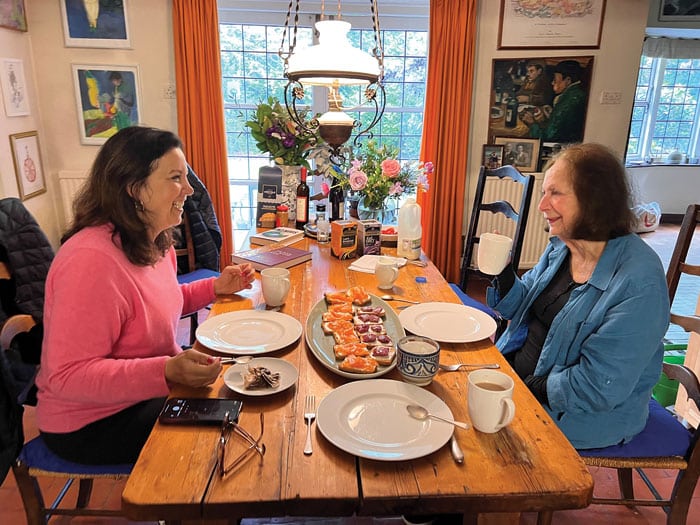
For tea, she served us delicious toasts with smoked salmon and red wine pickled herring, as well as with macerated strawberries and clotted cream. The day we visited, she tested a couple of recipes — one was phyllo fingers stuffed with semolina, pistachios and sugar, and another stuffed with corn flour. Ever the perfectionist, she was not happy with the results and decided they needed more work. Instead, she shared a recipe for her mother’s almond phyllo fingers.

We sat at her kitchen table and talked for hours. Neil and I felt bad that we had taken up enough of her time but she wouldn’t let us go, she wanted us to tell her about Los Angeles and Freda and the family. We stayed another hour. It was like visiting a beloved aunt.

Before we left, she showed us her beautiful English garden and we took some photos. She told us that she enjoys having friends over for dinner and that she has become very close to two famous chefs, Yotam Ottolenghi and Nigella Lawson. She even hosts them for Shabbat dinners.

As she walked us out to our Uber, she confided that she is thinking of moving closer to her kids. But she is definitely still working on the next new recipe and food discovery.

What an enchanted afternoon.

Photo by Rachel Sheff

My Mother’s Almond Fingers

by Claudia Roden

These exquisite and delicate Arab pastries (Assabih bi Lozare family favorites. They feature in medieval manuscripts as lauzinaj, which were fried and sprinkled with syrup, rose water and chopped pistachios. In North Africa they are deep-fried but we have always baked them. You need the very fine filo sheets also called yuvka.

Makes about 30
2 1/3 cup ground almonds
1/2 cup superfine sugar, or to taste
3 Tbsp orange blossom water
1/2 lb phyllo pastry sheets
3 oz unsalted butter, melted
Confectioners’ sugar, to sprinkle on
Mix the ground almonds with sugar and orange blossom water.
Cut the sheets of phyllo into four rectangular strips about 12 x 4 inches (the size of sheets varies so it is not possible to be precise) and pile them on top of each other so that they do not dry out. Brush the top one lightly with melted butter.
Put one heaped teaspoon of the almond mixture at one of the short ends of each rectangle, or take a small lump and press it in to a little sausage in your hand. Roll up into a small cigar shape, folding the longer sides slightly over the filling midway.
Place on a buttered baking tray and bake in a preheated 325°F oven for 30 minutes, or until lightly golden.
Serve cold, sprinkled with icing sugar.

Variations:
• Other delicious fillings are ground pistachios flavoured in the same way with sugar and orange blossom water or chopped walnuts mixed with sugar and a tablespoon of ground cinnamon or the grated zest of an orange.
• Instead of baking them, you may deep-fry the pastries in not very hot oil and for only a very short time, until lightly colored. Drain on absorbent paper and dust with confectioners’ sugar. Serve hot or cold.


Sharon Gomperts and Rachel Emquies Sheff have been friends since high school. The Sephardic Spice Girls project has grown from their collaboration on events for the Sephardic Educational Center in Jerusalem. Follow them on Instagram @sephardicspicegirls and on Facebook at Sephardic Spice SEC Food. Website sephardicspicegirls.com/full-recipes.

Tea With Claudia Roden Read More »

A Win for Angelenos with Disabilities—and Their Families

Mothers want the world for their children. We want them to be able to get an education, secure a fulfilling job, and nurture a loving family. When we learn that our children will be born with intellectual and developmental differences, or IDD, the picture in our mind of what their life will look like may shift, but we never stop dreaming about a bright future. 

At the same time, we never stop holding our breath about the path ahead for them.

My 15-year-old daughter Anya was diagnosed with a rare disease, tuberous sclerosis complex (TSC), at eight weeks old. TSC is a multi-system genetic disease that causes non-cancerous (benign) tumors to grow in the brain and other vital organs such as the kidneys, heart, eyes, lungs, and skin. For the first year-and-a-half of Anya’s life, she had 20-30 seizures a day due to a cluster of tumors on her brain. After trying a variety of medications, some that were not yet FDA approved, a few worked, and others did not. However, the only viable option was to have Anya assessed for brain surgery. This decision to move forward with brain surgery was not easy, but was one of the only real solutions to give her a better quality of life. Due to the placement of her tumors, she luckily was a candidate, and at 18 months she had a right temporal lobectomy at UCLA Mattel Children’s Hospital. Over the next few years, Anya’s seizures were controlled, but this is only one aspect of TSC. Anya is also on the autism spectrum, often deals with behavior and anxiety issues, has learning challenges and needs consistent medical monitoring for the various tumors on her kidneys, eyes and skin.  

Anya is currently a thriving sophomore at Santa Monica High School. Still, I’ve continued to witness up close the devastating results of a system that perpetually underserves, if not outright ignores, people like my daughter. I’ll never forget the heartbreak I felt when groups of kids were having sleepovers or birthday parties and my daughter was rarely invited. Or the time when she politely asked another middle-schooler to ride the Santa Monica Pier Ferris Wheel with her and the girl responded, “No. You can ride with your people.” The realities of her developmental differences meant I was constantly living in fear for her future. How would she be able to make friends? Could she manage college? A job? Her living situation? These worries have been a permanent source of stress for me and my family. It could be difficult at times to see a way through. 

The support structures for adults with IDD are even more limited than those for children. The infrastructure to provide them with meaningful employment, housing, and social opportunities is mostly non-existent. This community must reckon with the reality of skyrocketing housing prices in metropolitan centers like Los Angeles. Housing in L.A.’s core that does not discriminate against adults with IDD and provides on-site support is exceedingly rare, which renders independent living mostly impossible for adults with IDD.

This leaves adults with IDD in a precarious position. Only 11% of adults with IDD in the United States are able to live on their own. Little more than 20% of working-age Americans with disabilities are employed. And 40% of adults with disabilities report feeling lonely or socially isolated, which can have profound effects on their physical and mental health. 

This year, our family came across The Village — a pilot project of Cornerstone Housing, a nonprofit that creates and operates housing in Los Angeles for residents who have developmental differences.

For the first time since my daughter was born, I felt like I could exhale. 

The Village, which broke ground earlier this month, will transform a commercial property in Pico-Robertson into a state-of-the-art residential and retail site that empowers adults with IDD to live active, independent lives. It will be open to residents of all backgrounds who can live independently, with a portion of units allocated for low-income individuals. It will be staffed by a professional team that will be onsite 24 hours a day. It will even offer job training and placement, internship and apprenticeship opportunities, and post-secondary education assistance.

The Village combines nonprofit expertise, government support, and philanthropic vision to house adults with IDD in a city where building new properties is notoriously difficult. 

[.speaker-mute]The Village is more than a housing property. It also represents a new model that can be replicated nationwide. The Village combines nonprofit expertise, government support, and philanthropic vision to house adults with IDD in a city where building new properties is notoriously difficult. This development should serve as a shining example to nonprofits and philanthropists from coast to coast that, with the right vision, new housing with wrap-around services can be erected in city centers to empower America’s nearly 7 million people with IDD to live independently.

For too long, individuals with IDD have been excluded from public consciousness, leaving families to suffer alone. I know because I’ve lived this.

It can’t come soon enough. For too long, individuals with IDD have been excluded from public consciousness, leaving families to suffer alone. I know because I’ve lived this.

Our family foundation has sought to help children and adults with IDD pursue their highest ambitions. We are committed to funding programs and initiatives that empower these individuals to pursue education, employment, and independent living and to claim their places as valued members of their communities. When we learned about The Village, we knew that we had found a project that would make a lasting difference in the lives of people with IDD and their families. 

The Village made me think, for the first time since my daughter was born, that maybe there is a chance for her to live independently in a community that inspires and uplifts her, a chance for families like mine to connect and feel included, and a chance to fulfill that dream of a joyous, abundant life every parent has for their child.


Anita Bhatia, MHA, is Executive Director of the Ramesh and Kalpana Bhatia Family Foundation. 

A Win for Angelenos with Disabilities—and Their Families Read More »

Europe Turns to Israel for Defense Modernization

When Russian forces invaded Ukraine on February 24, 2022, an era of peace in Europe came to an abrupt halt. The conflict unleashed a humanitarian catastrophe, including the largest wave of refugees since World War II.  

Since the end of the Cold War diplomacy and economic soft power have been the pillars of European statecraft. The Ukraine War creates a new reality: military budgets across the continent are rising more steeply than they have in decades; NATO is expanding military assets on its eastern flank and accelerating readiness; and almost all European nations have provided some form of military assistance to Kyiv.

European policymakers, looking to modernize their militaries in response to the Russian threat, are increasingly turning to their Eastern Mediterranean neighbor with cutting-edge defense technology: Israel. 

Earlier this month, Reuters reported that the German government will purchase Israel’s Arrow-3 missile defense system for nearly $4.3 billion. If the sale goes through, it would be the largest defense export in the history of the Jewish state. 

The strategic defense relationship between Israel and Germany is multifaceted and continues to grow. Germany builds Dolphin-class submarines that are central to Israel’s strategic deterrence against hostile states. Last year, Berlin purchased $160 million in munitions for its Israeli Heron-TP drones developed by Israel Aerospace Industries (IAI).  

Other nations recently purchasing Israeli defense articles include Finland, Romania, Netherlands, Greece, Denmark, Estonia, United Kingdom, Poland, Sweden, Slovakia, Croatia, and Italy.  

Finland, a new NATO member, is acquiring the David’s Sling air defense system from Israel in a $345 million deal. 

The German-led European Sky Shield Initiative (ESSI), launched last year, involves 17 countries working toward integrated air and missile defense across the continent. Given the high demand for technologies such as Arrow-3, David’s Sling, and Iron Dome, ESSI will further strengthen Israeli defense exports to Europe. 

The defense sales are not just business transactions but a sign of Israel’s growing relations with the region. Europe is Israel’s largest trade partner and the EU is one of Israel’s top innovation funders. The EU accepted Israel into its premier research and development program, Horizon Europe. Brussels signed a major natural gas deal with Israel and Egypt last year to help reduce European reliance on Russian energy. In July, the 27 EU member states voted to resume the EU-Israel Association Council, the highest forum for bilateral consultations between the parties.  

Political support for Israel is expanding in Europe. In December, the U.N. General Assembly adopted a deeply biased resolution to refer Israel to the International Court of Justice (ICJ).  While the measure was supported by 87 nations in favor, a strong majority of European countries either voted against the resolution or chose to abstain. 

The UK recently signed a landmark agreement boosting security, technology, and trade ties with Israel and is advancing legislation to prohibit local government councils from participating in the anti-Israel boycott, divestment, and sanctions (BDS) movement. 

Iran’s supply of lethal drones to assist Russia in its war on Ukraine further aligns European and Israeli foreign policy. 

The foreign minister of Estonia, which recently signed a deal for advanced Israeli long-range loitering munitions, announced in November 2022 that the Baltic nation has revised its foreign policy and will no longer vote for anti-Israel UN resolutions.

The benefits of strong relations between Europe and Israel continue to yield dividends for both. 

The benefits of strong relations between Europe and Israel continue to yield dividends for both. 

When the founders of the modern State of Israel declared independence, they likely never imagined their nascent country would become an indispensable partner for European defense modernization. Remarkably, that is now happening.


Siamak Kordestani is the West Coast Director of Friends of ELNET, the European Leadership Network, an organization working to strengthen European-Israeli ties.

Europe Turns to Israel for Defense Modernization Read More »