fbpx

February 22, 2023

Is Private Security the Best Option for Protecting Jewish Communities?

As the Los Angeles Jewish community settles into another Shabbat, there is a looming cloud of concern about security. A suspect is in custody in the Pico-Robertson shootings, but violence and antisemitism have been an unfortunate and recurring burden facing Jews around the world. Security is no doubt going to be a hot topic throughout the community.

But at a time when police departments are having their funding cut and experiencing major retainment issues, response time for emergency services when you call 9-1-1 has been rising at concerning levels. 

In Los Angeles, there are several organizations that specialize in supplementing public security specifically for the Jewish community — some volunteer and some for hire.

A few spoke with the Journal in the wake of the shootings, including Evan Bernstein, CEO and national director of Community Security Service (CSS). The sole aim of CSS is to “protect Jewish life and the Jewish way of life.” 

Before touting his organization, Bernstein made sure to laud law enforcement authorities.

“First of all, let’s be grateful for the Los Angeles Police Department and how law enforcement stepped up and how fast they made the arrest and how people did not have to go into Shabbat wondering whether or not there was a perpetrator out there who was allegedly shooting people that were wearing yarmulkes and were Jewish, and I think that that’s a huge win,” Bernstein told the Journal.

“I think the other piece is it shows the climate that we’re in and that we need to be diligent as a Jewish community, but we cannot let these kinds of acts of hate prevent us from practicing our Judaism and from going to synagogue. And even though the numbers continuously go up and we’re seeing more and more of these acts of hate, even on the East Coast, we saw what took place in Penn Station and everything else that when we are dealing with these kinds of incidents, that we need to be able to still practice our Judaism and do it in a way where we are aware of our surroundings, aware of the threats that are around us, but not let that prevent us from practicing our religion.”

CSS is made up of volunteers, and Bernstein said that nobody is going to care more about what’s going on inside a community than a volunteer. Bernstein added that it’s critical to empower the Jewish community to work in conjunction with local law enforcement or private security to “be a force amplifier.”

“The key is that no one’s going to know the physical plant better, no one’s going to know who belongs or doesn’t belong better than a volunteer, and especially a well-trained volunteer,” Bernstein said. “Local law enforcement may rotate at a particular institution. Private security may also rotate. They’re not members of the community typically, and may not know the physical plant the way volunteers do.”

Bernstein offered the example of a bar or bat mitzvah. In this case, a volunteer will know which door is going to be left open when the caterer arrives. He says that it’s those litttle nuances that only a volunteer may know. But it’s not a question of hired security or volunteers, it’s a collaboration of both that makes the difference. 

Another prominent nonprofit specializing in security for the Jewish community is Magen Am. Founded in 2015, Magen Am is Hebrew for “nation’s shield.” Their licensed armed security professionals can be seen deployed and protecting synagogues. 

In 2020, when violence broke out around town in the wake of the George Floyd protests, the Journal reported on Magen Am receiving calls to provide patrols around defined Jewish neighborhoods in Hancock Park, North Hollywood and the Pico-Robertson community. 

“There’s the message of, ‘We are not a soft target. We are a hard place to get into,’ which will deter the majority of people.” Magen Am President Rabbi Yossi Eilfort told the Journal. 

Magen Am also provided security for the Hatzolah Emergency Medical Services of Los Angeles. Hatzolah provides additional pre-hospital services that would typically be provided by LAFD emergency medical technicians. They patrol the areas of Fairfax/La Brea, Pico-Robertson and North Hollywood. They’re a volunteer service, so when they’re called, it doesn’t make a difference if the victim is uninsured. 

There is also Chaverim North America, which specializes in providing free road assistance and other non-medical emergency help at home or on the road. Chaverim is currently located in 23 cities in the U.S. and Canada. 

Another group is Shmira Public Safety, established in 2022 in response to the rise in crime in Jewish neighborhoods in Los Angeles, as well as Queens, Brooklyn, Staten Island and the Catskills in New York. Shmira is another trained volunteer force that patrols neighborhoods. “Shmira” comes from the Hebrew word that means “safeguarding.”

While much emphasis is put on protecting synagogues and events, a growing concern is about anti-Jewish crime waged on the streets and sidewalks. 

While much emphasis is put on protecting synagogues and events, a growing concern is about anti-Jewish crime waged on the streets and sidewalks. And that’s what concerns AEGIS Security and Investigations President and CEO Jeff Zisner.

“The problem with this kind of crime is that it’s occurring on the street — you’re not in a secured space,” Zisner told the Journal. “Some people are clearly identifiable [as Jewish], especially near shuls. A security presence creates an opportunity for a professional to identify a person engaging in suspicious behavior on just a typical day. Security isn’t just one component. It’s a layered approach that requires forethought and requires consistency and requires a level of professionalism to be done properly.” 

AEGIS is a Los Angeles-based security guard service that has clients far beyond the Jewish community, including retail loss prevention, hotels and resorts, entertainment studios and banks. The service also has partnerships and deployments throughout the Jewish community. 

As a security business, AEGIS offers an alternative to relying on nonprofits. AEGIS has resources to increase security presence for hire, but in times like these, the funding and personnel might prove to be out of budget for many small but threatened Jewish communities. 

The local Jewish Federation has been instrumental in coordinating security efforts throughout the community. 

“Coordinated effort on security is critical,” Bernstein (CSS) said. “One of our closest partners is the Community Security Initiative (CSI), which is part of the Los Angeles [Jewish] Federation.”

CSI was founded in 2012 to “combat the rising threat of terrorism” and protect “every Jewish school, synagogue, summer camp, and organization in Jewish Los Angeles,” according to its website. “CSI functions as a single point of contact for critical incident coordination, information and intelligence sharing, safety and security training, and resources for Jewish institutions across L.A. and offers the individuals within these establishments the necessary instruction and awareness to arm themselves against potential threats. The initiative is a link to a network of Jewish communal organizations and provides unprecedented access to federal, state, and local emergency services.”

CSI’s services include site visits and vulnerability assessments, a 24/7 analysis center, training on making organizations a harder target, as well as classroom teaching sessions.

CSI’s services include site visits and vulnerability assessments, a 24/7 analysis center, training on making organizations a harder target, as well as classroom teaching sessions.

Is Private Security the Best Option for Protecting Jewish Communities? Read More »

LA Times Misfires on Pico Shootings

Writing news headlines is not for the faint of heart. Trying to catch a reader’s attention without sensationalizing or exaggerating the news is no easy feat. It’s even more difficult in a digital era in which the number of clicks on a particular story link can have a seminal effect on that news organization’s success, influence and survival.

But those of us who still read the Los Angeles Times woke up to quite a shock last Saturday morning, when the top story on the Times website came with the following headline: “LA Jews are resolute — and armed — after gunman targets community in 2 shootings.”

The Times deserves credit for providing high-profile and continuous coverage to the two attacks against two Jewish men in the Pico-Robertson neighborhood last week. The gunman had a long history of public and ugly antisemitic behavior and had admitted to specifically targeting Jews on their way to religious services. However, the news that the Jewish community was arming itself in response to these shootings was startling. 

And misleading.

Jewish Americans tend to lean leftward politically and have historically favored more stringent gun control measures by overwhelming margins. (The seminal 2019 Cal State L.A./Pat Brown Institute poll showed that 83% of Los Angeles Jews supported stricter gun control laws.) If Jewish Los Angeles was turning toward gun ownership as a means of self-protection in significant numbers, that would signal a tremendous cultural, political and public safety transformation that would fundamentally change the nature of the Jewish community here.

The article began with the owner of a neighborhood kosher restaurant asserting that many of his friends and customers were now arming themselves in response to the shootings. After the first few paragraphs of the story in which the restauranteur was quoted, the four reporters who authored the piece did not raise the issue of gun ownership again, reminding us that – as the late Senator Daniel Patrick Moynihan once said – the plural of anecdote is not evidence.

Within a few hours, Times editors had realized the problem with that headline, and so the earlier version was quickly corrected to replace the misleading words “and armed” with the safer alternative “on edge”. (Both versions were immense improvements over the headline that ran in the Times’ print edition: “LA Jews ‘always worried’”, using an out-of-context quote from a concerned mother of a teenage girl to make our entire community look weak, frightened and pitiable.)

The Times’ coverage was extraordinarily frustrating, but the quickly-erased headline about “armed” Jewish Angelenos does raise important questions about how we should be protecting ourselves as the threat of antisemitic violence continues to grow. Los Angeles city officials and law enforcement responded with an immediate and visibly heightened police presence in the affected area. But given the increase in gun violence in many other areas of the Southland, it will be difficult to maintain that greater level of protection.

Many Jewish Angelenos would instinctively advocate for stronger gun control measures, but California already has among the toughest anti-gun laws on the books of any state in the nation and additional federal legislation is unlikely in the immediate future.

The debate over public safety inevitably leads back to the question of the level of law enforcement needed to protect our communities. 

It’s possible that better application of so-called red flag laws that provide for more frequent gun violence restraining orders may have caught this particular gunman. But the debate over public safety inevitably leads back to the question of the level of law enforcement needed to protect our communities. While the number of progressives who literally want to eliminate police funding is mercifully small, the overall trajectory in the politics of criminal justice for most of the 21st century has shifted away from longer sentences and toward lesser penalties and rehabilitative measures. The increasing frequency of violent street crime suggests that those trends may be about to change.

Mayor Karen Bass is resisting pressure from her party’s ideological base to reduce police funding. She also recognizes the benefits of supplementing law enforcement with enhanced social service specialists. But the fight over police funding is coming and the Jewish community here will need to decide where it stands.


Dan Schnur is a Professor at the University of California – Berkeley, USC and Pepperdine. Join Dan for his weekly webinar “Politics in the Time of Coronavirus” (www.lawac.org) on Tuesdays at 5 PM.

LA Times Misfires on Pico Shootings Read More »

Passover Program Coming to the Las Vegas Strip

When Jews visit Las Vegas, they have to go off the Strip to celebrate Shabbat, find kosher food and be near the community. The closest synagogues are miles away, and not within walking distance of the hotels.

Now, a non-profit organization called The Shabbat Inc. is looking to change that, beginning with a Passover program right in the heart of the Strip at Resorts World. The new program, which will run from April 4-16, is just the start of Torah observance on the Strip; it kicks off year-round Shabbatonim (communal Shabbats) with a fully stocked five-star kosher kitchen at the hotel.

Aryeh Rifkin

“Imagine a Shabbaton bringing kedusha (holiness) to the Las Vegas strip,” said Aryeh Rifkin, president and founder of The Shabbat Inc. “You no longer need to imagine it, because it’s here.”

Jewish singles and families will be able to have an authentic, traditional experience at the Passover program, which includes visits to Mt. Charleston, Zion National Park and Red Rock Canyon. It will also feature a choreographed sing-along Haggadah with acapella band Shir Soul, Moshav Band, Six13, classes with rabbis, comedy with Mark Schiff, Daniel Lobell and Brian Kiley and discount tickets to events around town for Chol Hamoed, the intermediary days.

Our mission is to bring Jews closer together.” – Aryeh Rifkin

To ensure the program is as inclusive as possible, it will be non-gebrochts and kitniyot free, as well as provide Chassidish meat and cholav Yisrael dairy to adhere to the strictest kashrut standards under International Kosher Mehadrin. Rifkin negotiated Shabbos elevators with Resorts World so participants can avoid using electricity on the non-work days of Passover as well as Shabbat. He also got Resorts World to change the plumbing fixtures in the hotel to non-automated – a huge undertaking.

There will be an indoor playground for kids and teens that’s about 20,000 square feet, opportunities for singles to meet and separate swimming hours for men and women.

“Our programming is for singles, families and children, and we welcome any observant hashkafah (outlook): Sephardic, Orthodox, Chabad, Carlebachian, etcetera,” said Rifkin. “The size and elasticity of Resorts World provides us the unique opportunity to run simultaneous programs for singles, couples and kids of all ages. The Shabbat Inc. welcomes hosting Jewish organizations and private events.”

Rifkin, who founded JACLA, a Jewish events space in Pico-Robertson, hired heavy hitters such as ex-Angeleno Michal Taviv-Margolese, who is director of guest relations, events planner Tahlia Miller and Jodi Weiss, who runs Shul on the Beach in Venice, to help with The Shabbat’s Passover and year-round programs.

Taviv-Margolese, who moved to Vegas during the pandemic, was surprised that there wasn’t something for observant Jews on the Strip already.

“Even though it’s such a big capital for so many conventions, and even though the community is one of the fastest growing in the country, there’s nothing solidly happening on the Strip,” she said. “Our goal is to ensure every single guest and family feels part of this growing and vibrant community, and are connected through fantastic entertainment, inspired davening, the great and gorgeous outdoors, networking possibilities and so much more.”

Finding Resorts World and deciding to put on the Passover program and year-round festivities was not easy for Rifkin. But, as a baal teshuva and a cancer survivor, he’s passionate about having – and creating – meaningful experiences that help Jews engage with Judaism, each other and God.

“I contacted and toured 55 Las Vegas resorts and found only one capable and willing to work with the Jewish community,” he said. “As all this was coming together, I worked night and day developing videos, marketing materials, digital assets [and] messaging and [managing] a team of web developers. I work every minute I’m awake. Still, it’s the most rewarding thing I’ve ever done, although my salary is only $1.00.”

Since this is an introductory program, and The Shabbat Inc.’s number one goal is simply to offer a fulfilling and positive experience, prices are lower than that of a typical Passover program.

“Our mission is pure,” Rifkin said. “Our mission is to bring Jews closer together.”

Find out more and register for Passover at TheShabbat.org.

Passover Program Coming to the Las Vegas Strip Read More »

Judicial Overreach: When 61 Seats Buys You Supreme Power

There is one question that has gotten lost in all the noise about the hugely controversial and divisive judicial overhaul being pushed by the new right-wing coalition in Israel.

I’ve heard the critiques about how this is a blatant power grab by the ruling coalition. I’ve heard the defense that it is a “correction” of the previous power grab by the Israeli Supreme Court. And I’ve heard the centrists who argue that some reforms are needed but that both sides should negotiate a reasonable compromise (my preference).

What I haven’t heard is this: If the judicial overhaul goes through, what happens when a center-left coalition comes in with 61 seats and embraces all this extraordinary power?

As the right-wing coalition charges ahead with laws they love, what will happen when they see another coalition establish laws they hate? After all, they’ve set the precedent: Get a majority of 61 seats in a parliament of 120 seats and you have the “democratic right” to grab as much power as you like.

As reported in Times of Israel, the coalition has already “passed in its preliminary reading a bill that could almost completely end court oversight of legislation, by enabling parliament to legislate laws that are preemptively immune to judicial review with a simple majority of 61 of 120 MKs.”

In other words, because the new bosses have a majority of seats, they’ve decided they can set rules that give them power to set any rules they like. Get it? They’re using power to get more power.

One reason this issue has been so confusing is that this is not the kind of activity we’re used to seeing from a parliament, which typically deals with legislation to improve the economy, health care, education, infrastructure, and so on.

No, this coalition has focused instead on increasing its own power. It’s not debating how to reduce the cost of living but how to reduce the power of the Supreme Court and transfer it to itself.

Even if you completely agree with this power shift and every new law that is being advanced, the question remains: What happens when a different coalition takes full advantage of this new power?

What if the new coalition, for example, decides that every store can open on Shabbat, or every ultra-Orthodox must join the army, or every illegal outpost must be dismantled? And because of the new rules set by this coalition, no court can override any of it?

The problem with gutting the power of the courts to check the power of politicians is that in Israel’s system, there is no other line of defense. As Yedidia Stern of the Jewish People Policy Institute writes in Ynet, “Many of the lines of defense accepted around the world do not exist in Israel… and while we have a legislative branch, it lacks practical power to oversee the operation of the executive branch.”

Yes, judicial reforms are needed to correct the current imbalance. The answer, however, is not to overcorrect and give virtually all the power to politicians and turn Israel into a system with one supreme branch of government with no checks or balances.

Yes, judicial reforms are needed to correct the current imbalance. The answer, however, is not to overcorrect and give virtually all the power to politicians.

America’s Founders understood that anything having to do with distribution of power is sacrosanct. Unchecked power in any direction can undermine fundamental human rights, not to mention minority rights. That’s why they made it so difficult to change the rules of power, demanding a Constitutional amendment by a two-thirds vote of both Houses of Congress, and a subsequent ratification by three-fourths of the State legislatures.

In Israel, the new coalition has decreed that changing the rules of power doesn’t require a two-thirds supermajority but only a one seat majority– 61 seats out of 120.

Where does this cockiness come from? Are they assuming they will never lose their slim majority and will govern indefinitely? Have they not seen the latest poll showing them losing nine seats to 55 and the opposition winning nine seats to 65?

Before the pendulum swings back again, as it invariably will, the new sheriffs in town can do their country a big favor and negotiate a reasonable compromise. As Stern writes, “Compromise is necessary to preserve our solidarity… Leaders of Israel: History will judge you by the sincerity of your willingness to move toward compromise.”

Judicial Overreach: When 61 Seats Buys You Supreme Power Read More »

Cassandra Kane: Reimagining the World of Fashion and Sustainability in the Jewish Way

When we think of fashion and leather goods, we don’t usually think about sustainability. For the majority of people who can’t afford designer “investment pieces” that are timeless and high quality—pieces that are purchased once and worn or used for years to come, and that typically cost much more than average pieces—fashion is about finding cheap and easy ways to replicate runway trends and designs. It’s anything but sustainable.

Fast fashion,” as it’s called, is by its very nature disposable. We love it for a short time, but we grow tired of it quickly and then dispose of it to make way for the newest trend, which means that most of it (around 73%) ends up in landfills. But it gets worse. The increasing push toward “cruelty-free” and “vegan” leathers, most of which usually contain phthalates and other chemicals and toxins and can take thousands of years to break down, has resulted in an increasing amount of excess real leather waste given the decrease in leather sales in favor of these supposedly more ethical leathers. A staggering amount of these leather hides—millions, in fact—also end up being thrown away. And these are hides that exist as a biproduct of the meat industry. In other words, buying “vegan” leather doesn’t mean you’re saving a cow. It simply means that you’re sending a hide that would otherwise be used to the landfills or to be burned.  Given these facts, it’s easy to wonder what are the most ethical choices when it comes fashion.

If you’re doing the math, then you should be horrified. It’s exactly how I felt when I attended a talk on sustainability and the fashion industry in Florence, Italy in the fall of 2021. One of the speakers was Cassandra Kane, an American Jewish woman who grew up in New Jersey and worked in the luxury fashion industry in New York City before moving to Florence six years ago.

I recently met with Kane to chat about fashion, sustainability, and Sieme and Zero Lab, her creative solutions to the tremendous amount of waste in the leather industry. For Kane, the “worst part about ‘fast fashion’ is that it devalues the true cost of garments and products so that customers can no longer appreciate their true value. If we have the expectation that a shirt costs $5 or $10, why would we value and take care of that garment in the long term? The truth is, that price can only be achieved through exploitation of natural resources and labor and ‘fast fashion’ has essentially trained two to three generations of people that this is OK,” she said. “The ‘fast fashion’ model doesn’t work when you need to provide for people, planet and profit.”

Many of the most popular “fast fashion” brands (like Zara, and H&M for example) like to talk a lot about sustainability because it’s trendy and buzz-worthy. However, these retailers and others fall far short of their alleged goals. But for Kane, a designer and entrepreneur, sustainability is not just a buzz word. It’s a way of life, and she’s figured out how to make it a way of life for others as well—without sacrificing quality and aesthetics.

When I first heard Kane talk about the leather industry, which is substantial in Florence, I was shocked by her comments on vegan leather. Given the mass amount of marketing for these products—and the touting of them by celebrities like Miley Cyrus, Kim Kardashian, and Meghan Markle—I have to admit I’ve felt more than a touch of guilt over all of my beloved leather boots and jackets. But the truth is that vegan leather is much more damaging to the environment than real leather.

“The vast majority of vegan leather that’s on the market has plastic in it in some way,” said Kane. It’s not as sustainable or ethical as we’ve been led to believe. But “there’s a way to have ethical real leather” because as a material, “leather is technically biodegradable and lasts longer than any vegan leather will ever last if you take care of it because it can be repaired. It can be passed down through generations, and so in that respect it’s one of the most durable materials. There’s a reason we’ve been wearing it since the dawn of time.”

Understandably, some might still find the environmental impact of vegan leather less egregious than the alternative, which in theory requires killing an animal. But even that isn’t what it seems.

“What most people don’t know is that over 90 percent of leather that’s used in the fashion industry is a biproduct of the meat industry. So if we weren’t utilizing the leather then it would be getting thrown away,” said Kane. “Leather is like an added bonus to meat industry … last year in the U.S. we burned or buried five million hides that just weren’t used because, overall, the desire for leather goods is going down because there are a lot of alternative materials on the market.”

“Leather is like an added bonus to meat industry … last year in the U.S. we burned or buried five million hides that just weren’t used because, overall, the desire for leather goods is going down because there are a lot of alternative materials on the market.”

Think about it: five million hides burned or buried, just last year alone, in the U.S.

But it’s complicated. As we know, the meat industry is a massive contributor to air pollution and other environmental concerns. And so, as Kane says, the problem isn’t leather; it’s that we need to eat less meat in general. “For the last 30 years our meat consumption has continued to rise,” she said. And “you can’t talk about using less leather without talking about eating less meat. The two go hand in hand.”

But for now, with levels of meat consumption as they are, the question is how to avoid the tremendous amount of waste that the leather industry is known for. This is where Sieme, Kane’s artisan Italian accessories company, comes in. Sieme re-purposes and uses luxury fashion’s leather off-cuts to make beautiful handbags and other accessories.

“On average, 20-40 percent of leather used in accessories production is discarded in the process. In Italy that can go up to 60 percent because of quality control issues and because when you have really high markup you’re not as incentivized to utilize all the material you need and reduce the consumption for cost the same way you are if you’re more mass market or contemporary design level,” said Kane. “But in luxury … it doesn’t matter. In Tuscany alone that equals over 260 tons a year of leather that gets thrown out (400,000 pounds a year).”

And what happens to it when it gets thrown out? What does that mean, and where does it go?

It goes through a “disposal” process. “Leather is considered industrial waste because of the way it’s tanned. If it’s vegetable tanned leather [where natural tannins are used—which only give us muted colors rather than the whites and bright colors] … it becomes fertilizer.” But vegetable-tanned leather makes up less than 20 percent of leather that’s used in the fashion industry. The “vast majority of leather uses chemicals for tanning and can’t get thrown out normally. It has to go through a dechroming process to become biodegradable, which is expensive and which they do here in Italy, but in a lot of other countries they don’t. Or it gets sent to special landfills more often than not, or it gets sent to be incinerated because it makes very good fuel to burn other trash.”

Leather may be biodegradable, and an obviously more environmentally sound choice than so-called vegan leather, but when treated with chemicals it can still pose a substantial threat to the environment when it’s burned or buried. And beyond that, it’s a tremendous act of waste. But, as Kane says, there’s always going to be a little bit of waste. The idea of having “absolutely zero waste is not realistic.” But given that leather is such a “high value material,” we should be able to find a use for it, and “60 percent waste is insane.”

It’s horrifying. But even though this kind of waste is now finally on the fashion industry’s radar, Kane admitted that it’s hard to process until you see it for yourself—until you are in the industry and traveling to factories and witnessing how production works and what happens to the discards.

“My aha moment with leather didn’t come until I was working in a factory, and it was a very small factory [after she studied at Florence’s prestigious Scuola di Cuoio] that makes high-end samples for runway shows in very small production and we were working for one specific brand and we ended up having to throw away 60 percent of the leather they ordered because they couldn’t accept it … it was a very natural leather and there were a lot of wrinkles and changes to the texture and they wouldn’t accept it,” she said. “And I was like, wait a second, and it really did click that if this is happening here, this must be happening on a massive scale.”

Kane, who comes from a long line of people in the fashion industry—her grandmother was a seamstress, her grandfather was a tailor, and her mother worked in a designer showroom—has always been attracted to leather and “hard piece fabrics.” She was a leather, fur (although she believes we should no longer be using fur), and outerwear designer in NYC. Her first job in the industry was with Dennis Basso, and she remembers asking the designer why he would take so long to make each piece, and his response was that all of the materials being used came from life, and so his job was to respect it and do it in the best possible way he possibly could. This lesson stayed with Kane. So when she witnessed for herself the extreme level of waste, she knew there had to be a way to reduce it while creating quality and beautiful products.

At Sieme, “we weave or manipulate all the leather … because when dead or excess materials are being used, there’s a finite amount, so we have to figure out a way to manipulate or design it so that you can scale it.” Kane was really inspired by weaving because the method was born here in Tuscany hundreds of years ago, and “the reason they used to weave leather is here because in Tuscany specifically they don’t have a lot of cows—traditionally they always had lamb—and they ate a lot of lamb and that’s why there’s pecorino cheese. Now they have cows too, but they always had a lot more sheep in Tuscany. And so they had sheep leather, and sheep leather is way softer but it was too soft for bags and shoes, so what made it stronger was weaving it together … I wanted to take that and turn it around and say, well also all of this discarded leather is not waste; it’s just off-cuts really.”
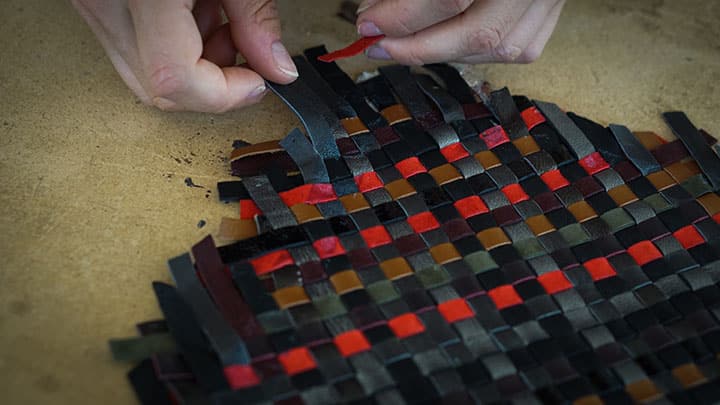
The behind-the-scenes process of how leather goods are made is eye-opening, to say the least. Some of the “luxury brands will take an entire lambskin and cut one front panel in the back and middle of the skin and the rest of it they throw away, because when you’re selling a bag for 8,000 euros or dollars it has to be perfect. And the cost doesn’t matter. So that’s what we’re working with. And sometimes we’re working with whole skins because … every production orders ten percent more than what they need in case there are defects or something happens.”

When we consider that this is not only happening in Tuscany but all over the world, it becomes clear that this is not just a local project. It has to be a global or industry-wide effort.

To facilitate this process of gathering and re-purposing leather off-cuts from designer and luxury brands, Kane realized she needed to build an infrastructure, so she started Zero Lab, a hub for the recycling of leather waste. “Just this week we got a shipment from a factory that was 15 giant boxes of full rolls of leather that was accumulated over seasons but they have no use for it.” Zero Lab is not just a leather recycling studio; it’s also a sustainable design hub and creative working space for emerging designers and smaller brands that are interested in working with “waste” and offcuts. One of their first big partners is Gucci. The hub is also developing other projects that are business to business and trying to find more ways to keep leather out of landfills. “We are also working on a project where we’re quantifying the amount of carbon that’s saved by keeping this stuff in circulation as opposed to just sending it to landfills and then it getting burned and used as fuel to burn other trash.” Kane hopes to be able to help companies in the future be able to quantify the amount of carbon that their products are using.

 

The mission is simple: “It’s keeping leather out of landfills and making the industry more circular and sustainable. And number two, supporting artisans, independent designers, emerging designers, and small artisans here in Florence” because over decades many companies have bought up small factories and absorbed them. “We don’t want to lose that culture … it’s what makes Italy Italy. We’ll never get the next generation of designers and brands who are going to be able to move the needle and make the industry more sustainable if they have no way to start. So that’s the big way that Zero Lab comes in. It’s finally a place for all these people to come together.”

Kane’s vision is a big vision. It’s not just wanting to be in Florence and Tuscany and make beautiful bags. “It’s a mitzvah,” I said to Kane. And there really is a strong tikkun olam component to everything Kane does. A cornerstone of Judaism and Jewish identity is the idea of ethical responsibility. What Kane is doing epitomizes this. It’s one thing to make personal decisions to buy only sustainable products, but it’s another to thing altogether to make it your life’s work, to make it easier for other people to make ethical decisions.

It’s one thing to make personal decisions to buy only sustainable products, but it’s another to thing altogether to make it your life’s work, to make it easier for other people to make ethical decisions.

It’s also true that the commandment of bal tashchit—do not destroy or waste—is crucial to a Jewish environmental ethic. The Jewish tradition forbids wasteful behavior because it contributes to the degradation of the planet. It’s the opposite of tikkun olam. Needless destruction and the act of destroying anything that may be of use to people are prohibited. It applies to wasting energy, clothing, water, money, and wastefully burning oil or fuel.

I had to ask Kane: Do you think that being Jewish has impacted what you do or why you do it?

Her response: “Yeah, my mom and my bubbe always engrained in us to give back, to volunteer. And it was always through the Jewish community in some way whether nursing homes or different organizations, or with USY—because that’s a big part of what they do, you give back in so many different ways—and so I do think that it’s your responsibility to leave world a little bit better than how you found it, or at least try to.” Kane is passionate about fashion, and says, “Every time I sit at a sewing machine I think of my bubbe. It feels very natural that the way I’m going to try to give back and solve a problem is within that industry because I feel very connected to it on a much deeper level.”

On social media, Kane offers hilarious and compelling critiques of couture fashion. She also gives an insider’s view of her life in Italy (she is currently planning a wedding with her Italian fiancé Lorenzo) and as a designer and entrepreneur. But most notably, she is unabashedly Jewish. One of my favorite moments was her description of how she had been dying to take Lorenzo home for a Jewish holiday, but the holiday that worked ended up being Yom Kippur, the one holiday where Jews don’t eat. One can imagine that the idea of not eating on a holiday must be confusing for Italians.

Kane grew up in a conservative Jewish community and spent a lot of time at the synagogue, where her mom ran the gift shop and was president of Sisterhood, and her dad was equally involved. Kane went to Camp Ramah and was active in USY on Wheels. The city in which she lived was around 40 percent Jewish. Later she lived in New York City, another place of high Jewish visibility, where the markets are filled with Jewish foods. It’s easy to take being Jewish for granted in such an environment. “I always really liked being Jewish,” Kane said, “and I didn’t really have to think about it so much.”

But living in Italy as a Jew is much different. For example, Kane started cooking Jewish foods in Italy because she couldn’t find them. “If it’s important to you to do, you have to make the time,” she said. “To find all the stuff to make matzo ball soup at Passover is a commitment, and in a way it makes it more important.” To be Jewish in Italy requires being more intentional. It doesn’t happen automatically; you have to seek it out. Kane regularly interacts with people who’ve never met someone who is Jewish, or if they have they’ve only encountered Hasidic or Lubavitch Jews, people who are visibly Jewish. But she enjoys exposing people to Jewish identity in a place where the word for “Jewish” doesn’t really exist. In Italian, the word is “ebreo,” which translates as “Hebrew.” It’s not the same thing. But sometimes Jewish identity can be discovered or re-discovered in the unlikeliest of places. “I’m forced to think about it a lot more here,” said Kane. “I appreciate it more.”

Kane is carving out an important space and doing something that really matters without sacrificing creativity. We should all feel inspired.

To discover and shop Sieme brand, visit www.wearesieme.com


Monica Osborne is a former professor of literature, critical theory, and Jewish studies. She is Editor at Large at The Jewish Journal and is author of “The Midrashic Impulse.” Twitter @DrMonicaOsborne


Cassandra Kane: Reimagining the World of Fashion and Sustainability in the Jewish Way Read More »

A Jewish Answer to the Teacher Shortage Crisis

“Yehoshua ben Perachyah said: Make for yourself a teacher; acquire for yourself a friend; and judge every person on the positive side” (Avot 1:6).

Last week, Sen. Bernie Sanders (I-Vt.) called for a minimum salary of $60,000 for public school teachers, capitalizing on the push by President Biden in his State of the Union speech to give public school teachers a raise. “We should be paying public school teachers a minimum of at least $60,000 a year,” Sanders said at a town hall at the Capitol with national teachers’ union leaders. “I am proud to tell you I will soon be introducing legislation to do just that.” Low pay, highly stressful working conditions and the political battleground that has rendered the classroom ground zero have resulted in a nation-wide teacher shortage that threatens the fabric of public education at all levels and across all demographics.

Yet, there is another force behind the mass-exodus of highly qualified educators from the field and that is the regressive and highly predatory nature of student loan debt and how this debt has resulted in an extreme housing affordability crisis that makes it impossible for teachers to live in the communities they serve. According to Jewish tradition, while we may not ultimately solve a problem, it is incumbent upon us to make every effort to attempt to find a meaningful solution and we must approach the teacher shortage crisis by drawing from our sacred tradition as well as exploring viable and practical political responses.

How did we get here as a nation?

As Jews, we are taught to elevate the role of the teacher to the highest level, placing reverence and obedience at the center of the student-teacher relationship. Yet by the late 1980s, government divestment from higher education financing had resulted in a massive shift of the cost of post-secondary education to the individual laying the foundation for what is today a close to two trillion-dollar crisis. Albert Einstein once famously said that “Better than a thousand days of diligent study is one day with a great teacher.” But today, the career of a teacher is regretfully mired in overlapping crises that result from poor and myopic policy decisions at the local and national level. Moreover, teachers often find themselves at the epicenter of overlapping crises such as student debt, housing shortages, and political posturing at the expense of our children. Specifically, according to a 2021 study, 42 percent of educators, including students planning to enter higher education faculty positions, took out at least $65,000 in student debt. Moreover, faced with low wages in their early career, it takes teachers much longer to pay off their student debt, allowing it to grow with interest. The same study found that 42 percent of educators with more than 11 years of experience still have student loan balances, with 29 percent having a remaining balance of at least $65,000. Further, although public service workers have been eligible to pursue debt relief through the Public Service Loan Forgiveness Program since 2007, the program’s success was long stunted by administrative issues, resulting in a 98 percent denial rate despite the recent limited waiver, which, according to 2022 data from the Department of Education, has seen scant single-digit improvements down to a 92% denial rate. These statistics, compounded by the removal of the constitutionally guaranteed right to declare bankruptcy uniquely from student loan debt, creates a spiral of negative amortization that can trap teachers into a lifetime indentured servitude.

But today, the career of a teacher is regretfully mired in overlapping crises that result from poor and myopic policy decisions at the local and national level.

The average public school teacher salary in Los Angeles, CA is $62,900 as of January 26, 2023 with the median private Jewish school teaching salary at $67,246. Yet, according to a 2022 survey done by Gobankingrates.com, the income needed as a homeowner in Los Angeles is $191,142.92 while the income needed as renter comes to $83,238.92. The result of this tremendous imbalance between income and cost of living is that teachers are either forced to live in much more remote communities resulting in hours-long commutes, sky-high gas bills and high carbon emissions, or our teachers must apportion much higher percentages of their incomes to afford ever-increasing rents for increasingly smaller cramped living conditions. This data highlights that while admirable and progressive, Senator Sanders’s plan is not a solution that will have uniform effects in raising teachers’ standard of living across all states. Akin to a necessary but insufficient question on the SAT, we need local solutions to broader political initiatives.

What else can be done both locally and nationally to address this urgent crisis?

Start local and think global. Last week, Los Angeles Mayor Karen Bass ordered city officials on Friday to prepare a list of the city’s surplus and unused properties over the next three weeks, the first major step in identifying which ones will be used for building homeless housing. According to a study conducted in January of 2022, there were 26 vacant and unused city properties spanning the valley to the city, not counting abandoned parking lots and underutilized public spaces. Wealth inequality is destroying our city, hitting the working and middle-class the hardest as they are faced with stagnant wages in a climate where home ownership is only attainable through either massive wealth transfer or high six-figure salaries with teachers being shut out of homeownership and even affordable rent. For this reason, in addition to addressing the urgency of housing Los Angeles’s unhoused population, Mayor Bass might consider identifying vacant properties and underutilized spaces, renovating and modernizing them, and subsequently allocating them to much needed faculty and staff housing for both public and private school employees. Criteria for allocation should take into consideration proximity to schools, both public and private, and should be offered at subsidized rents far below market rate housing, which will remain permanently subsidized for future educators and staff. On the transportation front, Mayor Bass might consider carpool lane passes for educators and school staff to use the carpool lanes on the freeway as solo drivers, free Metro passes for all faculty and staff, and electric and hybrid vehicle stipends to apply towards the cost of energy efficient automotive transportation.

On the national level, the response to the teacher shortage crisis must be swift, resolute and permanent. The number of years required to receive Public Service Loan Forgiveness must be halved from ten down to five and all student loan payments must be paused with zero interest accrual, throughout the time that a teacher is actively employed at a non-profit establishment. Further, credit on a sliding scale toward public service loan forgiveness must be on a sliding scale whereby public servants receive loan cancellation annually for each year completed so that if circumstances prevent the completion of all five years, public servants will receive credit for all time served as opposed to the current all or nothing regressive plan. Such action would result in an increase in monthly take-home wages within the rage of $200-$1000 depending on the size of the loan and since teachers usually have master’s degrees, student loan payments can destroy the ability to ever own a home, live close to one’s work, save for retirement and even have children.

On the national level, the response to the teacher shortage crisis must be swift, resolute and permanent.

Teacher shortages are the result of policy choices that have placed profit, rather than people, at the center. To quote Rabbi Jonathan Saks, Z”L, “Throughout the centuries, when the vast majority of Europe was illiterate, Jews maintained an educational infrastructure as their highest priority. It is no exaggeration to say that this lay at the heart of the Jewish ability to survive catastrophe, negotiate change and flourish in difficult circumstances.” His words ring true today as we are tasked with this tremendous work of tikkun olam that will have reverberating effects on the lives of our esteemed educators and consequently on our children’s futures for generations to come.


Lisa Ansell is the Associate Director of the USC Casden Institute.

A Jewish Answer to the Teacher Shortage Crisis Read More »

What’s Herzl Got to Do With It?

Every Saturday night in Tel Aviv, as most of the Jewish world is well aware of by now, protestors take to the streets to make their voices heard against aspects of Israeli society they find intolerable, including the influence of religion in the public sector, proposed legislation by the governing coalition to eradicate the independence of the Supreme Court, and the legalization of rogue Jewish settlements in the occupied territories. Several weeks ago, I filmed a rambunctious group of young demonstrators from Hashomer Hatzair, one of the original Labor Zionist youth groups, positioned with their drums, trumpets and flags in front of the World Zionist Organization on Rehov Kaplan, which as all Tel Avivi know, is adorned with a mural of the visionary of the state, Theodor Herzl. The next week, the Meretz Party, which stands for social democracy and a two-state solution in Israel, posted a photo of a protest sign that showed Herzl in tears. And yet a week later, when students from Tel Aviv University walked out of their classrooms to hold an anti-judicial reform rally, counter-protestors arrived from the organization Im Tirtzu to hammer home their support for the Prime Minister and the government’s ideas. Im Tirtzu, of course, is a Hebrew translation of the beginning of Herzl’s most famous quote: “If you will it, it is no dream.”

Whether one is observing the right or the left in Israel, references to Herzl are ubiquitous. Both political camps in Israel fashion the founder of the country as their spiritual leader, claiming ideological ownership of his likeness to advance their own agenda. The left prefers to characterize Herzl as a progressive: a secular, social liberal who dreamed of a Jewish state where women and religious minorities received total civic equality, and where democratic institutions that were inchoately idolized in 19th-century Vienna run the show. The right prefers to see him as a hyper-nationalist, as a fighter for the Jewish people at any cost, a man who would be bullish today on maintaining the Jewish character of the state and fighting off enemies with whatever weapons we have in our arsenal. Unfortunately for both partisans, their interpretations cannot simultaneously be accurate.

If anyone can bring clarity to this Herzlian tug-of-war, it is professor, author and public intellectual Gil Troy. Troy recently launched the first three volumes of “The Library of the Jewish People,” a new initiative that seeks to educate our community by re-releasing historical published works. The Library’s inaugural release is a three-part compilation of Herzl’s writings, including his books, diaries and plays—featuring an introduction by Troy and a series of essays introducing each of the eleven years Herzl was a Zionist. Reading Herzl in his own words provides clarity not only for Israel’s current social turmoil, but also in terms of how the man who started it all might interpret it. The series is enlightening, provocative and most assuredly necessary.

Following here is my conversation with Professor Troy on Herzl’s vision for the creation of the state and how such a miraculous country should be managed for future generations.

BF: First, I wanted to start with a question on why Herzl had an affinity toward young people. If you read his work, he appears to be obsessed with us. He constantly brings it back to us, whether in his short story “The Menorah” where he writes that “the young and poor are the first to see the light,” or when he scribbles in his diaries about the need for a “proletariat of young intellectuals” who must lead the way to building a Jewish state. He seems to even create a wedge between young Jews and old Jews in a sort-of 1960s way, constantly conveying his disappointment with older generations and the Jewish establishment. And then he conveys a sense of drama regarding political change that I believe young people are more likely to be receptive to. Why did he have this particular style, and why do you think it was ultimately successful?

GT: First, we must understand Herzl’s background as a lawyer and as a playwright. They are crucial to his identity. His story as to how he arrived at Zionism, the myth of the assimilated Jew who was awakened during the infamous Dreyfus trial and then goes on to establish a wild new idea, is a genius three-act play, the greatest play he ever wrote. He created that legend very consciously. There were things before the Dreyfus trial that certainly perked Herzl’s interest in the Jewish question such as the moment when his fraternity brothers denounced Jews while mourning Richard Wagner, the victory of the notorious antisemite Karl Lueger in Vienna’s mayoral elections, and others. But the Dreyfus trial as a turning point is more dramatic because Dreyfus was the most assimilated Jew Europe had to offer. Therefore, the story of “we tried to be like them, they still hate us, let’s get out,” is created: Genesis, synthesis, Zionism.

BF: So, what does this all have to do with why Herzl was so focused on the youth?

GT: Herzl grew profoundly frustrated with how the Jewish establishment was not able to recognize this dynamic. And that spirit was shown elsewhere. Look how young the kids were who made up the First Aliyah and who founded the first kibbutzim! They were all rebels against an older world and against their parents. Revolutions need young people, and Zionism was certainly revolutionary. Revolutions, as it happens, also need drama.

BF: Could you provide insight on what this has to do with Israel today? How fighting for ideas on how Jewish civilization should operate informs our current climate?

GT: In my book, “The Zionist Ideas,” there is a lovely piece by Rachel Sharansky, Natan and Avital Sharansky’s daughter, in which she asks: how are we supposed to fill the shoes of the earlier Zionists? They fought for the establishment and protection of the state, and we are fighting for cottage cheese [referring to the 2011 protests in Israel over the price of everyday goods, like cottage cheese]. But no, there are still so many things to fight for in Israel. And fighting for the society you want to see is in the Zionist spirit and Herzl’s spirit. The spirit still exists in young people like you who are coming to Israel who have the power to really make a difference.

The spirit still exists in young people like you who are coming to Israel who have the power to really make a difference.

 BF: Speaking of public protests, one may say that today’s Israel is more polarized than ever. And yet, we often forget that the founding spirit of Zionism is indeed one full of infighting and ideological warfare between even the closest of allies. Different ideas as to what Zionism would look like in the coveted Jewish state clashed so often (Herzl vs. Ahad Ha’am, Ben-Gurion vs. Begin, Jabotinsky vs. Gordon) that they nearly sank the entire project in its early days. But this was ultimately proven to be a good thing. The tug of war between ideas gave way to progress. Which is why I cannot help but feel annoyed when people within Israel and outside of Israel criticize Jews with different viewpoints on how their society should be run with accusations of sinat chinam, or baseless hatred, when in fact, it is disagreement that has seemed to always carry us along to success.

GT: Well, let’s bring back the infamous quote from the late representative John Lewis, who spoke of “good trouble.” There is a difference between good trouble and bad trouble. Bad trouble for example is the new generation of some, not all, liberal rabbis in the States taking more and more negative stances against Israel and the spread of BDS among some Jews in the Diaspora. But then there is good trouble, which operates in service of Jewish society and not in opposition to it. This was a Jewish and a Talmudic thing long before it was a Zionist thing. We are the people of the book and the people of the debate; those go hand in hand. One thing I love so much about Herzl is that his critiques of other Jews sound like they could have been written yesterday: of the wealthy Jews throwing their money around, of the assimilated Jews who are so desperate to be accepted, of the ultra-Orthodox whose views are so narrow. But that’s Zionism, the understanding that this was all part of your world, and these were the people that were regardless, one people at the end of the day. Herzl says he goes into this fight looking to find his pride, and instead he finds his soul, and he brings more light into his work and his home every day. That is an amazing metaphor for what we can’t forget even as we fight it out politically.

BF: So how do we encourage more “good trouble” among young Jews, the people to whom Herzl seemed to be speaking most often?

GT: Israel education abroad is great, and it’s of course needed. But if you really want young Jews to feel connected and engaged, they need to come here. Because when they do, they see that we are in a multicultural, dynamic, pluralistic, and ever-changing society that constantly is wrestling over ideas. Seeing it with their own eyes significantly challenges what they see on social media and allows them to see what Zionism is truly about.

Seeing it with their own eyes significantly challenges what they see on social media and allows them to see what Zionism is truly about.

 BF: So, getting even more political here. I often have arguments with my more religious friends about Herzl and his vision for the country. Because when I press for less Halakha in the public square and equal treatment on non-Jewish minorities, I like to reference Herzl and the utopia he constructed in “Altneuland,” for example. Yet they always shoot back and say that God works in mysterious ways and indeed acts through history, and that the secular liberal Zionists such as Herzl were chosen to bring Israel into existence simply because they were, at the time, the Jews most capable of doing so. They were not living in shtetls in Eastern Europe, but instead were educated in the west and were assimilated enough to have powerful connections. Even the atheist kibbutzniks were still characters in God’s will, the donkey leading the Messiah, if you will.

GT: I try to stay away from arguments over who did more to bring Israel into existence. And the reason is because after Herzl’s death, Rav Kook, at the time the head rabbi of Jaffa, found himself with a lot of followers who were deeply mourning Herzl’s passing—despite Herzl’s public non-observance. Rav Kook realized he needed to write a eulogy for Herzl, but how do you write such a eulogy for someone deeply secular? So, he decided to in his eulogy characterize Herzl as “Mashiach Ben Yosef,” or Messiah son of Joseph, Joseph being the biblical figure who saved the Jewish people using secular methods (in this case, the Egyptian system of power). The Messiah son of Judah is one who saves the Jewish people using religious means, and the Messiah son of David (the big one) is one who brings the two together. The lesson we take away from this is: why care about which side did more? What is important is that Rav Kook gave his sermon. Rav Kook danced with secular Jews in the kibbutzim, and they switched clothes with each other—them in his caftan and him in their worker’s attire. He said: “Look, you see, we are one!”

BF: I want to believe we are one, I truly do. But there was recently an article in “The State of Tel Aviv” by Atilla Somfalvi that rang all the alarm bells on the possible disintegration of trust between the Israeli Defense Forces and the government, and even between different units of the IDF, which has always operated under the principle that its soldiers leave their politics at the door. If it’s true that our most sacred institutions are being undermined by political arguments in a fashion we have never seen before, does the beautiful sentiment of Rav Kook still stand up to scrutiny?

GT: A lot of that might be media fodder. My kids were and still are in the IDF, and they all had an intrinsic understanding that you simply leave your politics at the door. When you’re in a unit, you are depending on one another all the time, sometimes for your life. Anyone in the IDF knows that and no bickering can get them to not believe it.

BF: Well, you know, I am considering joining the army this year. And part of the reason why I am thinking it over is because I have dedicated the last two or three years to commenting endlessly on the divisions within the Jewish world and for somebody secular, the IDF promises a sort of Jewish community feeling that is really unified that we cannot really get anywhere else. You are telling me I shouldn’t let the latest government dictate whether I do it. It’s noted. But let me tell you, my parents were at first not too happy about the possibility. However, they came around in time.

GT: And there is something Herzlian about that isn’t there? About your parents coming around. There are people living normal lives and then boom, something happens to them that allows them to see the benefit of belonging to their tribe. Whether it was Herzl understanding the nature of antisemitism or whether it was your parents realizing that defending the Jewish people is something intrinsic to one’s soul, not simply just a career choice.

BF: Well, there have been many Herzlian moments in my life. I was a theater kid who was interested in playwriting throughout my childhood, then in college I drifted toward political activism, only to be shocked to discover that my peers actually harbored a lot of antisemitism and were not capable of living up to the ideas they espoused. That led me straight into the heart of Zionist activism and eventually into making Aliyah. I hope I don’t sound too narcissistic in saying I have noticed some similarities. But to me, thinking about this gives me hope, because I think about all the other Jewish children in the Diaspora who may be going through similar situations and who find Zionism, and Herzl in particular, as a source of inspiration and pride.

GT: That’s what Herzl is at the end of the day, hope. Herzl, like Moses, knew deep down that he would never see the Promised Land, but he was willing to put everything on the line to make sure future generations could get there. He did everything in his power to make sure we kept moving forward, and that even after the state was established, we would keep moving forward from there.

As we finished our conversation, I didn’t yet have an answer as to which side of the aisle is more correct in their use of Herzl as the emblem for their political agenda. Rather than providing a simple yes or no answer, my discussion with Professor Troy instead meandered through more philosophical and existential questions about Israel’s reality and future, which muddies the water of any black-and-white view of politics. But one theme that remained constant was that of conflict between Jews themselves, well before Israel was created, and which remains alive and well today. In the spirit of this conflict is undeniable passion and drive to progress Jewish society, regardless of one’s interpretation of this society and how differing interpretations may clash. Perhaps I was convinced that it is innately Herzlian to push for a Jewish civilization that is more congruent with one’s own values, whether they are religious or secular, right or left.

Yet there is no denying that the youth in Israel wield the most legitimacy in invoking Herzl. However sharply young and passionate Jewish young people may disagree with each other, Herzl’s writings inform us that we embody the Zionist vision almost exclusively, for it is the young people who are not only crazy enough to write down innovative ideas, but also crazy enough to will them into existence.

Therefore, I’d like to end this first part in a series of writings on Herzl and the men and women in Israel who are working to keep his legacy alive by encouraging young people to move to Israel, especially American young people, who in numbers could bend the future of the State of Israel any way they please. Nothing does more to honor the visionary of the state than directly taking part in his dream.


Blake Flayton is the New Media Director and columnist for the Jewish Journal.

What’s Herzl Got to Do With It? Read More »

Searching for the Perfect “Mother of” Party Dress

I knew the hunt for the perfect dress for my son’s spring wedding would be rough. I wanted to find a dress with pizazz that showed off my assets (but not too much) while hiding my waistline and telegraphing the dignity of my position. I didn’t want a dress that screamed, “Look at me,” but something subtler. A dress that whispered, “I know I still got it. Watch as I dance a hora in high heels.”

I decided to head to the major stores, where I imagined I would touch, feel and try on slews of pretty dresses. But it turns out that in-store shopping is not the fun it once was. Not only is stock low, it is virtually non-existent in Los Angeles for women past a certain age. Everything is either too bare, too short, or too show-biz. Still, I persisted.

My first stop was Saks. After ricocheting around the store, I approached a mature salesperson and bluntly asked, “Where can I shop in this store with my current body?” After a quick appraisal she told me that two brands were possibilities and that evening wear departments no longer exist. Wandering in the wrong direction, I was quickly intercepted. “Don’t bother,” another saleswoman said. “These dresses don’t come in your size.” Ouch.

Then I remembered an article I recently read in The New York Times. It reported that upscale fashion brands prefer not to dress women over size 2, thereby eliminating most humans, including me—a mortal who hovers between a 10 and 12. “Major players in the fashion industry still choose to exclude women whose bodies are inconsistent with the brand image they want to cultivate,” reported Dr. Renee Engeln, director of the Body & Media Lab at Northwestern. Even in the times of Lizzo, extreme thinness is a fantasy that sells.

Even in the times of Lizzo, extreme thinness is a fantasy that sells.

Was I naïve to think that I could find a dress that would make me feel beautiful at my age? Even my gentle salesperson at Nordstrom, my next stop, agreed that it would be a challenge. “So many women come here looking for a special occasion dress for birthdays or weddings. They come in because they want to try on, but the buyers just order a size or two. We can order other sizes for you online.” “So can I,” I thought, feeling deflated.

By the time I pulled into Bloomingdales I was willing to try on anything that fit over my head and zipped up. An Israeli-American salesperson in tennis shoes smelled my desperation. She had the chutzpah to pose the eternal question, “Are you willing to go sleeveless?” before tearing through the store like a fighter pilot.

The woman wasn’t a quitter. She brought to the dressing room a neon blue dress with three tiers of ballooning ruffles, a long-sleeved wrap dress in a loud tropical print, a daring low cut purple jumpsuit, and a sparkling French black and gold column. She even showed me dresses at deep discounts. Out of respect, I tried on everything. But no luck. I left the store that day with a giant headache, not a dress.

Driving home I realized that while staring at my reflection so intensely, I had lost sight of who I am. I am not a pop star picking up a Grammy. I’m an accomplished woman who is marrying off her beloved youngest son. At his wedding, I will be standing in front of friends and family who have all come to wish the couple well—not to scrutinize my tummy.

Once I realized that no dress would transform me into my younger, thinner self, I took a deep breath. I returned to the first dress I had tried on months ago—a knee-length sleeveless black sheath, with tiny pleats and an asymmetrical transparent cover-up that performed magic on my midsection. Now all I need are some dazzling accessories. I’m hoping to find them online.

To follow-up: The week after the story about high fashion’s refusal to make a wide range of sizes, the Times had an article in its style section about a new website. It’s called “Mother of” and it curates party dresses while offering a network for women who are struggling to find the right dress for a child’s wedding. Sisterhood survives!


Los Angeles food writer Helene Siegel is the author of 40 cookbooks, including the “Totally Cookbook” series and “Pure Chocolate.” She runs the Pastry Session blog.

Searching for the Perfect “Mother of” Party Dress Read More »

Jewish Federation Calls on Israeli Gov’t to Adopt Isaac Herzog Judicial Reform Compromise

The Jewish Federations of North America (JFNA) called on the Israeli government to adopt President Isaac Herzog’s compromise on judicial reform in a February 21 letter to Prime Minister Benjamin Netanyahu and Opposition Leader Yair Lapid.

They said that their “love and support” for Israel has caused them to follow “the increasingly acrimonious debate” over judicial reform that would “allow the Knesset to overturn decisions of the Supreme Court with a bare majority vote.” The JFNA urged them to embrace Herzog’s proposed compromise on the matter and pressed the Knesset to make sure that any proposed legislation gets more than just 61 votes. “The essence of democracy is both majority rule and protection of minority rights,” the letter stated. “We recognize that any system of checks and balances will be different than those in our own countries, but such a dramatic change to the Israeli system of governance will have far-reaching consequences in North America, both within the Jewish community and in the broader society.”

JFNA Chair Julie Platt announced in a video posted to social media that Netanyahu and Lapid both responded to the letter, with the former calling for dialogue without precondition and Lapid agreeing with the letter’s principles and calling for legislative activity to be halted. She pointed out there is still a “gap” in the responses. “Surely this difference can be overcome in the interest of the essential unity of the Jewish people,” Platt said.

Judah Ari Gross called the JFNA letter “highly unusual” in a Times of Israel article, noting that mainstream American Jewish organizations tend to shy away from voicing their views on domestic Israeli matters. A JFNA spokesperson told Gross that the letter is not out of character for the umbrella organization, as they “have always stood up for the interests of North America’s Jewish community, which is why we’ve been active on issues such as the [Western Wall] agreement, religious pluralism, and an inclusive civil society in Israel for decades.”

On February 19, the Journal and The Tikvah Fund hosted a debate on judicial reform between Member of Knesset Simcha Rothstein, one of the key legislators behind the proposed reforms, and constitutional expert Professor Yaniv Roznai of Reichman University, who has staunchly criticized the proposed reforms. The debate can be seen in its entirety here.

Jewish Federation Calls on Israeli Gov’t to Adopt Isaac Herzog Judicial Reform Compromise Read More »

South African Rugby Union Disinvites Tel Aviv team

On February 3 the South African Rugby Union (SARU) disinvited the Tel Aviv rugby team on from an upcoming rugby tournament in March.

SARU President Mark Alexander said that the Tel Aviv Heat had been disinvited from the March 24 Mzansi Challenge Rugby Tournament after listening “to the opinions of important stakeholder groups and have taken this decision to avoid the likelihood of the competition becoming a source of division.”

Jewish groups denounced SARU’s decision.

“The SARU’s decision was reportedly taken due to pressure from the anti-Israel Boycott, Divestment and Sanctions (BDS) movement, a campaign that seeks to demonize Israel in every manner possible, including by marginalizing them throughout the sporting world,” Anti-Defamation League CEO Jonathan Greenblatt wrote in a February 15 letter to World Rugby Chairman Sir Bill Beaumont. “Sadly, over the past few years, the politicizing of sporting events has become an all too frequent occurrence for Israeli athletes.” He added that World Rugby’s mission statement explicitly says that they “exist to ensure that rugby is accessible and inclusive for all” and that the SARU decision “grossly” violated the statement. “We therefore strongly urge World Rugby to speak out on this matter, making it clear the importance of ensuring the Israeli team is not discriminated against and be allowed to compete in the Mzansi Challenge,” Greenblatt concluded.

International Legal Forum (ILF) CEO Arsen Ostrovsky wrote in a February 15 letter to Alexander that was obtained by the Journal that Alexander did not consult with the Tel Aviv Heat before making the decision. “We can only deduce therefore that SA Rugby took the independent decision to cowardly cave-in to extremist anti-Israel forces and groups promoting the racist Boycott, Divestment & Sanctions (BDS) campaign against Israel in South Africa,” Ostrovsky wrote. “Who better than South Africa knows the power of sport, and in particular rugby, to be a force for good and a vehicle to promote peace, teamwork, tolerance and bring people together, the very antithesis of BDS, which relies on tactics of intimidation, violence, bigotry and exclusion.” Ostrovsky argued that the decision to exclude the Tel Aviv team violated both the World Rugby Handbook and the SARU constitution’s clauses mandating inclusivity, and that the ILF is considering “all possible legal avenues, including, but not limited to, filing a formal complaint against SA Rugby with the World Rugby body.”

StandWithUs said in a statement that they agree with the Tel Aviv team’s statement that disinviting them “will only sow further division in South Africa and beyond by bolstering voices dedicated to vilify, demonize, and censor those who do not share their views” and that it “runs contrary to the spirit and core values of rugby, promotes the politics of hatred and retribution over the best interests of sport, and exposes the Tel Aviv Heat and its supporters to being targeted by aggressive, hateful language designed to intimidate, delegitimize, and silence.”

“SARU’s indefensible, and contradictory position is even more hypocritical because the Tel Aviv Heat was previously invited to South Africa by the Blue Bulls and participated in three matches in March 2022,” StandWithUs said. “So, what has changed in eleven months? SARU owes the South African public, the global rugby fans, and the international sports parent bodies an explanation as to why they suddenly chose to implement a double standard against Israel and which ‘important stakeholders’ they consulted before they implemented such a hostile and unfair decision.”

The Israel Rugby Union and Tel Aviv Heat gave an ultimatum to SARU on February 21: answer their questions on why they disinvited the Heat and rescind the decision by February 22 or risk facing legal action, The Algemeiner reported.

The World Rugby and SARU did not immediately respond to the Journal’s request for comment.

This article has been updated.

South African Rugby Union Disinvites Tel Aviv team Read More »