fbpx

January 18, 2023

Biden’s Fumble

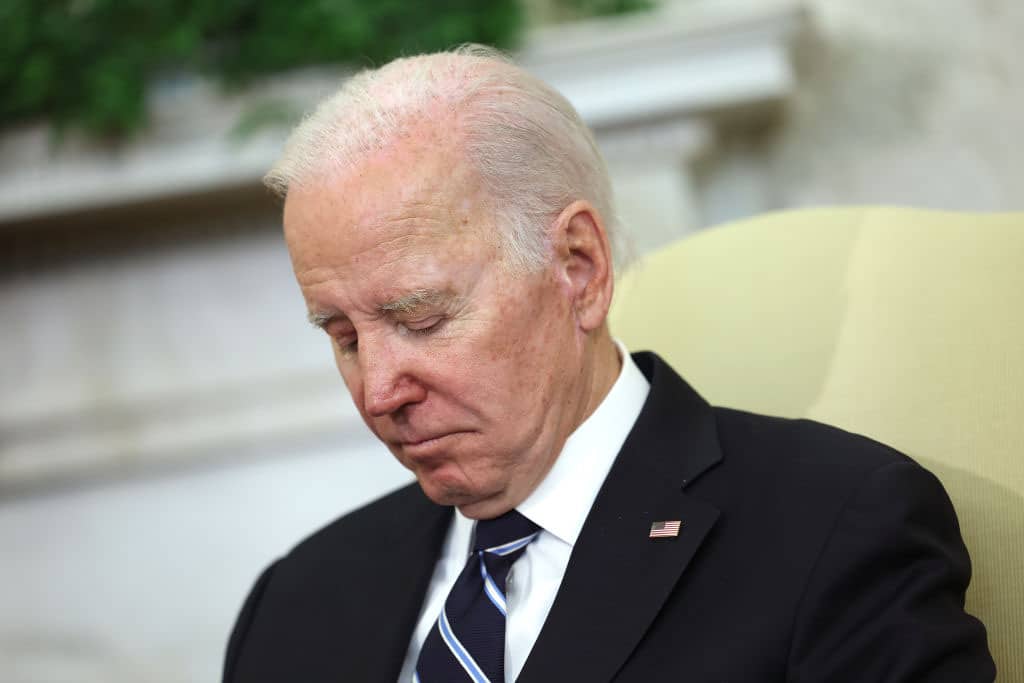
Joe Biden’s new year seemed to be off to such a good start. The Democrats’ better-than-expected showing in the November elections had quieted talk of a primary challenge to his reelection bid, the brawl among House Republicans to determine their new leader had created a contrast that elevated him in the eyes of voters, and he had begun to stake out centrist turf on immigration and other policy matters to position himself for the 2024 campaign.

But that was before the disclosure and subsequent controversy surrounding the classified documents from his vice presidency that have turned up in nonsecured locations. The furor will create all sorts of political problems for the president at just the time when it appeared that he was developing some post midterm momentum and he was establishing himself as a grown-up alternative to what many swing voters saw as disorganized and feckless GOP House revolutionaries.

Biden’s advisors have worked hard to highlight the distinctions between the president’s situation and that of his predecessor, who left the White House with a trove of sensitive information last January. Donald Trump had retained in his possession a much larger number of documents at Mar-a-Lago than Biden had in his possession and Biden has been much more cooperative in his dealings with legal authorities once this information was discovered. But Republicans have adroitly seized on the parallels between the two men.

An ongoing debate about the specifics of the two situations does Biden no favors: it overshadows his message about the economy, Ukraine and other topics that work to his benefit. Instead, the controversy traps him in an ongoing argument in which his strongest argument is that he was less irresponsible than Trump. 

The greatest damage caused by this uproar is that it undermines the central premise of Biden’s presidency. In a country that is essentially divided ideologically and politically, Biden’s most important promise in the 2020 campaign was his intention of restoring “normalcy” to the White House and to the country. Voters who were fatigued, frustrated or embarrassed by Trump’s antics could be reassured that Biden would restore a missing dignity to the Oval Office.

Biden’s core argument was one of competence. The hard-core Trump voters didn’t care: they were excited by their hero’s combative and politically incorrect manner. But the voters who decide elections ultimately turned to Biden less out of ideological conviction than a need for reliability and reassurance that adults would be in charge of the country again. They wanted a president with the experience and maturity to lead the nation forward in a less disruptive and dangerous way.

So it was not a coincidence that Biden’s first significant nosedive in the polls took place immediately following his administration’s botched withdrawal from Afghanistan during his first summer in office. Even though most Americans agreed with the president’s decision to leave, the manner in which the departure of U.S. troops was handled and the subsequent mass bloodshed caused this country’s voters to question whether Biden’s years in government had actually prepared him for the challenges of the presidency. While the easing of inflation (along with Trump’s ongoing controversies) has been the biggest contributor to Biden’s improved standing, his successful handling of the war in Ukraine has been of huge importance in restoring his credibility – and competence – in the eyes of the voters.

Now, that hard-earned reputation might be slipping away again. Biden has been greatly helped by the ongoing contrast that Trump provides him, but the news coverage of the January 6 investigations has subsided, at least for the time being, and the uproar over the Mar-a-Lago documents has been neutralized. So that advantage is murkier than it was in either 2020 or 2022.

Trump has rescued Biden before and he can certainly do it again. Right now, though, it appears that Biden is the one throwing a life preserver to his old nemesis.

Biden and his team need to figure out a way to get this behind them – and fast. But that is beginning to look less and less likely. Trump has rescued Biden before and he can certainly do it again. Right now, though, it appears that Biden is the one throwing a life preserver to his old nemesis, not the other way around.


Dan Schnur is a Professor at the University of California – Berkeley, USC and Pepperdine. Join Dan for his weekly webinar “Politics in the Time of Coronavirus” (www.lawac.org) on Tuesdays at 5 PM.

Biden’s Fumble Read More »

Tel Aviv Syndrome

Of all the great cities in which I have lived, only in Tel Aviv do I fully experience the sweet delusion of being freed from history. My most recent visit, in November 2022, centered around the launch of my Russian poetry collection “Stikhi iz aipada” (“Poems from the iPad”) at Babel Bookstore on Allenby Street, one of the main coordinates of Israel’s Russophone cultural life and, since the outbreak of the War in Ukraine, increasingly a publisher of Russian books in exile.

In the course of four very full days, I did research about my ancestor, the early Israeli writer Batya Kahana who wrote in Russian and published in Hebrew; purchased an Italian-made dress for my wife from an Iranian-born shopkeeper (a ritual); gorged on a conversation with my father’s first cousin David Sharir, a visual artist born in Tel Aviv in 1938 to immigrants from Ukraine; drank vodka with my close friend Maxim Krolik at an outdoor Ukrainian restaurant as we celebrated his deliverance from Putin’s Russia; and visited the dairy farm that the family of my maternal grandfather’s sister had started in the 1940s at Be’er Tuvia. I had only one day for the Tel Aviv version of dolce far niente, and this day resulted in an anthropological discovery.

On the late morning of that day I strolled to a coffee shop on Ben Yehuda, then cut across to the beach on Trumpeldor Street, thinking of the last words of the one-armed Shiva of Zionism who died while defending a Jewish settlement from an attack by an armed band from Jabal Amila in Southern Lebanon. “It’s sweet to die for one’s country.” Did the dying Joseph Trumpeldor utter a tongue-twisting Russian damnation to the enemies of Israel or a Horace-infused line in Hebrew? It was Erev Shabbat on the Tel Aviv waterfront. I paid the machine and handed a ticket for a beach chair to a man who spoke no English and practiced strong gestural Hebrew. Another Russian-speaker, a tall tanned fellow in skimpy shorts, appropriately asked me if I was from “Ukraine or something,” and was amused to learn that I was from Moscow by way of thirty-five years in New England. He claimed to know the Moscow neighborhood where I grew up near the Kurchatov Institute of Atomic Energy. The idler told me that he went swimming every morning and that life in Tel Aviv was “honey cake.”

All around me, strands of Russian speech interwove with Hebrew, French and English, forming a tetralingual braid of Tel Aviv locals, tourists and recent repatriates. Easily one fourth of the November beachgoers and definitely a majority of the autumnal swimmers were Russian speakers, although their accents betrayed not only members of the Moscow intelligentsia (from the ranks of those who only left when Putin and his henchmen started pumping the last gallons of freedom from Russia’s atmosphere) but also refugees from war-ravaged Ukraine. Prior to fleeing home, some of the Ukrainian repatriates had learned for the first time what Israelis live with: the sound of missiles of hate and despair. And yet the afternoon in Tel Aviv was so peaceful and serene that it seemed that nothing would ever harm this young city and these “Russian” and “Ukrainian” escapees basking in the November sun like prodigal children of the Levant.

It was then, in the midst of this happy, unthreatening place, the term “Tel Aviv syndrome” entered my mind, and I’ve since been finding more and more evidence of its validity. Did I invent the term? Perhaps I did, but I cannot be sure. An extensive literature review revealed no evidence of the term’s prior existence. Features of “Tel Aviv syndrome” include: hedonism, denialism (or is it denihilism?), gourmandism, beachfrontism, casual athleticism, and nonmilitant secularism. The false if comforting sense of carpediemism, characteristic of those with Tel Aviv syndrome, may be defined both oppositionally—in contrast to the amply-described Jerusalem syndrome—and as essential to the city and its aura.

Psychiatrists and cultural historians have been aware of Jerusalem syndrome for quite some time. The term refers to obsessive and/or delusional behavior associated with visiting Jerusalem and experiencing its special hyperreligious and densely layered historical atmosphere. In “Jerusalem Syndrome,” a 2000 case report published in The British Journal of Psychiatry, Dr. Yair Bar-El and colleagues state that “since 1980, Jerusalem’s psychiatrists have encountered an ever-increasing number of tourists who, upon arriving in Jerusalem, suffer psychotic decompensation.” In “Jerusalemski Sindrom,” a more recent article published in Psychiatria Polska, Drs. Katarzyna Prochwitz and Artur Sobczyk define the syndrome as “an acute psychotic state observed in tourists and pilgrims who visit Jerusalem. The main symptom of this disorder is identification with a character from the Bible and exhibiting behaviors which seem to be typical for this character.” Dr. Bar-El et al. expected the number of those carrying Jerusalem syndrome to grow in the new millennium. The eleven months following the start of the War in Ukraine have amply corroborated their forecast while also throwing into sharper relief the prevalence of another urban Israeli syndrome.

I have become especially aware of the existential reality of Tel Aviv syndrome as the “emergency aliyah” has flooded the gates of Israel. My good colleague Mark Tolts of Hebrew University, a leading demographer of post-Soviet Jewishness, recently pointed me to the most current Israeli population data: As of December 2022, of the total of 73,000 repatriates, over 60,000 had come to Israel from Russia, Ukraine and Belarus. While the geography of the wartime olim is as diverse as Israel herself, and certainly encompasses the north with Haifa and Upper Galilee and the south with Ashdod and Ashkelon, the newly arrived, trend-setting “Russians” fall into Jerusalemites and Telavivians as they embody salient features of Jerusalem syndrome vs. Tel Aviv syndrome.

I have become especially aware of the existential reality of Tel Aviv syndrome as the “emergency aliyah” has flooded the gates of Israel.

I was hardly surprised when Alisa Nagrodskaya, a friend of my Soviet youth who came to Israel in 1990 from then the not yet un-re-renamed Leningrad and settled in Jerusalem, decided to riff on the subject of Jerusalem syndrome. Mother of twin girls completing their IDF service, a blogger with a following, and an inveterate Jerusalemite, on 24 May 2022 Nagrodskaya published a short and piquant Russian-language manual-cum-intro to her city’s gestalt. Since its publication on Facebook, Nagrodskaya’s explication of Jerusalem syndrome for the newly-arrived Russian speakers has received over 1000 likes and has been shared more than 50 times: “Well, the most important thing, perhaps, is that each denizen of Jerusalem is proudly wrapped in a plume of being slightly messed-up. And, truth be told, not always slightly. … Jerusalemites like difficult paths. … Material flashiness isn’t our thing. … One can’t for the life of it determine the status of our city based on clothes. … So if you’re weird and low-maintenance, our city joyfully awaits you” (my literal translation).

In Nagrodskaya’s presentation, Jerusalem’s viscous intensity is juxtaposed to Tel Aviv’s glitter, vanity and lightness. In her analysis, bearers of Russian culture would immediately recognize the trappings of the old St. Petersburg-Moscow rivalry—and here I speak as a product of both the Moscow lore and the St. Petersburg mythology. What Fyodor Dostoevsky wrote about the Venice of the North applies so well to Jerusalem: “the most abstract and deliberate city on earth”; “the most fantastical city.” In contrast, recall the opening chapters of “Anna Karenina” and think not just of Moscow but also of Tel Aviv. Dostoevsky’s greatest competitor, Leo Tolstoy, evoked the bustling yet cozy atmosphere of old Moscow, to which Levin ascends from his country estate. I keep imaging poor Levin driving in a pickup truck to Tel Aviv from a moshav in central Israel, hopeful as he is yet burdened by the fear of Kitty’s rejection.

Born to a Muscovite mother and a father from Leningrad (St. Petersburg), I’m familiar with the museumist atmosphere of St. Petersburg, an atmosphere that I reexperience while spending time in Jerusalem. But I also know the native Moscow vibe of being on the cutting edge and nonchalant about it, and when I return to Tel Aviv, I feel more and more like a former Muscovite regaining a home rather than a Bostonian losing one. Please don’t get me wrong: I love Jerusalem. I feel a sense of transcendent relief when I press my forehead to the Kotel, and this feeling is akin to what I used to experience while visiting family graves at the Preobrazhenskoye Jewish Cemetery in St. Petersburg. Still, it’s not in Jerusalem but in Tel Aviv that I retire in my brightest fantasies. Being here infallibly accords a sense of sudden and, perhaps, unjustified calm in view of history’s calamities. I call this condition “Tel Aviv syndrome.”


Maxim D. Shrayer is an author and a professor at Boston College. His recent books include “A Russian Immigrant: Three Novellas and “Of Politics and Pandemics.” Shrayer’s new memoir “Immigrant Baggage is forthcoming in 2023.

Tel Aviv Syndrome Read More »

Exhibition in Israel Presents Snapshot of 2022’s Best News Photographs

To read more articles from the Media Line, click here.

The Israeli-Palestinian conflict, clashes on the Temple Mount in Jerusalem, and far-right Israeli politician Itamar Ben-Gvir. These are some of the compelling winning photographs currently on display at the 19th annual World Press Photo and Local Testimony dual exhibitions at the Eretz Israel Museum in Tel Aviv.

Guy Aloni’s winning photograph of far-right Israeli politician Itamar Ben-Gvir, who heads the Otzma Yehudit party. (Courtesy)

Local Testimony, which features the works of Israel-based photographers, is being presented alongside the prestigious World Press Photo exhibition.

The works of about 100 artists are on display in the two shows, which present the cream of the crop of local and international photojournalism and documentary photography.

In addition to the most recent events in Israel, Local Testimony this year also decided to exhibit pictures from the ongoing war in Ukraine.

A woman holds a white cloth on a stick in Ukrainian city of Irpin on March 10, 2022 as people flee the cities of Irpin and Bucha from Russian forces. (Heidi Levine for The Washington Post)

“We felt that there was such a strong [connection] of what happens there to what happens here because of the big Russian and Ukrainian communities that live here and the Ukrainian refugees that arrived to Israel,” Dana Wohlfeiler-Lalkin, founder and manager of the World Press Photo and Local Testimony exhibits in Israel, told The Media Line.

Dana Wohlfeiler-Lalkin, founder and manager of the World Press Photo and Local Testimony exhibits in Israel. (Maya Margit/The Media Line)

Some of the photos on display, which were taken in war zones or in the midst of riots, demonstrate how photojournalists often find themselves on the frontlines of dangerous situations.

“As a photographer and as a photojournalist you’re exposed to a lot: a lot of conflicts, a lot of situations that are sometimes unbearable like terror attacks or war,” Yuval Tebol, a veteran photographer and lecturer at Hadassah Academic College in Jerusalem, told The Media Line. “I think that the importance of a documentary commitment is huge.”

A photographer who is being kept anonymous to protect their safety photographed protesters using slingshots and other improvised weapons to fight security forces in Myanmar. (The New York Times)

The Photo of the Year award for Local Testimony was given to a strikingly evocative picture taken by Itai Ron.

It shows young ultra-Orthodox men sitting in a tree during the funeral of ultra-Orthodox Jewish leader Rabbi Haim Kanievsky, who died earlier this year.

Photo of the Year for Local Testimony was awarded to Itai Ron, for this image showing ultra-Orthodox Jews at the funeral of Rabbi Haim Kanievsky. (Courtesy)

“You can see that it’s about much more than documenting the ultra-Orthodox Jews on the trees at that funeral,” Tebol said. “When you see photojournalists document a funeral or the [aftermath] of a terror attack, you can see the point of view of the photographer much closer than when you hear about it on the news.”

Local Testimony also includes documentary works, such as Eti Namir’s series showcasing the inner workings of a large veterinary hospital in Israel.

“For the past one and a half years I’ve been documenting the Beit Dagan University Veterinary Hospital, where they treat large animals,” Namir explained. “It’s not something people know enough about.”

Eti Namir’s ongoing documentary series depicts the inner workings of the Beit Dagan Veterinary Hospital. (Courtesy)

In parallel with Local Testimony, the World Press Photo touring exhibit presents the works of 24 of the world’s top photographers. This year’s winners were chosen by an independent jury that reviewed more than 64,820 photographs from 4,066 photographers in 130 countries.

Aboriginal people set strategic fires to manage the landscape and prevent out-of-control fires. (Matthew Abbott for National Geographic/Panos Pictures)

In addition to offering photojournalists a platform for their work, the exhibitions highlight the importance of press freedom by paying tribute to those that lost their lives on the job. According to Reporters Without Borders, 46 journalists were killed and another 488 imprisoned in 2021.

In a world that has become inundated with images, Wohlfeiler-Lalkin hopes that those visiting the exhibit will leave with a better understanding of the importance of the work carried out by photojournalists.

(Tal Heres)

“I want people to feel; I want people to get excited,” she said. “It’s not an easy exhibition. It’s an exhibition that actually asks you to take a look at some issues which are not easy.”

The World Press Photo and Local Testimony dual exhibitions will be on display at the Eretz Israel Museum in Tel Aviv until February 11.

Piraha women and children, standing next to their camp on the banks of the Maici River, watch drivers passing by on the Trans-Amazonian highway hoping to be given snacks or soft drinks. (Lalo de Almeida for Folha de São Paulo, Panos Pictures)

Exhibition in Israel Presents Snapshot of 2022’s Best News Photographs Read More »

20% of Americans Believe In At Least Six Antisemitic Tropes, ADL Report Says

The Anti-Defamation League (ADL) released a report on January 12 finding that 20% of Americans believe at least six antisemitic tropes.

That 20% figure was higher than the 11% figure the ADL found in 2019; additionally, the report found that 85% of Americans believe in at least one antisemitic trope, an increase from 61% in 2019. Such tropes included the belief that Jews are more loyal to Israel than the Unites States (39%), Jews stick together more than other Americans (70%), and that Jews have too much power in the world of business (26%). 

The report also found that 24% of Americans hold at least one anti-Israel sentiment; for instance, 40% of Americans believe that Israel’s treatment of the Palestinians is similar to how the Nazis treated the Jews, 24% don’t believe that Israel is a force for good in the world and 18% don’t feel comfortable being around a pro-Israel individual. Additionally, 21% of young Americans hold “significantly more anti-Israel sentiments” than older adults (11%).  

The report concluded that there was a “substantive correlation … between belief in anti-Jewish tropes and anti-Israel sentiment.”

ADL CEO Jonathan Greenblatt further discussed the organization’s research in a January 13 op-ed for The Hill, noting that belief in antisemitic tropes has “led to violence.” “The notion of Jewish control of government, for example, fueled the horrifying antisemitic attacks in Pittsburgh and Poway, Calif., as well as the hostage crisis that unfolded a year ago in Colleyville, Texas,” Greenblatt wrote.

He added toward the end of his op-ed that “antisemitism does not emanate from a single source and there is no magic wand that we can wave to stop it.” “We need leaders from all segments of society to speak out against it. And more than anything, leaders need to meet the occasion by showing a willingness not only to condemn the other side’s role in surging antisemitism, but their own as well,” Greenblatt wrote.

20% of Americans Believe In At Least Six Antisemitic Tropes, ADL Report Says Read More »

Hamas Video of Israeli Captive Is Attempt To Pressure Israel Toward Swap Deal

To read more articles from the Media Line, click here.

[Gaza] A video released by the Izz ad-Din al-Qassam Brigades, the military wing of Hamas, claiming to show Avera Mengistu, an Israeli citizen being held captive in the Gaza Strip since 2014, has sparked controversy over its timing and motivations.

The Prime Minister’s Office in Israel said hours after the video was made public early on Monday that the government is investing all of its resources to release the captives held in Gaza Strip, but it did not say that it had been able to verify the video’s authenticity.

The video was released on the same day as the swearing in of the new chief of staff of the Israel Defense Forces, Herzi Halevi. Hamas spokesperson Hazem Qassem told The Media Line that this was meant to tell Halevi “that, he must put this file on top of his priorities, given the failure of [former military chief Aviv] Kochavi to make any progress in this regard.”

Qassem accused Israel of thwarting all previous attempts to reach a prisoner exchange deal by being dishonest and not serious in its communications with Hamas.

The first message is to the Israeli community to say that Mengistu is alive and well, and that all allegations saying that he is mentally ill or injured are false ones, so they must move quickly in order to release him and the others

Gaza-based political analyst Hussam al-Dajani, a professor of political science at Ummah University in Gaza, believes that the published video carries several messages.

“The first message is to the Israeli community to say that Mengistu is alive and well, and that all allegations saying that he is mentally ill or injured are false ones, so they must move quickly in order to release him and the others,” Dajani told The Media Line.

Another message, according to Dajani, is related to the different ethnicities within the Israeli army.

“Hamas wanted to show Israelis that there is blatant racial discrimination, not only in the political administration, but even within the military institution itself,” he said.

Dajani told The Media Line that: “Mengistu is an Israeli soldier of Ethiopian origin, and the other soldier [Hisham al-Sayed], who is also being held by Hamas till this day… is of Arab origin, so their capture receives little attention. However, Gilad Shalit, an Israeli soldier of a European origin who was captured by Hamas in 2006, was released via a prisoner swap deal with Hamas” five years later.

Mengistu was exempted from mandatory military service after being found unfit; his family has said that he has struggled with mental illness. As an Arab citizen of Israel, al-Sayed has an automatic exemption from military service.

In June, Hamas published its first video of one of the Israeli captives, al-Sayed, who entered Gaza in April 2015 and has been held there since then by Hamas. The footage showed al-Sayed lying in bed and breathing through an oxygen mask.

Screen grab from handout video released by Izz ad-Din al-Qassam Brigades, the armed wing of Hamas, on June 28, 2022, shows Israeli hostage Hisham al-Sayed connected to a ventilator.

However, Hamas still refuses to disclose any information about the other two soldiers, Lt. Hadar Goldin and Staff Sgt. Oron Shaul, who were captured during the 2014 Israeli military offensive against Gaza, and whom Israel says are dead.

This ambiguity in uncovering the fate of the Israeli prisoners is a method that has been used by Hizbullah in the past, Gaza-based political analyst Mansour Abukrayyem, told The Media Line.

“Hizbullah did not disclose any information regarding the captured Israeli soldiers until Israel received them in coffins. Only at that moment Israel found out that it had been involved in a losing deal in which it exchanged the living for the dead. Therefore, Israel learned the lesson and is fully aware that this policy is not successful,” he said.

The current Netanyahu government is an extremist government that does not want any settlement with the Palestinians, neither in the West Bank nor in Gaza, and it certainly does not want any deal through which Hamas might obtain any political or moral victory, especially since Hamas’ demands are high

The current circumstances are completely unsuitable for reaching a prisoner exchange deal between Hamas and Israel that would be similar to the Shalit deal in 2011, according to Abukrayyem.

“The current Netanyahu government is an extremist government that does not want any settlement with the Palestinians, neither in the West Bank nor in Gaza, and it certainly does not want any deal through which Hamas might obtain any political or moral victory, especially since Hamas’ demands are high,” he said.

Israel does not want the Shalit deal scenario to be repeated, Abukrayyem claims, explaining that “Hamas gained great popularity and political victory at the time by this [Shalit] prisoner swap deal. Moreover, Israel is sure that the other two soldiers are dead thus the power cards of Hamas are completely different compared to those of the Shalit deal who was a soldier and alive.”

The recent video of Mengistu will have little influence on the progress of the prisoner swap deal “because Israel knows already that he [Mengistu] is not dead. By this video, Hamas aimed to incite Israeli public opinion and move on with the prisoners’ cause to pressure towards reaching a satisfactory exchange deal,” Abukrayyem concluded.

Hamas Video of Israeli Captive Is Attempt To Pressure Israel Toward Swap Deal Read More »

Do You Have the Courage to Listen?

Listening is more difficult than it sounds. As individuals and as communities, we’re usually bad at it. We skim news stories for headlines or highlights, or we rant on social media and over meals. We dismiss the cries of pain from our marginalized siblings. We form hasty judgments about people who don’t match our expected standards of behavior.

Here in Los Angeles, hate violence and incidents increased by 23% in 2021, especially targeting Black, Asian, Jewish and trans folks. As identity-based hatred continues to burn in communities across the U.S., leading to violence and grief, it feels easier to turn inward, to keep to our respective tribes. And then, when we actually want to make meaningful change to repair the harm of racism, anti-Black hate speech and violence, antisemitism, Islamophobia, anti-LGBTQ rhetoric or any of the other awful realities that tear at our social fabric, we find ourselves filled with passion and drive but lacking the allies and connections that we need to put it to use.

For each of the writers of this piece, a Black Muslim man and a Japanese-American Jewish woman, identity is key. In 2010, we participated in a professional fellowship program run by NewGround: A Muslim-Jewish Partnership for Change. The fellowship trains a group of Muslim and Jewish leaders from LA to strengthen their listening, facilitation and storytelling skills over a nine-month program.

Sometimes it’s as simple as telling the other person what you heard and asking if you got it right. Once people feel heard, it gives them the capacity to hear you as well. “Did I get it right?” leaves space to be corrected; the speaker can feel that they’ve been truly heard the way they want to be—a rare gift we can offer each other. NewGround’s methodology doesn’t shy away from the hard stuff; instead, they dive into the most tangled and painful parts of our lives, as well as the most beautiful and joyful parts, that drive our decisions and actions.

Beyond the skills of listening and facilitation, NewGround focuses on the power of relationships to effect change. The program trained us to think about our circles of influence, the networks we move in and how we can bring those together in powerful ways. As we work together, our differences may bring us into conflict with the very people we need to work alongside. Conflict is inevitable, but being stuck is a choice.

We got to know each other deeply during the fellowship, learning the texture and complexity of our experiences and stories. We learned how to slow down our conversations, to understand why we responded with powerful emotions to trigger words, and how to lean on the relationships and trust we had built before reacting or making assumptions. We felt transformed, learning so much through both inter- and intra-faith dialogue and relationship building.

We’ve maintained those relationships in the years since. We hit the streets to drive voter engagement. Maya showed up and brought her community to support I.L.M. Foundation’s Humanitarian Day, a project that brings a host of organizations together to serve LA’s unhoused residents. Both of our faith traditions emphasize social responsibility, through the Jewish value of tikkun olam and the Muslim teaching in Surah 49:13. We use our power to help build peace, one small step at a time.

Umar says that NewGround’s model of dialogue is like open-heart surgery for communities: profoundly vulnerable, sometimes necessary to save a life, and an essential step on the long road to healing. When we have conversations that cut so deeply to the core of who we are, it can be so hard that we want to walk away from the table. Polarization is a vicious cycle: The more we argue, the further apart we drift and the more we find things to argue about. And as we’ve been so painfully reminded, again and again, as polarization festers it can escalate into physical violence. But berating each other doesn’t fix anything. Cutting through polarization requires compassion.

After the first year of the COVID pandemic, the rising cry for justice for Black Americans made it clear that we needed this kind of intervention. NewGround created the Courage Accelerator program, inviting a select number of alumni from their fellowship program to deepen our skills and focus our dialogue on confronting racism in our own religious communities. Both of us were eager to participate.

It was exactly what we needed. Talking about individual and institutional racism is really hard. Each of us has a different window of experience. For some, like Umar, that experience was direct and raw. For others, like Maya, it was indirect but very close to home. We dove into stories, because stories are more powerful than statistics when it comes to driving change. By exercising our empathy, we moved from listening into action, opening space for these incredibly challenging conversations in our communities.

At one point when we were talking about intervening in conversations on racism and bias, Umar commented that we are “holy infiltrators.” We shouldn’t sit on our training, waiting for change to happen. We can make it happen, one small step at a time. Story by story, surgery by surgery, conversation by conversation. It’s slow, and it’s often painful. But it’s a crucial step on the long road to healing. As Dr. Martin Luther King Jr. said, “Men often hate each other because they fear each other; they fear each other because they don’t know each other; they don’t know each other because they can not communicate; they can not communicate because they are separated.” We hope you’ll take a moment today to think about conversations that require your courage, and will consider what voices need your ears, your hands, your heart.

Do You Have the Courage to Listen? Read More »

Pro-Palestinian Students Chant “Intifada Revolution!” at U Mich

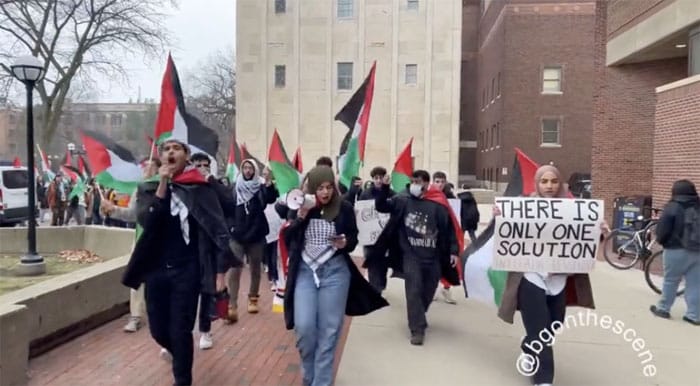
Several pro-Palestinian students at the University of Michigan chanted “intifada” in a video taken on January 12.

The video shows the students saying, “There is only solution: intifada revolution!” and “Long live the intifada!” as they walk through campus. The Algemeiner and Washington Free Beacon reported that the students belong to a group called Students Allied for Fairness and Equality (SAFE), an affiliate of Students for Justice in Palestine (SJP). They were protesting a speaking event on campus by Vice President Kamala Harris, as the students were accusing her of “committing genocide.” Harris was there to discuss climate change.

Wolverine for Israel, which describes itself as a bipartisan campus organization aimed at enhancing the alliance between the United States and Israel, wrote in an Instagram post that they disagree with Israeli National Security Minister Itamar Ben-Gvir’s law banning the public display of Palestinian flags. However, the pro-Israel student group argued that SAFE’s intifada chants amounted to “a call to violence against Israelis and the Jewish state.” “As we have seen over the last year, such violent rhetoric has led to the brutalizing of Jews in the United States as well,” Wolverine for Israel wrote. “This direct call for violence directly affects the lives of many innocent Israelis and is not the solution for peace.”

Others on Twitter had similar reactions to the intifada chants.

“The first and second intifadas were waves of murderous violence that killed and maimed thousands of Israeli Jews,” writer Avi Mayer tweeted. “Calls for an intifada on an American college campus are a direct threat of violence against Jewish students. Authorities must investigate.”

Alums for Campus Fairness said in a statement that they were “appalled” by the intifada chants. “It is long past due that the University of Michigan’s President Santa Ono and the administration takes decisive and immediate action against such deeply appalling antisemitic protests and actions,” they said. “As the unified alumni voice against antisemitism, we hope that the University of Michigan will work diligently to counter antisemitism on campus.”

Columnist Jeff Jacoby tweeted that the intifada chants were essentially expressions of  “support of murdering Israelis and Jews who support Israel.” “Imagine the roar of outrage if these were racists calling to lynch people of color,” he wrote. “Where is the outrage at calls to lynch Jews?”

Aviva Klompas, a former speechwriter for Israel at the United Nations, similarly tweeted that the students were “calling for the murder of Jews. And not enough people think that’s freakin outrageous.”

The university and SAFE did not respond to the Journal’s requests for comment.

Pro-Palestinian Students Chant “Intifada Revolution!” at U Mich Read More »

Out and Proud ft. Eliad Cohen

Marla and Libby start of this week’s episode with their usual updates, They discuss bad first dates and dating multiple people at once, before welcoming their wonderful guest, Eliad Cohen. Eliad shares about how he got his start in modeling and what he learned from his experiences in the IDF (Israeli Defense Force). He also discusses with the girls his coming out journey and how he dealt with the realization that he was gay. Eliad also discusses how he navigates being a part of both the Jewish and gay community. He shares some really meaningful experiences that helped him see how impactful his work can be. The three end with a game of Hot or Not, an impromptu game of “Jeans or No”, and “Cute or Cringe.”

Out and Proud ft. Eliad Cohen Read More »

Who’s Afraid of the West?

Natalie Wynn, known by her YouTube channel name as ContraPoints, is an internet personality as intelligent as she is hilarious. A few times a year (if we’re lucky), Wynn publishes a feature-film length video essay online, impressively produced with costumes and sets, on a controversial topic she — and presumably her audience — is obsessed with. Such topics have included envy, addiction, J.K. Rowling, beauty and capitalism. But one ContraPoints video I am routinely drawn back to above the others is dedicated to “the west,” more specifically to the term itself, which is often used but seldom understood. As a politically involved new immigrant to Israel, frequently immersed in conversations surrounding Jewish identity, religion, governance and conflict, the notion of “the west” is something I am confronted with daily. And since Israel’s recent election, it feels like something I read about on an hourly basis.  

But what does the term really mean, and what are its implications — especially when talking about Israel?

“It’s easy to take for granted that there is a historically continuous, clearly defined thing called western civilization that starts in ancient Athens and flourishes in our own era,” says Wynn. She continues: “But this is really just a story constructed retrospectively by modern people for particular purposes.” In other words, one’s own definition of “the west” usually depends on how they themselves would like it to be characterized depending on their political ideology. For example, a right-wing populist may think of the west as civilizations made up predominantly of white Christians and will use the term as a bludgeon against immigrants and refugees who come from non-white, non-Christian countries. An academic might think of the west as any society that continues Greco-Roman traditions of democracy, whereas a philosopher might think of the west as that which rises from a specifically secular observation of the world. A classical liberal might think the west is comprised of societies that institutionally protect minorities both ethnic and religious, whereas a leftist may regard the west primarily as a vehicle of colonialism and exploitation.  

The truth is, that all of these definitions and none of these definitions are correct because the notion of the west is malleable and subjective. Even ideas that come from irrefutably western places like 19th-century Germany or France are often in stark contradiction with each other: communism vs. capitalism, civic vs. ethnic nationalism, democracy vs. fascism. Think of it this way: It can be argued that Adolf Hitler didn’t necessarily betray western ideals by killing six million Jews, considering that the reactionary nationalism that gave birth to the Third Reich was fundamentally a child of western thinking. Karl Marx didn’t betray the values of the west by advocating for a worker’s revolution against the propertied class, because Marx’s ideas were rooted in western academic tradition. Both the neo-Nazi and the progressive professor are correct in their characterizations of western civilization because it has, at one point or another, championed their own worldview. 

Now, zoom into Israel, year 2023. “The west” is often the start of an argument between the Jewish state’s many factions. 

First, the west is sometimes portrayed by those who fall on the more religious and right-wing side of the spectrum as a boogeyman that has come to chip away at the Jewish identity of both the individual Israeli and the State of Israel, an agent of assimilation, the Hellenistic force permeating Judea in our modern era. Rabbi Yishai Fleisher, a Hebron local who advocates for continued Jewish settlement in the West Bank and a more traditionally religious society within Israel, told The Daily Beast, “I know how to handle problems in a Semitic manner, not necessarily in a western manner, and to understand that sometimes western ideas — including Jewish leftist ideas — are actually colonial ideas.” He continues: “For example, the two-state solution: That is absolutely a western, colonial model.”  

Rabbi Fleisher is a supporter of Rabbi Yehuda HaKohen, a charismatic speaker gaining traction in young Diaspora circles for advocating continued Jewish settlement from the river to the sea and the further entrenchment of spirituality within Israel proper. After Israel’s election in November, HaKohen decried “Israel’s westernized Liberal-Zionist ruling class that is primarily concerned with the material well-being of the Jewish people (security, economy, diplomacy, etc.) but maintains a very European sense of national identity while remaining largely estranged from the ancient values and traditions of Am Yisrael.”  

These characters advocate for policies that are considered ultra-nationalist, yet rail against the west in presenting their ideas. In contrast, many both in Israel and the United States support the very same proposals but make use of “the west” as a positive, and not a negative. Some argue that the settlements of the West Bank are a bulwark of the west against an Islamic caliphate stretching all the way from Tel Aviv to Kabul. And on social issues, conservative politicians in the United States cite Jewish tradition as a foundation of the west, which in their minds rests upon the “Judeo-Christian values” found in the Hebrew Bible. Politicians on both the left and right may justify their support for Israel because of the “shared values” between Israel and the United States and their “shared vision for democracy,” as the State Department notes.  

On the other side of the aisle, “the west” is utilized just as often. The Israeli mainstream left, which opposes right-wing policies in the West Bank and favors secularism over Halakha in the public square, marches toward a vision of Israel that is a European-style western country, a “Vienna on the Mediterranean,” as Theodor Herzl envisioned it. After the most recent election, this once dominant Israeli vision appears to be slipping away. In contrast, those on the more fringe-left in Israel and in the Diaspora regard Israel as already the embodiment of the west, only proven by the most recent elections. In their (often antisemitic) view, Zionism is the poster child for the west, an instrument of colonialism and dispossession. Palestinian intellectual Edward Said famously wrote of Zionism in 1979: “There is an unmistakable coincidence between the experiences of Arab Palestinians at the hands of Zionism and the experiences of those black, yellow, and brown people who were described as inferior and subhuman by 19th-century imperialists.”

If one thing can be learned from all these observations, it’s that “the west” is no longer a useful term in discussions about Israel.

If one thing can be learned from all these observations, it’s that “the west” is no longer a useful term in discussions about Israel. The idea is too subjective, too open to interpretation, and too revealing of political priors that might as well be said without needless obfuscations. If the idea of “the west” is so flimsy that it can be used to buttress anyone and everyone’s argument, it becomes tedious. If you want one-state or two-state, say it. If you want the Rabbinate in charge of more state affairs or the start of civil marriage and the expansion of public transportation on Shabbat, say it. There is no need to bring up a term with a definition hardly ever agreed upon.  

At the end of her video essay, Wynn provocatively proposes the abolition of the concept of the west in its entirety. “We should get rid of it altogether,” she states forthrightly, “and adopt a more cosmopolitan understanding of ourselves and acknowledge that the world is too complicated to reduce to simple us and them binaries.” Living in Israel for only four months has led me to agree with her.


Blake Flayton is the New Media Director and columnist for the Jewish Journal.

Who’s Afraid of the West? Read More »

Learning the Truth About the Court

It was a remarkable educational moment with regard to the true reality of Israel’s Supreme Court: Just a few months after completing her tenure as the President of the Court, the Hon. Dorit Beinisch paid a visit to California. I was a part of a small group of rabbis from across the community the local Israeli Consulate invited to meet with her. With not many other rabbis in attendance, it presented an opportunity for personal interaction.

After the formal presentation, I approached the Justice, quietly asking her, “Why did you invalidate the Tal Law?” Some years earlier, Tzvi Tal, a distinguished Orthodox Israeli Supreme Court Justice, crafted the “Tal Law.” Like many laws, it was a political compromise, attempting to find a middle ground in the continuous issue of Yeshiva students serving in the IDF by creating an avenue to mainstream more students to the army and work. During the last months of her tenure as President of the Court, Chief Justice in the American parlance, Beinisch led the court in invalidating the Tal Law. 

This pushed Israel into a major political conflict, and was a catalyst for the fall of the government. Officially, the court invalidated the law based on their version of “equality,” an ideal that is lofty but not always wise. Their ruling was a result of a left-wing group who argued that it was not fair that some serve in the IDF and others do not. While this is a persuasive argument, the real question is how we create societal change in the Haredi community. Will the sledgehammer of judicial fiat set back the goal of integration? If you follow the numbers, that is exactly what has happened since the Beinisch ruling — fewer Haredim are joining the army. (Personally, I attended a Chabad Yeshiva that supported serving in the IDF. The majority of students received deferments during their studies and then joined the army later.)

I wondered what kind of legal reasoning Justice Beinisch would give me. I was astonished with her simplistic yet telling answer. “We made the ruling because it was not working.” In other words, according to her assessment, the Tal Law was not successful in creating a larger integration of Yeshiva students to the Army and society, so she struck it down. I remained stoic, respectful, not revealing my astonishment.

In a moment of emotional honesty, she had revealed her inner thoughts. She didn’t like what was going on; the Yeshiva students were not moving fast enough along the road to participating in the army or working. She was going to give them a push. There is a place for this kind of assessment in a democracy, but it’s in the Knesset. While I said nothing, I recalled the words of the U.S. Supreme Justice that I had once heard, “It is not our job to change the law. If you want to, cross the street and have congress vote a new law.”

In Washington, the Supreme Court and the Congress are just across the street. The same is true in Jerusalem. The role of the legislative body is to deliberate, find compromise and solutions. The role of the court is to evaluate if the legislature has acted callously and trampled on the rights of another, or broken the law. If Beinisch would have given me a legal argument, then one could evaluate if it had merit or not. But her true reason for the ruling had nothing to do with law. “It was not working.” I wondered why Beinisch didn’t resign her position in the court, and run for the Knesset.

Israelis have been watching the court slide from being a bastion of justice to a culture of leftist legal supremacy. The seeds of the present crisis go back to the original establishment of the court, when Justice Minister Pinchas Rosen blocked the appointment of Gad Frumkin. He had been the longest serving jurist in Palestine and a member of the British Mandate Supreme Court. Rosen rejected him because he was not a Mapai (Labor Party) supporter. Ever since then it’s been “one friend brings another” until Aharon Barak. He propelled the court to a point where leftist activism is its culture. Yes, there will be token religious or conservative Justices like Tzvi Tal or Menachem Alon. Both confided to me in separate conversations that they felt at odds with dominant ideology in the court.

Cases can be brought even if you have no standing or relevance to the case. The court has used the concept of “reasonableness” — in other words “we don’t think that’s a good idea” — and then ordered government ministries to change their policies or even dictating to the military because the justices on the court thought they were a better judge of policy. No American court uses these guidelines; clearly it’s a case of judicial overreach. 

Judaical reform is essential for Israel to remain a vibrant democracy. Just one segment of society, the liberal elites, cannot continue to impose their worldview. They claim that modifying the present legal systems will “endanger democracy,” which is just a way of saying, “the law must be my way, otherwise it’s not democracy.”

One also has to wonder why some U.S. liberal Jewish groups have been lobbying against any reform. Would they agree with a U.S. court that operated like one in Israel? Would they support the Conservative-leaning U.S. Supreme Court selecting its successors? The Israeli justices have used the court repeatedly to impose their beliefs on Israeli society. When the city of Afula decided that just one of the many concerts they fund will be for Haredim with separate seating, the New Israel Fund supported the case to ban it. NIF and similar groups have skillfully brought many cases, using judicial fiat to enforce their views. With a balanced court, that will be challenging. Are they really concerned for democracy, or do they want to protect the court so it can advance their political goals that they cannot win in the ballot box?

This issue must be approached with delicacy and serious deliberation. Clearly the methodology of selection judges must be modified. The court should only judge cases where the litigants have standing. While consideration should be made for an override clause, in my personal view, this should be carefully evaluated to ensure that it not be abused. Judicial reform is essential in Israel. But it must be done with careful deliberation — a scalpel is needed, not an axe.

A society with people of diverse viewpoints — and as we know most Israelis have strong opinions — must find a way to coexist. That comes with political compromise and respect for the person with whom you do not agree. 

A society with people of diverse viewpoints — and as we know most Israelis have strong opinions — must find a way to coexist. That comes with political compromise and respect for the person with whom you do not agree. As the Sixth Lubavitcher Rebbe, Rabbi Joseph Isaac Schneerson, wrote to a group of Yeshiva students, “You should spread Judaism in a way of peace, you should seek the good in another and the weaknesses in yourself.” At the same time, a fair court is essential to help the society strike that balance. It must be a lighthouse of justice and evenhandedness to ensure the rights of all Israelis, despite their differences.


Rabbi David Eliezrie is the president of the Rabbinical Council of Orange County. His email is rabbi@ocjewish.com. 

Learning the Truth About the Court Read More »