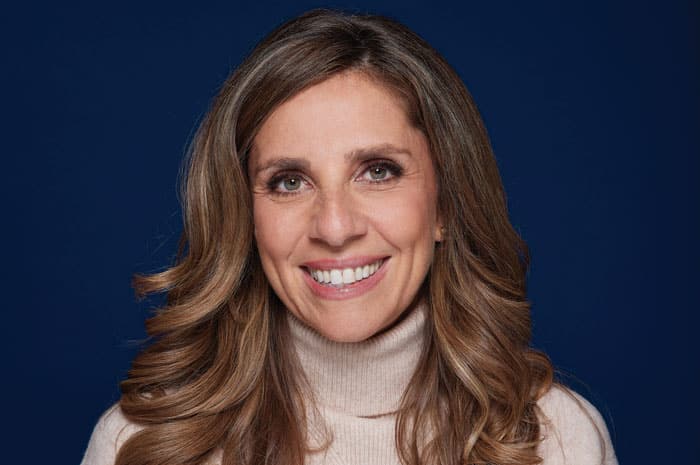
Nicola Mendelsohn: An Observant Jewish Leader at the World’s Largest Social Media Platform
When Nicola Mendelsohn moved to New York City over a year ago, the first thing she did was go to The Jewish Museum and pick up some Judaica for her new home.
“I bought everything I needed to make Shabbos,” she said. “I got my candlesticks there and I asked for recommendations for kosher food. Judaism is really at the heart of everything I do.”
Mendelsohn moved to NYC to work for the newly formed Meta — previously Facebook. She’d been working at Facebook as the vice president for Europe, the Middle East and Africa since 2013, but was now taking on a new role as Vice President of the Global Business Group at Meta, which includes Facebook, Instagram and WhatsApp. In her role, she helps businesses on these platforms find new audiences, gain more exposure and build growth strategies.
“In the days before Facebook and Instagram, if you wanted to open a business, you needed cash to do it,” she said. “There were so many great ideas and amazing businesses that never could have happened because there were so many barriers. Today, all you need is a good idea. Then, you can create a Facebook page or an Instagram and sell directly on them. We’ve made it easier.”
Mendelsohn recently met with the owners of Economy Candy, a third generation, family-run Jewish business and the oldest retail candy shop in NYC. She interviewed the owners on her Instagram Live series, and they told her they’ve been around for 85 years and never used advertising.
“Over the pandemic, when everything shut down, they had to find a way to connect to and reach people,” she said.
Economy Candy turned to Instagram, where the store now has nearly 30,000 followers.
“We can create new relevancy and audiences for businesses that are older as well,” Mendelsohn said.
Mendelsohn is a native of Manchester, England, and the daughter of kosher caterers. She’s always been actively involved in Jewish life.
“I grew up in an Orthodox home. It’s my identity and motivates me in my day-to-day work.”
“I grew up in an Orthodox home,” she said. “It’s my identity and motivates me in my day-to-day work.”
Mendelsohn worked in advertising for two decades and became the first woman to be president of the IPA, the advertising industry trade body. She was also awarded a Commander of the British Empire (CBE), the highest-ranking Order of the British Empire award, aside from damehood or knighthood. Other CBE recipients include Stephen Hawking, Harold Pinter and Helena Bonham Carter.
Throughout her time at Meta and Facebook, Mendelsohn has openly expressed her Jewish values — and the company has been receptive to them. For instance, there are groups at Meta including Jews@, Black@ and Women@ for Jewish, Black and female employees there.
“Meta is a company that really encourages people to bring their whole selves to work,” she said. “I’m proud of our Jewish community at Meta. I hope to strengthen it and foster allyship with other groups too.”
When Mendelsohn first started at Facebook 10 years ago, she was able to visit Tel Aviv, where Facebook was opening its first research and development center in Israel, and meet with Shimon Peres.
“I’ll never forget: When I met President Peres, he said, ‘Nicola, we used to be the people of the book, and now we’re the people of Facebook.’”
“I’ll never forget: When I met President Peres, he said, ‘Nicola, we used to be the people of the book, and now we’re the people of Facebook,’” she said.
There was recently a Hanukkah celebration in the office, and during Sukkot, they had a sukkah at Hudson Yards, where Meta’s offices are located. There was also a session on Jewish learning in the digital age, which fittingly took place in the Metaverse. Meta brought a delegation to March of the Living last year as well.
“I’m really proud of our ongoing work here to support organizations to ensure ‘never again,’” Mendelsohn said.
One of the things that Meta does is remove antisemitic and hateful posts as well as provide users with credible information about the Holocaust. In 2020, Meta announced it was updating its hate speech policy to prohibit the denial or distortion of the Holocaust. According to Mendelsohn, Meta has worked with groups like World Jewish Congress, the American Jewish Committee and the Simon Wiesenthal Center to combat the hate.
“We have zero tolerance for any form of hate on our platforms,” she said.
Still, the hate slips through. One year after the ban, the Anti-Defamation League criticized Facebook in an article on its website for keeping up nine troubling posts about the Holocaust. Facebook had only responded to one that said the Holocaust was a fraud and didn’t take it down because it wasn’t deemed hate speech. After the ADL posted about it, Facebook then removed all nine posts.
In August of 2021, the Center for Countering Digital Hatred (CCDH) had gathered more than 700,000 posts that contained “anti-Jewish hatred” on social media; Facebook was the worst performer when it came to taking action on these posts, failing to act on 89% of them.
According to Mendelsohn, Meta is taking this very seriously. Of the 70,000 employees at Meta, more than 40,000 work on safety and security on the platforms.
“It speaks to how important we hold safety and security to be,” she said. “When people come on to our platforms, we want them to have good experiences.”
Meta uses deep machine learning and AI to find and reduce the prevalence of hate speech and remove it when it violates the terms. Employees who speak over 70 languages work around the clock on flagging and removing problematic posts, making Meta the largest global independent fact-checking platform.
“For every 10,000 views of content, only about two views are classified as hate speech. It’s still two too many.”
“For every 10,000 views of content, only about two views are classified as hate speech,” Mendelsohn said. “It’s still two too many.”
Mendelsohn has navigated her prominent role, and being a wife and mother of four children, while battling cancer. In 2016, she was diagnosed with a rare and incurable form of blood cancer, follicular lymphoma, which is a non-Hodgkin lymphoma. It’s a slow-growing cancer that can show up in bone marrow, organs or lymph nodes, and only 3.5 people in 100,000 people have it.
Follicular lymphoma is more likely to appear in people ages 65 and older, but Mendelsohn was only in her 40s when she was diagnosed. She received chemotherapy and immunotherapy treatments and said she is “very pleased with the results,” but the disease will never go away. That is why she chooses to “live every day to the fullest.”
Once Mendelsohn went through treatment, she was inspired to help others diagnosed with the disease, especially because there is so little information about it. She founded The Follicular Lymphoma Foundation (FLF), which provides insights on follicular lymphoma, fundraises to find a cure, and runs the largest global online community for people with the disease on Facebook. Currently, Mendelsohn’s group has 10,000 members. The FLF had its first international all-day summit on January 11 in Tel Aviv; experts gathered to discuss the disease at Azrieli Sarona Tower.
“The summit is really the first significant step towards delivering on our mission to find a cure … and find it fast,” said Mendelsohn.
Looking to the future, Mendelsohn wants to keep pushing on, hoping to find a cure for follicular lymphoma in her lifetime, or at least in her children’s lifetime. At Meta, she’s excited to keep expanding her Jewish community and support her employees and the businesses she serves.
“I want to ensure people here are doing the best work of their careers and saying, ‘This is the place where I learned the most,’” she said. “I’m excited about the ongoing opportunity to support businesses and help them innovate and grow.”
As for her personal life? That’s easy, she said.
“Since I’m a mom of four, my goal is to be a cool grandma. That’s what matters. I want to sit around the table during the chagim and see the generations coming after me. That’s my hope.”