fbpx

December 21, 2022

Illuminating Comments During Hanukkah

When you are living in the only house in your street not illuminated at Christmastide
but on Hanukkah did not light a menorah,
it seems your shared identity with goyim—though you may be too polite to use the word—you have denied,

while of your Jewish one ignobly an ignorer.

In Israel many place menorahs, — more accurately — hanukkiyot, outside
their homes so that all passers-by can see
the lights some cover with clear glass in what become “glass houses,” choosing not to hide

what gives them all on Hanukkah great pride, Jewish identity.

Discussing Steven Spielberg’s movie “The Fabelmans” in the 12/16/22 NYT, (“Contemplating a Canon of Jewish American Films”) Esther Zuckerman writes:

Throughout his career Spielberg has constructed images that are synonymous with Americana — from Indiana Jones to suburban kids on bikes in “E.T.” In “The Fabelmans” he uses some of those same tricks. But the Fabelmans are not like every other all-American family. Their house is the only dark one on the block in New Jersey at Christmas time.

Gershon Hepner is a poet who has written over 25,000 poems on subjects ranging from music to literature, politics to Torah. He grew up in England and moved to Los Angeles in 1976. Using his varied interests and experiences, he has authored dozens of papers in medical and academic journals, and authored “Legal Friction: Law, Narrative, and Identity Politics in Biblical Israel.” He can be reached at gershonhepner@gmail.com.

Illuminating Comments During Hanukkah Read More »

Making the Acacia Great Again

Tamar Kafri was surveying the Gilat plant nursery of the JNF (Jewish National Fund, HaKeren HaKayemet LeYisrael) when she suddenly encountered a ghost from the past: a gay acacia tree. This unique species of acacia – with fragrant blossoms that seem as if someone replaced the grains on a stalk with small brushes, and with flat, wide pods as fruit – does not grow in the wild in Israel, and was last seen in nature next to the borders of the country in the 1960s. Yet, to Kafri’s surprise, the impressive tree was now before her eyes, alive and thriving.

Kafri, an agronomist with a master’s degree in ecology and a climate entrepreneur, was surveying the nursery for a study, the results of which were published in Forest (Ya’ar), a journal published by the JNF. The paper recommends that the ecosystem of the Negev and Aravah could be rehabilitated if it was planted with acacia trees from species not common nowadays in Israel.

Tamar Kafri. Photo by Yael Shemesh Aharon

According to Kafri, who conducted the survey as part of a JNF course training “foresters of the future”, acacias have an important role in the desert ecosystem. Still, the diversity of its species is in decline and their condition has taken a turn for the worse. Despite their high durability, the last 50 years have seen a shrinkage of over 60% of the number of acacia trees growing in the Aravah, due to tillage for agriculture, road building that diverts the streams flowing in the rainy season, and long periods of drought.

As a result, many species that live next to the trees are harmed: among the animals that have a close connection to the acacias, you can also find rare species, such as the Aravah gazelle, the desert hedgehog, and the Pharaoh eagle-owl. “Not many perennial plants grow in the desert, and the acacia provides shelter from the heat and nectar and produces a lot of nitrogen necessary for other plants growing next to it,” says Kafri. “The tree serves as an oasis for more than 50 species of plants and wildlife.”

What We Learned from the Pines

Despite its significance, there are only 4 species of acacia that are common in the Negev and Aravah, and a greater variety of species is desired, in a way that will help the ecosystem. “We want to avoid a situation where ecosystems are too homogeneous – so that if any one species of the tree is attacked by a harmful species, the entire ecosystem doesn’t go down with it,” explains Kafri.

An example of the importance of diversity in trees is the case of the Israel pine bast scale, an invasive species of insects, that apparently arrived in Israel with imported Turkish pines. In the 1970s, this species attacked vast areas of forest, and many trees of the Jerusalem pine species were damaged. This outbreak was one of the reasons the JNF changed its mode of operation and started planting forests with multiple species of trees, instead of homogeneous pine forests.

It is worth mentioning that a similar invasion of a harmful species would have a much more devastating effect if it were to occur in the Negev and Aravah areas, as plants grow there much more slowly, and not many species can survive the harsh conditions of these areas.

An Acacia for Each Purpose

The Gilat plant nursery, which has been growing about 30 species of acacia in the past two decades, is now ready to enter the scene: “the purpose of the survey was to collect information from the nursery about characteristics of the different species, and to form a detailed list of acacia species that can be relied upon for planting and recovery,” says Kafri.

Most of the species in the survey are not native to Israel, but they do come from areas that have climate systems similar to that of the Negev and Aravah areas – African deserts with one rainy season and one dry season. “Acacias are key species in the desert ecosystem,” says Kafri. “Even a tree not native to that ecosystem can serve as an oasis for many species, a fact that can be observed in nature.”

Kafri and her team, Denis Lozkovoy and Gilad Reisfeld, who also took part in the “foresters of the future” course, focused on 12 species of acacia growing in the Gilat nursery, whose survival rate during the last two decades was over 88%. They examined two main criteria: the diameter of the trunk and a measure of the clumpiness of the canopy, which ultimately quantifies the shade given by the tree.

Following the survey, the researchers created a list of different species of acacia, together with the use they can have when used in afforestation. “Trees whose canopy is more clumped together, such as the umbrella thorn acacia, are suitable for resorts,” says Kafri. “They can be planted in the public campsites in the Aravah for people to enjoy the shade when they take a refreshment break there.” According to her, species that have higher trunks – with height measuring over 6 meters – such as the red acacia, are best planted away from roads and human settlements so that they won’t be disturbed by us, and a variety of animals and plants may thrive. According to the paper, a noticeable presence of tall trees allows for shorter trees to grow under them, so that a multi-layered and diverse ecosystem can be formed.

It is important to note that the introduction of new species into an ecosystem is no small matter: actions must be taken slowly and deliberately, to examine the influence of the foreign species on their new environment and to make sure that they cause no harm; that they don’t become an invasive species. That is the case even with species that have previously grown there or close nearby, especially since environments tend to change over time (and even more so in a time of a climate crisis such as ours).

From the Past, For the Future?

One of the recommendations by the researchers is to plant the gay acacia in Israel – even outside of the nursery where Kafri incidentally encountered it. An instance of the gay acacia was first recorded in 1891, south of the dead sea (at a place now governed by Jordan) – but it doesn’t grow in Israel in the wild. “This year saw the passing of Shuka Ravek, an amazing person and one of the most prominent hikers and amateur botanists in Israel,” tells Kafri. “After the peace treaty with Jordan, when the borders opened up for tourists, he went on a tour there with botanist Prof. Avi Shmida, where they found the gay acacia.” According to Kafri, seeds of the tree were later imported to Israel, and the tree was planted in botanical gardens around Israel. “I believe that the Jerusalem botanical garden at that time already started considering growing trees of the species in Israel.”

Kafri believes that the trees she saw in the Gilat nursery were 6–7 years old. “They were adult trees rising to a height of over 2 meters,” she says. “I started asking questions, and I learned that there are a few trees of the species in Israel. Its blossoms are impressive – and its seeds grow in quantities that allowed for passing seeds and shoots among the botanical gardens in Israel.”

Kafri claims that the fact that the gay acacia managed to take root in several locations is a reassuring sign of the chances of its survival in nature – so as of the possibility to plant it in places with very rough conditions. “The recording of the gay acacia in the 19th century was near Sodom – an area with hard soil, with very scarce nutrients, where not many plants can survive,” she explains.

“If processes such as the ones we recommend are taken into action, it would be an excellent opportunity to reintroduce species which have long disappeared from the local scene – an effect which has a merit of its own,” concludes Kafri.

This article was prepared by ZAVIT – The News Agency of the Israeli Society of Ecology and Environmental Sciences

Making the Acacia Great Again Read More »

Israel: Filling in the Blanks

Since Benjamin Netanyahu’s victory on November 1, most American Jews have been feeding the latest Blue-and-White-Scare. Since 1948, these periodic panics keep spiraling from genuine concerns about events occurring in Israel into hysterical laments about the death of Israel’s soul and the inevitable rupture it will cause with American Jewry. But hysteria — accelerated by its sidekick, blind partisanship — is not only contagious and addictive, but also reductive. One can rarely indulge in such full-fledged emotional frenzies without skipping over subtleties, complexities and inconvenient facts.

So many American Jews keep throwing these fits because their relationship with Israel is so overwrought. No country is as deified from within American Jewry as Israel. But likewise, no country is as demonized from without — and increasingly within as well. The result is a whiplash-inducing manic-depressive relationship. Like surly teenagers struggling with their parents, American Jews keep ping-ponging between viewing Israel through a technicolor, Disneyfied, blue-and-white prism where everything is perfect, and through a catastrophized, blinkered, black-and-white lens where Israel is doomed.

This dynamic is as old as the state. In 1952, a Commentary article defined “the essence of what has upset so many Jews and a good many of the best Zionists about Israel today.” The conclusion: It was a “moral crisis exemplified by a government of Israel charged by the people with unreliability, indecision, inefficiency, nepotism, and bureaucratic arthritis.” In 1988, Woody Allen accused Israel in the American Jewish Bible-cum-bulletin-board, The New York Times, of “state-sanctioned brutality and even torture.” Allen exclaimed: “My goodness! Are these the people whose money I used to steal from those little blue-and-white cans after collecting funds for a Jewish homeland?”

By 2009, amid another avalanche of pending-divorce articles discovering American Jews who “loved Israel blindly” but were “learning to ask hard questions,” Professor Jack Wertheimer of the Jewish Theological Seminary yawned. He called such pending divorce articles the “journalistic cliché of our time.” 

Thirteen years later, it’s worse.

I write as a critic of the incoming coalition. In 2017, I was the first Israeli columnist to propose that Benjamin Netanyahu resign with a presidential pardon — to spare Israel assaults on its national institutions from its supposedly nationalist party. I reject Itamar Ben-Gvir’s bigotry, Noam Maoz’s homophobia and Aryeh Deri’s sticky-fingered public service career. 

As a Jewish peoplehood person, I empathize with Reform and Conservative Jewish pain. They keep hearing that “we are one,” but in Israel “you are second-class Jews.” 

I see the Israeli right’s blind spots too. I criticize a professedly liberal Zionist party like the Likud for caving to anti-Zionist, ultra-Orthodox parties. Likudniks forget that Zionism is a national movement most committed to saving Jewish bodies, and Jewish souls if possible. I challenge Religious Zionists who read the Torah’s commandments about loving strangers and acting ethically to resist the extremist faction that christened itself the Religious Zionist Party. And I don’t understand how anyone who knows the Law of Return’s history would question the grandchildren clause: Hitler murdered people with Jewish grandparents.

Nevertheless, these Israeli hiccups do not justify the arrogance, contempt and despair dominating today’s American Jewish conversation about Israel. Valid concerns rocket rapidly into sweeping condemnations fueled by half-truths, partial-truths and un-truths. Stoked by hostile reporters, venomous professors and too many non-Zionist liberal rabbis, the discourse often lacks texture and refinement — occasionally among overly-defensive defenders, and among Bash Israel Firsters, always.

It’s an important lesson: You can dislike an incoming democratically-elected government without always claiming it’s endangering democracy. 

Defying the trend, let’s fill in the blanks. Let’s seek a fuller, grittier, more dimensional Israel update. No article can capture any country’s texture. But some Zionist group therapy could help — particularly Israel-oriented cognitive behavioral therapy. Cognitive behavioral therapists identify cognitive distortions, thinking patterns hooked on negative biases. Similarly, noting what we and our media sources have overlooked or misread can help us see Israel more accurately and more sympathetically. Confronting Israel in its complexities can calm the kosher Chicken Littles. The sky may not be falling. It’s an important lesson: You can dislike an incoming democratically-elected government without always claiming it’s endangering democracy. 

That lament is the primary distortion. The firestorm triggered by Israel’s fifth election parallels 1977’s gloom-and-doom-fest, when Menachem Begin’s Likud displaced the Labor Party after it had ruled for 29 years. Who that May would have predicted that by November, Begin would welcome Egyptian President Anwar Sadat to Jerusalem, and that by September, 1978 Begin would have negotiated an Egyptian-Israeli peace treaty?

Instead, November 1 unleashed waves of hysteria blasting a government that has not yet formed. The mounting condemnations of what Israel is “doing” and “thinking” ignore three essential facts. First, the Prime Minister of Israel remains the centrist Yair Lapid. Second, Lapid headed a diverse coalition that included Arabs and limited ultra-Orthodox power. For years, many detractors blamed Bibi for their alienation from Israel. The left-to-center-right-seeking coalition led by Naftali Bennett and then Lapid showed that for most, their big problem with Israel was Israel. The anti-Zionists proved they were anti-Zionist, not just anti-Bibi, while the Israel-beater-uppers revealed they can always find something to bemoan as ruining their false nostalgia for an ideal Israel that never existed.

Finally, the sweeping assertions about where Israel is “going” overlooked the country’s deep divisions manifested in five elections. Despite the right’s triumphalism and the left’s despondency, four thousand more Tel Aviv votes could have changed the outcome. Coalition politics may propel Israel in some dismaying directions, but it will be lurching not evolving, easily corrected if the people insist, and unable to undo much cultural and social progress. 

The falsifications keep accumulating — faster than anti-Israel resolutions in the U.N. Israel-mourners forget that patriotism involves loving one’s country sometimes because of its politicians and always despite its politics. Outsiders judge a country by its leaders, like superficial readers judging books by their covers. Insiders understand that a country is far more than its worst lawmakers. Avi Maoz may gay-bash reprehensibly, but Tel Aviv will remain the Middle East’s most LGBTQ-friendly city. Critics must decide: Do they attack Israel for “pinkwashing” — supposedly advancing LGBTQ rights to fool liberals — or do they brand Israel homophobic. You can’t do both.

Ultimately, one should judge a democracy by its under-the-radar trends rather than its over-the-top extremists. Trust the leap in Israeli-Arab students from 2% of the university population to 20% and the rise of an Israeli-Arab middle class to trump the haters from either sector.

Similarly, when a Reform lay leader I met claimed Israel’s ultra-Orthodox parties were like Iran’s modesty police, my answer was simple. “I sentence you,” I said lovingly, “to walk along the Tel Aviv beach.” 

Until Iran goes nuclear, the single most powerful force in the Middle East may be Netanyahu’s ego. Assuming that Cabinet members will run the government, upstage Bibi and ruin Israel’s soul underestimates Netanyahu and overestimates Israeli ministers’ power. Most ministers are handcuffed in office and few have any lasting impact. And Netanyahu has a decades-long track record of neutering subordinates.

There’s lots of “them” talk these days in American Jewry about “those people.” Liberals who bristle when Trumpians talk about “them” (immigrants) “taking over” America, rant about Hareidim “taking over” Israel. Anti-ultra-Orthodox bigotry is the last legitimate prejudice for liberals—including liberal Jews. 

Again, facts intrude. A stack of “the ultra-Orthodox are coming” articles dates back to the 1950s. Sidestepping the mean-spirited clumping together and maligning of fellow Jews, Israel remains only 8% Hareidi and only 10% National Religious. No one counts how many kids born into ultra-Orthodox family leave; there’s no graduation ceremony, no exit interview, no court martial. But the phenomenon of the lapsed Hareidi has become a familiar trope in Israeli popular culture. 

More important, Israel today is less nosy and bossy than yesterday’s Israel. Israel is more open, easy-going, and user-friendly left to right, religious to nonreligious. If buying coffee, watching movies, or going to restaurants in Jerusalem on Shabbat is “progress,” all those activities, once rare, are easy to do now. There are multiple creative, Reform, Conservative, Renewal and independent congregations in my Jerusalem neighborhood alone. The admittedly painful fight is over the very un-American notion of state support and recognition for these denominations, not the freedom to pray however one wishes.

Like it or not, Hareidim are leveraging their legitimately-acquired democratic power to extract concessions. When Israel was smaller, David Ben-Gurion supposedly quipped that if Reform Jews wanted recognition, then 300,000 of them should make aliyah and then flex their muscles. I prefer an Israel that doesn’t need political muscle to impose religious equity. But Ben-Gurion’s point makes sense.

Liberals are equally inconsistent regarding the judiciary. In America, liberals shout that the too-powerful court threatens democracy. In Israel, liberals shout that a too-weakened court will ruin democracy. However, conservatives currently dominate the U.S. Supreme Court while Israel’s clubby judicial culture is overwhelmingly liberal. It seems that people’s faith in checks and balances depends on who is actually doing the checking and balancing. Masquerading policy differences behind structural arguments sacrifices the priceless for the cheap; undermining people’s enduring faith in their democracy is simply not worth the momentary political points. 

Underlying these tensions is the Palestinian issue. The systematic global campaign against Israel’s legitimacy has inflicted a simplistic black-and-white narrative onto a most complicated conflict. Palestinians’ Great Replacement Theory substitutes the truth of Jews’ unique national-religious identity and deep ties to Israel with falsehoods transforming Jews, often victims of the West, into victimizers perpetuating the worst Western crimes including racism, colonialism, imperialism and white supremacy. Fueled by this Dis-Orientalism, Palestinians’ tale-of-woe has become a paranormal narrative. Its mystical powers resist the facts, inoculating the most evil terrorists from condemnation.

The Palestinians’ haze of lies and half-truths shrouds the Middle East like a desert dust storm. Particularly toxic is the broadly-believed lie that the territories hastily defined in the 1949 armistice talks are an organic entity exclusively belonging to Palestinians. By contrast, just reference Genesis, which traditional Jews were reading during this prolonged post-election shiva-for-Israel’s-soul. 

Negating Jewish rights to the biblical heartland negates Jewish history, Jewish identity and the truth — regardless of any ideal solution today. If Jewish peace activists truly love peace, they should assert Jewish rights to Judaea and Samaria by saying, “I love peace so much, I am willing to give up some or even all of it.” 

The Oslo-era joke bears reviving. Ehud Barak and Yasir Arafat negotiate with Bill Clinton at Camp David. Barak proclaims: “President Clinton. In our Bible this week we read how Palestinians ambushed the Israelites just as we were entering the Land of Israel, slaughtering our innocents.” Arafat exclaims: “That’s a lie. We weren’t there. We weren’t even a people then.” 

Barak smiles. “Exactly. Now we can begin….”

I don’t challenge Palestinian claims. I know how painful it is when others deny our Jewish ties to the Promised Land, and Jews’ rights to live there. But no one should dismiss Jews’ pre-existing, 3500-year-old connections either.  

I don’t challenge Palestinian claims. I know how painful it is when others deny our Jewish ties to the Promised Land, and Jews’ rights to live there.

Another popular tic has supposed peacemakers asserting the Violence Veto. Warning that some Israeli action or politician will provoke terrorism rationalizes evil. It projects pundits’ dismay onto murderers. Predicting terrorist waves to disagree politically undermines every knee-jerk condemnation of terrorism as “useless.” It legitimizes Palestinian terrorism as a crude popular referendum on what Israel does, rather than a despicable lashing out against what Israel is.

Beyond being obscene, such propagandizing prophecies are less reliable than weather forecasts. Five years ago, an Atlantic article claimed that by recognizing Jerusalem as Israel’s capital, Donald Trump “didn’t just invent Muslim violence, he provoked it.” The predicted violence never occurred; nor were the equally-confident predictions of terrorism after the Abraham Accords fulfilled.

The Abraham Accords, negotiated under Benjamin Netanyahu, also muddy the anti-Israel narrative. With one signature, Israel proved that it seeks peace, that it is neither an apartheid state nor an anti-Arab society. We should now speak of the Arab-Israeli conflicts (adding an “s”) being solved one-by-one, rather than a never-changing, never-ending, unsolvable monolith.

Day-by-day, Israelis confront realities that also muddy the one-sided indictment. No one can understand Itamar Ben-Gvir’s popularity without acknowledging the 31 innocents (and counting) terrorists murdered in 2022. It’s a terrorism of car rammings, stabbings, shootings and bombings. Two bombs recently targeted Jerusalem commuters, killing a 16-year-old and a 50-year-old father of six. 

Similarly, there is the under-reported story of Tiran Ferro, the eighteen-year-old Druze car-crash-victim. When his body was snatched from a Palestinian hospital, many Israelis reevaluated their government’s approach to terrorism. Consider the sheer brutality of Palestinian goons invading a hospital, disconnecting a critically-injured patient from life support, then kidnapping the body. Beyond that, the Druze threats produced immediate results. The Israeli press misleadingly credited the body’s quick return to negotiations between the IDF and Palestinian authorities. But the Israeli street told a different tale and drew different conclusions.

Finally, Americans must stop seeing Israel through their polarized red-white-and-blue lens. Israelis are not experiencing America’s Big Sort or Great Untangling. Countering partisan polarization, many other dynamics pull Israelis together rather than ripping them apart. This small family-oriented, still deeply-traditional country, surrounded by enemies, pulsates with a strong sense of community. Israelis remain in each other’s faces — for better and worse, interacting with those who dare disagree with them — on streets, at grocery stores, on busses, at family events, during national holidays. That social solidarity reduces political tensions and generates hope. Admittedly, this government-in-formation has triggered much pre-fury in Israel too. But in Israel one doesn’t feel the same American-sized despair.

Israeli critics should reserve some ammunition for actual policies, when implemented. Over-the-top pre-steria — premature hysteria in Israel and abroad — risks inuring Israelis to serious violations. Overstating what might be often normalizes what still shouldn’t be.

On a recent trip, chatting with Reform Jews, I heard a round of complaints about Israel. “I hear many of us judging Israelis,” one lay leader then said, “I wonder how Israelis judge us.”

Relationships involve judgments back-and-forth. In loving, constructive relationships, these insights can help others become their best selves. In crumbling, destructive relationships they become verdicts defining others by their worst moments. Jews and all democracy-lovers should be judgmental enough to keep the mutual exchange healthy but not so disapproving as to turn it toxic. Seeing one another more fully, accurately and sympathetically is essential for helping us tackle problems together rather than weaponizing differences of opinion to pull us apart.

Relationships involve judgments back-and-forth. In loving, constructive relationships, these insights can help others become their best selves. 

Zionism never promised the Jewish people a rose garden — only a home of their own. The Jews as a people “had no self-confidence up to now,” Theodor Herzl wrote. “Our moral misery will be at an end on the day when we believe in ourselves. Naturally there will always be fights and difficulties, internal and external ones. But what country, what state does not have them?” 

One-hundred-twenty-five years later, seventy-five years into this adventure in Jewish-democratic living in our old-new land, we have a state. We have “fights and difficulties.” But we Jews have a new “self-confidence” too. As we face the challenges ahead, let’s not let anyone rob us of that newfound buoyance. And let’s not psych ourselves out either whether we win or lose one partisan fight or the other —this round.


Gil Troy is a Distinguished Scholar of North American History at McGill University, and the author of nine books on American History and four books on Zionism. He is the editor of the new three-volume set, “Theodor Herzl: Zionist Writings,” the inaugural publication of The Library of the Jewish People (www.theljp.org). 

Israel: Filling in the Blanks Read More »

Politics Versus Football

Since the country’s biannual national election season has just concluded and our yearly bowl game and NFL playoff extravaganza is about to commence, now seems like an appropriate time for a reminder of the key difference between politics and football: In politics, the victories come between the forty yard lines. 

Unlike a sporting event, in which both sides are committed to completely vanquishing their opponent, politics in a democracy requires the two parties and their representatives to attempt to find some type of common ground. Complete victories and total defeats simply can’t happen in the legislative process, especially with a closely-divided Congress confronted with difficult policy challenges. 

But as the nation braces itself for two separate but related humanitarian disasters relating to federal immigration policy, congressional Democrats and Republicans have apparently walked away from a legislative fix that could have avoided both crises. Before this holiday week is through, the public health measure that prevented asylum speakers from entering the country at the height of the pandemic will be lifted, almost certainly resulting in a flood of migrants coming across the U.S.-Mexico border and overwhelming available services. In the near future, the courts are likely to complete the elimination of the Obama-era executive order that allowed hundreds of thousands of young people who were brought to this country without documentation as children to remain here. As a result, these “Dreamers” will be forced to leave the only country they have ever known.

Both of these actions will lead to real-world convulsions. Both could be addressed by last-minute legislation that Senators Thom Tillis (R-N.C.) and Kyrsten Sinema (I-Ariz.) have been feverishly working to complete. Both will remain unsolved, as elected representatives of both parties head home to spend the holidays with their families at the same time they allow untold misery to be visited on others.

Sinema and Tillis have crafted a bill package that both provided a laborious pathway to citizenship for Dreamers and tens of billions of dollars for enhanced border enforcement. Their proposal could not only have helped avoid these man-made disasters but also could have allowed both parties to accomplish one of their long-standing policy goals. But granting a victory to the opposition was too high a price to pay. Republicans refused to consider any legalization measures even in exchange for much tougher security measures. Democrats balked at the prospect of citizenship for these young people if it also provided for stronger restrictions on undocumented immigrant entry into the country. So neither happened.

When Congress returns to work in January, the newly-elected GOP House majority will make such a compromise virtually impossible. Most of the Republicans who helped President Biden pass bipartisan legislation this year will be gone by then. Even if their current leader, Kevin McCarthy, does make it into the speakers’ chair, it’s difficult to envision him being able to persuade his most hard-line members to give this type of immigration reform the time of day. 

Ronald Reagan and Bill Clinton have both fallen out of favor in their respective parties, as their 20th-century approach to working across party lines to achieve necessary policy goals has been replaced by doctrinaire and performative brinksmanship. But just for nostalgia’s sake, let’s look back at their public comments on this difficult issue:

In Reagan’s farewell address to the nation, the outgoing Republican president said: “If there had to be city walls, the walls had doors and the doors were open to anyone with the will and the heart to get here.”

Several years later, Democrat leader Clinton added a cautionary note: “The simple fact is that we must not and we will not surrender our borders to those who wish to exploit our history of compassion and justice.”

There’s little room in today’s Washington for cooperative effort. So the border will be overrun, the Dreamers will be deported and the scorched earth politics will continue.

There’s little room in today’s Washington for such sentiment, such cooperative effort or such foresight. So the border will be overrun, the Dreamers will be deported and the scorched earth politics will continue. But while we watch the bowl games and the playoffs, let’s also remember the knee-jerk partisans on both sides who decided that campaigning still comes before compassion.


Dan Schnur is a Professor at the University of California – Berkeley, USC and Pepperdine. Join Dan for his weekly webinar “Politics in the Time of Coronavirus” (www.lawac.org) on Tuesdays at 5 PM.

Politics Versus Football Read More »

Welcome to the Walking Wounded Club

My strong, athletic husband is temporarily on the disabled list. On November 13, while riding on a downslope of the Ballona Creek bike path and gaining speed, he collided with another biker who was riding uphill toward him. Jeff fell very hard and doesn’t remember exactly what happened. He only recalls finding himself on the ground, stunned, and hearing the voice of another biker standing over him and cautioning, “Don’t move. You have a dislocated shoulder.”

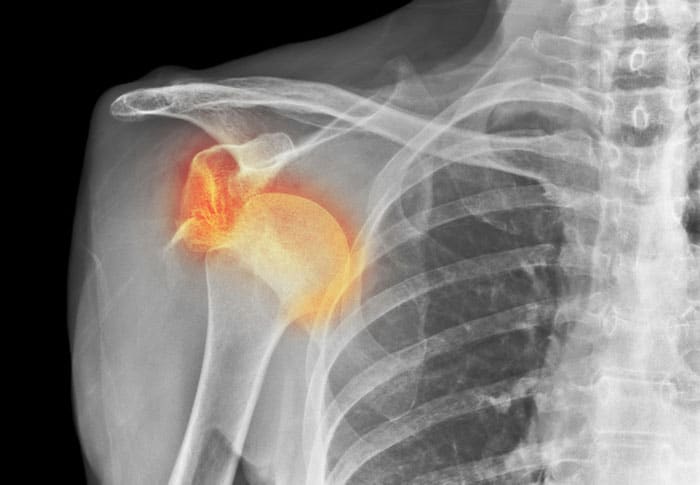
By the end of that day X-rays showed that Jeff’s shoulder wasn’t dislocated but completely separated from its ligaments. He also had two fractured ribs. His pain was excruciating; I drove us home slowly with the hazard lights on, avoiding the slightest bumps on the road. We both had a rude visual awakening seeing his clavicle bone protruding up between his neck and shoulder bone. Separation indeed. 

Upon hearing of his accident, friends and relatives kindly offered prayers, gifts, and a Shabbat meal. They visited and called. One friend even brought matjes herring, no doubt for its extraordinary medicinal properties. We’ve been given the phone numbers of orthopedic surgeons reported to be the best. Because when it comes to Jews and doctors, we only want the best.

It’s incredible how many people —including strangers — have felt an intense need to comfort Jeff by sharing their own war stories. 

It’s incredible how many people — including strangers — have felt an intense need to comfort Jeff by sharing their own war stories. I can’t tell you how often someone will see his right arm secured in that sling and tucked under his sweater and begin to ask him what happened. But he can get no further than the preamble: “I was riding my bike down on the Ballona Creek path. . .” when they interrupt:  

“Oh my God, let me tell you what happened when I slipped and fell on Wilshire Boulevard. Did you know I was in a wheelchair for six weeks?”

“Oh really? Did you know I was almost impaled on the handlebars of my bike when a reckless kid on an electric scooter slammed into me? It’s a miracle I’m still alive!”

“Yeah, I fell off my bike a few years ago. Fractured my jaw and needed dental implants. See this? I still can’t open my mouth that wide.” 

“Have you started physical therapy yet? Didja know that ‘PT’ really stands for ‘pain and torture?’ Those therapists know their stuff but they are tough. I went three times a week for four months and it really killed.” 

In the five weeks since the accident, we have heard more alarming sagas of torn ligaments, broken ankles, ACL tears, rotator cuff injuries, stress fractures, frozen shoulders, concussions, traumatic hernias, and complications from surgeries than we had ever heard in our lives. We are dazed and fearful of leaving the house. We are considering early-onset grab bars for the shower.  

As soon as Jeff inadvertently joined the Walking Wounded Club, we focused on being grateful that the injuries weren’t worse. For example, he fell on his right side, allowing him full use of his favored hand. He can write, text, eat, and manage several other tasks on his own. This means he can still work from home, which ensures not just his sanity, but mine, too. Because he never rides without his helmet on, he had no concussion, thank God. He was riding with a friend who helped him get to an urgent care center right away. He has an in-home nurse (me!) to take care of him, take him to doctor appointments, and keep the ice packs coming and the pain meds well stocked. I feed him well, too.

Our daily prayers and general awareness of God’s presence in our lives help us feel gratitude about what went right in an otherwise bad situation. And day by day we appreciate the miracle of how the body heals itself. 

Accidents happen in a split second, but healing takes time, patience, and a positive attitude. It also helps if you are willing to hear about other people’s injuries and their pain, and can tolerate major infusions of matjes herring. As they like to say these days, stay safe out there.


Judy Gruen’s latest book is “The Skeptic and the Rabbi: Falling in Love with Faith.”     

Welcome to the Walking Wounded Club Read More »

A Hanukkah Carol: How the Christmas Movie “Spirited” Taught Me a Hanukkah Lesson

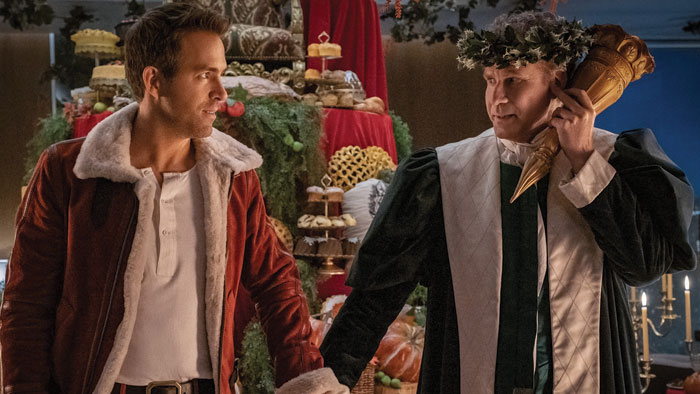
I never thought I would find a Hanukkah lesson in a Christmas movie, but that’s exactly what happened when I saw the new film, “Spirited,” with Will Ferrell and Ryan Reynolds.

One element I’ve often found missing in Hanukkah commentary is a discussion of personal growth. The holiday is so full of big ideas and religious symbolism, we don’t seem to ever get to the inner dimension of self-improvement.

Jewish holidays, however, are not just monuments in time with rituals and religious fervor; they are opportunities for us to improve ourselves and leave the holiday better than when we entered it. Watching the Christmas film, “Spirited,” helped me uncover that personal, more intimate aspect of Hanukkah.

The film is a modern, light-hearted musical retelling of the Charles Dickens book, “A Christmas Carol.” It’s funny and sweet and hits all the pleasant notes of a classic holiday movie. The story revolves around a few “irredeemables” – people who are so terrible that they can never change for the better. But after experiencing targeted dream sequences and countless cheesy showtunes, the heroes of “Spirited” discover what we know instinctively to be true – nobody is irredeemable.

But how do terrible people find their way to redemption? Surely, it would take years of intense work to truly change one’s entire personality and break dozens of horrible habits and fix myriad broken ways of thinking to really be redeemed.

“Spirited” answers, as always, in song:
“But even if you lost your way
You don’t have to stay a lost cause
So can we do a little good?
Maybe give a little more?
Work a little harder than we did the day before
It only takes a little good
And some doin’ what you can
Takin’ every chance to make the choice to be a better man
So do a little good”

Nobody can transform from bad to good in one fleeting moment of inspiration. Real lasting change takes a long time and hard work, but you’ll never get there if you try to flip the switch and become a perfect version of yourself overnight. Can you do a little good? Give a little more? Yes – of course we can. That is how the irredeemable is redeemed.

But it’s at the end of the song, when Ferrell and Reynolds sing “a little is enough, a little is enough, a little is enough” that it hit me: They were singing about Hanukkah!

When the Maccabees reentered the Holy Temple, they found the place literally irredeemable. They did not even have enough oil to light the lamps for long enough to restock their supply of pure olive oil. It was impossible to flip the switch and transform a contaminated Temple into a gleaming House of God. A lot of people in that situation would have said, “Let’s wait until we can get this Temple up and running before we restart all the Temple rites.” It would have been justifiable to wait for at least a few days to get the place cleaned up and looking respectable.

Just like the irredeemables in “Spirited,” the Maccabees believed that even when faced with an overwhelming challenge, “a little is enough, a little is enough, a little is enough.” And they were right.

But just like the irredeemables in “Spirited,” the Maccabees believed that even when faced with an overwhelming challenge, “a little is enough, a little is enough, a little is enough.” And they were right. A little was enough! Miraculously, one day of oil lasted for eight days.

We shouldn’t underestimate the spiritual fortitude and wisdom it took for the Maccabees to say “a little is enough.” We tend to focus on the miracle of the oil and the big picture implications of the story. Perhaps the more powerful and rarely spoken lesson of the Hanukkah story is the Maccabees’ belief, when faced with a monumental task, that even a little is enough.

This year, when I light the Hanukkah candles with my family, in addition to the familiar themes and lessons we review every year, I will share the Hanukkah lesson I gleaned from “Spirited.” Each night, with each candle we light, we will remind ourselves that no matter how big a problem looks, or how much a habit needs to change, “a little is enough.” And after eight nights, we will see through the eight gloriously lit candles that a little can indeed become quite a lot.

How ironic that a “little” Hanukkah lesson I picked up from a Christmas movie can turn out to be such a big idea.

Happy Hanukkah.

A Hanukkah Carol: How the Christmas Movie “Spirited” Taught Me a Hanukkah Lesson Read More »

When It Comes to Recipes, Including Hanukkah Food, Anything Goes

Chef Rossi likes breaking all the rules when it comes to cooking, so why should Hanukkah be any different?

“I learned to be zany and fun with food and throw away the stuck-up culinary rules that bind so many chefs,” Rossi told the Journal. “Pulled barbecue chicken on latkes, anyone?”

Chef Rossi
Photo by Melissa Donovan

Rossi, who was raised “Orthodox light,” credits America as her hometown. She grew up in a camper wedged on the top of a Ford pick-up truck and had visited most of the United States by the time she was 10 years old. Her wacky sense of humor and international food fusions reflect her Hungarian Yiddish background and her love of all things loaded with flavor.

“I cannot shake my Jewish mother’s lesson that too much is never enough,” Rossi said. “I always make TOO MUCH FOOD!”

The catering director, owner and executive chef of The Raging Skillet in New York, Rossi is self-taught and self-made. Her tasty memoir of the same name tells how she cooked her way through some of life’s biggest challenges in New York City’s most unlikely kitchens. What began as a revolt against the microwave turned into a quest to make food that is fearless, fun and, most importantly, delicious. 

“I love the holiday season because for just a snippet of time every year, everyone in NYC seems to be smiling,” the author, caterer and radio host said. “There is a feeling of love and wonder and child-like fun in the air. Then it all disappears at the first traffic jam or when someone else steals your taxi cab. But it’s pretty awesome while it lasts.”

Rossi remembers Hanukkah growing up, when her mother would sit everyone around the dinette table and dole out eight days of mostly awful gifts.  Sometimes, a jewel would emerge.

“I would hold my breath as I opened the many crappy gifts and almost gave up; I mean, who gives their kids shampoo for Hanukkah?” Rossi said. “Then would come that G.I. Joe action figure I wanted so badly. My mom loved the drama.” 

These days, one gift Rossi gives the most is her sense of flair when it comes to food. She thinks of herself as the anti-chef. Her reputation as the one to call when you want food that’s different is well-earned. 

Rossi likes mixing different types of food together and creating mini-food people will love.  “It is a recipe for my success,” she said. “If you are an old fashioned, super proper or rather uptight person, this will not work for you.” A great example is her recipe for Sweet Potato Latkes, which are “super easy and not at all precise.” 

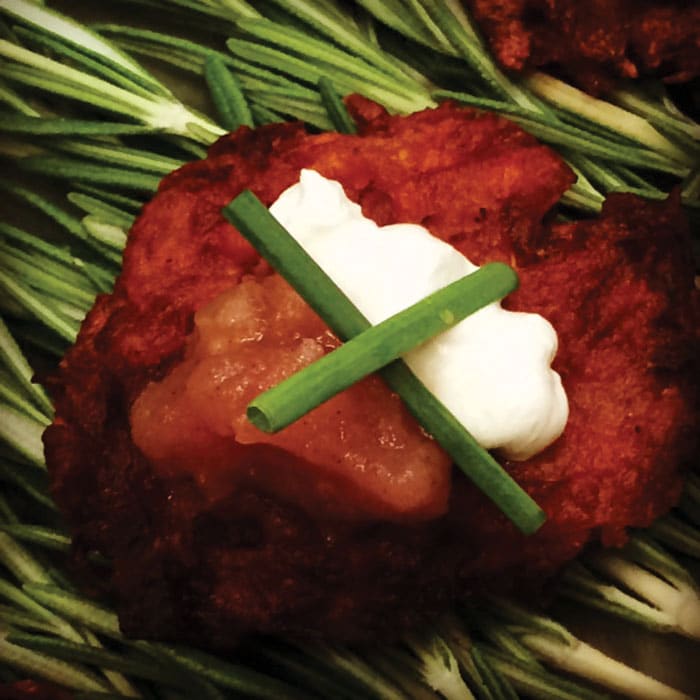
Rossi started making these because she is gluten-free, and can rarely eat latkes. She also has many vegan clients.  “They are amazing,” she said. “I serve them with applesauce, no sour cream, -so they stay vegan. And they are just super yummy.”

Sweet Potato Latkes

Sweet Potato Latkes
Photo courtesy Chef Rossi

We always make a huge volume when we do this. Ten sweet potatoes yields about 300 mini-latkes, so adjust accordingly. 

Ingredients
10 sweet potatoes
Salt
Potato starch
Ground pepper
Cooking oil

  • Peel 10 sweet potatoes and grate them. Since we usually make a large quantity, we usually put in the grating extension of our robot coupe because life is short.
  • Do not drain any liquid that comes out; you want the liquid.
  • Put grated sweet potato in a bowl, mix with a handful of salt and let it soak in. Then mix in several handfuls of potato starch. Add fresh ground pepper.
  • When you are ready to fry, put a frying pan over medium high heat with at least a 1/4 inch of oil in it.
  • Take a handful of sweet potato and roll it into a ball. Then smush it into a mini latke size pancake. Fry until firm and brown on both sides.

It’s hard to believe that this works with no egg and no other binder, but it does. We make these ahead of time and freeze them. They are fabulous, gluten-free and vegan.

Rossi did not grow up with donuts for Hanukkah.

“The first time I ever had a donut on Hanukkah I was in my 40s,” Rossi said. “It seemed all of my Israeli pals were doing it, but it was not an Ashkenazi thing.”

Rossi did a gorgeous Latin Jewish wedding and they made mini-dessert empanadas.

Mini Dessert Empanadas

Ingredients
Mini empanada wrappers
Tub of cream cheese
Sugar
Orange zest
Guava paste
Powdered sugar

  • Defrost mini empanada wrappers.
  • Mix cream cheese with a pinch of sugar and orange zest.
  • Cut guava paste into small dice.
  • Fill the empanadas with a teaspoon of cream cheese and one piece of guava. Fold it over and press with a fork. Freeze until ready to cook.
  • Heat a frying pan over medium heat with oil. Then fry them up until lightly brown. Serve with powdered sugar. Oy vey and Olé!

“Oil is not just for latkes,” Rossi said. “Anything fried is cool with me for Hanukkah.”

When It Comes to Recipes, Including Hanukkah Food, Anything Goes Read More »

Rosner’s Domain— A Declaration of Consensus

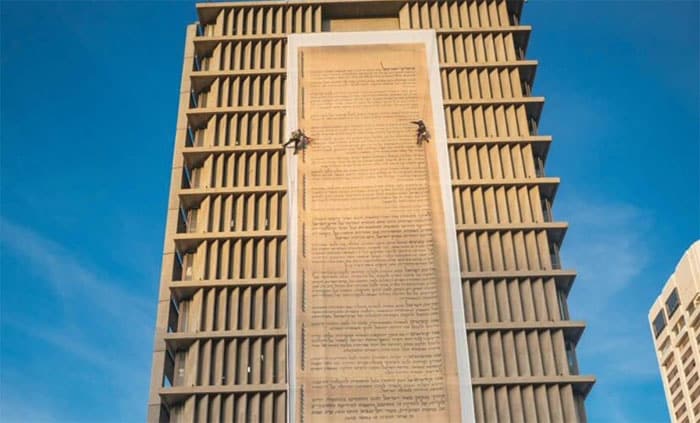
The road to hell is paved with good intentions. The road map showing the way to hell was hung last week on the Tel Aviv City Hall.

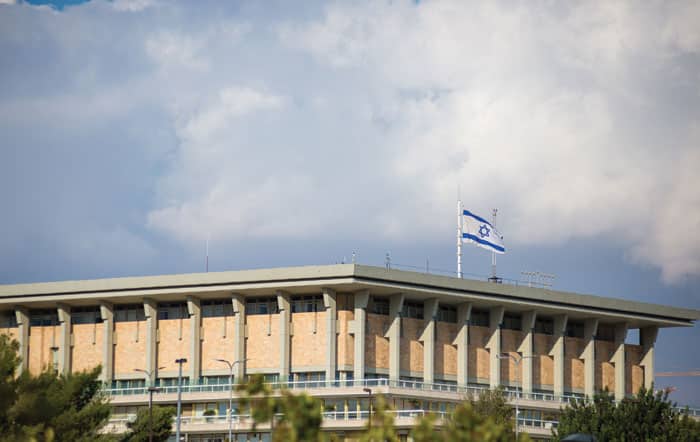
Good intentions: This is what caused the mayor of Tel Aviv and his team to hang a large banner on City Hall with the important text of Israel’s Declaration of Independence on it. Where do good intentions lead? We have already said where they lead. And in this specific case, they lead to the politicization of one of the only texts that have survived the test of time and have not yet been politicized. If Israel’s Declaration of Independence is merely another tool in the arsenal of the opponents of the government, the leftists of Tel Aviv, it will quickly lose its appeal to the many supporters of the government.

In other words, the mayor of Tel Aviv wanted to advance the message of the Declaration. He wanted to boost it at this time not because Israel is nearing its 75th anniversary. This was a confrontational move, suggesting, in a nutshell, that what the new coalition plans to do would contradict the principles of the founding fathers. Mayor Ron Huldai wanted to boost the status of the Declaration and may have ended up eroding it. Here is a comparison that may upset some readers: A similar process eroded the consensus around the day of mourning for the assassination of Yitzhak Rabin. This is what happens when an issue in agreement is utilized for political confrontation.

The Declaration of Independence is not a document known to every Israeli. Forty percent of us do not know exactly what it is (the declaration made by David Ben-Gurion when Israel was born). Some Israelis think the Declaration is related to something that happened at the U.N. Some believe it was signed in Jerusalem (the actual place was Tel Aviv). 

So, an initiative aimed at widely publicizing the text of the Declaration (the state “will be based on freedom, justice and peace as envisaged by the prophets of Israel“) is a good idea. If someone wants to hang it on a building, that’s great. Put it on billboards, even better. Advertise it on the radio — by all means, let them do it. 

This works provided that it will be everyone’s Declaration, or at least that an effort will be made to keep the Declaration a consensual text, dear to everyone. This was important for Ben-Gurion, who agreed to pay a price in drafting the Declaration, so that everyone would sign. Meir Wilner the communist, Haim Moshe Shapira of the Orthodox Mizrahi, Yitzhak Meir Levin of the ultra-Orthodox, Yitzhak Gruenbaum the liberal, Zvi Segal the rightwing revisionist. The Declaration ought to belong to everybody, those who support the new government and to those who oppose it. If it doesn’t belong to everyone, its importance will decrease and its status will erode.

The Declaration of Independence cannot be held as a hostage in the hands of extremists who may or may not like the use made of it. 

What could be done? One option was not to hang the Declaration as a political statement at this tense time. City officials would probably reject such suggestion. They’ll say that the other political camp cannot dictate when it is and when it isn’t the appropriate time to mention the Declaration. The Declaration cannot be held as a hostage in the hands of extremists who may or may not like the use made of it. 

This is not a bad argument. But it can be answered with a second proposal: In these highly charged times, when everything that becomes politicized by one side, and also becomes toxic in the eyes of the other side, leaders should search for middle ground. In this case, instead of hanging the Declaration on the Tel Aviv City Hall alone — making it a case of “the State of Tel Aviv” against the new government of the State of Israel — hang it on several city halls of several municipalities, not all of which are politically identified with one political camp. How beautiful it would be if the important text of the Declaration of Independence were hung in parallel by the mayors of Tel Aviv and Petah Tikva, Elad and Bat Yam, Nazareth and Eilat. Of course, not every mayor was ready to do such a thing. But it was worth a try. You know what? It is still not too late to try.

Something I wrote in Hebrew

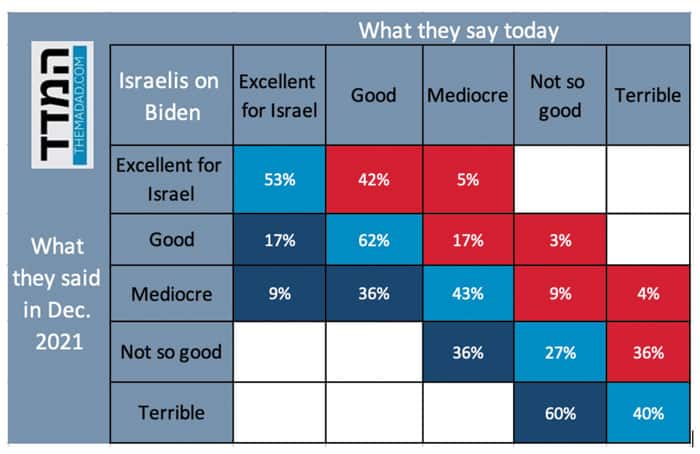
em, or a sharp conflict over Iran, Israelis have an opinion about the American president that is derived from their politics. Only right-wing Israelis sometimes say a Democratic President is “bad” for Israel. On the other hand, there is not a single right-wing or center-right supporter who says Biden is “excellent” for Israel. Similarly, there is not a single left or center-left supporter among those who responded to our survey in both 2021 and 2022 who said of Biden that he is “bad for Israel.” Quite a few of them said he is excellent (27%) or good (54%).

A week’s numbers

Here’s how a group of Israelis change their minds on Biden from Dec. 2021 to Dec. 2022 (or didn’t change it). 

A reader’s response:

Avi Dagan asks: “Shmuel, can Israel survive without American Jewish support?” My response: Possibly, but why would Israel need to survive without American Jewish support? I am confident it will always get American Jewish support. I see no alternative to such future. 


Shmuel Rosner is senior political editor. For more analysis of Israeli and international politics, visit Rosner’s Domain at jewishjournal.com/rosnersdomain.

Rosner’s Domain— A Declaration of Consensus Read More »