fbpx

December 21, 2022

A Bisl Torah — Which Miracle?

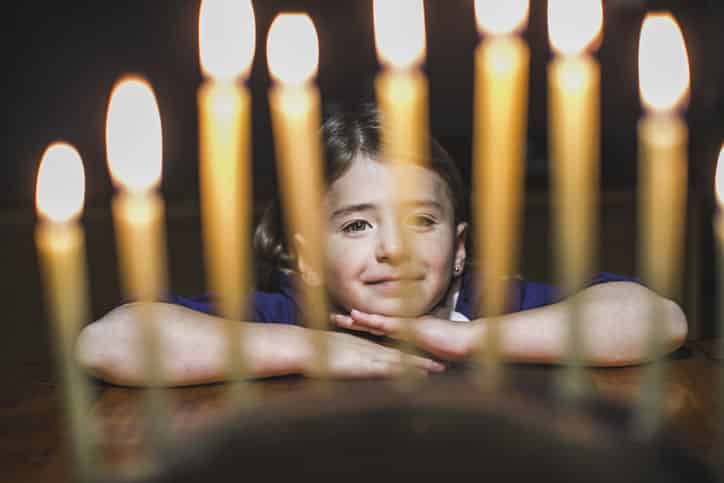
With the way the Jewish calendar falls this year, our family is traveling almost all of Hanukkah. We meticulously packed our Hanukkiah, candles and matches, wondering where exactly our celebrations would take place. Would there be a window to let others see the dancing lights? Perhaps we’d witness other stealthy guests lighting their hannukiyot, hidden within their rooms.

As I worried about fire alarms within hotel rooms, I watched the reflection of our faces in a small window, hands lighting the candles, mouths opening to belt out blessings. Yes, we are meant to light the candles to publicize the miracles of thousands of years ago. But, we also light the candles to publicize the miracles of today. Jewish children proudly singing the same songs of their ancestors. Jewish adults passing down the lessons that we may still live through fearful times but the strength of our faith is the fuel that pushes us forward.

Tonight, as we watch our own reflections flickering in the candlelight, let the ancestral lights illuminate the miracles… miracles of yesterday, today and tomorrow.

Shabbat Shalom and Happy Hanukkah

Rabbi Nicole Guzik is a rabbi at Sinai Temple. She can be reached at her Facebook page at Rabbi Nicole Guzik or on Instagram @rabbiguzik. For more writings, visit Rabbi Guzik’s blog section from Sinai Temple’s website.

A Bisl Torah — Which Miracle? Read More »

A Moment in Time: “There’s Nothing ‘Minor’ about Chanukkah”

Dear all,

Chanukkah….

Growing up, it was the biggest, most awesome Jewish holiday in the world. Fun food, fun music, fun games, family, presents…. It was so the opposite of so many other observances.

But then, at some point, I was told that in the whole scheme of things, Chanukkah is really a minor festival. It’s big only because of Christmas, which is at the same season.

But this rational …. It overlooks a major, major concept….

Chanukkah is one of the only opportunities where Jews really and truly feel our identity. In a world of Christmas lights (don’t get me wrong – they are beautiful), there is a connection unlike any other when we smell latkes, notice a dreidel, and see the Chanukkiah.

In so many ways, Chanukkah deepens our Jewish experience more than any of the “major” festivals.

So …. Where does that leave me?

Chanukkah will never be at the same level as Christmas. For believers, Christmas is about the birth of Jesus. That’s HUGE.  Chanukkah does not carry the same theological weight.

But it carries emotional and spiritual depth which we should not discourage.

Bring it on! Let’s celebrate. Let’s re-kindle the lights. Let’s indulge in the foods. And let’s connect with our people! This, truly, is our moment in time!

Happy Happy Chanukkah!


Rabbi Zach Shapiro

A Moment in Time: “There’s Nothing ‘Minor’ about Chanukkah” Read More »

Table for Five: Miketz

One verse, five voices. Edited by Salvador Litvak, the Accidental Talmudist

So all the world came to Joseph in Egypt to procure rations, for the famine had become severe throughout the world.

– Genesis 41:57


Yehudit Garmaise
Reporter, Freelance Writer, Teacher

Until now, “ochel” or “bar” have been the words that refer to the food and grain that Yosef set aside to store for seven years until the famine hit. 

Now, Bereishis Rabbah, tells us, the Torah uses the word, “sheber,” which means hope. In Perek 146 of Tehillim, we see this word, as “his hope,” in the line, “Praiseworthy is he in whose help is the God of Jacob; ‘his hope’ is in the Lord his God.” 

From the Torah’s use of “sheber,” we learn that when “all the world came to Jacob to buy provisions,” both the Egyptians and the foreigners were not just buying food, but they were also buying into the G-dliness that Yosef was revealing. 

By naming Yosef, “Tzafnas Paneach, the explainer of hidden things,” Pharoah indicates that his viceroy is not merely a talented statesman, but someone who could share beautiful, spiritual, and healing truths. 

Yosef, however, had to change himself before he could change the world. When we first meet Yosef, he was overly concerned with his appearance, he tattled on his brothers, and he callously reported his dreams of domination over his brothers and parents. Yosef’s narcissism was so painful to his brothers that they plotted his murder and sold him into slavery. Only in the merit of Yosef’s growing chesed, which we see when he noticed the butcher and baker’s sadness, was he resplendently empowered to a position from which he could feed the world the radical hope of G-dliness.


Rabbi Abraham Lieberman
Judaic Studies, Shalhevet HS 

The Talmud (Sotah13b) asks, why did Joseph die much earlier than his brothers? He was one of the youngest siblings. The answer given us is surprising. It was because he acted with authority, the usage of his position put him in a situation where his actions showed his power. 

Pirkei Avot (1:10) teaches that one should hate and avoid such positions. The Talmud does not provide a source text or a verse to back up its claim that Joseph acted with such overt authority. Many commentaries have come up with different answers. Some go back to his dreams, where it is clear that he is the center of power. Others point to the fact that in his conversations with his brothers, before he reveals himself to them, they refer to their father as “his servant” and Joseph never corrects them. 

I believe that the source for this teaching is our verse. Joseph has now risen to the top of his career. The famine is now widespread and all need him. His office has consolidated his awesome power in total authority. His laying out of the austere plan of collecting all grain, having everyone pay for their basic sustenance, is clearly a usage or a mis-usage of his authority. 

In a different statement the Talmud (Pesachim 87a) teaches “woe to the people of exercise their authority, their position will cause their burial.” We need people to be in positions of authority, but how does one use that power? 


Rabbi Ari Schwarzberg
Shalhevet High School

As the drama of Yosef and his brothers reaches its fever pitch in this week’s parasha, it’s easy to lose sight of the story within the story: Yosef’s rise to power in a foreign land. Yosef’s ascendance to Egyptian aristocracy isn’t just a prerequisite to his eventual reunification with his family, it is its own story about Jewish power in a foreign land. The viceroy of Egypt is none other than Yaakov’s favorite child, and the Torah is clear — it’s him upon whom the whole world relies. Without Yosef, the Jew, the famine becomes catastrophic. 

Yosef, whose life in Egypt is initially one of servitude and prison, quickly finds himself in the royal palace. It’s there, however, that Yosef is able to make up for his past failures. As a young man, Yosef finds himself elevated above his brothers and his condescension leads to dysfunction and disunity. But his 15 minutes of fame in Pharaoh’s palace are defined by wisdom and humanitarianism. This time Yosef uses his privilege to save a world in desperate need. 

At this very moment our community is unfortunately being forced to react to the weaponization and absurd depictions of “Jewish power.” But, as we defend and protect our own, it’s equally as wise to dwell on the model Yosef depicts for us in this week’s parasha. If, indeed, we are in a position of power or influence, let’s ensure that we’re doing whatever we can to uplift the world around us. 


Rabbi Dr. Janet Madden
Fountainview at Gonda Westside

We read Parshat Miketz before or during Hanukkah, in Kislev, the month of dreams and dreamers. In this darkest time of the year, the Joseph stories explore the relationship between dark and light, brokenness and potential for growth. 

In his persona as competent administrator, rationing the grain that he has stored, Joseph seems a long way from the dreaming youth he once was. He has been catapulted from indulgence to slavery, from prison to prominence. Now, Joseph’s true power is revealed — god-like, he holds the power of life and death. 

The Zohar observes “There is no greater light than that light which emerges out of the greatest darkness” (2:184a:4). In this moment of catastrophe, we see the constricting land of Egypt become a beacon of hope. Ironically clad in the trappings of power beyond even his early dreams of dominance, Joseph does not descend back into egocentrism.

Miketz reveals that Joseph’s time of brokenness has been a time of sacred darkness, exactly the environment required for his growth. The Kotzker Rebbe taught “there is nothing so whole as a broken heart” and Miketz poignantly explores the outwardly successful Joseph’s broken heart, from his ironic naming of his sons to his dramatic encounter with his brothers. 

Although Miketz marks an end, it also, and more profoundly, marks a time of nourishment, the beginning of healing for Joseph and for his family. As environmental activist Joanna Macy observes, “The heart that breaks open can contain the whole universe.”


David Sacks
Podcasts “Spiritual Tools for an Outrageous World” weekly on all platforms 

The Prophet Amos says, “Days are coming. There will be a hunger in the land. But the thirst will not be for water and the hunger will not be for bread. But to hear the word of the living G-d.” 

The world is still coming to Joseph for food. But who is Joseph? 

Joseph is the Jewish people. 

And what food are they longing for? 

To hear Torah, the word of the Living G-d. 

But the question is, how can we feed the world when so many of us don’t know what it means to be Jewish? 

To remain Jews in America today, it is not enough to hold fast to your beliefs while someone is threatening you. To remain spiritually alive, we need to know what our mission is. Not just for us but for the sake of the world. 

On one level, the antisemitism in the world today is a wake-up call. Not to be less Jewish, but to be more Jewish. 

As Reb Shlomo Carlebach put it, “The whole world is waiting for Jews to be Jews.” But before we can feed the world, we must begin by feeding ourselves. And the only way to do that is through Jewish education. 

So show up to a Torah class this week. Or dance with us at the Happy Minyan this Friday night. Go online to Chabad.org or Aish.com and be amazed how much light is waiting for you to bring the world this very second. 

Table for Five: Miketz Read More »

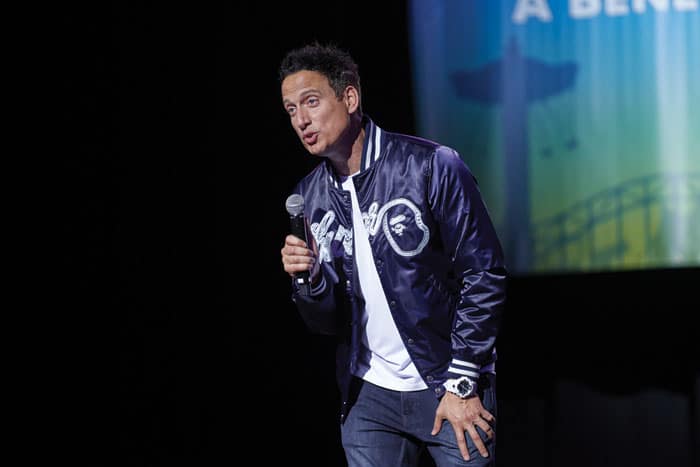
Comedian Elon Gold Picks Favorites in New Comedy Special

Comedian Elon Gold has a holiday gift for the world. 

“Guess who my number one favorite people are,” Gold says in the opening lines of his new comedy special. He is teasing the answer bit by bit, each night of Hanukkah. The 32 minute comedy special, “Sets in the City: Elon Gold’s Favorite People” is his Holiday gift to the world: the gift of laughter.

Gold calls it his “comedy version of ‘White Lotus.’” In the HBO show, they set up a dead body and then at the end, you find out who died. Similarly, for “Sets in the City,” you have to wait until the end to find out who his favorite people are. But the week-long release is not merely eight teasers. 

Each night, the 52-year-old comedian dives into what he loves about particular ethnic groups of people. And in true Gold fashion, it includes his talent for crowd work and a knack for accents.

“What I love about this special is not just that I did it on my own, but that it has this relevant and beautiful message of tolerance for all, but it’s through jokes,” Gold told the Journal. The premise is that Gold has a favorite group of people, and one by one, he discusses why he loves each but (for the purpose of the joke) is not his number one. 

Gold’s last comedy special “Chosen & Taken” premiered on Netflix in 2014 and is currently streaming on Amazon. But unlike then, this new mini-special was completely self-produced and released. Rather than getting caught in the development hell (a real Hollywood industry term) that stalls the production of many television shows and films, Gold opted to do what many comedians are doing these days: self-release. 

“Comedians get to go direct-to-consumer now and can cut out the middle man,” Gold said. “And that’s why comedians like me and Sam Morrill, Mark Normand and Ari Shaffir have gone straight to YouTube.” Morrill’s 45-minute special, “Up on the Roof” racked up over 2 million views just on YouTube. 

Gold lamented that the streaming executives these days aren’t taking risks on up and coming comedians. That’s the exact opposite of what HBO did in the 1980s—making up-and-coming comedians household names, among them Chris Rock, Howie Mandel, Sam Kinison, Andrew Dice Clay and Ellen DeGeneres.

“[Executives] are just taking the lazy route and taking the biggest stars of comedy and giving them specials instead of discovering talent, which is what HBO did in the eighties and nineties and was so exciting to watch,” Gold said.

“Sets in the City” features bits that Gold has been working on for the last few years mixed with bits he wrote in the days leading up to the performance. He also said that some of the bits were improvised on the stage while filming at New York’s Comedy Cellar in Greenwich Village, about a 40 minute ride on the Subway from his native Bronx.  

“From the white supremacists to Kanye to everything that’s out there, this is my answer to them: love and a message of tolerance and acceptance of all. And it couldn’t be more timely right now.”

And on the eighth day of Hanukkah, which happens to fall on Christmas Day, Gold will release the whole special on YouTube. In the meantime, Gold will keep audiences laughing at the edge of their seat, wondering who his favorite people of the night will be. 

“I just wanted to put out a new special with this really unique and sort of important theme, which is just mocking hatred,” Gold said. “I love mocking, I’ve always said this, but I love finding the funny in hate because you get to expose the ignorance of bigotry.”

Gold will be releasing snippets of his mini-special via his Instagram page, and has agreed to let the Journal release simultaneously on Instagram as well. 

“The first people I make fun of are Jews and then I make fun of everyone else,” Gold said. “But I do it from the perspective that I love all people. And that’s one of my favorite lines in the special. ‘I love all people—just not equally.’ I don’t love my immediate family members equally. I love them all sort of differently. And it’s okay to love people not equally. It’s okay, as long as you have no hatred in your heart.”

You can watch Elon Gold’s “Sets in the City” throughout Hanukkah at his Instagram page: www.instagram.com/elongold

The special will be released in full on his YouTube page on December 25th: https://www.youtube.com/@ElonGoldComedy 

Comedian Elon Gold Picks Favorites in New Comedy Special Read More »

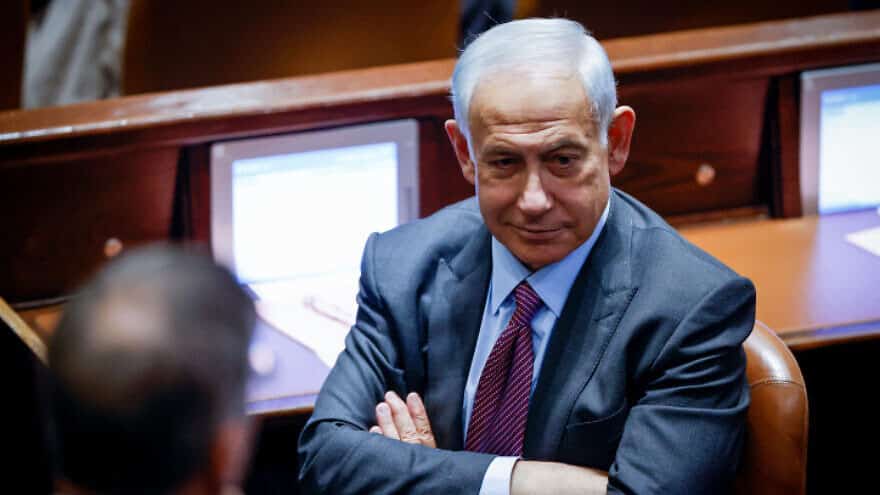
Netanyahu Announces Formation of Israel’s 37th Government

Israeli Prime Minister-designate Benjamin Netanyahu late Wednesday night informed President Isaac Herzog that he has secured the necessary backing to form the country’s next government.

Netanyahu tweeted that he had succeeded in forming a right-wing/religious coalition, just minutes before the midnight deadline.

The tweet consisted of a two-word Hebrew phrase that roughly translates into, “I got it.”

After a victory for his Likud Party and its “natural allies” at the polls on Nov. 1, Netanyahu had anticipated an easier job in forming a coalition, announcing that it would be ready in time for the opening of the Knesset on Nov. 15.

However, the demands of his prospective coalition partners delayed the matter. As the initial 28 days he had been granted to form a government were winding down, Netanyahu requested a two-week extension. Herzog limited him to 10 additional days.

The extra time was also needed in order to pass laws necessary to satisfy allied political parties. These included a law to allow Shas Party Chairman Aryeh Deri to serve as a minister despite a recent conviction for tax evasion, and the creation of a minister of national security position with expanded powers over the police for Otzma Yehudit Party leader Itamar Ben-Gvir.

Those bills, along with one for Religious Zionism Party leader Bezalel Smotrich, are working their way through the Knesset’s legislative process.

The new government will not be sworn in until next week at the earliest as Netanyahu and outgoing Prime Minister Yair Lapid agreed that the next Knesset plenum meeting will only be on Monday, after Hanukkah.

The deadline to swear in the next government is Jan. 2.

Netanyahu Announces Formation of Israel’s 37th Government Read More »

Teens Support Their Peers Nationwide with the Teen Talk App

The Teen Advisors at the Teen Talk App are using their powers of empathy and experience to help their peers. And indeed, it’s a powerful thing.

“Every day I find myself in awe of the teen volunteers in our program,” Leeron Tzalka, the Teen Talk App community relations manager, told the Journal. “Their maturity and dedication to helping their peers keeps me hopeful about the future.”

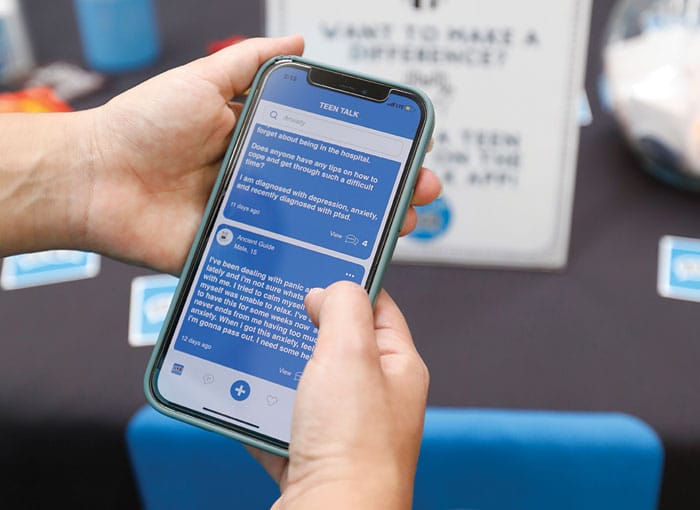
Teen Talk, which is available on Android and iOS, is a non-sectarian program of Jewish Big Brothers Big Sisters of Los Angeles. The app’s user interface resembles your Facebook newsfeed and provides a free, anonymous, safe space for teens ages 13 to 19. App users can post and ask questions at any time.

“We found that teens are calling hotlines less and less, as they’re feeling less comfortable speaking on the phone. We consider ourselves a warm line rather than a hotline.” – Leeron Tzalka

“It is all post-related,” Tzalka said. “In doing research, we found that teens are calling hotlines less and less, as they’re feeling less comfortable speaking on the phone. We consider ourselves a warm line rather than a hotline.”

The Teen Advisors, who are supervised by mental health clinicians, are available on the app every day from 5 p.m. to 10 p.m. PT. They have all undergone a 50-hour training to learn reflective communication skills, crisis intervention and how to recognize the signs of mental health struggles. When there is a teen in crisis, they are brought into a private conversation with a mental health professional and receive referrals if they need them.

Tzalka believes this kind of a forum normalizes everything that teens are feeling. It makes them feel like they’re not alone. “Social media is a highlight reel,” Tzalka said. “People are watching things on TikTok and Instagram, and they feel [bad] at the end of the day.”

The Teen Talk space tells them that there are hard things in the world, but there are also resources and coping mechanisms. They are also peers who may have gone through — or are going through — similar things, who care about them and want to speak with them.

Teen Advisors spending time together
Photo by Cody Rapoport

The most common topics on the app relate to relationships, depression, suicide and abuse. As new topics are always emerging, the teens come together monthly for continuing education.

The app, which has been around since 2018, currently has 140 teen volunteers across the country. They support about 250 daily active users, and, this year, have had 6,000 conversations with teens around the world. Some of these ongoing conversations have 15 back-and-forth messages; others have 100.

While all teen users can read through other people’s posts, only the trained teens can respond. 

“We know that this is a safe space that has trained teens speaking to them,” Tzalka said. “It’s not just unsolicited advice that they can get on the internet that’s not supervised by licensed professionals.”

To become an advisor, teens need to be in at least ninth grade and make at least a one-year commitment. Most of them stay longer, as they find it to be such a meaningful experience.

The other bonus: It’s a low barrier volunteer opportunity. 

“We understand that not everyone has a parent or guardian who can drop them off at the hospital or the local food pantry to volunteer,” Tzalka said. “We wanted to reach teens who wanted to make an impact, but maybe didn’t have the ability to do so in person.”

Teen Talks’ national presence was a product of the pandemic. The app, which is based in Los Angeles, shifted to virtual training, enabling them to work with teens across the United States. 

Tzalka said that a lot of their training is centered around Jewish values, concepts they share with all their advisors, no matter their religious connection. 

“We even use words such as tikkun olam and kehillah in our training,” she said. “These values are important to our mission, as our app serves teens worldwide.”

The Teen Advisors’ experiences speak for themselves. To protect their anonymity, they only shared their first names.  

“I became a Teen Advisor because I was a Teen Talk user in middle school,” Jonah, 17, told the Journal. “It was a rough episode in my life and Teen Talk helped to cultivate a lot of self-growth in me. When I found out that the organization needed volunteers, I wanted to contribute.”

  Sarah, 15, said, “I used to think I was alone in my experiences, but now I know that other people are dealing with the same things I am.”

 “I used to think that only adults could really help people, but now I know that teens have the power to help,” said Ben, 15.

“While it is a joy to witness their growth over the course of training and their shifts on the app, what is most rewarding is seeing our teens feel empowered to help others and themselves, discovering that they do not have to be ‘perfect’ to do so,” Lauren Veillette, the Teen Talk App Training Coordinator, told the Journal. “They just need to be their thoughtful and compassionate selves.”

Teen Talk offers about six to eight training cohorts a year, so if you know an interested teen, learn more at TeenTalkApp.com.

Teens Support Their Peers Nationwide with the Teen Talk App Read More »

Moritz Hochschild: Ruthless Capitalist or Heroic Savior of Jews?

Genia Farkas is 102 years old and lives in a retirement home in Israel. Recalling how she survived the Nazi era, she said that in 1938, when she was 18, she left her hometown of Ulanów, Poland and joined her sister and her sister’s husband in Brussels, Belgium. Her brother-in-law had spent time in Germany and had seen evidence that alerted him to the coming tragedy. By 1939, World War II was already raging, and Genia’s brother-in-law pushed for the three to leave Europe. When they learned that Bolivia was virtually the only country open to Jewish immigration, they requested and received their life-saving visas to that landlocked, poor, politically-unstable country in the middle of South America.

The three of them boarded a ship, and the first few days at sea were terrifying. While still near Europe, the vessel, carrying many Jewish passengers, did not travel at night for fear of mines. Lights were turned off and everyone wore life jackets at all times, even in bed. Once the ship was well into the Atlantic, they could breathe more easily. Weeks after leaving Europe, the three disembarked in Arica, Chile, then boarded a train that became known as the Jewish Express. 

Visas in hand, they entered Bolivia, which was as alien to Genia as if she had landed on the moon. But at least they’d survived, and they were far away from the SS and concentration camps. After a year in Bolivia, Genia managed to cross the border into Argentina, where she lived for the next 35 years, raising a son and a daughter. (Full disclosure: Genia is this reporter’s mother-in-law, and the story of how she survived is an amalgam of many conversations.) 

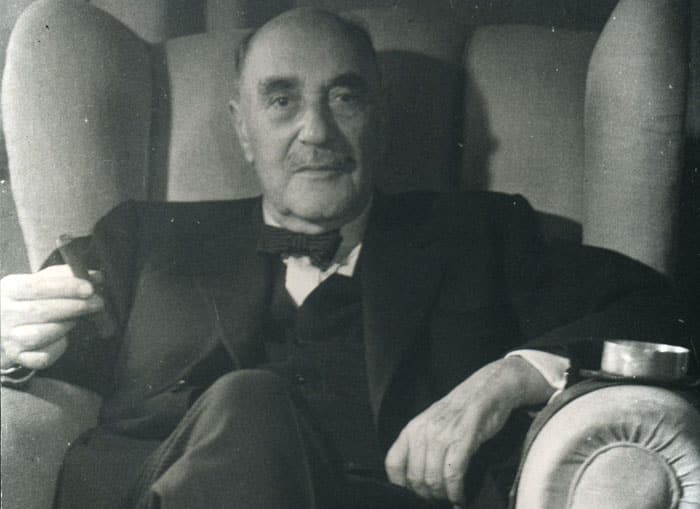
Genia was one of at least 9,000 and perhaps as many as 22,000 Jews who found refuge in Bolivia. The man behind this effort was Moritz (Mauricio) Hochschild (1881-1965), a mining magnate whose mines accounted for a sizable percentage of Bolivia’s exports. In the 1930s and early 1940s, Hochschild, a non-observant German Jew, hobnobbed with Bolivia’s elite, including presidents, generals and business leaders. Because of his huge economic influence, Hochschild was able to convince Bolivian government officials that it was in their economic interest to offer visas to imperiled European Jews. As a result of Hochschild’s cajoling, the Bolivian government decreed, in June 1938, that its “doors are open to anyone … who is healthy in body and spirit, anyone who wants to come and work.”

Hochschild’s efforts have come to light relatively recently. After Bolivia nationalized the mining industry in 1952, Hochschild’s business in Bolivia was shut down. The company’s offices, in a suburb of La Paz, were left alone for many years and fell into ruin. In 1999, decades after Hochschild’s 1965 death, a search in the mining operation’s offices turned up a trove of important papers from the 1930s and 1940s. A team of masked and gloved investigators moved in and began to study and catalogue thousands of letters, receipts and other documents. In 2004 those investigators began releasing some of what they’d found, and they have continued to do so, posting the results in public archives. 

What they discovered was that besides saving thousands of Jewish lives during the war, Hochschild also shipped tin and other raw minerals to smelters in the U.S. at below market price, providing the U.S. with materials for making ammo boxes, weapons, medical equipment, airplane parts and tin cans that preserved food. 

In his lifetime Hochschild did not publicize his heroic role. In fact, he was called a “ruthless tin baron” who paid low wages to his employees. He was subjected to antisemitic slurs by Bolivian politicians and journalists who garnered support when they called him a “foreign exploiter” and “the worst kind of businessman.”

The letters and documents that have been made public decades after his death have led to a reassessment of Hochschild. Rather than labeling him “ruthless exploiter,” he’s now called “the Bolivian Schindler.” 

What’s been discovered in recent years has changed opinions about him, in Bolivia as well as in the rest of the world. The letters and documents that have been made public decades after his death have led to a reassessment of Hochschild. Rather than labeling him “ruthless exploiter,” he’s now called “the Bolivian Schindler.”  

But who was Moritz (Mauricio) Hochschild?

He was born in 1881 into a middle-class Jewish family in Biblis, Germany, a suburb of Frankfurt. He studied mining engineering in nearby Freiberg, then worked as a mining engineer in Spain. After that he spent five years in Australia’s mining areas. He then went to Chile, where he continued to work in different aspects of the mining industry: buying ore and selling it to smelters abroad. In 1919, one year after World War I ended, he returned to South America, this time to Bolivia, where he lived and worked for the next 25 years. 

In 1947, long before his actions as “The Bolivian Schindler” became known, the financial magazine Fortune described Hochschild this way: He is “a slightly mysterious South American mining overlord … [with] a great, bald boulder of a head, burning eyes under bushy brows, and a heroic nose leading down to a bristling moustache.” 

The article points out that “the most remarkable thing about the remarkable Hochschild head is that it has remained comfortably affixed to his shoulders … though so often in danger.” Hochschild was a mining mogul in a country where wealthy entrepreneurs were sometimes jailed or kidnapped and he was subjected to both of those indignities: jailed twice, kidnapped once. When he refused to go along with what he considered an unfair government demand, one Bolivian president even threatened the Jewish mining titan with execution, a threat that was not carried out, his advisers having talked the president out of having Hochschild killed.

His having been jailed, kidnapped and threatened may explain why Hochschild remained secretive about his role in bringing refugees to Bolivia. When writing to American Jews involved in bringing European Jews to Bolivia, however, Hochschild was open about his involvement. In the trove of documents that have been made public, there’s an April 1940 letter from Hochschild to James N. Rosenberg, Chairman of the Agro-Joint project—an agency that placed Jewish refugees in farms located in various countries. When writing to Rosenberg, Hochschild was clear about his role in how the visas came about: “I arranged with the [Bolivian] government that we could bring in a total of 30,000 Jews for colonization.”

Though this letter was a plea for more money to help settle Jewish refugees, it’s also clear from other documents that Hochschild used vast amounts of his own money in his efforts to save Jews and help the Allies win the war.

There’s no doubt that Hochschild exploited workers who made him wealthy. On the other hand, he saved tens of thousands of Jews and helped the Allies win the war. Saint or devil? This complex man was probably a bit of both, like most of us.


Roberto Loiederman has written more than 100 articles for The Jewish Journal. He is co-author of “The Eagle Mutiny,” a nonfiction account of the only mutiny on an American ship in modern times. 

Moritz Hochschild: Ruthless Capitalist or Heroic Savior of Jews? Read More »

Unpacked Doc, Federation and Chabad Menorah Lightings, MDA Ambulances Dedicated

Jewish rapper and influencer Noah Shufutinsky, who believes antisemitism is one of the oldest hatreds, was one of the many young people to appear in a new film about how antisemitism has evolved. 

“What’s new is that in progressive, liberal-leaning and leftwing spaces, Jews are experiencing increasing hostility,” he says. 

Shufutinsky – who goes by the hip-hop name, “Westside Gravy” – was speaking in the new documentary, “Unsafe Spaces,” featuring Jewish influencers and college students discussing how they’ve been excluded from progressive spaces simply because of their Jewishness. 

The film’s subjects include Shufutinsky, social media personality and the Journal’s New Media Director Blake Flayton, digital creator Hallel Silverman and Israeli activist Yirmiyahu Danzig. They cite their experiences on social media and college campuses. 

Unpacked, the short-form content arm of OpenDor Media, produced the 17-minute film, which screened this month at schools at schools and synagogues across Los Angeles and surrounding areas as part of a ten-day tour. 

The 10-day tour stopped at Kadima Day School, De Toledo High School, YULA High School, Milken Community School, Gindi Maimonides Academy, Pressman Academy, Yavneh Hebrew Academy, and Wilshire Boulevard Temple Religious School.

“Our goal is to be the Jewish storytellers of this generation, to allow the Jewish people to tell their story and do it in a way thoughtful, nuanced and entertaining way and meet people where they are, which is their phones,” Noam Weissman, executive vice president at OpenDor Media, told the Journal.

The tour’s speakers included Weissman, content creator Yirmiyahu Danzig; OpenDor Media Editor Sara Himeles; Shaked Karabelnicoff, the face of OpenDor’s TikTok; and Emily Gelman, an attorney and educator at Harkham Hillel Hebrew Academy.

“We wanted to go to L.A. to do a tour there because we have a collaborative of Jewish schools across the city who use our curriculum extensively, and it’s across the denominational spectrum, from YULA to Milken Community School, Yavneh to de Toledo High School,” Weissman said. “As much as people want to divide Jewish people, we’re quite united on the issue of antisemitism.”


Unpacked leaders stopped at the headquarters of the Jewish Federation of Greater Los Angeles as part of a ten-day tour of their new film, “Unsafe Spaces.” Courtesy of Unpacked

On Dec. 15, recently elected Los Angeles Mayor Karen Bass joined Los Angeles Jewish Federation leaders at Grand Park in downtown L.A. 

Bass, elected officials and community leaders came together as part of a nationwide campaign called Shine A Light. The campaign focuses on combatting the alarming rise in antisemitism and all forms of hate by uniting leaders and representatives from diverse backgrounds around Hanukkah. 

The event featured a ceremonial menorah lighting as well as speeches from state and local leaders, including Bass, Los Angeles County Supervisors Kathryn Barger, Janice Hahn, and Hilda Solis; Assemblymember Jesse Gabriel (D-Encino), State Senators Ben Allen (D-Santa Monica) and Henry Stern (D-Ventura), and Los Angeles City Councilmember Elect Katy Yaroslavsky. L.A. Federation and President Rabbi Noah Farkas also spoke.

For additional information on the “Shine a Light” campaign, visit https://jewishla.org/Shine-A-Light.


Karen Bass lights the menorah at the Pico-Robertson festival Screenshot

On Dec. 18, Los Angeles Mayor Karen Bass also attended the Pico-Robertson Hanukkah street festival, lighting the menorah to mark the start of the holiday. Rabbi Chaim Cunin of Chabad of California, which helped organize the festival, said the event spreads a positive message. 

“Hanukkah teaches us the power of one little candle to transform the world of darkness,” Cunin said. “What better way than to do that here joyously, proudly, lovingly — to embrace the lights of Hanukkah and to spread its love and light throughout the world.”


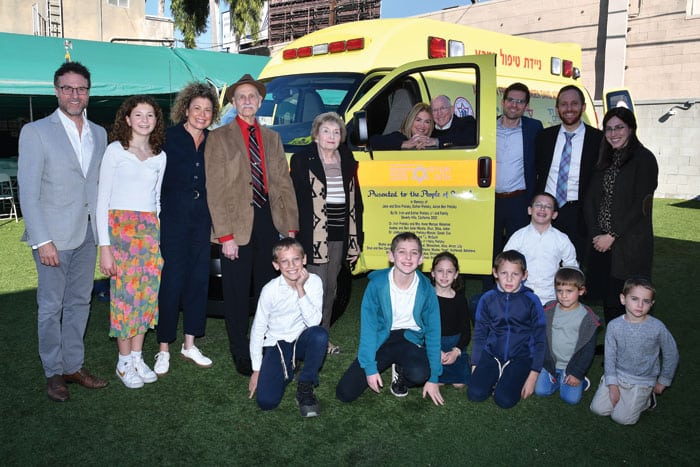
The family of Dr. Irvin Pretsky come together for a dedication ceremony of a Magen David Adom ambulance on Nov. 13 at Temple Beth Am. Courtesy of American Friends of Magen David Adom

Los Angeles residents recently dedicated ambulances they sponsored for Magen David Adom, Israel’s national paramedic and Red Cross service. 

Dr. Irvin Pretsky of Beverly Hills and Rosalie Klein of Los Angeles dedicated Mobile Intensive Care Unit ambulances (MICUs) that will be shipped to Israel. Dispatched to treat and transport patients in the most urgent and life-threatening situations, MICUs are equipped with sophisticated technology and equipment that enable paramedics to perform complex procedures that often mean the difference between life and death.

Pretsky sponsored the ambulance in memory of his late wife, his parents, and his son. He also honored the next generation by inscribing the names of his children, grandchildren, and great-grandchildren on the vehicle’s doors, many of whom were present for the dedication ceremony held on Nov. 13 at Temple Beth Am.

Approximately 60 of Pretsky’s friends and family members gathered to celebrate. Speakers included MDA Senior Paramedic Aryeh Myers, who shared his experiences in the field with attendees; Beth Jacob Rabbi Kalman Topp and Beth Am Rabbi Adam Kligfeld. 

On Dec. 4 at Chabad of Beverly Hills, Klein, a local real estate professional, dedicated a MICU she sponsored in memory of her parents and beloved husband, Morrie, who died in 2021. Approximately 70 of her friends and family members gathered to send the ambulance off to Israel. 

“What’s more important than saving lives?” Klein said. “Morrie and I had wanted to do this for a long time, and after his death I thought this would be a way to do something that will help a large number of people in his honor.”

Unpacked Doc, Federation and Chabad Menorah Lightings, MDA Ambulances Dedicated Read More »

Reclaiming the Sacred from Tribal Politics

Walking up to the bimah this past Rosh Hashana, the new rabbi at my former congregation paused to take a deep breath. And then he initiated the apparent purpose of his rabbinate: centering tribal politics in faith. As his d’var reached its peak, he offered a perspective that would have made Jerry Falwell applaud: “We can’t mix politics with religion. They were never separate in the first place.” In other words, the idea that politics and religion are distinct but can overlap at times is a fallacy. There simply is no distinction at all; they are one and the same. What’s more, politics are not to be transformed through faith into the transcendental (a justice of universal love) but faith is to be transformed through politics into the reductionist (a justice of division). 

For over twenty years, this congregation was my spiritual home. It is where I had the joy of celebrating my daughter’s Bat Mitzvah and my wife’s conversion. I remember holding my then infant daughter in my arms during services and the smiles from fellow congregants as we tried to keep her quiet. I recall our first service in 2002 when we couldn’t believe we had found such a wonderful community. I have so many blessed memories there.

I have left that community.

What I witnessed is not unique to my former congregation; it is happening in non-Orthodox congregations across the country. In fact, it’s not even unique to Judaism. A singular political ideology is becoming the center of the religious experience in Blue America. You are much less likely to see a “He is Risen” banner in front of a mainline Protestant church than you are one declaring “Black Lives Matter.” If you live in a district with a Democratic representative, it is likely that progressive politics has become the lingua franca of your religious community—if you attend at all.

A year before my congregation made the change to the new rabbi, a congregant told me this direction was necessary to “bring in millennials and Generation Z.” During Rosh Hashana, the rabbi speculated that what caused his childhood shul to close was insufficient attention to the political and too much to the sanctuary. But why do we call it, then, a sanctuary? It is where we step out of the corporal and into the world of God as we have for millennia. Apparently this is now insufficient. People want to castigate, confront and fight.

The politics central to this perspective is unilateral. It isn’t humble, questioning or respectful of ideological differences. It is singular: The congregation must always be on the side of whomever progressive sentiment declares the oppressed. If a congregant admits they voted for a Republican, voices a divergent perspective, or speaks to concerns about this political orientation, they will be called out as an oppressor. This happened to me when I expressed disappointment about the direction of the rabbi’s d’vars and he tweeted in response: “It’s amazing how much attention the complaint of a single, straight, cis, white man can command.”

The fundraising value of creating a divide between evil and good can be seen in the explosion in size in the advocacy sector.

While it is painful for anyone to be reduced to an identity—and by a fellow Jew in my case—I am writing this essay because the trendline is much more concerning. I have been in the social change space for my entire professional career. I understand the advantages and disadvantages of an applied binary. The fundraising value of creating a divide between evil and good can be seen in the explosion in size in the advocacy sector. On the other hand, the retreat from heterogenous coalition partners and diversity of thought has caused policy and societal paralysis. The result is not a more beloved community but rather a tearing of bonds within and across groups. In attempting to be unified, we are pulled apart and away from the divine within each of us. I shudder in fear that such a fate awaits contemporary Judaism as it reduces individuality and common humanity simultaneously, offers answers in the place of questions, and elevates the base. It is incompatible with the spiritual. 

Mainline Protestantism, which has increasingly become politically monolithic, reveals what will befall Judaism if it follows this path. The “seven sisters” of mainline Protestantism, where belief in God is now only present in 66% of adherents, have seen their share of the U.S. population drop since the 1970s from 30 percent to about 10 percent. It is worth noting that Evangelical Christianity, which embraced intertwining faith with politics on the opposite side of the ledger, is experiencing its own significant attrition. After all, how can a house of worship compete in the political realm with an actual party, advocacy organization or Twitter? It cannot. What it can provide, if it remembers, is a sanctuary. It is a place for God, faith and prayer. It offers a community of people who show up for each other during illness, loss and joy, irrespective of political differences. It is where we search and love, together.

Moreover, progressive politics as the map for justice for Judaism is a risky proposition. Its incompatibility can be seen in the fact that most so-called progressive congregations only gingerly touch the Israeli-Palestinian conflict. Progressive orientation and most coalition partners compel alignment with the Palestinians. So why is it avoided? The answer is obvious: Telling people that they are aligned with “oppressors” is asking them to wear a scarlet letter—never a popular move. Instead, the topic is avoided in favor of solidarity, as rabbis declare to congregants: You too are oppressed. Unless you forget your roots. And then you are on the side of the Pharaoh. For this reason, my former rabbi castigated Jews for “hoarding” power. Instead we must return to perceiving our oppression. As the rabbi advised the congregation, “If you want your children to be Jews, and live as Jews, and be proud to be Jews, remind them that they were slaves.” This is a game that cannot be won, particularly by Jews who have learned the lesson, again and again, that a world of allies and enemies is one where we eventually stand alone.

A form of Tikkun Olam that strips away dissent, undermines universal love, and presents itself as the only path for adherents is not religion nor justice. It is dogma.

Rabbi Abraham Heschel figures prominently with those who seek to center progressivism in Judaism. But they miss his lesson. A transformative rabbi, and a transformative congregation, is one that finds God in moments of joy and suffering. It helps people overcome loss, celebrate simchas, apply the wisdom of ancestors to our lives, love our fellow humans as ourselves, and find the divine everywhere. A form of Tikkun Olam that strips away dissent, undermines universal love, and presents itself as the only path for adherents is not religion nor justice. It is dogma. 

We forget this at our peril.


Jared Feuer is a long-time resident of Atlanta who has worked professionally in the social change sector for his entire career, including at the American Civil Liberties Union and Amnesty International USA.

Reclaiming the Sacred from Tribal Politics Read More »

My Journal Food Survey

Some of my earliest memories are of putting together trays of crackers and vegetables, while my mother was busy preparing the main holiday meal. I can smell the brisket just thinking about it.

Isn’t it amazing what memories food inspire? Whenever I see mandel bread, I remember making it with my grandmother in Michigan. I see noodle kugel and I remember sitting on a stool in my Chicago grandmother’s kitchen, watching her make it. And after every meal, there would always be a pack of leftovers to take home. 

For me, for many, I think of Jewish food as comfort food. There’s something beautiful about knowing the recipes we make have been enjoyed by those who came before us and that they will be passed down to future generations.  

There’s something beautiful about knowing the recipes we make have been enjoyed by those who came before us and that they will be passed down to future generations.

We also love to talk about food: what we are going to eat, what we are eating and what we just ate. The planning, the preparation, the togetherness of the experience is just as valuable as the food itself. Perhaps that’s true of all cultures, not just ours.

Food connects us. 

I asked some of my fellow Jewish Journal writers why they think food is so important in the Jewish culture. Here’s what they had to say.

Kylie Ora Lobell: “Judaism is all about bringing the holy into the mundane routines of our everyday life. We are instructed what food is kosher (holy) and what food is not kosher. We say blessings on our food to thank God before and after we eat. Food presents an opportunity to incorporate spirituality into our daily routine.”

Ryan Torok: “Food brings families together. Family is a major part of Jewish observance, and food helps connect us with our loved ones. It’s also part of keeping kosher, obviously, and thus a way to express our commitment to Jewish law and tradition.”

Brian Fishbach: “Nobody should be Jewish in a vacuum. To be Jewish is to go to Jewish gatherings with fellow tribe members and enjoy life together. What better reason to gather and enjoy life with fellow Jews than to eat?”

Harvey Farr: “Because what is considered ‘Jewish food’ so often connects to Jewish holidays, rituals and traditions. It also reminds us of the foods our mothers made when we were growing up and how we celebrated Jewish holidays in our youth.”

Aaron Bandler: “It’s a way of celebrating our ancestors while also the opportunity to connect with one another.”

Tabby Refael: “We truly never knew whether we would be alive tomorrow. That meant we made every meal count.”

David Suissa: “[Food] appeals to everyone and is disconnected from politics.”

When I asked about their favorite Jewish food, Harvey gave the most detailed answer.

“Herring,” he said, “if it can be considered a Jewish food. It is an acquired taste that is being forgotten. There was a time when no shul kiddush was complete without herring and crackers, but now it seems to appear only by special request of the kiddush sponsor.”

Aaron’s favorite is brisket and David’s is spicy Moroccan fish.

Kylie’s favorite Jewish food is the Hillel Sandwich, which we eat at the Pesach seder. I also enjoy that combination of charoset and horseradish between two matzos.

Tabby likes Gondi, Iranian Jewish chicken and chickpea meatballs, prepared for Shabbat.

Brian’s favorite is matzo ball soup; his favorite to make is noodle kugel, which is Ryan’s favorite, as well.

Speaking of kugel, about two thirds prefer sweet kugel, while a third goes for savory. Also, about two thirds are pro-gefilte fish, the rest said they’d pass. 

As far as favorite deli foods are concerned…. 

Kylie: Club sandwich kosher style with fried pastrami instead of bacon and no tomatoes.

Ryan: Pastrami on rye.

Brian: Salami on rye with matzo ball or kreplach soup. 

Harvey: Pastrami. Nothing like a fresh, warm pastrami sandwich on rye bread.

Aaron: Roast beef sandwich with au jus sauce.

Tabby: Fried salami.

David: Scrambled eggs with lox and onions.

As for me? I love lean corned beef on rye with mustard, chicken matzo ball soup and a chocolate phosphate.

You didn’t expect me to pick just one, did you?

Wishing you a happy, healthy, food- and family-filled new year!

My Journal Food Survey Read More »