fbpx

November 16, 2022

Why This Non-Orthodox Jew Is Sticking With His Orthodox Prayer Book

About a year ago, a new siddur—prayer book—called “Siddur Davar Hadash,” began making the rounds in certain progressive Jewish corners of the internet. Created by trans Jew brin solomon (who uses it/its pronouns and, for some reason, lowercase letters), Davar Hadash reimagines Jewish prayer for a radically diverse world.

To this end, the siddur uses nonbinary pronouns for God; replaces all prayers that yearn for Zion with prayers that “yearn for a full decolonization of the world;” replaces “ableist” directives to “stand or bow or look” with words like “worship, be humble, [and] pay attention;” along with countless other alterations to bring Jewish tradition in line with modern notions of gender, politics, and theology.

Even passages from the Torah, such as the Shema, have been reworked to fit the political/social agenda of the siddur’s architect.

While the Davar Hadash project is extreme, it isn’t unique. It is essentially just a more dramatic version of the approach that the Reform and Conservative movements have taken with the siddur, which is to rewrite prayers with modern political and social considerations in mind.

For the Reform and Conservative movements, this means mentioning the matriarchs along with the patriarchs, removing prayers that express longing for the return of the Temple and the sacrificial service, universalizing prayers that express ideas of chosenness or Jewish particularity, and softening prayers that express longing for our enemies to be crushed or whatnot.

In nine cases out of ten, I find these updates to be needless, pollyannaish, and uninspiring. For this reason, I remain a non-Orthodox Jew who uses an Orthodox siddur.

I’m not here to condemn this practice of updating prayer for modern sensibilities. Jewish prayer wasn’t handed down at Sinai. The siddur evolved over millennia and has undergone changes throughout the years for all kinds of reasons. I find nothing inherently objectionable about this fact, and I myself add the names of the matriarchs to the first blessing of the amidah.

That said, if the Orthodox world is stuck on the notion that prayers can never change, the non-Orthodox world seems obsessed with the idea that our prayers should have an asymptotic relationship with our political ideology.

It’s this idea—that prayer should primarily be a vehicle for ideology—that I take issue with.

The brilliant historian of religion Karen Armstrong makes the case that humans apprehend the world in one of two modes. The mode of logos—logic—is what allows us to think rationally, objectively, and strategically. The mode of mythos—myth—is what allows us to think creatively, analogically, and associatively. Logos gives us science and history. Mythos gives us art and religion.

One is not superior to the other. “Logos was essential to the survival of our species,” Armstrong writes, “But it had its limitations: it could not assuage human grief or find ultimate meaning in life’s struggles.  For that people turned to mythos or ‘myth.’”

In Armstrong’s analysis, we live in an era of logos. Our mythic minds have atrophied, and we have come to view even matters of the spirit through the lens of hard logic. The result has been increasing atheism on the one hand, and the rise of fundamentalism on the other—both phenomena having a flat, literalist interpretation of religion in common.

It seems to me that a certain fundamentalism of this kind is at work when we try to make our liturgy align perfectly with our politics. I find the very notion to be noxiously literalist. Prayer is a matter of mythos. Like poetry, it speaks in the language of metaphor and symbol. To try and make it suit our modern sensibilities about gender and geopolitics is, in my opinion, as absurd as erasing all references to the “corners of the earth” from the Torah because we now know that the world is round.

Prayer emerges from murmuring deep of the mythopoetic imagination. It is not a matter of studied, inoffensive, political sloganeering.

If we want to create a new liturgy that stands a chance of becoming a lasting, vital contribution to Jewish spiritual life, we will not achieve this by going through the siddur (or the Torah) with a red pen. This officious impulse would scrub our tradition clean of all that is lurid, mysterious, outrageous, challenging, vivid, and beautiful. Rather, we will achieve this by diving into the mythic deep as our ancestors did. Only then will we find new realms of spiritual expression and utter at last a new word.


Matthew Schultz is the author of the essay collection “What Came Before” (2020). He is a rabbinical student at Hebrew College in Newton, Massachusetts.

Why This Non-Orthodox Jew Is Sticking With His Orthodox Prayer Book Read More »

A Bisl Torah – Showing Up

This week we memorialized a beloved member of our Sinai Temple community, Bart Kogan. Bart developed so many connections around the country, but each person felt as if they were part of Bart’s family. He had a unique quality of being a leader that lifts someone’s spirits time and time again.

Another board member was sitting at the memorial. I approached her, wondering about her connection with Bart. I didn’t think they knew each other very well. She explained to me that whenever she went to a shiva, Bart was always there. It was clear that sometimes he knew the deceased and sometimes he didn’t. But she continued to be inspired by this man that was devoted to making a minyan, committed to the value of community, and showed up anytime he could. She thought to herself, God-forbid something happened to her, she knew Bart would be there. How could she not show up for him?

Bart didn’t show up to life cycles to be noticed or receive accolades. He showed up because he cared. He cared with a lev shalem, a complete heart. Hillel was known for saying, “Do not separate yourself from the community.” But what does it look like to unite the community? What does it look like to immerse oneself in community? An answer could very well be in what our board member observed in Bart. Showing up for each other because you might be needed. Showing up for the sake of honoring another human being’s story. Showing up because God has given us life to connect and hold each other.

What a beautiful person. What a beautiful legacy. What a beautiful challenge. May showing up for each other be an integral thread of our story.

Shabbat Shalom

Rabbi Nicole Guzik is a rabbi at Sinai Temple. She can be reached at her Facebook page at Rabbi Nicole Guzik or on Instagram @rabbiguzik. For more writings, visit Rabbi Guzik’s blog section from Sinai Temple’s website.

A Bisl Torah – Showing Up Read More »

A Hurrah in Brooklyn for the Downfall of Stalin

“Hurrah!” in a pre-messianic matter
tells Jews to stand up and keep fighting.
Even though I’m not a Superman,
I’m of this mantra a tremendous fan,
fulfilling it with words I’m writing,
less mad than a March-mellowed hatter,
I hope, although of course some may
believe that I am even madder,
tolling fun out of a barrel
a wonderman like Lewis Carroll,
puffing myself like an adder,

born in the merry month of May.

Menahem Mendel told hasidim
on Purim, before Stalin died,
to shout “Hurrah!” None could forbid him,
in the pre-messianic tide,
in which it to the Rebbe seemed
that he himself was the messiah,
a hero who by Jews who dreamed

his dreams would not be called a liar.

“Hurrah!” in Hebrew means “He’s wicked!”
and what the Rebbe prophesied
explains the tyrant’s “Hoo ra!” ticket,
by a hidden God supplied,
like that which Haman got on Purim,
predicting hopefully one given
to Putin, by a Jew who’ll cure him,
by Zelensky unforgiven,
like Nuremberg defendants who
failed in a fatal Purimfest,
as I hope Putin, too will do,

condemned in no peace, probably, to rest.

Max A. Kohanzad, in a thesis submitted to the University of Manchester for the degree of PhD in the Faculty of Humanities, 2006, writes in ‘The Messianic Doctrine of the Lubavitcher Rebbe – Rabbi Menachem Mendel Schneerson’ in an article republished by academia.com:

The Rebbe avoided ever mentioning the word ‘Russia’, but rather referred to ‘that country’, and it was widely believed within the movement that he even caused the death of Stalin, with the combined power of his words and those of the community at a Hasidic gathering, on the Shabbat of Purim 1953, when they all chanted ‘Hoo Ra! Hoo Ra! Hoo Ra!’. This sounded like the common expression of joy and elation, but could be interpreted as Hebrew for ‘He is Evil! He is Evil! He is Evil!’. At this very same moment, thousands of miles away, on the 6th of March 1953 Stalin died. Thus the Rebbe was able to demonstrate the prophetic gift of being able to kill with the power of his words, even at a distance….

In 1985, prior to its actual downfall, the Rebbe asked one of his emissaries to talk to Michael Gorbachev about his plans for political reform. This emissary, so the story goes, was unable to meet Gorbachev until 1988, after he had begun the programme of Glasnost and Perestroika. Gorbachev was reportedly shocked by what the emissary had to say, because until 1987 he ‘hadn’t planned any political reforms at all’.

Later on in that same year, The Rebbe called upon the Israeli government to prepare for an unprecedented wave of immigrants from Russia, warning them of the need to construct more housing and to establish business centers. He also initiated the construction of a new neighbourhood in Jerusalem with world facilities ‘for the new immigrants’. At the time, no one understood his directives but of course, his predictions materialised.

What appears now like commonsense advice was at the time actually ignored by the Israeli government, because they thought that it was unlikely that Russia would release any of its Refuseniks, let alone millions of Russian Jews. It seemed unlikely that some old rabbi in Brooklyn would have better intelligence about Russia’s political situation and intentions than the Israeli government…..

The downfall of Russian Communism was hailed as a victory for the Lubavitch movement, which over seventy long years had withstood, continued persecution and religious oppression at the hands of the Communists. This was seen as a personal triumph for the Rebbe and his predecessor over Russia, for religion over atheism, for spirit over matter, for will over force. It also fitted in very well with the Rebbe’s messianic persona.

Gershon Hepner is a poet who has written over 25,000 poems on subjects ranging from music to literature, politics to Torah. He grew up in England and moved to Los Angeles in 1976. Using his varied interests and experiences, he has authored dozens of papers in medical and academic journals, and authored “Legal Friction: Law, Narrative, and Identity Politics in Biblical Israel.” He can be reached at gershonhepner@gmail.com.

A Hurrah in Brooklyn for the Downfall of Stalin Read More »

Group Chat Updates

Wondering what’s happened since the end of season 1? In the first episode of season 2, Libby and Marla go stag, aka no guest this week, to give some major life updates. What’s going on in their dating lives? Careers? Why is it just the two of them? You’ll get the answers to all your burning questions! And of course this episode won’t just be two girls schmoozing, the schmuckgirls also discuss proper post-date etiquette – to text or not to text?

Group Chat Updates Read More »

How to Survive the Effects of Daylight Savings on Shabbat

There are three times of the year that I dread like an imminent root canal: first, the weeks of incessant cleaning and shopping leading up to Passover (imagine bumping elbows with hundreds of frantic shoppers as you search for a $9 bottle of Kosher for Passover ketchup); second, the arrival of summer break (I have small children who, for some reason, aren’t content with boredom for three months); and finally, the approach of Daylight Savings each fall. 

I have only one reason to associate Daylight Savings with stress and depletion: It’s not due to the fact that my kids currently wake up at 5:30 a.m. as a result of turning the clocks back one hour. It’s not even due to the fact that it’s dark when I wake up and dark when I arrive home. I am anxious in the days leading up to Daylight Savings because Shabbat will begin impossibly early at roughly 4:30 on Friday afternoons. And given that this reality affects each and every observant Jew, particularly women, in the country (except for Arizona and Hawaii, where Daylight Savings doesn’t exist), let’s really break down its ramifications. 

Here are what the demands of preparing for Shabbat meals in general, and in the weeks after Daylight Savings in particular, would entail for the average married man: Still depleted from never-ending work obligations and from preparing everything for the previous Shabbat, he would text invitations for the upcoming Shabbat meal on a Wednesday morning; frantically jot down a grocery list on a Wednesday evening; leave work early to shop at a kosher market Thursday afternoon; visit yet another market two hours later (because he had forgotten to buy two additional ingredients); prepare the ingredients and cook an entire meal Thursday night (when all he really wanted to do was to watch Netflix and take a shower); and on Friday morning, he would realize that had cooked a delicious meal for guests he’d invited to Shabbat lunch, but his wife and kids would still need something to consume for Shabbat dinner. 

Now replace the married man with a married woman, but throw caring for several children into the mix, and then turn the clocks back an hour so that Shabbat begins at 4:30 p.m. Even someone who observes Shabbat, but doesn’t have children, would be flustered by having to prepare everything by 4:30 p.m. 

Here’s the hardest part: When you observe the laws of Shabbat, your computer must be closed shut; that meal must be completely cooked; those floors vacuumed; the kids bathed; and your hair relatively presentable (or at least, partially combed) by 4:20 p.m., leaving you with ten minutes to clear the kitchen counters and quickly plug in a Shabbat hot plate. Did I mention that you still worked that day and had to log off your computer at 3 p.m., leaving you with a whopping hour-and-half to ensure that everything was prepared? 

By 4:29 p.m., you realize that you probably didn’t prepare enough Shabbat dinner for your own family and, horror of horrors,you can’t identify the location of the bottle opener so that you can sneak in a few extra belts of wine during kiddush (I realize there’s an extra eighteen-minute window of cushioning before lighting Shabbat candles, but let’s not kid ourselves. The only food that can be prepared in that amount of time is a bag of Orville Redenbacher popcorn. And even Mr. Redenbacher forgot where he put the wine opener every now and then).

I’m also aware that many people don’t even enter supermarkets anymore, thanks to shopping apps. But try visiting Los Angeles’s kosher stores on a Thursday afternoon or Friday morning and you’ll surmise that the majority of us still need to shop-in-person for Shabbat.

We can’t control what time Shabbat begins, but we can make a few small changes that will have an enormous impact in our home by offering more support to those who shoulder the biggest burden when it comes to Shabbat preparation. 

We often imagine that serving an elaborate Shabbat meal takes much time to cook. That’s partially true. What we seem to forget is the laborious amount of time it takes to shop for groceries for Shabbat meals and the food preparation that’s involved long before the oven is even turned on. This is why I now boycott buying fresh herbs for Persian stews. Between working and constantly responding to my kids’ demands for food, attention or conflict intervention, I don’t have time to wash half a dozen bunches of various greens, check them for bugs and finely chop them. Do you know how long it takes to finely chop six to eight giant bunches of fresh leeks, cilantro and parsley? I’d rather spend that hour trying to decide what to watch on Netflix.

If you currently live with a partner who is responsible for most (or all) of the grocery shopping and the cooking in your home, I implore you to commit to the following: Ask your partner for a detailed grocery list and visit at least one supermarket a week yourself. If supermarkets feel like foreign territory to you, you’ll truly begin to appreciate what it takes to maneuver one, two, three or four of them a week. You’ll probably buy the wrong type of marinade; you may bring home turkey when the shopping list clearly stated “chicken,” but at least you saved your partner a trip to the store and landed within a general category of poultry. 

If you don’t know how to cook, help with food preparation. Chopping herbs, cucumbers or potatoes doesn’t require a master’s degree (I prefer to use my master’s toward pulling tiny bits of shells out of raw, cracked eggs). If you don’t know how to chop a cucumber, wash the dishes. If you can’t wash dishes, clean the countertops. If you don’t know how to do any of these tasks, walk straight out of your home and buy your partner a bottle of wine, a great dessert or simply an expensive pair of dish gloves, because your partner will most likely have to wash dishes for the rest of her life. Yes, I’m aware that I used the feminine pronoun. 

I’ve heard from many male friends that early Shabbats are incredibly difficult for men as well, because they work a half-day on Fridays (as do many observant women). But I also know men in traditional marriages who offer tremendous support to their partners, men who, before attending Shabbat morning services, sweep the kitchen floor, put toys away, set a nice tablecloth on the dining room table and help in other ways that relieve some of the burden of a completely messy and chaotic home. I’m deeply thankful to my own husband for his embrace of responsibility.

Shabbat is not only beautiful; it’s a lifeline for the Jewish people. I know I’ve painted a picture of inconvenience and even depletion in my descriptions above, but neither I nor anyone else is a victim of the demands of Shabbat (even a Shabbat that begins early). Still, it’s important to speak openly of the challenges that modern Jews now face in embracing this wonderful, ancient ritual.

I’ve realized that there’s a big silver lining to those early Shabbats: They’re more kid-friendly, they offer a chance for more connection and sleep, and when they’re over, we’re left with a small sense of longing, almost as if this beautiful day did not last long enough. 

And in the years since I first began to observe the laws of Shabbat, I’ve realized that there’s a big silver lining to those early Shabbats: They’re more kid-friendly, they offer a chance for more connection and sleep, and when they’re over, we’re left with a small sense of longing, almost as if this beautiful day did not last quite long enough.


Tabby Refael is an award-winning LA-based writer, speaker and civic action activist. Follow her on Twitter @TabbyRefael.

How to Survive the Effects of Daylight Savings on Shabbat Read More »

On Dave Chapelle and the Jews

Comedy is not pretty.
-Steve Martin.

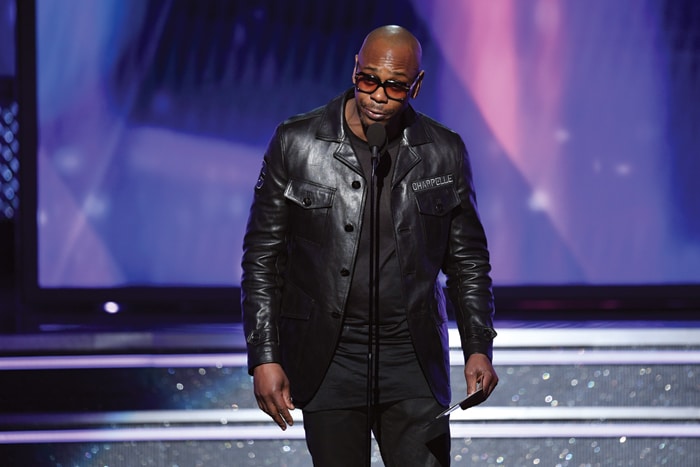
I love Dave Chapelle. I’ve laughed at his line-crossing humor, including his monologue from this past weekend’s “Saturday Night Live” that had the dual effect of also making me uncomfortable as a Jew.

I consider myself to be a student of comedy. Most people I interact with think I’m funny and I often get asked why I’m not a stand-up comedian. I guess I’d be good at it, but it seems like a whole lot of work, going to the comedy open mic circuits, and I’m at the point in my life where I’m just tired.

That having been said, I continue my studies, not just for entertainment, but also to inform my appreciation of comedy and for my eventual great act.

There’s an unwritten rule in comedy that draws from a line often attributed to Mark Twain: “Tragedy plus time equals comedy.” What this means is that everything is funny; you just need to wait an appropriate amount of time before you joke about it. There are some notable exceptions to this. For many people the Holocaust will never be a source of humor and that joking about it will cause problems for everyone. (This makes me wonder about the pitch meeting for the old show “Hogan’s Heroes.” “It’s a comedy set in a German prisoner of war camp — hilarious!”) The secret part to this rule of comedy is that for many comedians everything is funny immediately. They (and possibly we) just know, at least most of the time, not to say it right away while the tragedy is still fresh in the public’s mind.

Enter Dave Chapelle, fresh off his not quite cancellation by the trans community and supporters due to his alleged transphobic material. 

Dave’s monologue, which was lengthy in terms of the amount of time hosts are typically given, dealt with many things, including Kanye West, the midterm elections and, of course, the Jews. As a self-professed student of comedy, I have studied Chapelle’s sets thoroughly. I have watched all his Netflix shows. I have seen a handful of his TV show episodes, and I have followed his career with a great deal of enjoyment for a long time. I must admit, I laughed throughout his entire monologue, even when he mentioned “the Jews” and it became awkward. I knew when I heard this that it was going to be a problem for a lot of people. I wondered if before he came out on stage he was thinking, “Am I not doing enough to get canceled?” This monologue may speed the process along.

Dave implied that we’re not allowed to talk about “the Jews” and that although Jews may not run Hollywood, there sure are a lot of Jews in the industry. I believe that’s actually true. Southern California has one of the largest Jewish populations in the world. Many Jews come to Los Angeles, or stay, to have access to and be comforted by the large Jewish community. Here in LA, we find Jews in any corner of our city.

I don’t believe that Chapelle is transphobic or antisemitic. I think shock value humor has always been successful, and among the funniest. 

I don’t believe that Chapelle is transphobic or antisemitic. I think shock value humor has always been successful, and among the funniest. There’s a reason why “South Park,” which has crossed every conceivable line, and many we didn’t even know existed, is so successful. Most of us find it very funny.

But how comedy is delivered makes a difference. In the “Weekend Update” segment of “SNL,” Michael Che delivered a very funny joke about newly-elected women governors. It crossed a line, implying that in the states where women were not governors, dinner would be served on time. I’ll give you a minute to be shocked by this. Michael’s reaction to his own joke, gave us a clear signal that he was just kidding and saying something he doesn’t believe, just for the sake of humor. Everyone in the audience laughed. 

The difference with Chapelle is that he delivers his shocking lines with the acknowledged context that he is offending people who are trying to silence or cancel him. His delivery implies he believes what he is saying, and that it’s actually important that he gets to say it. And that’s the potential problem with his recent monologue.

Comedy has always been an important platform for social commentary on politics or any world events, and it should continue to be that. But delivery matters.

Much of the Twitter-verse responded with comments suggesting that this was the best thing “SNL” has done in decades. There were also some comments from Jews, calling out the antisemitism they heard from Chappelle’s set.

I laughed while I watched his monologue. But as a Jewish person deeply immersed in the news cycle, which lately comes complete with daily instances of antisemitism, I found Chappelle’s portrayal of Jews as the mysterious other uncomfortable.

Perhaps it sounds like I’m equivocating too much. I admit to appreciating Chappelle’s comedy on its own terms. I laughed while I watched his monologue. But as a Jewish person deeply immersed in the news cycle, which lately comes complete with daily instances of antisemitism, I found Chappelle’s portrayal of Jews as the mysterious other uncomfortable. Twitter has told me I’m not the only one.

P.S. Dave, please stop smoking, especially in front of audiences. This is going to kill you much sooner than the court of a public opinion will, and it’s a terrible example for children and all humans.


Rick Lupert is the poet in residence at the Jewish Journal, the author of 26 books of poems, including “God Wrestler: a Poem for Every Torah Portion“ and “I Am Not Writing a Book of Poems in Hawaii.“ Find him at www.jewishpoetry.net. 

On Dave Chapelle and the Jews Read More »

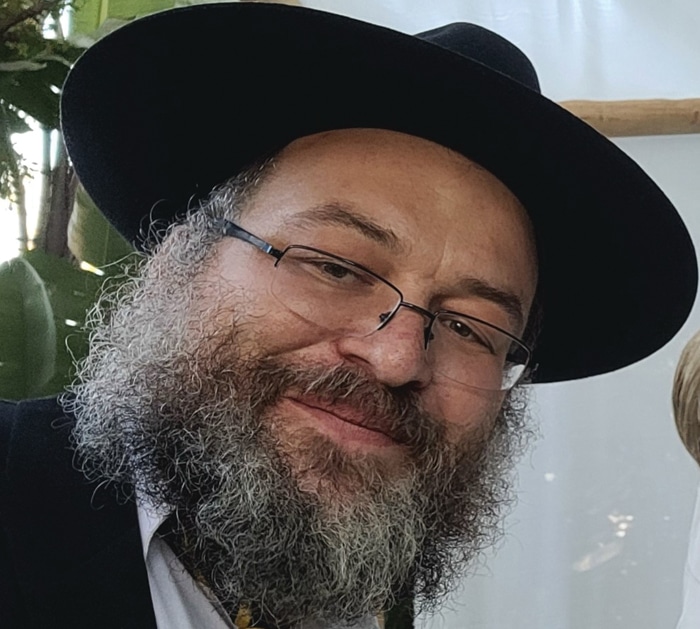
Rabbis of LA | Rabbi Dovid Gurevich: Bringing Judaism to UCLA

Practicing Judaism was not possible for Jews living behind the Iron Curtain. So when Rabbi Dovid Gurevich was coming of age in Ukraine in the 1980s, he didn’t have many Jewish experiences.

“I was aware I was Jewish, but we didn’t practice any of it,” he said. “I grew up with the fear that there would be repercussions if I did.”

In the summer of 1991, that changed. The Soviet Union was collapsing, and the government was now officially allowing Jewish programming. Gurevich, who was a teenager, attended Camp Gan Israel, a Chabad-Lubavitch summer camp. 

“I thought of myself as a pretty thoughtful 14-year-old, but being exposed to a diverse Jewish experience was a huge eye opener,” he said. “Everything was new and interesting, and I learned very quickly.”

Gurevich was drawn to Orthodox Judaism. When his family arrived in Los Angeles in 1992, he attended Valley Torah High School, and then he learned in a Chabad yeshiva in Kfar Chabad, a Chabad-Lubavitch community in Israel. He wasn’t sure he was going to become a practicing rabbi, so he went to law school back in the United States. 

“After a few years of practicing law back in Los Angeles there was an opportunity that arose at UCLA, and I felt like it couldn’t pass by,” he said. “I jumped into it, and I’m still here 16 years later.”

Gurevich and his wife Elisa serve as Chabad shluchim (emissaries) on the UCLA campus. For nearly two decades, they’ve hosted weekly Friday night dinners for up to 200 students; Elisa makes the meals, which includes baking challahs for the dozens of students in attendance. 

“We are a team, and she does the heavy lifting,” Gurevich said. “She does pretty much everything I do and it’s a major partnership. It’s very unique in that way.”

The rabbi helps students put up mezuzahs on their doors, offers classes like “Parsha and Pizza” and “Soul Maps: Kabbalah of You” and holds daily minyans, where men can wrap tefillin. 

According to Gurevich, it’s important for students to connect to their Judaism while they’re in college because “they either make it or break it on campus,” he said. “It’s their heritage, and I think it can enrich their lives. They shouldn’t miss out on their core identity. They make big life decisions around this time, like where they will live and work and whom they marry and how they will raise their children. It’s such a crucial and pivotal time in their lives.”

While Gurevich and his wife offer inspiration to students, it’s not always easy to get students involved when they face antisemitism and anti-Israel sentiments on campus and in the world at large.

“There have been changes over the past 16 years,” he said. “The attitudes that students have and the climate have changed. Even between older and younger siblings, for younger ones, it’s a bigger struggle to be Jewish. Students are impacted by cancel culture, political correctness and anti-Israel talk.”

Right now, Gurevich said many students feel scared, though most of it is internalized. 

“It’s not the actual reality. If someone were to display their Jewish identity openly, I don’t think they would encounter problems on a day-to-day basis, but from time to time an incident can spark fear. People are a lot more cautious and easily intimidated.”

Even though antisemitism and anti-Israel sentiments are increasing every day, Gurevich doesn’t let that slow him down.

“I enjoy being able to have an impact on a young person’s life, like how my life was impacted in Ukraine.”

“I enjoy being able to have an impact on a young person’s life, like how my life was impacted in Ukraine,” he said. “I find it to be extremely meaningful and unique.”

When he’s working, he always keeps the Torah teaching “Love your neighbor as yourself” in mind.

“It’s something the Rebbe ingrained in his followers,” he said. “It’s the driving force behind everything that we do.”

His motivation for serving the students at UCLA? To do mitzvot, to bring Jews closer to their Judaism and hopefully usher in the future redemption.

“The ultimate goal is to bring Moshiach,” he said. “Every small thing we do is another piece of the puzzle that we will hopefully be able to complete.”

Fast Takes with Dovid Gurevich

Jewish Journal: What’s your favorite Jewish food?

Dovid Gurevich: I, and hundreds of students and alumni, would have to celebrate our addiction to my wife’s homemade challah.

JJ: What was your favorite subject in school? 

DG: History. I loved all kinds of history and still do. I feel that people never learn from it enough and the main mistakes could be avoided by looking at the past.

JJ: What do you do on a day off?

DG: I usually try to organize and catch up on things I feel I’m behind on, including learning a little bit more Torah.

JJ: If you could have any superpower what would it be? 

DG: To slow down time. I feel like it flies by too fast sometimes. 

Rabbis of LA | Rabbi Dovid Gurevich: Bringing Judaism to UCLA Read More »

WWII-Era Boxcar Arrives Ahead of Auschwitz Exhibit Premiere

On a chilly Thursday morning, a German-made World War II-era freight car, one that could have been used to transport victims of the Holocaust to Auschwitz, arrived at the Reagan Library.

Towed by an 18-wheeler, the freight car arrived at 9:15 a.m., trailed by a helicopter as well as a motorcade of 50 motorcycles featuring leather-clad riders, Simi Valley Police Department officers and U.S. veterans.

The freight car is a key artifact in “Auschwitz. Not long ago. Not far away,” a traveling exhibition that will be making its West Coast premiere at the Simi Valley-based Ronald Reagan Presidential Library in the spring.

The boxcar, which arrived at the Reagan Library on Nov. 10, is one of 700 artifacts of historic and human interest that will be displayed in the upcoming exhibition, which was created by Spanish traveling exhibit company Musealia in partnership with the Auschwitz-Birkenau State Museum in Poland.

“The museum in Auschwitz decided it was not only time to bring people to Auschwitz but to bring Auschwitz to people.” -Michael Berenbaum

“The museum in Auschwitz decided it was not only time to bring people to Auschwitz but to bring Auschwitz to people,” Michael Berenbaum, director of the Sigi Ziering Institute at American Jewish University and the curator of the exhibition, said.

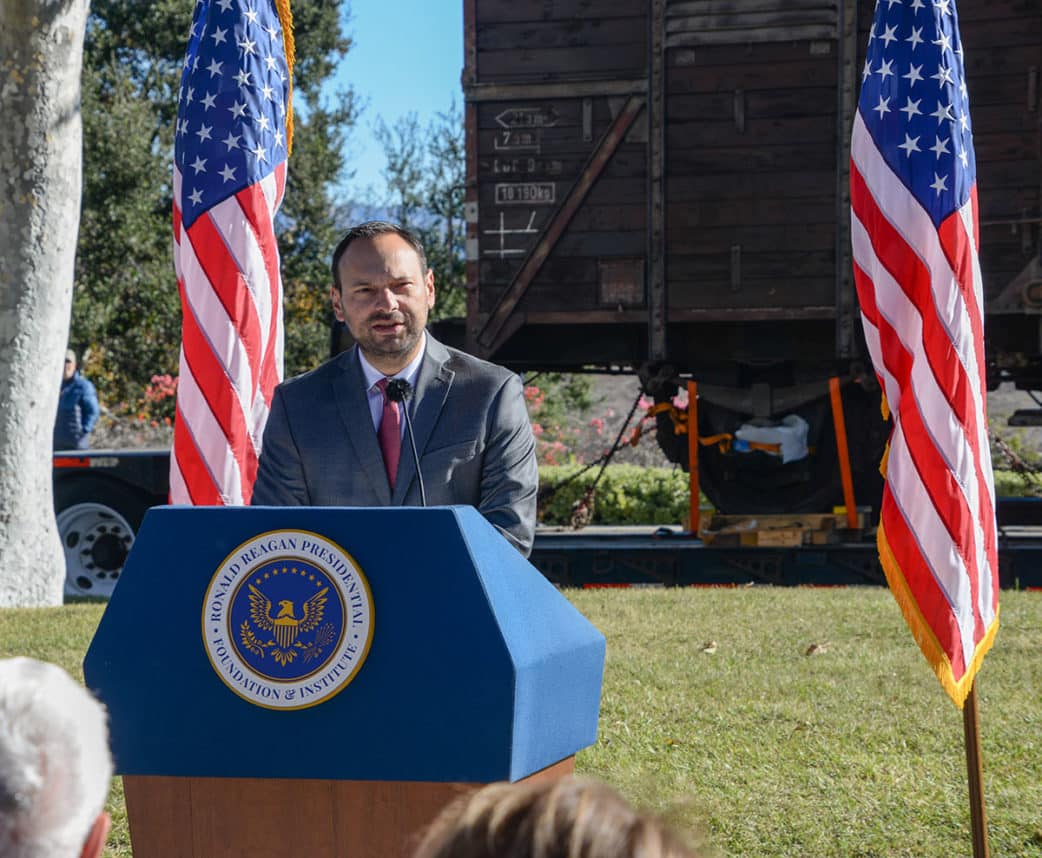
Michael Berenbaum, director of the Sigi Ziering Institute at American Jewish University and exhibition curator. Courtesy of the Ronald Reagan Presidential Foundation and Institute

Last week, Berenbaum was one of a handful of community leaders on-site for the boxcar’s West Coast arrival. He spoke at the Reagan Library along with Valley Beth Shalom Senior Rabbi Nolan Lebovitz; Auschwitz survivors David Lenga and Joe Alexander; and former U.S. Ambassador to the European Union Gordon Sondland. 

They appeared before a small crowd of journalists, Reagan Library staff and members of Patriot Guard Riders and Rolling Thunder CA-1, national nonprofits dedicated to celebrating fallen U.S. military service members that participated in the boxcar’s motorcycle escort. 

The program fell on the 84th anniversary of Kristallnacht.  As the mammoth truck hauled the boxcar up the windy Presidential Drive to the library’s entrance, John Heubusch, executive director of the Ronald Reagan Presidential Foundation and Institute, explained the truck had brought the freight car to Simi Valley from Kansas City, which last year became the second location in the U.S. to host the exhibition. 

The boxcar is being installed in the Reagan Library’s main courtyard. 

On Thursday, the speakers discussed the symbolism of the boxcar at a time when antisemitism is on the rise.

Valley Beth Shalom Senior Rabbi Nolan Lebovitz appeared at a ceremony at the Reagan Library marking the boxcar’s arrival. Courtesy of the Ronald Reagan Presidential Foundation and Institute

“When we look at a boxcar like this, we remember the consequences of hate left unchecked,” Lebovitz said. “We realize that history now looks to us to stand up.”

Lebovitz also praised President Ronald Reagan’s close ties with Israel. The 40th U.S. president, the VBS rabbi said, “stood as one of those great friends of the Jewish people here and around the world. President Reagan was one of those great friends of the State of Israel.”

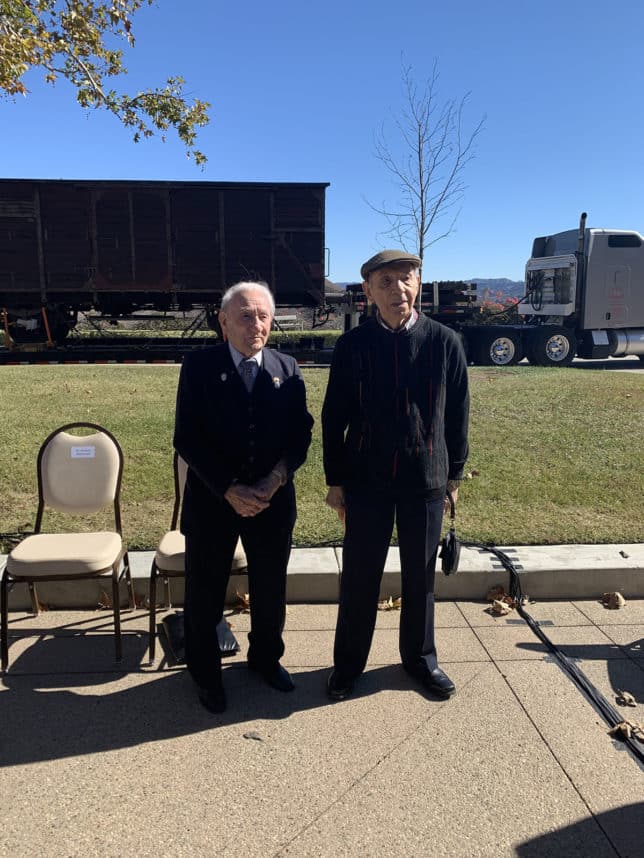
Providing a human face for tragedies experienced during the Holocaust, both Lenga and Alexander — who were just boys in Poland when the Nazis began targeting Jews — shared stories of their survival.

From left: Auschwitz survivors Joe Alexander and David Lenga. Photo by Ryan Torok

Imprisoned in Auschwitz when he was 14 or 15, Lenga snuck into a group of prisoners that were being transported from the camp. He’d not been chosen for this group, but he went anyway, thinking a safer fate awaited them than those left behind. As the train pulled away, a man, still outside, yelled that he’d been selected but overlooked. Lenga, without knowing, had taken his fellow inmate’s place on the train. But at that time, under those extreme circumstances, Lenga did not have the capacity to feel anything, he told the crowd assembled at the library. 

Decades later, the 95-year-old has committed himself to remembrance.

“We all owe it to the Holocaust victims — both those who lost their lives and those who were fortunate to survive — to show our respect,” he said. “We must remember them with dignity and gratitude and recognize the horror they endured.”


“Auschwitz. Not long ago. Not far away” opens March 24, 2023 at the Reagan Library. For tickets and additional information, visit reaganlibrary.com/Auschwitz.

WWII-Era Boxcar Arrives Ahead of Auschwitz Exhibit Premiere Read More »

The School That Changed My Life

My first day of high school, I walked into the lobby and saw students with dyed red and green hair, boys and girls carrying paint easels and cameras and a girl running down the hallway with a fake tail attached to the back of her T-shirt. Everyone was quirky. Everyone was strange. 

I smiled and thought: I’m home. 

I came from a middle school where I didn’t fit in. The popular girls would pass each other notes in class and put makeup on in the bathroom together and giggle about boys. I kept my hair in a messy bun, got good grades in English and listened to my Sony Walkman. 

The girls never missed an opportunity to make me feel like I was a freak. 

“You’re weird,” they’d say to me, laugh, flip their hair, and walk away in unison.

I would quietly cry at my locker when they weren’t looking and think, “Why are they making fun of me? What did I do to deserve this?” I guess I was different, but was that really a bad thing? Was I not a good person? 

And, inevitably, I’d think: Were things ever going to get better?

Instead of going to the local public high school, I applied to a magnet school, a specialized school that prepared students for their future careers. There were “primes,” which were like majors. I applied for business, but the school also had fine art, dance, the culinary arts, singing, cosmetology, carpentry, acting and literary arts. When I was accepted, I had no idea what I was in for. 

That first day of high school felt like a giant, warm hug. 

I immediately made friends with a group of Jewish kids who all knew each other from middle school, but they took me in. We spent Friday afternoons hanging out at the mall, drinking Slurpees and trying out the Sleep Number beds while testing the employees’ patience. 

I could be myself around my friends. I didn’t have to worry about dressing a certain way or thinking about what I was going to say before I said it or wondering if they thought I was a freak. 

In high school, I talked about existential issues and joked around with my teachers, who treated us like young adults instead of kids. In the middle of accounting class, I’d ask my teacher Ms. Lynch, “What is the meaning of life, really? Does it need to involve boring balance sheets? Please tell me it doesn’t, Ms. Lynch.” 

She’d laugh and match my obnoxiousness with sarcasm.

“Yes, it does. It absolutely does. Now go back to those liabilities,” she’d say with a wink. 

High school was the first time I felt that the adults in my life were actually listening to me. In middle school, when I’d speak up or be funny, I’d get yelled at and sent to the guidance counselor. Now, I was validated. I wasn’t some annoying kid.

High school was also the first time people recognized my writing talents. I received compliments on my work in the school paper, where I flourished as a columnist who wrote about life’s trials and tribulations. Not much has changed since then, I guess.

This time in my life was profound. It taught me a major life lesson: There is always hope.

This time in my life was profound. It taught me a major life lesson: There is always hope.

I was hopeless in middle school. I felt trapped. I felt like the world didn’t want to hear from me and there was no point to being alive. Kylie was useless. Kylie was nothing. 

That all changed within a short period of time. I was so wanted and so loved in high school. All it took was a change in environment and finding people who appreciated me for who I was.

Home is out there. Sometimes you have to search hard for it, and sometimes Hashem makes it easy and lovingly hands it to you. 

One thing is for sure. When you find it, you’ll know: This is exactly where I’m meant to be. 

Want to reminiscence with me? Email me at Kylieol@JewishJournal.com.


Kylie Ora Lobell is the Community Editor of the Jewish Journal.

The School That Changed My Life Read More »

Can American Jews Make Demands on Israel If They Don’t Live There?

On Monday morning, news broke that controversial, far-right, probable soon-to-be-minister in the Knesset Itamar Ben-Gvir, while in coalition talks with Benjamin Netanyahu, expressed support for an amendment to existing Israeli policy, an amendment that would no doubt harm relations between American Jews and Israeli Jews. This change relates to aliyah — who is considered Jewish enough to move to the Jewish state, and who must be kept out. Status-quo Israeli policy welcomes converts to Judaism into Israeli citizenship, even converts who underwent the process of becoming Jewish with a rabbi in the Reform movement. The approval of such Jews has drawn the ire of the more observant in Israel, including the Rabbinate, which notably launched an open rebellion against the state when hundreds of thousands of Russians began emigrating in the 1990s, some of them with only one Jewish grandparent.

Ben-Gvir is seeking to revive this war by ensuring that only converts who were guided by an Orthodox rabbi are allowed to immigrate to Israel. American Jews, the second largest Jewish community on earth, tend to trend more liberal on such matters, and they aren’t afraid to show it. Comments online after the news broke ranged from: “This lunatic (Ben-Gvir) thinks he gets to decide who qualifies as a Jew and who doesn’t,” “Ben-Gvir is determined to ruin the state,” and “This will be a divorce between American and Israeli Jews.” Yaakov Katz, Editor-in-Chief of the Jerusalem Post, writes: “This is just the beginning. Hang on tight.” 

Regardless of whether this more traditional preference on the matter of aliyah has any possibility of being a reality (and not just typical saber rattling from rabble rousers in government), this development has sparked a familiar debate. And I am in a unique position to see both sides when it comes to whether or not American Jews deserve to have an opinion on Israeli politics.

Israelis have a right to their ruffled feathers when those who have not spent a day in their shoes feel entitled to explain how they should vote and how they should feel about their reality.

Last week, Thomas Friedman of The New York Times wrote a scathing opinion piece on the heels of the Israeli election, airing fears that “the Israel we once knew,” meaning the one that American Jews are comfortable defending, is slipping away. Whether or not to support Israel “will haunt pro-Israel students on college campuses. It will challenge Arab allies of Israel in the Abraham Accords … it will stress those U.S. diplomats who have reflexively defended Israel as a Jewish democracy that shares America’s values,” Friedman writes. 

Though I have lived in Israel for barely two months, I can sympathize with some of the bitter reactions to this piece from Israelis, which are based, I believe, in a justified resentment. It’s true: Most Diaspora Jews have not served in the Israel Defense Forces, most of us do not understand the language being spoken by the politicians who we want to make certain kinds of decisions, and many of us have never even spent a prolonged amount of time in the Jewish state. 

When the Executive Council on Australian Jewry published a statement condemning the rise of Itamar Ben-Gvir and partner Bezalel Smotrich, comments on their Twitter page ranged from “Stay out of our Israeli election, focus on Australia,” to “If you don’t like the results of the election, put on your big boy pants, move here and vote,” and “With all due respect, Israeli politics can only be by Israelis, in Israel, in Hebrew … Diaspora communities cannot be a part of it.”

This discomfort must be acknowledged as valid. Israel is constantly in the limelight of the international arena, constantly analyzed unfairly, disputed, and placed under harsh scrutiny by those who see the land between the river and the sea as a grand morality play between good and evil. Israelis have a right to feel defensive; they have a right to their ruffled feathers when those who have not spent a day in their shoes feel entitled to explain how they should vote and how they should feel about their reality.

If Israeli Jews shifting further and further to the right truly feel that American Jews have absolutely no standing to intrude into their lives, then they cannot expect American Jews to remain vocally supportive of Israel.

Yet this right does not come without its consequences. If Israeli Jews shifting further and further to the right truly feel that American Jews have absolutely no standing to intrude into their lives, then they cannot expect American Jews to remain vocally supportive of Israel, as Thomas Friedman says, either on campus, in politics or in the diplomatic arena. They would have to rely on support mainly from Evangelical Christians, who unlike American Jews, emphatically support right-wing policies in Israel like annexation of the Palestinian territories and the incorporation of more religious law in the public sector. Such a future, many agree, such a detachment from Israel in the lives of American Jews, is far from appealing. 

Tsvi Bisk, social critic and author of “The Suicide of the Jews,” said during an interview for his (very Zionist) book: “We (Israeli Jews) have resentment, justifiable resentment, at the hypocrisy and double-standard of the world … our resentment is justified. However, you cannot make rational policy based on an emotional resentment.” 

What Bisk means by this is that yes, when an animal is backed into a corner, lashing out is expected. But this impulse cannot infiltrate a society so profoundly that it results in terrible governance. Is American infiltration, what some Israelis go so far as to label a form of cultural imperialism, justified? Probably not. But is doing whatever the hell you want as a response, with no eye on international opinion let alone on the attitude of half the world’s Jews, justified? Definitely not. 

The emotional tug of war will no doubt continue to persist. Israelis will be shocked and offended by UNESCO’s shameful declaration that Jews have no right to the Temple Mount, which will compel them further to vote for radical parties. Jews in the Diaspora will continue to voice their moral condemnations of this, which will only deepen the hostilities.

A solution to this quandary would be for both sides to bite the bullet. If Jews outside of Israel feel so strongly about what is happening in Israel, they should take the advice of those with whom they most disagree and move their lives here. They’ll have a stake in the future of the nation, and will have a sturdier platform when speaking for or against its policies. Simultaneously, Israeli Jews should come to realize that though they are entitled to their choices, they are not entitled to be free of scrutiny and backlash, and that what the rest of the world thinks of you does make a difference in the future. No nation has ever been able to survive moral and political isolation, especially not one whose citizens consider millions living overseas to be part of the nation as well.


Blake Flayton is the New Media Director and Columnist at the Jewish Journal.

Can American Jews Make Demands on Israel If They Don’t Live There? Read More »