One verse, five voices. Edited by Salvador Litvak, the Accidental Talmudist
But today we are not fearful. The very opposite! These are the days of our joy, the season of rejoicing. These are days when we sense the bounty of Your world, the richness of harvest, the wealth of resources we have been given. We shout Hosha-na! out of joy and not out of fear.
– Meditation on Hoshana Rabba prayers
Aliza Lipkin Writer and Educator, Maaleh Adumim, Israel
Rosh Hashanah and Yom Kippur are known as Yamim Noraim, literally translated as “Days of Awe.” We acknowledge God’s sovereignty at the onset of the new year and seek atonement throughout the Aseret Yemei Teshuvah, the ten days of repentance. These are awe-inspired days replete with devotion and dedication to repairing our relationship with God and His Torah.
The Days of Awe are not intended to be fear-based. They begin with recognition of God’s sovereignty. The acknowledgment that He is the ultimate Source of everything that exists compels us to subject ourselves to His will in order to extend our own existence. God’s will is that we walk in His ways and follow the Torah, thus “lengthening our days” by imbuing them with meaning and value. This recognition causes feelings of remorse for the times we strayed. Recognition and regret are vital components of teshuva that aid in connecting our soul to its Source. This connection gives rise to a sense of vitality and joy that is unparalleled. The God within is the life force that gives us meaning and purpose. Thus it is with renewed spiritual vigour and fervour we feel a more complete sense of awe for God. One that finds us not simply crying “save us” out of fear of lack but “save us” from a life of futility by keeping us connected to haKadosh Baruch Hu, For it is this connection that makes the bounty and resources of this world truly blessed!
Rabbi Abraham Lieberman Judaic Studies, Shalhevet HS
On the final day of Sukkot (before Shemini Atzeret begins) is Hoshana Rabbah.
The Zohar teaches that on this day the final seal is placed on the verdict issued on Yom Kippur, hence Hoshana Rabbah also has been named a Mini Yom Kippur. The Hazzan wears the white Kittel, the number of prayers is increased, some of the tunes invoked resemble the Yom Kippur tunes.
Yom Kippur, a very solemn day of repentance, would naturally bring with it a sense of trepidation and fear. This beautiful, positive prayer posits the opposite. It brings forth in us a sense of humility as we realize the blessings bestowed upon us. On Hoshana Rabbah, as we take leave of the Arbah Minim (the Four Species), we lift the Arava, the simple willow. Unlike the other three species it has nothing to show: No smell, no taste, just leaves, just the willow. Yet it is the willow that allows us a sense of security on this day. The great Hasidic Master, Rabbi Yehudah Aryeh Leib Alter of Ger, the author of the “Sefat Emet,” writes that that lonely simple willow represents The Jewish People. We arrive at the final seal of judgement not with our actions and deeds, not with a sense of arrogance, but plain and uncomplicated, in our transparent selves, in humility. Hashem’s love for the Jewish People does not depend on actions.
It is an unconditional everlasting love simply for who we are. Hence we can shout with joy Hoshana!!
David Porush Student, teacher, writer
These Great Pleas for Salvation are our very last chance. We circle with willows, take out all the Torahs, and as Rambam said, “exuberantly dance and sing.” In some traditions, we’re supposed to study and pray all night, read all of Deuteronomy and Psalms. It’s a busy day with a dramatic contradiction in its heart: How can we “beg not with fear but joy”? How do we face the most dreadful doom with an ecstatic soul?
The Hoshanot poetry itself is the answer. Read the longest version you can find — probably Sefardi or Chabad’s. It preserves deep connections to our agrarian roots, to Temple rites, to the mysteries of willow and water. We plead for rain. We invoke our heroes and the many instances of divine beneficence in our history, a long soul-lifting list of G-d’s bounty. Transcendent “geshem” flows through the verses. We acknowledge the singular miracle of Israel’s survival. This poetry, sung together, is designed to unleash maximum joy.
The Lubavitcher Rebbe asked how we can achieve climactic joy and still fulfill the other obligations on this day. “The greatness of one’s joy is not dependent on time,” he said. “A brief episode can have very intense strength … the greatest possible.” He was showing us how to activate The Maximum Joy Hoshana Rabba app and let it flow into our busy smartphone lives: Be grateful for every moment.
I’m on the floor, gazing into my infant granddaughter’s knowing eyes. Rain patters the window …
Rabbi Natan Halevy Kahal Joseph Congregation
Tishrei is the month of high holy days. ‘Tishrei’ rearranged spells “Reishit,” signifying “the head of our year,” when we draw down the energy and blessings required for the upcoming year. Our traditions help elicit these blessings.
King David states “Hashem is your shade on your right side.” Hashem reflects our actions back to us.
Rosh Hashanah and Yom Kippur atone for the past, helping us ascend from lower to higher levels. We become vessels for the energy revealed on Hoshana Raba through Sukkot, when we begin integrating these lofty blessings into our physical realm.
Joy is integral to serving Hashem and crucial to this process. Living with an abundant mindset helps our brains see opportunities all around us. When the mind is relaxed it can reach higher states of functioning.
Faith and trust in Hashem reveal goodness and blessings in our lives. Our prophets taught us this. “The blessing of the Lord will bring riches, and no sadness with it.” “Blessed is the one who trusts in Hashem; Hashem shall be their refuge.” “Those who hope in Hashem will renew strength.” “For one shall be like a tree planted by the water, that sends out its roots by the stream.”
The merit of trusting Hashem helps ensure one receives what is needed in their life, even if undeserving of this gift. How is trusting Hashem so powerful? Trusting Hashem is spiritual service. And its reward is the fulfillment of our desires.
May we all be blessed to merit this trust.
Dr. Erica Rothblum Head of School, Pressman Academy
The Rabbis believed that Hoshana Rabba was a day during which we are all judged by God, similar to Yom Kippur, as God decides whether we are worthy of the rain. To show God we are indeed worthy, we declare our joy. In other words, a criterion of our worthiness is our joyfulness. While on Yom Kippur we receive redemption by confronting our wrongdoings and asking for forgiveness, on Hoshana Rabba, we receive redemption by acting with joy. These two sacred days are in fact a pair, each in need of the other. Our tradition is teaching us that ultimate redemption is not possible without both self-reflection and joy.
Dr. Adam Grant, an organizational psychologist, writes about the origins of joy and about how emotion, especially joy, is a collective act. There is research that people laugh five times as often when they are with others as when they are alone, that exchanging pleasantries with a stranger on a train is enough to spark joy. Dr. Grant writes “You can feel depressed and anxious alone, but it’s rare to laugh alone or to love alone. Joy shared is joy sustained.” While on Yom Kippur, we spend the day engaged with our own minds, hearts and souls, the true mitzvah of joyfulness on Hoshana Rabba must happen within community. And in this there is another lesson from Judaism: ultimate redemption is only possible both when we care for ourselves and when we engage with the wider Jewish collective.
Andrew Gutmann, a parent activist warning of the spread of wokeism in schools, explained that woke ideology is rooted in “Marxist philosophical foundations” and poses a “danger to Jews” in a September 29 CAMERA webinar moderated by Jonah Cohen.
Gutmann’s activism started in the summer of 2020, when Black alumni of Brearley School — an all-girls private school on the Upper East Side of Manhattan that his daughter attended — “shared their grievances … which they perceived to be racially oriented over decades” on social media. “Everything about the school … seemed to change after that,” Gutmann said.
The school quickly expressed support for the Black Lives Matter (BLM) movement, urging students to protest. Brearley even sent out a community pledge for parents to sign, requiring them to “not only support antiracism initiatives in the school” but also agree to “teach them at home.” Gutmann and his wife refused to sign it, and the school pressured them, with the principal even threatening to bar Gutmann’s daughter from attending the school. The Gutmanns stood strong, but the principal said they would have to sign the pledge the following year and also attend antiracism sessions.
Gutmann said that “more than half of the families are unhappy with the direction of the school,” but were reluctant to speak out. Eventually, the Gutmanns switched their daughter to a different school, a decision she supported since her viewpoints were getting shut down in class, Gutmann said.
Gutmann decided to take action by sending a letter to every school family, urging them to speak up; he did not expect media attention would come from it, but former New York Times Opinions Editor Bari Weiss published his letter in her April 13, 2021 Substack newsletter, and it became “very widely read,” Gutmann said. Fox News asked him to appear on their network to discuss it, but he declined. The New York Post featured his letter on their cover, which helped spark “what was then the nascent parents movement,” as at that time most people didn’t know about Critical Race Theory (CRT).
But Gutmann didn’t fully understand the revolutionary component of wokeism until he and Paul Rossi, an educator exposing wokeism in schools, were provided access to 100 hours of leaked videos from the 2021 National Association of Independent Schools’ (NAIS) People of Color Conference (PoCC). The NAIS is a nonprofit that “influences everything” K-12 private schools do, according to Gutmann, and the PoCC is the “leading DEI [Diversity, Equity and Inclusion] conference for K-12 education” in the country. After watching these videos, Gutmann was able to decode the insidious nature of woke buzzwords, particularly: diversity, equity, belonging, inclusion and justice, all of which have different meanings to DEI practitioners.
To DEI practitioners, “diversity” is code for creating an “oppressor vs. oppressed dichotomy,” Gutmann said. They divide groups into different identities that are purportedly being victimized by a system of white supremacy. “Inclusion” urges schools to adopt “an antiracism, antibias, anti-oppression lens” in every aspect, including libraries and science classes. One video even showed a DEI practitioner referring to kindergartners as being “natural social justice warriors.” Another aspect of “inclusion” is “allyship.” “Everybody has to try to become an ally,” Gutmann said. “If not, then you’re an ‘oppressor.’”
The term “belonging” is an offshoot of inclusion, used to justify the creation of “safe spaces” on campus where “nobody can say anything that can harm me,” Gutmann explained. In his view, it’s “code for shutting down free speech.”
All of these buzzwords are used to achieve DEI goals of equity and justice and to tear “down the white supremacy culture.” For DEI practitioners, capitalism, liberalism, individuality, perfectionism and meritocracy are part of “white supremacy culture,” Gutmann said. These are “many if not all of the attributes that make our society free and good and prosperous.”
“Justice” is what happens after Western society is torn down: the establishment of a “Marxist collectivist society” with the “formerly oppressed on top,” per Gutmann. “Effectively it’s reparations,” he added, “making up for centuries or decades or millennia of certain groups being oppressed.”
Gutmann analogized the DEI agenda to China’s cultural revolution under Mao Zedong. “It’s terrifying when you realize how revolutionary this is,” Gutmann said, adding that it’s being taught “in schools all around the country.” “This is not about teaching about slavery or Jim Crow or Trail of Tears or what we did Native Americans or Holocaust education,” he said. “This is about revolutionary takeover of the schools.”
And why is this bad for Jews? In Gutmann’s view, the DEI woke agenda is implicitly antisemitic through its promulgation of anti-Israel, anti-Zionist rhetoric. DEI practitioners don’t teach people that Jews are bad, but they do view Jews as white, and their goal is to “eradicate white supremacy culture.” Consequently, they view objectivity, respecting one’s elders, respecting one’s family and respecting one’s rabbi as being part of “white supremacy culture.”
He explained that his grandparents fled the Nazis in the 1940s and came to America speaking little English and with no money, forcing them to work menial jobs. But eventually, thanks to hard work and education, Gutmann’s family lifted themselves out of poverty. “That’s meritocracy and that goes against the ‘systemic racism’ narrative,” Gutmann said.
Jewish success despite Jews being the most persecuted ethnic group in world history contradicts the woke narrative, according to Gutmann.
In the woke view, Blacks have underperformed in American society due to racism, while Jews have overperformed because they’re an “oppressor,” per Gutmann. But Jewish success despite Jews being the most persecuted ethnic group in world history contradicts the woke narrative, according to Gutmann. As such, DEI practitioners combine the Boycott, Divestment and Sanctions (BDS) with BLM and the #MeToo movement; to the woke, Israel is the colonial apartheid oppressor of the Palestinians, and thus the Jewish state must be torn down.
“It’s frightening,” Gutmann said. “It absolutely has implications.”
Many people don’t speak out because schools have threatened to expel students if their parents speak out, and thus they’re afraid of getting canceled, per Gutmann. Additionally, attending private schools in New York City is seen as an “enormous status symbol,” the gateway to get into prestigious universities and obtain a prestigious Wall Street job, Gutmann said. Parents that “make waves” put threaten this.
He stressed the need for “more Jews to understand this ideology.” “We owe it to America who has been good to us … to preserve these [classical liberal] values,” Gutmann said. “We need to mobilize significantly more number of Jews … If we lose the liberal tradition, we lose the best home for Jews outside of Israel.”
Adozen years ago, Robert Berg wrote his mother’s obituary. Although she was still alive, her age was already in triple digits. As a devoted son, international developer and a senior advisor working at the United Nations, he had learned long ago to be prepared.
He need not have hurried. Despite her immense enthusiasm for life and world-class energy, her family did not anticipate she could keep going this long.
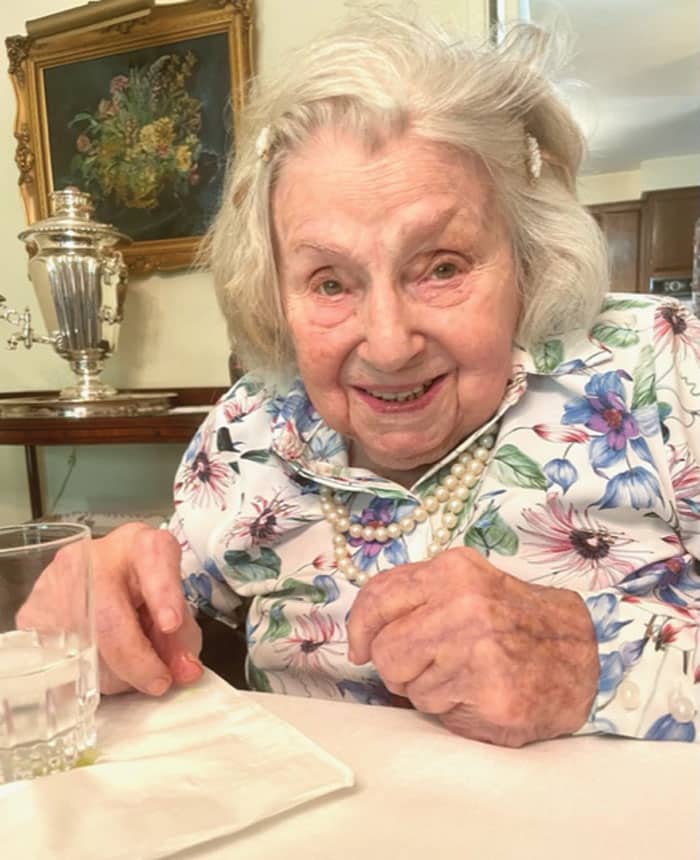
On Oct. 1, 2022 Pearl Berg, who still lives in her home of 47 years in the Los Feliz district, turned 113 years old. According to her family, Pearl is the oldest person in Southern California, the second oldest in California, eighth oldest in the U.S., and she is tied for 33rd in the world.
“We believe she is the oldest Jewish person in the United States, and likely in the world.” For a dozen years, Pearl’s birthdays have been flitting by.
“I don’t know why,” said Robert, “but I was just floating along. Then suddenly she got to be 105, 106. I started thinking ‘we are in extraterrestrial neighborhoods.’ We think a great-grandmother of hers lived to an advanced age. Her mother died at 88, but she was a lifelong smoker. My assumption is any other person would have died of lung cancer long before that age.”
This month, on Oct. 1, when Pearl was reminded by family and caretakers that her birthday had arrived, she strongly resisted the date — as she has for her entire life.
Pearl Berg on her 113th birthday
Her two sons, Alan, 84, and Robert, 82, visit several times a year, and now it was Alan’s turn when 113 dawned. One hour before a few guests were to arrive, Alan informed his mother it was her birthday. As firmly as a rock, Pearl insisted that it was not, that her birthday is in February.
According to her birth certificate, discovered about five years ago, Pearl Louise Synenberg was born, at home, in Evansville, Ind., on Oct. 1, 1909 to Annie and Archie Synenberg, whose families were from Russia and Poland, though he was born in Toronto and she in Toledo.
Pearl was named for her father’s aunt, Pearl Finkelstein. For various reasons, however, her parents told their families, and Pearl, that she had been born on Valentine’s Day, 1910, in New Orleans, one stop among a huge number of cities that her parents visited as itinerant photographers, traveling with a theatrical troupe.
As Pearl has lived knowing no other birth date, the family long celebrated her birthday on Valentine’s Day. Even on this month’s birthday, with characteristic firmness Pearl declared that this is October, and her real birthday is on Feb. 14.
As few people really know, when you have practiced a habit for about 108 years (1296 months) it is virtually impossible to overcome it.
However, through online research, Judy Taback, the birthday girl’s niece and the family historian, compiled an enormous number of volumes about her relatives and discovered the truth — Pearl’s Evansville birth certificate. Taback is the daughter of Pearl’s late sister Selma (1913-2003).
An immense amount of irony abounds throughout Pearl Berg’s fascinating and colorful life.
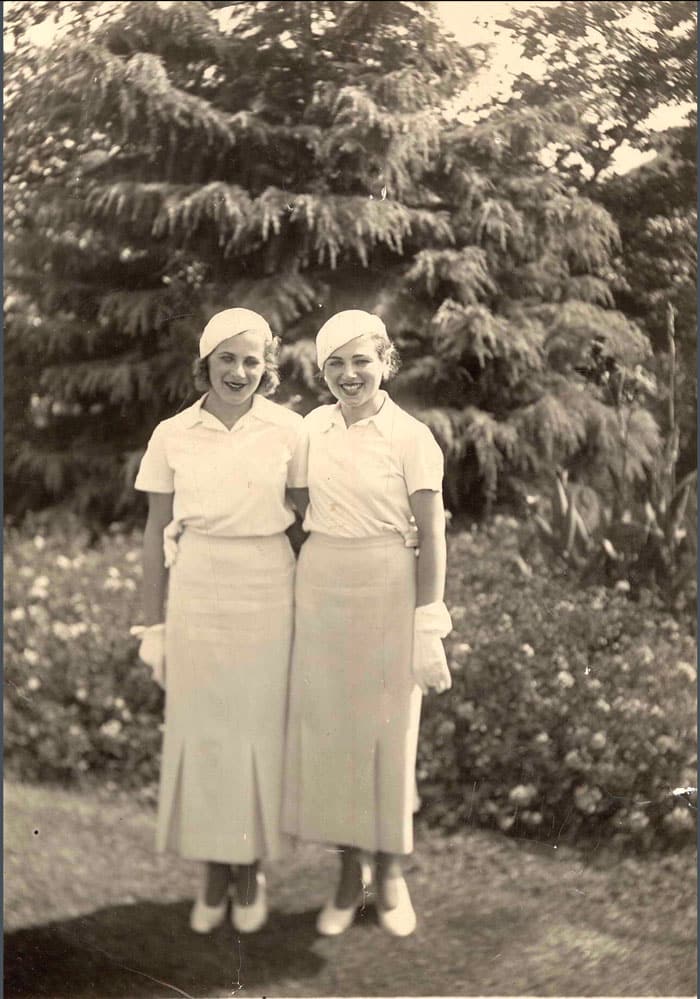
Selma and Pearl, 1934
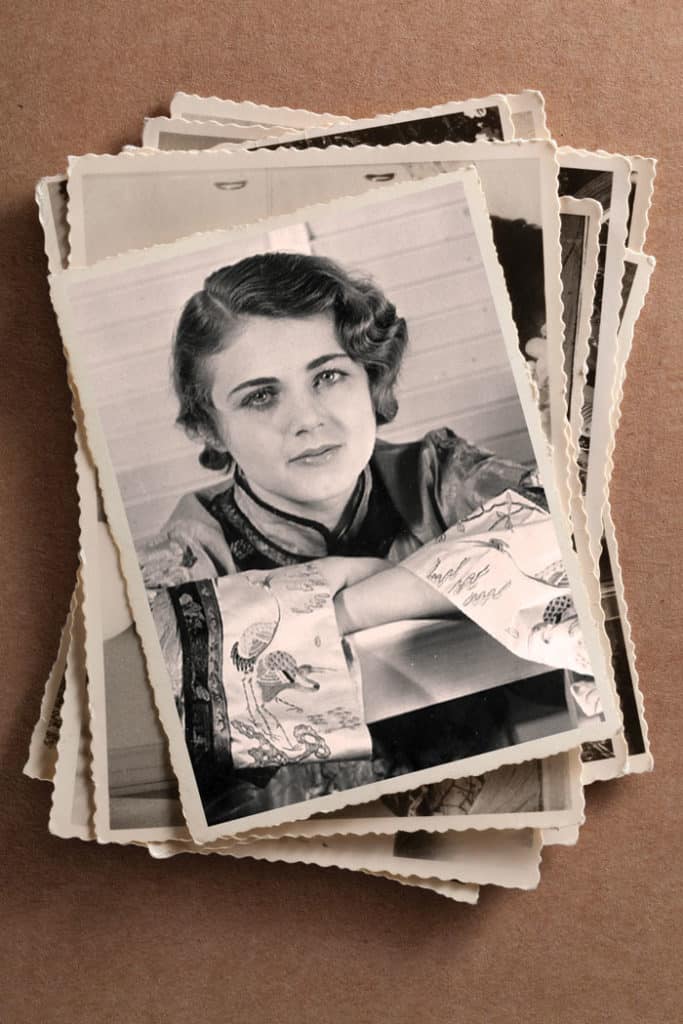
In Taback’s booklet, printed as a tribute to her Aunt Pearl’s 100th birthday, the cover page, with a photo of cute Pearl at about age five, declares “Pearl’s Story, celebrating her 100th birthday, February 14, 2010, Los Angeles, California.”
The seven lines of copy on the opening page faithfully report “Not only Jazz began in New Orleans and came up the Mississippi. Pearl Louise Synenberg was also born in Louisiana, on February 14, 1910. Her parents, Archie and Annie Synenberg, were itinerant photographers, traveling in the winter months through the South, going by train from city to city as they sought opportunities for work. In the summer months, they worked in the North. When their daughter Selma was born in 1913, they decided to stay in the North. They went to live in Canton, Ohio, not far from Archie’s family in Cleveland.” (The youngest sibling, Pearl’s brother Bob, was born in 1914.)
Although she was born in Indiana, her parents did not remain there for long. Pearl grew up in Pittsburgh. She moved with her parents to Los Angeles in 1929, shortly before her 20th birthday. Less than a month later, she met her husband-to-be, Mark Berg, an ambitious immigrant from Ukraine. Pearl’s cousin introduced her to the girl he was dating, Louise Berg. Louise had been tasked with finding a date for her “old” Uncle Mark, 28 at the time, for a group outing to the mountains. Face-to-face for the first time, Mark immediately was smitten by the diminutive, 4-foot-11 Pearl.
Pearl and Mark wed two years later on Nov. 15, 1931 in the Boyle Heights home of the rabbi who married them. The couple honeymooned in Murrieta Hot Springs, a Riverside County resort that was popular at the time and cost $50 per week for food and accommodations.
Judy Taback, the family historian, explained what came next: “By the mid 1930s, it was clear that Mark was very ill. His symptoms were extreme fatigue, loss of appetite, darkening of the skin, low blood pressure and depression.
“Los Angeles doctors suggested he go to the Mayo Clinic for a diagnosis. There he was diagnosed as having Addison’s Disease, the same affliction that John F. Kennedy had many years later. Pearl and medications nursed him back to health. But he always carried the disease. When he died, he had the distinction of having the oldest case of Addison’s on record.”
Pearl was widowed 33 years ago at the relatively tender age of 80 after an intensely active and involved 58-year marriage.She eventually became a vital part of Mark’s successful business, Berg Metals, Berg Pipe and Steel, Airomotive Equipment of Southern California, and a brokerage business specializing in extra-large pipe.
Taback said that Pearl was “Mark’s big asset” in transforming business connections into friends. “Her beauty, her fine hostessing (starring her coconut icing cake), bright remarks and laughter led to lifelong friendships.
“For example, there were the Brocklehursts. Pearl and Marge Brocklehurst became best friends for over 50 years until Marge passed away at age 100. “Their friendship (Marge and Pearl talked on the phone often) created beautiful memories — trips to Balboa, parties and just being together — that have lasted into the next generation.
“Another example of Pearl’s asset to the business was her help with Japanese businessmen who would bring their wives for dinners at fancy restaurants.
“The wives did not speak each other’s languages,” said Taback, “but Pearl’s smiles and sympathetic gestures did their magic with the counterpart wives. Those evenings ended with a hug (and a deal sealed).
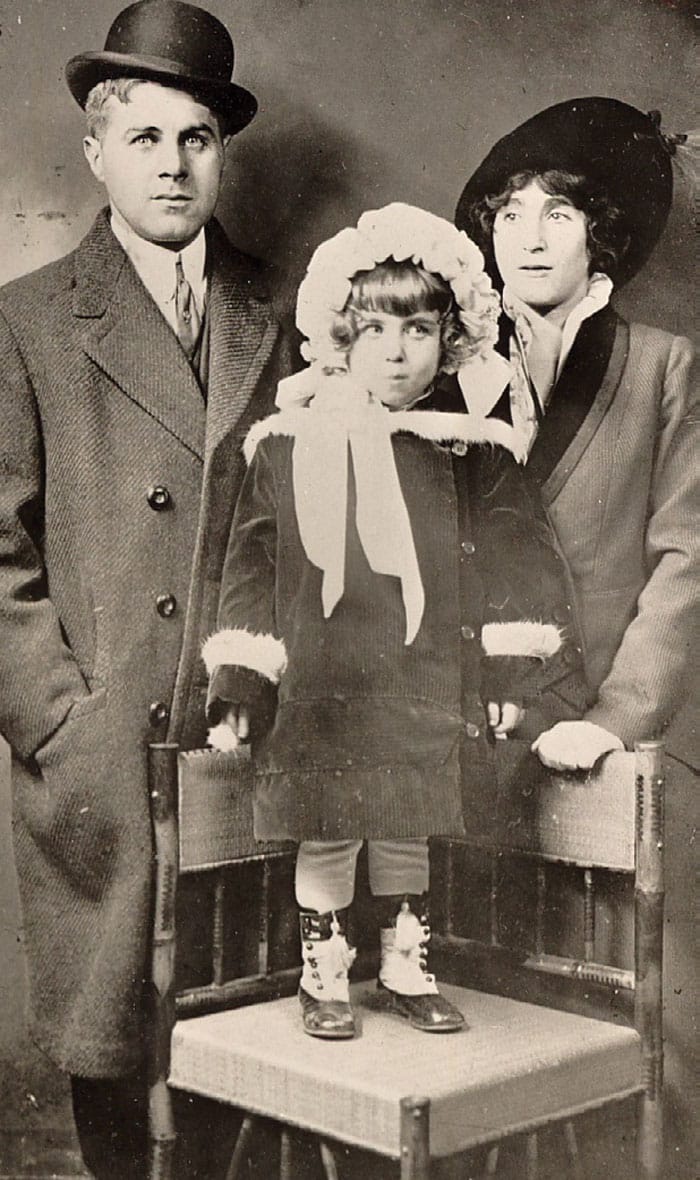
Pearl with her parents, 1913
“Pearl was and is very close with her family. Her parents had a difficult life economically and as a social unit. But she made the best of it, as did her sister, Selma.”
Over the years, Pearl accompanied Mark on many of his business trips to cities across America. Often they would combine family with business and entertaining customers. Additionally, Pearl and Mark traveled to lands across the globe, leading to this classic Pearl story. Taback reports that in May 1961, Pearl traveled with Mark for a two-week adventure in Japan. “Without speaking two words of Japanese,” Taback said, “Pearl won over their business hosts by simply smiling and being supportive of Mark. Good thing. Mark, a paragon of ethics, was chagrined to have to bring a gift to the CEO of a major steel company. The Bergs brought a mink stole only to find that a competitor had brought a Buick. Pearl, however, was the equalizer.”
After arriving with his Ukrainian family in Pasadena in 1924, in order to learn English, the 24-year-old Mark attended night school and during the day also attended third grade at a local elementary school. Additionally, he started to work at California Mill Supply, sorting used bottles by color. By the end of the 1920s Mark was with Berg Metals as a buyer of scrap metals and quickly rose to management levels on his way up the ranks. He even had a new car, a Hupmobile. By the end of World War II, he was general manager.
She created a new life of theater, concerts, book groups and bridge — all of which she was active in for decades.
Looking back four decades, Pearl’s family recalls she almost literally took a time-out from 1980 to 1989 after Mark was diagnosed with Parkinson’s disease. She cared for him through that ultimately fatal disease, and in the last years was augmented by professional caregivers. After Mark died in late 1989, Pearl pulled herself together impressively. She created a new life of theater, concerts, book groups and bridge — all of which she was active in for decades. Knitting and beading became two of her favorite pastimes.
Robert reported that “one of the really nice things she did when she was in her late 90s, and until she was 105, was to write condolence notes on behalf of Temple Israel of Hollywood. She labored over them … very carefully. Each message was individual. She searched for the specialness of every person.”
In 1937, the year of their first son’s birth, Pearl and Mark joined Temple Israel of Hollywood, where Pearl remains a member after 85 years. “I think people used to come to temple on Friday nights just to see her and greet her in her front-row seat,” says Taback.
Let there be no doubt about Pearl’s sense of humor, even when it was unintentional. Robert remembers a conversation in 2001 when she was 92 years old and still driving. “My car has a slight shimmy,” she told Robert. “But it goes away when I go past 70.” She drove until her mid-90s.
One explanation for Pearl Berg’s uncommon longevity may be that she appears to have been nearly as active in the second half of her life as she was in the opening half.
One explanation for Pearl Berg’s uncommon longevity may be that she appears to have been nearly as active in the second half of her life as she was in the opening half. While she has confronted and dealt with periodic dementia, some things never change. Her daily diet is one example of this consistency, and includes “dark chocolate of any kind and desserts,” says Taback. “They keep her going.”
While the Bergs are proud of Pearl’s longevity, Robert said the only time she commented on it was on her 107th birthday in 2016.
A KTLA television reporter visited the house to interview her during her birthday party. His first question was, “Mrs. Berg, how did you get to be 107?” She looked up with a twinkle and said, ‘First, you have to be 106.’ She has a lovely sense of humor,” says Robert.
Like their high-achieving parents, Pearl and Mark Berg’s two sons have made strong marks on their professions.
Alan P. Berg, Ph.D, MD, 85 in a few weeks, is a retired, award-winning physician who lives in a suburb of Philadelphia. He was known for meeting with his patients in their homes, people too sick to be out of their homes but not sick enough to be hospitalized.
Robert Berg, 82, has careers in international development, non-profit leadership and has worked as senior advisor to four major parts of the United Nations: UNICEF, UNDP, UNESCO and the UN Economic Commission for Africa. He lives in Washington D.C., and travels regularly.
Three years ago the Journal reported on Pearl’s approaching 110th birthday. In a reflective mood, Rabbi John Rosove, rabbi emeritus of Temple Israel of Hollywood, recalled that he “blessed her at services every year since she was about 100.” He said that when he uttered the traditional phrase, “To 120,” Pearl responded, “Please God, no.” And there she was, almost 110.
Rosove described Pearl as someone with “a great sense of humor. He continued: “Every time I see her, she brings a smile to my heart, and she doesn’t complain about anything,” Rosove said. “If you ask her, ‘How are you?’ she says, ‘I’m 109, what do you think?’ She’s one of those favorite people that you come across from time to time [who] is somewhat ageless.”
There is no question about Pearl and Mark’s commitment to Judaism. She was a leader of Hadassah until the end of her active days. Robert said his parents were committed to support of Israel, especially when it was fighting in 1948. But the elder Bergs knew when to speak out and when being quiet was crucial.
“My mother was silent when my father and his older brother Mischa — then head of the Los Angeles Jewish Federation — arranged in 1947 for a shipment of ‘agricultural equipment’ to Israel, via Mexico,” Robert said. While the boxes were marked with those two innocent words, “agricultural equipment,” the contents were actually airplane engines meant for the Israeli air force.
“Neither of my parents ever spoke about this,” said Robert.
It is said that all who have entered Pearl’s circle during the past 113 years became immediately familiar with her reputation as a fashionista.
It is said that all who have entered Pearl’s circle during the past 113 years became immediately familiar with her reputation as a fashionista. From the earliest days of her Queen Esther costumes at Purim to the galas she attended with her late husband Mark, Taback said Pearl “always has dressed with a flair.” Incidentally, she could remember what everyone wore and said at the bar mitzvahs, weddings and funerals of the past. Relatives have marveled at her memory.
For those who are struck by irony, Pearl and Mark moved into the Los Feliz district home that they designed and had built on the November day in 1966 that their only grandchild, Belinda, was born to Robert and his wife Ellen.
In contrast to the lifelong upbeat Pearl, her mother Annie’s childhood was oppressive. It would leave its mark. When Pearl’s grandfather enlisted in the Army — he served in the Spanish-American War in 1898 — nine-year-old Annie was left to tend to her younger sister, Josephine, while her single mom went to work as a peddler, selling items door-to-door. This practice was not only extremely rare but also dangerous for a woman. Since Annie was bright — she had a few years of schooling and could read and write — she kept her mother’s books for her business. Starting as a young child, Annie also did all the housework, cooked meals and looked after her younger sister.
Archie, Pearl’s father, had a different upbringing. Though his mother died when he was only nine years old, family lore holds that he led quite a happy existence since everyone fussed over him. He lived with his father and was cared for by his older sisters.
Following the 1909 marriage of Annie and Archie Synenberg, and Pearl’s birth, the family pursued photography (Archie’s first professional love) for two more years, before moving to Cleveland to operate a silent movie theater. By 1914, Archie, Annie, Pearl and Selma relocated to Pittsburgh the year brother Bob was born.
The Synenberg family joined Rodef Shalom Synagogue, a Reform congregation where Pearl was confirmed May 19, 1926. Her class had over 100 students.
Pearl attended Schenley High School in Pittsburgh, two-and-a-half blocks away from her home on Craig Street. She was remembered as a very good student. However, as with many young girls at that time, she opted to leave high school after completing the 11th grade. She enrolled at Grace Martin’s Secretarial School for her senior year. When she graduated, she immediately secured a job. Her father always felt, though, that she could have become a lawyer if she had been able to attend a university.
Archie Synenberg owned a garage, Massie’s Motors, a few blocks from their home. He sold used cars and also had car repair facilities. Around 1927, Archie acquired a Hudson-Essex agency, selling cars for budget-minded people. But as the 1920s came to a close, sales sank to zero. The Great Depression was at hand. For business owners such as Archie, there were no prospects of a recovery. Things grew desperate.
Due to the economic conditions Archie faced, the Synenberg family decided to sell their home to a doctor who lived in an apartment building next door and move to California, where Annie had family. Her mother, Jennie Gerson, had moved there in 1926.
As the family was preparing to drive across the country in August, 1929, Pearl’s life was about to change dramatically.
As the family was preparing to drive across the country in August, 1929, Pearl’s life was about to change dramatically. First, though, Pearl, her sister Selma and her brother Bob, all teenagers, shared space with their parents for the cross-country journey in the family’s McFarland, a large touring car.
When the Synenbergs first arrived here in Los Angeles., since almost-20-year-old Pearl no longer was a girl but a young woman, she needed to help support the family. With the Depression on, Annie and Archie implored Annie’s brother-in-law, Uncle Mike Norin, to help their family. He hired Pearl to run the PBX machine in his office. But it also became apparent to Archie, says Taback, that the economic climate, the Depression, had made it impossible to continue in the used car business. Following a few tries in other fields — one was renting a small diner that formerly was a barbecue joint near 36th and Western in the Jefferson Park neighborhood — Archie turned to what he knew and loved best, photography, to make a living.
Pearl with her sons and their spouses
Even today, more than 85 years after Archie happily returned to his first love, relatives remember seeing Archie and his faithful camera at every occasion. Throughout the 1930s and 1940s, Archie was a fixture at Berg parties and other family affairs, says Taback, “photographing them and letting us see how the family looked year after year.” He was a commercial photographer who recorded many Los Angeles landmarks, industries, class photos and weddings. Capturing people on film was his first love. Archie’s ever-present camera also created pictorial memories of Hollywood stars of the day.
He knew his craft well, says Taback. Meanwhile, his son Bob helped him with the labor of transporting the equipment and setting up the shoots. Annie always was there, too, helping to arrange the shots, even adding color to his black and white images. Archie conducted his commercial photography business for the rest of his life.
Unlike the majority of his remarkably long-lived family, Archie died on Aug. 7, 1952, at age 66, typical for the times but youthful by the standards of his family. Taback says that Annie lived a less than happy widowhood until her late years when she mellowed. A much more forthcoming personality emerged. Annie died in October 1978 at age 88.
While Pearl and Mark were a lot alike, Annie had a different temperament. She and Archie were an example that opposites attract. He was restrained and she was compulsive. He acted like a pacifist. He could make friends easily but she was insecure and had difficulty making friends. He was a bit indifferent but still nicely dressed. She was neat as a pin and always was presentable. Knowing she had next to no social friends of her own, Pearl took her mother everywhere and gave her an outside life for the rest of her days, placing a needed glow around her mother’s waning life.
By the time Archie revived his photo career on the West Coast in the ‘30s, Pearl, who always lived around the Los Feliz district, was uncommonly busy with a life-threatening crisis in her own home, Mark’s frightening, never-ending bout with Addison’s disease.
Robert paid tribute to his mother’s “wonderful ability to keep old friends and make new friends throughout her life. The warmth of her love continues. It is the glue that binds families and numerous continuing friendships.”
Simchat Torah takes place on the last day of Sukkot; this year it starts on the evening of October 17. It’s celebrated by taking out the Torah scrolls and carrying them around the sanctuary in seven circles (hakafot). Dancing, singing and rejoicing are part of the festivities, as is eating Torah-shaped food.
Chef Jeff Frymer decided to create special Torah Crepes in honor of Simchat Torah.
“Crepes have always been a food of celebration in my house,” Frymer told the Journal. “I thought why not combine the joy of this special family fare with the joy and celebration of the Torah.”
“Crepes have always been a food of celebration in my house,” Frymer told the Journal. “I thought why not combine the joy of this special family fare with the joy and celebration of the Torah.”
Frymer said crepes can be sweet or savory, simple or complex. They can be anything from a sprinkle of sugar and drizzle of lemon juice on top to plump, fruit- and cheese-filled crepes more akin to blintzes.
He started learning the art and craft of crepes at the age of 9,
“I stood beside my mother as she deftly maneuvered the just-right-hot pan beneath the just-right-consistency mixture of flour, eggs, milk, water, and butter,” Frymer said. “That is the foundation to the art of it. The rest is practice.”
Crepes
2/3 cup flour
2 eggs
1/4 cup water
3/4 cup whole milk
1 Tbsp melted unsalted butter
1/8 tsp salt (a pinch)
Batter Instructions:
Put all ingredients into a bowl with high enough sides to avoid splashing, and mix, using an immersion blender. You can also use a regular blender or mixer.
Blend mixture until you reach a smooth, easily pourable consistency, akin to cream. It should be thicker than half-and-half and thinner than pancake batter.
If you have the time, let the batter rest anywhere from half-an-hour to overnight in the fridge. Honestly, they’ll be delicious if you make them immediately.
Making the Crepes:
Unless you already have a couple 10” crepe pans, use whatever 10” non-stick pan you have available. If you are just learning to make crepes, one pan will suffice, but once you get the hang of it, you’ll be able to wield two pans like a ninja.
Set pan(s) on medium heat as you get everything in place on the counter near the stove:
– Bowl of prepared batter with a small ladle
– Cup of water to thin batter as necessary
– Firm/frozen butter and knife
– Thin-bladed spatula (non-metallic preferred to avoid damaging pan)
– Plate for cooked crepes
Apply a thin coat of butter to the pan, it doesn’t need to be perfect. You can paint it with a frozen stick of butter, or you can just scrape a knife blade tranche into the pan and swirl, which is my preferred method. Take care not to burn the butter.
Once the butter is in the pan(s), work quickly. Swirl batter with a ladle to mix a bit and take a half scoop to start, holding it at the ready over the bowl.
In the other hand, take the pan off the fire and hold it next to the bowl. Bring pan to the bowl and ladle the batter into the center, while maneuvering the pan to coat the surface (yes, this will take practice). You will find that the better you get with your pan hand, the less batter you will require. Your reward will be a greater quantity of thinner crepes.
Replace the pan on the fire for about 30-40 seconds. The goal is to cook the batter just enough so it releases easily from the pan and can be flipped with a spatula; the edges will just start to brown.
Use the edge of the spatula to gently lift the crepe; slide the spatula under the center and flip. Sometimes an edge gets bent over on itself on the flip; gingerly, and taking care not to burn yourself, flip it flat with your fingertips (safety first). You may also find it easier to simply raise one side of the crepe with the spatula; then flip with your fingers from the get-go.
If you are like me, you will become emboldened to skip the spatula altogether, let the crepe cook a little longer for you to shake it loose from the pan and deftly flip it one-half rotation in the air and back into the pan. Any crumpled missed attempts aren’t a tragedy; they just wind up eaten before making it to the table.
Allow flipped crepes to cook another 20 seconds or so, and then slide or flip onto a plate. Feel free to add a little water as necessary to thin the batter, as it may thicken slightly, particularly if it’s not rested.
Repeat the process until all the batter is used. The above recipe netted me 9 ½ crepes in total, which you can use in any way you prefer. Continue on to make the Torah Crepe!
The Torah Crepe
Filling Ingredients:
5oz fresh spinach
12 thin asparagus, or 4 larger spears
4 quarter-inch slices from center of
medium zucchini
8oz cottage cheese, ricotta, or cheese
of your choice
2 pats butter
Salt and pepper to taste
Instructions:
Saute spinach in butter, salt and pepper to taste, set aside.
Blanch asparagus, salt to taste, set aside.
Core center of zucchini slice to fit 3 small or 1 larger asparagus, then brown on both sides. Salt to taste and set aside.
Putting it all together:
Arrange 3 crepes on a cutting board, 2 of them next to each other (edges touching) and 1 over the center of the others.
Mix spinach and cheese together. Place equal amounts of filling in a vertical line in the center row on the outer crepes. The goal is to roll the outer crepes to create the scrolls leaving a little space in the middle to look like an open Torah scroll, so channel your inner artist.
Press asparagus into the middle of the mixture, allowing the tips to poke out the tops and bottoms of the crepes. These will be the “handles.”
Now comes the tricky part. With both hands roll each side of the crepes (one at a time), trying to preserve as even a cylindrical shape as possible from the outside and stop in the middle (closed scroll). Gently transfer onto the center of a serving plate. Unroll “scroll” leaving a couple of inches in the center. Slide zucchini slices over the asparagus tips and voila: Torah Crepe!
“Simchat Torah is a celebration of the Torah scroll and eating foods that signify a resemblance is traditional.“ – Samantha Ferraro
Samantha Ferraro, author of “The Weeknight Mediterranean Kitchen” and founder of The Little Ferraro Kitchen, said there is nothing like her mother’s sweet and sour cabbage rolls.
“She always insisted on adding sour salt, which is hard to find,” Ferraro told the Journal. “The addition of fresh lemon juice and brown sugar does the trick.”
Her recipe is a simple mixture of meat, rice and herbs, which are stuffed inside hearty cabbage leaves and simmered in slightly sweet and tangy tomato sauce.
“Simchat Torah is a celebration of the Torah scroll and eating foods that signify a resemblance is traditional, making these stuffed sweet and sour cabbage rolls the perfect addition,” Ferraro said.
Sweet and Sour Cabbage Rolls Photo courtesy of The Little Ferraro Kitchen
Sweet and Sour Cabbage Rolls
Yields 6 servings
Ingredients:
Small head of green cabbage
1 red or white onion, sliced thin
Meat mixture:
1 pound ground beef
1 small shallot, chopped finely
2 tsp garlic powder
1 tsp paprika
1 tsp Kosher salt
1/2 tsp black pepper
2 tbsp chopped parsley
1/4 cup breadcrumbs
1/2 cup basmati rice
1 egg, whisked
Sweet and Sour Tomato Sauce:
4 cups tomato sauce or pureed tomatoes
1 tbsp garlic powder
1 whole lemon zested and juiced
1/3 cup brown sugar
2 tablespoons tomato paste
1/2 tsp salt or more to taste
1/4 tsp black pepper
Instructions:
Preheat the oven 350°F.
Bring a large pot of water to a boil and carefully place the whole cabbage in. Boil until the outer leaves begin to soften, about 10 minutes. You can also place the cabbage in the freezer the day before and thaw, which makes the leaves pliable.
Place the cabbage in a colander to cool enough to handle. Cut out the core of the cabbage and gently peel away whole cabbage leaves. If some tear, that’s okay. You can either double up with another leaf or line the bottom of the pot with broken leaves later on.
In another bowl, mix the ground beef, spices, chopped parsley, breadcrumbs, rice and egg and mix well until well combined.
For the sweet and sour tomato sauce, add all those ingredients in a bowl and stir to combine. You can taste for seasoning and if you wish to make it more sweet or sour, adjust as you like..
Line an oven-safe pot with any extra or torn cabbage leaves and scatter sliced onions.
Use a small paring knife and cut the hard stem off each cabbage leaf. Take about 1-2 tablespoons of meat mixture and roll cabbage up, tucking in the sides so no meat is exposed, then continue rolling into a tight cabbage roll.
Line the cabbage rolls in the pot and pour tomato sauce over the cabbage rolls.
Cover the pot with lid and lace in the oven and bake for about 50-60 minutes, until meat is cooked through and rolls are tender.
Serve cabbage rolls with a spoonful of tomato sauce and extra lemon if you prefer.
This week Rachel and I are honored to share our column with a family friend. My younger brother Danny met Judy through a mutual friend when they both went boogie boarding as young teenagers. Over the years, Judy became part of my family. She introduced my brother Danny to her roommate Lemor. Danny and Lemor are married now.
I never had the honor of meeting Judy’s mother but I know firsthand how much her father loved her. Love like that is an inspiration.
—Sharon
By Judy Kaufman-Ledgley & Malkie Rodin, Rachel Kaufman & Alexandra Stern
Some flavors are tried and tasted for a brief moment of fancy, others last in the archive of our taste buds for a lifetime.
This story is about the latter. Specifically the alchemic connection that takes place when good food, people and conversation converge.
It’s the shared narrative of nomadic culture. The legacy of immigrants who carried food from place to place on their backs. The ancestors who trod snowy village roads from the baker’s communal oven to their small shtetl home.
It is in these “one pot wonders” that we find reflected the Jewish melting pot of many countries and many kitchens but one people.
For the reader who experienced my mother’s Hungarian kitchen first hand, your taste buds must be stirring. For those who did not, allow me to invite you in.
My three sisters and I were born into the Los Angeles Borsht Belt scene in the 1970’s and 80’s. We lived in the Fairfax area and our grandmother lived downstairs from us. She always had garlic hanging from the rafters and she often had a carp swimming in the bathtub (fresh gefilte fish).
Our home was a place where nothing from the outside world could be more important than the people who were in it. Most notably, our home was a gathering place, a place where incredibly fragrant Bohemian inspired dishes were served to anyone and everyone that walked in the door.
We weren’t a typical LA family, (I’m sure most children of immigrants can relate). We understood from a very young age that something about our home was different. It made us feel slightly ashamed and extraordinarily confident at once.
We were raised with my parents’ stories of their happier memories of Hungary. We laughed at the funny sounding Hungarian words and the absurd themes of the songs.
We heard stories about gypsy song and dance, horse-drawn carriage rides between villages and street vendors selling roasted chestnuts.
We learned that only rich children got oranges for snack or a penny to buy a cookie at the local bakery. And that people actually stomped grapes by foot to make wine!
The one common string that connected my Mother’s “fancier” city upbringing in Budapest and my Father’s provincial village life in Debrecen, it was the warmth and beauty of Shabbat. If there was scarcity during the week, there was abundance on Shabbat. If there was brutal cold outside, there was a warm glow within on Shabbat. If there were plain clothes every day, there were special clothes reserved for Shabbat. Above all, on Shabbat, the home was a palace and they celebrated like kings and queens.
The fun stories of our families past were tragically cut short. My parents both survived the horrors of the Shoah and the communism that followed; their early years were spent more in turmoil than in joy.
My Mother and her twin sister Judy (my namesake) were born in 1943 and hidden as babies in the Budapest Ghetto under very difficult conditions.
My Father was 14 years old when he, his Mother and siblings were carted off in cattle wagons to Auschwitz.
My grandfather, an officer in the Hungarian army, was captured by the Russians and sent to slave labor in Siberia. He and my were father were the only ones to return.
My Father was raised as a Satmar Hassid. But after the war, he gravitated towards the secular Zionist youth movements (Shomer Ha’Tzair). My Mother, who came from a traditional home, leaned deeper into a more spiritual and religious life.
My mother’s three older sisters, Edie, Ilona and Eva, survived and fled Hungary immediately after the war. Through their generosity, the remainder of my Mother’s family were able to escape by foot during the Hungarian Revolution. They made their way to Los Angeles, where my young, teenaged Mother worked to help her family stand on their feet. She was very bright and a fast learner. Over the years, she held Executive Assistant positions for the CEO’s of iconic companies and industries.
My Father survived some of the most notorious Nazi camps, including Auschwitz, Dachau and Muhldorf. After the war, he set his sights on the newly established State of Israel, exchanging his striped pajamas and yellow star for khakis and heavy artillery. He gallantly defended his new homeland during the Sinai Campaign of 1956, the Six Day War of 1967 and the Yom Kippur War in 1973.
I can say with certainty that he literally “paved the roads” to build the country as we know it today. Next time you travel to Eilat, know that the road you travel was one of the many projects he took on between battles in the then unpaved desert land. If you happen to have an ice cream at Witman in the town center of Netanya, know that it is the very same ice cream parlor my Father established in the 1960’s.
The meeting of my parents was serendipitous. While on vacation in Los Angeles, my Father was directed to a Hungarian home that welcomed travelers for Shabbat meals. My Grandmother served the very same meal I’m sharing in this article. But my Father was tempted by something other than the food. He was instantly smitten by the young lady at the table. Within two weeks he asked for her hand and married her. Yes, you read that right — met, dated and married within two weeks!
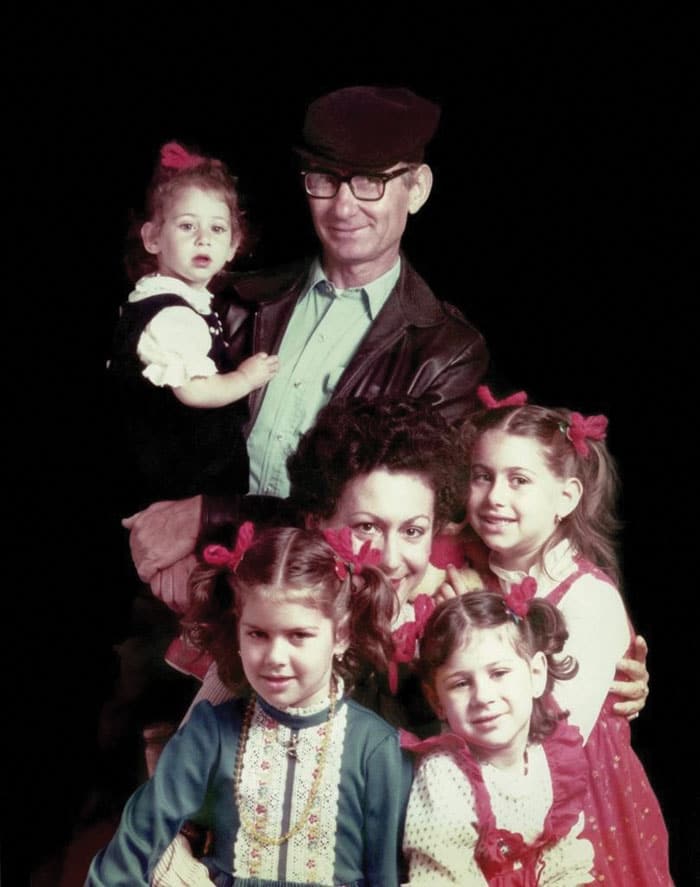
The Kaufman family
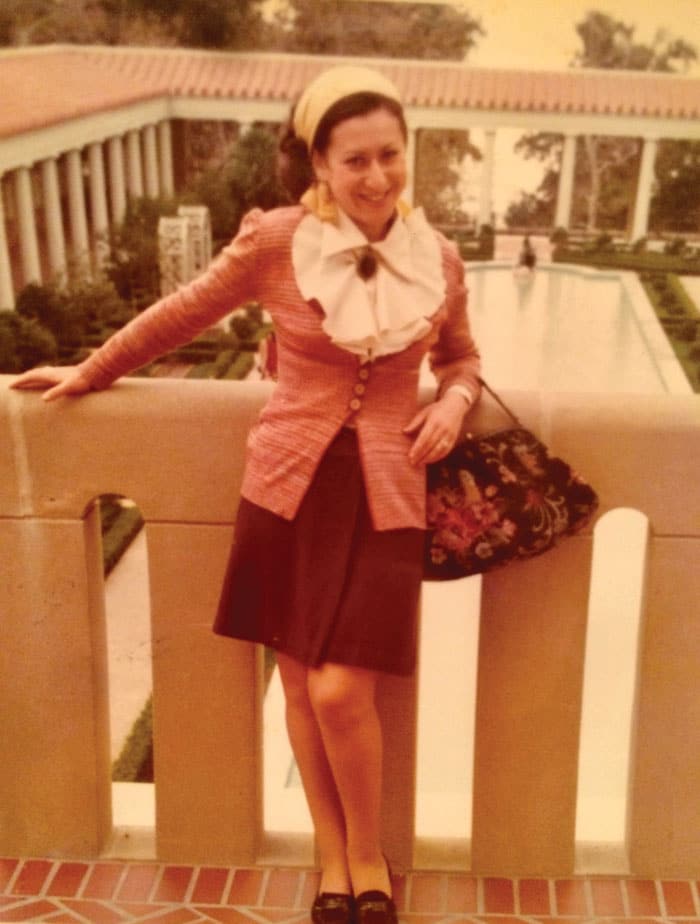
This savory Hungarian dish is much like their story and very much like the loving home my parents, Margaret and Joshua Kaufman, built together — surprising, colorful, tasteful and unforgettable!
This dish feels hearty and light at the same time. It is picante and subtle, multi-sensory in texture and unforgettable in flavor. Enjoyed by royalty and peasants alike, it can be found on any Hungarian table. Orthodox Jews modified the original recipe which includes dairy. I substitute the traditional dumplings (nokedli) with potatoes.
My sisters and I grew up loving the flavors. We would lick our plates and our friends laughed at first. Then they tasted it and ate voraciously. This dish brought my family together for generations. It has created new family members at our table.
Before I share the recipe, let me say to all the Hungarians reading—I know your “Paprikash Chirke” is better than mine and certainly more authentic. Of all my mother’s handwritten recipes, I couldn’t find this one. But I know it by heart—a fine starting point for all things good!
I would like to leave the reader with one last impression—more important than the recipe for the food is the recipe for the Hachnasat Orchim (hospitality) that my parents performed so fervently and so lovingly.
Just like the stranger that showed up at my Grandmother’s door (my Father) looking for a place for Shabbat; so too my parents never turned a guest away nor did they let anyone who came for a visit leave hungry. At our table people met and married, made memories, created connections, cried, laughed, sang and learned.
This time last year our dear Mother passed to the next world. May the legacy of her hospitality live on through us, her four daughters.
In blessed memory of our lovely Mom, Margaret Kaufman z”l who passed from this world on the first day of Sukkot last year. May her memory be a blessing, may her kindness and generosity be an inspiration.
Chicken Paprika
3 tablespoons extra virgin olive oil, divided
2 onions, finely chopped
8-10 cloves garlic, crushed
1 red pepper, finely diced
1 green pepper, finely diced
6 Chicken Legs & Thighs, cut into 12
pieces
1/2 bunch fresh parsley
1 1/2 teaspoons salt
2 teaspoons sweet paprika
2 teaspoons granulated garlic
Jalapeño, optional
2-3 large tomatoes, finely chopped
3 large potatoes, diced
Parsley, for garnish
In a large skillet, warm 2 tablespoons oil over medium heat. Add chicken pieces and a sprinkle of salt. Sauté chicken on each side until lightly browned. Set aside.
Pour remaining oil in the skillet and sauté the onion for 3 to 5 minutes until translucent and slightly golden. Add the peppers and garlic and sauté for 3 to 4 minutes. Add the tomatoes and jalapeño, if using.
Place chicken in the skillet and gently stir to mix with the vegetables. Sprinkle the remaining salt, paprika and garlic.
Add water just below the level of chicken (the dish should be more sauce than broth) and bring to a boil.
Add potatoes, then lower heat, cover and simmer for at least 3 to 4 hours (the longer it cooks the more flavorful it tastes).
Serve over Basmati or Jasmine Rice.
Sharon Gomperts and Rachel Emquies Sheff have been friends since high school. The Sephardic Spice Girls project has grown from their collaboration on events for the Sephardic Educational Center in Jerusalem. Follow them on Instagram @sephardicspicegirls and on Facebook at Sephardic Spice SEC Food. Website sephardicspicegirls.com/full-recipes





 I would like to leave the reader with one last impression—more important than the recipe for the food is the recipe for the Hachnasat Orchim (hospitality) that my parents performed so fervently and so lovingly.