fbpx

October 13, 2022

Report: More than 350 Antisemitic Incidents Occurred on US College Campuses Last School Year

A total of 359 anti-Semitic incidents took place on U.S. college campuses during the 2021-22 academic year, according to a report released by the Anti-Defamation League on Wednesday.

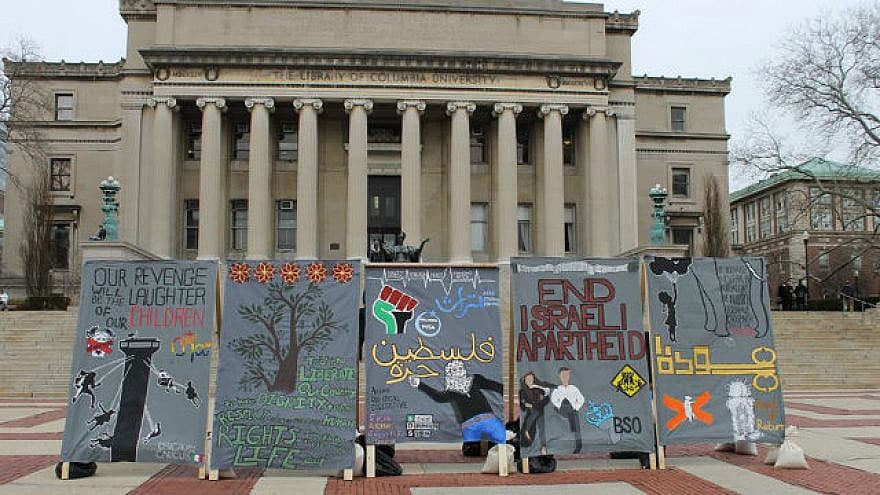
The ADL’s Campus Report documented instances of accusations or “genocide” and “ethnic genocide” levied against Israel as well as the “ostracizing of Jewish students from campus organizations because of their assumed support for Israel or Zionism.”

Among the incidents, there were 165 protests/actions, 143 anti-Israel events, 20 BDS resolutions and referendums, 11 incidents of vandalism, nine instances of targeted verbal and/or written harassment and one physical assault.

In response to the large number of incidents, the ADL announced that it would be “broadening its educational and programmatic investment on campus, including the launch today of an expanded online resource to support students and combat anti-Semitism on campus.”

According to the ADL, the report exhibits a snapshot of a growing campus radicalism that places opposition to Israel and Zionism as “core elements of collegiate life or as a requirement for full acceptance in the campus community.”

The report provided information about the sources of funding for the student clubs responsible for many of the incidents, including Students for Justice in Palestine and Jewish Voice for Peace. While most funds come from student activity fees, the Rockefeller Brothers Fund funds JVP and Westchester Peace Action Coalition sponsors SJP.

There were three major themes and events characterizing campus anti-Semitism last year, according to the report—“Demeaning and ostracizing Zionists and Zionism, including expelling and excluding students from campus groups for expressing any affinity with Zionism or Israel; voicing support for anti-Israel terror and violence; and invoking classic antisemitic tropes and conspiracies in lectures and social media posts,” the ADL stated.
Report: More than 350 Antisemitic Incidents Occurred on US College Campuses Last School Year Read More »

Theodor Herzl after Basel: The New King of the Jews Visits Palestine

Editor’s note: Excerpted from the new three-volume set, “Theodor Herzl: Zionist Writings,” edited by Gil Troy, the inaugural publication of The Library of the Jewish People, to be published this August marking the 125th anniversary of the First Zionist Congress. This is eighth in a series. 

The First Zionist Congress in 1897 electrified the Jewish masses – and stirred the (kosher) doubting Thomases. Critics came not only from the assimilationists and the fundamentalists but from some Zionists. Veteran activists resented Theodor Herzl as an ignorant Johnny-come-lately so pleased he had discovered something they had known for years. Others feared Herzl’s focus on diplomacy and politics, considering Jews’ political and diplomatic impotence during millennia of powerlessness. Hashiloah, the Odessa-based Cultural Zionist Ahad Ha’am’s publication, warned that the “new enthusiasm is artificial … and its end will bring despair … Israel’s salvation will come from ‘prophets’ rather than from ‘diplomats.’”

Political Zionism was a leap. But it was timely. Blending pragmatism and grandiosity as usual, Herzl would write in his diary on September 3, 1897: “At Basel I founded the Jewish State. If I said this out loud today, I would be answered by universal laughter. Perhaps in five years, and certainly in fifty, everyone will know it.” On November 29, 1947, the United Nations would vote in favor of establishing said Jewish state in Palestine. And on May 14, 1948, this old-new Jewish-democratic state was established. 

Herzl’s growing fame got his play, “The New Ghetto,” produced in Vienna, Berlin, and Prague. Reaction in Vienna was mixed – but in Berlin it was merciless, devastating Herzl. The Viennese production in January 1898 did get Sigmund Freud from 19 Berggasse dreaming about the play written by Herzl, who lived at 6 Berggasse from 1896 to 1898. Freud worried “about the future of children to whom one cannot give a fatherland.” Although never a Zionist, Freud would flatter Herzl in 1902, calling him a “poet and fighter for the human rights of our people.” 

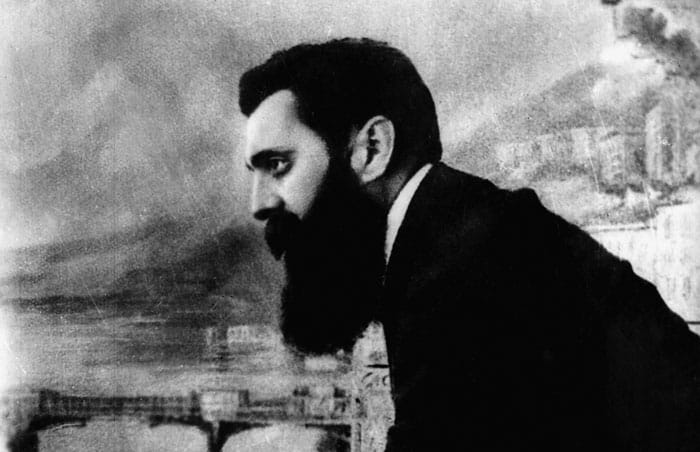
While mapping out his thoughts for a state in a novel, Herzl enjoyed some diplomatic progress. He succeeded in meeting the German emperor in Constantinople in October 1898, then followed Wilhelm II to Palestine, arriving in Jaffa on October 19. This ten-day mission would be Herzl’s only trip to the Holy Land.

Romantics still celebrate the visit as the secular Zionist version of the priestly blessing, with Herzl, the high priest of Jewish nationalism, embracing the Jewish homeland. 

Romantics still celebrate the visit as the secular Zionist version of the priestly blessing, with Herzl, the high priest of Jewish nationalism, embracing the Jewish homeland. But it was more like a European-Jewish version of “A Connecticut Yankee in King Arthur’s Court.” One photo captures a handsome Herzl sitting cross-legged on the deck of his ship, the Emperor Nicolai II, waiting to dock in Israel. Flanking Herzl are European Jews in stiff suits and local Arabs in flowing robes. Another has Herzl and his four companions, looking like proper European bourgeois-penguins, waiting in formal wear on rocky Jerusalem soil to meet the Kaiser, with David’s Citadel and the Old City’s walls looming in the background. And, perhaps most fitting for the diplomatic misfire that occurred, a photo shows the Kaiser passing by the delegation, with only Herzl’s foot appearing in the actual shot, before a standing photo of Herzl was photo-montaged in.

Ever-conscious of his image and fearing mockery, Herzl refused throughout the trip to mount “a white donkey or a white horse.” Years later, this memory charmed Italy’s King Vittorio Emanuele III. It was “so no one would embarrass me by thinking I was the Messiah,” Herzl admitted. The king laughed.

Herzl’s words captured the rollercoaster emotions so many pilgrims had on visiting Jerusalem. “The silhouette of the fortress of Zion, the citadel of David,” he writes, “magnificent,” conveying his woozy first impression. Then, the letdown, contemplating that “if Jerusalem is ever ours, and if I were still able to do anything about it, I would begin by cleaning it up.” Finally, the Herzlian, dream-catching, ever-tinkering, flourish: “I would build an airy, comfortable, properly sewered, brand new city around the holy places” – which, essentially, has happened. 

Two moves were perhaps most portentous. Herzl visited Motza, a small settlement neighboring Jerusalem, to plant a tree – a Zionist act of renewal replicated by millions of Jews since. And when Herzl arrived in Jerusalem on Friday night, despite feeling ill, he walked to his hotel instead of riding. This secular Jew was honoring the Holy City’s mostly religious Jews. 

When the Kaiser refused to push his Ottoman allies to make Palestine a Jewish protectorate, Herzl started lobbying the Russians and the British. He also focused on launching the Jewish Colonial Trust, authorized by the Second Zionist Congress and incorporated in London in 1899, the bank’s central mission including financing land purchases and settlements in Palestine while more generally supporting the Zionist enterprise. After the Fifth Zionist Congress in 1901, Herzl insisted and the delegates finally voted to establish the Jewish National Fund, to raise money to buy land in Palestine. Herzl gave the second donation.

Herzl struggled daily. He was draining his wife’s dowry. Their interactions usually ranged between frosty and testy. He remained frustrated by his inability to write a play that popped and felt constant pressure from his assimilationist Jewish publishers to stop embarrassing them and the paper with his Zionist antics. In fact, they never mentioned their most prominent journalist’s connection to the movement until Herzl’s death. The diplomatic initiatives proceeded fitfully, as did his outreach to many of the wealthiest Jews – whose resistance rankled. And, despite his relative youth, Herzl kept experiencing fatigue, heart palpitations, shortness of breath, dizzy spells, and other signs of rapidly advancing heart disease. “The wind blows through the stubble. I feel the autumn of my life approaching,” Herzl wrote in 1901. “I am in danger of leaving no work to the world and no property to my children.” He was barely forty-one years old.


Professor Gil Troy is the author of “The Zionist Ideas” and the editor of the three-volume set, “Theodor Herzl: Zionist Writings.” the inaugural publication of The Library of the Jewish People, to be published this August marking the 125th anniversary of the First Zionist Congress.

Theodor Herzl after Basel: The New King of the Jews Visits Palestine Read More »

Israel’s Deputy Foreign Minister Idan Roll Goes to Hollywood

On September 19, the Israeli government sent an envoy to Los Angeles to make a direct appeal to the big dogs of television and film streaming. The goal: get more original scripted content from Israel on the biggest streaming stages in the world today, among them Netflix, Hulu and AppleTV+.

Titled the Scripted Israel Conference, the gathering was a four-day meeting of Israel’s top film and television creators with Hollywood streaming executives and studio heads. This first-of-its-kind event was initiated by the Consul General of Israel in Los Angeles Dr. Hillel Newman in conjunction with Israeli Deputy Minister of Foreign Affairs Idan Roll. 

Idan Roll with USC students

“The Ministry of Foreign Affairs should be the most enthusiastic advocates for Israeli creation,” Roll told the Journal. “I am a great believer in sharing the Israeli story and sharing the life that we live on a daily basis. And I know that without getting to experience Israel firsthand, things can lack context. They can be one-dimensional. So I think streaming platforms and TV altogether is a great way to reach new audiences and tell them about what we love so much about Israel, what’s interesting about it and what’s complicated about it. It’s about sharing feelings and experiences.”

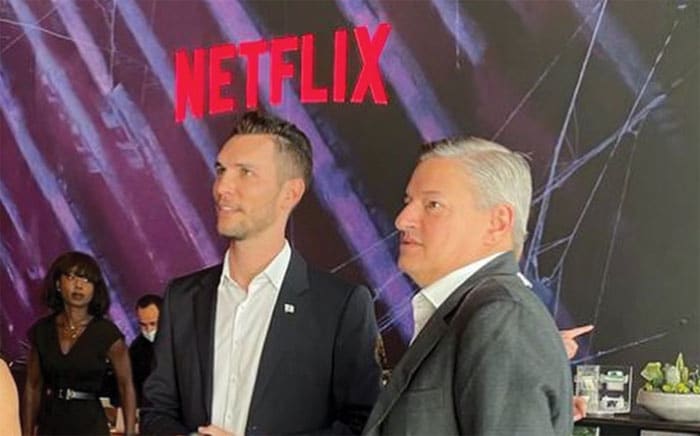
During his visit, Roll and an entourage of over 40 Israeli television creators and producers met face-to-face with many power-players in town. Roll met with Netflix co-chief executive officer and chief content officer Ted Sarandos. He also met with the head of television at William Morris Endeavor (WME), Rick Rosen. Rosen was instrumental in bringing the first Israeli television show to be adapted for an American audience, “In Treatment,” to HBO. The Scripted Israel delegation of creatives also met with senior executives at Sony Pictures Entertainment, CAA, HBO, Warner Brothers and Paramount.

“Part of why I’m so passionate about Scripted Israel is the fact that Israel is a tiny market, but it’s bursting with ideas and bursting with great content.” – Idan Roll

“I really think that Israel, despite being so tiny, has this amazing diversity and you have so many different communities and religions and ethnicities, it’s kind of like, you really can’t walk the streets of Israel without getting ideas,” Roll said. “Part of why I’m so passionate about Scripted Israel is the fact that Israel is a tiny market, but it’s bursting with ideas and bursting with great content.”

Israeli filmmakers and showrunners have been creating film and television content for years. Some of Israel’s most popular shows are already accessible to international audiences through the streaming service Chai Flicks. 

With streaming in almost every corner of the world, Israeli creators don’t have to necessarily rely on just the Israeli market to showcase their works. Still, there’s a crowded field of pitches that come from every creative corner of the world to California to get on the most ubiquitous streaming platforms. To get a leg up, Israel’s creative community has a young government appointee hyping their work in the United States. 

Hollywood is a town where an intriguing story isn’t enough to get your project greenlit. So Israel didn’t send just any government official to represent their arts scene in Hollywood. Roll, a 38-year-old openly-gay father of two, has a story of his own. 

After serving in the Israeli Defense Forces, he earned his law degree at Tel Aviv University while also working as a commercial model. In 2017, he started getting politically active for the first time, urging the Israeli Supreme Court to overturn a rule that banned same-sex couples from adopting children. He also founded “Proud Front,” a movement that advocated for more LGBTQ Israelis to take political action — which led him to run for public office. From there, Roll became the head of the Yesh Atid party’s LGBTQ caucus before representing the centrist-liberal Blue and White alliance in the Knesset from 2019-2020. 

In 2021, after being re-elected to the Knesset representing the Yesh Atid party, then new Prime Minister Naftali Bennett appointed Roll to the position of Deputy Minister of Foreign Affairs. Roll serves in the same position under the current Prime Minister Yair Lapid.

Along the way, Roll became a father via surrogacy in Oklahoma with his now husband, singer Harel Skaat.

As the politician in the family, Roll says that he is the “less fun” part of the family. Still, he and Harel manage to live and love life with their children in Tel Aviv. 

When it comes to film and television, Roll said that their children are into dinosaurs but far too young for “Jurassic Park.” He added that they are fans of the animated series, “LEGO Jurassic World: The Indominus Escape,” but would rather play outside than watch film and television. 

Looking back at his own first taste of American film and television, Roll smiled and listed “Forrest Gump” and “E.T.: The Extra Terrestrial” as his all-time favorites. 

“[‘Forrest Gump’ and ‘E.T.’] touched close to home, they had this naive aspect of them,” Roll said. “You know, like things working out, there’s something very reassuring when you have films that have a good ending.”

That optimism has fueled Roll throughout his life. During his visit to Los Angeles, he brought that optimism when speaking with younger generations. He spent most of his first day in town at USC talking to students, visiting Hillel and meeting with LGBTQ campus organizations. They talked about Israel, threats in the Middle East and fears of expressing Judaism on college campuses. 

Roll is a great believer in the mission of the Scripted Israel Conference, what he calls “getting people in one room sharing ideas, and getting to know each other.”  

“I would be very happy if we can make [the Scripted Israel Conference] an annual thing so people can be waiting for this conference each year with ideas,” Roll said. “It’ll become something very instrumental to Israel creation and to distributing it to the world through Hollywood.”  

Israel’s Deputy Foreign Minister Idan Roll Goes to Hollywood Read More »

Matching Cheap Suits

It was a beautiful Sunday summer morning in the Bronx. Songbirds were tweeting and neighborhood rats were dining alfresco on their garbage.  If you’ve never seen a rat trying to scratch off a piece of cheese that’s stuck to the inside of a charred pizza box, well, it’s a sight to behold.

This was also the day of my cousin Freddy’s bar mitzvah party. Mine was still five years away.  My dad bought us both cheaply made matching blue suits for the bar mitzvah. Despite how cheaply made they were, we looked amazing.  

My dad bought us both cheaply made matching blue suits for the bar mitzvah. Despite how cheaply made they were, we looked amazing.    

It was 9:30am and the bar mitzvah was at noon. Dad and I were already dressed and raring to go. 

“We’re going out for a little walk,” my dad said to my mom. 

She belted back, “Julie, NO ROWBOATS!”

 “Ok!” Dad yelled back.

Dad and I loved renting rowboats and looking for fish. After all, what Jew doesn’t like fish? We were always hoping a thinly sliced Nova Scotia lox might swim by. We headed to the lake with no malice intended.  We had nothing against my mom’s wishes.  But my dad had a mischievous side to him.  No harm, no foul.

Before climbing aboard, my dad placed a newspaper across the wood slat seat. 

“I want absolutely no splashing or rocking the boat,” he said. 

“Yes, captain,” I saluted.  

“If we get even one drop of water on us, she’ll know it.”  

Now, usually, when we went out, I would sit facing my dad as he rowed. This time, for some reason, I faced his back.  

The lake was silky smooth, we chatted about nothing, and the sky reminded me of Renoir’s “Pont Neuf.”  

After about 15 blissful minutes he said, “We’re heading in.” 

“Five more minutes,” I begged.

“No. Your mother is going to kill us if we’re late.”

What happened next was very strange. I either jumped into or fell in the water. Even though I knew how to swim, I slowly sank and did not fight it. Everything was moving slowly. I remember thinking I was going to die. But oddly enough, I was not scared. All was peaceful, serene, and meditative. 

Then, with the force of an orangutan pulling bark off a tree, I was heaved up and out of the water. I woke to find my dad performing CPR on me.  

Now wide awake, I saw I was lying in a puddle of blue water on the concrete. When dad helped me stand, I felt a wiggle in my jacket pocket. I reached in and pulled out a small fish. I tossed it back in the water.

I then saw my dad also in a puddle of blue.  

He took a deep breath and took my hand.  He gave it a… “glad you’re alive” squeeze as we headed home sopping wet to be murdered. 

Walking home, I remember his face looked drained of all blood.

Entering the apartment, my mom was standing there, ready to leave.  Still dripping blue water, on seeing her, we froze in the doorway, still as store window dummies.

By now, my bargain basement suit started shrinking and tightening around my right leg.  

I think this was the moment that she realized she was living with two morons. First small tears and then she began to laugh hysterically and out of control.  

I thought of laughing with her for a second but chose not to chance it.  

“You did it. You went against me,” she said, shaking her head.

Like members of Mao’s army, we nodded in unison. 

With her teeth clenched she said, “I don’t even want to know what happened.” 

Combining anger and hysteria while her face took on the color of an over-ripe beefsteak tomato, she kept repeating the word, “Why?”  

My dad tried to answer her “why” with, “We were just trying to kill some time. I’m sorry. I’m sorry.” 

She just said, “Zip my dress in the back and go change.”  

Even though my mom was silent to and from the bar mitzvah, we all seemed to have a good time. That night, through their bedroom wall, I could still hear her asking “why” over and over as my father begged her to forget it and let him sleep. 

If they ever talked about having another child, all bets were off after that day.


Mark Schiff is a comedian, actor and writer, and host of the ‘You Don’t Know Schiff’ podcast.

Matching Cheap Suits Read More »

Water and Sand – A poem for Parsha Vezot Hab’rachah

For they will be nourished by the abundance of the seas,
and by the treasures hidden in the sand.
-Deuteronomy 33:19

I’ve never lived more than a few miles from
a body of water. When I was born it was

the Hudson River. In Florida, there was
more water than land and I lived in

perpetual fear of alligators. In Syracuse,
the Erie Canal’s fish hung from my bicycle

most summers. In California, there are
numerous dry beds labeled river which

would cause concern except for the
Pacific Ocean, the biggest thing on the planet

always a half-hour car ride away.
There has never been a time I couldn’t

cleanse myself in a living body of water
on the same day I thought to do so.

Still, the news tells us water is not a given
and the company that sends it through our pipes

has been clear it won’t last forever.
So we’re letting the lawn go and giving in

to the desires of only the least thirsty plants.
The icebergs are melting and the politics of it

doesn’t look good. We were promised nourishment
from the sea but the offer may have timed out.

As for the other part of the promise, when I was a boy
and excited about the potential of treasures

found in the sand, the bigger issue was we couldn’t
afford a metal detector. Eventually I found employment

and didn’t need one. Sometimes we need to make our
own treasures. The lottery isn’t going to win itself.

I don’t think it’s even trying. So keep digging.
Just maybe not in the sand. Whatever you need

is worth the effort.


God Wrestler: a poem for every Torah Portion by Rick LupertLos Angeles poet Rick Lupert created the Poetry Super Highway (an online publication and resource for poets), and hosted the Cobalt Cafe weekly poetry reading for almost 21 years. He’s authored 26 collections of poetry, including “God Wrestler: A Poem for Every Torah Portion“, “I’m a Jew, Are You” (Jewish themed poems) and “Feeding Holy Cats” (Poetry written while a staff member on the first Birthright Israel trip), and most recently “I Am Not Writing a Book of Poems in Hawaii” (Poems written in Hawaii – Ain’t Got No Press, August 2022) and edited the anthologies “Ekphrastia Gone Wild”, “A Poet’s Haggadah”, and “The Night Goes on All Night.” He writes the daily web comic “Cat and Banana” with fellow Los Angeles poet Brendan Constantine. He’s widely published and reads his poetry wherever they let him.

Water and Sand – A poem for Parsha Vezot Hab’rachah Read More »

A Bisl Torah — Stretching Your Sukkah

I have a hypothesis as to the physical and symbolic challenge during Sukkot. Each year I hear the following: the poles aren’t fitting the way they used to. Those that build a sukkah know what I mean: due to weather or deterioration over time, the poles sometimes need a little shaping, hammering, and stretching to fit the sukkah you’re trying to build this year.

I love this idea. Perhaps the essence of the holiday is learning how to stretch the sukkah, to stretch it in a way to invite those in our lives that this year, are meant to be included.

There is a story about Rabbi Pinhas of Koretz and Sukkot. The rabbi was known for his wisdom and because so many people used to see him, he didn’t have time to study. One day, he decided to no longer see any disciples and instead devote himself only to prayer. This seclusion went on for weeks and months.

Sukkot came and the rabbi invited several people to join him in his sukkah. They all said no. His students were still dismayed by his off-putting behavior. So, on the first night of Sukkot, Rabbi Pinchas invited the ushpizin, the mystical biblical guests to join him. He figured those guests were bound to say yes. But no luck. Instead, Rabbi Pinchas had a vision of Abraham refusing to enter the sukkah. Rabbi Pinchas asked Abraham, “Why won’t you join me in my sukkah?” And Abraham replied, “I will not enter a place where there are no guests.” From that moment onward, Rabbi Pinchas began to see his students.

The story isn’t really about Rabbi Pinchas not inviting people over. I think the story is a warning. On Yom Kippur, we retreat into ourselves. But we aren’t meant to stay in seclusion. Rather, on Sukkot, we are forced to look up and look around to remember who it is that helps us feel held, embraced, and rooted.

Like sukkah poles that haven’t been used in a year, it takes work to restrengthen and reclaim dusty relationships. It’s the stretching of the heart that allows for the stretching of the sukkah.

May your sukkah and heart stretch far and wide to include those that will hold you up, and hold you close.

Shabbat Shalom and Chag Sameach


Rabbi Nicole Guzik is a rabbi at Sinai Temple. She can be reached at her Facebook page at Rabbi Nicole Guzik or on Instagram @rabbiguzik. For more writings, visit Rabbi Guzik’s blog section from Sinai Temple’s website.

A Bisl Torah — Stretching Your Sukkah Read More »

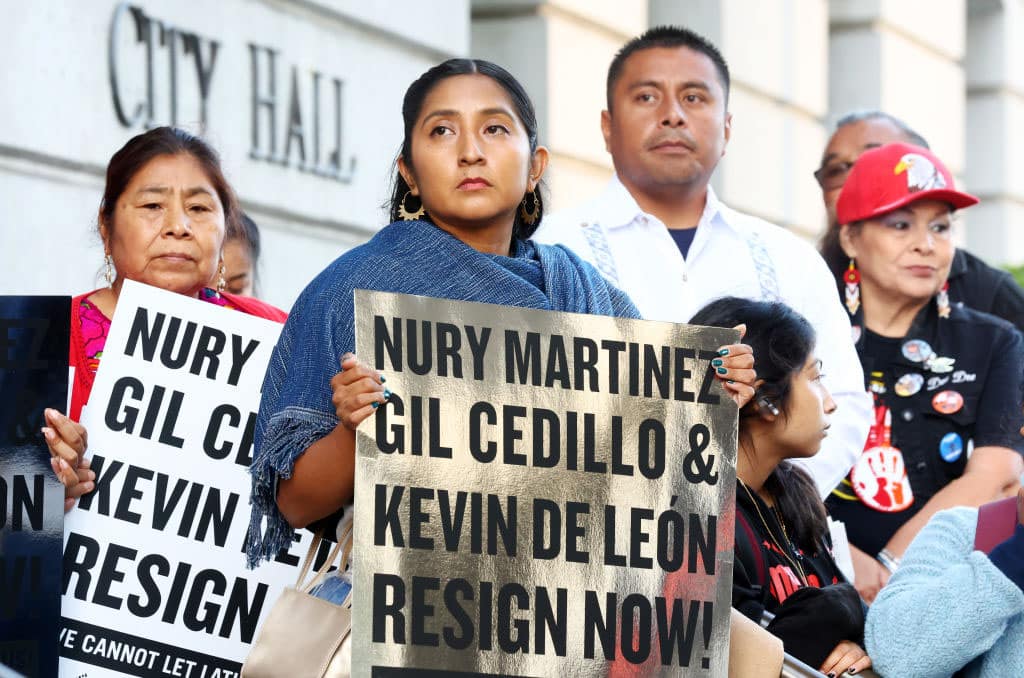
Racist Remarks by City Leaders Also Included Anti-Jewish Remarks

The Jewish Federation of Greater Los Angeles denounced the group of city leaders caught on a leaked audio recording making racist comments about African Americans, Oaxacans, Jews and Armenians.

“We are appalled by the racist, antisemitic and derisive remarks by members of our Los Angeles City Council,” the L.A. Federation said in a statement on Wednesday. “We hold our elected officials to a higher standard as values-driven leaders who should unite and embrace our city’s rich diversity. As a historically-targeted minority group, Jews understand how hateful speech by leaders can lead to hateful actions. We do not tolerate bigotry; leaders should be held accountable for their actions”

On Sunday, the Los Angeles Times reported three Los Angeles City Council members and one top county labor official expressed racist and derogatory views about colleagues during a private conversation about the city’s redistricting process.

The discussion, which took place Oct. 2021, was between L.A. City Council President Nury Martinez, Los Angeles County Federation of Labor President Ron Herrera and L.A. City Councilmen Kevin de Leon and Gil Cedillo. It is not known if there were other individuals in the room.

Unbeknownst to the four city leaders, their conversation was being recorded. The audio recording was posted on message board Reddit, causing widespread outrage along with demands for their resignations.

In the recording, Martinez can be overheard calling the young Black son of a white colleague a “parece changuito,” or “like a monkey.” She also mocks Oaxacans, an indigenous group in Mexico. Speaking about Los Angeles County District Attorney George Gascón, Martinez says, “F— that guy.… He’s with the Blacks.”

What got little coverage, however, was that the conversation also included anti-Jewish remarks.

On the recording, Herrera can be heard speaking about former state Assemblymember Richard Katz, who is Jewish. “I’m sure Katz and his crew have an agenda,” Herrera said.

Martinez responded by saying, “Judíos cut their deal with South L.A. They are gonna screw everybody else.” Judíos means Jews in Spanish.

On Wednesday, Martinez resigned from L.A. City Council after having stepped down as city council president and announcing a leave of absence. Herrera resigned on Monday night. As of press time, city leaders and others were calling for de Leon and Cedillo’s resignation.

A spokesperson for U.S. President Biden condemned the remarks. Other elected leaders and organizations, including the Anti-Defamation League and members of the California Legislative Jewish Caucus, also rebuked the city leaders’ hate-filled language.

“The blatantly racist language used by members of the Los Angeles City Council is disgusting and unconscionable,” Rep. Adam Schiff said in a statement. “There is no excuse or justification that can lessen the pain it has caused. And knowing this language was used about a young child makes this situation even more heartbreaking and tragic.”

Racist Remarks by City Leaders Also Included Anti-Jewish Remarks Read More »

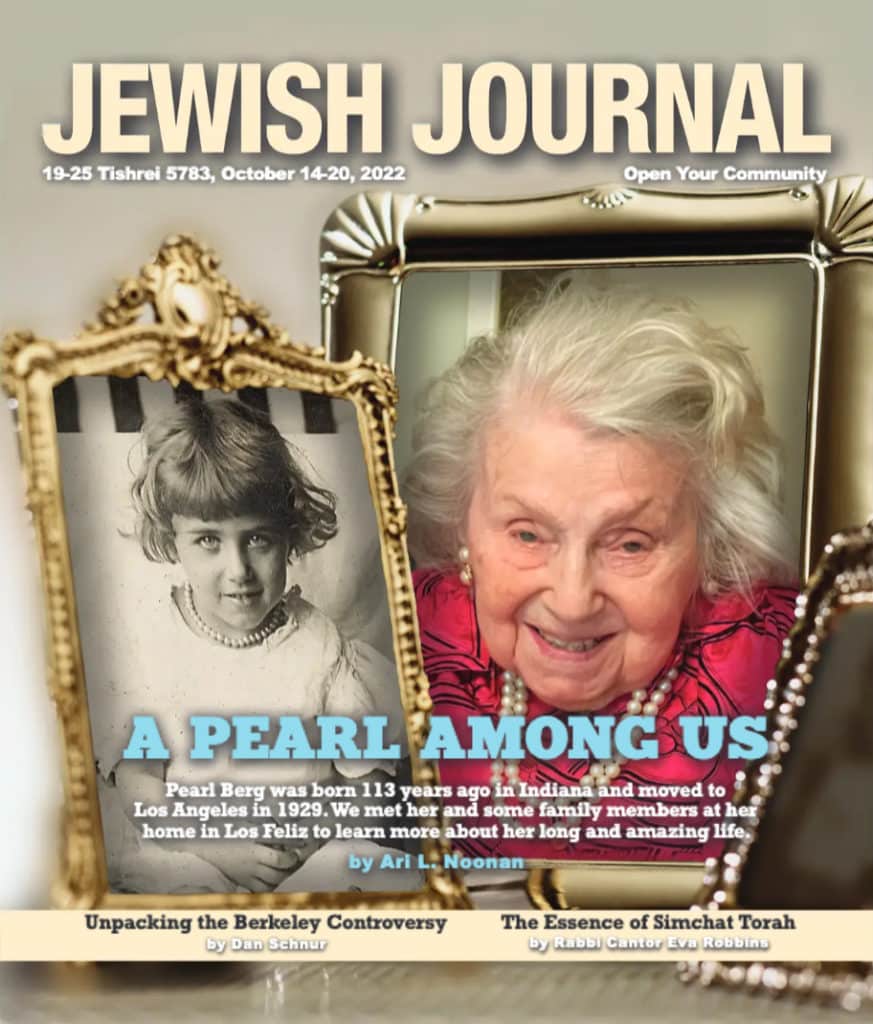
Print Issue: A Pearl Among Us | Oct 14, 2022

CLICK HERE FOR FULLSCREEN VERSION

Print Issue: A Pearl Among Us | Oct 14, 2022 Read More »

Leslie Schapira

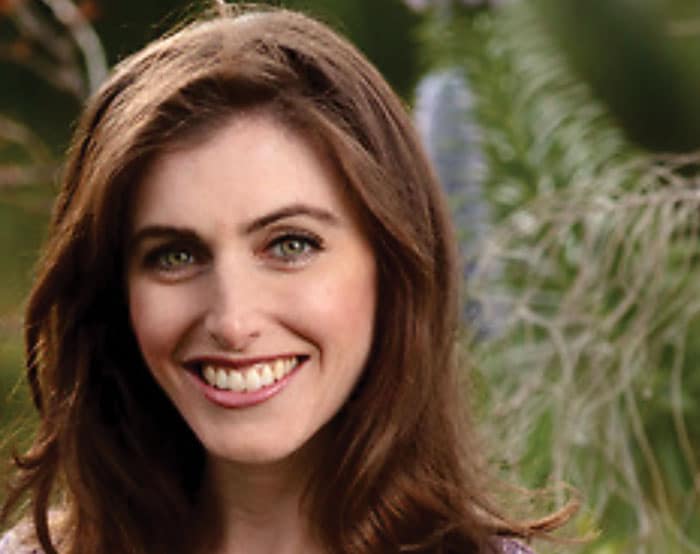
Leslie Schapira: An Israel Advocate Climbing the Ranks in Hollywood

Growing up in Los Angeles, Leslie Schapira was in close proximity to Hollywood. At the same time, she was connected to the Jewish community, attending Wilshire Boulevard Temple on Shabbat and holidays and going there for Hebrew school until she was a teen. Her parents are Zionists, and she has a deep love for the Jewish state. 

“Our Jewish identity is very important to us,” she said. “Being a proud Jew and Zionist are priorities in my life.”

Today, Schapira, 33, is a TV writer; she worked on “Big Shot” on Disney+ and is currently on staff at “Noonan’s,” a Harley Quinn spinoff that’s going to air on HBO Max. She’s also involved in AIPAC, the Jewish Federation of Greater Los Angeles and AMIT Children, and is outspoken in her Zionist beliefs. 

“My Israel advocacy work is just as important as my TV comedy writing,” she said. “I live and breathe it.” 

When the opportunity arises, Schapira connects with other professionals in the entertainment industry to talk about supporting Israel. With her friends Anna Schiff, area director of AIPAC in Los Angeles, and Briana Benaron, Atid director at Sinai Temple, she started a dinner series where they bring young people in the entertainment industry together to talk about changing Israel’s narrative that currently dominates traditional and social media.

“It’s really important to identify as Zionists in this industry,” she said. “We need to stand together, empower one another and try to make a difference. It’s very unpopular to be pro-Israel, but that’s why it’s more important than ever to speak up and do our part.”

One of the issues that Schapira comes across is some people don’t want to be seen at these dinners – Israel support in Hollywood has become incredibly stigmatized.

“At our first dinner, we found that some people were afraid to attend,” she said. “They didn’t want to be seen at a pro-Israel event. Our hope is that as we have more dinners with incredible participants and it generates some buzz, it’ll inspire others to get over their fear.”

When Schapira isn’t working on Israel advocacy, she stays busy at her writing job. She spends her days collaborating with the other “Noonan’s” writers either virtually or at the studio offices in Burbank. 

While Schapira was at business school at UCLA, she wrote a pilot about her experience there and sent it to David Kelley, the creator ofTV shows including “Doogie Howser, M.D.” and “Ally McBeal,” who became her mentor.

“I sent my script to David and he loved it,” she said. “Off of that script, he hired me for ‘Big Shot.’” 

While she enjoys working in writers’ rooms, Schapira’s dream is to run her own show and create stories with Jewish and Israeli themes. She is also interested in telling stories about young women finding their voices and standing up for themselves when it isn’t comfortable or profitable for them to do so.

“I’m interested in portraying people who can buck that system and find their own voice and truth.” 

“Right now, we’re in a very tough environment that promotes following a certain narrative,” she said. “I’m interested in portraying people who can buck that system and find their own voice and truth.” 

For now, Schapira is continuing to work her way up so that she can make her dreams possible.

“I have yet to figure out what my next show is going to be,” she said. “But I want it to be something that speaks to my passions and values.”

Leslie Schapira: An Israel Advocate Climbing the Ranks in Hollywood Read More »

Getting More Out of Jewish Holidays

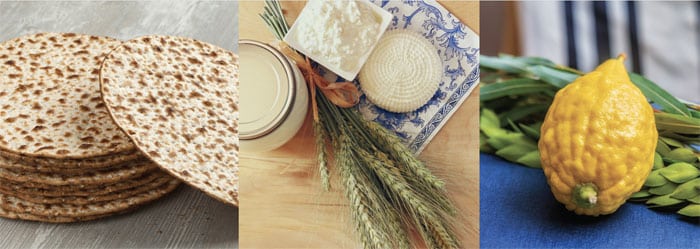
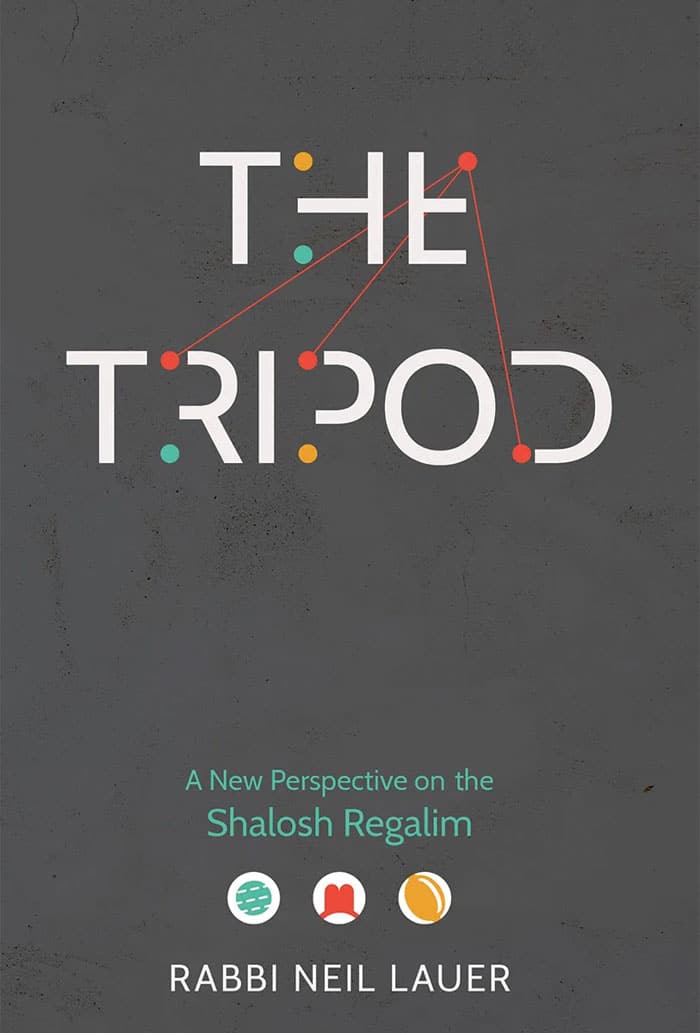
The first thing that strikes you when you open “Tripod: A New Perspective on the Shalosh Regalim,” by Rabbi Neil Lauer, is that the author wants to pull us out of the weeds of Judaism. 

What are those weeds? They are the hustle and bustle that we see when we just look straight ahead and miss the big picture around us.

He uses the analogy of a central bus station, when most travelers will focus on making sure they don’t miss their bus, while missing the grandeur of the station itself. Lauer’s book is a call for us not to miss the grandeur of Judaism that surrounds the “grand station” of our tradition.

He contrasts, for example, the narrow approach of observing festivals — focusing on “praying, eating and spending time with family”—with a “broader and more nuanced appreciation of the agendas and significance of each holiday” when one reflects on “the festival’s impact on all aspects of their life.”

At first, this seems a little too obvious: Why would anyone not want to make the most out of each holiday to positively impact their lives? It’s only when we return the bus station analogy that it becomes less obvious. The reality is that most of us lead our lives — religious or otherwise — by going from one bus to another. It’s human nature: we do what needs to be done in the moment, day after day.

When a Jewish holiday arrives, we give it the same pragmatic approach. We get busy with food shopping, preparations, prayer services, invitations, etc., because there’s so much to be done. Who’s got time to savor the holiday’s broad impact on all aspects of our lives?

That is why Lauer’s call is far from obvious. It goes against human nature.

The timing of the book is fortuitous, as the isolation many of us felt from the pandemic has prepared us for contemplating a broader view of life. Indeed, this book demands from us contemplation.  

The timing of the book is fortuitous, as the isolation many of us felt from the pandemic has prepared us for contemplating a broader view of life.

Indeed, this book demands from us contemplation.  

Lauer does a deep dive on each festival, inviting us to look at each holiday from every possible angle, from historical to legal to biblical to agricultural to ritualistic, among others, while making unusual connections between the holidays.

The title of the book, “Tripod,” sets up the idea that the sum of the three festivals is greater than their parts. We’re asked to contemplate not just how each holiday impacts our lives but the sublime wholeness of the three festivals.

The three holidays, Lauer writes, “form a unit of the basic theological lessons of Judaism.”

This “tripod” unit poses an obvious challenge to Jews who pick and choose what they observe. Among many in the non-Orthodox world, for example, Shavuot and Sukkot are often overlooked; many will only observe the annual Seder at Passover. In an engaging way, Lauer shows those Jews what they’re missing.

His bigger aim, however, is to show Torah observant Jews how much more they can get out of Jewish holidays by going deeper and broader.

The idea that most resonated with me was taking a broader view of the value of the holidays. I’ve often felt that we focus so much on each holiday in real time that we forget to take their lessons with us during the rest of the year.

If some of the lessons of Sukkot are to nurture our humility and gratitude, and reconnect us with the earthiness and awesomeness of nature, aren’t those lessons worth taking with us?

If Shavuot reminds us of our ancient family gathering 3300 years ago at Sinai, which feeds a sense of Jewish peoplehood, isn’t that worth taking with us as well?

If Passover increases our awareness of the trauma of slavery and the responsibility that comes with freedom, isn’t that worth taking with us during the year?

This weaving together of the Shalosh Regalim  is the essential contribution of “Tripod.” By making that connection the golden thread of the book, Lauer makes it easier to chew and digest the considerable amount of information and Torah wisdom he brings to the table. 

Because that information and wisdom connect directly to the splendor of Judaism’s grand central station, we don’t mind missing a bus or two.

Getting More Out of Jewish Holidays Read More »