fbpx

October 7, 2022

Redemption in Slow Motion

On July 4, 1974, Anatoly Sharansky and Natalia Stieglitz got married in a friend’s apartment in Moscow. Both planned to move to Israel, but Stieglitz had to leave immediately because she had an exit visa that would expire the next day. Sharansky hoped to receive a visa soon thereafter. And so Anatoly went with Natalia to the airport, where they pledged to each other: “next year in Jerusalem.”

After that, life changed dramatically for both of them. Anatoly, who was soon known by his Hebrew name Natan, was refused an exit visa and eventually arrested, spending nine years in prison. Natalia, or Avital, led a worldwide campaign for Natan’s release. After 12 years apart, the United States secured Natan’s release in a spy exchange, and on February 11, 1986 Natan was finally reunited with Avital. When he first saw her, Natan made reference to that promise they had made 12 years before, and said to Avital: “Silchi li she’icharti k’zat” (“Sorry I’m a little late”).

Redemption isn’t always on time. Jews prayed for “next year in Jerusalem” for 1,900 years of exile; but even when we knew it would take quite a bit longer, we sang the song anyway. Big dreams are often a little late.

At first glance, Sukkot commemorates a non-event: After the Exodus from Egypt, the Jews spent 40 years in the desert, dwelling in huts. Why is this celebrated with a holiday?

Perhaps the best way to understand Sukkot is to compare it to Pesach. The Talmud (Sukkah 27a) notices and derives halakhic practice from the unusual symmetry between the two holidays; both are a week long, and both begin on the 15th of the month exactly six months apart.

Thematically, there is much in common between the two holidays. On Pesach, the central ritual is the Korban Pesach, the Passover sacrifice, which symbolizes the protection God gave the Jewish homes on the night of the Exodus. The Sukkah commemorates the protection God gave the Jews while camped in tents during the years of the desert.

In both holidays, the theme of protection is combined with a memory of the difficulty and adversity. On Pesach, it is remembered through the bitter herbs, which are eaten together with the Korban Pesach; even on the very night of redemption, the years of slavery are not forgotten. On Sukkot, the tent, which symbolizes protection, is specifically built as a diraat aray, a flimsy, temporary structure. God may have protected the Jews in the desert, but they were at the same time homeless and vulnerable. Both Pesach and Sukkot connect us to the ups and downs of redemption, to moments of distress and deliverance at one time.

Both Pesach and Sukkot connect us to the ups and downs of redemption, to moments of distress and deliverance at one time.

But the analogy between Pesach and Sukkot ends with matzah. This quickly baked bread is all about chipazon, hurry, a redemption so rapid that one leaves the house in surprise, grabbing some unbaked dough on the way out the door.

Matzah offers a vision of instant redemption; doors fling open, seas split, former slaves march forward to freedom. Everything moves at lightning speed. By contrast, Sukkot is about a point in history when things more or less stood still. For forty years, day in and day out, the Jews lived in the same tents, with the same food, and the same complaints. Only at the very end, after barely crawling through the desert, do they finally arrive at the doorstep of the promised land. Sukkot commemorates a redemption that moves at a snail’s pace.

Pesach is a story made for the silver screen, with high drama and a conclusion that is miraculous. Sukkot, on the other hand, seems to be a celebration of tedium, of forty years when not much happened. And the question remains: What exactly are we celebrating on Sukkot?

Redemption is a topic fraught with preconceptions. Our default is to expect the most of redemption. It should be immediate, transformative and astonishing, a moment of clear divine intervention. If the Messiah doesn’t ride in on a white donkey, it’s not a true redemption.

When the Zionist movement arose, some Orthodox Jews adopted an anti-Zionist stance. One of the arguments they used against Zionism is that it runs counter to a passage in the Talmud (Ketubot 111a) that (according to a manuscript cited in Rashi) says that the Jews should not “push forward the redemption.” This is seen as a prohibition against the Jewish people taking redemption into their own hands; they are obligated to wait for the Messiah.

From this perspective, any attempt to create a Jewish State before the arrival of the Messiah is a fraud and a heresy. Every redemption should be absolute. When the Messiah comes it will feel like Pesach, with a new Moshe and many miracles.

But other rabbis had a very different perspective on Zionism. Rabbi Tzvi Hirsch Kalischer, who was an early-19th-century proponent of the return to Zion, pointed out that the Talmud Yerushalmi (Berakhot 1:1) states that “such is the redemption of Israel, at first it is bit by bit, and as it proceeds, it gets larger and larger.” These religious Zionists saw the hand of God in every step forward. Because of this, they could appreciate the contribution of unusual heroes. Rav Kook famously said that when the young secular Zionist pioneers played sports to strengthen their bodies, their exercise was as holy as reciting Psalms. Their newfound strength would build a new country. A slow motion redemption doesn’t follow the ordinary script, with ordinary heroes.

And this is exactly what we are celebrating on Sukkot. What the early Zionist rabbis are describing in their writings is precisely what Sukkot commemorates: a redemption that comes bit by bit, one that is halting, imperfect and at times confusing. On Sukkot, the distance between one step and the next on the road to redemption is measured in years, not feet.

As we approach the 75-year anniversary of the State of Israel, we can say that what we have seen is a Sukkot type of redemption. On a daily basis, Israel is imperfect and tests our patience, but when we see it in the context of the last 2,000 years of Jewish history, we recognize that it is miraculous.

Sometimes redemption arrives a bit late. Sukkot reminds us that we need to cherish every step on the road to redemption.


Rabbi Chaim Steinmetz is the Senior Rabbi of Congregation Kehilath Jeshurun in New York.

Redemption in Slow Motion Read More »

Theodor Herzl Launches the First Zionist Congress in 1897

Editor’s note: Excerpted from the new three-volume set, “Theodor Herzl: Zionist Writings,” edited by Gil Troy, the inaugural publication of The Library of the Jewish People, to be published this August marking the 125th anniversary of the First Zionist Congress. This is seventh in a series. 

In July of that critical year of 1896, when he became “a sort of poor man’s lawyer for unfortunate Jews,” Theodor Herzl returned to Vienna, becoming the Neue Freie Presse’s feuilleton editor. Herzl would spend the rest of his life as a full-time Zionist and a part-time journalist, just to keep some income streaming in. He felt enslaved to the newspaper but proud that he earned nothing from the movement. His diaries track the meetings he pursues and has, the articles he conceives and writes, the strategies he ponders and follows, the relationships he makes and leverages, and the ideas for this new Jewish state he keeps generating, refining, spreading. 

With his manifesto “Der Judenstaat, The Jewish State,” the talk of the Jewish world, Herzl started thinking about how to give this Zionist movement forming around him official status and organizational shape. In mid-June 1896, Herzl had to note how far he had traveled in barely a year. He visited Constantinople with his diplomatic agent Philipp Michael de Newlinski, an impoverished Polish aristocrat turned journalist. Although he initially failed to secure an audience with the Sultan, who controlled Palestine through the Ottoman Empire, Herzl met with the Vizier and received the “Commander’s Cross of the Order of the Medjidie.” This man came with no formal organization, a stateless people, and only a popular pamphlet behind him. Nevertheless, the Turks took Herzl seriously. When Herzl stopped in Sofia on his way home, hundreds of Jews cheered their new Messiah. Herzl was encouraged – the Jewish masses were awakening. 

Such adulation gave Herzl “strange sensations. I saw and heard my legend being born.”

By August 29, 1897, then, when Herzl convenes the First Zionist Congress, momentum has already been building for two years. More Zionist circles are forming, expanding a network that started decades earlier, especially after the Russian pogroms from 1881 to 1884. Characteristically, Herzl has already established a Zionist newspaper, Die Welt. And equally characteristically – for the Jewish people – the backlash is growing: from “Protest Rabbis” in London and Vienna, to refused invitations from the more culturally-oriented and settlement-focused Hovevei Zion rival group in England, to the refusal of the Munich Jewish community to host this first Zionist congress. Reform and Orthodox rabbis, who rarely agree on anything, agree on one thing: they do not want the Zionists in their city.

That is why Herzl shifts the Congress to Basel, Switzerland. But that, of course, solves only one of his many headaches. As the Congress approaches, Herzl’s agitation increases. On the train to Zurich in late August, he catalogs the invisible “eggs” he is juggling in this excruciating “egg-dance” threatening his dream. They include the eggs of the Neue Freie Presse, of the Orthodox, of the modernists, of Austrian patriotism, of Turkey and the Sultan, of the skeptical Edmond de Rothschild, of the rival Hovevei Zion, of the colonists in Palestine whose financial subsidies “must not be queered.” Herzl adds the “egg of the Russian government, against which nothing unpleasant may be said, although the deplorable situation of the Russian Jews will have to be mentioned” and the “egg of the Christian denominations, on account of the Holy Places,” along with the eggs of personal differences, envy, jealousy. This whole endeavor “is one of the labors of Hercules,” he sighs.

Thanks to Herzl’s tortured journey and his still deeply inadequate, obviously scarred, sense of self, he makes one of his great moves. He insists that the 197 delegates – including thirteen women – attend the Congress in formal eveningwear. “These people should consider this Congress as the most superior and festive of all,” he explains to an even more prominent enlightened European Jew turned Zionist, Max Nordau.

By impressing the outside world, it launched Herzl’s feverish diplomatic efforts, which many historians today say put the Zionist movement on the international agenda and by 1917 resulted in Great Britain’s Balfour Declaration. 

The Zionist Congress’s pageantry was doubly effective. By impressing the outside world, it launched Herzl’s feverish diplomatic efforts, which many historians today say put the Zionist movement on the international agenda and by 1917 resulted in Great Britain’s Balfour Declaration. But it also stirred the Jewish masses. It took a Herzl – a Western, assimilated Jew, mastering the symbols of modernity while refusing the Enlightenment’s cover-up-your-Judaism bargain – to impress the beaten-down Eastern European Jew that this movement was credible – and able to spawn a New Jew, not just a solution to the Jewish Problem.

One delegate from Odessa, Mordechai Ben-Ami, wrote: “Before us rose a noble, almost angelic figure whose deep and piercing stare mixed quiet majesty with unutterable sorrow. This was … not the elegant Dr. Herzl of Vienna, but a royal scion of the House of David, risen suddenly from the grave in all his legendary glory.” 

In those “three days of awakening Jewish history,” Herzl proclaimed, “Zionism introduced itself to the world.” Before Basel, the movement “remained in the ghetto. … Now it has entered the public arena and engages public opinion around the globe. Many hundreds of newspapers wrote of it during the past week.”

Building on dozens of other initiatives, including the farming villages already being established in the Holy Land, the First Zionist Congress voted in the Basel Program, proclaiming: “Zionism aims at establishing for the Jewish people a publicly and legally assured home in Palestine.” Four essential “means” would achieve that goal: promoting settlements in Palestine, organizing Jews “into local or general groups,” strengthening “the Jewish feeling and consciousness,” and appealing to governments to help for “the achievement of the Zionist purpose.” Most practically, the Congress adopted “HaTikva” as the national anthem, accepted a blue-and-white flag with a six-pointed star in the middle as the Zionist standard, and established the Zionist Organization, with Theodor Herzl elected as president.

Looking back, Herzl admitted that “when I started out, I was only a ‘Jewish Statist.’” Gradually, he became “a Hovev Zion [Lover of Zion]. For me there is no other solution but Palestine for the great national question which is called the Jewish Question.”


Professor Gil Troy is the author of The Zionist Ideas and the editor of the three-volume set, “Theodor Herzl: Zionist Writings,” the inaugural publication of The Library of the Jewish People, to be published this August marking the 125th anniversary of the First Zionist Congress.

Theodor Herzl Launches the First Zionist Congress in 1897 Read More »

FIDF Gala, SWU Internships

On Sept. 20, Friends of Israel Defense Forces (FIDF) held its national New York gala, with a handful of Los Angeles community leaders among the more than 500 guests.

Israeli Prime Minister Yair Lapid, making his first visit to the U.S. since taking office in July, attended the glitzy gathering. He was in the U.S. to speak at the United Nations General Assembly and praised the work of the FIDF. 

“The fact that I am standing here today, as Prime Minister of the State of Israel, a free country, with a strong army with friends like you, did not happen on its own,” the Israeli official said. “At every moment, Israel must be strong, free and secure, with a powerful army that can defend its citizens. On behalf of the State of Israel, and on behalf of the soldiers of the IDF, I salute you, my friends.” 

The FIDF event was held in tribute to FIDF Chairman Peter Weintraub. It also recognized two Israeli soldiers for incredible acts of courage during their service. The first was Sergeant First Class M., who serves in the IDF Special Forces Unit, Oketz, the Canine Unit that specializes in training dogs for designated tasks. The second soldier, Major Bar, joined the Israeli Air Force in the footsteps of his late father. 

Several special guests turned out, including FIDF CEO Steve Weil, Israeli Ambassador to the U.S. Michael Herzog and FIDF President Fred Gluckman. 

“We are grateful to Prime Minister Lapid for his exemplary leadership, and we are most honored to have him join us this evening at our annual FIDF National New York Gala in support of Israel’s soldiers,” Weil said. “There is no entity of individuals more critical to the existence of Israel and the safety of Jews worldwide than the soldiers of the IDF, and we are humbled to stand in strength and solidarity with Prime Minster Lapid in our common goal to support them.”


StandWithUs student interns are trained to defend Israel on their respective high school or college campuses. Courtesy of StandWithUs

Pro-Israel education group StandWithUs (SWU) has announced the 2022-23 students participating in its high school and campus programs.

The 2022-23 Kenneth Leventhal High School Interns – comprised of self-identified leaders in 11th and 12th grade seeking to proactively improve their local schools and communities – come from YULA Boys High School and YULA Girls High School; Shalhevet High School; Milken Community School; and De Toledo High School, among other local schools.

The 2022-23 Emerson Fellows, a prestigious one-year program, trains, educates and empowers student leaders on college campuses worldwide. This year’s students are from UC Santa Barbara, Cal Poly, USC, UCLA, and California State University Northridge.

Both programs select and train student leaders to educate about Israel and fight antisemitism at their schools and communities. The students attended respective week-long conferences in August, preparing them for the school year.  They learned how to identify and combat anti-Israel campaigns and how to have rich conversations about Israel.

They will also participate in a second StandWithUs conference, “Israel in Focus” held in Los Angeles from March 2-5.  

StandWithUs student internships – Kenneth Leventhal High School Interns and the Emerson Fellows – provide instruction on combating antisemitism and anti-Zionism. Courtesy of StandWithUs

“Each year, I remain impressed with the enthusiasm and creativity of our awesome high school and college student leaders,” SWU Co-founder and CEO Roz Rothstein said.  “They learn from previous participants in our programs and nominate candidates for the coming year.  As antisemitism continues to rise, including in Los Angeles, these students – already leaders in their schools and communities – are fully prepared to confront these challenges while also organizing programming that shares the beauty, accomplishments and experience of Israel.”

FIDF Gala, SWU Internships Read More »

The Real Love Boat–Come Aboard!

Thank you to Princess Cruises, CBS TV and Paramount for including me in Premiere Party on Discovery Princess for the Real Love Boat Series. I grew up watching The Love Boat TV show and worked for Princess Cruises for many years. The new reality romance series is a cross between the original series as well as the challenges of The Amazing Race with the dating promises of The Bachelor! Please enjoy the sneak peek below! The show is hosted by Rebecca Romijn and Jerry O’Connell.
THE REAL LOVE BOAT celebrates its upcoming Season 1 premiere with a Princess Cruises launch party in San Pedro, CA on October 1st, 2022. Pictured (L-R): Paolo Arrigo, Ted Lange, Ezra Freeman, Jill Wheelan, Matt Micham, and DuVaul Gamble. Photo: Sonja Flemming/CBS ©2022 CBS Broadcasting, Inc. All Rights Reserved.
“The ship’s Crew members – Captain Paolo Arrigo, Ezra Freeman (Bartender) and Matt Mitcham (Cruise Director) – play pivotal roles in the matchmaking and navigation of the romantic yet sometimes turbulent waters, just like the beloved original scripted series “The Love Boat.” With over 40 combined years working in the industry, Arrigo, Freeman and Mitcham bring their real-world expertise to help the Singles look for love in this adventure of a lifetime.
CBS original series THE REAL LOVE BOAT, scheduled to air on the CBS Television Network. — Pictured (L-R): Matt Mitcham, Ezra Freeman, and Captain Paolo Arrigo. Photo: Sara Mally/CBS ©2022 CBS Broadcasting, Inc. All Rights Reserved.
Singles experienced in the ups and downs of romance come together on THE REAL LOVE BOAT to find a true love connection while visiting and competing in some of the world’s most beautiful cities, including Barcelona, Marseille, Rome, Santorini, Athens and more. A shoe designer, firefighter, nurse, teacher and landscape architect are among the men and women setting sail on the romantic adventure. From divorce and broken engagements to terrible online dating experiences, being unlucky in love has not discouraged these Singles from seeking true romance. Throughout the season, Singles embark on destination dates and compete in challenges to test couples’ compatibility and chemistry, while earning valuable rewards. The romantic waters will be tested when new Singles come aboard, and those who don’t find a match will “Shove Off” and be left behind at port. After nearly one month at sea, one winning couple will dock in the final port and take home a cash prize plus a once-in-a-lifetime trip courtesy of Princess Cruises, the series’ exclusive cruise line partner.”
THE REAL LOVE BOAT is produced by Eureka Productions in association with Buster Productions. Chris Culvenor, Paul Franklin, Wes Dening, Eden Gaha and Jay Bienstock serve as executive producers for Eureka. Rebecca Romijn and Jerry O’Connell serve as hosts and perform the vocals for the iconic song featured in the series opening credits. “Premiere Episode” – THE REAL LOVE BOAT inaugural episode sets sail as hosts Rebecca Romijn and Jerry O’Connell greet five single women and five single men who are ready to find love and begin the adventure of a lifetime aboard the Regal Princess Cruise Ship. After the singles make their way through the stunning city of Barcelona, they are thrown into the first competition of the season – a talent show where they must impress potential partners! But all is not smooth sailing when two new men come aboard and crash a cocktail party. The episode concludes with the Sail Away Ceremony where the women each choose who has caught their eye and will remain on the ship, while the rest will “Shove Off” and be left behind at port. Special guest star Ted Lange, whose iconic character Isaac helped singles find love in the original 1970s scripted series “The Love Boat,” passes the proverbial cocktail shaker to the new Crew who will help singles navigate romance on the high seas.
The Real Love Boat–Come Aboard! Read More »

The Iranian Me-Too Movement

Harvey Weinstein is an odious human being who deserves to spend the rest of his life behind bars. But when his horrific behavior became public five years ago, it helped trigger a long overdue cultural revolution. While still far from complete, the Me Too movement forced our society to finally confront the consequences of widespread sexual abuse and harassment, and to consider the penalties, remedies and support systems required to bring about systemic change.

But Ebraham Raisi has done far more damage than Weinstein. The president of Iran, under the direction of Ayatollah Khamenei and his mullahs, is the latest and possibly most oppressive of that country’s elected leaders to oversee suffocating restrictions against the women of his country. The most visible symbol of that repression is the requirement that all women wear a hijab, and it was the death of Mahsa Amini, a young woman who had been arrested by the Iranian “morality police” for failing to cover her hair with sufficient modesty that led to the current nationwide protests that have been taking place from one end of Iran to the other. 

Iran periodically sees widespread uprisings against its authoritarian government, most notably the Green Revolution of 2009 and the 2019 Bloody November protests. Both were ruthlessly suppressed by the governing authorities and both were all but ignored by American presidents Barack Obama and Donald Trump. But resentments among the Iranian people have continued to fester, and Amini’s death has led to an outburst of public dissent that have proved much more difficult for the country’s leaders to shut down. 

There are two noticeable differences between the current protests and those in previous years. The first is the visible and vocal support the Biden Administration has provided the insurgents. Biden has strongly denounced the Iranian government and his administration has imposed sanctions and worked to maintain Internet service for the country in the face of a government shutdown, providing the protestors with vital communications and organizational tools. 

The other important change is the unprecedented leadership role that the women of Iran are taking to shape the protests and drive them forward. Women have participated in these types of demonstrations in the past, but largely in a supportive role. This time, the decisions of women of all ages and religious backgrounds to remove, discard and even burn their hijabs have become the focal point for the resistance. This is the Iranian Me-Too movement, with even higher stakes as they fight to end the gender-based apartheid under which they have suffered for too long.

But while the Weinstein-fueled uprising against sexual misconduct transcended national boundaries five years ago, this populist pushback has remained almost completely within Iran’s borders. While protests have taken place in cities around the world, the vast majority of participants are those of Iranian descent. The global solidarity that existed in this movement’s earlier days is noticeably absent.

Some of this is the way a geographically isolated country such as ours often reacts to injustices that take place in other parts of the world. Ken Burns’ new documentary on the American passive reaction to the Holocaust was a jolting reminder as to how an isolationist nation can ignore the rest of the world if it tries hard enough. The current genocide being committed by the Chinese government against the Uyghur people of the Xinjiang is only beginning to receive the type of attention and outrage that it deserves and still only makes a sporadic impact in American cultural awareness despite the scope of the atrocities.

We owe it to the women of Iran to stand by them more loudly and more forcefully than we have to date.

The luxury of being bordered by the world’s two largest oceans allows the United States to maintain an isolationism and ethnocentrism matched by few other countries. So it’s easy to assume that problems that exist here are the only ones that matter. But equality for women, opportunity for women and safety for women are universal challenges, whether in Los Angeles, New York, or Tehran. We owe it to the women of Iran to stand by them more loudly and more forcefully than we have to date.

Zan, zendegi, azadi. Woman, life, freedom.


Dan Schnur is a Professor at the University of California – Berkeley, USC and Pepperdine. Join Dan for his weekly webinar “Politics in the Time of Coronavirus” (www/lawac.org) on Tuesdays at 5 PM.

The Iranian Me-Too Movement Read More »

Out of the Box Jew

I’m an out-of-the-box Jew. 

While I call myself Orthodox, I don’t fit into any one type of Orthodox subset. I’m Modern Orthodox in practice, but Haredi in my head. Chabad is what inspired me to become religious, but I don’t think I could ever give up my kosher dairy, non-chalav yisrael treats. Carlebach services are uplifting and young professional minyans can be fun, but I also enjoy davening in quiet shuls and typically get along better with people twice my age.  

I converted through an Orthodox beit din, but technically am 0.6% Ashkenazi, according to 23andMe. I enjoy Ashkenazi shuls because they are more accessible if you don’t read or speak Hebrew, but I prefer Sephardic tunes. I feel most alive in Israel and Morocco and know I must have lived in the Middle East in my past life. 

Being an out-of-the-box Jew comes naturally to me because I’ve never fit into any groups throughout my entire life. In middle school, the popular girls made fun of me because I wasn’t cool, and I wasn’t nerdy enough to hang out with the geeks. I went through my rebellious teenage phase but still was a shy kid who loved to write in her online diary. When I was in college, most people around me spent their time partying; I stayed in my room, ate pizza and read The Onion. 

As an out-of-the-box Jew who came from a completely secular background, I’m now able to interact with many different types of people. I can chat with an Orthodox rabbi from Lakewood about the joys of Shabbat one minute and catch up with a friend about what movies I recently watched the next. 

The beauty of this is that I’ve made friends from all different parts of the Jewish community. On Sukkot, we sit in the beautiful sukkah my husband and I build and enjoy a nice holiday meal. For some people there, eating in our sukkah is the only Jewish thing they’ll do all year. Others are Orthodox like us, and for them, this is one of many Sukkots they’ve celebrated over the years. 

While there are many wonderful Jewish communities around the world, I believe that Los Angeles has one of the best. LA is an out-of-the-box place. It’s a town where people come to follow their dreams. Most people I know are not from here – they are outsiders, just like me. 

Every time my husband Daniel and I have parties, our friend, an Orthodox rabbi, remarks how we always have a great mix of people there. I take pride in the fact that we could walk into any synagogue in Pico-Robertson on a Shabbat and know at least one person there, since we’ve gone to all of them at this point. 

Sometimes, I admit, I feel like I’m out of my comfort zone, though. If I’m at someone’s house and they don’t have a bencher with English translation, I feel embarrassed that I can’t say the entire grace after meals in Hebrew. Or, if I walk into a synagogue and I’m the only person wearing brightly colored clothing and kitschy earrings, I feel like I stand out. Usually, I’m the only blonde-haired, blue-eyed person in the room. 

But then I think about how I felt when I celebrated my first Shabbat ever, back in 2010, when my husband took me to a Chabad for Friday night dinner. There were little kids, hipsters with torn jeans, a man wearing orange-rimmed glasses and two Hasidim in furry, round black hats. We all came together and had lovely conversations and an enjoyable meal. When I witnessed the love everyone had for each other, despite their differences, I was inspired to start my conversion process.

By calling on us to have our holiday meals inside these odd-looking frail huts, Sukkot is truly an out-of-the-box holiday. So, as I’m sitting in our sukkah this year celebrating with friends, I guess I’ll feel right at home. 

By calling on us to have our holiday meals inside these odd-looking frail huts, Sukkot is truly an out-of-the-box holiday. So, as I’m sitting in our sukkah this year celebrating with friends, I guess I’ll feel right at home. 

I would love to hear from you! Drop me a line at Kylieol@JewishJournal.com.


Kylie Ora Lobell is the Community Editor at the Jewish Journal.

Out of the Box Jew Read More »

Rachel Bloom Reflects on “Reboot” and Dreams of Being on Broadway

Growing up, Rachel Bloom watched every single episode of “Mad About You” with her parents.

“The series finale was one of the most brilliant of all time,” she said. 

Decades later, the actress and comedian is now starring in “Reboot” on Hulu, alongside one of her childhood favorites: Paul Reiser, who played the main character on “Mad About You.”  

“I was so excited to work with Paul,” Bloom said. “He was a really great scene partner.”

In “Reboot,” which premiered September 20, Bloom plays a showrunner who wants to bring back a cheesy ‘90s show called “Step Right Up.” However, she has to face off with Reiser, the original showrunner. At the end of the first episode, there is a major plot twist, and it’s revealed that Bloom and Reiser are closer than the cast members of “Step Right Up” could have predicted. The two star alongside Keegan-Michael Key, Johnny Knoxville and Judy Greer.

“It was a wonderful show to work on,” said Bloom. “The actors were just wonderful.”

“Reboot” is Bloom’s first major television project since “Crazy Ex-Girlfriend,” a show she created and starred in from 2015 to 2019. It followed Rebecca Bunch, a mentally unstable woman who has a nervous breakdown, leaves her impressive career as a lawyer in a big New York City law firm just as she makes partner and moves to West Covina, California. There, she pursues Josh Chan, whom she dated at summer camp when she was a teenager. 

The comedy musical included a number of songs about Judaism, like “JAP Battle” and “Remember That We Suffered.” Tovah Feldshuh, who played Bloom’s mom on the series, sang her magnum opus, “Where’s the Bathroom?” a klezmer-style tune that’s full of Jewish mom guilt.

“Until I was about 9-years-old, I went to Hebrew school on the weekends,” Bloom said. “My husband (Dan Gregor) was raised much more Jewish. I’ve learned much more about Judaism being with him for 14 years. I feel a connection to the culture.”

Bloom is a Manhattan Beach native. While she was in close proximity to Hollywood, and some of her classmates had agents, what she always wanted to do was go into musical theater. 

She performed theater on the weekends and ended up attending New York University’s Tisch School of the Arts and got a BFA in Drama. In 2013, she started releasing musical comedies including “Chanukah Honey,” a Jewish parody of “Santa Baby.” “Crazy-Ex Girlfriend” was her breakout work, and since it went off the air, Bloom has been keeping busy. In 2020, she and Gregor had their first child together, a daughter. 

“When I’m working, my brain is in that mode, and when I’m with my daughter, I’m in that mode,” she said. “There are two different parts of my brain. My relationship with my daughter feels very different and separate from my relationship with work.”

Even though Bloom and Gregor are both in show business, they aren’t pushing their daughter into it, unless she wants to give it a try as well.

“I was so driven to be a performer from such a young age.”

“Someone told me that when it comes to kids, you can’t change the hardware, only the software,” she said. “I was so driven to be a performer from such a young age. My grandfather was an amateur performer and standup comedian. I was really the one driving that aspiration, and I want her to pursue what makes her happy.”

The married couple is showing their daughter a positive example of what it’s like to work in showbiz, though. They are both successful – Gregor was a writer on “How I Met Your Mother” and “Crazy Ex-Girlfriend” – and they’re collaborating on movie projects together. 

“We have our daughter, which is the ultimate collaboration,” said Bloom. 

During her time in the industry, Bloom, who is outspoken about women’s issues, has seen how it’s gotten better for women. 

“A lot has changed over the past 15 years, when I started,” she said. “Suddenly, having a female perspective or an alternate perspective that’s not from a straight white guy has become cool and profitable for big companies. There’s an encouragement of saying what you want and your point of view and not having to necessarily funnel it through the male gaze. There is less of that pressure now.” 

Along with starring in “Reboot” and being a mother, Bloom is doing live shows again and recording her upcoming special in Los Angeles, where she lives with her family. Having a musical TV show was her ultimate dream, but now she’s looking towards even bigger things. 

“I’m continuing to push myself,” she said. “Being on Broadway, starring in a show I wrote, is still a goal. I’m looking to TV and figuring out what I can do that I haven’t done before.”

Rachel Bloom Reflects on “Reboot” and Dreams of Being on Broadway Read More »

In Pico, Sukkah Store Pop-up Carries Torch

For most of the year, Eli Aharon and Yonah Bastomski co-run a senior healthcare wellness company, providing older adults with physical trainers once their health insurance no longer covers the service in hospital settings.

But come the High Holy Days season, the two buddies-since-high-school turn their attention toward another entrepreneurial venture — selling sukkahs, schach and supplies for the holiday of Sukkot. 

The Sukkah Store, their storefront operation in the heart of Pico-Robertson, is one of a handful of pop-up sukkah shops seemingly springing to life out of nowhere this time of year, between Rosh Hashanah and Yom Kippur. 

In addition to Sukkah Store, run in partnership with Sieger Sukkah, there is Sukkah Depot across the street – not to mention the flyers hastily taped to utility poles up and down Pico advertising affordable sukkah-building services.

“We’re one of many small businesses selling sukkahs,” Aharon said, offering a tour of his store on a recent Thursday afternoon. “But we think we offer the highest quality. So, what kind of sukkah are you looking for?” 

There are a lot of choices. In the front of their store, their signature Sieger Sukkah stands erect on the sidewalk. In the back, sukkah parts and inventory lean against the walls. 

“Made in China,” Aharon pointed out.

The Sieger Sukkah is made of industrial-grade steel. It’s expandable, 8-feet-tall and fits in a bag. Then there is the Open Air Sukkah, which has 100% full mesh walls, making it appropriate for warm LA evenings. 

Ronnie Sieger, a sofer (Torah scribe) developed these sukkahs. For more than 25 years, Sieger sold his custom-made sukkahs out of his Pico-Robertson home before relocating to Las Vegas during the pandemic.

“When I mention my name, they go, ‘Oh, you’re the sukkah man.’” –  Ronnie Sieger

“The sukkah work, it’s something I take pride in. It’s something I’ve done a long time. It has my name on it,” Sieger told the Journal in 2018. “When I mention my name, they go, ‘Oh, you’re the sukkah man.’ ”

But with Sieger no longer in LA, Aharon and Bastomski – who met at Mesivta Birkas Yitzchok, a local boys yeshiva high school – are now carrying the Sukkah-selling torch.

At the Sukkah Store, other sukkahs for sale include the Deluxe Sukkah, which has a fully enclosed design and waterproof walls, offering full protection from the elements in the rare event of rain. 

Perhaps the most novel of their sukkahs is the Travel Sukkah, a portable Sukkah that folds into a small, easy-to-carry bag and pops up in seconds. Sturdy, lightweight and compact and sold with a kosher schach mat, the Travel Sukkah “is sure to enhance your chol hamoed trips,” says the Sukkah Store catalogue.

The Travel Sukkah

Each sukkah comes with a five-year warranty. So if something happens to yours and it isn’t your fault, they are returnable. They also come in various sizes; if your young family is expecting more children in the future, buy a larger size now, Bastomski recommends. 

“A lot of people try to return their sukkahs after their families have outgrown them,” he said. “We don’t allow that.”

Prices can be steep – the smallest Sieger Sukkah, 6’ x 6’, bundled with schach, is $665, and the largest, 20’ x 20’, goes for $2,845 with schach. 

The schach, of course, is crucial to the mitzvah, which dictates the sukkah roofs need to cast more shade than they allow in sunlight. At the Sukkah Store, the bamboo schach mats are woven with natural and unprocessed raffia thread, ensuring they are halachically acceptable.  

Generally speaking, the Sunday before Yom Kippur is the busiest day for those in the sukkah trade, but people buy sukkahs right up until the holiday begins, which this year is after sundown Oct. 9. 

“It’s a very stressful business because everyone orders at the last minute, so that can be difficult,” Sieger said. “But at the same time, I am happy I can help people have sukkahs in their yards.”

In Pico, Sukkah Store Pop-up Carries Torch Read More »

Harvest Food to Celebrate Sukkot

Sukkot starts on the evening of October 9, and to celebrate this annual agricultural festival, Jews build sukkahs and enjoy their holiday meals in them.

James Beard Award-winning Israeli chef Alon Shaya has vivid memories of Sukkot from his childhood. “I remember feeling a sense of excitement – not really about the holiday itself – but mostly about the food it brought to me,” he said.  

The restaurateur behind Saba, Safta, and Miss River and author of “Shaya: An Odyssey of Food, My Journey Back to Israel” recalled lots of fruits, vegetables and dishes like tzimmes and stuffed cabbage.

“I always was obsessed with food even as a young child, but that holiday was my first experience with celebrating a harvest.”
– Alon Shaya

“I always was obsessed with food even as a young child, but that holiday was my first experience with celebrating a harvest,” he said. “It was probably my first time connecting food with a specific season of the year, as opposed to the story-driven meals of Passover and Hanukkah.” 

Shaya calls his Apple and Fennel Salad with Candied Pecans “fun to eat” in fall and winter. It’s crisp and fresh with striking flavor combinations. 

“Candied pecans are, hands down, better than pretty much anything else,” he said. “But if you don’t have the time to make them, they can be replaced with simple toasted nuts. The  dressing’s got enough flavor to pull its own weight, helped along by the scallions and pink pepper.”

Apple and Fennel Salad with Candied Pecans

Yield: 4 to 6 servings

Ingredients:
1 egg white
2 tablespoons sugar
1 ½ teaspoons kosher salt, divided
½ teaspoon Aleppo pepper
1 cup pecan halves
3 tablespoons orange juice
1 tablespoon apple-cider vinegar
1 tablespoon honey
¼ cup extra-virgin olive oil
2 large apples, preferably Pink Lady or
another sweet-tart variety
1 large fennel bulb, with its fronds
4 scallions, thinly sliced
2 tablespoons whole pink peppercorns

Recipe:

  1. Heat the oven to 325°F and line a baking sheet with parchment paper.
  2. In a large glass or metal bowl, beat the egg white until it’s frothy enough to hold soft peaks. Mix in the sugar, ½ teaspoon salt and Aleppo pepper, then fold in the pecans until they’re evenly coated. Spread this mixture over the prepared baking sheet, and bake on the center rack for 20 to 25 minutes, rotating halfway through. You’ll know the nuts are done when they smell great and the coating has completely dried. Keep in mind that if you taste one while it’s still hot it will be a little soft; the nuts become crunchy as they cool, so go by sight and smell rather than texture.
  3. Combine the orange juice, vinegar, honey and remaining 1 teaspoon salt. Whisk vigorously while you stream in the olive oil, mixing until it emulsifies into a smooth dressing. Set aside.
  4. Core the apples, and thinly slice them into half-moons. Pull the fronds from the fennel, remove its stems and halve the bulb; thinly slice the bulb, and chop or tear the fronds.
  5. Toss the fennel and fronds together with the scallions in a large bowl. Add the peppercorns, crushing them between your fingertips as you add them.
  6. Pour in all the dressing and delicately toss to combine. Add the nuts just before serving.

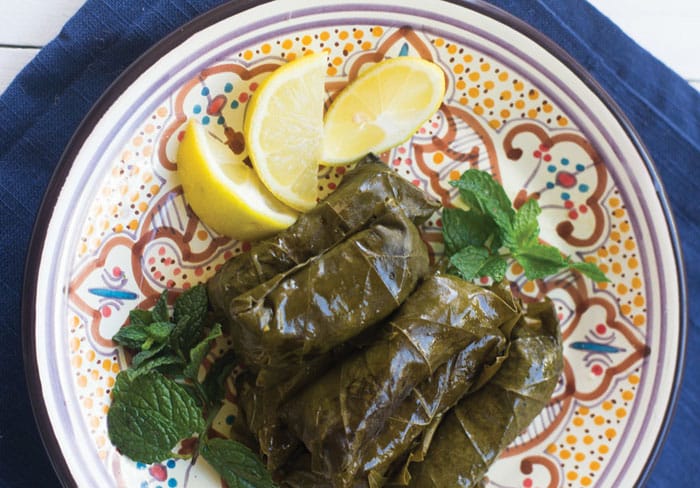
One of the first recipes Samantha Ferraro learned to make from her Sephardic mom was stuffed grape leaves, which are perfect for Sukkot.

Ferraro, author of “The Weeknight Mediterranean Kitchen” and founder of The Little Ferraro Kitchen, said the recipe is a process that’s well worth the effort.

“Typically, we fill our [grape leaves] with a combination of ground meat and rice and simply steam the stuffed rolls with lemon and water,” Ferraro said. “Simple as they are, the briny leaves flavor the mixture, and [tasting them] is one of my fondest memories.” 

Over the years, she’s adapted different recipes and tried different fillings. Her Vegetarian Stuffed Grape Leaves are full of bright flavors. 

“The filling is stuffed with a bounty of fresh herbs and chickpeas, lemon zest and rice and rolled into a tight and flavorful package,” she said. “These can be enjoyed hot or warm and even at room temperature, making them a great recipe to make ahead of time and to be enjoyed throughout the holiday.”

Samantha Ferraro’s Vegetarian Stuffed Grape Leaves
Photo Credit: The Little Ferraro Kitchen

Vegetarian Stuffed Grape Leaves

Ingredients
1 jar grape leaves
3 tablespoons olive oil
1/2 onion chopped finely
1 1/2 cups uncooked basmati rice
1 can garbanzo beans, drained and roughly chopped
2 medium tomatoes, grated
1 tablespoon dried mint
Small bunch of parsley, finely chopped
Small bunch of fresh dill, finely chopped
Few sprigs of fresh mint, finely chopped
1 lemon juiced and zest + 1 lemon, sliced
2 cups vegetable stock or water
Salt and pepper to taste

Recipe:

  1. Start by removing the grape leaves from the jar and separating the leaves. Give each leaf a good rinse under cool water and place them in a colander while you make the filling.
  2. Place a skillet over medium heat and drizzle with olive oil. Add the chopped onions and sauté for about 2-3 minutes until the onions become translucent. Add the basmati rice and toss with the olive oil, making sure all of the grains are lightly coated with the oil, for another minute.
  3. Add the sautéed onions and rice to a bowl, along with the grated tomato, chickpeas, fresh herbs and lemon zest and juice and season with salt and pepper.
  4. Line the bottom of a large pot with any broken leaves and lay a grape leaf flat in front of you, shiny side down.
  5. Cut off the thick stem and place a small teaspoon amount of the mixture towards the bottom of the leaf. Then roll half way up, tucking the sides in until all rolled up.
  6. Place the grape leaf seam side down into your pot and finish rolling the rest.
  7. Once all the stuffed grape leaves are rolled, top with leftover torn leaves and lemon slices.
  8. Add the water or vegetable stock and cook on low for about 45 minutes, until the rice is cooked through. Add more liquid if needed.
  9. Once done, serve grape leaves with extra lemon wedges.

Harvest Food to Celebrate Sukkot Read More »

Rosner’s Domain: The Israel-Lebanon Deal— A Calm Evaluation

On Sunday, Israel accepted a U.S.-brokered proposal for a deal demarcating a maritime border with Lebanon. The deal – if accepted by the other side and signed – will open the way for a profit-sharing arrangement in a disputed gas project. Is this agreement good for Israel? You can’t expect Israelis to be in agreement concerning such questions. Not on the eve of another election. So, we should state at the outset: the agreement is neither a historical achievement (the government’s position), nor a shameful surrender (the opposition’s position). Israel did not obtain the most profitable deal, nor did it go bankrupt. This is an agreement between two parties who have decided that they have exhausted their ability to bargain, who have decided to stop at a certain point. The question of whether this is the right point for Israel depends on priorities.

We should state at the outset: the agreement is neither a historical achievement (the government’s position), nor a shameful surrender (the opposition’s position).

Of course, our government is no ordinary government. The government’s opponents ought to admit that even such a government must make decisions. The government’s supporters must admit that had it been an interim Netanyahu government announcing annexation of 800 square kilometers, their insistence of government prerogatives would not be as vocal (Israel is ceding 800 square kilometers — 308 square miles — to Lebanon in the forthcoming agreement). But we all know that intellectual honesty is a rare commodity in the political arena, especially on the eve of elections. 

Where do we go from here? Let’s start with the obvious: Opposition leader Benjamin Netanyahu’s announcement that he will not honor the agreement is nonsense. An international agreement signed by Israel is a done deal. It is possible that the whole purpose of his fierce rhetoric is to make the Lebanese hesitate, or force the government to ask for approval from the Knesset (which it will not get). Perhaps Netanyahu truly believes that the agreement is bad. Perhaps he does not want to let the government have an achievement. Perhaps he does it because the debate about “territorial compromises” is a convenient one for him to have before a vote. Can you believe it? On the eve of these elections, Israel is repeating the old debate about territories – just not the territories we are used to talking about.

And why do Prime Minister Lapid and Defense Minister Gantz want to sign the agreement? We don’t have access to their hearts and minds. They certainly want the best for the State of Israel, but don’t they also have a political interest that influenced their considerations? Would they have compromised in the same way had there been no elections on the horizon? The elections are a stopwatch that forces all parties to stop and decide. Menachem Begin attacked the nuclear reactor in Iraq on the eve of elections. His opponent Shimon Peres protested vigorously; later Peres himself was a guest at the Sharm el-Sheikh conference on the eve of the elections. His opponent Netanyahu protested vigorously. Lapid and Gantz, like all their predecessors who worked to achieve goals on the eve of elections, know that if not now, maybe never, or maybe not them. So yes, the election is a factor, a stopwatch, but not the only one. Alongside it there is also the plan to begin drilling for gas. 

Israel had two options for compromise, which the opposition would paint as surrender, and one option to hold firm, and take a risk. Compromise one: sign – as the government wants to do. Compromise two: postpone the driling, so as not to risk a violent outbreak. Option to hold firm: begin to drill without reaching an agreement. Hezbollah would likely respond with fire. Israel would respond to the response. Maybe this means a short exchange of fire, maybe an all-out war. Either way, it is clear that choosing to hold firm and drill is more dangerous – at least in the short term.

And what about the long term? That’s the root of the real debate. Did Israel act wisely when it decided not to insist on secondary issues (disputed territory at sea) and get a practical arrangement that allows it to do what’s really important (drill, produce, make a profit). Or maybe Israel acted foolishly, by teaching Hezbollah how to use threats to advance its goals. And in this matter, there should be no doubt: Hezbollah’s threats had an effect on the negotiations. Because of them, Israel had to choose between a somewhat painful compromise and an insistence that could lead to war. Should this be considered a “surrender to terrorism”? Any negotiated compromise between any two countries requires surrendering to something. Israel surrendered the Sinai Peninsula to Egypt to prevent a future war. Was it surrender to terrorism? Sure – the Egyptians essentially said, either you return Sinai, or there will be another war. Was it worth it? Israel gained peace on the Egyptian border, and lost territory. 

There is no return without paying a price. Hence, what is required is an evaluation of the return compared to the price. One is willing to pay a lot for a certain product; the other believes that the price is too high for such product. All else is just politics.

Something I wrote in Hebrew

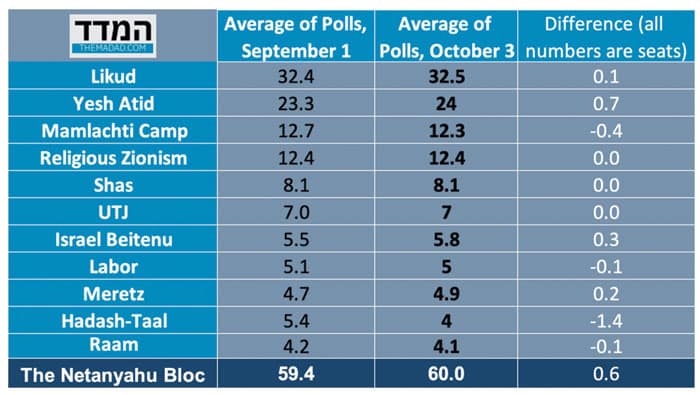
Look at this, and then at the table below it:

Only one significant political change took place in September, and that is the transition from two Arab parties to three. One of them does not cross the electoral threshold in the polls (Balad) but takes from the two other parties (Hadash-Taal and Raam). Both of them are very close to the electoral threshold, barely above it. On average – this is just one seat less for the Arab parties., But potentially, this is a significant seat, because of the possibility that all three parties will end up below the thresholds, which means no Arab representation at all, and eight seats for grabs that will likely hand Netanyahu a victory. 

A week’s numbers

In the most static election in Israel’s history, the polls barely move.

A reader’s response:

In response to my last week’s article (how do we define a good year), Fred Ginzburg writes: “A year without Netanyahu was definitely a good year”. My response: so this year is up for grabs. 


Shmuel Rosner is senior political editor. For more analysis of Israeli and international politics, visit Rosner’s Domain at jewishjournal.com/rosnersdomain.

Rosner’s Domain: The Israel-Lebanon Deal— A Calm Evaluation Read More »