fbpx

October 6, 2022

Super Stuffed (Veggies) for Sukkot

Sukkot is a time of joy in the Jewish calendar, an autumn festival of Thanksgiving. The Bible refers to this holiday as Chag Ha’asif (Feast of Gathering), when the last grains and fruits were harvested in Israel and as Chag Ha’sukkot (Feast of Tabernacles) commemorating the forty years of wandering in the wilderness, sheltered in temporary huts and the miraculous clouds of glory that sheltered the Israelites from the hot desert sun.

There are no rules dictating what we must eat in our Sukkahs, but there is definitely a tradition of eating stuffed foods from vegetables to pastries, to represent the abundance of the season.

We’ve spent hours praying in the synagogue, we’ve eaten all the symbolic foods of Rosh Hashanah, we’ve fasted and now it’s time for some serious al fresco feasting. There are no rules dictating what we must eat in our Sukkahs, but there is definitely a tradition of eating stuffed foods from vegetables to pastries, to represent the abundance of the season. Ashkenazi Jews eat kreplach, a triangular noodle filled with potato or ground beef, mostly served in chicken soup but also fried like a wonton. Stuffed cabbage also makes an appearance on the Ashkenazi table. 

For Sephardim, it’s all about the stuffed veggies. The Syrians and Egyptians call it Mehshi (pronounced mekh’shi) from the Arabic word for stuffed. Like the Ottoman Turks, the Iraqi Jews call stuffed grape leaves dolma. But for the holidays and other festive occasions, the Iraqi Jews prepare a large assortment of stuffed vegetables giving it the name ma’hasha.

My grandmother Nana Aziza stuffed onions and cabbage, potatoes and zucchini, carrots and beet leaves. In Iraq, the stuffing was made with ground lamb, rice and tomatoes. For our American palate, the recipe calls for ground beef. I remember the pleasure she took in assembling all the vegetables. I remember the beautiful red stain of the beets on the stuffed white onion skin. I remember the delightful complexity of the tender vegetables encasing the soft rice and meat, smothered in the sweet and sour flavor of the sauce, a perfect marriage of tart lemon and the deep flavor of tomato paste. 

I share with you my mother’s version of her mother’s recipe. My mother uses the fresh silver beet leaves of beet root (find it in the organic section at Ralph’s and Whole Foods). They have a beautiful green color and a wonderful texture when cooked.

And I share with you the fervent wish that your home and your Sukkah always be filled with happy faces and wonderful food.

—Sharon

Many years ago, my mother strongly encouraged me to go to a party hosted by the Sephardic Education Center and that’s where I met my husband Neil. Maman knows best. 

In those years there was a weekly SEC class with lots of interesting speakers hosted by Rabbi Moshe Benzaquen at Kahal Joseph Congregation. We formed a close-knit group of young friends, resulting in many marriages. Rabbi Benzaquen officiated at many of them, including ours. 

In those early years, Neil and I lived in Westwood, where Rabbi and his beautiful wife Yafa created a lovely community. 

They were the best hosts and would always have a huge crowd of young people for lunch. They were a wonderful example for all of us. He was always so sweet to her and we all knew how much he loved her. She was not much older than us, and already raising young kids, but she was never flustered and always had a smile on her face. 

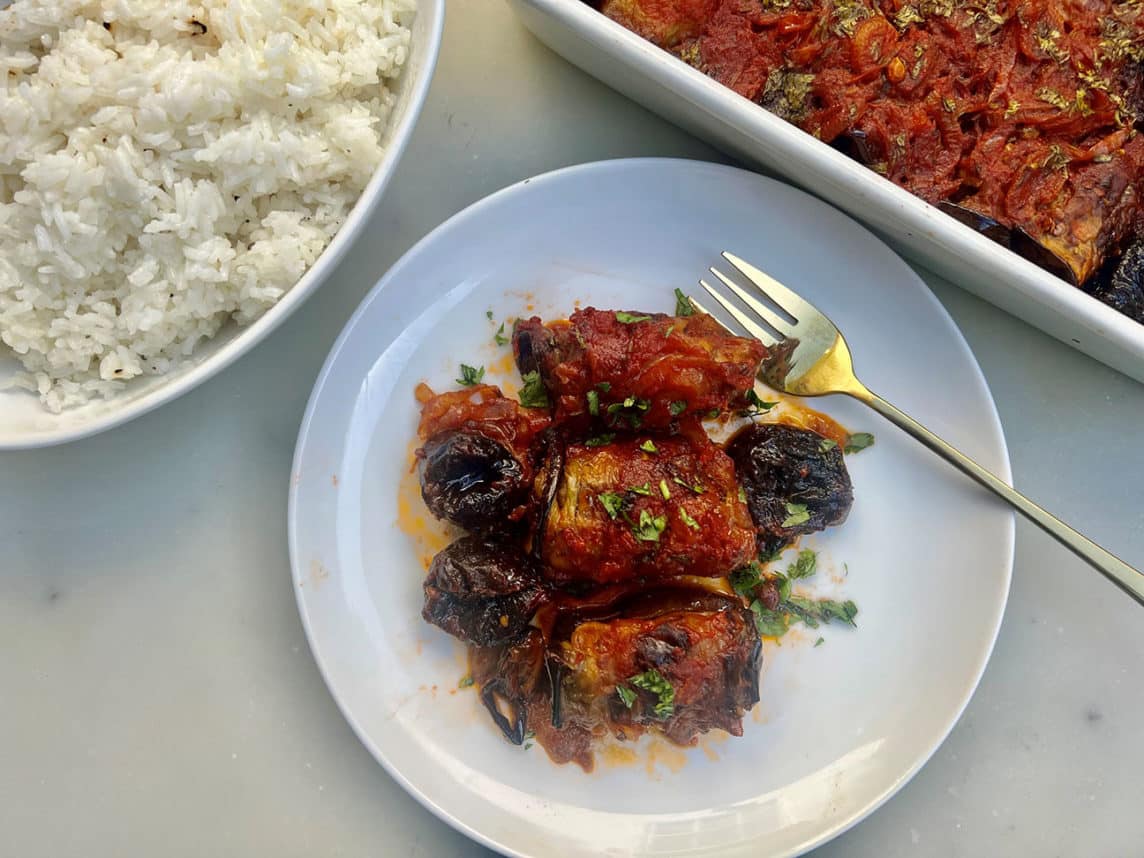
An incredible cook, she made huge amounts of food and it all tasted so good. There were big pots of hamin (chicken and rice), chicken dishes and flavorful briskets. A table full of salads. Born in Israel to a Persian family she was a master of rice. But my very favorite were her eggplant and ground beef rolls. To this day I recall the savory and sweet deliciousness!

She learned the recipe from her very good friend Hadassah Insilburg, who is the sister of the famous Moroccan Israeli actor Ze’ev Revach. Every Sukkot, I looked forward to this stuffed eggplant dish. 

We have been through so many life experiences with Rabbi and Yafa, from our wedding to the bril milahs of our sons (he’s a mohel) to the shiva and Shloshim of my mother. They still hold a very dear place in our hearts and we are so grateful to Yafa for sharing her recipe with you, our reader. 

The original recipe called for frying the eggplant, but to make it easier and a little healthier, I roasted it in the oven.

Wishing you a Chag Sameach and memorable meals in your Sukkah!

—Rachel

Nana Sue’s Ma’hasha

Sauce
1/4 cup extra virgin olive oil
1 large onion, finely chopped
2 tomatoes, diced
2 tablespoons tomato paste
2 teaspoons sweet paprika
6 garlic cloves, crushed
2 lemons, juiced
2 tablespoons sugar
2 cups water
• In a pot, warm oil over medium heat and sauté until translucent. Add tomatoes and continue to sauté for two minutes.
• Add tomato paste, garlic, lemon juice, sugar and water.
• Stir well, lower heat and allow to simmer for a half hour.
2 large white onions
7 medium zucchini or Mexican squash, halved
4 medium tomatoes
12 silver beet leaves, soaked and drained
2 beets, peeled and cut into thin slices
2 tablespoons extra virgin olive oil
• Slit the onions from top to bottom, halfway to the middle.
• Boil the onions for 10 to 15 minutes until the layers can be detached. Drain and leave to cool.
• Core the middle of the zucchini and tomatoes and reserve the inside of the vegetables to put in the skillet with stuffed vegetables.
Stuffing
1 1/2 cups jasmine rice
1/2 lb ground beef
1 small onion, finely diced
1/2 cup Italian parsley, finely chopped
1 teaspoon sea salt
1/2 teaspoon black pepper
2 tablespoons tomato paste
2 tablespoons extra virgin olive oil
• In a large bowl, mix all the stuffing ingredients together.
• Coat the bottom of a large skillet with 2 tablespoons of olive oil.
• Fill the zucchini with stuffing and arrange on the outer edges of the skillet.
• Stuff the onions and tomatoes and arrange in the center of the skillet.
• Place stuffing in the middle of the beet leaves and wrap to form a small cigar. Arrange stuffed beet leaves between the zucchini. Arrange slices of beetroot around the vegetables.
• Cook vegetables on low heat for about two minutes, then pour sauce over the stuffed vegetables. Simmer over medium-high heat for five minutes.
• Cook covered over low heat for about an hour or until most of the liquid has been absorbed. Add a little water if necessary to prevent the vegetables from burning.
  • Photo by Alexandra Gomperts

    Yafa’s Beef and Eggplant Rolls

    Sauce
    1/4 cup olive oil
    2 onions, thinly sliced
    2 garlic cloves, grated or finely chopped
    1 14 ounce can of tomato sauce
    1 teaspoon salt
    1/2 teaspoon pepper
    1/2 cup water
    1 large lemon, juiced

    • Warm olive oil in a large skillet over medium heat. Add the onion and sauté until tender.

    • Add the tomato sauce, salt and pepper. Lower heat and allow to simmer for 10 minutes.

    • Add water and lemon juice and stir well for 2 more minutes. Set aside

    3 medium eggplants, thinly sliced in long strips
    1 tablespoon kosher salt
    1/4 cup avocado oil
    2 tablespoons avocado oil
    1 onion chopped
    1 lb ground beef
    1 teaspoon ground cumin
    1/2 teaspoon salt
    1/4 teaspoon pepper
    3 tablespoons potato starch
    1 egg
    1/4 cup chopped Italian parsley
    1 tablespoon olive oil
    1/2 cup pitted prunes

    • Preheat oven to 450°F

    • Sprinkle salt over eggplant strips, place in a colander and let drain, about 20 minutes.

    • Squeeze water from eggplant and pat dry with a paper towel

    • Brush both sides of eggplant with oil and place on a parchment lined cookie sheet

    • Bake for 10 minutes or until tender and slightly golden.

    • Remove eggplants from oven and reduce oven heat to 350°F

    • In a medium skillet, warm oil over medium heat and add onion. Sauté until translucent and soft. Set aside to cool.

    • Place ground beef in a medium bowl, then add the onions.

    • Add the spices, potato starch, egg, parsley and oil and mix to combine.

    • Roll the beef mixture into long meatballs and place on the wider side of the eggplant. Roll the eggplant over the meat filling and place in a large ovenproof dish.

    • Arrange prunes in between the eggplant rolls.

    • Pour the sauce over the eggplant rolls.

    • Cover with foil and bake for 45 minutes, then uncover and bake for an additional 15 minutes.


Sharon Gomperts and Rachel Emquies Sheff have been friends since high school. The Sephardic Spice Girls project has grown from their collaboration on events for the Sephardic Educational Center in Jerusalem. Follow them on Instagram @sephardicspicegirls and on Facebook at Sephardic Spice SEC Food. Website sephardicspicegirls.com/full-recipes

Super Stuffed (Veggies) for Sukkot Read More »

Table for Five: Sukkot Edition

One verse, five voices. Edited by Salvador Litvak, the Accidental Talmudist

For a seven day period you shall live in booths. Every resident among the Israelites shall live in booths, in order that your [ensuing] generations should know that I made the children of Israel live in booths when I brought them out of the land of Egypt. I am the Lord, your God. 

– Lev. 23:42-43


Miriam Yerushalmi
CEO SANE; Author, “Reaching New Heights” series

The Baal HaTanya writes that each year after the shofar is blown, the hidden light of “Mochin,” a new intellectual wherewithal, descends into the world, to be revealed on the holiday of Sukkot. 

G-d reminds us that He has moved from the throne of justice to the throne of mercy. Our remorse over the past now becomes a springboard impelling us forward, energizing us to return ever closer to Him, with renewed and refreshed zest. The awaited time has arrived to sit together with our beloved, away from all distractions, to receive G-d‘s hug of love and acceptance. 

Throughout the holiday of Sukkot, Hashem is sending us a message of His love. The sukkah walls are like extended arms with which Hashem embraces us. The schach is like the tallis of a chuppah under which two beloved souls are united into one. The Lubavitcher Rebbe teaches that on Sukkot, the full nature of joy is revealed, giving us a taste of life with Moshiach. 

The joy expressed in the sukkah, as we realize that with this unique mitzvah our entire being–in its physical, intellectual, and spiritual aspects — is fully surrounded by the Divine, all day and all night, for over a week, is great enough to break through the gates of heaven. As we knocked on our hearts while praying to G-d for forgiveness, G-d has been knocking, too, asking us to open them up and let Him in. 

Let us respond happily and spend the holiday — and all year — together with Him!


Rabbi Pinchas Winston
Thirtysix.org

There are many types of mitzvos, but few encompass all of us like living in a sukkah for seven days. There is no other mitzvah to be completely inside something, other than the mitzvah of living in Israel. There is a mitzvah to be ritually pure, which we accomplish by immersing in a mikvah. But the mikvah is more of a means than an end. 

According to the verse, it seems a sukkah is also just a means to an end, that being to recall that God “made” our ancestors live in booths after leaving Egypt. 

But we know otherwise, especially according to Kabbalah. One level of explanation says that the walls of a sukkah are to the person inside what the body is to the soul. Just as the walls are temporary, but the person within them will live beyond the seven days of the holiday, so too are our bodies temporary and our souls will live beyond their death. 

It’s the opposite of how many people live. We don’t see our souls, but we do see our bodies, causing them to become top priority in life. 

Billions of dollars are spent pampering the body while so little is spent pampering the soul, and that is what usually leads to the sins for which we atone on Yom Kippur. That is when we are supposed to realize this and make our souls the priority. Living in the sukkah for seven days is supposed to concretize this realization for the new year. 


Rabbi Michael Barclay
Temple Ner Simcha, Westlake Village

This verse explicitly tells us that one of the reasons for dwelling in the sukkah (there are additional reasons in other texts) is so that future generations know of God’s omnipotence as demonstrated in the Exodus, and in sustaining us through the desert. 

But how does living in a booth allow us to really know God’s greatness? 

There are many ways, but the most clear is found in the holiday’s practice of Ushpizin: inviting guests to our sukkah. This includes inviting physical guests, but also the spirits of our ancestors Abraham, Isaac, Jacob, Joseph, Moses, Aaron, and King David into our booths. 

Each night of the holiday we call out to these spirits as we invite them by name into the sukkah. The liturgy is clear. “Be seated, be seated exalted guests. Be seated, be seated guests of faithfulness,” is followed by a calling out of each of their names. The spirits of these seven ancient luminaries who experienced God’s greatness directly and personally are welcomed into our homes and hearts. 

With our souls inspired by the spirits of these ancestors, we become encouraged to talk with our physical guests about God’s greatness. Through the spiritual presence of these ancestors we are guided to remember God’s greatness not based in what we read in the Torah, but in the personal accounts their departed souls subtly relate to our souls in the sukkah. 

So let’s all invite guests into our booths, and go as guests to others. And in doing so, may we all be affected at the deepest level to truly know God’s greatness and love.


Yehudit Garmaise
News reporter, Parsha teacher

While the Temple stood in Yerushalayim, on Yom Kippur, the kohain gadol burned incense in the Holy of Holies to expiate the sins of all of K’lal Yisroel.

Throughout the next five days, while we prepare for Sukkot, the smoke that arose over the Bais Hamikdash from that incense offering transformed into the Clouds of Glory, which are the origin for the mitzvah of Sukkah according to Sukkah 11b in the Gemara.

The smoke from the incense offering was spiritually charged so powerfully because it manifested am Yisrael’s heartfelt teshuva, which the Lubavitcher Rebbe said is “a revelation of the soul’s highest dimension, which transcends our conscious minds.”

While the fun and exciting mitzvah of Sukkah begins to give us a sense of how the Clouds of Glory absorbed enemies’ arrows in the desert and how much Hashem protects us every day, the sukkah’s power can sometimes feel as subtle and elusive as Hashem’s responses to our heartfelt tefillos to change ourselves.

So that we can internalize the koach and brachos that Hashem wants to give us in response to our teshuva, He gives us the mitzvah of lulav, which brings down Divine, strengthening, protective, and loving energies into our day-to-day lives, as we continue to realign our identities with whom we want to be in 5783.

With each back-and-forth movement of the lulav, we bring back into ourselves “a different spiritual force,” the Rebbe said. “After each such motion, we bring the base of the lulav back into our hearts.” 


Rabbi Chaim Singer-Frankes
Multi-faith Chaplain, Kaiser Permanente Hospital, Panorama City

In verse 43, Rashi is concerned with ki b’sukkot hoshavti i.e. “in booths I caused (you) to dwell.” Rashi’s understanding is simple; this references “annei ha’kavod,” (clouds of God’s glory) i.e. Israel’s sacred camouflage. What do clouds of God’s glory have to do with a booth? We might also ask that if clouds of glory are what God meant, then why doesn’t the text simply state “I (God) will envelop you in clouds of glory,” and be done with it? 

As Israel flees from Egypt there is a pall of uncertainty. We fathom that God directs our fate with Moshe as our interlocutor. However, God’s physicality remains liminal and unseeable. Meanwhile, we are in the midbar, translated alternately as desert or wilderness. It is by contrast, an overtly physical wild place, given to the vicissitudes of changeable weather, tormenting snakes, and scorpions, to say nothing of the anxieties over an insecure food supply. We can ask, what does a temporary booth offer in the face of such elements? Rashi hits the nail on the head. Not only does God place us in sukkot, an appreciably real place to rest our heads, but His pillar of cloud (first seen in Exodus) extends upon us an eternal shroud of protection. We reenact God’s gesture of Divine love by dwelling in booths for seven days each year. In Greek literature, it is known as theophany, a manifest encounter with God. Therefore, to sit in the sukkah is to personally understand God’s intimate, unique love.

Table for Five: Sukkot Edition Read More »

Face Time – A poem for Parsha Ha’azinu

And He said, “I will hide My face from them…”
-Deuteronomy 32:20

Yes.
No.
I don’t know.

Those are the three answers
my students used to give me when
I’d asked them if they believed in God.

The follow-up question, after they
filled those three columns, was always
who’s right?

This led to an hour-long conversation
in which nothing was decided and thus
mimicking how our government works.

It gets more complicated, when
in the second to last chapter of the entire
scroll of chapters full of reminders

to do what we’re told by the
Grand Teller of things to do, he/she says
I will hide My Face from them.

The future is foretold in which we will
have strayed and God will not be around
to consume anyone with fire.

Thousands of years later we’re
struggling to see signs of the flames.
Why do what we’re told when

the face of the Teller is hidden?
It used to be, no one would dare to think,
let alone say out loud, no, or I don’t know,

or even maybe. It was always a
resounding YES, even if we decided to
take our own path.

Either the Face has been hidden for so long
or we forgot how to see it. If you’re at all skeptical
May I suggest you look into the face

of any other human being?
If you tune your eyes right,
what is hidden is not.


God Wrestler: a poem for every Torah Portion by Rick LupertLos Angeles poet Rick Lupert created the Poetry Super Highway (an online publication and resource for poets), and hosted the Cobalt Cafe weekly poetry reading for almost 21 years. He’s authored 26 collections of poetry, including “God Wrestler: A Poem for Every Torah Portion“, “I’m a Jew, Are You” (Jewish themed poems) and “Feeding Holy Cats” (Poetry written while a staff member on the first Birthright Israel trip), and most recently “I Am Not Writing a Book of Poems in Hawaii” (Poems written in Hawaii – Ain’t Got No Press, August 2022) and edited the anthologies “Ekphrastia Gone Wild”, “A Poet’s Haggadah”, and “The Night Goes on All Night.” He writes the daily web comic “Cat and Banana” with fellow Los Angeles poet Brendan Constantine. He’s widely published and reads his poetry wherever they let him.
Face Time – A poem for Parsha Ha’azinu Read More »

The Etrog in Eden

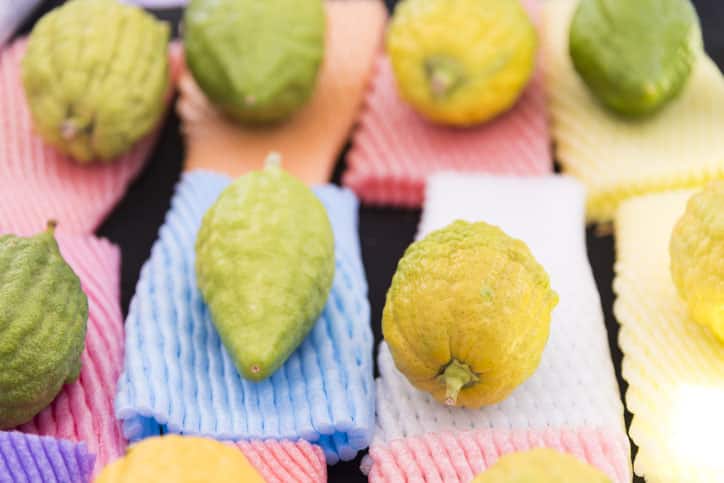
It’s possible the etrog was the fruit

which God told Adam not to eat while Edened.

He did, and therefore had to make himself a suit,

 by sinful citron-induced pleasures hedoned.

To the Tenth Commandment, “Do not covet,”

in Aramaic etrog is alluding,

Its beauty, that’s the reason that we love it,

produces pleasures that are soul deluding,

As Solomon said, beauty is a lie,

and wisdom is a better thing to choose.

While waving on Sukkot four species high,

remember pleasure can be bad for Jews.

Choose wisdom just like Solomon, although

You must read his Qohelet, book composed

to tell you it’s most vital that you know

that wisdom’s not as great as you supposed,

as, when consuming from the Tree of Knowledge

what had been recommended to them by a snake,

Eve-Adam learned, in Eden’s Ivy college,

committing a pre-sophomore mistake.

I composed this poem on 10/5/22 after Yom Kippur 5783 after learning an interesting theory about the etymology of “etrog,” the citron that Jews use on Sukkot, presented by Reuven Chaim Klein s in “The Anatomy of a Mitzvah:The Beautiful Citron”:

The Torah (Lev. 23:4) commands that on the first day of Sukkot one must take Four Species, including something deemed a pri eitz hadar (translated as “a beautiful fruit of a tree” or “a fruit of a beautiful tree”). As we will explain in this essay, this term refers to the citron fruit, also known more technically as the Citrus medica. Besides hadar, other Hebrew/Aramaic terms that refer to this fruit include etrog, etronga, trunga, and tapuach….

Dr. Zohar Amar (of Bar Ilan University) clarifies that the fact that scholars have not yet found any evidence that citrons grew in the Holy Land before the Persian Period does not prove that it was only imported then, because the sporadic nature of Archaeobotany cannot give us a complete picture of the Holy Land’s entire floral oeuvre.

Moreover, according to one Tannaic opinion, the forbidden fruit from the Tree of Knowledge refers to a citron (see Bereishit Rabbah §15:7, Brachot 40a). About that fruit,  the Torah says, “the woman [Eve] saw that the tree is good for eating, and that it is enticing for the eyes…” (Gen. 3:6). Rabbi David Kochavi of Estelle (who in the 1300’s in Provencal France) infers from this passage that the fruit in question only looks like it tastes good, but in practice the fruit has very little flesh to it—an apt description of the citron.

It is customary for a groom to write in a marriage document that his bride may collect her Ketubah from “all the better arag of my property.” Rabbi Eliezer ben Yoel (1140–1225), known as the Raavyah, explains that the word arag is an expression of “desirable,” because Targum Onkelos (to Gen. 2:9, 3:6, Prov. 21:20) translates the word nechmad (and taavah in Deut. 5:18) as ragig, and arag is a cognate of that term.

Based on this, Nachmanides (1194–1270), who was Raavyah’s younger contemporary, adds that the word etrog is also a cognate ragig and arag, which leads him to explain that etrog can rightfully be translated as “the desirable fruit.” In light of this, Nachmanides argues that the term pri eitz hadar must refer to the etrog, because hadar and nechmad mean essentially the same thing.

Nachmanides even goes as far as to say that hadar is simply the Hebrew word for what is called etrog in Aramaic—making the two terms totally synonymous.

Deut. 5:18 states:

יז  וְלֹא תַחְמֹד, אֵשֶׁת רֵעֶךָ;  {ס}  וְלֹא תִתְאַוֶּה בֵּית רֵעֶךָ, שָׂדֵהוּ וְעַבְדּוֹ וַאֲמָתוֹ שׁוֹרוֹ וַחֲמֹרוֹ, וְכֹל, אֲשֶׁר לְרֵעֶךָ.  {ס} 17 Neither shalt thou covet thy neighbour’s wife; {S} neither shalt thou desire thy neighbour’s house, his field, or his man-servant, or his maid-servant, his ox, or his ass, or any thing that is thy neighbour’s. {S}

Onkelos translates the Deut. 5:18 as follows:

וְלָא תַחְמֵד אִתַּת חַבְרָךְ וְלָא תֵרוֹג בֵּית חַבְרָךְ חַקְלֵיהּ וְעַבְדֵּיהּ וְאַמְתֵיהּ תּוֹרֵיהּ וַחֲמָרֵיהּ וְכֹל דִּי לְחַבְרָךְ:

And do not covet your neighbor’s wife. And do not desire your neighbor’s house, his field, or his male slave or his female slave, his ox or his donkey, or anything else that belongs to your neighbor.’’

The fact that וְלֹא תִתְאַוֶּה is translated by Onkelos as  וְלָא תֵרוֹג  supports the suggestion  that the forbidden fruit in the Garden  of Eden was an etrog, the fruit that stimulated desire, as per Gen 3:6, which, by stating וְכִי תַאֲוָה-הוּא לָעֵינַיִם links it to the etrog:

ו  וַתֵּרֶא הָאִשָּׁה כִּי טוֹב הָעֵץ לְמַאֲכָל וְכִי תַאֲוָה-הוּא לָעֵינַיִם, וְנֶחְמָד הָעֵץ לְהַשְׂכִּיל, וַתִּקַּח מִפִּרְיוֹ, וַתֹּאכַל; וַתִּתֵּן גַּם-לְאִישָׁהּ עִמָּהּ, וַיֹּאכַל.           6 And when the woman saw that the tree was good for food, and that it was a delight to the eyes, and that the tree was to be desired to make one wise, she took of the fruit thereof, and did eat; and she gave also unto her husband with her, and he did eat

Onkelos uses a verb that recalls the etrog when using וּמְרַגֵּג  to translate  , וְנֶחְמָד a word that recalls וְלֹא תַחְמֹד in Deut. 5:18:

וַחֲזַת אִתְּתָא אֲרֵי טַב אִילַן לְמֵיכָל וַאֲרֵי אַסֵּי הוּא לְעַיְנִין וּמְרַגֵּג אִילָנָא לְאִסְתַּכָּלָא בֵהּ וּנְסֵיבַת מֵאִבֵּהּ וַאֲכָלַת וִיהָבַת אַף לְבַעְלַהּ עִמַּהּ וַאֲכָל:

The woman saw that the tree was good for food, and that it was tempting [healing] to the eyes, and that the tree was appealing [to look at] as a means of [obtaining] wisdom. She took of its fruit and she ate, and she also gave it to her husband with her, and he ate.

It is interesting that Ps. 42:2 uses the Hebrew verb ערג which means “ascend” to denote “panting with desire,” twice using the word תַעֲרֹג which resonates with תֵרוֹג, the Aramaic translation used by Onkelos to denote desire that causes illicit coveting:

ב  כְּאַיָּל, תַּעֲרֹג עַל-אֲפִיקֵי-מָיִם–    כֵּן נַפְשִׁי תַעֲרֹג אֵלֶיךָ אֱלֹהִים. 2 As the hart pants after the water brooks, so pants my soul after Thee, O God.

Three verses in which detractive comments about wisdom are attributed to Solomon are Qoh. 2:14-16:

יד  הֶחָכָם עֵינָיו בְּרֹאשׁוֹ, וְהַכְּסִיל בַּחֹשֶׁךְ הוֹלֵךְ; וְיָדַעְתִּי גַם-אָנִי, שֶׁמִּקְרֶה אֶחָד יִקְרֶה אֶת-כֻּלָּם.  14 The wise man, his eyes are in his head; but the fool walks in darkness. And I also perceived that one event happens to them all.

טו  וְאָמַרְתִּי אֲנִי בְּלִבִּי, כְּמִקְרֵה הַכְּסִיל גַּם-אֲנִי יִקְרֵנִי, וְלָמָּה חָכַמְתִּי אֲנִי, אָז יֹתֵר; וְדִבַּרְתִּי בְלִבִּי, שֶׁגַּם-זֶה הָבֶל.      15 Then said I in my heart: ‘As it happens to the fool, so will it happen even to me; and why was I then more wise?’ Then I said in my heart, that this also is vanity.

טז  כִּי אֵין זִכְרוֹן לֶחָכָם עִם-הַכְּסִיל, לְעוֹלָם:  בְּשֶׁכְּבָר הַיָּמִים הַבָּאִים, הַכֹּל נִשְׁכָּח, וְאֵיךְ יָמוּת הֶחָכָם, עִם-הַכְּסִיל.         16 For of the wise man, even as of the fool, there is no remembrance for ever; seeing that in the days to come all will long ago have been forgotten. Alas the fool!


Gershon Hepner is a poet who has written over 25,000 poems on subjects ranging from music to literature, politics to Torah. He grew up in England and moved to Los Angeles in 1976. Using his varied interests and experiences, he has authored dozens of papers in medical and academic journals, and authored “Legal Friction: Law, Narrative, and Identity Politics in Biblical Israel.” He can be reached at gershonhepner@gmail.com.

The Etrog in Eden Read More »

A Moment in Time: Hearing the Call

Dear all,

During the Holy Days, as Jerry sounded the shofar, my kids approached the bima to get a front row view.

But it wasn’t the shape of the shofar that intrigued them.  Rather, it was the resonant sound.  And for the rest of the day, they mimicked it over and over (and over and over!)

For them, the sound was kind of funny.

But for me, the sound contains so much.

The shofar is the sound of Creation.

The shofar is the sound of Sarah in utter despair when she believed her son, Isaac, to be dead.

The shofar is the sound of Revelation at Mt. Sinai.

The shofar is the sound of the Maccabees fighting for religious freedom.

The shofar is the sound of hidden Jews during the Inquisition, who played the shofar in an orchestra so that other Jews could bring in the New Year.

The shofar is the sound of modern Israel’s independence.

The shofar is the sound of any human being crying for help.

But in any moment in time, these sounds are empty unless we hear them.

As the call of shofar continues to resonate, even now after the Holy Days have ended – let that sound pierce our hearts, that we may hear the call and redirect our future!

With love and Shalom,


Rabbi Zach Shapiro

A Moment in Time: Hearing the Call Read More »

A Bisl Torah – Praying and Building

The days after Yom Kippur are both easy and hard. We are spiritually uplifted and spiritually exhausted. We’re fueled to jump into the new year with renewed energy and vigor. And there is an equally sizable force drawing us to relax and lean back towards complacency.

Which is why we build a sukkah. To bolster our petitions with plywood and nails. To strengthen our promises with poles and hammers. To remind ourselves to get outside. Outside of our well intentioned thoughts, pairing prayer with action.

Rashbam, Rashi’s grandson teaches that living in sukkot provides ample reason to be grateful to God. Stepping outside of ourselves, we are confronted by the hard work and effort it takes to achieve our dreams, transforming lofty goals into practical achievements. And with the construction of the sukkah just mere hours after Yom Kippur, we give thanks to God for both the ability to dream and capacity to build.

The strongest prayers are those that find a way outside of our hearts, living, breathing and growing. First we pray…and now we build.


Rabbi Nicole Guzik is a rabbi at Sinai Temple. She can be reached at her Facebook page at Rabbi Nicole Guzik or on Instagram @rabbiguzik. For more writings, visit Rabbi Guzik’s blog section from Sinai Temple’s website.

A Bisl Torah – Praying and Building Read More »

Jewish Community Foundation Names Rabbi Aaron Lerner President and CEO

The Jewish Community Foundation of Los Angeles today announced the selection of Rabbi Aaron Lerner as its next president and chief executive officer effective Jan. 2, 2023.

Lerner, executive director of UCLA Hillel since 2012, will succeed Marvin I. Schotland, who has led the Foundation since 1989 and will transition to president and CEO emeritus.

Schotland announced his intention to retire in January 2022. The Foundation immediately launched a comprehensive national search for Schotland’s replacement.

In a statement, Foundation Board Chair Evan Schlessinger said: “Rabbi Aaron Lerner is an energetic and dynamic nonprofit leader with a demonstrated track record of success and is distinctly qualified to guide The Foundation into the next generation. There are neither adequate superlatives nor sufficient expressions of gratitude to Marvin Schotland for the steadyhanded leadership and visionary strategic thinking, resulting in the remarkable growth achieved during his tenure.”

Under Schotland’s 33-year leadership, the institution has grown from $90 million to $1.6 billion (as of Dec. 31, 2021) in charitable assets under management and ranks among Los Angeles’s largest foundations. During the last decade, The Foundation has distributed nearly $1 billion in grants to nonprofits locally, nationally, in Israel and around the world, including $123 million in 2021.

“I have known and long admired the pivotal role The Foundation plays in fostering, strengthening and sustaining our communities – both Jewish and nonsectarian,” Lerner said in a statement. “I am honored and humbled by my selection as its next president and CEO, and excited by the opportunity to immerse myself in The Foundation’s vital work in concert with its talented management team and staff, committed lay leadership and passionate community of donors.”

Looking back at his long tenure at the helm of The Foundation, Schotland said: “Leading The Foundation has been the greatest privilege of my professional life and, when I joined in 1989, never could have imagined that my role here would extend to nearly half the organization’s existence. In Aaron Lerner, though, I am confident The Foundation identified the person with all the appropriate attributes for the job he’s about to assume.”

Under Lerner’s leadership, Hillel at UCLA has expanded leadership training initiatives and increased engagement to nearly 2,000 students annually. An educator by training, Lerner plays a leading role in Israel advocacy and has been instrumental in fostering initiatives that have been replicated on some 80 college campuses nationwide. He has also directed major fundraising efforts for the organization, including its current endowment campaign.

In 2021, The Foundation and its donors distributed $123 million to more than 2,000 nonprofits with programs that span the range of philanthropic giving. Over the past 10 years, it has distributed nearly $1 billion to thousands of nonprofits across a diverse spectrum.

Jewish Community Foundation Names Rabbi Aaron Lerner President and CEO Read More »

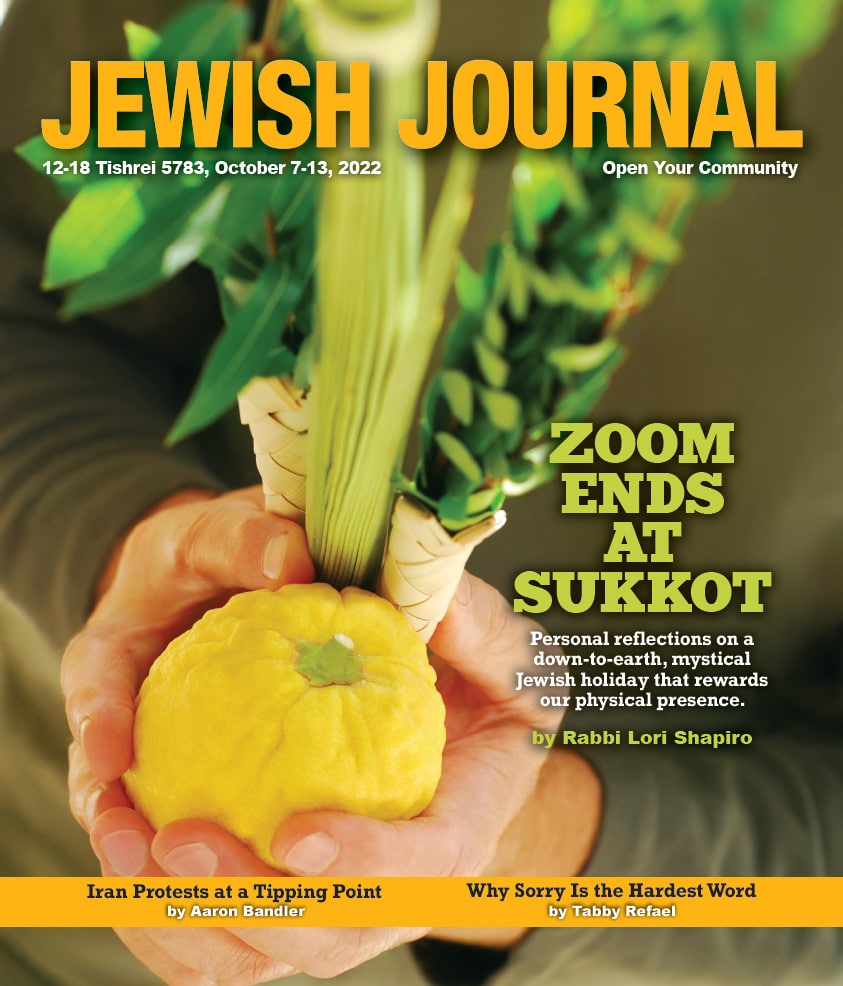
Print Issue: Zoom Ends at Sukkot | Oct 7, 2022

CLICK HERE FOR FULLSCREEN VERSION

Print Issue: Zoom Ends at Sukkot | Oct 7, 2022 Read More »

Why Global Boycott Campaigns Against Israel Are Antisemitic

There has been some confusion in recent years about why many people consider boycott campaigns targeting Israel to be a form of anti-Jewish bigotry. Unfortunately, there is a mountain of evidence that the social justice rhetoric used to promote these campaigns is a smokescreen for hate. The latest example comes from the Students for Justice in Palestine (SJP) chapter at the UC Berkeley’s Law School. SJP persuaded eight other student groups to amend their bylaws to prohibit invitations to Zionist speakers. They openly stated that this new rule is part of BDS, a global campaign promoting boycotts against Israel. Why have huge numbers of Jewish students, organizations, and concerned community members condemned this action? Because for most Jews, Israel is an important part of their Jewish identity. In practice, SJP and its partners have smeared and called for the exclusion of the vast majority of Jews worldwide.

The organizers of boycott campaigns against Israel, like the one within the law school at UC Berkeley, may think they are being clever by attempting to separate Jews from Israel. They often claim, “we are not anti-Jewish, we are simply anti-Zionist.” They count on the confusion this creates and bank on the ignorance or biases of their target audience. Sometimes they even manage to convince genuinely well-meaning people. Their falsehoods may do a lot of damage, but they cannot undo reality. And the reality is that Jews cannot be separated from Israel.

On a basic level, Zionism is about the Jewish people’s connection to their homeland. Israel is the birthplace of Jewish culture, language, religion, and more. It has played a central role in Jewish identity for over 3,000 years. On a political level, Zionism is a movement supporting the rights of Jews to self-determination in their ancestral homeland. Before 1948, that meant working to create an independent Jewish state. Now that Israel exists, Zionism is about ensuring that it can survive and thrive in peace. Nearly half of the world’s Jews live in Israel, and many (if not most) of the rest have family or friends living there.

So it’s no wonder that Israel’s right to exist and the safety of its citizens would be important to most Jews around the world. A minority may disagree or feel indifferent, as is their right. However, the claim that Israel and Zionism can be separated from the Jewish people as a whole is false, and will remain so no matter how many times it is repeated.

At their rallies, boycott activists often chant, “from the river to the sea, Palestine will be free,” and “we don’t want two states, we want ’48.” They claim these are calls for justice and are not meant to harm Jews. But the Jewish state is located between the Jordan River and the Mediterranean Sea, and it was established in 1948. Demands for its destruction represent a threat to most Jews around the world.

Trying to strip away Jewish rights in the name of Palestinian rights is not a path to freedom, justice, or peace. Tragically, boycott campaigns only encourage Palestinian leaders and terrorist groups to continue promoting endless war against Israel. The Palestinian leadership has rejected every major peace offer that would have ended the conflict and led to the creation of a Palestinian state. They should be pressured to compromise for the good of their people and the region as a whole. Instead, they are being encouraged by boycott and other anti-Israel campaigns to prolong the suffering of Palestinians until Israel can be wiped off the map.

Will Israel disappear because of boycott campaigns on or off campus? That didn’t happen when Arab governments tried to economically strangle the Jewish state from birth, and it won’t happen now. However, anti-Israel extremists lacking the power to achieve their destructive goals through physical war, does not make their efforts any less antisemitic. Their “activism” inevitably causes real life harm to Jews on campus and elsewhere. Unfortunately, that will continue to be true as long as they refuse to accept that Israel is the homeland of the Jewish people and isn’t going anywhere. It is up to everyone who truly wants a better future for both Israelis and Palestinians to stand up strongly against this hate and not be confused by its rhetoric.


Roz Rothstein is the co-founder and CEO of StandWithUs, an international, nonpartisan Israel education organization.

Why Global Boycott Campaigns Against Israel Are Antisemitic Read More »

Letter to the Nine Berkeley Law Groups from a CUNY Professor

Berkeley Law Muslim Student Association;
Berkeley Middle Eastern and North African Law Students Association;
Berkeley Womxn of Color Collective;
Berkeley Asian Pacific American Law Students Association;
Berkeley Queer Caucus;
Berkeley Community Defense Project;
Women of Berkeley Law; and
Berkeley Law Students of African Descent,

My name is Professor Jeffrey Lax. I am a Zionist Jew, both by ethnicity and in my religious belief.

I am also a lawyer with expertise and scholarship in discrimination law and with over 20 years of experience teaching various law courses at The City University of New York (CUNY). I am a co-founder of the pro-Zionist advocacy group, Students and Faculty for Equality at CUNY (S.A.F.E. CUNY). I’ve experienced discrimination personally at my campus, where a purportedly progressive group created rules that excluded observant and Zionist Jews from joining and held meetings on Friday nights to ensure that exclusion.

I advocate passionately for all marginalized groups and, in fact, have proudly written in support of many protected classes represented by a number of groups included on this email’s recipient list. For example, I am a lifelong supporter of, and have written in support of, the LGBTQ community (see here and here), of women’s rights (see here and here), and on behalf of other marginalized groups in various fora, including during my on-air consulting work for several cable news networks. I covered the trial of the horrific murder of George Floyd extensively, and mourned with the black community.

To my Muslim cousins, in particular, I’d like to assure you that I firmly and genuinely do believe that Palestinian civilians are victims who deserve far, far better. By absolutely no measure am I anti-Palestinian or Islamophobic. That’s not what my strong sense of Zionism is about. In fact, those bigoted views would conflict with how I define, experience, and practice my Zionism. I’d love to come show you how all of these statements are congruent.

I write here not to complain about the recent bylaw adoption by the 9 groups on this email that excludes Zionist speakers from presenting for your respective organizations. I am reaching out, instead, to request an invitation to your campus and your group to give a talk about why such a bylaw is illegal and discriminatory under American law in all 50 states. I encourage attendants to challenge my assertions and to engage in spirited debate. I ask only two things: First, that you not turn me away or ignore my email due to my ethnicity and religious belief. Second, that all discussion and debate remain peaceful, civil and respectful.

I hope that you will consider inviting me and I look forward to a highly engaged, thoughtful, courteous, and civil discussion.

Sincerely,

Jeffrey Lax
Professor

The City University of New York
Co-founder, S.A.F.E. CUNY

Letter to the Nine Berkeley Law Groups from a CUNY Professor Read More »