fbpx

August 25, 2022

A poem for Torah Portion Re'eh by Rick Lupert

The Birds I May Not Eat – A poem for Parsha Re’eh

You may eat every clean bird.
– Deuteronomy 14:11

As a vegetarian, most of this text
does not apply to me, or, as the Rabbis say
my thoroughness is to be commended.

As a reader of Torah, and occasional
conversationalist with Rabbis, it’s important to note
they may not have actually said that.

I may eat every clean bird, but
regardless of whether they’ve bathed
I choose not to.

I may not eat an Eagle.
America, America, America!
I may not eat a bat.

And I won’t. They’re the cutest
of the flying mammals. Just turn them
right side up and their little furry faces

rival any puppy, or at least hamster.
I may not eat a pelican, and why would I?
The taste of a long neck has never been my thing.

I may not eat a raven, and I wouldn’t dare!
I wouldn’t want to anger their community.
I don’t know who would dream of eating an ostrich.

The looks they give you in every situation –
The guilt would be irreconcilable.
The stork too…they do so much work

propagating our species, it wouldn’t feel right
to have them for dinner. Then there are the birds
I’d never heard of, but the bird watching community

would be horrified if I even considered it –
The hoopoe and the atalef – how about the ossifrage?
Who are these birds?!

I may not eat the magpie or the cormorant –
I’m glad to see the owl on the list.
They know so much more than I ever will.


God Wrestler: a poem for every Torah Portion by Rick LupertLos Angeles poet Rick Lupert created the Poetry Super Highway (an online publication and resource for poets), and hosted the Cobalt Cafe weekly poetry reading for almost 21 years. He’s authored 26 collections of poetry, including “God Wrestler: A Poem for Every Torah Portion“, “I’m a Jew, Are You” (Jewish themed poems) and “Feeding Holy Cats” (Poetry written while a staff member on the first Birthright Israel trip), and most recently “I Am Not Writing a Book of Poems in Hawaii” (Poems written in Hawaii – Ain’t Got No Press, August 2022) and edited the anthologies “Ekphrastia Gone Wild”, “A Poet’s Haggadah”, and “The Night Goes on All Night.” He writes the daily web comic “Cat and Banana” with fellow Los Angeles poet Brendan Constantine. He’s widely published and reads his poetry wherever they let him.

The Birds I May Not Eat – A poem for Parsha Re’eh Read More »

Just Like with Afghanistan, Biden Must Have His Deal with Iran

The impending decision by President Joe Biden to revive the nuclear deal with Iran has been widely criticized. It’s hard to find anyone who can make a reasonable case for empowering the world’s #1 sponsor of terror.

Mossad chief David Barnea, according to Hebrew media outlets, has called the accord “a strategic disaster” that gives Iran “license to amass the required nuclear material for a bomb” and provides Tehran with “billions of dollars in currently frozen money, increasing the danger Iran poses through the region via its proxies.”

Iran’s danger to the region has been well covered. But how much is President Biden aware of Iran’s danger to Americans, of its longtime lust to kill Americans?

According to the Jerusalem Center for Public Affairs, Iranian military action, often working through proxies using terrorist tactics, led to the deaths of well over a thousand American soldiers in Iraq and Afghanistan. Iran reportedly paid Taliban fighters $1,000 for each U.S. soldier they killed in Afghanistan.

“The Islamic Republic has been carrying out a campaign of assassination, kidnapping and intimidation of its critics from its earliest days,” Bret Stephens writes in The New York Times, noting that many of these victims have been Americans. It’s a long list. The tentacles of the terror regime reach far and wide.

So, what gives? How does one explain President Biden’s rush to throw $100 billion a year, according to some estimates, to empower an enemy that calls America “The Great Satan?”

The only explanation I can think of is a repeat of what happened a year ago in Afghanistan, when the president stubbornly decided that “we must leave” come hell or high water. When hell and high water came, nothing could change his mind, not even for a gradual exit that would mitigate the tragedy.

He seems equally determined to sign a deal with Iran, come hell or high water. Biden is a man of photo opps, not deep thought or strategy.

Just as he overlooked the disastrous repercussions that would follow his bungled withdrawal from Afghanistan– so he could boast that “I got us out of there”– he’s overlooking the disastrous repercussions of caving in to Iran, so he can boast that “I brought us back to the deal.”

It’s not pleasant to discuss such simplistic motivations about the leader of the free world in the face of such high stakes in a dangerous and complex geopolitical conflict.  At the very least, if he does decide to sign the deal, Biden will owe us a compelling explanation for why the deal is good for America.

I hope he won’t tell us that he wants to lower gas prices before the midterms.

Just Like with Afghanistan, Biden Must Have His Deal with Iran Read More »

Calling for the Death of Jews on Campus

In their zeal to create “safe” campus environments, universities have instead created educational environments where students from approved victim groups are coddled, nurtured and shielded from criticism and intellectual or emotional challenges.

Hate speech has long been understood as any speech that expresses prejudice or is abusive toward someone based on their race, ethnicity, religion or sexual orientation. But the definition of hate speech has now been broadened to include any expression that contradicts the prevailing progressive orthodoxy on campuses, and such speech is seen as harmful, even violent, by proponents of these ideas. In other words, even questioning whether it is reasonable to view all white or light-skinned people as racists or oppressors, for example, is akin to an act of violence.

Fighting racism is a worthy endeavor. But on many college campuses students and faculty are often forced to offer explicit admissions of their own racism simply because they are light-skinned. Sessions and courses that discuss implicit bias, invisible racism, “white privilege,” and microaggressions, together with a consequential battery of programs and initiatives to protect minority students from this alleged bigotry are in abundance. Mandatory sensitivity training for all faculty and students, school-wide solidarity with the Black Lives Matter movement, and campus-wide initiatives to increase the recruitment of minority students and faculty are the norm. Anyone who questions or challenges these sweeping, unproved allegations of systemic racism can be accused of white supremacy and the promotion of injurious hate speech, which further marginalizes and harms a victim group.

There is, however, one victim group that is rarely protected from vilification and ideological assault, namely, Jewish students who are supporters of Israel. Progressive students have decided, from within their own moral self-righteousness that the Palestinian campaign for self-determination is such a sacred cause that anyone who defends Israel is a moral retrograde. To support Israel is to risk being deemed a racist, an imperialist, a tacit supporter of apartheid or even a white supremacist now that Jews are considered to enjoy “white privilege.”

Groups such as Students for Justice in Palestinian (SJP) have waged an unrelenting cognitive war against Israel and its campus supporters and Jewish students are confronted with activism, rhetoric, and condemnation that, were it aimed at any other minority group, would be immediately and forcefully denounced, not only by fellow students but by university officials as well—just as they do when a racist, homophobic, or other incident against a victim group takes place. At the University of Chicago, for example, the school’s SJP chapter even used a repulsive Instagram post to urge their fellow students not to enroll in any “sh*tty Zionist classes.”

In 2020-2021, 17 BDS resolutions are were pushed through student governments in which Israel is maligned as a racist, apartheid regime, existing on stolen Arab land, and chronically oppressing the human and civil rights of Palestinians. Yearly Israeli Apartheid Weeks reinforce this false narrative with mock apartheid walls constructed in university quads and guest speakers who parrot calumnies against the Jewish state while accusing its supporters of racism, ethnic cleansing, and genocide.

Often heard at these campus anti-Israel hate-fests is the grotesque chant, “Intifada, intifada, long live intifada,” referring to an uprising in which Israeli civilians, not soldiers, are murdered randomly by psychopathic Arabs. Anti-Israel activists regularly support “resistance” on behalf of the ever-aggrieved Palestinians, resistance being a comfortable euphemism for terrorism against Jews.

Anti-Israel activists regularly support “resistance” on behalf of the ever-aggrieved Palestinians, resistance being a comfortable euphemism for terrorism against Jews.

On campuses where misgendering someone is now considered an act of “violence,” it is telling that when rhetoric calls for the murder of Jews, there is a shocking silence on campus, made even more ironic by the fact that those same activists most likely think of themselves as woke, tolerant and compassionate for the plight of the underdog.

On August 15, 2022 for example, the University of Melbourne Student Union (UMSU) tabled an anti-Israel motion that included the expected slanders against the Jewish state, including the allegation that Zionism is racist and colonial, that Palestine is occupied by Israel, and that ethnic cleansing is part of that situation.

Most inflammatory, though, was the language in the motion that “UMSU supports the self-determination of the Palestine people and their right to engage in self-defence [sic] against their occupiers,” that self-defense, of course, being the assumed right of the Palestinians (including the terrorist thugs of Hamas) to indiscriminately lob lethal rockets and mortars into southern Israeli towns from Gaza with the express intent to murder Jewish civilians in their sleep.

Even when university campuses worked diligently in the 1980s to dismantle South African apartheid, no one called for Black people to murder their white oppressors; no one yearned for the complete destruction of the South African state and its replacement with a new, Black-run sovereignty. But in the fictitious narrative about Palestine, illegal occupation and Israeli oppression of an indigenous people, these students make it clear that terrorism and the murder of Jews are not only condoned but celebrated.

The pro-Palestinian movement has always devalued Jewish lives, justifying the murder of Israelis because of the alleged systemic racism and oppression inherent in Zionism and the very existence of the Jewish state. So the language in the UMSU motion calling for and justifying terrorism against Israel is not uncommon, despite its ghoulish lethality and indifference to Jewish suffering.

Lately, that genocidal support for Palestinian terrorism has become even more extreme, suggesting that, if anything, the toxic activism against Israel and its Jewish supporters on campus has grown more sinister and morally debased.

At Ohio State University, for example, the school’s Students for Justice in Palestine (SJP) chapter just hosted a vigil to honor terrorist Ibrahim Nabulsi, who was killed in a joint operation by Israeli counter-terrorism forces. “Come out for our emergency protest and candlelight vigil for the recent tragedies happening in Palestine,” the group’s Instagram post read. “We will be honoring our martyrs Ibrahim Nabulsi, Hussein Taha, Islam Soboh, and Momen Jaber. Please join us as we continue to fight and stand for justice in Palestine.” Justice in this case presumably means the continued murder of Israelis in the name of Palestinian self-determination.

One of those named “martyrs,” Ibrahim Nabulsi, also known as the “Lion of Nablus,” was not a random terrorist but a key member of Al-Aqsa Martyrs’ Brigades, designated as a foreign terrorist organization by the U.S. State Department. He was responsible, before being neutralized on August 9, 2022, for multiple shootings against Israeli civilians and the IDF.


Unsurprisingly, when OSU officials were queried about the event being held by one of the university’s student groups, they fecklessly sidestepped the issue, claiming that the university is committed to free speech and disingenuously refusing to condemn the event by suggesting it was not an official university event since it was held off campus.

In Canada, two student organizations, Solidarity for Palestinian Human Rights McGill and Solidarity for Palestinian Human Rights Concordia, co-sponsored a similar grotesque vigil for the murderous terrorists slain by Israel, “Glory to Our Martyrs.” “Over the past few days,” the McGill Facebook post read, “Zionist aggression has escalated … Despite the ruthless attempts to break Palestinians’ collective spirit, the latest war has been named ‘The Unity of All Fronts.’ It is in this spirit of unity that we call on the Montreal community to march against Zionist aggression and honour our martyrs. Until full liberation and return, the struggle continues.”


The “full liberation” of and “return” to Palestine is mentioned here carelessly but it assumes that such an event would result in the completely “liberated Palestine” that SJP, BDS supporters, and their fellow travelers actually seek a Palestine that includes, and subsumes present-day Israel—achieved through the use, if necessary, of terrorism and the murder of Jews.

That university students around the world, professing to speak on behalf of the oppressed, marginalized, and victimized, can in the same breath honor and valorize terrorists, encouraging them to murder more Jews as a justifiable tactic of achieving statehood, indicates how debased the social justice efforts on campus have become.

It should come as no surprise, then, that Jewish students on these campuses, whether or not they actively support Israel or are animated by Zionism, are maligned by this aggressive activism against the Jewish state, and are made to pay the price for the alleged crimes of Israel simply by virtue of being Jewish.

That anti-Israel radicals have hijacked the narrative about the Israeli/Palestinian conflict and have cast Israel and its supporters as malignant and irredeemable racists while casting the Palestinian Arabs as innocent victims who justifiably may kill Jews is a continuing tragedy in which Jewish students continue to be targets of the world’s oldest hatred.

Antisemitism disguised as anti-Zionism is still Jew-hatred.

Richard L. Cravatts, Ph.D. is a Freedom Center Journalism Fellow in Academic Free Speech and President Emeritus of Scholars for Peace in the Middle East, is the author of the forthcoming book, “The Slow Death of the University: How Radicalism, Israel Hatred, and Race Obsession are Destroying Academia.”


Calling for the Death of Jews on Campus Read More »

Not Forgetting Zanzibar or Zion

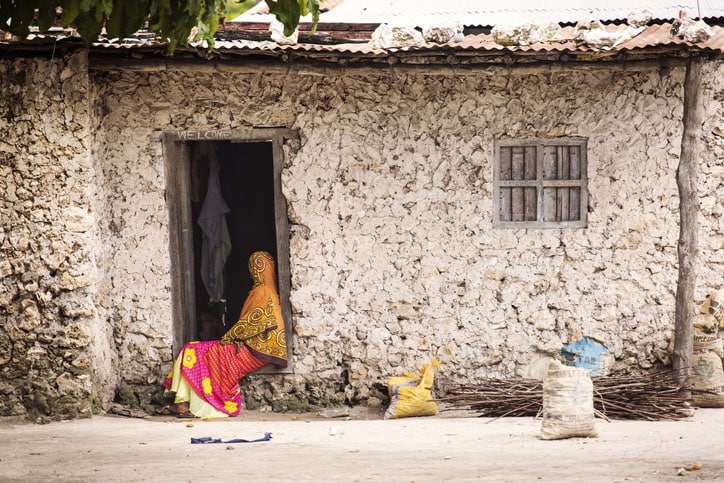
Daughter of the Sultan of Oman, Muscat,
born to a fair Circassian concubine in Zanzibar,
Salme, my sad heroine whom he begat,
was born to fall just like a Middle Eastern falling star.Far from Oman her father cultivated cloves
in Zanzibar, importing slaves to do the labor which
made him from his abundant, fragrant spicy groves
extremely powerful, near Africa, and very rich.

When her father died, beloved Salme fell
in love with a  rich German merchant, so she left her home,
becoming Christian—Emily! An Arab belle,
apostasy epitomized by beauty in her tome.

She told how once she’d had three children she became
a widow, for her merchant husband fell beneath a tram
in Hamburg, and she found life there was not the same
without a husband. Everything now seemed to her a sham.

She was contrasting German coldness with the heat
of her close family and friends at home, and greatly missed
the bubbly laughter of the Arabs on the street,
something  rare in solemn German homes, and hard to beat.

Salome thought she could abandon Zanzibar,
but Zanzibar remained within her heart, on German soil.
If you should try to change the person who you are,
stay close to home, or you’ll be yearning for your native soil,
just like Judeans, who in Babylon would weep,
remembering—though some tried not—walls of Jerusalem:
a lot whose right hand never fell asleep
and played their harps to make sure they would not forget this gem.

Too many Jews today no longer sing when far
away from Zion, and assimilate like Salme, to
a land as far from Israel as is Zanzibar.
Unlike Salme, few will realize the harm they do.

Adam Wheatcroft reviews “The Sultan’s Shadow: One Family’s Rule at the Crossroads of East and West” by Christiane Bird (NYT Book Review, 9/12/10):

A green and fecund island, ¬barely 20 miles off the east coast of Africa, Zanzibar for centuries represented gratified desire. For voyagers across the Indian Ocean its safe harbor was a refuge after a long journey. The vast Chinese trading fleet led by the eunuch Zheng He moored at Zanzibar in the early 15th century to exchange its silver for African gold. For Vasco da Gama, who landed there in 1499, beginning 200 years of Portuguese domination, it was an island of repose for men slaughtering their way across the Eastern seas….

In her book and her letters, Salme remembered the love and warmth of Arab families, and also the bubbling laughter of Arab women. In exile she pined for her homeland. She died in 1924 in Jena, Germany. Her daughter Rosalie found a box of Zanzibar sand among her mother’s belongings; it was mixed with Salme’s ashes, which were buried in the grave of her long-dead husband. Finally, her greatest desire was gratified: symbolically, she went home.
Reviewing  Afterlives, a novel set in colonial-era German East Africa, by  Abulrazak Gurnah, a Zanzibar–born Nobel laureate, Imbolo Mbue writes in the 8/21/22  NYT Book Review (“Love and Empire”):
In his 1961 book “The Wretched of the Earth,” the French psychiatrist and political philosopher Frantz Fanon wrote that “the settler only ends his work of breaking in the native when the latter admits loudly and intelligibly the supremacy of the white man’s values.” Abdulrazak Gurnah’s superb 10th novel, “Afterlives” — his first to be published in America since his work went out of print decades ago — proves this theory true, through the interwoven stories of three protagonists in an unnamed coastal town in German East Africa in the early 1900s, a period when virtually all of the continent “belonged to Europeans, at least on a map: British East Africa, Deutch-Ostafrika, África Oriental Portuguesa, Congo Belge.”

Gershon Hepner is a poet who has written over 25,000 poems on subjects ranging from music to literature, politics to Torah. He grew up in England and moved to Los Angeles in 1976. Using his varied interests and experiences, he has authored dozens of papers in medical and academic journals, and authored “Legal Friction: Law, Narrative, and Identity Politics in Biblical Israel.” He can be reached at gershonhepner@gmail.com.

Not Forgetting Zanzibar or Zion Read More »

A Bisl Torah — The Second Day

I am thoroughly enjoying the social media posts of children and grandchildren’s first day of school. The well-choreographed poses, clean shirts, and bright smiles. We’ll certainly post pictures as our children begin Sinai Akiba Academy next week.

However, my favorite picture was one taken not at the start of the day, but at the end. A mother photographed her daughter sleeping on the front steps, hair thrown in every direction, sweaty and dirty. Nothing perfect about the scene but a dose of reality. This is what a child looks like after their first day of school.

But we tend to leave out those kinds of pictures. The second days of school, the days after the honeymoon, what it looks like when everyone goes home after the birthday party, the scenes that scream truth aren’t usually the most photogenic. But what if the picture we posted wasn’t perfect? What would that convey? A small chip in the persona we’ve built for others to see?

Or an invitation to others: you can be you and I can be me.

Rabbi Dr. Erin Leib Smokler offers insight regarding the notion of seeming complete. Commenting on the Sefat Emet, Rabbi Yehudah Aryeh Leib of Gur, she writes, “In order to arrive at shleimut (wholeness), one must recognize the ways in which one is ridden with holes. The Torah offers a path toward completeness, but it can be received only by those who can see how very incomplete they are.” When we outwardly project via photos and words that our worlds are complete, we are emotionally and spiritually void of the wholeness we seek. Conversely, when we reveal who we are, shleimut comes closer.

In no way am I suggesting refraining from posting first photos. I love first photos. But I join in the challenge of posting second and third days…the photos of hair undone, messy children, tearful moments, and times of frustration. Because it’s then in which we see each other.

Holes and all…that’s a step towards achieving shleimut, the wholeness we seek.

Shabbat shalom


Rabbi Nicole Guzik is a rabbi at Sinai Temple. She can be reached at her Facebook page at Rabbi Nicole Guzik or on Instagram @rabbiguzik. For more writings, visit Rabbi Guzik’s blog section from Sinai Temple’s website.

A Bisl Torah — The Second Day Read More »

A Moment in Time: Stepping In or Holding Back

Dear all,

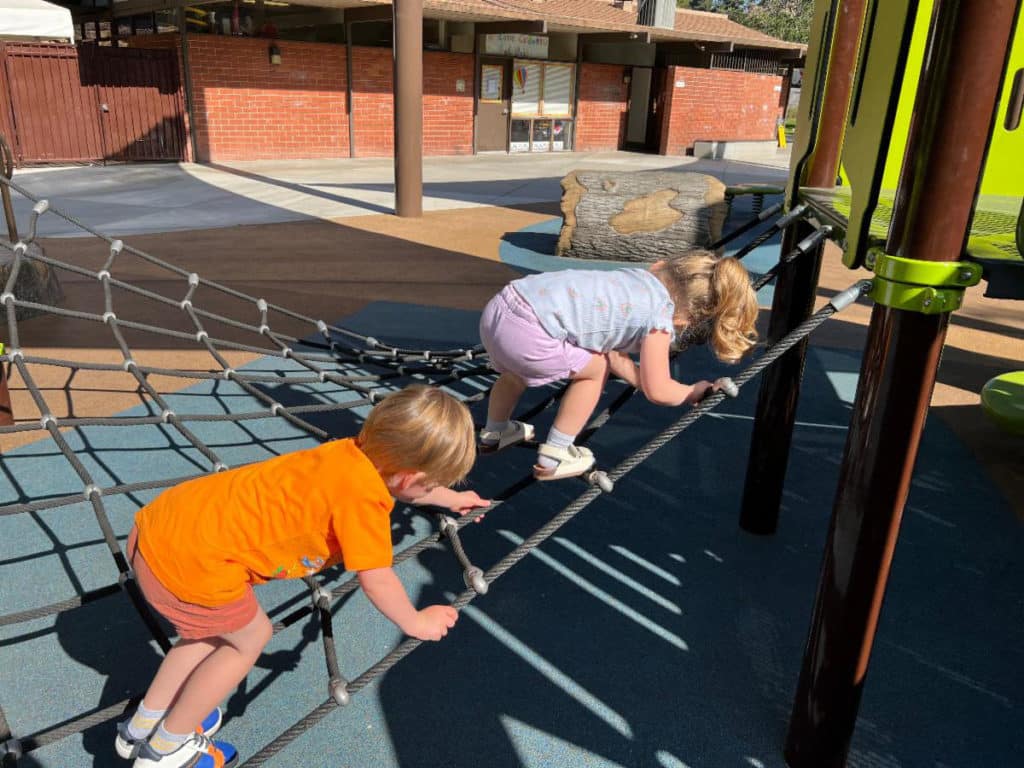
When we were at the park with the kids recently, they found themselves tangled in a web at the playground.

“Daddy! Abba!” (I am “daddy” and Ron is “abba”) they called out to us. Our instinct was to step in and hold their hands. But we held back and instead told them “Look around you and see if you can figure it out.”

It’s hard to know in any moment in time when to step in and when to hold back. I suppose the older they get, the more we will face this decision.

Judaism teaches that parents are to teach their children to swim (Talmud Kiddushin 29a). The metaphor therein is that parents must ensure their children know how to navigate difficult circumstances.

Maya and Eli figured it out. But there were a couple of scraped knees along the way. And while our hearts may have skipped a couple of beats, our holding back enabled them to step in and step up. I suppose this is how life works.

Someone let me know how this will feel when they learn to ride a bike, go to camp, drive a car, have a first love, leave home….  We may need someone to come and hold OUR hands when those times come!

With love and shalom

Rabbi Zach Shapiro

A Moment in Time: Stepping In or Holding Back Read More »

24-year-old American Israeli Student Develops AI-based App to Prevent Food Waste

To read more articles from The Media Line, click here.

An American Israeli student has developed an artificial intelligence-based mobile app that aims to cut down food waste and improve nutrition.

Daniela Saunyama, 24, an immigrant to Israel from New Jersey and veteran of the Israeli military’s Search and Rescue Brigade, is a third-year nutritional sciences student at Ariel University. 

She first presented the idea for the app during a course on nutrition and technology. Saunyama was then accepted into the university’s entrepreneurship accelerator program to further develop her idea together with co-founder and fellow student Avichai Shapiro.

A prototype of the SustainEat app that is set to launch soon. (Screenshot: Courtesy)

The app, called SustainEat, is set to launch in Israel in the coming months before reaching the United States and other countries, Saunyama said.

“I just saw that there was a problem in the kitchen: People were throwing out so much food and not realizing that they have food in their house before going out to buy [more],” she told The Media Line. “People are not only endangering their health by having old food in their fridge but are also wasting a lot of money in general.”

SustainEat helps cut food waste in several ways. Firstly, it keeps an inventory of the food in a person’s home by scanning shopping receipts (or via manual input) and by providing an estimated expiration date for each product. The app notifies users of any items that are approaching expiry and offers personalized recipes that are based on a user’s unique dietary preferences.

It can also recommend personalized grocery lists in order to cut down on shopping times and save money.

“This [personalized shopping list] is created from all kinds of information that you put into the app so it’s using AI technology in order to make this personalization happen,” Saunyama explained.

The goal, the budding entrepreneur said, is to make nutrition, shopping, and cooking more efficient. Unlike other food waste apps, SustainEat is entirely personalized and learns what to recommend to users based on their input.

“We’re an end-to-end solution because we help you from grocery shopping to when you’re throwing things out and cooking your food,” she said. “We want to use specialized technology in order to customize the whole way. In addition to that, we also have a focus on sustainability.”

A prototype of the SustainEat app that is set to launch soon. (Screenshot: Courtesy)

Dr. Shiri Sherf-Dagan, who teaches the course on nutrition and technology that Saunyama attended, noted that food loss is a major problem around the globe. In fact, the UN estimates that nearly half of all produce goes to waste each year.

“Roughly 35% of food in Israel goes to waste,” Sherf-Dagan, who works both at Ariel University and Assuta Medical Centers, told The Media Line. “There are significant environmental and economic repercussions to food loss in Israel and the world.”

Sherf-Dagan recommended a two-pronged approach to address the issue: implement legislation and taxation policies, as well as educate people regarding best practices for food consumption and storage. She also believes that apps like the one developed by Saunyama can help.

“At the moment there is a significant need to advance technologies that will help individuals and communities better manage their buying and use of products in order to reduce food waste,” Sherf-Dagan said. “Similarly, by preventing good food from getting thrown away and with the help of donations to those in need, we can also reduce food insecurity in Israel and the world.”

24-year-old American Israeli Student Develops AI-based App to Prevent Food Waste Read More »

Print Issue: The Teachers We Can’t Forget | Aug 25, 2022

CLICK HERE FOR FULLSCREEN VERSION

Print Issue: The Teachers We Can’t Forget | Aug 25, 2022 Read More »

The Power of a School Teacher

When it comes to the vexing subject of education in the Jewish world, by far the most dominant issue is affordability, and for good reason. Indeed, the fact that so many people can’t afford the high cost of a Jewish day school education is so true, so talked about and so important, that other aspects of education can easily get lost in the noise.

Such as, for instance, the value of a school teacher.

Many of us have fond memories of a teacher who made a lasting impact on us, whether in grade school, high school or even kindergarten. It could be a memorable line we can’t forget, or a teacher’s attitude or personality that resonated with our young minds. It could be a teacher who soothed our insecurities and gave us confidence. Teachers can influence us in myriad ways.

So, for our Education Issue this week, we decided to ask people across the community to share memories of teachers who moved them. We hope you’ll be moved as well by the stories, and that it’ll spark some of your own memories that you can share with those around you.

Just to give you a little taste:

Sharon Nazarian remembers Mr. Kinny, her cherubic, white-bearded seventh grade English teacher she had in 1979, soon after her family escaped the Iranian revolution. Despite her broken English, Mr. Kinny gave Sharon the confidence to participate in a school contest she’ll never forget.

Beverly Hills Mayor Lili Bosse will never forget Mr. Solomon, who introduced her to her lifelong best friend when she moved from New York at age nine in the middle of the school year.

Rabbi Tarlan Rabizadeh can’t forget Gilla Nissan, a substitute teacher in first grade of Jewish Studies, who, out of the blue, turned off the lights one day to make a point about Shabbat. That one experience planted the seed in the rabbi for understanding holiness, and what it means to sanctify time. 

There are many more such stories and memories, compiled by our award-winning weekly columnist Tabby Refael. The point of all the stories is to remind us of the unique and lasting power of those who teach.

The last two years, of course, have been radically disruptive for all school systems with the unprecedented lockdowns and restrictions due to the pandemic. Administrators, teachers, students and parents have had to constantly adapt and adjust. Some restrictions went too far; others were too confusing. Even the best teachers found it hard to overcome the constant disruption. The education and mental health of too many students suffered as a result.

With the pandemic in the rearview mirror (we hope), teachers will have a renewed chance to shine. If anything, the radical disruption of the past two years has accentuated the radical value and importance of the school teacher.

Now, with the pandemic in the rearview mirror (we hope), teachers will have a renewed chance to shine. If anything, the radical disruption of the past two years has accentuated the radical value and importance of the school teacher.

This cover story of memories, then, is as much for teachers and educators as it is for anyone else. It’s a reminder of the value of educators in the lives of students. 

Initiatives like the Milken Educator Awards, from The Milken Family Foundation, understand this value. They’ve been honoring top educators around the country for 35 years. Locally, they team up every year with Builders of Jewish Education to honor local teachers from across denominations. By honoring teachers, they indirectly honor the ultimate beneficiary of great teaching — the student. 

This cover story of memories, then, is as much for teachers and educators as it is for anyone else. It’s a reminder of the value of educators in the lives of students.

“Touching the life of a child is the single snowflake that can start the avalanche,” educator Melissa Boyd writes. “There is no limit, no bound to the distance or time [a teacher’s] influence can travel. When my days as a teacher are through, I know that the good I have done will live on in my students and everyone they touch along their own journeys. To me, that’s power.” 

It’s true that affordability remains the issue in Jewish education. I should know, because my parents couldn’t afford to send me to a Jewish day school in Montreal. So, there I was in grade six at a public school that was part of the Protestant School Board of Greater Montreal. My teacher was a non-Jew who smoked, wore lots of make-up and ate bacon lettuce tomato sandwiches for lunch.

Her name was Ms. Cleland. She made me fall in love with English and with writing. She was the most beloved teacher I ever had, the one I will never forget.

The Power of a School Teacher Read More »

Christian Pastor an Enthusiastic Advocate for Israel

James Kaddis’s love for and loyalty to Israel and the Jewish people stretches back to the 1970s.

His Egyptian-born Christian parents arrived in Los Angeles not long before James, the second of their four children, was born.

The elder Kaddises were committed to teaching their offspring about loyalty to God and, crucially, His favored people, the Jews. This was a family tradition. Mr. Kaddis’s grandfather was a Presbyterian minister in Egypt for 65 years and Mrs. Kaddis’s dad was a Baptist minister for 35 years in their native land.

The family emigated to Southern California in the late 1960s. And no one was surprised when the outgoing James grew up to graduate from Downey High School and became Pastor James Kaddis. 

His now widely recognized advocacy for Israel and the Jewish people is not merely because he is the leader of the Calvary Chapel in Signal Hill.

Pastor Kaddis spends his days in his Signal Hill studio reaching out to a nationwide audience, making videos on multiple platforms – and delivering radio sermons – for his millions of followers, who count on his advocacy for Israel.

“We were raised with a love for what I always refer to as God’s ancestrally chosen people, the Jews.” – James Kaddis

“We were raised with a love for what I always refer to as God’s ancestrally chosen people, the Jews,” the pastor told the Journal. “My dad was committed to teaching us the Bible and advocacy for Israel,” a single concept as far as he was concerned. “We never had to have a conversation that said ‘advocate for Israel.’ We knew that is what you do. We were taught ‘we love Israel.’”

To cement his pro-Israel education, Kaddis related a story told by his Arabic-speaking grandmother he visited every week growing up.

“She talked about when the family lived in Upper Egypt, not far from Sudan,” he said. “She told me that during wartime when they were growing up she did not allow my father or any of my aunts and uncles to listen to Egyptian radio,” said the pastor. “She said it wasn’t real news. The only radio they were allowed to listen to was Israeli radio. My grandmother said the Jews were telling the truth and the Egyptians were lying.”

Kaddis said his ancestors were very supportive of Israel. “They understood what the Bible said about Israel. They weren’t betting against God.” 

Describing his family’s history, he said they were “pure-blooded Egyptians who go back to the days of the Pharaohs.”

How did his ancestors become so ardently supportive of the Jewish people in a land where that was not a popular viewpoint?

When speaking of Israel, Kaddis refuses to use the term West Bank. “I say Judea and Samaria for a reason — to educate people.” To any Christians or others who resist his aggressive advocacy for Jews and Israel, the pastor pushes right back. He looks skeptics in the eye and challenges, “Have you listened to the news, even looked at a small portion of recent Israeli history?  You will quickly realize God is doing what he said he would do in the Bible. We are watching a manifestation of Ezekiel 37 coming to pass. It tells us God would plant his people back in the land, never to be plucked out again.While contrary opinions occasionally arise online, he said the number is insignificant.

Kaddis speaks plainly and without histrionics when he seeks to persuade audiences of his pro-Israel convictions, especially when he alludes to Israel’s rivals.

“If you go to Israel today — and I have been there eight times, taking church groups — you will know right away,” he said, “the greatest benefits coming to the Palestinians are those who are productive members and citizens of Israel. 

“Instead, Hamas, Hezbollah and other groups choose to fight Israel, to cause problems. You have to understand their ideals are not to make peace. It is in their charter to say they must destroy every Jewish life to obtain what they call their ideal. It doesn’t work.”

Not surprisingly, in Egypt, Kaddis’s parents ‘met substantial resistance from Islamists” about their belief in Jesus. His grandfather, the Presbyterian minister, was not as outspoken about Israel in 20th century Egypt as Kaddis is in contemporary America. “He wasn’t living in a situation where it was conducive for him to speak out,” said Kaddis. “People were aware of my grandfather’s positions, but they could not speak as vocally as I do.”

In October, he marks his 30th anniversary in the ministry. “I have been a lot more vocal the last two-and-a-half-to-three years, because all of this craziness started happening from the virus,” he said. “It gave people some weird kind of justification to start acting with a totalitarian mechanism that has been very anti-Israel [and]anti-God.”

However, he converted the situation into a positive. “I became a lot more vocal when that started,” he said. “By God’s grace, He gave us a tremendous platform. On YouTube alone, we average about 2 million views a month. We produce roughly 100 videos a month, a large portion of which are videos supportive of Israel.”

After a long run on radio at KKLA-FM, Kaddis’s “Countdown to Eternity” program recently moved to pray.com, called the No. 1 app for daily Christian prayer and Bible audio where he reaches “something like 300 stations.” 

Kaddis and his wife Nicole are the parents of two adopted daughters who are sisters, ages four and one-and-a-half. The proud father had the closing words.  “Nicole is a speech pathologist,” he said. “But when we got the children, she walked away from that. We did not adopt children to have them be babysat.”

Christian Pastor an Enthusiastic Advocate for Israel Read More »