fbpx

August 18, 2022

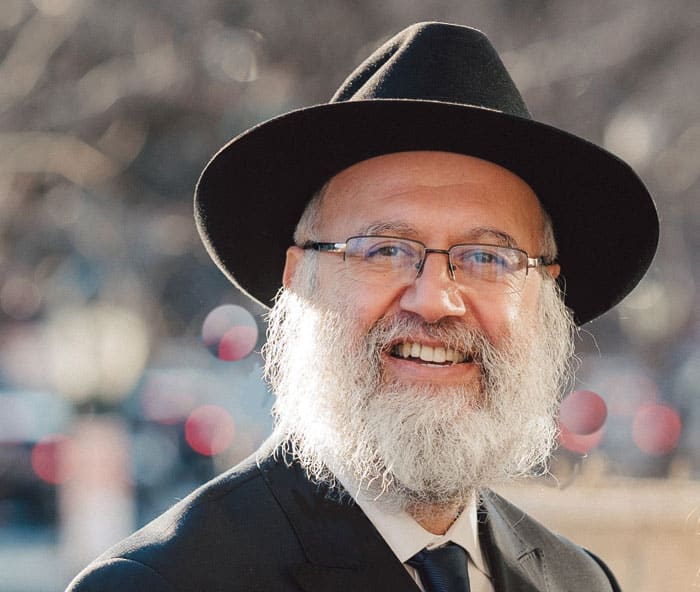
Avi Liberman’s Blueprint for Adventure

Comedian Avi Liberman is no stranger to being on the road. His followers on social media are keenly aware when he’s about to board a plane to do a comedy show in their town—and it’s often.

But like so many other entertainers, Avi’s travel schedule faced numerous hurdles during the first year of the pandemic. L.A.’s live comedy scene went dark. And overseas, PCR tests and quarantine requirements deterred most travelers. Undaunted, Liberman, armed with American and Israeli passports, took to the road for seven months. 

“Don’t let bureaucrats decide your life for you,” Liberman writes in his book, “Traveling During the Pandemic: How Two Weeks Turned Into 7 Months, 8 Countries, and The Adventure of a Lifetime.”

“If there is a possibility to do something adventurous and exciting, if at all possible, take the chance,” he writes. 

The original plan, as the title reveals, was for Liberman to travel to Israel for two weeks to perform for his “Comedy for Koby” charity in honor of terror victim Koby Mandell. The shows support the Koby Mandell Foundation, which for close to 20 years has helped bereaved mothers, fathers, widows, orphans and siblings who have lost loved ones due to terrorism or other tragedies. Twice a year, Liberman gathers a group of comedians who travel from LA to Israel for benefit shows. 

Avi Liberman

In August of 2020, however, as the pandemic was gaining steam, Liberman extended his trip by a few days to visit Greece. Then he extended his trip some more, and then some more. The resulting adventures are chronicled in his book. 

“You know, it felt like almost these [tourist destinations] were like an exclusive little tour for just you and just a few people around you and that’s it,” Liberman told The Journal. With Israel as his basecamp, he would also travel to Bulgaria, Serbia, United Arab Emirates, Ukraine, Turkey and Russia. 

In addition to performing his comedy during many of his travels, Liberman writes about how it felt to be the only person at many historical sites in countries he visited. While customer service with the airlines was at an all-time low, Liberman felt the townspeople of the places he visited were grateful for his curiosity and presence, not to mention his tourist dollars.

Fancy hotels were cheap, and, of course, there were Chabads in nearly every city with open arms to host Liberman for Shabbat. This came in handy, as Lieberman is an Orthodox Jew who’s an active member of the Pico-Robertson community. 

When he would post on Facebook about his next destination, his fans would connect him within minutes to someone who could show Liberman around their home town. 

“‘God bless you Israelis for coming! You are saving our economy!’” a man said to Liberman in Plodiv— Bulgaria’s second-largest city. 

In Dubai, he was the first Israeli citizen to perform at a comedy club called the Laughter Factory. It was during Chanukah, so he opened his set by saying, “Happy Chanukah!” The crowd went silent. 

“That’s the response I expected!” Liberman said as his follow up line, which generated many laughs in the club. During his time in Dubai, Liberman lit Chanukah candles and put them in the window of his hotel room. To openly perform a Jewish ritual in one of the Gulf States was a powerful experience for Liberman that made him feel even more welcome in his travels. 

The book is full of such observations, food experiences and wide-eyed amazement. And the humor never escapes the pages. 

When visiting the famous Haiga Sofia Mosque in Istanbul, he compares it to the Astrodome in his hometown of Houston, former home of his beloved Houston Astros baseball team. There are even pictures in the book of Liberman flipping the bird to statues of Bohdan Khmelnytsky in Ukraine, and Karl Marx in Russia. The statue he was most surprised to see was that of Sholem Aleichem, the author whose stories about Tevya the Milkman inspired the play and film “Fiddler on the Roof.”

“They could care less that he was Jewish, but they take big pride that he was Russian,” Liberman wrote. 

Liberman’s book is a funny, inspiring blueprint for how to travel to places you’ve always wanted to visit and make friends with people you never dreamed of meeting. Surviving a horrible car accident in Miami in May 2021 has undoubtedly helped Liberman treasure every moment of life.
“Find a way to turn a negative into a positive,” Liberman writes at the end of his book. “You never know. You just might end up wandering in Greek hills, having a beer with a new friend in Serbia, encountering a Roman Amphitheater in Bulgaria, watching people ski indoors in Dubai…” 

“Find a way to turn a negative into a positive,” Liberman writes at the end of his book. “You never know. You just might end up wandering in Greek hills, having a beer with a new friend in Serbia, encountering a Roman Amphitheater in Bulgaria, watching people ski indoors in Dubai, enjoying some tea in a café in Istanbul, feeding a rabbit in Ukraine, riding subways in Russia… and having the time of your life.”

Liberman’s book can be purchased on Amazon. He will be returning to Israel to perform in Comedy for Koby shows in Herzliya, Tel Aviv and Jerusalem on October 11, 12 and 13. For more information, go to comedyforkoby.com

Avi Liberman’s Blueprint for Adventure Read More »

Hospital Pushes for Peace with New Palestinian Training Program

The Israeli-Palestinian conflict is ever-present in the Middle East. However, a new program aims to nurture hope and co-existence by improving the lives of Palestinian women in disadvantaged areas.

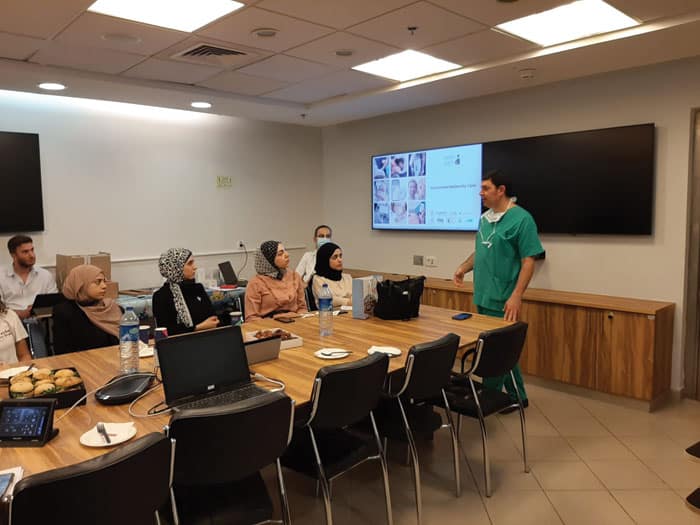
Sheba Medical Center, Israel’s largest hospital, is collaborating with Project Rozana, a non-profit organization that aims to strengthen relationships between Israelis and Palestinians through healthcare. The project takes Sheba’s OB-GYN Beyond – a virtual OBGYN department – into rural Hebron and trains female Palestinian healthcare workers to run it.

“This project is important because it focuses on cross-border community building and peaceful co-existence between Israelis and Palestinians while bridging critical healthcare education and delivery gaps for Palestinian women and children in rural communities,” said Ronit Zimmer, executive director of Project Rozana.

Dr. Avi Tsur, director of the Women’s Health Innovation Center at Sheba and director of OB-GYN Beyond, is heading the team that is training and supporting 12 Palestinian healthcare professionals, including gynecologists, a pediatrician, nurses, a midwife, a nutritionist and a dentist. The women are learning about the cutting-edge and remote care technologies that enable OB-GYN Beyond to function, and they are interacting with hundreds of women and children, as well as their families, through this program.

“Our goal at OB-GYN Beyond is to provide women with the medical care they need, wherever they are located,” said Tsur. “Telemedicine allows us to bridge geographical, political and cultural gaps in the shared vision of optimal health outcomes.”

The World Health Organization and other regional healthcare stakeholders identified more than 145,000 Palestinian women and children from rural communities that are at risk due to limited or no access to sexual reproductive and primary healthcare. Factors like transportation issues, a lack of infrastructure and cultural and financial barriers create obstacles to accessible healthcare services.

“The pandemic has amplified these factors by forcing a scaling-down of services by major healthcare providers, and decreasing the number of women seeking healthcare,” said Zimmer. “This has exacerbated pre-existing health issues in women of all ages, alongside gender-based violence.”

Sheba already serves patients from the West Bank and Gaza Strip for urgent care every day and engages in efforts with the Palestinian Authority to train and educate doctors.

”Palestinian and Israeli health professionals have an effective history of cooperation, and thousands of Palestinians have studied and trained in Israeli healthcare institutions.” – Ronit Zimmer

“While Israelis and Palestinians live in protracted conflict, limited cross-border interaction is a recent phenomenon that denies positive opportunities to meet and enables distrust to thrive,” said Zimmer. “Yet, Palestinian and Israeli health professionals have an effective history of cooperation, and thousands of Palestinians have studied and trained in Israeli healthcare institutions.”

Zimmer points to research that nurses, doctors, midwives and other healthcare professionals can play a role in peacebuilding between nations. 

“[We] see the health arena as fertile terrain for advancing peacebuilding in the region,” said Zimmer. “No less important, quality healthcare is a key pillar of highly functioning societies and supports the long-term interests of the Palestinian people by laying the groundwork for effective Palestinian institutions.”

The initiative is the first of its kind in the region, and so far, it’s been successful in three rural areas in the West Bank, according to Zimmer.

The initiative is the first of its kind in the region, and so far, it’s been successful in three rural areas in the West Bank, according to Zimmer.

“We have had very positive feedback from patients and communities, especially with the use of the remote care devices, which they have never been exposed to,” she said. “I was sent photos from the team’s nutritionist, who, together with the dentist, delivered a seminar on good eating for healthy bodies and teeth. It was very well received.”

This year is the pilot year for the joint project between Sheba Medical Center and Project Rozana. In the future, the hope is to expand the program and encourage other peacebuilding efforts between Israelis and Palestinians. 

Zimmer said, “This project can inspire future collaborations between Israeli and Palestinian hospitals, bringing together increased numbers of medical professionals in different fields, thereby increasing the numbers of community influencers and building large-scale trust on the ground.”

Hospital Pushes for Peace with New Palestinian Training Program Read More »

Tuna À La Tunisian

One of my favorite memories of my childhood in Casablanca, is spending the day at Ain Diab Beach, where the coastline is covered with golden sand and turquoise water.

My cousin Alia recently reminisced: “It was such a beautiful, carefree time. Your father would drive all of us to the beach. His car would be stuffed with towels and beach bags, beach balls and floating mattresses for the pool and all of us children, excited for a day at the beach. American songs would be playing on the radio and we all sang along without understanding a word of the lyrics!”

The ocean was a bit breezy, a bit rough and a bit chilly, but I was thrilled by the sound of the waves and the other beachgoers and the warm sun slowly burning my skin. After spending the morning swimming in the pool with my cousins and friends, we would run back to my family’s chairs and umbrellas. 

My mother was always so elegant with her bouffant hair and stylish bathing suit and my father was dashing with his sunglasses and cigarette between his lips. 

My mother would always pack a huge picnic basket and she would always include her delicious Tunisian tuna salad and fresh crusty baguette and we hungrily devoured it. 

The flavors of that mouthwatering salad still take me back to those spectacular days. 

—Rachel

While there is nothing easier than opening a can of tuna, chopping some celery and adding lots and lots of mayo for a satisfying salad or sandwich filling, this recipe for Tunisian tuna salad may just change your tuna salad palate forever. Instead of relying on mayonnaise to do all the heavy lifting, this salad has a whole roster of exotic and exquisite ingredients to make that humble canned tuna truly amazing!
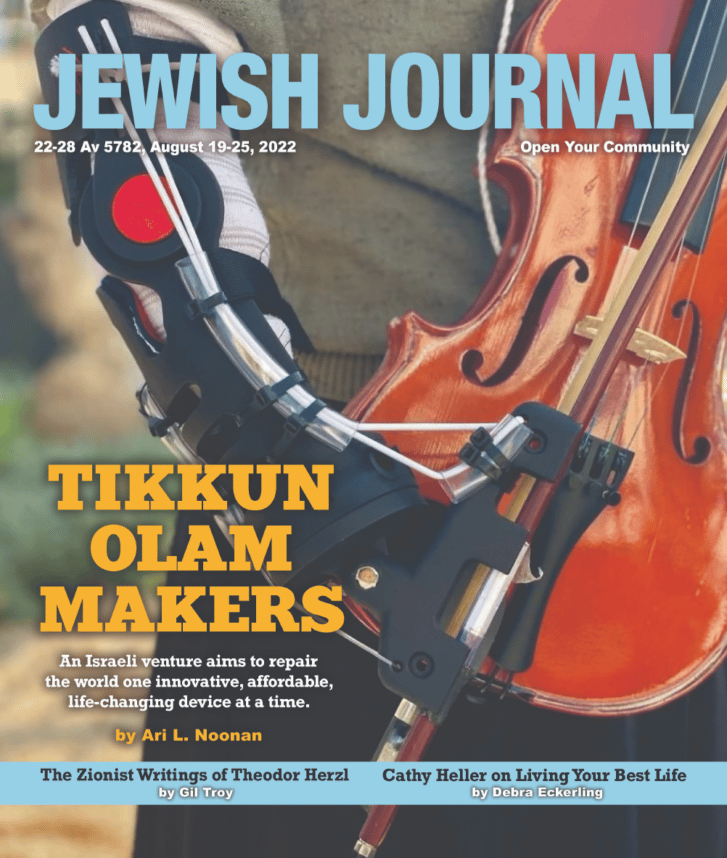
The flavors of this salad keep your taste buds guessing and just wanting more. The baby potatoes add a creaminess. The preserved lemon adds umami. The flaming red chili harissa adds fire. The pickles and cucumbers add crunch. The olives add a satisfying saltiness. The green beans and tomatoes add beautiful color (and added nutrition). 

We love this recipe because a little prep goes a long way. 

Serve it as part of your appetizer course on Shabbat or as the whole meal on a warm summer night. And if you’re lucky enough to have leftovers, stuff the salad in a fresh, crispy baguette for the best sandwich you’ve ever had. 

—Rachel and Sharon

Tunisian Tuna Salad Recipe

1 12 ounce can white tuna, drained
10 baby red potatoes, boiled and diced
1/4 cup extra virgin olive oil
1/4 cup preserved lemon, finely chopped
2 tablespoons harissa
1/2 cup Italian parsley, finely chopped
1/4 cup cornichons pickles,
finely chopped
2 Persian cucumbers, finely chopped
8 ounces haricots vert, lightly steamed
2 hard boiled eggs, for garnish
1 cup cherry tomatoes, for garnish
1/2 cup green, black and kalamata olives,
for garnish
Salt and pepper to taste

  • Place potatoes in a small pot, add cold water and 1 teaspoon kosher salt and bring to a boil over medium.
  • Cover pot, lower heat and simmer for 10 minutes or until fork tender.
  • Drain and let cool.
  • Place tuna in a large bowl and gently flake with a fork.
  • Chop half the potatoes into a small dice and add to tuna.
  • Add olive oil, preserved lemon, harissa, parsley, pickles and cucumbers. Mix well to combine all the ingredients.
  • Slice the rest of the potatoes in thin rounds. Arrange potatoes and steamed green beans on a board.
  • Add tuna and garnish with hard boiled eggs, cherry tomatoes and olives.

Sharon Gomperts and Rachel Emquies Sheff have been friends since high school. The Sephardic Spice Girls project has grown from their collaboration on events for the Sephardic Educational Center in Jerusalem. Follow them on Instagram @sephardicspicegirls and on Facebook at Sephardic Spice SEC Food. Website sephardicspicegirls.com/full-recipes

Tuna À La Tunisian Read More »

Print Issue: Tikkum Olam Makers | Aug 18, 2022

CLICK HERE FOR FULLSCREEN VERSION

Print Issue: Tikkum Olam Makers | Aug 18, 2022 Read More »

The College Education Crisis Today is a Crisis of Wisdom

The average 12-year-old student at a yeshiva has more wisdom than almost any student at Harvard or most other universities. (A yeshiva is an Orthodox Jewish school with an emphasis on religious studies. About half the school day is devoted to religious studies — taught from the original Hebrew sources.)

This is probably true for many 12-year-olds in traditional Christian schools as well.

College students do have more knowledge than almost any 12-year-old in religious school. But they have much less wisdom.

I know this because I was a yeshiva student from the age of 5 until 19. To appreciate how much wisdom I was taught is to appreciate the root of our society’s present crisis: Secular life doesn’t teach wisdom (nor, it should be noted, do many schools that call themselves “Christian” or “Jewish”). Generations of Americans have not been taught wisdom; instead, they have been told that it is sufficient to rely on their feelings to understand life and to determine right from wrong.

Here are just three examples of basic insights into life that most 12-year-old yeshiva students know and that few secular students — or, for that matter, secular professors — know.

No. 1: I knew well before the age of 12 that people are not basically good. Any young person who studies the Bible — and believes in it — knows that God says, “The will of man’s heart is evil from his youth.” (Genesis 8:21).

Aside from the issue of God’s existence, this is probably the most important issue in life. It might be said that wisdom begins with this realization about human nature. It is hard to imagine any person who believes human nature is good attaining wisdom.

To be clear, the message of the Bible is not that human nature is basically bad. What matters is that we acknowledge the reality, noted in the Bible and affirmed by all of human history, that human nature is not inherently good.

No. 2: Precisely because human nature isn’t good, the preoccupation of my religious education was how to work on myself to make me a better person. Every yeshiva student in the world memorizes the Talmudic aphorism, “Who is the strong man? The one who conquers his urge(s).”

One of the great differences between a religious and secular education can be summarized thus: I was taught that the greatest problem in my life is me. In the secular world, students are taught that the greatest problems in their lives are others. That is the genesis of the current American tragedy.

Vast numbers of young people blame others and/or America for their problems and their overall unhappiness. Few are taught to struggle with their own nature. Blacks are told to struggle with whites, with America, and with systemic racism. Women are not taught to first work on themselves but to blame men and fight misogyny, patriarchy and America for their unhappiness.

No. 3: People are to be judged by the standards and behavior of the generation in which they lived.

Ask any yeshiva student — even one in elementary school — to explain the verse in Genesis, “And Noah was a righteous man in his generations.” (6:9) He or she will tell you what I first learned in fourth grade: that the ancient rabbis debated what the words “in his generations” were meant to teach. Some rabbis argued that they were inserted to teach that Noah was a particularly righteous man only in comparison to the (awful) generations in which he lived. Other rabbis argued that these words were there to make the point that if Noah was a righteous man in the awful generations in which he lived, he must have been a particularly righteous man, since it is very difficult to be good when those around you are bad.

Whichever interpretation one agreed with, it was clear that people are to be judged according to the time in which they lived, not by the present time. In the present Age of No Wisdom, the best educated — usually the same people who most lack wisdom — dismiss the unique moral accomplishment of America’s Founders because most of them owned slaves. Fools — the term for people who lack wisdom — judge the Founders by our time, not by the Founders’ time when slavery was universal.

Wisdom can sometimes be a product of aging but given how many old fools there are and how many young people have some degree of wisdom, it should be clear that wisdom, like math, a foreign language, and any other discipline must be taught. Only then is one likely to become wiser with age. Otherwise, a young person without wisdom is most likely to become an old person without wisdom.

When America was more religious, wisdom was taught to young people. This is another reason to fear a thoroughly secularized America — it is producing a nation of fools. The proof is our universities. The most secularized institutions in America are also the most foolish institution in America.


Dennis Prager is a nationally syndicated radio talk-show host and founder of PragerU. His latest book, The Rational Passover Haggadah, was published by Regnery on March 1. He may be contacted at dennisprager.com.

The College Education Crisis Today is a Crisis of Wisdom Read More »

Two Jewish College Students Claim They Were Excluded from Sexual Assault Survivors Group Because of Pro-Israel Views

A complaint was filed to the Department of Education’s Office of Civil Rights (OCR) after two Jewish students accused a State University of New York (SUNY) New Paltz sexual assault survivors group of excluding them.
The complaint, filed by the Louis D. Brandeis Center for Human Rights and Jewish On Campus on behalf of the two Jewish students and obtained by the Journal, alleges that the New Paltz Accountability (NPA) group “excluded” and “publicly vilified” the two students, Cassandra Blotner and Ofek Preis. Blotner and Preis were then “subjected to further sustained harassment, including threats and intimidation of social media,” the complaint stated. “Although the University knew about and publicly acknowledged the exclusion and harassment, it failed to intervene, either to discipline NPA or the organization’s leaders or to ensure opportunities for all victims of sexual assault on campus. It also failed to address the Complainants’ safety concerns arising from the harassment; as a result, both students were unable to attend classes and Ms. Blotner was afraid to spend time on campus.” Additionally, the complaint noted that the campus Jewish Student Union (JSU) stated in a letter to the university that SUNY New Paltz’s failure to action against the NPA signaled that antisemitism is “acceptable on campus.”

The complaint then details the sequence of events leading up to the compliant: Blotner and another student founded the NPA group in May 2021; she and Preis were both active in the group. But in December 2021, Blotner wrote in an Instagram post: “Jews are an ethnic group who come from Israel. This is proven by genealogical, historical and archeological evidence. Israel is not a ‘colonial’ state and Israelis aren’t ‘settlers.’ You cannot colonize the land your ancestors are from.” The NPA leadership chided Blotner for her post in a series of private WhatsApp messages for “condoning imperialism and settler-colonialism” and insisted that they meet with her to discuss it. Blotner rebuffed their efforts for a meeting because she felt like they were attempting to hold the only Jewish member of the group “accountable for the actions of a foreign government.” However, she did later suggest that the NPA meet with her and the JSU to discuss Zionism, but the NPA refused, stating they didn’t believe that adherents of Zionism were compatible with the group’s mission to fight oppression.

Preis, herself a Jewish Israeli, posted the same message to Instagram that Blotner did as a form of solidarity in January; the NPA then ceased informing Preis about their activities and revoked her access to the group’s documents. Preis issued a public resignation from the NPA, to which the NPA told her that Zionists were not allowed in the group. The NPA subsequently issued a document stating that they don’t support Zionism or the Israeli government because they don’t “support imperialism, settler-colonialism, nor white supremacy” and “supporting a settler-colonial state goes against what we stand for and thus we cannot organize with members who do so. Those members have left the organization due to our political differences. We stand in solidarity with Palestine and all other oppressed groups!”

The Oracle, a student newspaper at SUNY New Paltz, reported on these events in February, prompting the NPA to issue yet another social media post doubling down on their anti-Zionist stance and then published their private messages with Blotner and Preis. The complaint blames the NPA’s public stances against Zionism for inciting harassment against Blotner, which included receiving messages on the anonymous messaging app Yik Yak calling her a “dumb b—-” and that she “needs to go.” Blotner reported the harassment to the university and said she didn’t feel safe on campus, but was told that there was nothing they could do and that she should simply stay home if she felt unsafe. And so she did, causing her grades to suffer. Similarly, Preis stopped going to class because she didn’t feel safe on campus and her grades suffered to the point where her second major had to be turned into a minor so she could graduate.

“While I didn’t initially think I should be forced to defend my personal beliefs, I realized the opportunity here to educate NPA that as Jews we share a history, theology and culture—we’re both a faith and an ethnicity—and it’s all deeply tied to the Land of Israel,” Blotner said in a statement. “Expressing support for the Jewish homeland is core to my Jewish identity, the two are inseparable, and I shouldn’t have to shed that piece of my Judaism in order to advocate for survivors of sexual assault. To then get cancelled, stalked and harassed, well I can’t even put into words what a horrific and frightening experience this all turned into for me.”

SUNY New Paltz President Donald Christian has publicly stated that the university can’t take action against the NPA because they’re not recognized as a student group on campus; the complaint argues Christian’s statement is false because the university “has treated NPA as a de facto recognized student group on campus, providing survivors of sexual assault and their allies with educational programs and activities on campus through NPA.” Consequently, the university has an obligation under Title VI of the Civil Rights Act to take action against the NPA and protect Blotner from harassment on social media; because the university failed on both counts, they are therefore in violation of federal law, the complaint alleged.

“Excommunicating and excluding Jewish and Israeli survivors from NPA denies us of our right to fight against sexual assault on college campuses and hold our universities accountable,” Preis said in a statement. “We were left with nowhere to go, feeling isolated from those who claim to be fighting for us, for our right to an uninterrupted education. The accusations made against me on account of my national origin denied everything I inherently am as a person: a fighter for justice, an anti-racist, a combater of oppression, and most relevantly, a survivor. I should not have been asked to choose between being Israeli or being a survivor. I should not have been asked to align with only survivorship or only Zionism. It is possible and necessary to include intersectional identities in spaces that fight for survivors.”

The complaint concluded with a call for SUNY New Paltz to take a series of steps to ameliorate the situation, including a full investigation into the NPA’s action, ensuring that a truly inclusive student group exists for sexual assault survivors on campus, providing Blotner and Preis with adequate security on campus and adopting the International Holocaust Remembrance Alliance (IHRA) definition of antisemitism.

“Ms. Blotner and Ms. Preis were shunned and isolated by the very people to whom they had turned for support as sexual assault survivors; these women were excluded from a survivor support group merely because they expressed pride in the Jewish people’s ethnic and ancestral connection to Israel,” Brandeis Center Director of Legal Initiatives Denise Katz-Prober said in a statement. “Unfortunately, universities often fail to recognize this form of anti-Semitic harassment and discrimination. When Jewish students, like Ms. Blotner and Ms. Preis, are cast out of social justice spaces and campus activities because they express pride in their ethnic or national identity, that is a form of unlawful discrimination, not political speech. This case is not about the awful things that were said to these women. Rather, it is about the awful things that were done to them. Title VI of the Civil Rights Act requires universities like SUNY New Paltz to ensure that Jewish and Israeli students are not denied educational opportunities due to discriminatory behavior that targets them on the basis of their ethnic and national identities. That’s exactly what was done here when these women were thrown out of their student organization because, as Jews, they feel a strong sense of connection to the Jewish homeland. Unfortunately, universities are misdiagnosing the problem and, as a result, failing to protect their Jewish students, like Ms. Blotner and Ms. Preis, from unlawful discrimination.”

Jewish on Campus CEO Julia Jassey also said in a statement: “These students were subject to a litmus test which forced them to decide: forfeit your commitment to an integral social cause, or forfeit your identity. Beyond the clear example of anti-Semitism and sexism which this case shows, it further demonstrates how normalized xenophobia against Israelis has become on American campuses, with one student being explicitly harassed for their Israeli nationality—an identity they were born into, and one they have the protected right to be proud of. This case is about anti-Semitism, it is about sexism, it is about harassment, and it is about xenophobia. More than anything, though, it is about justice and equality. And as jarring as this case is, the experience these students have faced is unfortunately not unique. All over the country, Jewish students face unjust treatment due to their identities. It is our duty, as an organization that speaks by and for Jewish students, to ensure that no student is denied the protection they deserve.”

The university said in a statement to the Journal, “SUNY New Paltz has provided access to resources and support for those impacted by the events of this past year and we continue our active engagement to support our Jewish students and employees around the rise of antisemitism, to address antisemitism and bias concerns when they arise, and to continue dialogue and educational efforts. As a public institution, we value the First Amendment and uphold the free exchange of ideas.”

In February, after The Oracle’s report came out, the NPA issued a response stating that Blotner showed “indifference and denial of the genocide and terror the Israeli military has put the Palestinian population through,” they wrote. “We simply could not stand by and not address it with her. So no, we did not corner her into talking about it.” They also argued that Preis was not an official member of the group and more of a “prospective member.” The NPA did not respond to the Journal’s request for comment.

This article has been updated.

Two Jewish College Students Claim They Were Excluded from Sexual Assault Survivors Group Because of Pro-Israel Views Read More »

The Eternal Kaddish

“There’s something special about this little people, the Jews,” said Zoltan Klein, in the newly restored and digitally remastered documentary “Kaddish.” “This little people, if united, can withstand anything.”

But his son, a young Yossi Klein Halevi, was not buying it. He was raised on his father’s bedtime stories of his grandparents’ extermination at Auschwitz, along with 400,000 Hungarian Jews, with his father only surviving by burying himself and two friends in an underground “bunker” for six months. Those stories led to recurring nightmares of being chased by Nazis on the Coney Island boardwalk. The Nazis would always kill him while everyone else kept eating cotton candy.

In fact, young Yossi was angry that his father hadn’t gone back to slaughter as many non-Jewish Hungarians as possible. The stories also led to a foreboding sense of doom. Young Yossi thought life, safety—”all was an allusion.”

“Kaddish,” which originally premiered in 1984, is an intimately powerful documentary about the effects of the Holocaust on its first- and second-generation survivors. In 1976, filmmaker Steve Brand spent five years chronicling the lives of the Klein family—Zoltan, Yossi, his mother, Breindy, and his sister, Karen. The film, which went on to win a Special Jury Award in Documentary at the Sundance Film Festival, movingly contemplates how trauma is passed down from parent to child. 
The film was initially intended to tell the stories of several survivor families. Brand began with the Klein family. Midway through the filming, Zoltan died. So the focus of the film became, in effect, surviving the death of a survivor. Now, almost 40 years later, the film has become “a metaphor for the passing of the survivor generation,” Yossi has written. 

After surviving the underground bunker, Zoltan managed to emigrate in 1950 to Brooklyn’s Borough Park, the largest Orthodox community of survivors in the United States. He met and married Breindy, who was also Hungarian but had emigrated before the war.

Yossi’s childhood was dominated by his father’s belief that the Shoah could recur at any time. It was not a happy childhood.

At first, Zoltan didn’t see the point of bringing Jewish children into the world. But Breindy insisted. Three years later, Yossi was born. As with many survivors, having a family helped Zoltan reintegrate into society. But while other survivors did not talk about it openly, Zoltan wanted his son to be “emotionally prepared.” For many coming of age in the 1950s and ‘60s, the postwar years were a time of stability and calm, but Yossi’s childhood was dominated by his father’s belief that the Shoah could recur at any time. 

It was not a happy childhood. In the film, Yossi says that his own emotions were so repressed that “it was as if my real life was underground.” His mother tried to compensate by reading the kids Dr. Seuss books.

Despite these efforts, Yossi’s life was shaped by horrific events that he could only imagine. While he desperately wanted to break away from the legacy—“I just want to be normal”—he also idolized his father.

As a child, Yossi and his friends organized civil defense units, planning escape routes through Borough Park’s sewer systems. In the sixth grade, Yossi became a writer and activist, forming a Zionist discussion group and joining the Student Struggle for Soviet Jewry. He led student delegations to confront Jewish establishment organizations in New York and eventually the Ovir—the Soviet migrations office—in Moscow. 

He was arrested multiple times. “I didn’t want to be a spectator,” says Yossi. “So I became a professional Jewish demonstrator.”

But young Yossi was also quite anxious, worried that they were “constantly on the verge—of annihilation or revelation.” He couldn’t think ahead—the opposite of what his father wanted. He worried about what’s not portable—and about the challenge of a world where there are no longer survivors to bear witness.

He also saw in the 1980s “apocalyptic times”—a “soullessness,” a sense of “decay”—as well as fascism on both the right and the left. “Everything that made the Holocaust possible,” says Yossi.

“The world knew what was happening to the Jews and did nothing—for six years.”

When his father passed away in 1978, he was numb. “When you grow up surrounded by death, you’re not stung by it.”

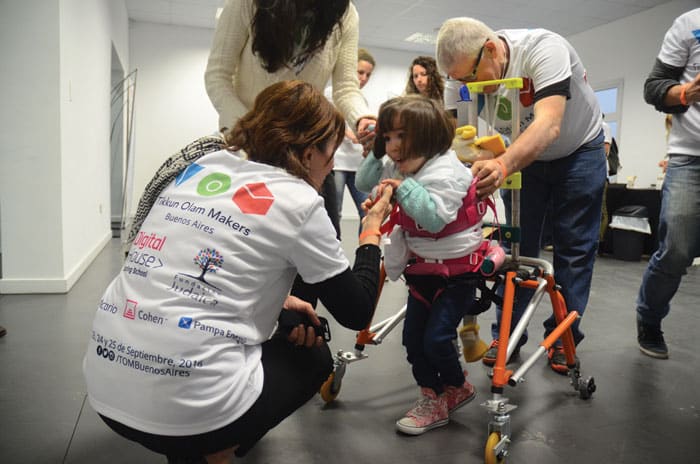
Yossi Klen Halevi on a New York subway, 1984

But after attending the 1981 World Gathering of Holocaust Survivors in Jerusalem, Yossi began to find a new perspective. “When there was no order, my father created his own order. That’s what I wanted to do.” In 1982, Yossi Klein Halevi finally made Aliyah. In 1983, he married and had three children.

Each child has watched “Kaddish” so that they could “hear and know the story of their grandfather.”

“Sadness is part of our collective memory,” said Yossi. But he began to make the eternal Kaddish–shifting his focus from being perpetual victims to being resilient survivors. Jews today are all “monuments to survival.”

In the discussion organized by Mosaic Magazine after viewing the newly restored film, Yossi said the film was about “how memory is transmitted—how individual identity is formed in resistance” to family and generational trauma. 

For his father, “Israel represented the future—his way of returning to the Jewish faith.” Israel provided “comfort—a center of moral imagination.” Israel made it possible for survivors to believe they were chosen for a specific reason—to come to terms with “the unbearable notion of chosenness.” 

“There’s something about the Jews that doesn’t make sense,” said Yossi. “The story of the Jewish people is surreal. But religion is irrational enough to explain the Jewish story.” 

While the younger Yossi worried about Nazis on Coney Island, Yossi today, a senior fellow at the Shalom Hartman Institute in Jerusalem and the author of four books, is worried about the return of organized Jewish anti-Zionism in the United States. “Anti-Zionists are restoring the conditionality of Jews.”

“During the six-day war, America fell in love with Israel—with Israeli heroism and self-reliance. But today the victim is hero, and we refuse to play the role of victim, rejecting self-pity.”

Today, Yossi is focused on “who we are as a people—what has helped us endure. What is eternal about Judaism? The Jewish insistence on life.” While history remains “an open wound,” Yossi also aspires to create a “post-Holocaust” Judaism: “What it means to survive. It’s about moving the focus from Egypt to Exodus.” 

“There is wisdom in ritual,” said Yossi. “The Kaddish is a song of praise.” Repeatedly saying the Kaddish, Yossi explained, forces the mourner to continuously and publicly praise G-d. As a result, the prayer itself “becomes an affirmation of life.”

For more information about the film: kaddishdocumentary.com


Karen Lehrman Bloch is editor in chief of White Rose Magazine.

The Eternal Kaddish Read More »

Cover Story: Technology to Repair the World

“It is costly to be poor, to live with a disability and be elderly. With today’s technology, we can help all of them.” 

This was how the Israeli-born entrepreneur Gidi Grinstein, founder of the Reut Institute, explained his motivation at a recent event in a private home in Los Angeles. 

Adapting the latest technology to the specific needs of each group, eight years ago Grinstein set out to change the trajectory of their lives. He launched Tikkun Olam Makers, now widely known as TOM. He chose the name because it was a quick read, since everyone knows that tikkun olam means to repair the world.

By now a global movement, Tikkun Olam Makers (TOM) harnesses technology and innovation to design affordable solutions for the disadvantaged.

By now a global movement, TOM harnesses talent from around the world to design affordable solutions for the disadvantaged. TOM’s signature event is a three-day Makethon, which is a blitz of innovation in centers called ‘makerspaces’ and equipped with 3D printers and other necessary machines. To date, TOM has held more than 100 Makeathons in 35 countries, with the latest one in July in Paris. This global effort led Inc Magazine to dub TOM as “the TEDx of social action.”

Photo courtesy Tikkun Olam Makers

Grinstein acknowledges that his publicly announced goal of aiding 250 million people is audacious. But it comes with a logic. “We know that thinking at this scale has its own merits, because sometimes it is easier to think 10x growth than 10% growth”” the 52-year-old father of five told the Journal. His point: “For TOM, it means that everything we create must be built for scale.”

For example, TOM is creating a library of open-source free solutions, such as a $150 prosthesis that allows amputees to cook, hold utensils, paint or play the violin. Each solution is documented in detail and “deposited” in the public domain, which means that anyone can access it and download it for free. TOM’s objective is to accumulate between 1,000 and 1500 such solutions that could help anyone in any country. This would be the largest library of its kind in the world. Grinstein calls the TOM Portfolio “the keystone to our entire operation, and an invaluable societal asset.”

That portfolio of products is also the cornerstone of TOM’s diplomatic reach, which currently spans 35 countries and aims to bolster Israel’s global standing. “Effectively,” he said, “TOM will be an asset not only for Israel or the US, where our team operates, but also for every country around the world. It is a platform for transferring a tremendous amount of knowledge within countries, from urban to rural areas, and among countries, from developed to developing nations. Of course, this means that TOM can help any country in the Middle East and around the world, and establish personal connections among emerging local leaders, on the one hand, and Israelis and the local Jewish community, where one exists, on the other.” For this original approach, Ambassador Ron Prosor, Israel’s current Ambassador to Germany and former Ambassador to the UN and the UK, awarded TOM the 2019 InnoDip Award for innovation in diplomacy by the Abba Eban Institute. 

Photo courtesy Tikkun Olam Makers

TOM is a uniquely complicated venture, relative to most other nonprofits, because it requires both developing and distributing solutions. 2022 was declared as the “year of distribution,” which Gidi refers to as the “last summit of the TOM process.” They are specifically focused on figuring out mass-customization and mass- distribution of TOM solutions to users in Israel, the US and around the world, all centered on delivering on its pledge: “Affordable and accessible for anyone anywhere.” 

TOM’s current distribution drive is focused on four products, that separately and together tell the story of TOM: 

Galgaloosh, which means a small wheel in Hebrew, is a wheelchair for children aged 2-3, developed by the nonprofit Go-Baby-Go and a team of students from Shenkar College at 10% of the cost of an existing market alternative. Within the past six months, it was delivered to nearly 100 families in Israel, as well as in Turkey. 

Drawing Dreams is a device to support arms of children with Cerebral Palsy, as they eat and draw. It was designed by the TOM Fellow at the Technion and was voted winner in TOM’s 2021 Global Innovation Challenge. Judges came from 14 countries, including Bahrain and the UAE. 

Photo courtesy Tikkun Olam Makers

Another winner of that competition is One-2-Go, which is a portable, light weight and radically affordable toilet seat for teenagers and adults with Cerebral Palsy, who need such a product when traveling. Its developer team hailed TOM from New Orleans. PJ Prosthesis is a highly affordable ($120-$150) lightweight (1 pound) prosthesis with a standard ‘arm’ and an alternating ‘hand’ for painting, using a tablet, going to the toilet, playing violin or guitar, eating with utensils or cooking. It has been designed by five teams from three Israeli universities and from Singapore. 

While developing its portfolio, TOM is also thinking about distributing millions of products around the world. Their primary focus is engaging Care Centers, which can distribute TOM Solutions to their patients and their families, by training their staff and using their in-house makerspaces. In addition, TOM plans on engaging corporations to manufacture and deliver specific products as part of their CSR efforts; launching an Amazon Store for products that do not need customization, in places where Amazon-type platforms exist; and using local makerspaces in libraries, universities, schools or homes to manufacture and sell to local users at highly affordable prices. Perhaps their most engaging effort has been ‘build parties’, which are fun events with music and free food for local distribution of a specific product. It has been in such parties that 100 units of Galgaloosh have been distributed in Israel. 

Grinstein acknowledges that the distribution numbers are still small, but isolated anecdotes fuel his dreams. For example, “A user found TOM online, reached out to the nearby TOM Fellow at UPenn, requested a One-2-Go, which was then manufactured and delivered,” he said. These little stories remind him of the story of Jeff Bezos in the early days of Amazon, when his team would ring a bell when an order came in.

Photo courtesy Tikkun Olam Makers

“Initially,” Grinstein said, “the Amazon team discovered that behind every order was a family member or a friend, until one day the bell rang for a real unknown customer. Then the bell began to ring more and more often until the team had to disconnect it because it became a noise-hazard.” He’s hoping for that kind of “problem” at TOM.

The magic of TOM, he says, happens in the interaction between the “makers”, who are engineers, product designers and occupational therapists, and “need-knowers,” who are people living with a neglected challenge, such as a disability, that has no affordable and accessible government or market solution. Once the challenge has been identified, the makers and need knowers collaborate in designing a solution that can be accessed by anyone anywhere.

TOM’s motto of “Affordable and Accessible for Anyone Anywhere” requires mass-creation of solutions, followed by mass-customization and mass-distribution. All of that is made possible by the TOM Process, which begins by identifying neglected challenges, then creating teams that develop working prototypes of affordable solutions. These solutions are then documented in open-source free digital product files that are deposited in the cloud so they can be disseminated to end-users via local makerspaces and 3D printers.

What inspired Grinstein to develop TOM in the first place? At his presentation in LA, he traced the birth of TOM to two separate sources of inspiration.

About a decade ago, he and his Reut team were working in Tzfat, one of the poorest cities in Israel. “We heard that residents of Tzfat needed to drive to Haifa, more than an hour each way, to get medical devices,” he said.

This occurred at a time when 3-D printing was becoming more prevalent. Grinstein and his team asked a simple question: Why drive to Haifa to get a device that can be manufactured locally?

The second source of inspiration was the challenge to make Israel’s hi-tech-driven prosperity more inclusive by “systematically using innovation in design and technology to address needs of vulnerable communities at the bottom of the economic ladder.” This required not only developing a web-platform (https://tomglobal.org) and a unique process for product-development, but also an entirely new economic model that, as Grinstein says, “unlocks societal value” by mobilizing untapped technical talent and manufacturing capabilities in universities, corporates, schools and care-centers. 

Grinstein has a long history with innovation. He was an integral part of the group that designed Birthright Israel (which he wrote about in a Journal cover story) before forming the non-profit think tank, Reut Group. Before that, he had a stint in government work in the office of Prime Minister Ehud Barak. At 30, he was the youngest member of the Israel delegation at the Camp David Summit.

“When I served in the government of Israel,” he said, “I saw the incredible level of sophistication Israel has in dealing with security challenges. But there was no equivalent approach to dealing with social problems. Out of that came the idea to create a national laboratory for innovation around social problems. That is TOM.”

Even before that, however, the seeds of social innovation were planted.  After Prime Minister Yitzhak Rabin’s assassination in Nov. 1995, he was among 60 people who were assembled from across the religious and political spectrum of Israeli society to “think about Israel’s future 30 years on, namely until 2025.”

“After each of us wrote our personal forecasts for 2025, there was a shocking revelation,” Grinstein said. “The vast majority of participants had a negative, sometimes dystopian, outlook on where Israel would be. I was part of the smaller group with a more optimistic vision.” 

He said the common denominator among those seeing an optimistic future for Israel was their “envisioning of a just society that takes care of people who are poor, live with a disability, minorities, and the elderly.” 

That was when Grinstein, who published a book about Jewish resilience titled “Flexigidity,”  became intrigued by the field of development economics and the notion of inclusive prosperity. 

“How do you balance growth and prosperity?” he asked. “How do you expand the pie while dividing the pie and taking care of the people at the bottom?” He then dedicated his year at the Harvard Kennedy School of Government to researching the answer to those questions. 

Grinstein’s conclusions are inspired by Jewish history and destiny. “The Jewish people has led humanity for thousands of years in thinking about social justice through strong public institutions, taxation and redistribution of wealth, free market practices and tzedakah and philanthropy. This has been our qualitative contribution to humanity.

“In the 21st century, for the first time, we can make a quantitative contribution to humanity by helping millions of people through the combination of technology, Israeli innovation, the worldwide web of Jewish communities and the ethics of tikkun olam. TOM was designed to realize that potential.”

Cover Story: Technology to Repair the World Read More »

Rabbi Danny Yiftach: The Iranian Chabad-Lubavitch Chassid

When the Iranian Revolution occurred, it became clear to the Jewish community that their country wasn’t going to be safe for them anymore. However, it wasn’t easy for them to leave. They were forced to get creative to find a way out.

Thankfully, the Lubavitcher Rebbe, Menachem Mendel Schneerson, who was based in New York, had an idea: he would send emissaries to Iran to make arrangements for Jewish children to escape. He would give them student visas to study in Chabad schools in New York. Rabbi Danny Yiftach, the rabbi at Chabad of Marina del Rey, was one of the several thousand children the Rebbe rescued.

“When I came out of Iran, I was alone,” said Yiftach. “In those days, it was nearly impossible to get everyone out, and not everyone wanted to get out. My parents got out later.” 

Yiftach spent time in New York, learning about Judaism from a Hasidic perspective. Though he grew up observant, it wasn’t the same as Chabad.

“There was no Chabad in Iran,” the rabbi said. “My parents were typical Sephardim. We were very traditional and we observed everything like keeping kosher and Shabbat to the extent we had learned. We were considered one of the more observant families.”

While in New York, Yiftach met the Rebbe and experienced a real-life miracle. He was standing in a long line to talk with the Rebbe and ask him for a special blessing for his great uncle, who was in need of a heart transplant and running out of time. The entire time he was in line, he was saying his great uncle’s Hebrew name and the fact that he needed a blessing for a refuah shlema (speedy recovery).

“When it was my turn, the Rebbe gave me a dollar, and it was time to say what I wanted,” said Yiftach. “I was standing there, trying to compose myself and say something, but nothing came out. The Rebbe said ‘bracha v’hatzlacha,’ blessings and success, like he told everyone. But then he paused for a moment, looked up at me, and said ‘refuah shlema.’ I was a frozen. I was in a daze. He gave me the blessing I was going to ask for even though I didn’t ask for it.”

Yiftach called his family members afterwards, but he couldn’t get hold of anyone. Eventually, later that evening, his mom got back to him. At the same time the Rebbe was wishing Yiftach’s great uncle a speedy recovery, his family got a phone call that a heart had been found, and it was time to run to the hospital for the transplant.

“That’s why I couldn’t reach them,” Yiftach said. 

Yiftach was so inspired by Hasidic teachings and his encounters with the Rebbe and his teachers at yeshiva that he decided to become ordained.
“What really drew me close to Chabad was the unconditional love and non-judgmental mindset,” he said. “People feel genuine love and care in a Chabad house.”

After learning in New York upon his arrival in America, Yiftach ended up at Yeshiva Ohr Elchonon, a Chabad yeshiva in Los Angeles. Professionally, he ran the Bais Chaya Mushka Chabad School for Girls in Pico-Robertson for 34 years and now, he teaches online classes for 150 Jewish women in Iran. They talk about topics like the weekly Torah portion and Jewish law.

Even though the rabbi and his family are the only Orthodox Jews in his Marina del Rey community, he said it doesn’t make a difference. Either way, he’s there for anyone who needs him.

“Chabad sees everyone the same regardless of their background or where they came from,” he said. “That’s what makes our Chabad a welcoming place.”

The rabbi runs Chabad of Marina Del Rey with his wife, Sonya, who is an equal partner in all the work they do. 

“Sonya has been a partner in everything that we have accomplished in our decades long, serving the community in various capacities,” Yiftach said. “She graciously allows me to be the front man for what she is really mostly behind. She is the thinker, innovator and orchestrator of our activities.”

Yiftach said that a teaching in the Tanya, written by Rabbi Shneur Zalman of Liadi, the founder of Chabad Hasidism, motivates him to work hard for his Jewish community and be there for them whenever they need him.

“Our souls are literally part of God himself,” he said. “That, to me, opens the floodgates of understanding yourself, who you are and where you come from. Chabad Hasidic teaching is founded on that. Through that, Judaism comes alive. It’s not just an ideology. It’s a way of life.”

Fast Takes with Danny Yiftach

Jewish Journal: What is your favorite Jewish food?
Danny Yiftach: Anything being served at a Hasidic farbrengen (gathering). 

JJ: What would you be doing if you weren’t a rabbi? 

DY: I would still want to be in a line of work that helps people. Maybe I’d be a psychologist. These days, unfortunately, society is in desperate need of help. 

JJ: Where’s your favorite spot in Marina del Rey?

DY: The Chabad house is where my life is. I don’t often make it to the marina or the ocean. But when I do, I go to the canals, which are peaceful if you want to go for a nice walk.

Rabbi Danny Yiftach: The Iranian Chabad-Lubavitch Chassid Read More »

Table for Five: Eikev

One verse, five voices. Edited by Salvador Litvak, the Accidental Talmudist

You shall know in your heart, that just as a man chastises his son, so does the Lord, your God, chastise you.

– Deut. 8:5


Eva Robbins
Co-rabbi, Congregation N’vay Shalom, Faculty AJRCA

From the opening of this Parshah, the interwoven relationship with HaShem is emphasized. We are reminded to observe and perform “everything that comes from the mouth of God.” 

Though each one of us has a unique relationship with God, as reflected in the opening blessing of the Amidah, when we say “The God of Abraham, The God of Isaac, and The God of Jacob, (and in a non-Orthodox prayerbook, The God of Sarah, The God of Rebecca, The God of Rachel, and The God of Leah)” – each of our ancestors speaking from a different heart – we all call God Avinu, our Father (and same say Imanu, our Mother). 

We all share this relationship for God as our parent, the ONE who loves us, has faith in us, and even will rebuke us. The most painful and yet critical gift in our learning to become the better part of who we are meant to be and live up to our potential are the critiques when we stray or make bad choices. 

The people are reminded that consequences are an essential feature of veering off the path and as God’s children we are not only given love and acceptance but also the gift of consequences, the means by which we gain wisdom from our mistakes. Just as we care enough to guide and sometimes punish our own children with consequences for their behavior, so God cares enough about us to respond when we ignore our commitments and core responsibilities as partners in maintaining this world.


Rabbi Gershon Schusterman
Rabbi, Businessman, Mashpia

A loving father doesn’t short-sightedly spare the rod (Proverbs 18:24), for in disciplining his child he shapes him to live up to his highest potential. When a rebuke is given out of love, it may sting but it doesn’t really hurt. 

How do we view our life when we experience a significant setback or loss? Do we view it as a chance occurrence, as bad luck, or as a message from the One Above? If we see it as coming from God, does it make us angry or humble? It really depends on our ongoing relationship with Him. If we relegate God to designated compartments in our lives, and we invite him in only for a periodic Shabbat meal or at special God-times and life-cycle events, then when a tragedy occurs we get angry with Him for breaking out of His allotted compartment and meddling in our lives. 

We can tend to forget that God created us for a purpose, chose each of us for a special mission and wants to be part of our lives all the time and to be invited in — joyfully. 

Remember how Tevyeh, the milkman of Fiddler on the Roof, spoke to God? With the warmth of a child complaining to his loving, devoted parent. We often worship God in our minds but do not bring Him into our hearts. God beseeches us, “You shall know with your heart” that I am your loving father and want your good even as I chastise you.


Rabbi Chaim Tureff
Rav Beit Sefer of Pressman Academy
Director of STARS Addiction Recovery

Self-refinement and self-worth. That is how I understand this verse. 

The Ibn Ezra understands the verse to mean to mean we follow God even though at times God punishes us severely. The Ramban understands this verse to mean that just as a parent loves a child and any sort of punishment is just and for the right reason, even more so does God demonstrate punishment through the ultimate veil of love. 

In the world we live in now, this is a difficult concept on so many levels. Ultimately, we see many signs that point to #NoJudgment or #MyTruth and so on. This is beautiful in the sense that it allows those that have experienced difficulties to move through the process without shame or being gaslit. 

Yet at the same time there are things that happen to each one of us that are difficult to ascertain and yet ultimately are for our benefit. In working with recovering addicts, those who have refined themselves through the process of recovery and ultimately carry the mantle of sobriety, understand that everything they went through got them to where they are today. Every misstep, slip up, and night in jail brought them to their own personal redemption. The process, difficulties and chastisement brought them to the person they have become. Without these struggles and consequences, they might be not sober or even dead, and certainly not the person they are today.

 May we all see chastisement as a catalyst for growth.


Aliza Lipkin
Writer and educator, Maaleh Adumim, Israel

In Jonathan Haidt’s book, The Righteous Mind, he discusses how one’s intuitions and emotions guide their reasoning. In other words, the heart instinctively informs the mind what one’s opinions and decisions should be. Therefore, many people remain adamant about their positions even after cogent opposing arguments have been presented. However, if one first conveys warmth and respect to their interlocutor then there is a much better chance those arguments will be accepted. 

Moshe tells the nation that they should “know in their heart that just as a father chastises his son, so too the Lord chastises you.” The word ledaat, to know, is the term used to convey deep intimate knowledge. Moshe, in his great wisdom, understood that the only successful way to keep the nation following in God’s ways and observing His commandments is for them to “know in their hearts” that God loves and cares about them like a father loves his son. This knowledge of the heart will ensure continued devotion whether they understand the commandments or not and through good times and bad times. 

God is the ultimate Father Who created us uniquely to be His cherished children. He gave us the Torah for our own good so that we can live the best life possible. Just as children know with every fiber of their being that their father loves them and would never mislead them, we must understand that Hashem chastises us only out of love and concern for our wellbeing. 


Miriam Yerushalmi
CEO SANE; Author, Reaching New Heights series

The Talmud tells us, “What comes from the heart goes into the heart.” As our loving father, Hashem’s chastisement comes from His heart to ours; He guides us so that we will rectify our misdeeds. Is washing a dirty garment punishing the garment? No, it’s a means of restoring it to its former pristine state. Hashem’s chastisements, similarly, are the means to return us to a holier state. 

Chassidus teaches that whatever gain we experience from sin can be rectified through some corresponding pain. For example, if we eat something we shouldn’t, we may experience physical pain in our mouth or stomach as a consequence. If we have experienced emotional pleasure from doing something we shouldn’t have, we may experience emotional pain, such as being insulted or humiliated. 

With words of teshuvah, our body rectifies sinful actions; with regret, we rectify the emotional excitement we felt from those actions. Just as flossing our teeth should be part of our bedtime routine, “flossing our soul” should be as well. Reciting the Bedtime Shema before going to sleep provides both the opportunity and the procedure for examining our deeds and cleansing our soul. The Lubavitcher Rebbe teaches that teshuvah should be done in a spirit of joy, because we have been taught that our loving Father will forgive us. When we go to bed spiritually strong, we wake up spiritually strong–strong enough to receive Hashem’s chastisement, if necessary, because we know in our heart that it is an expression of His love.

Table for Five: Eikev Read More »