fbpx

August 18, 2022

Theodor Herzl and the Jews’ Leap of Hope

Editor’s note: Excerpted from the new three-volume set, “Theodor Herzl: Zionist Writings,” the inaugural publication of The Library of the Jewish People edited by Gil Troy, to be published this August marking the 125th anniversary of the First Zionist Congress. This is first in a series. 

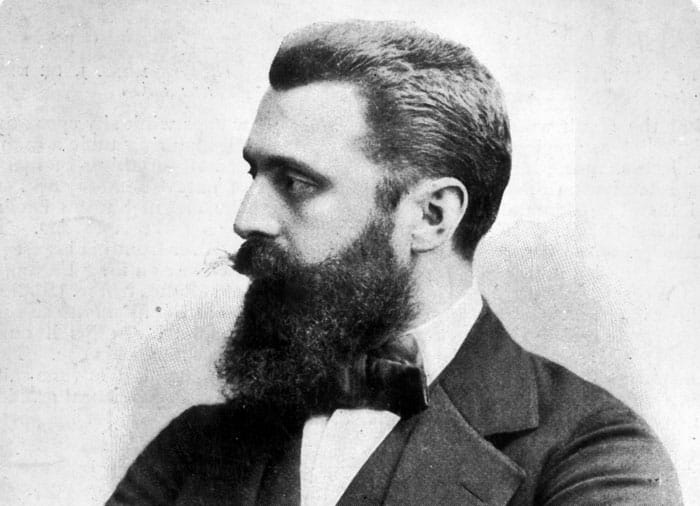
Today, Theodor Herzl is best known for his beard, not his books, for an Aha-moment he never had, for being an anti-anti-Semite rather than an idealist, and for launching the Zionist movement in 1897 – eighteen months after he released his history-changing Zionist manifesto. Despite this confusion, he remains Israel’s iconic Founder, with George Washington’s mythic status, Thomas Jefferson’s ideological impact, and Winston Churchill’s memorable bon mots. One hundred and eighteen years after his tragic death at the age of forty-four, and 125 years after he convened the first Zionist Congress in August, 1897, Theodor Herzl remains influential. His outsized shadow – and the true, complicated, multi-dimensional person behind the myth – are precisely why it is so important to read his Zionist writings in this new edition, which, quite fittingly, is also inaugurating the Library of the Jewish People.

It was a perfect match: the People of the Book got themselves a bookish savior. Theodor Herzl wrote articles, plays, novels, poems, manifestos, editorials, diary entries, stylish literary essays – feuilletons – and hundreds of letters. These volumes recreate his last eleven years as a Zionist leader. On these pages, Herzl works out his ideas, works through his problems, works his contacts, and works himself to death, trying to hustle a Jewish state into being. These pages demonstrate that Herzl was not just another bookish Jew. As a proud Jewish nationalist seeking to revive the independence Jews celebrate at Hanukkah, he was also a Maccabean – a fighting Jew – a Jew with a spine and spunk, not just a Jew with a mind and soul.

The diaries’ rollicking, free-flowing nature make them among the most easily misquoted and misunderstood sources in the Zionist canon. Anti-Zionists frequently rifle through Herzl’s writings, cherry-picking an entry here, a phrase there, to indict the entire Zionist enterprise as “ethno-nationalist,” “racist,” “imperialist,” “colonialist,” or in today’s popular phrase “settler-colonialist.” These volumes confirm that the often vain, petty, thin-skinned, imperious Herzl was not perfect and very much a turn-of-the-century European. Nevertheless, this historical scavenging tells us little about Herzl’s Zionism and much about Zionism’s enemies – who daily demonstrate Herzlian Zionism’s biggest failure: it did not end antisemitism.

The diaries record the cascade of feelings – and ideas – as Herzl’s Zionism evolves. He shifts from imagining a novel explaining his vision to drafting a manifesto charting out the Jewish future.

The diaries record the cascade of feelings – and ideas – as Herzl’s Zionism evolves. He shifts from imagining a novel explaining his vision to drafting a manifesto charting out the Jewish future to trying to make his dreams come true. It is a brainstorming book – which is why extracting one line here or there to define the man or the movement distorts the diaries’ freewheeling, free-associational character. Day by day, Herzl’s Jewish consciousness and self-importance grow, along with his doubts. His life has become a high-wire act, with big ideas, great thrills, and historic stakes.

Perpetually struggling with tone – and self-definition – Herzl writes that “artists will understand why I, otherwise of rather clear intelligence, have let exaggerations and dreams proliferate among my practical, political, and legislative ideas, as green grass sprouts among cobblestones. I could not permit myself to be forced into the straitjacket of sober facts. This mild intoxication has been necessary. Yes, artists will understand this fully. But there are so few artists.”

Sometimes, he is more playwright than architect, as when he plots out the Jews’ redemption in three acts from “Introduction” to “Elevation” to “Emigration.”

As a result, his diaries frequently read like the political-science version of an artist sketchbook. Herzl draws in the contours of the Jewish state. He plans different dimensions from a flag to the architectural aesthetic, from labor-capital relations to the dynamics between rabbis and politicians. Sometimes, he is more playwright than architect, as when he plots out the Jews’ redemption in three acts from “Introduction” to “Elevation” to “Emigration.”

On these pages, Theodor Herzl emerges as the Zionist Organization Man – building an infrastructure for the movement that would eventually become a provisional government until 1948, then today’s sovereign government of Israel. He emerges as the Great Jewish Diplomat – advancing the Zionist project by leveraging relationships while exploiting antisemitic assumptions that the super-rich Jews could buy themselves out of exile. He emerges as the Jewish Dreamcatcher – living his phrase that became a cliché: if you will it, it is no dream. And he emerges as the Liberal-Nationalist Tinkerer – generating ideas about how to make the Jewish state into a model that saves the Jews and inspires the world.

These writings help solve the ongoing interlocking historical mysteries surrounding Theodor Herzl. First, what made him tick – why did this ambitious, outer-directed, journalistic hotshot and somewhat successful, somewhat frustrated, playwright become a Jewish visionary and leader? Second, what did he accomplish in barely a decade on the Jewish stage? And third, what made him The One? How is Herzl the Modern Moses: of all the Jews’ leaders, of all the Jews’ thinkers, of all the proto-Zionists who sometimes grumbled that they came to the party first, how did he become the face of Zionism and the prophet credited with transforming millennia of Jewish trauma and longing into today’s Jewish-democratic State?

Herzl’s diaries show that even in his thirties, he felt the angel of death hovering about. He sensed his heart would not keep him going for much longer. In 1897, when he was thirty-six, Herzl wrote a will, explaining: “It is proper to be prepared for death.” Sure that “my name will grow after my death,” he trusted that “a future generation will be better able than the masses of the present to judge what I meant to the Jews.” He deemed these writings, “in which I have recorded my work on behalf of the Jewish cause,” his “principal legacy.” Even he, the great Jewish dreamcatcher, grandiose enough as his Zionist career began to imagine that we would still be reading his writings more than a century later, was not as sure about an even bigger legacy: a thriving Jewish state which still horas – and waltzes – to some of his rhythms.

Theodor Herzl as Master Myth Maker

The most popular story about Theodor Herzl’s Zionist awakening is fun to tell. It conveys an essential truth about Zionism and about Herzl’s path from European man of letters to Jewish patriot. Yet it overdramatizes, oversimplifies, and overshadows other truths about Herzl’s more torturous lifelong journey as an emancipated Jew seeking freedom and dignity daily in an increasingly Jew-hostile Europe.

Nevertheless, for years we have heard the Disneyfied version: about this elegant, cultured European, a model Jew freed from the ghetto to be a lawyer, a playwright, a journalist. A turn-of-the-century Middle European with piercing eyes and a beautiful black beard, fluent in Magyar, German, French, having been born in Hungary, educated in Austria, working now in Paris for Vienna’s most prestigious newspaper. And there he is, so sure that he fits in, that he belongs, covering the treason trial of the French Army Captain Alfred Dreyfus.

The Parisian crowds are seething. After all, in the 1890s, nationalism is rising. The French feel proud of their Frenchness, the Italians of being Italian, the Germans of their Germanness. And a traitor, accused of smuggling secrets to the enemy, threatens the nation, body and soul. Still, in January 1895, the crowds don’t just shout “Down with Dreyfus” or “Down with the traitor” but “À mort! À mort les Juifs [Death to the Jews]!”

Herzl is traumatized. How could this happen, Herzl wonders, reeling, even before it becomes obvious that conniving Jew-haters framed Dreyfus. We Jews have worked so hard to be accepted.

Herzl is traumatized.

How could this happen, Herzl wonders, reeling, even before it becomes obvious that conniving Jew-haters framed Dreyfus. We Jews have worked so hard to be accepted. Yet, we are always suspect. And even if one of us is guilty, why does that crime condemn us all? Only when Jews have a proper sense of nationalism, a proper state of our own, a Jewish state, will we be respected – and truly free.

Herzl plunges ahead. Before you know it, it is 1897 and he is addressing the First Zionist Congress in white tie and tails. When the conference finishes, he acknowledges that people may mock him but within half-a-century there will be a Jewish state.

Israel’s establishment in 1948 proves Herzl right. Being just off by one reality-check-of-a-year allows fans to chuckle at how close the Zionist prophet’s prediction was.

The story is delicious. It is dramatic. It is a useful parable. It covers much ideological territory vividly and efficiently. Essentially two scenes explain the European liberal nationalist context that spawned Zionism, the antisemitism that turned so many Jews into Zionists, and the Zionist quest for pride, dignity, national salvation. This cinematic plot tracks the Zionist trajectory from Wandering Jews to Rooted Jews, from homelessness to homeland, from powerlessness to power, from victim to victor, from broken ghetto Yid to muscular Israeli.

Moreover, much of the legend is true. Herzl covered the Dreyfus case. And the Jew-hatred was palpable, persistent – and brutal. But Herzl’s conversion didn’t occur in a flash – he had been struggling with Jew-hatred and trying to define a sense of Jewish peoplehood his whole life. Herzl did not initially report the story as crowds shouting “Death to the Jews,” but “Judas! Traitor!” – although he admittedly helped simplify his story and embellish his own legend over the years.

Finally, decades before Herzl’s Zionist Congress launched the formal Zionist movement in August 1897, the momentum had been building. In 1862, Moses Hess wrote Rome and Jerusalem: The Last National Question. In 1882, the first group of BILU Palestine pioneers arrived in the Land of Israel. In 1890, Nathan Birnbaum coined the word “Zionism.” In 1895, David Yellin transformed Naftali Hertz Imber’s 1878 poem “Tikvatenu” into “HaTikva,” which became the national anthem. Other voices were demanding justice.

This romantic liberal-nationalist ends his pamphlet with a sweeping, idealistic, constructive vision that not only proves he was not the Garrison Zionist most people believe, but demonstrates the power of liberal nationalism to redeem a people and the world. 

Herzl himself rocked the Jewish world in February 1896, with his Zionist manifesto – Der Judenstaat, the Jewish State. And, perhaps most important, we see that Herzl’s Zionism entailed more than anti-antisemitism. This romantic liberal-nationalist ends his pamphlet with a sweeping, idealistic, constructive vision that not only proves he was not the Garrison Zionist most people believe, but demonstrates the power of liberal nationalism to redeem a people and the world. “The Jews who want a state of their own will have one,” Herzl writes, democratically acknowledging those who wish to stay in the Diaspora. “We are to live at last as free men on our own soil and die peacefully in our own homeland.” Then he soars, as every liberal-nationalist should, building up universal hopes and values, not putting up walls and barriers to idealism: “The world will be freed by our freedom, enriched by our riches, and made greater by our greatness.”

How lucky we are – to be his heirs, to inherit a state that he helped create, rather than being born into the much harsher, more insecure world he inherited from his ancestors.


Professor Gil Troy is the author of The Zionist Ideas and the editor of the three-volume set, “Theodor Herzl: Zionist Writings,” the inaugural publication of The Library of the Jewish People, to be published this August marking the 125th anniversary of the First Zionist Congress.

Theodor Herzl and the Jews’ Leap of Hope Read More »

The Salty and the Sweet – A poem for Parsha Eikev

From there, they journeyed to Gudgodah, and from
Gudgodah to Yotvath, a land with streams of water.
– Deuteronomy 10:7

The first time I thought about how good it is
when the salt and the sweet blend together
was in Israel.

I was there on a program, because even if
one isn’t on a program, a trip to Israel
is different from going to Palm Springs

or even Paris…It is a journey with weight.
It is the culmination of thousands of years
of history. It’s what your ancestors

always wanted for you, and what was
promised to you before anyone had a pen
to write anything down.

I had some free time, which is unusual
on a program when so much is packed
into your every day, you need a lifetime

to sleep it off when you return to
what you call home. And there,
across the street from the beach, in the

magnificent and modern city of Tel Aviv
sat Yotvata – a miracle of a dairy restaurant
with a beckoning watermelon and salty cheese

on the menu like a revelation. In my young state
(my hair hadn’t even thought about turning gray
or leaving my head yet) I had never heard of

mixing fruit and cheese. My tongue was in love.
Soon all kinds of opposites started showing up
in my diet, the most significant addition –

sea salt and chocolate. According to
all the knowledge available to me, Yotvata
is permanently closed in Tel Aviv though

some sources say they moved to Rome
perhaps to rejuvenate the empire.
But Kibbutz Yotvata still thrives

on the land where the Israelites visited
after a stop in Gudgodah on their journey
to their permanent home across the river.

Sometimes things are too salty, sometimes
too sweet. But the blending of these disparates
ascends above all the conflicts of our tongues.


God Wrestler: a poem for every Torah Portion by Rick LupertLos Angeles poet Rick Lupert created the Poetry Super Highway (an online publication and resource for poets), and hosted the Cobalt Cafe weekly poetry reading for almost 21 years. He’s authored 26 collections of poetry, including “God Wrestler: A Poem for Every Torah Portion“, “I’m a Jew, Are You” (Jewish themed poems) and “Feeding Holy Cats” (Poetry written while a staff member on the first Birthright Israel trip), and most recently “I Am Not Writing a Book of Poems in Hawaii” (Poems written in Hawaii – Ain’t Got No Press, August 2022) and edited the anthologies “Ekphrastia Gone Wild”, “A Poet’s Haggadah”, and “The Night Goes on All Night.” He writes the daily web comic “Cat and Banana” with fellow Los Angeles poet Brendan Constantine. He’s widely published and reads his poetry wherever they let him.

The Salty and the Sweet – A poem for Parsha Eikev Read More »

Chosen Comedy Festival in Coney Island Lives up to Hype

Coney Island is historically known for the hot dog eating contest on July 4, but soon it may also be known for hosting the world’s premier Jewish comedy festival. To be sure, the 4,000 who sold out the Coney Island Amphitheater on Aug. 16 needed a laugh. For many, it was the first time attending a large event since the pandemic began. And let’s not forget inflation and high gas prices and Russia’s invasion of Ukraine and terrorism in Israel and anti-Semitic incidents all over the place. Some Jews in the audience think the current president doesn’t remember what he’s supposed to say, while others wish they could forget what the former president used to say.

But comedian Elon Gold didn’t forget. In a perfect Donald Trump impersonation, he noted how The Donald said conflicting things about Russian leader Vladimir Putin, like “He’s a nasty guy, he’s a horrible guy and we’re very close.” Gold added that President Joe Biden is like the substitute teacher of presidents. Gold launched into a masterful impression of Jackie Mason if he had to deal with not touching his face during Covid, and then gave us what Rodney Dangerfield would sound like if he was an Orthodox Jew.

 “I tell ya my mother, she never liked me, when I was a baby, I tried to nurse, she pushed me away and said, ‘hey you’re still fleishig,’” Gold said in an uncanny Dangerfield voice, noting a three or six-hour prohibition of milk after meat.

Elon Gold had the crowd laughing with impersonations of Jackie Mason, Rodney Dangerfield and former President Donald Trump.
(Photo by Perry Bindelglass)

Gold had perhaps the best joke of the night, saying how it was silly for Jew-haters to chant “Jews will not replace us.”

“We don’t want to replace you,” Gold said. “We just want to put braces on you…we just want to manage your portfolio…we don’t want to replace you, we want to place you, in a 30-year fixed low interest mortgage…we want to fit you for glasses, heal you teach you, inspire you, make you laugh, represent you in a divorce, and she replaces you.”

I’ve seen Gold and Modi Rosenfeld (known simply by his first name) perform together at Stand Up NY numerous times, and while they were electric, this time the voltage felt on another level. Their chemistry shows. Gold got a big reaction from the crowd when he said that more Jews left New York for Florida than did from Egypt “because the only thing worse than Pharoah was (Bill) de Blasio.”

Modi showed power and ferocity. When he saw a reporter in the crowd wearing a Covid mask, he quipped: “You’re in a room of Orthodox Jews. Half of this room’s vaccinated. The other half identifies as being vaccinated.”

He pointed out a double standard when it comes to insulting groups.

 “You say something bad against somebody who is Asian or Latino or Black or Gay or Trans, you’re done,” he said. “You gotta change your Twitter, get a lawyer, get a new job. If somebody says something bad against somebody who is Jewish, the worst that could happen is they make them visit a Holocaust Museum, which is the stupidest idea in the world. You’re taking somebody who hates Jews into a Holocaust Museum. They come out of there. Wow! Did you see that. That was amazing!”

Jeff Ross, known as “Roastmaster General,” was the headliner of the night. He told Modi he looked like John Travolta’s rabbi and told his sidekick, Dave Attell, he looked like an owl come to life as a human. Attell told Ross he looked like Putin if instead of joining the KGB, he joined the KFC. But Ross turned the roasting on himself, saying he knows he looks like a version of Vin Diesel who is neither fast nor furious. Ross paid homage to the late Gilbert Gottfried, recounting how the wild comedian agreed to play Hitler in a “Historical Roasts” on Netflix.

“Roastmaster General” Jeff Ross was the headliner of the event.
(Photo by Perry Bindelglass)

“He was the best Hitler ever,” Ross said. “My hero, Mel Brooks, said that comedy is revenge through ridicule. What better way to ridicule the Nazis than have their leader portrayed by the loudest, most obnoxious Jew in history.”

Los Angeles resident Jessica Kirson got a standing ovation for her cutting act, when she imitated southern women, as well as millennial and older women, saying one said to her after a show: “You’re so pretty up close, but on stage, you look like an animal.” She added that those in the audience not laughing were miserable people who should have gone bowling.

Jessica Kirson got the crowd laughing as she imitated an old lady.
(Photo by Perry Bindelglass)

Alex Edelman, who hustled from his hit one-man show “Just For Us” to make it to the festival, said his father is a genius who created an artificial heart and nearly won the Nobel Prize for medicine, but if one would ask his mother, she’s “married to the dumbest piece of crap who ever lived.”

TJ Miller oddly wore a yarmulka folded in half on his head, but his reasoning became clear when he explained that he’s a “maybe Jew” as his mother was adopted and he may or may not be Jewish. He showed off his physical comedic skills by juggling three matzah balls and eating some of them.

Likely for the first time ever, TJ Miller juggled matzah balls on stage.
(Photo by Perry Bindelglass)

Leah Forster, who had many fans in the crowd who know her from her “Tichel Tuesday” online posts, said that she recently survived a fire on Fire Island-and specified that she wasn’t joking.

Forster, who was raised Ultra-Orthodox, implied that her mother would not have wanted her to be doing comedy and talking about being a lesbian.

“If my mother was still alive, this would have killed her,” Forster said. “She’s probably looking down, correction, my bad, she’s probably looking up.”

Rabbi Shmuley Boteach, who biked to the event from Manhattan, told the Journal that “being Jewish isn’t only about suffering and depressing issues. We shouldn’t only be doing events about how to combat anti-Semitism. We should celebrate our Jewishness. We should laugh. We should choose joy. It’s so important.”

Queens resident Merav Kho said she loved “how [the festival] talked about inclusivity and Jewish pride and we don’t get to see that so often and we need it in these times.”

The event also included the award-winning kosher brisket of the Wandering Que, founded by Ari White. A man who stopped near me appeared to choke as he laughed at one of Modi’s jokes as he had a mouthful of brisket. As I do not know the Heimlich maneuver, it is fortunate he recovered.

On the music side, Laivy Miller, son of Matisyahu, performed one of his original songs early in the night.

“I felt a great vibe from the crowd and I went with it,” Miller said.

Nissim Black brought the energy and had a rousing duet with Gad Elbaz on “Hashem Melech.”

And even the security guards were bobbing their heads when Kosha Dilz, whose real name is Rami Matan Even-Esh, performed “Schmoozin” and “Span-Hebrish.”

Kosha Dillz, Gad Elbaz and Nissim Black provided great musical entertainment.
(Photo by Perry Bindelglass)

He also served as a DJ along with Mikey Darwish. Dilz, who appeared on the recent season of “Nick Cannon Presents: Wild ‘N Out” on VH1, was clearly pumped.

“The energy tonight was incredible,” he said. “You could see in the eyes of the audience that this is so powerful, and I can’t wait to bring this to LA.”

The producer of the Chosen Comedy Festival, co-owner of Stand Up NY, Dani Zoldan, confirmed that the plan is to bring the show to L.A., given its initial success.

“I’m very happy,” Zoldan said. “We sold out 4,000 people, my mother was here, and next time we will be doing this in LA. You can see how much people enjoyed it. To have Elon and Modi and then Dave (Attell) and Jeff Ross onstage at the same time, it’s unbelievable to see such great comedic minds and it was unforgettable.”

As he was headed to the afterparty, Gold couldn’t hide his excitement at the prospect of bringing the festival to L.A., his home city, and possibly others.

“We rocked the house,” Gold said. “This is something very exciting. We’re gonna make it a tour and do LA next and then Miami, Tel Aviv and Montreal. With me and Modi performing together, it’s a hard thing to pull off, especially with those egos on stage. It was symbiotic.”


Alan Zeitlin is a New York based writer. His articles have appeared in The New York Jewish Week, The Forward, The Jerusalem Post and other publications.

Chosen Comedy Festival in Coney Island Lives up to Hype Read More »

Ken Burns Distorts FDR’s Policy on Jewish Refugees

If you’re going to make a documentary film about America’s response to the Holocaust, shouldn’t you at least know how many Jewish refugees were admitted to the United States during those years?  Surprisingly, filmmaker Ken Burns appears to be unaware of that basic information—or is for some reason seeking to misrepresent the facts.

Burns has announced that his forthcoming film will challenge the “myth” that President Franklin D. Roosevelt abandoned Europe’s Jews. That remarkable assertion flies in the face of the historical record that numerous scholars have thoroughly documented. Nonetheless, in recent interviews, Burns has claimed that during the Roosevelt years, the United States “accepted more refugees than any other sovereign nation.” That’s simply false.

Start with 1933, the year Adolf Hitler and the Nazis rose to power in Germany. America’s immigration laws would have permitted the entry of 25,957 German immigrants. But the Roosevelt administration suppressed immigration far below what the law allowed. That year, only 1,324 German nationals were admitted to the United States. Smaller numbers came from other European countries—961 Poles, 864 Hungarians, 236 Rumanians (and not all of them were Jewish refugees.)

By contrast, the British government in 1933 admitted over 33,000 European Jews to British-ruled Palestine, plus thousands more to the United Kingdom itself, and small numbers to other British controlled-territories.

In the years to follow, the contrast between the Roosevelt administration and the British government was even more stark. In 1934, the U.S. accepted 3,515 German citizens—less than 14% of that year’s quota—while the British admitted about 50,000 Jewish refugees to the U.K. and British territories (mostly Palestine).

Later in the 1930s, the British began reducing Jewish immigration to Palestine in response to Arab terrorism—but they still took in more European Jewish refugees than the United States did.

And it wasn’t just the British. Consider 1938, when the Roosevelt administration admitted 17,872 German and Austrian refugees. Both the British and the Japanese rulers of Shanghai each took in a similar number that year. France, too, accepted more Jews than the U.S. that year.

During the years 1939-1941, the overall picture changed, but the United States still did not accept “more refugees than any other sovereign nation,” as Ken Burns erroneously claims.

From 1939 to 1941, the Soviets took in an estimated 300,000 Jews fleeing from Nazi-occupied Poland, according to the website of the U.S. Holocaust Memorial Museum. That was far more than the number of Jewish refugees the Roosevelt administration admitted during those years.

In 1942, the numbers admitted by the American and British governments were similar. In 1943, however, there was a significant gap between the two. That year, the United States admitted just 1,286 German immigrants. The British, by contrast, admitted 8,507 Jewish refugees to Palestine in 1943, as well as small numbers to other British territories. Those trends continued in 1944 and 1945.

Obviously these immigration numbers do not change the cruel reality of England’s White Paper policy, which blocked most Jewish immigration to Palestine; nor do they change the facts about the Soviet regime’s mistreatment of the Jews in its territory. But the numbers show that Ken Burns is seriously mistaken when he contends that the Roosevelt administration’s record on refugees was better than that of any other country.

None of these immigration statistics are a secret. They all appear in publicly-available Immigration and Naturalization Service charts, which historians have been quoting for decades. If Burns has not seen the charts—or has not read any of the many history books that cite them—that’s cause for concern. If he knows the true figures but is choosing to distort them for partisan purposes, that’s even more troubling.

Sheer numbers aside, there is the problem of the moral relativism inherent in the argument that Burns is making. The Roosevelt administration’s response to the Holocaust should not be minimized or excused just because other countries also did much less than they could have.

Moreover, is it really impressive if the president of a country claiming to represent high ideals of humanitarianism was slightly more generous in admitting refugees than, say, the military juntas ruling in South America? Is that the moral standard by which we as Americans judge our country and our leaders?

In fact, the rulers of the tiny South American country of Bolivia—which is only 424,000 square miles—took in more than 20,000 Jewish refugees during the Nazi years. What does that say about the United States, which is nearly 3.8-million square miles?

Translating Burns’s point into more contemporary terms, is it really a badge of pride that America’s meager response to the Darfur genocide was slightly better than the response of, say, Peru or Lithuania? We have a right to expect better from our country.

We also have a right to expect better from our filmmakers. While a full assessment of Burns’s film must await its release, the inaccurate statements that he has been making about the historical record are cause for concern.


Dr. Medoff is founding director of The David S. Wyman Institute for Holocaust Studies and author of more than 20 books about Jewish history and the Holocaust. His latest is America and the Holocaust: A Documentary History, published by the Jewish Publication Society & University of Nebraska Press.

Ken Burns Distorts FDR’s Policy on Jewish Refugees Read More »

Whataboutism

Comparing searches for the documents of Donald Trump and Hillary,
invoking dicey doctrines such as whataboutism,
induces me to jest, while  being Jack and Jillery
about bread cast on troubled waters of Trumpistic doubtism,

The doctrine surely was endorsed ecclesiastically
by a PC Preacher who was called Qohelet,
but since it’s problematic it’s one I can’t enthusiastically
endorse, although Qohelet never managed to expel it.

In the 8/14/22 WSJ, Alan Dershowitz, a professor emeritus at Harvard Law School and author of “The Price of Principle: Why Integrity Is Worth the Consequences,”  writes,

Attorney General Merrick Garland is a decent man, and he said the right things in his statement regarding the search of Donald Trump’s residence at Mar-a-Lago: “All Americans are entitled to the evenhanded application of the law, to due process of the law, and to the presumption of innocence.”
It is what he didn’t say that raises disturbing questions about the process. Why didn’t the Justice Department seek to enforce the subpoena it apparently had issued, rather than seek a search warrant? Was this consistent with the “standard practice” Mr. Garland articulated in his statement—“to seek less intrusive alternatives to a search” whenever possible?
Why was the matter handled so differently from the prior investigations of Sandy Berger and Hillary Clinton, who were also suspected of mishandling classified material? Mrs. Clinton herself mocked that question by sporting a baseball cap with the logo “But her emails.”
Her hat is intended to deride the argument made by Trump supporters and some civil libertarians that the investigation of Mr. Trump’s alleged security breaches should be evaluated against the way in which earlier cases were handled. Berger and Mrs. Clinton were suspected of mishandling confidential materials—he by removing them from the National Archives in 2005, she by transmitting them over her private email server while serving as secretary of state. Berger was administratively fined, and Mrs. Clinton was rebuked by James Comey, then director of the Federal Bureau of Investigation, which might have cost her the 2016 election. But neither was subjected to broad search warrants or criminal prosecution.
Those who reject this comparison accuse those who make it of “whataboutism.” But treating like cases alike is crucial to the equal protection of the laws. The way in which Berger and Mrs. Clinton were treated is highly relevant in determining whether Mr. Trump is being subjected to a double standard of justice.

The facts, especially the degrees of culpability, may be different; and if so, that would provide a good answer to the “what about” question. But if the facts are similar and the treatment is different, Americans are entitled to ask whether this constitutes the even application of the law that Mr. Garland promised. The shoe must fit comfortably on the other foot if justice is to be done and seen to be done. There can’t be one rule for Democrats and another for Republicans…..

“Whataboutism” is a new word for an old idea. There’s a 19th-century Yiddish expression: “a for-instance is not an argument.” Yet sometimes it is. If a pattern of nonenforcement can be demonstrated—as with the Logan Act, under which nobody has been prosecuted since 1852—it will be difficult to prove equal justice if it is suddenly and selectively invoked to target a political enemy. If, on the other hand, violation of the Classification or Records Acts were routinely prosecuted and alleged violators subject to a search warrant, then the case for equal application of the law will have been made.

Qoh. 11:1 states:
א  שַׁלַּח לַחְמְךָ, עַל-פְּנֵי הַמָּיִם:  כִּי-בְרֹב הַיָּמִים, תִּמְצָאֶנּוּ. 1 Cast thy bread upon the waters, for thou shalt find it after many days.


Gershon Hepner is a poet who has written over 25,000 poems on subjects ranging from music to literature, politics to Torah. He grew up in England and moved to Los Angeles in 1976. Using his varied interests and experiences, he has authored dozens of papers in medical and academic journals, and authored “Legal Friction: Law, Narrative, and Identity Politics in Biblical Israel.” He can be reached at gershonhepner@gmail.com.

Whataboutism Read More »

Write Your Fortune

In San Francisco, we received a great tip to visit the Golden Gate Fortune Cookie Factory. Tucked within a decorated alley, we almost missed this hidden gem. A narrow door revealed fortune cookie wonders: all different flavors of cookies and best of all, the chance to write your own fortune and watch it get folded into a cookie.

Coincidentally, my husband and I wrote fortunes…for each other. Something felt wrong about writing a fortune for ourselves. He read what I wrote for him and vice versa. However, the kids had no problem writing fortunes for themselves.

As we read our notes, I wondered why my husband and I felt silly writing our own. As we begin the High Holy Day season, shouldn’t we all be articulating and formulating the fortunes we hope to experience? Verbalizing and integrating the changes we pray to see and impact we yearn to make? Why not put into the universe the ways we seek to grow? The ways we regret acting and wish to transform?

Rabba Sara Hurwitz writes about Rambam’s blueprint for teshuvah, repentance. Determining to do things differently and not repeating egregious behaviors is the key to change. She summarizes, “This moment is turning point when a person decides to rewrite the script that guides their lives. Awareness. Confession. Regret. And Resolve to change and do better.”

A fortune cookie is usually reading someone’s prediction for the person that randomly chooses that treat. But Jews don’t believe in that kind of divination. Instead, we believe in the ability to partner with God in changing this world and changing ourselves.

In other words, we can write our own fortunes. It’s this act of heshbon hanefesh, accounting of our souls that might just put the world back on track.
Shabbat Shalom

Rabbi Nicole Guzik is a rabbi at Sinai Temple. She can be reached at her Facebook page at Rabbi Nicole Guzik or on Instagram @rabbiguzik. For more writings, visit Rabbi Guzik’s blog section from Sinai Temple’s website.

Write Your Fortune Read More »

A Moment in Time: The Shortest Flight from Tel Aviv

Dear all,

Here’s the photo I took last week upon departure from Ben Gurion Airport in Tel Aviv. I was on the shortest flight that exists from Israel.

It was not to Eilat.

It was not to Cyprus.

It was to Amman, Jordan, covering a distance of 69 miles. The flight schedule is slotted for 45 minutes, though the actual time in the air is less than 20 minutes! (It’s quite an incredible flight for an avgeek like me!)

But those 20 minutes connect two cultures that in so many ways are worlds apart. The flight is a handshake, an olive branch, an effort to communicate. It’s a smile, a gesture, a bridge.

If Israel and Jordan can have this – so can we with those in our lives.

Take a moment in time to consider:

With whom do I need to connect?
What will help me make that connection?

When am I going to make it happen?

The shortest distance between two points is a line. Let’s get that line drawn!

With love and Shalom,

Rabbi Zach Shapiro

A Moment in Time: The Shortest Flight from Tel Aviv Read More »

When Acupuncture Meets Faith

As a licensed acupuncturist and a religious Persian Jew, Roy Kimia may not sound like a traditional man of healing.

“I am here as a shaliach (messenger) for Hakadosh Baruch Hu (God),” he said while standing with a visitor in his breezy, ground floor, open-window room at Kimia Wellness in midtown. “[God] brings the healing. I bring the refuah (healing) as best I can.”

Successful acupuncture is not merely a one- or even two-way street. It requires conviction from the third party. 

“The patient has to believe as strongly as the doctor,” Kimia said. 

Except for the comfortable table where the patient lies, the room bears scant resemblance to a hospital setting. Framed pictures of deeply religious writings are on the walls.

Prominent on the eastern wall is a prayer for healing by the Rambam, the 12th century teacher Maimonides. 

Another sign that says, “Live Life as You Imagine It,” stands out in large bold letters. 

Always soft-spoken, Kimia declares that is one of his mottoes.

“Hashem gave us the body as a sanctuary for our soul. In every one of us there is that space we need to take care of.”

“My patients can recover and live the lives they want,” he said. “It’s just a matter of aligning themselves and treating their bodies as sanctuaries. Hashem gave us the body as a sanctuary for our soul. In every one of us there is that space we need to take care of.”

Pain is the most common reason his acupuncture services are sought, along with anxiety, nausea, cancer, the common cold and immunity.  

Acupuncture, described as the practice of penetrating the skin with thin, solid, metallic needles, also claims to have resolved infertility issues and breeched babies. While he never claims that acupuncture is a substitute for the wonders of modern medicine, Kimia clearly is a believer.

“The way Hashem created the body is so amazing,” he says. “All the points do different things. With one point, you can take care of a headache. A few points, and then it’s gone.”

The 40-year-old Kimia, born in Tel Aviv, came to America with his family at age 14. Later he graduated from the USC Marshal School of Business. For eight years he worked in real estate. 

But one day, he felt as if God was knocking on his door.

“I was davening to Hashem throughout those years in real estate,” said Kimia, but suddenly the response to his prayers felt different.  

“I had become a ba’al t’shuvah (returnee to Judaism) when I was 22. The next year I went on a Birthright trip. That opened up the world of Judaism for me. 

“When our family moved here, I saw there was, like, something missing in my neshama (soul). I didn’t know what it was.” 

Kimia’s parents were traditional Persian Jews. They met and got married in Iran, then moved to Tel Aviv. Shabbat just meant Friday night. On Saturday you could travel or do whatever you wanted. 

“When I got to Birthright,” he said, “I went on their Sephardic Education program. This 10-day trip opened up everything. Being with observant people, we went from Tzfat to where Ben-Gurion signed the statehood documents to Yerushalyim, and I said to myself, ‘Look, we have this beautiful tradition.’”

Eventually, he no longer would be realtor Kimia.

When davening, he would ask “What is my purpose, Hashem?” He conceded, “So I am helping and doing real estate. But what is my tachlis (real purpose)?”  

The answer was painful, so to speak.

By his late 20s, Kimia’s body had a new visitor: physical struggles. Lower back pain, anxieties, stress.

When he received an acupuncture treatment, the pain started to vanish. Placebo or not, Kimia was stunned. “I was like, I don’t need surgery,” he recalled thinking.

“The Rambam says, ‘You need to be in good health in order to serve Hashem,’” said Kimia. “I asked HaShem, ‘What do I need to do?’

“And He found this way (acupuncture) for me to heal myself…I have to go learn a little bit and see if I can help others. I took a fundamental course. This is real… This is not like hocus-pocus and you put in a needle.

“There is a whole system of the body, working with points, with ingredients, with organs, with emotion. Every organ connects to a different emotion.”

“There is a whole system of the body, working with points, with ingredients, with organs, with emotion. Every organ connects to a different emotion.”

“Anger has to do with the liver,” said Kimia. “You see symptoms of anger, like headaches. And you put a (needle) point on the liver channel, and it takes away the headache. You have fear? Lower back. You put a point on the kidney, and it takes away the lower back problem. 

“It all is connected to emotions.”

Kimia enrolled in a master’s program at Emperor College, Santa Monica. There he learned acupuncture, Chinese herbal medicine, Chinese medicine diagnosis, Western medicine across four-and-a-half years before pursuing mandatory board approval. 

“Not an easy task,” he said. “[It] took me another six months, and so within five years, I was a licensed acupuncturist.”

He then opened the Kimia Wellness Center in 2017. His practice offers massages, chiropractic care, energy healing, physical therapy and cupping.

Kimia calls acupuncture both modern and old, dating back 2,000 years to its Chinese origins and arriving in the United States about 50 years ago. 

His passion for acupuncture has been broadened and perhaps validated by his passion for Jewish learning.

“Before I do my work, I say a prayer because the healing comes from Hashem,” said Kimia. “I learned this from a rabbi who learned it from the previous Biale Rebbe. It goes like this: ‘Hashem, make me a channel so I will be able to bring a complete healing of body, mind and soul. May the angel of healing guide and protect me.’”

A large part of healing, Kimia continued, is “letting go, because we hold onto so much in our lives.”

When Acupuncture Meets Faith Read More »

Looking to the Torah for Help with Addiction

In the United States, 40 million people struggle with substance abuse disorder. The Jewish community isn’t immune to these issues; here in Los Angeles, there are rehabs like Beit T’Shuvah and Chabad Treatment Center treating Jews battling substance abuse. 

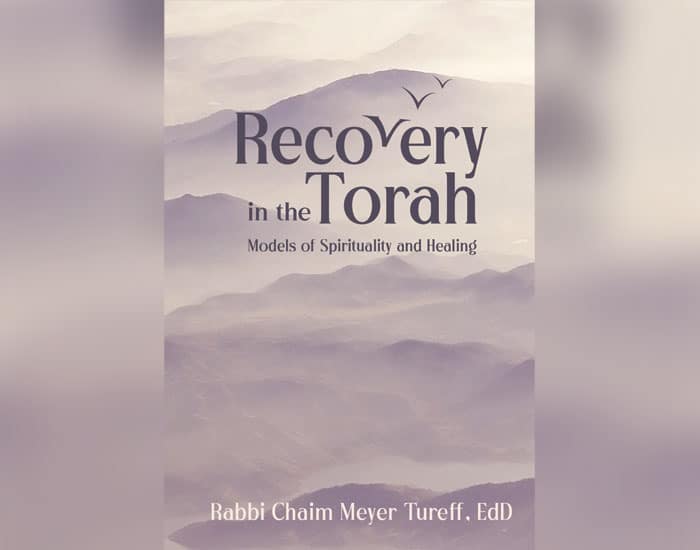
In his new book, “Recovery in the Torah,” Rabbi Dr. Chaim Meyer Tureff, who has long worked with addicts, details how each Torah portion and holiday can give us insights on substance abuse and help us on the road to recovery. 

The opening chapter, which covers Bereishit, discusses the Torah verse, “It is not good that man should be alone; I will make him a helper opposite him.”

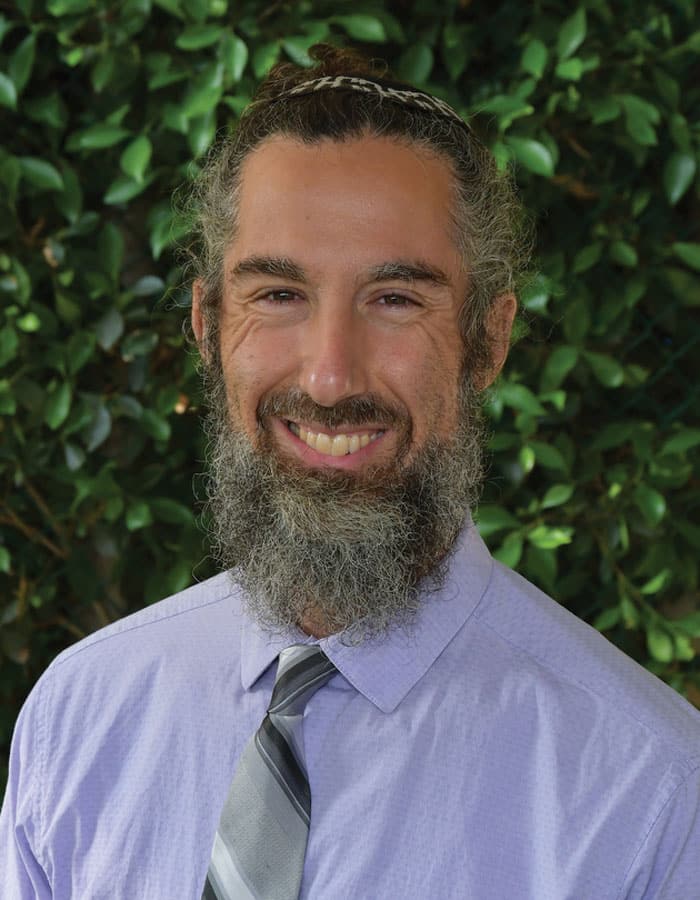
Rabbi Chaim Tureff

Tureff equates this to addicts finding a sponsor who can help them. “It is difficult enough for man to navigate these challenges, but with a partner whom one can trust, he has someone with whom he can work. This is the same in the world of recovery and rehab. One is not asked to try to become sober on his own. It is a difficult task to go through recovery by yourself. That is why it is important—and some say imperative—to have a sponsor as you are starting on the road of recovery.”

The rabbi is rav beit sefer at Pressman Academy, director of an organization called STARS, which helps individuals struggling with addiction, as well as the spiritual guide for Soberman’s Estate, an addiction residential men’s treatment center in Arizona. He’s spent 19 years working with addicts and lecturing on the topic of substance abuse at rehab centers, synagogues and schools. He’s also worked with people from all different backgrounds, including many Jews.

“It hits Jews disproportionately because of our mentality which includes shame, trauma, constant self-criticism and unrealistic expectations.”

“[Addiction] is a big problem in our entire society,” Tureff told the Journal. “It hits Jews disproportionately because of our mentality which includes shame, trauma, constant self-criticism and unrealistic expectations.”

There are times when Jewish ritual calls for drinking wine, such as Shabbat, the holidays and simchas. Tureff writes that on Purim, drinking plays a major role, with the obligation to drink until you can’t tell the difference between Haman and Mordechai. As a former member of Hatzalah, a Jewish volunteer emergency medical service organization, he has seen drinking on Purim cause serious issues – and even death. 

“As a midrash from Leviticus Rabbah states about drinking, ‘The negative effect of wine is like a snakebite, separating life and death,’” the rabbi writes. “We know the dangers of drinking on Purim and many synagogues take precautions so that young people are not influenced by excessive drinking and adults don’t make decisions that have unintended consequences.”

In the chapter on Pesach, Tureff relates Pharaoh’s contending with the 10 plagues with hitting rock bottom and feeling the consequences of it. “Much like someone in active addiction, each plague brought new hardships,” he writes. “His willfulness led to suffering, the downfall of Egypt, the death of his family, and, according to many interpretations of the story, his own death in a painful and tormented manner. When one is active in his addiction, he often refuses to see the signs or plagues that impact his life.”

When individuals who are struggling with addiction read his book, Tureff hopes they learn about healthier ways to address their issues. 

“There are alternatives to going down a path that will actually make life more difficult,” he said. “I think there is a lot about everyday crutches, an example being social media and how people fall into these things to avoid dealing with feelings or issues at the present moment. It is so much easier to play on your phone rather than deal with real life.”

Tureff believes that the Torah can be valuable when it comes to addiction treatment – but you have to know how to decipher the messages. 

“It is a powerful spiritual tool, with guidance and wisdom to deal with these issues, although it is not always explicit,” he said.

Though it may be tempting to jump to conclusions or judge a person who is dealing with substance abuse, Tureff stresses that importance of having empathy and seeing the godly spark inside of them. 

“There should not be any stigma with those that are struggling with addiction or know someone who is struggling,” he said. “We all have a special soul that God put in us for a reason. Everyone should remember that.”

Looking to the Torah for Help with Addiction Read More »

Sinai Temple Basketball Clinic, L.A. Federation and Repair the World Partnership

Sinai Temple held a multifaith basketball clinic and panel discussion with 11-year NBA veteran Enes Kanter Freedom and college basketball star Ryan Turell. 

“We can use sports as a tool to bring people together,” Kanter Freedom, who played for the Utah Jazz, Oklahoma City Thunder and the New York Knicks, among other teams, said during the Aug. 10 event at Sinai.

Sinai Temple hosted the community program in partnership with the Muslim Coalition for America (MCA), a nonpartisan coalition dedicated to providing a positive national platform for American Muslims. Additional partners were Tamir Goodman Basketball Camp, Faithful Central Bible Church and Church of the Good Shepherd.

“I’m passionate about sports and faith – not about trade deadlines and box scores, but about what is in athletes’ hearts and souls,” Sinai Temple Rabbi Erez Sherman told the Journal.

During the basketball clinic, more than 65 students of different faiths, in grades first through eighth, participated in various drills led by Kanter Freedom and Turell. 

Afterwards, a panel discussion featured Kanter Freedom and Turell. 

Omar Qudrat, founder of MCA, provided opening remarks, and Sherman moderated the conversation. Each of the panelists shared their experiences integrating faith with basketball and discussed how sports can be a vehicle for creating interfaith unity. 

During his lengthy career in the NBA, Kanter Freedom has sought to have an impact beyond the basketball court. He has been vocal about human rights issues, denouncing Turkish president Recap Erdogan as well as the Chinese government. The 6-foot-10-center and practicing Muslim recently visited Israel for the first time to launch a multifaith basketball camp. 

“The political people, we might not be able to change their mindset, but the young kids, we can,” he said, “because we can use basketball as a tool to change it.” 

Turell, who led Yeshiva University’s men’s basketball team to unprecedented succcess, spoke about what it was like to be an observant Jew in basketball.

“I feel like everytime I step on the court, I’m representing not just myself and whoever I play for,” he said, “but the Jewish people as a whole.”

From left: Ryan Turell, Father Ed Benioff of Church of the Good Shepherd; Sinai Temple Rabbi Erez Sherman; Muslim Coalition for America founder Omar Qudrat; and former NBA star Enes Kanter Freedom. Courtesy of Miller Ink

Repair the World and Jewish Federation of Greater Los Angeles have announced a partnership to expand the footprint of Jewish service in Los Angeles.

According to the L.A. Federation, the two organizations are aiming to create more opportunities for young people to engage in impactful service work around Los Angeles.

“With committed local partners, more young people in Los Angeles will be able to engage in service alongside their neighbors and create meaningful change in their communities through a Jewish lens, Repair the World CEO and President Cindy Greenberg said. “We’re excited to collaborate closely with the Jewish Federation of Greater Los Angeles to address urgent local needs.”

Repair, with support from the L.A. Federation, is launching a two-year, full-time stipend fellowship in Los Angeles and will continue to operate its part-time stipend Service Corps and episodic service opportunities. With these initiatives, “We are well positioned to expand our efforts throughout Los Angeles,” Michael Auerbach of Repair the World Los Angeles said.

L.A. Federation President and CEO Rabbi Noah Farkas expressed excitement about the Federation collaborating with Repair the World.

“We are a stronger Jewish community when we work together, and we are thrilled to solidify this already strong bond between our Federation and Repair the World,” Farkas said.

Sinai Temple Basketball Clinic, L.A. Federation and Repair the World Partnership Read More »