fbpx

August 4, 2022

More Happiness: The Happy Minyan Finds a Home

To read David Suissa’s column on The Happy Minyan, click here.

In his book “Tzava’at Harivash,” Rabbi Israel Baal Shem Tov, the founder of Hasidic Judaism, writes: “Serve God with reverence and with happiness. They are two companions, complementing one another, that must never part.”

This is a teaching that The Happy Minyan in Pico-Robertson takes to heart. On any given Shabbat or Jewish holiday, members sing at the top of their lungs, excitedly dance around the bimah and daven with absolute joy. Close your eyes at one of their services, and you might just think you’re at the Kotel during peak Shabbat davening. 

This is intentional. The Happy Minyan is a Modern-Hasidic synagogue that takes the teachings and melodies of Rabbi Shlomo Carlebach zt”l, using them to infuse passion into prayer and soulfulness into spirituality.

“You’re singing, dancing, eating, sharing with others and enjoying prayer. There really is a sense that you are not just observing Shabbos – you are celebrating it.” – David Sacks

“At The Happy Minyan, prayer is a participatory sport,” said David Sacks, one of the co-founders. “You’re singing, dancing, eating, sharing with others and enjoying prayer. There really is a sense that you are not just observing Shabbos – you are celebrating it.”

After operating out of the Rokah Karate studio on Pico Boulevard for many years and holding services in members’ backyards during COVID, Happy Minyan has finally secured a space of its own at 9311 West Pico Blvd. This is a momentous step for the synagogue, which, since its founding, has never had a permanent home. 
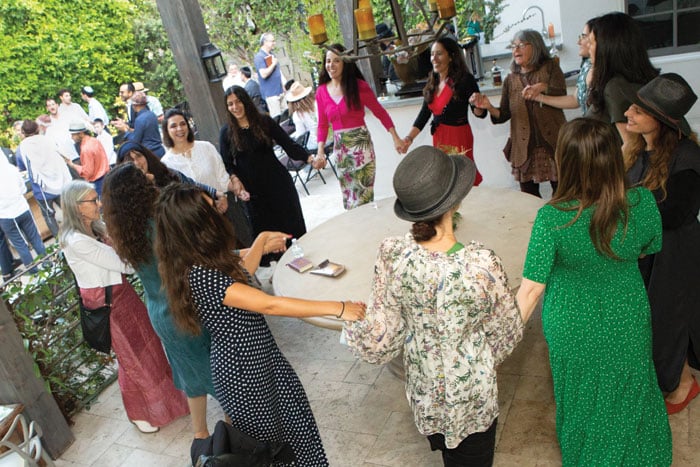
Women join hands, sing and dance their way out the week and into Shabbat. (Jonah Light)

“This will be the first time ever that The Happy Minyan has a full-time place of its own 24/7,” said Sacks. “That means we will be able to expand the classes and programming we do. We really want it to be a Center of Jewish Spirituality for Los Angeles, where people feel comfortable dropping by to grow and hear the beauty and positivity of what it is we’ve been yearning and working toward for thousands of years.”

In 1989, members of the Pico-Robertson community—Stuie Wax, David Sacks, Johnny Boyer, Lewis Weinger and Jeff and Linda Rohatiner— got together and decided to start a Carlebach minyan. Sacks gave the d’var Torah for the first Shabbat, and they met weekly in Wax’s home. 

But the founders yearned for something more. They wanted to make Happy Minyan official, a staple for the neighborhood that everyone could enjoy. In 1995, they moved into the basement of Beth Jacob Congregation in Pico-Robertson, and it was then that the name Happy Minyan came about.
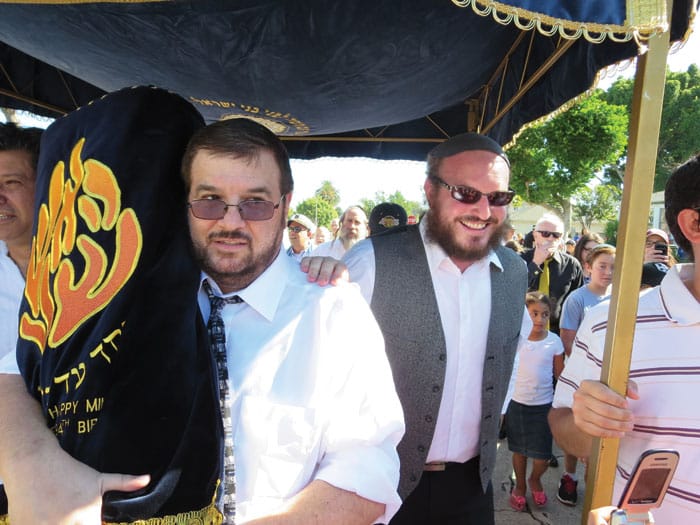
One of the original founders of The Happy Minyan, Stuart Wax, who now lives in Florida, holding a Torah next to singer Shlomo Katz, who lives in Israel.

The synagogue started attracting Jews from all different backgrounds, from those who were frum from birth (FFB) to baal teshuvas, from Hasids to secular Jews and men and women and children of all ages. 

Naomi Solomon, executive director of The Happy Minyan, whose husband Yehuda Solomon is the chazzan and lead singer of Moshav band, started attending services in 1999 because of the upbeat davening she experienced there. 

“Most people go to shul either because as an observant Jew, davening with a minyan is required, or because it’s a place where they can connect socially and identify with being Jewish,” she said. “Happy Minyan is a place where people actually embrace and enjoy davening. Meaningful davening, like yoga or a meditation practice, becomes something that people crave. [They’re] waiting all week to be back in shul on Shabbos so they can plug back in to that joy and connection.”
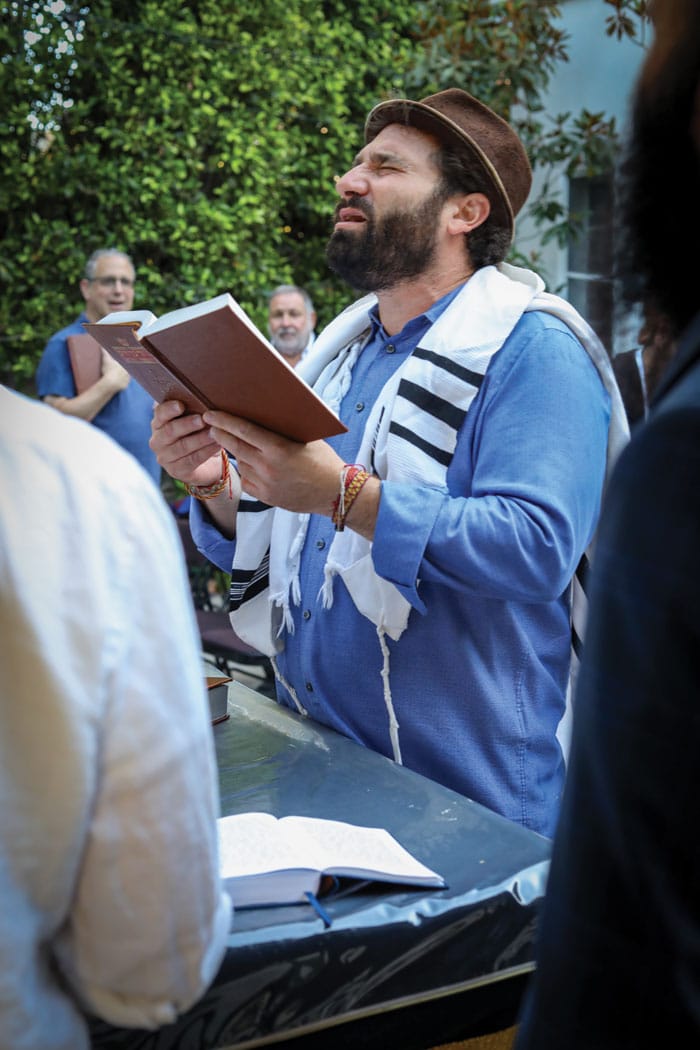
Yehuda Solomon, Chazan of The Happy Minyan, leading the Friday night prayer service using the unique Nussach of Rabbi Shlomo Carlebach, z”tl. (Naomi Solomon)

The synagogue offers a Sunday morning class, other classes and concerts year round, weekly Shabbat services, a monthly sponsored Shabbat lunch for the community and childcare for ages 6 months to 12 years during services.

“Even our children look forward to coming with us to shul, not to participate in the children’s program, but to actually be in shul, davening,” said Naomi. “Two of our children go early, at 8:30 a.m., 30 minutes before davening begins to hear David Sacks’ Shabbos morning shiur. I think that speaks worlds about what it’s like for children growing up at Happy Minyan.”

The minyan currently has about 100 members, and visitors from around the world – New York, Chile, Israel and Northern California, to name a few – come to pray there. When Sacks, an Emmy Award-winning producer and writer for “The Simpsons” and “Malcolm in the Middle,” was in Mea Shearim in Jerusalem, he was making small talk with a Hasid who was selling tallit bags when the topic of his shul came up. 

Sacks told the Hasid he goes to The Happy Minyan, and the Hasid got so excited that he called across the store to another Hasidic man who was working the cash register, telling him, “This person davens at The Happy Minyan in Los Angeles.” 

“His friend was even happier,” Sacks said. “Meanwhile, I was trying to figure out what was going on. I ask, ‘Have you been there?’ And the person said, ‘No. But I know that at The Happy Minyan every Jew is welcome.’ It was a great moment realizing that what we’ve created with the atmosphere at The Happy Minyan has become bigger than the place itself.” 

Though the Minyan has developed a reputation around the world, and more people have been attending services at the tail end of COVID, that doesn’t mean the pandemic was easy for the shul to navigate.

“Our COVID experience could be compared to a forest fire. We were stripped down to the core… But on the other side of that long haul of survival, when we finally regenerated, we came back even stronger.” – Naomi Solomon

“Our COVID experience could be compared to a forest fire,” said Naomi. “We were stripped down to the core. We lost our space, left most of our belongings behind, stopped serving food and ended our childcare program. Everything was so uncertain and there were times when we had hardly more than a minyan. But on the other side of that long haul of survival, when we finally regenerated, we came back even stronger.”
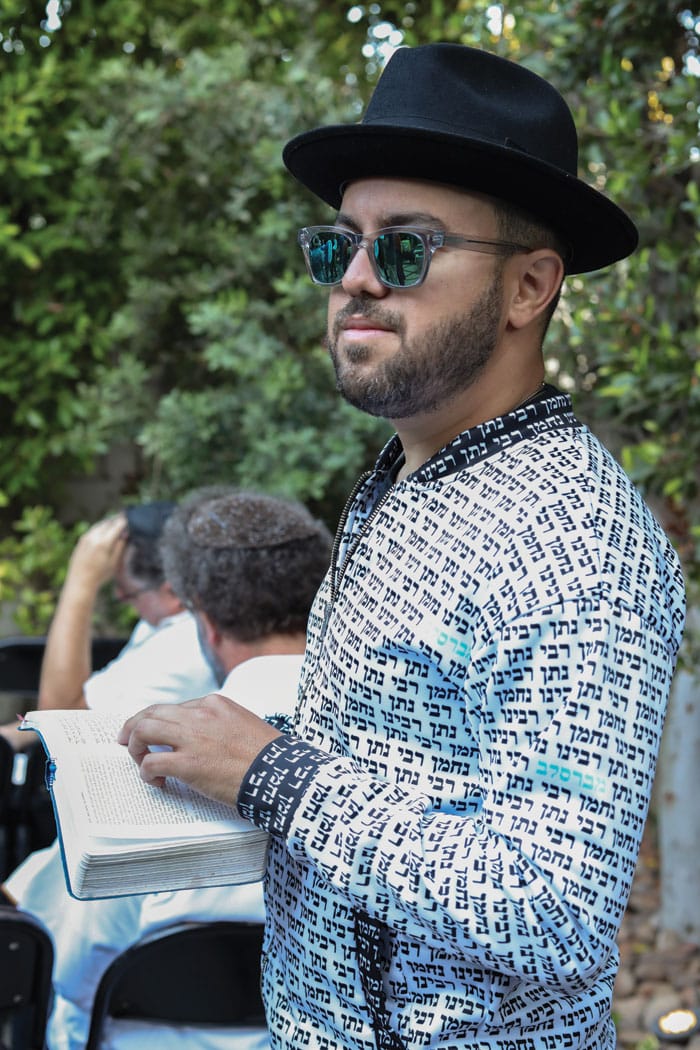
Erez Safar has been attending The Happy Minyan for 7 years. (Naomi Solomon)

In typical Happy Minyan spirit, members stepped up to offer their backyards as part of a grassroots operation. For months, services were held in the backyards of couples Bryna and Moishe Fiedler, Travis and Nikita Putnam and Ruchie and Steve Fried. 

“Something magical happened when we began praying in the home of the Frieds,” Naomi said. “When the first month ended, they extended. After the second month ended, they extended again. After the third month, they said we could stay at their home indefinitely until we were able to move back indoors.”

The synagogue has been in that backyard for 11 months; when the new space on Pico is ready – hopefully before the High Holidays – it will move. 

With the backyard davening, The Happy Minyan proves that a spiritual connection can happen anywhere. The Frieds have an olive tree in their yard that doesn’t bear fruit; the gardener chose it so it wouldn’t make a mess. After several months of holding services there, with Yehuda Solomon singing under the tree, the tree now has olives. 

“The barren tree is bearing fruit,” said Naomi. “[That’s] the power of prayer.”

Ask any Happy Minyan member to describe the shul, and one word will keep popping up: welcoming. 

“Happy Minyan offers a safe and joyous space for anyone, no matter where they are holding spiritually, or how they dress, to come and connect through joy, and get a taste of Shabbes,” said Yehuda Solomon. “Once you pray with Happy Minyan, you never leave.”
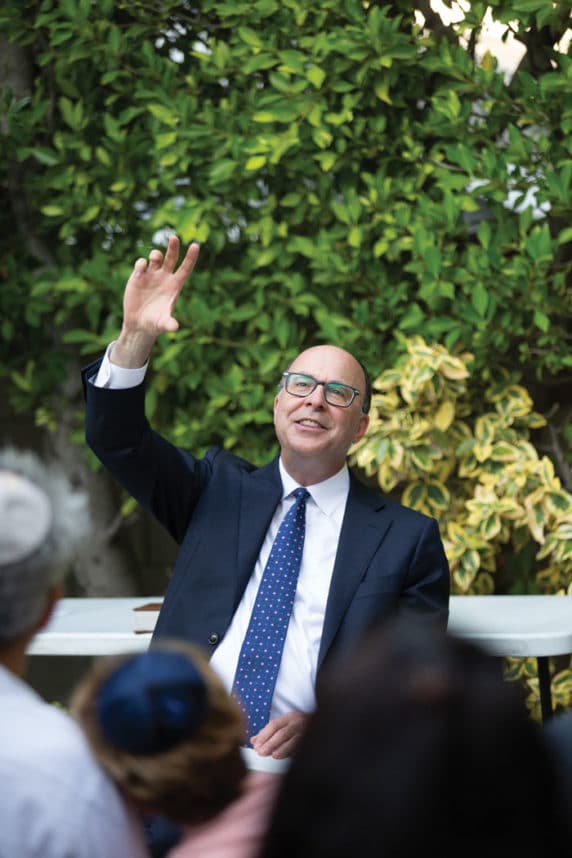
David Sacks, the Spiritual Leader and Senior Lecturer of the Happy Minyan since its inception, sharing Torah thought.
(Jonah Light)

Sacks, a baal teshuva (returnee to Torah observance), didn’t keep Shabbos or kosher growing up, but his mom did start taking him to a synagogue when he was 14. That “little shul across the street” from his home, he said, was the Carlebach Shul on 79th and West End Avenue, which has been around since the 1940s. 

“Reb Shlomo brought me to Torah observance, was like a father to me, and married me and my wife,” said Sacks. “Going there created a yearning in me that finally culminated in becoming observant when I was 24.”

Yehuda also had a personal connection with Carlebach. He grew up in Israel on Moshav Mevo Modi’in, next door to the rabbi. His parents had met Carlebach in San Francisco at The House of Love and Prayer, a synagogue the rabbi founded, in the early ‘70s. There, they reconnected with their Judaism. 

Yehuda’s father ended up being a founder of Diaspora Yeshiva Band, which performed some of Carlebach’s tunes. The chazzan followed in his father’s footsteps, founding a Jewish band of his own, Moshav, which was also influenced by Carlebach. 

The synagogue is not only for those who were close to Carlebach; it is for anyone who wants to feel a deeper spiritual connection. Although some members grew up observant, they find the services at Happy Minyan help them connect on an even deeper level.

“After I started going to Happy, I found myself counting down the days until Shabbos so I could feel that amazing connection to Hashem that I feel every Friday night and Shabbos day at Happy.” – Bryna Fiedler

“I used to find Shabbos really difficult, [because powering] down from work and [being] shut off from the world was really hard,” said Bryna Fiedler, who has been a member for six years. “After I started going to Happy, I found myself counting down the days until Shabbos so I could feel that amazing connection to Hashem that I feel every Friday night and Shabbos day at Happy. That connection helped me realize that the whole week is the hard part and Shabbos is pure joy and peace.”

David Fiedler, Bryna’s husband, who was also frum from birth, had a similar experience.

“Like many of my FFB peers, I never went to shul on Friday nights, but then when I came to minyan on Friday night over six years ago, I was hooked,” he said. “My wife, high school and middle school children love it too. We even bring Shabbat in early every Friday, and it is the highlight of our week.”

Another favorite for members is the High Holidays, and specifically Yom Kippur, which takes on a whole new meeting at the synagogue. Services last longer, the singing is extra meaningful and they reach new spiritual highs. 

“The level of intention and focus brought forth as a united community, combined with such heartfelt awe and joy for the potential of the day results in an extremely powerful and moving spiritual experience that is unmatched by any other day of the year,” said Naomi. “It’s simply awesome.”

According to Naomi, in signing the long-term lease at the new space, The Happy Minyan now has a permanent place for Shabbat and holiday services. They will be launching open-book learning for men, chavruta-style, hosting women’s drop-in morning davening after carpool, reopening for seudah shlishit on Shabbat, the third meal, and extending it into a melaveh malkah after Shabbat ends.

“Having our own space allows for the organic process of the Minyan’s growth and the opportunity to fully access our potential.” – Naomi Solomon

“Having our own space allows for the organic process of the Minyan’s growth and the opportunity to fully access our potential,” Naomi said. 

Nikita Putman, a member for six years who attends services with her family, is looking forward to gathering in the new space.

“I hope the space will result in more access to not just praying over Shabbat, but [also] learning and enriching all aspects of Jewish life,” she said. “It is a space where people can come and feel like an extended family.”

It is their goal, as always, to help Jews, no matter where they’re coming from, connect to their yiddishkeit, their community and their Creator, of course, with joy.  

The Happy Minyan community is optimistic about their synagogue’s future. It is their goal, as always, to help Jews, no matter where they’re coming from, connect to their yiddishkeit, their community and their Creator, of course, with joy.  

“We are excited to further engage the youth and for them to know that they will have a place on Pico they can call their own,” said Naomi. “Having our own dedicated space means more concerts, more gatherings and more Torah learning. We’ve been dreaming of this for years and now, with God’s help, it’s finally here.”

The Happy Minyan’s capital campaign, “Mission Possible” will launch online August 9th. Tax-deductible donations can be made anytime at happyminyan.org/donate. To become a campaign ambassador, please email info@happyminyan.org.

More Happiness: The Happy Minyan Finds a Home Read More »
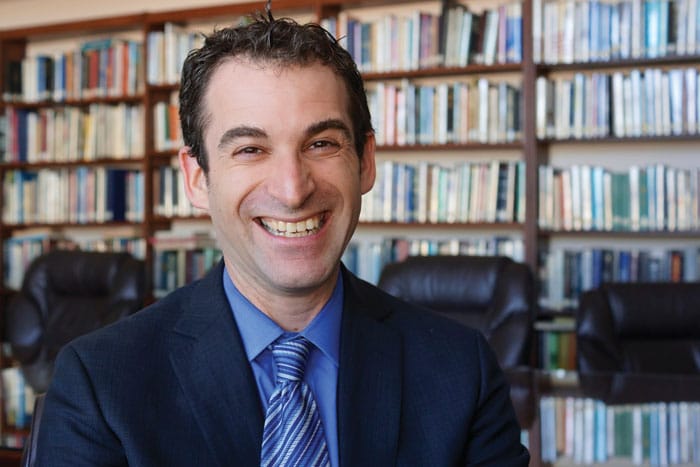
Rabbis of LA | Rabbi Zach Shapiro: Welcoming Jews With Open Arms

When Rabbi Zach Shapiro of Temple Akiba of Culver City was 11 years old, he knew he wanted to be a rabbi when he grew up. He played Jewish songs on the guitar at his Reform summer camp and met other song leaders there who inspired him to take a rabbinical path.

“I said, ‘Wow, I want to do this too,’” he told the Journal. “It was that love of Jewish music that really began my journey toward becoming a rabbi. I realized at an early age my mission in life was to bring good into this world, and I had the treasures of Judaism to guide me in the process.”

While music was what Shapiro said “stirred his soul,” he didn’t think that becoming a cantor was for him.

“I thought about it, but music was more of a hobby than anything else. Once I started diving into rabbinic texts, that became much more of a passion for me.”

After Shapiro graduated from high school, he headed to Colby College, a small liberal arts school in Maine. It was important to him to attend college and expand his worldview before entering the rabbinate.

“Growing up, my rabbis said if I wanted to be a rabbi not to major in Jewish studies, because then I wouldn’t know anything except for Judaism,” he said. “They told me to get a well-rounded liberal arts education so I could understand a little bit more about how the world works.”

After earning his degree in Spanish, Shapiro spent five years at Hebrew Union College-Jewish Institute of Religion (HUC), where he studied in Israel for a year and then Cincinnati for another four. In 1997, his final year at HUC, the rabbi, who is gay, applied for jobs all over the United States. 

“It was still early on in the movement for congregations to hire gay rabbis,” he said. “One congregation told me that they hired a gay cantor and they couldn’t have two gay clergy members. I said, ‘I’m sorry, I need to remove myself from this interview.’”

Shapiro interviewed at University Synagogue, where they didn’t judge him for his sexual orientation. “I said I was gay and they said it’s a non-issue,” he said. “They asked me to join their team.”

While the rabbi enjoyed the eight years he was there, he didn’t plan on staying in Los Angeles long-term. However, that changed when he met Ron Galperin, an attorney and part-time cantor in Montebello, at a break-the-fast event after Yom Kippur. 

“We’ve been together ever since we met,” said Shapiro, who married Galperin, now the Los Angeles City Controller. The two are proud parents to 3-year-old twins, Maya and Eli.

Since 2006, Shapiro has been the rabbi of Temple Akiba. Back then, there were 250 families at the synagogue, and today, there are more than 400. 

“I love this community,” he said. “It’s such an incredible gem in the LA area. We’re an eclectic, down-to-earth and heimish community.” 

Shapiro was a visionary; he could see how Culver City was flourishing and would continue to do so in the years ahead.

“When I first came here, Culver City was just entering a renaissance of renewal,” he said. “A lot of young families were flocking here, and the city had just gone through a renewal program. I knew this was the right place for a Jewish renaissance, and that’s exactly what happened.” 

What matters most to Shapiro is that when people come to Temple Akiba, they feel at home. 

“We have members waiting at the gate and the door, welcoming people as they walk in,” he said. “They ensure no one walks in alone. I’m always outside on Sunday mornings greeting religious school families.”

“I want people to realize they are a link in the chain, and they have a sacred responsibility to make sure they are not only a descendant of Judaism, but also an ancestor.”

“I want people to realize they are a link in the chain, and they have a sacred responsibility to make sure they are not only a descendant of Judaism, but also an ancestor,” Shapiro said. “They are carrying a torch that will not end on their watch, but instead inspire others to begin their journeys.”

Fast Takes With Zach Shapiro

Jewish Journal: What is your favorite Jewish food? 

Zach Shapiro: It’s the food I’m sure Moses ate in the desert: toffee-covered matzah.

JJ: What do you buy too much of on Amazon?

ZS: Books about airports and airline history. I love aviation. Logan Airport in Boston is my favorite.

JJ: What would you be doing if you weren’t a rabbi?

ZS: I would be a YouTube vlogger who talked about the airlines of the world. 

JJ: What do you do when you have a day off?

ZS: Before we had kids, I would go to the airport and watch airplanes. I would fly somewhere because I love flying so much. Now, I take our kids to the airport and they watch with me while we enjoy a picnic lunch. 

Rabbis of LA | Rabbi Zach Shapiro: Welcoming Jews With Open Arms Read More »

Table for Five: Devarim

One verse, five voices. Edited by Salvador Litvak, the Accidental Talmudist

And the Lord said to me, “Say to them: Neither go up nor fight, for I am not among you, lest you be struck down before your enemies.”

– Deut. 1:42


Rivkah Slonim
Education Director at the Rohr Chabad Center at Binghamton University

Our parasha contains Moshe’s subtle rebuke of the Jews for their various missteps in the desert, including their lack of faith in God’s ability to bring them into the Promised Land. Moshe recalls how the Jews allowed themselves to be convinced by the spies and spurn the Land, only to reverse course and attempt its conquest. At that point, God tells them to desist and makes clear that if they do go up, they would be smitten. 

Earlier, God had charged them with conquering the land and promised them success. What changed? A story is told about the saintly chasid, Rabbi Meir of Premishlan. Every day, Reb Meir immersed in a mikvah that stood atop a steep hill. Even when the weather turned icy and most others could not safely navigate the elevation, Reb Meir walked in a  surefooted manner. One winter day two young men decided to disabuse the townsfolk of their belief that Reb Meir was somehow possessed of extraordinary spiritual powers. They proceeded to negotiate the same treacherous walk up to the Mikvah only to fall and hurt themselves. Bemused, they decided to ask the tzadik how he did it. Reb Meir famously replied: “When you are bound above, you don’t fall below.” 

Had the Jews hearkened unto God’s original command they could indeed have successfully overtaken all of the mighty nations who inhabited the land. But not being “bound above” God taught them — and their descendants for all time — will only lead to a fall.


Rabbi Aryeh Markman
Executive Director, Aish LA

I just visited Highland Park, Illinois, stopping at ground zero of the July 4th massacre. I was born and raised there and lived an idyllic suburban childhood. It seemed that the populace was traumatized. I asked my good friend of 37 years, Highland Park Chabad Director Rabbi Yosef Schanowitz, what can the Highland Park Jews do to overcome this event and begin to lead normal lives again? He said in his characteristic soft spoken, self-effacing way, “I hear learning Torah is a good thing.” 

Sometimes God is like the sun on an overcast day. We can’t detect Him, but He is there. If I can give my children only one piece of advice it would be, “Follow the directives of the Torah.” For today might seem gloomy, but the sun will eventually shine. 

The generation that left Egypt was duped by the Spies and made to believe it would be slaughtered trying to settle in the Land of Israel. Sound familiar? In their refusal to enter Israel, God gave them a 40-year sentence until the men of that generation died out. The day after that verdict, a horde defiantly broke for Israel and God warned them to desist. God said, “I am not among you”, meaning the Ark, and the Torah within, wouldn’t be traveling with them. They were defeated. 

As we travel in life, do bring the Torah along. Like the Jews in the desert, we will be directed from Above as to when and where we are supposed to go! 


Lt. (res) Yoni Troy
Councilor, Beit-Hatzayar, school for at-risk youth

This verse seems to challenge modern Zionism – but as a Zionist I don’t believe it does. When the Jews who created the State of Israel decided to settle the land, it, too, seemed they were going against the “word of G-d.” But despite the cries from much of the Orthodox camp that they “rebelled against G-d,” the early 20th century Zionists saved millions of Jewish lives. What is the difference? Why did only the modern decision to settle the land fulfill G-d’s wish — as evidenced by its success? Because the intentions behind the actions differed. 

In this week’s story, the decision to settle the land doesn’t come from a pure love of the Land of Israel but from a desire to run away from responsibility. Believing the Spies, the Israelites had just rejected the Land. But instead of taking responsibility for their sin, they immediately try to fix it. 

The first lesson you learn in the Army is that “timing is holy.” If you are told to be somewhere at 8:01, you get there at 8:01. No lateness is tolerated.

The Jewish people had to learn that lesson too. In Deuteronomy, it wasn’t yet the right time to go to Israel. Their failure to understand that shows they still had not learned to read the situation and make educated decisions. Hence, the decree to spend 40 years in the desert. 

Fortunately, Zionists got the timing right – although many Jews waited too long before coming to that realization.


Rabbi Janet Madden
Rabbi of Fountainview at Gonda Westside

I struggle to imagine the new generation of Israelites paying unwavering attention to Moshe’s long valediction; their new leader, Joshua, has already been selected and confirmed. The people must have been impatient to get on with their lives in the Land, imagining the future. 

So I like to think even the most inattentive suddenly woke up when Moshe spoke of an idea so terrifying that we cannot imagine it: Divine withdrawal. The prospect of the absence of Presence is fearsome. But this is not imaginal: the warning comes from the Holy One. 

How could the loss of the Divine center lead to anything but catastrophe? If there is a void where Oneness was, what would happen when the force that animates us, guides us, loves us and calls us to account is no longer available? 

We would awaken to a sense of shattering helplessness. There would be no possibility of prevailing against any force, inner or outer. Surely, we would not survive. 

Without holiness in our midst and at our core, without the Presence to cling to and build our lives around, how could either individual or communal coherence be achievable? 

The warning of the consequence of the lack of Presence in our midst and at our center is not a lesson for our ancestors only. We moderns might more easily relate to WB Yeats’ interpretation: when the center is lost, “mere anarchy is loosed upon the world.” It is a condition, many fear, to which we edge ever-closer.


Rabbi Chaim Singer-Frankes
Chaplain at Kaiser Medical Center, Panorama City

Moshe reframes accounts from Bamidbar in which Israel impetuously challenges God’s plan. Apparently to forestall sacred wrath, they prepare to make war against the Amorites. God admonishes the people not to embark upon a fool’s mission, apprising the People that their military campaign will be doomed. 

From this verse alone, one might conclude that God opposes making war altogether. However, given Israel’s enumerated and multiple victories with God veritably at the tip of their swords, this would be a false conclusion. Indeed, holy wars are God’s determinate means for clearing a path to the promised land. But in this telling, the People of Israel are impudent, so God has an important lesson. 

The People take it upon themselves to strike under a false assumption. Do they believe that war has the power to annul misdeeds, to somehow purify their sins of murmuring against Moshe and God, and thereby assuage God’s fury? Israel seems to neglect the implicit element; they are sanctioned for battles, but ONLY those which God certifies. Imagine Am Yisrael being so taken with their favored status before God, so self-possessed in their march to battle, so overwhelmed in their bloodlust, that they are blinded into believing that war has become their own proprietary instrument, even that it empowers them to supplant holy fortune! 

Israel is so hot-blooded by shameful guilt, they become deafened to the unambiguous will of God. Woe to sinister deities who are appeased by crimson sops — Hashem cannot be corrupted through bribes of gratuitous bloodshed.

Table for Five: Devarim Read More »