fbpx

July 27, 2022

Each Person is a World

Jewish tradition teaches that one person is a world. What does this idea mean and why is it so significant?

The Mishna (Sanhedrin 4:5) states that Adam, the first human, was created as a lone figure in order to teach us that if one destroys a single soul, he is as guilty as if he destroyed the entire world, since every human being is descended from one person: Adam. Since a single soul can create an entire world, anyone who sustains one soul is credited with sustaining the whole world.

Indeed, the stories are legion of Holocaust survivors who lost everyone and everything in the war and yet a single survivor often ended up surrounded with a large family, renewing life for generations. The Glatt family story, reported in today.com, is exemplary. Jessica Glatt’s grandfather and grandmother survived the Holocaust and lived to see their great-grandchild. The occasion was dramatically portrayed in a picture of the granddaughter, when she was three months old, “holding her great-grandfather’s arm, his concentration camp tattoo still etched in his skin.”

Throughout history, it is often a lone individual who has had a major impact on the world and even transformed it. Abraham was the first Jew and introduced the concept of monotheism to the world. Moses freed the Jews from slavery in Egypt and received the covenant on Mount Sinai. In modern times, Alexander Fleming discovered penicillin, which led to the development of antibiotics, both of which have saved innumerable lives and changed the nature of medical science. Jonas Salk created the vaccine against polio that saved countless lives, including mine. Galileo’s discovery, in the early 1600s, revolutionized our understanding of our place in the Universe. Marie Curie, who won two Nobel Prizes and was the most acclaimed scientist of her era, discovered radium and plutonium, both used in the treatment of cancer.

What are the ramifications of the idea that a person is a whole world, not just in numbers, but in impact? As the English poet John Donne wrote, no man is an island and “any man’s death diminishes me/ because I am involved in mankind/ And therefore never send to know for whom/ the bell tolls; it tolls for thee.”

The Mishna cites another reason for the fact that we all come from a single human being: Since we all descend from the same progenitor, no one can justifiably claim his father is greater than someone else’s. Jews know only too well that hatred for one group never ends with that group. It reflects a sick society that will end up devouring itself and others. Either we respect each other, no matter how different, or we all end up paying the price. Each person and each group represents so much more than itself. History provides endless examples.

The corollary to the first principle is that no one is free unless everyone is free. When Soviet Jews went to prison for practicing their religion, Jews around the world demonstrated publicly and applied political pressure until the prisoners were set free and allowed to leave for Israel. The current war in Ukraine illustrates that one dictatorship’s attempt to conquer a democratic neighbor is an unspeakable outrage against the idea that all have the right to be free and choose their own destiny. If it’s wrong here, it’s wrong there and it impacts you and me. The idea that every person is a world suggests that the world is an organic whole, a single unit.

The corollary to the first principle is that no one is free unless everyone is free.

Further, individualism does not mean every person for himself but rather what Rabbi Jonathan Sacks termed “the dignity of difference.” Within the framework of unity, solidarity and shared values, there are important and necessary differences. Those differences make us unique, but they must not be a cause for discord. The balance is a difficult one but “the dignity of difference” means that we must find common ground and recognize each other’s integrity in the face of different viewpoints.

For example, practical terms the notion that “each person is a world” is useful in thinking forward to an end to America’s catastrophic divisions. People who hold different views should see themselves as political opponents rather than enemies. We must all work to understand “the dignity of difference.” While we may not always agree with a perspective different from ours, it’s critical to accept that without differences in opinion and perspective, there is no meaningful dialogue.

Each person—along with their beliefs and values—constitutes a world of potential, worth and promise. Whoever undermines or disrespects any person murders the infinite potential within them, and whoever encourages and uplifts others participates in the creation of endless possibilities.


Dr. Paul Socken is Distinguished Professor Emeritus and founder of the Jewish Studies program at the University of Waterloo.


Each Person is a World Read More »
Russian Jews Sidestep Jewish Agency to Immigrate to Israel

To read more articles from The Media Line, click here

Often in moments of crisis, people will find a way to get the help they need.

The Jewish Agency for Israel could be shutting its doors soon in Russia, but many Russians are already choosing to immigrate to Israel independently.

One of the agency’s more well-known roles is to facilitate Jewish immigration to Israel. However, many in Russia – spurred by political pressure and fears of a new Iron Curtain – have decided to forgo the long wait times for appointments at the Israeli embassy in Moscow and at the Jewish Agency and are making their own way to Israel.

Ivan Kvasov, a biology teacher, left St. Petersburg for Israel with his wife and son back in March. The family only applied for Israeli citizenship once they landed in the country.

“Everything went very quickly,” Kvasov told The Media Line. “There were some lines and so on but in general everyone supported us.”

Kvasov added that he and his family decided to leave Russia abruptly after it invaded Ukraine in late February. The war, he said, changed the political reality on the ground almost overnight and made life in Russia unbearable.

“Israel needs to confront Putin, together with the entire civilized world, especially since Putin has shown his true face,” Kvasov asserted, adding that Putin’s allies “are Iran, Afghanistan, the Taliban, North Korea and Venezuela. None of these is a friend of Israel.”

Other newly arrived Russians circumvented the long wait times that have been reported at the Jewish Agency in Russia by traveling to Israel as tourists and applying for a change in status as soon as they arrived.

Asya Anistratenko, a freelance translator, and her husband, Kosta, an IT specialist, immigrated to Israel from Moscow last month along with their two kids and two cats.

Because they came on tourist visas rather than through the Jewish Agency, they had to purchase their plane tickets themselves and were only able to bring one suitcase each filled with a few belongings.

“We really hadn’t ever been to Israel before so this was not an easy decision,” said Anistratenko. “We didn’t know what would be here, how we would feel and all the business-related things are not the same as in Russia.”

Anistratenko left behind her brother and her elderly father, whom she described as “tragically pro-Putin.”

“It is hard to talk to him about the situation and [almost] impossible because we don’t want to argue every time we talk,” she said.

Last week, Russia’s Justice Ministry formally appealed to the Moscow District Court, asking for the Jewish Agency to be dissolved.

Former Jewish Agency chairman Natan Sharansky, who spent nine years in Soviet prisons in the 1970s and 1980s before being allowed to leave for Israel, told The Media Line that in recent months Russian President Vladimir Putin has undertaken many steps to bring back the Iron Curtain.

“I don’t think that [immigration] from Russia will be stopped, but I do recommend to all those who more or less decided already that their future is not in Russia to make this decision as quickly as possible,” said Sharansky, chair at the Institute for the Study of Global Antisemitism and Policy.

Israel’s Prime Minister Yair Lapid has warned that there would be consequences if Moscow shutters the Jewish Agency. Israel has tried to remain mostly neutral on the Russian invasion of Ukraine, due in part to its need for the consent of Russia – which patrols Syrian airspace – to carry out airstrikes against Iranian terror proxies in Syria.

“It is very unfortunate that the West, in a moment of weakness in the past, permitted Putin to take control of the skies over Syria,” Sharansky said. “In fact, both things – bringing Russian troops to Syria and establishing their bases, and beginning the war against Ukraine – happened at the same, approximately, eight years ago, after Putin decided that the West is very weak after Obama’s decision not to react to the use of chemical weapons in Syria.”

New Organizations Step in To Help With Immigrant Absorption

New organizations have stepped in to help cope with the surge in Ukrainian and Russian immigration that has come about as a result of the war.

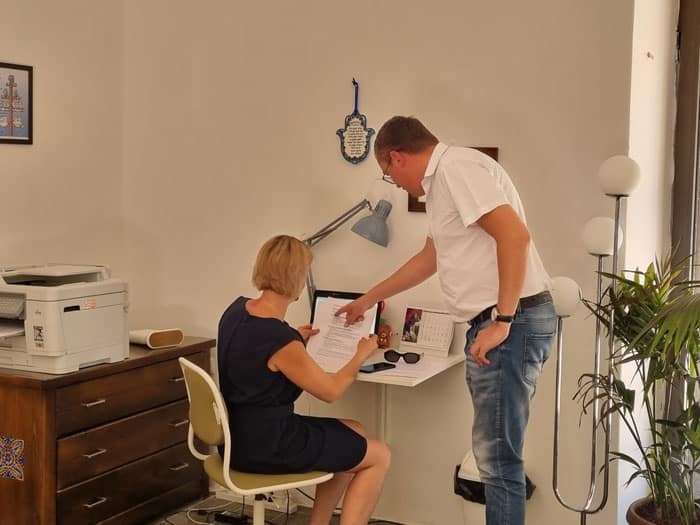
The Window to Jerusalem organization, which was founded earlier this year, has so far helped thousands of newcomers settle in. The non-profit group helps immigrants fill out governmental forms, answer questions and find schools for their children, as well as providing legal and financial advice.

According to Igal Sparber, a Jerusalem lawyer and one of the organization’s co-founders, the majority of those moving to Israel are, surprisingly, not Ukrainian refugees, but Russians wishing escape the oppressive political situation back home.

“Today if you want to make an appointment at the Israeli [embassy] in Moscow, you need to wait at least eight months, according to the information that we have,” Sparber revealed. “Most of the people we encounter begin to apply for citizenship once they are already in Israel and not through the Jewish Agency. They come to Israel on their own and settle their status once they’re already here.”

Sparber, who emigrated from Moscow to Israel in 1995 as part of a wave of Jewish immigrants from the former Soviet Union, added that the organization is also lobbying the Israeli government to ease the bureaucratic process in regard to the transferring of goods and assets from Russia to Israel.

Window to Jerusalem also has liaisons in Moscow to help those wishing to leave. The organization relies on a network of about 20 volunteers.

Sophia Sparber, Igal’s wife and Window to Jerusalem co-founder, worked at the Ministry of Population and Immigration for 15 years and is no stranger to the issues faced by newcomers.

“Israel’s biggest problem today is that it is not prepared to absorb so many immigrants,” she said. “They view the new Russian immigrants as being the same as those that arrived in the 1990s.”

Sophia Sparber, who moved from Crimea to Israel in 1996, said that Israeli government bodies are overwhelmed at the moment with high demand.

Nearly 20,000 Russians have immigrated to Israel since the start of the year, compared with some 7,800 last year, according to the latest figures released by the Ministry of Immigrant Absorption.

“Since the start of the war tens of thousands of Russians have immigrated to Israel,” Igal Sparber said. “I expect that as the political situation in Russia worsens – the closing of the Jewish Agency is a great example – then the number of immigrants will increase.”

Russian Jews Sidestep Jewish Agency to Immigrate to Israel Read More »

GA Dem Congressman Once Called Farrakhan “Impressive”

Representative Sanford D. Bishop Jr. (D-GA) once referred to Nation of Islam (NOI) leader Louis Farrakhan as “impressive” in a 2005 interview.

The interview, which took place as part of the Explorations of Black Leadership series of interviews with various Black leaders, featured Bishop telling the late Julian Bond, a former National Association for the Advancement of Colored People (NAACP) chairman, that in 1968 he attended sessions of the African People’s Congress. During one of those sessions he became “acquainted with a man known as Minister Louis Farrakhan who was so impressive that night that people stopped in mid-stride … I was just so taken by his message and his manner that I rushed out to the mosque the next day to hear him.” Bishop also said, according to a transcript, that Farrakhan was “so impressive that night.” The Anti-Defamation League has called Farrakhan “the most popular antisemite in America,” noting that Farrakhan has referred to Jews as being Satanic and being responsible for the slave trade.

Bishop then mentioned that he had considered joining NOI until his father caused him to “pause” on the matter. “I learned a lot about a lot of things and, of course, world religions, Judaism,” he said. “I grew up in Christianity.” In response to a later question from Bond on how Bishop drew “inspiration from Martin Luther King, Jr., former NOI leader Elijah Muhammad and Farrakhan,” he said: “While Malcolm X, Minister Farrakhan and Elijah Muhammad seemed to have initially believed that the white man was a devil, my experience taught me different. It taught me that there were good white men and there were bad white men and there were good black men and there were bad black men.”

In 2018, The Daily Caller reached out to 21 members of the Congressional Black Caucus who secretly met with Farrakhan in 2005––one of whom was Bishop––and asked if any of them would denounce Farrakhan. None of them did.

Bishop has served in the House of Representatives since 1993; he has expressed support for the 2015 Iran nuclear deal and has voted against two 2017 bills requiring the Department of Treasury to investigate financial institutions to see if they have any Iranian assets. Additionally, Bishop voted against a bill condemning a United Nations resolution that declared the building of Israeli settlements in the West Bank and East Jerusalem as being illegal and a 2008 amendment that barred money from going toward a guidance in intelligence agencies discouraging the use of the words “jihad” and “Islamic terrorist” in describing Islamic terror groups.

“His position on Iran seems to closely follow the approach of both Presidents Obama and Biden,” Associate Dean and Director of Global Social Action Agenda at the Simon Wiesenthal Center Rabbi Abraham Cooper said in a statement to the Journal. “Apparently has no concerns about a regime that crushes human rights, religious freedoms of its own citizens, executes gays, threatens nuclear Holocaust against Jewish state and continues to support and deploy terrorist assets from Iraq to South America. No surprise then he would have no problem with Farrakhan’s antisemitism and anti-American rhetoric.”

Bishop said in a statement to the Journal: “I denounce antisemitism just as I denounce all forms of racism. Throughout my career in the United States Congress, I have been a strong supporter of the State of Israel and enjoy the support of the Georgia Jewish community. I have advocated for cooperation between our two countries in the areas of defense, national security, intelligence gathering, science, technology, and agriculture. I supported the Joint Comprehensive Plan of Action, or the Iran nuclear deal, as did many Jewish Members of Congress and pro-Israel groups.”

The incumbent congressman is running against Chris West, a Georgia Air National Guard officer and lawyer. Axios reported the Bishop-West race “is considered Georgia’s only competitive congressional race in November.”

GA Dem Congressman Once Called Farrakhan “Impressive” Read More »

Where Israel Support is Fraying

Now that Joe Biden has returned from a largely uneventful Middle East trip, where his fist bump with Prince Mohammed Bin Salman received more attention than anything the American president said or did during his two-plus days in Israel, it’s an appropriate time to assess the sentiments of his constituents in this country toward the Jewish state. 

While Israelis made it clear during Biden’s visit how strongly they supported him and the broader relationship between the two nations, U.S. voters are much less enthusiastic – about both Biden and Israel. It’s no secret that Biden is struggling with unfavorable poll numbers here at home. But the attitudes of U.S. voters toward Israel are of much greater concern, as they underscore the threat posed by two dangerous long-term political trends.

First, the continuing transformation of Israel into a partisan issue among this country’s voters is accelerating. Recent polling from the Pew Research Center shows that only 44% of Democratic voters and independents who lean toward the Democratic Party hold positive feelings toward Israel, while 53% hold unfavorable opinions. Among self-described liberals, the numbers are even worse. Only 36% of liberal Democrats think favorably of Israel, while 62% hold unfavorable opinions. (By contrast, 71% of Republicans and independents who lean toward the GOP feel positive about Israel.)

Just as the far left of the Democratic party is increasingly becoming the home of anti-Zionist sentiment, there is a growing number of antisemitic activists in the most extreme conservative fringes of the GOP. So the ideological activists of both major parties present serious problems for most American Jews. But the growth in the anti-Israel sentiment among Democrats, and the immense amount of time and money that AIPAC, J Street and other groups are pouring into Democratic primary campaigns, has led to a level of internecine warfare that is starkly dividing the party.

Most American Jews will continue to vote Democratic on the basis of domestic policy, but the growing anti-Israel sentiment among progressive voters and officeholders (coupled with the continuing influence of pro-Israel religious conservatives in the GOP) may turn Zionism into a partisan football in the not-too-distant future. That trend bodes poorly for Israel, for the broader Middle East, and for the United States.

The other major take-away from the Pew survey is the ongoing deterioration of pro-Israel sentiment among young Americans. While feelings about Israel among all voters has remained fairly consistent in recent years (55% positive vs 41% negative), the generation gap that has emerged on this question is alarming. 18-29 year olds hold almost the exact opposite attitudes as the overall electorate, with only 41% feeling favorably toward Israel and 56 feeling unfavorably. Contrast the leanings of older voters (ages 65 and over) whose support for Israel is 69% versus only 27% against.

Voters under 30 also maintain somewhat more positive feelings toward the Palestinian people than Israelis (61-56%), in marked contrast to their parents and grandparents whose feelings toward Israeli are much more positive. Younger Americans have equally low regard for the Palestinian and Israeli governments (35-34%), while older voters give much higher marks to the Israeli government. (Pro-Israel advocates should recognize the political benefit of differentiating between the Palestinian people and their leaders.)

As millennials and Gen Z-ers move into leadership positions in politics, business and society, their anti-Israel sentiments will steadily gain influence on the campaign trail and in government. 

But demography is destiny. As millennials and Gen Z-ers move into leadership positions in politics, business and society, their anti-Israel sentiments will steadily gain influence on the campaign trail and in government. Democrats maintain huge advantages with these younger voters, and so it’s not difficult to see a future in which a younger and more progressive Democratic Party continues to become more skeptical – if not downright confrontational – toward Israel. At the same time, older and more religious Republicans will become more adamant in their Zionism – while simultaneously driving away most Jewish voters on social and cultural matters.

The combination of these partisan and demographic trends paints a bleak future for the future of American Zionism. Next week we’ll talk about how to reverse them while we still can.


Dan Schnur is a Professor at the University of California – Berkeley, USC and Pepperdine. Join Dan for his weekly webinar “Politics in the Time of Coronavirus” (www/lawac.org) on Tuesdays at 5 PM.

Where Israel Support is Fraying Read More »

Do We Still Know the Meaning of “Fascist”?

Last week, someone called a candidate for Los Angeles City Council a fascist. That someone was a former Los Angeles mayoral candidate who has a committed following on the extreme left of the political spectrum. Her target was Sam Yebri, a Democrat who’s running for a seat on the LA City Council against fellow Democrat Katy Young Yaroslavsky, representing the Fifth District. The accusation was hurled against Yebri (and Eleventh District candidate Democrat Traci Park) on Twitter — where else?

Her exact tweet, which was posted from her campaign account, read: “Sam Yebri in CD5 and Traci Park in CD11 are full blown fascists. Please tell your friends and family not to vote for them. They want to continue the practice of giving LAPD 50% of our city’s budget.” 

The author of the tweet, Gina Viola, was referencing Yebri’s recent endorsement by the Los Angeles Police Protective League (LAPPL), the police officers’ union. In a statement, the LAPPL President said, “Sam Yebri will fight to ensure our Police Officers have the resources they need.”

For receiving this endorsement, Yebri was called a fascist. And not just a run-of-the-mill fascist, but a “full blown” one by Viola and hundreds of her followers who piled on.

Viola herself has acknowledged that her politics aren’t for everyone. In a mayoral candidates’ debate sponsored by UCLA, she said, “I’m the infamous defund-the-police candidate.” Her self-description on her personal Twitter account makes her position clear: “DEFUND ALL POLICE EVERYWHERE.” Viola is a self-described “abolitionist”; she’s vocal about her ultimate desire to abolish the LAPD and to replace police with social services.

I decided to contact Viola via Twitter for further comment. She told me, “I have not met Mr. Yebri. I equate 41.18 and those who support it with fascism. I equate growing an over bloated, over militarized LAPD, and those who support that, with fascism.” Section 41.18 of the Los Angeles Municipal Code (LAMC) is related to homelessness and makes it illegal to “sit, lie or sleep in or upon any street, sidewalk or other public way,” after certain conditions are met, including an offer of shelter.

Incidentally, Yebri came to the United States as a refugee whose family was fleeing actual tyranny from the post-revolutionary Iranian regime in the early 1980s. You know, the same regime that holds the dubious distinction of serving as the world’s number one state sponsor of terror; the one that hangs gay men from cranes in town squares, stones women and, yes, denies its citizens access to Twitter. That regime. 

I’ve worked closely with Yebri for years (through our work with 30 Years After) and the man is anything but a fascist; he volunteers his time for organizations ranging from ETTA (helping those with developmental disabilities, Bet Tzedek (helping low income tenants) and the Anti-Defamation League (fighting all forms of hate).  It should be noted that I don’t know Park, the other City Council candidate who was called a fascist, but after reviewing her platform, I don’t believe that she’s a fascist either.

That’s the crux of social media: You can engage in a virtual hit-and-run by publicly calling someone a terrible name — and then close your app and meet your friend for coffee as if nothing happened.

But that’s the crux of social media: You can engage in a virtual hit-and-run by publicly calling someone a terrible name — and then close your app and meet your friend for coffee as if nothing happened. You rip into someone and almost never see them in person; you’re never there to see their face once they’ve read your vicious words. But in Judaism, slandering someone’s name and shaming them publicly is akin to spiritual murder. That’s why on social media, I liken it to a virtual hit-and-run.

Given that many on social media seldom care about the effect their public words will have on others, I decided to ask Yebri himself: How does it feel to be called a fascist?

“As a proud Jew, being called a fascist is a stab to the heart,” he told me. “It stops you cold and makes you shudder viscerally. Fascism is the mob dehumanizing minorities. In Europe, it meant gas chambers. In Iran, it meant expelling my family. That we can no longer have civil discourse about the safety of our kids in Los Angeles is despicable and frankly heartbreaking.” Not surprisingly, Yebri told me that the far Left has also targeted him for his pro-Israel views.

Has our political discourse really been reduced to reckless name-calling? Can we not make space for a balanced conversation before blasting others on the basis of another group’s endorsement? We’re completely depriving voters from hearing the positions of each candidate and deciding what makes sense to them.

Why haven’t those who’ve hurled falsehood against candidates in the upcoming elections been publicly denounced? That’s simple. Everyone’s scared of them and of their followers because they’re not afraid to go after others on social media. 

But now, more than ever, our leaders need to stand up to the mob, not cower in fear. 

Ironically, one of the trademark characteristics of a fascist regime is that it oppresses criticism and any form of opposition. It’s fair to ask whether those who quickly resort to calling others fascists realize they’re cheapening the word and employing the very same tactics. I’m certain they believe that those who disagree with them are actual fascists. But they’ve rendered the word wholly impotent. That reminds me that I need to give my fascist dry cleaner a negative Yelp review for not removing a turmeric stain from my favorite shirt. 

And for anyone whose wrath I’ve incurred in this column, I have one request: I don’t want to be called a fascist; it’s lost all meaning. I want to be called something else, and I have my own preferred term for anyone who wants to accuse me of being hateful, racist, oppressive and vile: Just call me the Ayatollah.


Tabby Refael is an award-winning weekly columnist and an LA-based writer, speaker and civic action activist. Follow her on Twitter @TabbyRefael

Do We Still Know the Meaning of “Fascist”? Read More »

Russia’s Fifth Column

Last week, The Jerusalem Post reported that Russia had ordered their branch of the Jewish Agency, the primary organization that facilitates Jews moving to Israel, to cease operations in the country. Such a decision, which Russia justifies as being due to the Jewish Agency’s “illegal obtaining of information from Russian citizens,” would add serious obstacles for Russian Jews who want to begin life anew in the Jewish homeland. “The information” that has been extracted from Russian Jews is likely to be no different from the information I gave to the Jewish Agency in my own process of moving to Israel—which includes a birth certificate, a declaration of health and proof of Jewish lineage from local rabbis. In other words, there is nothing within the Jewish Agency’s work that threatens Russia’s national security, unless of course one looks to history, and to Russia’s modern-day turmoil. 

Many have hypothesized that such a move by Putin is vindictive and vengeful—that Russia is punishing its Jewish population in response to Israel’s support for Ukraine. It is true that when the Soviet Union imposed upon its Jewish population endless bureaucratic obstacles in the 1970s and ’80s to prevent them from moving to Israel, it was in part because Israel had aligned itself with the democratic and capitalist west against the Soviet/Arab bloc. But geopolitics was not the only reason for this burden. Not only did the Soviets make it impossible for Jews to leave, but also they imprisoned, threatened and intimidated thousands of activists involved in Jewish circles who dared support Israel’s existence as a center for Jewish life. Clearly, something other than international alliances was at play. 

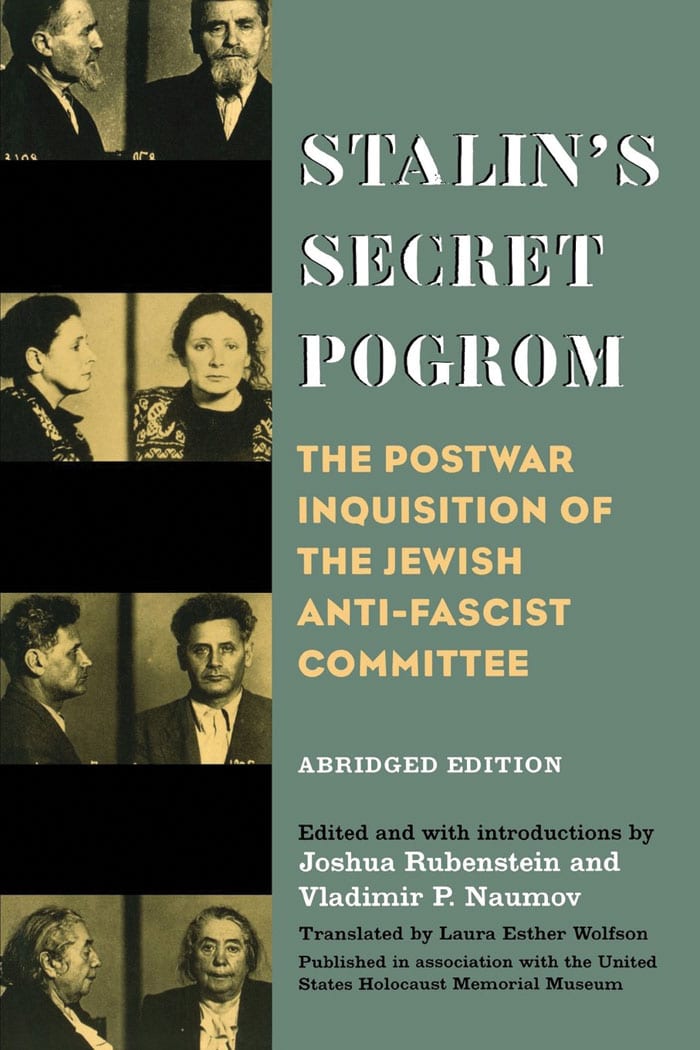
It just so happens that at the time this news breaks, I am reading “Stalin’s Secret Pogrom,” edited by Joshua Rubenstein and Vladimir P. Naumov. The book is a compilation of transcripts from the 1952 show-trial of 15 Jews involved in the Jewish Anti-Fascist Committee, a group organized by Joseph Stalin himself to broadcast the richness of Soviet Jewish culture to the rest of the world. The 15 Jews, five of whom were prominent authors and poets, were accused of Zionist conspiracies against the Soviet Union, treason, and espionage. Though they were loyal citizens and in fact patriots, their mother country, with scant evidence, executed 13 of them, exiled one, and let the remaining Jew die in prison. This horrific event is known today as “The Night of the Murdered Poets.”

There is more in common between The Night of The Murdered Poets and Russia’s decision to close the Jewish Agency than you may think. 

There is more in common between The Night of The Murdered Poets and Russia’s decision to close the Jewish Agency than you may think. Both events, though the latter is (for now) not as gruesome, represent a tradition in Russian culture that extends even before the ousting of the Romanov family. In times of crisis, be it in 1892 when most citizens lived in poverty, or in 1952 when the stage was being set for the Cold War with the United States, or in 2022 when international opinion turns on the Russians for their barbaric and criminal invasion of Ukraine, the Jews become objects of suspicion.

Many Jews today are aware that charges of “disloyalty” — accusations that Jews are more loyal to Israel or to the Jewish community than to their own nation — are antisemitic. What they may not know is that the society that put this trope on the map was indeed Russia. During tumultuous periods, the Kremlin has routinely spiraled into paranoia, and has routinely become convinced that by way of their particular language, culture, religion and homeland, the Jews are plotting to undermine Russian interests. The first institutions and organizations to be targeted are those that fly in the face of hegemony, where all Russians think and act the same. In 1892, it was the shtetl, in 1952 it was the Jewish Anti-Fascist Committee and the Moscow Yiddish Theatre, and in 2022 it is The Jewish Agency.

In 1892, it was the shtetl, in 1952 it was the Jewish Anti-Fascist Committee and the Moscow Yiddish Theatre, and in 2022 it is The Jewish Agency.

Being different, it would seem, is constantly perceived as a threat to Russian security. As long as Jews dare to be Jewish, we are a fifth column, guilty of treason, of espionage, of conspiracy, just from being ourselves. 

The man who knows this better than anyone is Natan Sharansky. In 1973, Sharansky was denied an exit visa from the Soviet Union to Israel on the pretenses that at one point he had received access to Soviet national security information, and therefore could not be permitted to acquire new citizenship. In other words, Russia used the same obtuse technicalities to trap Jews inside the country as they are using today. After years of advocating for fellow refuseniks, the KGB arrested and imprisoned Sharansky in 1977. In prison, he was subjected to solitary confinement, his health deteriorated, and he undertook multiple hunger strikes to protest the prohibition of his communication with the outside world. Sharansky understood then as he does today that the Soviets were not punishing him for supporting the existence of a country that was turning toward capitalism and democracy, but for publicly identifying himself as a Jew, and for his unequivocal insistence that Russian Jews were entitled to their human and national rights. 

Hebrew is more than a language. It represents the distinctness of the Jewish people, which is why the Soviets outlawed its use. Judaism is more than a faith. It represents the silent rebellion of the Jewish people against a godless society, which is why the Soviets shuttered countless synagogues and religious schools. Sharansky was more than a man. He represented Jewish particularism, the Jewish condition of not fitting in perfectly with the surrounding society, which is why the Soviets locked him up with every intention of throwing away the key. 

The Jewish Agency as it stands in Russia in 2022 is more than an organization that processes the paperwork of Jews who are looking to emigrate. It represents the idea that there is life outside of Russia as it barrels further down the path of illiberalism. It represents the longing to connect with one’s ethnic and religious identity. The Jewish Agency represents, as the 15 Jews of the Jewish Anti-Fascist Committee represented, as Sharansky represented, the truism that Jews will never be “just like any other Russian,” and therefore Russia has seized the opportunity to shut it down.


Blake Flayton is New Media Director and columnist for the Jewish Journal.

Russia’s Fifth Column Read More »

Rebuilding Together

I met a friend for coffee the other day in Tel Aviv. We hadn’t seen each other since before the pandemic, so it was especially nice to be together. He grew up in Jerusalem but recently moved to Zichron Ya’akov, a beautiful town overlooking the Mediterranean. My friend is a doctor who worked at Hadassah Hospital for many years and now is at Rambam Medical Center in Haifa.

We caught up on each other’s lives, talked about our families and our work, and shared how we each navigated the shutdowns, quarantines and disruptions of COVID. I asked him how he liked working in Haifa. He surprised me a bit by how he contrasted it with Jerusalem, a city in his words that was “built on hatred (b’nuyah b’sinah) between Arabs and Jews, secular and religious, Ashkenazim and Mizrachim, the political right and the political left. So much tension — every group hating the other.” By comparison, he continued, “Haifa has the same communities—people from all the same groups — but we get along so much better. The hatred just isn’t t8here.”

Our conversation was especially timely for this moment in the Jewish year, as we find ourselves in the period known as the “Three Weeks.” We commemorate the destruction of the Second Temple, which, according to the rabbis of the Talmud, was brought about by “senseless hatred” (sinat chinam). Jews during that time were split into a number of factions whose antipathy toward one another, the rabbis taught, led to the destruction of Jerusalem.

Almost two millennia have passed since the Temple was destroyed. We’ve experienced destruction and loss the likes of which our ancestors could hardly have imagined: inquisitions, pogroms and the ultimate darkness of the Shoah. After what we’ve been through together, after everything we’ve seen, one would hope that we’d finally learned our lesson, that we’d figured out how to get along, to embrace and even celebrate our differences so that we might love one another fully. 

A few weeks ago, I wrote about an incident at the Kotel that illustrates painfully how little has changed, how much more work must be done.

The classic teaching in our tradition about how to overcome senseless hatred was best articulated by Rabbi Abraham Isaac Kook (1865-1935), the first Ashkenazi Chief Rabbi of Mandatory Palestine. He wrote, “If senseless hatred is what destroyed us, we must rebuild the world through ‘senseless love.’” 

For Rabbi Kook, “senseless love” or “love without reason,” was the act of caring for and loving our fellow Jews not because they did something special to deserve it, or because of some reward or recompense, but simply because they exist, because they are part of our extended family, part of Am Yisrael—our people. Our love is born of a common history, the chapters of the human story that are uniquely ours. And, to be sure, our love is connected to a shared destiny. Whatever the world has in store for the Jewish People — the good and the bad, the ridiculous and the sublime — we all will be touched by it, and we all will benefit or suffer from it, whether we like it or not, together.

We grew up speaking different languages, eating different foods, and learning different nursery rhymes. Now we are friends. His story is part of my story and my life is richer because of him. 

My friend and I are about the same age but there is much that would seem to divide us. He grew up in Jerusalem. I was raised in Omaha. His family emigrated to Israel in the early-20th century from Morocco. Mine came to America around the same time from various parts of Eastern Europe. We grew up speaking different languages, eating different foods, and learning different nursery rhymes. Now we are friends. His story is part of my story and my life is richer because of him.

“I don’t know,” my friend said with a smile, “maybe part of the reason we get along in Haifa is the sea. You look out over the water and you feel a sense of peace, a sense of calm.”

I’m not sure how we get there, but these days remind me that we had better find ways to love each other more, accept each other more, and embrace our differences so that we can rebuild our world together.


Rabbi Yoshi Zweiback is the Senior Rabbi of Stephen Wise Temple in Los Angeles, California.

Rebuilding Together Read More »