fbpx

July 14, 2022

A Moment in Time: Shabbat Spice

Dear all,

There’s an ingredient we love to use each week when preparing our Shabbat dinner. You can’t find it at the supermarket or at the boutique eateries or online.

It’s a special ingredient called “Shabbat spice,” and it adds incredible layers to our Shabbat experience.

Shabbat spice appears whenever we prepare together.

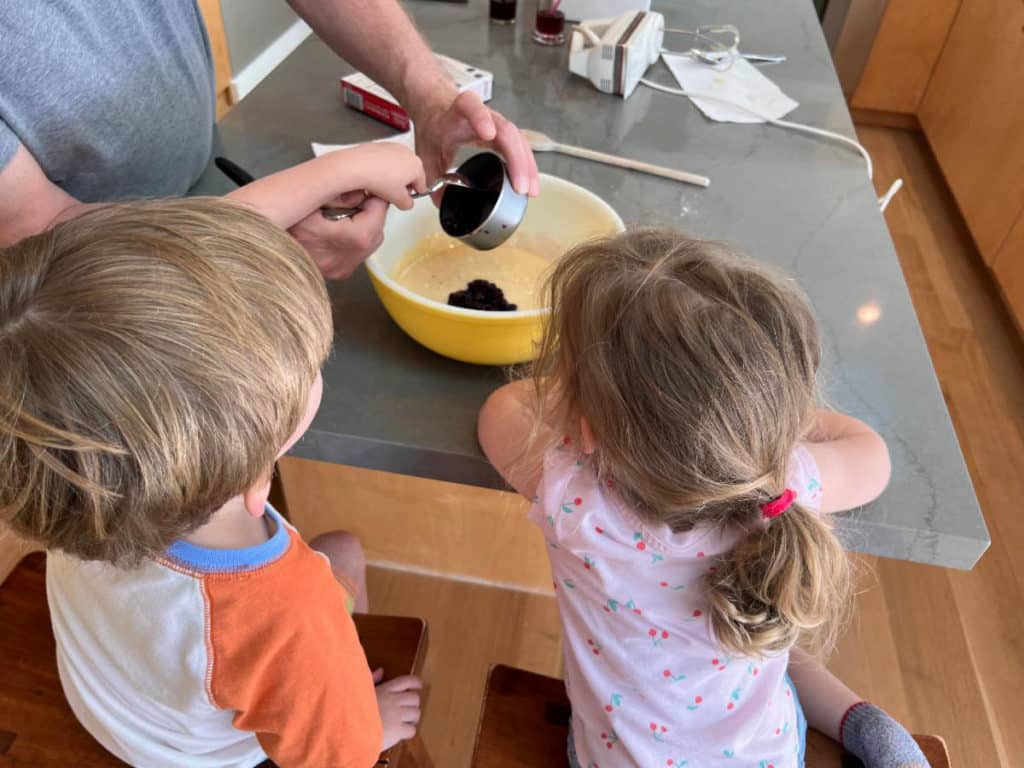
While our household has eight hands, you might be in a home on your own. You can still add Shabbat spice by putting out photos, video-chatting a friend, or utilizing a family heirloom.

Adding Shabbat spice each week creates a sacred moment in time to transform the ordinary into the holy! How will you add Shabbat spice this week?

With love and Shalom,

Rabbi Zach Shapiro

A Moment in Time: Shabbat Spice Read More »

A Bisl Torah – Get What You Need

This week, our family spent a few hours at the beach. As we made our way to the sand, a woman was entertaining those on the boardwalk, singing lyrics from The Rolling Stones:

“You can’t always get what you want
But if you try sometimes you just might find
You just might find
You get what you need.…”

Her voice wasn’t melodic. But she was passionate. Exuberant. Raspy and intriguing. I approached the woman and she explained that her singing supports those impacted by domestic violence. And in between each song she reminded her listeners to be grateful for today. Aligned with lyrics by The Rolling Stones, she was asking listeners to see today as an opening in finding what you need. That today might be an answer you weren’t necessarily considering.

Daily, we concentrate on what we want. Mixing up wants with needs. Do we need more material things, or do we want more material things? Do we need more recognition, or do we want more recognition? Do we need to go away on vacation, or do we want to go away on vacation? Differentiating wants and needs doesn’t negate the importance of a “want”. A “want” may enhance one’s quality of life. But a need is defined as something we cannot live without. Something essential.

Identifying one’s needs may lead to a more nuanced appreciation of the wants. What do you really need?

Jewish practice encourages such reflection. Each morning, we rub the slumber from our eyes and offer blessings, thanking our Creator for the ability to wake up, meet the day with renewed vigor, and see the day as a gift. Blessings that shape “today” as an opportunity not to waste.

As you wake up and contemplate your wants, start with today. Thank God for today. You may find that in that recognition, today is exactly what you need.

An answer worth accepting.

Shabbat Shalom


Rabbi Nicole Guzik is a rabbi at Sinai Temple. She can be reached at her Facebook page at Rabbi Nicole Guzik or on Instagram @rabbiguzik. For more writings, visit Rabbi Guzik’s blog section from Sinai Temple’s website.

A Bisl Torah – Get What You Need Read More »

Emotionally Incoherent at the Bully Pulpit

Emotionally incoherent,
they failed with filial disobedience
by showing less to God, their Parent

than to a Golden Calf allegiance,

behaving bovine in confusion,
looking darkly through a glass,
illuminated by illusion,

turning from epiphany to farce.

Faced by a golden calf that towered
just as a tower had in Babel,
Moses never anger showered,

destroying it, and not the rabble,

emotionally, in the process,
of control of damage in-
tellectually coherent, Moses

prevented harm caused by their sin.

Yet at Meribah, Moses was
not intellectually coherent,
blown by belligerence because

he was emotionally aberrant,

inappropriately angry
with followers whom he would mock
hitting a non-tangere

Meribah microphonic rock.

Abuse of Jews became the cause
of his dismissal, less coherent
than at the Golden Calf, because

to anger he became adherent,

not using as a microphone
the rock, condemned by God as culprit
for, with an unbullish, bearish tone

speaking from his bully pulpit.

Expressing anger thus to Jews
was implicitly forbidden,
In anger spoken, a “J’accuse”

caused Moses by God to be smitten.

Rabbi Jonathan Sacks, in an article called “Anger Management”, suggested that Moses’ fatal flaw was lack of emotional intelligence, which caused him to succumb to anger at Meribah (Num. 20:10-1) where he suffered from the same emotional incoherence that caused the Israelites to worship the Golden Calf. In his article, Rabbi Sacks cites what Maimonides wrote in Shemoneh Perakim, the “Eight Chapters” that form the preface to his commentary to the Mishnah, Tractate Avot, the Ethics of the Fathers:

In the course of these chapters Maimonides sets out a surprisingly contemporary account of Judaism as a training in emotional intelligence. Healthy emotions are essential to a good and happy life, but temperament is not something we choose. Some people just happen to be more patient or calm or generous-spirited or optimistic than others. Emotions were at one stage called the “passions,” a word that comes from the same root as “passive,” implying that they are feelings that happen to us rather than reactions we choose. Despite this, Maimonides believed that with sufficient training it is possible for us to overcome our destructive emotions and reconfigure our affective life.

Gershon Hepner is a poet who has written over 25,000 poems on subjects ranging from music to literature, politics to Torah. He grew up in England and moved to Los Angeles in 1976. Using his varied interests and experiences, he has authored dozens of papers in medical and academic journals, and authored “Legal Friction: Law, Narrative, and Identity Politics in Biblical Israel.” He can be reached at gershonhepner@gmail.com.

Emotionally Incoherent at the Bully Pulpit Read More »

The Great Unsend Button in the Sky – A poem for Parsha Balak

How can I curse whom God has not cursed…?
-Numbers 23:8

In the old days when God was
happening upon people by chance
all the time, there was no need for

an unsend button as all we could
ever do is say whatever had been
put into our mouths.

Can you imagine if just before you sent
an angry message, a Holy Voice appeared
in your ear saying don’t.

What about all the passive-aggressive
emails you’ve been sending?
We have grammar and spelling checkers.

How about a can you check your tone filter?
We all know the story of the Rabbi
who told the man to scatter

a pillow’s feathers all over town
and then learned of the impossibility
of gathering them back up when

he was told to do so.
This is how it is with words.
Once they leave your mouth

like the internet, they are forever.
I’d like to take back the typos
in all my poems, but they are

seared into the memory of my
eagle-eyed readers. I could use a
Yom Kippur in the middle of the year

to atone for the accumulation of
things I’ve thought. May all the words
that pass through your lips

be vetted by the God of common sense.
May your thoughts always default
to blessings. Never curses.


God Wrestler: a poem for every Torah Portion by Rick LupertLos Angeles poet Rick Lupert created the Poetry Super Highway (an online publication and resource for poets), and hosted the Cobalt Cafe weekly poetry reading for almost 21 years. He’s authored 25 collections of poetry, including “God Wrestler: A Poem for Every Torah Portion“, “I’m a Jew, Are You” (Jewish themed poems) and “Feeding Holy Cats” (Poetry written while a staff member on the first Birthright Israel trip), and most recently “The Tokyo-Van Nuys Express” (Poems written in Japan – Ain’t Got No Press, August 2020) and edited the anthologies “Ekphrastia Gone Wild”, “A Poet’s Haggadah”, and “The Night Goes on All Night.” He writes the daily web comic “Cat and Banana” with fellow Los Angeles poet Brendan Constantine. He’s widely published and reads his poetry wherever they let him.

The Great Unsend Button in the Sky – A poem for Parsha Balak Read More »

LA Family Dedicates Petting Zoo in Israel in Memory of Daughter

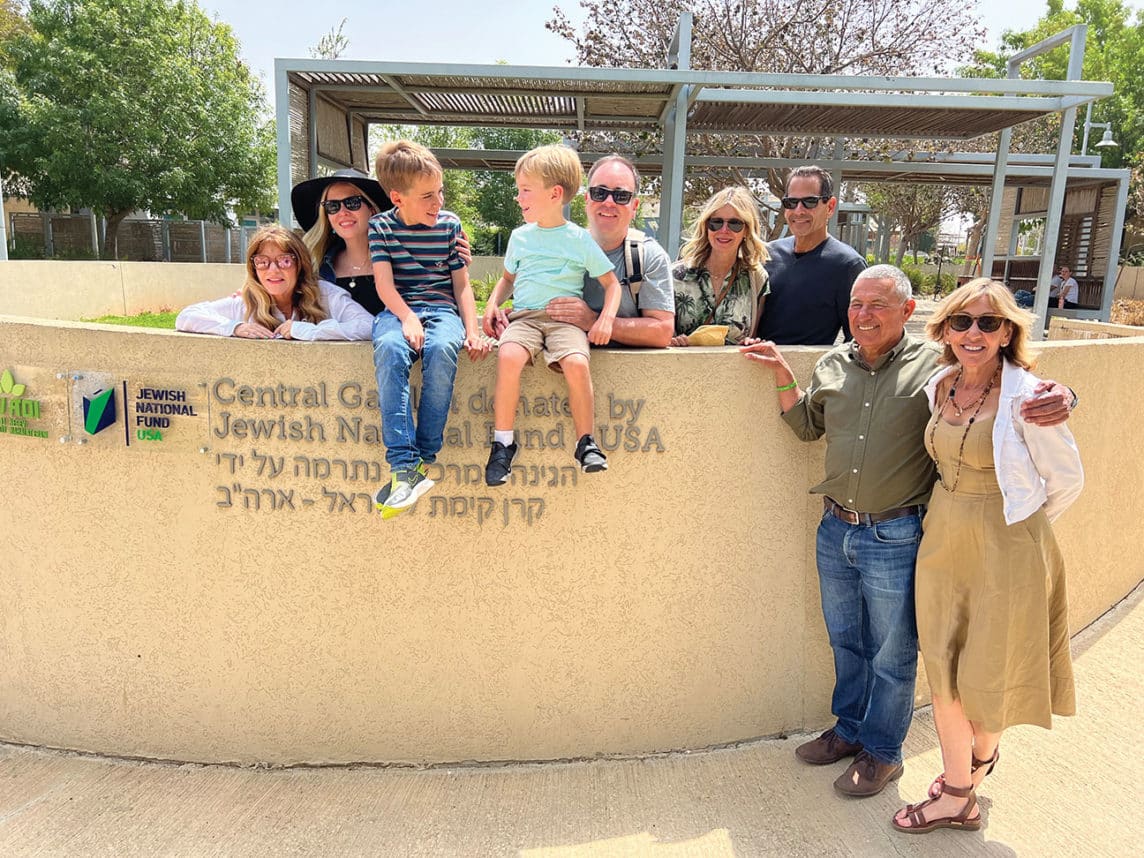
In January of last year, Jonathan and Kaye Steinsapir received devastating news. Their 12-year-old daughter, Molly, was riding her bike down a hill, with her helmet on, when she got into an accident and suffered from a traumatic brain injury. 

The family (Jonathan, a prominent lawyer, Kaye and their two young sons), started posting about Molly while she was in the hospital. Her story reached far and wide; it was followed byhundreds of thousands of people on social media. People magazine wrote an article about it. Actor Mark Hamill showed his support, posting, “Sending all our love to Molly!”

Just a few weeks after the accident, Molly passed away from her injuries. Now, with the help of Jewish National Fund-USA, the Steinsapirs have dedicated a therapeutic petting zoo in honor of Molly at ADI Negev-Nahalat Eran, a rehabilitation village in southern Israel that serves both children and adults with complex medical conditions and disabilities.

“It was Molly’s aunt, Polly Levine, who had the idea within a day or two after Molly’s passing, when she spoke with a friend of hers at JNF,” said Kaye. “As Polly knew, Molly was very passionate about animals.”

Molly Steinsapir

Molly became a vegetarian when she was four or five years old, even though no one else in her family kept a vegetarian diet. Kaye believes that Molly inherited a love of animals from her maternal great-grandparent, Dr. Paul Chaffee, who was the director of the Fresno Zoo. 

“The petting zoo is in a village created for special needs children, and Molly had a very unique bond with special needs children, including an autistic, largely non-verbal boy in her third-grade class,” said Kaye. “When he needed to be calmed, the teacher and the boy’s aide would always have Molly help them – so much so that we became concerned when Molly kept missing math lessons because she was outside helping with the boy.”

JNF-USA National Campaign Director Deb Rochford helped coordinate the petting zoo dedication for the Steinsapirs. 

“For residents to experience unconditional love, free of judgment, from the animals is incredibly healing,” said Rochford. “In return, the opportunity for patients at ADI Negev to provide care and love to the animals, to hold responsibility for the well-being of another living creature, is immensely therapeutic. It’s a mutual relationship that contributes to creating a rich and full life for ADI Negev’s residents.”

The petting zoo has another purpose: to introduce innovative programming to ADI and better serve its residents.  

“If one person can get peace of mind for a minute from just enjoying the petting zoo, that is enough.”
– Kaye Steinsapir

“The existence of the zoo serves the larger mission of pushing the envelope on what it means to provide holistic care,” said Rochford. “People come from all over the world to learn from ADI Negev, so therapeutic tools like the zoo help people with disabilities around the world enjoy a higher quality of life and change perceptions of what residential care can look like.”

The Steinsapir family with Doron Almog at the petting zoo

Maj. Gen. (Ret.) Doron Almog, the founder of ADI-Negev, emphasized at the dedication ceremony how the Steinsapirs are carrying on their daughter’s legacy. 

“[The family was] enamored with the relationship between our residents and the therapy animals here [and] how the ‘weak’ become strong when caring for the animals,” he said. “They said it seemed like something that Molly would have loved.”

In addition to dedicating the petting zoo and raising funds to ADI-Negev, the Steinsapir family has established a Molly Steinsapir Foundation to support other causes and perform tikkun olam. They encourage people to say a prayer for Molly; her Hebrew name is Miri Hannah bat Rahmi’el v Havah.

With the petting zoo, Kaye hopes that people will have meaningful experiences when they get a chance to visit. 

“If one person can get peace of mind for a minute from just enjoying the petting zoo, that is enough,” she said. “If many people can, that is all the better.”

LA Family Dedicates Petting Zoo in Israel in Memory of Daughter Read More »

Print Issue: Hollywood and Israel | Jul 15, 2022

CLICK HERE FOR FULLSCREEN VERSION

Print Issue: Hollywood and Israel | Jul 15, 2022 Read More »

Table for Five: Balak

One verse, five voices. Edited by Salvador Litvak, the Accidental Talmudist

The Lord opened the mouth of the she-donkey, and she said to Balaam, “What have I done to you that you have struck me these three times?”

– Num. 22:28


Batsheva Frankel
Education consultant at New Lens Ed, host of Overthrowing Education podcast

According to the Slonimer Rebbe there are two main elements to living as a Jew – emunah (faith) and kedusha (holiness). Balaam’s goal was to break the connection between the Children of Israel and G-D by trying to destroy our faith and holiness. 

These last few years have been so challenging. In addition to the world’s sufferings, we Jews have watched antisemitism grow like weeds everywhere. This often attacks our emunah. What does G-D want from us? How did we get to this divisive place? What is wrong with this world? And on and on. As Jews turn on each other, is our holiness compromised? 

How in this trying time do we increase our emunah and kedusha levels? It’s all about the donkey! The donkey is like our yetzer tov (good inclination); Balaam is like our yetzer hara (evil inclination). Our “Balaam” leads us to narrow places. Our “Donkey” sees and senses the danger and evil ahead. The donkey tries to lead in the right direction and avoid evil, but the evil inclination is strong and often “beats” the good inclination. Finally, the Donkey (aka yetzer tov), asserts itself (in one of the coolest miracles in the Torah!), “Why are you doing this to me? Can’t you see the danger? Then G-D opens Balaam’s eyes so he can see the danger. We, too, have to assert our donkey, allow our inner-Balaam to see, seek out positive ways, and move towards blessings.


Rabbi Elchanan Shoff
Beis Knesses of Los Angeles

Balaam was hired to curse an entire nation. He was assumed to have the capacity to use the power of speech to decimate a massive people. And yet when it came to his own donkey, he resorted to physical violence! 

He highlights his helplessness by exclaiming, “if only I had a sword, I’d kill you!” Our sages (Tanchuma, 9) depict how absurd Balaam looked in the eyes of his entourage of noblemen – the man hired to utterly destroy a nation was rendered impotent by a mere donkey. The Talmud similarly remarks, “could Balaam really be described as ‘knowing the thoughts of the Most High’ when he could hardly divine the motivations of his own donkey?!” 

That Talmud tells us that Balaam did not actually have great knowledge of God’s thoughts, but he was skilled at inciting God’s anger upon others. One who can understand other beings is a compassionate person, for even when confronted with the shortcomings of others, he can see the broader picture and find it in his heart to look at them kindly. This was not the case for Balaam. Living in a world of rhetoric and words, his impact was in painting a picture completely unsympathetic and unbending. He exposed the flaws of others, and held them up to God, asking for retribution. Rhetoric can destroy. It can tear a nation apart. Pay no heed to voices proclaiming the evil of those to your left or right. 


Ben Elterman
Screenwriter, Essayist, Speech Writer at Mitzvahspeeches.com

Balaam’s response to his donkey’s spontaneous argument was, “If I had a sword in my hand I would kill you now.” According to the Midrash, Balaam’s donkey countered, “You cannot kill me without a sword, yet you are going to wipe out the Jewish nation with only words?” 

Depending on which commentary you read, his donkey’s speech may or may not have been shocking to Balaam. However, to the men from Moav that accompanied them, it was certainly a miracle. And from it, they understood the absurdity the donkey was pointing out; Balaam was a fraud and his promised curses weren’t going to work. 

I think the point Torah is making is that a fraud may be able to assume a position of honor for a while. But as the adage goes, “You can fool all the people some of the time and some of the people all the time, but you cannot fool all the people all the time.” Sooner or later, the seemingly insignificant details are going to add up. The Midrashic argument between Balaam and the donkey continues (the details of which I will let you look up for yourself). The point is, the donkey refutes each of Balaam’s rationalizations with a more embarrassing exposure. 

Balaam should have quit then and there. But he was as stubborn as the donkey he rode and ended up proving he was a fraud in front of an even larger audience by failing to perform his hired task.


Nina Litvak
AccidentalTalmudist.Org

The Midrash teaches that Balaam’s donkey talks to show her master that “the tongue and mouth (speech) are entirely in God’s hands.” It is a warning to Balaam that his attempts to curse the Jews will fail. Unlike the Jewish prophet Moses, the gentile prophet Balaam is arrogant, crediting himself for prophecy rather than God. Being rebuked by his own donkey is a humbling experience that empties Balaam of ego so that he can transmit God’s message. The Lubavitcher Rebbe teaches that this bizarre episode is actually a preparation for the Messianic Age, when “the earth shall be filled with awe for the glory of the Lord as water covers the sea” (Habakkuk 2:14). Just as the arch Jew-hater Balaam blesses the Jews, so too will all creation acknowledge us as God’s messengers.

Only twice in the Torah does a non-human animal speak: the serpent who tempts Eve, and Balaam’s donkey. In neither case does the animal benefit; they don’t use their new power of speech to plead for food or safety. Rather, God places the words in their mouth, just as God provides humans with the ability to speak. As Sforno points out, before praying we ask “O Lord please open my lips.” If the words God puts into the mouth of a dumb animal are so powerful, how much more powerful are words that God puts into our human lips. Imagine what we can accomplish if God opens our lips. And all we have to do is ask.


Rabbi Jason Weiner
Cedars-Sinai 

Did a she-donkey actually speak in human words to Balaam, or is there a deeper message here? Some point out that the root of the Hebrew word for speaking, daber, never appears in relation to this donkey. 

Furthermore, it seems to me that this episode describes a much larger issue concerning the Divine response to suffering and injustice. What did this simple she-donkey do to deserve mistreatment? Nothing. And when such injustice occurs, God can endow the victim with increased abilities to overcome the oppressor. 

As King Solomon wisely states, “God seeks those who are pursued” (Ecclesiastes 3:15). In light of this Jewish theological foundation, “The Lord opened the mouth…” can be understood to mean that Balaam’s wicked behavior was an affront to God, who instructs us to interact at all times in a kind and compassionate manner. Such an affront automatically initiates a response from God. The Torah reflects this fundamental reality by suggesting that the she-donkey cried out against Balaam’s cruelty, so that her suffering, and this injustice, became obvious even to Balaam. 

That cry is expressed every time injustice occurs. Our challenge today is to be sensitive and listen carefully for the cries of the oppressed, whenever and wherever they might be expressed, and respond. By doing so, we will be heeding God’s continuing call to action against cruelty and injustice. 

Table for Five: Balak Read More »

Biden Says Dem Anti-Israel Voices Are “Few” and “Wrong”

President Joe Biden said during a July 13 interview with Israel’s Channel 12 that the anti-Israel voices in the Democratic Party are “few” and “wrong.”

Channel 12 news anchor Yonit Levi told Biden that some in “Democratic Party circles” view Israel as an apartheid state and have called for ending unconditional military aid to the Jewish state. “There is an undeniable gap between you and those voices,” Levi said.

Biden replied: “There are a few of them. I think they’re wrong. I think they’re making a mistake. Israel is a democracy. Israel is our ally. Israel is a friend.” He proceeded to tout his administration’s efforts in providing $4 billion in aid to Israel plus an additional billion dollars in military aid and they’re working with Israel on developing a “laser project” to replace the Iron Dome. Biden said it was in the United States’ interests to ensure Israel’s stability.

Levi then asked if there should be concerns over the future of Israel and the Democrat Party if even Iron Dome interceptors are considered “controversial.” “No,” Biden responded.

Jewish groups praised Biden’s comments.

“Thank you, @POTUS for this unequivocal statement and reassurance that, despite those who seek to distance the U.S. from its longstanding ally, we will never abandon the Jewish state,” Anti-Defamation League CEO Jonathan Greenblatt tweeted.

AIPAC similarly thanked Biden. “We are proud to champion bipartisan support for the U.S.-Israel relationship. Ensuring both parties stand with our democratic ally Israel advances America’s interests and saves lives.”

Conservative radio host Hugh Hewitt also praised Biden in a tweet, but added that he wished that Biden would stop trying to revive the 2015 Iran nuclear deal.

The Iran deal was also discussed in Biden’s interview with Levi. “I think the previous president made a huge mistake when he left the agreement, Iran is now closer to developing nuclear weapons than it used to be,” Biden said, adding that “we can act against them and still reach an agreement that will curb the nuclear program.” However, he pledged during the interview that he would not remove the Iran’s Revolutionary Guard Corps from the foreign terror organization list.

Biden is currently in Israel for the next couple of days and will fly to Saudi Arabia on July 15.

Biden Says Dem Anti-Israel Voices Are “Few” and “Wrong” Read More »

Why Uvalde is the Mass Shooting that Will Never Go Away

One of the tragic aspects of mass shootings is that they survive only as brand names connected to the horror of guns. Since gun violence, and the mindset of the shooters, are the topics that dominate the  aftermath of these events, mass shootings tend to blur into one another, going through the revolving door of news cycles. All that remains are indelible brands of darkness—Columbine, Sandy Hook, Parkland, and so on.

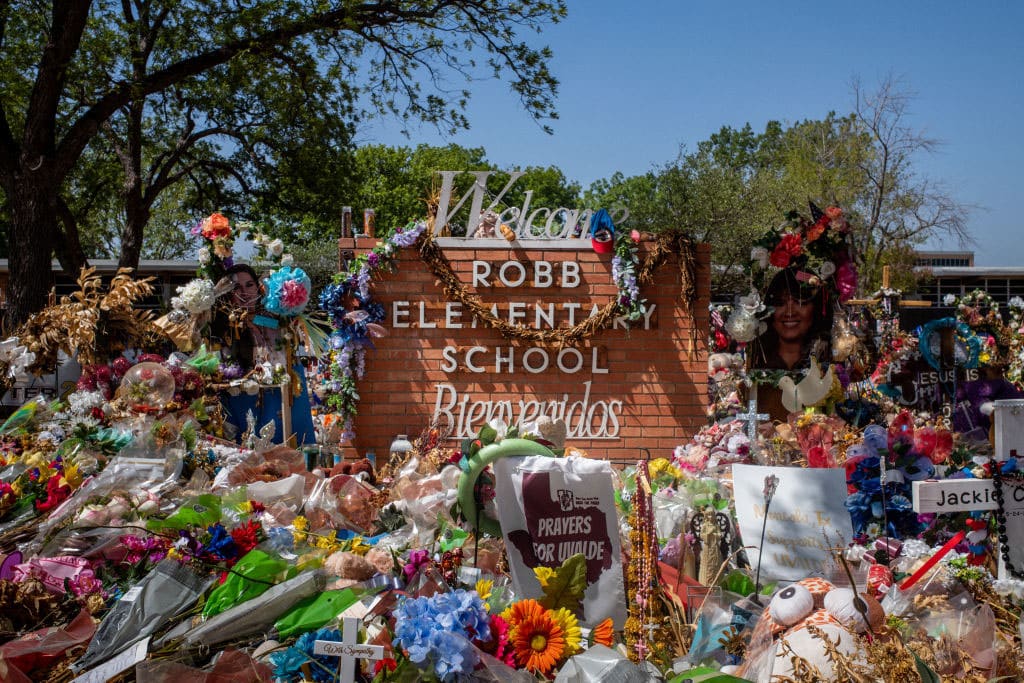
Uvalde is different. Nearly two months after the May 24 massacre, it is still very much in the news.

In large part, that’s because Uvalde doesn’t just signify the nightmare of a shooting act, but also the gross incompetence of law enforcement. This failure, moreover, is especially noteworthy because it’s connected to fear. We don’t usually associate law enforcement with fear or timidity. The typical criticism is that police are too aggressive, not too restrained.

And yet, the evidence that keeps dribbling out since May 24 leads only to that embarrassing conclusion—those sworn to protect us thought of protecting themselves first.

The latest shoe to drop is the release on Tuesday of surveillancevideo that gives the clearest account yet of how a crowd of officers waited 77 minutes outside a Robb Elementary classroom as the gunman killed 21 students and teachers.

The video is hard to watch. You see officers approaching the door of the classroom within minutes of the shooter entering, and then retreating after they hear gun shots. To spare the viewer more agony, the screams of students are edited out.

Finally, after more than an hour, the doorway of the classroom is breached and the gunman shot and killed.

So much anger has been unleashed, mostly from grieving parents and family members, that Uvalde will be in the news for many months to come. We can expect more investigations and more reports as people demand full transparency. “Who was in charge?” will surely be a key question.

Regardless of who was most responsible, the essential truth is already out, captured succinctly by Uvalde County Commissioner Ronald Garza: “They just didn’t act. They just didn’t move,” he told CNN on Wednesday. “I just don’t know what was going through those policemen’s minds that tragic day, but … there was just no action on their part.”

This is an astonishing admission. An act of violent aggression associated with police timidity.

This is an astonishing admission. An act of violent aggression associated with police timidity. It doesn’t matter if it’s an outlier—the mere idea of police timidity is indelible enough. In Uvalde we have a horrific event that embodies two opposite trends of American society: over-the-top violence and over-the-top fear.

What makes Uvalde unforgettable is that the fear came from those who are supposed to shield us from it.

Why Uvalde is the Mass Shooting that Will Never Go Away Read More »

Barcelona Dreaming— Kosher Chicken Paella

If you have ever toured Barcelona, you know that the city is all about the sparkling blue sea and bustling port, the whimsically quirky Gaudi architecture and the grand medieval architecture of the Barcelona Cathedral, the art of the surrealist Joan Miro and the incomparable modern master Pablo Picasso. 

Of course, if you are Jewish and visiting Barcelona, it’s a slightly different city. You are aware that the towering hill with the breathtaking view over the entire city is called Montjuïc. This “Jewish Hill” that is the site of the Olympic Stadium, museums and parks also holds the remains of a medieval Jewish cemetery. 

The crumbling, yet still beautiful ruins that make up the Ancient Synagogue in Barcelona date back to Roman times. The synagogue is still in use on Shabbat, but what used to be the women’s section houses a pizzeria (the owners refuse to sell the land to the Jewish community). The ceilings are impossibly low because the Catholic Church issued an edict that no synagogue could be built taller than the smallest church.

You are haunted by the memory that the thriving Jewish community of Spain ended with the expulsion edict. You know that the Jews who chose to remain as conversos were cruelly pursued and persecuted by the Spanish Inquisition. To the utter embarrassment of my children, I cried in the synagogue for the suffering of the Jewish people. 

(Family legend has it that my husband’s family were originally from Spain and their name was Gomes y Peres. When they went to Amsterdam, the name was changed to Gompertz and anglicized to Gomperts when they emigrated to London. DNA testing proved that 3% of the family DNA is from the Iberian Peninsula.)

When you are Jewish and visit Barcelona, you attend services at the Synagogue of Barcelona, a three-storied community center. On Shabbat, you feast at the Chabad of Barcelona with 250 Jews from all over the world. 

And then there’s Maccabi Restaurant, on the main promenade in town. We ate there as many times as we could. The Mediterranean food and tapas menu were so delicious! Housed in a building that dates from the 17th century, the restaurant has three different floors with narrow staircases and brick walls hung with old art. 

Four years after our summer visit to Barcelona, my girls still reminisce about their flavorful and luscious paellas. 

—Sharon 

After the expulsion from Spain, my family found refuge in Morocco. They joined a community so ancient that scholars cannot agree whether they arrived after the destruction of the First or Second Temple or on the boats of Phoenician traders. There is even a theory that some Moroccans descend from indigenous Berbers who converted to Judaism. 

For generations, my ancestors flourished in the bustling port city of Larache, on the northwestern coast of Morocco. My mother came from a family of rabbis. In 1954, a circle of history was closed when my uncle Rabbi Salomon Bensabat was called to serve in the newly built Synagogue of Barcelona. The legacy of our years in Morocco includes our wealth of Jewish tradition, language and song and my mother’s recipes.

One of our family favorites is Arroz con Pollo, a classic Spanish chicken and rice recipe. 

Like the famous Spanish paella, the rice is subtly infused with the flavors of the spices and tomatoes. But unlike paella, no shellfish or pork sausage feature in the ingredients, making it perfect for the Jewish home. So we improvised my Arroz recipe to create a simple paella recipe to satisfy Sharon’s daughters and everyone else!

Like the famous Spanish paella, the rice is subtly infused with the flavors of the spices and tomatoes. 

The trick to a flavorful skillet meal is to sear the chicken till it is lightly browned, ensuring that the juices are sealed in. The onions and vegetables are gently sautéed and the rice is glazed until golden. Diced tomatoes and liquids are added to cover the rice and then the chicken is gently nestled in the skillet. The steaming process softens the rice and fuses the flavors making for a one skillet wonder.

Saffron and paprika are the trademark spices of this dish, lending sweet, floral, earthy and complex flavor. (Nowadays, even Trader Joe’s sells an affordable, quality saffron, an indispensable ingredient in the Sephardic kitchen.) 

—Rachel

A Kosher Chicken Paella

6 tablespoons olive oil, divided

1 chicken, cut into 8 pieces

1 large onion, diced

2 garlic cloves, finely diced

1 cup finely sliced celery

1 red bell pepper, diced 

1 cup short grain or Arborio rice, rinsed
     and drained

1 1/2 cups saffron water  (see note)

1 8 oz. can diced tomatoes

1 can of baby artichoke hearts

10 oz. cherry tomatoes, halved

2 teaspoons paprika

1 teaspoon salt

1 teaspoon pepper

1. Sear chicken in 3 tablespoons of olive oil over medium heat till lightly browned, about 5 minutes each side, then set aside.

2. Sauté onion in the remaining olive oil till it becomes translucent.

3. Add garlic, celery and pepper until the vegetables are lightly glazed.

4. Add rice and saffron water and bring to a boil.

5. Stir till the rice has a golden color and reduce heat.

6. Add the canned tomatoes, cherry tomatoes, artichoke hearts, paprika, salt and pepper. Stir well.

7. Nestle the chicken pieces into the rice.

8. If rice appears too dry, add a little water.

9. Cover tightly and simmer for twenty minutes.

10. Turn off the heat and let sit for ten minutes.

11. Fluff with a fork and serve.

(Note: Saffron water can be found in Persian and Kosher markets. To make at home, steep a generous pinch of saffron in 1 1/2 cups warm water or broth for 20 minutes.) 


Sharon Gomperts and Rachel Emquies Sheff have been friends since high school. The Sephardic Spice Girls project has grown from their collaboration on events for the Sephardic Educational Center in Jerusalem. Follow them on Instagram @sephardicspicegirls and on Facebook at Sephardic Spice SEC Food. Website sephardicspicegirls.com/full-recipes

Barcelona Dreaming— Kosher Chicken Paella Read More »