If you have ever toured Barcelona, you know that the city is all about the sparkling blue sea and bustling port, the whimsically quirky Gaudi architecture and the grand medieval architecture of the Barcelona Cathedral, the art of the surrealist Joan Miro and the incomparable modern master Pablo Picasso.
Of course, if you are Jewish and visiting Barcelona, it’s a slightly different city. You are aware that the towering hill with the breathtaking view over the entire city is called Montjuïc. This “Jewish Hill” that is the site of the Olympic Stadium, museums and parks also holds the remains of a medieval Jewish cemetery.
The crumbling, yet still beautiful ruins that make up the Ancient Synagogue in Barcelona date back to Roman times. The synagogue is still in use on Shabbat, but what used to be the women’s section houses a pizzeria (the owners refuse to sell the land to the Jewish community). The ceilings are impossibly low because the Catholic Church issued an edict that no synagogue could be built taller than the smallest church.
You are haunted by the memory that the thriving Jewish community of Spain ended with the expulsion edict. You know that the Jews who chose to remain as conversos were cruelly pursued and persecuted by the Spanish Inquisition. To the utter embarrassment of my children, I cried in the synagogue for the suffering of the Jewish people.
(Family legend has it that my husband’s family were originally from Spain and their name was Gomes y Peres. When they went to Amsterdam, the name was changed to Gompertz and anglicized to Gomperts when they emigrated to London. DNA testing proved that 3% of the family DNA is from the Iberian Peninsula.)
When you are Jewish and visit Barcelona, you attend services at the Synagogue of Barcelona, a three-storied community center. On Shabbat, you feast at the Chabad of Barcelona with 250 Jews from all over the world.
And then there’s Maccabi Restaurant, on the main promenade in town. We ate there as many times as we could. The Mediterranean food and tapas menu were so delicious! Housed in a building that dates from the 17th century, the restaurant has three different floors with narrow staircases and brick walls hung with old art.
Four years after our summer visit to Barcelona, my girls still reminisce about their flavorful and luscious paellas.
—Sharon
After the expulsion from Spain, my family found refuge in Morocco. They joined a community so ancient that scholars cannot agree whether they arrived after the destruction of the First or Second Temple or on the boats of Phoenician traders. There is even a theory that some Moroccans descend from indigenous Berbers who converted to Judaism.
For generations, my ancestors flourished in the bustling port city of Larache, on the northwestern coast of Morocco. My mother came from a family of rabbis. In 1954, a circle of history was closed when my uncle Rabbi Salomon Bensabat was called to serve in the newly built Synagogue of Barcelona. The legacy of our years in Morocco includes our wealth of Jewish tradition, language and song and my mother’s recipes.
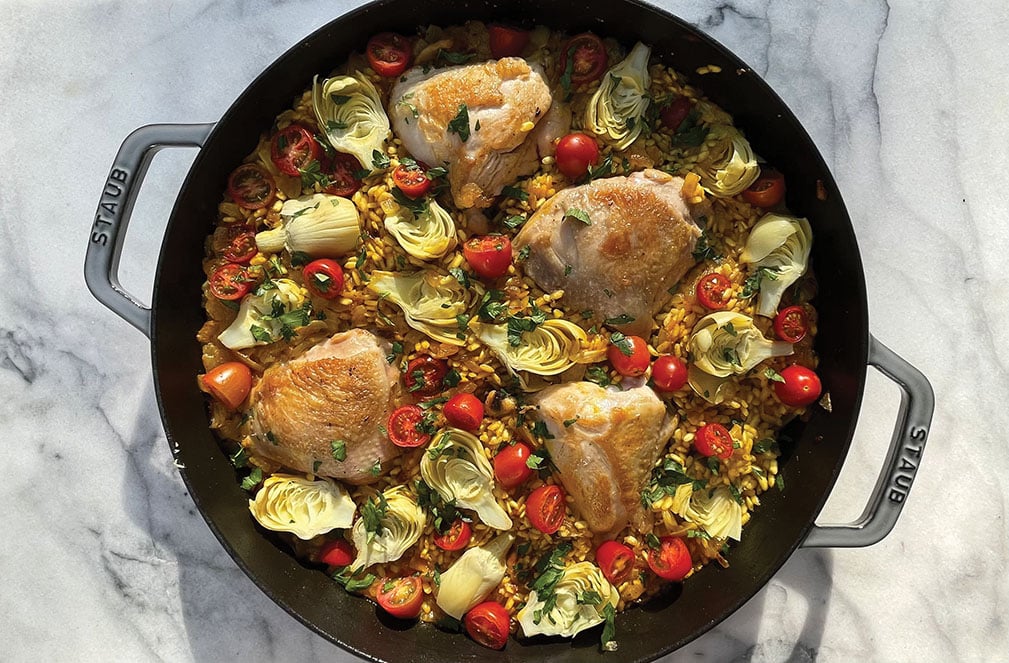
One of our family favorites is Arroz con Pollo, a classic Spanish chicken and rice recipe.
Like the famous Spanish paella, the rice is subtly infused with the flavors of the spices and tomatoes. But unlike paella, no shellfish or pork sausage feature in the ingredients, making it perfect for the Jewish home. So we improvised my Arroz recipe to create a simple paella recipe to satisfy Sharon’s daughters and everyone else!
Like the famous Spanish paella, the rice is subtly infused with the flavors of the spices and tomatoes.
The trick to a flavorful skillet meal is to sear the chicken till it is lightly browned, ensuring that the juices are sealed in. The onions and vegetables are gently sautéed and the rice is glazed until golden. Diced tomatoes and liquids are added to cover the rice and then the chicken is gently nestled in the skillet. The steaming process softens the rice and fuses the flavors making for a one skillet wonder.
Saffron and paprika are the trademark spices of this dish, lending sweet, floral, earthy and complex flavor. (Nowadays, even Trader Joe’s sells an affordable, quality saffron, an indispensable ingredient in the Sephardic kitchen.)
—Rachel
A Kosher Chicken Paella
6 tablespoons olive oil, divided
1 chicken, cut into 8 pieces
1 large onion, diced
2 garlic cloves, finely diced
1 cup finely sliced celery
1 red bell pepper, diced
1 cup short grain or Arborio rice, rinsed
and drained
1 1/2 cups saffron water (see note)
1 8 oz. can diced tomatoes
1 can of baby artichoke hearts
10 oz. cherry tomatoes, halved
2 teaspoons paprika
1 teaspoon salt
1 teaspoon pepper
1. Sear chicken in 3 tablespoons of olive oil over medium heat till lightly browned, about 5 minutes each side, then set aside.
2. Sauté onion in the remaining olive oil till it becomes translucent.
3. Add garlic, celery and pepper until the vegetables are lightly glazed.
4. Add rice and saffron water and bring to a boil.
5. Stir till the rice has a golden color and reduce heat.
6. Add the canned tomatoes, cherry tomatoes, artichoke hearts, paprika, salt and pepper. Stir well.
7. Nestle the chicken pieces into the rice.
8. If rice appears too dry, add a little water.
9. Cover tightly and simmer for twenty minutes.
10. Turn off the heat and let sit for ten minutes.
11. Fluff with a fork and serve.
(Note: Saffron water can be found in Persian and Kosher markets. To make at home, steep a generous pinch of saffron in 1 1/2 cups warm water or broth for 20 minutes.) ■
Sharon Gomperts and Rachel Emquies Sheff have been friends since high school. The Sephardic Spice Girls project has grown from their collaboration on events for the Sephardic Educational Center in Jerusalem. Follow them on Instagram @sephardicspicegirls and on Facebook at Sephardic Spice SEC Food. Website sephardicspicegirls.com/full-recipes