fbpx

June 30, 2022

It’s a Jewish Value to Study Both Sides

I received a note recently that the Book Club at East Side Jews was beginning a study of “The Hundred Years War on Palestine: A History of Settler Colonialism and Resistance, 1917—2017,” by Rashid Khalidi.

I wondered: Why would a Jewish group study a book written by a Palestinian who clearly takes the Palestinian side? Why would any group, for that matter, be interested in a book that plays up only one side of a long and complicated conflict?

It’s not as if they didn’t have an alternative. Yossi Klein Halevi’s “Letters to a Palestinian Neighbor,” for example, is a masterful effort to honor the divergent narratives of two peoples struggling for the same land. Halevi’s book doesn’t make you comfortable. It makes you think; it forces you to see both sides.

Khalidi’s book, by comparison, compels you to see only one side. It is a sophisticated yet predictable screed written by a Palestinian scholar with an obvious agenda.

But don’t take my word for it. In an incisive critique in the Jewish Review of Books, historian Benny Morris exposed the numerous distortions and biases in Khalidi’s book. I won’t list all of them here, but I’ll highlight what Morris considers the key flaw in the book—an attempt to force a progressive “colonialist” narrative on a nationalistic conflict.

“Khalidi’s bottom line,” Morris writes, “is that Zionism is a ‘colonialist’ enterprise, a doctrine enunciated in the Palestine National Charter of 1964. From this original sin stem all the evils of Zionism and all Palestinian suffering.”

But is Zionism a colonialist enterprise? Far from it.

“Colonialism is commonly defined as the policy and practice of an imperial power acquiring political control over another country, settling it with its sons, and exploiting it economically,” Morris writes.

By any objective standard, Zionism fails to fit this definition. As Morris explains:

“Zionism was a movement of desperate, idealistic Jews from Eastern and Central Europe bent on immigrating to a country that had once been populated and ruled by Jews, not ‘another’ country, and regaining sovereignty over it. The settlers were not the sons of an imperial power, and the settlement enterprise was never designed to politically or strategically serve an imperial mother country or economically exploit it on behalf of any empire.”

Morris goes on at length to debunk Khalidi’s central claim, which is featured prominently in the book’s title: “History of Settler Colonialism and Resistance, 1917–2017.” He even quotes Khalidi’s great-great-great-uncle Yusuf Diya al-Din Pasha al-Khalidi, a one-time mayor of Jerusalem and member of the Ottoman Parliament, who back on March 1, 1899 wrote to the founder of political Zionism, Theodor Herzl: “Who could contest the rights of the Jews in Palestine? My God, historically it is your country.”

To drive home his definition of Zionism as colonialism, Khalidi had to conveniently ignore crucial parts of Israel’s history. Did he realize how far he went to nullify Zionism’s national aspirations?

“At one point early on in the book,” Morris notes, “Khalidi grudgingly concedes that ‘there is no reason that what has happened in Palestine for over a century cannot be understood as both a colonial and a national conflict.’ But then he goes on to say that ‘our concern here is [with] its colonial nature’ and thereafter inundates the reader with rhetoric and ‘facts’ that point only to the ‘colonial’ nature of the Zionist-Arab conflict, driving from the reader’s mind any inkling that Zionism is a national movement and that the struggle has always been between two national movements, each with—as I see it—a rightful claim to the land.

“Indeed, Khalidi explicitly tells us that this is not a struggle between ‘two rights.’”

My point here is not to “prove” the Palestinian bias in Khalidi’s book. That is clear enough, as is the danger of perpetuating biases that keep us further and further away from reconciliation and conflict resolution. My point is that it’s a lot more interesting and useful to study the different sides of a conflict, especially one as complex and intractable as the Israel-Palestinian conflict.

The readers of Khalidi’s book will get little of that complexity. That’s a shame, because regardless of where one sits politically, appreciating complexity is a fundamental Jewish value.

Maybe once they finish Khalidi’s book, East Side Jews will feature a book on the conflict with more than one side.

It’s a Jewish Value to Study Both Sides Read More »

Beware the Woke Straws

I step up to the cash register to order my morning drug: my cup of coffee. Ahh, I think. I can’t wait to smell and taste that delightful beverage that has gotten me through daily life ever since I started drinking it when I was 14 years old.

The barista calls my name and order: “Large iced coffee! Kylie!”

“Thank you!” I say merrily. “May I have a straw please?”

The barista hands it to me. I unwrap it.

Oh no. It’s a paper straw.

I fall to my knees, look up to the ceiling and scream. Somehow, rain starts falling on me. Lightning strikes in the distance. 

Just kidding. What actually happens is I unwrap the straw, grumble when I see that it’s paper and begrudgingly place it into my coffee.

“Damn these woke straws,” I say under my breath.

The paper straws are indicative of the lunacy that’s happening in California lawmaking. While criminals are running rampant, homelessness encampments are taking over city sidewalks, inflation and gas prices are astronomical and housing prices are laughable, California’s choosing to focus on virtual signaling laws. 

We’re banning plastic straws and charging for plastic bags, making people ask for utensils and not automatically serving diners water anymore. We’re getting rid of gas leaf blowers and lawnmowers, restricting the sales of flavored tobacco products and requiring large department stores to use gender-neutral displays for children’s toothbrushes and toys. 

A few weeks ago, I woke up to a crime scene on my block – a block where a teardown starter home is $1.6 million. It turns out that dozens of cops were there because the previous night, a homeless man had hit another homeless man on the head with a bottle, killing him. I saw the body being taken away. 

Just days prior, my family and I came home from a vacation and found out $400 worth of packages had been stolen from us. We watched on our security footage as FedEx delivered the packages, failed to bring them onto our porch and instead left them outside of our gate and in less than four minutes, thieves stole them. 

“These people follow the delivery trucks, so that doesn’t surprise me,” one of the crime scene cops told my husband and I.

“So, what’s being done?” I asked.

“Nothing. We could catch these guys a dozen times, and the DA just lets them go.”

I’ve never been a fan of virtue signaling laws. When I heard that Mayor Michael Bloomberg was trying to ban Big Gulps, I rolled my eyes. 

I’ve never been a fan of virtue signaling laws. When I heard that Mayor Michael Bloomberg was trying to ban Big Gulps, I rolled my eyes. Let people decide what’s good for their health. Stick to the real issues, politicians. 

Back to the paper straws. I hate them because they dissolve in your drink and become unusable after 10 minutes. I don’t like those wooden spoons that come with ice cream and Italian ices either. They don’t feel good in my mouth, and they have a taste. Unlike plastic, they disrupt the flavor of food and beverages. 

I understand that people are concerned about the environmental impact of plastic. And they don’t want plastic straws to end up in the ocean. Paper straws require us to cut down trees, so there are still sustainability issues with them. Many kinds of paper straws are not recyclable or compostable, either. Isn’t that the entire point? 

Also, what about people who require plastic straws, especially ones that bend? Some people with disabilities need plastic straws to drink. Getting rid of plastic straws would be detrimental to their health. 

I’m not against an environmentally friendly straw option. But we also need one that isn’t going to dissolve in our drinks. 

“Carry around a metal straw,” you may be thinking. Sure, in an ideal world, I would. I have one. But I forget to bring it with me all the time. I also always forget my reusable bags in the car when I go grocery shopping. Hey, don’t hate me: at least I use my 10-cent plastic bags for picking up dog poop. 

Someone has to develop a better straw. I believe we can do it. This is America, where dreams can come true. 

My dream is for California, my home, to be more affordable, safer and cleaner. That’s a big ask. So in the meantime, just give me a freakin’ plastic straw.


Kylie Ora Lobell is the Community and Arts Editor of the Jewish Journal.

Beware the Woke Straws Read More »

Dr. Sheila Nazarian Won’t Be Silenced

When Dr. Sheila Nazarian started standing up for her values online in 2021, she didn’t do it for the attention, praise or followers. After all, she already had a successful plastic surgery office in Beverly Hills, a hit show on Netflix and hundreds of thousands of fans. She didn’t have to say anything.

But she couldn’t keep quiet anymore. She saw the attacks happening in Israel and the anti-Zionism and antisemitism that was spreading around the world on social media platforms such as Twitter and Instagram. So she used her huge following to stand up for her people and her values. 

She started posting in defense of the Jewish state. One tweet from this past March attracted widespread attention, appearing on many Twitter and Instagram feeds. It read, “IF YOU ARE SILENT WHEN TERRORISTS MURDER ISRAELIS, STAY SILENT WHEN ISRAEL DEFENDS ITSELF.” It received over 2,800 retweets and 12,500 likes on Twitter alone.

“The first day I became vocal on social media, I dropped 3,000 followers,” Nazarian said. “There was a shift in who was following me. But I learned you can’t have people absolutely love you by being non-polarizing. You have to accept that some people will hate you. I’d rather surround myself with people who have the same core values as me than have people who like me for the fake me.”

“If my life is fruitless, it doesn’t matter who praises me. If my life is fruitful, it doesn’t matter who criticizes me.”

Nazarian often makes statements of this nature on her pages. She recently posted, “If my life is fruitless, it doesn’t matter who praises me. If my life is fruitful, it doesn’t matter who criticizes me” and “There is only one way to avoid criticism: say nothing, do nothing, be nothing.”

Nazarian, who, with her mother, escaped Iran as a child, has been through a lot. Given some of her harrowing experiences, she feels invincible. She’s a survivor. 

She was born in New York and returned with her family to Iran in 1979, when the revolution started. “It was normal then, and I was busy going to school, but my parents were seeing what was happening behind the scenes,” she said. “If a Jew got valedictorian, they wouldn’t give it to them. They’d give it to the next person who wasn’t Jewish.”

Her father, a pathologist, ran the Shah’s heart hospital in Iran, so he was always looking behind his back. 

“He said there was no opportunity or growth there,” said Nazarian. “He didn’t want to live somewhere where he was constantly under threat.”

Once the Iran-Iraq War started — and it was happening literally at their doorstep — it was clear that Nazarian’s family had to escape. 

“There were bombs flying everywhere,” she said. “We’d watch them go off. One landed near our home and my dad said it was time to get out.”

Leaving would be tricky, though, so Nazarian’s father thought of a plan: He said he would be attending a conference to speak, and he’d hand over his wife’s and children’s passports in order to guarantee that he’d come back to Iran. But of course, that wasn’t going to happen. 

Instead, the family worked with HIAS to escape. They went to a bazaar and were put in the back of a car that looked like a hearse. They were each curled into a fetal position in the bottom of the vehicle and covered with burlap and corn so that they were concealed. While driving through the desert at night, the border police started shooting at their car.

“There was a ravine, and we went over it,” Nazarian said. “Border patrol was too scared to go over it because it was dangerous, so they left us alone.”

The family ended up in Pakistan. From there, they went to Vienna, reunited with her father and then came to the United States. They settled in Los Angeles among a large population of Persian Jews.

When Nazarian arrived, she was in the first grade. Though she worked hard and did well academically, it wasn’t an easy transition. 

“I was really nerdy and didn’t fit in,” she said. “I was exceedingly skinny and got teased a lot. I switched schools. I wasn’t popular.”

However, she didn’t let the bullies affect her schoolwork. 

“I was in a gifted program,” she said. “One of the things that gave me confidence was my intelligence and doing well in school. There was a self-imposed pressure to excel.”

Nazarian ended up at the prestigious Harvard-Westlake High School, then went to Columbia College at Columbia University, Albert Einstein College of Medicine and the University of Southern California, where she studied plastic surgery and medical management. 

The doctor, who is also a wife and mother of three, runs a successful practice in Beverly Hills, which landed her a Netflix show called “Skin Decision.” It premiered in 2020 and focused on helping people bring out their best selves; it wasn’t the run of the mill plastic surgery program. In one episode, an ex-model who was slashed in the face gets help in order to improve her appearance and feel confident again. The show was nominated for a 2021 Emmy in the Outstanding Lifestyle Series category. 

“It showed my industry for what it is and the real reason people get plastic surgery,” Nazarian said. “It’s not a circus show that’s demeaning to the patients. This is their journey.”

It was through the show that Nazarian first gained prominence and built up her social media presence. While she has plenty of posts about plastic surgery, she also found her activist voice online in early 2021.

She had been protesting the California ethnic studies curriculum, which some called antisemitic, in front of the Federal Building in LA. As a mother of children in California schools, Nazarian was concerned about the curriculum. 

“The protest was in January, before the Gaza War,” said Nazarian. “Persian Jews are pretty traumatized because we’re used to not letting anyone know we’re Jewish. I put a cardboard cutout of a menorah on our gate during Hanukkah, and my husband asked me what I was doing. As soon as I finished talking at the protest, my husband took me out of there. My family asked me what I’m doing.”

Like other Persian Jews, Nazarian feels deeply connected to Israel. When she was 16, she studied there for six weeks as a Bronfman fellow. She held her daughter’s bat mitzvah in Israel two years ago and will be going back this summer with the Young Professionals Organization for a three-day meeting in Jerusalem.

“Israel is doing a lot of good in the Middle East as far as keeping Iran in check when a lot of other places won’t. The Abraham Accords were beautiful.”

“Israel exists for us and everyone else as someplace we can return to,” she said. “Israel is doing a lot of good in the Middle East as far as keeping Iran in check when a lot of other places won’t. The Abraham Accords were beautiful.”

Along with pro-Israel and pro-Jewish posts, Nazarian expresses her conservative views on gender, gun ownership and wokeness on her feeds.

“Conservative values and Jewish activism definitely gets you some hate on social media,” she said. “One morning, I woke up, and my TikTok was erased. I got it back up in three hours because I know people, but this is what happens to Jewish accounts. They just get deleted. There are a lot more antisemitic people in the world than Jews.”

Nazarian deals with hate on a near-constant basis. She randomly gets one-star Yelp reviews on her practice’s page from people who are not her patients, and she’s received death threats online.

“One morning, I woke up, and my TikTok was erased…this is what happens to Jewish accounts. They just get deleted. There are a lot more antisemitic people in the world than Jews.”

“I became very close friends with the LAPD,” she said. “I have an armed guard at my home. I armed myself.” 

Coming from Iran, Nazarian is very proud to be an American, and she talks frequently about her patriotism online. For Memorial Day, she posted a photo of her husband and her, saying, “Happy Memorial Day from two very grateful Americans. We don’t take for granted our freedoms and are thankful to those who have sacrificed to make America the great nation that it is.” 

“It’s very frustrating when people who are so limited in their life experience start saying things about America when they really don’t know what the alternative is,” she said. 

It is in America that Nazarian made it. The businesswoman and mother is not only a prominent influencer, she also runs The Skin Spot, a skincare and wellness website where her medical-grade products are available, a spa, a business mindset training seminar and The Nazarian Institute, a 501(c)(3) non-profit organization that is dedicated to showing medical professionals the best ways to grow their personal and professional lives. 

Nazarian’s days are packed. She wakes up at six in the morning, goes to the gym with her husband, a neurosurgeon, and then takes her kids to school. Throughout the week, she meets with employees at her businesses, operates on patients and does virtual patient visits from home. On weekends, she unwinds by going to temple with her family, walking and visiting Lake Tahoe. 

“In the last few years, temple was the only place where I could shut my brain off,” she said. “It was almost like a meditation to go every Saturday.”

Nazarian may be thriving in her career, but it’s her family who is the center of her world. She said that with her activism, she is showing her children how to be strong.

“I’m modeling bravery and courage. I want my children to listen to their own voices. I’m making sure they are well adjusted and feel loved and they are stable and flourishing as well. I’m a tough person, and I’m tough with them as far as expectations, but it’s very important that they feel confidence and self-love as well.” 

Nazarian hopes that by standing up to bullies and speaking her truth, she can combat the anti-free speech movement that’s happening in this country. 

“People are afraid to speak up and say ‘These are my values,’” she said. “I’m like, oh my God, this is America. This is what happened in Iran. If you said what you felt you’d get kidnapped or killed. You need to be able to say what you think.” 

Though she faces harassment and threats, it’s not going to stop Nazarian.

“We can’t be silent, because if people only hear one side of the story enough times, it becomes true, no matter how false it is,” she said. “I’m not going to back down.”

Dr. Sheila Nazarian Won’t Be Silenced Read More »

Was There Anything Redeemable About Jewish Gangsters?

Samuel Levine always wore a kippah beneath his fedora. Born in Ohio in 1903, his bright red hair earned him the nickname “Red.” Levine was an Orthodox Jew. He ate only kosher food. And he also happened to be the preferred hitman of Lucky Luciano, the Italian-born gangster and architect of what became the American mafia in the first half of the twentieth century. 

“Red” adamantly refused to carry out hits on Shabbat. But if he was forced to “clip” someone during the period between Friday to Saturday night, he would don tallit and begin davening (praying). After he finished, he would kill his target. 

Yes, your reaction is normal, and it’s the same as mine: How can anyone call himself an observant Jew and be the mob’s number one hitman?

You’d be surprised how many Jewish mobsters attended Shabbat or Yom Kippur services, or hosted Passover seders, according to Dr. Robert Rockaway, one of the preeminent historians of Jewish gangsters and professor emeritus at Tel Aviv University. 

There was a time in America when Jewish gangsters ruled the roost, even if their practice of Judaism was more folk than frum. Mickey Cohen and Meyer Lansky were raised in Orthodox homes. Arnold Rothstein — who famously fixed the results of the 1919 World Series — turned organized crime from a bunch of uncontrollable thugs into an actual business, however illegal. Minnesota’s most notorious mobster was a Jew named Kid Cann; Louis Lepke was the head of the feared hit squad, Murder Inc. 

Their names could have constituted the world’s most entertaining minyan: Allie “Tick Tock” Tannenbaum; “Dopey” Benny Fein; Joe “The Greaser” Rosenzweig; Vach “Cyclone Louie” Lewis; Abraham “Pretty” Levine; Harold “Hooky” Rothman; Max “Kid Twist” Zwerbach; “Big” Jack Zelig and Harry “Pittsburgh Phil” Strauss. There was also Abner “Longy” Zwillman, otherwise known as the Al Capone of New Jersey.

But perhaps the most famous Jewish American gangster in history was Benjamin “Bugsy” Siegel. He earned that nickname (which he loathed), when his childhood friend, Meyer Lansky, watched him beat up rivals in street fights in such a savage, almost maniacal way that left no doubt as to whether Ben was slightly “bugs.” To put it more eloquently, the nickname insinuated that Siegel was off his rocker. In 1921, he and Lansky formed the Bugs and Meyer Mob. Its primary function was bootlegging and protecting bootleggers.

If you’re wondering why I’ve dedicated the precious space in my weekly column to Jewish gangsters, I have a shameful confession: I have a strange fascination with Siegel, and last week marked the 75th anniversary of his assassination in a home on Linden Drive in Beverly Hills. His murder remains one of the Beverly Hills Police Department’s longest unsolved cases, and researchers can’t even investigate the file because it’s still an open case. 

Here’s why I feel ashamed of my fascination: Not only was Siegel a murderer, but he also was accused of rape (the woman later withdrew her accusation, though it’s no stretch to imagine she feared for her life). I’ve been learning about Siegel’s life for years, and I’ve had to be very careful not to glamorize him — with his handsome face, baby blue eyes, and movie-star aura — in my own mind. I’ve also had to stop myself from romanticizing the home where he was killed on June 20, 1947, each time I drive by the mansion. “It’s just a space where a murderer died by the way he lived,” I’ve been forced to tell myself, but I’ve never stopped thinking about the many photos I’ve viewed online that were taken at the grisly scene.

“When it came to action there was no one better.”

There are many theories as to why the public is still so fascinated by Siegel and other Jewish gangsters. “Siegel’s death continues to fascinate for several reasons,” Dr. Larry Gragg, Curators’ Distinguished Teaching Professor Emeritus at the Missouri University of Science and Technology, told me. Gragg is also the author of “Benjamin Bugsy Siegel: The Gangster, the Flamingo, and the Making of Modern Las Vegas” (Praeger, 2015). “His murder has never been solved … Also, the murder took place in a beautiful mansion and Siegel was a handsome man who loved being with Hollywood celebrities. He had affairs with a number of them, including actress Wendy Barrie, and often was the subject in gossip columns. Finally, he was the man most associate with the opening of the Flamingo Hotel, the first luxury resort hotel in Las Vegas.”

I have my own reasons for my dark fascination with Siegel, and they won’t win me any friends because I’ll be accused of glamorizing a murderer.

I have my own reasons for my dark fascination with Siegel, and they won’t win me any friends because I’ll be accused of glamorizing a murderer. Here’s the crux of why I’m so drawn to Siegel: Over the past few years, I’ve become weary and depressed over news of Jews being beaten up in America, from New York to California, and it’s easier to tell myself that there once were American Jews — feared gangsters — with whom no one would have messed. And those who did, like one of the rivals of Abe “Kid Twist” Reles, might have found themselves buried alive. 

“When it came to action there was no one better,” former mobster Joseph “Doc” Stacher once said of Siegel. “I’ve seen him charge 10 men single–handed and they would all turn and run. I never knew a man who had more guts.” Incidentally, it was Stacher who enabled the shidduch (“match”) between the Italian and Jewish mafias, resulting in a national organized crime syndicate. Mazal tov, indeed. 

On one level, Stacher was wrong about Siegel; it took zero guts to never earn an honest day’s living, or to prostitute women, or to shoot a guy because he was cheating in a poker game (Siegel put the man’s slumped body back upright, then shot him once more for not betting again). On the other hand, Stacher may have been right: Siegel was almost pathologically fearless. Once, when he was recovering from an attempt on his life, he left the hospital to kill his would-be assassin, then returned to his hospital room. I’ll admit, there’s a part of me that would have liked to have unleashed Siegel on antisemites who’ve attacked Jews in the streets of Crown Heights lately.

Did these gangsters’ tough images help American Jews? “Some Jewish gangsters (not all), despite their criminal activities, did contribute to combating the usual stereotype of the weak, fearful, and defenseless Jew,” Rockaway told me. “Ben Siegel in New York and later in LA, Abner ‘Longy’ Zwillman in New Jersey, Davey Berman in Minneapolis, Mickey Cohen in LA, and the all-Jewish Detroit Purple Gang, beat the stuffing out of Nazi Bundists in the late 1930s.”

If you ask me, Rockaway chose the best name anyone can imagine for his book: “But He Was Good To His Mother: The Lives of Jewish Gangsters” (Gefen Publishing House, 2000). It was Rockaway who even managed to get the infamous Lansky to speak with him on record before Lansky’s death. 

Rockaway undoubtedly makes an important argument: Many Jewish gangsters went after Nazis in America; they were apt to enter Nazi rallies in auditoriums, including in Southern California, lock the doors, and get to work. “Remember,” said Rockaway, “the 1930s saw the rise of Hitler in Germany, which made American Jews fearful of what could happen in the USA, especially with Henry Ford’s series on the ‘International Jew’ in his newspaper The Dearborn Independent. Many German Americans were proud of Hitler and many Italian Americans were proud of Mussolini. This caused consternation and worry among American Jewish leaders.”

While most American Jewish leaders hated Jewish gangsters for spreading even more antisemitism, one of the few exceptions were young American Jews. “The Nazi bashing by American Jewish mobsters created pride among many American Jews, especially among the young,” said Rockaway. “It showed that Jews were unafraid to stand tall and give as good as they got.” 

I asked Rockaway, whom, after my interview questions, had effectively morphed into my therapist, if I was wrong to take delight in stories of Jewish mobsters beating up Nazis. “You have a right to admire the good deeds of American Jewish gangsters and their efforts to protect Jews,” he responded. “Especially contrasted with what was going on in Germany, Poland, and Hungary in Europe at that time.”

I also asked Rockaway if it’s possible to separate the murderer-gangster from the Jewish-defender-gangster: “Yes,” he said, “you can separate the nefarious acts by these men with their defense of Jews. Things are never all black or all white.”

Still, I’m not sure. I’d hate to ever see Samuel “Red” Levine’s tallit. In fact, I hope someone burned them. 

“No. Not me, pal.”

In his vibrant book, “Tough Jews: Fathers, Sons, and Gangster Dreams” (Vintage, 1999), Rich Cohen famously wrote, “If Jewish gangsters still thrived today, if they hadn’t gone legit, if Jews of my generation didn’t regard them as figments, creatures to be classed with Big Foot and the Loch Ness monster, I think the Jewish community might be better off. After all, everyone needs someone who gives them the illusion of strength.” 

Not everyone agreed with Cohen: In his review of “Tough Jews” for The New Republic, Leon Wieseltier summed up his opinion on whether Jewish gangsters accomplished anything heroic: “They were simply “dumb f-cks,” wrote Wieseltier.

In an April 2007 Shofar essay, “Guardians, Millionaires, and Fearless Fighters: Transforming Jewish Gangsters into a Usable Past,” Wendy Bergoffen highlighted the tendency of some male writers to selectively rewrite Jewish gangsters as a means to redeem or refashion Jewish masculinity. I’m not a male writer, but maybe I’m guilty of the same. “In the past, respectable and assimilated members of the Jewish community did everything in their power to disavow kinship with criminals,” wrote Bergoffen. Now Hollywood makes multi-million-dollar films and TV series about them.

“If you are not free to take the low path, then your choice to take the upper has no meaning. The gangsters proved that the Jews of America had free will.“ – Rich Cohen

 I decided to ask the sinner himself. I wrote to Cohen and asked whether Jewish gangsters helped combat stereotypes of the helpless Jew, or made things worse, rendering Jews an even bigger perceived scourge than before in the eyes of antisemites. “I think they were part of the midcentury culture that made American Jews — the kids, especially —  free to make their own way, choose their own destiny and live outside the common roles and beyond the stereotypes,” Cohen told me. “If you are not free to take the low path, then your choice to take the upper has no meaning. The gangsters proved that the Jews of America had free will. Chaim Weizmann said something like, ‘When we have Jewish cops chasing Jewish criminals you will know the State of Israel is a success.’ By this definition, America, as it was in the time of Bugsy, was the true promised land.”

Like Professor Rockaway, Rich Cohen seemed like a man I could harangue into the role of therapist. I asked him, too, if it was normal for me to veer into near-admiration of Jewish gangsters’ toughness, while also being revolted by their mercilessness. “Yes,” Cohen affirmed. “Completely normal. At a time when Jews were seemingly defined by tragedy and passivity in the face of that tragedy, these guys stood up and said, ‘No. Not me, pal.’”

Not Exactly Robin Hood

Jewish gangsters were fiercely protective of their families; most of them didn’t want their children to even contemplate entering their line of “work.” They believed in giving tithes and tzedakah (charity); they donated thousands of dollars to Jewish causes. Siegel gave generously to the United Jewish Appeal and other charities. After World War II, some of them even helped in arms-smuggling efforts to bolster the burgeoning Jewish state. On many levels, these men wanted to earn legitimacy in the eyes of the greater Jewish community. It usually didn’t work, even in the Jewish state. In 1970, when Meyer Lansky tried to seek asylum in Israel, then-Prime Minister Golda Meir responded with a resolute, “No.”

Make no mistake: Jewish gangsters were quite adept at preying on, exhorting and, if needed, killing other Jews. There’s a reason why Dean Jennings’ 1992 biography of Siegel is titled “We Only Kill Each Other.” As Rockaway wrote in his book on Jewish gangsters, “These men were not latter-day Robin Hoods and should not be glorified as such.”

In his biography of Siegel, Gragg asks, “Should Jewish gangsters be dismissed as a one-generation anomaly in the chronicle of a historically peaceful people, or should they be included as one piece in the complex tapestry of the Jewish experience in the United States?”

Who Wants to See “The Wall”?

In 2012, the National Museum of Organized Crime and Law Enforcement, also known as the Mob Museum, opened in Las Vegas. The space features many exhibits related to organized crime; there’s even an underground speakeasy and visitors can also learn about Prohibition history. There are many artifacts on display, including an original script of “The Godfather,” a century-old valise with hidden flasks, a ticket to the 1919 World Series, a gun belonging to undercover agent Mike Malone (who helped bring down Al Capone), and a pair of Bugsy Siegel’s sunglasses. 

But during a cursory internet tour, I almost fell out of my chair when I learned the museum has on display part of the St. Valentine’s Day Massacre blood-stained wall. Yes, that wall, from the garage where, on February 14, 1929, seven gangsters were infamously shot and killed, execution-style. The museum’s website, especially its blog, is excellent and its YouTube channel is particularly interesting for those unable to attend its public programs. 

In 2019, 410,000 people visited the museum (an average of 1,123 per day). Since its opening, there have been 3.25 million visitors. I asked Geoff Schumacher, Vice President of Exhibits and Programs at the Mob Museum, why the space is so popular. “People are interested in all different aspects of history, yet in school our studies tend to follow a fairly narrow historical path that ignores topics such as organized crime and law enforcement,” he said. “I think the Mob Museum appeals to people who are interested in the narratives they are typically not exposed to in school. Our museum takes a serious-minded approach to telling these stories, sticking to the facts, busting the myths and refusing to glorify criminals. The Mob Museum earned national accreditation after only five years in existence, which is a rare feat.” 

I don’t know about you, but I wouldn’t pay to see any execution wall in history other than the one at the Mob Museum (and maybe not even that, since I’m weak-stomached). What is it about gangsters that still holds away over us? “The public is fascinated with gangsters because of their characters. Gangsters lead adventurous and dangerous lives, in a dark and elusive underworld with its own rules and codes of conduct operating in the shadows of civilized society,” Eytan Rockaway, son of Robert Rockaway and writer/director of the acclaimed 2021 biographic crime drama, “Lansky,” told me. “They reminded me of the characters in Greek and Norse mythology who had the capacity and the will to be forces of evil inflicting tremendous harm and chaos around them, while at the same time they could be forces of good, honor and judgment.”

There does seem to be something hideously mythical about gangsters, particularly Jewish ones.

 There does seem to be something hideously mythical about gangsters, particularly Jewish ones. Why do we continue to research, retell and yes, perhaps even romanticize the era of “Red” Levine, “Moe” Sedway and “Bugsy” Siegel? “Because it recollects a time when Jewish life seemed more exotic, various and strange,” said Cohen. “Because the gangster is the story of the American dream, and the portrait of the American titan, seen in negative.

For Robert Rockaway, there’s an “incongruous fascination” on the part of Americans for the gangster (think “The Sopranos,” “Once Upon a Time in America,” “Bugsy,” and other films and TV shows). “Why would non-Jewish Americans find these productions so interesting, especially since they defy the usual anti-Jewish stereotypes?” Rockaway asked me. “Maybe they enhance another image or aspect of the American Jew.”

Ultimately, Gragg doesn’t believe it’s possible to separate Siegel’s “good deeds” from his unforgivable ones. “He was part of a generation that chose not to follow the typical route to the American Dream that the overwhelming majority of Jewish immigrants followed,” said Gragg. “He did not have the patience for the sacrifice, hard work, or essential education that his contemporaries understood were the ways to a better life.”

The Circle Closes

There’s one city where Siegel will never be forgotten: Sin City. His was the vision of a glittering desert oasis with top-of-the-line casinos and resorts, as immortalized in his 1946 Flamingo Hotel & Casino (the last of its original structure was demolished in 1993). “Siegel remains a figure of great interest in the city of Las Vegas,” said Schumacher, mentioned above. “The city has come to terms with his generation of gangsters because they acknowledge that Jewish and, to a lesser extent, Italian gangsters were men who had experience in running illegal, but substantial gambling establishments elsewhere and their collective expertise was critical in developing the successful casinos of the 1940s and 1950s.”

It was Siegel’s family legacy that ultimately lived and died in Las Vegas.

It was Siegel’s family legacy that ultimately lived and died in Las Vegas. In 2017, Rabbi Mendy Harlig, a Chabad-Lubavitch rabbi, visited a dying 86-year-old Jewish woman at the request of her family at Compassion Care Hospice. Her name was Millicent Rosen, and she was the eldest daughter of Benjamin “Bugsy” Siegel.

When the family informed Rabbi Harlig that they planned to have Rosen cremated due to economic restraints (she would have been interred at the family mausoleum in New York), the rabbi immediately offered to raise funds for a proper Jewish burial according to halakha. When Rosen’s daughter, Wendy, told the rabbi her family had some history in Las Vegas, he responded, “What history?” She proceeded to identify her infamous grandfather. 

As told to writer Dovid Margolin for Chabad.org, Rabbi Harlig said, “At that point, I suggested that we bury her here in Las Vegas … We have a historic Jewish cemetery here; it seemed like a way of completing the circle.” Harlig and wife, Chaya, direct Chabad of Green Valley in Henderson, NV, and on November 21, 2017, Millicent Rosen was buried in the city whose legendary leisure her own father could never have imagined.

Thanks to Rabbi Harlig, there was a minyan present at her burial.


Tabby Refael is a Los Angeles-based writer, speaker, and civic action activist. Follow her on Twitter @TabbyRefael

Was There Anything Redeemable About Jewish Gangsters? Read More »

Alison Hendeles

Remembering Alison Hendeles, OBM

Nine months ago, I heard the news that my niece, Alison Hendeles was diagnosed with a serious form of cancer.  Our family was distraught but we had held onto hopes for a recovery through treatment. Family, friends and acquaintances prayed for her cure. Aliza Talia Sara bat Dena Rachel fought her illness valiantly with her characteristic strength and dignity. Tragically, Alison succumbed to her illness on June 14, 2022, leaving behind friends, family, and Hillel Hebrew students and colleagues who loved her infectious laugh and friendly demeanor. 

Alison was born in 1984 to Howard and Diane Brokowsky. She attended Hillel Hebrew Academy, Shalhevet High School and Stern College in NY. In 2005, she married Alex Hendeles and settled in Beverlywood, raising their twins, Isabelle and Noah.

Alison – or Ali, as she was known to family and friends — had a positive, upbeat way about her.  One personal memory sums up my niece’s essence. Once at Pesach, when our entire Hendeles family gathered with all the cousins, after the meal I shared a concern with Ali. She listened to me, heard me out, waved her hand, and then in her relaxed, but perky, voice said, “Aunt Miriam, they’ll figure it out!” 

Figuring things out and helping others realize that they too can figure stuff out was her gift.  Whether she was sharing one of her philosophies about child raising, or giving tips on where to buy a product, we knew we could reach out to her.  She had a huge heart and offered a listening ear and tips as to newcomers to town as to where to shop for groceries, what neighborhood was best for them, and what baby gear was the most practical for their kids.

Alison’s priority was her family. She was a devoted mom to her children, and helped her husband, Alex in their business. She was a pre-school Morah for years at Hillel Hebrew Academy and also worked in event-planning, helping out with the logistics of weddings and parties. 

Ali was outgoing, creative, full of spunk and had friends from all walks of life. As her mom, Diane says, “her 8th grade class was divided into groups where some went to YULA, some Shalhevet and some Bais Yaakov, but they all remained close and kept in touch.” Liron Factor, a long-time school friend who spoke at the funeral, shared how Alison was always the one against bullying. When kids were teasing one another, Alison would scold the teaser, and say, “That’s mean, stop it!”

Alison must have known she had little time to waste; she spoke quickly and you knew you had to listen carefully. 

Alison must have known she had little time to waste; she spoke quickly and you knew you had to listen carefully. Ali cared so much and gave her friends and colleagues her smile, kindness and wisdom every day of her too-short life. At her pre-school class, she’d cover an entire wall with canvas so the kids could splash paint. With her next-door cousins she’d play fun games on Shabbos, laughing and always having a great time. When she was in the depth of her illness, in the final days of her life, she inquired about whether others have eaten yet. Alison somehow figured out how to show up in so many settings, and inspired others to do the same. In her short life, Alison taught us so much about knowing what is important in life, and staying focused. 

Hundreds attended funeral services at Beth Jacob Congregation, to bid farewell to Aliza Talia Sara bat Chanoch Feivel. Rabbi Daniel Grama led the proceedings and burial was at Mt Sinai in Simi Valley. Alison leaves behind her husband, Alex, children Isabelle and Noah, parents, Diane and Richard Rosenthal, loving in-laws, siblings, cousins, and friends. May her memory be for a blessing.

CORRECTION: Please note that in an earlier version of the final paragraph of the Alison Hendeles obituary, it was mistakenly changed and printed that Diane and Richard Rosenthal are Alison’s in-laws. They are her parents.

Remembering Alison Hendeles, OBM Read More »

The Fall of Roe v. Wade and Four Ways to Take Action

When I laid my head back to have my hair washed in the sink, a constitutional right to abortion existed. In the mere five minutes it took to shampoo my hair for a haircut, I sat up to discover the right to make a medical decision with my doctor had vanished. 

Stumbling to the salon chair in shock, I looked to my left to see the woman next to me silently weeping: black mascara streaming down her cheeks, matching the black dye the colorist was brushing through her foil-dotted hair. 

Those mascara steaks, that black salon chair, the eerie quiet in the salon as every person in it watched the news in silent disbelief — those are the scenes I will remember. Like 9-11 or the assassination of JFK, Americans will remember where they were, what they were doing, and who they were with when the Supreme Court issued a 6-3 decision to ban abortion on June 24, 2022: overturning a half-century of precedent and the most basic right to control our own medical care in an instant. 

If you’re beside yourself, you are not alone. In fact, you’re actually the majority. With eight-in-10 Americans supporting a right to choose, Americans everywhere are reeling, with many wondering what could possibly come next following the concurring opinion from Justice Clarence Thomas. Is it now “open season” on long-held protections over other basic rights like access to contraception, protections for gay marriage, and even the right to gay intimacy?

We are living through an unprecedented unraveling of our rights, norms, and institutions. There’s only one thing we know for sure and that’s this: nothing is off the table and the stakes have never been higher.

That’s why, while we’re reeling, we’re also fired up. In this disruptive moment in history we can feel gutted, but we must not feel helpless. We each have a part to play in what comes next and we cannot afford for a single one of us to sit this one out on the bench.

As I wrote in the Journal after the passing of Justice Ruth Bader Ginsburg, it was RBG who reminded us of the power of chipping away at the wall of gender bias instead of toppling it. 

As I wrote in the Journal after the passing of Justice Ruth Bader Ginsburg, it was RBG who reminded us of the power of chipping away at the wall of gender bias instead of toppling it. Here are four ways you can do your part to chip away at this miscarriage of justice and claw back what is yours:

1. Get educated: The anti-choice movement has propagated an incredible amount of misinformation and it’s absolutely essential that you know the state of play and your rights. Start with NARAL Pro-Choice America’s fantastic resource center for understanding abortion laws and policies. You should also acquaint yourself with The Washington Post’s map of where abortion is now banned, which shows where trigger bans (state laws that were passed in anticipation of Friday’s decision in the Dobbs case, which enabled the immediate elimination of abortion in 10 states on Friday) went into effect and where they’re anticipated to go into effect.

The most important thing you can do in your local elections right now is exercise your right to vote and to make sure the people around you vote as well. Period. 

2. Donate your time: One of the most important things you can do right now is donate your time and commit to continuing to donate your time. Organizations like NARAL had phone banking planned as soon as Thursday to support pro-choice candidates in 2022 swing state elections. Expect opportunities like this to continue, as well as opportunities to door-knock and canvas as the midterm elections draw nearer. You can learn more about how to donate your time with NARAL, Planned Parenthood, or EMILY’s List.

3. Donate your treasure: If your style is more checkbooks than clipboards, you can also use the above links to make a donation. NARAL, Planned Parenthood, and EMILY’S List are joining forces in the hopes of raising $115 million to support abortion access and choice. Every penny counts. 

4. Vote: The most important thing you can do in your local elections right now is exercise your right to vote and to make sure the people around you vote as well. Period. 

As I sit here, writing in St. Louis on a long-scheduled business trip, I’m struck by just how instantaneous the impact of the Dobbs case is. 

I’m in a state where on Friday morning, when I put my head back in that sink, a woman could get a safe and legal abortion. By lunch the Attorney General was on the move to implement Missouri’s “trigger ban” and by dusk clinics were permanently shuttered. 

Women seeking healthcare in the United States of America were turned away: left to fend for themselves amidst a formula shortage, a tampon shortage, and a lack of accessible, affordable childcare. Not to mention the fundamental healthcare needs and life circumstances that drew them to that clinic in the first place—a point illustrated by Missouri Congresswoman Cori Bush who watched the clinic where she received an abortion after she was raped at age 17 shutter. 

The only way out is through and we must turn our anguish into action. Join me in making your rage your resolve to never stop fighting.


Randi Braun is an executive coach, consultant, speaker and the founder of Something Major.

The Fall of Roe v. Wade and Four Ways to Take Action Read More »

Iranian Activists Visit Israel to Raise Awareness of Protestors Suffering Repression in Iran

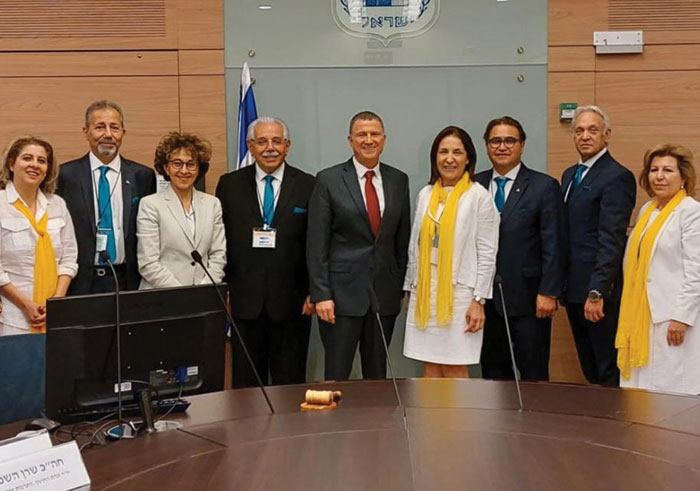
Nearly a dozen Iranian activists opposed to the Islamic regime in Iran — from Northern and Southern California as well as from Europe — visited Israel last month in an effort to raise awareness among Israeli political leaders, academics, non-governmental agencies and news media about average citizens who have suffered repression from the Iranian regime in the last few months during their increased public protests.

The 10-day trip called the “Shoshana Mission” was organized by the Los Angeles-based “Persian American Civic Action Network” (PACAN), a non-profit group that works with various Iranian American activists to advocate for an end to human rights abuses carried out by the Iranian regime as well as for a secular and democratic government in Iran.

“Our group went to Israel because that is the only country that has been consistently speaking out against the Islamic regime in Iran,” Zohreh Mizrahi, the president of PACAN, said. “Our goal was to increase visibility about the suffering the people of Iran are enduring at the hands of this regime that has not been covered by the mainstream American news media. We also went to bring about closer collaboration between Israelis and Iranian opposition groups and build relationships between Israelis and Iranian activists who want to one day help rebuild Iran when this current regime is toppled by the people of Iran.”

Mizrahi said that during their trip the PACAN group met with current and former Israeli members of the Knesset as well as Israeli foreign ministry officials to ask them to urge American leaders to reject any type of “deal that would only enrich and embolden the Iranian regime instead of helping average Iranians.”

“We wanted Israeli officials who have the ear of American leaders, to let them know that the Islamic regime does not have the best interests of the people of Iran in mind and to ask for their help in removing the regime’s false narrative to world that it represents the people of Iran,” said Mizrahi. “This regime only seeks to advance their own perverted version of Islam to the world and to send the wealth of Iranians to terrorists such Hezbollah, Hamas and to Venezuela.”

The PACAN trip to Israel was not the first time Iranian American activists reached out to Israelis on issues pertaining to Iran. In 2019, the organization first took a group of 10 Iranian activists to Israel to become better acquainted with Israeli society and learn how they could more successfully advance their own public awareness efforts against the Iranian regime.

But due to the COVID-19 pandemic in 2020 and 2021, PACAN board members decided to place their trips to Israel on hold, Mizrahi said.

Last year, six Iranian dissidents from the U.S. also visited Israel on a week-long tour organized by the Southern California-based Institute for Voices of Liberty (iVOL) in an effort to connect Iranian opposition activists with Israeli experts in water, agriculture and technology.

Dr. Amir Hamidi, a former U.S. diplomat at the U.S. Embassy in the United Arab Emirates who led the PACAN delegation to Israel, said a large portion of the group’s efforts were focused on asking Israeli government leaders and news media to differentiate the Islamic regime ruling in Iran from the people of Iran when speaking about issues pertaining to Iran.

“We came to Israel to tell Israelis that the vast majority of Iranians have no hatred for them and we know his first-hand when we hear them protesting and chanting slogans such as ‘not Gaza, not Lebanon, I will only give my life for Iran’ or ‘our enemy is not America or Israel, our enemy is here!’”

Mizrahi, who is Jewish herself, said nearly all of the activists on the mission were non-Jewish Iranians who had not previously visited Israel but were impressed by the warm reception they received from various Israelis.

Photo courtesy Dr. Amir Hamidi

“Our group spoke at a conference at Ariel University which was attended by nearly 100 students and academics who were very interested in what we had to say because we are emersed in everything Iran—so we offered them unique insights and extensive knowledge about the tremendous hardships people in Iran face today with reduced pay, food and water shortages and their internet getting shut down by the regime,” said Mizrahi.

Hamidi, who is also a former U.S. Drug Enforcement Agency official, said many who attended his lecture at Ariel University were especially surprised to learn of the Iranian regime’s 40-year international drug trafficking efforts.

“I spoke for an hour and I took questions for another hour from the audience — they were totally shocked to learn that the Islamic regime in Iran runs a multi-billion-dollar mafia narco-terrorism enterprise whose international reach spans from Kabul in Afghanistan to Caraccas in Venezuela!” Hamidi said.

Professor Ronen Cohen, an Iran expert and Chair of the Middle East & Central Asia Research Center at Ariel University, said those who attended the lectures by the PACAN participants were particularly interested to learn about the deep historic ties between Iranians and the Jewish people.

“The real surprise was to hear the message of the delegation that talked about the real bond between Iranians and Jews or Israelis even today and not only from 2,500 years ago,” said Cohen. 

Other Iranians on the Shoshana mission, such as Nazenin Ansari, editor of the Persian language Kayhan news outlet based in London, said they was pleasantly surprised by the welcome their group received from Israelis of Iranian heritage.

“The attachment of the Persian Jewish community in Israel to their Iranian cultural heritage and its preservation is stunning!” said Ansari. “We met many who had immigrated to Israel as children but still spoke Persian fluently. On a few occasions we met people who were not first or second-generation Iranians, but who still made an effort to trace their roots to Iran.”

Hamidi said that Israeli media news reporters and editors with whom he spoke were unaware of the strong support for Israel and sense of friendship Iranians in Iran feel for Israelis.

“Iranians know that Israel with its cutting-edge technology and water expertise is best suited to help them rebuild their country after they depose this criminal regime.” – Dr. Amir Hamidi

“Iranians know that Israel with its cutting-edge technology and water expertise is best suited to help them rebuild their country after they depose this criminal regime,” said Hamidi. “Since my return, about 99-percent of the private messages I have received from Iranians in Iran about my trip to Israel have been positive and wishing to join me next time in Israel!”

Len Khodorkovsky, a former senior advisor to the U.S. Representative for Iran during the Trump administration, praised the PACAN delegation for visiting Israel. Last year Khodorkovsky proposed the “Cyrus Accords,” a potential future peace deal between the people of Iran and Israelis based on increased interactions between both peoples.

“The warm relations between the Jewish and Iranian people dates back to Cyrus the Great,” Khodorkovsky said. “It’s another encouraging step toward the Cyrus Accords era when a free, democratic Iran and the Jewish state of Israel will live in peace and mutual prosperity.”

Mizrahi said PACAN’s leadership has plans in the near future to take other Iranian American activists and journalists to Israel in hopes of strengthening the relationship between Iranians and Israelis.

Iranian Activists Visit Israel to Raise Awareness of Protestors Suffering Repression in Iran Read More »

Moroccan Orange and Cured Olive Salad

Recently, I was sitting in my office and my phone rings and I see that the call is from David Suissa, editor of the Jewish Journal. I get a little nervous because I’m wondering “What did we do wrong?” (You know that feeling when you’re called to the principal’s office and you’re not sure if you’re in trouble?)

Happily, he’s calling from his mother’s home in Montreal. He sounds excited and his sisters are laughing in the background. He tells me that his mother has cooked dinner for all of them and served their favorite Moroccan orange and black olive salad. 

The sisters mentioned to David that the Sephardic Spice Girls also make this salad. He replied that he had never seen it and that we’d never done an article on it. 

I confirmed that yes, we have posted the salad on Instagram. Meme Suissa pipes up in the background and says “But you put onion!” 

I start laughing because I know that she means that I am messing with the recipe. 

I promise her that when I serve it to my family I never put onion because my dad would hate it. But for Instagram, the purple onion just made the picture so much prettier. She conceded the point. Then David’s sisters got back on the phone. 

We had a lovely conversation about food and different recipes and it was like reuniting with long lost cousins. 

Writing as the Sephardic Spice Girls has really connected Sharon and I with so many people. We get so many messages from people saying that seeing recipes that they thought were lost has brought tears to their eyes. I’m also really proud that recording our Moroccan recipes has brought such joy to our editor. 

The flavors of the Moroccan kitchen are unique and interesting and inventive. The list is long but it includes the blending of many different spices, red-hot harissa, bright and briny preserved lemon, mouthwatering matbucha and the slow cooking tajines. 

There is a layered complexity where a salty dish will be offset with sweetness and spice. 

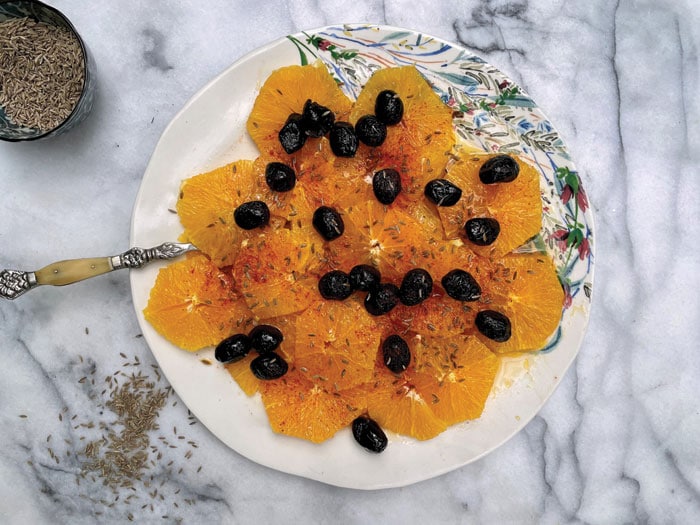
This Moroccan orange salad with cured black olives is a perfect example.

And my father eyes light up when he sees it on our Shabbat table. 

—Rachel

Sometimes I find it ironic that I write a food blog because I rarely follow recipes. I’m inspired by recipes but I rarely follow them faithfully. When you know the technique and correct temperature and what seasonings work and how much salt you need, you just throw it altogether. (Baking, on the other hand, is a science that doesn’t leave much room for messing around.)

The refreshing bright citrus of the orange contrasts with the deep salty dryness of the olives. The dressing of lime, olive oil, paprika and cayenne pepper adds a citrusy, spicy kick. 

This salad is lovely and so refreshing when served with cold oranges. Easy to make, so pretty and healthy too. The refreshing bright citrus of the orange contrasts with the deep salty dryness of the olives. The dressing of lime, olive oil, paprika and cayenne pepper adds a citrusy, spicy kick. Garnishing with cumin seeds adds another dimension to the explosively delicious flavors. 

So take this recipe and make it the way it’s written. Or be inspired to do it your way. 

Put the salad on a bed of arugula, add minced garlic to the dressing or garnish with fresh herbs like parsley, cilantro or mint. And purple onion is okay too!

—Sharon

MOROCCAN ORANGE AND CURED OLIVE SALAD

Dressing
2 limes, juiced
2 tablespoon argan oil or a fruity extra
virgin olive oil
1 teaspoon sweet paprika
1/8 teaspoon cayenne pepper
1/2 teaspoon kosher salt

In a bowl, whisk the lime juice and olive oil, then add paprika, cayenne and salt.
Set aside.

3 medium oranges, chilled in the
refrigerator
1/2 cup oil-cured dried black olives, pitted
1/2 teaspoon cumin seeds or 1/8 teaspoon
cumin powder

Peel oranges. Slice into 1/8 inch thick circles and deseed.
Arrange orange slices on a plate, then sprinkle olives on top.
Pour dressing over the salad.
Sprinkle with cumin seeds or cumin powder.


Sharon Gomperts and Rachel Emquies Sheff have been friends since high school. The Sephardic Spice Girls project has grown from their collaboration on events for the Sephardic Educational Center in Jerusalem. Follow them on Instagram @sephardicspicegirls and on Facebook at Sephardic Spice SEC Food. Website sephardicspicegirls.com/full-recipes

Moroccan Orange and Cured Olive Salad Read More »

House of Representatives Roundtable on JCPOA Implications, ADL Annual Gala Celebration

International leaders recently gathered to discuss the implications of an imminent Iran deal on the Abraham Accords.

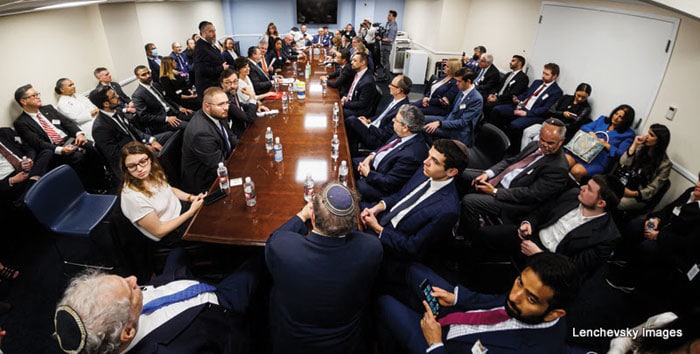
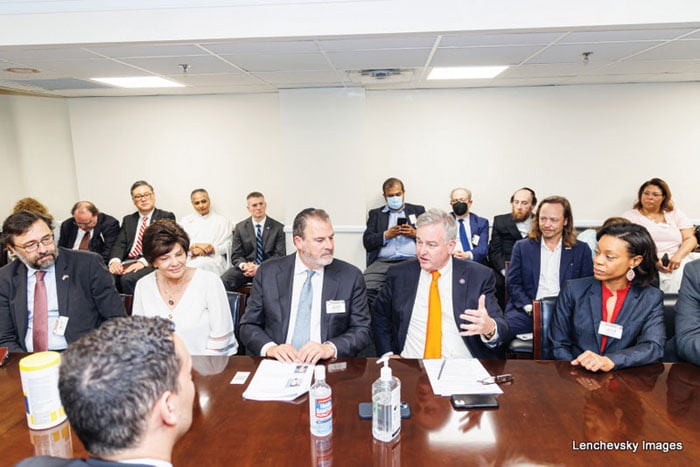
Representatives of Middle Eastern countries as well as the United States met at the House of Representatives for a roundtable discussion. They focused on repercussions the Iran nuclear deal—also known as the Joint Comprehensive Plan of Action (JCPOA)—would have on the U.S.-brokered agreements between Israel and several Arab countries.

“The United States has to stand for the members of the Abraham Accords,” Robert Rechnitz, a prominent leader who was instrumental in the passage of the Iron Dome legislation, said at the roundtable on May 17. 

Rechnitz hosted and moderated the gathering, which drew U.S. Reps. John Curtis (R-Utah), Andy Biggs (R-Arizona) and Yvette Herrell (R-New Mexico), among others. They voiced concerns and apprehensions to the newly proposed JCPOA bill as a threat to the security of the Abraham Accords.

From left: Slovak Ambassador Radovan Javorcik, U.S. Rep. Yvette Herrell, Robert Rechnitz, U.S. Rep. David Trone, entrepreneur Brock Pierce and Tiffany McKever. Photo by Lenchevsky Images

“This dialogue is not about Israel,” Rechnitz said. “Rather, it centralizes on upholding the commitment to support the Abraham Accords member states and to discourage any policy which could abandon the nations who rely on this agreement—such as Bahrain, Morocco, the UAE and Sudan.” 

Additional attendees included ambassadors from Bahrain, Morocco, Slovakia and Argentina as well as Jacob Choe of the Eurasia Center; American Jewish Committee assistant director Nissim Reuben; California Congressman Doug LaMalfa; and Ezra Friedlander, founder and CEO of public relations agency the Friedlander Group.

During the meeting, Rechnitz shared the good achieved by the Abraham Accords. He has decided to do all that can be done to influence every community, both Democratic and Republican, about the importance of demanding transparency in the JCPOA agreement in order to be fair and loyal to the members of the Accords. 

Before the roundtable, Rechnitz traveled to Israel and the United Arab Emirates to conduct high-level meetings regarding the JCPOA. After the meeting, he flew back to the United Arab Emirates.


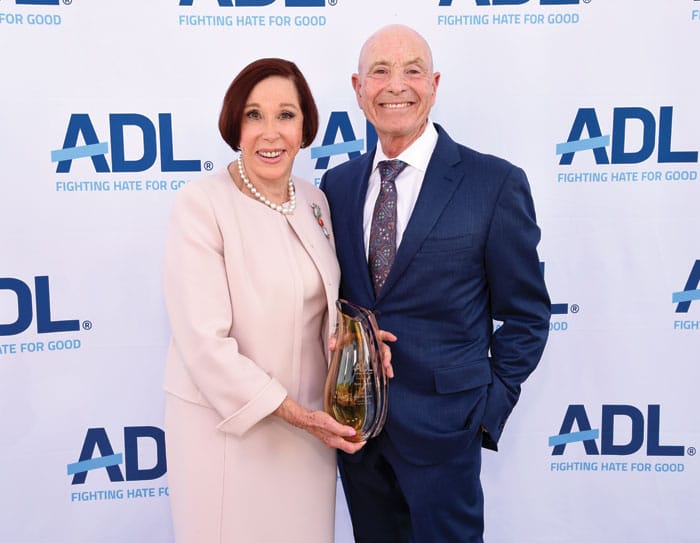
Husband-and-wife Faith and Jon Cookler.
Courtesy of the Anti-Defamation League

Anti-Defamation League (ADL) Los Angeles held its annual gala celebration, honoring Faith Cookler with the Deborah Award for her service to ADL’s causes both locally and nationally.

Marking the first time the ADL held its annual gala in-person since 2019, the recent program was held June 23 at Stephen Wise Temple.

“When I am asked what I find so compelling about ADL that kept my commitment for so many years, it is that since its founding over 100 years ago, ADL first and foremost, fights anti-Semitism, but recognizes that no one can be free unless all are free,” Cookler said during her acceptance speech.

Actress Janina Gavnkar, of ABC’s acclaimed series “Big Sky,” hosted the evening, and Danielle Finn, a recent finalist on “American Idol,” performed. 

Attendees included ADL Senior Vice President of International Affairs Sharon Nazarian, ADL Los Angeles Board Chair Sharyn Nichols, Jewish Federation of Greater Los Angeles CEO Rabbi Noah Farkas, and Rabbis Nicole Guzik and Erez Sherman of Sinai Temple. 

ADL Regional Director Jeffrey Abrams, under the weather with COVID-19, attended virtually.

“From the start of my tenure, our honoree Faith Cookler has been a supporter and mentor, and a true friend long before I started at ADL two years ago,” he said.

The evening raised more than $1 million to support its work of combating anti-Semitism and bigotry of all forms. 

House of Representatives Roundtable on JCPOA Implications, ADL Annual Gala Celebration Read More »

Shalom Rubanowitz: The Rabbi on the Beach

On the Venice Beach boardwalk, just steps away from trendy restaurants, weed shops, tattoo parlors and, of course, the ocean, is an Orthodox synagogue with three bright blue Stars of David on its facade. It’s called the Pacific Jewish Center, AKA the Shul on the Beach, and it’s there that Rabbi Shalom Rubanowitz welcomes Jews of all kinds. A typical Shabbat service might include those who are observant, those who are unaffiliated, young professionals, community residents and visitors to the popular SoCal destination. 

Given his unique congregation, it’s no surprise Rubanowitz became the synagogue’s spiritual leader in a non-traditional fashion. Over the weekend of July 4, 2015, with his daughter Dena he Airbnb’d a boat in Marina del Rey. He called the Shul on the Beach to see if anyone could offer Shabbat hospitality.

“We hit the ‘Shabbos invitation jackpot’ and were invited to the home of a lovely couple from the shul, with whom I became great friends,” Rubanowitz told the Journal. “When the shul needed a rabbi a few years later, I’m told I was the first call.”

The rabbi, who is originally from the Fairfax district and attended Yavneh Hebrew Academy, has been working at the synagogue since 2015, but he’s been a lawyer and a pulpit rabbi for over 20 years. He learned at Beth Medrash Govoha in Lakewood, New Jersey, and received ordination while he was there, became certified in Jewish marriage and family law and gained admission to the Bar in 14 states.  

Growing up, Rubanowitz spent three years in Israel when his parents decided to make aliyah and try living there. While in the Jewish State, he studied in Safed and Jerusalem.

“That was a big part of my life,” he said. “I gained new knowledge of a broader Jewish world outside of just our local community. I learned Hebrew and understood Israeli life.”

Rubanowitz had no intention to become a rabbi. While his parents raised him and his nine siblings to be learned, he wanted to take a different path from his five brothers; all of them became rabbis and teachers and didn’t go to college. He attended Rutgers Law School, where he came across a rabbinic opportunity.

“I got a place to live above a shul and in exchange, I was the rabbi,” he said. “I was a part-time rabbi and just never stopped. I knew I wanted to be a lawyer since I was in high school, but I never thought I’d go into the rabbinate. Once I saw I could do both, I kept it up throughout my career.”

Going to college gave Rubanowitz a more open-minded perspective, one which would serve him well at the Shul on the Beach.

“I recognized there is a lot of wisdom and knowledge in the secular world,” he said. “If you’re a rabbinic student or raised very Orthodox, you may think this is the only way to go and other people are wrong. It gets very insular and can create a feeling that you know the truth and the truth is only held by those who grew up Orthodox. Going to law school, I was able to see the value of human beings in the secular world and relate to them. It made my religious and secular worlds better, giving me a broader perspective on my religious life.”

Rubanowitz calls himself the “out-of-the-box Orthodox rabbi.” When he first came to the Shul on the Beach, it was in survival mode, because many of the congregants had moved to the La Brea and Pico-Robertson Jewish communities. Working with the remaining shul members, he came up with ways to ensure the shul not just survived, but thrived.

“I focused on creating a place where people can find a home and connection,” he said. “Now it’s in a revival, where people are joining us for Shabbat meals and services. People are happy to be part of a community.”

One Friday night a month, the synagogue hosts a Shabbat lounge, where sushi and sake are served. They’ve held standup comedy shows and klezmer concerts and offer a matchmaking service, too.

“I got divorced and I’m still single, so I can relate to a lot of singles out there,” said Rubanowitz. “We have a very big focus on singles who can meet each other. We’ve made some matches.”

In the end, what he believes attracts people to the Shul on the Beach is its dedication to traditional Judaism – while welcoming in outsiders.

In the end, what he believes attracts people to the Shul on the Beach is its dedication to traditional Judaism – while welcoming in outsiders.

“We’re very authentic and keep the sense of tradition,” Rubanowitz said. “But at the same time, it’s very open to any kind of person who comes in. People are able to feel at home because they can connect to something authentic. It’s just what their Jewish soul is looking for.”

Fast Takes With Shalom Rubanowitz

What’s your favorite Jewish food?

Shalom Rubanowitz: Can I have two? Chopped liver and good schmaltz herring.

JJ: What’s your perfect Shabbat look like?

SR: Having plenty of time to eat and learn and meet everybody and sleep.

JJ: What do you do on your day off?

SR: On Sundays, I’ll take time to ride my motorcycle and sail my boat and hang out with my kids.

JJ: What’s your favorite place in Venice?

SR: I love the canals. No question about it. And my shul’s library. I love my library. 

Shalom Rubanowitz: The Rabbi on the Beach Read More »