fbpx

June 30, 2022

Toeing the Line – A poem for Parsha Korach

Aaron returned to Moses at the entrance of the Tent of Meeting,
and the plague was checked.
-Numbers 17:15

The Holy One drops the mic again
This time on rebels who were consumed
in an instant.

A rapid plague takes them all out
even more rapid than the rapid tests
of our day.

We’re reminded again to know
what’s what and not stray from that path
because consequences.

It’s one thing to see this in ancient text.
It’s another to see the word plague
in all the media.

The masks are coming off but
the variants don’t care. I stroll
the supermarket aisles

looking for ice cream and flavored popcorn
and it looks like, based on whose mouths I see
half the people will survive.

I may not be one of them based on
my choice, though I’ll gladly do what I’m told
if more direction comes.

I’m no Korach. I’m a team player.
I’m the last guy who wants to get swallowed up
by the earth.

I’d love to point the Lawmaker in the direction
of the Texans who are vocalizing their
preference for plague and lies.

Or the majority of supreme robed individuals
who have itchy fingers about choices
that aren’t theirs to make.

Or the Czar and his army of nouveau Cossacks.
Yes, that is still happening. Or will I have
water to drink next week?

I may let the lawn die. Write a few pointed letters.
I’m the ultimate line-toer, and I’ve got
so much more to say.


God Wrestler: a poem for every Torah Portion by Rick LupertLos Angeles poet Rick Lupert created the Poetry Super Highway (an online publication and resource for poets), and hosted the Cobalt Cafe weekly poetry reading for almost 21 years. He’s authored 25 collections of poetry, including “God Wrestler: A Poem for Every Torah Portion“, “I’m a Jew, Are You” (Jewish themed poems) and “Feeding Holy Cats” (Poetry written while a staff member on the first Birthright Israel trip), and most recently “The Tokyo-Van Nuys Express” (Poems written in Japan – Ain’t Got No Press, August 2020) and edited the anthologies “Ekphrastia Gone Wild”, “A Poet’s Haggadah”, and “The Night Goes on All Night.” He writes the daily web comic “Cat and Banana” with fellow Los Angeles poet Brendan Constantine. He’s widely published and reads his poetry wherever they let him.

Toeing the Line – A poem for Parsha Korach Read More »

Why Jews Don’t Mix Milk and Meat

A dog’s view of the world, wrote Rainer Maria Rilke,
is being in it, constantly amazed. I’d add, like E.T.,
not against, as are observant Jews, to what is meaty
when it is served with what comes from a cow that is a milker.

In Jordan they love eating milky mutton, called mansaf,
amazing delicacy that the Torah laws forbid
three times, perhaps the cause—-according to this rhyming monograph!—
for:  “Do not boil in its mother’s milk a kosher kid.”

Rilke’s rule explains why we’re told by the true-tried Torah
to offer any food that is not kosher to a dog.
This rule is taught in every Jewish school and synagogue,
and proves the Torah loves all dogs and is not their deplorer.

If you, wise reader, don’t enjoy this poem I hope that
you will not criticize The Jewish Journal if it blogs
its content.  Though it may not be “canina hora” glatt,
it should not, I believe, be thrown to our beloved dogs.

In “An Innovator Sold Jordan’s National Dish in a To-Go Cup. Controversy Ensued: Is “mansaf in a cup” a novel way to enjoy the country’s most treasured delicacy, or an affront to its most hallowed traditions?” NYT, June 26/22, Ben Hubbard and Asmaa al-Omar write:
The idea struck the restaurateur like a bolt of lightning after he spilled food on his suit while eating in his car. What if he were to take Jordan’s national dish — a milky mountain of mutton and rice called mansaf, which is traditionally eaten by hand from a large communal platter — and sell it in a paper cup to diners on the go? ….

The mansaf-in-a-cup experiment took off in Amman, along a street crowded with cars blaring pop music and merchandise displayed on the sidewalks.
“What is happening is not just a matter of food, but a way of mocking the people’s heritage,” Mr. al-Majali added. “And when you mock the heritage of a people in this way, it is a prelude to trivializing what is most important and diluting or dissolving identity.”
The mansaf dust-up has roiled the kingdom for the last two years, pitting traditionalists against innovators, those who eat with their hands against those who eat in their cars, and raising the question of how much a culinary tradition can change before it forsakes its roots…..
To make the mansaf, the meat was boiled on the bone in huge metal cauldrons. The cooks dissolved large white balls of a dehydrated sheep’s yogurt, known as jameed, in giant pots to make a salty, milky soup.
When the meat was partially cooked, the cooks drained the water it was boiled in and replaced it with the milky mixture. The meat boiled in the milk until it was tender, making the signature mansaf combination.

“Canina hora” is a wordplay for the Yiddish expression “kineina hora”, which means “No evil eye,” and signifies the desire to ward off evil intentions towards us by satanic forces.


Gershon Hepner is a poet who has written over 25,000 poems on subjects ranging from music to literature, politics to Torah. He grew up in England and moved to Los Angeles in 1976. Using his varied interests and experiences, he has authored dozens of papers in medical and academic journals, and authored “Legal Friction: Law, Narrative, and Identity Politics in Biblical Israel.” He can be reached at gershonhepner@gmail.com.

Why Jews Don’t Mix Milk and Meat Read More »

Children’s Book “I Hate Borsch!” Is a Love Letter to One’s Culture

Whether you love it or hate it, borsch is likely part of your Jewish cultural identity. And the version you eat has as much to do with where you are from as the ingredients you put into it. 

For Yevgenia Nayberg, author and illustrator of the children’s picture book, “I Hate Borsch!” borsch is just a regular, familiar food that was part of her upbringing in Kyiv, Ukraine. It’s the same way many Americans feel about pizza.

“I do not hate borsch,” Nayberg said. “I come from a very strict Jewish household, so I don’t think I had many choices.” 

More commonly spelled “borscht,” the soup’s name comes from the beetroots that give it the bright red color. The name is also used for a variety of sour-tasting soups without beetroots, such as sorrel-based green borscht, rye-based white borscht, and cabbage borscht.

While borsch, which evolved from an ancient soup, originally cooked from pickled stems, leaves and umbels of common hogweed, it’s important in Russian and Polish cuisines, with Ukraine is frequently cited as its place of origin. 

“I Hate Borsch!” tells the story of a young girl who despises the beloved soup. When she emigrates to the United States, she tries a bunch of American food, but that leaves her feeling empty. After discovering borsch recipes in an old suitcase (departing gifts from all the grandmothers she knew in the Ukraine), she decides to give the soup another try. 

Imaginatively illustrated with splashes of bright borsch red, “I Hate Borsch!” is a love letter to borsch that captures the complicated experience of rejecting and embracing one’s culture.

An award-winning illustrator, painter and set and costume designer, Nayberg’s other picture books include, “Anya’s Secret Society” (which came out in 2019 and received a Junior Library Guild Gold Selection Award), “Typewriter” and “Mona Lisa in New York.” Her illustrations have also appeared in magazines and on theater posters, music albums and book covers; her paintings, drawings and illustrations are held in private collections worldwide.

Nayberg, 47, moved to the United States in 1994, first to Pittsburgh, then to Los Angeles for 10 years. She moved to New York City 17 years ago, where she hopes to remain. 

“I come from the Soviet Jews,” she said. “Most of us, of course, are very secular, because we really didn’t have any opportunity to practice. Many people hid their religious affiliation.” 

She continued, “I feel very Jewish. Maybe not religiously Jewish, but very culturally Jewish. [I relate to the] Jewish sense of humor and the irony. And, of course, the food.”

Unlike her young character, Nayberg was 19 when she moved to the States.

”I did not want to write a book about borsch. I wanted to write a book about the foods that I came to taste when I came to America.” – Yevgenia Nayberg

“I did not want to write a book about borsch,” she said. “I wanted to write a book about the foods that I came to taste when I came to America.” 

Nayberg polled her immigrant friends about what they found weird about American foods. Eventually, the American foods, including the peanut butter and jelly sandwich), were all reduced to one page, and somehow it became the borsch book.

“What I think is autobiographical in this book is mostly just the voice,” Nayberg said. “If any of my books capture my own personal voice – how I speak and how I see the world – this is it.”

Nayberg thinks “I Hate Borsch!” is a good book for learning how to  be at peace with your identity. Many young immigrants come to the U.S.  and are happy to be like everybody else. They may even try to reject or suppress that cultural identity, like her character did. 

The author hopes her book encourages people to dig out their identity, see it in a new light and come to terms with it. She also wants readers will try her beloved borsch recipe.

From “I Hate Borsch!”

There are as many borsch recipes as there are Ukrainian grandmas. And don’t even get me started on the neighboring countries of Eastern Europe and their borsch recipes!

There is hot borsch and cold borsch, one with beans and another one with beef. There’s a version with prunes, and one with mushrooms. There’s even green borsch, which I refuse to discuss here.

It takes courage to share a borsch recipe. What would the grandmas think? And yet, I am going to do it.

This version of mine is vegan, at least until you add sour cream to your bowl at the end. (It is vegan by its nature, not because I removed some delicious ingredients.)

Yevgenia’s Vegetarian Borsch

Get the tiniest head of green cabbage you can find. Slice it in half and save another half for the time you decide to make some sauerkraut.

Roast and grate 4 small beets. (You can cheat and buy the scary-looking vacuum pack of ready-to-eat beets if you want.)

Peel and quarter 3 medium potatoes. Peel and grate 3 medium carrots.

Heat some neutral oil, like grapeseed or canola, in a large pot and drop the potatoes in. Let them get a bit of a tan and drop in the carrots. Stir from time to time to make sure they don’t burn.

Once they soften and brown a bit, fill the pot with boiling water, add a generous pinch of salt, and a whole peeled onion. Important: now is the time to add a pinch of sour salt. Sour salt is another name for citric acid. You can find it at most supermarkets. Skip this step and end up with sad, brown borsch.

Next, add a heaping tablespoon of tomato paste. Drop in the grated beets, bring the borsch to a boil, then cover the pot and let it simmer for at least 30 minutes. I like to simmer for an hour.

While this is happening, slice the cabbage as thinly as humanly possible. Bring the borsch back to a boil and drop the cabbage in. Stir and turn the heat off immediately. This way the cabbage will retain some bite to it. Don’t let it turn into a mushy mess!

Fish out and discard the onion. Crush a clove of garlic into the pot.

Ladle borsch into a bowl, add some sour cream, and sprinkle with fresh dill.

Any borsch will taste better the next day.

If this does not sound like the borsch your grandma makes, I apologize. I am sure she is a wonderful lady and a great cook.

Nevertheless, I stand by my borsch — as an artist, an omnivore and a dual citizen.

Children’s Book “I Hate Borsch!” Is a Love Letter to One’s Culture Read More »

Ideas for a Kosher Cookout on the Fourth of July

Summertime … and the grilling’s easy. It turns out, there is way more to a barbecue than making delicious food on the grill. 

“When I barbecue, it’s always more like jazz than a three-act play for me,” chef Jeff Frymer told the Journal. Frymer, a licensed marriage and family therapist in private practice and Certified Inner Bonding facilitator, spends his off time as guest chef on a catamaran.

For a recent family barbecue, Frymer pre-seasoned tri-tip with salt and pepper. Then, he took it out of the refrigerator 20 minutes before cooking it. He also drizzled salmon with olive oil and then added salt, pepper, paprika, fresh chopped garlic, thinly sliced red onion and fresh thyme. Whereas the meat went directly on the grill, he foil-wrapped the salmon (skin-side down) before putting it on the flame. 

Cooking times, Frymer said, vary, since everyone’s grill is a little different. “I pretty much go by smell and check often for doneness.” 

Frymer also has a “tried and true technique” for cooking corn on the cob. After removing the husks and silks, Frymer butters and seasons the cobs. He then wraps them back in washed husks and covers them in foil. 

“Turn/roll the corn often over well-prepared coals/wood or gas,” he said. “Not too much flame or it will burn, unless that’s the result you want to suit your taste.” 

Be careful when removing the foil so you don’t get scalded by the steam.

“The corn comes out amazing,” Frymer said. “It’s juicy and crisp to the bite with just a hint of smoky charred flavor.” 

Ali Rosen, cookbook author and Emmy and James Beard Award nominated host of “Potluck with Ali Rosen” believes that you don’t have to put cheese on a burger for it to be tasty. 

“For the perfect Jewish BBQ, you really need a sauce that makes you forget any other grilled food exists.” 
– Ali Rosen

“For the perfect Jewish BBQ, you really need a sauce that makes you forget any other grilled food exists.” 

The ginger sauce for Rosen’s grilled beef has only four ingredients, but it gets the job done. This sauce goes on a lot of different proteins, but marries particularly well with steak. After you’re done making your steak, you can pair it with Rosen’s plum and cucumber salad, too.

Ali Rosen’s Grilled Beef with Ginger Sauce. Photo credit: Noah Fecks

Grilled Beef with Ginger Sauce

Serves 4-8

Serves 4-8
1/3 cup finely chopped fresh ginger
2 cups finely chopped scallions
2 tablespoons soy sauce
1 teaspoon balsamic vinegar
1 tablespoon olive oil
Dash of salt
4 lbs sirloin steak
1/4 cup vegetable or canola oil

Make the sauce: Combine the ginger, scallions, soy sauce, vinegar and olive oil. Set aside (I think the sauce gets better the longer it sits, but at least let it sit while you cook the steak so it has time to settle together). Then make the steak. Generously salt the steak on both sides.

Start your grill and let it come to temperature. Rub oil on both sides of the steak. Add the steak to the grill and cook for 5-8 minutes, depending on the size of your steaks and the desired level of doneness. You will want to flip the steak every 30 seconds or so to ensure that it cooks evenly – it will cook better this way rather than just leaving it to only flip once. Remove the steak and let it rest for at least 5 minutes. Slice off the fat and then cut the steak into ¼ inch pieces lengthwise. Add the sauce on top and serve.

Plum and Cucumber Salad

Serves: 8-10

This recipe is perfect for a Jewish barbecue because you get all the intense flavor without any limitations on dietary restrictions. And it only takes 10 minutes to make

4-5 large ripe plums, diced
   (approximately 4 cups)

2 large English cucumbers, sliced into  
   1/4 inch discs (approximately 4 cups)

3 tablespoons fresh lime juice
   (approximately 2-3 limes)

1/4 cup of extra virgin olive oil

1/2 cup finely chopped cilantro

1/2 tablespoon dried chili flakes

Dash of salt

Combine all ingredients and serve.

Note: This dish is spicy as is, so if you’d like it to be less so then you can easily cut the amount of chili flakes in half. Remember: You can’t take spicy out, so sometimes it is good to start with half and then you can always add more.

Substitutions: This dish is also great with peaches.  That way, you can use the flavor combination year round. Just substitute the same amount of peaches for plums and you’ll be all set to have a summery version of the same dish.

Spicy Grilled Pineapple

Makes 6 pineapple slices

For a great unexpected dessert, try Rosen’s spicy grilled pineapple. 

“It takes a fruit that is often just the filler in a fruit salad and makes it into something exciting and different,” Rosen said. “Grilled pineapple is a delight on its own, but by adding a few spicy flavors, you’ll make it unforgettable.” 

1 whole pineapple
1/8 teaspoon chili powder or cayenne
2 tablespoons granulated sugar
1/2 teaspoon ground ginger

Cut up the pineapple: trim the top, bottom, and sides, and then core out the middle (it’s also fine to leave the core). Slice the pineapple into 1-inch-thick rounds. In a bowl, mix the chili powder, sugar and ginger. Sprinkle the chili mixture on top of the pineapple slices.

Turn on your grill and make sure it has completely reached full heat. Turn on your hood or fan before cooking the pineapple slices, because once they hit the pan they will smoke a bit. Cook the pineapple slices on one side for 2 minutes, without moving them, until the slices have browned. Flip to the other side and repeat. Let them cool on a wire rack, allowing the juice to drip out, before serving them.

Michael Tanenbaum’s Vegan No-Bake Cheesecake. Photo credit: Michael Tanenbaum

Delicious Vegan No-Bake Cheesecake

“Sharing food is a wonderful way to spend a holiday,” Michael Tanenbaum of Consciously Kosher said. “It enables us to expand our palette of shapes, textures, flavors, aromas, colors and sounds that our food comes in.”

Tanenbaum founded Consciously Kosher to help busy people in the kosher food community who have a limited time and budget make healthier food-buying decisions.

His raw vegan cheesecake is a wonderfully tasty alternative to real dairy, and the perfect way to cap off any summer meal.

Crust:
3 Medjool dates, pitted
1/2 cup organic pecans and/or walnuts
1/2 cup almond flour (not almond meal)
2 Tbsp of coconut oil
1 Tbsp cinnamon (we use Ceylon
cinnamon)
Pinch of salt

Filling:
2 cups of soaked cashew nuts
1 cup of coconut milk
1/3 cup of maple syrup
1/4 cup of coconut oil
2 Tbsp of lemon juice
1 teaspoon of vanilla extract
1 cup fresh blueberries (plus an extra cup of blueberries for the garnish)

Crust: Throw all ingredients into a food processor and blend on high for about 30 seconds. Pour into a round 8-inch baking pan. Put in the freezer for a few minutes while you prepare the filling.

Filling: Soak cashews (overnight if possible, or for at least 2 hours); drain and rinse. Add all filling ingredients into a high-speed blender and blend on high for 30-45 seconds.

Remove crust from freezer. Pour 2/3 of the filling mixture onto the crust. Put back in the freezer for 30-45 minutes or until hardened.

Add a cup of blueberries to the remaining 1/3 filling mixture and blend on high for 15-20 seconds.

When the first layer hardens, remove from freezer and pour the second layer on top. Put back in the freezer for at least 30-45 minutes. Remove from freezer and garnish with fresh blueberries. Thaw for a few minutes before serving.

Ideas for a Kosher Cookout on the Fourth of July Read More »

International Jewish Women Look to the Future

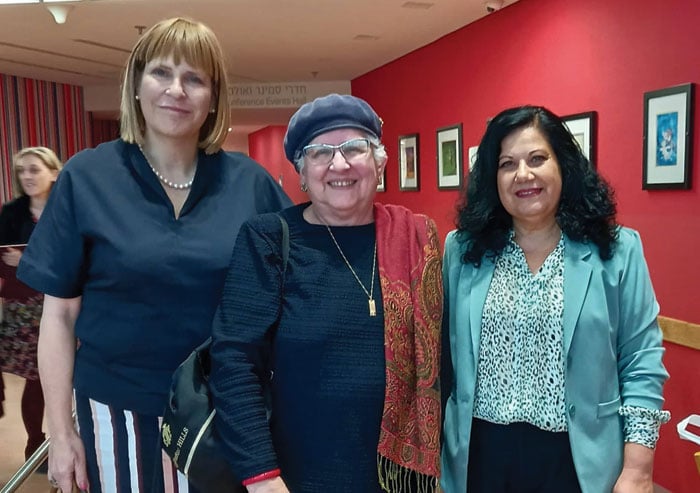
On Sunday, May 22, 50 women of the International Council of Jewish Women (ICJW) met for a gala opening of their five-day Quadrennial Conference, called “Looking to the Future,” at the Shalva National Center in Jerusalem. They exude a sense of true feminine power that they are channeling to fix the world. According to spokeswoman Sarah Manning, of the Tikshoret Communications Agency, they were presidents of national Jewish women’s organizations from, Israel, the U.S., Canada, South Africa, Mexico, the Czech Republic, Bosnia and Herzegovina, Australia, Georgia, Germany, Hungary, Slovakia, Sweden and Switzerland, and elsewhere, and delegates who represented the interests of Jewish women at the United Nations in New York, Geneva and Paris. Due to COVID-19, it was the first time in four years they had met face-to-face. 

In a fractured world, it was refreshing to see women who represented a broad religious and political spectrum in their private as well as public lives. Among the Israeli women were representatives of Emunah, Women’s International Zionist Organization, the chairperson of the left-wing Meretz party and a past MK of The Jewish Home and New Right parties in the Knesset.

The outgoing president, Penelope Conway of the UK, said “The ICJW was founded in Berlin 110 years ago and is an umbrella organization for women’s organizations from 37 countries, working to promote a just society based on Jewish values … Jewish woman are a force to be reckoned with.” 

During the past four years, said Manning, Conway and her team have been involved in the Jewish NGO campaign at the United Nations to modify the antisemitic content of the United Nations Relief and Works Agency (UNRWA) text books used in Palestinian schools. (More on that later.) The ICJW has also participated in international campaigns including #metoo, anti-trafficking campaigns, calling out antisemitism, combatting domestic violence, interfaith dialogue, environmental awareness, and Generation Equality. Their meetings have also been about the UN Commission of Inquiry against Israel.

ICJW’s incoming president, Lilian Grinberg of Mexico, said “one of my goals is to get more young people involved, including through volunteer work.  We have to be grateful to the countries where we live. I live in Mexico. I’m Jewish. But Mexico opened their arms when our grandparents came from Europe.” Grinberg is involved in helping impoverished Mexican communities, the Mexican Red Cross, Mexican hospitals, schools for children with disabilities, a center for at-risk youth, and homes for elderly people. 

Zohar Damsa Blau, the eloquent MC for the evening, spoke emotionally about how her mother, Bosna Barhanu, who was also in the audience, brought Zohar and her siblings from Ethiopia. She told the audience, “I will be happy when people stop looking at my color.” Zohar is the coordinator of the “Street Mobility” project in Ramla, holds a BA in Administration and Law, is a fellow of the Gal Community Leadership Program, has worked at a locked home for at-risk girls, and at a shelter in Lod for girls on a path toward prostitution. 

Shuli Davidovich, head of the Bureau for World Jewish Affairs and World Religions at Israeli’s Ministry of Foreign Affairs, told the international crowd, “we will always be here for you when you decide to come,” and said they should, “work together against hate speech in social media.” Davidovitch described the life of a woman who is a diplomat, and how her children were born in various cities and countries throughout the world.

The delegates toured Jerusalem, visited Ben-Gurion University to learn about progress on climate change and sustainability, and met with residents of Jewish and Bedouin towns.

The delegates toured Jerusalem, visited Ben-Gurion University to learn about progress on climate change and sustainability, and met with residents of Jewish and Bedouin towns. They discussed how to help victims of domestic and sexual abuse in the Jewish community, and women who are denied a Jewish divorce by their husbands. Panel discussions included the situation in the Ukraine and Central Europe, women’s health and economic independence, and the environment.

Dr. Joan Lurie Goldberg now retired, has represented the ICJW as a JNGO – a Jewish Non-Governmental Observer at the UN for the last 17 years. 

“We started a serious effort to fight this problem [of the schoolbooks] at the UN in NY in 2016 and 17.” Their website is: www.reformUNRWA.org. “The path to peace begins in the classroom, but not these classrooms, where the UNRWA has taught this obnoxious curriculum. 

“The UN has a High Commission of Refugees. Refugees do not pass on that status to their children; if they can’t go back to their own homes, these people are resettled.  However, UNRWA decided that being a Palestinian refugee is an inherited characteristic, but only for Palestinians, so there’s a never-ending increase. Since 1948, the number by now should be down to a few hundreds or thousands, but due to UNRWA’s definition, it is about 5.5 million.

“500,000 of them are being educated at any one time. The teachers were also educated this way and the whole culture is about hating and aspiring to destroy the state of Israel.

“UNRWA is inciting the students to start a war of return so they will inherit the entire state of Israel. They are no longer interested in a two-state solution. Every single textbook they teach out of has that position in it. There is a second-grade textbook in which children sing about having a war of return and then having the remnants of the Jewish population pushed into the sea.” 

Dr. Lurie Goldberg works with David Bedein of the Center for Near East Policy Research and says that his work is “amazingly impressive.” It includes, among other things, documentaries about the schoolbooks in the refugee camps. She refers to a film produced by the Center, “The Summer of 2021 — Hamas and Jihad Summer Camp,” and says, “It’s really one of the most horrendous films I’ve ever seen on this topic.”

She expresses frustration that “executives of major Jewish organization in the U.S. either don’t know about this issue or don’t care. We feel that if we can get these movies in front of major women’s organizations, not necessarily Jewish women, we would have an impact. I also believe we should be talking more with the evangelical Christians, because obviously they have a very strong interest in not having these Palestinian children grow up to be murderers; it’s not good for Christians either.

 “The angle that has been relatively ignored is child abuse in the classroom, child abuse in 7-to-10-year-olds crawling with rifles in their hands through barbed wire. Why don’t people who claim to care about children’s rights rise up and do something?

“We, the US, used to be the biggest donors [to UNRWA] but now it’s Germany who gives the most money — to a system that teaches people how to kill Jews!

“The ICJW has been incredibly supportive of our work, and has a delegation at the UN in Geneva. They have to listen to the Human Rights Council bash Israel three or four times a year. There’s a new and really atrocious antisemitic UN project called a ‘Commission of Inquiry’ in which three very anti-Israel people are being given millions of dollars to go around the world investigating everything bad that Israel has allegedly done from 1947 till today, and it’s going to go on in perpetuity from 1947 till today.” 

Dr. Lurie Goldberg is originally from Brooklyn. She raised two children in New Jersey; she was in California for 14 years, where, as a physicist, she worked with satellites taking picture of the earth. She says she worked on both classified and unclassified projects. “I did ‘Google Earth’ before there was a Google.”

In a video message, Dr. Lurie Goldberg says, “After 70 years of largely ignoring all of this, the world is starting just now to pay attention. Corruption at the highest level in UNRWA has been discovered; several nations have actually held up their funding for UNRWA because of this corruption; it has put UNRWA in the news.

 “The Committee on the Elimination of Racial Discrimination (CERD) of the UN has cited the Palestinian Authority for the antisemitic textbooks they are producing. UNRWA doesn’t write a single book, but UNRWA is tasked with vetting the books that the Palestinians produce. The Secretary General of the UN for the first time in history has started an investigation of the anti-Semitism in these books. We might actually see some progress.”

It was a moving vision at the gala opening when every delegate walked in with her country’s flag and the evening concluded with a wide variety of accents filling the hall with the singing of “Hatikva.” 

Toby Klein Greenwald is the award-winning theater director of Raise Your Spirits Theatre, a recipient of American Jewish Press Association Rockower Awards for Excellence in Jewish Journalism, and editor-in-chief of WholeFamily.com.


International Jewish Women Look to the Future Read More »

Table for Five: Korach

One verse, five voices. Edited by Salvador Litvak, the Accidental Talmudist

He spoke to Korach and to all his company, saying, “In the morning, the Lord will make known who is His, and who is holy, and He will draw [them] near to Him, and the one He chooses, He will draw near to Him.”

-Num. 16:5


Yael Weinstock Mashbaum
Interim Middle School Director/Sinai Akiba Academy

Moshe could have said, “I understand how you feel, Korach. It is unequal that there is an elite crew that you are not part of; but this is how God designed it.” 

Rather, without empathy, Moshe explains that the hierarchy is determined by God. It may seem callous of Moshe, not a fitting response when there is discontent within the nation. But, it is actually a brilliantly calculated move that ultimately highlights the flaw in Korach’s argument. 

By reminding Korach that God determines who is worthy of the priesthood, or who is holy enough to be granted direct access, he tests Korach’s faith and trust in God. Are Korach and his colleagues suggesting a nation without leadership or hierarchy, or do they want to be the leaders and are speaking out of envy? Do they trust God to choose leaders based on a specific set of standards or would they prefer to abolish the entire system just so that they can, undeservedly, be in powerful positions? 

The Torah is clear from this verse that high standards are necessary to maintain the appropriate hierarchy within the leadership of a nation and, that simultaneously, the Jewish people must have complete faith in God and God’s plan. Moshe’s response to Korach reveals to us that there is a role for each holy person in the community, but not all at the top of the leadership ladder. We must earn our place through menschlichkeit behavior, and leading a life of Torah and mitzvot.


Rabbi Elliot Dorff
American Jewish University

The use of the word kadosh, holy, here is very clearly defined as doing what God wants. The word, though, is defined more specifically elsewhere, and it becomes a central attribute that the Torah uses for describing the People Israel as “a kingdom of priests and a holy nation” (Exodus 19:6). What, then, does “holy” mean? 

First, a note about what it does not mean. English is a language created and used primarily by Christians, and so we should not be surprised that “holy” in English carries with it Christian connotations. Holy people in Catholicism, especially, are priests, nuns, and monks – that is, those who are ascetic. That, though, is not the Jewish meaning of the term. 

The Jewish meaning of being holy is defined specifically in Leviticus 19, where God says to Moses: “Speak to the whole Israelite community and say to them, ‘You shall be holy, for I, the Lord your God, am holy.” That is the header for the rest of the chapter, which defines holiness as a set of very high standards for our behavior. Among other things, we must observe the Sabbath; respect our parents; care for the poor; deal honestly in business; avoid gossip; come to the aid of those in distress; and, ultimately, “Love your neighbor as yourself.” Korach and his followers claim that the people are already holy. They mistake the kind of people we currently are with what we, as Jews, should continually aspire to be. 


Rabbi David Eliezrie
President, Rabbinical Council of Orange County

Moses waited for the morning because he was hopeful that Korach would realize the error of this ways and repent. The Talmud tells us (Berachot 19a) that if you “witness a scholar committing a transgression at night you should not harbor ill thoughts about him, because by the morning he might have repented.” 

Imagine if you arrive late for an appointment—“Oh it was the traffic.” However, if someone else comes late, causing us a disruption, we tend to be harsher and think, “Can’t he get his act together?” Our self-love makes us blind to our own weaknesses and leads us to judge others more harshly. 

Moses is faced with a challenge to his leadership from Korach, who is indeed a great scholar. Acting with humility he falls on his face, wondering, “Maybe I have a spiritual flaw?” Moses realizes the fault is in Korach and not himself. Still, Moses remains patient, and even though the chances are slim, he hopes that the Korach will realize the error of his ways.

The Torah is teaching us not to rush to judgment when we see another have a spiritual failure. It is telling us to have patience and to help the other come to their own realization that their actions were incorrect. Sadly, in the case of Korach, that did not succeed, but it can in our lives. 


Yehudit Garmaise
Reporter, Teacher

When we feel that surely we could take on roles to which we have not been assigned, instead of continuing to paint our own appointed corners of the world, we can remember Korach, who incited 250 men to rebel that they should all serve as high priests. 

After Korach argues that everyone, and not just Aharon, was holy, Moshe’s first words in response were, “In the morning.” 

By invoking the sunrise, a Midrash tells us that Moshe was teaching Korach, “Hashem has placed boundaries in his world.”

How can you possibly intermingle night and day? So, too, Hashem has chosen to separate Aharon. 

“You, Korach, have the same chance of negating Aharon’s holiness as you have of undoing Hashem’s separation of night and day.” 

The Lubavitcher Rebbe writes, G-d created the world so that each created being remains distinct and different from each other. 

The Midrash tells us that Moshe told Korach, “We have but one G-d, and but one high priest: the 250 of you all desire to be high priests? I, too desire to be one!” 

While Moshe Rabbeinu also wanted to serve as the Kohan Gadol, he felt happy for his brother to be chosen for such an exalted role. 

“Ultimate peace and harmony only come about when each level supports the other, helping it achieve what it could not accomplish on its own,” writes the Rebbe, who reminds us to hold open space for others to express themselves and fulfill their G-d-given roles.


Rabbi Shlomo Yaffe
Congregation Bnai Torah

We have in this verse three descriptions:

  1. “Who is His” 
  2. “Who is holy” that “He will draw [them] near to Him” 
  3. “The one He will choose (future tense), He will draw near to Him.” We have iterated twice “He will draw near to Him”— once for the first two statements and a second time for the “one He Chooses.” 

In Pikei Avot (1:11) we find a description of Aharon’s qualities: 

  1. Aharon “loved peace”
  2. “Pursued peace” and harmony amongst all people he engaged – two fundamental qualities of character 
  3. He loved the “Creations” – even deeply flawed humans – Aharon found a way to love them – precisely because he saw that G-d created every person for a purpose and there is always some ember of that potential left alight. He was engaged in a dynamic, individualized search within each encounter to find the good in each individual 

We know that Korach’s protest was against Aharon’s position as Kohen Gadol – High Priest. To this, Moses replies that Aharon was “drawn close” to this role by G-d by virtue of his innate qualities: being 1) Who is His – loving peace, and 2) Who is Holy – pursuing peace. Aharon embodied these qualities in a fundamental manner, hence the use of the present tense. There is also a dynamic, ever-developing quality: 3) Loving Creations, that causes G-d to choose Aharon tomorrow and every day, hence a second act of “drawing close” using the future tense “He will choose”. 

Table for Five: Korach Read More »

A Moment in Time: Access to Reproductive Care

Dear all,

I believe that all people should have access to reproductive care.

I believe that a person should have full autonomy over her or his body.

I believe that life begins as birth (a belief codified in Judaism).

I believe that a woman should not be forced to sit on trial to defend her reproductive needs.

I believe that all families (like mine) who are not able to have children in a conventional way should be afforded every possibility that medical science can allow.

Our Supreme Court challenged these core beliefs, and for the first time in our nation’s history, freedoms were taken away.

So when we read our Declaration of Independence this 4th of July, we stand firm with regard to self-evident truths: we all deserve equality, namely – Life, Liberty, and the Pursuit of Happiness.

This is a pivotal moment in time for our country, and we are not spectators. This is about us. This is about you. This is about our core values and beliefs. This is about principles, not politics. This is about freedom. This is about liberty. This is about justice.

With love and Shalom,

Rabbi Zach Shapiro

A Moment in Time: Access to Reproductive Care Read More »

Print Issue: She Won’t Be Slienced | Jul 1, 2022

CLICK HERE FOR FULLSCREEN VERSION

Print Issue: She Won’t Be Slienced | Jul 1, 2022 Read More »

Dreams Come TRUE: Niver’s News: June 2022

June News 2022 with Lisa Niver & We Said Go Travel:

This month I was a finalist at the 64th Southern California Journalism Awards for book critic! It was my TWENTIETH (20th!) nomination and I have won FIVE times so far! I am now represented by Chip MacGregor of MacGregor Literary, Inc.

I went on a dream trip to Denali, Alaska and went to my 102nd country–ICELAND! Two places on my bucket list that I have always wanted to explore! Explore with me by clicking on the links below to my photos and video!

Thank you to Pursuit Alaska for my bucket list trip to Denali!

Read about my adventures from Anchorage to Talkeetna here and next month I will share another article about our adventures in Denali.

See all of the videos here:

Earlier this year I went to FOUR NEW STATES!! For the first time, I visited Michigan, Ohio, Tennessee and Wisconsin–state #43! I went to Elkhart Lake which is an hour from Milwaukee. I loved our adventures and –of course–the cheese! See two articles below about where to stay, eat and what to do:

Exploring Elkhart Lake: Where to STAY and EAT

What to DO in Elkhart Lake, Wisconsin

See all of the Elkhart Lake videos here:

I am honored to share this excerpt from Alan Henry’s new book, Seen, Heard and Paid: The New Work Rules for the Marginalized. Alan is my incredible editor at WIRED!

Thank you to this month’s THEY SAID writers:

Terry Lee Marzell about her trip to the Dead Sea, Drew Steinberg honoring her mother, Jeff Blumenfeld on how to stay safe while traveling and Rabbi Knobel on how to educate and inspire Jewish youth.

Thanks PENN GAZETTE for sharing my alumni news!

Lisa Niver C’89 writes, “I’ve been sharing ways to help Ukraine on my website, www.wesaidgotravel.com, such as ‘You Can Help Keep Ukraine’s Media Going’ and ‘You Can Help Rescue the Refugees at the Ukrainian Border.’ During the ongoing COVID Coaster, I have been working on my memoir about 50 crazy challenges I did before turning 50! I was a two-time finalist for the 2021 National Arts and Entertainment Journalism Awards and recently was published in HuffPost: My Octopus Teacher Was Mesmerizing but There’s 1 Thing that Deeply Troubled Me.’ My other COVID project was to join TikTok—find me @LisaNiver—and my YouTube channel is now over 1.5 million views (youtube.com/WeSaidGoTravel). Thanks to everyone who watches, comments, and shares! I hope my next update is about a book contract for my memoir!”

WHERE CAN YOU FIND MY TRAVEL VIDEOS?

Here is the link to my video channel on YouTube where I have over 1.6 million views on YouTube! (Exact count: 1,606,000 views)

Thank you for your support! Are you one of my 3,560 subscribers? I hope you will join me and subscribe! For more We Said Go Travel articles, TV segments, videos and social media: CLICK HERE

Find me on social media with over 150,000 followers. Please follow  on TikTok: @LisaNiver, Twitter at @LisaNiver, Instagram @LisaNiver and on FacebookPinterestYouTube, and at LisaNiver.com.

Fortune Cookie SAID:

“Minutes are worth more than money. Spend them wisely.”

“As a chapter ends, you will find yourself on a road to a new discovery.”

Lisa Niver in Talkeetna seeing ALL of Denali June 7, 2022. WOW!! Put this on your bucket list! I loved it!!

Dreams Come TRUE: Niver’s News: June 2022 Read More »

Bennett Put Country Before Ideology and Made History

Politics is not policy. Politics is about the fight for power; policy is about the fight to make things better.

For the past 12 months, under a highly improbable “unity” coalition, the news in Israel was very much about policy—about the fight to make things better. This followed two years of virtual paralysis as politics ruled and Israel went through four elections.

Now, with the fall of the “miracle” coalition, Israel is back to its political comfort zone, following events with the breathless excitement of watching a championship sporting event. The media has little choice but to play along: Who is winning? Who is losing? Who will be humiliated? Who will be redeemed?

Compared to such riveting drama, things like improving transportation in congested Tel Aviv, or investing in underdeveloped periphery towns, or addressing the rise in violence in Arab communities, or even just setting budgets, don’t stand a chance. This is the hard work and drudgery of setting policy, of compromising for a greater good, that the unity coalition engaged in during its year of living dangerously.

To put policy above politics, one must first put country above ideology. Naftali Bennett and Yair Lapid did just that when they scraped together a razor-thin coalition of unlikely bedfellows, from the far right to the far left, even including an Arab Islamist party. The cynics rolled their eyes at the time, predicting the coalition “wouldn’t last five minutes.” It lasted 12 months.

Now that the divisions will once again dominate, we can only wish that a noble attempt to put country first will hold a rightful place in Israel’s collective memory.

It matters that the impetus for the coalition was a shared aversion to Benjamin Netanyahu, a ruthless political warrior under indictment for corruption. To stay on his throne, few things were off limits for Bibi. His overriding ideology is winning, even if he has to drag his country through five elections in three years.

Among his ruthless tactics, Bibi would pit groups against one another and attack his nation’s institutions. In fairness to Bibi, despite his hard-knuckle ways, he did some great things for his country, especially on the international front. But in the last two years of his tenure, when his legal troubles caught up to him and he failed over and over again to gather a majority coalition, the worst in him came out. It was Bibi first, everything else second.

Now, after an extraordinary interruption that will surely go down in history, the Israel of Bibi looms once again. This is the Israel where the right and far right and religious parties have enough seats to govern, and where the leader’s key mission is to stay in power, even if nearly half of the country feels disenfranchised.

Don’t be fooled by the argument that the right felt disenfranchised under the Bennett-Lapid coalition. The truth is that Bennett, who hails from the right, did nothing during his tenure to undermine traditional right-wing ideology. His innovation was to focus, along with his partner Lapid, on issues that went beyond ideology and applied to the whole country– things like health care, transportation, the economy, security and so on.

If anything, this was the landmark achievement of this coalition: a brief yet poignant reminder that despite the intense differences within Israeli society, there is more that unites them than divides them.

Now that the divisions will once again dominate, and the fight for political power will once again rule the airwaves, we can only wish that a noble attempt to put country first will hold a rightful place in Israel’s collective memory.

Bennett Put Country Before Ideology and Made History Read More »