fbpx

May 26, 2022

It’s Time for a Rewrite – A poem for Parsha Bechukotai

…the value of a male shall be twenty shekels,
while that of a female shall be ten shekels;
Leviticus 27:5

There are a thousand poems to write
about how all the genders should be
priced equally.

There are a thousand more to write
about why not to put a monetary value
an any human.

I thought someone else had written
these poems already. I’m sure I
read some of them.

It’s time to rewrite who gets what
until all the lines look the same.
Can you believe, in the news

men are deciding what will happen
with women? I could swear these battles
were won when Y2k came along.

Don’t we have bigger things to worry about?
Has anyone noticed the earth is melting?
Some countries have taken it

upon themselves to take other countries.
A man just walked into a Buffalo supermarket
to kill black people…and that wasn’t his whole plan.

There are children dead in Texas.
Killed by a man who was barely no longer a child
thanks to guns as easy as vending machine snacks.

How are we still focused on separating people
who have unique, identifying characteristics?
Women are worth all my shekels.

When the glass ceiling is forged in
ancient text, it’s time to take up our pens.
(You can type if you’re more comfortable.)

This rewriting – It’s overdue.


God Wrestler: a poem for every Torah Portion by Rick LupertLos Angeles poet Rick Lupert created the Poetry Super Highway (an online publication and resource for poets), and hosted the Cobalt Cafe weekly poetry reading for almost 21 years. He’s authored 25 collections of poetry, including “God Wrestler: A Poem for Every Torah Portion“, “I’m a Jew, Are You” (Jewish themed poems) and “Feeding Holy Cats” (Poetry written while a staff member on the first Birthright Israel trip), and most recently “The Tokyo-Van Nuys Express” (Poems written in Japan – Ain’t Got No Press, August 2020) and edited the anthologies “Ekphrastia Gone Wild”, “A Poet’s Haggadah”, and “The Night Goes on All Night.” He writes the daily web comic “Cat and Banana” with fellow Los Angeles poet Brendan Constantine. He’s widely published and reads his poetry wherever they let him.

It’s Time for a Rewrite – A poem for Parsha Bechukotai Read More »

Tlaib Attends Rally Featuring Speaker Who Says “We Are the Arabs Who Are Going to Lift the Palestinians All the Way to Victory”

Representative Rashida Tlaib (D-MI) attended and spoke at a May 15 rally in Dearborn, MI that featured a speaker who said that “we are the Arabs who are going to lift the Palestinians all the way to victory.”

Middle East Media Research Institute (MEMRI) reported that the speaker, Arab American News Publisher Osama Siblani, said to the crowd: “Do you see what is happening in Palestine? They thought that 1948 was the demarcation line. They thought we forgot. Now, surprise, fedayeen are setting out from the land of 1948.” “Fedayeen” is Arabic for “one who sacrifices himself,” according to Jewish Virtual Library. “They are striking them with their knives and with their bare hands, and they are victorious,” Siblani added. 
He then declared: “We are the Arabs who are going to lift the Palestinians all the way to victory, whether we are in Michigan and whether we are in Jenin.” Siblani said that “everyone should fight within his means,” saying that “they will fight with stones, others will fight with guns, others will fight with planes, drones, and rockets. Others will fight with their voices, and others will fight with their hands and say, ‘Free, free Palestine!’”

Siblani’s speech took place during a Nakba Day rally hosted by Palestinian-American comedian and activist Amer Zahr. During her speech at the rally, Tlaib vowed to vote against the unconditional military aid the United States provides to Israel and fight against Israel’s “apartheid status quo.” Tlaib’s office did not respond to the Journal’s request for comment by publication time.

Jonah Cohen, Communications Director for the Committee for Accuracy and Middle East Reporting in America (CAMERA), said in a statement: “Congresswoman Tlaib shared a stage with a man who was literally shouting for violence in Michigan. By sharing a platform with such a demagogue, Tlaib has given an air of legitimacy to his appalling calls for bloodshed in America. Extremist rhetoric like his has led to a spike in antisemitic hate crimes across the nation.”

CAMERA analyst David Litman also said in a statement, “The media has a solemn duty to find out whether Rashida Tlaib condemns the dangerous extremism that was on full display at the rally. There is no excuse for violent rhetoric which puts America’s Jewish minority at risk.”

Journalist Karmel Melamed tweeted, “This is disgraceful and horrific to see in America today! Jew-hating clowns calling for the genocide of Jews and inciting violence against Jews. I’d expect to hear this garbage from the Ayatollahs and their goons in Iran… not in Michigan!”

Middle East analyst Seth Frantzman tweeted that the rally looked “like a far-right rally…except in the West they pretend this is progressive. It’s like a huge scam for these people who all belong on the thuggish far right but found a cause where they can still get accepted in polite society as being for a ‘cool cause.’”

Tlaib Attends Rally Featuring Speaker Who Says “We Are the Arabs Who Are Going to Lift the Palestinians All the Way to Victory” Read More »

We Need Policy and Change—And Thoughts and Prayers, Too

In recent years, in the aftermath of mass shootings in the United States, people have attacked the phrase “thoughts and prayers.” Their argument is valid when it comes to politicians: Our elected officials are often all talk and no action, and many of them say what they have to so they can retain their power. Too many of them don’t actually care about us and our safety. They’d rather just climb the ladder in Washington and use us to do it.

However, that’s not a reason to go after the notion of thinking about and praying for the victims and their families. Thoughts and prayers need to be coupled with policy and change. They can work hand in hand.

When I hear about a horrific event, I’m shocked. I immediately think about everyone involved, and how horrible they must be feeling at that time. I pray for them. I pray to God that they can find some healing during this heartbreaking time.

If something terrible happens to someone I know, I reach out to them and ask if they need anything. That could be a meal or simply a text asking them how they’re doing. I want them to know that I’m thinking about them. That they are not alone. Grieving is awful, and feeling like you’re the only one going through it, and that no one is there for you makes it so much worse.

If I don’t know the person who is going through this experience, the actions I take will vary. Sometimes I’ll donate to a cause. I may speak out about this incident online to encourage others to step up. I’ll hold a door open for a stranger, wish somebody a “good day” or hold my children tighter. All of this can contribute to a better world. I strive to be better in the face of tragedy, in the face of evil.

Learning to rely on prayer and put my faith in God has kept me sane and made my life worth living. When people are hurting or sick, prayer helps.

As an observant Jew, I absolutely believe in the power of prayer. Learning to rely on prayer and put my faith in God has kept me sane and made my life worth living. When people are hurting or sick, prayer helps.

I totally understand the impulse to not believe in God when these things happen, and to think that thoughts and prayers are utter nonsense. I used to be an atheist. My main reason was because if there was a God, bad things wouldn’t happen in the world. Judaism has shown me that the answer to that argument is much more complex. We just don’t know why things happen the way they do.

And just because I’m observant now, don’t brush me off. When I hear about tragedies, I get mad at God. I cry out to Him. I question Him. Eventually, I just have to trust that God knows what He’s doing and there’s no way human beings will ever be able to understand.

Judaism is a religion of doing: We aren’t supposed to stand by when others are suffering. We are supposed to provide food for the sick and the needy, protect the widow and the orphan and call out injustices. We must make necessary change happen to create a more peaceful world.

I don’t know what it’s going to take to make these mass killings stop. But what I do know is that I am not powerless—and neither are you.

During this time, do what you can to make the world a more loving and just place, whether it means calling your local congressperson or peacefully protesting or being kind to your neighbor or volunteering at your local food bank.

And let the victims and their families know you are thinking about them and praying for them as well. We need to show them we are there for them. They are not alone. They will not be forgotten.

We Need Policy and Change—And Thoughts and Prayers, Too Read More »

To Prevent Massacres Like Uvalde, We Need More Wisdom and Fewer Hysterics

If you were looking for a stunning symbol of the corrosive state of our national dialogue, it’s hard to find a better example than the politicized reactions to the horrific mass killing of 19 schoolchildren and two teachers in Uvalde, Texas. From Hollywood to the political class to the Twitterverse, social warriors have channeled their rage by spewing the usual clichés about gun control and getting into verbal shooting matches with their political opponents.

I’m as angry and frustrated as anyone at yet another mass shooting in America. But beyond the justified anger and the tired arguments that surround gun violence, are there any concrete ideas that can make a real difference in preventing more massacres?

There are, but first, let’s note something that often gets lost in the noise: The measures typically promoted by gun control advocates are not suitable for preventing mass shootings.

As David French writes in The Dispatch, “Mass shooters are frequently law-abiding, right up until the moment when they commit mass murder. Mass shootings are often meticulously planned, which means that they can circumvent common gun control laws. For example, the Buffalo shooter legally purchased the weapon he used and then illegally modified it to make it more lethal.”

Whether we’re referring to expanded background checks, assault weapons bans or limits on magazine capacity—the standard wish list of gun control advocates– the general rule, French writes, is that “none of those measures, even if implemented, would have actually prevented any recent mass shooting.”

He notes that in 2015, the highly credible Glenn Kessler of The Washington Post fact-checked Marco Rubio’s assertion that assault weapons bans and magazine limits would not have prevented any then-recent mass shooting and found it to be true. That kind of reality check rarely gets through the verbal wars around gun violence.

So, if hysterics and cliches can’t address the scourge of mass shootings, what can? For starters, we can try a little wisdom.

One wise approach championed by French and others is what’s called Red Flag laws. Instead of trying to mass control weapons, the idea is to zero in on potential killers based on behavioral patterns we’ve seen in mass shootings.
As French explains: “If a person exhibits behavior indicating that they might be a threat to themselves or others (such as suicidal ideation or violent fantasies), a member of his family, a school official, or a police officer can go to court to secure an order that permits police to seize his weapons and prohibit him from purchasing any additional weapons so long as the order lasts.”

French quotes a study in 2018 that showed that “in every one of the deadliest school shootings, the shooter exhibited behavior before the shooting that could have triggered a well-drafted red flag law.”

Writing in The New York Times, Nicholas Kristoff suggests an even stronger version of Red Flag laws. He notes that “We typically don’t allow people with felony convictions to possess firearms… wouldn’t it also make sense to bar purchases by someone with a recent misdemeanor conviction for drug or alcohol abuse, for violence, or for stalking? Only 10 states bar people with stalking convictions from buying guns.”

He adds that “people going through breakups are particularly a risk to themselves and to their ex-partners. So why not pass red-flag laws that allow guns to be removed from someone who is undergoing a mental health crisis or subject to a domestic violence protection order?”

Potential killers are out there right now. The quicker we can red flag them, the more lives we will save.

Red Flag laws are only one instrument in the fight against mass shootings; there are others. The point is that if we can focus on smart, bipartisan solutions rather than partisan hysterics, we’ll have a better chance to tame this unique American plague.

Potential killers are out there right now. For all we know, all the media attention surrounding mass killings may give these killers additional motivation to wreak havoc. The quicker we can red flag them, the more lives we will save.

To Prevent Massacres Like Uvalde, We Need More Wisdom and Fewer Hysterics Read More »

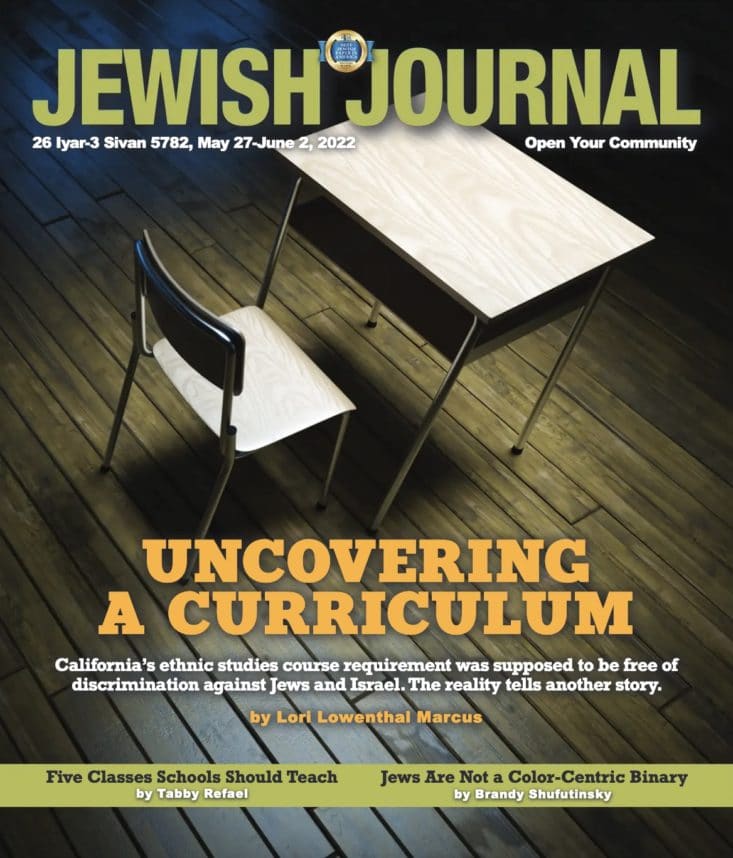
Print Issue: Uncovering a Curriculum | May 27, 2022

CLICK HERE FOR FULLSCREEN VERSION

Print Issue: Uncovering a Curriculum | May 27, 2022 Read More »

Sandra Caplan: Embracing Non-Jews Who Want to Be Jews

On May 29, the Sandra Caplan Community Beit Din will honor one of its founding rabbis and salute its 20th anniversary. Friends and some of the Beit Din’s 726 converts will gather at Leo Baeck Temple in tribute to Rabbi Jerrold Goldstein, one of the founders. He was the details maven.

The Beit Din is the only pluralistic standing rabbinic court for conversion in the world. It calls Shavuot “the holiday of choosing Judaism,” the day God gave the Torah to Moses.

Friends and some of the Beit Din’s 726 converts will gather at Leo Baeck Temple on Sunday afternoon in tribute to Rabbi Jerrold Goldstein, one of the founders. He was the details maven.

“We All Choose Judaism” is a Beit Din motto. The 128 rabbis in the system are from five streams of Judaism – Reform, Conservative, Reconstructionist, Transcendental and Renewal.

“Rabbi Jerrold is the one who knew how to put everything into practice,” said Muriel Dance, the Beit Din’s executive director. “Some are good at having ideas, but putting them into practice is more complicated.”

Dance called Goldstein a “builder” who brought innovative ideas to life. Working with fellow founders Rabbi Elliot Dorff and the late Rabbi Richard Levy, Goldstein wrote most of the group’s early documents, especially regarding standards, the operating principles and their application.

Goldstein is credited with shepherding the candidates and their sponsoring rabbis through the process. Dance said Goldstein, a 60-year veteran of the rabbinate, set up a way to convene three rabbis to sit on the Beit Din and developed a method for listening to candidates tell their stories.

A native Angeleno, Goldstein had a ready reply when asked about his main contribution. “I was a good note-taker,” he said before explaining his meaning.

In 1997, he and five other rabbis started meeting monthly to talk about a dream they had for conversion and structure on an unusually large-scale basis. “Out of those discussions the concept and then the principles emerged,” he said, for what became this Beit Din. 

Pluralism was their goal. “We all agreed that conversion ought not to be denominational or a single synagogue,” said Goldstein. “We are welcoming persons into the Jewish people. There are many paths in Judaism, historically and in contemporary life.”

Goldstein said his Hillel campus experiences – most recently at Cal State Northridge — led him to a commitment to pluralism.

“My job was to help young Jews find their path in Judaism, and then express it,” he said. “I was helping Orthodox Jews to be Orthodox. I was helping Reform Jews to be Reform. I was helping unaffiliated Jews – the majority – appreciate what it meant to be an engaged Jew and to include some kind of religious dimension in their lives.”

“I was helping Orthodox Jews to be Orthodox. I was helping Reform Jews to be Reform. I was helping unaffiliated Jews – the majority – appreciate what it meant to be an engaged Jew.“ – Jerrold Goldstein 

The 86-year-old Goldstein is proud he had the advantage of being raised in the open Jewish community that is Los Angeles. 

“This is a place where Jews find acceptance,” he said. “Nobody asks, ‘what denomination do you belong to?’”

The Beit Din was named for the late wife of the founding donor, George Caplan, who wanted to ensure “there is a place to embrace seekers of Judaism,” he said. ”[That] is a passion that gives meaning to my life and her memory.”

Dance said the Beit Din “is not about teaching a candidate one more thing. It is an opportunity to find out what called these people to our tradition. Of course, one question is, do they know enough to do Jewish? Another is, are their motivations authentic?”

A former university dean on numerous campuses, Dance is a close observer of the conversion candidates.

“We want to affirm them where they are,” she said. “We never ask a trick question. Our questions are open-ended. We want to find out what they know and how they have internalized what they have been studying.”

The Beit Din requires an Introduction to Judaism course or its equivalent before a candidate stands for conversion. “Some might say we are traditional in our standards,” said Dance. “Coming before a rabbinical court, men must have brit milah or a circumcision that has been affirmed, and mikvah immersion.”

Dance identified three kinds of candidates, along with children. There is a prospective spouse or partner of a Jewish person, “seekers, people who are soul-yearning for something that gives meaning, who understand there is something larger beyond human life” and people who find out they have Jewish heritage through DNA testing. 

Dance became familiar with the third group through Birthright because “they are very liberal in their interpretation of people they welcome on Birthright trips. “A young woman goes on Birthright because she has a Jewish parent, although she was raised by her Chinese mother. After Birthright she says she wants to reclaim her father’s Judaism now that she knows more about Judaism. So the mother and daughter studied together for more than a year, and then both came to the conversion mikvah.”

The pandemic did not interrupt the flow of conversion candidates. In the first year there were 46 and last year, there was a record 63 conversions.

While many candidates are coming because their attraction to Judaism has been affirmed by DNA tests, said Dance, DNA is much better at detecting Ashkenazim than Sephardic or Mizrahi Jews. Almost a quarter of conversion candidates are Jews of color.

The Beit Din has created a conversion mentor program to guide and guard new Jews down the highway of a different lifestyle after the ceremony is over. 

“Not everyone needs a mentor,” said Dance. “But a significant number of single people convert, and they do not have a built-in family for support.”

Dance grew up in Los Angeles but her career took her away for decades. When she returned, she explored four synagogues before settling at IKAR.  

“I began inviting people to sit with me at my congregation,” she said, “because it’s hard being a newbie.” 

Sandra Caplan: Embracing Non-Jews Who Want to Be Jews Read More »

A Classic of the Iraqi Kitchen: Curried Chickpea Sambusak

Many Shabbat afternoons of my childhood were spent at the Bondi apartment of my great uncle Nuri and his wife Auntie Tina. We were in Sydney, Australia but we may as well have been in the Middle East. The Hebrew and Iraqit (Judeo-Arabic) that flew across the room, the warmth and endearments, the jokes, laughter and heated backgammon games and the food all spoke to my family’s Middle Eastern origins.

Uncle Nuri was the beloved youngest sibling of my grandmother, Nana Aziza. He grew up in wealth and comfort in El-Azair, where my great grandfather was the keeper of the Tomb of Ezra the Scribe (and helped to supply the British Army when they occupied Southern Iraq after the fall of the Ottoman Empire). Nuri was tall and dignified, with a full sweep of black hair, piercing eyes and a prominent nose. He was deeply religious and one of the kindest men I have had the privilege of knowing. 

As a young man, he married Tina, the eldest of seven daughters from a wealthy family in Basra. Where he was tall and angular, she was short, with soft round features and the happiest, most smiling disposition. They had old fashioned manners and were so respectful and devoted to each other and their family. 

I still remember the food she served. Of course there was T’bit, aromatic stuffed chicken and rice cooked overnight. Lots of salads. Baba Tamar (crispy date cookies) and ka’ak (a savory, flaky cracker in the shape of a ring). Lots of nuts and dried fruits. And the one thing that Auntie Tina made the best — Sambusak bel tawa (chickpea turnovers). 

Imagine an Indian samosa but with meaty ground chickpeas and caramelized onion perfectly seasoned with cumin and curry powder surrounded by a fluffy, crispy dough.

They are just deep fried bites of heaven (and a historical testament to the way Indian spices and recipes impacted the cuisine of Iraq). 

The delicious complexity of the flavors is matched by the many steps involved in making the Sambusak. The chick peas need to be soaked overnight, mashed and seasoned. The onions need to be fried. The dough needs to be kneaded and allowed to rise. The turnovers need to be formed and then fried. A lot of work but kind of justified when the results are this spectacular. Chickpea sambusak are vegan-friendly, full of protein, fiber and antioxidants and just perfect for a snack, as an appetizer or a meal with a salad.  

The delicious complexity of the flavors is matched by the many steps involved in making the Sambusak.

After many years living in Sydney, Uncle Nuri and Auntie Tina returned to Jerusalem, where he was the beloved Chazan of his synagogue. When he passed away thirteen years ago, Auntie Tina moved to Ramat Gan, so she could be closer to her sisters, her daughter, her granddaughter and her great-grandchildren. 

Every time I visit Israel, my children and I spend an afternoon with Auntie Tina. She is still as sweet and smiling and full of blessings and endearments. By some miracle, her amazing Sambusak bel tawa still appears on the table, creating memories for the next generation. — Sharon

Chickpea Sambusak Recipe

Stuffing

1lb dried chickpeas

4 tablespoons olive oil

4 onions, finely diced

1 1/2 tablespoon curry powder

2 teaspoons ground cumin 

Salt and pepper

Wash the chickpeas and soak overnight in lightly salted water.

Place chickpeas and soaking water in a large saucepan. Cover with more water and bring to a boil. 

Reduce heat to medium and simmer half covered for an hour or until chickpeas are soft. 

Drain and reserve the water for the dough. 

Mash the chickpeas and set aside. 

In a large saucepan, heat the oil and sauté the onions until golden. Reduce the heat to low and add the mashed chickpeas.

Add curry powder, cumin, salt and pepper and mix well.

Dough

1 1/2 cups of unbleached all-purpose flour

1 teaspoon baking powder

1 teaspoon salt 

2 tablespoons olive oil

About 1 cup warm chickpea water

Oil for frying 

Mix together the flour, baking powder, salt and olive oil, then slowly add the chickpea water until the dough begins to bind and is stretchy. 

Cover the bowl and let the dough rest for 30 minutes. 

Roll out a small quantity of dough to 1/4-inch thickness. Using a 4-inch cookie cutter or glass, cut the dough into circles. 

Stuff each circle with one tablespoon of the chickpea mixture.

Dab water along one half of the circle and bring the other half over and close edge firmly to form a half moon shape. 

Repeat until you have used all the dough. 

In a large frying pan, warm oil over medium heat and add a few sambusak, leaving space for them to puff and expand. 

Fry until crisp and golden. 

Serve hot. 

Makes 36 turnovers  


Sharon Gomperts and Rachel Emquies Sheff have been friends since high school. The Sephardic Spice Girls project has grown from their collaboration on events for the Sephardic Educational Center in Jerusalem. Follow them on Instagram @sephardicspicegirls and on Facebook at Sephardic Spice SEC Food. Website sephardicspicegirls.com/full-recipes

A Classic of the Iraqi Kitchen: Curried Chickpea Sambusak Read More »

Skirball Exhibit Showcases Jewish Deli and Immigration History

Everyone has a deli favorite: chicken matzah ball soup, pastrami or corned beef on rye with lots of mustard, bagels and lox. But the deli is so much more than the food itself. 

In its new exhibition, “I’ll Have What She’s Having: The Jewish Deli,” the Skirball Cultural Center celebrates the delicatessen’s rich history, culture and legacy.

Co-curated by Skirball curators Cate Thurston and Laura Mart, with renowned writer and producer Lara Rabinovitch, a specialist in immigrant food cultures, “I’ll Have What She’s Having: The Jewish Deli” is joyous, communal and nostalgic.

“The exhibition explores how Jewish immigrants imported and adapted traditions to create a uniquely American restaurant,” Rabinovitch, whose PhD from NYU was about pastrami, told the Journal. “More than a place to get a meal, the Jewish deli is a community centered in food that demonstrates the important contributions immigrants have made to American society.”

And with a title like, “I’ll Have What She’s Having,” fun is clearly on the menu. The exhibition’s title comes from the movie “When Harry Met Sally.” It’s the hilarious line that concludes the memorable scene in New York’s Katz’s Delicatessen. 
“’I’ll Have What She’s Having’ is about sharing a meal, enjoying something,” Thurston said. “It’s an inside joke, if you get it, and it’s an offering to build community and share food, if you’re not familiar.”

Mart and Thurston started developing the idea for the deli exhibition in 2017. Skirball is always looking at ways to tell stories about immigration that highlight how the United States is a pluralistic society, Mart said. The duo did a research trip in 2019, where they traveled, looking through archives for unexpected objects to tell these deeper histories and eating at delis across the country. 

“We have contextualized these objects so that visitors can dive deeper into this history and the nostalgia and learn more,” Mart said. “Education is a big part of museum practice, and so we’re taking this opportunity to educate our visitors and the general public about Jewish history, food history and American history.”

“Education is a big part of museum practice, and so we’re taking this opportunity to educate our visitors and the general public about Jewish history, food history and American history.” – Laura Mart

The exhibition is organized into sections, thematic content modules that are like mini-exhibits. 

“Food of Immigration” features artifacts from the Skirball Museum collection. At the turn of the century, Jews brought candlesticks, knives, suitcases, passports and textiles, along with their hopes, dreams and foodways. “The Food” features a colorful display of food imagery and props, as well as helpful definitions of food terms and fun food facts. “Mid-Century Heyday” focuses on the period of the unparalleled growth for the American Jewish community and its delis in the mid-20th Century, and features deli and restaurant menus and matchbooks from that time. 

“No Substitutions” looks at the original characters, the people who own and work at delis. On display are vintage uniforms, implements from classic LA delis Factor’s, Canter’s, and Nate n’ Al’s, along with photographs and video interviews. 

“No Substitutions” is one of Mart’s favorite storytelling moments in the show.

“We have stories from some deli owners and workers, told through original interviews that we conducted, as well as some archival footage,” she said. 

Visitors are also invited to write down their go-to deli food or favorite deli memory and pin it up on a restaurant-style order line. 

“Who’s at the Table?” reflects on how immigrant-owned delis and their foods were woven into the urban American landscape, and embraced by Jews and non-Jews alike. It also reveals how ideas of Jewishness in the United States during the 20th Century were rooted in Central and Eastern European Ashkenazi Jewish culture.

“Survivor Communities” displays the stunning original neon sign that brightened the entrance to Drexler’s Deli in North Hollywood, which was owned and operated by Rena Drexler, a survivor of Auschwitz, and her husband, Harry. Delis were a lifeline for many of the 400,000 Holocaust survivors and refugees, who rebuilt their lives in the United States. 

“Pop Culture on Rye” explores why the deli continues to be used by Jewish creatives as a setting and a character in film and television. It features artifacts and photographs that explore deli nightlife, as well as a viewing station of deli footage in TV (“Curb Your Enthusiasm,” “Seinfeld,” “The Marvelous Mrs. Maisel”) and film (“When Harry Met Sally,” “At War with the Army”). 

“One of the most surprising finds is the image of Elvis Presley with deli employee Joe Guss at Glassman’s Deli and Market, Los Angeles, CA, 1969 (from the Bonar Family Collection),” Rabinovitch said. “Glassman’s Deli and Market, open from around 1930 to 1979, sold Jewish specialty foods. It was located on Western Avenue in Hollywood, next to an adult theater. Some scenes from Elvis Presley’s last movie, “Change of Habit” (1969), co-starring Mary Tyler Moore and Ed Asner, were filmed in Glassman’s Deli and Market.” 

“Shifting Landscapes,” which contains menus from eateries around the country, reflects on how delis have adapted to change over the years, whether that meant revising their menus, moving locations or closing due to health trends, real estate prices, family issues or business woes. This includes influences from Sephardic and Israeli Jewish cuisine, focusing on justice in running their businesses and of course adapting to the COVID-19 pandemic. 

Deli is a food of resilience, Thurston said.

“Even though the physical number of delis has dwindled since its mid-century heyday, it is a foodway and a cuisine that has just as much resonance now as it did in the past. It is something that brings people together and we find great joy and purpose in that resilience. I think that thread is really visible in our survivor stories, where we feature the stories of Holocaust survivors and refugees, both locally and nationally, and the delis they started and the communities they built.”

Both of the Skirball cafes have cooked up some specials specifically for this exhibition. Find cheese blintzes, potato knishes, tuna melts, New York cheesecake and more at Zeidler’s Café. Judy’s Deli’s offerings include hot pastrami and corned beef sandwiches, matzah ball soup, rugelach and black and white cookies.

“Our shop will also be featuring a selection of classic deli products like mustard and sauerkraut [and] Dr. Browns, so people will be able to scratch the food itch,” Mart said.

“I’ll Have What She’s Having: The Jewish Deli” will be on view at the Skirball through September 4, 2022. Watch for a variety of exhibition-related programming, including an outdoor screening this summer of “When Harry Met Sally.”

The Skirball is located at 2701 N. Sepulveda Blvd. in Los Angeles. Advance timed-entry reservations are required. For general information, call 310.440.4500 or visit skirball.org. 

Skirball Exhibit Showcases Jewish Deli and Immigration History Read More »

Table for Five: Bechukotai

One verse, five voices. Edited by Salvador Litvak, the Accidental Talmudist

I will grant peace in the land, and you shall lie down untroubled by anyone; I will give the land respite from vicious beasts, and no sword shall cross your land. 

-Lev 26:6


Denise Berger
Freelance writer 

These blessings are among a series promised in reward for following the mitzvot. Apart from brief periods of peace, this particular grouping has never actually come about. 

The conventional explanation would be that the Jewish people have not yet fulfilled the mission. And while this interpretation is technically true, it also doesn’t match our experience of G-d. Just a few weeks ago, the parsha admonished us not to put a stumbling block before the blind. Surely, if G-d doesn’t want us setting people up to fail, He wouldn’t do that to us. He wouldn’t purposely dangle a blessing that He knows will elude us for thousands of years, just to get us to “try harder.” Hashem is not mean. 

So often in life, when we encounter something that feels inconsistent, we derive the most cynical conclusions. There can be such a strong tendency to believe the worst: About others’ intentions, about the meaning of events, about the world in general, and G-d. Maybe when there is a part of the Torah that feels “off” in some way, it’s preparing us for just those situations. When faced with something that goes against all the good we know about a person, (or about Hashem), maybe step back, and reflect on the relationship and the bigger picture. Believe the goodness and the love which we know unequivocally to be true, and set the rest aside. The goodness and the love can assure us that in time, the confusion will make sense. 


Rabbi Abraham Lieberman
Judaic Studies, Shalhevet H.S.

While most commentators look at the verse as referring to some kind of universal peace, the Sifra (quoted by Rashi) derives from this verse the well-known point that peace is the ultimate blessing. Ramban (1194-1270) indicates that the verse is to be understood as the peace between us, each other, learning not to fight and argue, one against the other. 

The deeper lesson would be the ultimate dream of real Achdot, unity amongst brothers. As we study our Tanach, we constantly find brothers fighting with each other, always with sad results (Cain-Abel, Isaac-Yishmael, Jacob-Esau, Joseph and the brothers). Only two brothers in Torah don’t fight and get along with each other, Ephrayim and Menashe, and that is the reason why we invoke their names as we bless our children on Friday nights. As the verse states: “By you, shall Israel invoke blessings, saying: G-d make you like Ephrayim and Menashe” (Breishit 48:20). 

Rabbi S.R. Hirsch (1808-1888) develops Ramban’s point even further. In his commentary he writes: “As a result of the spirit of contentment and harmony among the people, and their mutual joy in each other, the nation’s communal life will be blessed with tranquility.” Contentment comes about with an “inner peace” when we have reached a point of selflessness and realize our responsibility towards the greater whole, of which we we are only a part. The utopian peace we all desire and pray for should be a reachable goal.


Rabbi Chaim Singer-Frankes
Chaplain, Kaiser Permamente, Panorama City

God vows that a magnificent “peace” will be ours. Textually it forms the apex of superb things vouchsafed for being in league with God. Reading it so frequently (in the prayer for peace before Mussaf), I am comforted; it sounds like Nirvana. I chant fervently, with inspired and rousing tunes, that these things be manifest in our time. Regarding “neither shall the sword pass through your land,” Rashi (11th – 12th century France) teaches “not even armies pursuing war in other lands will pass through your land.” To me, this version of “peace” sounds like some sort of Starship Enterprise; both the people and the land Yisrael will enjoy God’s exclusive forcefield of protection. But Torah is not a fantasy show. Were this passage the only one, it truly would be a different world. However, our relationship with God is a marriage, a covenant. Covenants are conditional pacts. 

Coming from God, I have no doubt that the vow can be manifest, true, and completely possible. Just as this passage is the zenith of terrific things which we will enjoy in a heaven-on-earth scenario, so too it is followed by a series of warnings; the quintessential “if.” If we do not adhere to our end of the covenant, then God is free to take vengeance as is fit, and God decides what is fit. Therefore, by mandating a just and holy society — fulfilling promises in partnership with God — we can dispel any darkness threatening the world, a task we can achieve.


Nina Litvak
AccidentalTalmudist.org

In this week’s Torah portion, God describes the good that will happen to us if we follow His laws and commandments. He promises that we will be blessed with rain, produce, and bread — things necessary to sustain life. But God wants us to do more than just survive. He wants to give us the ultimate blessing: peace (shalom.) Rashi says that peace is equivalent to everything else. As it says in our morning prayers, “Blessed are you… who makes peace and creates everything.”

Shalom is a word with multiple definitions. In this verse, it seems to mean going to bed without worrying about being killed by a vicious beast or sword. We live in a society that is filled with strife, and crime is at record highs. Yet for most of us in America, we can sleep without fear of imminent attack. It’s a luxury we take for granted, but for many people throughout human history, and tragically in some countries today, people go to bed in fear. 

It’s ironic and sad that while people in Ukraine — and Israel — need bomb shelters, here in America, we actually keep ourselves awake at night. Insomnia and sleep aids are at an all-time high. I often struggle to fall asleep as my mind races through things to be anxious about. This verse teaches me that going to bed without fear of being killed is a gift from God. Instead of worrying about my problems, I should lie in bed and be thankful.


Kylie Ora Lobell
Community and Arts Editor, Jewish Journal

This parsha is pretty clear: If the Jewish people follow the commandments, then they will experience peace in the land of Israel. If they do not, they will be cursed. But unlike the Jews in the Torah, we do not have a crystal-clear view these days of which of our actions lead to blessings and which to curses. A bad thing that happens to us could actually be a good thing, and vice versa. 

We are also taught that everything Hashem does is for the good. This is an extremely difficult concept to grasp, especially when attacks are happening every day in Israel. The conclusion I’ve reached over the years is that while we think we may have clarity, we don’t. 

We don’t see the bigger picture. We don’t know how everything ties together. When our redemption comes, we will gain a better understanding of why things happen. Why things are the way they are. For now, we must do our best to follow the commandments. We must do the right thing, even when it’s the harder thing. And above all else, we must trust in Hashem, even when it feels like we’re experiencing curses. It’s the only way that we will truly be able to experience peace. 

Table for Five: Bechukotai Read More »

California’s Ethnic Studies Curriculum is Hiding Its Anti-Jewish and Anti-Israel Teachings

As a lawyer who represents people who have been discriminated against in educational settings because they are Jewish or pro-Israel, I followed California’s ethnic studies saga for years. I remember the cheers and collective sighs of relief when the original version of California’s A.B. 101 was yanked, and Governor Newsom announced that the antisemitic and other biased material in the original version would “never see the light of day.” 

Those celebrations were premature. It appears now that the proponents of the earlier version, the folks peddling “liberated ethnic studies,” twisted the Governor’s words into a strategy for infiltrating the same anti-Jewish material into California’s public schools. They are injecting that material into the schools in a way that is hard to see by ordinary observers — by stealth. By going “below the radar,” they are shielding that material from “the light of day.”

This is what we at The Deborah Project, a public interest law firm, discovered through documentary research and interviews of dozens of parents, teachers and other education advocates.  We have now launched a legal challenge in federal court in Los Angeles: Concerned Jewish Parents and Teachers of Los Angeles v. Liberated Ethnic Studies Model Curriculum Consortium, et al. 

Our lawsuit seeks to expose the use in Los Angeles public schools of the same hateful teaching materials previously rejected by Governor Newsom, materials that denounce Zionism as white supremacy and Israel as a “white,” “western” and “colonialist settler” state founded and defended through apartheid and the commission of genocide. This material also falsely instructs students that attacking the Jewish state is not antisemitic because Judaism and Zionism are completely ‘distinct.”

Our lawsuit seeks to expose the use in Los Angeles public schools of the same hateful teaching materials previously rejected by Governor Newsom.
We do not intend to allow these educators to evade the law by counseling ideologically-aligned teachers to conceal what they’re doing, and so our case also seeks to enable Californians to learn what’s actually being taught by the proponents of these materials.

Let me explain what we’re doing, why we’re doing it, and how we got here.

Jesse M. Fried, a Harvard Law School professor, started The Deborah Project (TDP) after he’d witnessed increasing hate and violence directed at Jews in universities and other academic settings over the past two decades.  TDP’s mandate is to defend students, teachers, and university faculty in the United States facing harassment and persecution because they are Jewish or pro-Israel.  It uses legal tools to expose and resist efforts to demonize Jews and Israelis in universities and other academic arenas.

TDP’s mandate is to defend students, teachers, and university faculty in the United States facing harassment and persecution because they are Jewish or pro-Israel.  

TDP filed our Liberated Ethnic Studies case after Fried learned of an effort by the Los Angeles Teachers Union to pass an anti-Israel BDS (boycott, divestment and sanctions against Israel) measure in the wake of Israel’s conflict with Hamas in the Spring of 2021.  The language of the proposed resolution wasn’t just one-sided.  It was full of mistruths and nontruths, all of which were used as springboards for broadsides against the lone Jewish State.  It asserted that the Israel Defense Forces had unleashed on Gaza “an intense campaign of bombing and mortar fire” and mentioned the numbers of Gazans who were killed or wounded. But it ignored the thousands of missiles Hamas launched at Israel before there was any Israeli military response and it was completely indifferent to the death of Jews — a topic about which the resolution was entirely silent.  

The resolution also claimed, falsely, that “1500 Palestinians in Jerusalem” were facing “displacement and home demolitions.” The resolution’s supporters accused Israel of committing apartheid and genocide against the Palestinians. Of course, the numbers belie such oft-repeated claims. There has been no genocide; indeed there are far more Palestinian Arabs in and around Israel than ever before. And apartheid? The ruling coalition in Israel’s Parliament contains a faction made up only of Palestinian Arabs.  Israeli courts, police departments and its diplomatic corps are also populated with Palestinian Arabs.

The Union’s hostility goes far beyond opposition to the Jewish state, as evidenced by the fact that it placed Dr. Melina Abdullah on a joint Union-LA School District committee on Ethnic Studies.  Asked to condemn shouts of “F**k the police and kill the Jews” during BLM riots in 2020, Abdullah pointedly refused, insisting it was “an uprising, a rebellion, a revolt.” Abdullah also tweeted her distaste for American Jews, echoing other haters: “we must dismantle patriarchy! specifically jewish patriarchy offending muslims & controlling our economy & campuses” and “more & more jews invading campuses, causing islamophobia, racism & intolerance!”  That people who regularly make statements of this nature are given the authority to decide how to teach Ethnic Studies in LA’s public schools should concern everyone.

The union’s BDS resolution was withdrawn, at least for now, as a result of widespread outrage at its one-sided support of Hamas violence and indifference to the threat Hamas posed to Jewish lives. But our work on that issue led us to another product of the same hostility to the Jewish state:  The Liberated Ethnic Studies Model Curriculum Consortium (LESMCC), a group dedicated to implementing the original Ethnic Studies curriculum that was vetoed by Governor Newsom.  Filled with denunciations of the Jewish state and Zionism, the LESMCC issued a press release on the Gaza war which was essentially identical to the Union’s, ignoring the Gazan rockets into Israel and disregarding the death and maiming of Israeli civilians. The Consortium also slapped back at California’s government and its citizens for revising the earlier version of A.B. 101, while revealing its determination to put back into the public schools’ curriculum exactly what had been removed by California lawmakers. In their own words: 

“Finally, as educators, it is our responsibility to do what others will not, to teach truth. The refusal to acknowledge Palestinian history and human rights by those in government and by the media mirror the actions taken by the California Department of Education when it rejected inclusion of Palestine in the California Ethnic Studies model curriculum. This week’s events make it crystal clear why our students need to learn about Palestine. In this light, we refer you to our colleagues at teachpalestine.org for support in curriculum and resources on Palestine and how to bring Palestinian voices into your classrooms.”

The contact information on the Consortium’s press release is Dr. Theresa Montaño, one of the defendants in our case.

After discovering the Consortium’s press release, we learned about the Liberated curriculum itself, which seeks to carve hostility to the Jewish state into the minds of California public school children. We also came in contact with a number of Jewish parents and teachers who were deeply concerned about the campaign to teach anti-Israel sentiments in LA’s public schools.

We also came in contact with quite a number of Jewish parents and teachers who were deeply concerned about the campaign to teach anti-Israel sentiments in LA’s public schools.

The Consortium prepares, disseminates and trains teachers on how to teach Ethnic Studies in California.  Its lesson plans and teachers’ manuals claim that Israel is a “white” and “settler colonial state” — that is, the Jews are not indigenous to the Middle East and have no connection to the land of Israel.  And with that falsehood as a foundation, they teach that Arabs are among the four favored “racialized” groups, because they are Asians and Pacific Islanders — that is, because they originate in Asia (which the Consortium seems to think embraces the region of the world usually called the “Middle East”).  But Jews who’ve lived in the same places as Arabs for millennia don’t fall in that special category. Jews, apparently, all originated in a shtetl in Eastern Europe. Because this is how the Consortium wants to teach Ethnic Studies, it should be no surprise that, as the parent of a LAUSD student told me while I was doing research for this case, when his daughter asked why there was no mention of antisemitism in an ethnic studies discussion, she was reprimanded by the teacher: “that’s not what this is for.”   

The Consortium’s lesson plans and teachers’ manuals claim that Israel is a “white” and “settler colonial state” — that is, the Jews are not indigenous to the Middle East and have no connection to the land of Israel. 

You should know that the Consortium doesn’t only malign or exclude Jews from its ethnic studies curriculum. The advocates of liberated ethnic studies insist that it must be based in “critique[ing] empire, white supremacy, racism, patriarchy, cisheteropatriarchy, anthropocentrism, and other forms of power and oppression at the intersections of society.” It asserts this position in contrast to what the California legislators decided to include in place of such language, which the liberated proponents flatly reject: “Promote critical thinking and rigorous analysis of history, systems of oppression, and the status quo in an effort to generate discussions on futurity and imagine new possibilities.” In other words, the LES folks don’t see ethnic studies as having as its goal a positive future for all.  Their goal for ethnic studies is to create a forum for some previously excluded groups to call out and punish those whom they view as “oppressors” and ignore — or worse — any other groups which don’t fit their victim template.

The Deborah Project doesn’t believe this negative weaponization of ethnic studies should be acceptable for any group whom those proponents denounce or ignore, but the plaintiffs we are representing in this case are Jewish parents and teachers. 

The first step taken by the liberated ethnic folks to harm our plaintiffs and all Jews, is to disaggregate Israel from the Jews, insisting that they are unrelated, that Judaism is distinct from Zionism.  Once you’re convinced that the Jews have no roots in the land of Israel, you need another reason to explain what they are doing there now.  The Consortium solves this problem by drawing on its deep well of hostility to Western civilization, explaining that the Jews’ presence in Israel is an exercise in Western imperialism, and so an exercise of power by white people over people of color.  The measures Israel takes to defend its citizens (all of its citizens, one might point out, if one actually wanted to understand reality, including the 20% who are Arabs) from the efforts to eliminate them are thus transformed into “genocide,” “apartheid” and “ethnic cleansing.”  If this is where you start, it’s no surprise that the end result was a public LA Teachers’ Union seminar on how to teach Ethnic Studies at which Palestinian advocate Celine Qussiny taught the teachers that “we have to always be confronting Zionism.”  Qussiny went on to explain that when she’s talking about Zionism, she’s “talking about a political, settler-colonial ideology that justifies ethnic cleansing of the Palestinians from their central homeland,” and described Israel as a “fascist dictatorship.”

All of these ideas are incorporated into the Liberated Ethnic Studies Model Curriculum.  This is what that Consortium wants your kids, and all kids, taught about Israel, starting in pre-kindergarten.  When those kids grow up and are shown pictures of children someone claims were killed by the Israeli army, what reaction do we think those children will have?  How much evidence will they need to collectively convict the Jewish State and Jews?

One of the key claims of Israel’s opponents, including the Consortium, is that they oppose only Zionism and not Judaism; they say the two are “distinct,” so it’s not antisemitic to oppose the existence of the Jewish state. This idea is a common justification for hostility to Israel—it showed up recently, for example, at the Harvard Crimson, where the claim was made that endorsing “Palestinian liberation is not antisemitic.”  That’s why a linchpin of our case is the sincerely held religious belief of our clients — the Jewish belief in, and commitment to, the return of the people of Israel to a free and sovereign existence in the land of Israel.  This is what Daniel Patrick Moynihan explained long ago when condemning the UN’s despicable, and since-repealed, resolution denouncing Zionism as racism — that Zionism is the national liberation movement of the Jewish people.

One of the key claims of Israel’s opponents, including the Consortium, is that they oppose only Zionism and not Judaism; they say the two are “distinct,” so it’s not antisemitic to oppose the existence of the Jewish state.  

Though advocates of Liberated Ethnic Studies claim the right to define both Judaism and antisemitism, they seem ignorant about both.  Our case details how the commitment of the Jewish people to their return to Zion is manifest throughout the Jewish bible, its oral law, its prayer books and its calendar.  And that’s true across all Jewish denominations, not just the Orthodox.  The Reform movement’s official platform, for example, is wholeheartedly committed to the State of Israel.  It states:

“We believe that the renewal and perpetuation of Jewish national life in Eretz Yisrael is a necessary condition for the realization of the physical and spiritual redemption of the Jewish people and of all humanity. While that day of redemption remains but a distant yearning, we express the fervent hope that Medinat Yisrael, living in peace with its neighbors, will hasten the redemption of Am Yisrael, and the fulfillment of our messianic dream of universal peace under the sovereignty of God.”

The Reform siddur includes the blessing for the State of Israel as “reishit tsmichat geulateinu” – “the beginning of the flowering of our redemption.”  

No one can speak for every single Jew in the world—not even Moses was up to that job.  And our case certainly doesn’t presume to take on such an impossible task.  But the broad consensus among Jews that the existence of a Jewish state of Israel is a good and even necessary thing reveals just how dangerous is the falsehood that one can propose to eliminate the Jewish state without meaning to attack the Jews.  After two thousand years of wandering the planet, and having absorbed the disastrous consequences of Jewish weakness and dependence on the kindness of strangers, most Jews know that the Jewish people needs a room of its own, at least one small place where they can be a free people in their own land.  Denouncing that aspiration, or libeling it, is an attack on Jewish peoplehood and on Jewish people — actual flesh and blood people who will get hurt or die if the Jewish state does not defend them and their aspiration to live as Jews.  That’s why it’s no coincidence that the people who claim to be outraged about Israel’s defense against the terror rockets from Gaza took out their anger on Jews.  Not Israelis and not even Zionists.  Just Jews.  Remember last year’s attacks by Palestinian flag-wielding thugs on Jews dining at a Sushi restaurant? Before attacking, the thugs demanded to know “who are the Jews?”

In a backhanded way, the Consortium folks acknowledge that all Jews are Zionists — at least Zionist enough to be categorized as bad.  As part of its effort to defeat attacks on its curriculum, the Consortium warns that its enemies—whom it refers to as Zionists—include organizations such as the Anti-Defamation League, the Jewish Federation, the Jewish Community Relations Councils, and even the Simon Wiesenthal Center, not to mention organizations such as the Zionist Organization of America. People who actually are Jews know that there’s a very wide space between the ADL and the hawkish ZOA. But for the Consortium, all Jewish organizations look alike.

In a sense, the Consortium is right: Virtually all Jewish organizations do support the existence of the Jewish state.  What the Consortium fails to accept is that this is so because, throughout the Jewish canon, customs, holidays, and history, the yearning of the Jewish people for sovereignty in the land of Israel is built into the DNA of Judaism.  

As a legal matter it’s certain that what’s required in our case is a sincerely-held religious belief, which our clients in this case hold, in the idea of Zionism. Our case demands that publicly-funded California teaching materials not denounce that belief, any more than such publicly-funded materials would denounce as racist or apartheid the Muslim commitment to the holiness of Mecca and Medina, and so too the principle of sharia law that denies entrance to that city to any non-Muslim, or the imposition of sharia law by dozens of officially Muslim countries.

As a practical matter it’s hard to see what innocent explanation there can be for the Liberated curriculum’s obsession with Israel, while ignoring countries where slavery is legal; where kleptocratic dictators leave their people starving; where the internet is closed and people are force-fed a restricted diet of state-generated propaganda; or where children labor and die in mines.  

Indeed, it’s hard to see quite a number of things about the Liberated Curriculum’s teachings about Israel and Zionism, because the Consortium has taken active steps to hide these elements from the public. Much of the evidence we have quoted is gone from the website. The press release issued last spring condemning Israel is gone; also gone from the website is anything to do with teaching about Palestine/Israel, including lesson plans. That’s why it’s hard to learn not only what they say about Israel and the Palestinians but also where they obtained these so-called facts.  Our research also reveals that their teaching materials are verbatim copies of documents found at teachpalestine.org. That material, also since vanished from its website, was prepared by an organization called the Middle East Children’s Alliance, which is aligned with the Popular Front for the Liberation of Palestine — a designated terror organization committed to the destruction of the Jewish state.  This is the source of the material that the Liberated Ethnic Studies Model Curriculum Consortium wants taught to California public school children about the Jewish state.   

It’s hard to see quite a number of things about the Liberated Curriculum’s teachings about Israel and Zionism, because the Consortium has taken active steps to hide these elements from the public.  

The Consortium tells teachers they may encounter resistance to teaching from such materials. To avoid resistance, their materials encourage: “Be strategic!” The Consortium asks these teachers, “Is your administration likely to be supportive if you tell them about your plans [to teach from Liberated Ethnic Studies]? Or are you better off flying under the radar or growing strong enough as a group to pressure them?” Use as your role models “other teachers who shut their doors” so that they can “teach their students liberatory curriculum.”

All of this is illegal under California law, but it’s also a slap in the face to all California parents and teachers who pay for and use California public schools.  The counsel of secrecy is a direct attack on the right of parents and the public to know what’s being taught in their schools.  What would make anyone think that was appropriate? One can imagine, of course, a teacher feeling the need to conceal a child’s personal situation — perhaps a pregnancy, or a decision about sexual identity, or a history of having been attacked — from a parent who is believed to pose a threat.  But this LESMCC secrecy is simply to enable the teacher to put the teacher’s own ideas into the heads of her students without any involvement, or “interference,” from parents who might want to know what their children are being taught. 

There is no justification for such secrecy, which is why the other relief we want from the court — other than a ban on teaching materials that denounce our clients’ sincerely-held religious belief — is an order requiring public release of these materials, and barring teachers from hiding what they’re teaching Los Angeles public school kids.

When the Ethnic Studies law was first proposed, the Liberated Ethnic Studies folks drafted a curriculum that included every single one of the anti-Israel and anti-Zionist ideas laid out here, along with the calumny that because Judaism and Zionism are separate, it’s not antisemitic to attack the Jewish state.  That draft produced a firestorm, led by Jewish legislators and leaders of the California Jewish community, along with non-Jews who know hatred when they see it.  That draft was rejected, and the law as enacted explicitly forbids the inclusion of such ideas in California’s schools. And yet here are the same people trying again to include exactly what was ruled out.

The Liberated folks know that what they want to teach is unpopular as well as officially barred from public school classrooms.  But they want to teach it anyway, and they’re prepared to go under the radar to achieve their goals if they think that’s what it takes.

This explains the secrecy. The Liberated folks know that what they want to teach is unpopular as well as officially barred from public school classrooms. But they want to teach it anyway, and they’re prepared to go under the radar to achieve their goals if they think that’s what it takes.

They can’t be allowed to succeed.

Many people have become aware of how hostile to Israel college campuses have become. And that’s before California’s public school kids are fed a curriculum with nothing but one-sided attacks on the world’s only Jewish state. If you think things are bad on college campuses now, just wait for the campuses to be filled with a generation of California public school kids educated in discrimination against Israel, Zionism, and any Jew who believes in those things. That’s a lot of Jews to hate.  

That is what our case is meant to stop.


Lori Lowenthal Marcus, Esq. is Legal Director at The Deborah Project. 

California’s Ethnic Studies Curriculum is Hiding Its Anti-Jewish and Anti-Israel Teachings Read More »