fbpx

April 21, 2022

A Short Update on My Recovery

Some (good) updates because it’s been a few weeks…

1. Saw the doctor today and the incision on my throat is healed enough that I don’t need to cover it anymore; I can shower without bandaging it or even bathe or SWIM for the first time in months!

2. It’s been long enough for both my artificial (lumbar and cervical) discs to heal, that I’m FINALLY cleared to safely start physical therapy. I’ve never been so happy to do exercise! I’ve gained 16 pounds thanks to all of this sitting around, and inability to start the exercises (other than daily walks), and the only way I’ll know how I feel with these discs is by actually using them, so I’m really excited to get started!

3. I’m allowed to start driving as soon as I don’t feel drugged anymore, and one more week on this gabapentin and I’ll be allowed to stop taking them FINALLY. It’s been months of feeling drowsy much of the day, and inexplicably wide awake late at night. So I can’t wait to feel clear headed AND be able to drive myself around again! (This is by far the longest I’ve gone without driving since I got my permit at 15.)

4. As a nurse, my hospital requires me to be back to 100% full capacity without restrictions to return to work. My goal and plan that we are confident about is to get me back there late August, unrestricted. I also really look forward to being able to play sports again; I haven’t been able to play tennis in over a decade or softball in over 5 years.

Now let’s will all of this into reality!

A Short Update on My Recovery Read More »

Pro-Palestinian Protesters Chant “Long Live the Intifada,” “We Want All ‘48‘” in Front of LA Israeli Consulate

A group of pro-Palestinian protesters chanted anti-Israel slogans like “Long live the Intifada” and “We want all ‘48” in front the Consulate General of Israel in Los Angeles on April 21.

The protest was billed as a rally to “Defend Al-Aqsa” and “Defend Gaza.” There has been ongoing clashes between Israeli authorities and Palestinian rioters at the Al-Aqsa; the Israel Defense Force also struck various Hamas locations in retaliation for rocket fire launched from the Gaza Strip toward Sderot on the evening of April 20. Israel holds Hamas responsible for any rocket attacks from Gaza.

In addition to chants of “Long live the intifada” and “We don’t want no two states, we want all ’48,” the protesters also chanted “Free the people, free the land, justice is our demand, no peace on stolen land.”

Jewish groups condemned the chants.

“ADL [Anti-Defamation League] is committed to the right to free speech and the right for citizens to criticize ruling government bodies,” ADL Los Angeles Regional Director Jeffrey I. Abrams said in a statement to the Journal. “This applies even when we don’t agree with the criticism of Israeli policy. However, all too often criticism or condemnation of Israel allows antisemitism to seep into the mainstream, including traditional antisemitic imagery or stereotypes, blaming all Jews for the actions of Israel, or denying or questioning Israel’s right to exist – and this we cannot and will not accept.”

American Jewish Committee Los Angeles Regional Director Richard S. Hirschhaut similarly said in a statement to the Journal, “The bedrock American principle of freedom of speech assures even the most incendiary voices a platform. As it should. But how unfortunate and sad that those gathered outside the Israeli Consulate today chose to use that opportunity to call for the destruction of the Jewish state. If there is to be an ultimate resolution of the Israel-Palestinian conflict, such venomous appeals must give way to genuine partners who envision a day when Israelis and Palestinians may live in peace. The vitriol spewed by the ragtag collection of activists today may give them a sense of satisfaction, but it does nothing to advance the interests of those they profess to care about or the cause of peace.”

StandWithUS CEO and Co-Founder Roz Rothstein also said in a statement to the Journal, “Chants like ‘Long Live the Intifada’ and ‘From the River to the Sea, Palestine will be Free,’ are deadly slogans that encourage violence and murder. They are not calls for peaceful coexistence and never have been, and are certainly not supportive to the Palestinian people.  Instead of calling for more bloodshed, we hope that one day soon Palestinian leaders will accept Israel and call for peace with their neighbor, because Israel is not going anywhere. Imagine what real peace would mean for the region.”

A similar protest took place in front of the Israeli consulate in New York, with chants of “From the river to the sea Palestine will be free” and calls to “globalize the Intifada.” Advertisements for the event called for “resistance by any means necessary,” according to Jewish News Syndicate (JNS).

“We witnessed in the past weeks how these kinds of statements incited violence in the Middle East,” Itay Milner, the consulate’s spokesperson, told JNS. “Now, some people want to bring the same violence here to New York City.”

Pro-Palestinian Protesters Chant “Long Live the Intifada,” “We Want All ‘48‘” in Front of LA Israeli Consulate Read More »

Ahavat Torah Is Teaching Torah to Women Prisoners

In 1986, Linda Badger was convicted of murdering her husband. She maintained that she was innocent and received a Federal court ruling in 1997 recommending a pardon based on a miscarriage of justice. However, it would be another 17 years before she was released on parole. 

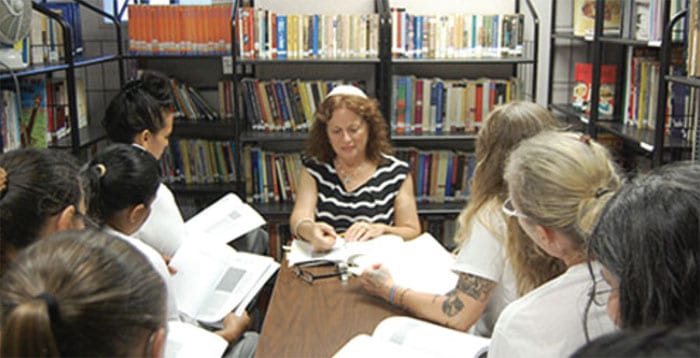
During her time behind bars, Badger, who is Jewish, learned Torah with volunteers, including Rabbi Miriam Hamrell of Ahavat Torah Congregation. Together, with other Jewish inmates, they would celebrate Shabbat, Rosh Chodesh and Jewish holidays, hear about Talmudic teachings and take classes on ethics and justice. 

“The volunteer teachers brought their own special skills, and each one, in a different way, prepared us to make the most of our lives while in prison,” said Badger. “[We’d think] about the challenges when we were released so that we would know how to adapt in positive ways to the free world.”

When she was released in 2014, Badger joined Ahavat Torah, where she has been executive director for five years. At the synagogue, she’s organized clothing drives for homeless veterans and toy drives for children with parents in the military. She also created the synagogue’s Holocaust tent for a Jewish World Watch fundraising walk.  

“In Judaism, we are taught to take care of the stranger, the widow, the orphan, the hungry and those who are oppressed,” Badger said. “I am always seeking out additional projects or programs which will translate these Jewish ideals into action.”

Hamrell began volunteering at the prison 14 years ago at the encouragement of Shayna Lester, Ahavat Torah’s current president who was the Lead Volunteer Chaplain at the prison under Rabbi Moshe Halfon. Twice a month, Hamrell would drive four hours round trip to teach and learn with seven to 30 Jewish women there. 

It was important for the rabbi to make the trek, she said, because “for these women to be able to become functioning, loving and contributing members of the Jewish community once they got out of prison, they needed to know and feel and experience that we support them, even in the hell hole they were experiencing in prison. It’s a hell hole of no freedom: no freedom to speak, no freedom to act.” 

When Hamrell arrived at the prison, she would guide them spiritually if they came to her for advice as well as teach them Talmud and how to solve problems.  

“The way of the Talmud is that there is more than one way of solving an issue, even with your rival,” she said. “Many of the women are incarcerated because they thought or felt that there was only one way to resolve a situation. The Talmud shows them there are many ways to resolve it, and we have to take all angles into account.”

Hamrell is so dedicated to helping the women and teaching them Talmud that one time, Badger recalled how she bought a new wardrobe just to get inside the prison. 

“Volunteers were not allowed [to wear] the [same] color clothing that the inmates had [on],” said Badger. “Once, the rabbi came, and the guards would not let her in because of a blue line in her dress. She went to the local Kmart store, bought a $5 dress off the rack, went into the dressing room and changed her clothes. She returned to the prison where, now, she was allowed to enter. Keep in mind that for most volunteers, the round trip to and from the prison was about 100 miles.”

Since the volunteer program started, several other inmates aside from Badger have become members of the synagogue. One of them was Terri Scrape, who got out after 33 years behind bars for a crime she said she didn’t commit, according to Lester. Scrape, who has since passed away, rose to become the president of Ahavat Torah.

“It’s an opportunity to engage in something that they might have lost and now, they want to reconnect. That has to be supported. That is teshuva.” – Rabbi Miriam Hamrell 

Though serving time is incredibly difficult and heart-wrenching, Hamrell said that there was a chance for the women to look inward. “They could feel connected to their Jewish roots and would not feel forgotten. They could think, ‘Maybe God is giving me the time to look into my roots.’ It’s an opportunity to engage in something that they might have lost and now, they want to reconnect. That has to be supported. That is teshuva.” 

This past Purim, Ahavat Torah celebrated the holiday with a party and honored the rabbi, as well as several congregants, who volunteered at the California Institute for Women over the years. They were presented with certificates from the Mayor’s office, Congressman Ted Lieu and Senator Dianne Feinstein for their work. 

Since COVID struck, the volunteer program has been put on hold, but according to Lester, they want to resume it again. 

“We hope to begin to be able to go back in with special programs again as soon as it is deemed safe with COVID,” she said. “We are highly involved in social action and believe, as a synagogue, this is one way we can help in tikkun olam. We have seen over the 16 years the healing that has taken place for the women and for the volunteers involved.”

When COVID is more under control and it becomes safer to go, Hamrell encourages other rabbis and Jewish men and women to volunteer with inmates.

“They are good human beings who have done something wrong,” she said. “Their neshama has to be fanned with some oxygen from the outside world. Each one of us has a little flame of God within us. We need to show them they are not forgotten. We need to show them the way to connect with their own godliness and come back to the path of righteousness.”

Ahavat Torah Is Teaching Torah to Women Prisoners Read More »

New Book Explores Cold Case Murders at a Jewish Farming Colony in Argentina

On June 9, 2009 Javier Sinay, a Jewish Argentine journalist, received a startling email from his father, who had just discovered that his grandfather — Sinay’s great-grandfather — had written an account of gruesome crimes against Jews. 

In an article published in Yiddish in 1947, Mijl Hacohen Sinay, Sinay’s great-grandfather, wrote that between 1889 and 1906, twenty-two Jews were murdered in an Argentine area that had been heavily colonized by thousands of Jews who had immigrated from Czarist Russia in the late 1800s. 

The murders, described in gory detail, were the stuff of nightmares. One involved the deaths of three members of one family; another, the dismemberment of a young woman who had apparently been raped. According to the 26-page exposé, the alleged perpetrators of these murders were gauchos, the Argentine version of rootless (and occasionally violent) cowboys, and no one, the article said, was ever arrested or held accountable for these crimes.

Naturally, this more than piqued Sinay’s reporter’s instinct, and he began investigating. The years that followed the initial email from his father changed Sinay’s ideas about his family, about the Jewish farming colonies, and about his connection to his Jewish heritage.

“The Murders of Moisés Ville: The Rise and Fall of the Jerusalem of South America” is an account of Sinay’s investigations into the murders. He tells us of his struggles to locate documents, to learn a bit of Yiddish, about his trips to Moisés Ville and about his conversations with locals at that village, as well as with historians and descendants of colonists. (Moisés is Spanish for Moses.)

The reader looks over Sinay’s shoulder during the twists and turns of his research, which goes back and forth in time and involves many threads.

On April 4, 2022 in a Zoom webinar hosted by the Center for Jewish History, Sinay discussed his investigations into the murders his ancestor wrote about. The event was timed to coincide with the publication of his book’s English translation.

Sinay said his research was complicated by the fact that these were very cold cases. Another barrier was that many of the documents were in Yiddish, which Sinay “did not understand a word of” when he started his research.

Moreover, as Sinay mentioned in his talk, many of the materials had been housed at AMIA (Argentine-Israel Mutual Association), the Jewish organization in Buenos Aires whose headquarters was bombed in 1994, a terrorist act that took many lives and also destroyed books, publications and other records. 

Sinay said that at the time he started his research, he had only a vague notion that his great-grandfather was a journalist who, as a young man in 1894, immigrated to Argentina and settled in Moisés Ville, a Jewish farming colony several hundred miles north of Buenos Aires. 

As Sinay delved into his research, he learned that his great-grandfather started the first Argentine Yiddish publication, in 1897. 

During his talk, Sinay was asked why the murders were never investigated, much less punished. “Argentina is a land of immigrants,” Sinay said, “but Jews were the most exotic.” If these Jewish immigrants did not pursue justice for the murders, perhaps it was because “they were trying to keep to the official story that Argentina had opened its arms to us [Jews] and let us work the land like in biblical times.”

“Murders” is the key word of in the title of Sinay’s book, but the contents are about many other topics: Sinay’s process of investigation; what brought Jews to Argentina in such large numbers starting in 1889; and how they got from Russia to South America. (One chapter imagines the crossing.) 

Sinay writes extensively about Baron Maurice de Hirsch, the wealthy European Jew who founded (and funded) the Jewish Colonization Agency (JCA), which took thousands of Jews out of shtetls and shipped them halfway around the world where they struggled to become farmers. 

“Moisés Ville was the first and largest colony,” Sinay said. “But there were twenty other Jewish farming colonies in different parts of Argentina.”

During his talk, Sinay fielded questions. Someone asked what Moisés Ville is like now. “A place that was once more than 90% Jewish in the 1930s is now less than 10% Jewish,” he said.

A repeated refrain among descendants and historians, Sinay said, is that Jewish colonists “planted wheat but grew doctors.”

He added that the children and descendants of those Jews that settled in Argentine farming colonies eventually moved to Buenos Aires, where they often became professionals. A repeated refrain among descendants and historians, Sinay said, is that Jewish colonists “planted wheat but grew doctors.”

In his book, Sinay writes that after investigating the 22 murders of Jews in the late-19th and early-20th century, he came to the conclusion that most, if not all, of those murders did take place, but not in the way his great-grandfather described them.

Sinay comes to the conclusion that his journalist great-grandfather, when he wrote about the murders in 1947, exaggerated and even invented horrific details. But why? Why would a veteran journalist and archivist do that?

Sinay thinks he knows the answer. In the 1940s the wounds of the Shoah were still fresh, so he contends that his great-grandfather’s distortions were deliberate, intending to draw attention to the then-recent deaths of Jews in Europe. For Sinay, that is a justifiable reason for misrepresenting some of the details of the murders.

Thus, the final chapter of Sinay’s book is not so much about the murders but rather a touching homage to his great-grandfather, an ancestor he never met but with whom he proudly shares his journalistic DNA.


Roberto Loiederman has written more than 100 articles for The Jewish Journal. He is co-author of “The Eagle Mutiny,” a nonfiction account of the only mutiny on an American ship in modern times. 

New Book Explores Cold Case Murders at a Jewish Farming Colony in Argentina Read More »

Pasadena Jewish Temple and Center Turns 100

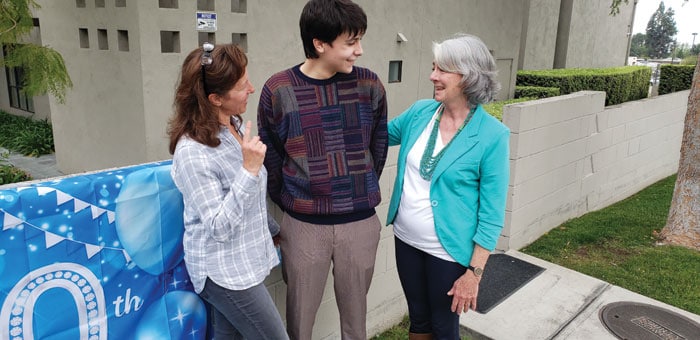
When a synagogue with one of the oldest histories in the Los Angeles area celebrated its 100th birthday this month, the emphasis was on youth. The Pasadena Jewish Temple and Center (PJTC)is planning for a future at least as lengthy as its past.

Executive Director Beryl Strauss said that when she started at PJTC in 2016, 60% of congregants were over 65, including the No. 1 senior, Mollie Wolzeck, who is 97 years old.

Thanks to a renewed interest in youth groups and a campaign to attract young families, the reverse is true. Among the 500 families at the Conservative synagogue, two-thirds of the members are on the younger side.

Strauss said the environment changed when the temple expanded its professional staff and Youth Director Melissa Levy moved into a newly created position, Director of Congregational Engagement. 

“Melissa had started a wonderful youth program. And now, with a new position, she has infused our community with a new passion.” 

Temple member and chapter president of United Synagogue Youth Sam Svonkin, 15, had been busy in the runup to PJTC’s  April 3rd centennial celebration, helping to set up a pop-up history museum 

 “I was interested in the centennial project and in learning more about PJTC’s history,” he said.

When Betsy Kahn, a retired school librarian who joined PJTC seven years ago heard about the centennial, she knew she wanted to get involved.

“I had not had any involvement with kids [since retiring], and I missed it,” said Kahn, a member of the musical group that sings and plays on Shabbat mornings. “That had been my whole life as a school librarian.”

Looking at the students’ dedication to PJTC and its past, Kahn said, “These kids are all self-selected. We asked who would be interested in researching the history of our synagogue. To have a dedicated group of kids interested in history is unusual. This is a lovely product,” she continued, “but for me, the real success was in the process. We literally dug dusty boxes out of closets. We were trying to make connections and figure things out.”

Since last fall, Kahn and students have been assembling the backbone of the museum, the PJTC’s 10-decade history. She has also organized the commemorative book’s content, and has been commissioned to research the history of the Sisterhood, the Men’s Club and its Religious School.

“Especially after being involved in research for this project, as a librarian-type and historian-type, I am looking for the threads that connect,” Kahn said. “From the beginning, the thread that runs through everything, starting in 1921, is the kids.”

The first goal of the founding members was to establish a religious school for children. 

“There was a group of women who were involved in social services – providing services for orphans, services for institutionalized people,” she said.” Out of that kind of locus of concern came the germ for religious education.”

“We just wanted this temple setting for our kids.” – Betsy Kahn 

Kahn said that in every interview she and the students conducted with congregants, every man and woman said, “We just wanted this temple setting for our kids.”

Kahn and her colleagues have split their attention between the past and what lies ahead. “We have wondered what it is going to be like a hundred years from now when those congregants wonder what our lives were like. We are hoping that what we have created and what we have found can be preserved.”

Stacey Sharp, president of PJTC, is concerned about where Conservative Judaism is headed in the future. “What weighs on my mind is what people are going to say a hundred years from now,” she said. “The Conservative movement really is being stressed, and it has had to redefine itself to meet with the times.”

“A hundred years ago, Conservative Judaism was expanding. Now it is going through a redefinition. For us to survive, especially as we progress through the pandemic, our Ritual Committee had to expand their interpretation to allow technology that did not even exist 20 years ago.” – Stacey Sharp

She elaborated on her point, adding, “Conservative Judaism and traditional Judaism have to take a different shape and form to survive. You are seeing Conservative seminaries struggling. A hundred years ago, Conservative Judaism was expanding. Now it is going through a redefinition. For us to survive, especially as we progress through the pandemic, our Ritual Committee had to expand their interpretation to allow technology that did not even exist 20 years ago.”

One upside, said Sharp, is installation of technology in the sanctuary. “This has allowed us to expand our walls. We are trying to be more welcoming to any and all shapes and forms.” Across the San Gabriel Valley, Jews are a minority that frequently interacts with neighbors of all different backgrounds. “We have had a lot of people interested to see what Judaism is all about, from our interfaith-based community to the people out in rural areas,” Sharp said. 

“They are able to see Judaism is about with no physical boundaries.”

Pasadena Jewish Temple and Center Turns 100 Read More »

Adat Shalom Creates a Happy Passover for Survivors

When Nazis were hunting down and slaughtering Jews across Europe in the 1940s, the most optimistic Jews could not have imagined scenes that played out last week across Los Angeles.

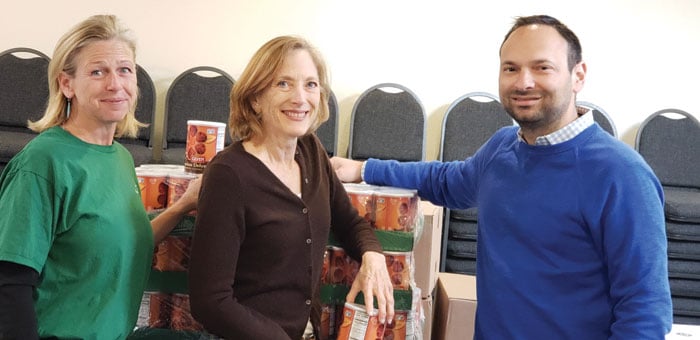
Forty Adat Shalom synagogue members fanned out to the homes of 200 of the neediest survivors of the Shoah bearing kosher for Passover food. 

Adat Shalom raised nearly $10,000 from its community, purchased the food from Western Kosher and then packaged it. Two food bundles were handed to each of the frail elderly survivors. Their impoverished status requires them to rely on Jewish Family Service and its social venue for survivors, Café Europa, for basic needs.

“The thought that they could not get kosher for Pesach food was the impetus.” – Renalee Pflug

“We have done amazing programs with Café Europa for years,” said Renalee Pflug, Adat Shalom’s executive director. “At the start of the pandemic two years ago, we realized that while all of us were struggling, the Holocaust survivors of Café Europa really were having a difficult time, especially when it came to Passover. The thought that they could not get kosher for Pesach food was the impetus.”

Rabbi Nolan Lebovitz and board member Stephanie Ginzburg, now chair of the shul’s Café Europa Passover Initiative, started the mitzvah project. As the pandemic struck, “the rabbi and Stephanie said ‘We need to do something,’” said Pflug. “We called in support and donations from Western Kosher and volunteers to provide food.”

As Lebovitz closes out his seventh and final year at the Conservative shul (to take the senior position at Valley Beth Shalom), the 200 families who comprise the community are familiar with perhaps his most defining declaration: “It always has been a passion of mine to help prevailors,” the rabbi’s preferred term for survivors of the Shoah.

Lebovitz explained why he coined this term. “I call survivors prevailors because I don’t like identifying my four grandparents solely by their survival,” he said. “I have never met a person who just survived the Shoah. They prevailed in the sense that they created new lives, they created new families, they created businesses, they created a whole new world. In that sense, they prevailed. I acknowledge they prevailed.”

The seed for Adat Shalom’s Passover gifts was sown unobtrusively, the rabbi recalled.

“Two very special congregants of mine, the Ginzburgs, Evelyn in particular, heard me give a sermon on the Shoah,” he said. “She asked if I had any interest in Café Europa.  I began volunteering as rabbi for the holidays and different events throughout the year.”

Then, the rabbi wanted to know what else he could do.

 “Every interaction I had drove me to do more,” he said. “What we are doing now was the result of a need during the pandemic. Everybody was reluctant to go into supermarkets, especially this demographic, and they needed Passover groceries.”

Lebovitz said his motivation is direct: “It is the responsibility of the entire Jewish community to make sure that the prevailors of the Shoah have what they need for Passover.”

Stephanie, a daughter-in-law of the Ginzburgs the rabbi mentioned, was pleasantly surprised that the number of recipients almost doubled last year’s total.

“We had 118 prevailors a year ago,” she said, “and now we are up to 200 by gathering in people who were on the outskirts.”

Stephanie does not know how many survivors live in the Los Angeles area. “I hate to comment, because I recognize that every day there are fewer,” she said. We are in a golden time to be able to serve this particular group. We will not be able to do this for more than a decade. We are on the threshold of being able to offer as much as we can.”

How did Adat Shalom become the first synagogue to create this gift for survivors?

“I have to say, there are beautiful people in the community who have touch points,” Stephanie said. “This is a specially guarded community – it takes a special kind of connection to be able to have the trust and confidence that the people involved in the project have the right intentions and that they are able to assist in the most momentous way right now at this moment.”

The Ginzburg connection with Café Europa, which meets every Tuesday in Mid City, dates back decades. “My mother-in-law already was working with them 20 years ago,” said Stephanie.  “It’s a nice way for them to keep the human connection going. That is most important.” 

On the morning the food packages were being bundled, Stephanie was the first to arrive. “Here’s what Adat Shalom has provided, and this was the beauty we saw last year,” she said. “Coming together to do all of this was really the first time since the pandemic began that we were able to come back together, physically, as a community with what we were able to put out. This built so much energy and ruach.”

Even Stephanie was surprised. “It really did snowball for us into a much bigger thing than we had anticipated,” she said. The biggest surprise for the army of volunteers was still to come. “The connection we were able to have when we approached the doors of these prevailors was best of all,” Stephanie said. “Each of us was able to speak to them and have full conversations. All of us delivered, [even] the rabbi and his family.

Each prevailor received two containers: Three boxes of matzah, matzah ball mix, cake mix, grape juice, seltzer water, gefilte fish, macaroons, tea, turkey cold cuts, a carton of eggs and a bouquet of flowers.

According to Stephanie, it was crucial to realize some recipients do not have anyone to say hello to every day. “This was a way for us to say ‘We are still here for you. We are not forgetting you. You are part of our community.’”

Adat Shalom Creates a Happy Passover for Survivors Read More »

The Meal Train: A Great Community Gift

After the first time I gave birth, I was resting in my bed at Kaiser, waiting for the airline-style kosher food from the cafeteria to arrive. I was expecting to eat some bland mush or maybe some grey-colored chicken. But before it could come, my rabbi surprised me and stopped by with some food instead.

And then came my friend, a woman who lived near the hospital and made kosher food for all the Jewish mommies who delivered babies there, even if they were complete strangers. Since it was Friday, she delivered food for Shabbat: chicken, challah, warm kugel and a yummy dessert.

And since it was also Sukkot, my other rabbi and his wife invited my husband and mother-in-law for dinner. They came back to the hospital after the meal with tons of food in hand. 

When I was discharged and went home, the food started pouring in from the meal train. Lasagna. Shawarma. Tacos. Fruit salad. Delicious authentic mole from our rebbetzin from Mexico City. Scrumptious home-cooked meals and takeout. Food prepared and delivered by friends, members of our synagogue and people in the community who heard about the meal train and wanted to chip in.

When my friends and fellow moms came over with a hot meal and talked to me about the difficulties of new motherhood, I felt so seen. When they reassured me it would get easier, I felt comforted. It’s extremely isolating being home all day with a newborn, and seeing familiar faces helped me avoid the feelings of loneliness I’m sure I would have experienced.

I had never felt so supported and cared for in my life. It made giving birth so much more special knowing I had people I could count on. These people, who were busy with their children and their work and their own lives thought of me. I was incredibly touched. 

When I gave birth for the second time this past December, I expected a meal train like the first time around. But this time, it was much bigger. Friends from the first one and new friends chipped in. People dropped off baby gifts with their food. I got Venmo payments and gift cards from people I never met who wanted us to order from our favorite restaurant.    

One person signed up and didn’t deliver the food at the time we specified. When we called them to see what happened, they were so sorry that they forgot. We told them it was fine and not to worry about it.

“I want to make it up to you,” they said. “I’m ordering you dinner tonight, and then tomorrow, when you’re hungry for lunch, you call me and I’ll order some for you.”

“You don’t have to do that,” my husband told them. 

“No, I’m serious. I insist,” they said. 

The next day, in the craziness of having a newborn, we forgot to reach out. The person called us around noon.

“Hi, I told you to call me. Look, I’m ordering you food. Go pick it up.”

I couldn’t believe it. I retrieved our feast from LA Burger Bar, and it lasted us until the next day.

By contributing to our meal train, our community not only shared in our simcha; they showed us they had our back when we needed them the most. 

Giving birth, especially the first time, is a whirlwind that completely knocks you off your feet (in a good way). By contributing to our meal train, our community not only shared in our simcha; they showed us they had our back when we needed them the most. 

Now, any time I see a meal train posted in a WhatsApp group or on Facebook, I sign up, even if I don’t know the person. It could be a meal train for someone who gave birth, experienced a loss or just went through surgery and needs a little extra help. I want to spread the kindness and love that I received. 

Ten years ago, my husband and I moved to LA not knowing anyone in the community. Now, I can proudly say that not only are we part of this amazing community, but we are also part of something much larger than ourselves: one big, loving Jewish family.


Kylie Ora Lobell is the Community and Arts Editor for the Jewish Journal. 

The Meal Train: A Great Community Gift Read More »

Remembering Gilbert Gottfried

The world has lost one of its funniest people: Gilbert Gottfried.

Gilbert was what we in the comedy business call “a comic’s comic,” meaning that even comedians would enjoy watching him. Most of the time, comedians are not interested in watching each other perform. Gilbert was so unpredictable, outrageous, silly and animated that you truly never knew where he was going with a premise or what you were in store for when you went to see him perform. 

He also had one of the most iconic voices in all of show business. The first time I heard that voice was when it came out of the mouth of an animated parrot, Iago, from “Aladdin.” I never thought back then that one day, I’d get to know and be friends with the person behind the parrot.

Gilbert was so unpredictable, outrageous, silly and animated that you truly never knew where he was going with a premise or what you were in store for when you went to see him perform.

The first time I met Gilbert was at the New York Friars Club. My friend David and I went into the Billy Crystal Room to get a drink at the bar, and there was Gilbert, nursing a Coca-Cola in a glass bottle. 

When he saw me, he clutched the bottle close to his chest.

“Stay away from my Coca-Cola,” he said comedically.

It was one of the strangest ways to meet one of your comedy heroes.

Thankfully, I had a less awkward interaction with Gilbert later on. I got to know him a little bit while having the privilege of sitting at one of the funniest tables ever. After the roast of Jerry Lewis at the Friars Club, I was seated between Gilbert and Robert Klein, and around the table were Freddie Roman, who was my sponsor to get into the club, Pat Cooper, Norm Crosby and two of the cast members of “The Sopranos.”

I’d listen to Gilbert when I was a security guard doing overnight shifts in Manhattan. He would come on “The Howard Stern Show” and was one of Howard’s funniest guests. He was always willing to go where no one else would, taking things to the extreme for a laugh. 

It was his tendency to push the envelope that got him in trouble for making a 9/11 joke in the aftermath of the attack.

“I have to catch a flight to California,” he said. “I can’t get a direct flight. They said they have to stop at the Empire State Building first.”  

Years later, Gilbert lost his job as the voice of the Aflac duck after joking about the tsunami and earthquake in Japan, and his irreverent behavior is what likely caused Howard Stern to ban him from the show. 

These are the makings of a high-flying comedian who plays without a net – someone who takes risks and pays penalties for them, but doesn’t stop finding the line and crossing it. It is what the spirit of being a comedian is all about. In this culture of political correctness and censorship, we see what most comedians are really made of. 

When I moved to Los Angeles in 2012, I was working for the late, and great, comedian Ralphie May. Ralphie invited me to his son’s birthday party, and Gilbert was there. We hung out, and he agreed to do my podcast “Modern Day Philosophers.” 

On the podcast, which we recorded in Gilbert’s apartment, we discussed his Jewish identity. He told me that the only thing that made him feel Jewish was the knowledge that if there was another Holocaust, he’d be sent to the camps. I thought it was a pretty sad statement, but it’s unfortunately how many American Jews relate to their Jewish identity today.

I was surprised that in real life, Gilbert was shy, humble, sweet and a real family man, with two little kids and a wonderful wife, Dara Kravitz. He let my wife Kylie and I tour around his place and look at all his comedy memorabilia, including a special Iago figurine Disney gave him. We posed for pictures with Iago and Gilbert and had a great time. 

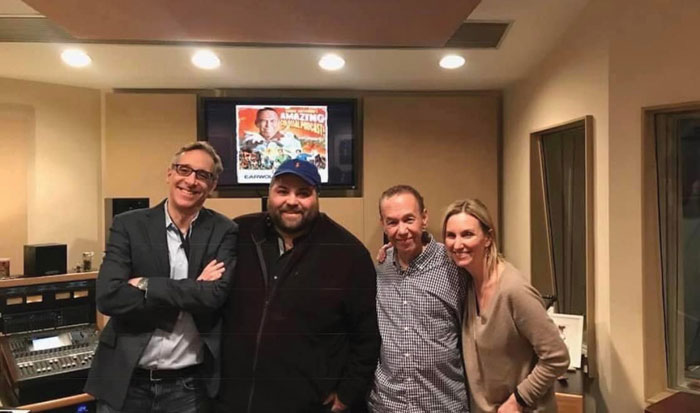
He also had a massive painting of Groucho Marx hanging over his couch. It was one of the biggest paintings I’ve ever seen in anybody’s home. Not only was Gilbert a huge fan of the Marx Brothers, but he was obsessed with show business. It became the theme of his podcast, “Gilbert Gottfried’s Amazing Colossal Podcast!” which he co-hosted with Frank Santopadre. They were kind enough to have me on as a guest.

He inspired me – and millions of others – to go for the joke, no matter the cost. And that will be his legacy: funny first.

Gilbert was always looking for the jokes in life. His laughter was infectious, and spending time with him was one of the most enjoyable and fun experiences of my career in comedy. He inspired me – and millions of others – to go for the joke, no matter the cost. And that will be his legacy: funny first.

He will be missed. Baruch dayan ha’emet.

Remembering Gilbert Gottfried Read More »

UCLA Y&S Nazarian Center Celebrates 10-Year Anniversary Gala

The UCLA Y&S Nazarian Center for Israel Studies honored Sharon Nazarian, president of the Y&S Nazarian Family Foundation, with the Legacy Award, highlighting her unparalleled role in the founding of the UCLA Nazarian Center. 

Nazarian was honored during the UCLA Y&S Nazarian Center’s ten-year anniversary gala, held at the Wallis Annenberg Center for the Performing Arts in Beverly Hills on April 11. 

Celebrating the Center’s efforts promoting the study of modern Israel, the event also recognized the Rosalinde and Arthur Gilbert Foundation with the Visionary Award, which was presented by UCLA Chancellor Gene Block and accepted by Foundation’s co-trustees Richard Ziman and Martin Blank, Jr.

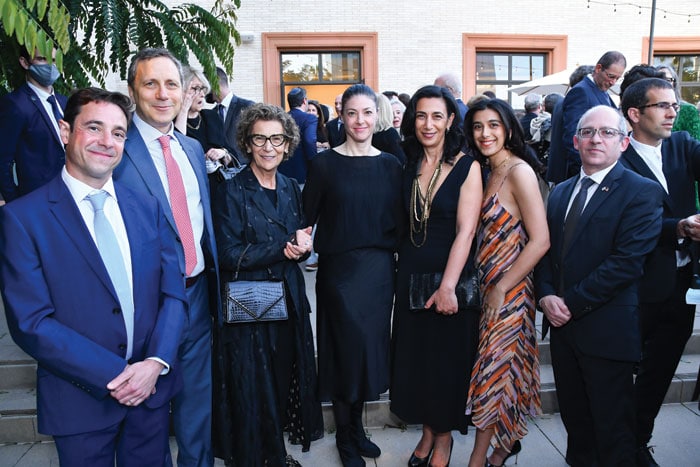
From left: Dov Waxman, Rosalinde and Arthur Gilbert Foundation Chair of Israel Studies at UCLA; Fernando Flint, husband of Sharon Nazarian; Soraya Nazarian, co-founder of The Nazarian Family Foundation; Israeli MK Merav Michaeli; Sharon Nazarian, president of the Y&S Nazarian Family Foundation; Layla Nazarian, daughter of Sharon Nazarian; and Consul General of Israel Hillel Newman. Photo by Vince Bucci

The evening included a tribute to the late Younes Nazarian and concluded with a discussion between the gala’s guest speaker, Israeli MK Merav Michaeli — Israel’s Minister of Transport and Road Safety, member of the security cabinet and leader of the Israeli Labor Party — and Jodi Rudoren, editor-in-chief of the Forward, who flew out from New York for the interview. Their powerful conversation covered the future of the Bennett–Lapid coalition government, the recent wave of violence in Israel and issues related to women in Israel, which has been a focus of the minister’s activism for years.

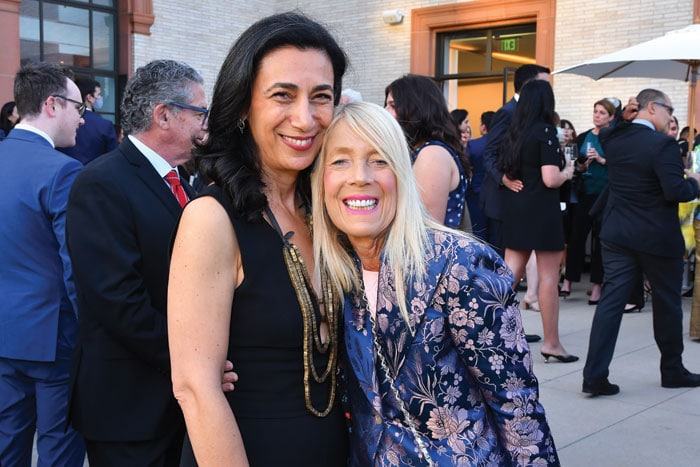
Sharon Nazarian, president of the Y&S Nazarian Family Foundation (left) and Mayor of Beverly Hills Lili Bosse. Photo by Vince Bucci

Professor Dov Waxman, director of the Center and the Rosalinde and Arthur Gilbert Foundation Chair of Israel Studies at UCLA, hosted the program, which opened with a recorded message from Isaac Herzog. The Israeli president expressed appreciation for the Center’s ongoing efforts supporting the unbiased, academic study of Israel by sponsoring UCLA courses, public programs and academic research and hosting visiting Israeli scholars, writers, and artists.

Nearly 300 people joined the UCLA Nazarian Center in celebration, including Block; Soraya, David and Shulamit Nazarian and family; Sinai Temple Rabbi David Wolpe; Consul General of Israel in Los Angeles Hillel Newman; Anti-Defamation League CEO Jonathan Greenblatt; Beverly Hills Mayor Lili Bosse, Jewish Federation of Greater Los Angeles President-CEO Rabbi Noah Farkas; and Andrew Cushnir, executive vice president and chief development officer at the Federation.

UCLA Y&S Nazarian Center Celebrates 10-Year Anniversary Gala Read More »

The Four Questions

Spring is the season of Passover, the Jewish holiday that celebrates the Israelites exodus from slavery in Egypt some thirty-six hundred years ago. To me it has always been about three things: family, food, and the recommitment to what feels like a central tenet of Jewish life; kinship with the vulnerable.

When I was a very young child, we celebrated Passover at my grandmother’s house in Florida. I remember the elegant white tablecloth and the faces and voices of my grandmother’s dear friends, a childless couple who came every year with their two pint-sized dachshunds. It was humid and hot, and the air had a torrid, green smell I easily recreate in memory. My grandfather must have been there too, but I hardly remember him. To me, it was my grandma’s house, her soft lap, her warm kitchen, her blooming orange trees and cool stone floors.

Later, we celebrated at our home in New York. By then I was old enough to wield a knife to cut up the apples for charoset, and to read the Four Questions. My mother and I cooked the same meal every year for thirty years; the same kind of apples, the same chicken broth from a family recipe, the same slippery gefilte fish and horseradish, the same flourless chocolate cake. The Rubin family came every year bringing the same jokes, made hilarious by repetition, and a few good bottles of wine. It was the only time we saw them, so it became a marker of the stages of life, like the pencil marks on the kitchen doorframe recording our heights as we grew. First the new babies, later kids and teenagers, later another generation of babies, toddlers, and children reading the Four Questions.

When I moved to California the seder moved with me. Now it was my turn to prepare the epic meal with my mother and daughter, using recipes my mother brought with her on little faded index cards. At some point the men in the family would come home and move the furniture to make room for the long table. Then my mother would go upstairs to change into a colorful, flowing dress, her signature party attire. We had different guests every year, unlike the old days. But after Laura, the youngest of the Rubin family, moved to Los Angeles she came every year, bringing wine, as her parents had in the decades in New York.

My father always led the seder. In the last few years of his life it became difficult for him to read, and he no longer seemed to enjoy the role. Then my brother took over, bringing a more serious, religious tone to what had always been our rather informal ceremony. In 2016 my father died, and soon after, my mother. Once they were gone the inspiration seemed to go out of the tradition and instead of hosting a seder we attended one. The people were welcoming and kind, but I missed the flavors of my mother’s cooking and the hectic hours with her in the kitchen before the men came home and the guests arrived. I can’t quite bring myself to make the meal, to put on the whole production, without her.

At the heart of the Passover story is the desperate flight of an enslaved people. The Israelites, in bondage for four centuries in Egypt, escaped under cover of night, crossed the Red Sea, and survived for forty years in the desert, where their leader Moses received the ten commandments. It is a tale full of old-fashioned miracles, but also one of timeless, painful relevance, as we contemplate the persistence, century upon century, of oppression and injustice.

As the story goes, “We were slaves in Egypt until God freed us with a mighty hand.” To persuade the Pharaoh to free the Jews, God inflicted ten terrible plagues upon the Egyptian people, the last and worst being the killing of every family’s firstborn child. Before this final plague God commanded Moses to tell the Israelites to mark their front doors with lamb’s blood so that death would “pass over” their homes. The Israelites, under God’s protection, fled toward freedom.

The story of the Exodus is one of immense suffering; the suffering of the oppressed, but also the suffering that is necessary to break the bonds of oppression. As a child I always struggled to understand the terrible paradox at the heart of the tale. Why did God cause the Egyptians to enslave the Israelites, only to punish them so cruelly? Weren’t they God’s people too? The seder acknowledges this mystery: As we recite the list of plagues we spill ten drops of wine on our plates to mourn the suffering of the Egyptians, saying, “So the cup of joy is lessened by the slaughter of our foe.” No explanation is offered for this seeming divine perversity, any more than faith, or reason, can explain why, some 3,600 years later, humanity is still rife with violence and oppression.

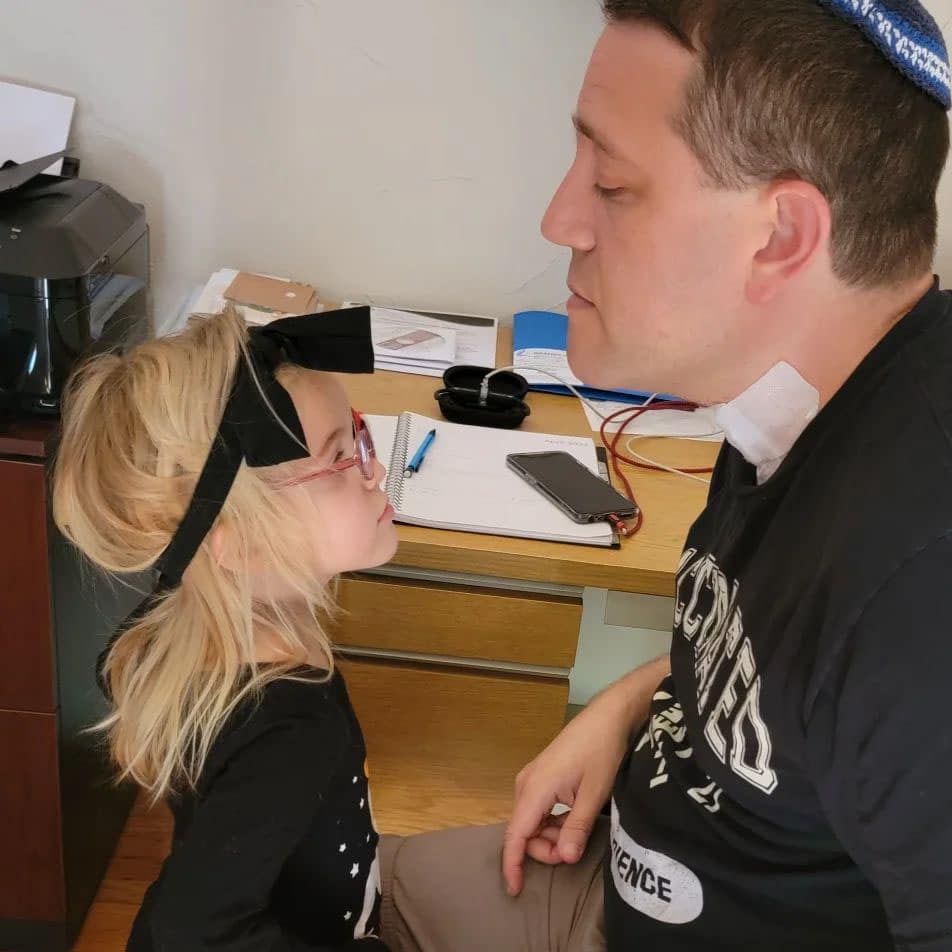
The Four Questions, recited by the youngest child, encapsulate the harshness of life under slavery, the urgent haste of the Israelites escape, and the privilege of freedom. Perhaps this responsibility is given to the youngest because of her innocence, her remoteness from the dark side of human nature. It is poignant to hear a child earnestly reciting the questions, clearly concerned only with getting them right, understanding little of the story conveyed in their deceptive simplicity. The seder’s dark mysteries unfold only gradually, over decades, forming an arc of love and protection between the elders, seasoned by painful experience, and the youngest children.

When I started thinking about the meaning of Passover as a young adult, I was puzzled that the questions were so strangely focused on food. Why do we eat matzoh, not bread? Why do we eat bitter herbs dipped in salt, why do we (at least in orthodox families) recline during the meal? My friend Rabbi Lori Shapiro recently explained that the “Four Questions” are really just one question: Why is this night different from other nights? And the answer is that we gather for this highly ritualized meal with specific foods eaten in specific ways so that we observe the celebration with appropriate somberness and joy.

For me, the question Passover asks is one of identity. Who are we, the Jewish people? Deep in the text of the seder is a quote from Deuteronomy: “You shall not turn your back on the widow, or the orphan or the stranger in your midst, for you yourself were a stranger in the land of Egypt.” Seven centuries before Christ, Jews were enjoined to remember the feelings of the oppressed, to truly inhabit them, with full empathy and understanding. Had I not heard this sacred vow of compassion recited every Passover since I was a child, I would be merely an accidental Jew; Jewish by birth but without a deep connection to the faith. Passover reminds us that we ourselves have been hunted and robbed of our humanity and driven from our homes. The difference between modern Jews and others who struggle on the margins is a single generation, or national border or election cycle. The oppressed and disenfranchised, wherever they may be, are our people.

Passover is celebrated in spring, the season of renewal. Its repetition reminds us of beloved continuities: of families, of planting and harvest, of earth’s reawakening after the darkness of winter. It also reminds us that the journey from servitude to freedom is cyclic, not straight. The prayer, “Next year in Jerusalem! Next year may all be free!”, is an acknowledgment that all are not, in fact, free. The path to freedom continues to loop back on itself as if the Red Sea had never been crossed, as if we had never received the Ten Commandments. Centuries from now, people will regard us – our episodic lapses into brutality, our dark chapters of racism and oppression – with bafflement, as we do the long-ago Egyptians.

Last year, in 2021, Passover happened to coincide with the trial of Derek Chauvin. His crime was a stark reminder of the undercurrent of negation that drags against any movement toward freedom. That he was convicted on three murder charges provides some reassurance that we are trending in the right direction. Many of us drew a sigh of relief, as if, once again, the angel of death had passed over our houses; as if the scourge of racism might finally be coming to an end.

But even as the jury was deliberating, Georgia enacted a slate of laws designed to prevent Black people from voting. Among many other restrictions, these laws made it illegal to offer water to people waiting in line to vote, while also severely reducing the number of polling places in minority neighborhoods, ensuring that people would wait outside for hours in the sun. The intent, to dehumanize and disenfranchise people of color is, as the lawyers say, prima facie; evident on first impression.

This year the world is limping to the end of a near-biblical plague that has already claimed over 6 million lives, a number with excruciating resonance for Jewish people. Although the similarity between the number of Jews killed in the Holocaust and the death toll of covid is merely a painful coincidence, there are significant historical parallels as well. In both eras large swaths of the population were under the sway of malignant demagogues who poisoned the public domain with lies, virulent nationalism, and pointless, unhinged aggression. Civil discourse collapsed, minorities were persecuted, rank paranoia superseded information, and the institutions that ensure stability teetered on the verge of failure.

Now, in the spring of 2022, the desperate flight of the Ukrainians links us through history all the way back to the Exodus. In our technological age we can observe intimately, in real time, the suffering of people who, but for an accident of geography, could be our neighbors and cousins and friends. The veil between security and terror is infinitesimally thin. We can’t help but see ourselves staring back at us from the other side.

Primo Levi said that every age has its own fascism. With the right combination of economic and social forces, leadership, and popular sentiment, a kind of negative alchemy can take place and an eruption of savagery will crack the façade of civilization. Every age, no matter how intent on its own virtue, caries the potential for this darkness.

Writing in the early 20th century, the psychoanalyst, Carl Jung, described the repressed and therefore unknown aspects of personality as Shadow. He explained that we bury many instinctual drives, like sexuality and aggression, in the psyche to enable us to function effectively as a society. Through intensive conditioning we come to feel that these drives are bad and that by purging them we become good. But the energy of the instincts remains and festers. The more severely we repress our disowned qualities the more explosive they become, and the more intensely we project the most negative and extreme versions of those qualities on others. Instincts are part of nature, but Shadow contains an element of nihilism. It doesn’t care what it breaks.

Shadow is both an individual and a collective phenomenon. Individually, a hardworking sister may loath her “slacker” brother, while the brother considers his sister a soulless grind. In reality, she may be sensitive and emotional. He may work like a demon on his painting or music. But each sees in the other their own disowned, impermissable selves. At a collective level societies project ignorance or violence, criminality or brutish sexuality on people who seem different. Shadow produces anti-semitism and racism, ethnic cleansing and genital mutilation. Fascism is collective Shadow unleashed by malignant demagogues.

The cycle of repression and explosion of Shadow is one possible lens for viewing history. Whenever there is a movement toward freedom or the expansion of rights, there is a backlash toward domination and control. The cycles can take place over days or centuries. Often there are many overlapping cycles. Barack Obama, America’s first Black president, is followed by Donald Trump: A short cycle. The liberalization of social norms in the 60’s and 70’s is followed by the emergence of the religious right: A medium cycle. The increasing presence of women in positions of power is followed by an overpowering push to revoke Roe V. Wade: A medium cycle. Lyndon Johnson’s War on Poverty is followed by the largest enrichment of the already wealthy in history under Reagan: Another medium cycle. The end of slavery followed by centuries of efforts to diminish African Americans: A very long cycle with countless variations. These cycles overlap and mingle. In every case, both sides have their own projections. Each demonizes the other. Each feels real fear.

To me, Passover is not just a historical tale, or a parable of humanity’s journey from oppression to freedom. It is a capsule of the human condition, the dialogue between dark and light contained within each personality. If we think about history as a dialogue between these forces we can perhaps see an opportunity to guide the pattern. At any given moment, we are somewhere in the cycle. If we know that we are in the grip of innate human forces, can that knowledge provide an element of choice?

Passover is laden with images of the sea. God parts the Red Sea to allow the Israelites to flee, then inundates the pursuing Egyptian army. We dip bitter herbs in salt water to symbolize the harshness of slavery. The sea is the mother of all life but an excess of salt kills everything.

The seder recapitulates the story of the Exodus to remind Jews that we were once refugees. Now the greatest refugee crisis humanity ever known is impending. Climate change denial is the ultimate manifestation of the nihilism of Shadow. It doesn’t care if it breaks the world.

The most mysterious and fascinating aspect of Shadow, as Jung defines it, is the Golden Shadow, the qualities of excellence we deny in ourselves and project on others. Brilliance, heroism, vision, generosity, and nobility of character are all aspects of the Golden Shadow. Few of us see ourselves in those terms. We don’t believe that we are capable of great things. But our times require that we internalize some of the excellence we project. Passover asks us to behave as if all refugees, present and future, are our own people, to attain greatness by concerning ourselves with the future good of all, not only ourselves. If we do this now, we will flourish. If not, we will bring about our own inundation.


Rachel Hoffman is a longtime student of Jungian psychology and recently published an essay in Psychological Perspectives, the quarterly journal of the C.G. Jung Institute.

The Four Questions Read More »