Vogue Magazine has restored model Gigi Hadid’s comment in their Instagram post about how she’s donating her earnings from Fall 2022 shows to both Ukraine and the Palestinian territories after initially removing it.
As the Journal has previously reported, Vogue had echoed Hadid’s March 6 Instagram post about her pledge to donate the earnings to Ukraine and included the quote “as well as continuing her relief efforts to Palestine.” After being bombarded with criticism, Vogue removed the Palestine quote.
But Vogue’s removal of the quote resulted in a new set of criticism.
“So @GiGiHadid pledges to donate her earnings from Fall 2022 to relief efforts for occupied Ukrainians *and* occupied Palestinians and then @voguemagazine magazine just erases the Palestinians from its @instagram post on her pledge?” MSNBC host Mehdi Hasan tweeted.
So @GiGiHadid pledges to donate her earnings from Fall 2022 to relief efforts for occupied Ukrainians *and* occupied Palestinians and then @voguemagazine magazine just erases the Palestinians from its @instagram post on her pledge? pic.twitter.com/rO7xao87lZ
Arielle Hadid, who is Hadid’s sister, wrote on Vogue’s Instagram post: “Wow you removed [Palestine] she is supporting BOTH the crises in [Palestine] and Ukraine. It’s a sad time when you can be bullied out of factual reporting.”
Vogue’s Instagram post now says, without quotes, that Gigi Hadid is “donating her fashion month earnings towards relief efforts in Ukraine as well as continuing to support relief efforts in Palestine.” An editor’s note at the bottom of the post states: “We have updated this caption to accurately reflect Gigi Hadid’s statement on her donation.”
Stop Antisemitism tweeted, “Vogue deletes Gigi Hadid’s mention of Palestine and now has re-added it. The bigger question is why are influencers being allowed to utilize Vogue’s digital platforms in the first place to push their own agendas? Completely ridiculous.”
Vogue deletes Gigi Hadid's mention of Palestine and now has re-added it.
The bigger question is why are influencers being allowed to utilize Vogue's digital platforms in the first place to push their own agendas?
Human rights lawyer Arsen Ostrovsky, who heads the International Legal Forum, tweeted in response to Tlaib that people like her “deny [the Palestinians] agency, give support to Hamas and turn your back to gross human rights violations by the corrupt Palestinian Authority. Now, please stop appropriating every tragedy. It’s not always about you!”
Yes, by folks like you, who deny them agency, give support to Hamas and turn your back to gross human rights violations by the corrupt Palestinian Authority.
Now, please stop appropriating every tragedy. It’s not always about you!
Daniel Laufer, who works in communications, tweeted: “Despite constant re-centering of Ukraine to Palestinian activism, Palestinians are fortunate to not actually be experiencing anything resembling that carnage. 5-7 times more were killed in Ukraine-Russia conflict since 2014 than Arab-Israel conflict.”
Despite constant re-centering of Ukraine to Palestinian activism, Palestinians are fortunate to not actually be experiencing anything resembling that carnage.
5-7 times more were killed in Ukraine-Russia conflict since 2014 than Arab-Israel conflict.
It seems frivolous now, but once upon a time the nation spent a week debating whether a woman who didn’t want to stay home and bake cookies was fit to be the first lady. Afterward, that non-baker really got out of the house. She ran for president in 2016 and though she had major qualifications—first female partner in her law firm, Senator from New York, Secretary of State—people still couldn’t get over her lack of interest in cookie-baking. They said that she lacked warmth. So they elected a man with no qualifications at all—but a deep love of Oreos.
Nearly thirty years later I’m still wondering why Hillary Clinton disparaged the cookie bakers. Wasn’t feminism supposed to mean that we were no longer defined by narrow gender roles? Women could be astronauts and men could bake bread and take care of the kids, right? The idea that baking cookies wasn’t important work never sat well with me. I got over it by the time she lost the election. Then I wept.
First lady Hillary Clinton offers cookies to the Arkansas press corps during an interview with President Bill Clinton in the Roosevelt Room at the White House in 1993.
Growing up in the same era as Hillary, I considered myself a feminist from the start. Ever since I sauntered into a small room at City College, New York, circa 1970, with a sign on the door saying “Women’s Liberation Society,” I was in. The great unfairness regarding women’s place in society was something I felt in my bones. Those were heady years. I put on my Converse and marched defiantly down Fifth Avenue behind Gloria Steinem and Flo Kennedy, picketed for the ERA, and dressed only in T-shirts and jeans for a few years. Bras were history.
By the time I started working in the publishing industry in New York in 1972, not only was I wearing a bra, but also I was putting on a tailored business suit, buttoning up my silk blouse complete with pussy bow, and donning sensible shoes to march into the office and become an executive. Except for the occasional wild night at the disco, I was a serious career person. A big fluffy dress, marriage and children were not on the agenda.
By the time I came home from the hospital with my first baby, I was collecting vintage cookie jars and thinking about how to fill them. I wanted to have it all—a high powered career and quality time with my kids.
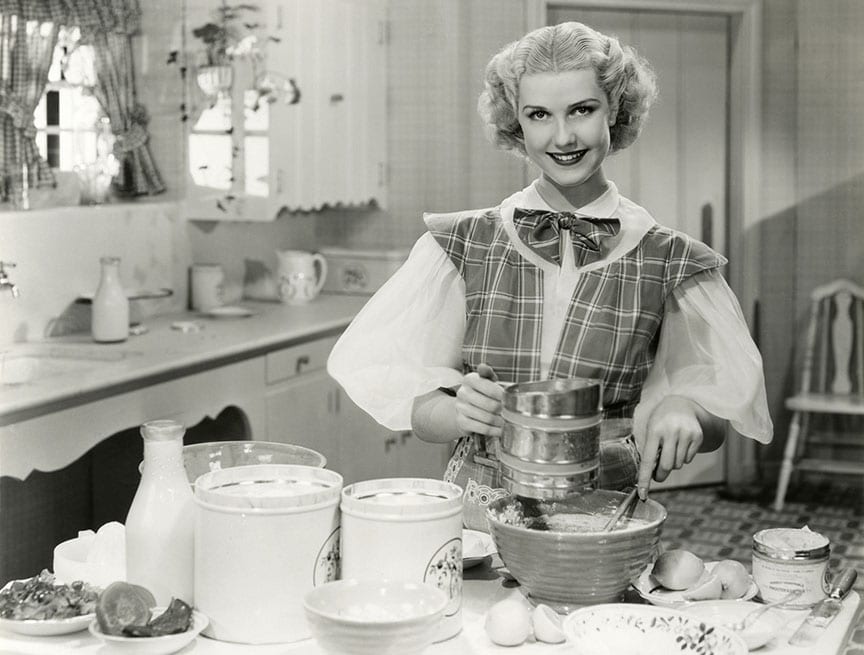
Then my thirties happened. By the time I came home from the hospital with my first baby, I was collecting vintage cookie jars and thinking about how to fill them. I wanted to have it all—a high powered career and quality time with my kids. As the kids grew older, I came up with a novel solution to the work/life dilemma. I would work from home as a cookbook author, and turn into supermom when the kids came home. If you tried this during COVID, you know it’s not so easy.
In the days before chefs became sexy, my career choice did not earn me lots of respect in our liberal Los Angeles community. A more enlightened feminist writer once informed me that she didn’t like to plan, shop, or cook food. “Why should I think about cooking a lamb chop,” she asked, “when I’m busy writing?” I was shaken. You mean you don’t start your day planning your dinner? It was a revelation—and a smackdown.
The author
Even the rabbi at our liberal temple was judgmental. When he introduced my husband and me to the congregation at my first son’s Bar Mitzvah, he started with my husband. “I respect the father enormously. He is an important journalist for the Los Angeles Times.”
“And the mother?” he said with a smirk. “She writes recipes,” shrugging his shoulders as if to say “Isn’t she cute, with her fake job?” I was never his biggest fan.
Truth be told, climbing any career ladder is not easy. Whipping egg whites and making perfect caramel may be fun, but all the people you have to climb over to make a career happen don’t exactly clear a path. Does Martha Stewart look like someone who graciously invited competitors over for tea? Plus, there was always the weight gain to consider.
Thirty years later, having a job that requires you to stay home and bake cookies is considered cool. Graduates from elite schools are inventing condiments, opening bagel shops, and planting radishes on organic farms to heal the earth. As for artisan baked goods—my Instagram feed fills with so many crusty sourdough loaves and gorgeous macarons each day I could plotz just looking. As for gender, it no longer matters.
Anyone whose work delivers a fleeting moment of happiness these days gets our complete respect. And so, the cookie wars ended.
Los Angeles food writer Helene Siegel is the author of 40 cookbooks, including the “Totally Cookbook” series and “Pure Chocolate.” She runs the Pastry Session blog.
On one side of the world, a child wakes up,
makes his breakfast, proudly dressing in his favorite red shirt,
mismatched socks and a baseball hat.
Growing older, growing up.
On one side of the world, a child doesn’t sleep,
puts on headphones, drowning out gun shots ricocheting outside the window,
tear-drenched pajamas and soiled sheets.
Growing older, growing up.
On one side of the world, a child readies for school,
ties his shoelaces, jams crayons and books in a bulging backpack.
Blue lunchbox, sliced apples, and a special treat.
Growing older, growing up.
On one side of the world, a child readies to flee,
ties his shoelaces, jams sweaters and a stuffed bunny in a bulging suitcase.
Pockets filled with bandages, Tylenol, and a bar of soap.
Growing older, growing up.
On one side of the world, a child kisses his mother,
laughing, giggling, pretending to wipe his cheek
as he says goodbye.
Growing older, growing up.
On one side of the world, a child kisses his father,
crying, pleading, placing father’s cheek to child’s
as they say goodbye.
Growing older, growing up.
On one side of the world, a child returns home,
nestling closer, comforted by the warmth of his mother’s embrace,
retelling the day of teasing, learning, playing, singing.
Growing older, growing up.
On one side of the world, a child can’t return home,
comforts of bed and a father’s embrace left only in the remnants of dreams,
retelling the day of running, hiding, crying, praying.
Growing older, growing up.
On one side of the world, a child looks at the bright blue sky,
determined to rush time, wondering how soon he can start
growing older; how soon he can start growing up.
On one side of the world, a child looks at the bright blue sky,
determined to stop time, wondering how soon he can stop
growing older; how soon he can stop growing up.
Rabbi Nicole Guzik is a rabbi at Sinai Temple. She can be reached at her Facebook page at Rabbi Nicole Guzik or on Instagram @rabbiguzik. For more writings, visit Rabbi Guzik’s blog section from Sinai Temple’s website.
At the park last weekend, Maya and Eli were at play on the slide. I noticed how Eli hesitated for a moment before going down. It wasn’t a long wait. Just a short pause.
I often think about how important it is for us all to pause before we do something, to create space to evaluate, consider, and create meaning in our journey.
Cantor Frailich always reminds our B’nei Mitzvah to take a big breath before we start the service.
Shabbat is our opportunity to realign our souls before the new week begins.
We offer a word of gratitude before we eat a meal.
That moment of pause makes a difference, as it puts focus into our frame of mind. Embracing that pause only takes a moment in time.
A new report from the New York City Police Department (NYPD) found that antisemitic hate crimes spiked by 400% in February 2022 compared to February 2021.
The Jerusalem Post and i24 News reported that there were 56 antisemitic incidents this past February, whereas there were 11 in February 2021. Similarly, there was a 300% increase in antisemitic incidents in January 2022 (11) compared to January 2021 (4). Some examples of antisemitic incidents that occurred in New York City in February included a swastika being drawn on a Yeshiva school bus and a Jewish man being spat at and called a “f—ing Jew.”
Brooklyn City Councilmember told The New York Jewish Week that the latest numbers on antisemitic incidents in the city are heartbreaking and that the council is “developing an action plan with community leaders to address this spike in hate crimes and build bridges across our communities to deepen cross cultural understanding and respect.”
The Simon Wiesenthal Center tweeted, “To fight back against the scourge of #Antisemitism in NYC: Full funding for police, secure communal facilities, educate stakeholders, teachers, and students. Hold anti-Semites accountable in our courts, campuses, and online. Forge new alliances with our neighbors. SWC is involved in all these areas.”
To fight back against the scourge of #Antisemitism in NYC: Full funding for police, secure communal facilities, educate stakeholders, teachers, and students. Hold anti-Semites accountable in our courts, campuses, and online. https://t.co/O3IZJ0VOlg
— SimonWiesenthalCntr (@simonwiesenthal) March 9, 2022
Forge new alliances with our neighbors. SWC is involved in all these areas.
— SimonWiesenthalCntr (@simonwiesenthal) March 9, 2022
MONTEREY, MASS. — Thousands of Israeli kids look forward to spending their summers at one of Kimama’s many locations across the country. Now the Berkshires are about to get a taste of Tel Aviv. Kimama is bringing an Israeli touch to Camp Half Moon, a century-old summer camp located on Lake Buel.
Nicknamed “The Best Little Camp in the Berkshires”, Camp Half Moon transferred ownership to Kimama in December, 2021. Half Moon opened its doors in 1922 and for almost 100 years, the camp has brought joy to children from all around the Northeast. Campers from as far back as the 1950s remember swimming in the lake and late night campfires. When Kimama Half Moon opens in June, a new generation of campers can enjoy everything this wonderful location has to offer.
Kimama Half Moon will operate both a day and overnight camp. The day camp will be open to children ages 4 and up, while the overnight camp will be available to campers ages 7 to 17. Overnight campers can choose between one, two, and three-week stays.
“Camp Half Moon is a staple of the Berkshires summer camp world and we are excited to add the Kimama touch to this iconic institution,” said Avishay Nachon, Camp Kimama’s CEO. “With a few improvements, we’re creating a modern, international summer camp that will inspire Jewish and non-Jewish campers alike.”
That “Kimama touch” involves bringing their team of Israeli staff to run the camp’s traditional activities, which include water sports, arts programming, and outdoor activities. The camp will also integrate Hebrew into the camp’s daily activities and run Israel-inspired programming, such as Maccabiah (Israeli Olympics).
The decision to open a new camp in the Berkshires couldn’t have come at a better time. For most of the past two years, the pandemic has kept children indoors. With playgrounds closed and schools operating remotely, in-person interaction has been hard to come by. Parents have struggled to balance work and childcare, and many are yearning for a break.
“Camp has always been about meaningful interactions between campers,” said Arnon Rabin, Vice President of Kimama. “We’re excited to open a new camp at a time when that is needed more than ever. At Kimama Half Moon, campers can form real friendships that last a lifetime.”
Kimama will be hosting an event to celebrate the opening of their first overnight camp in the US. The event will take place on Sunday, March 20th at NORTH by Eyal Shani in NYC and will include a full brunch, camp activities for the children and a Purim costume competition with a grand prize of a free week of camp at Kimama Half Moon.
An international camping experience
Campers at Kimama Half Moon will become part of a thriving and diverse community. That’s because Kimama is an International network that brings Jewish children and teens together from around the world. When Ronen Hoffman, founder of Kimama (today Israel’s Ambassador to Canada) founded camp in 2004, he wanted to bring American-style sleepaway camps to Israel. Since then, the camp has expanded to locations in Spain, Italy, Austria and the New York metropolitan area. In Israel, Kimama runs 3 summer camps and 9 different programs under the supervision of the Ministry of Education.
Oftentimes, campers will choose to mix up their experiences and try different Kimama programs each year. One summer could be spent on beautiful Lake Buel, while the next could be on the beach in Israel. “We want to offer campers the opportunity to see the world and experience all of the beauty in it,” says Nachon. “It doesn’t hurt to have fun and make some good friends, too.”
Last year Kimama launched its Ambassador program for Jewish teens from North America looking for an international experience all while connecting with their Jewish roots in Israel. The program combines Kimama’s camp experience in Michmoret with a road trip across Israel. Thanks to a generous grant from RootOne, campers from non-Orthodox day schools can receive a voucher of $3,000 to attend the program.
Want to spend your summer at our newest camp in the Berkshires or adventure across Israel? Registration is now open for Kimama Half Moon and the Ambassador program — sign up now!
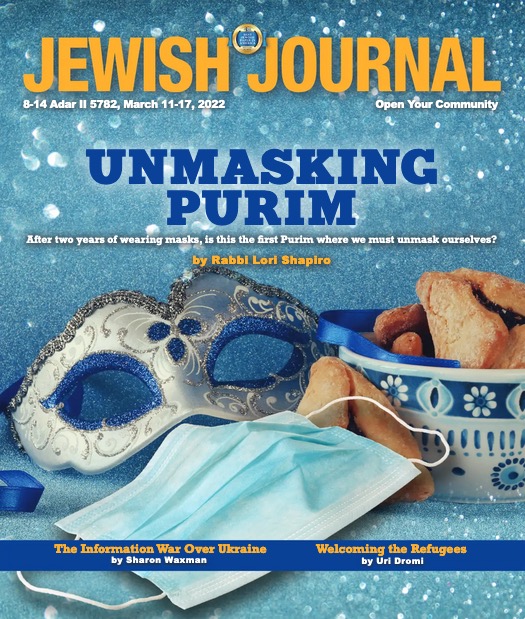
The masks are coming off. More and more, I’m walking into retail stores, cafes and offices and seeing real human faces. As COVID restrictions are being relaxed nationwide, we are entering the period of the Great Unmasking, and not a minute too soon.
How ironic that this moment arrives just as many Jews are picking out their masks and costumes for Purim, that quirky holiday that commemorates how the Jews were saved from persecution in the ancient Persian Empire.
As we will read in the Book of Esther, the Jewish people of Shushan were threatened by the villain Haman, who convinced the King to kill all the Jews, because Mordecai refused to bow down to Haman. In the end, the Jews are saved by the heroic Queen Esther, Mordecai’s niece and adopted daughter, who married the King. When the King discovers that his wife is Jewish, he decides to reverse Haman’s decree, and instead of the Jews being killed, Haman and other enemies are killed.
This miraculous and unlikely turnaround has contributed to the “upside down” nature of this holiday, what Rabbi Lori Shapiro, in her cover story this week, calls a “topsy turvy” holiday. “Throughout Megillat Esther and the rabbinic discussions about it, the idea of ‘Hithafchut’ or reversal, spotlights the vertiginous experience of our observance,” she writes. “In addition to the commandment to get so drunk as not to be able to distinguish between Haman and Mordecai, the preponderance of these literary device reversals read like spinning teacups – a scroll within a scroll.”
The odd fact that a Jewish holiday of masks is coinciding with our great COVID unmasking is itself in keeping with the topsy turvy spirit of Purim—it’s another scroll within a scroll, another spinning tea cup.
This year Purim also coincides with the unmasking of two men who have dominated the headlines: Russian President Vladimir Putin, a modern-day Haman wreaking havoc in Ukraine, and Ukrainian President Volodymyr Zelensky, a modern-day Mordecai and former comedian who has refused to bow down to him.
As if this weren’t enough, this year Purim also coincides with the unmasking of two men who have dominated the headlines: Russian President Vladimir Putin, a modern-day Haman wreaking havoc in Ukraine, and Ukrainian President Volodymyr Zelensky, a modern-day Mordecai and former comedian who has refused to bow down to him.
After two decades of showing us a shrewd and calculating face, Putin went all in this year, taking off his mask and eliminating any doubt about his primal, predatory nature. Meanwhile, the former Jewish stand-up comic Zelensky, who no one took seriously since he became president, has revealed himself as a true hero by courageously standing up to the Russian bully.
That alone is a story worthy of Purim.
Even the Western nations, who have been divided and feckless in recent years, took off their masks since Putin’s invasion to reveal a ferocious unity and determination to sanction and isolate the rapacious Russian.
But what about us? What will happen after we take off our COVID masks for good? Who will we reveal? Will we be gluttons of the freedom that was taken from us these past two years, and regrab our pre-COVID lives with a vengeance? Or will we reveal our more modest, humbled selves, wiser to the things that bring us the most meaning?
What will happen after we take off our COVID masks for good? Will we be gluttons of the freedom that was taken from us these past two years? Or will we reveal our more modest, humbled selves, wiser to the things that bring us the most meaning?
I wonder if some of us may even miss the cocooning forced on us by COVID, an ideal excuse to stay away from the pressures of socializing. Will we miss the anonymity that the masks provided, the aura of “crisis” that the masks represented that relieved some of the anxieties of modern living?
The good news is that we’re in a position to even ask these questions — that we’ve reached a point where a lethal virus, while still not fully tamed, no longer dictates our lives.
In a sense, we’ve been living the vibes of Purim continuously since March 2020, with our lives and our worlds turned upside down and our faces hidden from one another.
Now, as we take our COVID masks off and look for our Purim masks, perhaps we can look for that singular mask that will reveal our best and deepest selves.
My family first joined a synagogue, the Compton Jewish Community Center, in September 1967. I knew nothing, not even the word “gornicht.” When March 1968 came around, I saw in the newsletter there was a holiday called “Purim” on the calendar. I asked what the word meant (saying it like “pure ‘em”), and I was told “Lots.” I thought “lotsa what?” But after my embarrassing mispronunciation, which identified me as a dilettante among the seventh-grade cognoscenti, I thought I would wait until someone actually told me what the holiday was a lot of.
I later learned that the Persian word “pur” — pronounced like North Dakotans says “poor” —means “lots,” as in a lottery. In fact, the book of Esther tries to help here. In Esther 3:7, it says “pur, which is goral, were cast in the presence of Haman.”
The book of Esther translates for us the Farsi word “pur” into Hebrew, “goral.” Once my Hebrew improved, I knew what “goral” meant: fate, or destiny. So “Purim” in English is “Fate.”
To understand why this holiday is called “Fate,” the backstory is necessary… Purim is a lottery (the holidays of lots, a game of chance) but the Hebrew word for the holiday means “Fate.” We insist on a name that suggests some unsettling mix of randomness or fate. How reassuring is that? How does one even celebrate randomness and fate at the same time?
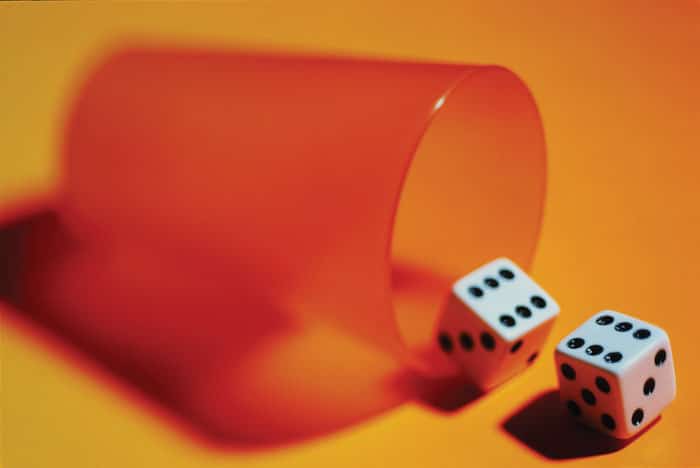
To understand why this holiday is called “Fate,” the backstory is necessary. Haman was trying to find the most propitious day to exterminate the Jews, and so the “the pur were cast before him.” Think of “pur” as dice—they threw dice to find the lucky month and day on which Haman and his evil minions would attack the Jews.
You can see the problem. A lottery is a game of chance. The winning number is random, we hope, not fated. Haman, however, was trying to find out his lucky number. “Lucky number” suggests there is some destiny involved. Purim is a lottery (the holidays of lots, a game of chance) but the Hebrew word for the holiday means “Fate.”
How could this be that the Persian word for a game of chance is defined by the Hebrew word for destiny? Aren’t the ideas of “lotteries” and “fate” opposite? Something felt amiss.
I later learned that the Hebrew word for a “lottery” is “hagralah,” from the word “goral,” “fate.” Who came up with this? Who oversees the Hebrew language?It turns out there is someone in charge of the Hebrew language in Israel — a committee, actually, “Va’ad Halashon,” “The Language Committee.” I will expose my unfortunate correspondence with that committee when I write my Memo-Wars.
Without any help from the ironically named and hopelessly confused Language Committee, I figured out how lottery and fate can be the same word: We typically think of a lottery as game of chance, but then after the lottery people might think that the outcome was fated, destined to be. Through the windshield, it looks random. In the rear-view mirror, it looks like destiny. Fate is what we see in the mirror. Somehow true.
It is not satisfactory, however. I still find it odd: “Lottery” is translated as “Destiny.”
Before you throw the dice, it feels that the number on which they land will be a matter of randomness, chance. After the dice are thrown, depending on the outcome, someone may be called “lucky” — those numbers “were destined to be.” In a way, to assume that the dice will result in good luck for someone (and bad luck for someone else), or closer at hand, a propitious day for someone, but a catastrophe for another, gives us a sense that the game is rigged.
Amended epigram: “Fate is what we see in the mirror, and the game is rigged.”
To summarize: Casting the “pur” (plural, purim) has a sense of both “chance” and “destiny.”
This semantic problem is probably why no one told me what “Purim” meant—it is not easy to explain a word that means two opposite things.
This semantic problem is probably why no one told me what “Purim” meant—it is not easy to explain a word that means two opposite things. The interstices between those meanings, chance and fate, portend ominous existential implications. You can’t tell kids everything.
With that now cleared up, I am sure you are asking how I know how North Dakotans pronounce the word “poor” (as in Puer Aeternatus, a Greek god who often makes his appearance at Purim celebrations).
Prior to the movie “Fargo,” the only thing I knew for sure about North Dakota was that the capital was Bismarck (yes, named for Otto von Bismarck) and there is a city called Moscow there. That there should be a city in America named Moscow intrigued me when I was kid during the Cold War.
(I just checked the weather for Moscow, North Dakota, to see how cold it actually is there. It is 32 degrees F, but “feels like 22,” according to the website. Now that really intrigued me. Whom would they ask what it felt like there today? There are only 17 people in Moscow, North Dakota; I guess for that 17th person it feels like 22 degrees.)
Apparently, the city of Moscow, ND, just about emptied out after the U.S. Air Force dropped an atomic bomb on Mars Bluff, South Carolina on March 11, 1958. I think it was a Purim prank, even though the bomb was dropped a good five days after Purim. The Jewish calendar was as much a mystery then as it is now.
Since the bomb landed so many days after Purim, no one got the joke. Especially Walter Gregg, whose house it destroyed. The incident left deep scars on Gregg’s family. For example, his grandson Clark Gregg found a leading role in the TV show “Agents of SHIELD” (SHIELD meaning Strategic Homeland Intervention, Enforcement, and Logistics Division) as a way to “shield” himself from further Atomic Bomb attacks. Very psychological.
Anyway, back to Moscow, North Dakota. Seeing that, first, the U.S. Air Force had apparently no reluctance to bomb an American city just for the fun of it, and second, the US Air Force flubbed the date for Purim, the residents of Moscow, North Dakota assumed that the same Air Force might flub again and mistake Moscow, ND for Moscow in the USSR. And so they fled for towns with more propitious names, probably avoiding the nearby North Dakota cities of Dresden and Munich.
Anyway, the movie “Fargo” (which is where I learned how North Dakotans pronounce the word “poor” — just like the Persian word “pur”) is about many things including philately (an awful perversion in my mind even though I am pretty libertarian about people’s personal choices) and feeding bodies into woodchippers.
Frances McDormand and Steve Park in ‘Fargo.’ | CREDIT: GRAMERCY PICTURES
The main thing, however, the linchpin of the movie and the turning point, is Mike Yanagita. Mike, you may recall, tells Marge, the sheriff, that his wife Linda Cooksey died from leukemia and that he has been despondent ever since. Sheriff Marge Gunderson, played by Frances McDormand, says “poor Mike,” as in “Purim”!Get it?
It turns out that Mike is lying. He was actually never married to Linda; he was just stalking her. Sheriff Gunderson now realizes (and this is big for North Dakota, apparently) that people lie! She then puts it all together, and among other things happens upon Gaear feeding Carl’s body into the woodchipper, not as rare as lying but nonetheless unusual for North Dakota.
Now what are the chances that Sheriff Gunderson, while in Minneapolis investigating the kidnapping case at the heart of movie, would agree to have dinner with disturbed stalker Mike, who just by chance happened to be in town, and then by chance the good sheriff discovers that Mike was lying, and thus inferring that the persons of interest in the kidnapping, the whole lot (!) of them, were lying? Wow! Not to mention her stumbling upon, by chance, the very moment when the woodchipper was being used in a manner very likely contrary to the warnings in the user’s manual.
Here is the point in case you missed it. Why don’t we just translate the name of the holiday Purim? But we must decide. Shall we call it “Fate” or “Chance,” or “Fate/Chance,” or even better, “Rigged Destiny” or “Fat Chance”?
But why call it some version of Fate/Chance anyway? Is this story really about Haman throwing the dice? No. This story is about the Jews of Persia defeating evil Haman and his wicked crew. Perhaps we should call it Persian Jewish Victory Day, or PJV Day for short.
Instead, we insist on a name that suggests some unsettling mix of randomness or fate. How reassuring is that? How does one even celebrate randomness and fate at the same time? And what, exactly, is being celebrated? Is it that life is random—nothing happens for a reason? That everything is predestined and there is no free will? No, I am actually asking.
Give me an existential break! The idea makes me want to go out and get tipsy. Party to distraction. Read aloud to the drunken midnight choir weird, ancient stories about royal court intrigue and trot around incognito.
What are the chances that King Ahasuerus would choose Esther (you may know her as Hadassah), the one Jewish contestant, as his queen, thus allowing the Jews to reverse their fate to a different fate, and what does “fate” actually mean in that case?
I did some more thinking. What are the chances, first, that King Ahasuerus would choose Esther (you may know her as Hadassah), the one Jewish contestant, as his queen, thus allowing the Jews to reverse their fate to a different fate, and what does “fate” actually mean in that case?
Second, what are the chances that Haman would be strung up on the very gallows meant for Mordecai? Isn’t that a little too perfect?
That’s about as likely as Mike Yanagita and Sheriff Gunderson having dinner in Minneapolis and Sheriff Gunderson stumbling upon a realization leading to woodchippers and eventually a closing scene with Sheriff Gunderson in bed with her philatelist husband (I did have to close my eyes on that one).
Maybe that is the basic exclamation point, that this mad, crazy holiday of Purim leaves us all hanging between chance and fate.
Mordecai Finley is Rabbi of Ohr HaTorah Synagogue in Mar Vista, CA.
“Sharon! Your grandmother’s cookies!!” was the excited direct message from our friend Ruth when she saw our Instagram post about the upcoming Sephardic Spice Girls Iraqi Master Bake Class.
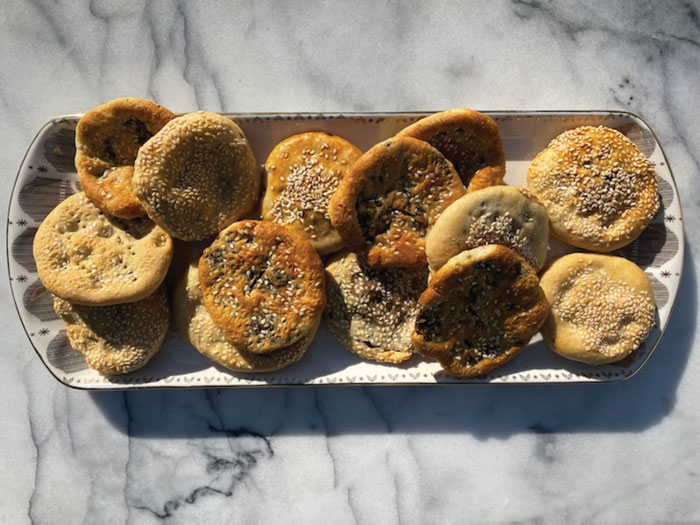
In those few words, she telegraphed so much. You see, my grandmother Nana Aziza made the most incomparable, most delectably tasty ba’ba tamar. Ba’ba tamar are the best treat you’ve probably never had—a thin four inch round cookie made with a crispy, unsweetened dough and a soft, chewy date filling. About 30 years ago, Ruth and her husband Todd were initiated into the fan club of my grandmother’s delicious baking.
In our family, my grandmother’s ba’ba tamar were highly prized (and jealously guarded). On baking days, she would start early. She would proof the yeast and mix it with the flour, oil and water. She would knead the dough until it was a wonderfully soft, stretchy texture. She would cover it with a muslin cloth and let it rest, like a precious baby. She would soften the pitted date paste with a bit of oil and in her own untraditional take on the recipe, she would add crushed walnuts.
Watching her oiled hands work the dough and dates was like watching a magician at work.
Watching her oiled hands work the dough and dates was like watching a magician at work. Roll the dough into balls. Roll the date mixture into balls. Press the dates into the middle of the dough and make it disappear. Take the wooden rolling pin and flatten the dough into a perfectly round cookie with no date filling breaking through the thin crust of the cookie. Turn the end of the rolling pin and make four indentations in the center. Brush with the egg wash and sprinkle sesame seeds on top.
Then the cookies would be lined up on baking sheets and placed in a warm oven. The cookies had to be watched with a hawkish eye — too little time in the oven would result in a pale doughy cookie, too long and they’ll have the texture of a hard brick.
My grandmother would pack the cookies in brown paper bags to give to her children and grandchildren. The rest would be stored in a big airtight container to serve to guests with a cup of her cardamom scented mint tea.
Every year before Purim, there is a community bake at Kahal Joseph, with grandmothers teaching their children and grandchildren how to make traditional Iraqi pastries — cheese sambusak (dough pockets stuffed with feta cheese), malfouf (flaky filo pastry cigars filled with crushed walnuts), crispy almond macaroons and, of course, ba’ba tamar.
This year, Rachel and I were determined to do a Purim baking class to empower women (and ourselves) to make these seemingly complicated recipes. Two weeks ago, we had a Sephardic Spice Girls Master Bake at Kahal Joseph. Yvette Dabby, the President of Kahal Joseph, her sister Rosie Nissan, Orly Kattan and other volunteers made a massive amount of dough, date filling and cheese filling to facilitate the Bake.
Yvette, who left Iraq in 1971 with her husband Joe and a degree in architecture, explained that in Baghdad, all the women would gather together to bake for Purim. They would arrange the treats on silver trays and give them as Mishloach Manot.
The evening was a huge success with over sixty women (and a few intrepid gentlemen) happily learning to make ba’ba tamar and cheese sambusak.
Rachel and I saved a dozen ba’ba tamar for Ruth.— Sharon
Sharon’s Ba’ba Tamar Recipe
Date Filling 2 cups pitted dates
1/4 cup olive oil
3 tablespoons water 1/4 cup crushed walnuts
In a frying pan, over very low heat, combine dates and olive oil. Stir for 5 minutes until the date mixture is soft. Add water and walnuts and stir until it becomes a smooth paste.
Set aside to cool.
Garnish 3 eggs
1 tablespoon honey
1 tablespoon water 1/2 cup sesame seeds
In a small bowl, beat together the eggs, honey and water. Set aside.
Dough Recipe 2 packets active dry yeast
1 tablespoon sugar
1 teaspoon kosher salt
2 cups warm water, divided 7 cups all purpose flour, sifted
1 cup avocado or vegetable oil 1 teaspoon fennel seeds
In a small bowl, add warm water to yeast, sugar and salt. Cover and leave to proof for 10 to 15 minutes.
In a stand mixer, add flour, oil, water, fennel seeds and yeast mixture and mix until a dough is formed.
Remove dough from mixer bowl and knead the dough by hand until it is smooth and stretchy.
Place the dough in an an oiled bowl, then rub some oil on top of the dough. Cover with a kitchen towel, set aside in a warm spot for 1 hour.
Remove the dough and knead for 2 minutes. Return to the bowl and let stand for 25 minutes.
Preheat oven to 375°F.
Divide the dough into four pieces. Grease hands with oil, pinch the dough into golf ball size balls and roll till smooth. Lay the dough balls on a greased baking sheet.
Place a ball of dough into the palm of your hand, make a deep indentation into the dough and place half a tablespoon of date filling in the hole.
Pinch dough closed, dip the ball into the egg mixture, then roll in sesame seeds.
With a small rolling pin, roll the ball flat until it is about 4 inches in diameter. With the end of the rolling pin, make a few indentations in the center of the cookie. Place cookies on a baking sheet. Repeat until all dough and date filling are used.
Bake for 12 to 15 minutes, until golden and crispy.
Photo by Alexandra Gomperts
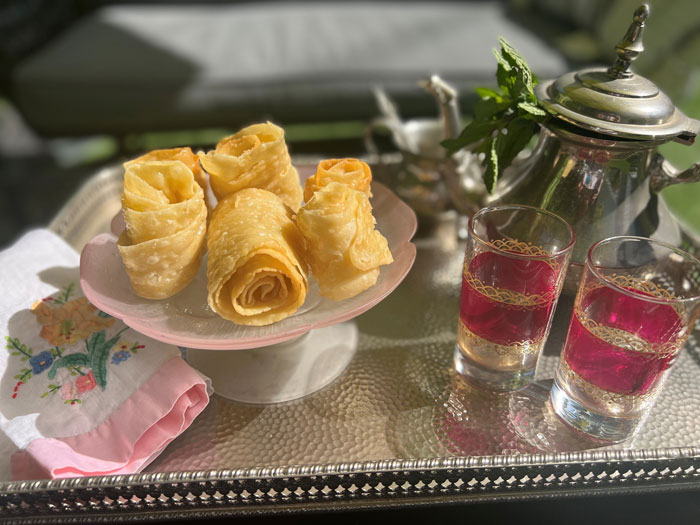
Lately, I have been nostalgic for fijuelas, the fried crispy delicate sweet treat that my mother made every Purim. My mother would prepare the light dough and stand in front of the stove, quickly frying batch after batch of perfectly uniform strips of dough into rolled fijuelas. Then she would dip them into a lemon-scented sugar honey syrup. While they go by many different names—fijuelas, fazuelas, hojuelos—they are an iconic pastry common to the cuisines of Sephardic Jews from Spain to North Africa, from Italy to Argentina.
Hélène Jawhara Piner, author of “Sephardi: Cooking the History,” writes that these Sephardic treats are a recipe that dates from the late Spanish Middle Ages. They are first mentioned in a famous story, “La Lozano Andaluza.” In the 16th century, Andalusian author Francisco Delicado writes about a Jewish woman fleeing the Inquisition. Having found refuge in Rome, she tells another woman that when she lived in Andalusia, she used to prepare hojuelas.
This scholar of food and medieval history says that “their characteristic form is undeniably reminiscent of Esther’s Megillah.” She adds that Christians in Spain still eat this dessert for a special feast called Semana Santa, a holiday that always falls within days of Purim.
I will always remember my mother’s kitchen in Morocco, with every surface covered with thin strips of dough ready to fry for fijuelas. Traditionally, the dough was rolled out flat with a rolling pin and cut into long ribbons. But then the pasta machine came to Casablanca. My mother would clip hers to the side of the table, she would put the dough through with one hand, I would crank the handle for her and she would catch the thin strips of dough on the other end.
I will always remember the big Purim Seudahs of my Casablanca childhood.
I will always remember the big Purim Seudahs of my Casablanca childhood. The meal always included letrea, homemade egg noodles flavored with Saffron. Dessert was lots of Moroccan cookies and best of all, freshly fried fijuelas.
When I set out to make my own fijuelas, I was very surprised that twirling the dough to get the scrolled form wasn’t as easy as my mother made it look. But the more I practiced, the easier it got and by the end, my fijuelas were pretty enough.
I shared them with my family, bringing a huge smile to all their faces.
Wishing you a happy Purim with a world that is turned right side up.
Fijuelas Recipe
2 extra-large organic eggs
(break eggs open and keep the largest
half for measuring oil and water)
2 eggshells olive oil
1 eggshell water
1 eggshell orange blossom water (or plain
water)
Juice of one lemon
A big pinch of kosher salt
½ teaspoon baking powder
400g all-purpose flour (approximately 3 cups)
Almibar (Syrup)
2 cups sugar
1 cup water
I lemon, cut in quarters
8 tablespoons honey
Peel of one lemon
In a large bowl, mix eggs, oil, water, orange blossom water, salt, baking powder and lemon juice.
Slowly add the flour and mix well. When the dough comes together and is not sticky, stop adding flour (there may be some unused flour.
Cover the dough with a dish towel and let stand for 20 minutes.
Form the dough into a log and cut into 3 to 4 pieces.
Take a piece of dough and make 2 inch wide long, thin strips, using a pasta machine or a rolling pin. Then cut the strips until they are approximately 8 inches long.
In a large and deep frying pan, warm oil over low to medium heat.
Pick up one end of the dough strip and insert it between the tones of a fork.
Dip the fork and the dough into the warm oil. As the dough starts to blister, lift up the other end of the dough, slowly feed it into oil and slowly rotate the fork, wrapping the fried dough around the fork.
Once a coiled pastry is formed, remove from the oil and place on paper towel to drain. Continue to process until all the dough strips are fried into coil shapes.
Make the syrup by adding all the ingredients into a small pot. bring to a boil, keep stirring and when the syrup starts to thicken and feel heavy on a spoon, turn it off.
Dip one Fijuela at a time into the syrup, and cover all sides, place on a serving platter.
Best when eaten same day. Can be kept in a well-sealed container for a few days.
Sharon Gomperts and Rachel Emquies Sheff have been friends since high school. The Sephardic Spice Girls project has grown from their collaboration on events for the Sephardic Educational Center in Jerusalem. Upcoming events include interviewing Chef Shimi Aaron at the WIZO Purim Luncheon and a Sharsheret Passover Cooking Webinar. Follow them on Instagram @sephardicspicegirls and on Facebook at Sephardic Spice SEC Food. Website sephardicspicegirls.com/full-recipes