Purim will always have a special place in Nina Safar’s heart. Each holiday, Safar’s mother would prepare big batches of hamantaschen dough and create her own mixture of sweet prune jam to stuff them. She would bake with her 11 children and then her grandkids.
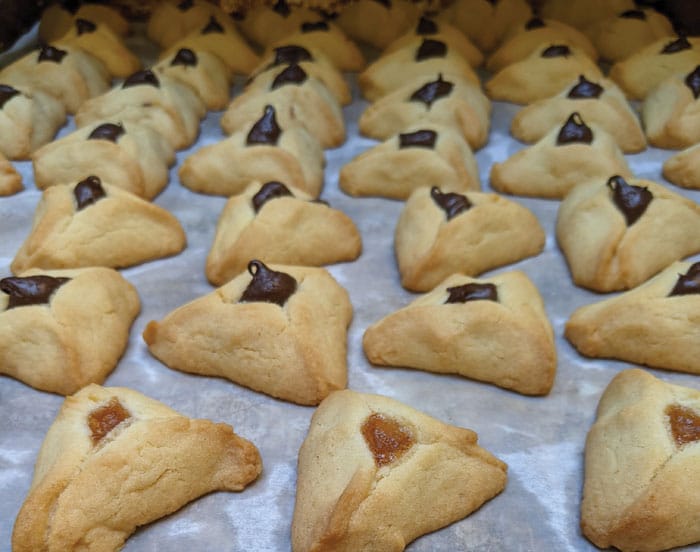
Lotus Cookie Butter Cheesecake Hamantaschen Photo courtesy of Kosher in the Kitchen
“It was such a warm, loving experience to be in her kitchen,” Safar, a kosher chef who runs the Kosher in the Kitch website, Instagram and YouTube channel said. “I baked them with her a couple weeks before she passed [away on Purim in 2020]. I knew it would be the last time she would make anything in the kitchen, and I wanted to just freeze that moment forever. Now, when I’m missing her, I bake a batch with my son, and it almost feels like we are baking with her.”
All Jewish holidays are attached to food in some way. And Purim, perhaps, has the most literal food connection. The shape of the cookie represents the triangular hat supposedly worn by Haman, the villain of the Purim story in the Book of Esther. In Hebrew, hamantaschen are known as oznei Haman, which translates to “Haman’s ears.”
Safar started her Kosher in the Kitch blog to share easy and modern kosher recipes with family and friends. One of her innovations? Savory hamantaschen.
“I thought it would be fun to stuff hamantaschen with the unexpected,” she said. “A few of my favorite savory versions would be my barbecue chicken stuffed pizza hamantaschen, fig jam and candied beef facon hamantaschen and taco hamantaschen. I personally love those flavors.”
Safar also has a sweet tooth; she enjoys sweet hamantaschen just as much as the savory ones. “My favorite stuffing would be cookie butter cheesecake,” she said. “It’s addicting.”
When discussing the savory versus sweet hamantaschen debate, Dan Messinger, owner of Bibi’s Bakery & Cafe and The Kosher Cookie Company in Pico-Robertson, said he is partial to the traditional sweet ones.
“Unlike sufganiyot for Hanukkah, I think the best hamantaschen keep it pretty simple,” he said. “I personally like a fruit filled hamantaschen.”
At Bibi’s, the biggest sellers are chocolate and poppy. Israelis especially like the latter. “The challenge, of course, is making sure that the poppy and the chocolate don’t get mixed up because people are very sensitive when they get the wrong one,” Messinger said.
At Bibi’s, the biggest sellers are chocolate and poppy. Israelis especially like the latter.
“The challenge, of course, is making sure that the poppy and the chocolate don’t get mixed up because people are very sensitive when they get the wrong one,” Messinger said.
Messinger’s earliest memory of hamantaschen is baking them with his mother who, he said, enjoyed the prune versions.
These days, Messinger said, “I don’t have much time to personally bake them. But I find time to eat them.”
Marti Kerner over at the Everyday Jewish Mom website has been making hamantaschen with her two kids since they were little.
Kerner was raised Reform, and is bringing up her kids the same. Almost five years ago, she started her blog and YouTube channel to share the accessible way she practices Judaism – and celebrates holidays – with her family.
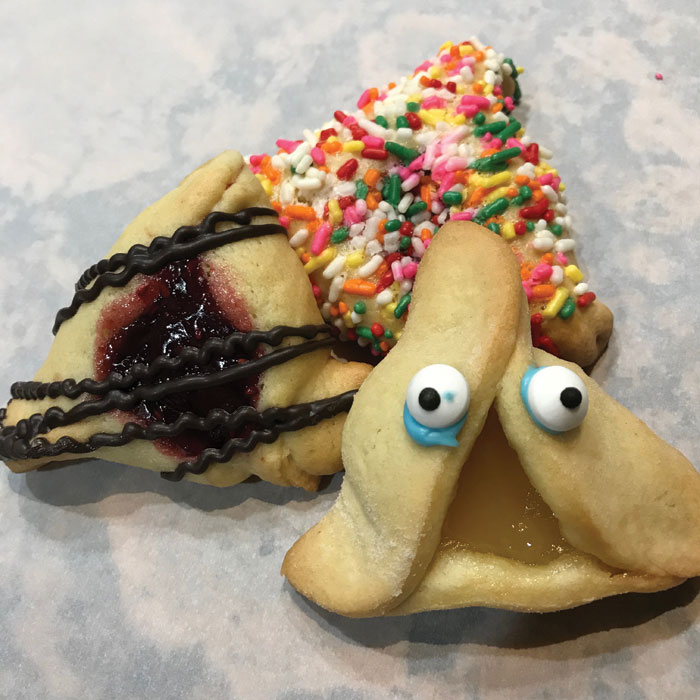
“Sometimes they’re triangles, sometimes they’re blobs. The most important part is that we enjoyed the time together.”– Marti Kerner
One thing she focuses on is memory building and not necessarily the outcome when it comes to baking hamantaschen. “Sometimes they’re triangles, sometimes they’re blobs,” she said. “The most important part is that we enjoyed the time together.”
Photo courtesy of Everyday Jewish Mom
Want to start making hamantaschen with your kids? Kerner suggested practicing the folds with Play-Doh around a checker. Then, when you are ready to try it with actual ingredients, use a chocolate candy in the middle, “since there’s no wet filling to spill out,” she said.
Every year, Kerner creates fun new flavors. For instance, she’s made cotton candy hamantaschen with raspberry filling, white chocolate, cotton candy and Pop Rocks.
“I think it’s really in the spirit of the holiday to go as wild as possible, but my heart will always be with sweet hamantaschen in the traditional flavors,” she said. “My favorite is prune. I love the idea that I’m eating the same flavors as my grandparents and their parents.”
Kosher in the Kitch Lotus Cookie Butter Cheesecake Hamantaschen
Ingredients:
2/3 cup sugar
1/2 cup oil
2 eggs
1 teaspoon vanilla
2 1/2 cups flour
2 teaspoon baking powder
1 cup cheesecake filling (recipe below)
1 cup Lotus cookie butter icing (recipe below)
Crushed Lotus cookie for garnish
Cheesecake Filling:
1 8oz package of cream cheese
1/3 cup of sugar (you could use 1/2 cup if you like it very sweet)
1 tsp. of vanilla extract
Combine ingredients until smooth. Makes about 1 cup.
Cookie Butter Icing:
3/4 cup powdered sugar
1 tablespoon almond or soy milk. Water can also be used.
1 tablespoon Biscoff Lotus cookie butter
Combine until smooth.
Directions:
Cream together sugar, oil, eggs and vanilla. Slowly add flour and baking powder. Mix together. The dough might be crumbly, so use your hands to smooth it out and combine it. Roll out dough on floured surface to about 1/4 to 1/8 inch thick and cut out circles using a large circle cookie cutter or the rim of a large glass cup or Mason jar.
Fill the center of each circle with about 1/2 tsp to 1 tsp cheesecake filling and then add a 1/2 teaspoon cookie butter on top. Fold over one side, then the next, and finally bring the bottom on top. Gently pinch the corners. You can also simply bring up the sides, forming a triangle by pinching the corners together.
Bake at 350 degrees for 12 to 15 minutes, depending on how soft or crispy you want them. (I like them super soft so I bake them for about 12 minutes). Allow hamantaschen to cool and then drizzle cookie butter icing on top and sprinkle lotus cookie crumbs over glaze.
Thirty years. That’s approximately how long I’ve had a subscription to Entertainment Weekly (EW). And this is their last issue. I shouldn’t be waxing nostalgic, but I can’t help it.
Shabbat is the time that most of us observant Jews turn off our phones and televisions, and actually — gasp — disconnect and read books. As a kid, I inherited my older brother’s MAD Magazine subscription, and devoured it and continued subscribing for a number of years; but I also was a very young movie and TV fanatic.
I once sat down with a piece of loose-leaf paper and pen, and tried to recall all of the movies I’d ever seen. I was a kid, maybe eight or 10 or so. I couldn’t get up, because I found myself obsessively remembering more and more and more. It went on for about eight pages or so, just line after line of movie titles, plus even a one-phrase synopsis, and, God help me, I am sad that I don’t still have it framed somewhere.
But the point is that I was entertainment-obsessed from a young age. My first movie in the theater was who knows what, but I can affirm I was gleefully watching R-rated movies with my parents, and although things may have been over my head, I still loved them all. (I recall hearing a certain crude zinger from Danny DeVito’s mouth during the hysterical “Ruthless People,” and on my fifth viewing or so at home, suddenly realizing, “Ohhhhh, that’s what it means!”
As a child and teenager, I kept a collection of the movie stubs from films I saw for years, writing the name of the person with whom I’d seen it and stuffing them into countless Ziploc bags. Again, I wish I had kept those. To be fair, I still keep my stubs each year and write down the person’s name, but once I mark my tally on my Excel spreadsheet, I just toss them.
Around 1992 or so, I decided to add one other subscription to look forward to, Entertainment Weekly. This was before the age of the internet offered me minute-by-minute updates, and my only entertainment news source was the Calendar section of my parent’s LA Times. (Side note: Every Monday I would pore over the Calendar section to read the Box Office results from the weekend, along with its corresponding commentary. I don’t know if there were any other 10-year-old kids who cared about movie receipts as much as I did, anywhere on earth.)
Joe Raedle/Getty Images
So Entertainment Weekly quickly became my guide to what was happening behind the scenes. I was reading book reviews and articles about musicians. I was learning about up and coming actors. And my favorite issue each year listed the domestic and international grosses of the top 100 movies, which I practically memorized. I devoured it all.
At some point in my adulthood the magazine either became more political, or I just started to notice it; and although it continued to be a fun weekend read for me, it never quite gave me the same sense of total relaxation and pure fun as it had before. Not everyone agrees with this sentiment, but some things in life just need to entertain us, and allow that part of our brain that’s always tense and focused on the world’s strife to take a backseat for the evening. That’s what I hope for from most of my entertainment, whether it be magazines, TV, movies or sports. I didn’t ever enjoy Entertainment Weekly to the same degree again, but I still looked forward to it as my Shabbat reading material. (Only when finishing the magazine would I allow myself to continue whatever book I had been reading.)
The years passed by, and my first college job was at Blockbuster Video, but that’s a story for another day; or, rather, it was already written by me in 2013. Oh, and did I mention my movie blog was and still is called “Boaz’s Movie Obsession”? I believe that says it all. (Important side note: My dear, extremely close childhood friend Josh Rothstein, who I write about in the story, tragically died in October, and even at his funeral I was honored to recount our Blockbuster days while eulogizing him to his family and friends.)
At some point in 2019 EW became a monthly magazine, really truly disappointing me, but they made the bizarre choice to keep the consequently-ironic name “Entertainment Weekly.” In an eerie maybe-not coincidence, MAD ended its publication after 67 long years, also in 2019. Although I had stopped subscribing to it for many years, I still found it quite sad. I remember cracking up at a few MAD issues that skewered Entertainment Weekly with entire mockups of it section-by-section, renaming it EntertainMe Weakly. Those were brilliant.
Last week my friend Mike told me that Entertainment Weekly’s print magazine had come to an end.Sure enough, the final issue had been published without so much as a goodbye.
Last week my friend Mike told me that Entertainment Weekly’s print magazine had come to an end.Sure enough, the final issue had been published without so much as a goodbye. The magazine, which often included editor notes about each changing of the guard in the staff, and about each stylistic change and decision, went out with a whimper, like any other issue. It arrived last week and there was not so much as an editor’s note, or final issue notice, making me wonder if they didn’t even have time to put one in before publication. Since I have a subscription that was not due to expire for a few years, I called customer service to get a refund, and here’s the insane thing: I realized that I knew their phone number by heart.
[Author’s note: “Well now I feel stupid! Multiple reports were that EW had immediately finished any and all print issues, but I just found out to my horror and amusement that there is still one last issue to come, with Star Wars on the cover (a fitting final topic in my estimation).”]
For some context, I’m not a mad genius with numbers. The only phone numbers I can remember are my own, my wife Adi’s and my parents. But then there’s a special part of the brain that can remember childhood phone numbers and addresses. You know this is true if you grew up before the age of cell phones and the internet. You had to rely on memorizing numbers. I can still remember the address and especially home phone numbers of friends Ronnie Rosenberg, Daniel Stein and Seth Isenberg. I can still remember the work phone number to Nagila Pizza (priorities, people)! And I can still remember, God help me, the customer service number to Entertainment Weekly, which I would call every time my issue didn’t arrive, a few times a year or so. I never planned to write a eulogy for a somewhat mediocre magazine, but when you realize you’ve known their phone number since your Bar Mitzvah, and the last issue brings up memories of times road tripping with your mother, when you’d read articles to her in the front seat, or times you’d be studying the box office chart harder than you ever practiced for the SATs, you realize that it’s time to put pen to paper once again.
Boaz Hepner works as a Registered Nurse in Saint John’s Health Center, and teaches COVID vaccine education throughout the hospital, and to the community at large. He grew up in LA in Pico/Robertson and lives here with his wife and daughter. He helped clean up the area by adding the dozens of trash cans that can still be seen from Roxbury to La Cienega. He can be found with his family enjoying his passions: his multitude of friends, movies, poker and traveling.
Two years. It’s been two years since we’ve seen an UnMasked World. Two years of children breathing their own imperfectly brushed tooth-smells, two years of N95 synthetic creating a layer of “mascne” (mask induced acne) on our mien. For two years we have been shut out of stores without our masks on, told by formerly close friends that we are no longer inner-circle by their eyes only, and messaged by the world that something dreadful, indeed lethal, might happen to us UnMasked. Our voices and freedoms have been muffled and muted beneath layers of filters and fear.
With mask mandates being repealed across the country, what lies beneath these UnMasked Times leaves our baby-soft skinned mouths agape: refugees fleeing a European country, the threat of nuclear accident (or purposeful attack), and the daily montage of gruesome images out of Ukraine reminiscent of Vietnam-era photojournalism. It seems that the world itself has UnMasked, revealing the ugliness that has brewed beneath our breathlessness for two years: the reboot of an existential threat to democracy and the urgency, more than ever, to protect it.
It seems that the world itself has UnMasked, revealing the ugliness that has brewed beneath our breathlessness for two years: the reboot of an existential threat to democracy and the urgency, more than ever, to protect it.
As each of us discerns exactly when and where we will UnMask, an urgent question arises alongside the Purim reading of the Megillat Esther: How does the Great UnMasking transform into the Great Jewish Reveal?
This year, a confluence of occurrences in time, like a cosmic event of an eclipse or comet visitation in space, occur together around Purim: Our end-of-winter festival aligns a few days before the beginning of Spring. The days following Purim are the start to Daylight Savings Time, literally a harbinger of extended light in our life. As a shmitah year, our end-of-winter festival has an amplified sense of release and renewal. And if that weren’t enough, we are hovering between two Purims this year, as it is a leap year—Adar Alef and Adar Bet, as the Jewish leap year adds an extra month to our calendar. Indeed, our time, our light, yes, our lives, are expanding at hyper warp speed.
The Megillah’s shadows also loom greatly upon our landscape: Putin wears the Haman mask as the bloodshed of the ninth chapter is happening in real time with war exploding in Ukraine.
However, the Megillah’s shadows also loom greatly upon our landscape: Putin wears the Haman mask as the bloodshed of the ninth chapter is happening in real time with war exploding in Ukraine. And as our nation passes the one million mark of COVID deaths any day now, what expression of Purim should be “celebrated”? What significance do we find in the mitzvah of “joy” while we also recognize the anniversary of the two-year mark of COVID times earlier that week, a time when we were introduced to the world of isolation, hand sanitizer, lock downs, quarantine, Zoom, and masks. How might our ancient tale of light and darkness bear significance to all we have lost or borne witness to?
And, in the face of all of these woes, how do we, like Esther herself, reveal ourselves to the world as individuals transformed by all that we have been through? Are we prepared to take a stand in a world where God indeed seems hidden? This Purim, how do we, once and for all, UnMask as Jews?
Purim—Awareness of Reversals
Purim is a topsy-turvy holiday. This idea is taken so literally that JT Waldman, the clever artist/author of a graphic novel, “Megillat Esther” (JPS, 2005), required the reader to turn the book upside down in order to complete the second half. Throughout Megillat Esther and the rabbinic discussions about it, the idea of “hithafchut” or reversal, spotlights the vertiginous experience of our observance. In addition to the commandment to get so drunk as not to be able to distinguish between Haman and Mordecai, the preponderance of these literary reversals reads like spinning teacups—a scroll within a scroll.
In the face of all of these woes, how do we, like Esther herself, reveal ourselves to the world as individuals transformed by all that we have been through?
The story begins with a description of time and place in a kingdom that extends far and wide “From Hodu to Cush,” only to be amended in b. Megillah 11a so that “Hodu and Cush are next to each other.” The Book itself, called Esther, is about a woman whose name was Hadassah, but who was renamed as the Babylonian Goddess of Love Esther, also known as a cognate of the ancient near-eastern goddess Isthar scribed in the Enumah Elish. Sent by Mordecai (or Marduk, a likening from the same Babylonean myth), Esther is all at once, Mordecai’s niece, cousin, adopted daughter and even his wife. Esther is both a “bitulah” (virgin) and the most beautiful woman ever created, so that even at 80 years old (Genesis Rabbah 39:13), she aroused the interest of the king more than all of the other virgins in the land. The name Esther itself suggests something more ominous in the book, as the letters of the name bear a theological message about the presence of God through dark times: alef, a symbol of God in rabbinic tradition, is followed by the letters samech, tav and reish, the root for the word “hidden,” as it is the only book in the Bible in which God is not mentioned. In a troubled world where God did not show up, our ancient scribes chose to inform us, Esther literally (and literarily) did.
And the reversals continue in the most embodied way: Purim is the gender-bending holiday, where the prohibition from Deuteronomy 22:5 — “There shall be no man’s item on a woman, and a man shall not wear a woman’s garment, for anyone who does these things is abhorrent to YHWH your God” — is not valid. In a Teshuvah (Judah Minz, Padua, 1509) it is stated that “with regard to the custom of wearing a parsufim (mask) whereby a man dresses himself in the garment of a woman and a woman puts on the attire of a man, it is not forbidden.” The collection of reversals and switchbacks in the Megillah itself grants primacy to the gender-bending land of queer sarisim (eunuchs) who “guard the harem” and are themselves agents of plot twists in the text.
Perhaps more than ever in our lifetime, Purim resembles the world we UnMask into today, capturing the dramatic tension of our time. From non-binary eunuchs who administer makeup to the harem-like “RuPaul’s Drag Race,” to the efforts of the descendant of Amalek (Haman) to plot our ultimate demise—Purim plays out like a Jewish horror play, a brutal tale (just read Chapter 9!) of the forces of light and darkness, good and evil, revenge and ascension. What does it mean in our modern expression of the holiday that our Megillah story is glorified as a celebration for children in a retelling of the story as a dissimulated Shushan-style Disneyland, complete with ball gowns and tiaras? Perhaps this is just another reversal, or perhaps a conditioning—an intentional onboarding for young children into the cruelty of the world around us. At its essence, Purim illuminates the path ahead for how to navigate through our own experience of diabolical antagonists presenting existential threats to a Jewish community that has already experienced too much. As we consider our Purim costume this year, perhaps the most essential one of all might be the one that UnMasks the story and bears its true essence.
The Origins of Masks
Purim holds a unique place in the Jewish canon, a literal “historic event”: Where Torah commands holidays “by God,” Purim reverse engineers a new holiday in this image, as the Purim celebration is uniquely commanded not by God, but by humans. With this in mind, what is the implication of this year’s observance? If the story itself is a human-crafted celebration, what other imperatives around this year’s observance might we glean? This year, how must we make Purim different?
The Hebrew words for mask, “parsuf,” has preference over “massekhah” as the latter is associated with graven images. Parsuf was used for the first time to describe one wearing a costume with a face covering for a masquerade in the 16th century, an historic déjà vu when war in central Europe and persecution in Ukraine has removed a sense of ease and confidence in Jewish gathering. Derived from the Italian commedia dell’arte, the masks first resembled stock characters from a traveling minstrel: Zanni (servants, clowns in our tale), Vecchi (the wealthy old man; here, Mordecai), Innamorati (the beautiful maidens, or Esther) and Il Capitano (the braggart “man in command,” here a buffoon of a king, Ahausueros). The commedia did not spotlight a character of pure evil, as it sought to achieve levity and lightness; perhaps, for Jews, our addition of Haman in costume, dressed in triangular hat and black mask, was as much inspired by the times besmirched by pogroms and persecution as the story itself.
However, masking itself was historically a controversial subject. Jewish law switches between laws prohibiting masks (which would “inhibit moral behavior”) and permissive pursuits of mask-wearing merriment. In essence, the parsuf represents how people in different times and places expressed concerns and interests around persecution, dissimulation, and what we might even invite Karl Jung to call “The Shadow”—an unconscious aspect of our personality of which we are not fully conscious. With the plasticity of the history of masking in mind, what role does the mask take on for us as we face Purim, 5782?
The Great Unmasking
This year, Purim arrives the same week that the State of California changes its masking recommendations.
This year, Purim arrives the same week that the State of California changes its masking recommendations: “With declining case rates and hospitalizations across the West, California, Oregon and Washington are moving together to update their masking guidance. After 11:59 p.m. on March 11, California, Oregon and Washington will adopt new indoor mask policies and move from mask requirements to mask recommendations in schools” (gov.ca.gov, 2/28/22). With our most vulnerable being invited to finally, after two long-lost years, take off their masks, we must consider the true question hovering among us: Are the adults ready? The only way that “The Great UnMasking” can occur is if the adults do the work that is required to succeed in this perhaps greatest of all reversals. We will need the courage of Esther, the humility of Mordecai and the faith in a God in hiding to get through it.
The Great UnMasking of 5782 requires us to take personal responsibility for ourselves. It asks us to do more than accept that when we finally take down our masks, our teeth may reveal a yellowing, as dental appointments for cleaning are hard to come by. Our smiles will be shy as the hearts engineering them have lingering suspicion toward the stranger with questions like: “Will our ultimate demise come from a friend whom I haven’t seen in two years?” and “How will I deal with the fact that he spits when he talks?”
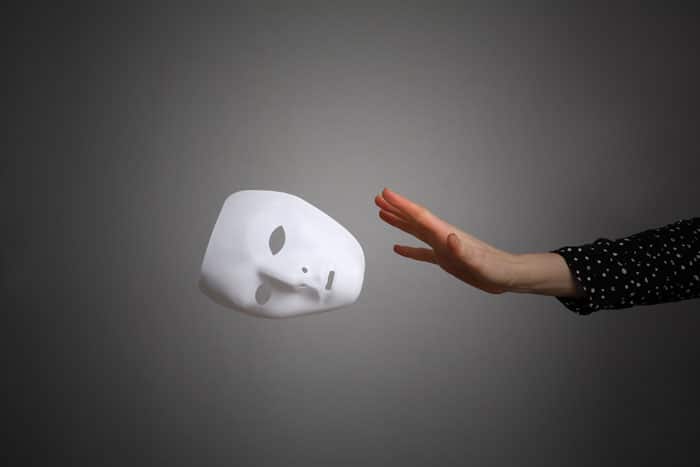
When we let down our masks, we must also let down our judgements. We must lay down the staffs of our own imperial rule and grant entry to others —other ways of living, other life choices, other ways of seeing.
When we let down our masks, we must also let down our judgements. We must lay down the staffs of our own imperial rule and grant entry to others — other ways of living, other life choices, other ways of seeing. Like Esther, we must all recognize that all of us are the other. All of our ways will be foreign to others and all of our mouths potential weapons of mass destruction. The Great UnMasking of Purim 5782 demands that instead of meeting difference with judgement, we must exercise our flaccid compassion muscles — muscles that thrive in crowded subways, hushed movie theaters when someone has a cough, bustling restaurants on a rainy day during lunch time when the person next to us sneezes. We must release our prejudices or assumptions that we know science better than others, and instead learn to trust that the other is looking out for us as we are looking out for them. We must move from our Comedy of Terrors to a Comedy of Errors and find forgiveness and even humor in the many malapropisms awaiting a culture out of practice doing culture together.
Deposit Photos
In his own “Great Unmasking” last year in The New York Times, David Brooks, perhaps prematurely, wrote that “The Great Unmasking asks ‘What’s really important, and how should I focus on what matters?’” He continues: “People wear masks when they feel unsafe, and for more than a year, we were unsafe, and we had to wear masks. But the physical masks we wore were layered on top of all the psychological masks we had put on, out of fear, in the years before COVID.” Now at two years, and with war in Europe, how much more terror hides behind our N95s?
A Topsy Turvy Future
With the world burning around us, pandemic not abating, and climate change the next existential threat just around the corner, Purim’s unique place as “the only holiday celebrated in the world to come,” may feel, uncomfortably, closer than ever. And yet, perhaps we are evolving as a civilization conditioned to meet the highest call ever known to global humanity—a call for a world-wide repentance. As Mordecai took to sack-clothes upon the news of Haman’s plot to destroy the Jews, might we turn our own hearts and employ all of our power and understanding to truly embody what is asked of us at this time? What would a world-wide unmasking filled with soul-searching repentance look like?
Rabbi Avraham Sutton, the Rabbi of the Carlebach Shul on the Upper West Side, in his book, “Purim Light: The Reality of G-d in Our Lives,” writes:
“[In the Megillat Esther,] the Divine soul is forced to leave its place in ‘heaven’ and descend into a world where ‘heaven’ is completely hidden. Only there can the soul ‘go to itself,’ i.e., realize its own potential. The only catch is that it might initially fall into a state of amnesia in which it temporarily forgets its higher self, who it really is. But precisely in such a stage of exile will it be forced to draw upon its deepest reservoirs of holiness and transform not only its physical vehicle but the entire world around it into a stage for the revelation of G-d’s presence.”
What would a world-wide unmasking filled with soul-searching repentance look like?
In Chapter 5 of Megillat Esther, Mordecai addresses Esther with the same missive more directly: “Do not imagine that you will be able to escape in the King’s palace any more than the rest of the Jews. For if you persist in keeping silent at a time like this, relief and deliverance will come to the Jews from some other place, while you and your father’s house will perish. And who knows whether it was just for such a time as this that you attained a royal position!”
As apocalypse means “uncovering” in Greek, perhaps our path to redemption requires us, like Esther, to face our most essential truth: American Jews (like Esther in Shushan, living like royals in the Diaspora) must hit the amnesiac alarm clock, UnMask from our assimilated veneers, and rise to the call of Jewish spiritual transformation leaning into our core values of justice, love, compassion, grace and truth.
COVID times already prepared us for what comes next. It has already revealed our truest colors—triggers of mandates, political schisms, isolation, loss, loneliness, health challenges and more demanded that each of us face our own truths within the walls of our homes, and begin to practice self-improvement and self-knowing. Now, as we collectively hear the air raid sirens wail across the land on Purim, 5782 — from Ukraine to the United States and Alaska to Argentina — as bombs crashing into kindergartens explode in Europe, and ear-piercing tones induce headaches in hospitals as COVID patients code; as our children gather into storage closets while they practice “active shooter preparedness” in schools, and as the rabbi throws a chair at an intruder; as the media irresponsibly tears at the frayed seams of our country’s divide, and as the CO2 clock is about to blare with a reckoning that makes a pandemic look like a dress-rehearsal, perhaps the time has finally come. Perhaps, on the morning of Purim, 5782 when our alarm clocks go off we will recognize them as groggers in our modern world, a call to smite out evil once and for all, beginning with each of our broken, tender souls, and to turn, with fear and trembling, and face this momentous turning point: the moment when all of us will, once and for all, take off our masks and stand as Jews as a face-off to the world’s moral ambiguity and existential impermanence. As Jews, we have over 3000 years of knowing how to handle war; we are resilient. We know how to respond to a graven images of destruction — we mourn and find meaning. We’ve got Mordecai and Esther in our back pockets, a leader in Ukraine unafraid to speak truth to power, and the Great UnMasking to unmuffle and amplify our voice. This Purim, find yours.
Rabbi Lori Shapiro is the founder and artistic director of The Open Temple in Venice.