fbpx

March 10, 2022

UFC 272

UFC 272: Reflections on a wildly entertaining weekend

Listen to the full episode on any of your favorite podcast platforms!

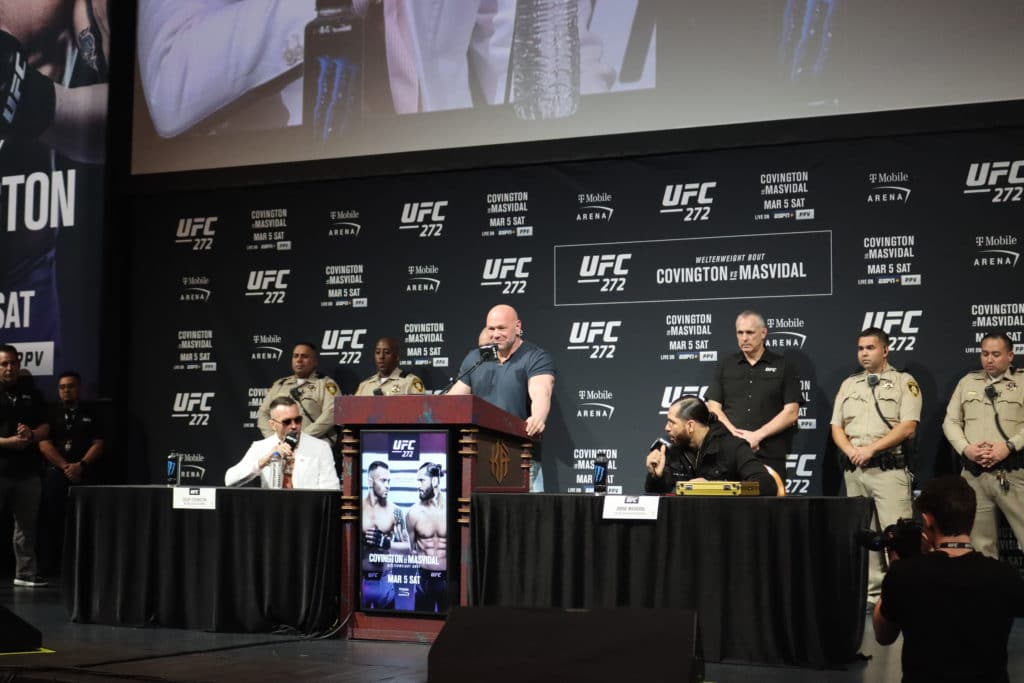
David asks Shanni about her recent trip to Las Vegas to cover UFC 272. They discuss the growth of the UFC, the differences between boxing and mixed martial arts, how the organization persevered through covid, all the live UFC 272 coverage and so much more.

Some standout press conference moments mentioned in the episode:

Follow David Suissa on Facebook, Twitter and Instagram & Shanni Suissa on Instagram, Twitter and TikTok.

You can check out Shanni’s new show here!

example one
example two
example two

UFC 272: Reflections on a wildly entertaining weekend Read More »

Putin’s #1 Enemy Is Not Zelensky, It’s Freedom

In the battle over Ukraine, we’ve been hearing a lot about sovereignty. Russian President Vladimir Putin, by invading Ukraine, wants to stop what he sees as the encroachment on Russia’s sovereignty of NATO and the West, while Ukraine is fighting tooth and nail to keep its sovereignty intact.

But not all sovereignties are created equal. Russia is a sovereign country, but it’s also a brutal dictatorship that spreads lies and jails dissenters. Ukraine is also a sovereign country, but it’s an emerging democracy desperate to get closer to Europe and become more Western.

That is what really threatens Putin—it’s not geography as much as values. Ukraine has gone in another direction than Mother Russia. Instead of looking East, it’s looking West. For Ukrainians, compared to the oppressive misery of Russia, European and Western values are a slice of heaven.

Ukraine has gone in another direction than Mother Russia. Instead of looking East, it’s looking West.

Ukrainians are fighting so ferociously because they’re fighting not just for sovereignty but for a country they believe in.

There’s a misconception that democracies don’t create fierce warriors. It’s often just the opposite. When soldiers fight for something, especially something as priceless and indispensable as freedom, they go all in. Just look at Israel.

Meanwhile, what’s Putin fighting for? To expand his oppressive misery onto other states? What kind of enticing “value” is that? What’s in it for these other states? And what’s in it for Russian troops— to force others to join their repressive society?

Putin knows very well that NATO is a defensive alliance, not an offensive one. Unlike Russia, NATO doesn’t invade countries. While there’s nothing “aggressive” about NATO, there’s everything aggressive about Russia. Free countries fear Russia; they crave the protection of NATO.

Putin’s heartless decision to bomb hospitals and civilian areas has only reinforced the motivation of the Ukrainian people. They must surely be asking themselves: Who would want to be under the thumb of such evil?

The great irony, of course, is that Putin’s horrendous aggression has backfired and moved Ukrainians even closer to Europe and the West. And who can blame them?

The great irony, of course, is that Putin’s horrendous aggression has backfired and moved Ukrainians even closer to Europe and the West. And who can blame them?

There is a fundamental principle that must enter the conversation about wars such as this one: Leaders who don’t believe in freedom are threatened by leaders who do. Putin is threatened by freedom. He’s been on the throne for over 20 years and he doesn’t plan to give it up. To stay in power, dictators like him need order and repression. The last thing they need is Western-style freedoms.

There’s another irony— because dictators surround themselves by loyal cronies, they rarely hear the truth. The Russian army’s poor performance in Ukraine is the inevitable result of a system where a leader is not held accountable, and where corrective mechanisms are rarely instituted. Again, look at Israel, where after every setback public commissions are created to study mistakes and make sure they’re not repeated. You’ll never see public commissions in Russia. Dictators can’t afford to admit mistakes or show any sign of weakness.

Ukraine is a flawed democracy, with its own set of problems such as corruption. But it had the collective wisdom to elect a brave and courageous leader who is now carrying the torch of freedom for his country.

Every human being prefers freedom to oppression. Zelensky, a former comic, knows all about freedom. It is that love of freedom that makes him such a threat to Putin, and to dictators everywhere.

Putin’s #1 Enemy Is Not Zelensky, It’s Freedom Read More »

Nonprofit Keeps Jewish Troops Fed Every Holiday

One of the success stories of Jewish entrepreneurial life was born on a quiet spring afternoon 14 years ago in the Monsey, New York home of real estate broker Sara Fuerst.

The bat mitzvah of her daughter Leah was approaching, just ahead of Purim. Leah wanted to do something meaningful to celebrate the event. 

Since this was 2008 and the Iraq War was raging, Sara suggested doing mishloach manot, making Purim baskets for Jewish soldiers. She was a businesswoman with contacts and West Point was about 30 miles away; she rounded up the names of 150 Jewish soldiers.

Sara, Leah and their family and friends filled and mailed off all 150 Purim baskets. 

To their surprise and delight, their unique one-off project started to take off. At first, a few soldiers began sending thanks to Sara and Leah, and then more and more soldiers followed. Sara had no idea this modest bat mitzvah project would create such an impact. 

Since Passover was only four weeks away, Fuerst and friends went into repeat mode. Shavuot beckoned six weeks later.

Sara enlisted her friend and neighbor, Ava Hamburger. A school psychologist and creative arts therapist, Hamburger had a knack for reaching out to kosher food manufacturers for donations. Virtually overnight, KosherTroops, a 501(c)(3) nonprofit, was born.

Now, five times a year – the High Holy Days, Hanukkah, Purim, Passover and Shavuot – the Fuerst-Hamburger team of volunteers sends thousands of packages around the world, to many of the 5,000 Jews in the U.S. military.

Since 2008, at least 87,500 food packages have been delivered.

Since 2008, at least 87,500 food packages have been delivered. “KosherTroops is a 100% volunteer organization,” Sara said, alluding to the 40 to 80 people who pack and put together the boxes of shelf-stable food. “Ninety percent of the items we send are donations from kosher food companies. The rest of our expenses – shipping costs, warehouse, trucking and some website and graphics, are paid [through] financial donations.”

Messages from grateful soldiers would cover a sizable piece of Dodger Stadium. 

Take Jonathan Gross, an Orthodox lawyer in the U.S. Army, formerly stationed in Iraq.

“I can’t begin to express how nice it is that people back home are thinking about us,” he wrote. “It says in Pirkei Avos, ‘One mitzvah leads to another.’ I encourage you to continue exercising your religious freedom by performing one mitzvah a day. Every single mitzvah is your way of making what I do worth it.”

He continued, “Thanks for reminding us why we do what we do. I’m proud to be a soldier, a citizen of this great country, and a Jew. May Hashem bless you all.”

Sara speaks of the soldiers’ sacrifices with awe.

“The Shomer Shabbat soldiers are truly courageous,” she said. “Many go to great lengths to avoid chilul Shabbos. One soldier said he walked two hours in the blazing heat on Shabbos to report for duty so that he wouldn’t have to go by jeep. Can you imagine their self-sacrifice under these conditions?” 

The soldiers whom the Fuersts – Sara, her husband Shlomo and Leah – regularly correspond with are not just names. Many care package recipients have become long-distance family friends. 

One even reminds Sara to count sefirah (the 10 emanations of God in Kabbalah) every day.

As for Sara’s background, her Moroccan-born father served as the rabbi in Curacao and later in Venezuela, where she grew up. At 18, she was sent to Stern College, New York, “to get a Jewish education and a Jewish husband,” she said. 

From the beginning, she was not intimidated about sending mishloach manot packages to U.S. troops. “My father-in-law had worked with NATO and the Air Force, and from that experience, I knew about shipping to APO addresses (military addresses billed at local shipping rates),” she said. 

Some soldiers don’t have much Jewish education, so KosherTroops includes Chabad pamphlets with each holiday shipment. Others are young people who ran away to the army, and sometimes protest they don’t need kosher food.

“We send it to them anyway,” Sara said. “Often those kids, despite themselves, turn into Jewish leaders among their peers because they’ve been to yeshiva, and they are more Jewishly informed than everybody else.”

Nonprofit Keeps Jewish Troops Fed Every Holiday Read More »

Peace Offering – A poem for Parsha Vayikra

And from the peace offering, he shall bring a fire offering to the Lord
-Leviticus 3:9

In the oldest days peace came
in the form of slaughter.

You can read the details of the ritual –
Which animal, what happens

with its kidneys and liver,
how it all becomes     smoke.

Not far away and a couple millennia
gone by, the chief oligarch

brings a three mile convoy
of peace

and claims of NAZIs to sweep away.
Our pale of settlement

gets more pale.
Around the world the banks

make a forceful peace –
An electronic siege.

The technology of war
has kept up.

Meanwhile, the number of
living humans fluctuate.

Who or what do I need to
slaughter today to have my

peace offering heard? There’s nothing
in the fine print about this.


God Wrestler: a poem for every Torah Portion by Rick LupertLos Angeles poet Rick Lupert created the Poetry Super Highway (an online publication and resource for poets), and hosted the Cobalt Cafe weekly poetry reading for almost 21 years. He’s authored 25 collections of poetry, including “God Wrestler: A Poem for Every Torah Portion“, “I’m a Jew, Are You” (Jewish themed poems) and “Feeding Holy Cats” (Poetry written while a staff member on the first Birthright Israel trip), and most recently “The Tokyo-Van Nuys Express” (Poems written in Japan – Ain’t Got No Press, August 2020) and edited the anthologies “Ekphrastia Gone Wild”, “A Poet’s Haggadah”, and “The Night Goes on All Night.” He writes the daily web comic “Cat and Banana” with fellow Los Angeles poet Brendan Constantine. He’s widely published and reads his poetry wherever they let him.

Peace Offering – A poem for Parsha Vayikra Read More »

Jews For Sale

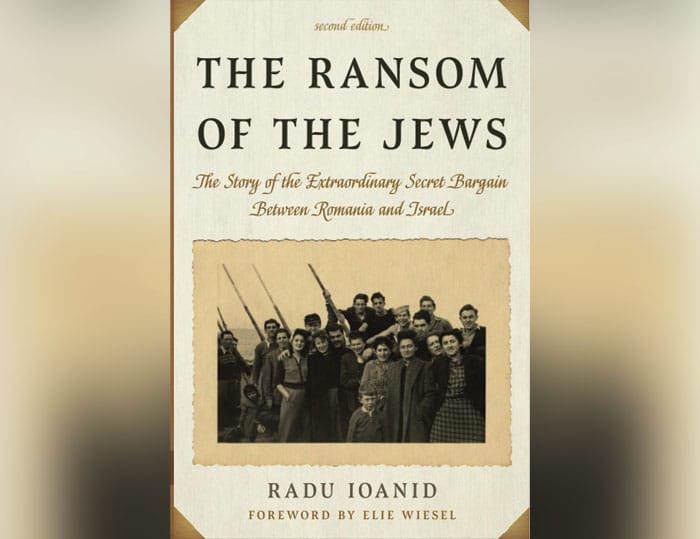
Readers Beware: The author of the book, “The Ransom of the Jews: The Story of the Extraordinary Secret Bargain between Romania and Israel,” Radu Ioanid, now Romania’s Ambassador to Israel, was a colleague of mine for almost a decade at the United States Holocaust Museum some thirty years ago, and has been a friend ever since. I was technically his boss, but it would be an exaggeration to suggest that Ioanid was subordinate to anyone. So, I am neither dispassionate about the man nor the subject.  An informed reader can make the appropriate judgments about this review.

In 1944, during the most intense final period of the murder of the Jews, there was an advertisement in major newspapers: “Jews for Sale.” There were no takers; after all, what was one going to do with these Jews and who would pay for their ransom?

Let us understand the context: Romanian ruler Marshal Ion Antonescu, the Romanian dictator who had been allied with Nazi Germany, had come to the conclusion, widely shared in 1944 after Stalingrad and the Soviet advances in the East, even before D-Day, that Hitler’s Germany was going to lose the war. Suddenly, after Romania had most actively participated in the murder of its own Jews and willingly assisted Germany in the murder of non-Romanian Jews, living Jews might be more valuable than dead Jews, more profitable to him, more advantageous to his nation.

Antonescu’s plan was unsuccessful for wont of a buyer—no country quite wanted the Jews—and also because of wartime conditions money could not be exchanged with the enemy. Fortunately for the Jews of the “old Romania”—not the territories that Romania was given because of its alliance with Germany—this plan to sell the Jews was a lifeline as the killing was postponed and soon, though certainly not soon enough, the war ended and a sizable population of Jews remained alive in Romania. 

That story has been well-told twice by Ioanid, first in his own masterful book “The Holocaust in Romania: The Destruction of Jews and Gypsies Under the Antonescu Regime, 1940-1944” and later in the work that he undertook as part of the Wiesel Commission, a truthful international study of the record of Romania toward its own Jewish community during the Holocaust chaired by Wiesel and with the participation of a committee of some of the world’s leading scholars both in Romania and elsewhere. Because of the Nobel Prize-winning author’s stature and the reputation of his fellow panelists, as well as the quality of Ioanid’s work, the Commission prevailed against political pressure from Romanian authorities.

Romanian Jews were the largest national community in Israel. Howa that happened is a fascinating story with plots and subplots, corruption, intrigue, daring, politics, and, above all, money.

In “The Ransom of the Jews,” Ioanid gets to complete the story of “Jews for Sale,” this time most completely as prior to the great Aliyah of Soviet Jews, Romanian Jews were the largest national community in Israel. How that happened is a fascinating story with plots and subplots, corruption, intrigue, daring, politics, and, above all, money.

The basic outlines of the story are easy to tell but the devil is in its fascinating details.

After World War II, Romania was in desperate need to buttress its floundering agricultural sector, including even sperm for calves, and a Jewish middleman living abroad proved useful. He would supply what was needed, and the cost would include exit permits for a modest number of Jewish families. There were handsome profits for the middleman—genuine gains for Romania’s economy and a limited number of Jews were set free to live a life of their choosing in Israel or in the Western world.

Later as industrialization was gaining some steam in the post-war Romanian economy, this Jew again proved useful as machinery replaced chickens and sperm as the desired import. Again, money was exchanged, profits were significant, and an additional but limited number of Jews were allowed to leave.

Enter the Israelis, and most especially a most skilled intelligence operative Shaike Dan. They were anxious to eliminate the Jewish middleman, more anxious still to get the Jews out and not unhappy to remove some levels of corruption even as Jews benefitted from that corruption, which proved indispensable to their freedom.

Romanian ruler Nicolae Ceausescu was a key player. He was an anomaly: tyrannical at home, he tried to distance Romania from the Soviet orbit and to chart some sort of independent policy toward the West.  He did not break off diplomatic relations with Israel after the Six Day War. Because of that attitude and his apparent dissent within the Communist Soviet bloc, he became a darling of the West, which learned to tolerate his corruption and his tyrannical tendencies as long as he charted a course somewhat independent of the Warsaw bloc.

Ceausescu discovered that Romania had two unexpected sources of foreign currency: Germany and Israel. West Germany was willing to ransom ethnic Germans from Romania and Israel was willing not only to absorb Romanian Jews but also to pay for their release on a sliding scale depending on their age and training. Children and retired Jews were to be released for free, and Romania was reimbursed for the education and training of Romanian Jews of working age. The Romanian ruler would skim vital sums of money off the top both to support himself in style and to enrich himself over time.

The Chief Rabbi of Romania, one of the most fascinating characters in Eastern Europe, was indispensable to this operation. Rabbi Moshe Rosen lived in style; in synagogue and on official occasions he wore a long purple robe with a Jewish star dangling from his neck slightly yet noticeably larger than the cross worn by the Cardinal. He was sent to the West to advance Romania’s agenda, most especially its desire to receive Most Favored Nation Status for his country and met with Jewish leadership and with Congressional leadership. The trade off was clear. Support the State, even the tyrannical state, and that state will continue doing business with Israel. However unpleasant the tradeoff, however compromised his role as shtadlan, the traditional Jewish intercessor, Rosen had two unparalleled achievements: Romanian Jews were able to move to Israel in record number, and synagogues and old age homes, even Jewish educational and cultural institutions, remained viable for an ever-diminishing Jewish community. It wasn’t pretty, it wasn’t morally pure, but it worked.

As a Romanian, Ioanid is most uncomfortable with the moral compromises that were made, with the corruption of Romanian leadership and with the way that Ceausescu was able to use the Jews to prolong his rule. As a storyteller, he is fascinated by the story—who would not be?—as will be his readers. As a historian, he divides the book in two, narrating the story in the first part and presenting the original documents that substantiate his case in the other, documents now available because of the freedom that Romania has enjoyed in the post-Communist era.

It is important to understand that Jews are much better off in a free society, but if forced to live under tyranny, they are fortunate if they are perceived to be of use to the regime, and most fortunate if they are wanted elsewhere. When Jews were offered for sale this time, Israel and American Jewish organizations were willing to pay the price. Both dictators Antonescu and Ceausescu found that living Jews were more valuable than dead Jews, but only Ceausescu was able to actually sell them.


Michael Berenbaum is director of the Sigi Ziering Institute and a professor of Jewish Studies at American Jewish University.

Jews For Sale Read More »

Lenny’s Casita Now Delivering Food By Drone

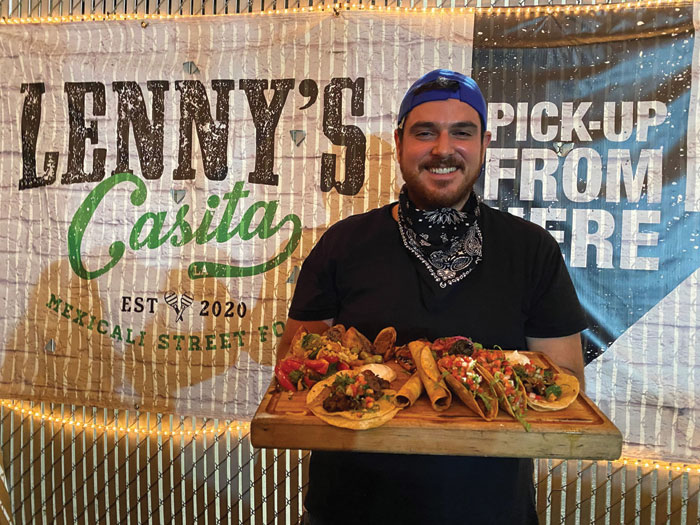
The white bubble-wrapped package came hurtling down from the sky like manna from heaven. But it wasn’t manna. And it wasn’t from heaven. It was from Lenny’s Casita, a kosher Pico-Robertson restaurant delivering chipotle honey wings and Wagyu boneless spare ribs – by drone. 

As so many people have become accustomed to restaurant delivery services such as Uber Eats, Postmates, DoorDash and the like, the Mexican eatery is taking it one step further by also offering drone delivery. 

“Our intention is to modernize and be on the cutting edge of the food delivery business,” Lenny Nourafchan, owner of the restaurant, said. “Drone delivery is an option that we are trying out right now.”

Lenny’s doesn’t actually operate the drones. That is left to a startup called Flyby, which is just getting off the ground (pun intended). Orders are placed via the Flyby app and prepared by the restaurant. The restaurant then hoists the packaged order via a pulley system to its rooftop, where Flyby personnel attach it to a drone and operate the software to assure the food lands at its intended destination. 

“Lands” is a key word. The Flyby drones are guided to their locations and hover about 30 feet in the air. A Flyby “pilot” then calls the customer and asks them to go outside and make visual contact with the drone. When the coast is clear, the pilot gives a five second countdown and then remotely releases the securely packaged food to its intended recipient. This ensures that a neighbor, passerby or hungry pet doesn’t nab it.  

And it all happens in about 15 minutes. Delivery price? Only 99 cents.

If it sounds too good to be true, there’s a catch. In fact, several. 

“We’re just starting out and developing the system,” Jason Lu, the cofounder of Flyby, said. “We realize we have a way to go to give people the restaurant food delivery experience they expect.”

Nourafchan and Lu are quick to point out that the Flyby system is – for now – hampered by a maximum weight that each drone can carry. The weight limitations narrow the choices of Lenny’s menu offerings to just six lightweight items. If a customer orders three items, two drone trips might be required.  

The items currently available via drone are: Wagyu boneless spare ribs, chipotle honey wings, churro waffle, chicken chorizo sliders, short rib taquitos and the crunchwrap supreme.

In addition, the area Flyby covers is limited to the immediate Pico-Robertson community. Lu said they need to keep the delivery area small, as the drones must remain within the pilot’s eyesight at all times.

Flyby also offers snacks and sweets separate from Lenny’s food. But for the immediate future, Lenny’s is the only kosher restaurant Flyby works with. The two have a temporary exclusive arrangement to develop the system so more menu items can be delivered to a wider area. 

A big part of progress consists of finding more efficient methods to release the packages, which may include using cables or other techniques that Lu isn’t prepared to discuss. 

“This is a very competitive business, and we need to keep some of our plans under wraps for the time being,” he said.  

And there are other challenges.

“We know people are concerned with privacy,” Lu said. “Some believe a drone flying through their neighborhood could be videotaping them through their windows or in their backyards. The concern is understandable, which is why our drone cameras do not have a memory card, so video or pictures can’t be stored. Further, the cameras, which pilots need to safely drop the packages, are low resolution and unable to take sharp video or pictures anyway.” 

Because the Lenny’s Casita and Flyby drone partnership is still in its infancy, the two companies are not promoting the service aggressively. In fact, one could say they are keeping the drone service a bit under the radar.

“At this early stage, we are trying it out and gathering as much customer feedback as we can.”  – Lenny Nourafchan

“At this early stage, we are trying it out and gathering as much customer feedback as we can,” Nourafchan said. “It is basically a novelty that we want people to try. Our intention is to improve the system so we can deliver the full range of menu choices people expect and to a wider area.”

Lenny’s Casita Now Delivering Food By Drone Read More »

Chaya Celebrates Persian Jewish Women in Honor of Purim

On Purim, we retell the story of Queen Esther, who saved the Jewish people in Persia. In anticipation of the upcoming holiday, along with Nowruz, the Persian New Year, a local nonprofit, Chaya, is holding a panel of Persian Jewish women discussing their roles as changemakers and influencers in the community. 

The event will be held Sunday, March 13 and will feature a panel consisting of Jessica Naziri, a digital lifestyle expert, Davina Farahi, co-founder and CEO of the luxury brand Shaya, real estate developer Parisa Roshan, editor-in-chief at Los Angeles Confidential magazine Ramona Saviss and Rabbi Tarlan Rabizadeh, Hillel at UCLA’s director of student life. Shannon Delijani, a Chaya board member, will moderate, and it’ll take place at a private home in Brentwood. 

“We brainstormed women in our community who we think are changemakers and succeeding in unconventional career paths,” said Tara Khoshbin, executive director of Chaya. “We had a list and tried to pick women from different industries.”

Chaya holds events that empower the Jewish Iranian community, such as “Women on Purpose,” where women get together to discuss topics like leadership, friendship, mother-daughter dynamics and goal manifestation, and “Dinner With Strangers,” where once a month, five women and five men sit down to discuss a hot topic like dating, politics and self-expression. 

According to Khoshbin, the work Chaya does is important because her community “has a set life path for many of the women: choosing a conventional and steady career path like a lawyer or doctor, getting married and having children. We want to show the young people in our community, especially the young women, that there are more options out there than the ones we have been told.” 

“Over the last seven or eight years, to a great extent due to organizations like Chaya, there has been a greater interest in and recognition of what it means to be a Jewish Persian American woman,” said Roshan, one of the speakers on the upcoming panel. “While I’m so glad that women of our generation are beginning to share their stories, it is my hope that there will be opportunities for our mothers to tell their stories as well, because we are standing on their shoulders.”

Rabizadeh, a trailblazing rabbi, is inspired by Purim, and specifically, Queen Esther. “What I love about the story of Purim, but Queen Esther in particular, is that she used her femininity to realize her ultimate goal – which in the case of the Purim story – was to save the Jewish people from total destruction,” she said. “One of the lessons I learned from her behavior in the story is that a person should use their gifts [and] their talents, whether hidden or visible, in which God gave [them], in order to help other people in life.”

Khoshbin calls the panelists “modern-day Queen Esthers” and hopes that people go into the event with an open mind and learn there are different career paths – not just the conventional ones parents may expect them to choose.

Khoshbin calls the panelists “modern-day Queen Esthers” and hopes that people go into the event with an open mind and learn there are different career paths – not just the conventional ones parents may expect them to choose. 

“We should follow our passion and do what we love when it comes to our careers and in all of our life choices.”

Roshan, who worked at RAND Corporation prior to entering real estate, echoed a similar sentiment. “I’m really proud of these women,” she said. “Though the details of our lives may differ, we are rooted in the same rich history, we uphold similar traditions and values and we have all navigated the divide between being modern American women and being the daughters of immigrants. Together we are writing the story of our generation of Persian Jews.”

She continued, “It’s a gift to be a Persian Jewish woman. It’s not always easy, but it’s a gift.”

Tickets for Chaya’s event are available online at secure.actblue.com/donate/chayapowerhouse.

Chaya Celebrates Persian Jewish Women in Honor of Purim Read More »

The PA Keeps Saying No, But Never Gave an Honest Yes

No matter how many times Palestinian officials declare that agreements they never lived up to are null and void, such Palestinian officials will always become more irrelevant.

As Palestinian Media Watch (PMW) reports in English, the Palestinian National Council (PNC) Deputy Chairman, Ali Faisal, announced last month that there is a legally-binding decision across Palestinian Authority (PA) institutions to “renounce … all agreements with Israel.” This is the front of anti-normalization that the PA is promoting in the name of “peace and justice,” all while brutally cracking down on dissidents, armed opponents, and even nonviolent protestors who may think that the PA functions otherwise.

Clearly, there are conflicting interests at play for Palestinian government officials. Yet what weaves together all of these disparate objectives in Palestinian politics is the pursuit for a monopoly on power by telling every audience what they want to hear: the internal base (Palestinians), the powerful patrons (the Europeans and the Americans), and beyond.

The lucky folks who are shunned, even while being asked for funding, are the Israelis and the Sunni Arab nations. Fortunately for the PA, these increasingly aligned states have an interest in making sure that Palestinian nationalist fervor is ruled by the law and order of a local entity, albeit an autocratic one currently.

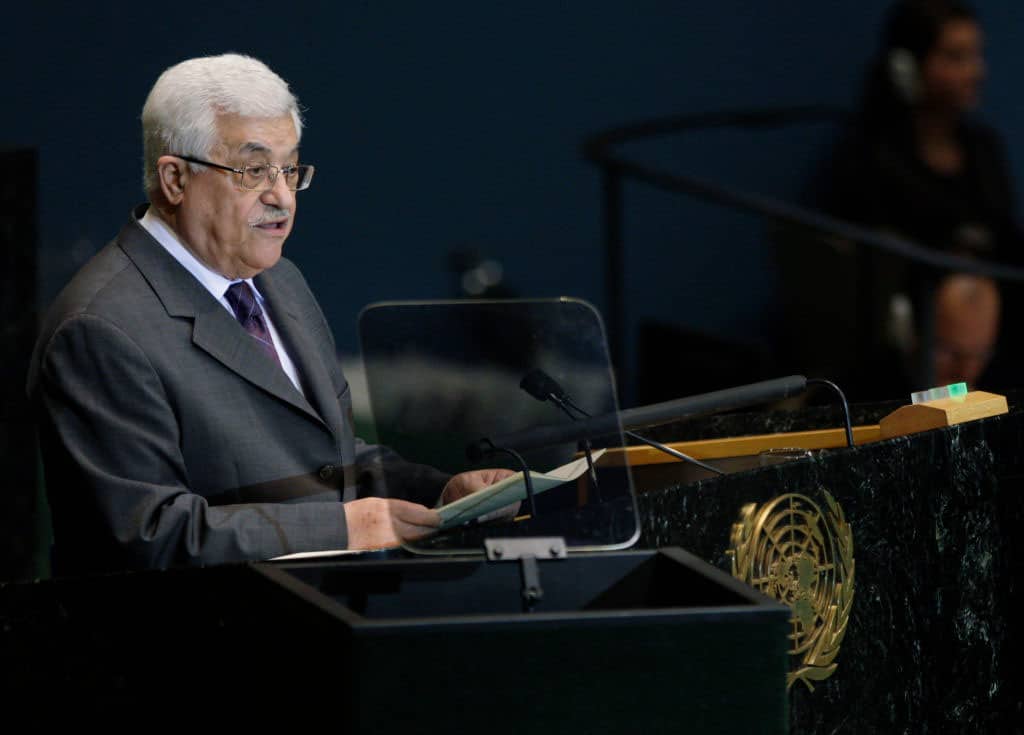
This corrupt, pandering, incendiary and dictatorial PA government shows many signs of decline and a desperate aim to hold on for control. PA President Mahmoud Abbas, entering his seventeenth year in office for a four-year term, is running out of phony attempts to announce and postpone elections.

This corrupt, pandering, incendiary and dictatorial PA government shows many signs of decline and a desperate aim to hold on for control.

Abbas’s efforts over the past few years to scale down or threaten to end any cooperation with Israel is just the latest bid to grab international attention, as well as unconditional aid, domestic legitimacy and a unilateral path to full sovereignty. Ensuring the security of Israeli civilians? Bottom of the list, if at all.

Nearly thirty years after the Oslo Accords that pioneered an Israeli-Palestinian peace process, Oslo is only as dead today as the Palestinian leadership says it is. But here’s the thing: The Palestinian Authority never gave peace an honest, full-blown try in the first place.

Negotiating and signing for peace in bad faith, sponsoring terrorism via the Martyr Fund, and expecting the full benefits of sovereign independence is like planning on having a healthy child with your partner while deliberately engaging in substance abuse, and then blaming your partner for the miscarriage. And there have been plenty of “checkups” and rounds of talks along the way to correct the course.

Despite his enduring tensions with rivaling Palestinian factions such as the terrorist organization Hamas, Abbas seems to think that he would lose power only by truly committing to peace and acknowledging such terror in the first place. When Australia recently chose to list all wings of Hamas as a terrorist organization, Abbas condemned the decision as an unfair classification for this supposedly mainstay party, which, according to him, represents the fabric of “Palestinian resistance and pride” as well.

Meanwhile, new worlds are opening to increase partnership with Israel, from the Gulf and North Africa to Israel’s Arab sector itself. As PA President Mahmoud Abbas cheers on Amnesty International for another debunked report isolating Israel as an “apartheid state,” Israeli Islamist party head of Ra’am, Mansour Abbas, partakes in the current Knesset coalition, condemns terror attacks, advances reforms for Arab-Israeli citizens, and openly recognizes Israel as a Jewish and democratic state.

Where there is room to gain credibility as a partner for peace and convince more Israelis to challenge legitimately problematic policies affecting Palestinians, Palestinian leaders cut down every measure possible that would build Israeli trust for reconciliation. Trauma is the cognitive barrier that keeps Israelis skeptical and hawkish toward withdrawal from the West Bank and full Palestinian independence.

Strangely enough, the PA sees an unconditional guarantee to preserve its power by entrenching Israeli trauma through fanning Palestinian resentment and violence toward Israeli civilians. This isn’t a plan to practically get rid of Israel overnight. It’s a desperate, but calculated effort for the long-haul in making peace impossible, to the political and monetary benefit of only President Abbas and his elites.

What is most profoundly ironic is that Palestinians aren’t moved by leaders threatening to cut ties with Israel. Many Palestinians have long perceived a coexisting sovereignty alongside Israel as a humiliating surrender of the regional monopoly Arabs have largely enjoyed. Simultaneously, over 100,000 Palestinians make remarkable ends meet in Israel. Kids who stabbed other kids got paid more by the PA on their first check in 2017 ($1,719 minimum upon incrimination) than the monthly salary of a PA public sector employee in 2021, during the pandemic: $1,390 (from $292 million USD divided among 210,000 PA employees when averaged).

Abbas isn’t making amends with his subjects by speaking the same lines. The PA is failing to keep credibility among their frustrated people. Encouraging “resistance in all its forms,” as Ali Faisal touted, is like playing with fire. Even if you direct it against your enemy, you risk getting burned yourself. So if you’re bound to get removed from the throne with a stagnant, corrupt agenda, you might as well leave with the lasting reputation of a peacemaker instead. 

The views expressed in the article are the sole author’s and do not reflect that of his employer, the IAC.


Justin Feldman is a former research assistant at the UCLA Center for Middle East Development (CMED) and contributor to Dr. Steven Zipperstein’s “Zionism, Palestinian Nationalism and the Law: 1939-1948.” He is the National Activism Manager for the Israeli-American Council, Mishelanu.


The PA Keeps Saying No, But Never Gave an Honest Yes Read More »

Who Cares about the Six-Day War?

“You have yourself a real good Christmas,” Dr. Dayan Goodenowe told me at the conclusion of our Zoom consultation to review my patients’ blood tests. I’m used to people mistaking me for a non-Jew. After all, my name is Marjorie Ordene. What’s Jewish about that? And how would a gentile from Saskatchewan guess that he’s speaking to a religiously observant Jewish woman?

When I had my first consultation with Dr. Goodenowe about a month ago, I took note of his name—Dayan.  An odd first name, I thought, I’ve never encountered it before. Could he be a Yid? Not likely. He did sport a baseball cap, which has come to be accepted, in certain circles, as a way of hiding your kippah—a rather flimsy Jew-detecting device. But if I had any illusions, his parting remark dispelled the notion.

No Jew would say that, at least not in my world. Here in New York, we’re all careful to say, “Happy Holidays!” You never know what tradition the other person might be observing.

My memories of how to relate to this holiday date back to early childhood. My cousin Judy, fifteen years older than me, had a fight with her new husband over whether to celebrate Christmas. Judy wanted to, claiming it was an American holiday. Irv wouldn’t hear of it. I remember their 1959 wedding in the living room of my aunt and uncle’s Upper West Side apartment. Four men held up the chuppah poles and Judy and Irv stood beneath dressed like a perfect wedding cake bride and groom. Although Irv wasn’t religiously observant, he apparently had a closer connection to Yiddishkeit than Judy. At my son’s bar mitzvah some fifty years later, he told our black-frocked, homburg-hatted rabbi that his father had learned at Slobodka, the famed Lithuanian yeshiva. Who knew? Irv had told us only that his father owned a grocery store in New Britain, Connecticut.

Now at my second consultation with Dr. Goodenowe, I resolved to ask about the origins of his name. The test we were discussing detects deficiencies in our cell membranes which, when corrected, can prevent or reverse Alzheimer’s. Having lost both my mother and my mother-in-law to this dreaded disease, I am passionate about preventing it. After a lively discussion about brain biochemistry that took up the better part of an hour, I thanked the good professor for his patience and apologized for all the biochemistry I had forgotten since medical school.

Then I broached the topic. “I’d like to ask about your name,” I tendered.

“Oh,” he answered, not surprised, “I’m not an Israelite; my family traces its roots back to England in 1638.” He paused before continuing. “But I was born around the time of the Six-Day War. My parents named me after Moshe Dayan.”

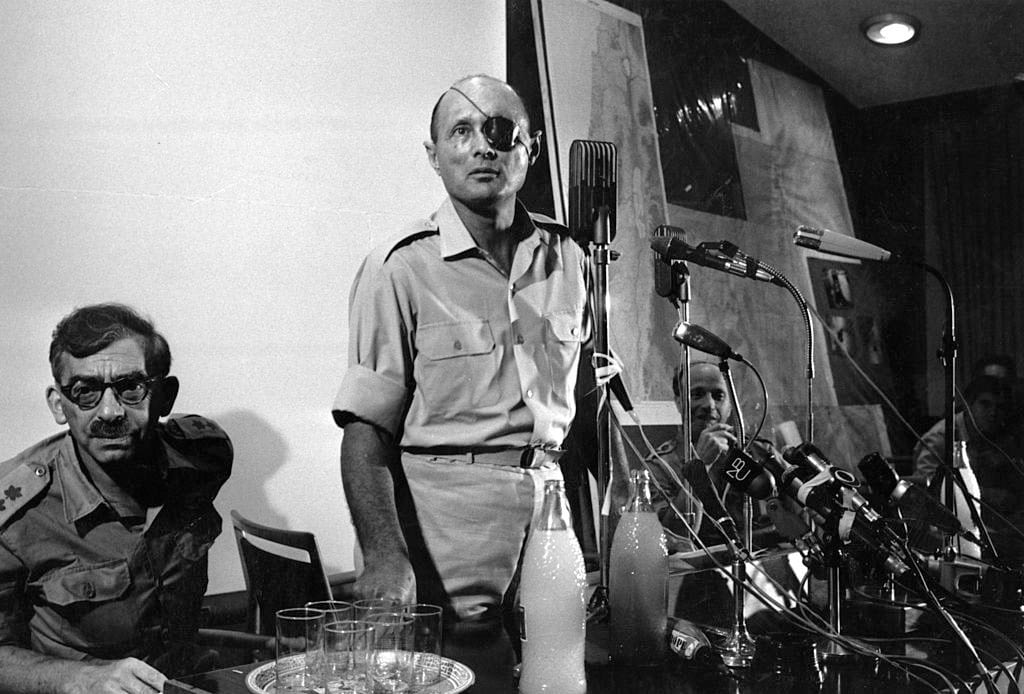
“Of course,” I answered, “the man of the hour. He was quite the hero,” I reminisced, photos of the khaki-clad, eye-patch-sporting Dayan flashing before my eyes. “But we’re not so fond of him now,” I added, thinking of his unfortunate decision to hand the Temple Mount back to the Islamic authorities.

“Well, people’s reputations do change over time,” he acknowledged.

“Do you know what dayan means?” I asked.

He didn’t. “A dayan is a judge,” I told him.

“That’s interesting,” he answered, “I thought it was just a name.”

That evening, I recounted the conversation to my husband. Dr. Goodenowe’s answer surprised him.

The Six-Day War was not just our miracle—it was a miracle for the world.

“They’re not Jewish?  Why would they care about the Six-Day War?” But of course, they care; everyone cares. The Six-Day War was not just our miracle—it was a miracle for the world. With its dazzling military victory, Israel gained new respect in the world. Famed refusenik Natan Sharansky described how the Six-Day War changed everything. He wrote, “The call that went up from Jerusalem, ‘The Temple Mount is in our hands,’ penetrated the Iron Curtain and forged an almost mystic link with our people. And while we had no idea what the Temple Mount was, we did know that the fact that it was in our hands had won us respect.”

And that same call, it seems, penetrated the minds of a non-Jewish couple in Saskatchewan who decided to name their son, Dayan.


Marjorie Ordene is an integrative physician and nutritionist. Her essays, short stories and poetry have been published in various magazines and anthologies including Tablet, The Sun, Aish.com, Lilith, Ami Magazine and Mishpacha Magazine. She lives and practices in Brooklyn.

Who Cares about the Six-Day War? Read More »

Swastikas Found on Abandoned Granada Hills RV

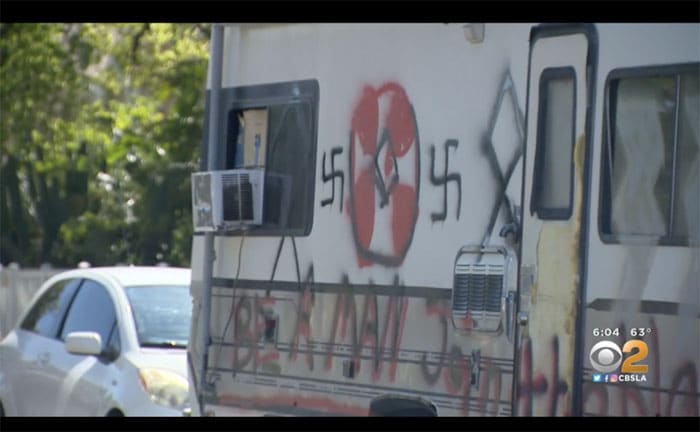
Swastikas were found spray-painted on an abandoned RV in Granada Hills on March 8.

CBS Los Angeles reported that the RV had been sitting on the Granada Hills street for the past six months and was parked the wrong way. Several tickets were put on the RV’s windshield and the license plate tags expired in 2011, yet it has continued to remain on the street despite various members of the neighborhood requesting that the police, Department of Transportation and city council to move it. On the morning of March 8, residents saw the RV was vandalized with “swastikas and hate speech,” CBS Los Angeles reporter Joy Benedict said.

“It’s just horrendous,” one resident told Benedict. “We have kids in the community, we have neighbors of all different ethnicities and cultures, and to see this on our streets… it’s really appalling and upsetting.” 

Benedict reported that the neighborhood doesn’t think the RV graffiti was targeting anyone specifically, and some are concerned that the vandalism was conducted simply to get the RV removed. The RV was eventually towed on March 9.

“It’s really sad it had to have this disgusting language on it for anybody to act on something,” the resident told Benedict.

Jewish groups condemned the graffiti.

“As soon as we were contacted by a community member regarding these hateful and antisemitic messages on an abandoned RV in their neighborhood, [the Anti-Defamation League] immediately reached out to our city and county partners to make sure that it was removed as soon as possible,” ADL Los Angeles Regional Director Jeffrey Abrams said in a statement to the Journal. “We condemn the hateful symbols and messages on this vehicle and encourage community members to reach out to ADL, LAPD and city officials if they see anything similar.”

American Jewish Committee Los Angeles Regional Director Richard S. Hirschhaut also said in a statement to the Journal, “It is disturbing that this abandoned RV, long an eyesore in a residential area, has become a target of antisemitic graffiti and crude racial epithets. And it is unfortunate that requests to have the vehicle removed went unanswered for more than six months. Whether or not its defacing with hate symbols was intended to get the attention of public officials, the use of such graphic images reveals an ease with which some resort to weaponizing the indicia of hate. When the RV is finally moved, we trust local authorities will cover the vehicle, lest it become a mobile billboard of hate.”

Associate Dean and Director of Global Social Action Agenda at the Simon Wiesenthal Center Rabbi Abraham Cooper criticized the City of Los Angeles for failing to remove the RV for several months in a statement to the Journal. “This is a hate attack that should not have happened but the City of Los Angeles failed its citizens, affixing countless tickets but never removing the abandoned vehicle for 6 months,” he said. “Bigots then converted the RV into a billboard of hate. No accountability by the City, no accountability for the bigots. Without leadership and accountability, there’s no reason therefore to believe the hate will disappear on its own anytime soon.”

StandWithUs CEO and Co-Founder Roz Rothstein, the daughter of Holocaust survivors, also said in a statement to the Journal, “Hate and ignorance will not intimidate the Jewish community. It brings us together and makes us stronger. Messages like this only serve to remind us that we must be more determined than ever to educate people of all ages about where such dangerous symbols of hate can lead.”

Swastikas Found on Abandoned Granada Hills RV Read More »