fbpx

November 26, 2021

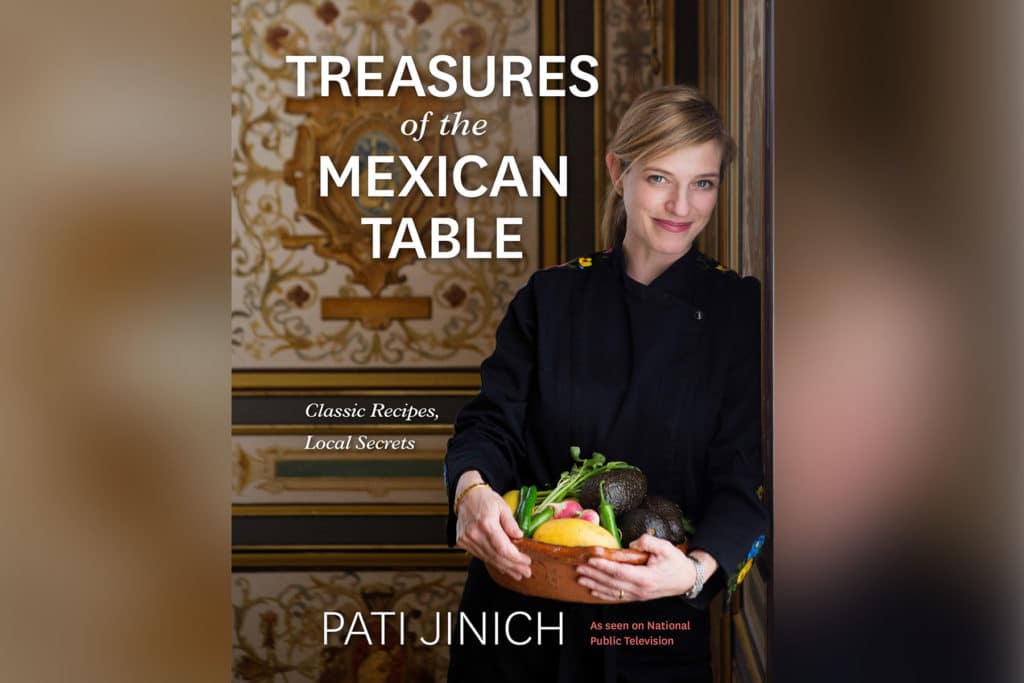
Chef Pati Jinich Shares “Treasures of the Mexican Table”

What makes a good meal? Is it aromatic spices and harmonic flavors? Or, is it flavorful ingredients passed down from generation to generation?

Chef Pati Jinich believes that the quality of the dish lies in the sazón—that unique taste achieved only by cracking the code. It’s that special something that gives Mexican food its distinctive personality. “It may just be an extra dash of salt or cooking something a little bit longer,” explains Jinich. “The same dish can be made by ten different people, but one person really took the time to cook it all the way or add that extra little bit of salt. That’s what makes a dish stand out—the time, care, and attention.”

The Jewish Mexican cuisinière offers more than 150 recipes full of sazón in her new cookbook, “Treasures of the Mexican Table: Classic Recipes, Local Secrets” (Mariner Books, November 2021). Jinich considers it more ambitious than her previous two cookbooks.

“It has incredibly delicious dishes that are approachable and easy to make and that you can make your own,” says Jinich. “It’s just a book full of delicious, accessible dishes that you’re going to want to include in your weekly meal rotations. The best part of it is that along with the dishes comes a story that will enrich your table just as much.” Her favorite recipes include the salsa macha, a tomato-scallion-and-cheese soup, and a traditional mole from central Mexico.

“The best part of it is that along with the dishes comes a story that will enrich your table just as much.”

Born in Mexico City, Jinich comes from a long line of food aficionados. Her paternal grandfather came from a tiny shtetl in Poland. His diet primarily consisted of pickled herring, fried herring, boiled herring, potatoes and white onion. Jinich’s grandmother was able to find her sister, an Auschwitz survivor, through the Red Cross. After she was recovered, Jinich’s great-aunt Annie opened the very first Austrian bakery in Mexico.

Originally trained as a political analyst, Jinich studied at the L’Academie de Cuisine in Gaithersburg, Maryland. She shares her wealth of knowledge as the Emmy-nominated host of “Pati’s Mexican Table.” Currently in its tenth season, the award-winning series follows the culinary artist as she journeys across her homeland. Jinich expresses her boundless enthusiasm for Mexican food to audiences around the world.

“Oh, it is just so full of life and stories,” notes Jinich. “It’s so diverse and rich. We’re such a treasure trove of wonderful ingredients.”

Jinich finds cooking therapeutic. That being said, it’s not easy balancing writing cookbooks with filming a television series and raising a family.

“I don’t balance anything! Who said I balance? I don’t!” laughs Jinich. “Everything is completely combined and mixed because I don’t balance.” Part of the cooking show is filmed inside of her kitchen at home. Jinich tries to schedule her travels when her children and husband have time off. “My work, my family, and my personal life are very combined.”

Jinich’s overall cooking philosophy involves walking two paths. The first path involves honoring and respecting everything she has inherited—“the recipes that have been passed down, the techniques that have been taught to us,” as well as “the proper use and care of ingredients.” Jinich explains that she tries “to preserve all those heirlooms and treasures and lessons and keep them alive and pass them on. But, at the same time, I always open a window for exploration and for a new air to come in.” The second path may lead her to try a new dish with a beloved ingredient. “So, I always do those two things,” says Jinich. “Respect and honor what we have, but also leave room for something new.”


Eve Rotman is a writer on the West Coast. Follow her on Twitter @EveRotman

Chef Pati Jinich Shares “Treasures of the Mexican Table” Read More »

Hanukkah: A Time For Remembering and Responsibility

Hanukkah is a both/and kind of holiday.

It’s a celebration of a martial victory, a successful resistance to a predatory colonial empire. As we say in our Hanukkah addition to the daily prayer, when “the wicked Hellenic government rose up against Your people Israel to make them forget Your Torah and violate the decrees of Your will … You, in Your abounding mercies, stood by them in the time of their distress. You waged their battles, defended their rights, and avenged the wrong done to them. You delivered the mighty into the hands of the weak, the many into the hands of the few, the impure into the hands of the pure, the wicked into the hands of the righteous, and the wanton sinners into the hands of those who occupy themselves with Your Torah.”

There’s no doubt that this is a stunning victory worth celebrating.

But Hanukkah is also a celebration of a different kind of miracle—a spiritual victory that shines brightly each year as we light candles in remembrance. We learn in Talmud Bavli Shabbat 21b, “What is Hanukkah? Our Rabbis taught: On the twenty-fifth of Kislev [commence] the days of Hanukkah, which are eight, and we do not lament the dead during them and we do not fast during them. For when the Greeks entered the Temple, they defiled all the oils there, and when the Hasmoneans prevailed against and defeated them, they searched and found only one vial of oil which lay with the seal of the High Priest with only enough oil to burn for one day; yet a miracle was made with it and they lit with it for eight days. The following year these [days] were appointed a Festival with [the recital of] Hallell and thanksgiving.”

Other Jewish holidays may be commemorated with fasts and mourning. But Hanukkah is different. It’s meant to be a real, full-blown celebration of life and food and miracles.

Today, Hanukkah remains a celebration of Jewish peoplehood and our Jewish brit (covenant) with HaShem. As the Rav, Rabbi Joseph B. Soloveitchik, teaches, the political victory won by the Hasmoneans did not last long. The land was conquered by the Romans who destroyed the re-dedicated Temple. But the Maccabean wars represented a learning moment for the Jewish people. They discovered what they would fight for and fight against. The Jews never revolted against Alexander the Great. They offered him tribute and he mostly left them alone. What provoked a grueling guerilla resistance that took years to accomplish its goal, was the attempt by the Seleucid Greeks to impose their gods on the people, to get between us and the One we worship. The Judean people fought religious erasure, and took a big step on the way to becoming Jews in doing so.

The Judean people fought religious erasure, and took a big step on the way to becoming Jews in doing so.

The Hasmonean dynasty and the Temple are gone, but Jews everywhere still celebrate the miracle through which shines our relationship with one another and with HaShem. As Rabbi Soloveitchik wrote, “Hanukkah is celebrated today, and that is a sign that the holiday, and its commemoration of God’s miracles, belongs to the group of Jewish holidays that have Passover as their pinnacle. These holidays are based on an everlasting value, which no political destruction or military downfall can erase.”

This year, I’m struck by the proximity of Hanukkah and the American holiday of Thanksgiving—a holiday and a connection to Hanukkah that Rabbi Soloveitchik happily endorsed. What could be more Jewish than enjoying a feast with beloved family and friends while consciously practicing gratitude? And we can be especially grateful to live in a time and place when we do not have to compromise our pride in who we are.

But consciously commemorating the anti-colonialist aspect of Hanukkah complicates our Thanksgiving celebrations. The phrase “settler colonialism” has become fraught, with whole strings of debate attached to it, but I’m not sure how else one could describe the conquest of the Americas and the displacement of indigenous people. How can we place our hanukkiotin windows, proud beacons of our survival and thriving, and not recall that generations of indigenous Americans were sent as children to boarding schools that were designed to make them forget their languages, their cultures and their own covenants with the Most High?

Given that Jews understand the importance of pushing back against attempts to erase Jewish religion or culture, are we not also responsible for ensuring that the religions and cultures of others are not forgotten? Perhaps the Jewish community has a special responsibility here.

I’m not trying to trash your Thanksgiving dinner. I’m hoping that our communal celebrations can include the very Jewish activity of storytelling, the kind that draws out complexity and points to unfinished business.

I’m hoping that our communal celebrations can include the very Jewish activity of storytelling, the kind that draws out complexity and points to unfinished business.

Los Angeles sits on traditional unceded Tongva land. Some Tongva thinkers are reviving a concept called kuuyam, being a good guest. They don’t imagine that we can return to an idealized past, but they are calling on us to transform our future in this place. As Charles Sepulveda writes in “Our Sacred Waters,” “Residents of Tongva land (Tovaangar), for example, can be Kuuyam and not act as colonizers or seek to further domesticate the environment for their own benefit. They can be welcomed guests, and not looked at by the Native community as settler colonizers—no matter their skin color, histories, or origins. The status as Kuuyam is neither demanded nor ordered. It is instead a relationship offered and chosen.”

Jews have a value corresponding to kuuyam, one that we affirm in our daily recitation of those behaviors that sustain us in this world and the next: hokhnasat orkhim, hospitality to guests. That value assumes a relationship in which guests appreciate and respond to the courtesy they receive.

As guests on this land, let us take the opportunity this Thanksgiving to educate ourselves regarding its history. Even as we come together for celebrations with family and friends, we can support initiatives such as Tongva Tah-rah’-hat Paxaavxa and Acjachemen conservancies that aim to restore Tongva relationships with this land and the spiritual practices that express them. We can delight in and support expressions of indigenous culture and spiritual values as we delight in our own Hanukkah festivities. We certainly can come together to eat with friends and give thanks, but while we do it, let’s acknowledge the unfinished journeys on which we are all embarked in this messy, unredeemed world.


Rabbi Robin Podolsky serves on the Board of Governors for the Sandra Caplan Community Bet Din, writes at shondaland.com and jewishjournal.com, advises the Jewish Student Union at Occidental College and serves as writing facilitator and dramaturg for Queerwise, a spoken word and writing group. She also serves on the National Ritual Committee for Bend the Arc.

Hanukkah: A Time For Remembering and Responsibility Read More »

“Vos Iz?”: A Tribute to Rabbi Shimon Raichik

In memory of my mentor, teacher and friend Rabbi Shimon Raichik, who left us on Nov. 24.

It’s Shabbos, just before Musaf at the world famous Levi Yitzchak shul in Los Angeles, and Rabbi Raichik is about to begin his sermon.

There is emotion and vigor in his voice; he launches into a story about the Rebbe that he heard forty years before, and those listening feel like they are there with him.

Several times in the middle of his sermon, he pauses and closes his eyes, sometimes tapping on his lectern. You can tell that he is reliving a farbrengen (Hasidic gathering) with the Rebbe as if it’s happening today, and it is.

He pauses and asks a question; he comes back with the answer and then he stops again.

His tone changes and he looks at me and everyone present in the room.

I feel he is talking directly to me, and about “my now.” It hits me—what a gift! Who is like this man? Who can do this?

After he concludes his speech, I walk over and say, “Yasher koach. Thank you!” He responds with a twinkle in his eye and a shy smile, “Vos iz? What about it?” (I heard him talk dozens of times, and I have seen many people thank him, and I don’t remember him responding any other way). What I think he means is, “What did you receive? Did I talk to you and reach your neshama? Did we connect? Really? Wow!”

Rabbi Raichik never understood his appeal. Truly great people often can’t. Maybe it would stop them from being great if they knew.

He once wrote to the Rebbe about his failures. “I am doing A, B, and C and it’s all worth nothing.” And the Rebbe responded, “I got the letter full of good news but I don’t understand why you are upset?”

When Rabbi Raichik led farbrengens he always talked about his father and the great Chassidim he grew up with, and yet without realizing it, he surpassed and ascended higher than all of them.

He often made one comment when he was asked a question: “What do you want I should do?” At first I and many others didn’t understand his response. “We are asking you what we need to do, what are you asking me?”

Sometimes what he meant was “I wish I could make your life easier and tell you what you want to do is OK but I don’t know how it can be OK.”

Sometimes he meant “That’s a great question, but how can I possibly figure that one out? Who am I?” But other times, it was just a way of saying “Are you sure you want to do this? Isn’t there a better way?”

Some rabbis know the books and not the people. Some rabbis know the people and not the books.

And then there’s Rabbi Raichik.

He doesn’t only know the books. Yes, he knew and taught halacha and chassidus; he wrote extensively on halachaminhag, history and hashkafa. He learned it all and loved it like nothing else. (He once shared with me that because of a certain circumstance, he has more time to learn.)

He had a brilliant glowing smile when he said, “Men ken lernen oon lernen!” (I can learn and learn.)

But we didn’t call Rabbi Raichik specifically because he knows the books. At least, I didn’t. I called him (all the time, for any number of matters, from the most trivial to serious life and death issues, as all who knew him did) for a different reason. He was one of those few who knew the Author of the Torah, who could reach up and feel the Author, and then reach down to where you were and feel where you are. He brought the Author down to us.

A few weeks ago, a drug addict agreed to go to a rehab in Palm Springs right before Shabbos, but only if I took him. It would mean spending Shabbos away from my family and community and changing a million plans—was this my mitzvah? Couldn’t someone else take him? Was someone’s life at stake?

It’s not a question one learns in Yeshiva and I needed to call Rabbi Raichik.

I remember the first time I saw Rabbi Raichik after moving to Los Angeles; it was before Chanukah. I asked him about the preferred height of a menorah.

He took a look at me and said, “How am I supposed to know how big the menorah is that your wife just bought you?”

Good question. How did Rabbi Raichik know?  But know he did.

Years ago, I was staying at someone’s home out of town, and the rabbi called their home to speak to me. The one who answered the phone was a bit under the weather. A regular person might wish a refua shelaima.

But not Rabbi Raichik.

He called back again and again for the next two days (long after I had left their home) to see how they were doing. This person was floored: “Now this is a rabbi!” I found out about this and I asked him why he called back so many times, but he couldn’t understand why it was such a big deal.

“Did you hear how she sounded? Oy!”

Los Angeles is a big city, yet he was a small town Rav. And not only for this city. He was a Rav who knew and cared for each man, woman and child.

I wonder how many people noticed that when he gave his blessings at the end of his drasha, he closed his eyes and opened his warm, loving and kindest heart wide and asked for “our families and children.” ? He ddid that because that’s what he cared about.

But he’ll never get it.

I imagine Rabbi Raichik as he enters Gan Eden, the parade of thousands of neshamos he taught, uplifted and cared for, together with the millions of malachim created by his Torah study, his prayers and his kindness, all coming to greet him. But him? He looks behind himself to see who the parade is for.

And when he discovers that it’s for him?

For sure he will say, “Vus Iz?”

Any second, as the Rebbe said so very clearly and so very many  times, we expect to see you with Moshiach, and your central role of making it all happen will be obvious, men vet zen vus iz!

At this time “the living must take to heart” to be a little more sincere, to have a little more faith, to pay a little more attention to the Eye that sees us, to be a little more loving, to show a little more understanding, and most of all, to be a little more giving to each other. Why not? Vus iz?


Rabbi Moshe Levin serves as Rabbi and spiritual leader of congregation Bais Bezalel Chabad in Los Angeles.

“Vos Iz?”: A Tribute to Rabbi Shimon Raichik Read More »

Belgium to Label Products from West Bank Settlements

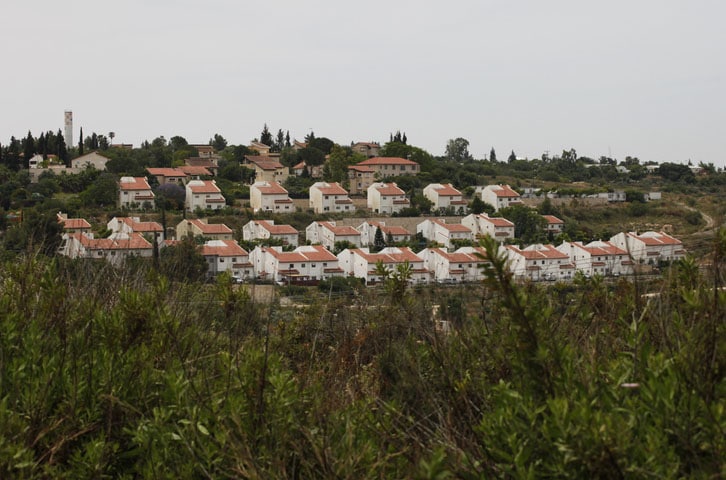
Belgium announced on November 23 that they will be labeling products coming from Israeli settlements in the West Bank and increasing controls on such goods.

The Associated Press (AP) reported that the Belgian foreign office said in a statement that they are simply delineating “between Israel on one hand and the Palestinian territories on the other hand” to comply with European and international law. The European Court of Justice ruled in 2019 that products originating from the settlements should be labeled as such rather than labeled as being “Made in Israel.”

The Israeli Foreign Ministry took umbrage with the announcement, saying in a statement that the move “harms Israelis and Palestinians and is out of step with the government of Israel’s policy that is focused on improving the lives of Palestinians and strengthening the Palestinian Authority and with the improvement of Israeli relations with other European countries.” Deputy Foreign Minister Idan Roll tweeted that he canceled his meeting with the Belgian Foreign Ministry and parliament over the matter.

“The Belgian government’s decision to label products from Judea & Samaria strengthens extremists, does not help promote peace in the region, and shows Belgium as not contributing to regional stability,” he wrote.

Palestinian Authority Prime Minister Dr. Mohammad Shtayyeh praised Belgium’s move in a tweet. “We commend Belgium’s decision to start labeling products from illegal Israeli settlements in occupied Palestine as per [international] legitimacy,” he wrote. “It’s critical for the [international] community to confront Israel’s illegal settlements, which erode the two-state solution & the possibility of peace.”

Representative Ilhan Omar (D-MN) tweeted, “Belgium decision is in line with [ECJ] ruling from two years ago. Now the question is will other EU countries comply with the EU court ruling and uphold international law?”

The American Jewish Committee tweeted, “Belgium’s decision to label Israeli products made in the West Bank as not ‘made in Israel’ puts Israeli and Palestinian livelihoods at risk, emboldens extremists, and undermines the peace process. We strongly oppose this biased move.”

Human rights lawyer Arsen Ostrovsky, who heads the International Legal Forum, tweeted that Belgium’s move is “outrageous” and “racist, discriminatory and entirely counter-productive to peace.” He also replied to Omar’s tweet, stating: “You really never miss an opportunity to reveal your Jew hatred, do you Ilhan?”

George Mason University Law Professor Eugene Kontorovich, who also heads at the International Law Department at the Kohelet Policy Forum, told The Jerusalem Post that the move “puts a new kind of yellow star solely on Jewish products. Belgium has no rules against doing business in disputed territories anywhere else in the world – because they know that such activity is not illegal under international law. Thus the labeling and lists it is requiring is not about business in occupied territories – it is about business with Jews.”

Belgium to Label Products from West Bank Settlements Read More »

A Hanukkah Gift: Argue, Don’t Fight

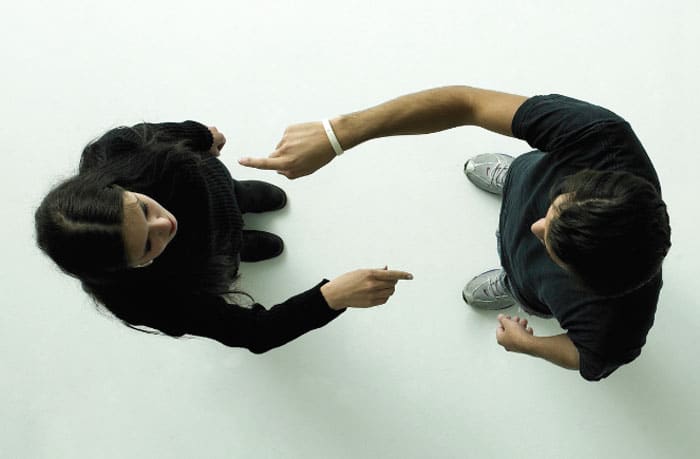
There’s an enormous difference between an argument and an attack. Calling someone a liar or a traitor is not an argument; it’s an attack. If you marshal facts and reason to make your case, that’s an argument.

Have you noticed how so many arguments these days quickly unravel into nasty fights?

OK, be honest. When you get an email, what kind of “information” gets your adrenaline pumping — a personal attack on someone or a reasoned argument about a serious issue? For most people, the personal attack, like hearing juicy gossip, is simply irresistible. It’s like watching the aftermath of a car wreck or seeing someone being arrested—there’s a weird thrill in witnessing trouble of any kind.

In the same way that popcorn tastes better than Brussels sprouts, it’s a bigger thrill to see a fight than a civil debate. It appeals to our primal appetites. 

In the same way that popcorn tastes better than Brussels sprouts, it’s a bigger thrill to see a fight than a civil debate. It appeals to our primal appetites. 

As much as the Jewish tradition values reasoned argument, in the hard reality of communal life that tradition often succumbs to the thrill of the fight. I see it all the time. When people are outraged, they’re more inclined to take the gloves off than to think in Talmudic ways.

I call it the “curse of being right.” Some people are so sure of themselves, so blinded by their passions, they will violate their own norms of decency. In that state, a polite person may become rude; a friendly person may become hostile; a calm person may become enraged. 

That is the curse of righteousness— it can bring out the worst in us. It can even make us forget who we are.  

But, you ask, when the stakes are so high, and if your opponents are so wrong and you must teach them a lesson, why not attack them if you think you’re right?

Because it’s ugly, divisive and boringly empty.

People who attack others — publicly, anonymously or otherwise — don’t enlighten but offer cheap thrills that spread gossip and division and leave everyone feeling empty and dirty.

Try listening to some juicy gossip at a Shabbat table or at any moment. It might give us a quick sugar high, but when we put down others to elevate ourselves, all we feel is emptiness. 

One of my favorite Jewish teachings is the idea of transcending our appetites. We’re not supposed to settle for quick hits and cheap thrills. Our tradition encourages us to be thoughtful at all times, even when (especially when!) our passions are inflamed.

Perhaps the biggest obstacle to civil dialogue is when people are hypnotized by a cause. If you despise Donald Trump, if you think the Iran nuclear deal is an existential threat, if you feel violated by vaccine mandates, and on and on, you’re vulnerable to the curse of being right.

The antidote to that curse is the blessing of curiosity. Open any page of Talmud and you’ll see the glorious offshoots of curiosity— careful listening, knowledgeable arguments, delightful complexity and a relentless commitment to civility.

It’s not a coincidence that in determining Jewish law, our Sages took the side of the Hillel school over the uncompromising school of Shammai. As the Talmud explains in Tractate Eruvim: “On what basis did the School of Hillel merit that the law should be determined in accordance with its positions? Because they were gentle and kind, and they studied their own rulings plus those of Shammai. They were even so humble as to place the words of Shammai before their own.” 

There are more than five centuries of civil, complex debate gathered in our Talmud. Those 40 volumes are as much a Jewish treasure as the Five Books of Moses, because they bring the Torah into our everyday lives and help us refine our characters. Of course, our Sages had a big advantage over us: they weren’t distracted by smartphones, email and social media, so it was much easier for them to dig deep and be thoughtful.

Today we must make a greater effort.

I can’t think of a better gift than to spread the light of civility. Whether it’s in our personal or communal relations, let us not succumb to the curse of being right. 

Since our Hanukkah cover story this week is about spreading light, I can’t think of a better gift than to spread the light of civility. Whether it’s in our personal or communal relations, let us not succumb to the curse of being right. Let us instead do the hard work of seeking knowledge, valuing complexity and arguing with decency.

If you disagree, I’m open to a reasoned argument. I’ve learned over the years to love Brussels sprouts. I hear they’re really good for you.

Happy Hanukkah.

A Hanukkah Gift: Argue, Don’t Fight Read More »

Unscrolled Vayeshev: Fortunately and Unfortunately

Back when I was a preschool teacher, I came across a wonderful children’s book called “Fortunately” by Remy Charlip. The story begins with a boy being invited to a birthday party. “Unfortunately, the party was in Florida and he was in New York. Fortunately, a friend loaned him an airplane. Unfortunately, the motor exploded. Fortunately, there was a parachute in the airplane. Unfortunately, there was a hole in the parachute.”

And so on. Each page features a stunning reversal of fate. Every “fortunately” leads to an “unfortunately” and every “unfortunately” leads to a “fortunately.”

I think of this story every year when the tale of Joseph comes back around, for Joseph is subject to just as many sudden and dramatic reversals of fate.

Let us, for a moment, track his tale in the style of Remy Charlip:

Joseph’s father sent him out to check on his brothers.

Unfortunately, he got lost on the way.

Fortunately, a man gave him directions!

Unfortunately, his brothers decided to kill him.

Fortunately, Reuben persuaded them not to kill him!

Unfortunately, they decided to throw him in a well instead.

Fortunately, they lifted him out of the well!

Unfortunately, they lifted him out just to sell him into slavery.

Fortunately, his new master took a shine to him and made him overseer of the house!

Unfortunately, his master’s wife falsely accused him of attacking her and had him sent to jail.

Fortunately, the jailer took a shine to him and made him master over the jail!

This is where our portion ends, but sure enough, more “unfortunately” and “fortunately” await on the horizon for Joseph.

At the heart of this tale is the truth that King Solomon had engraved upon a ring so that it would never be far from his sight: This too shall pass.

At the heart of this tale is the truth that King Solomon had engraved upon a ring so that it would never be far from his sight: This too shall pass.

To the pessimist, this teaching is sorrowful. All joys will pass, all beauty will fade, and all life will wither. To the optimist, however, it is uplifting. All pain will subside, all rainclouds will part, and all wickedness will abate.

Which is the perspective of Joseph?

Later on in Genesis, Joseph will reunite with his brothers when a famine in the land brings them to Egypt to ask for food. Then he will exclaim to them: “although you intended me harm, God intended it for good, so as to bring about the present result—the survival of many people.” (Genesis 50:20).

We readers, of course, know what happens after Joseph’s death. Fate reverses again, and the entire Jewish people comes to be enslaved in Egypt.

But then (fortunately) they are redeemed by Moses and brought to Mount Sinai where they receive the Torah.

But then (unfortunately) the people sin with the Golden Calf and Moses shatters the tablets of the law.

And so on and so on. Right up until this very moment, Jewish history has never ceased being a cycle of rotating Unfortunatelys and Fortunatelys.

There is something uncomfortable about this ever-constant shifting. Perhaps this is why so many Jews call the state of Israel “the first flowering of the redemption.” It is comforting to think that history is nearing its end and a final “fortunately” is approaching. Perhaps this is also why so many Jews wring their hands over Jewish continuity and other so-called “existential” threats. Doomsday predictions also offer a comfort in that they offer certainty.

It is much harder to live as Joseph does. He is, in truth, neither an optimist nor a pessimist. He is a Tzadik – a wise person—who trusts God entirely.

Later, when he returns to Canaan to bury his father, he will, according to Midrash, stop and pray at the well in which he was cast by his brothers, stating that one should always commemorate a place where a great miracle happened.

To borrow a phrase from the mystic Hildegard of Bingen, Joseph lives like “a feather on the breath of God.” He is unattached to either good or bad fortune, but rather goes with the flow, so to speak, trusting that all is unfolding as it must and as it should.

This too shall pass. Joy and sorrow. Life and death. All of it will pass. For the soul who has learned to coast on the breath of God, this fact is neither cause for celebration nor despair. It is neither fortunate nor unfortunate. It is the will of God, which is all Joseph needs to know.


Matthew Schultz is the author of the essay collection “What Came Before” (2020). He is a rabbinical student at Hebrew College in Newton, Massachusetts.

Unscrolled Vayeshev: Fortunately and Unfortunately Read More »

Table for Five: Hanukkah Edition

One verse, five voices. Edited by Salvador Litvak, the Accidental Talmudist

Throughout the eight days of Hanukkah, these lights are sacred and we are not permitted to make any other use of them except to look at them…

-Hanukkah Liturgy


Dr. Sheila Tuller Keiter
Judaic Studies Faculty, Shalhevet High School

Hanukkah, oh Hanukkah, most misused of holidays. When not grossly cast as a Jewish equivalent to Christmas, Hanukkah is often reduced to a generalized, even secular festival of light. The candles offer vague representations of hope, bringing lightness into a dark world at the darkest time of year. Bah humbug. Hanukkah has a distinct historic context. It celebrates the miraculous victory of Jewish freedom forces against the aggressively Hellenistic Seleucid Greek empire in the second century BCE. Emphasis on miraculous. The Jewish forces were ragtag, under-equipped, and wholly inexperienced. The Seleucids were well-trained, experienced warriors. As for equipped, they had elephants! The Hasmoneans attributed their unlikely victory to God and had no qualms about expressing it. Hence, our liturgical line is incomplete. We may not use the Hanukkah candles other than to look at them… “in order to thank and to praise Your great name for Your miracles, Your wonders, and Your salvations.” 

John Adams is often quoted as suggesting Independence Day be celebrated “with pomp and parade, with shows, games, sports, guns, bells, bonfires and illuminations from one end of this continent to the other.” People conveniently forget his prior exhortation that “It ought to be commemorated as the day of deliverance by solemn acts of devotion to God Almighty.” So too Hanukkah. Do not let the lights blind you. Hanukkah is a holiday expressing gratitude to the Savior of Israel. Without that, Hanukkah is just an excuse to save 20% on this year’s hottest toys, games, and electronics.


Rabbi Avraham Greenstein
AJRCA Professor of Hebrew

Unlike the Shabbat candles, which are meant to illuminate and enhance the Shabbat meal, the Hanukkah lights are not meant to illuminate anything except our hearts and our perspectives. Not only is the light of the Hanukkah candles distinctly non-utilitarian, but the holiday of Hanukkah itself does not specifically address the needs and pleasures of the human body. Hanukkah differs from Shabbat and from nearly every other Jewish holiday in that there are no prescribed feasts on Hanukkah. Oily food on Hanukkah is traditional, but it is essentially optional. What is required is merely the kindling of the Hanukkah lights, and that they be seen. This mode of celebration invites contemplation and a feeling of inner contentment instead of a reliance on food and drink to gladden us. 

The purely sacred nature of the candles reminds us that the purpose of our lives is—more than anything else—a sacred one. Hanukkah is a celebration and reaffirmation of Jewish values and Jewish spirituality. Each night of Hanukkah, we look at the candles in gratitude for the opportunity to make each moment, even those that seem dark and cold, pregnant with light and the warmth of divine activity. Hanukkah reminds us that we can find solace and inspiration in the words of prayer and in Torah and holy deeds. We are not alone. God shines into our lives through the light of the Hanukkah candles so that we can live with the memory of the Hanukkah lights even in our trying moments.


Rabbi Peretz Rodman
Head of Israel’s Masorti (Conservative) bet din

Struggling to keep Torah traditions alive and relevant for modern Jews, Rabbi Avraham Yitzhak Ha-kohen Kook famously wrote, “Let the old be renewed, and let the new be sanctified!” It is in that spirit of bold innovation that the Rabbis (as we call the founders of our Judaism) innovated a surprising, even shocking blessing: “Blessed are You… who has commanded us to kindle the Hanukkah light.” 

Where in the Torah is that mitzvah recorded? Nowhere, of course; the events it commemorates postdate the entire Bible. On whose authority, then, is the practice required? Why, that of the Rabbis themselves. It is they who established it, who debated and decided its form—increasing the lights each night rather than decreasing, as some had suggested—and its prescribed time and place. And it is they who laid claim to divine authority to back them up: these lights are not just lovely and traditional; they are kodesh, “sacred.” 

Modern Jews who care about Jewish traditions and community strive to balance fidelity to the past and relevance in the present. Jewish leaders need to be as bold as the Rabbis, and as Rav Kook, declaring even some of what is new to be as sacred to us as if it had been given at Sinai.


Romain Hini-Szlos
Photographer / www.rhsgallery.com

Hanukkah is on its way, the Festival of Lights. So why aren’t we able to use those lights for our benefit? It’s not as if Hanukkah is a seven-day Yom Tov. The answer is found in the story of Hanukkah, and how that little droplet of oil lasted eight days. In Judaism, eight represents superseding nature, into a realm of the miraculous. 

The reason we light the Hanukkah candles (or oil) is to elevate us beyond the limits of nature. So why are we not permitted to benefit from this? The purpose of Hanukkah is to use those eight days as a reminder that miracles do happen in times of darkness. If we use the light of miracles to our own benefit, it becomes mundane, without much difference from a regular light switch, and loses its purpose. 

These eight days of holidays remind us that miracles happen to light up our eyes, warm up our hearts and remind us of the source of those miracles by simply looking at them and kindling our neshamot. The light of the Menorah will kindle our hearts and our neshamot, and then, that same light that we internalize will be expressed to the world through us by our actions — a light that’s spread limitlessly, like miracles themselves. 


Miriam Yerushalmi
CEO SANE; Counselor; Author, Reaching New Heights

Oil represents chochmah, the wisdom of our G-dly soul; a wick represents the body, the strength of the animal soul. The Menorah is the vessel, created by our prayers, that contains both so they can work together. The absorption of the oil into a wick represents bitul, the level of self-sacrifice that allows us to implement our wisdom through action, by performing the physical mitzvot that cause our neshamah to shine brightly. Our mitzvos are absorbed into our body like oil into a wick, and then “burn away” our negative animalistic character traits while our holy deeds are elevated to Hashem like smoke ascending heavenward. 

The Zohar asks, why does King Solomon tell us “The wise man’s eyes are in his head,” (Ecclesiastes 2:14)? Where else would eyes be? The Alter Rebbe explains the deeper message: A wise man constantly uses his eyes and his head, contemplating every step, to see if it will bring him closer to producing the oil that will allow the Shechinah to rest upon him. If not, he desists from it. We pray meditatively so that our knowledge can be brought into practical use and our light, and the light of the Shechinah, can shine. The lights of the Menorah shine with oil for the Shechinah. Only the Shechinah can utilize them. We cannot use them for ourselves or our own ego, to light up our name. Powered by our mitzvot, the lights will burn eternally for the Shechinah.

Table for Five: Hanukkah Edition Read More »

Big Brothers Big Sisters: Guiding Teens to Make Positive Life Decisions

If one wants to understand the full scope of Jewish Big Brothers Big Sisters of Los Angeles (JBBBSLA), look no further than Melody Wachtel.

As Melody explained in a blog post on the nonprofit’s website, she first joined the organization in 2016 after the passing of her dad in late 2014, when she was just 14 years old. “Growing up as an only child and suddenly losing my dad at such a young age, my mom thought having a ‘Big’ would be a great opportunity for me to have someone I can look up to and to be a guiding light during tough times,” she wrote. 

Most people know JBBBSLA, which was founded in 1915, as a provider of mentorship matches exclusively to Jewish youth who need the support, guidance and understanding of a mentor. But there is so much more to the organization. 

“The relationships that JBBBSLA form last years, and sometimes a lifetime.”— Amanda Rykoff

Take the case of Melody. She started with JBBBSLA as a “Little,” meaning she was matched with a mentor, Melissa. She also participated as a camper at the organization’s Camp Bob Waldorf and trained as a Teen Talk advisor for the Teen Talk app. She then moved on to serve as a College Guidance participant and JBBBSLA Scholar, which allowed her to receive financial assistance for college. Although it’s been years since her mentorship days with Melissa, they still have a close bond.

Matching a young person with a mentor is a process that JBBBSLA takes very seriously. Amanda Rykoff, communications and outreach manager said, “We don’t match for convenience or expedience. We match for quality. That’s why our success rate is so high and long-lasting. Our average match length is three to four years and although we only ask for a one-year commitment, most matches continue much longer, and some even go on for five or 10 years.”

Typically, a parent calls up the organization after a life event has occurred because the parent believes their child could benefit from a mentoring relationship. JBBBSLA will do extensive fact gathering and conduct an interview with the family and the child, as well as interview potential mentors. 

 “We are not babysitters, [and we] don’t tutor or function as chauffeurs or nannies,” said Rykoff. “We are here to help children and teens who are struggling with a range of issues, such as socialization or loss, or the need for additional role models. Our role is to help them make positive decisions in their lives.”

The pandemic has not been easy for JBBBSLA; much of their work had to be done via Zoom. “Students were spending hours in front of their computers for school,” Rykoff said. “To get them to spend even more time with a mentor online was often a challenge.”

Recognizing the role that cell phones play in the lives of teens, JBBBSLA partnered with Teen Line, a nonprofit that provides emotional support to youth, to create the Teen Talk app. The app provides a free, anonymous, safe space for teens to request support from trained peers and learn from others with similar experiences. It’s available to download on iOS and Android devices for teens ages 13-19.

JBBBSLA also runs Camp Bob Waldorf, which is nestled on 112 acres in the Verdugo Hills of Glendale. Each year, more than 1,200 underserved youth from L.A. participate in one of the camp’s summer or weekend programs. 

Activities and experiences are grounded in four important values — Community, Inclusion, Identity and Respect — which campers put into practice each day as they learn new skills, develop their interests and make lasting memories.

“Our thorough process to make the right mentoring match takes a bit of time,” Rykoff said. “And, there is a waiting list for matches, especially in the Valley. Our history has shown us that the wait, if there is one, is well worth it. The relationships that JBBBSLA form last years, and sometimes a lifetime.”

Big Brothers Big Sisters: Guiding Teens to Make Positive Life Decisions Read More »

Ode to the Potato Pancake

Oh God, my God
of all the gifts You have given me
the potato pancake rises above
all my cherished possessions.

We are a people of the lasting oil
I am a person of the food
fried in the lasting oil. I am want
to put potato in mouth.

Crispy edges, browned so
my heart knows I mean business.
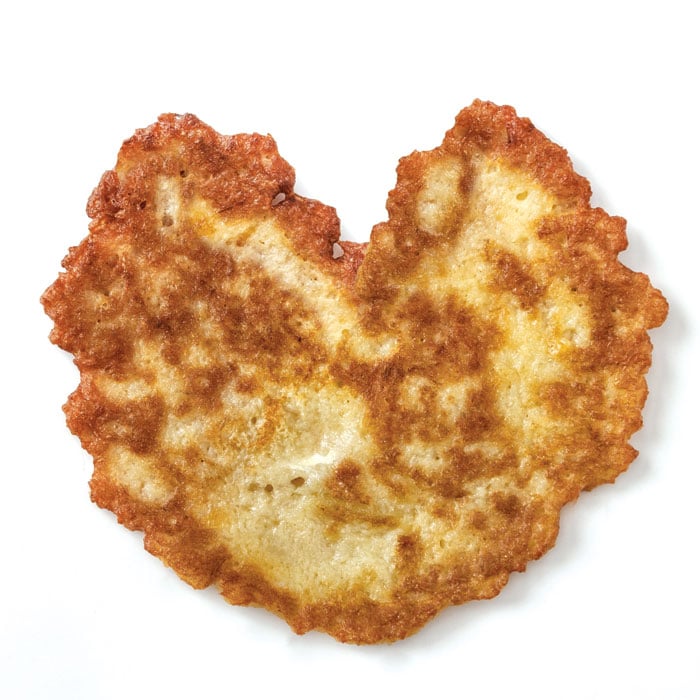
Soft shredded potato texture
on the inside – Egg and flour

even gluten free flour
holds it together without
affecting my whole thing.
Step aside jelly donuts.

You try so hard but
you ain’t potatoes.
You ain’t even small potatoes.
Sour cream and Apple sauce

Oh, praise God for the
combination of those two.
It was a fried potato that convinced
me I should be a believer.

At least for these eight nights.
This, a food from the world yet to come.
We’re crossing through the
gates of righteousness

a fork in our hand –
our cardiologist close behind.
Oh latke, I rededicate myself to you.
You are the miracle.


God Wrestler: a poem for every Torah Portion by Rick LupertLos Angeles poet Rick Lupert created the Poetry Super Highway (an online publication and resource for poets), and hosted the Cobalt Cafe weekly poetry reading for almost 21 years. He’s authored 25 collections of poetry, including “God Wrestler: A Poem for Every Torah Portion“, “I’m a Jew, Are You” (Jewish themed poems) and “Feeding Holy Cats” (Poetry written while a staff member on the first Birthright Israel trip), and most recently “The Tokyo-Van Nuys Express” (Poems written in Japan – Ain’t Got No Press, August 2020) and edited the anthologies “Ekphrastia Gone Wild”, “A Poet’s Haggadah”, and “The Night Goes on All Night.” He writes the daily web comic “Cat and Banana” with fellow Los Angeles poet Brendan Constantine. He’s widely published and reads his poetry wherever they let him.

Ode to the Potato Pancake Read More »

Be the Light

In an unusual moment, just after celebrating our American holiday of Thanksgiving, we come to welcome Hanukkah. It is an irony since the Jewish holiday of thanksgiving is Sukkot, and it is Sukkot that is truly the reason we celebrate Hanukkah for eight days. In fact, it is the religious immigrants, the pilgrims, who came to America, followers of the Bible, who were inspired by Sukkot to create this American celebration, Thanksgiving.

But Rabbi you must be confused, our tradition teaches that it was a small cruse of oil found in the desecrated sanctuary of the Holy Temple that is the foundation of Hanukkah. Talmud teaches that the oil unexpectedly lasted eight days and this is the basis for celebrating eight days. But it is a deeper dive into our history, spelled out in the Books of the Maccabees I and II, that truly reveals the story. These books are not part of our canon, nor did the ancient rabbis want to focus on political events for adopting a different menorah called chanukiyah. Unlike the original seven-branch menorah housed in the sanctuary of the Temple, the chanukiyah would have eight branches and come to represent the miracle of the oil.

The historical events represent a more unsavory reality. It was a time when the Greeks controlled Jewish life and Hellenism was influential. While the Greeks were attempting to destroy our religion, a group of courageous men, led by the Maccabee family of Priests, recruited others, creating an army that fought and defeated the Greeks, taking back our future and rededicating the Holy Temple. Strength and courage of a physical nature was not what the rabbis wanted to focus on, yet it was the inspiration for many Israeli soldiers who fought in the Six-Day War. Like young Maccabees, they were determined to fight for their country and Judaism. The story of the oil focuses on a different miracle, one that heralded spirit and not military battles. When the Maccabean war ended, the eight-day holiday of Sukkot could finally be celebrated, and the delayed rituals could joyously be expressed.

At a time in which we experience the darkness of hatred and antisemitism, we should find these historical events inspiring and a reminder of the importance of rededicating ourselves to strengthening Judaism’s future. 

As lovely as the sweet story of the oil is, at a time in which we experience the darkness of hatred and antisemitism, we should find these historical events inspiring and a reminder of the importance of rededicating ourselves to strengthening Judaism’s future. Assimilation can be a threat, just as it almost was over 2000 years ago. Lighting the menorah is a symbolic act of commitment to maintaining the light of our values, our traditions, our presence in this world, as much as it is a thing of beauty and joy. In these dark moments of the pandemic and isolation, what could be more nurturing than gazing at the beauty of lit candles, singing Jewish songs, and “fressing” (devouring) delicious latkes? 

There is no question that the symbol of fire is prominent in our tradition. G-d is encountered in the burning bush, at the fires on top of Sinai, and at the other end of the altar, where the sweet smell, “reyach nihoach,” of the burning offerings wafted toward the Divine. The seven-branch menorah, first in the Holy Tent of the Mishkan and then later in the Temple, stood, lit each day, as both a reminder of the seven days of creation and that the Divine light is always present. The cups held oil and a wick, burning continually, transmitting the warmth and the glow of life renewed. The Zohar teaches that we too are these lights: “In the midst of the Children of Israel, is a pathway to illumine and kindle the lights, connecting what is below (this world) with what is above (world beyond) uniting them as One.”

Ner Adonai Nishmat Adam,” the light of (for) G-d is the soul of man (Proverbs). We are the Divine light as well the light for the Divine. The oil, the wick, and the flame are both an expression of G-d emanating through our values and actions, but we are also the light, a guide for G-d, leading the way. In a world darkened by fear and pessimism, we are the conduit, not just for eight days, but for every day, to ignite love, grace, and goodness.


Eva Robbins is a rabbi, cantor, artist and the author of “Spiritual Surgery: A Journey of Healing Mind, Body and Spirit.”

Be the Light Read More »