fbpx

November 17, 2021

“What She Said” Film Explores the Experience of a Rape Survivor

“What She Said” is a new film that tackles the perils that a rape victim endures when they bring a criminal case to trial. 

Actress Jenny Lester stars as Sam, a rape victim whose siblings and friends all seem to have an opinion on how she should proceed, when she suddenly reveals that she wants to drop all of the criminal charges against her rapist. 

The film begins just after Sam retreats to a family farm house in Virginia’s Shenandoah Mountains to get away from all of the stresses of the trial. It’s Thanksgiving week, and her brother makes a surprise visit. Discovering that Sam plans to drop the charges, he convenes a support team of Sam’s friends to make her consider the repercussions. 

Lester, a San Fernando Valley native, is not only the star, but also the writer and music supervisor for the film. She conceived the story in the fall of 2017 during the emergence of the #MeToo movement. 

“During #MeToo, when I was reading all these stories [of assault victims], my writer brain went ‘Hey, that’s horrible that it happened,’ but I couldn’t help but wonder who this woman was before this all happened,” Lester told the Journal. 

She said that the stories of victimhood and survivorship made her want to present the experience of a scarred and traumatized woman who has difficulty communicating her most painful feelings to the people who care about her the most.

Jenny Lester in “What She Said”

“I was really struck by these cases. When they make it to court—which is usually never—but when they do, it’s usually the person who committed the assault who has letters from their elementary school teacher and pediatrician bolstering up their character and talking about how they’re amazing,” she said. “The woman gets torn apart and [the defense presents] all of the reasons why she deserves this to happen to her or why her character isn’t flawless, and that’s why she did this to herself.”

Although Lester herself is not a survivor, she interviewed several sexual assault survivors to make the film as authentic as possible. And it made all the difference in making Sam a believable, overwhelmed and conflicted character. In her orbit is a compassionate therapist sister and a short-tempered brother who wants to kill Sam’s rapist. The family is Jewish, but still puts up a Christmas tree in the farm house. 

Sam’s feelings are bottled up for so long that when they’re finally expressed, they come out as anger. With Sam on the verge of further breakdown, Aaron, a Muslim friend, recites an Arabic proverb to remind her that she is not alone in fighting the trauma that replays over and over in her mind. 

Lester pointed out that she wanted Sam’s support team to be a blend of millennial, culturally-specific but not necessarily religious group of people, because the New York community she currently lives in has a very strong sense of their culture that transcends religion. 

“There are Yiddish phrases that I know that are just innately part of me,” Lester said. “But I wanted to get the feeling from the other side.” 

In the film, there is heavy scrutiny when it comes to the words “should” and “no.” There is also much discussion of what happened in the past, but no flashbacks. When it comes to court testimony about an event that only the plaintiff and defendant witnessed, the legal battle becomes a battle of words: one person’s words versus another’s. That’s why the film is called “What She Said.” 

“My drive to keep going comes from empathy,” Lester said. “I feel really strongly that we as humans learn empathy best when there is a story that we can get behind. So many people don’t understand.”

“What She Said” is now available on digital platforms including Amazon Prime, YouTube and iTunes

“What She Said” Film Explores the Experience of a Rape Survivor Read More »

david suissa shanni suissa podcast

The Obsession with ‘Succession,’ ‘Ted Lasso’ and ‘Curb’– Unpacked


In the second episode of “Conversations with Shanni,” we explore why certain shows get so much buzz, and dive into the wild, new world of Crypto currency and NFT’s.


Follow David Suissa on FacebookTwitter and Instagram & Shanni Suissa on InstagramTwitter and TikTok


example one
example two
example two

The Obsession with ‘Succession,’ ‘Ted Lasso’ and ‘Curb’– Unpacked Read More »

Thankful for Our Blessings: The Best Sides of Thanksgiving

The boundless Pacific Ocean filled the horizon beyond the big glass doors. The sun was setting and the sky was perfectly gray and purple and streaked with red. The fireplace crackled with a blazing fire. The table was set. The kitchen smelled heavenly. And all our friends were lolling about the cavernous living room, sipping cocktails.

Our good friends Neil and Rachel had celebrated their marriage the night before and my uncle and aunt had graciously opened their Malibu home to host a special Thanksgiving Sheva Brachot.

We served a couple of roasted birds, gravy and cranberry sauce, mashed potatoes, green beans and sweet potatoes, roasted butternut squash and Brussels sprouts, a mushroom stuffing and a cornbread stuffing. But the groom was scandalized when my mother brought out a huge platter of her saffron rice garnished with caramelized onions, slivered almonds and dried cranberries (it all was eaten).

Exactly thirty years later, Neil (jokingly) shudders at the memory. And Rachel and I still laugh about it. 

— Sharon

Thanksgiving has always been a special holiday for me. My family emigrated from Morocco in October and we were invited to celebrate our beautiful first Thanksgiving. It’s hard to believe that it’s been 30 years since my BFF and Sephardic Spice sister Sharon hosted our first Thanksgiving as a married couple. Since then Neil and I have hosted our family and friends every year. Even though we are deeply rooted in our Sephardic food traditions, this holiday is All-American. Over the years I’ve worked hard to perfect the parve sides (because let’s face it, everything tastes better with butter!). I use Miyoko’s cultured vegan butter for my biscuits and pie crust. I poach garlic in olive oil and whip it up with my mashed potatoes. My gravy is laden with chestnuts. Instead of sugar, I use white honey, orange rind and orange juice in my cranberry sauce. The cooking load has gotten lighter now that my son is a chef and now that my daughter is older and loves to bake. It’s so meaningful to be surrounded by family and dear friends and I am so grateful for everything that Neil and I have built together. And of course, you’ll never find rice on my Thanksgiving table.

While everyone knows that the turkey is the star of the show, every Thanksgiving feast relies on the best supporting actors—delicious side dishes. 

While everyone knows that the turkey is the star of the show, every Thanksgiving feast relies on the best supporting actors—delicious side dishes. Our Sephardic spiced recipes are inspired by the abundance of fall produce like kabocha and delicata squash, heirloom carrots and crispy green beans.

The festive salad features thinly sliced delicata squash roasted with a sprinkle of cinnamon and nutmeg. Place it over a bed of mixed baby greens and purple onion, then garnish with delicate persimmon, ruby red pomegranate and candied pecans. Dress with a lightly sweetened balsamic vinaigrette just before serving.

The heirloom carrots are drizzled with a good oil, sprinkled with Ras el Hanout, a spice mix common in Tunisia, Algeria and Morocco, then roasted at 400°F.The green beans are sautéed with olive oil and minced garlic and the chestnuts are thrown in at the last minute. To achieve the ultimate crunchy topping, Rachel used a mandoline to thinly slice the leeks, fried them until they were golden and drained them in a single layer on a brown paper bag.



Rachel’s Nutty Kabocha Squash recipe is so good that we guarantee that you’ll make it over and over again. 

Legend has it that Portuguese explorers brought Kabocha squash from the Americas to Japan, where it acquired the name Kabocha and why it is sometimes referred to as Japanese pumpkin. While the skin is either a dark green or bright orangey-red, Kabocha has a delicately sweet, earthy flavor with hints of chestnut. Rachel’s Nutty Kabocha Squash recipe is so good that we guarantee that you’ll make it over and over again. 

Wishing you a happy, healthy and very festive Thanksgiving! 

— Rachel

Rachel’s Nutty Kabocha Squash Recipe

1 kabocha squash, about 2 1/2-3 pounds
1/4 cup olive oil
1 teaspoon kosher salt
1/4 cup avocado or expeller-pressed
safflower oil
1/4 cup currants
1/3 cup pistachios or slivered almonds
1/2 cup chopped Italian parsley
Pinch of salt

  • Preheat oven to 400°F.
  • Wash the exterior of the squash thoroughly, pierce it a few times with a fork, then place on a microwave-safe dish.
  • Microwave the squash for 4 to 6 minutes. Squash will be ready when the sharp tip of a knife goes in easily.
  • Allow squash to cool for a few minutes, then cut the squash into ½ inch thick slices.
  • Arrange the slices of squash on a baking sheet, then toss with olive oil and salt.
  • Roast until the squash is caramelized, about 20 minutes.
  • Switch oven to broiler setting and roast for another 2 minutes. Remove from the oven and set aside.
  • In a shallow frying pan, warm oil over medium heat and fry the currants for a few minutes until they are puffed up. Remove currants from the pan and drain on a paper towel.
  • In the samepan, gently brown the nuts.
  • In a small bowl, toss the currants, nuts and chopped parsley, then sprinkle with a pinch of salt.
  • Arrange the hot Kabocha pieces on a serving platter and sprinkle with fruit and nut mixture.

Rachel Sheff and Sharon Gomperts have been friends since high school. They love cooking and sharing recipes. They have collaborated on Sephardic Educational Center projects and community cooking classes. Follow them on Instagram @sephardicspicegirls and on Facebook at Sephardic Spice SEC Food.

Thankful for Our Blessings: The Best Sides of Thanksgiving Read More »

Club Z Is Taking the Pro-Israel Cause to Campus

Nine years ago, on a typical weekday afternoon, Masha Merkulova’s son came home from Hebrew school clearly troubled. 

“I asked him what was wrong,” Merkulova, a registered nurse, said. “He then told me the teacher at his Hebrew school showed the class a movie that was anti-Israel. I couldn’t believe it. I immediately got a copy, watched it and was shocked at what I saw.”

Merkulova, who was born in Russia, said that while Russia was great at raising “social warriors,” that never extended to Zionism or Israel. 

“When I emigrated to the United States, I knew I needed to educate myself more about Israel and especially Zionism,” she said. “So I did.”

The incident at her son’s Hebrew school in the California Bay Area where she lives prompted Merkulova to ask the school for an explanation. 

“I found the teachers were well-meaning but uneducated about Israel and Zionism. They simply didn’t know the movie they were showing was inaccurate and out of context,” she said. “I then found a study guide on Israel that was fair and factual that the teachers could follow. But the school told me it would take one to two years for the board to approve it. We didn’t have a year or two, so I bought the program myself and started teaching it at a space donated by the local JCC.”

Her informal teaching led her to give workshops and seminars and eventually to creating Club Z, a nonprofit to “raise modern-day Zionists who are articulate and knowledgeable leaders,” according to the organization’s website. In 2017, she left nursing entirely to focus on growing Club Z. 

Headquartered in the Bay Area with satellite offices in Los Angeles, Charlotte, New York and San Diego, Club Z (the Z is for Zionism) provides teens with the tools they need to defend Zionism on high school and college campuses — which they are finding to be increasingly anti-Israel. These tools are provided via seminars, an institute, conferences and activism such as pro-Israel rallies that Club Z organizes and participates in.

Club Z members were among 170 California high school students and parents who sent a petition to Gov. Gavin Newsom. They urged him to veto AB 101 requiring ethnic studies courses for high school graduation. The petition stated in part: “This bill will sanction the hounding of Zionist students in high schools across the state…Zionism is integral to our Jewish identity and we are alarmed that this bill will institutionalize anti-Zionism, a dangerous form of antisemitism. We strongly urge you to veto AB 101.” Newsom ended up signing the bill into law on October 8, 2021.

“Supporting and loving Israel is great, and that is one of our principles, but it is not enough”
— Masha Merkulova

“Supporting and loving Israel is great, and that is one of our principles, but it is not enough,” Merkulova said. “Jewish students need facts and information to refute the misinformation that is taught about Israel on campus. Too often, fellow students just don’t know any better. They accept what they are told and never hear Israel’s side.”

While Merkulova is fully engaged in the mission of educating the next generation of pro-Israel teens, she admitted she misses nursing. “With nursing, there is instant gratification,” she said. “It’s actually a much easier job. You see results immediately when patients get better. Educating teens to stand up for Israel is a long-term challenge, but ultimately it is a battle well worth fighting.”

Local Club Z members speak:

Jennifer Karlan

Jennifer Karlan
Age: 18
College: Harvard University

“Club Z has fundamentally changed my view of what it means to be a Jew. In Club Z learning sessions, I have learned that being a Jew inherently means we are part of the Jewish people — Am Israel — and like all peoples, we originate from a land. That land is called Israel, and thus, we are an indigenous people to the land of Israel. 

“I have learned nuances of Jewish and Israel history, including the legal, moral and historic rights to the land, and the rebirth of the state.  Yet most revolutionizing was understanding the six historical accusations Jew-haters make against the Jews and how they shift throughout history, and seeing how blatantly antisemites use those accusations against Israel today.” 

Natalie Arbatman

Natalie Arbatman
Age: 17
High School: Mountain View High School

“Personally, I have felt afraid to express my Zionism and by extension my Judaism. Living in an extremely progressive area where most of my classmates are affected by the massive misinformation that they read online, where Zionists are labeled as racists. During the recent Gaza war, an overwhelming majority of my classmates posted ‘Free Palestine’ and other anti-Zionist slogans and infographics. Many of them vilified Zionists and said they would unfriend any person who wasn’t anti-Israel. 

“I in no way felt comfortable sharing my views or defending Israel for fear of being a pariah, but Club Z instilled in me a pride that trumped those emotions and I did engage with several of my peers online. The classic antisemitism that my parents experienced is not as common in America, but it has seeped into the so-called activism of well-intentioned progressive students at my school.” 

Shaya Keyvanfar

Shaya Keyvanfar
Age: 16
High School: Palisades Charter High School 

“Joining Club Z was one of the most life-changing decisions I made as a student. I decided to become proactive instead of reactive: to arm myself with as much knowledge as I possibly can on the Arab-Israeli conflict, Zionism and antisemitism. I have been part of the organization for a year now and in this short time, I have gained crucial knowledge regarding the state of Israel, partition plans and history, which I have implemented either in the classroom or through talking with my peers or fighting back on social media. 

“I remember my first day of Club Z institute: my peers and I had a discussion about the partition of the British Mandate of Palestine and the formation of Jordan, and I was so blown away by the information I learned, that I immediately lectured both my parents and proceeded to FaceTime my friends to share my new knowledge as soon as I got home. For me, this is what Club Z is about: using facts and knowledge for a good cause.”

Club Z Is Taking the Pro-Israel Cause to Campus Read More »

Palestinian Files Complaint Against Unilever Over Ben & Jerry’s “Discriminatory Boycott”

Bassem Eid, a Palestinian human rights activist who lives in the West Bank, filed a complaint against Unilever, the parent company of Ben & Jerry’s, over the ice cream giant’s “discriminatory boycott” against Israel.

The complaint was filed to New York’s Division of Human Rights in October against Unilever’s United States division, the New York Post reported. The complaint, which can be read in full on the Elder of Ziyon blog, states that Eid is opposed to the Boycott, Divestment and Sanctions (BDS) movement because it’s “counterproductive to peace and creates only more hatred, enmity and polarization” and boycotts like Ben & Jerry’s “will only result in increased economic hardships for actual Palestinians, such as myself.” In July, Ben & Jerry’s announced that they will no longer operate in the “Occupied Palestinian Territory.”

“If so-called pro-Palestinian activists truly want to help the Palestinians’ cause, then they should demand Palestinian leadership respect basic freedom, human rights and democracy for the Palestinian people, while assisting Israel in creating more jobs employing Palestinian people and initiating programs that bring the sides together, not create barriers, walls and only more hate,” the complaint stated.

The complaint noted that while Unilever has maintained that Ben & Jerry’s will conduct business elsewhere in Israel, they are “highly unlikely” to find a distributor elsewhere in Israel because Israeli law prohibits boycott activity based on “place of residence.” “The practical effect of the announcement is a decision to boycott the entire State of Israel. Therefore, regardless of where one draws the lines of Israel’s borders, the boycott will also to apply to me, as a resident of Jericho.”

Additionally, the complaint pointed to the fact that Anuradha Mittal, who heads Ben & Jerry’s board, “vehemently objected” to the part of the statement saying they would do business elsewhere in Israel, claiming that Unilever inserted that qualifier. Mittal has also expressed support for boycotting Israel, according to the complaint. “The circumstances of the Ben & Jerry’s announcement indicate that the company’s boycott is intended to engage in an unlawful discriminatory boycott, and the rhetoric about ‘illegal occupation’ is simply a fig leaf for the discriminatory activity.”

The complaint concluded by stating that the Gush Etzion Shopping Center in the West Bank is a mall at which both Palestinians and Israelis can shop, a “true realization of coexistence,” and is a place where Eid and his friends and family go to eat ice cream. “Gush Etzion is not the only mixed-commercial area in which such a positive dynamic occurs, and they are all targeted by the BDS movement, trying to push us apart instead of fostering and promoting such people-to-people togetherness, friendship, cooperation and peace,” the complaint stated. “The BDS’s movement has had tremendous negative affect on me and other Palestinians, some of whom have lost their place of employment and access to goods and services.”

Eid is invited to attend an event in January 2023 in the West Bank where ice cream will be served, but attendees will not have access to Ben & Jerry’s ice cream as a result of the Ben & Jerry’s boycott, therefore making Eid “an aggrieved party,” per the complaint. 

Eid told the New York Post: “The gangsters behind the BDS are causing a lot of damage to the Palestinians. I want to raise awareness among the US judicial system about how much damage they are causing. If they poured all of the money they are spending on boycotts into building factories and creating jobs in the West Bank and Gaza, it would go a long way to truly helping Palestinians.”

Stop Antisemitism tweeted that they applaud Eid for his complaint against Unilever.

The Simon Wiesenthal Center also tweeted, “Past due for @Unilever to resolve the @benandjerrys disaster now. The stain won’t wash away. More US states and cities taking action against this immoral and illegal boycott.”

Unilever did not respond to the Journal’s request for comment.

Eid’s complaint comes as states like Arizona, Florida, New Jersey and New York have stated that they plan to enforce their anti-BDS laws against Unilever over the Ben & Jerry’s boycott. StandWithUs and the Israeli American Coalition for Action have argued in a letter that Unilever has authority under its contract with Ben & Jerry’s to veto the ice cream giant’s decision.

Palestinian Files Complaint Against Unilever Over Ben & Jerry’s “Discriminatory Boycott” Read More »

Satirical Semite: The Tale of Jonny 5-Vax

I bumped into an old friend who had done something radical. It had nothing to do with him having received five different vaccinations—with three different brands injected into his arm “just to be safe”—but something far worse. He had insulted every Englishman who is, or has been alive during the last 70 years. My friend Jonny “5-Vax” walked out of the new Bond movie 10 minutes before the end. “I couldn’t take any more,” he said. “‘No Time to Die’? It should have been called ‘When the woke hits the fan.’”

His film review was scathing, but maybe he was delirious from an antibody-high. “We’ve seen Bond defeat over 100 villains in the last seven decades, but he has finally been defeated by the enemy known as Outtacontrol Leftism.”

So what if the new movie shows Bond relegated to the passenger seat of a car, the passenger seat on a motorbike, and the back passenger in a glider that is piloted by Nomi, a female agent who has inherited his 007 title?

So what if the new movie shows Bond relegated to the passenger seat of a car, the passenger seat on a motorbike, and the back passenger in a glider that is piloted by Nomi, a female agent who has inherited his 007 title? Jonny disagreed. “He’s a wuss. Bond makes breakfast for his daughter, even though his masculinity is undermined when her mother denies his paternity. Is Bond now a domestic goddess? Daniel Craig may have a Jewish wife and Jewish children, but nobody told the screenwriters there is a difference between circumcision and castration.” 

At least Jonny 5-Vax had the self-knowledge to admit he identifies with the old Bond, best described in 1995’s “GoldenEye” when Judi Dench’s M says to Pierce Brosnan’s 007: “I think you’re a sexist, misogynist dinosaur. A relic of the Cold War.” My friend continued, “At least you knew where you were when Bond was a man’s man. He is supposed to be mildly-sociopathic, slightly-chauvinistic, charming, seductive and a ruthless killer with the complete inability to maintain long-term healthy human relationships.” Much like some of the guys on Tinder. “We don’t need to see Bond make breakfast unless he is making a meal of his enemy.”

It’s important to have friends with different political opinions, even if they are wrong. I listened. “Diversity is crucial, but not with Bond. There is no need to align Bond with woke leftism, because that isn’t the world he lives in. If people don’t want to see the films, they don’t have to. There are plenty of other movies where heroes are gender-balanced, where men take a back seat to women. The new ‘Black Panther’ lead is female and we even have two Jewish female superheroes in Black Widow and Wonder Woman.” 

He had a good point. The best Instagram image of 2017 was Yaron Varsano standing next to his wife Gal Gadot, wearing the T-shirt with two female icons on it and titles beneath—the female stick-figure bathroom icon with the title “Your Wife” and an image of Wonder Woman with the title “My Wife.” Jonny, however, couldn’t stop himself from commenting. “Obviously the Neo-Marxist Wokerati Thought Police will explain why his t-shirt represents male subjugation, oppressive patriarchy and wonder-mansplaining. Banish them to Themyscira, the female utopia where Wonder Woman grew up, and wish them luck if they ever choose to cancel her fierce Amazonian tribe members.” 

Jonny’s final comments were repellent. “The current team of Bond screenwriters need to be fired, although not by Alec Baldwin. He brings a whole new meaning to the phrase ‘film shoot.’ Send those writers to a desert island for several years armed only with the original series of Ian Fleming’s novels and a bar full of lukewarm martinis that have been both shaken and stirred.” Perhaps Jonny 5-Vax should be exiled in their place, and given a mandatory license to chill.


Marcus J Freed is an actor, writer and consultant. www.marcusjfreed and on social @marcusjfreed.

Satirical Semite: The Tale of Jonny 5-Vax Read More »

Israeli Legal Advisor Responds to Charges of Apartheid in UN Speech: “Our Conflict Has Nothing to Do With Race”

Sarah Weiss Ma’udi, the Israel Mission to the United Nations legal advisor, responded to allegations of Israeli apartheid by stating in a speech that the “conflict has nothing to do with race.”

Ma’udi was responding to comments from the Palestinian representative in a November 16 speech to the UN. She said that she has spent time with her children in bomb shelters to shield them from rocket fire, has five nieces who live near the Israel-Gaza Strip border, and has lost friends and relatives to terror attacks. She also argued that the Israeli-Palestinian conflict can’t be solved “in the courtroom with vexatious or frivolous litigation.”

“You can lash false accusations at my country and cynically appropriate loaded terminology borrowed from important historic and current racial justice movements,” Ma’udi said, “and you can mock, as someone who themselves has never been a victim of antisemitism, and cheaply dismisses our pain. Or insinuate that we are not human or don’t act humanly, using actually classic antisemitic tropes that the speaker himself clearly has little understanding of. But we all know full well that our conflict has nothing to do with race and everything to do with messy, complicated, conflicting claims––legal and otherwise–– that we will only be able to solve together as partners at the negotiating table.”


The Simon Wiesenthal Center praised Ma’udi’s speech in a tweet as speaking “truth to power.”

Holocaust historian Deborah Lipstadt, who is currently nominated to serve as the Special Envoy to Monitor and Combat Antisemitism, tweeted that Ma’udi’s speech was “a powerful less than two minute take down of those who use antisemitic tropes for political purposes. Feel as you may about the Middle East situation, antisemitism has no place in it.”

Eugene Kontorovich, George Mason University Law Professor and head of the Kohelet Policy Forum’s International Law Department, had a differing take. “This is why Israel loses in public diplomacy,” he tweeted. “Palestinian: IT IS OURS! ALL OURS! YOU STOLE IT! Israeli: ‘Actually, we just have conflicting claims. We should just sit down and work it out.’ How can Israeli diplomat speak at UN without saying Israel’s claims are the right ones?”


Israeli Legal Advisor Responds to Charges of Apartheid in UN Speech: “Our Conflict Has Nothing to Do With Race” Read More »

Why I Love My ‘Hood

I have always lived in mostly Jewish neighborhoods. To be exact, religious Jewish neighborhoods, walk to shul Jewish neighborhoods, and kosher butcher shop Jewish neighborhoods. I live there, not because I am incredibly religious, but because I like living among Jews. 

I like seeing Jews walking the streets. I like seeing pictures of rabbis in store windows. I like seeing new shuls popping up and peeking in to see people praying. I like seeing women in supermarkets wearing sheitels which I can spot a mile away.  And I like living where it’s not a rarity to see men in kippahs wearing tallisim.

I like seeing people that seem to fear God. I like seeing Jews in outdoor cafes. I like waiting online behind Jewish husbands in bagel shops while they are on the phone checking with their wives as to what kind of bagels to bring home. I like hearing the words tatala and nisht.  I like names like Shlomo, Chava and Moshe. 

I really like my neighborhood because you still see families of five or more. I like seeing five young girls all in identical dresses. That reminds me of the Von Trapp kids from “The Sound of Music.” I like seeing a two-year-old with tzitzit hanging out. If you are in my neighborhood and it is four minutes before Shabbos, be careful crossing the street because an old beat-up station wagon with bald tires driven by a man with a long beard and kippah that’s almost hanging off his left ear might come screeching around the corner at 60 miles an hour trying to beat the Shabbos clock. 

On any given day, my neighborhood almost feels like I’m in the holy land. It’s a wonderful feeling. Plus, look at all the airfare I save. I like flying on planes with four hundred other Jews except when they wake me to pray.  

Truth be told, the older I get, the more I like Jews. You might say I love Jews. Not all Jews but an awful lot of them. I say most because how can I like Ben and Jerry? Nobody likes all of anything. Do you like every item in a bakery?  I don’t. 

When my kids were little, we lived in San Antonio, Texas for two years. We lived in a very non-Jewish neighborhood. Our Christmas manger was two doctors and three lawyers. But the people in our area were kind to us. When walking to shul, donning our Shabbos best, our neighbors would greet us with a big hello, even stop mowing their lawns to wish us a good Shabbos. Shul was a five-minute walk if we crossed a creek. Some months the creek water rose to over two feet. We wore high rubber boots to protect our shoes and clothes and to protect us from rattler bites. Not easy getting a Jewish woman to walk through rattlesnake infested water. Texas was great and the people amazing, but it was not a Jewish neighborhood. So, for me, something was missing.  

I love living where people are not afraid of openly showing that they are Jewish. I love seeing people I know doing mitzvahs.  When I walk my neighborhood, I feel a rush of gratitude that I don’t feel in other neighborhoods.

With the uptick of antisemitism, I love my neighborhood and the Jewish people even more. I love living where people are not afraid of openly showing that they are Jewish. I love seeing people I know doing mitzvahs.  When I walk my neighborhood, I feel a rush of gratitude that I don’t feel in other neighborhoods. In truth, I love seeing devotees of all religions. If they respect me, I certainly will respect them. But Jews get who I am at my core. To me that is a very comforting feeling in a very unsettling world.

So here we are living in the Pico Robertson area of Los Angeles. A neighborhood where you pay lots of money for a tiny house so you can be near other Jews. But where else except a Jewish neighborhood can you walk to the corner and get a freshly baked kosher rye or homemade shakshuka? Or on a Friday afternoon, get a phone call from my neighbor Aaron asking if I want to walk with him to shul? Where? Where else but in a Jewish neighborhood.  If I’m not going to move to Israel, this is the next best thing. Shalom.


Mark Schiff is a comedian, actor and writer.

Why I Love My ‘Hood Read More »

Rosner’s Domain: Is Eight Years Enough For a Leader?

With some fanfare (“promised and implemented”) the Israeli government decided to support legislation that will limit the term of an Israeli Prime Minister—any Prime Minister—to no more than eight years. Americans might think this is a good idea. They might think that finally, Israel is becoming more like America. Many Israelis might also think this is a good idea. They want Israel to be more like America. Yet, they are wrong. Israel is not becoming more like America. That is, unless what we mean by “being more like America” is being unserious about political processes. 

The idea to have a term limit for Israel’s Prime Minister gained traction for one reason: Benjamin Netanyahu. His long reign was so frustrating to his rivals, they convinced themselves that a repeat of such an outcome must be prevented by legislation. This is silly for more than one reason, the first of which is that Bibi’s gone. Maybe not for good, but he’s gone for now. Namely, the system works. When the voters no longer wanted him they got rid of him. The insistence to pass the radical legislation looks like a fixation on an old, outdated cause. Moreover, to gain a majority for the legislation and make it legally viable, the legislators had to accept that the new law will have no retroactive implications. This means that Netanyahu can still serve for eight more years, starting tomorrow.

I called the law “radical” and you might ask, what’s radical about it? How can I call it radical when the U.S. has such term limits? To which my answer would be: Yes, to have a term limit in a parliamentary system is radical. Israel has a PM, supported by a coalition that could crumble at any time. There is no four-year term guaranteed, there’s no two-term limit. And if you look around, it is easy to identify other countries with parliamentary systems that do not have term limits. Germany’s Angela Merkel is ending a more-than-eight-years term. Britain’s Margaret Thatcher served more than eight years. In fact, many of the most illustrious leaders of parliamentary democracies served more than eight years. Think Trudeau in Canada. Think Pitt, or Blair, in Britain. Think Gandhi in India. Oh, and that long forgotten guy, Ben-Gurion. Him too. 

Yes, the U.S. changed its constitution and limited its presidents to two terms. Had we wanted to be contrarians, we could wonder: was this a wise move, or just hysterical post-FDR aftershock? No president before FDR served more than two terms. No president after him served more than two terms. So we do not have any data or example with which to prove that a two-term limit produces better results than a one-term limit, a three-term limit, a fifteen-term limit or a no-term limit.

What justifies term limits in the eyes of its proponents? To prevent corruption, to prevent entrenchment of a certain ruling party and to infuse new people and ideas into the bloodstream of a country. Each of these arguments must overcome strong counterarguments. For example, certain studies of corruption in municipalities concluded that mayors do not tend to become more corrupt in their second or third term. The equation “more time in power” equals “more corruption” is a common cliché with little evidence backing it. It might be true for kings or dictators. But in democracies, a corrupt government is kicked out by the voters. Another example: New people could have new ideas, and that’s good. But they also have less experience and a propensity to make rookie mistakes, and that’s bad. 

So Israel is making a significant constitutional change for no reason other than confusion and frustration. And it is making a significant change that isn’t going to hold. Why not? Because of Israel’s system. Unlike the U.S., Israel does not have a elected president. Unlike the U.S., Israel does not have a constitution. When the post-FDR shock ignited the process that ended with term limits, the Twenty-Second Amendment made it permanent. What happens in Israel is different: It will pass legislation that could be altered back with a simple majority. And guess who is likely to have the simple majority needed to reverse the new legislation? If you guessed right, it’d probably be the PM with the popularity to serve, well, more than eight years.

Something I wrote in Hebrew

As the value of the US Dollar  came very close to  three New Israel Shekels (NIS), Israelis started pondering the meaning and implications of this change in exchange rates:  

Will the US Dollar drop below three Shekels? This is a childish question. There is no special importance to three shekels. A decrease in the value of the US Dollar from NIS3.2 to NIS3.1 is not fundamentally different from a decrease from NIS3.05 to NIS2.95. Still, this arbitrary threshold seems to have psychological significance. In life generally and economics in particular, the psychology of expectations plays a role that could have an impact on the real world. Should Israelis purchase US Dollars? Sell them? This is a decision by humans, influenced by the psychology of humans. 

A week’s numbers

An important factor of social and economic stability is to have a citizenry that believes in the possibility of social mobility (whether true or false). Here’s what Israelis say about the connection between effort and success (survey of 1500 Israelis, themadad.com).

A reader’s response

Following my last week’s column (“When the Budget Passes, Bibi Goes. Really?”), Dinah sent a question: “Why don’t Likud leaders challenge Netanyahu in Primaries?” Short answer: because they will lose. (Longer answer: One leader, former Minister of Health Yuli Edelstein, said he’s going to challenge him.) 


Shmuel Rosner is senior political editor. For more analysis of Israeli and international politics, visit Rosner’s Domain at jewishjournal.com/rosnersdomain.

Rosner’s Domain: Is Eight Years Enough For a Leader? Read More »

The Dos and Don’ts of Bar and Bat Mitzvahs

“Today, you’re a man, tomorrow, you’re back in the eighth grade” was the funniest thing my dad could think of saying to me during my Bar Mitzvah. Being a Jewish father, he repeated it several times over the course of the festivities, far past the point of it being humorous and always in front of as many people as possible. Imagine my horror this weekend when I saw my thirteen-year-old cousin for his Bar Mitzvah and the first thing I hear myself say to him is: “Today, you’re a man, tomorrow, you’re back in the eighth grade.” I reeled back from the table, dropped the piece of brisket out of my mouth, stared slack-jawed at my sister, and beseeched her: “Am I becoming dad?” 

She was not listening, as she was several glasses in, trying to lower the temperature of the table after our grandparents had accused her of not calling enough. Somewhere across the table, an argument was burgeoning over whether the Catskills were better for Thanksgiving than LA, where the colors are not vivid, but the weather is beautiful. The dispute was personal and intense, ending in a bitter stalemate. At the other side of the room, distant relatives commented on each other’s weight, all but certain to ruin someone’s evening, and somewhere the screaming about Trump and inflation was so loud that our waiters were certainly offering other patrons discounts on their meals. Yet all the same, the Shabbat dinner ended in hugs and cheers, with the knowledge we’d all do the same thing tomorrow at the reception. 

It is essential for any prospective Bar or Bat Mitzvah-goer to know what they’re getting themselves into. This is not an ordinary birthday party or wedding; this is a potentially catastrophic amalgamation of teenage hormones, family drama, and too much food (Jews are not known for easy digestion.) Fortunately, if done correctly, the occasion will be one to remember, and you’ll be gushing over pictures for years to come. Allow me to be your rebbe, sharing my wisdom on the dos and don’ts of this infamous Jewish spectacle. 

At the party, wine will make the hora ten times more enjoyable, and will make the pointed comments on your dating life ten times more bearable. 

Do #1: Drink (in moderation, of course.)

Alcohol is an institution in Judaism, right up there with Tanakh and guilt. In my line of work, I am asked quite often how it is that Jews persevere in spite of all the animosity we face. I talk about how we are empowered by our history and our traditions, but the more I ruminate, the more I’m certain it’s because our forefathers and foremothers busted out the cabernet at critical moments. My great grandmother pricked her fingers on needles in the Garment District for decades because she was too pickled to feel pain, and that’s the Jewish story in a nutshell. At the party, wine will make the hora ten times more enjoyable, and will make the pointed comments on your dating life ten times more bearable. 

Don’t #1: Overestimate strength 

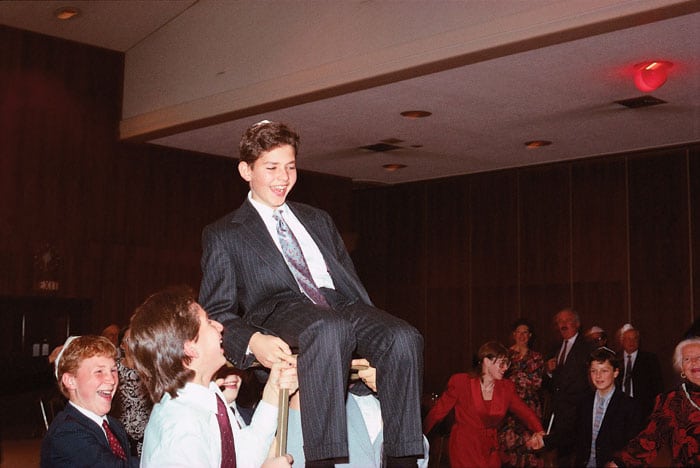
I write this due to the trauma of last night, when a cadre of men and boys went to lift up my uncle’s chair during the hora, only for it to topple over and take down three partygoers in its wake. “That never happens,” I said to the guest next to me, who was shocked too. Nobody was quite sure what to do. The humiliation of the recently emasculated lifters was profound, so consider this a warning to either hit the gym or refrain from volunteering. 

Do #2: Flirt 

This is something that I learned just recently, pondering spaces in my own life where I can find as many potential shidduchim. Curtain up on the Bar Mitzvah, teeming with family friends and various acquaintances. I am not suggesting you sit and speak with someone for long, lest you’re prepared for Pandora’s box of questions from voyeurs, but I am suggesting making the most of what amounts to speed-dating with the food and drink free of charge. This tip also doesn’t apply to the synagogue service—whispering your best pickup line during your cousin’s Haftorah is in poor taste. Also, make sure you’re not speaking to a distant cousin, for our tradition frowns on such things. 

Don’t #2: Politics 

As previously alluded to, discussion of current events is doomed to boil over quickly. My family is divided down the line between left and right. When I was growing up, family dinners were a contest over who would first get up from the table out of frustration and who would eventually have to slam their fists down to make a point. This is uniquely dangerous when in the presence of dozens, as Jews love nothing more than to add their two cents and to disagree for the sake of disagreeing. Heed my warning: If your uncle decides it’s a perfect time to bring up January 6, excuse yourself to the bathroom to flirt with various guests who are there for the same reason. 

Do #3: Lie 

Hear me out: Lying is fun, especially clever white lies. If you find yourself stranded at a cocktail hour, forced into the ominous throes of small talk, revel in the unique opportunity of speaking to people you’ll never have to speak to again. I don’t know why anyone would subject themselves to divulging information about the endless mundanity of our existences when you could tell Sharon from Phoenix that you just got back from studying infectious diseases in Bhutan. She might then introduce you to her son. But again, make sure you’re not speaking to a distant cousin. 

Don’t #3: Make Any Promises 

If out of the corner of your eye you see a distant relative making a beeline to your table, understand you might be harassed into attending various future events, including but not limited to Pesach next year, Long Island next summer, or a shiva call “just in case.” You must stand your ground, and let them know you will get back to them when your calendar is in order. Inevitably, your mother will berate you with guilt for not saying “yes” enthusiastically to the plans, but this is still far better than actually going to Long Island. 

I hope this short guide will serve you well. Bar and Bat Mitzvahs are a beautiful occasion and an excellent way to reconnect with those you haven’t seen in a while. Note that if all else fails, you’ll still be able to gossip about various guests at the Sunday brunch, and you’ll still have the chance to do it all over again at the next one.


Blake Flayton is New Media Director and columnist at the Jewish Journal.

The Dos and Don’ts of Bar and Bat Mitzvahs Read More »