fbpx

July 23, 2021

Satirical Semite: Shrinking Violets

The dating pool is shrinking since we are currently seeing a mad rush of post-lockdown weddings. This weekend should be a fortuitous time for Jewish singles since we celebrate the mini festival of Tu B’Av, which in recent years has been rebranded as a Hebraic Valentine’s Day. There are big parties in Los Angeles, New York and Miami, and the cutting-edge shores of Europe should follow suit in a few years. The Talmud speaks of two days when maidens would dance in the fields wearing white dresses and bachelors would look at them before making their choice of bride (Taanit 30b). One was the 15th day of the month of Av, while the other was Yom Kippur. Not all of the festive traditions have been revived, however, since for some reason a few people take issue with making women dance in a field while men look on and pick which one they want as a bride.

Modern dating has a similar approach of judging and plucking partners from a pool, purely based on their looks. Whereas we used to stand on the edge of the field, these days we stand on the edge of a dancefloor, or just get edgy as we look at men or women on a screen. Even the young and beautiful are more likely to meet someone via a dating app rather than in-person and swipe left if they don’t like the look of them. JSwipe has long overtaken JDate as the online platform of choice, although Jswiping—AKA Jew-swiping—sounds like some kind of medieval antisemitic sport for pagan peasants.

Watching someone dance in person is tricky now since mandatory mask mandates are being reinforced, since it’s harder to judge someone’s attractiveness when half of their face is covered. Although depending on the shape of certain peoples’ faces, this could work in their favor. Personally I’ll be wearing a full mask and leave the house wearing the face of Zac Efron.

I have a love-hate relationship with dating apps. I hate the addiction of regularly checking to see if anyone’s responded, and love to delete the app from my phone. I reinstall the app every two days to check my inbox and respond where necessary before deleting it again. The first of the Alcoholics Anonymous 12 steps is, “We admitted we were powerless over alcohol,” but the advantage of smartphones is that, unlike alcohol, you can delete things at any time and install an app blocker. Then again, blocking potential dates also goes to shrink possibilities of romance. I also get hit by the numbers, since my current age does not look attractive on paper. I recently tried a two-week experiment of using the exact same profile photos but listed my age as younger. I received five times as many responses but quickly explained it wasn’t my true age, and promptly corrected the numbers. One person said the experiment was dishonest, to which I explained that “I identify as being 35” and promptly took her to the Supreme Court, staged a landmark case for discrimination and libel, and won $5 million in damages. Weirdly, she didn’t want a second date.

I have a love-hate relationship with dating apps. I hate the addiction of regularly checking to see if anyone’s responded, and love to delete the app from my phone.

The thing that makes me most uncomfortable with JSwipe is their “most eligible” category. When you look at the photos, there is a group of people who one is free to connect with, but there is also a curated VIP selection of more good-looking people. You have to pay the full membership fee if you want to get in touch with the “most eligible” VIPs. I imagine there are some people in their office deciding if people are “hot to trot” or “not a lot” and placing a price on their head. I’m glad not to know which category I’ve ended up in because it could hurt more than being Jew-swiped by a Cossack in the Anatevka shtetl.

A reduced pool of people can be a good thing because fewer choices can minimize the chance of being overwhelmed with too many options. It can be crazy-making, but the best option is to keep going. If you’re finding it hard, by all means get coaching from a shrink but don’t be a shrinking violet when it comes to meeting people. Stand tall, be confident and make sure you scrub well. Just don’t wear a Zac Efron mask because it’s already taken. Happy Tu B’Av.


Marcus J Freed is an actor, marketing consultant, and currently single. www.marcusjfreed.com

Satirical Semite: Shrinking Violets Read More »

Menashe Amir: The Voice of a People

“Take a picture of us,” my father implored last week during what he described as one of his greatest celebrity sightings in Los Angeles.

“Alright,” I responded, “but I want a photo, too.”

The object of our wonder wasn’t a film or television star (this is Los Angeles, after all); it was an 81-year-old Iranian-Israeli veteran radio broadcaster named Menashe Amir.

Amir isn’t a household name in the United States. But if you’re an Iranian Jew of a certain age, whether in Westwood, Tel Aviv or Tehran, you will instantly recognize his legendary, comforting voice.

For 57 years, Amir served as a broadcaster for Kol Israel (“Voice of Israel”/”Sedaye Israel”) Persian radio, which was based in Jerusalem and broadcast to millions of Persian-speakers around the world, including in Iran. Amir has served as an all-knowing, trustworthy father figure for generations of Iranians, even before the Islamic Revolution, when Iran and Israel enjoyed friendly ties. In fact, it’s with deep reverence and gratitude that I liken Amir to an Iranian-Israeli Edward R. Murrow, if Murrow had lived in exile outside the U.S., but never lost his love for the country or its people.

For nearly six decades, Iranians woke up to the famous opening words of Amir’s daily broadcast: “Here [in] Jerusalem: This is Voice of Israel.” Growing up, whether in Iran or America (the program played during the mornings in the U.S. and early evenings in Iran), I knew better than to disrupt my father’s daily radio ritual, as Amir reported news about Iran and took calls from Iranians in cities ranging from Isfahan to Mashhad. Most of those callers were Iranian Muslims who described the hardships of life under oppression and expressed kinship with Israelis.

For nearly six decades, Iranians woke up to the famous opening words of Amir’s daily broadcast: “Here [in] Jerusalem: This is Voice of Israel.”

How was anyone in post-revolutionary Iran, which has an official state policy identifying Israel as an enemy state, able to call a radio station in Jerusalem? Iranians called a phone number in Germany, and their calls were routed to Israel. For some reason, the regime couldn’t prevent such calls, nor could it jam the Israel-based transmitters. Amir always asked his callers to announce from where they were calling. If they were still in Iran, he immediately asked them about the situation on the ground, whether in 1979 or 2009.

The secret to Amir’s success in reaching Iranians is twofold: He’s an unabashed champion of the Iranian people and of democracy; and he reports news that the regime itself keeps under wraps.

After the 1979 Islamic Revolution, it wasn’t uncommon for many Iranians to tape record Amir’s broadcasts and secretly give them to friends and family; such tapes were even exchanged between children on playgrounds. That’s how many Iranians of all faiths came to trust and rely on Amir and Kol Israel. His voice was even heard on taxi radios.

That same inimitable voice resonated through the large ballroom of Neman Hall at the Iranian-American Jewish Federation (IAJF) in West Hollywood last week, as Amir spoke to hundreds at an event hosted by IAJF on July 13. Naturally, I attended with my father. It was our first in-person event in 16 months, made even more extraordinary because we were surrounded by our own community.

“Menashe Amir’s voice brings us back to a time when we felt more peace and dignity in [pre-revolutionary] Iran,” announced event moderator Zohreh Mizrahi, a local immigration attorney and IAJF lay leader, as she introduced Amir.

His first order of business on stage? Declaring a wholly inseparable bond between the Jewish people and the land of Israel. Amir then commended the local Iranian American Jewish community for having created IAJF immediately upon arriving in the U.S. (in 1980).

“Often, the community has a tendency of acknowledging the contributions of its dedicated members posthumously,” Mizrahi told the Journal. “In this case, IAJF has been a pioneer in presenting and showcasing the value that the Diaspora community has offered, not just locally but also globally, when such recognition is due.”

Amir astutely reminded the audience that the event was taking place during the saddest days of the Jewish calendar—the nine days before Tisha B’Av. And then, he made an extraordinary observation: “Jews haven’t forgotten Israel and Jerusalem after 2,000 years. Iranians shouldn’t forget the real Iran after only 42 years,” he said in reference to the 1979 Islamic revolution that overthrew the secular, Westernized Shah and established an oppressive theocracy, with absolute power in the hands of a Supreme Leader. Before the revolution, there were 100,000 Jews in Iran; today, only 5,000 to 8,000 remain.

In a phone interview with Amir during a brief trip to San Francisco before he returns to Israel, I asked him why, after living in Israel for 61 years, his Persian was still so eloquently fluent. In fact, his impressive vocabulary is one of the many keys to his credibility with Iranian listeners.

“Every day after I came to Israel, I made sure to speak and write in Persian,” he said, acknowledging that his late wife, Sofia, who passed away in 2018, would joke that their home outside of Jerusalem was like a Persian museum because it contained so many Persian works of art.

I also asked Amir whether, four decades ago, he could have imagined that the regime would have lasted so long. “No,” he responded, “I couldn’t have thought it; [Revolutionary leader Ayatollah Ruhollah] Khomeini annihilated so many groups in order to consolidate power. And when the [Iran-Iraq] War started, everyone thought the regime would fall, but that only strengthened and nourished Khomeini.” Amir attests that even Khomeini listened to Kol Israel broadcasts.

As a former colonel in the Israel Air Force, one of Amir’s sons became familiar with the geopolitics of Iran. When Amir asked his son if he thought the regime would fall, he answered, “No, dad. It won’t.”

During the conversation with Mizrahi, Amir discussed a range of topics, from the Abraham Accords to the Biden administration’s Iran strategy. “Americans are very good-hearted,” he said, “but they don’t understand the political reality of what it’s like to actually live in the Middle East.” At one point, Amir made a diplomatic statement about former President Jimmy Carter, whom many Iranians loathe for having enabled the revolution. Gauging the audience’s response, Mizrahi joked that attendees might deport Amir back to Iran. My only thought? I hadn’t realized how much I missed in-person events. Such spontaneous audience engagement simply isn’t the same on Zoom.

In fact, I found myself as sentimental as ever, savoring each moment of the event, looking into the eyes and expressions of audience members and being reminded of how much I’ve simply missed faces. As the entire program was spoken in Persian, I also realized that I don’t know anyone under the age of 35 who would have understood most of what was being said. As for Amir, there’s a dangerous dearth of young, fluent Persian-speakers in Israel who could succeed him, but that’s for another column.

“American Jewish youth have been raised under the overwhelming shadows of a strong Israel and a free America, and have grown too comfortable and complacent, to the point that they need not worry about the re-emergence of the old hatred [of antisemitism],” Mizrahi told me. “So, more than the avid followers of Mr. Amir, younger Jews must take part in such conversations to learn from the former’s vast knowledge of the history, Israel, Iran, and the Middle-East.”

Engaging youth is critical for Amir, who recently published a series of interviews he conducted with the late Amnon Netzer, an Iranian-born, Israeli journalist, professor and researcher who was also a prominent broadcaster for Kol Israel. The aim of the book —“Jews, Iran, Israel”—which was also translated into English by Farshid Delshad, is to empower young Jews of all backgrounds to be experts about Jewish history. Amir is also working on an English-French-Persian dictionary.

Amir (ne Manouchehr Sachmachi) was born in a Jewish quarter (mahaleh) of Tehran in 1939. His parents were from the northern city of Hamadan, home to the ancient tombs of Esther and Mordechai (called “Shushan” in the Megillah of Esther). His father served in Reza Shah Pahlavi’s army.

During World War II, a young Amir listened to Nazi propaganda radio that was broadcast from Germany to Iran. He also loved listening to a local radio station in Tehran. This inspired him to sit in his bedroom, face a wall, and pretend to be a radio broadcaster. He also developed a love of foreign languages, eventually learning French, Hebrew, and Arabic, in addition to Persian.

At the age of 17, Amir began working as a journalist for the popular daily Tehran newspaper, Kayhan, an unusual profession for a Jew in Iran (ironically, after the revolution, it became one of the most conservative papers in Iran).That same year, he traveled to Israel as part of an educational delegation and fell in love with the country, making aliyahthree years later in 1960. He eventually met and married his late wife, an Argentinian Jew whose family was Ashkenazi. They had two sons.

He returned to Iran for a brief visit in 1978, on the eve of the revolution, never to return again. His reporting from Israel proved indispensable during the chaotic turmoil of the revolution and its aftermath.

“During the Iranian hostage crisis, from Nov. 4, 1979 to January 20, 1981, we relied on [Menashe] Amir’s views and his sources to understand the negotiation process and intertwined political conflicts with more transparency and clarity,” IAJF President Susan Azizzadeh told the Journal. “For 444 days, the world waited for his interpretation of the political changes that the IRI (Islamic Republic of Iran) brought to the country.”

Such reflections offer a sense of how tightly the new regime controlled the media; Iranians were forced to rely on a foreign country, Israel, to offer them truthful reporting about events at home.

During the Iran-Iraq War (1980-1988), Kol Israel Persian was the only regional broadcaster (beside Radio Baghdad) to warn millions of Iranians when Iran would be bombed each evening (early evening broadcasts played at 6:30 p.m.). I remember those shortwave radio broadcasts and Amir’s comforting voice vividly. I also recall wondering why Israel, and not my own government, was warning residents of imminent attacks.

I remember those shortwave radio broadcasts and Amir’s comforting voice vividly. I also recall wondering why Israel, and not my own government, was warning residents of imminent attacks.

How did Amir know about planned bombings? He and his staff listened to Arabic-language programs on Radio Baghdad.

Kol Israel also broadcasted Persian music from exiled Iranian artists. The station (and bootleg music tapes) were virtually the only options for millions of Iranians who longed for the forbidden pop music that was banned after the revolution. In the early 1980s, Amir announced a daily count of days since Israeli pilot Ron Arad went missing in Lebanon, imploring listeners to call if they had any information about him.

Most of today’s Persian-language call-in shows, whether on radio, television, or online, owe much of their formats to Voice of Israel Persian. For years, Amir broadcast alongside Farnoush Ram, a formidable and knowledgeable Iranian-Israeli who became a leading female producer and commentator in her own right (and who now serves as a Radio Farda correspondent in Israel for Radio RFE/RL).

But in May 2017, Israel closed down the Israel Broadcasting Authority (IBA), which ran Kol Israel, and restructured its state broadcasting. Suddenly, Kol Israel Persian offered its last broadcast. It is without hyperbole that I recall that day as one of the hardest of my father’s life; nearly every Iranian Jew over the age of 50 with whom I spoke in Los Angeles that month lamented the end of the program (and a devastating end to their daily radio ritual, which offered the voice and commentary of Amir as an old, knowledgeable friend).

The decision to close Kol Israel Persian, according to Amir, was “a foolish move by bureaucrats who didn’t understand the value of Persian language reporting.” In response, Amir created his own website, which featured written news reports and audio clips in Persian. In December 2017, he launched Radio Payam-e-Israel (“Message of Israel”), which offers written news reports, and which, before July 1, also provided audio broadcasts featuring Amir (the latter have been suspended due to budgetary constraints, but the news reports are written and updated daily).

In Jan. 2018, Khan, a new publicly-funded Israeli broadcaster, re-launched Kol Israel’s Persian broadcasts with a new editor. But without Amir’s trademark voice, it was akin to “The Oprah Winfrey Show,” without Oprah Winfrey.

During his recent visit to California, Amir was accompanied by journalist, Faranak Herott, who helps manage Radio Payam-e-Israel. He also spoke at Eretz Synagogue and Cultural Center in Tarzana, as well as at Chabad of Lamorinda in Lafayette, near San Francisco. He gave several interviews for local Persian-language television shows, and was also hosted by a milieu of Iranian Americans at their homes. According to Amir, nearly each person asked him when they could hear his voice on the digital radio station again.

During a recent television appearance, Amir was gifted a pre-revolutionary [Imperial] Iranian flag. He kissed it tenderly. When Mizrahi asked him whether he felt more Iranian or Israeli, he responded, “I’m 100 percent Iranian. I’m also 100 percent Israeli.”

It is my hope that he will read the following words while he is still with us, filled with as much passion and vitality as ever: There will never be another Menashe Amir.

In an age when even the unqualified are extolled as experts, Amir is one of the last, true experts in his field, fueled by an insatiable love for Iran, Israel and the Jewish people. It’s no wonder that the audience at Temple Beth El listened to him with rapt attention, like children listening to a wise and comforting father (even though some attendees were older than him). His relationship with listeners can never be duplicated.

At the end of the program, an elderly Iranian man held the microphone that was set up for audience questions and lovingly announced that he hadn’t seen his “old friend,” Amir, in 70 years. The audience applauded enthusiastically and Amir was visibly touched. The man then proceeded to tell his life story before finally asking a question.

It was a testament to the pulsating, incomparable magic of being with others face to face. But more than anything, it was the best reminder of the love and trust between Amir and millions of grateful listeners around the world.

For advanced copies of “Iran, Jews, Israel,” email Iran.jews.israel@gmail.com


Tabby Refael is a Los Angeles-based writer, speaker and activist. Follow her on Twitter @RefaelTabby


Menashe Amir: The Voice of a People Read More »

Iraqi Survivor Ruth Pearl, 85, Fostered Harmony and Understanding in Memory of Son Daniel Pearl

Ruth Pearl, mother of slain Wall Street Journal correspondent Daniel Pearl and co-founder and CFO of The Daniel Pearl Foundation, died this week at the age of 85.

Ruth, an electrical engineer and computer software analyst who was born in Baghdad, and her husband, Judea Pearl, were thrust into the international spotlight when their son was abducted and murdered by Al Qaeda terrorists in 2002 in Karachi, Pakistan. His widow, Mariane, gave birth to their son, Adam, three months after Daniel was killed.

Ruth and Judea founded and ran the Daniel Pearl Foundation to promote cross-cultural understanding through journalism and music. She co-edited the 2005 book I Am Jewish: Personal Reflections Inspired by the Last Words of Daniel Pearl.

The Daniel Pearl Foundation sponsors an annual international Music Day and a fellowship that brings journalists from Muslim countries to the United States. For more than a decade, a Daniel Pearl Fellow, spent a week at the Jewish Journal of Los Angeles every year. A Los Angeles Unified School District magnet school in Lake Balboa focusing on journalism and communications is named in Daniel’s memory.

Ruth ran the foundation, working to perpetuate her son’s commitment to reaching across divides through music and words.

“It’s very hard even today. It doesn’t change. Time doesn’t do anything. I miss him. We all miss him. And it doesn’t end, because he’s always in the news,” Ruth said in testimony recorded with USC Shoah Foundation in 2014.

“It breaks my heart to know that Judea has lost his beloved Ruth, and the world has lost another Pearl,” said Stephen Smith, USC Shoah Foundation Finci-Viterbi Executive Director. “I’m profoundly grateful to have known Ruth, and to know that her story and that of her son Daniel live on in her testimony.”

Ruth’s testimony is one of 20 interviews in the Visual History Archive collected in recent years about the Jewish experience in North Africa and the Middle East in the World War II era. Jews who fell under German occupation in these regions were subject to Nazi persecution, and some 850,000 were expelled from Muslim and Arab countries after the establishment of the State of Israel in 1948.

In her 2014 testimony, Ruth said that the night Daniel was kidnapped, she dreamt that he was scared and in trouble, and she told him she would bring him tea and take care of him. She woke up in a panic and sent her son an email.

“I said, ‘Danny, this is a dream that I had. Please humor me and answer this email immediately.’ He never did,” she said.

Ruth had been having vivid nightmares since an antisemitic pogrom tore through Baghdad in 1941, when she was five years old. Throughout her adult years, she had a recurring dream that a man with a big knife was chasing her up the stairs in her school.

Born Eveline Rejwan in Baghdad on November 10, 1935, Ruth lived in a mixed Muslim and Jewish neighborhood with her parents and four siblings.

Her peaceful childhood was shattered when a failed coup left a power vacuum in British-controlled Baghdad and on June 1 and 2, 1941, thousands of Iraqi civilians, soldiers and paramilitary youth gangs, prompted by Nazi-inspired propaganda and anti-Zionist fervor, rampaged through the streets with machetes and guns. The violence became known as the Farhud, a Kurdish word denoting a breakdown in law and order.

In her testimony, Ruth recalled looking out the window and seeing Jewish homes and shops being looted and bullets flying past her mother, who was holding Ruth’s baby sister. Her father ushered the family down to the cellar, but allowed Ruth to go back upstairs to retrieve his cigarettes, warning her to not look out the window.

“Of course, I looked. And I saw a man [who was a looter] with a sack next to him, injured, leaning at the door,” she said.

One-hundred-seventy-nine Baghdadi Jews—some historians say the numbers are much higher—were killed during the Farhud, and hundreds of others were raped, injured, or had their homes and livelihoods destroyed.

After the Farhud, the Rejwan family moved to the suburbs. Still, Ruth said, “We were at a state of panic—the kids—at all times. Because we were afraid that there will be another violence.”

She and her best friend would stand look-out for each other when they walked home at night. Her father was attacked while riding his bicycle, losing vision in one eye. Her brothers were arrested for no reason and released only after their father bribed the police.

She remembers the bodies of Jews—accused of being Zionists, Communists, or on trumped up charges—hanging in the public square.

Ruth and her siblings were members of the Tenuah underground Zionist youth group, and her two older brothers were smuggled from Iraq to Palestine around 1948.

In February 1951, Ruth, then 15, her parents and her two younger sisters were part of a mass exodus of Jews allowed to leave Iraq if they forfeited their citizenship and all their assets. They were transported to Israel on cargo planes through Cyprus.

Ruth was in a refugee camp in Holon when she met a friend from Baghdad who revealed shocking news: Ruth’s oldest brother had been killed fighting in the Israeli army in 1949.

“I felt like somebody hit me on the head … And I was walking. And I didn’t know how to go back to the tent, because then, you know, how am I going to tell my mother? How am I going to tell the family?” she said in her testimony.

She walked aimlessly for hours, and then found her father, who confirmed what she had heard. He had not wanted to tell his daughters or his wife before they embarked on their risky journey to Israel.

The family subsequently bought an apartment in Tel Aviv and Ruth attended high school in the evening while working during the day. She enlisted in the Navy in 1955 and then earned a degree in electrical engineering at The Technion Israel Institute of Technology in Haifa, where she was on of four women in a class of 120.

At Technion, she met Judea Pearl, whose family had come to Israel from Warsaw in 1924. They married in 1960 and moved to New Jersey to pursue graduate degrees. They had three children in eight years as Judea earned a PhD in electrical engineering and Ruth earned a masters. The family then moved to Los Angeles, where Judea took up a teaching post at UCLA in 1970 and Ruth worked as a computer software analyst.

Daniel, the middle child between sisters Tamara and Michelle, was born on October 10, 1963, and became a precocious child who loved music and sports.

Since his murder, every year on Daniel’s birthday dozens of communities around the world host bridge-building concerts as part of the Daniel Pearl Foundation Music Day project, in addition to the many programs focused on journalism and education.

“Dehumanizing people is the first step to inviting violence, like Nazism and fascism,” Ruth said in her testimony. “It’s very easy to dehumanize. I’m sure the killers of Danny didn’t have any sense of identifying with the humanity that connects us. For them, Danny was an object. And that can happen only if you really don’t have your own self-respect and your own respect for human beings. So we have to figure ways to educate the next generation differently.”

Ruth Pearl is survived by her husband, Judea, her daughters Michelle and Tamara, her daughter-in-law Mariane, her sister Carmella, and grandchildren Leora, Tori, Ari, Evan, and Adam.


Julie Gruenbaum Fax is a writer in Los Angeles working on community outreach at USC Shoah Foundation. 

Iraqi Survivor Ruth Pearl, 85, Fostered Harmony and Understanding in Memory of Son Daniel Pearl Read More »

Torah Portion Va-Etchanan – The First of the Seven Weeks

Torah Portion Va-Etchanan – The First of the Seven Weeks

This week is the first of seven weeks that take us to Rosh HaShanah. This week’s Torah portion is an excellent first step. We have here the 10 Commandments as well as the Shema, two foundations of the Jewish religion.

In thinking about the High Holy Days, though, I find myself drawn to another part of our Torah portion – the first few verses. “Va-etchanan” means, “I pleaded.”  Moses pleaded with God to allow him to see the Promised Land. God refused. There are competing theories why God said no, but the most important thing was the “no.” Moses was not going to get what he wanted, what he dreamed of, what his life’s purpose was. At least what he thought his life’s purpose was.

According to the book of Deuteronomy, Moses did not collapse. He did not quit. He doesn’t even seem to have been depressed. He carries on. Promised land, but not to him. “All right. Did not see that coming. Now what?” All right. Did not see that coming. Now what?

Does Moses suddenly understand that it was never ultimately about the land, about his going into the land? Surely –[?] the land of Canaan was a place where Israel could, as a nation, create a spiritual and moral path to God.

Moses had been traversing another path to God since the day he left Pharaoh’s palace on a journey into the unknown. When Moses encountered the angel of God in the heart of the burning bush, he was told, “Take your shoes off your feet, for the place that you stand upon is holy ground.” That ground was his holy land, a holy place he never left, wherever he went.

The land across the Jordan was crucial for the formation of the “kingdom of priests and a holy nation,” but not sufficient for encountering the Holy.  You can walk the land and never encounter the mystery. Angels watch as we walk on by.

As we begin our walk to the Days of Awe, we have to remind ourselves: It’s not about religion. It’s not even about God. The Days of Awe are about encountering the God beyond God, the encounter with pure Being. The soul encountering its source.

This encounter can be profoundly unsettling. Beyond the text, beyond the prayers, beyond theological knots – a place where you just know a Presence that cannot be named – yet, it somehow knows your name. Silence is the greatest prayer, as we experience the unbearable lightness of our being.

Menachem Mendel of Vorki was asked, “What constitutes a true Jew?”  He said, “Three things are fitting for us. Upright kneeling, silent screaming and motionless dance.”  (Buber, Tales of the Hasidic Masters).

This encounter is unbearable  if it lasts too long. If you stay there, you can’t come home. If you have been there, you can’t come home anyway, not the way you used to be.

This experience never leaves the heart, and in some ways creates a hole in the heart that yearns to be filled. Some of us are born with that tear (a “kera” in Hebrew) in the heart; for others, life rips it open. It can only be filled with the overflow of pure being (the “sheaf,” as the Kabbalists call it). The overflowing, the “sheaf,” has many vessels into which the it pours itself. Religion-this-side-of-God can certainly be one of them. For many, however, religion out of a can is not a satisfying vessel. Much of religion this side of God refuses it to admit it is a finger pointing at the moon. It is not the moon. And the light of the moon is not its own light. Moonlight reflects sunlight.

Suturing that tear, that wound, takes us into the world of spirit, to the garments of God: Love, justice, truth and beauty. The Good. The Holy.

When experiencing the incoming Overflow, you face the existential burden of knowing that you are choosing a life in the presence of the Knowing One. With this knowledge, a calm resilience, a strength and courage, settles in as well.

When God says to Moses, “You can’t cross over to the land,” perhaps Moses thinks, “I’ve been on this land the whole time, anyway.”

Of course, the problem is we can forget all this. Just go back to sleep. We have to be methodical about staying awake to the beauty, to the light, to the love.

So here is a start on the path to the High Holy Days: Remember to love this Truth, this Beauty, when you lie down at night and when you arise in the morning. From love will come duty.


Torah Portion Va-Etchanan – The First of the Seven Weeks Read More »

Tough Jews, Las Vegas, and the Legacy of Meyer Lansky

In his autobiography “Being Oscar: From Mob Lawyer to Mayor of Las Vegas,” Oscar Goodman recounts his 35 years as famed criminal defense lawyer for Jewish gangsters Meyer Lansky, Benjamin “Bugsy” Siegel and Frank “Lefty” Rosenthal, on whom the character “Ace Rothstein” was based in the movie “Casino.”

Goodman served three elected terms as the popular mayor of “Sin City,” succeeded by his wife Carolyn, a former local Jewish Federation leader whose own third term ends in 2024, capping 25 consecutive years of this couple’s relatively non-partisan mayoral leadership.

Relentlessly promotive of Las Vegas as both a glamorous international tourist destination and an increasingly desirable suburb for California tax refugees, Oscar Goodman advocated the development of the highly regarded Mob Museum (The National Museum of Organized Crime & Law Enforcement), which carefully documents the many stories of the predominantly Jewish and Italian mafias in the United States as well as today’s international criminal gangs engaged in financial cybercrimes, human trafficking, and the global drug and exotic animals trades.

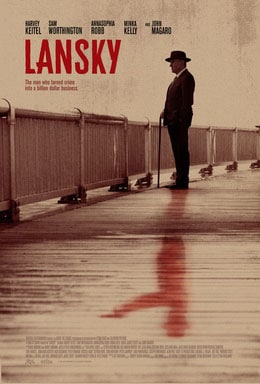
On a recent summer evening, guests of the Mob Museum gathered for a four-story tour of the well-curated exhibits as well as a movie screening and Q&A with the brilliant, Israeli-born director Eytan Rockaway and charismatic actor David Cade of the new biopic “Lansky.”

The film is a soulful but lively re-telling of the life and times of the legendary Jewish-American gangster, starring Academy Award nominee Harvey Keitel as a terminally ill Lansky relating his stories and secrets to a writer he commissioned to release his authorized biography upon death.

Aging in Miami, but still under Federal investigation for a suspected $300 Million in undiscovered cash savings (much of his fortune was made in 1950s Cuba but then likely lost when communists destroyed the gambling halls of Havana), the real-life Meyer Lansky did in fact reveal his tales, prior to his natural passing in 1983, to historian Robert Rockaway, a longtime professor at Tel Aviv University and co-writer of the movie with his son Eytan.

Lansky’s notorious life helped inform Robert Rockaway’s insightful study “But He Was Good to His Mother: The Lives and Crimes of Jewish Gangsters,” which details not only disreputable criminal behavior but also lesser known but significant efforts to help their own people.

Prof. Rockaway tells the stories of Arnold Rothstein, the New York based organized crime mastermind known as the key figure behind the infamous 1919 Chicago “Black Sox” World Series baseball scandal; the “Cleveland Four,” including “Moe” Dalitz, Morris Kleinman, Sam Tucker and Louis Rothkopf; Al Capone’s financial adviser Jack “Greasy Thumb” Guzlik; and the “Purple Gang,” the Detroit mob formed by Sammie Cohen and led by the Bernstein brothers.

In his book “Tough Jews: Fathers, Sons, and Gangster Dreams,” author Rich Cohen adds to this catalogue of Jewish criminals the story of Louis “Lepke” Buchalter, the head of the mafia hit squad known as Murder, Inc. and the only mobster ever executed by the state of New York. Born in 1897 to Yiddish-speaking parents, his mother called him “lepkeleh” or “little Louis,” which later became “Lepke.” His three brothers became a dentist, a college professor and rabbi, and a pharmacist, but Louis rose to become a notorious garment industry and bakery trucking racketeer and independent contract murderer for Cosa Nostra mobsters.

Buchalter arranged for the 1935 hit on powerful New York gangster Dutch Schultz on orders of senior mafia officials after kingpin Charles “Lucky” Luciano rejected Schultz’s suggestion that the mob’s top Commission approve his request to assassinate rising “gangbuster” New York District Attorney Thomas Dewey.

Ironically, Dewey later prosecuted Buchalter for the murder of candy store owner Joseph Rosen, who had been driven out of the trucking industry and whom Buchalter (likely wrongly) suspected of cooperation with the law. Eventually sentenced to the death penalty, Buchalter then saw his final appeal for commutation rejected in a widely watched 1944 decision by the now popular New York Governor and two-time U.S. Presidential candidate Dewey.

But it is Meyer Lansky who was the top mobster of his era, as previously featured in David Mamet’s HBO movie “Lansky” (1999) starring Richard Dreyfuss. Among many popular films of this genre, arguably the two best are “The Godfather” trilogy (I and II in particular), which tells the story of an Italian crime family led by Don Corleone (based on both Frank Costello and “Lucky” Luciano, Lansky’s key associate and the most powerful Mafia boss in the U.S.), and “Once Upon a Time in America,” a stunning saga of the rise of young Jewish street gangsters (loosely based on Lansky and Bugsy Siegel) in Brooklyn, N.Y. during the Prohibition Era of 1920-1933.

In this violent but also more philosophical film treatment, writer-director Eytan Rockaway features Lansky’s efforts to lend his power to combat a period of threatening antisemitism and American Nazism in the U.S. as well as to support the fledgling Jewish state of Israel.

Writer-director Eytan Rockaway features Lansky’s efforts to lend his power to combat a period of threatening antisemitism and American Nazism in the U.S. as well as to support the fledgling Jewish state of Israel.

Meyer Lansky was born Meier Suchowlański in Belarus, on July 4, 1902 to a poor Polish family that faced persecution and pogroms. Meyer arrived to the Lower East Side of Manhattan in 1911. A voracious reader, he also quickly exhibited the remarkable math and gambling skills that helped him become “the mob’s accountant” as he rose to increasing influence in the organized crime syndicate.

During the pre-World War II decades, attacks on Jews became rather virulent in parts of the country. Several religious broadcasters in the Midwest openly targeted Jews as undesirable, and the Brown Shirts in New York and the Silver Shirts in Minneapolis attacked Jews in the streets. Though not religiously observant, several Jewish gangsters noted the lack of strong response from organized Jewish leadership and decided to step up to protect Jewish communities.

First, upon the request of New York State Judge Nathan Perlman, Lansky was asked to break up the rallies of the German-American Bund in New York City, provided that Lansky’s “toughs” would not kill anyone. Lansky would have preferred to knock off some American Nazis, but he agreed and further advised he would take no payment, stating “I was a Jew and felt for those Jews in Europe who were suffering. They were my brothers.” Prof. Rockaway notes that “Nazi arms, legs, and ribs were broken and skulls were cracked, but no one died.”

Lansky described breaking up one Brown Shirt rally in Manhattan: “The stage was decorated with a swastika and a picture of Hitler. The speaker started ranting. There were only fifteen of us, but we went into action. We threw some of them out the windows. Most of the Nazis panicked and ran out. We chased them and beat them up. We wanted to show them that the Jews would not always sit back and accept insults.”

Gambling honcho David Berman and his allies similarly broke up rallies of the Silver Shirts in Minneapolis, who sought to replicate Hitler’s Brown Shirts in Germany and Mussolini’s Black Shirts in Italy by attacking “Jewish communists” in America. After three public meetings were violently disrupted, the Silver Shirts halted their campaign to demonize American Jewry.

Next, continuing his anti-Nazi efforts during World War II, Lansky led the efforts to assist the U.S. Office of Naval Intelligence to identity German infiltrators and submarine-borne saboteurs. In exchange for the release of his friend Luciano from prison, Lansky’s men provided security for U.S. warships being built in the docks of New York Harbor. German submarines were sinking allied ships along the eastern seaboard and the mob went to work to infiltrate, identify, and inform on pro-Nazi supporters on the New York waterfront.

Further, both Meyer Lansky and his partner Bugsy Siegel helped the nascent Jewish state of Israel. One reported meeting took place between Bugsy and Reuven Dafne, the emissary of the Haganah, in 1945. Jews were seeking funds and weapons to liberate Palestine from British control. Bugsy said, “You mean to tell me Jews are fighting? You mean fighting as in killing?” When told yes, Siegel advised, “I’m with you.” He quietly provided suitcases full of cash in support.

Bugsy Siegel of course was Meyer Lansky’s boyhood friend who became the most famous of Jewish gangsters. As teenagers, they created the Bugs and Meyer Mob. Lansky served as the brains of the outfit, with Siegel providing the brawn. Siegel was the youngest member of the gang, known as the vilda chaya, yiddish for “wild animal(s),” which engaged in illicit activities like prostitution, gambling, loan sharking, bootlegging, and labor racketeering.

In 1937, Bugsy moved his gambling rackets to California, where he befriended Hollywood moguls and starlets, borrowing money from several celebrities whom he never repaid. He dated actress Virginia Hill, an underworld moll herself who helped Bugsy’s bosses back east keep an eye on him. In 1945, Siegel and Hill came to Las Vegas to build a gambling mecca in the Nevada desert, starting with the Flamingo Hotel and Casino, funded by the eastern crime syndicate with $1.5 million.

Unfortunately, after Bugsy ran up debts of some $6 million through theft and mismanagement, all of Lansky’s defenses of his longtime pal proved insufficient to prevent the mob hit ordered by the syndicate. On June 20, 1947, Siegel was shot four times as he sat on a sofa in Hill’s Beverly Hills home while reading the Los Angeles Times.

The mob accelerated the development of the Las Vegas strip of casino hotels and ruled the town for decades until its replacement by corporate management. Famed mobster turned developer Moe Dalitz was given the key to Las Vegas in 1979. Over recent decades Jewish leadership in building Las Vegas included not only the Mayors Goodman but also Steve Wynn, the visionary casino creator who was financed by the junk bonds created by investment banker and humanitarian Michael Milken, as well as the developers of the world’s largest hotel, Jewish philanthropists Sheldon and Dr. Miriam Adelson.

Lansky’s life was complex and brutal. His victims must be remembered and respected.

His personal life was marked by the ups and downs of family life, including an honorable son Paul who attended the U.S. Military Academy at West Point and then joined the U.S. Air Force and served in Vietnam, and another son Buddy who sadly suffered from cerebral palsy. He also had a daughter, Sandi Lansky Lombardo who grew up with wealth, parties and private schools as described in her own autobiography, “Daughter of the King: Growing Up in Gangland.”

Perhaps the most compelling scene in “Lansky” focuses on his attempted emigration to Israel in the early 1970s where he sought to avoid tax evasion prosecution in the U.S. by appealing for citizenship under “the law of return.” Denied asylum by Golda Meir, who faced pressure from American authorities, Lansky bitterly recounts that his early support of Israel was not reciprocated at his most critical time of need.

Lansky managed to evade U.S. prosecution, however, and live as a free man to age 80. Through his highs and lows, his fortunes and misfortunes, Lansky appears at the end of his life as an intelligent and introspective figure. He never changed perspective, holding firm as a “tough Jew” to his motto, “life is shades of grey, not black and white.”

Smiling as he slowly walks into the sunset along the beach in Miami, with the Feds having quit their chase for his never-found (and always denied) remaining riches, Lansky survived and thrived and lived on his own terms. He left a disturbing legacy of inexcusable violence, but endures as a humanized figure of intense fascination for the American public, and not least for American Jewry whose communal legacy includes several bigtime gangsters with humble Yiddish roots who fought against some of the Jews’ worst enemies.


Larry Greenfield is a Fellow of The Claremont Institute for the Study of Statesmanship & Political Philosophy.


Tough Jews, Las Vegas, and the Legacy of Meyer Lansky Read More »

Ben & Jerry’s Contractor Resigns from Company Following Their “Statement on Israel”

Susannah Levin, a graphic design contractor, announced in a July 20 Facebook post that she would be no longer be doing business with Ben & Jerry’s after “their statement on Israel.”

On July 19, Ben & Jerry’s issued a statement that they would no longer be selling their products in the “Occupied Palestinian Territory” and would operate elsewhere in Israel. Levin wrote in her Facebook post that after 21 years, she will no longer be working at the company over their statement. As part of her rationale, she linked to a video from the late Rabbi Jonathan Sacks on why anti-Zionism is antisemitism.

Levin told the Journal in an interview that even though she’s a contractor, she had been working exclusively with Ben & Jerry’s “for years.” “My art touched every part of the business,” Levin said, which included murals, sides of trucks and coupons.

She first learned about the Ben & Jerry’s decision because there had been a pressure campaign against them since the Israel-Hamas conflict in May to issue a statement against Israel, and people noticed that Ben & Jerry’s had been silent on social media since then. Prior to the July 19 announcement, the last tweet from the Ben & Jerry’s Twitter account was on May 18.

Levin started asking people in the company what was going on, and she eventually saw a recording of an all-company meeting where it was made clear that Ben & Jerry’s “was going to have do something” but they weren’t sure what exactly they were going to do. Levin noticed that none of the employees at the meeting gave any indication they were opposed to action, prompting Levin to reach out to the higher-ups to give her input.

“I wanted to teach them about the nature of a BDS [Boycott, Divestment and Sanctions] campaign and what it’s really like in Israel, and how there’s so much nuance they’re missing if perhaps they’re only looking at the kind of information that’s being presented to them,” Levin said. She added that she knew whatever action Ben & Jerry’s took could be “a really, really big deal.”

“Israel can survive without Ben & Jerry’s and Ben & Jerry’s can survive without Israel, but when Ben & Jerry’s makes a message, they make it big,” Levin said. “They generally do not just make a single message, they have a website and a whole social media blast and an event with ice cream and posters and a letter writing campaign, and the more I thought about it, the sicker I got thinking that … they might assign me to the job or one of my media co-workers to essentially do the task of spreading BDS propaganda. And I just knew I had to stop it because there’s so many impressionable people that follow Ben & Jerry’s and really love their product and trust them.”

Levin said she did talk to two people “at the highest level” in the company who were “gracious” in giving her time to share her views. She says that she had two separate meetings with one of them who was “pretty convinced of BDS being truthful and my view as merely an opinion.”

She said that she linked to the Sacks video in her Facebook post because “Rabbi Sacks really had his finger on the pulse of it.” “A lot of people say it’s not antisemitism to criticize government policies, but when the so-called government policies that you’re criticizing are not actually policies at all, that’s blood libel. And it’s no different than the blood libel of the 1930s or the blood libel of the Middle Ages. It’s the same thing. It’s impugning Jews for crimes that they have not committed.

“Nobody’s trying to claim that Israel is perfect and that the Israeli government is perfect, they’re far from that. But apartheid state? Arguably no. There’s so much that’s wrong in these arguments and there’s so much good that can be done.”

Levin said the reception she’s gotten from the public since her Facebook post went public has been “very positive.” “I want people in the Jewish community to know that there are so many resources out there. You don’t have to do this on your own.”

Ben & Jerry’s Contractor Resigns from Company Following Their “Statement on Israel” Read More »

To Remain Relevant, Judaism Needs a Visibly Open Door

Twenty-five years ago, the prominent Conservative rabbi Harold Schulweis of Encino’s Valley Beth Shalom (VBS) Synagogue had a modest proposal. In response to the greater freedom of Jews in America and in much of the world, and the high Jewish attrition after intermarriage, he suggested Judaism return to its ancient tradition of proselytizing. In doing so, Judaism could tap into the millions of cultural Christians and others who yearn for a rich tradition and a deep spiritual experience.

Unlike many of his contemporaries, who have typically focused on bringing in less affiliated Jews, Schulweis recognized that outreach and inreach were one and the same. In a mixed society, many Jews are so deeply embedded in their surrounding communities and detached from Jewish life that they may not be reached by outreach efforts aimed at Jews. According to the most recent Pew survey, intermarriage rates among the U.S. non-Orthodox Jewish community have climbed above 70%, with only 28% of parents in intermarriages raising their children within Judaism.

In a sense, this is a measure of the success of liberal streams of Judaism, whose goal was to create well-integrated Jews, and of a larger non-Jewish society that can be open enough to welcome these Jews even as marriage partners. Many Jews would like to fully participate in the surrounding society, and they are largely successful. But the Jewish aspect of their lives is an odd piece out. In a world that values new developments and advancement, it is a religious tradition that emphasizes its continuity with ancient times. In a world that values pluralism, it is an ethnicity and a religion at the same time. In a world that values rationalism, it is a theistic faith.

So, even before Jewish affiliation is lost, traditional Judaism is on the defensive in these communities. Practices as intensive as keeping kosher and observing Shabbat are isolating, dating only Jews limits one’s options, and the special tie of many Jews to Israel—home of nearly half the world’s Jews—is increasingly being attacked. Over the course of several generations, the Jewish aspect of these people’s lives often becomes ever-smaller, until it disappears.

Over the course of several generations, the Jewish aspect of these people’s lives often becomes ever-smaller, until it disappears.

Traditional Jews have responded by creating religious enclaves, some turning to hyper-religiosity. However, this approach misses many Jews even in the major Diaspora population centers and is not practical in areas without a critically large Jewish community. Separatism is also, in a sense, an admission of defeat. It is an acquiescence to the idea that Judaism is peripheral enough and adds little enough to the surrounding community that individuals and groups can pull away with few effects. This is not true. Throughout history, from the Islamic Golden Age to the European Enlightenment to today’s America, Jews—especially secular Jews—have contributed to numerous creative disciplines out of proportion to their numbers. A world separate from its Jews would be missing much of its character.

Fortunately, there is a third way, one that has been little explored. That way is to work to absorb the surrounding community. Just as Jews are integrated and become part of other communities, members of these communities can also be integrated and join the Jewish people. This is the fullest acknowledgment that Judaism is not only an ancestry, and that Jews are not simply one people among many. Rather, Jews make up a vital world civilization that continues to be relevant to its practitioners. Jewish outreach must be attractive without being intrusive, as well as mindful of other groups. If it is, it will go a long way toward helping people understand Judaism.

Our silence about the value of being Jewish is a striking contrast to our willingness to be loud about other Jewish issues. We are not shy about calling out antisemitism or about discussing the importance of Israel as a state for the Jewish people. While we expect others to accommodate us in these areas, making sometimes extensive demands, we are mostly mum about the flip side—what Judaism actually is, how belonging to it enhances our lives, and what Jews offer world culture. Becoming more vocal about Judaism would enable us to offer positive insights and experiences to those around us.

Since Schulweis’s call to action, only a handful of rabbis and Jewish communities have taken steps similar to those he advocated. Valley Beth Shalom continues to maintain its conversion outreach program even after his death. Others have moved along similar lines, largely independent of one another. For example, Conservative rabbi Michael Gilboa of the Detroit area’s B’nai Israel Synagogue maintains an Internet-based program of Open Outreach. Reform rabbi Miriam Terlinchamp of Cincinnati’s Temple Sholom broadcast her synagogue services on local television to spread Judaism to the widest possible audience, Jewish or not. Several years ago, the well-known Orthodox rabbi Shmuley Boteach came out in favor of Jewish proselytization. A few funds, such as the National Center to Encourage Judaism’s grants for educational programs, have become available for Jewish outreach intended for people who do not identify as Jewish. Even with their limited reach, such efforts have brought thousands of people into Judaism.

In order for Judaism to remain relevant, it is time to fully embrace the promotion of its relevance, not only to born Jews but also to the wider world.

Despite the energetic and successful open outreach programs at smaller scales, few efforts have been made to coordinate its practitioners, analyze what works, prioritize, and support similar initiatives at the scale needed to impact the Jewish demographic. In order for Judaism to remain relevant, it is time to fully embrace the promotion of its relevance, not only to born Jews but also to the wider world. If we practice explaining why Judaism is relevant to people of many different cultural backgrounds and walks of life, we will better understand its relevance for ourselves and our children.


Rebecca Sealfon is a Reconstructionist Jewish writer and social media consultant who lives in New York City. She started and maintains a popular Israel-Palestine peace forum called Unity is Strength, which receives more than 1,000,000 views per year and attracts writers from Israel, Palestine, and all over the world. Rebecca has published in the New York Daily News, Smithsonian magazine, and the Daily Beast, as well as appeared multiple times on NBC’s Rosie O’Donnell Show.

To Remain Relevant, Judaism Needs a Visibly Open Door Read More »

David Suissa Podcast Curious Times

Curious Times Episode 39: Michael Held Talks About His Life’s Mission – a Village


A Village project to help people with disabilities, the holiday of love, a tribute to Ruth Pearl and this week’s Torah portion.

Listen on Apple Podcasts

Listen on Spotify

Listen on Stitcher

Follow David Suissa on FacebookTwitter and Instagram

Curious Times Episode 39: Michael Held Talks About His Life’s Mission – a Village Read More »

For First Time, Olympics Opening Ceremony Honors Israeli Athletes Murdered in Munich

(JTA) — For the first time ever, the Olympic Games held a moment of silence during the opening ceremony for the 11 Israeli athletes murdered during the Munich Olympics in 1972.

There, the Palestinian terrorist group Black September attacked members of the Israeli Olympic team, ultimately killing six coaches and five athletes, as well as a West German police officer who participated in an unsuccessful raid to free the hostage athletes.

Ankie Spitzer and Ilana Romano, widows of two of the murdered athletes, have long advocated for the International Olympic Committee to acknowledge the massacre in the opening or closing ceremony. But the IOC has never before heeded the call, at times suggesting that honoring the Israeli athletes could be divisive.

“We must consider what this could do to other members of the delegations that are hostile to Israel,” an Israeli committee member told the BBC in 2004, when a small memorial was held at the Israeli ambassador’s house in Athens before the Olympics there.

In 2012, ahead of the London Olympics, the IOC rejected an international campaign for a moment of silence. “The opening ceremony is an atmosphere that isn’t fit to remember such tragic events,” Jacques Rogge, then the leader of the IOC, said at the time.

Ahead of the 2016 Rio Olympics, the first official Olympic ceremony was held to honor the victims — but not during the opening ceremony; instead, it was held two days before.

Now, a year away from the 50th anniversary of the terror attack, the Olympics held a moment of silence. The event, which had not been previously announced, came a day after the opening ceremony’s creative director, a Japanese actor and comedian, was fired over a Holocaust joke he made in the 1990s.

For First Time, Olympics Opening Ceremony Honors Israeli Athletes Murdered in Munich Read More »

Florida Gov Calls for Sanctions Against Ben & Jerry’s

Florida Governor Ron DeSantis, a Republican, sent a letter to the State Board of Administration (SBA) on July 22 requesting that they take action against Ben & Jerry’s and their parent company Unilever.

“It has come to my attention that Ben & Jerry’s has announced plans to remove its products and prohibit the sale of ice cream in Judea and Samaria,” DeSantis wrote, arguing that doing so puts Ben & Jerry’s and Unilever “within the prohibited activities” under Florida state law. DeSantis asked that the SBA put Ben & Jerry’s and Unilever on “the Continued Examination Companies that Boycott Israel List” and the “Scrutinized Companies that Boycott Israel List.”

If Ben & Jerry’s continues to not sell their products in the West Bank after being put on these lists, then “the Board must refrain from acquiring any and all Unilever assets consistent with the law,” DeSantis wrote. “These actions affirm the State of Florida’s relationship with the State of Israel and our commitment to a swift response to those who discriminate against the Israeli people.”

A spokesperson from the DeSantis administration told Fox Business that if the SBA follows through on DeSantis’ request, they  “would prevent the board from buying stock in Unilever … and its corporate entities. The state would also be unable to contract with these companies unless they ended their boycott.”

B’nai Brith International tweeted “kudos” to DeSantis. “The ice cream maker must be held accountable for its #antisemitic boycott of #Israel.”

Other states appear to be taking similar actions. The New York State Comptroller’s Office sent a letter to Unilever CEO Alan Jope on July 23 stating that they are “troubled and concerned” that Ben & Jerry’s “is involved in BDS [Boycott, Divestment and Sanctions] activities.” Unilever has 90 days to prove that Ben & Jerry’s is not partaking in BDS activities; otherwise, the state may withdraw their pension funds from Unilever under New York’s anti-BDS law.

Pennsylvania State Representative Aaron Kaufer, a Republican, requested that state government officials enforce Pennsylvania’s anti-BDS law against Ben & Jerry’s and Unilever. He received replies stating that officials would ensure that their anti-BDS laws are being upheld.

“Unilever is feeling the heat,” journalist and author Gary Weiss tweeted. “The question is whether it believes it benefits more from standing with Jews or antisemites. Its long tradition, going back to the 1930s, is not encouraging.”

Florida Gov Calls for Sanctions Against Ben & Jerry’s Read More »