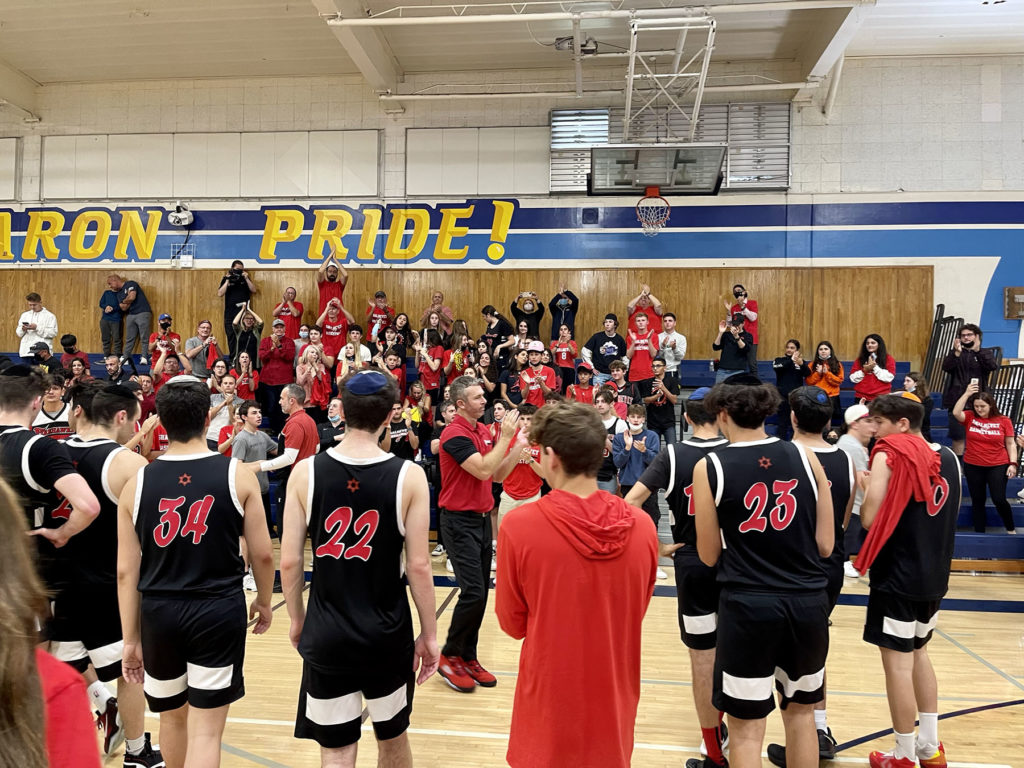
Shalhevet High School’s dream basketball season ended Monday morning with a 77-71 loss to Bonita Vista in the championship game of the CIF Southern California 3-A Regional tournament.
The Firehawks’ 22-4 record was the best in the history of the school that opened 29 years ago. It was a major upgrade from last year’s 15-14.
Last Thursday night, Coach Ryan Coleman’s team rallied from 14 points down to defeat top-seeded Glendora, 67-65, in overtime when Ze’ev Remer put Shalhevet ahead to stay on a three-point play with 18.5 seconds remaining.
Fifth-seeded Shalhevet started strongly against number two Bonita Vista, holding a 10-point advantage, 19-9, at the end of the first quarter.
The teams exchanged runs of momentum in the second and third quarters, and Shalhevet led by 10 going into the fourth period.
Photo by Tushar Dwivedi
Reflecting on the loss, Coach Coleman tracked the trends of the game.
“We controlled the game for the first quarter because were able to execute our offense as we planned,” Coleman told the Journal. “We had too many defensive lapses in the second quarter, and this led to Bonita Vista gaining momentum. They also began to pressure us on defense, and we turned the ball over way too much.”
Shalhevet rebounded but only temporarily. “We dominated the third quarter by attacking the rim and taking care of the ball,” Coleman said.
“Unfortunately, the fourth quarter was the worst quarter we have had in years. We turned it over time after time, and we could not get any stops on defense.”
Coleman noted that Remer “led us all year long, but he was hampered by foul trouble” and eventually fouled out.
With 28 points, Avi Halpert was the Firehawks’ leading scorer for the second straight game, Remer had 24, and Jacob Pofsky 12.
Occasionally, this essay is written as a public service announcement for Jews. It’s my way of giving back.
You’re welcome.
Let’s call this one: “The Survival Guide for American Jews—Democrats, that Means You!”
Now is actually a propitious, if not outright urgent, time for a cautionary tale for the tribal, some advice for the timid, and a buyer beware for voters—especially for Jewish Democrats. (This is recommended reading for Jewish Republicans, too, with bipartisan health and sanity benefits—regardless of party affiliation.)
With Jews being beaten in the street, threatened with rape, set aflame, pelted with eggs, cursed at, chased down in cars, their storefronts ransacked, synagogues vandalized, diners hassled, and with trepidations about venturing outside, this is a pulse-taking moment for American Jewry.
The palpitations are, well, palpable.
The beloved Democratic Party, in which over 70% of Jews are registered voters, is gradually forsaking them for other political agendas and, as a sign of the times, more fashionable constituencies. The heartbeat of the party has turned progressive, or democratic socialist, or race-conscious autocratic, or whatever Sen. Bernie Sanders and the Squad say it is.
It’s not clear whether progressives now make up a critical mass of the party. Even if not officially in charge, they sure are making the most noise, generating the tweets, and dominating the news cycle. As partisan outliers, their outsized influence over Democratic messaging cannot be denied. Progressives have captured the left-of-center conversation and stand ready to shove moderates out.
The Party of FDR is now the party of BLM. Those who don’t openly ascribe to the new racial politics live in terror of the tweeting hoard. A sturdy plank of that politics has a decidedly anti-Israel bias, and very little affection for, and room for inclusion of, Jews.
The Party of FDR is now the party of BLM.
Great Britain experienced similar ideological confusions with then Labour Party leader, Jeremy Corbyn, who appeared alongside Hamas leaders, treating them as heads of state and referring to them as friends. He also never missed an opportunity to characterize an antisemitic slur as a harmless Jewish joke. Eventually, it all proved too much for liberal Jewish lawmakers. Seven defected from the Labour Party and formed their own.
Don’t expect the same reaction from the 25 Jewish members of Congress. In response to the Squad’s antisemite-in-chief, Ilhan Omar’s, recent conflation of the Taliban, Hamas, the United States and Israel into one morally equivalent global menace, fewer than half of the Jewish congresspersons signed a letter requesting that Omar clarify her tweet. They didn’t denounce or condemn her words. They just requested a clarification. The remaining 13, who couldn’t even sign on to that, are still hiding in their offices.
Meanwhile, congressional Democratic leaders refuse to censure her, or remove her from the House Foreign Relations Committee, an assignment wholly inappropriate for an antisemite who openly despises America’s lone democratic ally in the Middle East. House Democratic leader Nancy Pelosi yet again took no action after Omar’s recent Jew-hating remarks. She was satisfied that Omar clarified her remarks, stating that she had “a point she wanted to make, and she had a right to make that point.”
Why is “clarification” seemingly the only punishment of choice for Democratic politicians? Did her words really need further clarity? She wrote that Israel has committed “war crimes,” “crimes against humanity,” and “unthinkable atrocities.” Along with America, it stands in the same culpable position as genocidal terrorists.
Where’s the ambiguity? The Speaker should know by now that hating Jews is Omar’s jam.
A full-throated declaration of support for Israel and repudiation of Omar’s false and irresponsible mischief with moral relativism was the least that should have been expected. Omar should also have been censured. What makes her antisemitism less odious than Congressman Steve King’s racism, which resulted in a censure resolution and the stripping of all his committee assignments?
Why is a lawmaker who labels a nation with Arab Supreme Court Justices and an Ethiopian Miss Israel an “apartheid state,” given such a plumb foreign policy assignment?
The Squad members know they have “Get Out of Jail Free” cards, making them impervious to charges of antisemitism and anti-Zionism—and not because the police are being defunded. The cards are for them, alone—stacks of them. Blood libels available for repeating, dressed up in the best intersectional finery of Black Lives Matter and Critical Race Theory.
And the Democratic Party won’t dare reprimand them.
Many believe that the recent violence against American Jews was precipitated by the Squad’s antisemitic tweets and the silence that followed from the political class.
The Biden White House wasn’t that much more vocal in support of those beleaguered Jewish communities. More of the same tacit acceptance of bigotry against white people. Is it too soon to consider whether we can make room for a new term of art: Black privilege—immunity from embarrassment and blame? To violate or challenge the privilege is to court accusations of racism and Islamophobia.
There aren’t many places for moderate Democrats to turn. There are no dynamic, intellectually honest and liberal-minded Senators like Henry “Scoop” Jackson and Daniel Patrick Moynihan anymore. The Congressional Black Caucus has also shown little to no support for Israel and the convenient scapegoat that is Jewish America.
There aren’t many places for moderate Democrats to turn.
Jews linked arms with African Americans during the civil rights era. And Jews marched beside the protestors at last summer’s Black Lives Matter demonstrations. All that solidarity brought them little goodwill.
No one is standing up for Jews. The allure of the Squad is irresistible to a rainbow coalition where Jews of any stripe or color are unwelcome.
So cut and run? But where to? Registering as Independents would be very lonely. Might as well call it the Wandering Jews Party. It’s best to have ideological partners. Who will take liberal Jews in? They are no longer “tired” and “poor,” but they may end up as a huddled mass yearning for some political refuge. The Republican Party’s social conservative inclinations are, for many Jews, a dead end. There are Jewish Democrats who would rather die than vote for a Republican.
Let’s hope they don’t have to.
Thane Rosenbaum is a novelist, essayist, law professor and Distinguished University Professor at Touro College, where he directs the Forum on Life, Culture & Society. He has written numerous works of fiction and nonfiction and hundreds of essays in major national and global publications. He is the legal analyst for CBS News Radio and appears on cable TV news programs. His most recent book is entitled “Saving Free Speech . . . from Itself.”
At the end of last summer, Naftali Bennett, the head of the Yamina party and a man with no job other than being an opposition politician, wrote and published a short book: “How to Beat a Pandemic.”
How?
Writing a recipe for how is one thing, beating it in real life is quite another. And Bennett, the lucky guy, will get to do both. He wrote the book when he was in the opposition, and now, as Prime Minister of Israel, he will get a chance to implement its conclusions. First stop: Ben Gurion airport. In the last couple of weeks, some Israelis came back to the country carrying the Indian variant of COVID-19. The result is worrying: schools in which dozens of students got infected; cities in which mask rules are back in place, just days after masks were eliminated. Israel is not yet in crisis mode, and the number of people directly impacted is still small. But on the street one can already hear people joking with one another as they walk their dogs. “Yes, I decided to take a little walk before the quarantine is back.”
What happened? Two things. One, the Indian variant is highly infectious, and a few unvaccinated teens can quickly spread the disease. Two, Israelis cannot sit still. As soon as the airport was opened, they hurried to renew their routine of constant travel. One survey from yesterday found that half—half!—of all Israelis intend to travel abroad this summer. Dear world, five million Israelis are coming your way. Dear world, please make sure to send them back unharmed.
Alas, some of them do come back with the unintentional capacity to harm. They get COVID, they fly, they enter the country, they engage with other people and pass along the virus. At the airport they discover that Israel did not yet implement Bennett’s manual for battling a pandemic. We’re seeing long lines, no masks, little supervision. Many of them are sent home too soon. Many of them do not obey the command to stay home, quarantined for a few days. The result is a rapid rise in the number of infected Israelis. A rapid, scary, and depressing rise in new COVID cases.
Last week I wrote about Bennett’s first test: a law that he must pass for which there is still no majority. The resurgence of COVID could be his second, even more important test. And for now, his government does not seem more efficient than the government that Bennett was so eloquent in criticizing.
For now.
Of course, we should give it some time to organize. We should give it some time to prove that a better way to manage the country during a pandemic can be found. The Netanyahu government was highly efficient in getting the vaccines and immunizing the population. It was ineffective in running the country while we were all waiting for the vaccines to be developed and shipped. Bennett was one of the more pointed critics of the government because of its inefficiency and clumsiness. “The obvious goal,” he wrote in his book, is “to maintain an almost normal routine of life alongside the corona.” He also wrote that this is “an achievable goal.”
The transition from knowing what needs to be done to doing what needs to be done seems simple but is the most difficult transition in every policymaker’s career. Knowing is easy because it only involves one person, the one who thinks he knows. Implementing is messy and complicated. It involves other people who might have other ideas. It involves a bureaucracy that does not always function with the necessary efficiency. It involves political interests—such as not offending your partners, and not enraging the public. Bennett is a fresh PM. Does he want to begin his term with a move that is likely to enrage the five million Israelis who plan to travel this summer?
The transition from knowing what needs to be done to doing what needs to be done seems simple but is the most difficult transition in every policymaker’s career.
Today, he pleaded with Israelis to stay home. Nice try. If we learned anything from the first round of the pandemic, it is that requests and pleadings do not have enough impact on people who really want to travel/work/attend school/attend synagogue/dine at a restaurant. Bennett will soon have to deal with families who must see a grandfather who lives in Australia, with Haredim who come from New York, with soldiers who already bought a ticket to Greece, with droves of Israelis who got the vaccine and lost their sense of vulnerability. If he wants all of these to refrain from travel (again, half the country plans to travel), he will need to do more than ask. He will have to quickly tighten the procedures at the Ben Gurion airport. He will have to make decisions that will not be popular. He will have to do all this while a combative opposition is ready to undercut his authority and question his legitimacy.
So yes, writing a book was the easy part.
Shmuel Rosner is an Israeli columnist, editor, and researcher. He is the editor of the research and data-journalism website themadad.com, and is the political editor of the Jewish Journal.
(The Media Line) Yousif Mohamed, 20, of Manama, Bahrain is also known as @Yousifmohd2 on Instagram, and has around 1,300 followers combined on various social media platforms. He is also one of the first Bahrainis to visit to Israel. The social media influencer, who lives with his family in the kingdom’s capital city and hopes to work on tourism development overseas, is used to documenting his life over the internet and has braced for the repercussions of posting pictures of himself in Israel.
“I am young, but you’re never too young to want to try and change the world,” he told The Media Line. “I faced a bit of pressure and criticism online probably due to being one of the first Bahrainis to visit Israel, but I think it’s expected that people need some time to open their minds.”
“Ignorance can sometimes hinder us and it was because of this that I decided to visit and see things for myself, and I’m really happy that I’ve taken that step,” he added.
Mohamed is one 25 social media influencers from three of the four countries that signed the Abraham Accords who met in Israel to find common ground with Israelis and act as emissaries for peace.
Ignorance can sometimes hinder us and it was because of this that I decided to visit and see things for myself, and I’m really happy that I’ve taken that step.
In a trip that was originally scheduled during last month’s Gaza-Israel flare up, young people from the United Arab Emirates, Bahrain and Morocco flew back from the Jewish state Sunday after a week-long tour of the country organized by Eyal Biram, founder of the Israel-Is organization, a nonprofit founded four years ago to enhance Israel’s relationship with other countries through young people meeting each other on a personal level.
The trip, coming in the wake of the cross-border violence between Gaza and Israel, caused some of the non-Israeli participants to drop out of the trip.
Biram said the conflict dominated the news in the Arab world, causing some to feel pressure not to go for political reasons or out of fear for their safety.
“Of course, it’s going to change the number of participants,” Biram told The Media Line. He did not respond to a question about how many would-be participants canceled.
“There is still wide support from the government of Bahrain and the UAE, but on the ground, especially on the social media level, we see a massive affect,” he continued. “Some of the participants were afraid to come. The people who did go have a lot of courage because they believe in what they’re doing, and they understand the importance of being here.”
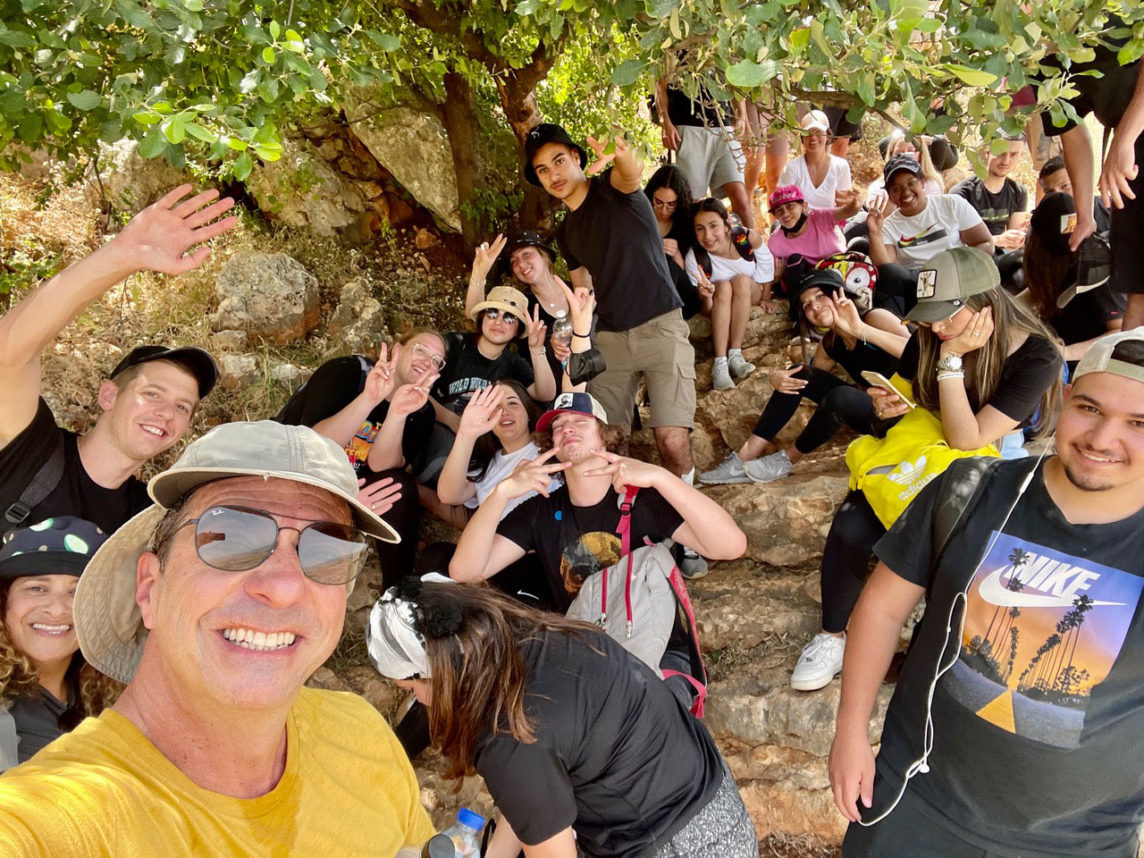
The trip is designed to enhance Israel’s relationship with other countries through young people meeting each other on a personal level. (Itamar Eyal)
The Israel-Palestinian conflict was addressed as the group of influencers met with different Arab and Jewish leaders.
“We waited until the conflict ended and then we went to see the true picture,” said Saoud Saqer, another trip participant from Abu Dhabi who works as an engineer. The thirty-year-old influencer, known as @binhamooah, had ten thousand followers on his old Instagram account but had to create a new one in Israel after his account got spammed.
“They want to make things better now and they want to show the world that they’re trying to be the people of peace, they don’t want the world to have the wrong idea perspective of them and I’m talking here about the people themselves, not the government,” Saqer said of the Israelis he met.
“I’m not saying that since the establishment of the State of Israel, everything was fine … I have spoken to many Israelis that agree with me,” he added. “They say that we were not perfect and a lot of complicated situations arose.”
The Emirati social media influencer has also faced pushback online over the trip.
“There are negative comments … from people who don’t want peace to prosper,” Saqer said, noting the criticism had “zero impact” on him.
“I’m a goal-oriented person; We are on a mission to spread peace so regardless of the negative comments, we are going to keep going,” he added.
Saqer’s favorite experience in Israel was visiting Al-Aqsa Mosque in Jerusalem, which has been the site of recent clashes between Muslims and police.
While the trip did not change his “actual perspective” on the Israel-Palestinian conflict, Saqer said he feels that the group can make positive steps toward peace.
“We are talking like the people of now, we want to make things better in the present time,” he added.
Saqer says the trip helped him become more informed about Israelis.
“I got more educated about Israelis because the general idea is that they are more Western, but I came to see that they are more Middle Eastern than Western,” he said.
One lesson that Saqer wants to bring back with him to Emiratis who have not been to Israel is that Israelis come from all different backgrounds.
“Israel is a nation, it’s a country; it’s not a race and it’s not an ethnicity … Within that state, there are Muslims, Jews, Christians, and all of them share their love for the land and for the state of Israel. There are even Israeli [Jews] who have an Arab background,” he said. “I want the world to know the state of Israel is diverse: there are Arabs and Muslims who are working in Israel’s health department, the police, in the army… .”
It’s completely different from what you see in mainstream media. They aren’t people who want death to Arabs … In fact, they live with Arabs like their brothers.
Mohamed was also surprised to learn about the many cultural differences within Israel and that all Israelis are not like the ones he has seen on TV.
“It’s completely different from what you see in mainstream media. They aren’t people who want death to Arabs … In fact, they live with Arabs like their brothers,” he said.
Mohamed wants to take back to Bahrain the message to not stereotype a whole country by the actions of some individuals.
“Never look at the small 0.1% of the population and judge the rest based on that,” he said.
Despite the setback of the Gaza-Israel violence, Biram characterizes the trip as a “huge success,” with plans for more such trips to Israel and for activities within the group.
“We are creating, in our groups, leaders who are involved for the long term,” he said.
This is buttressed by the “Leaders of Tomorrow” online group, with hopes of building one-on-one connections for Israelis with individuals in countries that both have and lack peace treaties with Israel.
For both Saqer and Mohamed, this first visit to Israel will be one they will never forget. While learning about Israel, they also have things that they want Israelis to know about their respective countries.
“Israelis are all welcome to visit here and experience the culture,” Saqer said of his home country Bahrain, noting that it is safe to do so.
“Bahrainis are friendly, polite, simple and welcoming people but we take honor and respect very seriously. We love to learn about new cultures and our tolerance comes from existing in a very multicultural country, with about a 50/50 ratio of local to expatriate population in our kingdom,” Mohamed said. “We have a Jewish community and a synagogue since the late 19th century,” he added.
I’ve just experienced an awakening of the Israeli in me. After a month of intense joy and drama in the Promised Land, I am truly feeling at one with my inner sabra. I travel to Israel every year. It’s one of the great perks of making a living as an entertainer in the Jewish world. My Israel shows are always memorable and I often extend my stay to see friends and relatives throughout the country. Typically, on these trips, I enter and depart as an American Jew. I view Israel as a beloved Jewish Disneyland, replete with E-ticket rides (great hikes, museums and Old City explorations,) refreshments (shwarma, pita and chummus) and selfies with an abundance of characters. This trip, however, was no mere vacation.
My wife, Shira and I had the gift of marrying off our daughter to a handsome young man from the Tel Aviv area. Our celebration of the “sound of bride and groom in the hills of Judea” was exactly that: 250 guests partying in an idyllic garden setting in Gush Etzion. The spirit was tangible; Sarah, surrounded by adorable friends gathered over the three years since she made aliyah after high school and Kobi Luria, her 6 feet 3 inches tall combat soldier hunk of a husband, surrounded by rowdy comrades from his five-year Hesder army service/Torah study program. The following saga details a wedding, a war and the angst of international travel during Covid.
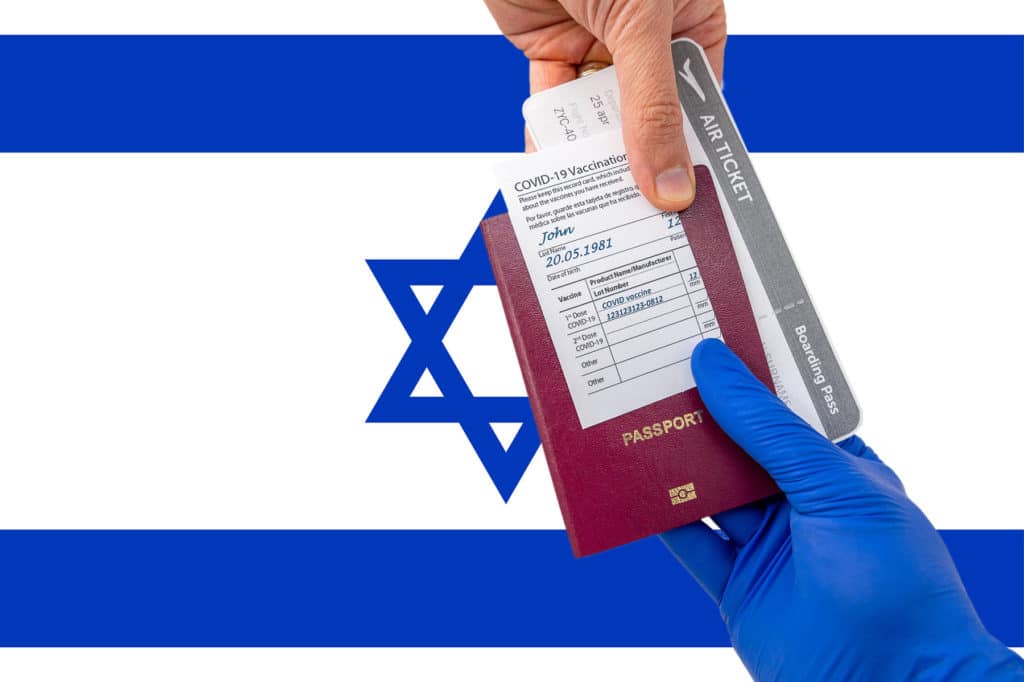
Sarah’s nuptials were planned right before Passover. After spending a month getting our half-inch stack of documents together to enter the closed country, we took off in an Uber at 6:13 am to the Los Angeles airport. Our papers were accepted in LA, but six hours later in Newark, the official made us wait on the sidelines rather than board the flight, thanks to a missing document.
Over the next few hours, we watched as everyone boarded until we were told the final verdict: the doors would be closing without us on the plane. We trudged dejectedly to an airport hotel and returned to LA the next morning, where we waited for our lost luggage, launched into last-minute Passover plans and re-engaged in battle with the Israel consulate. Much to my daughter’s chagrin, the wedding had to be postponed for a month and a half, until after Lag B’omer. We rebooked the wedding vendors, secured new lodging and purchased new flights. Even after several panicked visits to the consulate, we received the required documents only hours before our flight.
Over the next few hours, we watched as everyone boarded until we were told the final verdict: the doors would be closing without us on the plane.
Yes, we kissed Israeli soil when we finally landed.
Week One
We got COVID and serology tests at the airport and then picked up a rental car to meet Kobi’s parents for the first time. Before long, I recognized that sharing the road with Israelis required either channeling my inner Israeli or perishing. Upon our arrival at their Petach Tikvah high rise, my machatunim walked me to an outdoor Corona-style minyan where I received a hero’s welcome as Kobi’s new father-in-law.
We enjoyed a delicious Israeli dinner over the lights of the city. Even though our broken Hebrew was as shaky as our new relatives’ English, we immediately felt like family. After supper, we motored three hours north to meet my brother Yom Tov and wife Leah, their eight amazing kids and four grandkids in a sprawling six-bedroom rental in the Old City of Tzfat. There we would eat-pray-love over the Lag B’omer holiday and Shabbat. The following night I had my first experience visiting Meron, merging with over a hundred thousand happy Chassidim at the annual festival.
Over the next several hours, we nudged our way to the main hall where we danced in the closest quarters imaginable. In spite of my enthusiasm for this manic mosh pit, multiple times I shouted to my brother over the din of the ten-piece klezmer band, “This is a death trap!” The riotous slam dance intensified to the degree that I feared for the safety of my eleven-year-old nephew, Sruli. With determination, we ushered him to the rooftop of the grave of Rabbi Shimon Bar Yochai where we watched the undulating crowd below with a mix of amusement and horror.
Photo courtesy of Sam Glaser
At midnight, the twenty Glasers on the premises got a WhatsApp message that the time had come to assemble at a meeting place in the forest. We would be welcoming Avrami, my brother’s oldest son, who had flown in that day from Brooklyn to surprise his seven siblings. As we climbed a trail up the mountainside, I saw the first of the ambulances approaching from the bottom of the mountain. Something had gone very wrong and I feared the EMTs would be unable to reach their victims.
As we climbed a trail up the mountainside, I saw the first of the ambulances approaching from the bottom of the mountain.
Tragically, my niece Adina’s husband Avreimi hadn’t received the message about our rendezvous. While we were celebrating the arrival of Avrami, Avreimi was still inside the courtyard and was caught in the wave of falling Chassidim, crushing those below him, and trapped by those who had fallen from above. The screams were deafening. And then the screaming stopped.
After what seemed like hours, the rescuers finally arrived to pull bodies from the wreckage. Thankfully, Avreimi was carried into an ambulance and rushed to a hospital in Tzfat. X-rays revealed his crushed legs weren’t broken, but his body had released near fatal levels of the substance CK-MM. He would require another four days in the hospital on an IV drip to avoid renal failure, but thanks to a miracle, he was able to walk out of the hospital unassisted.
We spent the rest of the night wandering Meron, eventually finding a local family friend who let us wait in her backyard. For hours we listened to the sirens of emergency vehicles. There would be no bus service back up the hill until 8 a.m. Just before dawn, I passed out on the family’s trampoline. I awoke a few hours later to find myself in a clump of Glaser bodies, my weight having caused various nieces and nephews to roll beside me. Finding a bus to take us home took another few hours. We walked like zombies from the bus depot to our Tzfat compound, prayed the morning prayers and passed out for the rest of the day.
That Shabbat was both celebratory and somber. The quaint town of Tzfat is delightful on weekdays. When Shabbat comes in, it is nothing short of magical. Dozens of synagogues welcomed pilgrims from the world over. There wasn’t an empty bed in the city. Our meals were plentiful and delicious and the z’mirot were sung with particular urgency. We joined the entire Jewish world in earnest prayer for the injured and shared a sense of profound grief over the forty-five deaths.
After a musical family Havdalah, I walked the Old City streets alone with my melodica, delighting in eerie reverb of empty synagogues. I perused the famous cemetery with the graves of Rabbi Isaac Luria (father of contemporary Kabbalah and ancestor of my new son-in-law,) Hoshea the prophet, Rabbi Yosef Caro (author of the “Code of Jewish Law”) and the extended family of Rabbi Nachman of Breslav. I serenaded the bones of R. Shlomo Alkabetz, author of the L’cha Dodi, with the rendition that I composed. I eventually joined a jam session of a few dozen musicians playing heavenly Jewish songs into the night. At about 1 a.m. we were asked to stop playing; a funeral for one of the Meron victims was about to commence. After several tear-soaked eulogies, a Sephardic cantor took the mic and led a succession of the Psalms of David. It was impossible not to weep in the presence of a chazzan so overcome with emotion. All the musicians in our jam joined the call and response wailing. Our empathy for the mourners evolved from lip service to utter oneness.
Photo courtesy of Sam Glaser
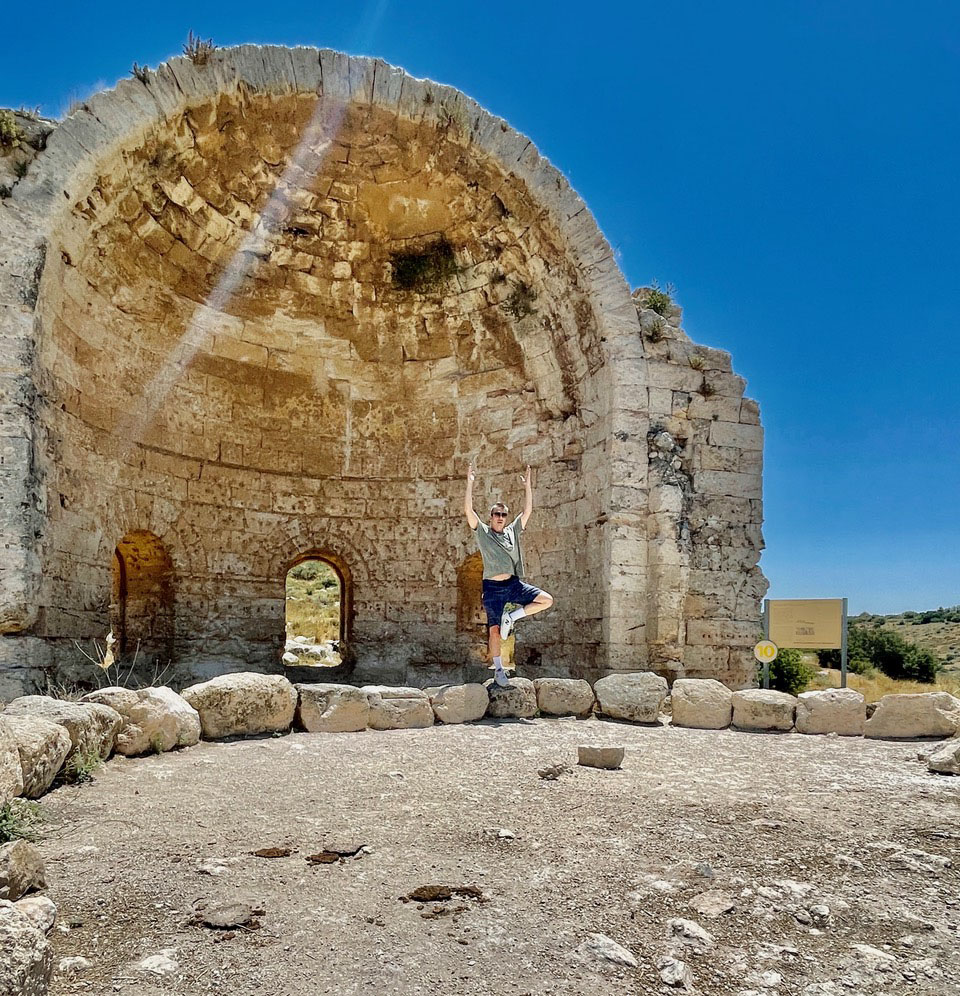
The next day my wife and daughter joined me on a tour of the Golan Heights, through Arab, Jewish and Druze towns, exploring the spectacular ruins of a thousand-year-old Crusader fortress and the lush gardens and waterfalls of the Banias river. We stayed in a lakeside Tiberias Airbnb and enjoyed natural hot springs, an adventurous hike climbing Mt. Arbel and a boat ride on the Sea of Galilee. This would be our last chance to fêteour vivacious Sarah as a single girl. I made a point to join minyanim at the tombs of such tzadikim as Rambam and Yochanan Ben Zakkai, Rabbi Meir Ba’al HaNess and Rabbi Akiva and his wife Rachel.
The blended city gave us the chance to interact with Russians and Ethiopians, religious and secular, Israelis and Arabs. I must state for the record that in my dozens of Israel trips I have experienced only respectful relations with our Arab cousins, other than a pickup street soccer game that I joined. At one point, a mother noticed that a tall, Jewish guy was playing goalie amidst Palestinian youth; her blood-curdling screams sent us all scattering.
At the end of the week, we returned to Jerusalem to attend the wedding of one of my daughter’s childhood best friends. Visiting Sarah Hulkower over the years was part of the reason our daughter eventually decided to make Israel her home. Now the two twenty-one-year-olds would marry within five days of one another.
Week Two
We moved into a 10th-story apartment in central Jerusalem right by the Machaneh Yehudah shuk. This marketplace is a shopper’s delight by day and a raging nightspot when the sun goes down. Our aerial view of the City of Gold was dizzying. We were blocks from my brother’s home and my parents’ Airbnb. We were so grateful that my 91- and 81-year-old dad and mom were cleared by immigration to make the arduous trip for our occasion. The next day, Yom Tov joined me on a hike in Wadi Kelt, a lush river valley replete with red rock arches, springs and swimming holes.
Toward the end of our hike we had run out of water. Upon returning to the river’s mouth, I spotted a lone Bedouin and asked in my best Hebrew if he knew of a source of drinking water. Suliman didn’t really want to speak to me but after a few gentle prods, he finally led us to a hidden fountain of pure spring water emanating from the rock wall. In spite of the refill, the end of the hike required a few miles of ascent while ninety-degree dry heat leached moisture from our exhausted bodies. We managed to convince a passing Jeep to give us a ride back to the car. There was no room inside so we stood on the floorboards and clung to the roof racks as the driver careened up the pitted dirt path. We sang the Indiana Jones theme song the whole way.
There was an incredible feeling of love and gratitude in the room during our festive Shabbat meals, especially now that Avreimi had been dismissed from the hospital. So many happy Glasers were present, other than our two sons who couldn’t make the trip since they hadn’t been vaccinated. I prayed Friday night services at the Western Wall with Jews from all over Israel. They had amassed in the capital for a three-day weekend that would culminate in Yom Yerushalayim, Jerusalem Day, the celebration of the 1967 reunification of the holy city. In spite of the throngs of worshippers, I sensed an emptiness generated by the absence of Diaspora Jews. Indeed, this trip would be an unprecedented experience of Israel just for Israelis. No Christian tour groups, no backpackers, no youth groups or Birthright trips.
In spite of the throngs of worshippers, I sensed an emptiness generated by the absence of Diaspora Jews.
Tragically, punctuating our prayers was the din of stun grenades overhead on the Temple Mount. The Arabs were concluding the month-long observance of Ramadan and grew intolerant of the presence of Israeli police deployed to keep things orderly. Stone slabs, rocks and fireworks had been stockpiled in anticipation. Over two hundred were injured in the aftermath. Remarkably, the riot didn’t dampen our ecstatic worship just below.
Our Friday night dinner was a collaborative effort of the half dozen chefs in the family and was devoured among singing, divrei Torah and l’chaims. Then on Saturday morning, I joined Yom Tov at his favorite spot, the Pinsk-Karlin headquarters in Meah Shearim. Grateful for my undying sense of direction, I found this group of gold-coated, shtreimel-wearing Chassidim screaming the morning prayers at full volume. In Pinsk I’m known as Achshel, a nickname gained from association as “Ach shel Yom Tov,” the brother of Yom Tov. Every few minutes of the service, I was enthusiastically embraced by yet another blond-haired, blue-eyed member of the extended Pinsk dynasty that had called Jerusalem home for hundreds of years.
It’s possible to spend all one’s time in Israel sitting in cafes and air-conditioned living rooms. I prefer to walk the land. That Sunday, I convinced a family friend, Yudi, to join me on an exploration of Nachal Darga, one of the most intimidating and spectacular canyons plunging two thousand feet to the Dead Sea. We emerged from the hike on our last legs only to cover ourselves with mud and float in the 31% salt concentration of the Dead Sea, alternating with forays into co-located Olympic-sized freshwater ponds. Only in Israel!
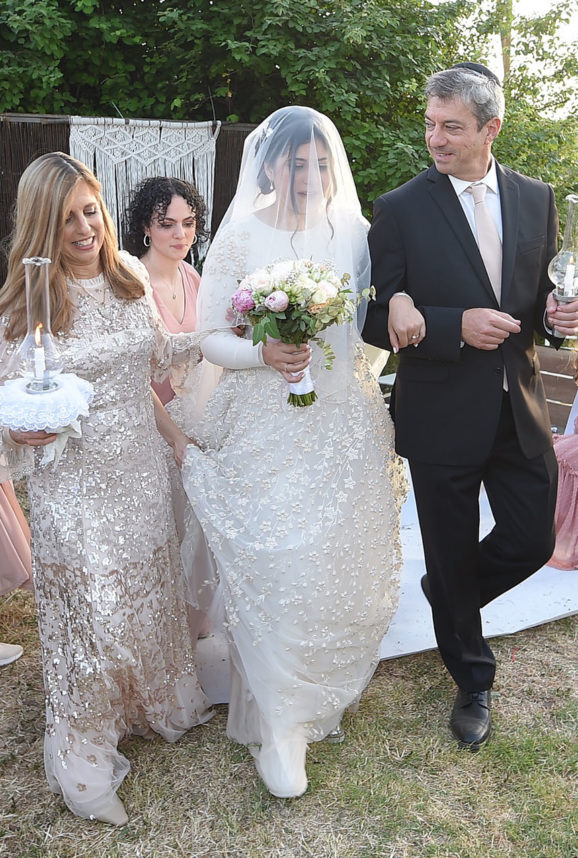
At last, Sarah’s Yom Yerushalayim wedding day arrived. I wandered the Old City amidst thousands of holiday revelers while my wife and the bridesmaids primped. We then drove to the arid venue a mere ten miles from Hebron. Our joy was overflowing as we greeted guests from various chapters in our lives, all gathered to bring joy to the bride and groom. The band, Rimonim, kept the energy going throughout.
Photo courtesy of Sam Glaser
Just before the ceremony, we assembled for the afternoon prayers. We could hear explosions in the distance as Hamas fired the first salvo of rockets toward Jerusalem. Many asked if I wanted to know what was going on. “No,” I said, “I’m trying to focus on my daughter’s wedding!” Still, some people had departed to comfort alarmed children or report for duty. My dear friend Rabbi Shlomo Katz was set to offer words of Torah at the chuppah; he was forced to return home since sirens were sounding in his community. Nevertheless, the wedding proceeded peacefully and we ate and drank and schmoozed and danced in frenzied circles until our aching bodies couldn’t handle another rotation.
Week Three
Traditional Jewish weddings don’t end after the reception. Seven days of partying follows and we were scheduled to visit a different city every night to continue the celebration. In spite of hundreds of rockets launched daily, we drove to Beit Shemesh, Nof Ayalon, Ranana, Petach Tikvah and Sanhedria. We kept track of attacks with cell phone apps, ready to run for cover at a moment’s notice. Several of these festive meals were outdoors; as we dined we watched the light show of Iron Dome protecting the citizens below. Unwilling to give Hamas a victory by letting rockets stunt my trip, I managed to sneak in a few more hikes in Park Canada, Beit Guvrin and Mt. Heret, and spent a wondrous day perusing art and archaeology at the Israel Museum.
Petach Tikvah came under attack during our Shabbat lunch event. We had to dash for bomb shelters multiple times. At one point, as we walked with the bride and groom back to our hotel, the sirens began their harrowing growl. One does not want to be caught outside since the miraculous defense system, known in Israel as the Iron Kippah, unleashes shrapnel with each interception. The ladies sprinted, heels and all, to a nearby building’s stairwell. This time the concussion was directly overhead. After waiting the requisite ten minutes, we emerged to see the smoke ring right above us. A bit close for comfort.
After waiting the requisite ten minutes, we emerged to see the smoke ring right above us.
The week of Sheva Brachot culminated in the holiday of Shavuot, the anniversary of receiving the Torah at Mount Sinai. This holiday is unusual in that the Torah doesn’t tell us the specific date for its observance. We do know that it’s seven weeks after the Exodus on Pesach, the 50th “jubilee” day, an ethereal moment outside of time and space. So, too, is our Torah eternal and ephemeral. So, too, is the Jewish People and, unfortunately, the ghastly plague of antisemitism guaranteed by the Torah to infect the nations as we wander the globe. In Israel, our resolve was strong and we shared complete unity in the need for an effective military response. Each time I checked my cell phone for the international news, however, I noted a diametrically opposed unity among reporters to spin sympathies toward the “war-weary residents of Gaza.”
This was the first time in my life I kept only one day of the Shavuot holiday. Normally, in the Diaspora, we hold by two days of observance. But now my inner Israeli was fired up, and my Beverlywood Chabad rabbi told me that if my wife is with me in the Promised Land, it’s as if my home is truly there. Since Israel was only open for Israelis, it was clear to me that a two-day celebration would have been superfluous. That night I taught an all-night-learning workshop for a women’s group on a breezy rooftop in the Old City of Jerusalem and after jumping in a crowded mikvah at dawn, joined thousands of worshippers at the Kotel. The cacophony of dozens of minyanim culminated in netz, the moment of sunrise, when the entire plaza launched into the holiday Amidah. The world fell silent. Only the chirps of swifts broke the cool morning air. Pure inspiration.
Week Four
Hamas cancelled our return trip to the U.S. Thanks to the 4300 rockets launched on civilian populations over ten days, American carriers stopped flying, leaving El Al as the only way out. I had to purchase a brand new ticket to get back to LA for a wedding, a client’s album release party and a busy week of work in my recording studio. I was grateful to our archenemy for one thing: I got an extra few days to tour the country and one more precious Shabbat to enjoy my relatives, pray at the Wall and dance in the streets with my fellow Israelis.
Shira and I realized that had the Israeli government allowed us to enter the country before Passover, we would have had a peaceful trip with a relaxed wedding and minimal drama. Clearly, God had other plans for us. In hindsight, I’m grateful to have the Israeli in me awakened. Jewish survival is not merely theoretical.
We returned to find the masses on the American streets joining fundamentalist Islam in a call for Jewish blood. Teachers, journalists, unions, actors, musicians and Black Lives Matter protesters gleefully jumped on the Israel-bashing bandwagon. Antisemitism lurks behind the veil of anti-Zionism, crouching at the door, waiting for a skirmish like the war with Hamas to bare fangs and let true colors shine. I’ve seen a plethora of videos explaining who started this conflict, extolling the ethical conduct of the Israel army and lambasting Hamas for using Palestinians as human shields. Our feeble attempts at hasbara (pro-Israel propaganda) may be falling on deaf ears but that doesn’t absolve us of the imperative to try.
Antisemitism lurks behind the veil of anti-Zionism, crouching at the door, waiting for a skirmish like the war with Hamas to bare fangs and let true colors shine.
It’s time to take off the gloves and influence whomever we can. We need only look back a generation or two to see the effectiveness of trying to hide, assuming society won’t cancel the “nice” Jews. It took a trip to Israel during wartime to drive home the point that we are all in this together, like it or not. There is no hiding. In my book, “The Joy of Judaism,” I emphasize the importance of affiliating and proudly wearing a kippah or Jewish star jewelry. Hostility toward the “other” unravels with face-to-face contact. Let us be in the faces of those who would oppose us, let them see that Jews are human and love their children too.
Israelis are known for being tough on the outside and sweet on the inside. Let’s share that inner sweetness while clarifying that even after 3333 years since Mt. Sinai, we still stand strong as an ancient, accomplished, brave people. My conversations and social media postings emphasize that no apologies are necessary; Jews are the indigenous tribe in Israel. Seven million Jews in the world’s only Jewish homeland versus three hundred million Arabs in the Middle East—and the Arabs are the underdogs? The “occupation” in Gaza is thanks to Hamas, not Israel.
My brother Aharon was advised by his rabbi to wear a baseball hat rather than a kippah for his recent trip to Phoenix. I say the opposite: display Judaism openly and be ready for whatever questions, skirmishes or eye rolling the symbols engender. Approach those who seem to be in opposition with conversation and kindness. We can fight this battle, even if we’re not in the Israeli Defense Forces.
My inner Israeli is wide awake. I hope it never goes back to sleep.
Sam Glaser is a performer, composer, producer and author in Los Angeles. He has released 25 albums of his music, he produces music for various media in his Glaser Musicworks recording studio and his book The Joy of Judaism is an Amazon bestseller. Visit him online at www.samglaser.com. Join Sam for a weekly uplifting hour of study every Wednesday night (7:00 pm PST, Zoom Meeting ID: 71646005392) for learners of all ages and levels of knowledge.
After Biden’s inauguration, there was hope that the United States could go back to some sense of normalcy and focus on healing a divided nation. Unfortunately, that has not been the case. Instead, we are now reckoning with attempts to dismantle democracy by restricting voting and providing tools to overturn election results—and what’s worse is that these efforts are going largely ignored.
In the wake of some Republican losses last November and the continuous discussion about “massive voter fraud,” several conservative groups have scrambled to enact voter suppression laws across the country. It may sound alarmist to call them “voter suppression laws,” but the Brennan Center for Justice at the New York University School of Law counts 22 new laws—either restricting absentee, early, and mail-in voting, purging voter rolls, weakening voter registration efforts, or limiting valid forms of voter ID—across 14 states, with an additional 61 bills taking shape in 18 states. Overall, the only states where lawmakers haven’t yet introduced a restrictive voting bill are Delaware and Vermont.
These measures have been or are being introduced purely by Republican lawmakers. The states being hit the hardest are Arizona, Georgia, and Texas, all of which are traditionally-red states in which a surge of largely-minority voters help defeat (or came close to defeating) entrenched conservative interests in 2020. Thus, it is neither partisan nor derogatory to say that the new “Trump era” GOP is currently focused on voter suppression. It’s simply fact.
Thus, it is neither partisan nor derogatory to say that the new “Trump era” GOP is currently focused on voter suppression. It’s simply fact.
Earlier this month, a group of academics that included Ivy League political science and government professors wrote an open letter calling for increased federal voting protections to combat GOP efforts, which they characterized as “transforming several states into political systems that no longer meet the minimum conditions for free and fair elections.”
For their part, the federal government response has been underwhelming. Attorney General Merrick Garland laid out the DOJ plan to protect voting rights: publishing new guides on early voting, mail-in voting, and redistricting, as well as doubling the lawyers on staff at the Civil Rights Division of the Department of Justice in order to aid enforcement of the Voting Rights Act of 1965, the National Voter Registration Act, and the Help America Vote Act. But the fact of the matter is that, following the 2013 Supreme Court decision in Shelby County v. Holder, the Department of Justice doesn’t have the authority it used to, and several states have carte blanche to make any changes they want without preclearance.
On the legislative side, the For the People Act is dead in the water since the U.S. is nowhere near liberal enough to support automatic voter registration, and the John Lewis Voting Rights Act will be subject to the filibuster, which means its chances in the Senate are only slightly above nil.
Where does that leave us?
Firstly, it leaves us with the grim knowledge that living in a democracy is not a spectator sport. The slow erosion of checks and balances, as well as the constant attacks on electoral integrity, are made possible by the fact that the majority of the American public treat politics as something to pay attention to once every four years—or at best, once every two years. During the Trump administration, constant high-stakes and high-coverage issues such as the so-called Muslim ban and attempts to repeal the Affordable Care Act resulted in a constant state of public awareness and engagement. But with the expected return to the status quo under Biden, we risk slipping back into apathy and skimming headlines. If we are to build a truly democratic nation, participation must be constant, and so must the flow of information.
Firstly, it leaves us with the grim knowledge that living in a democracy is not a spectator sport.
Secondly, this ongoing movement to silence voters also leaves our country vulnerable to unrest. Realistically speaking, you cannot silence a population. You can disenfranchise them. You can even take away peaceful protest as an option, as various laws are already doing. But they won’t just sit there and watch their rights being taken away. Our own Founders argued that “whenever any Form of Government becomes destructive of these ends, it is the Right of the People to alter or to abolish it.”
And when that happens, it happens by any means necessary.
Seth Jacobson is the founder and principal of JCI Worldwide, a Los Angeles-based communications and research firm. He spent several years in the Carter and Clinton administrations in positions focused on economic development, foreign policy, and media relations. He is a frequent lecturer on policy and public affairs at Pepperdine University and UCLA.