fbpx

June 21, 2021

“The Fifth Fiasco: How to Escape the Traps of Jewish History In The Twenty-First Century” by David Passig

Will the third Jewish Commonwealth fare any differently than two destroyed temples? In the wake of the 2020 pandemic and most recent Gaza conflict, perhaps this question is as relevant as ever. “The Fifth Fiasco” by David Passig is the author’s latest foray into exploring a Jewish future. This informative and fascinating tour de force first looks back to Jewish history in order to project a more desirable Jewish future.

Externally, the danger of physical and existential threats to the Jewish State and Diaspora community can seem overwhelming—from resurgent antisemitism in the Diaspora to the possibility of a nuclear war with Iran in Israel. Internally, disunity can seem even more daunting. From an Israel-Diaspora dichotomy to Haredi and Reform iterations of Judaism, we are all too often reminded just how fragile is the social and religious fabric of our people in the 21st century. Is there hope to avoid what Passig calls the “Fifth Fiasco,” which he describes as a series of avoidable catastrophes, and ensure Jewish survival and success?

Known widely in Israel, English readers have only just begun to be exposed to Passig’s work. Several years ago, I encountered Passig’s earlier book “2048” (2013), the story of a hypothetical future for the state of Israel’s 100th birthday. Since then the author and futurist has been busy with activities including posting fascinating YouTube videos, heading Bar-Ilan’s Virtual Reality Laboratories, and publishing papers on a variety of topics that seem to border on science fiction. For example, his “Improving Children’s Cognitive Modifiability by Dynamic Assessment in 3D Immersive Virtual Reality Environments” sounds like something straight out of a “Matrix” film. While “2048” focuses on different probable and possible futures for the Jewish State, “The Fifth Fiasco” takes the next step and discusses the possibility of crafting a preferable future for the entire Jewish people.

Continuing his important work of Jewish prognostication, Passig has created another page turner. This time, the futurist first takes us back in time before pushing us forward. In his words: “The past is the most powerful source of strength available to intelligent beings.” His historical overview includes a review of not only Jewish history, but world history as well. From Sargon the King of ancient Sumer to Lenin and the Bolsheviks, Passig parses these narratives to synthesize “the unforgiving chaos of human history” to learn how the Jewish people can succeed in the 21st century and beyond.

Continuing his important work of Jewish prognostication, Passig has created another page turner.

Jewish historians often chronicled Jewish catastrophes. For example in the wake of the Spanish Expulsion and the Holocaust, a whole genre of literature exists that recounts a sad past. “The Fifth Fiasco” does the same but with a contemporary lens for realpolitik and cutting-edge scientific methodologies. While some Jewish traditionalists might believe that fate and ritual observances alone can break the seemingly endless destructive cycles of the past, Passig advocates a pragmatic approach in which we overcome our obstacles and realize opportunities.

For example, what were the religious and political issues that led to a civil war in the Book of Kings? Conversely, how was a similar civil war averted in the Book of Judges? Passig believes these narratives of the past contain a recipe to mend contemporary differences of religion and politics within the Jewish community. By viewing Jewish history in a pattern of five distinct eras, we can all learn from our past mistakes.

The book is a treat for both laymen and those more acquainted with Jewish history. Along the way, the reader will learn a great deal about future studies, psychology, and “counterfactual” retellings of history by utilizing “process-based historical” thinking. These methods help us find “pieces of the puzzle that were previously hidden … with a view to enabling us to break the vicious cycles … and conceive of a better future as a promising anchor.”

A solution emphasized by Passig is the central role and contribution of women. While men tend to solve problems with a “left- brained” orientation, women have the ability to problem solve using “right- brained” solutions that utilize creativity—an approach that must be explored to a greater extent to solve larger societal issues. Other interesting interludes into arguments for the importance of territorial Judaism and historical pedagogy make for a stimulating read. For example, the author argues that if we teach students that the Holocaust happened because of Hitler, why bother teaching history at all? For Passig, a more useful approach is to explain the social, political and economic realities of those times as a way to learn about practical solutions for the present and future.

Passig challenges his reader to consider what might mend our internal differences in order to ensure outside forces do not once again destroy our Jewish State. While some of his conclusions might ultimately be rejected by readers, his masterful analysis provides space to explore a Jewish historical narrative in broader and more useful terms that will dominate the topic of many discussions in years to come. With 2020 now in the past, perhaps one thing we all can agree on is to be optimistic for a better year ahead.


Dr. Murray Mizrachi is a business professor at the Murray Koppelman School of Business at CUNY. His advisory firm, Murray Mizrachi Consulting LLC, is based in New York City where he resides with his family.

“The Fifth Fiasco: How to Escape the Traps of Jewish History In The Twenty-First Century” by David Passig Read More »

Lara Hope on her new album “Here To Tell The Tale,” rockabilly influences, how Jewish community theater helped shape her, and more

Winner of the 2017 Ameripolitan Music Award for “Best Female Rockabilly Artist” and named the “Best Up-And-Coming Band” by New York’s Hudson Valley Magazine, Lara Hope & The Ark-Tones have a forthcoming album coming out on June 25, 2021: “Here To Tell The Tale.” The group – fronted by Long Island, New York native Lara Hope – has spent much of the past few years on the road in Europe and the United States, touring alongside The Brian Setzer Orchestra, The Blasters and The Reverend Horton Heat. Beyond being invited to perform at the original site of the Woodstock Festival, Hope herself has been featured on the cover of UK Rock ‘N’ Roll magazine and New York’s Ulster Magazine.

Lara Hope & The Ark-Tones is far more than “a rockabilly band,” per its musical roots and pedigree. It was initially born from a hybrid of Hope’s former band The Champtones and upright bassist Matt “The Knife” Goldpaugh’s international psychobilly act The Arkhams. Hope and Goldpaugh also play as a duo, The Gold Hope Duo, and under that moniker they recently self-released a very topical album called “Songs In The Key Of Quarantine.”

On May 27, 2021, I had the pleasure of speaking with Lara Hope via Zoom, as embedded below. Besides “Here To Tell The Tale,” we discussed the following:

  • Musical and performance influences prior to rockabilly (hint: it involves Jewish community theater)
  • Her Long Island roots, growing up in Plainview, New York
  • Life during COVID-19, including performing weekly live-streamed shows
  • Future plans for 2021 and 2022

More on Lara Hope can be found here and here.

Lara Hope on her new album “Here To Tell The Tale,” rockabilly influences, how Jewish community theater helped shape her, and more Read More »

Thoroughly Modern Eggplant Salad

Eggplant journeyed from its origins in India and Sri Lanka to China, where there is mention of this plump and glossy vegetable as early as the 5th century. From there, eggplant embedded itself In the culinary repertoire of the Middle East. When the Muslim Moors from North Africa conquered the Iberian peninsula in 711, they brought eggplant to the European continent. In the thirteenth century, commercial trade with Arab merchants brought eggplant to the Italian peninsula.

Eggplant’s journey from India across the known world is reflected in its name in each language. In Hindi it is bianjan—baban’jan in Arabic, badan’jan in Farsi, berenjena in Spanish, melanzane in Italian and aubergine in English.

Eggplants come in all shapes and sizes and shades ranging from black to purple to zebra to yellow to white. We call them eggplant because of a European variety cultivated in the 18th century that are perfectly white and oval and look like eggs hanging from a shrub. The most common and favorite variety in the United States is romantically named Black Beauty, but the slender, lilac Oriental variety is also a good choice. Although eggplant is available year-round, the peak season is July to October. The freshest eggplants have a smooth, shiny skin and feel firm and heavy.

The creation of a Jewish state in 1948 and the massive influx of immigrants from the Middle East and North Africa resulted in the Israeli government instituting a system of rationing food and coupon books. During this austerity period Tsena, many eggplant recipes were created to take advantage of their low-cost, easy availability and the versatility of the firm flesh in adapting other flavors. Liver was scarce so they made mock chopped liver by flavoring eggplant. Tomatoes were scarce so they added one tomato to flavor several eggplants. And of course, eggplant was already featured in many Levantine iterations, including salads, pickles, sliced and fried for a crispy treat, as well as stuffed with rice and vegetables.

Nowadays, eggplant is still a favorite in the Israeli kitchen. Israeli chefs serve roasted eggplant with tahini and pomegranate, tahini and feta and tahini and goose liver. They even serve it with tuna tartar.

We were inspired to take our grandmother’s baba ghanoush recipe and give it a flavor makeover. Sure, it’s still got the wonderful nutty flavor of tahini, the piquancy of garlic and fresh tang of lemon juice. But we added walnuts and silan and deliciously caramelized and crisped red onion for a dish that will surprise and delight your friends and family. Grilling the eggplant over an open flame or on the barbecue imparts a wonderful smoky flavor, but roasting in the oven also gets the job done.

Modern Eggplant Recipe

2 medium eggplants, rinsed and dried
1 large red onion, thinly sliced
¼ cup extra virgin olive oil
2 tablespoons Silan
1/2 cup toasted walnuts, chopped coarsely
1 cup cilantro or Italian parsley, finely chopped

Pierce eggplant several times with a knife.

Place egg plant on barbecue or stove top set to a very low flame and cook for 45 minutes.

Turn the eggplant every 15 minutes, until the skin is completely charred.

Set aside and let cool.

Heat olive oil in a pan over medium heat, add onion.

Reduce flame and sauté the onion until onion is golden with crispy edges, then set aside.

Peel the eggplant and discard the skin, saving the eggplant juices for the dressing.

Cut the eggplant into thin strips and place in serving bowl.

Add parsley, then pour dressing and combine well.

Top with fried onion.

Drizzle with Silan and garnish with walnuts.

Dressing:
1 cup tahini
1 lemon, juiced
½ cup ice water
2 cloves garlic, finely chopped
½ teaspoon kosher salt
½ teaspoon pepper
1 teaspoon cumin
1 teaspoon Sumac
2 tablespoons extra virgin olive oil
2 anchovies, chopped finely (optional)

In food processor combine the tahini with the lemon juice and ice water until smooth.

Add eggplant juices, garlic, spices and olive oil and anchovies, combine until smooth and creamy.


Rachel Sheff and Sharon Gomperts have been friends since high school. They love cooking and sharing recipes. They have collaborated on Sephardic Educational Center projects and community cooking classes. Follow them on Instagram @sephardicspicegirls and on Facebook at Sephardic Spice SEC Food.

Thoroughly Modern Eggplant Salad Read More »

Will New Leadership in Iran Doom the Nuclear Deal?

Iran held a presidential election last Friday. Iran lost.

But that’s no surprise. It was clear long before the votes were counted that the Iranian people were the biggest losers in the election. That outcome had been pre-determined earlier this year, when the nation’s Guardian Council disqualified several prominent reform-minded candidates, leaving hardliner Ebrahim Raisi as the prohibitive favorite against the lesser-known contenders who were permitted on the ballot. The campaign was essentially a puppet show that allowed Iran’s true and undisputed kingpin Supreme Leader Ayatollah Ali Khamenei to install Raisi, his preferred subordinate and potential successor. The result will be an even more repressive regime with even less regard for the rights of its citizens and an even more antagonistic relationship with Israel and the West.

The result will be an even more repressive regime with even less regard for the rights of its citizens and an even more antagonistic relationship with Israel and the West.

For more than twenty years, Iranian presidential elections pitted doctrinaire candidates closely allied with the preferences of the ruling clerics against opponents with at least some instinct to relax societal constraints domestically and increase international diplomatic engagement. In elections where these options were permitted, the winner was consistently the reform candidate (though Iranian-style “reform” is still far more restrictionist than how that term would be used in the West.)

But Khamenei is now in his eighties, and his death could create a vacuum allowing an elected president to gain influence. Rather than running the risk of giving that opportunity to a moderate leader, Khamenei and his allies decided not to provide that alternative to the voters this year. Any potential candidate who had previously voiced support for opening Iran either domestically or internationally was banned from the ballot, leaving only one relative centrist as a weak opponent for the ayatollahs’ preferred candidate.

The final outcome was not surprising: Raisi rolled to victory by an overwhelming margin. But the Iranian people recognized that the fix was in and stayed away from the polls in historic numbers. Although the authorities extended voting by several hours to encourage increased turnout, voting participation was at an all-time low.

The question now is whether the installation of a hard-line government makes it more or less likely that negotiations over a new Joint Comprehensive Plan of Action (JCPOA) nuclear agreement will be completed. The Biden Administration has let it be known for months that they considered the June election to be a practical deadline for concluding the talks, given the almost-certain election of an Iranian president less willing to compromise than the current leadership. But over the last few weeks, the White House has hinted that the window could extend until early August, when Raisi will formally take office. This leaves about six weeks for a new nuclear agreement to be completed, but it is still unclear how much either the United States or Iran actually want that to happen.

Realistically, a new Iranian president may not be all that relevant to the ultimate JCPOA outcome. Khamenei ultimately calls the shots, so the new August deadline might have little substantive impact. But there is great symbolic value for Khamenei, especially if he does see Raini as his potential successor. Responsibility for an agreement with the U.S. could be assigned to the outgoing moderate president Hassan Rouhani, but the new conservative leadership would then benefit from the economic growth that sanctions relief could bring. Of course, Khamenei could still decide that quickly achieving nuclear capability is a more important goal than economic recovery. But either way, the decision will not fall to the individual who holds the lesser position of president.

The ball is now in Biden’s court. Iran tried to test him over the last few weeks, by appearing to deploy warships to cross the Atlantic with advanced weaponry for the renegade nation of Venezuela. This seemed like a way of determining whether Biden wanted a nuclear agreement so badly that he was willing to overlook such a provocative act in the U.S.’s own backyard. But the Iranian military vessels instead veered north toward either Syria or Russia, suggesting that the Biden Administration has quietly told Iran that such a transgression would not be tolerated.

Biden’s message to Iran therefore continues to be that a new JCPOA is important, but not necessary. The U.S. president would like non-nuclear weaponry and Iran’s support for terrorism as part of a new agreement, but that seems even less possible under Raisi. So we’ll continue to wait—to see whether Biden is willing to walk away from a bad deal or if he thinks he can build support for something better.


Dan Schnur teaches political communications at UC Berkeley, USC and Pepperdine. He hosts the weekly webinar “Politics in the Time of Coronavirus” for the Los Angeles World Affairs Council & Town Hall.

Will New Leadership in Iran Doom the Nuclear Deal? Read More »

Poet im Peltz


My suggestion to my wife that Sacher-Masoch’s book
‘Venus in Furs’ may have inspired the Kotsker Rebbe’s slur
about all sinful Jewish people who attempt to look
just like a tsaddik who’s im Peltz, which means “tsaddik in fur,”

inspired my wife to tell me she would buy me the fur hat
worn by tsaddikim, called a shtreimel, making me a poet
in fur. Though I’m no Venus or a tsaddik, she’s a cat
who lives with me, her hot tin rov, but if she will
bestow it

I hope no protests will be made by Figaro, the cat who
monopolizes in our home a coat of blackest fur,
his pelt, in German Pelz, in Yiddish Peltz. This
hatless Jew
trusts his shtreimel will not cause this purrer to demur,

though if it does protest, he may enjoy this masochistically,
recalling Sacher Masoch, strangely, he a philosemite,
a paradox explained here in this poem cappermystically.
I hope my wife enjoys it and this poem, and she might.


Leopold von Sacher-Masoch, the 19th-century Austrian writer who inspired the term masochism, was an ardent philo-Semite. Born in Galicia, Spain, Sacher-Masoch wrote a volume of short stories, “Jewish Life: Tales from Nineteenth-Century Europe,” and edited a literary magazine expressing tolerance for Jews in Saxony. “Masochism and Philosemitism: The Strange Case of Leopold von Sacher-Masoch” is a 1982 article by David Biale, now Emanuel Ringelblum distinguished professor of Jewish history at the University of California, Davis.


Gershon Hepner is a poet who has written over 25,000 poems on subjects ranging from music to literature, politics to Torah. He grew up in England and moved to Los Angeles in 1976.  Using his varied interests and experiences, he has authored dozens of papers in medical and academic journals, and authored “Legal Friction: Law, Narrative, and Identity Politics in Biblical Israel.” He can be reached at gershonhepner@gmail.com.

Poet im Peltz Read More »

Israel’s Fresh Start and the Media’s Missed Opportunity

On June 15 Israel managed to finally hold its Jerusalem Day flag parade, despite continued threats from the terrorist group Hamas. Prime Minister Naftali Bennett passed his first test as head of the country, and the new national unity government held together despite some intense internal disagreement. Unfortunately, many major media organizations failed their first test of how they intend to cover this new administration, missing the chance to prove their objectivity in what should have been an easy situation on which to report.

The Jerusalem Day flag parade is an annual event celebrating the anniversary of the reunification of the city after Israel’s victory in the 1967 Six Day War. It started in 1968 and since then it has become a staple of the celebration and festivities. This year, the original May 10 event was cancelled due to rocket fire from Hamas. Since then, the parade had been rescheduled multiple times for security purposes, with officials even changing the route in an effort to avoid further angering Hamas, before the final date for the modified and scaled-down version was confirmed for this past Tuesday.

But there is no negotiating with terrorists. Despite the various concessions, on Sunday night, just as the new Israeli government was being sworn in, Hamas once again called for a violent Day of Rage, complete with the launch of rockets and incendiary devices, if the parade was to go forward as planned. Faced with the decision on how to respond, Bennett unquestionably made the right call in allowing it to happen because anything else would have set an unbearable new precedent.

No sovereign nation should need to consult with terrorists about whether they can hold a parade in their capital city. That should not be a controversial statement at all, but somehow when it comes to Israel it is, and the problem runs much deeper than Hamas.

In the lead up to the parade, major media outlets called all would-be marchers “ultranationalists,” while others stuck with the equally pejorative “far-right” designation. The parade itself was referred to as “inflammatory,” “contentious” and “provocative.”

The United States unequivocally recognizes Jerusalem as Israel’s capital city. Calling it “incitement” for Israeli citizens to have a parade in their own capital is no different than vilifying the people of Washington D.C. for hosting their annual Independence Day march. It also feeds into the false narrative of Israel as occupier instead of the demonstrable historical and legal truth of the Jewish people as indigenous to the land.

Calling it “incitement” for Israeli citizens to have a parade in their own capital is no different than vilifying the people of Washington D.C. for hosting their annual Independence Day march.

But it is a bridge even farther to use the argument that an event might be divisive as an excuse to justify violence and create a false moral equivalence between citizens marching in a parade and a terrorist regime threatening to kill innocent people, then attempting to make good on that threat. Such coverage should be utterly shocking, but unfortunately, in the case of Israel, it isn’t, and that is shameful.

This time could have been different.

For the last several years former Prime Minister Benjamin Netanyahu was the media and leftwing politicians’ favorite international punching bag; everything he did was labeled either racist, undemocratic, or authoritarian in nature, and the anti-Israel pundits conveniently couched their uniquely harsh criticism of the Jewish State behind an open hatred for its leader. But Netanyahu is gone now, and the makeup of the new Israeli cabinet itself reveals just how laughable of a lie it is to call Israel an apartheid state. The ranks of the new Israeli ministers include Jews, Druze, and Muslims, along with multiple immigrants from Ethiopia, Morocco, and the former Soviet Union. The kingmaker of the governing coalition was none other than Mansour Abbas, the head of the Islamist Ra’am party. It was this national unity government, and not Netanyahu, that gave the final go-ahead for the flag parade to happen.

This week could have been a fresh start for those who claim they are not really anti-Israel. This time there was no civil court case in Sheikh Jarrah to drum up outrage, no right-wing government to castigate. Just a designated terrorist organization threatening a sovereign democratic country over holding a parade in its own capital city. But somehow, the media’s refusal to accept Israel’s legitimacy remained. Even in the aftermath of the event, multiple media outlets that have been known to call actually violent protests “mostly peaceful” when it suits their agendas ran stories on a tiny fringe group that shouted racist things, and that were immediately condemned by Israeli officials, as if they were somehow a representative group.

This week could have been a fresh start for those who claim they are not really anti-Israel.

What the first week of the Bennett administration has taught us is that the media’s Netanyahu charade was just that: It was never really about the leader of Likud, or his right-wing coalition, just as Hamas’s threats were never really about a flag parade. To be clear (because Hamas is very clear in their charter) it was also never really just about Jerusalem. Neither Hamas nor the prominent news outlets serving as their unofficial mouthpiece ever bother mentioning the multiple deals Israel has agreed to over the years that would have divided the city while giving the Palestinians a state.

The reason is because when push comes to shove, no matter who is sitting in the PM chair, or who is handling the negotiations, no Israeli government, no Israeli offer, and no Israeli rights will ever be enough to satisfy those in the region—or in the media—who simply don’t want the State of Israel to exist. People will continue to see what they want to see, and report what they feel should be reported, even if they need to twist the truth to make the spin work.

But now that the Bibi bogeyman is gone, it is getting even harder to deny that it was never really ‘all about the Benjamin.’


Dr. Mark Goldfeder is an international lawyer and Director of the National Jewish Advocacy Center

Israel’s Fresh Start and the Media’s Missed Opportunity Read More »

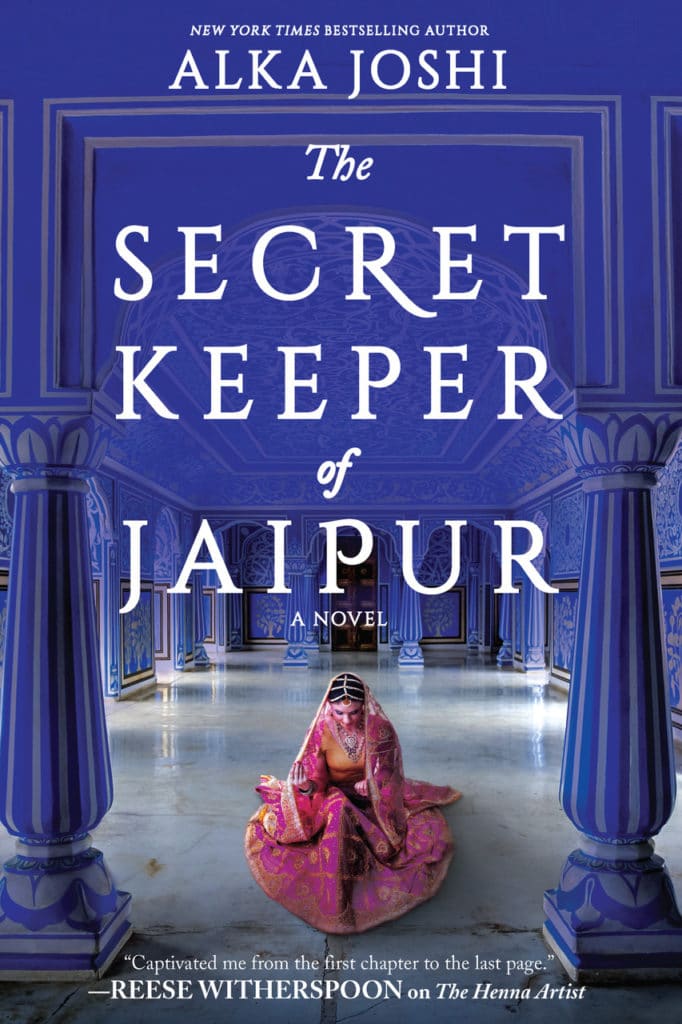
Travel back to India: The Secret Keeper of Jaipur

I absolutely loved The Henna Artist by Alka Joshi and wrote about it for Ms. Magazine and Thrive Global. It is possible that I enjoyed her new book, THE SECRET KEEPER OF JAIPUR, which will be available TOMORROW even more!
In the second book, which is set in 1969, Malik is now twenty, Lakshmi is running the Healing Garden of Shimla and in this excerpt she meets Nimmi: 2 LAKSHMI I love this season, the sharp air in my nostrils, the crunch of snow crystals beneath my boots and the anticipation of a new season ahead. Having lived the majority of my life in the dry heat of Rajasthan and Uttar Pradesh, I never thought I’d come to love the cooler weather of the Himalayan foothills. As I round the last hill on my morning walk, I spot the roof and gables of my Victorian bungalow topped with the last of the snow, like an elaborate pastry decorated with cream. Off to one side of the house is a Himalayan cedar, its branches weighted with white powder. The scene always fills me with joy, and I wonder—as I often do—how I could capture its delicate beauty with a henna design. Then I spot Nimmi waiting on my doorstep. On the path, I hesitate. In full tribal regalia, her slim figure is striking. Her skin is the color of wet bark, so dark that her eyes—small, deep set— shine like those of an energetic black-eyed bulbul. These and her hawkish nose make her seem severe. I chide myself for judging her. Haven’t I taught myself to appear pleasant even when the situation doesn’t call for it? It’s a skill I mastered during a decade of tending to the whims of the ladies of Jaipur as I painted their hands with henna. Perhaps the women of Nimmi’s tribe are raised not to temper their true emotions?

Want to know more about ALKA JOSHI? Listen to our interview about Passion, Perseverance and Patience:

Alka interviewed me for her show, Reimagine:

BUY YOUR COPY TODAY: The Henna Artist and THE SECRET KEEPER OF JAIPUR

Travel back to India: The Secret Keeper of Jaipur Read More »

Tevye is Back — and in Beverly Hills

There is good news for lovers of “Fiddler on the Roof” (and who isn’t?) –Tevye is coming back for a new chapter of his life– and in Beverly Hills, yet.

More precisely, the legendary milkman will reappear on June 23 at the Wallis, but this time he’ll have the stage all to himself, absent his wife, daughters, sons-in-law and lame horse.

Left alone to propel the action is Tom Dugan, who triples as writer, co-director (with Michael Vale) and star in the world premiere of “Tevye in New York.”

In the final scene of “Fiddler on the Roof” Tevye and most of his clan fled Anatevka in the face of a 1909 Russian pogrom and along with thousands of other East European Jews settled on Manhattan’s Lower East Side.

When “Tevye in New York” opens, it is July 4, 1914 and Tevye, now a proud American citizen and dressed like the small businessman he has become, is waiting for the upcoming Independence Day Parade, led by President Woodrow Wilson himself.

While selling pickles from a barrel and hawking ice cream bars, Tevye entertains  the neighborhood merchants and residents with the story of his life and explains the difference between living in Russia and New York.

In Russia, he says, when they say, “Good Morning” they mean, “go to hell.” In New York, when they say, “go to hell” they mean “Good morning.”

Also, while Jewish life in Russia was marked by constant bad luck, in America ”you make your own luck.”

A Mrs. Murphy in the multi-ethnic crowd asks what kind of language Yiddish is, and Tevye explains, “In Yiddish you can say a lot with a little …plotz, kvell, tuchis, chutzpah.

Tevye now runs a small grocery, while his daughters work in the garment district and were witness to the disastrous Triangle Shirtwaist Factory fire in 1911. He goes into partnership with one of his daughter’s suitors from the old country, Lazar the Butcher.

For the festive opening of the joint enterprise, Tevye asks a sign painter to prepare a banner spelling out “Tevye’s Grocery featuring Lazar Wolfe’s Meat.” Regrettably, the painter is not a grammatical speller and the banner reads, “Tevye’s Grocery featuring Lazar’s wolf meat.”

Tom Dugan, 60, is a versatile actor, writer and director, who during a 40-year career has written, directed and performed in some 50 films and television shows.

One of his most successful stage shows was as Simon Wiesenthal, in which he wrote about and played the famed Nazi hunter and received an award for best solo performance by the LA Drama Critics Circle.

Since Dugan is of Irish descent, the Journal asked him how he came to write about and play such profoundly Jewish characters as Wiesenthal and Tevye.

“My wife Amy is Jewish, our children are Jewish and we are all members of Temple Judea in Tarzana,” Dugan explained. “Also, my father served as an American infantryman in Europe during World War II and I asked him a lot of questions about what happened there.”

Or perhaps his future course was set in 1976, when his high school in Rahway, New Jersey put on “Fiddler on the Roof” and Dugan was cast as…Tevye.

“Tevye in New York” will break new ground by becoming the first play at the Wallis Annenberg Center for the Performing Arts at its brand new pop-up outdoor terrace.

“Tevye in New York” will break new ground by becoming the first play at the Wallis Annenberg Center for the Performing Arts at its brand new pop-up outdoor terrace.

Paul Crewes, artistic director at the Wallis, said the outdoor performing space has tiered seating for 100 “socially distant” audience members each night, in addition to space for lighting and sound equipment.

As a bonus, the audience will in effect serve as the merchants and citizenry listening to Tevye on the Lower East Side.

The London-born Crewes said that the last 15 months had been extremely difficult for theater companies worldwide, but he hoped that by next year they would rebuild their audiences. In any case, he said, the Wallis would follow the tradition of England’s Old Globe Theatre in Stratford in staging outdoor performances of Shakespeare’s plays.

There are no definite plans at this point for bringing the play to New York or other American or European venues, or make it into a movie. Much will depend on the critical and commercial reception of the play during its initial run, with ticket sales very encouraging so far, Crewes said.

“Tevye in New York” will run June 23 through July 25. For the June 23-27 previews, tickets are $60 per person, thereafter $75 per person. Tickets may be ordered by calling the Wallis box office Tuesday through Friday from 9:30 a.m. tp 2:30 p.m. at (310) 746-4000, or online at Tickets@The Wallis.org. There will be no day of the event ticket sales available.

Tevye is Back — and in Beverly Hills Read More »

First Steps: A Game Plan for the LA Federation and Our Community

This is a critical, yet challenging moment for the Los Angeles Jewish community as we await the first population study since 1997 and anticipate the selection of a new executive leader of the Jewish Federation of Greater Los Angeles. What do we want to see for our community going forward?

We acknowledge current President and CEO of the Federation Jay Sanderson’s creative efforts to reconstitute the Federation and for his leadership in framing a distinct direction. As we know, each executive leader will introduce his or her perspectives onto the larger institutional canvas of the Federation.

We have experienced significant changes in the LA Jewish community over the course of the past twenty years and most certainly since the 2008 recession and the 2020 pandemic. The rise of the sovereign self, where personal choice, individualized philanthropy, and the privatization of Jewish expression are key, has emerged. Further, we have seen the emergence of boutique organizations that address specific Jewish communal issues including the environment, social justice, spirituality, Jewish text study, and more. The more generic political divisions within our country have also impacted our community, as differences around Israel and American politics have sharpened the divide among LA Jews.

We have experienced significant changes in the LA Jewish community over the course of the past twenty years and most certainly since the 2008 recession and the 2020 pandemic.

Jewish identity in Los Angeles reflects a constantly changing landscape of choices, experiences, and encounters as Jewish institutions consistently reframe their messages and offer new modes of communal participation. In many ways, the new and evolving Jewish Los Angeles can be described as a social experiment, taking place at the epicenter of civic and Jewish life but also on the edges of the city’s larger cultural scene. Just as the Federation and the community’s mainline congregations are seeking to reinvent themselves, alternative expressions of Jewish learning and cultural innovations are making creative inroads.

As the 2020 Pew Study confirms, we are witnessing a significant and transformative set of changes as we move to a new generational era reflective of the racial, demographic and cultural changes taking place among American Jews. Today, we find a more diverse community with varying differences in race, ethnicity, gender, and sexuality—all of which reconfigure who we are and how we identify as American Jews. Just as we account for the rise of the “Religious Nones” denoting the significant numbers of Jews, especially Millennials, who opt out of formal religious (synagogue) affiliation, we observe the continued growth and engagement of LA’s Orthodox community. Further, the presence of Sephardic, Israeli and Persian Jews make us one of the most diverse Jewish communities in the world.

Beyond some of the proposals introduced here and the data likely to emerge from this community study, this is a critical time for new leadership to conduct a listening tour of LA Jewry, capturing the insights and concerns of both involved as well as disaffected Jews in order to build credibility with key institutional leaders, former communal players, emerging actors, uninvolved persons, and more.

This transition period is an opportunity to reconstruct a unique but essential relationship, bringing together three core institutional partners: our agencies, synagogues and emergent boutique organizations.

Can we imagine a community plan that addresses a model that seeks to strengthen the partnership of our Federation with these enterprising entities? Rebuilding community, supporting Jewish learning and engagement, and building conversations around Israel and Diaspora connections will be important themes.

Can we envision the creation of LA Jewish forums, held simultaneously across the community, addressing critical issues of concern to our community?

Can we envision the creation of LA Jewish forums, held simultaneously across the community, addressing critical issues of concern to our community? Conversations focused on responding to antisemitism, growing Jewish educational options, dealing with our divisions and disagreements in connection with Israel, and unpacking the LA Jewish population study could comprise key but essential discussions.

But there is more!

    • A strategic plan that identifies our congregations, schools, camps and seminaries as designated Jewish partners in reaching and serving affiliated and unaffiliated LA Jews.
    • A study designed to expand the social, cultural and learning opportunities and offerings for our pre-teens and teens.
    • A new community initiative to grow Jewish educational and cultural opportunities, where the Federation initiates a city-wide partnership with our synagogues, seminaries, JCCs, museums and cultural centers to expand public offerings.
    • A program proposal that seeks to be responsive to Jews in crisis within our community.
    • A regional planning framework where federations within our general catchment area of LA, Orange, Ventura and Santa Barbara counties collaborate on joint ventures designed to serve the second largest Jewish population base within the country and to act in coordination on broad concerns and interests of the community.
    • An LA-based Jewish facilities study designed to maximize and strengthen the delivery and availability of social and human services as well as educational and cultural offerings.

Expanding the significant and essential partnership between our Jewish Community Foundation and the Federation will be a central tenet in constructing a shared assessment of the needs and priorities of our community.

This is also the moment to construct a relationship with Hollywood, in ways that had previously aligned the Federation with tinsel town in the 1930s. Its high profile Jewish players should be seen as strategic partners in helping to reset the image of Jews in this nation, in the aftermath of some of the most dangerous and destructive antisemitic expressions in recent history.

The Federation should consider developing working relationships with the various higher Jewish educational resources within our community by expanding training opportunities for its professionals. This would be the opportunity to strengthen the Board of Rabbis as an essential community resource and to build a partnership in supporting the Jewish Communal Professionals of Southern California.

Through our Federation, we want to revision how as a community we can most effectively intersect with other religious, ethnic, and racial groups that comprise LA and with key governmental leaders in the U.S., Los Angeles County and beyond. What is the best model to employ for creating a coherent and central message about who we are and what we represent as a community?

The demographics of LA speak to the vitality and robust character of this region, driven in part by the entrepreneurial spirit and quality of independence that defined the American West.

The demographics of LA speak to the vitality and robust character of this region, driven in part by the entrepreneurial spirit and quality of independence that defined the American West. Over the decades, this same spirit of freedom and the quest for separation has driven Jewish organizations and synagogues to experience their share of territorial battles with their national systems located in the Northeast. These “institutional wars” have led to the formation of very distinctive forms of organizational practice, employing a “West Coast” operational style. Such patterns have been evident with an array of membership-based organizations, charitable causes, and religious institutions.

How we define our community moving forward will be shaped by forming an entrepreneurial partnership between our Federation and the multiple organizations and agencies that comprise this marketplace.


Dr. Steven Windmueller is Emeritus Professor of Jewish Communal Studies at the Jack H. Skirball Campus of HUC-JIR, Los Angeles. His writings can be found on his website, www.thewindreport.com.

First Steps: A Game Plan for the LA Federation and Our Community Read More »

Welcoming The Jewish Family Library of Los Angeles

Something funny happened to Rabbi Moshe Levin during his childhood that would affect his whole life. In Worcester, Massachusetts, where Levin grew up, his mother gave birth to a novel idea for educating her seven children.

“She would buy comic books for us, hoping this would lead us to read something more substantial,” said the rabbi of Bais Bezalel in the Pico-Robertson neighborhood. “Our home was filled with all kinds of comics. And my mother also loved reading the funnies in the (Worcester) Telegram and Gazette.”

Mrs. Levin’s imaginative scheme worked, at least for Moshe, her second child. “When she got us into reading, it opened a whole world for me,” he said.

Two months ago, just before Passover, Rabbi Levin launched his brainchild, The Jewish Family Library of Los Angeles, a community first, bursting with more than 2,000 volumes and new books on the way each month.

From left, Rivka Shapiro and Bashi Shapiro, sisters, with Rabbi Levin. Photo by Ari L. Noonan

The urgency for creating a safe setting of solace, silence and inquisitiveness for curious Jewish children accelerated, the rabbi said, when the pandemic forced closure of the library at the Jewish Federation of Greater Los Angeles.

Levin thought to himself: Wouldn’t it be great if you had a space where children could walk in, where everything was pure?

“The Torah says a person is called ‘a tree in the field,’” Levin said. “When the tree is still at the seed stage, the tiniest change affects how that tree will grow.

“Similarly, if you give a child a taste of something that is wholesome and real and true, it guides the whole way that child will grow up.”

Besides the inspiration of the rabbi’s mother, there was an urgently pragmatic reason for organizing a library accessible to all in the community.

“You don’t always know what you are getting into when you go to a public library,” Levin said. “I used to take my [six] children [ages 6 to 17] to the Beverly Hills Public Library, which is beautiful. My children would want to take out books. I would say to them, ‘This one I approve of. This one I don’t approve of.’”

Now there is no more tug-of-war with the opening of The Jewish Family Library. Each book is “wholesome and pure.”

No need to bring money, either. Books are free. Each child may check out up to 10 books. A mother from Pasadena drove up the other day and returned 30 books her children had checked out. “Someone who knows about libraries will be impressed when walking in here,” Levin said.  “The person can tell everything is done in a professional, methodical way and catalogued by the Dewey decimal system.”

Reflecting on his own experiences as a boy and man, Rabbi Levin’s eyes silently  roamed the library, staffed by Tzipora Feige Jaffe, MLIS and Ph.D., and Levana Ekman, MLIS. “This is a wonderful time and place for parents and children to be together,” he said.

“I want a child to come in here and take a scent of the purity of the holy books here and bring that scent home.”

“I want a child to come in here and take a scent of the purity of the holy books here and bring that scent home.”

To underscore his belief that all children of the community will be drawn to his library, Levin envisions boys and girls arriving directly from McDonald’s and Burger King as well as from yeshivas.

The rabbi has a dream: “A child comes in from any background, religious, non-religious, has no knowledge of Judaism whatsoever. He says, ‘I am going to come here because it is a Jewish library, and I can learn whatever I want to learn.’”

Confident The Jewish Family Library of Los Angeles will succeed, Levin already is talking expansion, foreseeing a library that occupies the entirety upper floor of Bais Bezalel. Eventually, “the library will need a larger home,” he said.

Library hours: 3:30-6:30 p.m. Sunday through Thursday. 8:30 a.m.-12:30 p.m. Sunday only. 8850 W. Pico Blvd. www.jewishfamilylibrary.com

Welcoming The Jewish Family Library of Los Angeles Read More »