fbpx

March 4, 2021

A Bisl Torah — Planting a Seed

One year ago, I was comparing the plagues of the Passover story to the plague of Covid-19. But this year, I don’t want to focus on the plagues. Instead, I want to focus on how I can make this seder night different. Mah nishtana halaila hazeh? How I can make this seder night different from all other nights. How I can make this upcoming year different from all other years.

Certainly, different from last year.

So, I’m planting parsley. Today. Not such a radical decision but I often breeze through the dipping of greens on seder night without much thought or care. It is not usually the step that causes me to pause.

But this year, it’s different. In my story, the story I’ll tell at the Passover Seder, there has been much crying. Crying over an immense and unimaginable loss of life. The lives of beautiful souls in our congregation, community and world-wide. Crying over disappointments, loneliness and deep despair. And crying. Crying over engagements, weddings, births, bnai mitzvah. Joyous tears in the of choosing of celebration.

So I’m planting parsley. Parsley that I hope will grow in time to use for the seder. And in dipping the parsley, I’ll be reminded of the blending of tears. Tears over what has been lost and tears over what will be grown. Tears representing mourning. Tears representing rebirth.

At our seders, we teeter on the precipice of freedom. Looking backwards at faces streaked with rivers of pain. Looking forward to a spring filled with possibility, meaning and spiritual connection.

Say a little prayer that my parsley seeds will grow. I pray for my own renewal…and I also, pray for yours.

Shabbat shalom


Rabbi Nicole Guzik is a rabbi at Sinai Temple. She can be reached at her Facebook page at Rabbi Nicole Guzik. For more writings, visit Rabbi Guzik’s blog section from Sinai Temple’s website.

A Bisl Torah — Planting a Seed Read More »

Going Steady With the Lord — A poem for Torah Portion Ki Tisa

And now, if I have indeed found favor in Your eyes,
pray let me know Your ways
Exodus 33:13

Before we buy property together
we’d like to know where we stand.

Obviously at the mountain but
that doesn’t tell us how You feel.

When it’s an angel’s face instead of Yours
we wonder if You were busy that day

or if You’ve got another chosen group
You’re splitting Your time with.

Is this an open relationship?
That may be okay, but we just

need You to tell us. And when
You’re with us, You’re with us.

We’d like to take You to the
forty-year prom. We’re already

melting our spoils to make You
a golden corsage.

You’ll be the Finest Presence
leading us on this march.

We’re dressing up exactly
the way You want.

So tell us…are we going steady?
Are You ready to make it official?

Or is this a one redemption stand?
We don’t want to rush You, but every

generation yet to come needs to know.
We’re moving Your face to the

front of the parade. If You’re willing
to put Your divine ring on it

You probably already know –
We’re all in. We’re all in.


God Wrestler: a poem for every Torah Portion by Rick LupertLos Angeles poet Rick Lupert created the Poetry Super Highway (an online publication and resource for poets), and hosted the Cobalt Cafe weekly poetry reading for almost 21 years. He’s authored 25 collections of poetry, including “God Wrestler: A Poem for Every Torah Portion“, “I’m a Jew, Are You” (Jewish themed poems) and “Feeding Holy Cats” (Poetry written while a staff member on the first Birthright Israel trip), and most recently “The Tokyo-Van Nuys Express” (Poems written in Japan – Ain’t Got No Press, August 2020) and edited the anthologies “Ekphrastia Gone Wild”, “A Poet’s Haggadah”, and “The Night Goes on All Night.” He writes the daily web comic “Cat and Banana” with fellow Los Angeles poet Brendan Constantine. He’s widely published and reads his poetry wherever they let him.

Going Steady With the Lord — A poem for Torah Portion Ki Tisa Read More »

Stephen Wise Temple/AJC Webinar Discusses Ethnic Studies

Stephen Wise Temple held a Zoom webinar on the evening of March 3 to discuss California’s Ethnic Studies Model Curriculum (ESMC).

Richard S. Hirschhaut, regional director of American Jewish Committee (AJC) Los Angeles, began the webinar by stating that the AJC’s view on the ESMC is that it’s important to find common ground with marginalized communities while also ensuring that discrimination stays out of the classroom.

“Our collective efforts helped to ensure that BDS [Boycott, Divestment and Sanctions] as well as other anti-Semitic offensive material would be removed as well as discriminatory material about other ethnic groups,” Hirschhaut said, adding that “together we’ve advanced the importance of other ethnic groups” in the ESMC, including Sikhs and Armenians. The goal, he said, is to ensure that the final ESMC “teaches children about contemporary anti-Semitism and overall is balanced and inclusive.”

The webinar then turned to a panel consisting of Democratic State Assemblymember Jesse Gabriel, Be’chol Lashon Program Coordinator Shekhinah Larks, Jews Indigenous to the Middle East and North Africa (JIMENA) Executive Director Sarah Levin and Daniel Gold, vice president of Israel Education and Advocacy at the Jewish Federation of Greater Los Angeles. Gabriel began by clarifying that the state government is required under a 2016 law to develop the ESMC; the legislature doesn’t draft the curriculum, but the state Department of Education does.

“The sentiment behind ethnic studies… is that this is really about fighting bigotry and racism,” Gabriel said. He pointed out that the state legislature recently voted on a resolution condemning anti-Asian bigotry, and he shared that two of his colleagues said that ethnic studies was a way to fight hatred.

Levin said that JIMENA has been fighting for the experiences of Mizrahi and Sephardic Jews to be included under the “Asian-American Studies” section of the curriculum, given that they’re technically from Southwest Asia. JIMENA itself represents one million Jewish refugees from the Middle East. “Our organization said [that] we support ethnic studies,” Levin added.

Larks argued that the state’s current education curriculum puts Jews in a monolithic category and doesn’t examine the diversity within the Jewish community. “How are we fully educating them holistically… if we’re asking kids to leave half of their identity at the door?” Larks asked.

Larks argued that the state’s current education curriculum puts Jews in a monolithic category and doesn’t examine the diversity within the Jewish community.

Regarding the history of the ESMC, Gabriel said that the first draft in 2019 “caught everybody off guard” with its blatantly “deep anti-Jewish bias.” “We were not the only community or group to object to this,” Gabriel said, pointing out that Sikhs and Armenians also objected to the draft; The Los Angeles Times also wrote an editorial condemning the draft, and Governor Gavin Newsom, a Democrat, apologized for it.

“[The California Department of Education] actually had to push pause on the curriculum and push it back by a year,” Gabriel said. But Gabriel praised the Jewish community for working on improving the draft and developing the shared goals of removing anti-Semitic stereotypes from the curriculum and ensuring that the draft reflects “the whole diversity of California” and enhances the Jewish community’s relationships with other communities.

Gold said that the current ESMC process of “very long periods of writing and public comment” is typical for “when any new… subject is introduced to the CA State Board of Education.” If the final draft of the ESMC is good, then the next step is to “get involved on the local level” and talk to school board members, Gold argued.

Gabriel pointed out that the fact that the original authors of the ESMC asked for their names to be taken off the current draft shows how “we’ve made enormous progress” on the matter. He concluded the webinar by recounting how the day after the Chabad of Poway shooting in April 2019, he brought Holocaust survivors to the legislature to advocate for security grants for communities at risk of hate-motivated violence. Leaders of other community caucuses stood with Gabriel and the Holocaust survivors as they spoke.

“That was one of the most powerful and meaningful moments [for me],” Gabriel said. He added that the bill ultimately passed, and Stephen Wise Temple received a grant, showing that the Jewish community is now safer due to partnerships with other communities.

Stephen Wise Temple/AJC Webinar Discusses Ethnic Studies Read More »

US Reportedly Renews Investigation of Israeli Spyware Company NSO Group

(The Media Line) The US Department of Justice is showing renewed interest in an Israeli cyber company previously tied to the surveilling of journalists and rights activists around the world, after an FBI investigation began in 2017 was reportedly “stalled” in 2020. Israeli spyware company NSO Group is facing a lawsuit in the US filed by the messaging platform WhatsApp. The renewed efforts are part of the Biden administration agenda to increase its emphasis on human rights and crack down on the Saudis, experts say.

The Guardian reported on Monday that the Justice Department is reviving its examination of NSO Group. The report said that Justice Department lawyers had recently contacted WhatsApp for information regarding NSO Group’s alleged 2019 targeting of 1,400 users of the messaging app, which is at the heart of a lawsuit filed by WhatsApp against the Israeli company.

NSO Group is based in the coastal city of Herzliya, located in central Israel. The company is most famous for a tool it calls Pegasus, which reportedly has been used to target rights activists, journalists and government officials in such diverse locations as Mexico, Morocco and India. Pegasus, a smartphone spyware, is said to allow activities such as spying on phone calls and messages, as well as enabling the phone’s microphone and camera. While the company repeatedly has been criticized for its use against government critics around the world, it insists that the tool is sold for the sole purpose of fighting crime and terrorism.

Prof. Orr Dunkelman of Haifa University’s computer science department is a director of The Center for Cyber Law and Policy. He said that the special interest in this company, just one of Israel’s rich selection of cybersecurity firms, is because its tools are used for “offensive cyber.” “Offensive cyber is, in many ways, a weapon,” Dunkelman told The Media Line. While Israel has a number of offensive cyber companies, “NSO have simply been caught a few times’ in the surveilling of activists and journalists, “at least according to groups that specialize in this area such as The Citizen Lab,” he said.

Prof. Eytan Gilboa, an expert in US-Israel relations and American policy in the Middle East at the Begin-Sadat Center for Strategic Studies, explains that the renewed interest in the company under the Biden administration is a result of its increased attention to human rights issues. “This administration is sensitive to human rights,” Gilboa told The Media Line. Specifically, “any use of a cyber tool whose aim is to harm human rights is of special interest to them,” he said.

The Democratic administration developed a heightened sensitivity to cyber violations in response to the alleged Russian interference in the 2016 US elections, the professor explained.

Gilboa sees the revival of the investigation as also connected to a different policy toward Saudi Arabia, as well as a larger shift in American policy in the Middle East in general. While the Trump administration was a close ally to the Saudis, the present administration repeatedly has expressed its reservations regarding the Saudi regime. At the same time, the US has expressed its readiness to return to the Iran nuclear deal, after former President Donald Trump decided to step away from the agreement. “It has to do with Biden’s change in foreign policy in general, and its first application is Saudi Arabia,” he said.

The Saudis reportedly used NSO spyware to watch Saudi journalist Jamal Khashoggi, whose 2018 assassination in Istanbul by Saudi operatives has been revived by the current administration, and is significantly straining Saudi-US relations.

Gilboa doesn’t see a connection between the renewal of the investigation into NSO’s activities and the Biden administration’s policy toward Israel. He said he does not think that the first investigation into the company, which began under the Trump administration, was put on hold because of Israel, “and what is being revealed now isn’t necessarily connected to Israel, isn’t connected to Israel,” he said. “I believe that any other company would have found itself in the same position, and that’s my test.”

While Waxman believes the new administration is less likely to have been involved in renewing the investigation, he suggests that Biden entering the Oval Office may have removed political obstacles possibly put in place under Trump. “It’s more a removal of politicization, if there was” under the former president, he said. This politicization made the Justice Department under Trump more aligned with the former administration’s close relations with Israel and Saudi Arabia, to name two examples; Biden may have simply removed these considerations.

However, if there is a tighter connection to the present administration’s policy, Waxman points to its emphasis on human rights as central to foreign policy. Additionally, Google, Microsoft and their fellow tech industry leaders recently voiced their concerns regarding NSO. “The Biden administration definitely has a better relationship with those tech giants than did the Trump Administration,” the UCLA professor said, “so it’s more receptive to their concerns.”

Waxman refers also to a recent court win for NSO in Israel, which may have contributed to the renewed interest in the company. Amnesty International had petitioned the Israeli court to revoke NSO’s export license, but the petition was rejected in July 2020. NSO’s Pegasus is classified as a weapon by Israel, and therefore requires an export license from Israel’s Defense Ministry. The judge that rejected the petition said she was convinced that the licensing procedure is “a strict and sensitive procedure during which export requests receive deep consideration,” and that there is continued supervision that can lead to a suspension of the license in cases of human rights abuse, according to the Israeli business daily Globes.

Dunkelman expressed his concerns about such exports. “I tend to believe that Israel’s defense exports – including in this area – aren’t supervised carefully enough,” he said. He is echoing a lively debate in Israel surrounding the country’s arms exports and the supervision of those that eventually get their hands on advanced Israeli technology; supervision many in the country believe may not be strict enough.

NSO Group declined to comment for this report.

US Reportedly Renews Investigation of Israeli Spyware Company NSO Group Read More »

A Moment in Time: This Moment One Year Ago/ This Moment Next Year/ This Moment Right Now

This Moment One Year Ago.
This Moment Next Year.
This Moment Right Now.
Dear all,
This photo popped up on my phone on March 2. I took it exactly one year prior, and it was the last time I was on a plane.
Now, I’m a huge commercial aviation fan. Since my youth, I would go out of my way to fly. So a year without being on a plane has not been easy.
But this year of pandemic has put so much into perspective. Some things that seemed so important at this moment one year ago just don’t seem quite so relevant today.
What is relevant?
The music I sing with by babies.
The time I nurtured with my father (ZL).
The walks I take with my husband.
The study I engage in with my congregation.
The light I feel when I pray.
Yes, we have all experienced loss: Loss of opportunities. Loss of loved ones. Loss of dreams. But take a moment in time to ask yourself where you were a year ago, before things began to implode. What did you gain during this strange year? And then ask yourself where you hope to be one year from now, when the world opens up once again.
Finally, ask yourself, “where am I, right now?”
With love and shalom,
Rabbi Zach Shapiro

A Moment in Time: This Moment One Year Ago/ This Moment Next Year/ This Moment Right Now Read More »

Anthropause

On streets of San Francisco you could see coyotes,
and jackals would be seen in parks of Tel Aviv,
and if in Welsh towns you observed unusual goatees
they’d be on mountain goats, for that is where they’d choose to live

last spring, when the coronavirus epidemic started.
It then began what’s called by Christian Rutz the anthropause.
Normality’s reversal does not make me feel downhearted,
because I don’t think that it ever had inscribed its laws

in stone. I treat those as the Israelites once did the golden calf,
with skepticism tingeing reasonably reserved respect.
They cause me, as the golden calf caused Israelites, to laugh,
wondering whether all these laws are as correct

as we had thought – before affected by coronavirus.
Once we won’t need to stay at home in order to debug
the universe, we will no longer need to give admirers
or receive, after the epidemic, any hug,

nor will we need to see our doctors face to face. We’ll zoom!
If only Stanley would have had this option, he’d have said,
in darkest Africa, “Dr. Livingstone, I presume,”
wifidelis, zooming the good doctor’s missionary head.

Gershon Hepner
3/3/2021

‘Anthropause’ seems to have been coined by Christian Rutz and colleagues in ‘Nature Ecology & Evolution’ on June 22, 2020. Rutz is a biologist at the University of St. Andrews.


Gershon Hepner is a poet who has written over 25,000 poems on subjects ranging from music to literature, politics to Torah. He grew up in England and moved to Los Angeles in 1976.  Using his varied interests and experiences, he has authored dozens of papers in medical and academic journals, and authored “Legal Friction: Law, Narrative, and Identity Politics in Biblical Israel.” He can be reached at gershonhepner@gmail.com.

Anthropause Read More »

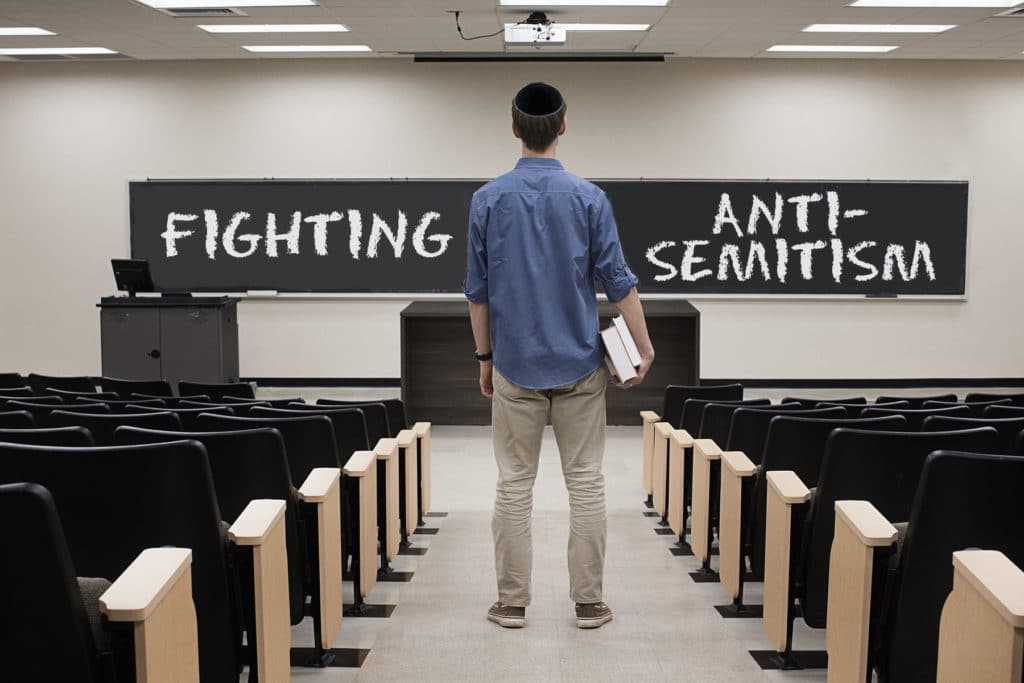
How Jewish Students Are Combatting Anti-Semitism on Campus: A Panel

Max Price unexpectedly found himself in the news lately. The junior at Tufts University, majoring in international relations and economics, is a member of the school’s Community Union Judiciary (CUJ). In that role, he objected to anti-Semitic wording in an initiative brought by Students for Justice in Palestine (SJP), which linked “racist conduct” by law enforcement to white supremacy and Israel.

His objections led to other members of the CUJ attempting to impeach him. He was also subjected to a stream of anti-Semitic harassment. The impeachment attempt was finally withdrawn, but Price says the administration has done nothing other than to claim, ‘We take harassment seriously.’”

College anti-Semitism is alive and seething, likely at a university near you. Brave Jewish students who find themselves in its crosshairs are making a difference, although it can be exhausting. Five such students, including Price, shared their experiences with on-campus anti-Semitism during a riveting panel discussion on March 2. Nearly 550 people tuned in to the discussion, hosted on the Clubhouse app and moderated by Bari Weiss, a former writer and editor at the New York Times. Weiss quit the Times in 2020 over the extremes of political correctness and even anti-Semitism in the organization that she said made her work impossible. She now publishes on Substack and Jewish outlets.

At the University of Bristol in the United Kingdom, Sabrina Miller started her activism after the administration sat on its hands when sociology professor David Miller was heard in a YouTube video saying that “the enemy we face here is Zionism.”  He later doubled down on his comments, calling Zionism a “racist, violent, imperialist ideology premised on ethnic cleansing.”  In February, Sabrina gathered more than 7,000 signatures on a petition calling for Miller’s dismissal resulting in her Twitter account being deluged with malicious comments and accusations.

Isaac de Castro, a Panamanian citizen, had hoped to be a regular student at Cornell, but he said that anti-Semitism had even leached into his architecture classes; on campuses, Zionism is equated with colonialism, oppression, police brutality and other evils. Tired of feeling silenced, de Castro founded Jewish on Campus, an Instagram account that records stories of Jewish students from around the United States who have also encountered anti-Semitism at school.

Adela Cojab, born in Mexico City, did not expect campus anti-Semitism at NYU,  but as president of the pro-Israel group Realize Israel, she faced an apathetic administration that told her she was “overreacting” despite an onslaught of anti-Semitic events: anti-Israel resolutions on campus, attacks on social media, boycotts against Israel and, most dramatically, anti-Israel students burning Israeli flags and assaulting a freshman student at a 2018 Yom Ha’Atzmaut event.

“The administration was going to act ‘quietly,’” Cojab recalled. “But Jewish students were scared. The administration not only didn’t discipline the group responsible but gave them the president’s service award for contributions to NYU life.” So, two months before she graduated in 2019, Cojab filed suit against NYU over the school’s failure to protect Jewish students. She was soon called by the White House, and President Trump signed an executive order expanding the definition of Title 6, adding language stipulating that Judaism also falls under the definition of the “shared ancestry” protected by Title 6.

When Blake Flayton started at George Washington University, he “was very excited to go to protests, to make friends in the progressive movements and be involved with the liberal pulse of the Trump era,” he said. Soon, though, he heard comments about the IDF being responsible for killing babies. “Maybe I was brainwashed, but even though I was uncomfortable, I joined in until I realized that Israel was important to me. I saw the institutional anti-Semitism in these groups. The largest LGBTQ advocacy group openly opposed any group connected with Hillel or Israel.”

“I saw the institutional anti-Semitism in these groups.”

Flayton’s breaking point was hearing a student talk about bombing Israel as a piece of s***. He read Weiss’s book, “How to Fight Anti-Semitism,” and sent her an email; Weiss encouraged him to develop an op-ed for the Times. After his piece was published, not a single professor asked him about the alarming experiences he had written about. “My pro-Jewish advocacy began as less as a defense of my own people and more of a social justice drive. The left’s policies are regressive, pitting people against each other,” he said. He also noted that this same ideology spills out into politics and corporations, making this advocacy crucial.

Weiss asked the panel why Jews didn’t count as individuals worthy of respect on campus. “In a hierarchy of oppression, Jews are not included,” Flayton explained. “You can say anything about the Jewish state and people, you can ban Jews from your organization, and it’s seen as punching up in the social justice hierarchy.” The dynamic creates a binary option: you are either a victim or a victimizer.

Miller added that people asked her why she was upset about anti-Semitism. “What about the Palestinians?” they’d counter. Cojab added that much of today’s progressivism on campus is a cover for anti-Semitism and Israel bashing; “At NYU, even resolutions about fossil fuels morph into an anti-Israel condemnation. You connect the worst thing in society with Zionism and Jews,” she said.

Panelists said that the best thing Jewish students could do was to “claim their space,” both in Jewish activism and beyond. But standing up to these circumstances is not for everyone. If you have to self-censor or explain yourself over and over again, it’s worth considering other options for higher education, such as going to university in Israel, de Castro said.

Max Price said, “I want to live in a world where my kids should be able to go to school wherever they want without fear. This is dirty work, and I don’t blame anyone for not wanting to keep fighting. Being Jewish in itself is an act of bravery.”


Judy Gruen is a writer and editor. Her books include “The Skeptic and the Rabbi: Falling in Love with Faith.”


How Jewish Students Are Combatting Anti-Semitism on Campus: A Panel Read More »

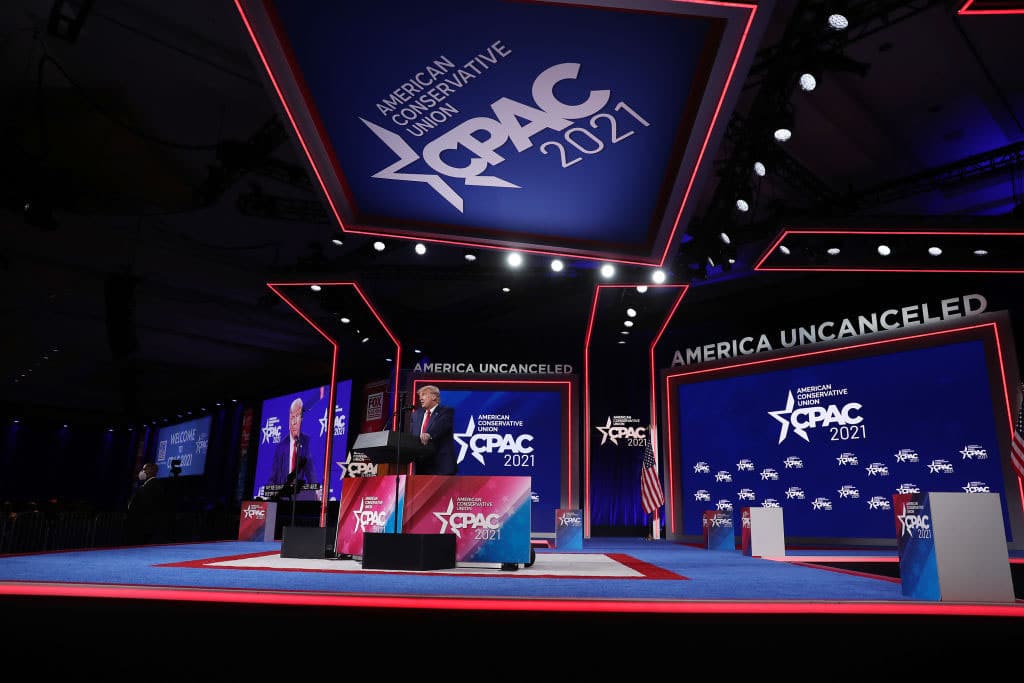
CPAC Stage Designer Says They Didn’t Know That Stage Looked Like Nazi Symbol

The company that designed the stage for the Conservative Political Action Conference (CPAC) in Florida told The Forward that they didn’t know that the stage design looked like a Nazi symbol.

The stage went viral on social media after some noticed that it resembled a Nazi rune symbol. The company, Design Foundry, told The Forward that they “had no idea that the design resembled any symbol, nor was there any intention to create something that did.” They added that they were simply trying “to provide the best use of space, given the constraints of the ballroom and social distancing requirements” and were “horrified” at the allegations that they intentionally used a Nazi symbol for the stage.

“Design Foundry denounces all hate speech and acts of racism, prejudice, or bigotry in all forms,” the company said.

Ian Walter, communications director for the American Conservative Union (ACU), which heads CPAC, also told The Forward that they will not be retaining the Design Foundry for stage designs going forward.

“ACU and CPAC have no interest in promoting antisemitism from our stage, whether it’s what happens on the stage or the design of the stage itself,” Walters said. “It’s clear that the company we retained designed a stage that has become an unwelcome distraction.”

It was subsequently reported that Design Foundry has also worked for the Biden Cancer Summit and MSNBC.

https://twitter.com/Breaking911/status/1367121725952057350


Journalist Yashar Ali tweeted that he knows that the owner of Design Foundry “is very liberal and was so excited for Biden’s victory” and that a lot of their employees are liberal.

“Now an event company, which is a liberal owned and run small business, is associated with a horrific allegation that is based on conspiracies and no evidence,” he added.


Mike Rothschild, an avowed liberal Jew who writes about conspiracy theories, similarly tweeted, “It’s clear that Design Foundry designed the stage, the ACU approved it, and it wasn’t meant to look like a Nazi rune. Now can we please go back to hating CPAC for its ideas, not its stage design?”


According to The Forward, under the terms of the ACU’s contract with Design Foundry, the ACU approved the design as one of several options, but couldn’t alter the state designs themselves.

The Hyatt Regency Orlando, where CPAC was held, also issued a statement saying that they had told CPAC about the Nazi symbolism and were told that the comparison wasn’t intentional. They added that it “became clear to us only after the event kicked off” and that any attempt to form a new stage during the conference would have been “disruptive.” CPAC’s attorney responded with a letter to Hyatt accusing them of making defamatory statements toward CPAC and asserted that Hyatt “approved and worked collaboratively to build this stage.”

CPAC Stage Designer Says They Didn’t Know That Stage Looked Like Nazi Symbol Read More »

A Response to Gil Troy: The Successful Conservative Movement

To read Gil Troy’s original article, click here.
To read Gil Troy’s counterpoint to this response, click here.

In his recent article, titled “The Non-Negotiable Judaism My Parents Gave Me,” Gil Troy laments the “collapse” of American Conservative Judaism and the overall failure of the Conservative movement. He takes the fact that by 2017, just 16% of American Jews identified as Conservative (compared to the time when it was the major movement in America) as proof of its failure. However, I disagree. I believe the movement did exactly what it was meant to do, even though it did not visualize the critical role it would have in ensuring the growth of traditional Judaism in the United States.

It is clear that the movement has been decreasing in strength and importance for some time. As early as the late 1970s, when I was Midwest regional president of United Synagogue of America (the congregational arm of the movement), I, along with Dr. Saul Shapiro (z”l), a senior statistical analyst for IBM and regional president of the Metropolitan New York Region, conducted a survey of 10% of the movement’s member families in the United States and Canada. Our goal was to find out enough about the religious practices and aspirations of the movement’s membership to chart a program for the continued growth of what was then the largest religious movement in the North American Jewish community.

The results of the survey were devastating. We were able to show, with a high degree of statistical accuracy, that the movement in the United States had no long-term capacity to replicate itself. We found that while many adult members of the movement came from more observant backgrounds, in the absence of any long-term commitment to religious observance, they had not been able to convey the same level of religious feeling to their children. As Troy’s article rightly points out, the movement was, and remains, composed mainly of observant clerical leadership with very few observant lay followers, even among the lay leadership itself.

I recall speaking in 1979 at Chicago’s Rodfei Zedek Congregation, a pillar of Conservative Judaism on the South Side, and being introduced not only by my title but also as “a Sabbath-observant Jew” — as if this were a novelty. At the time, I remarked to the assemblage that our future as a movement was bleak indeed, when it could not be taken for granted that the lay leadership was observant.

In an article which I penned for Commentary magazine in 1984, I predicted that, as a result of this dichotomous situation, the traditionalists in the movement would move to the modern Orthodox camp while the reformists and those anxious for further change would move toward the Reform movement, which, itself, would become more traditional. All that, of course, has occurred, although modern Orthodoxy is also in danger of being challenged as not sufficiently observant, at least in the eyes of the ultra-Orthodox. The continued reluctance of the movement to have taken unequivocal stands on major issues of religious import, coupled with the desire to be all things to all people, in the end, simply accelerated the defection of the movement’s members.

So in light of all of this, why do I believe the movement was a success? Because the movement should be acknowledged by one and all, especially by today’s Orthodox, as having been a transitional movement that “conserved” American Judaism for the ultimate resurgence of Orthodoxy. Recall that at the end of World War II, nobody thought there was a future for Orthodoxy any longer. The Holocaust had decimated the religious communities of Europe; American Jewry was suburbanizing itself with little interest in traditional observance; and those who arrived in Israel from Europe were little more than a thread of Orthodoxy.

It should be acknowledged as a transitional movement that “conserved” American Judaism for the ultimate resurgence of Orthodoxy.

What the Conservative movement did do, and for which it should be eternally proud, is establish a framework in which American Jews could hold on to their connection with traditional Judaism while being permitted to live a lifestyle concomitant with the social mores of the times. To accomplish this, the movement established large synagogue/community-center complexes, encouraged family prayer and organized a successful youth program, United Synagogue Youth (USY), a first-rate Hebrew-speaking camping experience (the Ramah Camps) and an Americanized day school system (the Solomon Schechter Schools). Thirty years later, when Orthodoxy began to take hold once again and increased learning and observance became the norm, there were Jews in America for Orthodoxy to recruit.

One would be very surprised to find how many leaders of modern Orthodox synagogues in America grew up in Conservative homes. Sitting around the Shabbat table in Los Angeles some years ago at the shalom zachor of our youngest grandson, I noted that 80% of the people there, all members of Orthodox congregations in Los Angeles’s Pico-Robertson area, grew up in Conservative congregations. The Conservative movement deserves accolades for holding the middle ground during an era of religious uncertainty.

As far as the Conservative movement is concerned, it should admit that it was indeed a transitional movement and that, as we have seen over the last years, it is a shrinking  element of the mosaic that is American Judaism. Nevertheless, it need not be ashamed of what it accomplished during a most difficult period in American Jewish life.

Gil Troy, along with me and many others who now live modern Orthodox lives, represent the success of that movement which was, for want of a better title, a product of its times.


Sherwin Pomerantz was formerly chairperson of the Council of Regional Presidents and a national vice president of the United Synagogue of America. He currently serves as president of Congregation Ohel Nechama, an Orthodox synagogue in Jerusalem’s Katamon neighborhood.

A Response to Gil Troy: The Successful Conservative Movement Read More »

In the Spirit of Debate: My Response to Pomerantz

To read Gil Troy’s original post, click here.
To read Sherwin Pomerantz’s response, click here.

Today’s thin-skinned culture demands that I be offended that Sherwin Pomerantz “disagreed” with my recent article, “The Non-Negotiable Judaism My Parents Gave Me.” But his response thrilled me, even if half his argument misfires.

I hoped my article would trigger debate — rather than be squashed by Conservative Jewry’s powers that be. Many have spent the last half-century demonizing anyone who dared to yell that the Conservative Emperor had no clothes — that American Jewry’s once-reigning religious movement had lost its way ideologically and theologically, not just demographically. So I thank Pomerantz for his serious, thought-provoking response.

I also deeply appreciate the many heartfelt — often anguished — responses I have received since the Jewish Journal published my article. Those of us who grew up in the Conservative movement and went Zionist or Orthodox or both don’t delight in Conservatism’s drift; most of us lament its inability to inspire others as it inspired us.

So, yes, I agree with Pomerantz that mid-century Conservative Jews’ central failure was that “in the absence of any long-term commitment to religious observance, they had not been able to convey the same level of religious feeling to their children.” Traditionally, Jews alternated between fearing God and fearing anti-Semites; in the Conservative world my parents raised me in, many leaders feared their congregants, and most congregants feared their kids. As I argued in my essay, the constant defensive worry about whether “they” will show up or stay Jewish put too many people on guilt trips without launching enough satisfying, sustaining Jewish journeys, guided by a bedrock faith in God or a non-negotiable commitment to Jewish peoplehood and the State of Israel.

Tragically, as more people drifted away, rather than having the deep, soul-searching, self-critical debate they needed about where they went wrong, too many Conservative rabbis and leaders tended to ask what was wrong with anyone who asked such questions. Before the coronavirus, you could witness what these decades of denial wrought in the many empty seats every Saturday morning, which turned American Jewry’s grandest cathedrals into Grand Canyons.

As more people drifted away, too many Conservative rabbis and leaders tended to ask what was wrong with anyone who asked such questions.

Pomerantz and I part ways in two critical junctures. First, he should beware of an uncalled-for Orthodox triumphalism celebrating Conservatism’s collapse. The numbers of religious Jews in America and Israel are quite sobering, too. Only 10% of American Jews are Orthodox — with a mere three percent identifying as “Modern Orthodox.” The 2013 Pew study reported that half of those raised Orthodox abandoned it — although retention rates among younger Orthodox Jews are improving. The Jewish Virtual Library reports that of Israeli Jews over 20 in 2020, only 11% identify as religious while 10% are ultra-Orthodox.

Most categorically, I reject Pomerantz’s claim that the Conservative movement succeeded as “a transitional movement that ‘conserved’ American Judaism for the ultimate resurgence of Orthodoxy.” That argument disrespects Conservative Judaism’s mission to serve as a sustainable form of Jewish life. Pomerantz’s conclusion is like deciding the Boston Red Sox succeeded by cultivating Babe Ruth’s hitting skills before trading him to the New York Yankees, or that Americans appreciated the military experience they gave Benedict Arnold before he switched over to the British.

This “Conservadoxing” phenomenon Pomerantz toasts is also quite marginal overall. Although Pew tracked the dramatic drift from Orthodox to Conservative to Reform to unaffiliated to intermarried, the researchers found very little “switching in the opposite direction. For example, just 7% of Jews raised in the Reform movement have become Conservative or Orthodox, and just 4% of those raised in Conservative Judaism have become Orthodox.”

Jewish historians know that over the millennia, many more Jews left the fold voluntarily by assimilating rather than being bullied or killed by Jew-haters — by many orders of magnitude. And American historians know that over the decades, the lure of America’s New World identity has weakened most Americans’ Old World ethnic and religious ties. Therefore, the challenge from my parents, from the serious Conservative movement of my youth and from my article remains: What positive vision of old-new Pilates Jewishness, strong at its core, shaped by non-negotiable bottom lines, will work — not to keep our kids Jewish out of guilt, but to keep them doing Jewish regularly, meaningfully, out of their own pride and passion?

I warmly invite Sherwin Pomerantz for coffee as a fellow Jerusalemite, where we can toast the most wildly successful modern experiment in keeping Jews Jewish — from generation to generation, be they secular or religious — Zionism!


Recently designated one of Algemeiner’s J-100, one of the top 100 people “positively influencing Jewish life,” Gil Troy is a Distinguished Scholar of North American History at McGill University, and the author of nine books on American History and three books on Zionism. His book, “Never Alone: Prison, Politics and My People,” co-authored with Natan Sharansky, was just published by PublicAffairs of Hachette.

In the Spirit of Debate: My Response to Pomerantz Read More »