fbpx

February 25, 2021

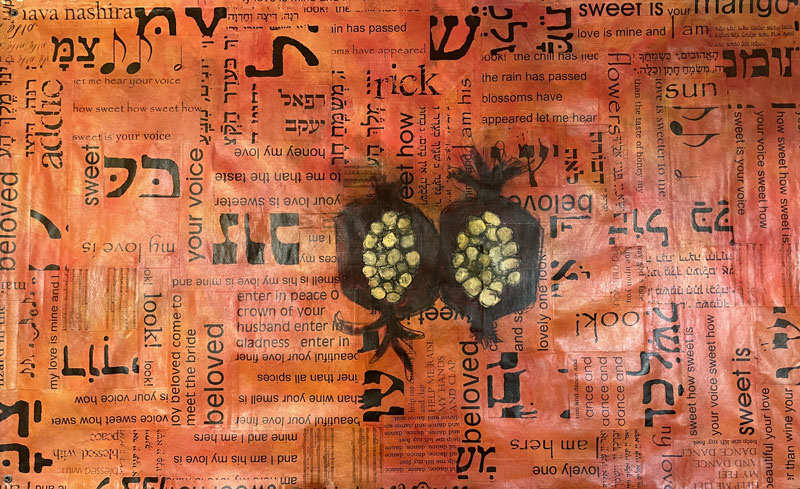
Punica Granatum — A poem for Torah Portion Tetzaveh

And on its bottom hem you shall make pomegranates
Exodus 28:33

In our home, which will, soon
no longer be our home, we planted
Biblical fruits in all the available spaces.

The pomegranate is the only one
still with us. The poor almond tree
first a feast for the possums –

rarely allowing us a taste despite
its many blossoms, eventually fell over.
We never saw the possum after that.

I’d like to include the kumquat tree
but despite all my knowledge of the Torah
I can’t find it represented in the text.

Which leaves the pomegranate.
It thrives in our front yard and we
even manage to eat a few before

God’s creatures take the rest away.
It makes us feel like good Jews and
reminds us of the holy woman from

Fargo, North Dakota, who painted
two of the beauties in the middle of
our Chupah so we could stand under them

and proclaim our forever love.
We think the new house has a lemon tree
and we’re hoping that’s okay with the Lord.

We’re willing to sew whatever is
necessary into our garments
like they did at the beginning

when all the rules were written down.
Our sleeveless robes, our linen pants
covering the awkwardness of our flesh.

We’d like to get this right so
an ancient priest doesn’t have to
bear all the burden.


God Wrestler: a poem for every Torah Portion by Rick LupertLos Angeles poet Rick Lupert created the Poetry Super Highway (an online publication and resource for poets), and hosted the Cobalt Cafe weekly poetry reading for almost 21 years. He’s authored 25 collections of poetry, including “God Wrestler: A Poem for Every Torah Portion“, “I’m a Jew, Are You” (Jewish themed poems) and “Feeding Holy Cats” (Poetry written while a staff member on the first Birthright Israel trip), and most recently “The Tokyo-Van Nuys Express” (Poems written in Japan – Ain’t Got No Press, August 2020) and edited the anthologies “Ekphrastia Gone Wild”, “A Poet’s Haggadah”, and “The Night Goes on All Night.” He writes the daily web comic “Cat and Banana” with fellow Los Angeles poet Brendan Constantine. He’s widely published and reads his poetry wherever they let him.

Punica Granatum — A poem for Torah Portion Tetzaveh Read More »

Jesse Gabriel Provides Update on Ethnic Studies Curriculum

California State Assemblymember Jesse Gabriel, a Democrat, provided the Jewish community with an update on the Ethnic Studies Model Curriculum (ESMC) during a February 24 webinar.

Speaking with Tye Gregory, executive director of the San Francisco-based Jewish Community Relations Council (JCRC), Gabriel began the webinar by stating that a recent article in Tablet about the ESMC was inaccurate and out of context.

“We had a deeply problematic first draft,” he said, arguing that the first draft contained “anti-Israel, anti-Semitic content,” which was “absolutely unacceptable.” Gabriel pointed out that the first draft was written “by a small group of people with some very problematic views,” so much so that The Los Angeles Times editorial board slammed it and California Governor Gavin Newsom, a Democrat, apologized for it. “We were able to push pause on that process and get it restarted,” Gabriel said.

The current iteration of the ESMC no longer has any pro-Boycott, Divestment and Sanctions (BDS) material and now has two lesson plans about the Jewish experience and teaches the International Holocaust Remembrance Alliance (IHRA) definition of anti-Semitism. Gabriel pointed out that the draft’s latest revisions have caused the original authors to ask for their names to be taken off of it. “That to me is one marker for how much the curriculum has changed from that really problematic first draft,” Gabriel said.

Additionally, Gabriel said that guardrails are being implemented to ensure that the state Department of Education will go after local school boards that adopt the first version of the ESMC. It’s important to explain to people that “we can’t have content that promotes bigotry and discrimination against Jews,” Gabriel said.

The final ESMC draft, which has a March 31 deadline to be approved by the State Board of Education, needs to be created by a consensus “that honors 90-95% of California,” Gabriel argued. He also said that he hopes “we can get to a good place with this curriculum” and believes that “this is the end of the beginning.”

Jesse Gabriel Provides Update on Ethnic Studies Curriculum Read More »

Pandemic Purim Brings Home the Value of Humility

It’s bizarre how last year’s Purim holiday and this year’s share a similar level of anxiety. Last year, many of us were nervous about the first signs of the COVID-19 virus. Who knew it would turn into the biggest public health crisis of our time?

This year, although a miracle vaccine is giving us hope, a level of anxiety remains: possibly dangerous variants, permanent damage to the economy, an uncertain, Zoom-obsessed future, continued restrictions, and so on.

These insecurities clash with the traditional “in your face” attitude we bring to holidays like Purim, which celebrate epic Jewish victories. These victory celebrations are usually one-dimensional: Our survival was threatened, and against all odds and with the help of miracles, we prevailed.

This core simplicity allows us to celebrate with abandon, without any reservation or ambivalence.

The pandemic, however, has thrown us off balance. Is it safe to go party at the synagogue and hear the Megillah? Will we be allowed to dance? Should we let the children go?

We’ve never had these insecurities. Throughout our lifetimes, especially in America, we’ve marched proudly into synagogues, worrying more about where we would sit than whether it’s safe to sit.

These unpleasant insecurities, however, carry hidden blessings. They serve as a cautionary tale against the simplified narrative of one-dimensional victories.

Purim serves as a cautionary tale against the simplified narrative of one-dimensional victories.

Victories, by their very nature, can arouse cockiness and complacency — a feeling of inevitable invincibility. When we teach biblical stories to our kids, it’s natural to highlight these victories and the heroic conclusion that Jews ultimately prevail. Holidays such as Purim and Chanukah turn epic victories into permanent icons of the Jewish experience.

But it’s easy to go overboard. This is particularly true at Purim, when a Talmudic edict calls on us to get so drunk that “one can’t tell the difference between ‘blessed be Mordecai’ or ‘cursed be Haman.’” Purim turns reality upside down. We wear costumes. We boo our foes. We pile on.

This past year, however, it is reality that has piled on, that has put its foot on our necks, that has isolated us and kept us from hugging our loved ones, that has turned our society and lives upside down.

Tonight, those of us who will walk into a socially-distanced space to hear the Megillah will likely experience a very different Purim — a Purim much more sober than the wild parties we are used to.

In that sobriety is a lesson in humility and a reaffirmation of our humanity. No matter how epic our victories, ancient or modern, we can never lose our appreciation for simple blessings, or let our guards down, or abuse the ritual of drinking alcohol or forget that even our foes are created in God’s image.

We’ve had two consecutive Purims to internalize these lessons. That is a spiritual victory for our time.

Pandemic Purim Brings Home the Value of Humility Read More »

A Moment in Time: Purim – Because One Voice CAN Make a Difference

Dear all,

(The above photo is NOT directly related to my Moment in Time: But it IS from our Purim Carnival a few years back!)

Tonight we celebrate the Festival of Purim, recalling the Biblical story when evil Haman attempted to annihilate the Jew of ancient Persia. The word “Purim” itself means, “lots” – as in drawing lots. According to the text, the date for slaughtering the Jews was randomly chosen.

But our story teaches that we can’t live our lives by random acts. Esther, a Jewish woman who married the King (encouraged by her uncle, Mordechai) found her voice. She raised it, and altered the course of history by speaking out with purpose – ultimately preventing the destruction of our people.

Purim teaches that in the face of random circumstances beyond our control, we have the opportunity to find our moment in time to show that one voice can shape the future with purpose and with light.

Chag Purim Sameach! (Happy Purim!)

Rabbi Zach Shapiro

A Moment in Time: Purim – Because One Voice CAN Make a Difference Read More »

Amos Oz: A Posthumous Tragedy

Long before I became a rabbi and a scholar, my first encounter with mystical texts was through the early prose of Amos Oz. It included seminal and soul-stirring stories such as “Unto Death,” a mystical story about the Crusades; “Late Love,” a riveting tale about cosmic longings and universal solitude; and “Touch the Water, Touch the Wind,” a metaphysical novel about genius and survival.

Enchanted and bewitched by Oz’s verbal virtuosity, I wrote to him from London — my place of residence at the time — and Oz responded to me with depth and generosity of heart. Later on, we were able to briefly interact in person during one of my summer visits to Israel.

Amos Oz was an injured soul. His mother took her own life when he was twelve, and his relationship with his father was thereafter severed for life. As an orphan, Oz moved to a kibbutz, changed his name and turned his inner pain into literary genius. Oz passed away in December 2018, at the age of seventy nine, after a battle with cancer. He authored more than thirty books, was translated into thirty five languages and was the recipient of numerous national and international awards. He was shortlisted several times for the Nobel Prize in literature.

Amos Oz was also, in the eyes of many, the beautiful Israeli. A secular prophet of left-wing Zionism, he was a stunning combination of world-class literary genius, humanistic conscience, overflowing charisma and dazzling external beauty. Rabbi Lord Jonathan Sacks called Amos Oz “The most expressive man I ever met.”

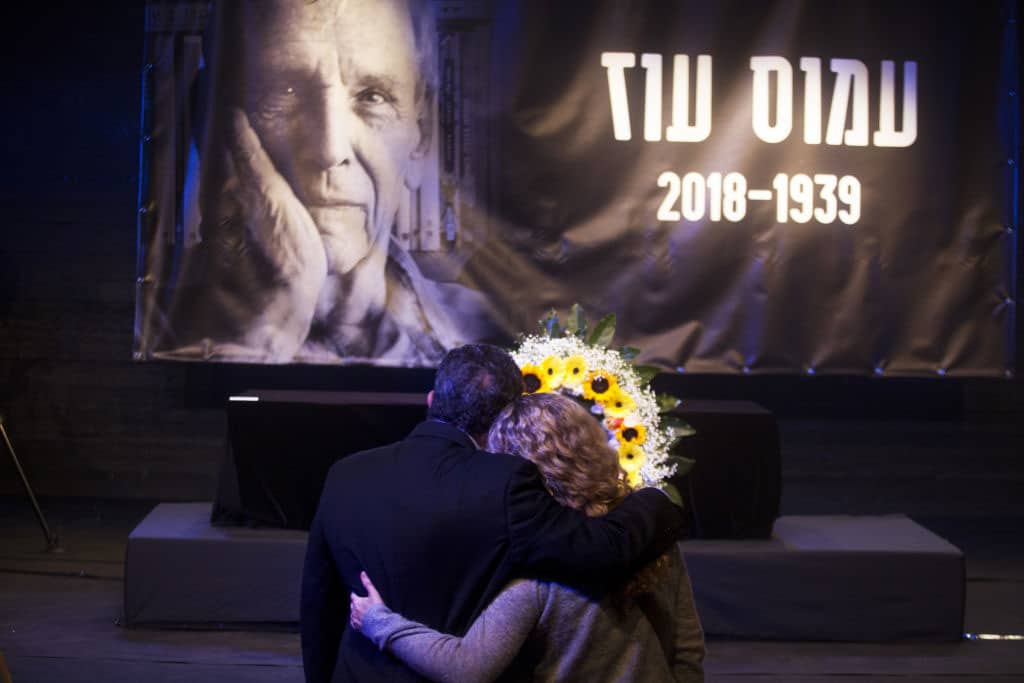
Earlier this week, Oz’s second daughter, Galia Oz, published a scathing memoir in which she accuses her late father of systemic physical and verbal abuse throughout her childhood. She also claims to have witnessed her father beating her mother in front of her on a couple of occasions.

This sordid affair facilitated a veritable cultural earthquake in Israel this week. The dissonance between Oz’s external persona and the accusations leveled against him by his own daughter is simply mind-numbing and heart crushing.

Oz’s widow, Mrs. Nili Oz, and Oz’s two other children, Fania and Daniel, recall an “astoundingly different” father and husband — loving, attuned, sensitive and caring. However, they will not explicitly deny the veracity of the claims made by their sister Galia.

This is an unspeakable tragedy — first and foremost for Galia Oz and the entire Oz family and secondarily for all those who loved and admired this unique artist and visionary. It is also a stunning real-life parable about the prospective darkness inherent in the human soul and the complexities of man.

It is a stunning real-life parable about the prospective darkness inherent in the human soul.

Ten Passovers ago, my friend and colleague Rabbi David Wolpe delivered an existentially ingenious sermon entitled “Brokenness.” In this sermon, Wolpe spoke about how we humans hide pervasive facets of our lives from others at times. The problem with that, reminded Wolpe, is that “if you hide — then no one will know you.” Wolpe went on to say that our cultural heroes of decades past were akin to “untarnished gods,” but that “it is better now,” when we can see our heroes in their all-too-human three-dimensional existence.

Finally, teaches Rabbi Wolpe, the antidote to brokenness (and we are all broken to varying degrees, and we all have facets of ourselves that we are not too proud of to varying degrees) “is acceptance, is love.”

Galia Oz says she wrote her shocking memoir for two reasons. First — to empower other people who grew up in similar life circumstances to cope better, to break the prison of their silence and to come to grips with their trauma and pain. Second — Galia Oz felt that her parents utterly declined to recognize her pain and its validity. Her mother told her that she had “an ordinary childhood.” It is not for us to judge the dynamics of the Oz family, nor is it our business to do so. Having said that, there is a universal lesson to be learned here about the intricacies of the human condition.

When Oprah Winfrey finished her show, she was asked what she learned about humanity after having conversed with people from all walks of life. Oprah responded by saying: “I learned that everybody has a story and that everybody wants to be heard.”

Philosopher Charles Taylor has written much about recognition in a cultural context. Recognition is also oxygen for the soul on the interpersonal realm. Perhaps this whole fiasco would not have transpired had Galia Oz felt that her pain was genuinely and compassionately recognized and lovingly affirmed by her parents.

For as Rabbi Wolpe taught us, the antidote to our brokenness and pain — to what Nietzsche called “the wound of existence” — the antidote to emotive suffering “is acceptance, is love.”


Rabbi Tal Sessler, Ph.D., is the author of four books in philosophy and contemporary Jewish identity. He is the Senior Rabbi of Sephardic Temple Tifereth Israel, and the incoming Dean of the Rabbinical School at the Academy for Jewish Religion in California, where he also teaches Jewish philosophy.

Amos Oz: A Posthumous Tragedy Read More »

My Purim Rabbi’s Hat

I liked the Rabbi’s hat I put on when Parashat Mishpatim needed a commentary that my Rabbis were about to miss. Now, when Purim is about to descend upon us, I feel compelled to put on my Rabbi’s hat again.

Throughout my upbringing — and I am sure it has been the same for you — Purim meant fun, parties, clowns, masks and noise makers (groggers), a sort of Jewish Halloween, save for the costumes being less scary and a bit more civilized.

In the past few years, however, I have come to see a profoundly personal meaning in the story of Purim, especially in this powerful message that Mordecai sends to Queen Esther: “Do not imagine that you, of all the Jews, will escape with your life by being in the King’s palace” says Mordecai. “For, if you keep silent in this crisis, relief and deliverance will come to the Jews from another quarter, while you and your father’s house will perish. And who knows, perhaps you have attained to royal position for just such a crisis.”

It has been several years now that this breathtaking message of Mordecai, not the Purim parties, has come to my mind whenever the story of Purim is narrated. So much so, that I began chanting it to myself whenever I had to utter words or take action that involved risking career opportunities or social acceptance. Personally, I have drawn tremendous courage from the fantasy that some 2,600 years ago, a wise Jew experienced a similar predicament and concluded that the decision was not entirely theirs: “Who knows, perhaps you were destined for this very moment.”

More recently, since the rise of academic McCarthism, I have started using Mordecai’s words on friends and colleagues who remain silent upon seeing their students intimidated by BDS cronies or seeing their junior colleagues “cancelled” or interrogated by various vice-squads.

Mordecai’s words resonate in my ears when I explain to colleagues: “We owe our academic stature to many who spoke out in such crises before. It’s now time for us to pay back our debt to the community by making our voices heard, despite the risks involved, or we’ll all perish.”

It’s now time for us to pay back our debt to the community by making our voices heard, despite the risks involved, or we’ll all perish.

I remind my academic friends that only 60 years ago, Ivy League universities had quotas on Jewish enrollment, and that these quotas were lifted by hard-working members of the Jewish community, many of them volunteers, who wrote letters, petitioned lawmakers and pressured university administrators to make admission equitable to all. Those volunteers expected our voices to be heard in the protection of their great-grandchildren on college campuses, currently facing the worst crisis since the days of quotas.

And it goes way beyond academia — be it business, arts, writing or the law, we owe part of our professional success to community support, and such support comes with expectation and responsibilities. We are expected to make our voices heard in support of those who are more vulnerable to the storm.

And when we hesitate, let us remember Mordecai’s words: “And who knows, perhaps you have attained to royal position for just such a crisis.”


Judea Pearl is a UCLA professor and president of the Daniel Pearl Foundation (www.danielpearl.org), named after his son. He and his wife, Ruth, are editors of “I Am Jewish: Personal Reflections Inspired by the Last Words of Daniel Pearl” (Jewish Light, 2004), winner of the National Jewish Book Award.

My Purim Rabbi’s Hat Read More »

Purim and The Risk of Isolation

(Israel Policy Forum) — Purim begins tonight, and as so often tends to happen, the arrival of this unique holiday has me thinking about what the Book of Esther tells us about what we see today. Jews’ embrace of Purim in the U.S. and Israel is very different. Here, it is seen as a triumphal Diaspora story, taking place entirely outside of the Land of Israel and telling the tale of a Jewish minority at the whims of an antisemitic regime turning the tables on its oppressors. In Israel, while it has turned into something of an excuse for bacchanalian partying, the Purim story and the absence of any mention of God in the Book of Esther resonates because it shows the possibility of making one’s own miracles happen without direct divine intervention, an obvious parallel to Zionism and Israel’s creation. These are both logical readings of Esther, but the fact that they are such different readings reinforces a point about Israeli Jews and North American Jews that one can see in Esther itself.

The Diasporic nature of the Book of Esther and the fact that it is the only book in the Tanakh (the Jewish canon) with not one mention of God are noted ad infinitum. What is perhaps as striking though is that Esther tells the story of a Jewish community that is thoroughly self-contained and cut off from its Jewish brethren anywhere else. Without knowing anything about Jewish history and only reading the text of Esther, one would assume that this is the only Jewish community that exists on the face of the earth. While the evil grand vizier Haman’s initial genocidal pitch to King Ahashverosh is that the Jews are “scattered and dispersed among the other peoples,” he confines this to the different nations living in Ahashverosh’s kingdom. It would make sense that Haman is focused only on the Jews living in a realm over which he has influence, but the Jews themselves in the story give no indication that they are not alone in the world.

The only mention of a Jewish historical presence anywhere beyond the kingdom’s borders is that Mordechai, the other hero of the Purim story alongside his younger cousin Esther, had a great grandfather who was exiled from Jerusalem. Despite the fact that, based on Mordechai’s genealogy, the Purim story takes place after Cyrus the Great allowed the exiled Jews to return to Israel, there is no indication in Esther that anyone has gone back or even a hint that anyone wants to. When the decree is issued to annihilate the Jews, there is no mention of Jews trying to flee, appealing to Jews elsewhere in the world, or deciding that perhaps now would be a good time to go back to their ancestral homeland. There is no talk of seeking outside help, no talk of leaving, and no discernible regret that these Jews who were only decades removed from sovereignty in their own land no longer have it. And once the tables have been turned and Mordechai and Esther send forth missives recounting the events and instructing Jews to commemorate them through celebrating this new holiday, they confine this request to Jews in Ahashverosh’s kingdom. If there is anyone beyond these borders who may be interested— including the Jews who left Persia to return to Israel—we are never told.

Even in the context of the Book of Esther’s universe, the Jews in the story are remarkably cloistered from each other. While the decree to annihilate the Jews applies across Ahashverosh’s entire empire, we are told only about the reaction of the Jews in the capital of Shushan. After Mordechai informs Esther of the decree to which her royal husband has given his blessing, Esther’s reaction is to ask Mordechai not to rally the Jews across the Persian Empire for three days of fasting, but only the Jews of Shushan, as if this group is operating independently of the other Persian Jews. Haman’s charge that the Jews are scattered and dispersed amongst their neighbors seems only a partial observation; the Jews appear to be scattered and dispersed from each other as well.

Ultimately, Esther tells a story of victory, but it also tells a story of tragedy. It is the tragedy of Jews who are cut off from their fellow Jews, and the figurative poverty of a self-contained community living in isolation. That Esther triumphed is a combination of her ingenuity and a heavy dose of luck. The seemingly obvious, albeit depressing, answer for Persia’s Jews is to head to Israel, but that option seemingly does not exist. Rather than rely on a solitary Jew whom nobody even knows is Jewish to save everyone, perhaps the Jews across these 127 states and territories should have coordinated together, but that does not happen until after the fact. Every group is in its own bubble, not relying on each other or realizing that one of their great strengths may be a larger Jewish people that exists beyond the walls of their own houses, or cities, or countries.

There are lessons here for contemporary politics and Jews on both sides of the ocean. For Jews in the Diaspora, it isn’t just a commentary on the fragility and vulnerability of Jewish existence, which is the most common takeaway, but the specific dangers for Jews and Jewish life who are cut off from Israel and Jewish sovereignty. There are increasing numbers of American Jews who not only feel no emotional connection to Israel but see no value to their own lives in Israel’s continued existence. Esther is the story of a community of Diaspora Jews who appear to evince similar feelings, and while everything turned out alright in the end, it was an awfully risky roll of the dice.

There are increasing numbers of American Jews who not only feel no emotional connection to Israel but see no value to their own lives in Israel’s continued existence.

For Israeli Jews, there is a reminder that Jews do better as a cohesive group than they do when they abandon their own for one reason or another. We are about to enter another period that will be marked by much arguing over the best approach to Iran, and Israeli Jews are almost certainly going to feel as if they are better off ignoring their American cousins and that they have nothing in common with Jews who do not share their precise concerns. The Jews of Shushan would have been better served by reaching out to other Persian Jews; the Jews of Persia would have been better served by remembering that there were Jews outside of the empire who would have welcomed them with open arms. Going even further afield than the wider community of Jews around the world, there is yet another lesson here about the benefits of cooperation when you work with the king or the superpower rather than trying to work against it, but that is a different can of worms.

Purim is a holiday of celebration, but amidst the merriment, plenty of warnings abound as well. If we take anything away from Purim this year, it should be that Jews do much better together than they do when they are apart.


Michael Koplow is Israel Policy Forum’s policy director, based in Washington, DC. To contact Michael, please email him at mkoplow@ipforum.org.

Purim and The Risk of Isolation Read More »

Rosner’s Torah Talk: Parshat Tetzaveh with Avi Hoffman

This week’s Torah Portion- Parashat Tetzaveh (Exodus 27:20-30:10) – continues giving us the instructions concerning the tabernacle, focusing on the role of the priesthood. Our discussion examines the meaning of ritual and pomp then and now.

Our guest is Avi Hoffman. He is a first-year Rabbinical Student at Yeshiva University’s RIETS, as well as a graduate student in their Bernard Revel Graduate School of Judaic Studies, where he is studying Medieval Jewish History. Avi is a passionate amateur close-up magician and is working on a book for magicians on his own creations, concepts, and ideas. Avi also has been running the GivTorah blog, a weekly interview on social activism issues related to that week’s Parshah.


Previous Torah Talks on this parsha

Rabbi Gil Steinlauf

Rabbi Peter Stein

Rabbi Alvan Kaunfer

Rabbi Fred Morgan

Rabbi Mendi Hecht

Rabbi Jack Paskoff


Rosner’s Torah Talk: Parshat Tetzaveh with Avi Hoffman Read More »

A Bisl Torah — Strength in a Cookie

We continued our annual tradition of baking hamantaschen. This year, the experience was a little different. Sinai Temple joined 75 other families on zoom, communally made dough and laughed through our baking questions. How much flour? How do you create the perfect triangle shape? How many minutes in the oven?

But we also asked, “Why hamantaschen?” Meaning, why do we eat this funny shaped cookie during the holiday of Purim? Also called oznei-haman, the cookies are said to resemble Haman’s ears, the villain of the Purim story. Another popular explanation: in medieval Europe, yummy pastries called Mohn Taschen hit the bakeries. These poppy filled pocket-treats caught on, reminded Jews of the name Haman, and as they say…the rest is history.

One more lesson: Tash is Hebrew for the word “to weaken.” The eating of hamantaschen may remind us of ways to weaken those that wish us gone. But perhaps, more importantly, the making of hamantaschen reminds us of the ways to strengthen ourselves. That in a moment in time in which the Jewish community could have easily faded in the night, we continue to stand together. Baking. Learning. Growing. Strengthening our core of faith. Strengthening our ever-beating heart.

Who knew a little cookie had so much to teach?

Shabbat Shalom and Chag Purim Sameach!


Rabbi Nicole Guzik is a rabbi at Sinai Temple. She can be reached at her Facebook page at Rabbi Nicole Guzik. For more writings, visit Rabbi Guzik’s blog section from Sinai Temple’s website.

A Bisl Torah — Strength in a Cookie Read More »

US Holocaust Memorial Museum Presents ‘2021 Western Region Virtual Event’ On March 11

At this historic time for reflection and action – members of the Western Region community supporting the efforts of the D.C.-based U.S. Holocaust Memorial Museum (USHMM) will come together virtually on March 11 at 7 p.m. PT.

The COVID-19 pandemic rapidly changed much of how the USHMM does its work, but not why it’s done. Eric and Suzi LeVine, from Seattle, will represent the Western Region Leadership Committee and join Museum supporters from the ten western states including Alaska, Arizona, California, Hawaii, Montana, Nevada, New Mexico, Oregon, Utah, and Washington to renew its pledge to ensure that the critical lessons of the Holocaust – lessons about the fragility of societies, the nature of hate, and the consequences of indifference – help shape our nation’s way forward.

The annual “What You Do Matters” Western Region Dinner normally held in Los Angeles and historically attracts up to 1,000 guests in-person, including many Holocaust survivors, will this year feature the theme of “Survival, Hope and Resilience” with special guests; compelling Holocaust testimonies from survivors and liberators told by celebrities Morgan Freeman, Jamie Lee Curtis, Camryn Manheim and Tim Matheson, among others; inspiring specialty music; and important messages about the Museum’s role in these challenging times.

Emmy Rossum will emcee the “2021 Western Region Virtual Event.” Rossum has been captivating audiences with her varied and exceptional talents for more than a decade. She was nominated for a Golden Globe Award for her performance as “Christine” in The Phantom of the Opera and starred in nine seasons of Showtime’s critically-acclaimed dark comedy series, Shameless. She has been an outspoken critic of antisemitism and bigotry in Hollywood.

Taking part in a special segment will be Gerda Weissmann Klein, Holocaust survivor, acclaimed author, humanitarian, subject of the Academy Award winning documentary “One Survivor Remembers,” and 2011 recipient of the Presidential Medal of Freedom. “One Survivor Remembers” relates the harrowing story of Klein and her journey of survival and remembering both before and after the war. Home Box Office and the United States Holocaust Memorial Museum co-produced the documentary film, which was awarded both an Emmy and an Academy Award.

The U.S. Holocaust Memorial Museum’s “2021 Western Region Virtual Event” comes at a pivotal moment for the nation and the world. The Holocaust is a harsh reminder of the consequences of unchecked hatred and the fragility of societies. Its lessons have never been more relevant. Today, with an alarming rise in antisemitism, racism, and neo-Nazism, the country and its citizens must recommit itself to learning those lessons. Derek Black, raised in a prominent white supremacist family, will talk about experiences that led him to renounce the white nationalist movement and inspire his current work of understanding and teaching the origins of race, racist ideologies and antisemitic beliefs.

In addition, Conservatory students from The Ziering-Conlon Initiative for Recovered Voices at the Colburn School in Los Angeles will perform music from the Museum’s Collection, which is the world’s largest archive of Holocaust artifacts and materials.

“These challenging times compel us to present a program that initiates critical thinking, inspires self-reflection and motivates the community to create positive change,” said Marla Abraham, the Museum’s director of the Western Regional Office. “We are grateful to have Emmy Rossum emcee our virtual event and recognize the significant work that the Western Region Leadership Committee put forth to make this non-traditional program deeply impactful. The event will be a memorable and powerful experience with appearances by Gerda Weissmann Klein, Derek Black and the musical performance by students from the Colburn School.”

The “2021 Western Region Virtual Event” is open to the public, but advance registration is required. Registrants will receive a link via email to access the program a day before the virtual event. Groups and individuals interested must register by March 10. Multi-level sponsorship opportunities are available and begin at $1,000. Sponsorships are being accepted now through March 1. For more information, contact the Museum’s Western Regional Office at 310.556.3222 or western@ushmm.org.

US Holocaust Memorial Museum Presents ‘2021 Western Region Virtual Event’ On March 11 Read More »