fbpx

February 25, 2021

It’s Not Too Late to Protest California’s Flawed Ethnic Studies Curriculum

In August 2020, after a spring and summer filled with anti-Semitic attacks from the far-right and the far-left on synagogues, businesses, institutions, college campuses and against Jews across the United States, Brooke Goldstein, the founder and executive director of the Lawfare Project, published an article in Newsweek titled, “The Time is Now for a Jewish Civil Rights Movement.”

In her piece, Goldstein noted how, for well over a century, Jews in the United States have been at the forefront of organizing, demonstrating and fighting for the civil rights of others. Yet, after another year of anti-Semitic hates crimes being at an all-time high, following a year in which Jews in the United States were 2.7 times more likely to be the victims of hate crimes than African Americans, we still see Jews in America far more likely to organize protests for others than for ourselves. Goldstein noted: “When four Jews were gunned down in a kosher supermarket in Jersey City, we didn’t blackout our Instagram accounts. It’s open season against Jews in this country, yet only a few of my Jewish friends even bothered to share these stories on social media.”

While it is certainly noble and important to organize and advocate to fight injustice against others, one of the greatest Rabbis and philosophers in the Jewish people’s history, Hillel, explained in Pirkei Avot the ethical duty Jews have to fight for ourselves as well as for others: If I am not for myself, who is for me? But if I am only for myself, what am I? If not now, when? (Pirkei Avot 1:14)

While many Jews in America have embraced the second half of Rabbi Hillel’s axiom, they have forgotten about or ignored the first half. As noted in Goldstein’s piece, the time for Jews, as an ethnic minority in the United States, to meaningfully and collectively respond to anti-Semitism as well as the lies and libel that fuel it is long past.

While certainly not on par with Hillel, Edmund Burke famously said: “The only thing necessary for the triumph of evil is for good men to do nothing.” Well, the only thing necessary for the triumph of anti-Semitism is for Jews to do nothing.

On March 17, 2021, an 11-member board appointed by California Governor Newsom will vote on a proposed Ethnic Studies Model Curriculum (ESMC). If it is approved, this curriculum will become required for all public school students in California — the state that is home to the largest public school system in the United States and the second-largest population of Jews. Yet since its inception, the ESMC has been grounded in controversy. And that is because many of its founders and much of its foundation were grounded in Jew-hatred.

The first draft of the ESMC was riddled with anti-Semitism. In a curriculum that was supposed to be about the unique and diverse history of ethnic minorities in California, only one foreign country was repeatedly blasted for existing — Israel — and only one ethnic minority was lambasted for being “privileged” (the one experiencing the most hate crimes per capita in America since at least the start of the twenty-first century).

Because it was so plainly anti-Semitic, the ESMC was sent back to the drawing board twice. And while much of the over-the-top and overt anti-Semitism has been excised from the third draft, the ESMC remains deeply flawed. In the current draft of the ESMC continues to outright laud and instruct students to venerate egregious Jew-haters like the Third World Liberation Front. And it is still the case that Jews remain the only ethnic minority for whom the term “privilege” is applied.

The reason why the ESMC still promotes Jew-hatred after three rewrites is because many of its founders are Jew-haters. They are almost all far-left academics, none of whom uttered a word of protest or objection when one of their co-authors recently characterized the ADL as a “white supremacist organization.” These same authors have also recently declared that their mission is to get school districts to adopt and require students to be taught the original version of their hate-filled curriculum.

Enough is enough. Baseball gave us the expression, “three strikes and you’re out.” Well, the ESMC authors have had three attempts at drafting a curriculum that doesn’t promote Jew-hatred, and after three strikes against the Jewish people, it is time for us to get out of our seats and into the streets.

After three strikes against the Jewish people, it is time for us to get out of our seats and into the streets.

On Sunday, March 7, 2021, the End Jew Hatred Movement, of which I am a part, is organizing a (socially distanced) protest against systemic Jew hatred in education.

The controversy over the ESMC is, after all, just the latest example of how embedded anti-Semitism is in education. On many American colleges, Jews are being told they have to check their Jewish identity and pride at the door if they want to be accepted. That is why a National Demographic Survey of American Jewish College Students in 2014 found that 54% of Jewish students reported experiencing or witnessing anti-Semitism on campus. That’s over half of Jewish college students in America. Linda Sarsour, another person that the ESMC features as a role model, lectured Jews about how anti-Semitism is “not systemic.” Doesn’t 54% sound “systemic”?

Again, enough is enough. If any curriculum is going to be mandated by the government for our students, then we certainly need a better curriculum. A curriculum free of any bias and discrimination. But more importantly, as Jews, we need to draw a line in the sand and secure an end to systemic Jew-hatred in education.

On March 7, 2021, at 1:00 p.m., at 11000 Wilshire Boulevard in Los Angeles, the #EndJewHatred Movement will be protesting against the imposition of this ESMC on California’s public schools.

We will demand that the California State Board of Education: 

  • Require the Ethnic Studies Model Curriculum to include the full Jewish experience as a targeted minority in America and remove anti-Jewish bias.
  • Train teachers and administrators about systemic anti-Semitism in education and how to dismantle it.
  • Implement mandatory study of the Holocaust, the expulsion of Jews from the Middle East and North Africa and systemic discrimination against the Jewish community in America for years K-12.
  • Investigate why blatant Jew-hatred was included in the initial drafts of the ESMC and mandate these drafts not be used.

What starts with Jews never ends with Jews. As Hillel’s wisdom implores us, now is the time to stand up for ourselves, so we can also continue to stand for others.

It’s Not Too Late to Protest California’s Flawed Ethnic Studies Curriculum Read More »

Table for Five: Tetzaveh

One verse, five voices. Edited by Salvador Litvak, the Accidental Talmudist

They will know that I, the Lord, am their God, Who brought them out of the land of Egypt in order that I may dwell in their midst; I am the Lord, their God. – Ex. 29:46

Rabbi Pinchas Winston
Thirtysix.org

The Torah is vast, and fulfilling its directives is no small chore. This is why so many people have avoided checking out its authenticity though they should. If fulfilling commandments is not a labor of love, they simply become a labor, and people only work hard for rewards they can see and enjoy in the here-and-now.

Even for the person who does love Torah and mitzvos, there are so many details to get right. As the rabbis say, “It is not for you to complete the task, but neither are you free from performing it.” You have to always do the best you can, given the conditions at the time. Perfection is rarely possible, and failure is sometimes inevitable but, we are told, “according to the effort is the reward.” And what is that reward? It can be many things, some material and some spiritual. But ultimately, the ultimate reward is summed up by these words, “in order that I may dwell in their midst.”

This is what ALL of it is for, to make it possible for God to dwell in our midst, personally and nationally. All of the mitzvos and their myriad of details allow us to build a world in which the Divine Presence, as holy as it is, can dwell among us. Some might prefer something more tangible, more material, as their reward. But that’s only because they have yet to know the ultimate pleasure of being a dwelling place for God.


Rabbi Shlomo Seidenfeld
Scholar in Residence, JMI/Aish

How does G-d become an impactful reality in our lives? Not just an idea or an ideal, but a palpable and influencing presence. In brief, how and when does G-d “reside” within us?

Let’s begin with a statement that is counter-intuitive. Not every child has a parent and not every parent has a child. Let me explain. When children feel unconditional love, encouragement and dedication from a parent, then that relationship indelibly nurtures both the child and the parent. In such a dynamic, even when children disagree with their parents or go through the inevitable rebellious growing pains, their “faith” in their parent’s love never wanes and is never in jeopardy.

Conversely, when children don’t experience their parent’s unbridled enthusiasm and participation in their lives, then their faith in their parents and in the values that they preach, is damaged. So too in our relationship with G-d! If G-d was a metaphysical creator but was an absentee parent, his significance in our lives would be diminished. His commandments would be ignored and his values would be empty vessels that infuriated his children.

G-d resides within us because he took us out of Egypt and has guided our miraculous journey and survival ever since that epochal moment. He resides within us because he gifted us with the Torah, a manual for living a life filled with purpose, passion and perseverance. G-d resides within us because he is the model parent. One who ceaselessly educates, elevates, forgives and loves. Shabbat Shalom.


Tova Leibovic-Douglas
Rabbi, teacher and spiritual counselor, rabbitova.com

I got very angry the other day and as I raised my voice in the kitchen, my three year old looked at me with her big eyes and in a serious tone said, “Mommy you should just yell or talk to God or something and then come back.” I looked at her and smiled. I won’t lie, having a rabbi for a mom may invite more conversations in our home surrounding God/Divine/Higher Power/Goddess/Universe/HaShem, but not necessarily in this way.

It was also the first time she mentioned her personal relationship with God. When I asked her what she meant, she elaborated and shared that when she is angry, she just talks to God and then “my mad goes away.” It was simple, pure, beautiful and made me long for such intimacy with God.

In my experience of a beautiful Jewish education, I learned a great deal of the God character of our bible, of the God that we pray to in our liturgy, but very rarely was I invited to explore my personal and intimate relationship with the Divine. This verse is a reminder that with all of the expansive theology, rabbinic literature and generations of rabbis, there will always remain the possibility that each and every one of us has a potential for such connection in our midst. We are perfectly imperfect, flawed but always with the opportunity to have such a profound relationship with God. Sometimes, we just need someone to remind us of this possibility.


Cantor Michelle Bider Stone
Shalom Hartman Institute of North America

Why does God want to dwell among Israel? Our parsha explains that God desired to dwell among the Israelites so they would know God through service. This could not happen until they were freed from Egypt. In Egypt, the Israelites served another master and weren’t able to serve, and subsequently know, God.

But did the Israelites leave Egypt to go from serving one master to another? This verse gives the insight into how their new Master was very different. First, God wants to dwell among the people, implying an intimacy and caring not typical for a master/slave relationship. Second, the verb used in Hebrew for “to know” suggests that the people should have a deep understanding of God. It is unusual for a master to want his slaves to really get to know him, especially as deeply as suggested in our verse.

Israelites were no longer subject to the service of a cruel, distant Pharaoh. Their new Master, while still looking for devotion, offered intimacy, familiarity, and kindness. And most importantly, the Israelites chose to enter this relationship with God. It was not forced upon them.

There are times when we may feel enslaved, not just physically, but also mentally or spiritually. We may feel like we are serving a master like Pharaoh. We struggle to feel God’s presence. Once we are able to find a way out of the darkness, we are free to make space for the Divine to dwell among us. Then we shall know God.


David Sacks
instagram.com/davidsacksspiritualtools

Hashem is telling us something amazing here. Look at this verse in the Hebrew, it doesn’t say that Hashem will dwell among us. Rather, it says that Hashem will dwell within us — the Jewish people.

Do you know what this means? Hashem is telling us that He lives inside of us!

That’s what it means to have a soul. It means that wherever we go, whatever we do, Hashem is right there with us. And that we’re never alone. Even if we think we are.

We think that as soon as we do something wrong, Hashem leaves us. But how can that be? As long as we’re still alive – that in itself is proof that Hashem hasn’t abandoned us.

So never give up. As long as there’s life there’s hope. We can fix anything that we’ve broken.

The Saadia Gaon, one of our greatest Rabbis, was leaving an inn where he’d been staying, and a crowd rushed to greet him and receive blessings. When the innkeeper saw this, he ran to the Saadia Gaon and begged for forgiveness. The innkeeper said that had he known that such a famous person was his guest, he would have treated him with greater honor. When the Saadia Gaon heard this, he broke down crying.

The Saadia Gaon explained that all of us are innkeepers. Inside of us we have the most special guest imaginable, the Divine Presence. If we truly realized that – how much more honor would we show it!

Table for Five: Tetzaveh Read More »

Gaining Moral and Ethical Clarity Through the Challenges of Drinking on Purim

Throughout many cultures and religions, we find certain days on the calendar commemorated by a certain degree of “escapism.” On these days, actions that typically would be deemed as abnormal are embraced as the norm, often leading to behavior that can approach chaos or even lawlessness. In the greater world, “carnival culture” gives people the opportunity to let loose and act in ways that many would never even think to engage in outside of that setting.

In Jewish tradition, the day which most approaches this escapist idea is Purim. The underlying explanation for why can be found in the Megillat Esther, which highlights the concept of upheaval — or turning reality upside down.

The Megilla itself is very different from any other biblical text. God’s name is never mentioned. An evil decree is launched against the Jewish people — but unlike all the many other times this is recorded in biblical texts, there is no explicit reason given for why this decree was issued. The Megilla extensively discusses issues which, on face value, are not directly related to the story. These oddities, along with other practical and thematic differences, make the Megilla stand alone.

Purim itself is also very different from any other day in the Jewish calendar. There are specific mitzvot that aren’t observed on any other day; specifically, our sages ordained that people should get inebriated to the extent that they are unable to distinguish between Mordechai the righteous and Haman the villain.

Like nearly every action that asks us to stray from our “normal” modes of behavior, this halacha has the ability to be done in a way that brightens our world and those around us, but almost as easily, it can darken that very same world.

Drinking can be done in a way that brightens our world, but almost as easily, it can darken that very same world.

Everyone who has enjoyed alcohol with the purpose of embracing Torah values or to open one’s heart in honest conversation knows that drinking can have a wholly positive and even heavenly purpose. But we also know how Purim can become a truly dark and disturbing day, where children and teenagers become exposed to the evil side of irresponsible drinking, which can lead to complete lack of control and even place people in great danger. Alcohol also has the additional risk of leading a drinker quickly along a path of addiction — a concept that is the more frightening when we’re talking about our children or grandchildren.

We are therefore presented with a real challenge where tradition asks of us to confront an activity that brings with it the potential for danger.

One option is to completely abstain. Stay away from drinking altogether and avoid potentially problematic parties. This is making a strong statement to avoid potential risks. But for many — particularly impressionable teens and young adults — it’s not overly practical, and it’s also not the best way to educate children about the importance of moderation and responsibility. Practically, teenagers will be exposed to these parties and will drink. But more importantly, if we are to completely ban drinking, we are also ignoring one of the basic elements that comes with the holiday.

The second option is to look at this challenge as a real teaching opportunity. Educators and parents should approach this issue by speaking with our students and children with honesty about the dangers that come with drinking, especially on Purim. We should not deny that alcohol can be a positive thing when carefully controlled, allowing us to escape from behind the “mask” we wear the rest of the year. But they need to understand that when it goes uncontrolled, the results can be tragic.

Our message should be that when we act responsibly but still remain in control, drinking can even be a blessed thing. The goal is to successfully instill within the next generation that we view our approach to this holiday as challenging but one that we can accept with the proper steps in place.

From both the educational and ethical perspectives, this is an appropriate lesson for Purim — and one which is applicable at all other times. Young people need to appreciate that there are many inherent dangers in our world, in both what we do and with whom we interact. But life gives us tools and capabilities to encounter those potential dangers and use them in a way that can be positive rather than destructive. To bring light rather than darkness and, indeed, to make us better and stronger people.

This is a key message and one that needs to be approached with patience and sensitivity. But if it is conveyed effectively and properly internalized, we can be confident that we are educating our children to be better prepared and equipped to make the difficult moral, ethical and practical decisions that lie ahead.


Rabbi Yuval Cherlow is the Director of Tzohars Center for Jewish Ethics.

Gaining Moral and Ethical Clarity Through the Challenges of Drinking on Purim Read More »

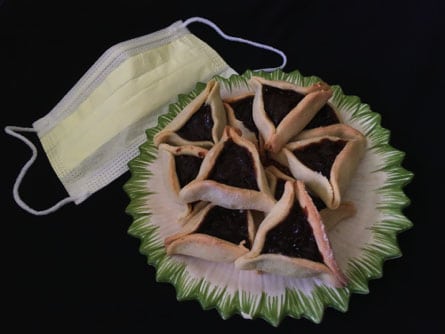
Making Hamantaschen and Puns, a Pandemic Year Later

When my phone calendar reminded me last week to start my annual hamantaschen operation, I realized autocorrect had changed Purim to Putin. I wondered if the FBI was deciphering my “buy ingredients for Putin” and “clear counter space for Putin” tasks. To any agents studying my recipe for clues (“What does she put-in there?”), no authoritarian leaders are entering my kitchen this pandemic or any time. It’s not my tradition.

Tradition matters. For my relatives, that means eating my grandmother’s prune hamantaschen recipe. I also like other poppyular fillings — especially if the holiday falls on a Mohnday — and I make additional flavors for friends. But I wouldn’t be apricaught dead sending non-prune to family without permission. My mother, Esther, loves prune, making them the queentessential version.

Looking at the calendar, I also felt a visceral reminder of last Purim. It’s sobering enough to (mostly) put aside bad puns for a moment and reflect on a year covering our punim with masks.

Last Purim arrived as the pandemic escalated. Here in Washington State, where the first U.S. case was diagnosed, cases and fatalities went up and communities cancelled large gatherings, including Purim festivities.

I’ve fulfilled my hamantaschen-making obligations in unusual circumstances before, so I felt hard-wired to make them. It was also a touchstone. Even modified ritual helps us through uncertainty. I mailed boxes to family then — with precautions — drove around dropping off containers for friends. Standing far apart, we wondered what would happen. Schools closed the next day. A lockdown started a few weeks later.

The ensuing year has been like a twisted version of Purim — minus the fun parts. We’ve worn masks, dressed in unusual ways, consumed more alcohol, ousted a certain public figure and made loud noises at specific times. Between pandemic fatigue and general exhaustion, we’re grogg(i)er than ever.

Between pandemic fatigue and general exhaustion, we’re grogg(i)er than ever.

I keep looking at the ingredients on the counter, knowing I need to bake, yet finding it hard to start. But I have to. It’s in my DNA.

My grandmother perfected her grandmother’s recipe into fragrant, delicate hamantaschen, adding lemon zest to the dough and making lekvar (prune butter) from scratch. As a kid growing up in an irreligious-but-Jewish home, all I knew of Purim, other than who Haman and Esther were, was that my grandmother sent prune hamantaschen layered on wax paper in those repurposed blue tins — you know, the ones covered in pictures of goyische butter cookies. I assumed Purim was a longer holiday, lasting from the hamantaschen’s arrival to the day we finished them. Before my grandmother moved to California, we’d drive from Manhattan to visit her on Long Island, where she put me on a step-stool and taught me to make them, cutting dough circles with a glass.

As my mother says, hamantaschen-making skips a generation in our family. I took over hamantaschen duties a few times in my 20s when my grandfather’s health declined and my grandmother took care of him. Then, in 2011, she died a few months before Purim. At the shiva, I leaned against my grandmother’s kitchen counter with my great-aunt Shirley, both of us trying to hold it together. She asked, “You’re making the hamantaschen, right?”

And I have — sometimes against all odds.

The following year, a few days after Aunt Shirley and Uncle Joe got their box, the hamantaschen for my parents in Manhattan still hadn’t arrived. My mother asked me to look up the location. “Still triangulating,” I said, finding the tracking number. The hamantaschen had gone south to a USPS facility near LAX — three miles from where my grandmother last lived. We joked that my grandmother’s memory wanted to make sure they were up to standards.

Weirder still, the tracking next showed them on Long Island, in Bethpage, NY — a few miles from where she lived before moving to California. After a week-and-a-half tour of the places she called home in my lifetime, the hamantaschen finally arrived undamaged in Manhattan.

The next year, in late January, I moved to Cayenne, French Guiana — and admitted that sending hamantaschen within a few weeks might not be realistic. Purim approached as my now-former partner and I were staying in a hotel, looking for housing. On the avenue outside, Cayenne was celebrating Carnaval with spectacular, rain-soaked, masquerade-filled parades more festive than any Purim celebration I’ve seen (but without triangular cookies).

I felt the pull of tradition and commitment. But I had nowhere to bake. Then, my new friend Jessica invited me to use her kitchen, where I made batches of hamantaschen with her two young daughters. As I attempted to match my grandmother’s ease, we laughed at the resulting pile of messy dough and at my even messier French. The younger girl insisted she’d make hamantaschen for me when she grew up, and I blinked back tears. We ate hamantaschen together.

It’s a gamble to send cookies on a three-continent journey, but beating odds is a Jewish tradition. Compared to Mordechai and Esther foiling Haman’s plot, coordinating an international family-hamantaschen export scheme seemed easy. I carried packages to the post office the next day in a heavy rainstorm that flooded the front yard of Jessica’s house. If I’d waited one day more, I wouldn’t have been able to bake. After a triangular route from Cayenne to Paris to the United States, the hamantaschen arrived intact.

Years later, I’ve never failed to send them. As I face round two of pandemic Purim pastries, I’m grateful my parents are healthy and have been vaccinated. Aunt Shirley and Uncle Joe celebrated Uncle Joe’s 100th birthday this year. Not everyone’s family has been so lucky. And like many, I’ve faced paralyzing pandemic-related depression and anxiety. It’s hard to find energy some days — even for making hamantaschen.

But I got up, started the prunes and am making the dough. Aunt Shirley and my mother have had these hamantaschen every Purim of their lives, and it’s my job to ensure that doesn’t change — to provide something consistent despite challenges. I’ll make extra for friends again too. Consistency, like good food, is cultural resilience.

So is humor. It’s why I’m drawn to the playfulness of puns and of Purim — for which there are lots. We won’t have parties, but we can celebrate safely. Masks are traditional — including Adarable little masks for kids. If some dangerous dude gets in our personal space, we’ll give him Esthern warning: “Hey-man, you’re getting too close.” We can Vashtihands and shush an anti-masker howling about inconvenience. We can prune down outdoor gathering size and avoid indoor ones. Asking people to move Megillah readings online or to a scenic outdoor spot is one way to a-spiel to their better nature.

Or we can stay home and make hamantaschen. As they bake, I’ll enter next year’s reminder into my phone, hoping for better days ahead. This time, I’ll check the spelling.


Deborah (Debs) Gardner is a public health professional, writer and semi-snarky Jew living in Seattle, WA. Our “pundemic correspondent,” she is a multi-time winner of Pundamonium Seattle, a local pun slam.

Making Hamantaschen and Puns, a Pandemic Year Later Read More »

Unscrolled, Parashat Tetzaveh: The Emperor Has No Nose

“Can you picture, in your mind, what Anna Karenina looks like?”

With this question, author Peter Mendelsund begins his book, “What We See When We Read.”

To any reader of Tolstoy’s classic novel, there can only be one answer to this question: “Yes. As if she were standing here in front of me.” Tolstoy’s clear and expert prose creates the sense that one is watching the novel unfold through a polished window. Anna’s physical appearance — her dark, curling hair; her flashing eyes; her full arms — is palpably experienced.

But then Mendelsund pushes further: “What does her nose look like?”

Suddenly, Anna’s palpable presence reveals itself to be nothing but a puff of air. What we pictured in our minds collapses into a heap of disorganized pixels — a vague and noseless suggestion of a person.

The act of picturing is a mystery. Compounding that mystery is the fact that our intuitions about picturing are almost all wrong. Commonly, we suppose that our mind’s eye is witness to some interior stage or screen, upon which the books we read and the stories we hear play out like Hollywood movies.

Upon even the slightest examination, however, this proves false. The emperor has no nose. What truly happens in our minds when we read is much vaguer, and much less visual, than we would like to believe.

In Parashat Tetzaveh, G-d continues commanding Moses concerning the ritual objects for the sacrificial service. The tabernacle, the menorah and the table of the bread of presence have already been described. God’s attention turns now from sacred architecture to sacred attire. Most of the parashah concerns the materials for the High Priest’s garments, as well as the methods by which they are to be assembled and the ways they are to be arranged upon the body of the priest.

We are being asked by the Torah to picture. This is no small thing. It wasn’t until I had read it through three times that I felt I could transform the words of the parashah into a clear and meaningful series of mental images.

We are being asked by the Torah to picture. This is no small thing.

During my first reading, I saw only a blurred collage, gleaming with gold, shot through with veins of blue, purple and crimson yarn, and luminescent with the glow of precious stones. The names of the stones themselves — carnelian, chrysolite, emerald, turquoise, sapphire, amethyst, hyacinth, agate, crystal, beryl, lapis lazuli and jasper — were sweet on my tongue, but not since the days of my childhood rock collection would I have been able to picture each one individually. Instead, what I saw in my mind’s eye was a heap of jewels, glowing in all the hues of the rainbow, like a glinting treasure chest in a child’s cartoon.

During my second reading, I exerted myself to create a viable mental image — assembling the breastplate upon the ephod, hooking it into the epaulettes and topping off the whole thing with a turban and a golden diadem. Still, many details of the text confounded this image rather than clarified it.

During my third reading, I caved and decided to consult an image of the priestly garments found in an illustrated children’s bible from 1966, which I had recently found out on the street. Finally, I felt that I could see what the text wanted me to see.

“Visualizing,” writes Mendelsund, “seems to require will.” It also requires effort, and it is astounding to imagine that Moses, hearing this stream of complex instructions, was able to assemble it all properly in his mind. Indeed, there is an element of the miraculous about it.

In Parashat Tetzaveh, God commands Moses in a holy act of picturing — of seeing clearly with the mind’s eye what has not yet been brought into being.

His ability to do so is what separates prophets from idle dreamers.


Matthew Schultz is the author of the essay collection “What Came Before” (2020). He is a rabbinical student at Hebrew College in Newton, Massachusetts.

Unscrolled, Parashat Tetzaveh: The Emperor Has No Nose Read More »

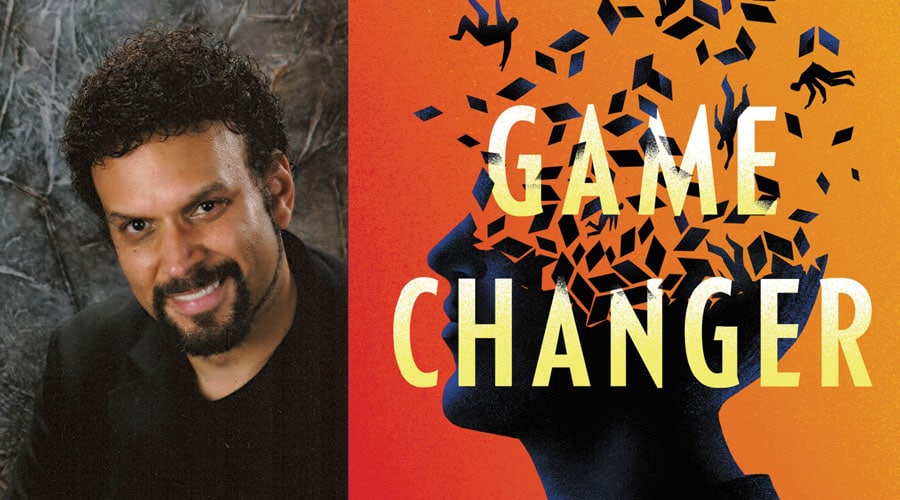
Neal Shusterman on Judaism, the Pandemic, and his Latest Book

Neal Shusterman is a Jewish literary powerhouse. During a career spanning over two decades, the award-winning author has produced multiple best-selling YA novels, including the bone-chilling “Unwind” series, the enthralling “Scythe” trilogy and the spectacular “Challenger Deep.” His latest novel, “Game Changer” (HarperCollins, 2021), is a creative tour de force that follows a teenage linebacker bounding through different alternate realities. In one dimension, segregation still exists in the United States. In another, the male protagonist was born a woman.

Shusterman never imagined his work would be read by millions around the world. Named after his grandmother, Nechemya (meaning “comforted by G-d”), Shusterman grew up an only child in Brooklyn. He regularly visited his Aunt Millie and her vast collection of books. Following her death in May 2020, Shusterman shared a social media post about her indelible impact on his work. The Journal spoke to him about her influence and about his latest novel.

JJ: I’m very sorry for the loss of your aunt, Mildred Altman.

NS: Yes, from the time when I was young, she was the one in the family with a huge book collection, and whenever I’d visit her, I’d look at her books. A lot of them were Judaica. I learned about the Holocaust from the books in her collection. When I started publishing, she read every single one of my books and would always write me this long, handwritten letter telling me about what she thought of it in detail. You can tell she really went into it. “Game Changer” is going to be the first book I’m not going to get that letter for. Those letters are treasures, and I miss her.

JJ: Let’s talk about “Game Changer.Some people are calling it your most controversial work yet, and that’s really saying something!

NS: I’m not surprised. We knew from the beginning that this was going to be a story that polarized people.… It’s interesting — what I’m finding is people who are on the extreme right are angry by it because it’s too left. Someone called it an “SJW [Social Justice Warrior] screed.” And on the left, they’re thinking that it’s not left enough, that [it focuses too much on the white protagonist]. But most of the people who are not that extreme are really able to appreciate it…

JJ: Do you deliberately leave Jewish “Easter eggs” in your books? For example, in “Game Changer,” there’s a reference to Yom Kippur. In “Unwind,” a character named Lev dances the hora. In “Dry,” a character does a mitzvah at her temple because she thinks the rabbi’s son is hot.

NS: It’s hard to say that they’re deliberate. If there’s an opportunity and the story lends itself, I’ll put it in there. The “tithing” party in “Unwind,” it was kind of actually the opposite. I didn’t want people to think that that was a bar mitzvah. It was a celebration of when he turned thirteen. And because this was in the future and this was supposed to be sort of this nondescript religion, I didn’t want people to think that it was a bar mitzvah, so I put something in there to make it show that he wanted to be put up on a chair like he saw at his friend’s bar mitzvah. So, that was sort of a subtle way of showing this wasn’t that…

My rabbi once said that my stories always seem to have a lot of Talmudic thought in them. I think that’s how [my faith] influenced [my writing]. There’s always a lot of deep thinking, and I think that is inherent in Judaism, that there is a lot of depth of thought in things. I think that is just part of how I was raised and part of the way I see the world. My grandparents were Orthodox. My parents weren’t — they were Conservative; I’m Reform, but I was raised with a huge amount of respect for the religion and for our culture.

“My rabbi once said that my stories always seem to have a lot of Talmudic thought in them.”

JJ: How has the pandemic affected your writing?

NS: It has greatly affected my writing in that it has been very difficult. I tend to get most of my work done when I’m away from home. Some people love their home office and their space. For me, I’m most creative when I’m out in the world. I travel a lot and always find interesting places to write. I find I get my writing energy from the world around me and from being in unique and new places. So, sitting at home [and] trying to get writing done has been very difficult.

But I’ve done it. I finished “Game Changer.” I finished another story that I was co-writing with my son, Jarrod, called “Roxy,” which is coming out later this year. But it has been a challenge. My writer friends and I call it “COVID Brain” because your head is not in a place to be creative during this pandemic and during everything else that has been brought on [by] this year. So, it’s been difficult to find those moments of creativity [when] I can really get the things done.

JJ: Speaking of the pandemic, it’s uncanny how certain scenes from “Dry” [a sci-fi novel about Californians losing access to water] ended up happening in real life — families rushing out of town, mobs flooding Costco and people hoarding water. Was it surreal to see life imitating art?

NS: Whenever that happens, it’s always surreal. When I wrote “Unwind,” people kept sending me articles about things going on with body parts and sales and all of the types of stuff I was writing about. It’s very odd to see life starting to imitate art. With “Dry,” we [Jarrod Shusterman and I] did a lot of research as to what might happen if water ran out. But also, a lot of it was our own extrapolation. The first thing that you do when there’s a crisis is you go to Costco to stock up on things that you need. So, that’s what I had the characters do… truth can be stranger than fiction.

JJ: Do you feel that your books have gradually grown darker over the years?

NS: I think that my books have grown deeper. I think that there is more to mine in them than when I first started. I think it’s because that’s what I’m reaching for. I don’t like to just sit on my laurels and just write the same thing over and over again. When I approach a story, I want to write something that is new and that goes somehow deeper than what I’ve written before. Sometimes the stories are dark. For me, the only reason for darkness is so that it can highlight the light. Characters can move through dark places in order to get to a place of greater light.

My stories are always optimistic. They always end on a sense of hope, and I feel that that’s important. I don’t like writing stories that are futile. Futility is not helpful, I don’t think, for our world. We need to find hope. We need to find solutions, and so that’s the types of stories that I try to write. And I don’t write solutions. What I try to do is I try to illuminate the problem because the questions that are worth asking don’t have easy answers. People will tell us from all sides of every spectrum that “here is an easy answer to the problem.” It’s never an easy answer. I don’t want to pretend to know the answer. What I want to do is … find interesting ways of framing questions so that it can give us perspective on finding the answers.

I’d like to let you know that there’s actually a Jewish-themed book that’s coming out. There’s a graphic novel called “Courage to Dream,” and it [has] five stories that are Holocaust-related. But, as is always the case, I’ve tried to do it from a different perspective. The idea was to write five fantasy stories that are Holocaust-themed and have them be heartfelt and really poignant but at the same time have these fantastical elements. The book is pretty much done. Andrés Vera Martinez is the artist and he’s done an amazing, amazing job with the artwork. It’s going to be coming out, I believe, in early ‘22. They haven’t set the actual [publication] date, yet, but this is a project I’ve been working on for, oh, eight or nine years, and I’m very excited about it.

This interview has been edited for brevity and clarity.


Eve Rotman is a writer on the West Coast.

Neal Shusterman on Judaism, the Pandemic, and his Latest Book Read More »