fbpx

October 12, 2020

My Mother’s Warfare Against Aesthetics

Picking out the outfit to bury my mother in was hardest for two reasons: One, she owned a lot of clothing. Two, she had very picky taste.

Of course, the task was difficult for all of the reasons one might imagine — a welling of grief and anguish, the palpable emptiness in the wake of loss.

But standing in my mother’s closet a mere two days after her passing, I hadn’t processed much of anything. I was still half-expecting to hear the distinct clack of her high-heeled boots coming around the corner.

Sifting through the hangers of olive-colored skirts and beaded tank tops, all I could really think was: would she want a jean or leather jacket?

Like many mother-daughter relationships, ours often revolved around clothing and makeup. My mother had always been interested in fashion and aesthetics. I found a picture of her when she was about my age in the 1980s, clad in a bold neon top, flare jeans, and dangling earrings.

From a young age, I remember us bonding through trips to the mall, trying on accessories in her bathroom, and strutting through the house for first-day-of-school fashion shows.

But our connection went far beyond bracelets and brooches. As I grew up, we shared our career aspirations, political opinions, and our deepest fears and anxieties.

My mother was a fierce, stubborn, hard-working woman. She was also a woman who cared about her appearance and deeply internalized the aesthetic pressures on women.

A materialistic woman is not seen as a “desirable” woman by society. Yet, the worldwide beauty industry is an almost $600 billion production based on selling women the belief that they are not enough. From the time that we are girls, billboards, commercials, and Facebook advertisements hardwire us to believe that certain material items are key not only to our happiness but also to our success.

In high school, I began to notice how much my mother tied her sense of self to how she looked. I judged her. I resented her. But I also related to her. Hasn’t every restless woman once asked herself: would I be happier if I were prettier? Skinnier? More youthful?

Hasn’t every restless woman once asked herself: would I be happier if I were prettier? Skinnier? More youthful?

As long as women are objectified, their physical appearance will function as a core value and the absence of their beauty will be perceived as something to fix.

I could judge my mother all I wanted, but the pressure to look a certain way is even greater for aging women. As Susan Sontag puts it in her essay, The Double Standard of Aging, “For women, only one standard of beauty is sanctioned: the girl.”

If aesthetic pressures are intensified for aging women, they become even more complex for sick women. When my mother’s chronic cancer turned terminal at age 59, the way that she related to aesthetics took on a new layer of significance.

 If aesthetic pressures are intensified for aging women, they become even more complex for sick women.

When you are sick, you are stripped of yourself. I saw this firsthand as my mother lost her appetite, her hair, and then her desire to get up in the morning. A woman, who once took so much pride and joy in getting ready and being out in the world, felt too ashamed and ostracized even to leave her own bedroom.

In her 1980 book, The Cancer Journals, the Black feminist poet Audre Lorde begs readers to confront the intersection between feminism and illness. Sickness robs women of their selfhood in a particularly insidious way. If women are taught to internalize their worth through their physical self, Lorde argues, then sickness is the ultimate threat to their personhood.

When my mother first got sick, I couldn’t understand why her aesthetic deterioration seemed to be the most agonizing part of all of it for her. I wished so badly that she would be a woman who would boldly buzz off all of her hair and fight societal standards as she fought the disease.

But when you are a sick woman, you are up against even more societal stigma than before. People kept telling my mother to fight — “keep fighting,” “you’re so strong” — as if her strength was dependent on enduring a never-ending pain.

Our medical system reinforces this pressure to no end. Not only are toxic treatments pushed at all costs, but in the hospital, your particular body becomes the body — converted into a test tube.

My mother decided to stop treatments when it was clear that they would only prolong a painful quality of life. She could no longer be the devoted mother, loyal friend, or fierce workhorse that made up her identity.

Instead, she put all of her energy into getting a wig. In her final days, she put on lipstick in the hospital mirror. She didn’t want to be pumped with more poison, she wanted us to paint her fingernails.

The idea of beauty as a site of resistance rather than capitulation circles back to Lorde and her fight with breast cancer. In 1988, she wrote, “Caring for myself is not an act of self-indulgence, it is self-preservation, and that is an act of political warfare.”

I came to see my mother’s desire to maintain her aesthetic as her form of warfare in a battle that had suddenly and brutally stripped her of her identity, motherhood, and womanhood at a young age.

My mother literally wore a wig on the day she died. Silly as we thought it was at the time, I now see this as my mother reclaiming herself in a world that had taken so much from her.

Sometimes I look at that wig — sitting in her closet — and its long, beautiful, blonde locks. They were not her own. But they gave an important piece of herself back to her when nothing else quite could.


Rebecca Katz just received her master’s in Journalism from USC Annenberg. She works in audio journalism and is in the works of starting her own podcast. twitter:@rebeccaerinkatz.

My Mother’s Warfare Against Aesthetics Read More »

Chloe Fineman and Drew Barrymore Gush Over Fineman’s Drew Impersonation on ‘SNL’

Actress Drew Barrymore meeting “Saturday Night Live” (SNL) cast member Chloe Fineman is the jolt of happiness you never knew you needed. Fineman was invited as a guest on Barrymore’s new CBS talk show, “The Drew Barrymore Show,” on Oct. 12 after Barrymore saw and obsessed over Fineman’s impersonation of her.

Fineman, known for her uncanny impressions of celebrities, took her Barrymore impression for a test drive during the season premiere of “SNL” on Oct. 3. During the sketch, Fineman, as Barrymore, acted in a fake promo video for the CBS show, which debuted Sept. 14. Within the sketch, Fineman also impersonated Reese Witherspoon and Nicole Kidman.

When Fineman and Barrymore greeted each other in the studio, both squealed they were “so excited to meet each other.”

“[Comedy is] the most attractive quality in any partner. It’s the thing you want with your friends. It’s what you look to entertainment for,” Barrymore told Fineman. “Laughter is the most important thing in the world but your talent, your range, the way you play all those characters …. I would just love to display your range of work and ask you your process because I am just in awe of you.”

Barrymore also mentioned Fineman’s Jewish father, who often appears on the California native’s Instagram posts. It was Fineman’s father who introduced her to improv classes in San Francisco at the Fort Mason Center, where the father-and- daughter duo still attend classes.

“Because of the pandemic, we started doing it on Zoom through Groundlings,” Fineman said, referring to the improvisational and sketch comedy troupe and school. “I’m close with my teacher Annie and she let my dad be like the creepy, old guy in the improv class.” Fineman also encouraged Barrymore to take her own children to improv classes.

Watch the full interview below:

Chloe Fineman and Drew Barrymore Gush Over Fineman’s Drew Impersonation on ‘SNL’ Read More »

Politics in the Sukkah, and Other Fine Subjects

I had an interesting conversation over Shabbat with a guest in my sukkah who wanted to talk politics. Immediately, I sensed trouble. I thought to myself: Are we really doing this again? Are we reminding ourselves how much we all agree with one another? And if we don’t agree, should we gear up for verbal combat during a holiday of rejoicing?

I managed to steer the conversation toward more philosophical questions, such as: Why does politics have such a hold on us? What price do we pay for allowing it to be so dominant? (I had to throw in: Will the Lakers finally beat the pesky Miami Heat?) It was a deeper conversation that took us to a more meaningful place than squabbling over candidates and political parties.

During this era of extreme partisanship, I’ve tried to look for meaningful places without taking sides. Yes, this is as hard as it sounds. It’d be much simpler to take a side, pile on, and tell readers who agree with me what they already know.

So why am I reluctant to do that? Because it’s too easy and too divisive. There is already more than enough commentary out there that reinforces what people already believe.

It’s more interesting, in my view, to look for broader ideas we all share or ought to share. Curiosity, for example. Instead of instant judgment, why not try to understand why people who disagree with us think the way they do? Stereotyping those on the other side is a time-saving device, but it doesn’t expand our own awareness and horizons.

I can’t tell you how often I hear people complain that they “just don’t understand” how anyone can vote for this or that party or candidate.

I like to reply: That’s correct, you don’t understand. But have you tried?

Putting ourselves in the shoes of the Other is one of life’s most difficult but worthy endeavors. Many of us have no problem doing that with victims of discrimination or other oppressed groups. Why not try it with those who sit on the opposite side of the political fence?

Well, for one thing, because we don’t see our political opposites as victims who deserve empathy. Because it’s too much effort. Because all we want to do is win.

But we can push for our side to win without denigrating the other side. We can understand other views without agreeing with them. We can open our minds without changing them.

Above all, even when we’re madly rooting for our team to win, we can look for things we share with the other side. As much as I enjoyed seeing my beloved Lakers bring home a championship Sunday night, I know that what I share with Miami fans is a deep love of basketball– win or lose.

Politics in the Sukkah, and Other Fine Subjects Read More »

Black/Jewish Justice Alliance Rethinks Safety and Security

Discussions on safety, security, white supremacy and allyship were at the forefront of the second annual Heschel/King Forum put on by the Black/Jewish Justice Alliance (BJJA) on Oct. 8.

Sponsored by Clergy & Laity United for Economic Justice (CLUE), the Southern Christian Leadership Conference of Southern California (SCLC), Bend the Arc: A Partnership for Jewish Justice, the ACLU of Southern California, IKAR and various multifaith organizations, the forum focused on bringing together the Jewish and Black communities to fight racial and anti-Semitic injustice. More than 100 people attended and, to date, the forum has more than 1,900 views.

IKAR Rabbi Sharon Brous kicked off the first discussion, moderating a panel on Black and Jewish relations featuring Rabbi Neil Comess-Daniels of Beth Shir Shalom and Rev. William D. Smart, president and CEO at SCLC.

Smart and Comess-Daniels acknowledged the decades of work Jewish and Christian leaders have done to bring together the two communities, dating back to the civil rights movement.

Smart and Comess-Daniels acknowledged the decades of work Jewish and Christian leaders have done to bring together the two communities, dating back to the civil rights movement.

“We have found a common enemy,” Smart said. “I know at times the common enemy — white supremacists — have tried to pit us against each other, but they are our common enemy …. We need to pull up our sleeves and go to work.”

Noting the August 2017 Charlottesville, Va., Unite the Right rally that turned violent, the October 2018 Tree of Life synagogue shooting in Pittsburgh, the April 2019 Poway synagogue shooting, numerous cases of police brutality, and what federal authorities say was an attempted kidnapping last week of Michigan Gov. Gretchen Whitmer by white supremacists, Comess-Daniels said now is the time to band together and “overwhelm” the hate groups to “make this nation whole.”

In another panel with Pastor Stephen Cue Jn-Marie; Melina Abdullah, co-founder of Black Lives Matter L.A.; Rabbi Sarah Bassin of Temple Emanuel Beverly Hills; and Gamal J. Palmer, senior vice president of leadership development at the Jewish Federation of Greater Los Angeles, the discussion focused on how to ensure safety for both the Black and Jewish communities.

When asked what public safety meant to each of them, Abdullah said,
“It’s not grounded in policing. There is no Black person who feels safe when a cop car pulls up behind them.”

Bassin said what safety currently means and what it should mean are two different ideas. “We talk about safety through the lens of crime and only crime. I think we would benefit as a community if we talked about safety in terms of security of one’s body, and the assurance of one’s well-being,” she said.

Palmer added that economic safety and Black entrepreneurship is essential, so that Black-owned businesses can be normalized in various communities. “[It means] we feel safe to invest in Black communities … Black entrepreneurs …. We don’t have that tradition of passed-down wealth … of financial security, so we have to get creative. When we have [economic and financial security] in our communities; [when] we can go into any area in Los Angeles or around the country and know it is a norm for folks of color to be business owners and not a special opportunity, then we have reached a different kind of level of safety.”

Abdullah said one way to keep people safe is through police reform and efforts to defund the police and reallocate those funds into programs and services that will benefit all communities.

“We know that budgets are absolutely zero-sum games. If you spend money in one place you do not have money to spend somewhere else,” Abdullah said, referencing Los Angeles’ city budget, which allocated 54% of its funds to the LAPD. “If you are spending money on police, you’re not spending money to make sure that every Angeleno is housed … you are not making sure there is quality care for after-school programs for our children or health resources.”

Bassin noted that with many synagogues and/or Jewish buildings employing security because Jewish spaces are often attacked, “Your budget is an expression of your value.” She added that although she is relieved that her synagogue has a 90-second response time from her local police department, she understands not everyone, including Jews of Color, feels safe. She said there needs to be reallocation at the local level with police and at the national level with the military.

“The revolutionaries push [the]conversation further so that the gradualists, when they open up in that space, can start to be heard,” Bassin said. “I think the relationship is really symbiotic.”

For Palmer, who is Black, gay and Jewish, it’s all about knowing “what we consider to be safe and who our protectors are.” Stating he’s been both protected and beaten by police, Palmer said, “I don’t think we are really owning the totality of what we’ve allowed police to mean in this country and we’ve accepted procedures and policies in this country and normalized it. We are talking about a system that we have accepted and that is an outgrowth of the fundamental illness of this country in the first place, which is structural racism.”

Palmer also shared how Jews of Color have been working to change values and ideas in the Jewish community. “We all have an opportunity here to really accept that Jews are Black,” he said. “Jews are also Asian, Jews are also Latino, Spanish and they’re also white: Caucasian. There’s been an erasure of Jews of Color. I want people to know there’s a massive movement right now within the Jewish community that was happening prior to the killing of George Floyd, and the response to that killing. There’s a massive movement for Jews of Color to be visible …. That’s a real thing and Jewish organizations are investing in that movement. It’s forcing white Jews to think about security …. That’s why I look at it as a system. New structures to change the system.”

Click here to watch the full conversation.

Black/Jewish Justice Alliance Rethinks Safety and Security Read More »

City Council Candidate Does Not Support BDS But ‘the Right of Public Citizens to Participate in Boycotts’

Nithya Raman, who is running against Democratic City Councilmember David Ryu in Los Angeles City Council District four, said in a Democrats for Israel (DFI) Los Angeles questionnaire she doesn’t personally support the Boycott, Divestment, and Sanctions (BDS) movement but she does support “the right of public citizens to participate in boycotts.”

The DFI Los Angeles questionnaire had asked, “What is your view on the Israel boycott and divestment movement and what will you do about it?”

The Journal obtained Raman’s full reply, which reads, “I don’t personally support the BDS movement, and I believe in Israel’s right to exist. I also believe, separate from any individual’s political activity, that any anti-Semitic language is hate speech and should be condemned as such. I would be against the participation of any local public agency in a boycott or divestment action. However, my position on the right of private citizens to participate in boycotts is that of Senators Kamala Harris, Elizabeth Warren, and Bernie Sanders: I believe how one chooses to spend their money or peacefully engage in political activity is protected by the First Amendment.

“I personally am deeply upset by policy decisions in India, my own country of origin, and while I have not participated in a boycott, I understand the argument for withholding economic activity. I believe those choices are constitutionally-protected political speech.”

DFI Los Angeles President Gregg Solkovits said in a statement to the Journal, “We appreciate that Nithya Raman supports the right of Israel to exist and personally opposes BDS but while DFI-LA also supports freedom of speech, we may differ in that discriminatory speech that targets individuals based on race, religion or national origin is prohibited by law and is not usually considered protected speech, which is why we have the Civil Rights Act. The BDS movement and many of its members have deliberately targeted Jewish students, community centers and Synagogues in demanding a unilateral ‘right of return’ of over 5 million Palestinians to move into a state with 6.5 million Jewish-Israelis and 1.8 million Arab-Israelis, which would drastically change the Jewish character and makeup of the country, fundamentally ending its existence.

“In grading or making recommendations, DFI-LA will have to weigh these factors, commitment to Democratic party values, including support for a two-state solution, and the candidate’s history of involvement in the Jewish community in making its determination, which is what we do with every questionnaire we review.”

Raman was endorsed by the Los Angeles Democratic Socialists of America (DSA) chapter in December 2019, and she told Jacobin magazine in February that she is “a member of DSA locally and pretty much my entire platform very much overlaps with what DSA has been fighting for here in LA.”

In 2017, DSA’s national party passed a resolution endorsing the BDS movement with more than 90% support. In August of this year, DSA Los Angeles tweeted out support for DSA’s New York City chapter, which came under fire at the time for asking city council candidates to pledge against traveling to Israel.

“Israel is an apartheid state,” DSA Los Angeles tweeted. “Weaponizing Jewish identity and experience for political gains is antisemitic. #FreePalestine #BDS

Additionally, DSA signed a #DropTheADL letter in August, which calls on progressives to distance themselves from the Anti-Defamation League (ADL). The letter accused the Jewish group of having an “ongoing pattern of attacking social justice movements led by communities of color, queer people, immigrants, Muslims, Arabs, and other marginalized groups, while aligning itself with police, right-wing leaders, and perpetrators of state violence.”

Ryu said in a statement to the Journal, “I absolutely do not support the BDS movement. At a time when hate crimes are rising in LA and across the world, it is dangerous for a candidate to be so closely aligned with a political movement bent on demonizing Israel and the Jewish people.

Raman’s campaign said in a statement to the Journal that Raman disagrees with DSA Los Angeles’ tweets on BDS. “Nithya does not support BDS,” the campaign said.

Raman, an urban planner, garnered 41% of the vote in the March primary; Ryu won 45% of the vote. The two are currently in a heated runoff election, which The Los Angeles Times described as “a progressive showdown over issues such as protecting tenants and reimagining policing.” In July, Raman signed a letter calling for the City of Los Angeles to adopt the Peoples’ Budget LA, which would reduce funding for law enforcement and policing from 53% of the budget to 1.64%. That same month, Ryu also supported the city council’s decision to redirect $150 million from the Los Angeles Police Department (LAPD) to underserved communities and approved of city council’s proposed legislation to establish an Office of Violence Prevention.

But Raman’s campaign has come under recent fire for the actions of some of her supporters. The Journal obtained a letter from several residents in City Council District four, stating, “We want to make sure you are aware of the tenor and actions of your campaign and some of your supporters.” The letter continued, “We have seen David Ryu lawn signs destroyed or removed, which some of your supporters even brag about online. We have seen misleading statements, racist and homophobic [sic] tropes, and downright lies propagated by your staff, supporters, and endorsers. We have even seen threats of physical attack. But more than anything, our communities and our neighbors are disappointed to see this level of online attacks and vitriol in the Council District 4 election.”

The letter acknowledged that many of Raman’s supporters are respectful, but too many aren’t; the letter went onto accuse Raman’s campaign of “negativity and bullying” and urged Raman “to disavow the lies, disavow the bullying, and disavow your supporters who traffic in false statements and cruelty. Our district and our city deserve better.”

The Journal also obtained a February campaign ad where Raman told her supporters “to get angry.”


“I have spent my time in office trying to bring people together and stand up to hate in all its forms,” Ryu said in a statement to the Journal. “This is not the time to be fomenting division — and I don’t believe hate belongs in the progressive movement.”

In a statement to the Journal, Raman responded to the letter by saying that she has suffered from “online harassment” from Ryu supporters and has taken a break from looking at social media as a result.

“Just as I do not and have never initiated, encouraged, or supported personal attacks on Councilmember Ryu on any platform, I do not believe that he is encouraging these attacks on me,” Raman said. “None of the social media posts referenced in the letter are from individuals who work on my campaign.

“What we’ve accomplished from this campaign is to give people who are frustrated with how our city has responded to some of our biggest challenges a positive place to channel those frustrations — an opportunity to learn about the power of local government, and about policies that can help us get to a healthier, more sustainable city going forward. I continue to believe that’s the most effective way to approach dissatisfaction with elected officials.”

Regarding the February ad, Raman said in a statement to the Journal, “I, like the vast majority of [Angelinos], am angry about the explosion in homelessness, skyrocketing rents, and increasingly toxic air we’ve been subjected to over the last half-decade. I think it’s appropriate to be angry about the crisis we’re watching play out on our streets right now. No other major city in America has a full one percent of its population living on the street.”


City Council Candidate Does Not Support BDS But ‘the Right of Public Citizens to Participate in Boycotts’ Read More »

What is the Endgame of Trump and COVID-19?

Is Donald Trump contagious? Is he immune? Is he in danger? Are we?

So many questions. So few answers. And so little time left before an Election Day that may or may not conclude this extraordinary and unprecedented presidential campaign.

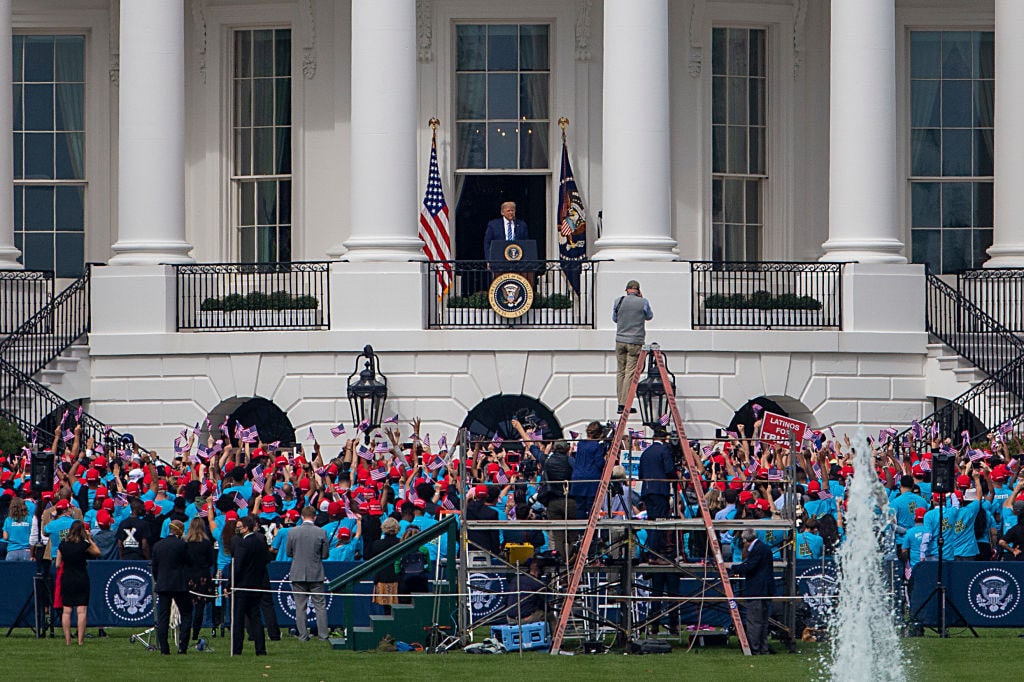
In the early morning hours of Friday, October 2, the political landscape was roiled when Trump announced that he and his wife had been diagnosed with COVID-19. Later that day, he was transported to Walter Reed Hospital. The following day, according to after-the-fact reports, the president may have been struggling to breathe. A day after that, he took a drive to greet supporters who had gathered outside the hospital. And the day after that, Trump returned to the White House, pronouncing himself cured.

Many of Trump’s advisors urged him to use his diagnosis as an opportunity to “reset” his virus-related messaging. The American people have harshly judged his handling of the pandemic, and his inner circle thought that a more empathetic approach based on his experience with the virus might help him regain some of that lost support.

But Trump was unwilling — or possibly unable — to heed their suggestions. He has always relied almost exclusively on the enthusiasm of his most loyal supporters to help him achieve political success, and the likelihood of him trying a new approach was slim at best.

And so the president did not attempt to reassure swing voters that he now understood their COVID-related worries. Instead, Trump directed a message of personal courage and defiance to energize his base. He emphasized his strength in defeating the virus, reinforced his skepticism toward traditional “establishment” experts, and used his recovery as a metaphor for reopening the country and returning to pre-pandemic life.

The President makes his first in-person appearance after being cleared by his doctors following his diagnosis of COVID-19 on October 2. (Photo by Tasos Katopodis/Getty Images)

Trump’s messaging certainly does motivate his true believers, but it is also driving the last remaining swing voters in the other direction. State and national polls released over the last several days show Joe Biden with a growing advantage in swing states, fueled largely by voters’ growing belief that Biden would handle the coronavirus better than Trump.

Although Trump’s doctors have not indicated that the president has tested negative for COVID-19, they have announced that he is no longer contagious. So Trump is returning to the campaign trail this week, planning to attend a series of rallies in key swing states. He has reportedly told his aides he wants to do campaign events every day until the election.

The risks of moving forward so aggressively are considerable—both politically and medically. Most doctors recommend that their patients take up to twenty days to recover, as their weakened state can leave them especially vulnerable to a recurrence of illness.

But actively campaigning may be Trump’s only possible remaining path to victory. The swing voters he has lost over the months of the pandemic appear to be slipping beyond his reach: his behavior since being diagnosed has reinforced their misgivings about his leadership throughout the crisis. Now, his best and last bet is to inspire his supporters to even greater levels of turnout.

Actively campaigning may be Trump’s only possible remaining path to victory.

This is unlikely but not impossible. This week’s confirmation hearings for Judge Amy Coney Barrett could excite conservative voters by reminding them of the importance of judicial appointments. There are many registered white working-class voters in Midwestern swing states who did not turn out in 2016, and Trump’s anti-establishment message regarding the virus could inspire them. (Since the spring, COVID-19’s greatest impact was in these densely-populated areas, and Trump’s tirades against medical professionals has stoked resentment against those advocating for a slower reopening).

But Trump might also be aware that such a strenuous schedule for a recovering COVID-19 patient will test all known health and medical boundaries and that exerting himself could easily lead to a recurrence that would sideline — and possibly hospitalize — him. If the coronavirus does force Trump to forego in-person campaigning, such a dramatic occurrence could provide him with one last excuse if his comeback falls short.

Trump has long cited the potential of voter fraud as a possible rationale for his defeat. But wouldn’t his defeat be more inspiring to his supporters (and to himself) if it came not because of unverified ballot malfeasance, but instead at the hands of an implacable disease? Such a valiant anti-COVID-19 fight could motivate Trump’s troops to the polls on Election Day. But if not, what a final chapter Trump could have written to buttress his self-told legend.


Dan Schnur teaches political communications at UC Berkeley, USC and Pepperdine. He hosts the weekly webinar “Politics in the Time of Coronavirus” for the Los Angeles World Affairs Council & Town Hall.

What is the Endgame of Trump and COVID-19? Read More »

Kol Koleinu Fellowship Develops Change-Making Jewish Teen Feminist Activists

In late September, three West Coast teens — Ava Lifton and Adina Kurzban from Los Angeles and Allie Tarkoff from the Bay Area — launched YourBodyYourImage, a website chronicling people’s experiences with body image, and providing resources and stories to increase self-love and acceptance. 

In early October, Danielle Gruber from Long Island, N.Y., launched “Voting With a Feminist Lens: A Workshop Created by and for Teens,” in partnership with BBYO, Jewish Feminist Alumnae Network, Union for Reform Judaism (NFTY) and United Synagogue Youth (USY). The event was  a three-session workshop for teens to explore the history and current state of voting. The teens created their projects through the Kol Koleinu fellowship, designed to explore and deepen teens’ feminist knowledge, share their beliefs and create change in their communities.

Founded by Moving Traditions, Kol Koleinu is open to Jewish high school students nationwide. Fellows learn about gender analysis, feminism and social change, teach their peers and complete feminist activist projects. In previous years, the group met monthly virtually and then in-person a few times a year. This year, all planned gatherings are virtual.

Moving Traditions Founder and CEO Deborah Meyer called the fellows “a source of inspiration in these dark times.” Quoting Pirkei Avot (Ethics of the Fathers), she said, ‘ “We are not required to complete the work, yet we cannot desist.’ By emboldening teen feminists to raise their voices and work for justice, we help fulfill this obligation.”

California Director Alisha Pedowitz said the fellowship is a “powerful addition” to Moving Traditions programs, like “Rosh Hodesh” for girls, “Shevet” for boys, and “Tzelem” for transgender and gender-fluid teens, offered in partnership with Keshet, which already serve 600 Jewish preteens, teens and their parents in greater Los Angeles. “Helping them to challenge inequities and unhealthy norms they see all around them and empowering them to create change in their own communities is what teens very much need while weathering the pandemic,” Pedowitz said.

“Jewish feminism has taught me that the fight for recognition does not end when I have achieved it but rather when all those around me have the same opportunity to grow.”  — Maya Martinez Lurvey

Rabbi Tamara Cohen, vice president and chief of program strategy at Moving Traditions, said the fellows are “feminists in the world and online, but haven’t really integrated it into their Jewish identity. Kol Koleinu helps them do that. They’re learning that they’re not the first feminist teens who are Jewish to think about these issues. We try to help them think about the Jewish sphere as an option. It’s part of who they are and they can hold that Judaism and feminism are not in conflict and that a Jewish community is supporting them.”

Moving Traditions’ Curriculum Manager Jennifer Anolik said the program includes various educational and pedagogical approaches and is “informed by the field of multicultural education and gender studies, specifically in conversations and activities related to systems of oppression, sexism and intersectionality.” 

USY and NFTY are collaborating with Moving Traditions on the fellowship.

Michelle Shapiro Abraham, NFTY director of learning and innovation youth, said in an email that Kol Koleinu “not only gives teens an opportunity to do deep and meaningful learning, but also gives them the tools and mentoring to take action in their own communities and the world.” 

Rabbi Joshua Rabin, USY’s senior director of teen engagement, identified Kol Koleinu as an opportunity for USY to look inward about how well it is modeling community, and for young women “to think about issues of gender in a way where they can be our teachers to ensure that USY is the best possible community it can be.” 

Cohen said the fellowship was meant to support older teenage girls’ leadership and activism, and that the organization hopes to build a “pathway of teen engagement that I hope we’ll eventually have for teens of all genders.” Some Kol Koleinu participants identify as nonbinary, and the fellowship is open to anyone who identifies as a feminist, Cohen added.

The program included West Coast and East Coast fellows in 2019-20. For 2020-21, there are 50 fellows in three regional cohorts, aligned by time zone to make virtual meetings easier. The 10 local fellows span the diverse geography and demographics of the L.A. Jewish community. 

Two members of the 2019 Kol Koleinu cohort at the November 2019 retreat. (right) Meredith Rosenthal (from North Jersey) and (left) Maya Kendall (from Brooklyn). Photo courtesy of Moving Traditions

“The fellowship empowers teens to actualize the change they see is needed in their communities,” Pedowitz said, adding that the projects “represent real and intersectional solutions to inequities that our fellows see in their lives. They are truly creating the change that builds a more inclusive, expansive Judaism and society.” 

Ava, a senior at L.A.’s New West Charter School and Adina, a junior at Shalhevet High School, explained in a joint Zoom interview that the YourBodyYourImage website is meant to be a space “where anyone can write and share stories,” Adina said. Ava added that the plan is to add new content monthly, “trying to grow our audience and reach as many people as possible, to help one or more people and hopefully our stories resonate with people.” 

Via email, the Journal asked some other 2020-21 Southern California-based fellows about their definition of Jewish feminism and their goals for the fellowship.

“A Jewish feminist is someone who advocates for equality and justice while viewing the world through a Jewish lens,” Eliana Becker, a de Toledo High School junior, said, “utilizing the values handed down to me through Jewish tradition and lessons learned from Jewish communities (such as Temple Beth Am, Ramah California and de Toledo) to form responses to current events and injustices in our world.”

“Being a Jewish feminist can look different for each person,” Hannah Kupferwasser, a senior at Wildwood High School said. “For me it means that I believe in equality for each gender, sex, race, religion and each cultural identity while also finding meaning in looking at equality through the lens of Judaism.” 

“Every girl comes as she is, without shame or judgment and allows herself to be changed,” said Zoe Lanter, a senior at Los Angeles Center for Enriched Studies (LACES) who also was seeking a space “where I could be myself — queer and observant — without being put on the defensive,” and to “engage in deeper and more nuanced explorations of Judaism and feminism.” She was also looking for “intersectional places on the left that I can participate in without ditching Israel” and wants to “use my privilege to amplify the voices of others without compromising my own. After all, feminism needs the voices of all who call for political, social and economic equality.” 

Maya Martinez Lurvey,  a 10th grader at Westridge School for Girls in Pasadena, said she’s hoping to grow representation for and learn the history of Jews of Color around the world. “Jewish feminism has taught me that the fight for recognition does not end when I have achieved it but rather when all those around me have the same opportunity to grow.” 

The other Southern California fellows are Malena Podolsky, a junior at Sierra Canyon High School; Miri Pottebaum, a junior at Beverly Hills High School, Michayla Brown, a sophomore at Immaculate Heart High school; Emily (Em) Renetzky, a junior at El Camino Real Charter High School in Woodland Hills; and Gabrielle Biederman, a junior at Pacific Ridge School in San Diego.  

Cohen said the program gives her “a lot of joy and hope. There are so many high schoolers who want to make a difference, who have energy, ideas and passion. We’ve seen some great support and funding coming to issues around gender equity and #MeToo. All of that is really important and this is another place that’s positive and proactive and equally deserving of support. I hope that the Jewish community can be even more open to supporting them. We need their creativity and their passion now, more than ever.” 

Kol Koleinu Fellowship Develops Change-Making Jewish Teen Feminist Activists Read More »

Facebook Announces Ban of Holocaust Denial Content on Its Platform

In an October 12 statement, Facebook announced that it will ban all Holocaust denial content on its platform.

The social media giant will also direct people who search for Holocaust-related terms to resources outside of Facebook, although it did not provide any specifics.

“Today’s announcement marks another step in our effort to fight hate on our services,” the statement read. “Our decision is supported by the well-documented rise in anti-Semitism globally and the alarming level of ignorance about the Holocaust, especially among young people. According to a recent survey of adults in the US aged 18-39, almost a quarter said they believed the Holocaust was a myth, that it had been exaggerated or they weren’t sure.”

Facebook credited various Jewish groups like the American Jewish Committee and Simon Wiesenthal Center (SWC) for teaching Facebook about the many ways anti-Semitism manifests itself online.

“Enforcement of these policies cannot happen overnight,” the statement concluded. “There is a range of content that can violate these policies, and it will take some time to train our reviewers and systems on enforcement. We are grateful to many partners for their input and candor as we work to keep our platform safe.”

Facebook founder and CEO Mark Zuckerberg wrote on his Facebook page that he has “struggled with the tension between standing for free expression and the harm caused by minimizing or denying the horror of the Holocaust. My own thinking has evolved as I’ve seen data showing an increase in anti-Semitic violence, as have our wider policies on hate speech.

“Drawing the right lines between what is and isn’t acceptable speech isn’t straightforward, but with the current state of the world, I believe this is the right balance,” he added.

https://www.facebook.com/zuck/posts/10112455086578451

Jewish groups praised Facebook for its decision.

“This has been years in the making,” Anti-Defamation League CEO Jonathan Greenblatt tweeted. “Having personally engaged with @Facebook on the issue, I can attest the ban on Holocaust Denial is a big deal. Whether it’s @ADL & #StopHateForProfit’s insistence, #NoDenyingIt-it doesn’t matter. Glad it finally happened.”

He added in a subsequent tweet: “Relieved that Zuckerberg and Facebook recognize the harm Holocaust Denial causes. Again, I wish this had happened five years ago, three years ago or even earlier this year, but as MLK said: ‘The time is always right to do what is right.’”

American Jewish Committee CEO David Harris similarly called Facebook’s announce “profoundly significant” in a statement.

“With knowledge of the systematic Nazi murder of six million Jews waning in the United States and around the world, particularly among young people, the power and credibility of Facebook are vital to preserving the facts of the most documented genocide in history, and helping maintain the guardrails against any possible recurrence,” Harris said. “There shouldn’t be a sliver of doubt about what the Nazi German regime did, nor should such a mega-platform as Facebook be used by antisemites to peddle their grotesque manipulation of history.”

Simon Wiesenthal Center founder and CEO Rabbi Marvin Hier and Associate Dean Rabbi Abraham Cooper also saidin a statement, “Denying the Holocaust has never been about free speech, but only as a tool for genocide-seeking Iran, neo-Nazis and bigots to demean the dead and threaten the living… At a time when the Internet is awash with fake news and technological tools that enable governments and virtually anyone to manipulate information we welcome Facebook’s change of policy to stand with historic fact and the 6 million Jews murdered by Nazi Germany during WWII [World War II].”

They added that Facebook’s policy changes will make a difference, pointing to the Iranian government doubling “down on its Jew-hatred by launching its third annual Holocaust Denial Cartoon contest; a principal in Florida who refuses to acknowledge the Holocaust as historic fact was rehired by a school board; and a poll indicates that most young Americans know virtually about history’s worst crime. The SWC therefore commends Facebook for redirecting anyone seeking to question or deny the Nazi Holocaust to reliable sources online which will educate them to the truth.”

StandWithUs founder and CEO Roz Rothstein said in a statement to the Journal, “StandWithUs is extremely grateful to Facebook and Mark Zuckerberg for this good news. In the face of the shocking lack of information about the Shoah, Facebook’s efforts in this area are critically important. As a daughter of Holocaust Survivors, I know that avoiding misinformation about the Holocaust will help people learn the truth about the greatest tragedy of the Jewish people.”

Facebook Announces Ban of Holocaust Denial Content on Its Platform Read More »

Gal Gadot to Play Cleopatra, Receives Backlash from Critics

From “Wonder Woman” to the Queen of the Nile: Gal Gadot will reteam with director Patty Jenkins, who has directed her twice as the superheroine, in “Cleopatra” for Paramount Pictures. Laeta Kalogordis will write the screenplay for the historical drama, which will follow the legendary ruler’s political and romantic alliances with Julius Caesar and Marc Antony. No further casting has been announced.

Gadot’s future slate has two other bios on it, one about actress Hedy Lamarr and the other about World War II heroine Irena Sendler, who saved thousands of Jewish children during the Holocaust while working for the Polish Underground. 

She’s currently shooting the Netflix heist thriller “Red Notice” and is in Kenneth Branagh’s remake of the classic whodunit “Death on the Nile,” in which she plays another character who meets her end in Egypt. It’s due for release Dec. 18, one week ahead of “Wonder Woman 1984.” Both films have been postponed several times each and their release dates remain pandemic-contingent.

Over the weekend, Gadot received backlash for accepting the role. Critics complained that Gadot is neither Egyptian nor Arab, while others are pointing out that Cleopatra wasn’t actually Arab.

Pakistani journalist Sameera Kahn blasted the casting, which was reported Sunday, in a tweet that has stirred widespread discussion on the platform.

“Which Hollywood dumbass thought it would be a good idea to cast an Israeli actress as Cleopatra (a very bland looking one) instead of a stunning Arab actress like Nadine Njeim? And shame on you, Gal Gadot. Your country steals Arab land & you’re stealing their movie roles… smh,” Kahn wrote.

Njeim is a Lebanese and Tunisian actress who was elected Miss Lebanon 2004.

Israeli journalist Sarah Tuttle-Singer responded to Kahn’s tweet, writing: “Sucks when a woman in power belittles another woman for her ‘bland’ looks. Also, Cleopatra was neither Arab nor African nor Israeli. She was Macedonian Greek.”

Cleopatra was the last monarch of the Ptolemaic Kingdom of Egypt, which ruled the country from 305 BC to 30 BC. She is a descendant of Ptolemy I Soter, a Macedonian Greek general.

Historians have not definitively proven the ethnicity or identity of Cleopatra’s mother.

Other Twitter users accused Gadot of supporting “genocide” for her Israeli heritage or called for the role to go to a Black actress, because Egypt is part of Africa.

The Cleopatra film will be directed by Patty Jenkins, who has also helmed the Gadot “Wonder Woman” films, the second of which is set to hit theaters this Christmas.

In her announcement of the film, Gadot said the Cleopatra movie would tell the queen’s story “for the first time through women’s eyes, both behind and in front of the camera.”

Gadot’s husband Yaron Varsano and the couple’s Pilot Wave production company will be involved in the project as well. Universal, Warner Bros, Netflix and Apple also vied for the rights to the film, according to reports.

Additional reporting by Marcy Oster, JTA.

Gal Gadot to Play Cleopatra, Receives Backlash from Critics Read More »

Facebook Redefines Line Between ‘Freedom of Speech’ and ‘Horror of Holocaust’

Eleven years ago, Brian Cuban, Dallas attorney, author, and brother to Mark Cuban, blasted Facebook publicly for “promoting and encouraging hatred,” following a conversation with a friend who runs the Jewish Internet Defense Force, a group that monitors and tries to eradicate anti-Semitic online content. 

Facebook never responded.  

Today, it finally decided to do something about it, announcing Monday morning, October 12, that it would now be updating its hate speech policy “to prohibit any content that denies or distorts the Holocaust.”

Cuban, who is of Russian Jewish descent, has spent years writing about his fight to have Holocaust-denial pages (and content) removed, sharing his frustrations on why Facebook should be taking the years’ worth of anti-Semitic content seriously. 

Despite what many believe to be “censorship,” it’s anything but, simply because Facebook is a private company. In a 2009 interview, Cuban told CNN that “there is no First Amendment right to free speech in the private realm.” 

Immediately following Facebook’s announcement Monday morning, I reached out to Cuban to see how, twelve years later, Facebook’s decision impacts the Jewish community. 

He responded to me later that afternoon via text message:

“I think that it’s good that the Jewish community on Facebook can now log on knowing that Facebook takes anti-Semitism more seriously, and make no mistake, Holocaust Denial is a form of anti-Semitic hate speech,” he told me Monday afternoon. “What is amazing, is that Facebook took so long to get here. They have been aware of this issue for over a decade. Myself and others brought it to their attention.”

Today, more than 250 white supremacist organizations, in addition to 22.5 million pieces of hate speech, have just been taken down thanks to Facebook finally acknowledging that it could no longer stand by and watch as content denying the Holocaust continued to plague its platform.

Monika Bickert, VP of Content Policy at Facebook specifically added that “enforcement of these policies cannot happen overnight,” continuing that “there is a range of content that can violate these policies, and it will take some time to train our reviewers and systems on enforcement.”

But this requires Facebook to actually interact with users and take “Reports” seriously, which in many cases, rarely happens. Thanks to the almighty algorithm and the “anonymous” human behind the Facebook Support response that deems the reported content to “not be a violation.”

So how exactly has Facebook contributed to the dissemination of such horrid content?

Using the “snowball” method on Facebook, where a user clicks suggested content based on prior activity, a 2020 report found that “when a user follows public pages containing Holocaust denial content,” Facebook actively promoted related content. The investigation by U.K.-based counter-extremist organization, Institute for Strategic Dialogue (ISD), Facebook search results would bring up suggestions for denial pages on Facebook, including recommended links to publishers who sold revisionist and denial literature, among other things.

Back in 2009, Brian Cuban, lawyer, author, and brother to Mark Cuban, blasted the company out publicly for “promoting and encouraging hatred,” to which Facebook never responded. Following Cuban’s outcry, Michael Arrington of TechCrunch also followed suit, calling the company “stubbornly proud” of its stance.

I spoke with Cuban following Facebook’s announcement about the impact the company’s decision has on users across the world, particularly the Jewish community.

In 2018, Jonathan Greenblatt, CEO of the Anti-Defamation League called out Zuckerberg for his 2018 comments, emphasizing that Facebook’s silence on this only encourages the “willful, deliberate, and longstanding deception tactic by anti-Semites that is incontrovertibly hateful, hurtful, and threatening to Jews.”

Back in May 2019, a Wall Street Journal report revealed that Facebook executives, including Zuckerberg, declined to moderate the platform after evidence that its algorithms “exploit the human brain’s attraction to divisiveness.” This has, of course, led to the birth of platforms like Parler.

Thankfully, Facebook has come to its senses, laying the groundwork for how social media platforms continue to address the First Amendment right to freedom of speech. 

World Jewish Congress President, Ronald S. Lauder responded to Facebook’s announcement on Monday, acknowledging that “by taking the critical step to remove Holocaust denial content, Facebook is showing that it recognizes Holocaust denial for what it truly is–a form of antisemitism and therefore hate speech.”

Lauder also described the dangers that social media platforms perpetuate when it chooses to remain silent:

“Denying the Holocaust, trivializing it, minimizing it, is a tool used to spread hatred and false conspiracies about Jews and other minorities. Today’s announcement sends a strong message that Facebook will not allow its platform to be misused to promote hate.

As for the impact Facebook’s decision will have on the future of social media and First Amendment arguments, Cuban stands by his argument from 12-years ago, arguing that this still isn’t a First Amendment believes this is just another step in the right direction:

“There will be those well-meaning and not-so-well-meaning that claim ‘censorship,’ but it’s not a First Amendment issue. Facebook is a private company. They have the right to create an environment, where we can all feel safe and welcome. Banning Holocaust Denial posts is another step in that direction.”

And to you Mr. Zuckerberg, if you are reading this, you have a unique power here. You have complete control over the dissemination of information that impacts each and every one of us, domestically and abroad. As Spiderman taught us, with great power, comes great responsibility. You have a responsibility to protect users as well as upholding the values you were also raised on: that you are a Jew and to defend our people against those who wish to see us removed or silenced following the Holocaust.

Facebook Redefines Line Between ‘Freedom of Speech’ and ‘Horror of Holocaust’ Read More »