fbpx

October 2, 2020

Jewish Community Mourns the Passing of Rabbi RBO Bat-Or

Local Los Angeles Rabbi RBO Bat-Or, passed away on Oct. 1 after a five-year battle with cancer.

The Journal spoke with RBO just over a year ago and you can read about per life and work in that interview here.

JQ International issued the following statement shortly after RBO’s passing:

Condolences: May Per Memory Be A Blessing

Rabbi RBO Bat-Or, a beloved parent, grandparent, friend, colleague, educator, LGBTQ+ activist, therapist and founder and director emeritus of the JQ Helpline & Inclusion Services, passed away on Thursday, Oct. 1 after a brave five-year battle with cancer.

Rabbi RBO leaves a legacy any of us would be lucky to achieve — one marked by a deep drive to make the world a more just and equitable place. RBO will be remembered for fierce advocacy on behalf of LGBTQ+ people and unparalleled gentleness and kindness. A devoted educator and a rabbi ordained by the Ziegler School of Rabbinics, RBO spearheaded the launch of the JQ Helpline in 2014, which continues to be a literal life saver for thousands of community members in need.

Over the course of per life, Rabbi RBO helped transform countless communities through LGBTQ+ inclusion education. (As a non-binary gender fluid human, Rabbi RBO used the gender pronouns per and pers.) Last year, the Jewish Journal did a feature story entitled “RBO The Rabbi who Eschews Conventional Gender Pronouns.”

The Talmud teaches that if you save a single life, it is as if you have saved the entire world. By that measure, Rabbi RBO saved our world over and over and over again. We grieve for a true luminary of our time, a role model and friend.

Rabbi RBO is survived by son Michael, daughter-in-law Jennifer and grandchildren Sam, Owen, and Ava. Memorial arrangements are pending and we will post plans on our website once they are finalized. Messages to Rabbi RBO’s family can be sent to execdir@jqinternational.org.

May per memory be a blessing.

RBO will be buried in Connecticut on Oct. 8. Zoom memorial and shivah arrangements will be held after the Simchat Torah holiday, which ends on the evening of Oct. 11

JQ is here for you at this moment of grief and always. If you need support, please reach out to our Helpline at 855-JQI-HLPS or helpline@jqinternational.org.

Jewish Community Mourns the Passing of Rabbi RBO Bat-Or Read More »

The Star of the Sukkot Party: Stuffed Grape Leaves

The highlight of the Sukkot holiday has always been nabbing an invite to the Sheff family’s sukkah party. Every year explored a new theme, ranging from “Mariachis and Margaritas” to “Western-Style Beers and Barbecue” to “Moroccan Cigars to Cuban Stogies,” not to mention the memorable night that famous Armenian singer John Bilezikjian brought his oud and we had an authentic Middle Eastern hafla (party). We were reminiscing about these fabulous parties and how Rachel would need a vacation after hosting each one. 

That same day, an email from an old friend popped into the inbox of Rachel’s husband, Neil. Attached was a video from the first sukkah party that Neil and Rachel had hosted as newlyweds in their backyard in Westwood. It’s crazy to go back in time and see all that the camera captured — the friends who ham it up and the ones who avoid the camera, the earnest dvar Torah and the funny ad libs. And the hair. Enough big hair to give “Jersey Shore” some serious competition. 

When Neil shared the video with our group, one friend said, “Thank you to the SEC (Sephardic Educational Center) for bringing us all together and for lifelong friendships. And long live big hair.”

These days, it’s all about the next generation: our children and their friends from the SEC Israel Hamsa Trips. 

Sukkot is the holiday that God dictates that we dine al fresco, under the stars in a temporary hut with family and friends. We commemorate the 40 years that the Israelites wandered in the desert, we remember the pilgrimages that our ancestors made to the Holy Temple in Jerusalem and we rejoice in the bounty of the fall harvest. 

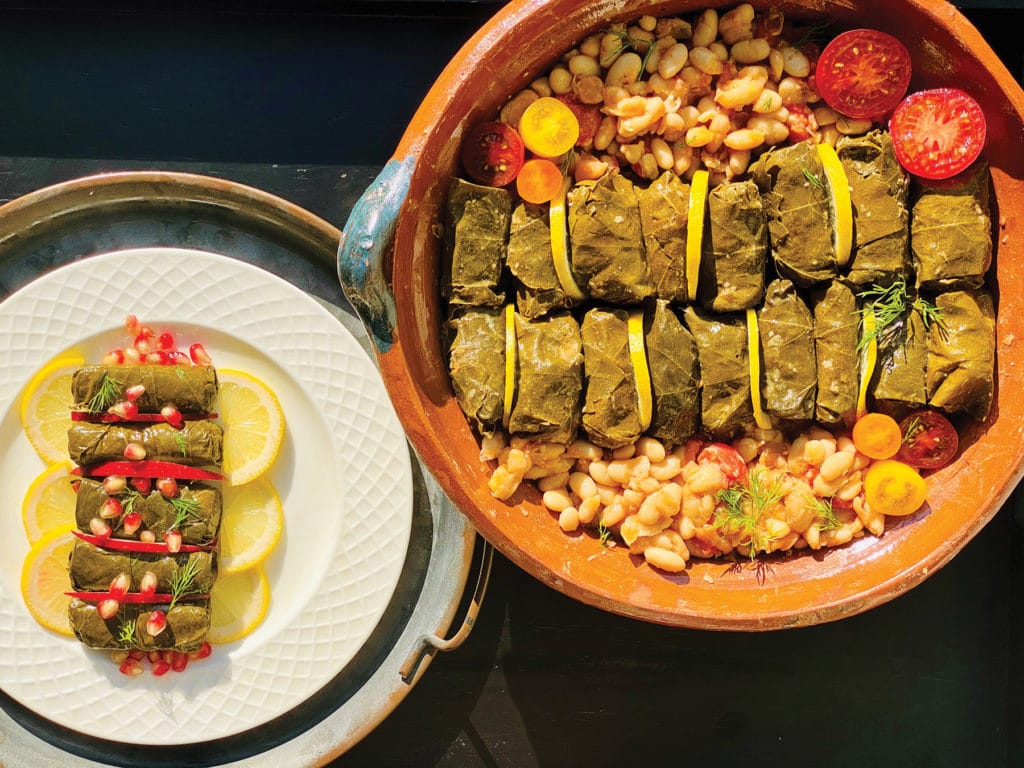
For Sephardic families, Sukkot means vegetables such as peppers, onion, eggplant, zucchini, tomato and, of course, vine leaves, stuffed with any combination of rice, parsley, mint, pine nuts, lemon and/or ground lamb or beef. 

While the origins of stuffed grape leaves may be Greek, the chefs of the Topkapi Palace in Istanbul served these exotic treats to the sultan and his exalted guests. Eventually, this food became an integral part of the cuisine of the Mediterranean, Syria, Iraq, Iran and Central Asia. The Jews of central Europe adapted the recipe by substituting cabbage leaves for the difficult-to-obtain grape leaves.  Thank goodness, you can pick up a jar of marinated grape leaves from the market. 

We hope you enjoy the recipes Rachel learned to make to honor her husband Neil’s Rhodesli culinary heritage.


YALANGI (RICE-STUFFED GRAPE LEAVES)

1 onion, chopped
7 tablespoons olive oil, separated
2 cups rice, rinsed
4 cups water, separated
2 teaspoons salt
1 teaspoon pepper
2 tablespoons parsley, finely chopped
Juice of 4 lemons, separated
32-ounce jar grape leaves, rinsed and drained

Sauté onion in 1 tablespoon oil until golden.

Add rice, 2 cups water, salt and pepper, and cook rice according to package directions. 

When rice is almost cooked through, add parsley and juice of 2 lemons and cook until all liquid has been absorbed.

Allow rice to cool.

Stuff leaves with teaspoon of rice mixture and roll leaves into small cigars. Arrange tightly in pot. 

Cover with 2 cups water, juice of 2 lemons and 6 tablespoons oil. 

Place dish on top of grape leaves, cover pot with lid and cook for 10 minutes. Then reduce heat and cook for 1 hour.

Best served same day. Do not refrigerate if serving same day cooked.

Can be frozen, defrosted, reheated and served at room temperature

Serve cold as an appetizer.

Makes 50-60.

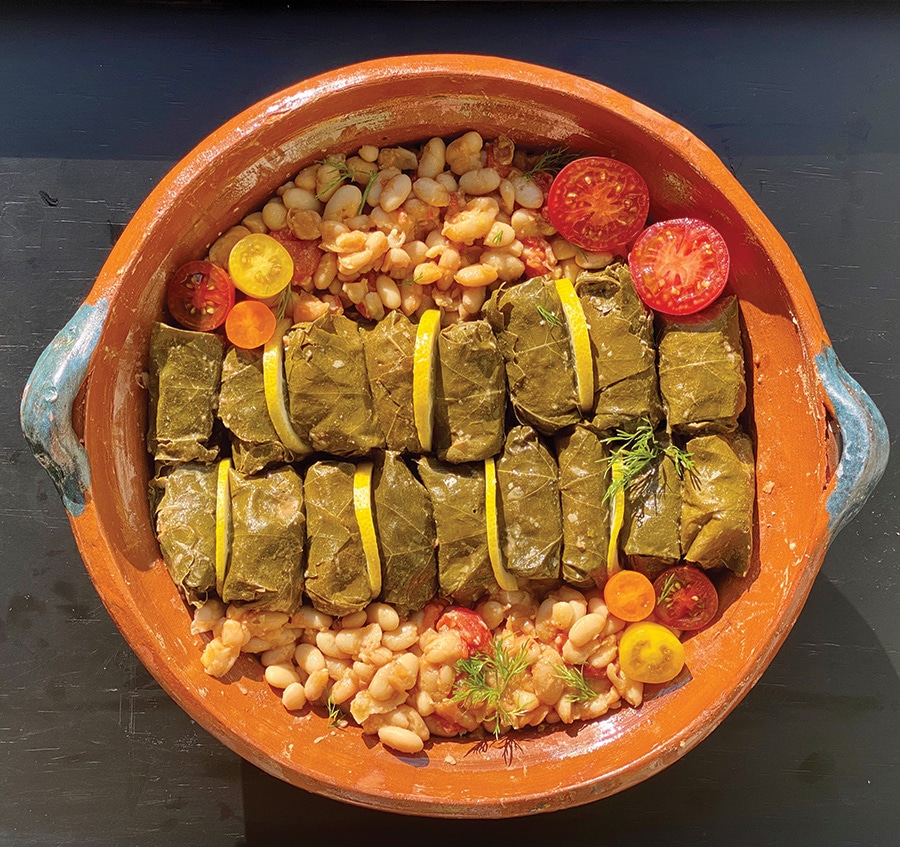
YAPRAKIS (STUFFED GRAPE LEAVES WITH MEAT), BRAISED WITH WHITE NORTHERN BEANS

1 large jar grape leaves, drained and rinsed
2-3 cans Great Northern beans, or 1 pound dry beans soaked overnight, boiled and salted

Filling:
2 pounds ground beef, lamb or turkey
1/2 cup long-grain white rice, rinsed and drained
2 teaspoon salt
1 teaspoon black pepper
2 tablespoons oil
Juice of 1 juicy lemon
1/2 cup parsley, finely chopped
2 tablespoons tomato paste

Sauce:
4 tablespoons olive oil
1 15-ounce can chopped tomatoes
2 cups water
1 teaspoon salt
Juice of 2 lemons

In large bowl, combine all filling ingredients and mix well. Set aside. 

In medium bowl, combine all sauce ingredients, except lemon juice, and mix well. Set aside.

Place rinsed grape leaves on kitchen towel. Cut off all tips of stems.

Place grape leaf vein-side up on flat surface. Place teaspoon of meat filling at the bottom and roll up tucking in the sides, and rolling.

In large, deep pan, place layer of beans, and then a layer of rolled grape leaves. Leaves should be placed in tightly packed circular pattern. Add another layer of beans and another layer of leaves, finishing with beans on the top. 

Pour sauce on top, then place dish on top so rolls don’t separate. 

Simmer for 1 hour, covered. When leaves are tender, add lemon juice. 

Do not add salt to sauce until it is cooked and you have tasted it.

Makes 36.


Rachel Emquies Sheff and Sharon Gomperts have been friends since high school. They have collaborated on Sephardic Educational Center projects and community cooking classes. Follow them on Instagram @sephardicspicegirls and on Facebook at Sephardic Spice SEC Food. 

The Star of the Sukkot Party: Stuffed Grape Leaves Read More »

david suissa podcast curious times

Pandemic Times Episode 92: As the 2020 Madness Continues, Sukkot Arrives

New David Suissa Podcast Every Tuesday and Friday.

What role can the festival of Sukkot play during these days of turmoil?

How do we manage our lives during the coronavirus crisis? How do we keep our sanity? How do we use this quarantine to bring out the best in ourselves? Tune in and share your stories with podcast@jewishjournal.com.

Pandemic Times Episode 92: As the 2020 Madness Continues, Sukkot Arrives Read More »

Ellipsis of a Lifetime

In speaking about relationships, my professor remarked, “With every first hello, there is an impending goodbye.” Meaning that with each birth, new connection, endeavor or beginning, an ending is inevitable. With a start, there is surely a conclusion. It is a natural phenomenon to begin missing someone even as they stand before us, knowing that one day, their physical presence no will longer be there; knowing that one day, our physical presence no longer will be here.

I believe this is the reason Rosh Hashanah and Yom Kippur are adjacent to each other. We acknowledge the birth of the world, our own renewal, a sense of beginning and starting over. And only 10 days later, we recognize that final chapters, endings and finales are just as frequent. Yes, we see a blank slate before us, but the slate is for naught if we think it will exist forever. The purpose of the bookends of Rosh Hashanah and Yom Kippur is to take advantage of the time in between. We are gifted a birth and know that death is something we cannot escape.

But the ellipsis of a lifetime is something we control. Not taking for granted a second, minute or hour of this time in between.

The Psalmist reminds us, “The life of man is like a breath exhaling; his days are like a passing shadow.” A lingering shadow to give us pause, awakening our senses, that with every rising sun, there is a sunset that follows.

Hellos and goodbyes will always come; but let us thank God for the “in-between.”

Shabbat shalom, shanah tovah and G’mar hatimah tovah.

Ellipsis of a Lifetime Read More »

Sinking Feeling

You know that feeling when you’re running late and there’s no hot water and you’re on hold forever because everyone who doesn’t want to pay a plumber time-and-a-half waits till Monday morning to call, and when you finally make it to your car there’s a ticket on the windshield? I have that feeling.

The feeling I got reading Anne Frank’s diary the first time, thinking how hideous it would be for strangers to know when I got my period, and how sad it would be to remain secreted away in an attic with my parents for years, all of our neighbors wanting us dead.

I have the feeling there’s just a few more feet at the amusement park before our roller coaster car careens off the tracks. The feeling the little Dutch boy must have had knowing his finger in the dike was the only thing between dry ground and drowning. The feeling ancient shepherds probably had when hail rained down — that this really was the end of times.

Maybe Alcoholics Anonymous has it right. Serenity. Acceptance. One terrifying, unbearable day at a time. Screwup after screwup after screwup when the truth is clear and we’ve been warned: This is not the selfie God was going for.


Paula Rudnick is a former television writer and producer who has volunteered for nonprofit organizations for the past 30 years. 

Sinking Feeling Read More »

Trump Says He Tested Positive for COVID-19; Jared Kushner and Ivanka Trump Traveled with him this Week, but Test Negative

(JTA) — President Donald Trump announced early Friday morning that both he and First Lady Melania Trump had tested positive for COVID-19 and would begin quarantining.

Jared Kushner, his son-in-law, and Ivanka Trump, his daughter, who are Jewish, both tested negative although they have been traveling with Trump, media reported, quoting White House sources. The Kushners also have taken leading roles in Trump’s reelection campaign. The sources also said that Trump was suffering “mild” symptoms.

Trump’s announcement — coming just weeks ahead of the presidential election — came hours after news broke that Trump advisor Hope Hicks had tested positive. She began to show symptoms Wednesday while traveling with Trump to a rally in Minnesota.

People with COVID-19 can transmit the disease before showing symptoms and may actually be most contagious during that time, according to researchers. That would put anyone who was in contact with Hicks or Trump earlier this week at risk.

Kushner also traveled to the Minnesota rally; he and Hicks also flew that day on Marine One with Stephen Miller, another Jewish senior advisor. Photographs show none of them wearing a mask. There was no word on whether Miller had tested positive. Miller’s wife earlier this year had the virus.

On Tuesday, Ivanka Trump was among the Trump family members in the audience at the presidential debate in Cleveland. According to media reports, she wore a mask when entering and existing the auditorium but not during the debate.

Trump’s announcement raises questions about whether Vice President Joe Biden, who is running against him and ahead in the polls, could have been put at risk during Tuesday’s debate, although the men stood more than six feet apart throughout the debate. Later Friday morning, Biden’s campaign announced that he would test for the virus.

It also comes after Trump faced criticism for his behavior during the debate, which included not condemning white supremacists when invited to do so, and amid ongoing criticism about his handling of the coronavirus pandemic, which so far has killed more than 200,000 Americans.

Trump Says He Tested Positive for COVID-19; Jared Kushner and Ivanka Trump Traveled with him this Week, but Test Negative Read More »

Table for Five: Sukkot

One verse, five voices. Edited by Salvador Litvak, the Accidental Talmudist

The Sages taught: All seven days of Sukkot, a person renders his sukka his permanent residence and his house his temporary residence. –Sukka 28b, B. Talmud

Sheila Tuller Keiter
Judaic Studies faculty, Shalhevet High School

As real estate agents say, it’s all about location. While the Talmud instructs us to make the sukkah our permanent residence, it follows this injunction with a long discussion of exceptions. One should dwell in the sukkah and make it one’s home, unless it is too hot, too wet, too annoying or too uncomfortable. Because these exceptions are fairly subjective, the exceptions seem to undermine the underlying rule. 

The Talmud explains this conundrum through metaphor: It is as though the king summons his servant to serve drinks and then pours the entire pitcher on the servant’s face. As usual, the king is God, and we are His servants. We are summoned to the sukkah to serve Him. However, we are not expected to suffer inhospitable conditions. The key to this metaphor is location. The sukkah represents God’s house, not ours. God invites us into His private domain. Like royal servants in the King’s chambers, our service to God in the sukkah affords us unparalleled intimate knowledge of our Creator and King. For seven days, we are invited into His inner sanctum. We should absolutely maximize this opportunity for as long as the invitation stands, making His home ours. 

Thus, it is little wonder that adverse conditions suspend the requirement to dwell in the sukkah. Oppressive heat and drenching rains would only hinder closeness. Yet, when conditions are conducive, there is no better place to dwell than in the sukkah of God. No wonder Sukkot is called the time of our rejoicing!

Rabbi Elliot Dorff
American Jewish University

“Discombobulating.” That is the word that continues to come to my mind to describe what the COVID-19 pandemic has done to our communal health, our economy, our schools and our religious life, seriously undermining what we used to take for granted about how life is lived. Sukkot, even in normal times, is supposed to do the same thing, albeit in more benign ways, for the laws of Sukkot, as summarized in this verse, require us to get out of our comfortable and secure homes to dwell in the temporary hut that is the sukkah. 

The point of inhabiting this flimsy structure is to remind us of the fragility of life, that we need to be thankful for our very lives and for what makes them flourish. Preserving life, though, takes precedence over this commandment, and so the Conservative movement’s Committee on Jewish Law and Standards has issued advice, written by Rabbi Joshua Heller, about how to observe the holiday this year. You can find it by visiting rabbinicalassembly.org and clicking on” Our RA Responds to COVID-19.” 

In sum, Heller writes, “It is always encouraged to have a sukkah for one’s household, and that practice is particularly encouraged this year. One is exempt from using the sukkah if one is ill or distressed, and in fact one is forbidden from being in a sukkah, and does not fulfill the mitzvah by doing so, if conditions in the sukkah are unsafe or being in a sukkah would make it unsafe for others.”

May Sukkot this year and every year be both joyous and safe. 

Yehudit Garmaise
Teacher of parsha, chassidus and simcha

After accepting our heartfelt prayers and sacrifices on Yom Kippur in the wilderness, HaShem transformed the smoke from our incense into the Clouds of Glory, from which our mitzvah of sitting in the sukkah derives. 

When we sit in our sukkah, we should remember that we are sitting in the Clouds of Glory, made by HaShem for us in the desert to protect us from all harm and discomfort. Our enemies’ arrows stuck into the outer walls of the Clouds of Glory, and they even cleaned and pressed our clothing!

According to kabbalah, when we are sitting in our sukkahs, we are sitting in spaces so holy, so beyond us, that the spiritual light of the sukkah walls utterly transcends our minds and hearts. 

In response to our ongoing chesbon ha-nefesh (accounting of the soul), prayers and charitable giving, HaShem generously and majestically showers down His 13 attributes of mercy. These are not, however, easily internalized by us. 

To accept HaShem’s mercy, we must first transform ourselves into vessels that can receive HaShem’s blessings. How, then, do we internalize HaShem’s pure, transcendent light? Only via mitzvot (commandments).  

This week, HaShem gives us a sukkah, lulav (palm branch bundled with willow and myrtle) and etrog (citron). When we sit in the sukkah, we feel HaShem’s hugs and internalize His holiness and purity. Each time we grasp the lulav, we elicit different spiritual forces of goodness. With each motion we make with the lulav, we bring HaShem’s power and blessing down into our hearts and draw ourselves ever closer to Him.

Rabbi Nicole Guzik
Sinai Temple

For serious sukkah dwellers, the interior of the sukkah has become more elaborate than ever. I have seen sukkot with chandeliers hanging from the roof, decorated tapestries adorning the walls, rugs from one end to the other, lights twinkling throughout. Couches and ottomans, beautiful tables, ornate pieces of art, the interim structure filled with anything that might bring in the comforts of “home.”

And I think it is becoming clear that Sukkot is less about the realization that everything is temporary. Rather, Sukkot is a holiday that infuses a sense of resilience; that in a world in which time is fleeting, we possess the mental tools to make moments feel everlasting. To create structures in which the memories of our people and the customs of our tradition enable us to feel protected, secure, bolstered and prepared. It doesn’t matter if wind blows down the walls around us, nor if the earth quakes below our feet. Through our historical identity as a wandering people, we have developed the ability to create home wherever we go. 

The Chofetz Chaim said, “The trip is never too hard, if you know you’re going home.” I take his words a step further. The journey has the potential to evade difficulty if you can create home wherever you are. 

It is during Sukkot that we’re all architects, understanding how to build a home with walls of love and a foundation of faith.

Rabbi Chanan Gordon
Motivational speaker

The central motif of Sukkot is captured by our Sages in our Mishnah, “all seven days of Sukkot, a person renders his sukkah his permanent residence and his house his temporary residence.” 

Sukkot is a metaphor for our relationship with this world. While in a literal sense, the mitzvah of sukkah consists of leaving our permanent residence, on a deeper level, it is a mandate to recognize the fleeting nature of our material world. 

By forcing us to differentiate between things that have eternal value versus fleeting moments, Sukkot gives us the tools to master “spiritual time management.” Unlike our homes, which get cluttered with our many things, the sukkah is bare. We are forced to prioritize between what we need and what we want. It is this minimization of materialism that grants us the ability to focus on our deeper values and goals by making a distinction between what is real and what is transitory. 

The sukkah functions as a spiritual space within a transient world, where we can divest from physicality and connect to what it is really important and eternal. By so doing, we open ourselves up for a full relationship with HaShem and His mitzvot. 

To paraphrase the words of the late author Stephen Covey, Sukkot helps ensure that we don’t get caught up in the thick of thin things, but rather helps us to keep the main thing the main thing! 

Table for Five: Sukkot Read More »