Shmuel Rosner and Pew researcher Jacob Poushter discuss his latest study, which raises the question: Is belief in God necessary for good morals?
Jacob Poushter is an associate director at Pew Research Center. He is an expert in international survey research and writes about international public opinion on a variety of topics, including the international image of the United States and perceptions of global threats. He also is responsible for designing survey questionnaires, managing survey projects, analyzing data and developing topics for the annual Global Attitudes Survey.
Beanie Feldstein (“Booksmart,” “What We Do in the Shadows,” “Lady Bird”) is about to channel her inner child. She will voice the curious 11-year-old title character in “Harriet the Spy,” Apple TV+’s animated adaptation of Louise Fitzhugh’s beloved children’s novel of the same name. Jane Lynch will portray Ole Golly, Harriet’s nanny, and Lacey Chabert will play Marion, the leader of the popular girls at Harriet’s school. The series will be set in 1960s New York.
As previously announced, Feldstein has also been cast in an equally famous but completely different character: She will play White House intern Monica Lewinsky in the FX limited series “Impeachment: American Crime Story,” about Bill Clinton’s presidency.
(JTA) — One was a former SS officer who helped murder 220 Lithuanian Jews. Another was a doctor who sent at least seven children to their deaths on Nazi orders.
After World War II, both Werner Scheu and Albert Viethen were among a group of former Nazi officials who ran children’s homes in West Germany where torture, abuse and malnourishment were commonplace, according to an investigative report broadcast this week on the German TV network ARD. Public heath insurance funded the homes.
According to an organization founded by survivors of the homes, from the 1950s to the 1980s, some 8 million to 12 million children were sent to the homes for spa treatment based on the advice of doctors, schools or welfare officials, according to the magazine Deutsche Welle. The survivors’ organization has more than 3,000 members.
At the homes, children would be beaten, put in solitary confinement, separated from their siblings, force-fed and subjected to other forms of mistreatment, according to the ARD report. The system of children’s homes was created in the 1930s.
“The children came back sicker than when they left, they were malnourished, had to be hospitalized,” said Anja Röhl, who founded the survivors’ organization. “Sometimes they were so disturbed they didn’t recognize their parents.”
Manfred Lucha, the chairman of Germany’s Ministry of Labor and Social Affairs Ministers — an association of German state officials responsible for labor and social policy — told ARD that the group is “looking into some depths, some dark holes” and will address the misconduct detailed in the report.
Michael Aloni is adding another family saga to his repertoire. Now shooting the third season of “Shtisel,” the popular series about a Charedi family in modern Jerusalem, Aloni will next lead the cast in Yes TV’s adaptation of “The Beauty Queen of Jerusalem,” a multi-generational, historical story set against the backdrop of the Ottoman Empire, The British Mandate and Israel’s War of Independence.
Based on the best-selling novel by Sarit Yishai-Levy, and set in locations in Jerusalem, Safed, Acre and other cities in Israel, the series also stars Hila Saada (“The Baker & The Beauty”), Itzik Cohen (“Fauda”), and introduces Swell Ariel Or who will play the title role of Luna Armoza, the beauty queen of Jerusalem. Yuval Scharf (“McMafia”), Ellie Steen, Moris Cohen, Irit Kaplan, Israel Ogalbo, Tamir Ginsburg, Tom Hagi, Omer Dror, Miki Kam, and Dov Navon round out the cast.
Yes TV has commissioned an initial 2 seasons of the series, which was created by Shlomo Mashiach and Ester Namdar Tamam and written by Mashiach, with Oded Davidoff directing. It’s produced by Dafna Prenner and Shai Eines from Artza Productions.
“After years of watching with envy costume dramas from around the world, we feel lucky to be able to produce a period drama that will bring to the screen the rarely seen sights and sounds of early 20th century Jerusalem,” Prenner said. “From acquiring the rights to Israel’s bestselling book of the last decade and the formation of a brilliant dream-like creative team, this has been a surprising, emotional and inspiring journey — and we can’t wait for what will come next.”
“The Beauty Queen of Jerusalem” will air on Yes TV in Israel in early 2021. No U.S. release plans have been announced.
The National Comedy Center’s annual Lucille Ball Festival goes virtual this year, with many MOTs among the artists taking part. Taking place in cyberspace from Aug. 14-30, all programs will stream online for free here as well as live on Facebook.
Among the offerings: Tiffany Haddish discusses her work, comedy and Emmy nomination for “Tiffany Haddish: Black Mitzvah” on Aug. 22 at 8 p.m. ET. Howie Mandel with talk with fellow comedian Harrison Greenbaum in a conversation on Aug. 21 at 9 p.m. ET. Greenbaum also hosts a chat with the creators of “Mad” on Aug. 16 at 8 p.m. ET and a talk with Gilbert Gottfried on Aug. 28 at 10 p.m. ET.
Judy Gold, the author of the new book “Yes, I Can Say That,” will discuss her career at 10 p.m. ET on Aug 22. She’ll also host the Margaret Cho convo on Aug. 14 at 10 P.M. ET. “Saturday Night Live” writer Alan Zweibel discusses his new memoir “Laugh Lines, My Life Helping Funny People Be Funnier” on Aug. 23 at 8 p.m. ET,
The Festival will close with a special tribute presentation: a never-before-seen interview from the Comedy Center archives with the late comic legend Carl Reiner. It will be accompanied by a discussion of Reiner’s genius with Paula Poundstone and producer Stephen J. Morrison.
“As a non-profit cultural institution, the museum celebrates comedy’s great minds and unique voices, while providing an examination of the time-honed creative processes that have elevated comedy to an art,” said Journey Gunderson, Executive Director of the National Comedy Center. “I can’t think of a better way to tell the story of comedy than via these artists’ voices, at a time when we all need laughter more than ever.”
Six years ago, I was performing at a comedy show involving comedians taking on different WrestleMania-type characters. The host told me to act like a “bad guy.”
Like Andy Kaufman used to do with his wrestling character, I made racy and offensive jokes. The crowd was both booing and laughing hysterically. It worked.
Sadly, though, I heard I’d offended another comedian who was on the lineup. I felt bad and wanted to make things right. A few weeks later, I approached her at a comedy club where she was sitting with her friends. I said I was sorry for hurting her. Seemingly unimpressed, she briefly thanked me and went back to her conversation. It was tough. I knew I was wrong, but I also knew I was misunderstood. However, I wasn’t there to make myself feel better. I was there in hopes of making her feel better.
I’m not trying to virtue signal. In fact, I may have just done the opposite. It’s to illustrate a point. My performance may have been insensitive and tone-deaf, but it did not come from a place of hate. Because I was in that situation, when people say offensive things about Jews, I don’t jump to conclusions. I hear them out. That being said, it’s difficult for me when I hear anti-Semitic comments from people such as rapper-comedian Nick Cannon, NFL player DeSean Jackson, Rep. Ilhan Omar (D-Minn.) and others. How can I tell whether they are coming from a good or bad place? Apologies seemingly written by PR people to protect a person’s “brand” are not enough. They feel rote and insincere.
So, if a quick apology isn’t the solution, what is?
It’s not to try to “cancel” them. You can’t cancel a person, anyway. Only God can do that. Cancel culture is based on the heartless assertion that people can’t and won’t ever change. In Judaism, we learn the opposite: People can improve and repentance is even greater than perfection. Specific action, then, is stronger than an apology. What will the offender do to make up for an anti-Semitic offense?
I suggest the Jewish concept of repentance or teshuvah. With sincere teshuvah, you should be able to un-cancel yourself. After all, it’s what we do every year on Yom Kippur. When God hears our atonement, He can decide to keep us alive when we were already decreed to die. It’s the ultimate un-canceling. What better example do we have to go off than that?
Cancel culture is based on the heartless assertion that people can’t and won’t ever change. In Judaism, we learn the opposite: People can improve, and repentance is even greater than perfection.
So let Nick Cannon’s meeting with the Simon Wiesenthal Center pave the way to a better and more forgiving future for our society.
Following this new protocol, comedian Roseanne Barr should be given a second chance because what’s fair for one should be fair for all. Let’s not divide ourselves any more by implementing double standards within segments of our population.
For instance, in the United States, while there is zero tolerance for hate toward other minority groups, you can say anything you want about Jews and pretty much get away with it. Take Ice Cube, who has experienced no repercussions for his multiple anti-Semitic attacks on social media. Why should Jews accept this? Every one of these comments expands the ever-growing anti-Jewish narrative, and sadly, history has shown us what follows.
After I saw the effects of my offensive performance, I took a more thoughtful approach to my words and actions. However, to be fair, if I find something to be funny and offensive, I still might say it. I love edgy humor. I just think before I speak and try to do a better job of taking the temperature of the room.
As for the anti-Semites who wish to destroy the Jews and don’t want to change, perhaps the best solution is to make sure they never get to work again.
“Wait! Daniel. That’s very mean and irresponsible. And you’re a Jew. You need to take the higher road or else you’ll be just as bad as they are.”
You’re right. I’m sorry. All good?
Danny Lobell is a comedian and storyteller based in L.A. He hosts the podcast “Modern Day Philosophers.”
Now that we are all doing a lot more cooking at home, “Modern Kosher: Global Flavors, New Traditions” by Michael Aaron Gardiner (Rizzoli) is an especially timely cookbook. Gardiner also offers recipes that are especially appropriate for Rosh Hashanah. But the book is so inventive and inviting that it has a shelf life that will extend far beyond our present circumstances.
The starting point, of course, is kashrut. “Kosher cuisine is about what can be done within a given set of rules,” the author concedes, but he also insists that “[k]osher food is a living, breathing process, not a museum piece.” Among his other innovations is an awareness of the secular dietary rules that have come to be overlaid on the laws of kashrut in many modern Jewish homes — some of his recipes are especially designed for vegetarians, vegans and gluten-free eaters.
The key word Gardiner uses to define his approach is “fusion,” but he points out that the concept has a long history in Jewish cuisine. “[T]he Jewish people traveled, willingly or otherwise, throughout the world,” he observes. “Forced to adapt the application to those laws to the local ingredients in these new lands, they engaged in a remarkably fertile exchange of culinary ideas with their hosts.”
It was always a two-way transaction. The Polish stuffed cabbage rolls called golabki are inspired by holishkes, “a dish prepared by their Jewish neighbors.” And Gardiner’s recipe for holishkesis itself a fusion of both Sephardic and Ashkenazi culinary traditions, a “combination of the sweet, evocative warming flavors from the cardamom and the creaminess and bitter notes of the tahini with the savory chicken and chicken parts inside the stuffed cabbage.” To his recipe he adds a dash of history — Gardiner honors the Jerusalem mixed grill, “a quintessential Israeli dish [that] was created in the shadow of Jerusalem’s Machane Yehuda Market no earlier than the late 1960s.”
Similarly, he argues that the very name of gazpacho, the iconic cold soup from Spain, is rooted in Hebrew word gazaz, which means “to break into pieces.” The dish itself dates back to the Moors, and he explains that “[m]uch of Sephardic cuisine began it life as Islamic (Moorish) dishes filtered through the laws of kosher.” Gardiner’s list of ingredients for gazpacho pointedly includes “attractive cilantro,” which is used to decorate the dish in the bowl, as do the five tiny dots of cilantro oil that are arranged in a crescent on the surface of the soup. (We learn these fine touches, by the way, from the superb color photographs that accompany all of the recipes.)
As an alternative to gefilte fish for Rosh Hashanah dinner table, Gardiner offers a recipe for oil-poached tuna with curry and chutney, a nod to the Jewish community that has long existed in India and still does in much reduced numbers. “Indeed, Judaism was one of the first — if not the first — foreign religions in India, arriving two millennia ago,” he writes. And he offers a recipe for tzimmes that uses beets, a traditional Rosh Hashanah ingredient, in place of carrots. “It may not look like tzimmes,” he cracks, “but, frankly, that’s a good thing.
The key word Michael Aaron Gardiner uses to define his approach is “fusion,” but he points out that the concept has a long history in Jewish cuisine.
The two main sections of “Modern Kosher” explore what the author calls “Diaspora Food” and “New Israeli Cuisine,” but all of the recipes have been updated and enriched. As an example of how he tweaks a traditional Diaspora dish, he gives us “Roast Chicken With Schmaltz Massage and Le Puy Lentils.” The Israeli dishes are no less innovative, and he points out that two dishes that have come to be regarded as part of Israeli cuisine, shawarma and shakshuka, are, respectively, Lebanese and Tunisian in origin. “And yet the Israeli versions of them aren’t just the old recipes transplanted to Israel,” he writes. “They are reinterpretations and variants on the originals. The living, ever-changing, fusion nature of Jewish cuisine continues.”
Most of “Modern Kosher” is devoted to recipes for various dishes to be served at the table, although Gardiner does not offer dessert recipes, mostly because “that’s not the way I eat.” However, he does provide a section titled “Pantry,” which consists of recipes for stocks, sauces, dressings, herb and spice blends, and other “garnishes, flourishes, and staples,” all of which, he promises, “can take your cooking to another level.” Here the reader will find more surprises, including a recipe for garum, a sauce made with fermented fish that originated in ancient Rome and exists today in Southeast Asian cuisine. “[Y]ou could add it to just about any sauce (or, for that matter, any savory dish) and it will make the dish better and cures what ails you.”
Gardiner, who identifies himself in the book as a Reform Jew, recognizes that not all of his readers keep kosher, and he makes an argument why you did not need to be highly observant to do so. “At the simplest level, if you keep kosher, you’re Jewish,” he explains. “Many — but not all — observant Jews would say it’s also true that if you do not keep kosher, you’re not Jewish.” At the same time, he defines kosher cuisine in an admittedly “non-Jewish” way. “A Jew who keeps kosher cannot simply walk into a supermarket and pull anything he or she wants off the shelf,” he writes. “In that sense, all aspects of eating — even shopping at the supermarket — become part of a surprisingly contemporary and spiritual notion: mindfulness.”
Jonathan Kirsch, author and publishing attorney, is the book editor of the Jewish Journal.
Actor Nick Cannon and Anti-Defamation League (ADL) CEO Jonathan Greenblatt called for unity between the Black and Jewish communities in a joint op-ed in The Forward on Aug. 11.
Cannon and Greenblatt wrote that there has been a rise in hate overall, citing “anti-Black prejudice” in response to the Black Lives Matter movement, a spike in anti-Semitic incidents nationwide in 2019 as well as a rise in anti-Asian incidents since the start of the COVID-19 pandemic.
“Racism isn’t just a problem for Black Americans; it’s my problem as a white Jewish man,” they wrote. “And anti-Semitism isn’t just a problem for American Jews; it’s my problem as a non-Jewish Black man. And yet, today, the Black and Jewish communities don’t always seem to stand together.”
Cannon and Greenblatt noted that the ADL and various other Jewish groups have had long partnerships with civil rights groups like the National Association for the Advancement of Colored People (NAACP) and that Jews marched with civil rights leaders in Selma, Ala., in 1965. However, the relationship between the two communities has eroded over the years because of differing “collective interests” and “loud voices on the fringes.”
“This needs to change,” they wrote. “Now.”
The two men suggested that the best way to do is for individuals to start taking responsibility when advancing stereotypes, even if it’s unintentional.
“It continues by advancing an agenda of learning, so we study and come to understand our respective histories so we can be better allies to each other,” Cannon and Greenblatt wrote. “And it is sustained by accelerating efforts to collaborate, even when it’s uncomfortable, so we can create authentic change that uplifts everyone because we cannot be free until everyone is free.”
They added that the two communities can’t let their differences divide each other.
“When Blacks and Jews fight one another, racists rejoice and bigots celebrate, even as the silent majority among our people mourn, especially the Jews of color caught between two worlds,” Cannon and Greenblatt wrote.
On Aug. 10, Cannon said on an American Jewish Committee (AJC) webinar that he had thought that his 2019 remarks about Zionists and the Rothschilds having too much power and claiming that Blacks are the true Hebrews were simply “factual information.” He said he has since learned that those remarks were actually anti-Semitic tropes and acknowledged that he unintentionally hurt people with those remarks.
“I apologize specifically for the hurtful words because that was never my intention,” Cannon said.
Cannon said that he has since been attempting to atone for those remarks through reading Jewish literature and talking to members of the Jewish community; he also observed the Tisha b’Av holiday and attended a Shabbat dinner.
Cannon also said he would be happy to act as a “conduit” to bring the Black and Jewish communities together.
“Let’s galvanize our positive energy and compassion and use it as a defense against the hate,” Cannon said.
Regarding Nation of Islam leader Louis Farrakhan, who Cannon praised in his 2019 remarks, Cannon said that he had seen Farrakhan “transform the lives of incarcerated individuals” but he could never stand for any of the “hateful” things that Farrakhan has said.
“I can condemn the message but I can never condemn the messenger,” Cannon said, later adding that “we must condemn hate, we must condemn demagoguery and anything that divides us but we are not able to throw away anyone.”
Cannon also said that his great-grandfather was a Spanish rabbi, stating: “I come from a Black and Jewish family on my mother’s side.”
(JTA) — The director of Hadassah hospital in Israel said his institution’s branch in Moscow is a “partner” in the development of what Russian President Vladimir Putin called the world’s first effective coronavirus vaccine.
Dr. Zeev Rotstein was speaking in an interview Tuesday with an Israeli radio station shortly after Putin’s assertion that the vaccine has been successfully tried on humans — including his daughter.
Hadassah “is a partner in the clinical trials of the new Russian vaccine,” Rotstein said. “It’s being done at Hadassah’s Moscow branch. We’re examining firstly safety levels, it’ll take time.”
The interviewer, Dr. Aryeh Eldad, a physician and former commander of the Israel Defense Forces’ Medical Corps, asked: “So Putin’s says he already has a vaccine, you’re saying you haven’t finished checking. Which is it?”
Rotstein replied: “We’re doing it simultaneously. In Russia they decided to do the clinical trial in parallel and collect the data, as is customary in the West, as well as allowing some cases that we call ‘compassion treatments’ for some patients.”
He said Hadassah’s work in Moscow on the vaccine is being led “by the city of Moscow, headed by the mayor, they’re doing fine work, they work differently to us and we adapt our methods to them.”
Hadassah’s work in Russia is unconnected to Israeli efforts to develop its own vaccine, Rotstein said.
Health Minister Yuli Edelstein said Wednesday that Israel will speak with Russia on obtaining a vaccine if it’s effective.
“I consider myself someone who’s been put in a lot of boxes. To the confusion of many people, no one box is satisfactory,” cantorial student Jenni Asher, told a group of approximately 74 attendees during an online panel on Aug. 6 titled“Through the Eyes of Our Students: The Experience of Being Black and Jewish.”
Also on the panel were rabbinical students Avigayil Levy-Yochan and Robin Harrison, which was moderated by Rabbi Mel Gottlieb, president of the Academy for Jewish Religion California (AJRCA) and dean of the academy’s rabbinic program. Gottlieb said the school’s responsibility was to “create a world of justice, love and opportunity for all.”
Asher, who is a second-year cantorial student at AJRCA, spent time in both the United States and the United Kingdom and said she experienced blatant and “color blind” racism wherever she went.
“In preparation for this event, I wrote down several pages of experiences with racism, many of which didn’t make it into the speech,” she said. “I asked my husband, in tears, how is it possible that I never noticed how many stories I have? And he said very simply and matter-of-factly, ‘Because people can be nice and racist’ and that’s a really hard truth for me.”
Asher added that there were uneducated students and strangers who passed her in class, and older members of her congregation who didn’t think she could be a congregant or prayer leader because she is Black. She also discovered that her friend’s parent wouldn’t let him be with Asher romantically because she is Black. She said she had trouble identifying especially within her own mixed-race family.
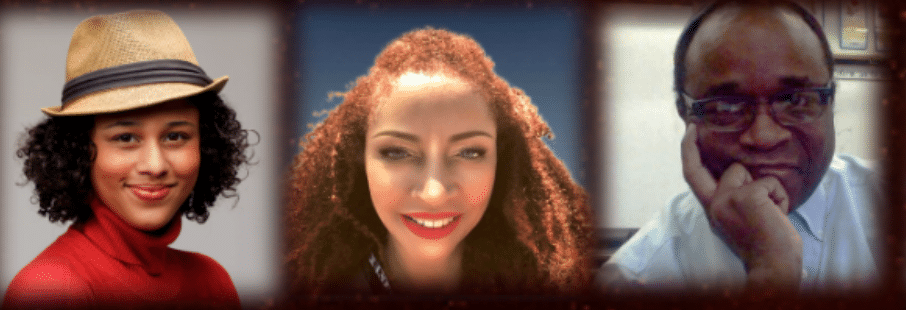
Jenni Asher, Avigayil Levy-Yochan and Robin Harrison
“I am seen as neither white nor Black, instead of both, which is truer,” she said. “As the daughter of a white mother with an entirely white family and a Black father with an entirely Black family, there were no mixed family members to model mixed race for me. The message I received from my families was either ‘This is how white people are’ or ‘This is how Black people are.’”
Asher said she hoped to find “the gorgeous in between,” quoting author Marra Gad’s book “The Color of Love: A Story of a Mixed-Race Jewish Girl” where she is able to live “in between the boxes.”
Harrison, who served as a teacher with the Los Angeles Unified School District for 25 years, said it all starts with proper education. A member of Temple Beth Davidin Westminster for nearly a decade and member ofthat synagogue’s board of directors, Harrison said he is strongly connected to his Judaism and fights against racism and anti-Semitism. Yet, people still come up to him surprised that a Black man can lead a minyan.
“This is an issue that needs to be addressed …. It starts from home where we are first and goes out from there. It really requires a great deal of openness and [honesty],” Harrison said. “This has to become a permanent part of who we are. Jews of Color are making themselves known more and more and it’s important to all of us to make them appear as if it is a part of everything we are … so that no one feels unwelcome.”
“These things may seem minor and insignificant to some people and if it was just one incident, it probably could be brushed off as that, but unfortunately it’s not. It’s more the norm than the exception.” — Avigayil Levy-Yochan
Levy-Yochan, too, has been questioned about being Jewish upon entering a synagogue. Born in Kingston, Jamaica, she spent her childhood in Crown Heights, N.Y. Her family chose New York because it had a strong Jewish population. However, she said they experienced so many forms of racism within their Jewish community — including being called derogatory names at Jewish day school —and inappropriate intimate questions about her identities, she often wondered if “social etiquette just drops out the window when someone different walks in. I call them micro-aggressions,” she said.
“I mean these things may seem minor and insignificant to some people and if it was just one incident it probably could be brushed off as that, but unfortunately it’s not. It’s more the norm than the exception,” Levy-Yochan continued. “All I want is to be welcomed with excitement as a newcomer who has a lot to offer the community.”
She said if people can get to know her, they won’t see the differences but only the similarities. While her experiences were more positive in Southern California when she moved here in 1995, she said she still noticed the lack of Jewish allyship.
“The silence is what hurt me more than anything else,” she said. “I expected my Jewish family to stand up for me and that’s not what happened. I just want our community to not be complacent. Look at your biases and actions, and lack of actions. It’s not always what you do but what you don’t do.”
Levy-Yochan also spoke about how her children are now able to identify racism. When her 9-year-old daughter wanted to see the protests happening in their neighborhood, Levy-Yochan was nervous. She said she asked her daughter why she felt compelled to attend and she simply said, “I had to stand up for my daddy and my brother because no one else is going to … because nobody looks like us.”
She is still fearful for her 25-year-old son, especially when he first learned to drive at 17. “I didn’t have just the talk on texting and driving,” she said. “I talked to my son about how to survive a traffic stop. How to make it home alive. So, with these past recent events [of African American men being the victims of police brutality], I just stood in front of the TV and I cried because I have a son and I don’t want to get that phone call.”
While Levy-Yochan said she can speak to other Black women and mothers about these issues, only one non-Black person in the Jewish community reached out to make sure she was OK.
“I know our country is deeply divided in many ways but I don’t want our community to be divided,” she said. “Our different cultures make up a beautiful mix of who we are. It makes us all wonderful.”