fbpx

August 12, 2020

Death of a Parent During Coronavirus

The calls come regularly from my daughter in Israel. We go through a routine: 

“Tatty, I’m concerned about you. I’m worried.”

“What are you worried about, Chana?”

“I’m worried that you’re not handling Saba’s death well. Your Instagram feed that used to be so cool became constant pictures of you saying Kaddish for your father.”

“Well, Chana, part of it is promotion,” I say. “I struggle three times a day to get a minyan to say Kaddish for Saba. People are reluctant to come to daven during COVID. So I’m promoting our prayer services.”

“It comes across like you’re obsessed with death. Like your whole life has become about doom and gloom.”

Chana, who lives in Jerusalem, had returned to the U.S. just before the coronavirus outbreak. She got stranded here because of the pandemic and quarantined with us in New Jersey. But then, as an Israeli citizen, she was permitted to travel with me and my wife to bury my father on the Mount of Olives.

“I’m fine, Chana. Everything’s fine.”

But “fine” is always subjective. And I have not been at peace since my father’s death in late May.

I have discovered that mourning and bereavement are the loneliest undertakings on Earth. You can be surrounded by a loving wife, children and grandchildren but, at the end of the day, you are all alone in the sensations of numbness; in feeling misunderstood; and in experiencing some dark weight pushing down on you, making it a challenge to experience happiness.
I have discovered that mourning and bereavement are the loneliest undertakings on Earth. 

And just when I thought my father’s death was more than I could bear, along came potentially much worse news: My older brother Chaim Moishe, with whom I shared a bedroom while growing up, and who lives in Miami Beach, had the coronavirus and was in the ICU. Chaim was the only brother who traveled with me to Jerusalem to bury our father. Having him at my side saying Kaddish as our father was being put into the ground — in Israel, there is no coffin, so the internment is brutally visual — was an immense comfort to me. “We are two brothers saying Kaddish together,” I told him. “You and I are never alone.” Now, with Chaim battling the coronavirus, I was thrown into a dark place even as I feverishly manned the phones with every leading medical authority I knew to get him the best care possible.

The business of death is a horrible thing, made much worse by the paralyzing effect of COVID-19, and, as I later learned, by the bizarre and byzantine rules that prevail in the United States about estates and trusts. No one warns you just how dark the experience is. At a time when so many people around the world have lost loved ones — especially elderly parents — to the coronavirus, I felt the urge to share my own journey of grief with others to help me get through it.

Rabbi Shmuley Boteach

My father did not die from complications related to COVID-19, but he may as well have. Having suffered a catastrophic stroke in late December the night before Hanukkah, he struggled to breathe while he remained mostly in the ICU at Cedars-Sinai Medical Center in Los Angeles. Every time he improved and we brought him home, a few days later his breathing would worsen and he would be readmitted. But at least we could visit him, hold his hand, and sing to him the beautiful Sabbath melodies he loved so much.

However, after the hospital went on lockdown because of the coronavirus, we could see him only through an iPad. At that point, despite the best efforts of the incredibly dedicated and professional staff, he essentially was warehoused. Bedsores and mouth sores took over. So we made the decision — after he was breathing on his own without external oxygen — to bring him home again under a physician’s care, where he lasted about another week until he was rushed on May 23 back to the hospital, where he died upon arrival.

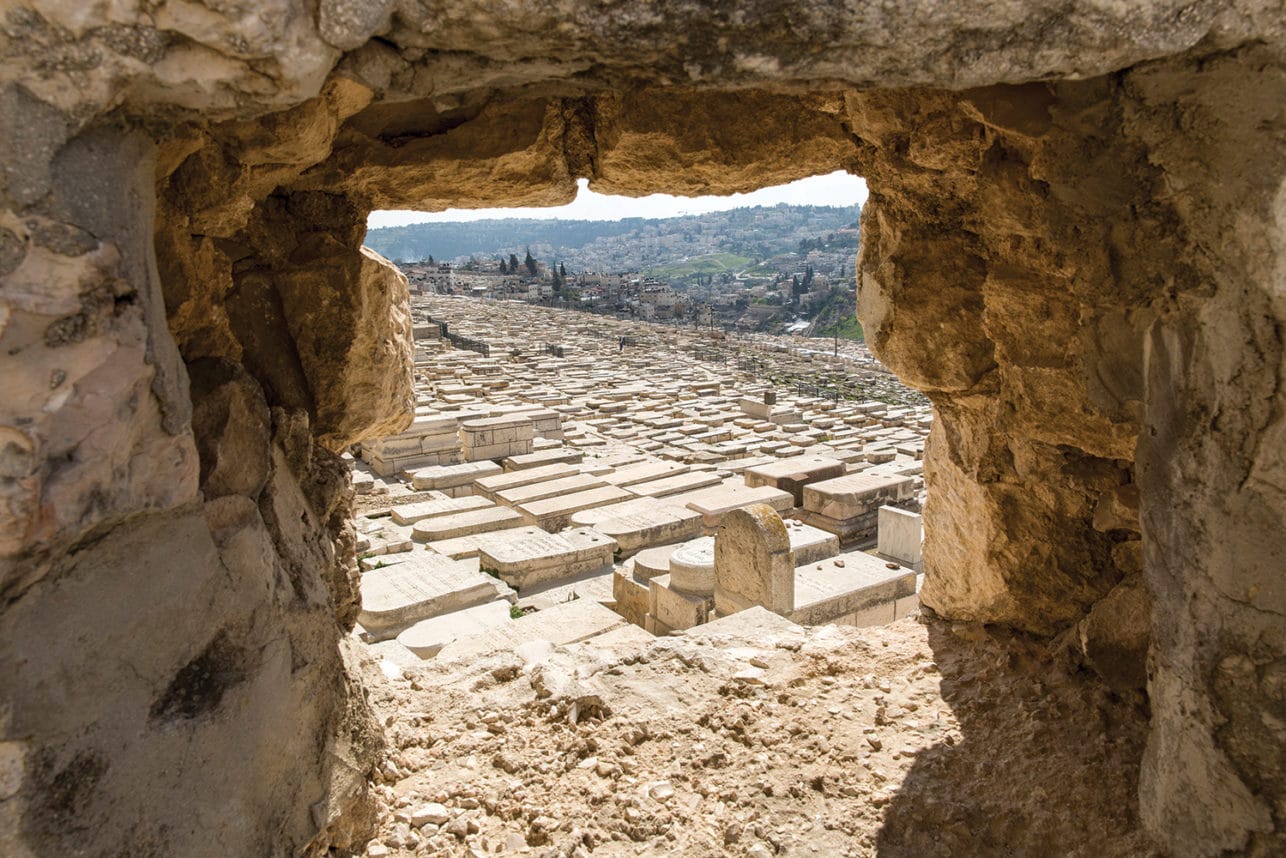
The next few days were a blur. I could not grieve. I had no time to grieve. My life was a dizzying array of calls to contacts in Jerusalem to secure a burial plot on the Mount of Olives, overlooking the Temple Mount, Judaism’s oldest and most revered burial ground. Then there were the nearly insurmountable logistics of moving my father’s body to Israel. El Al was completely shut down. United, which had flights from New York, didn’t accept any cargo. Then we heard about a specially scheduled El Al flight from Los Angeles that was bringing much-needed COVID-19 equipment to Israel, and the airline had room for two caskets. My father’s was one of them.

There was the issue of getting flights ourselves from New York and Miami, and persuading my siblings that as risky as it might be, children have a responsibility to bury their parents. I called my friend Dr. Mehmet Oz: “Should I go to Israel? Take the risk?”

“Shmuley,” he said, “my father died last year in Turkey and I traveled there and put him in the ground. A son has a responsibility to place his father in the ground. The infection rates in the New York area have decreased substantially. You should be fine.”

How ironic that while many leading rabbis were telling me the trip was too risky and halachah forbade us from traveling, it took arguably the world’s most famous non-head-of-state Muslim and one of the world’s best-known doctors to tell me that I, as a Jew and a rabbi, had an obligation to bury my father.

My life was a dizzying array of calls to contacts in Jerusalem to secure a burial plot on the Mount of Olives, overlooking the Temple Mount, Judaism’s oldest and most revered burial ground. 

So, off we went — me, my wife, Chana, our son Mendy, my brother Chaim and my sisters Ateret and Sara.

The flight was eerie; flight attendants seemed afraid of the passengers. No coffee or hot drinks. The meal was placed rapidly in front of you and then you had to fend for yourself. I couldn’t sleep. A torrent of memories rushed through my mind like a raging river. So I took out my laptop and began to write my eulogy. I had been against any eulogies at my father’s funeral, respecting as I do the Chabad tradition of silence at a burial except for prayers and Psalms. What words, however eloquent, could possibly do justice to a life? But my family wanted eulogies, and Israeli uncles and cousins wished to speak. So I wrote one.

When I speak in public, it is nearly always extemporary. At most, I have some notes. Not this time. I didn’t want to give a speech. I wanted to do justice to my father’s memory. I wanted to capture his essence. It had to be precise. It had to be done from the written word. I completed the eulogy over the next few hours, and finished just as I saw the beautiful coastline of Israel (and Gaza) coming into view.

To say I love visiting Israel is an understatement, arriving each time and immediately pressing my lips to the ground as I connect with the sacred earth of the Holy Land.

This time was different. We arrived at a Ben-Gurion airport that was a ghost town. The welcome was inhospitable. Israeli citizens deplaning from the same aircraft walked right past, while foreign nationals were held back, waiting for our names to be called so we could show the special permissions we had received. Temperature check. We cleared one hurdle, then we were pulled into a room where a pleasant young woman wearing a full hazmat suit gave each of us a COVID-19 test, sticking a swab straight up a nostril. Second hurdle jumped. Then security. Then customs. It was clear that Israel wasn’t exactly happy to see us. And who could blame it? At the time, Israel had handled the coronavirus better than almost any country in the world, specifically through these incredibly intrusive lockdowns.

The next day was the burial. There would be no formal funeral, only the internment and speeches. A few days earlier, Israel had begun allowing up to 50 people at outdoor religious ceremonies; our numbers, with family, friends and some Israeli notables, was just below that. By far, the worst part was when the Chevra Kadisha van arrived directly from the airport with our father’s body. The head told me, “You have to identify him, especially since he came from outside Israel.”

“No way,” I told my siblings. “You do it.” A debate broke out. Each of us refused the grim responsibility. In the end, Chaim said he’d do it with me. We climbed into the air-conditioned van, they removed the burial shroud, and we saw our father for the last time. It’s an image I wish I could erase from my memory forever. “Ken, zeh abba shelanu,” I said. “Yes, that is our father.”

The procession behind the body began. It was more somber than I expected. Most of those attending had emerged after months of quarantine for the first time. There was an eerie silence, broken only by the constant rush of cars coming from the nearby Palestinian village on the Mount of Olives, and the Jewish chanting of Psalms in the procession.

The scenery was breathtaking. The Temple Mount glowed in the late spring sun. Never had Jerusalem looked more beautiful. My father, I thought to myself, who was a real estate genius, was being buried in the most illustrious plot in all of Israel, just steps away from his great hero, Israeli Prime Minister Menachem Begin. It comforted me to think that he would be the first to arise at the Resurrection of the Dead at the time of the Messiah, as follows from the tradition of those buried on the Mount of Olives.

I was the officiating rabbi at my father’s funeral. There still was no time to grieve. As a rabbi I have, unfortunately, presided over many funerals. So I had to keep the trains running on time. I had to say the correct prayers. I had to call the eulogizers one by one, make sure they social distanced and wore masks, and ensure no speech went on too long because COVID-19 demanded we make the ceremony as brief as possible.

I was in a trance. I was in a different world. I clearly saw the outline of my father’s body right in front of me. There was no coffin; only an extremely thin shroud, in accordance with Jewish religious ritual that the burial garments be as simple as possible. But my thoughts were not on the death of my father, but on properly and religiously executing all the halachic requirements of a funeral. Was I consciously aware I was actually conducting my father’s funeral?

I delivered my eulogy. It was an upbeat remembrance of my father’s life — how he grew up in abject poverty in Isfahan, Iran, began working from the age of 10 to help support his 12 siblings, came to the United States and, with minimal education, built a successful company that enabled him to contribute to Israel and the Jewish community. I concluded with the promise of Isaiah, that one day “death shall be swallowed forever,” and asked God that my father reawaken into a world shining with particles of everlasting light.

My life was a dizzying array of calls to contacts in Jerusalem to secure a burial plot on the Mount of Olives, overlooking the Temple Mount, Judaism’s oldest and most revered burial ground. 

My sister Sara, the oldest, took the microphone. Her speech was short, powerful — and utterly devastating. “I was afraid of you,” she said. “I lived much of my life in fear of you. But I so loved you.” Her voice broke, and you could hear a pin drop. “I’m going to miss you so much.” Her speech was two minutes. It captured the anguish of a child better than anything I could have said.

It was time to place our father in the ground. My brother and I walked behind the body. We were not permitted by Jewish law to be pallbearers. They lowered my father into the freshly dug grave. His body slipped easily into the earth. Yes, I, too, hate coffins because they obstruct the biblical commandment “dust are thou and to dust thou shalt return.” But they make funerals bearable. The absence of a coffin was both appropriate and devastating.

And then, suddenly it hit me with such overwhelming force that I, too, felt I was being swallowed by the earth. This is not someone else’s funeral. I am not a disinterested party, a compassionate rabbi trying to help strangers through their grief. This time, I am the mourner. I’m the one saying Kaddish. I’m the one whose parent is being laid into the earth. I’m the one whom Rabbi Shlomo Gestetner of Mayanot, my friend of 40 years, pulled off to the side with a razor to tear my jacket and my shirt, exposing my broken heart. I am the grief-stricken son to whom all are saying, “Hamakom yenacheim etchem” … May the Omnipresent one comfort you along with the mourners of Zion and Jerusalem.

The grief caused knots in my stomach. Debbie, Chana and Mendy struggled to stop my sobbing. But they couldn’t. Neither could I.

The men filled the grave with earth. It was done very quickly — faster than I’ve ever seen it done before. It was time for Kaddish. I put the book before me and Chaim. I looked at the Hebrew name on the mound of earth. “Yoav ben Ezra v’Eshrat Botach.” Yes, this is my father.

“Yisgadal v’yiskadah Shmei rabba …” Magnified and exalted be his great name …

Chaim Moishe was hyperventilating. He couldn’t say the words. I started again. “Yisgadal v’yiskadash …” But try as he might, Chaim Moishe couldn’t utter the words. So, I waited. We both now were wailing.

Then a second wave of grief struck me. Now, neither of us could say the words. We struggled through the Kaddish. My daughter Chana bent down and sifted her fingers through the earth of her grandfather’s burial mound. A photographer captured the moment and it would make me cry again when I saw it weeks later.

Boteach, delivering the eulogy at his father’s funeral.

It was time for me to ask forgiveness of my father, as is the ancient Jewish custom. What went through my mind is how my father, 15 years earlier, asked his mother’s forgiveness at her burial in Beer Sheba that I presided over.

“Abba, there were times when I was disrespectful. There were times when I did not show you the reverence deserving of a parent. The memory of those times devastates me. I ask your forgiveness.” The apology was said loud enough for all to hear. I choked on the words.

It was time for the afternoon Mincha prayer. The funeral over, I now officially was a mourner. I led the prayers, staring at the Dome of the Rock and Al-Aqsa mosque just in front of me, where once the Holy Temple stood. The ancient words of the traditional Jewish mourning prayer came into stark relief: “May the Almighty comfort you along with the mourners of Zion and Jerusalem.”

The mourners began to disperse. I was left alone with my father. “It’s just you and me alone now, Abba. I loved you with all of my heart. I will forever miss you and I will, God willing, dedicate my life to perpetuating your memory. You will never be forgotten.”

Such a special moment. Utterly sacred. Never to be repeated. And yet … the van’s horn was honking. My sister Sara was calling me. “Shmuley, you can’t keep everyone waiting. We have to go and sit shivah.” One moment, I was experiencing eternity; the next, I was yanked back to Earth and a waiting vehicle.

And so, my new life as a 53-year-old man orphaned of his father began — with regrets. I regretted not having more time with my father alone at his gravesite. But I had to think of my siblings and the need to start what would be only a two-day shivah because the next day was Shavuot.

 I was in a trance. I was in a different world. I clearly saw the outline of my father’s body right in front of me.

Our shivah in lockdown began. I was in even more pain. I could not mourn. I could not pay my father the respect of saying Kaddish. I thought of the irony. There I was, staying at a family apartment that was only a 10-minute walk from the Kotel, Judaism’s holiest prayer site. But I couldn’t go there. I was in quarantine. I could not pray with a quorum of 10. I couldn’t say Kaddish. Yes, protecting lives is much more important than even saying Kaddish, but my inability to engage in this most fundamental of Jewish mourning rituals — especially while I was in Israel, in Jerusalem, just steps from the Old City — was driving me insane. How crazy had the world become? Oh, how I hated the grotesque coronavirus.

I alighted on a plan. It was Shavuot, and thousands of Jews were walking past our apartment on their way to the Kotel. I was not going to miss a single Kaddish for my father. I stood at the doorway of the apartment. I yelled out to the passersby: “I am an American who buried his father yesterday. I am in quarantine so I cannot leave my apartment. Can you all just stop where you are?” I counted. Ten men stopped. I began, “Yisgadal v’yiskadash Shmei rabba …”

Several times a day, I stopped the wayfarers so I got in my three Kaddish times. Chaim stood alongside me, reciting it as well. I turned to him. “We are two brothers saying Kaddish, Chaim Moishe. No one else can understand us. It’s you and me against the world.” My brother’s constant companionship brought me unending comfort.

Shavuot ended. I told my wife, Debbie, that for the first time in my life, I couldn’t wait to leave Israel. It killed me that I couldn’t say Kaddish properly with a prayer group. The law in Israel is that you either quarantine for 14 days or … forget that. Not happening. What is option two? You can leave quarantine whenever you want as long as you leave the country. 

I thought of the irony that a Jew must leave Israel in order to pray.

My wife, Chaim and I changed our tickets at the conclusion of Shavuot. We arrived at the airport. Temperature check again. We passed. I found a minyan of travelers outside the plane. Chaim and I said Kaddish.

I love Israel with all of my heart. Two of my children, Chana and Mendy, have served as soldiers in the Israel Defense Forces, including in an elite combat unit. A third is preparing to enter soon. I have spent much of my professional career as an Israel warrior in the media. But I couldn’t wait to leave the country I so adore: I had to say Kaddish for my father.

We arrived in New York. “Free at last, free at last, thank God Almighty, I’m free at last.”

Now, the hard work began. Because most synagogues were shuttered or operating at tiny capacity — with all kinds of restrictions for entry in place — I had to organize my own minyanim.

I started a minyan WhatsApp group. Poor, unsuspecting friends, whose only crime was to have made my acquaintance, became my targets. The text and phone calls began. “Can you come to a minyan tomorrow morning? This evening?” In the beginning, many obliged. As time went on, I became a pain in the backside. The minyan became more challenging. Sympathy and goodwill eroded. People saw it was me calling and hit “Ignore.”

I started to stagger my minyans between Englewood, N.J., and our organization’s townhouse in Manhattan, so I was calling on the people only half the time. Maybe that would work, I thought. If on a given morning, only eight or nine turned up, the feverish calls began anew. I was begging people to take taxis, ride their bikes, drive over, walk — whatever it took to be the 10th man. And every day, there was some miracle and I have yet to, thank God, miss a Kaddish. But how long would this last, especially as people grew more reluctant to attend even outdoor, masked minyanim as the spread of the coronavirus intensified and the news in Florida, Texas and California became grimmer?

One morning, we had only six men. I wasn’t going to miss a Kaddish. So we put everyone in the car and drove to a kosher supermarket in Teaneck. I stood outside and begged four men to stop so I could say Kaddish. The manager came out to complain. Perfect. Now I needed only three more people. I said the complement of morning Kaddishes, went home, and immediately began to work on the afternoon minyan. The hysteria to find the daily quorum of 10 to say Kaddish was all-consuming. How much longer could I hold up?

And then, suddenly it hit me with such overwhelming force that I, too, felt I was being swallowed by the earth. This is not someone else’s funeral. I am not a disinterested party, a compassionate rabbi trying to help strangers through their grief. This time, I am the mourner.

Then, I received a letter in the mail from the trust attorney of my late father’s estate. It spelled out that there were three trustees responsible for administering the estate, plus an estate attorney. Although two of the trustees are family members, the estate attorney and the main trustee doing most of the work were unknown to me. Who were these strangers who now were asserting control over my life?

The Shloshim (30th day) memorial commemoration was approaching. I decided I would have a communal Torah written in my father’s name, just as I did for Elie Wiesel when he died in 2016. We had organized that the last Kaddish, uttered by Elie’s son Elisha, would take place at a massive commemoration dinner where his widow, Marion, and Elisha, holding the scribe’s hand, would write the final letters. The commemoration, dedicated to the 6 million victims of the Holocaust and victims of genocide worldwide, also was attended by President Paul Kagame of Rwanda, who flew in from Kigali for the event. The hero of the Rwandan genocide, who stopped the slaughter of 900,000 innocent Tutsi and some Hutu who opposed the Hutu massacre, also wrote a letter in the Torah, holding the scribe’s hand. It was an unforgettable evening.

My father deserved no less. I would write a Torah, to be used by the community, in his honor. Because the estate refused to fund or even contribute to the Torah, I launched a GoFundMe page to help pay for it. Supporters of my work, who told me it was an honor to celebrate my father’s life after the battles I had fought for Israel and the Jewish community, contributed. It was a sentiment that touched my heart even as the interactions with the trustees continued to humiliate me.

We raised enough to have the Torah started at a Shloshim commemoration I held in our backyard, which was moving beyond words. Wearing masks and social distancing, members of my community and family each wrote a letter in the Torah, which will take 11 months to complete and which will be finished, God willing, on the day I utter the last Kaddish for my father.

Then, a celebration. Our youngest child, Cheftzibah, who is also the youngest of my father’s 27 grandchildren to be bar or bat mitzvahed, had her birthday the same week as the Shloshim. New Jersey had just allowed outdoor gatherings of up to 100 people for religious events. Finally, thank God, something to celebrate amid the painful realization that my father almost made it to the very last of all of his grandchildren’s b’nai mitzvah.

Friends attended the celebration where Jewish law allowed me to participate although there was music, because as the rabbis ruled, my father would want me at his granddaughter’s bat mitzvah, so I was not dishonoring his memory by attending.

I took the microphone and held up a small, pink Post-it note. I explained that 12 years earlier, my wife had complications with her pregnancy, that necessitated us having to finding out, for the first of our nine children, the gender of the baby. The nurse asked us how she should tell us. We said we wanted to find out alone, in the privacy of our home. She sent home an envelope. We opened it. It was a pink Post-it note scribbled with the words, “It’s a girl.” My wife and I were overjoyed. We were about to become the parents of our sixth daughter.

I explained to those gathered at Cheftziba’s bat mitzvah, that this was that same note. The occasion was beautiful and brought me much comfort.

Those who have lost loved ones told me to expect waves of grief, which did not come. Rather, my father’s loss is experienced as a constant pain, like a toothache, only more intense. I feel it in my core and from there it spreads to the rest of my body.

My children ask me why I’m taking my father’s death so hard. He was 87. He was sick. Death is horrible. But he had a long life. I tell them I cannot explain it. It is not rational. I myself don’t understand it. Saying daily Kaddish for my father brings me comfort. So I continue my unending daily minyan quest.

Meanwhile, the problems with the estate continued, leading to family tensions that further distracted me from mourning my father. I thought to myself: I had no idea that dying in America was so involved, the legal rules so arcane, the laws of estates such a senseless mess. I decided if I were ever elected to public office, I would propose legislation that intensifies protections for the elderly, and simplifies estate issues for children that enables them to be more respected by trustees.

The hysteria to find the daily quorum of 10 to say Kaddish was becoming all-consuming. How much longer could I hold up?

Meanwhile, the news of my brother contracting COVID-19 and being hospitalized hit me hard. The pain of my father’s death was substituted with much greater anxiety for my brother. I thought that God was sending me a challenge I could not surmount. It was too much. But there was no time to think. I had to do everything in my power to get my brother the best possible treatment, in the same way I had done for strangers who sought my help after contracting the coronavirus.

Day by day, we monitored my brother’s progress and always tried to cheer him up. We set up a Tehillim (Psalm reading) group for him. He began to feel slightly better. In medicine, direction is everything, and we were heartened by incremental changes that had him breathing easier.

And then, a moment of joy like no other. A son was born to our oldest child, Mushki. Thank God, a new grandson, our seventh, and the Talmud says the seventh is especially precious. But my daughter asked why I wasn’t showing sufficient joy. How do I explain to a child I love so much that the news of the baby’s birth came 30 minutes after I heard that my brother was admitted to the ICU?

My father’s loss is experienced as a constant pain, like a toothache, only more intense. I feel it in my core and from there it spreads to the rest of my body.

It was time to bite my upper lip, put my shoulder to the yoke and soldier on. One must be joyous, because Judaism is about life — choosing life and celebrating life.  It’s what we have done for thousands of years. And it’s what always has seen us through.

The day of the bris came. I put on my tallit. The baby was brought into the room where his paternal great-grandfather held him as he entered the covenant of Abraham. The baby was cut. He cried. I was given the honor of reciting the prayer where the baby is named. I recited the words, “Our God and God of our fathers, protect this baby under the wings of his parents and let his name in Israel be called …” I paused, as is the custom. I looked at my son-in-law, who had to give me the baby’s name. “Yoav Menachem.” I choked up. My God, my God. My daughter and son-in-law decided to name the baby after my father, just two months after his death, the highest honor that can be given the deceased. I struggled on through the remainder of the blessing.

My father’s memory will live on through his great-grandson. I hugged my daughter, who also was crying. “Baby girl, you have given me one of the happiest days of my life.”

My brother was watching the bris on Zoom. He had oxygen tubes around his nostrils, but he had just been released from the ICU. He was on the mend. He would recover. The joy of the day was complete. Even the decision by my father’s trustee that the trust wouldn’t give a gift to the new baby named after my father could not sadden me. I was walking on clouds. 

In the heavens, my father has intervened for his family. His son will be fine. His great-grandson will carry his name. The circle of life is complete.

While others may control my father’s assets, I control his legacy. I say Kaddish for him. I ensure that the world remembers him. My grandson carries his name. And that’s what matters most. My father’s memory will be a blessing.

A friend who is a great Jewish scholar wrote to me from Australia, where I studied as a rabbinical student: “Mazel tov, Shmuley. I just wanted to share with you a quote from the Jerusalem Talmud, which is discussing the first year of mourning. ‘Rabbi Elazar says: If a baby boy is born to the family in mourning, the entire family will be healed.’ ”

So it was promised. So it will be.


Rabbi Shmuley Boteach is the international bestselling author of 33 books, and soon will publish “Holocaust Holiday: One Family’s Descent Into Genocide Memory Hell.” Follow him on Twitter and Instagram @RabbiShmuley.

Death of a Parent During Coronavirus Read More »

Nazi Party Applications Reportedly Distributed in Indiana Park

Two men reportedly distributed “Nazi political party” applications as well as anti-Semitic pamphlets at a park in Henryville, Ind., on Aug. 8.

A photo of the two men, both of whom were wearing long-sleeved white shirts, trousers and armbands with swastikas on them, has gone viral on social media. Newsweek reported that the applications were titled “American Nazi Party” and “Official Supporter Application” and the pamphlets stated, “BE PART OF THE SOLUTION” and featured a swastika.

Henryville resident Karen Miller Munk told Newsweek that the two men were a father and his son.

“My husband walked up and asked what they were doing and the father stated [he was] ‘spreading the word of white power,’ ” Munk told Newsweek. “The father said he was a Marine. The mother showed up bringing the guys lunch. She was mouthy. The guys were there to spread the word, she was there to confront nonbelievers.”

She added that people kept telling the two men and the woman to leave.

“Cops were called out and determined that since it was public property, that they weren’t doing anything wrong,” Munk said.

One of the men in the photo, identified as Dylan Anderson, told Newsweek that he was exercising his right to freedom of speech.

“Multiple people came over under their own will and ask questions and took literature and pamphlets,” he said. “We were polite and we were not rude or used foul language or racial slurs. I have just as much rights as anyone else to voice my opinions.”

Anti-Defamation League CEO Jonathan Greenblatt tweeted, “Disturbed by reports from Indiana, where people wearing Nazi paraphernalia handed out Nazi ‘applications.’ This type of blatant recruitment & propagation of #hate has no place in our society.”


The Indianapolis Jewish Community Relations Council (JCRC) tweeted that the organization is “is appalled but not surprised to learn that applications to join the [N]azi [P]arty were being distributed in Henryville, Indiana. Antisemitism forms the core of white supremacy and white nationalism.”

The Indianapolis JCRC added in a subsequent tweet: “What’s most jarring is that such news is no longer shocking as the increased expressions of white nationalism continue to threaten our society. As we do with all instances of antisemitism, we will work with our partners at the @ADLMidwest.”

Democratic State Rep. Gregory W. Porter said in a statement that he was “appalled” at the two men distributing Nazi Party applications.

“Hoosiers need to step away from the notion that it is enough to be upset for the Jewish community,” Porter said. “Hoosiers need to realize that the Jewish community is also their community. This principle applies across the board for Hoosiers of all races, genders, sexual orientations, ethnicities and religions. Hate against one of us is hate against all of us.”

Nazi Party Applications Reportedly Distributed in Indiana Park Read More »

Print Issue: Aug. 14, 2020

CLICK HERE FOR FULLSCREEN VERSION

Print Issue: Aug. 14, 2020 Read More »

Ripple Effect: Generosity

Last week a very special, dear friend of mine was incredibly generous to my family and me.  She did not have to do what she did, but she knew that it would be of great help to us, so she simply did something generous and thoughtful. She did it with grace, compassion, and ease. 

My heart expanded with gratitude and was filled with love. What was special about this act of generosity was that my friend did it quietly without making a big deal about it. She simply told me “I’m doing this” and that was that. She did something because she could, and it was incredibly touching.

Again and again, when I do something nice or go out of my way for my students

they ask why I do it, and I respond, “Because I can.” They are always puzzled by my answer.

It is not a given that people do things because they can. Actually, in this life, people exercise “I can’t” so much more than “I can.” 

Again and again, people are not generous because they can’t be, or they can’t right now. Sometimes they really can’t, which is totally understandable. But many times, “can’t” is a convenient way to say “I don’t want to.”

Generosity has always been an important value to me. It is a choice to have generosity of your soul, your time, your spirit. It is not a given that those who have, give. Sometimes, I wish it was.

I can tell you that one of the things that COVID-19 has taken from me is my abundance of generosity. I don’t feel it.  For me, part of my COVID blues is shutting down and not doing as much as before. I am feeling heavy. I wish I could do more. I want to do more, but I am pulled down by things that get in my way of doing and being.

My friend’s generosity was straightforward and beautiful. People around me have been insanely generous supporting The Advot Project and donating funds, time and support. 

From my Homies, I have learned the most important lessons about generosity. Their generosity comes in a completely different form and shape. I call it accelerated generosity. When someone who has little but still chooses to give, when someone doesn’t feel like doing anything or being nice but still makes an effort, when life has given you really sour lemons and you choose not only to make lemonade, but you give it away, that is accelerated generosity and my students do it on a daily basis.

“Ms.” She looked at me. This one was an angry bird, tough and a little mean. She laughed when people tried new things and she did not cooperate with me and my curriculum. I wasn’t really sure why she kept coming and she was the closest I have ever come to asking someone to leave the program.

“Your writing exercises are stupid.”

“Okay,” I tell her. “Try and do it even though it’s stupid.”

“Fine!” and she rolled her eyes at me.

“You are not funny,” she said. 

“Not trying to be,” I add. 

And she cursed under her breath.

I have learned since then, that it is the distant ones that need us the most. They are the ones who will challenge us the most and, in the end, teach us the most.

The writing assignment I gave was about forgiveness, who needs to forgive us and why. 

One of the other participants shared a horrific story about something she did when she was under the influence. These actions got her locked up for a long time.

Looking at her I couldn’t imagine her assaulting anyone, let alone violently, but actions don’t fall from the sky.  They are connected to history. They are connected to trauma. They come hand in hand with addiction. These are not excuses but rather explanations. So many people judge so incredibly quickly without looking at the bigger picture and therefore lack the understanding of the complexity of situations.

The one telling the story was sobbing, sharing more than I really wanted to hear, but I had to listen. Everyone sat quietly. While I was waiting and thinking about what to say, it was my most difficult one, the one who said this was stupid, who leaned in first.

“Okay,” she said. “You did some dumb shit.”
She got up and sat near the other girl. This got everyone’s attention.

She pulled out of her bra a candy bar. In their bras, these girls hid things they were not supposed to have, and so much more. She generously handed the candy bar over to the one who shared.

“That was dope that you shared your story. I got you.”  

She put her arm around the one crying, which was the most generous act because she let her wall down and let the other girl in.

Everyone was shocked at her unexpected accelerated generosity.

To be honest, the interaction left me speechless. 

I stood there quietly. 

Then my tough one looked at me and added, “You know why this is a stupid exercise, Ms.? Because we all did fucked up shit. I did so many drugs. Fuck! Sometimes I didn’t even know my name. I ain’t asking no one for forgiveness but myself.” 

She looked at the girl who shared. “You hear me. No sorry to no one. Just say sorry to you.”

And then it got even quieter. That’s what happens in ah-ha moments.

The girl who shared looked at me and then at the tough girl.

“I think that’s what she wanted.”

She started to cry again. “I gotta forgive me before anyone else can forgive me.”

“Actually,” I said in a whisper. “If you don’t forgive yourself first, then even if someone else forgives you, it doesn’t really help. You got the exercise right on the nose.”

That made them giggle.

Then the girl who shared wiped her tears, took the candy bar she was given, and gave it back to my tough one, who said, “The same goes for being nice, Girl!!” 

“Take the candy for you. Be nice to you. You hear me? Be nice to you before you are nice to me.”

I rarely was afraid when I worked inside the walls of the detention facilities, but I took a step in because I was worried about what the reaction would be to this. And it was surprising. The tough girl who I thought was going to take a swing at the other girl, started to cry.

“That was the most nice thing anyone did for me,” she said.

The other girl started to laugh.

“Are you an asshole? You just gave me the chocolate. I am just giving it back to you.”

“You didn’t have to,” she answered, and then added,

“What you just did is generosity.”

The walls fell down, and this tough rough gang banger was softened by a small act, that, ironically, she had started.

Rabbi Jonathan Sacks wrote, “Happiness is not made by what we own. It is what we share.”

I don’t know if my student found happiness. I do know that this interaction opened the door for her to be less tough, more present, and absolutely less angry. And, maybe, a little happy. That is what generosity can do.

You should try it.

Ripple Effect: Generosity Read More »

Marjorie Taylor Greene, House Candidate Who Advanced QAnon Theory About Rothschilds and Soros, Wins Primary in Georgia

(JTA) — Marjorie Taylor Greene, a Georgia congressional candidate who has advanced conspiracy theories that have veered into anti-Semitism, easily won a runoff primary election Tuesday, making it likely that she will join Congress next year.

Greene has promoted the QAnon conspiracy theory, a complex narrative about a group of powerful people working to bring down President Trump who also run an international child sex trafficking ring. Critics say its focus on Jewish figures, especially the billionaire political donor George Soros, is anti-Semitic.

Jewish Insider uncovered a 2018 posting on a QAnon website signed by a Marjorie Greene that accused Soros and the Rothschild family of being involved in the conspiracy.

Greene’s primary win in a heavily Republican district means she is almost certain to join Congress this fall. Her closest opponent was also a right-wing Republican, but Greene received the backing of President Donald Trump.

Trump congratulated Taylor Greene on her win Wednesday morning.

“Congratulations to future Republican Star Marjorie Taylor Greene on a big Congressional primary win in Georgia against a very tough and smart opponent,” the president tweeted. “Marjorie is strong on everything and never gives up – a real WINNER!”

Dov Wilker, the regional director of the American Jewish Committee in Atlanta, lamented Greene’s win in a statement.

“It’s common for Americans to disagree on policy. But political candidates should not promote antisemitic tropes or associate with White Supremacists,” Wilker said. “This is not the face of Georgia.”

The Republican Jewish Coalition declined to support Greene but said it would not oppose her, either. It released a statement Tuesday night lamenting the primary win of Rep. Ilhan Omar, a Minnesota Democrat, but did not comment on Greene’s victory.

Marjorie Taylor Greene, House Candidate Who Advanced QAnon Theory About Rothschilds and Soros, Wins Primary in Georgia Read More »

Ilhan Omar Easily Fends off Primary Challenger Who Billed Himself as a Friend of Israel

(JTA) — Rep. Ilhan Omar, the first-term congresswoman who has been criticized for comments on Jewish influence in politics and supporting the boycott Israel movement, has won her primary against a progressive rival who received support from pro-Israel groups.

Antone Melton-Meaux conceded on Tuesday night with results showing Omar well ahead. Her solidly Democratic district, which includes Minneapolis, practically ensures that she will serve another term in Congress.

Omar is one of only two current members in Congress who openly support the Boycott, Divestment and Sanctions movement. The other is Rep. Rashida Tlaib of Michigan, a fellow member of the progressive group of female lawmakers known as “The Squad,” who have been critical of Israel’s policies. Some pundits see their influence as symbolic of the Democratic Party’s gradual leftward shift on Israel.

In Congress, Omar has made herself a singular target, however, for comments she made in early 2019 about the pro-Israel lobby AIPAC. Critics say she insinuated that the group pays politicians to support Israel, and many found it an extension of anti-Semitic tropes about money, Jews and political influence.

Melton-Meaux came out strongly in support of Israel and alleged that Omar did not have a sufficient relationship with the local Jewish community. Pro-Israel groups and donors poured money into the race in the hopes of unseating Omar.

“We all know that unseating an incumbent is an uphill battle, but Melton-Meaux was a strong candidate who made incredible inroads – far beyond what political analysts and observers had initially predicted,” the heads of the Pro-Israel America political action committee said in a statement on Wednesday.

Ilhan Omar Easily Fends off Primary Challenger Who Billed Himself as a Friend of Israel Read More »