fbpx

June 10, 2020

Bruce Corwin at 80: The Relentless Optimism Tour

The moment my grandfather Bruce Corwin was born on June 11, 1940, he already had defied all odds. He and his twin sister, Bonnie Fuller, arrived eight weeks early and were not predicted to live long past birth, let alone lead the extraordinary lives they have for the past 80 years. None of us imagined celebrating this milestone birthday for Bruce via Zoom, but if any one of us has the power to remain resilient through the most difficult circumstances, it is my grandfather. Amid these challenging times, optimism, kindness, and empathy are drawing people to one another and driving society forward. Bruce has always been a lighthouse, shining his light wherever he can to support and encourage others.

Ten years ago, my mother, aunt and grandmother organized friends and family members for a letter-writing project for Bruce’s 70th birthday. A decade later, thumbing through the scrapbook, I cannot help but beam at the plethora of wishes and stories sent in from people far and wide. My 9-year-old self wrote an acrostic poem that still rings true: The “E” in Bruce standing for “Excellent person who helps others.” All of the book’s sentiments boil down to the same theme: PEOPLE, Bruce’s iconic license-plate name and life philosophy. More than a mensch, he is everyone’s best friend.

Diagnosed with multiple sclerosis at age 28, my grandfather has made it his mission to befriend and help every person he meets who suffers from MS. Yet the National Multiple Sclerosis Society is only one among countless organizations that Bruce has not only financially supported, but also helped organize and mobilize, throughout his lifelong commitment to philanthropy. The Discovery Cube Children’s Museum; Variety Boys and Girls Club; J Street; the Pico-Union Project; Hebrew Union College; Tree People; Martin Luther King, Jr. Hospital; the Coro Foundation – the list goes on. My siblings, cousins and I constantly are unearthing fascinating anecdotes about our grandfather, especially illuminating his giving spirit.

The real birthplace of Bruce’s activism was his alma mater, Wesleyan University, where he discovered his passion for progressive politics. During his freshman year, he and his friends refused to join the Alpha Chi Rho fraternity unless its Christian and white clauses were removed from the national charter. And so, Esse Quam Videri, a fraternity devoted to individualism and diversity, was born. Soon after, he traveled with one of his religious-studies professors to Baltimore, where he marched with Dr. Martin Luther King, Jr. and was arrested for his participation in a lunch-counter sit-in.

In 1965, MLK delivered a sermon at Temple Israel of Hollywood, at which my grandfather and great-grandfather were present. Bruce belongs to four synagogues and has served as president of two. I grew up hearing from numerous Jewish adults that they were hired in my grandparents’ living room, and hearing from numerous Jewish teenagers that my grandpa gave them great advice on their b’nai mitzvah speeches (another hobby of his). He certainly has left his mark on Jewish life in Los Angeles.

I have attended more charity events and political fundraisers at my grandparents’ house than I can count. Until recently, however, I had no idea just how involved my grandfather had become in many of these people’s lives, long after their campaigns. He regularly chats with senators, diplomats and local elected officials; a month ago, my dad uncovered handwritten thank-you notes addressed to Bruce from Joe and Beau Biden. But to Bruce, they’re just more of his friends – no different from fellow temple members or fans who sit next to us at Dodger games. That’s the thing about Bruce: He treats everyone he cares about with the same deference and zeal, whether it’s a custodian at one of his theaters or a renowned world leader.

That’s the thing about Bruce: He treats everyone he cares about with the same deference and zeal, whether it’s a custodian at one of his theaters or a renowned world leader.

Everyone who has worked for him at Metropolitan Theatres, the California-based theater chain that has been in our family for four generations, says, “Mr. Corwin is the best boss.” One employee suggested that his name be written in golden letters. Bruce is always, without fail, there for the people he cares about, both when they need him and when they don’t think they do. Countless times, I’ve watched him flip through one of his old rolodexes, or more recently, scroll through the contacts on his iPhone, to connect two people who never explicitly asked for his help, but who he knows will mutually benefit from knowing each other.

This past January, Bruce was hospitalized for several weeks because of a back problem that caused him to contract pneumonia. None of us were sure what lay ahead for him. My sister and I, feeling absolutely helpless, did what we knew would touch Bruce, despite our physical distance. We sang “Mi Shebeirach,” a prayer for healing we often sing as a duet at Temple Emanuel. By mid-February, Bruce was out of rehab and back on his feet. He has always been a pillar of strength, in terms of both “body and spirit,” as the prayer says.

In 2008, he had hip-replacement surgery on a Tuesday and made it to Santa Anita to watch Bruce’s Dream, our colt, win his race on Saturday. My dad donated a kidney to Bruce, and even he knows that such a gesture of kindness in no way comes close to repaying his father for the lifetime of compassion he has shown not only to his sons, but to every community he steps into and every person he meets.

Bruce bites the inside of his lip when he is excited about an idea, and never says “no” to a favor or an adventure, no matter how farfetched. Almost every time he sees a movie, he declares it the “best picture of the year.” Of course he was a cheerleader at LA High and Wesleyan; he’s always been my biggest cheerleader, and I am not alone in that thought.

If I were to line up every person who felt the same way, we would fill the stands of Dodger Stadium. Now, more than ever, I admire my grandpa’s ability to skip the small talk and cut to important conversations. Here’s to an unbelievable nine decades (and counting) of ally-ship, rooting for the underdog and relentless optimism. May his legacy live on longer than the 18-inning World Series game he and I witnessed together in 2018, and may it transcend ages through living “l’dor v’dor”— from generation to generation.

Bruce Corwin at 80: The Relentless Optimism Tour Read More »
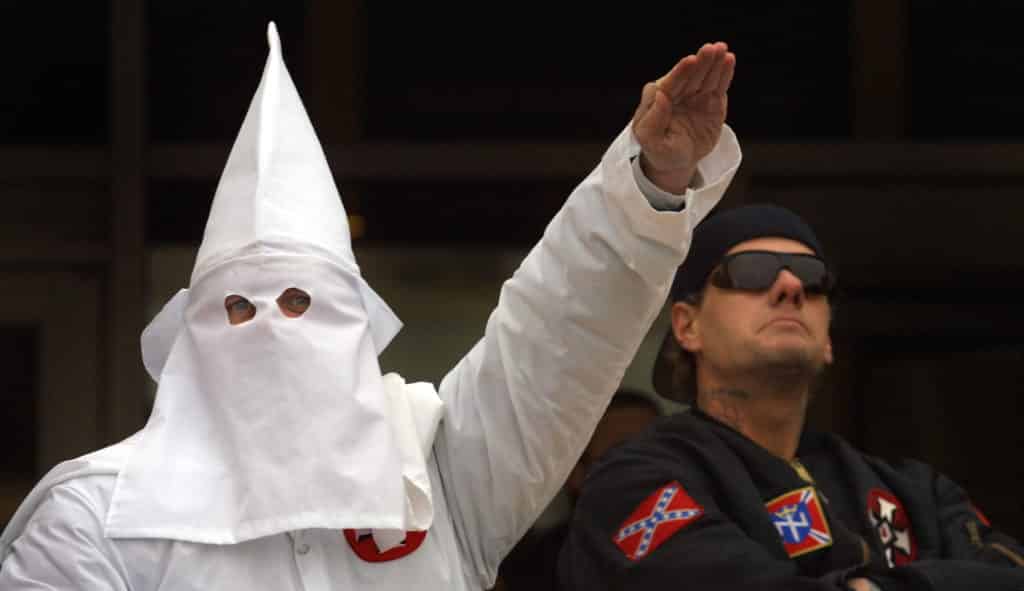
Two Petitions Call on Federal Gov’t to Designate KKK as Terror Organization

Two petitions have been circulating on social media calling on the federal government to designate the Ku Klux Klan (KKK) as a terror organization.

The New York Post reported that one of the petitions, titled “Make the KKK illegal,” is addressed to Congress.

“The Ku Klux Klan is a white supremacist hate group with [a] historic background of terrorism, including countless physical assaults and murders,” the petition reads. “The KKK is still active in certain parts of the country and has public rallies. Hate should not be a way to bring communities together, nor should it be allowed or tolerated.”

This petition has 368,789 signatures.

The second petition, titled “Declare the KKK as a terror organization,” is addressed to President Donald Trump and Rep. Dan Crenshaw (R-Texas).

“The KKK has long been a group of thugs that have suppressed the voices of and invoked fear into Minority Communities across the country,” the petition states. “It is time for that to end. This organization does not belong in this country, if declared a terrorist organization any attack would be an act of terror and will be treated as such.”

It added: “If equality and protecting the American people is your true goal this will easily resonate with you.”

President Donald Trump tweeted on May 31: “The United States of America will be designating ANTIFA as a Terrorist Organization.” Antifa, which is short for anti-fascist, isn’t an organization with a membership or an official leader. Antifa is a left-wing political movement comprising autonomous groups.

There is a debate as to whether the president or his administration has the legal authority to declare antifa a terrorist organization.

Journal columnist and social media editor Ariel Sobel wrote in a June 1 column, “Many of the most violent hate groups in the United States aren’t designated as terrorists. One notable example is the Ku Klux Klan, which for decades has used bloodshed, intimidation and crime to terrorize Americans.”

She argued that it’s important for white supremacists to be designated as terror groups, citing as an example Patrick Crusius, the suspect in a 2019 shooting at a Wal-Mart in El Paso, Texas, that resulted in 23 deaths.

“Crusius had posted about his intent to kill on the website 8chan,” Sobel wrote. “If white nationalists were considered terrorists, the NCTC (National Counterterrorism Center) might have been able to track and potentially stop the deadliest attack on Latinos in modern American history.”

Two Petitions Call on Federal Gov’t to Designate KKK as Terror Organization Read More »

david suissa podcast curious times

Pandemic Times Episode 55: What happened to the Pandemic?

New David Suissa Podcast Every Morning.

Reflections on the changing news stories and the movement to “defund the police.”

How do we manage our lives during the coronavirus crisis? How do we keep our sanity? How do we use this quarantine to bring out the best in ourselves? Tune in every day and share your stories with podcast@jewishjournal.com.

Pandemic Times Episode 55: What happened to the Pandemic? Read More »

Is Annexation Good? Ask the Settlers

The most interesting debate concerning annexation isn’t the one between Israelis and Palestinians, left and right wingers, Jewish Israelis and Jewish Americans or President Donald Trump and presumptive Democratic Presidential nominee Joe Biden. It’s the one between settlers who support or oppose annexation.

Yes, many settlers oppose annexation. Or, to be accurate, they oppose the proposed annexation based on the Trump peace plan. Their opposition is based on a strong ideological argument. It doesn’t involve the usual arguments about Palestinian rights, or international law, or the reaction of American Jews, or the dream about an end to the conflict, or about the offended king of Jordan, or the fear for Israel’s Jewish and democratic character. 

It’s based on the view that by annexing part of the territory, Israel is both receiving and giving up land. It would get about one third of the West Bank. Moreover, when Israel annexes land, based on the Trump plan, it would accept the idea on which the whole plan is predicated: If, one day, the Palestinians come to terms with the compromises they must accept if they wish to end the conflict, they would have a state in parts of Judea and Samaria.

The debate between the settlers is interesting because it exposes a rift within the maximalist camp — one that looks at the most important question for Israel: Is it worth it? 

The settler movement is, at its core, a pragmatic organism and the reason for its success. Its leaders are not a dreamy bunch. They are realistic, cynical and effective. They know how to handle politics, they know how to handle the bureaucracy, they have logistical skills, they can move mountains, they can be manipulative and cunning. They have goals, and they usually meet their goals. Of course, they also have ideology. It is quite simple: Israel ought to settle and control as much of the land as it possibly can. 

For most settlers, the M.O. is always pragmatic. They see an opportunity, they seize it. Act now, worry later. The question then becomes: Is the annexation plan a real opportunity? 

Some say it is. Implement sovereignty now, worry about a pipe-dream Palestinian state later. Enjoy Trump as long as he lasts, deal with Biden next year if he is elected. For the leaders of the settlement movement, the Trump plan is a no brainer. A gift is offered, you take it. 

But other leaders don’t see a gift. They see a poison pill wrapped as a gift. They see a small symbolic gesture — because annexation won’t have much impact on the reality on the ground — in exchange for a much larger symbolic gesture: a recognition that the end goal is a Palestinian state. For a movement that uses mostly bricks and cement, rejecting symbolic gestures isn’t out of character. 

Many settlers oppose the proposed annexation based on the Trump peace plan.

The debate between settlers is the only one that properly weighs the pros and cons of the plan, from Israel’s perspective, without much distraction. What are the pros? More land. But it is land that Israel already controls. Official recognition. But this is recognition only by a U.S. administration possibly at the end of its term. What are the cons? Israel might have to pay a price for annexation. Maybe international condemnation, possibly more. So, are we afraid of paying a price? Not when something real is at stake. The answer could be yes, when a mere symbolic recognition of an already existing situation is offered. 

The settlers understand that annexation isn’t a moral question. If it were, there would be no debate because they’re all on the same side. The settlers understand that annexation is a practical question. Annexation is good for Israel, but is it good enough to overcome the price?

Is Annexation Good? Ask the Settlers Read More »

This Guide Helps Jews Tackle Anti-Semitism While Supporting Black Lives Matter

Zioness, a 30-chapter strong coalition of Jews who bill themselves as “unabashedly progressive and unapologetically Zionist” has released a guide for activists against racism and anti-Semitism.

The 10-page packet is meant to answer questions and prepare progressive Zionist activists for potential challenges in confronting their own privilege, showing up as allies and educating people about anti-Semitic tropes they may face.

The guide recommends that activists watch “Just Mercy,” “I Am Not Your Negro,” and “13th.” It also encourages readers to follow American civil rights activists Bernice King,  DeRay Mckesson plus leaders Rabbi Sandra Lawson and Rachel Elizabeth Cargle, reminding its audience that “being an ally is a title we earn by showing up and doing the work — not a title we assume.”

The third section, “We May Experience Antisemitism. We Will Address it. We Must Not Walk Away,” addresses how the movement for Black Lives endorsed the boycott, divestment and sanctions (BDS) movement against Israel, characterizing it as “deeply hurtful.” Zioness recommends its members to “be conscious of the fact that what we hear often stems from a lack of understanding.”

“We were alienated by the Movement for Black Lives and its platform four years ago,” Zioness founder Amanda Berman told the Journal. “But we cannot sit this out. We cannot refuse to fight white supremacy and systemic racism in this country because of that discomfort, and we cannot cede this urgent movement for justice and equality to those who aim to splinter our natural and historic alliance with black leaders.”

Out of this vision comes the guide’s final section: “Addressing Antisemitic Tropes in Your Activism.” It provides pragmatic responses to concepts such as “Zionism is Racism,” “Jews were behind the Atlantic Slave Trade,” and “Israel trains American law enforcement to be racist.” The latter was the talking point of anti-Zionist group Jewish Voice for Peace’s “Deadly Exchange” campaign, which has been recently updated to note that “making connections between the U.S. and Israel without context can do harm,” and that “suggesting that Israel is the start or source of American police violence or racism shifts the blame from the United States to Israel,” among other caveats.

“We have always been allies and want to continue to be allies, and have no intention of debating the Israeli-Palestinian conflict in any domestic justice space,” Berman said. “But we do need to be equipped with the language and knowledge to stand up to anti-Semitism, which makes Jews afraid to engage and divides the movements — to their detriment.”

This Guide Helps Jews Tackle Anti-Semitism While Supporting Black Lives Matter Read More »

‘The Book of Ruth’ Stars Tovah Feldshuh as a Surviving Anne Frank

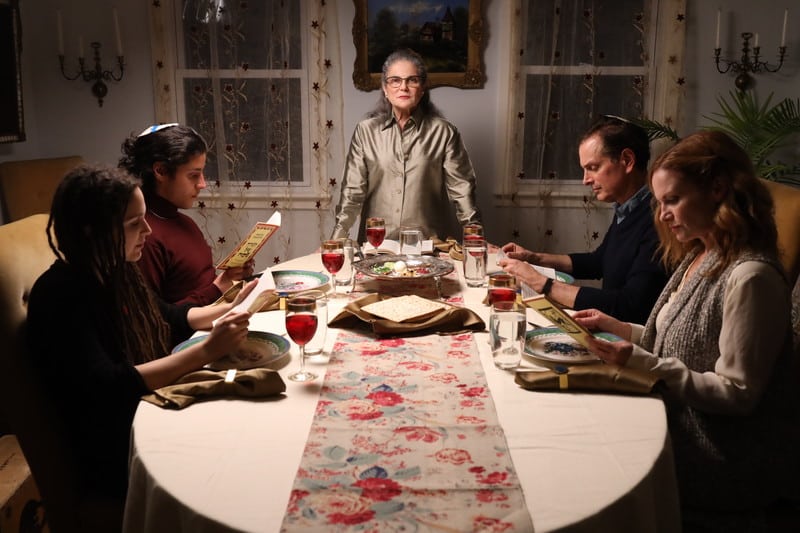
What would have become of Anne Frank had she survived the Holocaust? That intriguing hypothetical is the premise of “The Book of Ruth,” a short film premiering online at the DeadCenter Film Festival on June 11. The debut film from Israeli American actress-writer-producer Chen Drachman stars Tovah Feldshuh as a Jewish grandmother whose secret identity we discover via a conversation with her granddaughter (Drachman) after a Passover seder. 

Drachman got the idea for the film from a 2015 news report questioning the date of Frank’s death, and that made her think: “What if it had gone differently? Where would Anne be today? Would we know she was alive or would she keep it a secret, and what was the logic behind that? I found it fascinating on many fronts,” she told the Journal. 

So did Feldshuh, who admired Drachman’s focus, dedication and passion and wanted to help her get the film made. What also appealed was the premise: What would have happened if Anne Frank had lived? In the film, her titular character opts to stay anonymous and live out her life in peace, preserving Anne as an iconic figure whose young life was cut tragically short, as well as preserving the myths surrounding her.

“She chose to remain anonymous so the world could continue to relate to her story and be impacted by it. She was more powerful dead than alive,” Feldshuh, the Emmy- and Tony-nominated actress said in a separate interview. “I’m happy to represent this choice of Anne’s, but I don’t think it would have been my choice.” 

“[Anne Frank] chose to remain anonymous so the world could continue to relate to her story and be impacted by it. She was more powerful dead than alive.” — Tovah Feldshuh 

Feldshuh has played many Jewish icons in her five-decade career, including Golda Meir on stage and screen in “Golda’s Balcony”  and Ruth Bader Ginsburg in “Sisters in Law”  at the Wallis Annenberg Center last fall, a role she hopes to reprise on Broadway. (After meeting with Ginsburg four times, they’re now email pals.) 

Her first major recognition came in the 1978 miniseries “Holocaust,” and she more recently played Jewish mother Naomi Bunch in Rachel Bloom’s television series “Crazy Ex-Girlfriend.” She has fully embraced the “Jewish roles that came to me on a Magen David platter” since changing her name from Terri Sue to her Hebrew name, Tovah. 

“Why fight it? If you’re going to be pegged as an actress with Jewish expertise, you might as well go global,” Feldshuh said, emphasizing that her repertoire also includes Catherine the Great, Mama Rose in “Gypsy,” a trapeze-swinging grandma in “Pippin,” and, in her youth, Shakespeare’s Juliet. She doesn’t hesitate to play elderly women, declaring, “I have no vanity about myself on screen anymore.” 

Feldshuh was Drachman’s first choice, but it took four years of fundraising including crowdfunding before she and director Becca Roth and their diverse, mostly female crew could begin filming in April 2019 at a picturesque lake cottage north of New York City. “We did it in the way we wanted to do it, in terms of casting and filling positions,” Drachman said.  Her story’s themes of Jewish roots and history and being an immigrant living apart from family reflects her own experience. 

Tovah Feldshuh
in “The Book of Ruth.” Photo by Arin Sang-urai

From Holon near Tel Aviv, she now lives in New York and became a U.S. citizen last year. Like Feldshuh, Drachman has a familial Holocaust connection. Both grandfathers survived camps and her maternal grandmother, Tzipora, to whom the film is dedicated, fled persecution in Romania and made aliyah. She said her paternal grandmother was involved in the Belgian underground during World War II

Drachman learned English by watching un-subtitled American TV shows like “Buffy the Vampire Slayer” and knew early on that she wanted to write, produce and act. She sang in the school choir and moved to New York to study musical theater a decade ago. She flew to Israel for a visit in February just before the pandemic hit, but hopes to return to the U.S. in late June. She plans to take “The Book of Ruth” to other film festivals here and internationally, and is considering expanding her story as a feature film. Her next project will be a comedy feature, also with Jewish themes. Meanwhile, she’s working for the Israeli nonprofit ELEM, which serves at-risk youth.

Native New Yorker Feldshuh is living at her country home on Long Island with her daughter, son-in-law and baby grandson after a bout with COVID-19. She believes she contracted the virus at a bat mitzvah in early March. She developed a “weird cold” and lost her sense of taste and smell but was never hospitalized and recovered in a few days. Eating well and swimming half a mile a day, she lost 14 pounds in quarantine. “I’m two pounds under my wedding weight,” she said. 

Her upcoming films include “Bleecker,” an intergenerational family drama about love and loss, and “Clifford the Big Red Dog,” a live action-animation hybrid, are due out in the fall. Feldshuh adopts a thick Russian accent to play one of the people who discovers the outsize canine. She’s also writing a book called “Lillyville,” about her relationship with her mother. “The subtitle may be ‘How to Get What You Want and Still Get Along With Your Mother.’ It’ll come out Mother’s Day next year,” she said.

As her film’s premiere approaches, Drachman awaits the feedback. “I’d like people to talk about what resonates with them, how they felt about the logic behind [Anne’s] decision,” she said. I’m interested to see how others feel about it.”

“The Book of Ruth” premieres in the shorts program online at 7:50 a.m. PDT June 11 here. Tickets go on sale that day, and ticketholders can log in to watch the film and a pre-recorded Q&A with filmmakers through June 21. 

‘The Book of Ruth’ Stars Tovah Feldshuh as a Surviving Anne Frank Read More »

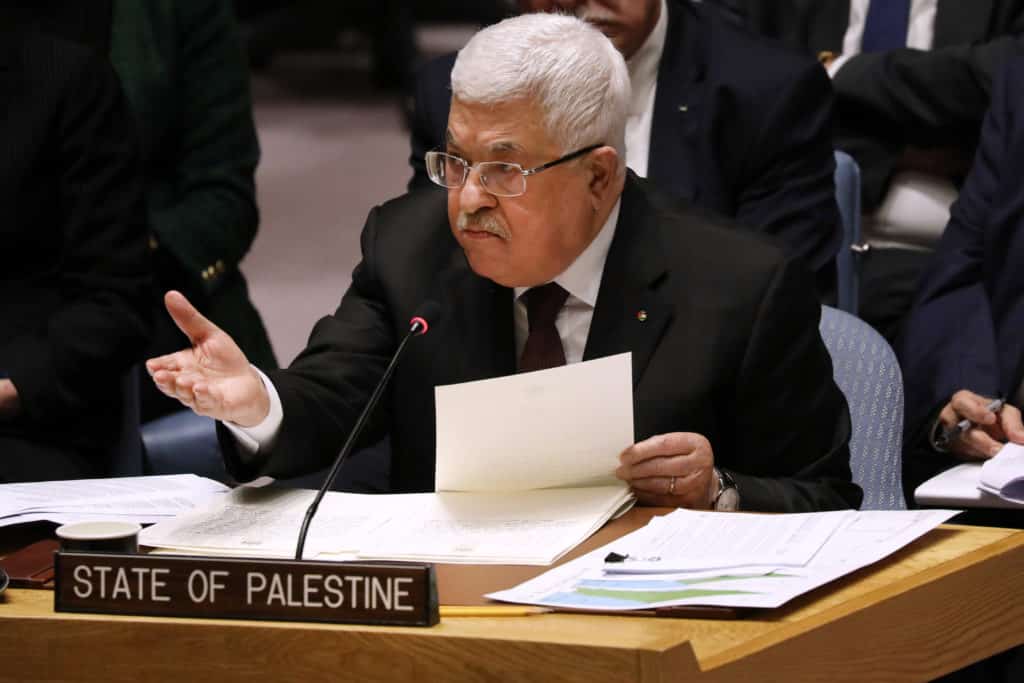
Palestinians Release Counterproposal to Trump Peace Plan

(JTA) — The Palestinian Authority has submitted a proposal for an independent demilitarized Palestinian state in Gaza, the West Bank and eastern Jerusalem.

Prime Minister Mohammed Shtayyeh said Tuesday that the P.A. had submitted a proposal to the so-called Quartet of international mediators — comprising the United States, the European Union, the United Nations and Russia — in response to the Trump administration’s release of its own Middle East peace plan in January.

Shtayyeh said the proposal calls for a “sovereign Palestinian state, independent and demilitarized” with “minor modifications of borders where necessary.” He declined to provide further details.

The announcement comes as Israel moves ahead with plans to annex parts of the West Bank. Under the Trump peace plan, which the Palestinians rejected in its entirety, Israel would be empowered to annex parts of the West Bank.

Shtayyeh said annexation represents an “existential threat” and would signify the “total erosion of our national aspirations.”

Palestinians Release Counterproposal to Trump Peace Plan Read More »

Do We Really Care About Justice for All?

The emails came fast and furious in a single day, from diverse sources who shared a single message: The food blogger, the editors’ professional association and the classical music radio station assured me they stood in solidarity with those protesting systemic racism and police brutality.  

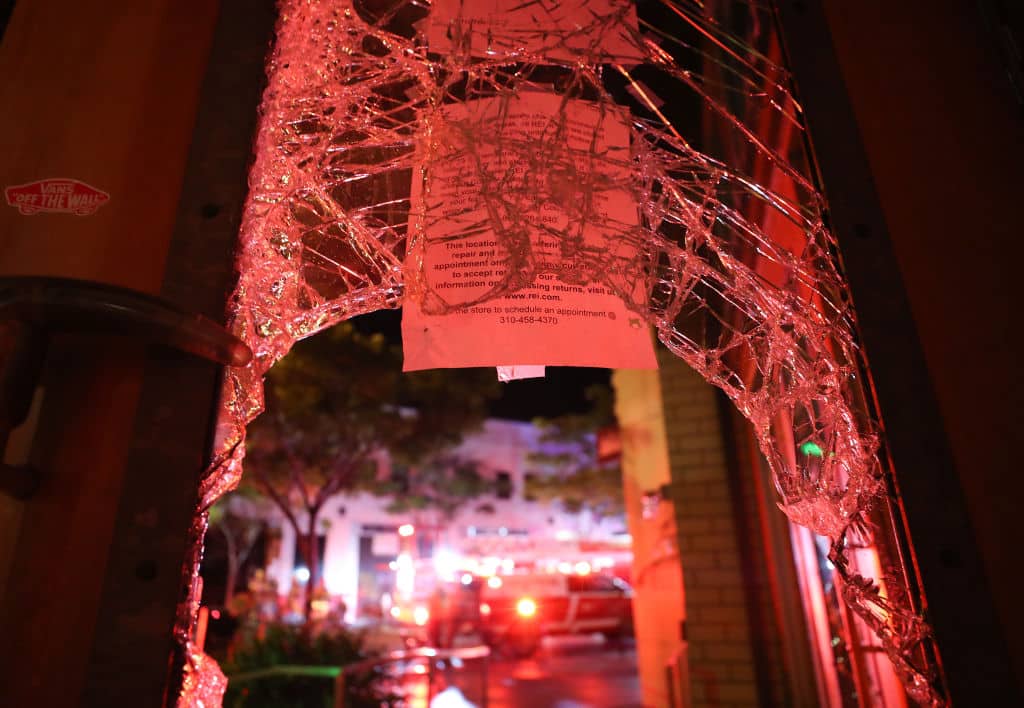
I felt sick over the despicable death of George Floyd, but the emails were irritating. The virtue signaling was de rigueur, but the selective call for justice was appalling. While “standing beside those who are calling for a more just, compassionate society, free of racism,” not a single one expressed dismay, outrage or a shred of compassion for the victims of the violent riots roiling our cities. Not a word of sympathy or empathy for the small business owners — many of whom are minorities in already hard-hit communities — devastated and violated by the looters demolishing their livelihoods and turning their neighborhoods into war zones.

Not a word about how the nihilistic violence undermines the cause of the peaceful gatherings. George Floyd’s family and girlfriend poignantly expressed this to the media, stating that he would have been devastated by the violence engulfing Minneapolis.

Not a word of concern for the safety of protesters from COVID-19, although these same communicators had encouraged us to make the best of it as we sheltered at home. In fact, the emails tacitly endorsed the gatherings. 

Not a word in support of law enforcement officers who are increasingly and unjustly being viewed as the enemy, yet who rush into the mobs day and night, and who are the targets of bricks, stones, Molotov cocktails and sometimes bullets.  

Not a word of outrage or grief for the African American police officers, including the 77-year-old retired Capt. David Dorn in St. Louis and David Patrick Underwood, 53, in Oakland, who were slain by looters while in uniform. Maybe some black lives matter more than others.

Not a word of empathy for the millions of people who were on lockdown again, frightened by incessant police sirens and helicopters whirring overhead and wondering, were those just gunshots we heard?   

Where was their compassion for the victims of this terror?

Where was their compassion for the victims of this terror?

Outrage and grief over the death of George Floyd must not blind us to the danger of growing anarchy in the streets. When law enforcement is demonized as a whole, we face looming catastrophe. Maybe it was a bad idea to start calling police officers “pigs.” 

With police increasingly accused of abusive tactics, even unfairly, it leads to “police nullification,” when officers refuse to answer certain calls in the most dangerous neighborhoods. The poorest minority neighborhoods therefore suffer the most, with skyrocketing shootings and homicides. But the consequences of demonizing law enforcement will be widespread. Last year, 86% percent of police chiefs nationwide said recruitment had declined since 2014. Resources are so tight in some cities that many 911 calls are ignored. 

Heather Mac Donald, author of “The War on Cops,” (2016), deems the notion of systemic police racism a myth, and her June 3 article in The Wall Street Journal is a crucial read. According to a Washington Post database, police fatally shot nine unarmed blacks and 19 unarmed whites in 2019, down from 38 and 32, respectively, in 2015. “Those nine unarmed black victims of police shootings represent 0.1% of all African Americans killed in 2019, while a police officer is 18 1/2 times more likely to be killed by a black male than an unarmed black male is to be killed by a police officer,” Mac Donald wrote.

Atlanta Mayor Keisha Lance Bottoms has pleaded with citizens to stop the rioting. She said, “I am a mother to four black children in America. And when I saw the murder of George Floyd, I hurt like a mother would hurt. … [But] this is not a protest. This is not in the spirit of Martin Luther King Jr. You are disgracing our city, you are disgracing the life of George Floyd. This is chaos, and we’re buying into it. Go home!”

George Floyd’s killer and the men who abetted him will face justice. Now it’s time to speak out against the riots against law enforcement that endanger us all. 


Judy Gruen’s most recent book is “The Skeptic and the Rabbi: Falling in Love With Faith.” 

Do We Really Care About Justice for All? Read More »

Texas School Board Member Apologizes for Comparing Abortion With the Holocaust

A member of the school board in Ector County, Texas, apologized on June 9 for a series of controversial Facebook posts, including one comparing abortion with the Holocaust.

Ector County Independent School District (ECISD) Board of Trustees member Doyle Woodall has been under fire for three Facebook posts. One post showed Nazi officers saying, “Jews aren’t actually people” juxtaposed with a woman telling a pregnant woman that “babies aren’t actually people.” Another post stated that it was important “to make evil people feel punishment again” accompanied by a photo of a noose.

The third post showed Muslims praying with the words “Spill a few gallons of bacon grease on that street and it would clear out fast.”

Woodall initially defended his posts but eventually issued an apology.

“Last Friday, I was being interviewed by Ruth Campbell, a reporter from the Odessa American, and I was still angry at what I saw as a small group of people trying to interfere with my constitutional right to free speech,” Woodall told CBS 7. “Near the end of our interview, Ruth asked me if I knew she is Jewish, and I said, no. She told me what one of my posts meant to her as a Jewish woman and I felt I had been kicked in the stomach. It was the opposite of my intent for the post. I had seen it only from my perspective. A blinder came off.”

He said that another blinder came off when he talked with the Texas Education Agency’s Deputy Commissioner of Governance, A.J. Crabill, on June 6. Crabill, an African American man, told Woodall that his post showing the noose had offended Crabill.

“It was like another kick in the stomach,” said Woodall, who is white. “Another blinder came off.”

Woodall added: “Today, I understand why my posts were offensive. I will remove them from my page. I have a lot to learn about cultural differences and I will dedicate a great deal of time learning by attending cultural awareness and sensitivity training. I want to say again, I am truly sorry.”

Newsweek reported that ECISD Board of Trustees President Donna Smith and ECISD Superintendent Scott Muri denounced Woodall’s post in a joint statement, calling them “offensive and demeaning.”

“They do not represent the views of Ector County ISD,” they said. “We embrace and serve a diverse staff and student body as well as a diverse community.”

Several people in the community have called on Woodall to resign over his posts.

“Anyone that is in a position of power has to call on [Woodall] to resign immediately or [you’re] complicit,” activist Rod Johnson told Fox 24 during a June 9 protest in front of the ECISD administration building. “The public has a right to assume that you agree with or that you are associated with those remarks until you publicly come out as a leader. Everyone, if you are not calling on him resign then you are complicit — your silence is that complicity.”

A petition also has circulated calling on Woodall to resign that garnered nearly 5,000 signatures. Woodall has thus far refused to step down.

The Simon Wiesenthal Center tweeted, “Adults are supposed to be dedicated to guiding America’s children to a better future. Proud bigot standing tall with his hate. Where are the other adults on the #Texas School Board?”

Texas School Board Member Apologizes for Comparing Abortion With the Holocaust Read More »

Pennsylvania Synagogue Zoombombed With People Saying ‘Death to Jews’

A Pennsylvania synagogue’s Shabbat services were disrupted and cut short on June 5 with people shouting anti-Semitic slurs, including “Death to Jews.”

The Morning Call newspaper reported that Keneseth Israel, which is located in Allentown, had around 75 participants during the service when the Zoombombing occurred. Keneseth Israel administrator Vicki Dunn told The Morning Call that she first noticed that something was wrong when she heard “strange music.”

“Then people started saying, ‘Death to the Jews,’ ” Dunn said. “We heard a ‘Hitler’ thrown in there. It was traumatizing.”

She added: “You feel like you’re attacked in your synagogue, and like you’re attacked in your home.”

The synagogue has reported the incident to local authorities and has since changed its Zoom security settings to prevent future Zoombombings; a virtual bar mitzvah held the following morning occurred without any disruptions.

“Zoombombing” is the term used to describe instances of people disrupting Zoom video conference calls, oftentimes with anti-Semitic and racial slurs and sometimes with pornographic imagery. Zoombombing has become more frequent during the COVID-19 pandemic because people are being relegated to using video conference calls more often.

Anti-Defamation League (ADL) Philadelphia Regional Director Shira Goodman told The Morning Call that although the Zoombombing of synagogues’ virtual services has recently declined, the Keneseth Israel Zoombombing was one of two instances of Pennsylvania synagogues being Zoombombed over the past two weeks.

“If you don’t call out hate at these levels, those are the kinds of things that fester and can escalate,” Goodman said.

Liora Rez, director of the Stop Anti-Semitism watchdog, said in a statement to the Journal, “It’s very frustrating to see that Zoom is not able to keep up with their ongoing security breaches. We highly recommend users move to ‘Google Meet/Hangout’ or ‘Microsoft Team’ to avoid bigots infiltrating their virtual spaces.”

The Israel Group founder and President Jack Saltzberg also said in a statement to the Journal, “Anti-Semitism has existed since Egypt and it will never go away. Only the delivery platforms are new, so it is not shocking to witness anti-Semitic Zoombombing.”

In an April statement, Scott Brady, a United States attorney in Pennsylvania, vowed to crack down on Zoombombers.

“Hackers are disrupting business and community meetings for sport and targeting specific groups, including addiction recovery meetings, in order to mock, harass and interfere with treatment,” Brady said. “This is another low point in this crisis. We are better than this. DOJ will use all of our resources to find, expose and prosecute these low-lifes.”

American Jewish Committee Director for Combating Anti-Semitism Holly Huffnagle told the Journal in a May 11 story that while only a handful of people are perpetuating Zoombombing, it is “affecting multiple Jewish student meetings; they’re affecting board meetings where there’s Jewish chairs, so this has been a huge problem.”

The ADL has explained how people can utilize Zoom’s security settings to prevent Zoombombing from occurring and how to handle a Zoombombing incident if it occurs.

Pennsylvania Synagogue Zoombombed With People Saying ‘Death to Jews’ Read More »