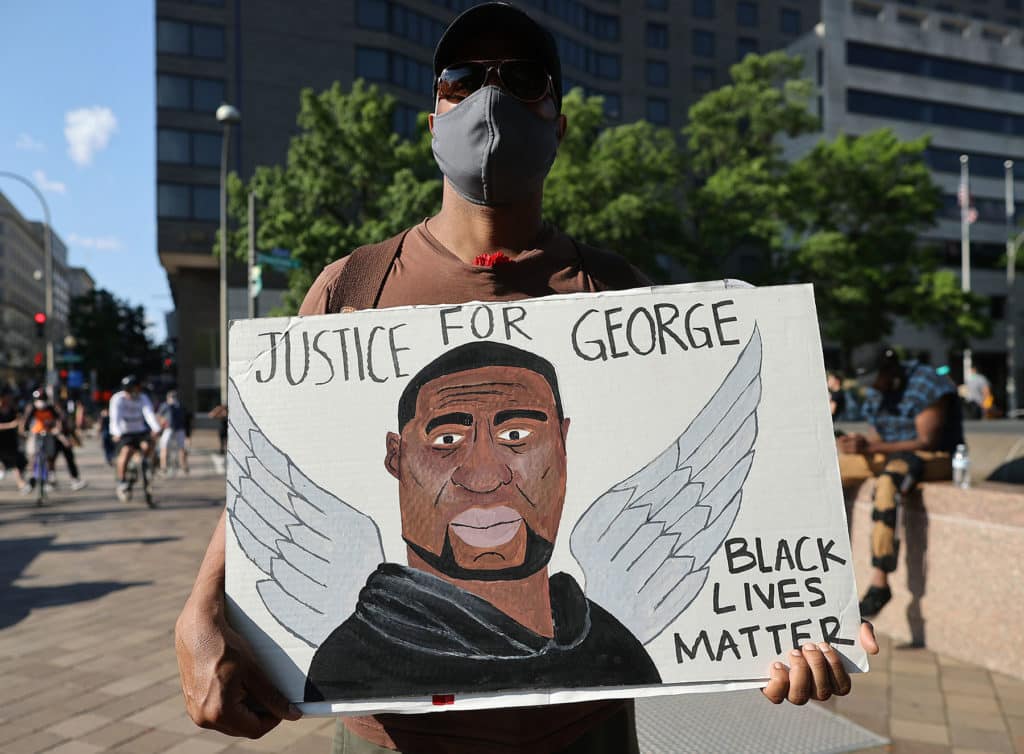
An extraordinary moment has arisen in America that taps into a deep history of racism that predates the birth of our country.
But instead of allowing blacks their moment, I’m seeing an outpouring of hysterics from some in the Jewish community about “anti-Semitism rearing its ugly head again!”
A small fraction of the countless businesses that have been damaged and looted across the nation have a Jewish connection. I get it. Even one is too many. After 2,000 years of persecution, we’re always on edge. Any sign that “they’re coming after us” is cause for alarm.
But let me ask you: When was the last time you saw a video of a cop killing a Jew because he was Jewish?
Nothing about the plight of Jews in America can compare to the racism against blacks. While we have our own global history of horrible suffering and persecution, the difference between the suffering Jews and blacks have experienced in this country is not merely in degree, but in kind.
For 244 years, from 1619 to 1863, it was perfectly legal to own a black slave in America. President Lincoln’s Emancipation Proclamation of 1863 did not end racial discrimination, which remained legal long after the abolition of slavery. Even the Civil Rights Act of 1964 did not end racial discrimination; it merely provided the legal tools to fight it.
When you see a white cop dig his knee into a black man’s neck for close to nine minutes, while the man pleads for his life, you get a reminder that the racist poison that started in 1619 is still lingering in our midst. Yes, we’ve come so far in the past 50 years, but we have so far to go.
That’s why fighting racism is the cause of the moment. It’s tapping into a well of pain that is 400 years old. It has triggered an emotional hurricane where millions are saying, “Enough is enough.” Is this really the best time for Jews to say, “Hey, what about us?”
Fighting racism is the cause of the moment. It’s tapping into a well of pain that is 400 years old. It has triggered an emotional hurricane where millions are saying, “Enough is enough.”
Don’t get me wrong. I’m disgusted by Israel haters who exploit the protests to bash Israel. But are we surprised? This is what they always do.
I know that Black Lives Matter officially supports the Boycott, Divestment, Sanctions (BDS) movement against Israel, which is a vile and discriminatory movement. But here’s the new reality: In the protests against racism, “black lives matter” is as much a slogan and rallying cry as an organization.
And yes, I’m disgusted by anti-Jewish graffiti on a synagogue wall or anywhere else. This is the mark of Jew-hatred. It is eternal and irrational. It will always be with us.
There are myriad, effective ways we can combat the evil of anti-Semitism without taking away from the cause of the moment. The cause of fighting racism is dominating the national consciousness right now and many Jews have joined the fight.
Jewish Contributions to Humanity #5: Original research by Walter L. Field.
Sponsored by Irwin S. Field.
The Big Bang, which is the leading cosmological explanation for how the universe came into existence, seems to provide at least as many new questions as answers. Thankfully for us laypeople, two Jewish scientists, Carl Sagan and Arno Penzias, did their very best to help us understand the scientific explanation of the biggest question of them all: Why are we here?
ARNO PENZIAS (1933-) b . Munich, Germany. Lives in Menlo Park, California. The Big Bang’s pioneer.
As happened with many of the scientists discussed in these columns, the unique circumstances Penzias found himself in were the precise ones he needed to make major contributions to humanity. After moving to the United States with his family in 1940, Penzias later joined the U.S. Army, which helped him get a position with Columbia’s radiation laboratory, which at the time happened to be focused heavily on microwave physics—Penzias spent much of his time at Columbia and Bell Labs researching radio waves. He eventually came across radio noise (cosmic microwave background radiation) that was leftover radiation from the Big Bang. His discovery helped scientists and astronomers deepen their understanding of the Big Bang and the origins of our universe. In 1978, Penzias won a Nobel Prize for his discovery along with his colleague Robert Wilson. The two pioneers continued their search for scientific truth, discovering unknown molecules throughout the universe. Penzias’s explanation of the molecule deuterium further strengthened the Big Bang theory, because deuterium is the only known molecule whose origin can only be explained by the processes of the Big Bang.
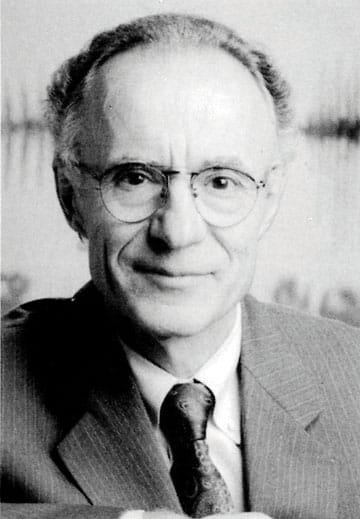
CARL SAGAN (1934-1996) b. Brooklyn, New York. An insatiable curiosity.
Astronomer; cosmologist; astrophysicist; author—the list seems endless. He “led a feverish existence, with multiple careers tumbling over one another” as one admiring writer said. Sagan accomplished much, but nothing reached as wide an audience as “Cosmos: A Personal Voyage”, a 13-part PBS series broadcast in 1980 that was revolutionary at the time, using special effects, science, and a charismatic host (Sagan) to take the viewer on a journey of our existence, from the Big Bang to the origins of life to humanity’s future. Sagan was fascinated with the possibility of alien life, creating the first messages (images and sounds) sent into space—the Pioneer plaque and Voyager Golden Record could theoretically be understood by extraterrestrial life. A lifelong consultant for NASA, Sagan consulted the astronauts on the Apollo before their voyage to the Moon, and he also assisted with many robotic spacecraft missions. His analysis of Venus as a dry and hot planet (as opposed to the previously accepted balmy climate that many had accepted) changed the popularly accepted view of the planet. Furthermore, his insights into the moons of Saturn and Jupiter led to the discovery that the reddish haze on Titan (Saturn’s moon) were organic molecules, a major discovery that suggested the possibility of life outside Earth.
Marilyn Blank died May 26 at 93. Survived by husband Fred; daughters Randi (Warren), Nancy. Hillside
Eddie Brauer died May 6 at 61. Survived by daughter Elvira Torres. Mount Sinai
Jack Smith Brody died May 22 at 93. Survived by wife Bernice; daughter Ellen (Stan) Langer; son Gene (Betsy); 5 grandchildren; 8 great-grandchildren. Mount Sinai
Martin Cohen died May 17 at 67. Survived by wife Katharine; daughter Magdalena; sons Gabriel (Zynette), Herschel (Marysa), Elijah (Brianne). Hillside
George Friedman died May 31 at 92. Survived by sons Sanford (Shelley), Gary (Carol), David (Kathy). Hillside
Eunice Garfinkle died May 14 at 99. Survived by sons David (Maria), Steven (Minerva); 1 grandchild. Hillside
Bernard Glassman died May 17 at 89. Survived by daughters Linda (David) Bry, Susan Robbins; 4 grandchildren; 5 great-grandchildren. Mount Sinai
Susanne Weiss Goldsmith died May 23 at 89. Survived by daughters Ellen (Howard), Laura (Walter); son Robert; 4 grandchildren. Mount Sinai
Martin Alan Goldstein died May 20 at 53. Survived by daughter Abbie; son Benjamin; father Jerald (Sharyn); sister Deborah (Mike). Mount Sinai
Asher Green died May 22 at 100. Survived by daughter Carol; son Philip (Beverly); 1 grandchild. Malinow and Silverman
David Gyepes died May 30 at 58. Survived by wife Shirley; daughters Adriana, Grace, Sarah; sister Nancy; brother Steven. Hillside
Andrew Harris died May 28 at 64. Survived by stepdaughter Courtney; stepson Nicholas; sister Sue (Steve). Hillside
Sonya “Sonny” Hollander died May 15 at 92. Survived by daughter Melanie Sue (James Stuart) Winetrobe; sons Mitchell A. (Michael J. Mooney), Rodger. Mount Sinai
Beverly Keldoff died May 24 at 87. Survived by son Scott. Hillside
Robert Kronick died May 28 at 96. Survived by daughter Janice; 1 grandchild. Hillside
Celia Latter died May 18 at 96. Survived by daughter Linda; sons Sam, Marshall; 4 grandchildren; 2 great-grandchildren. Mount Sinai
Marvin Levin died May 30 at 95. Survived by wife Ruth; sons Greg (Helen), Randy (Monique). Hillside
Rakhil Leytman died May 21 at 100. Survived by daughter Anna (Marik) Balyasny; 1 grandchild; 2 great-grandchildren. Mount Sinai
Ronald Lipstone died May 21 at 90. Survived by sons Laurence (Leslee), Douglas. Hillside
Diana Wain Menzer died May 16 at 80. Survived by daughters Liz (Charles) Wain, Marsha (Walter) Mueller; sons Matthew Wain, Mitch (Wendy) Menzer, Matt Menzer; 7 grandchildren; sister Jeannie Lederer-Morgan. Mount Sinai
Marlene Meyer died May 15 at 86. Survived by husband Howard; daughters Dani (Michael) Sparks, Lynn (Peter) Arkin; son Steven (Jenny); 7 grandchildren; 1 great-grandchild. Mount Sinai
Philip Miller died May 21 at 93. Survived by daughter Janice (George) Geldin; son Russell (Jo); 4 grandchildren. Mount Sinai
Lorraine Pasternack died May 16 at 101. Survived by daughter Beverly (Timothy) Kitz; 4 grandchildren; 5 great-grandchildren. Mount Sinai
Elizabeth Puche died May 22 at 65. Survived by husband Sergio; sons Sergio, Eric; sisters Monica, Connie, Thania. Mount Sinai
Martin Roe died May 16 at 86. Survived by wife Linda; daughters Maria (Brian), Lisa Lynn. Hillside
David A. Rosen died May 23 at 96. Survived by daughter Ronna (Alan) Goldstein; son Alan (Cheryl); 2 grandchildren; 1 great-grandchild. Mount Sinai
Allyn Rouse died May 15 at 91. Survived by wife Marilyn; daughter Melinda (Fred) Rouse-Beaver; sons Michael (Nancy), Lawrence (Shohreh); 3 grandchildren. Mount Sinai
Edward Wolfe Saltzberg died May 7 at 87. Survived by daughter Diane; son Jack (Katherine); 3 grandchildren; 1 great-grandchild. Groman Eden
Gail Sanders died May 14 at 91. Survived by sons Garey West, Paul; daughter-in-law Neysa West; 2 grandchildren; 4 great-grandchildren. Mount Sinai
Audrey Steinhaus died May 25 at 76. Survived by husband Jonah; daughters Stephanie, Jennie Gold; 3 grandchildren; sister Lynn Jacobs; brother Stuart Parnes. Mount Sinai
Joan Travis died June 1 at 95. Survived by daughter Cynthia; 2 grandchildren; sister Mona. Hillside
Stanley Ullman died May 19 at 79. Survived by sister Bonnie (John) Rankin; brothers Robert (Linda), John (Marla). Mount Sinai
Pearl Weber died May 24 at 94. Survived by daughter Janice Sostrin; son Robert; 4 grandchildren; 2 great-grandchildren. Mount Sinai
Rose Zislis died May 15 at 91. Survived by daughters Michele, Linda, Diana, Sandra, Chryste; sons Stanley, Murray, David, Michael. Hillside
We all know that partisans place truisms ahead of the truth, although we only recognize such fanaticism in our rivals. Especially as anger mounts and the stakes get higher it becomes ever harder to see the convenient lies and half-truths we sell ourselves. Tragically, while too many mainstream Republicans have allowed themselves to be bullied into slavishly supporting Donald Trump’s monstrous presidency, too many Alexandria Ocasia-Cortez Democrats have allowed themselves to become bullies in the fight to dismantle Trump’s bullying pulpit.
“Brick and mortar is not as important as life,” says Minneapolis Mayor Jacob Frey as a police station burns. “Destroying property, which can be replaced, is not violence,” says the Pulitzer Prize-winning reporter Nikole Hannah-Jones as looters ravage her city. “Never let them convince you that broken glass or property is violence,” says the designer Marc Jacobs as thieves trash his flagship store. “Property can be replaced, human lives cannot.”
And we wonder why so many cities were ransacked, with some innocent people beaten, even killed, in bursts of robbery, vandalism and arson that fit the dictionary definition of “riots” but politically correct colleagues sanitize as “protests.”
Meanwhile, as the president posts and postures, stirs the pot and pits “his” Americans against everyone else, Republicans cower silently. The few dissenters, such as Mitt Romney, know there is life without Trump and there will have to be a Republican Party after Trump. But the sickening stillness on the right illustrates that as Trump’s poisonous presidency persists, silence is not just consent but active collaboration.
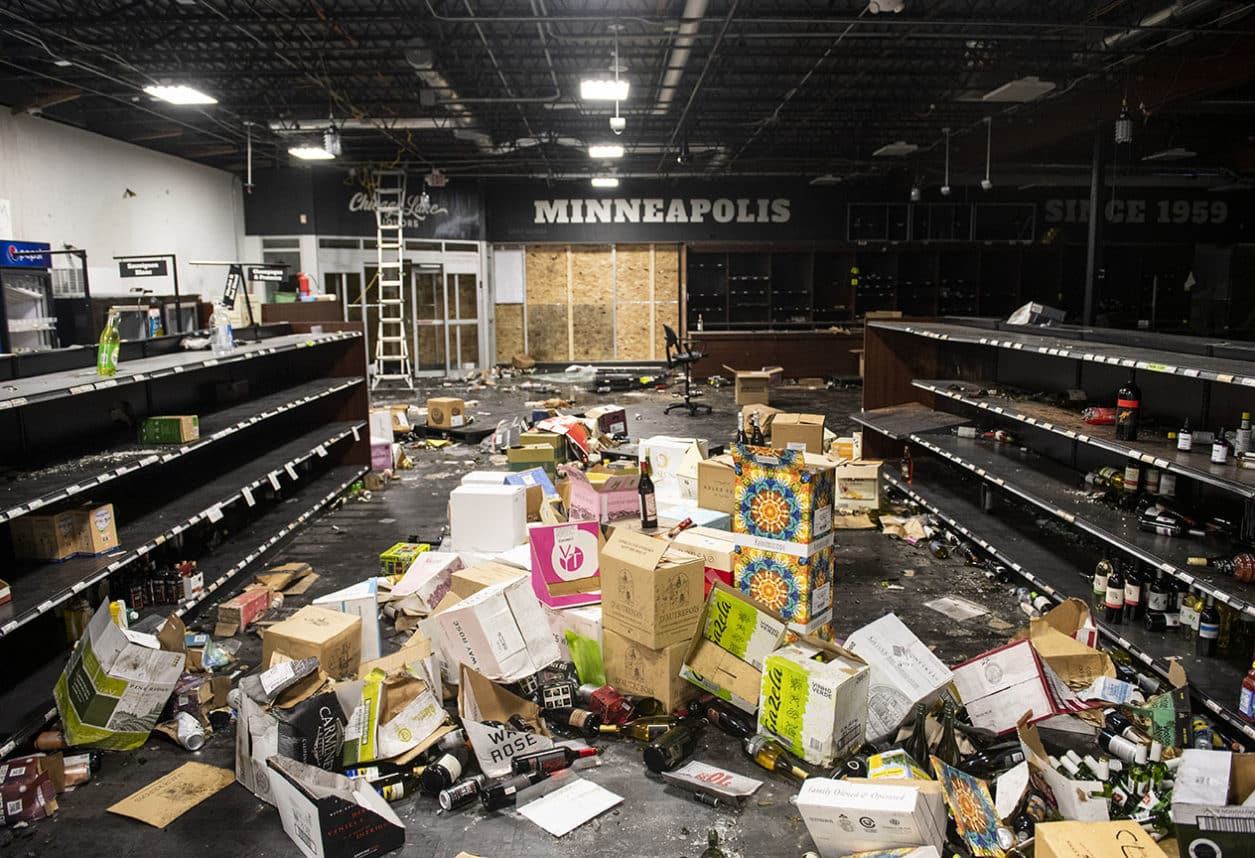
MINNEAPOLIS, MN – JUNE 05: A view of the damage inside Chicago Lake Liquors after it was looted during the protests and riots which followed the death of George Floyd on June 5, 2020 in Minneapolis, Minnesota. All of the merchandise left in the store will be destroyed due to smoke damage. (Photo by Stephen Maturen/Getty Images)
Eventually, America will return to sanity. We will someday, with any luck, on January 20 elect a commander in chief who accepts the sacred presidential responsibility to elevate not insult, unite not divide, heal not incite. We will relearn how to be F. Scott Fitzgerald-ians: intelligent people who “hold two opposed ideas in mind at the same time.”
On that day, we won’t demonize elastic thinkers who condemn the racism that murdered George Floyd and the hatred Donald Trump spawns while also condemning the rioting that caused real harm and terrorized millions. On that day, we won’t believe it’s too dangerous to pray together during a pandemic but not to protest; we will social distance consistently while fighting for justice fervently and safely. On that day, shopkeepers whose stores are still smoldering won’t feel pressured to sound like they are in Communist re-education camp and justify the crimes committed against them in the name of “social justice.” And on that day, David Dorn, the 77-year-old African American killed trying to defend his friend’s pawn shop at 4123 Martin Luther King Drive in St. Louis, won’t just be a right-winger’s “I told you so” cheap equivalence punchline, but a warning to us all not to embrace simplistic narratives.
Before writing these words — which risk alienating those on either side of our Great Divide — I watched the death of George Floyd again. Second by agonizing second, we not only feel his pain, but the pain of Africans ripped from their homelands, then packed onto slave ships. We not only feel his despair, but the despair of millions enslaved because of the color of their skin. We not only feel his fear, but the fear of proud black men called “boy” under the evil segregation of Jim Crow; of strong, black women obscuring their smarts or their spines; of young African Americans treated as suspects — and sometimes shot — for having the wrong color in the wrong place at the wrong time.
But all that anguish still doesn’t justify trashing our cities, stealing from store owners while robbing them of their dreams and terrifying fellow Americans who cower at home as their own neighbors delight in the mayhem on the streets.
But all that anguish still doesn’t justify trashing our cities, stealing from store owners while robbing them of their dreams and terrifying fellow Americans who cower at home as their own neighbors delight in the mayhem on the streets.
For weeks until this violence, a different side of America was on display. Despite our “corona-time” arguments and chaos and missteps, hundreds of millions of Americans agreed to shut down, stay indoors and crater our economy to protect our most vulnerable. During this first three months of social distancing, we witnessed epic acts of communal bonding.
Essential workers — from grocery cashiers to medical specialists to yes, police officers —bravely risked infection to keep us well-fed, healthy and safe. New Yorkers stuck their heads out of their windows night after night to applaud these workers’ courage. Neighbors sometimes communed with neighbors, sometimes shopped for neighbors, sometimes sang “Happy Birthday” or “Happy Graduation” or just “Happy Wednesday” to neighbors. Although such graciousness wasn’t unique to America, the decency here often had an all-American accent, highlighting the America that preceded Trump, that persists beyond the constant headlines about Trump and will outlast Donald Trump.
But that America needs more Republican rebels, more people of conscience from the right to break ranks, cross the aisle, defy the president and march for justice and against racism, be it at the top or on the street.
And that America has no use for mayors like Frey, who failed to see that when the mob burned down the Third Precinct station house, it wasn’t just about “brick and mortar.” Those red flames in Minneapolis became green lights, unleashing rampages coast to coast. That America has a legal system the New York Times Magazinereporter Hannah-Jones overlooks, which treats murder more severely than arson, burglary or assault while recognizing all as crimes. That America has a dignity, a self-respect, a refusal to be bullied, that Jacobs lacked, even after pillagers ravaged his Melrose Place store.
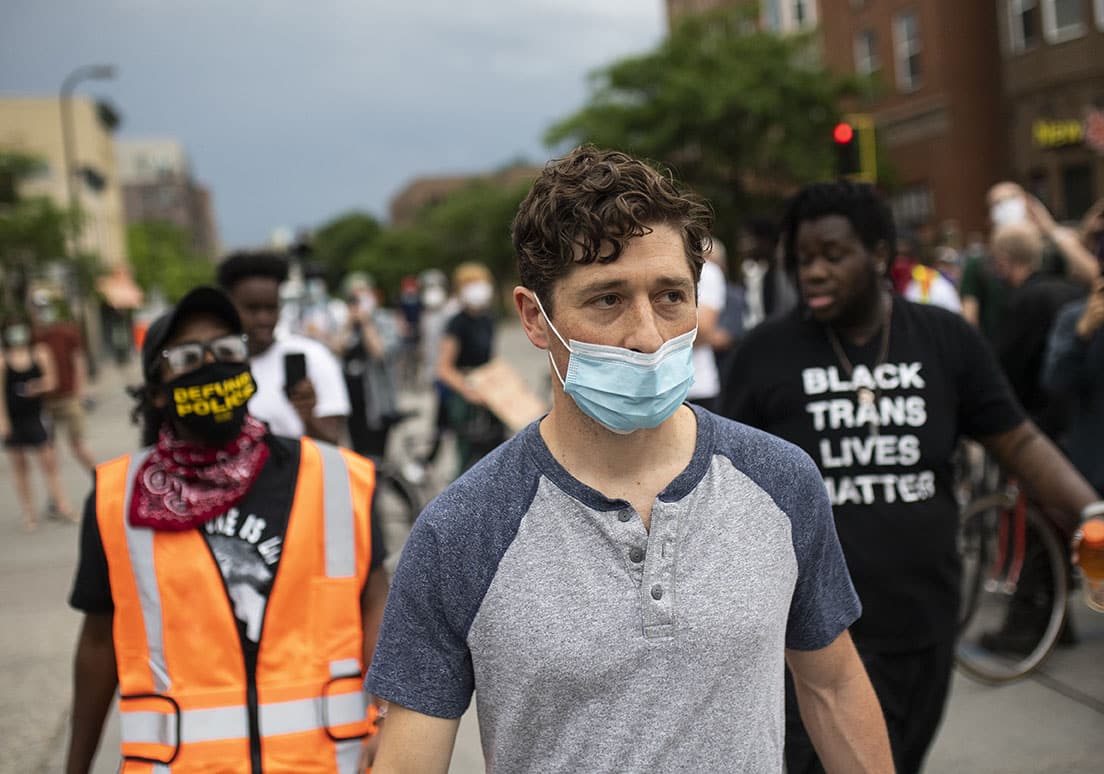
MINNEAPOLIS, MN – JUNE 6: Minneapolis Mayor Jacob Frey looks over a demonstration calling for the Minneapolis Police Department to be defunded on June 6, 2020 in Minneapolis, Minnesota. Mayor Frey spoke at the head of the march but was asked to leave by the organizers after declining to commit to fully defunding the MPD. (Photo by Stephen Maturen/Getty Images)
These three influential voices violated three core lessons from the civil rights era. First, consistency counts. As Barack Obama recently wrote, “If we want our criminal justice system and American society at large to operate on a higher ethical code, then we have to model that code ourselves.” So no, you can’t defeat injustice with more injustice and the same forces in American society that have long treated certain words as violent can’t now claim that looting isn’t.
Moreover, nonviolence is not just a tactical cure to heal the oppressor – but a vaccine for the oppressed. Civil rights activist Fannie Lou Hamer warned, “Hating just makes you sick and weak.”
Finally, more practically, historically, riots scarred communities without reforming our country, which is why Martin Luther King, Jr. always condemned riots as “socially destructive and self-defeating.” King so often is quoted selectively, but you cannot distort his core teaching that to progress we must distinguish right from wrong, the constructive from the destructive.
A society so decadent, so self-loathing that it won’t defend itself, will never reform, just as a society that’s so complacent, so self-absorbed it won’t criticize itself, will never truly flourish. Remember the secret to America’s civil rights advances: Only a resilient civil society can root out uncivil behavior, be it a few evil cops murdering individuals, or thousands of malicious protesters spinning off from politics into plunder.
One of the great rebukes to arrogant politicians — and partisans — is Psalm 51, capturing King David’s agony after his ends-justify-the-means sin of neutralizing Uriah so he could marry Bathsheba. David salutes God’s desire for a pure, inconvenient “truth in the inward parts.” And he speaks of zivchei-tsedek (sacrifices of righteousness). The age of Trump illuminates that phrase’s deeper meaning. Sacrifices of righteousness require us to resist self-righteousness, to avoid the partisan bully’s orthodoxies and oversimplifications, to embrace the true patriot’s search for the best path in a complicated, confusing world, with enough passion to do good yet enough humility not to demonize everyone who thinks differently as bad.
Gil Troy is a distinguished scholar in North American History at McGill University. The author of 10 books on presidential history, his latest works include “The Age of Clinton: America in the 1990s,” and editing the updated version of Arthur Meier Schlesinger, Jr. and Fred L. Israel’s “History of American Presidential Elections.”
As a veteran Israeli citizen and a professional Israeli diplomat, I am used to life being full of surprises − whether it be missiles from Iraq during the Gulf War or rockets launched against Israel from Gaza. We take disruptions of life as part of life.
After 20 years in the Foreign Ministry, I am used to waking up to an unexpected schedule. From unanticipated meetings to unforeseen assignments – it is part of the job description.
Yet, for me, the repercussions of the coronavirus pandemic and George Floyd’s death have been quite defining. It has posed unforeseen challenges, and has pushed us all, across the diplomatic spectrum, to use everything in our powers to cope.
This article is not to brief you on the political situation in Israel nor the geopolitical concerns in the Middle East. Instead, I would like to offer you a glimpse of the last few months from a diplomat’s desk, sharing with you our shifting agenda during these challenging times. I will discuss the challenges the coronavirus poses, which has dominated our agenda over the last several months.
It is understood that the essence of the life of a diplomat, what I enjoy so much about the profession, is the nurturing of in-person relationships, meeting people, striking up friendships, holding and attending events. However, since the outbreak of the pandemic, we have found ourselves in a different reality in which our work has completely transformed. We found ourselves facing new challenges and unknown territory.
From left: Consul General of Israel in Los Angeles Hillel Newman, philanthropist Dina Leeds and L.A. City Councilman Herb Wesson, who is running for a seat on the L.A. County Board of Supervisors.
My first order of business was tackling how we were going to continue to work. Diplomatic missions, like other essential working places, were exempted from the “stay home” order. So we split our staff into two shifts, each shift working alternate days. Thus, if someone fell sick and neutralizes that entire shift, the alternate shift could continue to “hold the fort.”
With the outbreak of the coronavirus, Israel immediately related to the virus as a national security issue. All central and relevant government agencies were gathered under one control center, including our Foreign Ministry. The most pressing issues were quickly identified, both immediate and long term.
One of our assignments was the rescue of stranded Israelis around the globe with the objective of getting them home safely. Israelis, on their treks and travels, tend to discover and inhabit the most remote corners of the earth, locations absent of even dirt paths back to civilization. With the indispensable help of our diplomats, approximately 9,000 Israelis were located and returned to Israel. We also had our own fair share of special cases right here in our area. For example, one morning, we received a call regarding Israelis, without entry visas to the United States, stranded on a boat stricken with coronavirus victims, docked in San Diego. With the close assistance of the U.S. State Department, we were able to get those citizens home.
The task of reuniting and rescuing gave moments of happiness; however, the work also can have moments of heartbreak.
The task of reuniting and rescuing gave moments of happiness; however, the work also can have moments of heartbreak.
Urgent calls from families wishing to transport the bodies of dear ones to Israel for burial presented some of the greatest challenges. We had to determine the reason of death, locate airlines that would agree to airlift the body and stamp their documents. We faced difficult and painful cases, from senior citizens to infants.
A top priority on our agenda was the sharing of best practices with friends and allies. From the outset of the pandemic, Israel adopted a “high-tech approach” to battling the coronavirus. It was put into practice by setting up incubators and specialized teams, blending private and public organizations, gathering medical staff together with computer engineers and military units with high-tech start-ups. The innovation resulting from these efforts enabled a swift shift from procurement to self-production.
As one of the first countries to impose restrictions on movement, then one of the first countries to devise a pilot-controlled exit strategy, we believed our experience could be of benefit to others. We also wanted to learn from the experiences, good or bad, of others. The United States of America has no better friend than Israel, and Israel has no better ally than the United States of America. For this reason, it was only natural that Israel and the United States partner, scientifically and practically, in sharing of knowledge and best practices, meeting the challenges of the virus together. Israel shared its protocols and best practices with decision makers throughout the United States, including here in Los Angeles.
Israel also shared with friends and allies in Europe. As a result, the Chancellor of Austria and the Prime Minister of the Czech Republic publicly expressed gratitude to Israel for the important information conveyed to them.
Another crucial priority in our work has been to maintain contact with Jewish federations, organizations, synagogues and community leaders. As expected, we found ourselves facing the deplorable and predictable wave of anti-Semitic vitriolic and repulsive conspiracy theories, targeting Jews and Israel during this time of crisis. It was important to us to convey a clear message regarding Israel’s care and concern for the wellbeing of the communities.
The Israeli consulate in Los Angeles wanted to express its solidarity with the people of Los Angeles and its gratitude to the first responders on the frontlines. The method we devised was the setting up of billboards along the I-10 freeway with messages of gratitude, friendship, solidarity and appreciation.
Among other assignments was the procurement of essential items for Israel. Companies here in California were approached, and they responded positively. Acquisitions were clenched. Such positive cooperation reflects the strong relationship between Israel and the United States, between Israel and California.
The entire Consulate team has been on-call around the clock since the beginning of the crisis. It is at moments like these that I feel the work we are doing serves one of the highest purposes as diplomats. My feeling is that my service as a diplomat is like being a soldier on the frontlines. Not the frontline of trenches and tanks, but a frontline of no less significance and meaning. I will continue to serve, anticipating the unanticipated call to duty.
Hillel Newman is the Consul General of The Consulate General of Israel in Los Angeles.
Rapper and actor Ice Cube has tweeted out several memes in recent days that have been criticized as anti-Semitic.
On June 10, Ice Cube (born O’Shea Jackson) tweeted out a Jewish Star of David with what appeared to be a Black Cube of Saturn. The Forward described the symbol as “a reference to occult worship.” The Daily Beast similarly described it as a reference “to a cult of Satan worshippers.”
Also on June 10, the rapper tweeted an image stating, “Hebrew Israelities [were] slaves in Ancient Egypt. Clearly they are a black people.” The Forward noted that the image “may be a reference to the idea, shared among some members of the Hebrew Israelite religion, that black people — not present-day Jews — are the true descendants of biblical Israelites.”
Creative Community for Peace Director Ari Ingel said in a statement to the Journal, “It’s disturbing to see a cultural icon who is a such a powerful voice for social justice in the Black community fail to understand the impact his words and the images he shares have on the Jewish community, especially when anti-Semitism is on a steady rise in America where it has turned increasingly violent. We stand with the Black community in their fight for justice and change in America, but fighting racism with anti-Semitism is unacceptable.”
Others in the Jewish community condemned the memes on Twitter.
“This is not fighting racism — this is inciting it,” British pro-Israel researcher David Collier tweeted to Ice Cube. “You are vile.”
This is not fighting racism – this is inciting it.
Adam Serwer, a writer for The Atlantic, tweeted, “Conspiracy theories allow their proponents to flatter themselves into thinking base prejudices are but marks of intellectual sophistication. Even so, ‘cubes are symbols of Jewish control’ reaches a new frontier of stupid when offered by a guy best known as … Ice Cube.”
Conspiracy theories allow their proponents to flatter themselves into thinking base prejudices are but marks of intellectual sophistication. Even so, “cubes are symbols of Jewish control” reaches a new frontier of stupid when offered by a guy best known as … Ice Cube. https://t.co/icds6YCiLu
Tablet senior writer Yair Rosenberg quipped, “I told the conspiracy we should have used septagons instead, but they didn’t listen and now we’re busted.”
Ice Cube had previously come under fire for a June 6 tweet of an image showing six old white men with hook noses playing a board game over several black and brown men. One of the white men is counting cash. The image had been painted as a mural in London, but was subsequently taken down because of complaints about the image being anti-Semitic.
The Simon Wiesenthal Center tweeted, “Shame, two years ago we met with @icecube to turn a new page. Now when it counts, instead of using his notoriety to promote peace in a fractured America he regresses to classic #antiSemitic tropes.”
Shame, two years ago we met with @icecube to turn a new page. Now when it counts, instead of using his notoriety to promote peace in a fractured America he regresses to classic #antiSemitic tropes.
— SimonWiesenthalCntr (@simonwiesenthal) June 9, 2020
Pro-Israel activist and human rights lawyer Arsen Ostrovsky tweeted, “Hi @icecube. I have tremendous respect for you as an artist and champion for peace & tolerance. But the image you shared, even as cropped, is strongly anti-Semitic. As a role model fighting racism today, would strongly urge you to please withdraw.”
Hi @icecube. I have tremendous respect for you as an artist and champion for peace & tolerance. But the image you shared, even as cropped, is strongly Antisemitic. As a role model fighting racism today, would strongly urge you to please withdraw.https://t.co/FfHwUPpLlz
Los Angeles County announced on June 10 that various facilities can start reopening on June 12.
Facilities that can start to reopen include gyms, swimming pools, sporting venues without live audiences, zoos, campgrounds, schools, hotels and production for movies, television and music.
Not included in county’s June 12 reopenings are bars and nail salons.
According to county health officials, there were 1,275 new COVID-19 cases on June 10 and 61 deaths; the county’s respective totals are now 67,064 and 2,768. KNX 1070 radio reporter Claudia Peschiutta tweeted that the COVID-19 transmission has slightly increased in the county and health officials are concerned about a possible shortage in intensive care-unit (ICU) beds in 2-4 weeks.
#COVID19 update: LA County health officials say they're seeing more evidence rate of transmission is up slightly and we may see a shortage of ICU beds in two to four weeks. @KNX1070
— Claudia Peschiutta (@ReporterClaudia) June 10, 2020
County Public Health Director Barbara Ferrer pointed out that the average daily COVID-19 death rate in the county has been declining.
“We can attribute this decline to the hard work that everyone has been doing to slow the spread of the virus, both in our communities, and at the skilled nursing facilities,” Ferrer said.
On June 5, the Associated Press reported that the California would start allowing bars, gyms, schools, summer camps and sporting venues without live audiences to start to reopen on June 12 on a county-by-county basis. According to CNBC, nine California counties have seen “a spike in new coronavirus cases or hospitalizations of confirmed cases.” The state has 133,489 total confirmed COVID-19 cases and 4,697 deaths from the virus.
Reaching Out to the Elderly Several weeks ago, members of the various boards of the Los Angeles Jewish Home were asked to volunteer by calling the residents to say hello and let them know that we are thinking about them during this difficult time.
Because the of the isolation and COVID-19 pandemic, physical contact was completely cut off. I was given the names of 30 residents to contact by phone.
They all understood the necessity of the lockdown and expressed deep appreciation for the extraordinary measures the facility took to keep them safe. All spoke glowingly about the extra efforts of the administration, doctors, nurses and staff to make them comfortable and knowledgeable about social distancing and masks. One woman expressed her disappointment in not being able to play cards with her friends, and a 92-year-old man from Ukraine said, “This isn’t a retirement home … this place is paradise!”
We should take great pride and satisfaction that our most vulnerable elderly members are so happy, so well taken care of and so safe during this unprecedented health crisis. Sheldon Steier, via email
Watch New Life Emerge We are the children of the “Parparim” (butterfly) class at the Early Childhood Center of Pressman Academy of Temple Beth Am. Our parents read Rabbi Bradley Shavit Artson’s story (“Sheltering in Our Cocoons, Preparing to Soar,” May 29) and we all could relate to the metaphor of being in a cocoon because we recently did an amazing project: We ordered caterpillars online and watched them develop into butterflies in a mesh habitat that we kept in our homes.
We would like to recommend this as a wonderful activity for people of any age to witness this incredible, magical transformation. It is a particularly appropriate activity for this period of quarantine, when you might be lucky enough to be present to see the butterfly emerge from the cocoon like we did. We hope that, as Artson described in his story and as we saw with our butterflies, our society will indeed do the work necessary to emerge from this challenging time changed, stronger and more beautiful than ever. Pressman Academy’s “Parparim”, Temple Beth Am, Los Angeles
George Floyd Protests I agree that there are many layers to the relationship between the police force and the black community. I also agree that the conduct of the officer who is charged in the death of George Floyd was simply wrong. However, I don’t see it fitting to fight fire with fire. Some of the things we’re seeing at these protests are not peaceful. Gal Cohavy, Los Angeles
I am writing to thank David Suissa for his thoughtful column “When the Riots Took Over the Story” (June 5) and Tabby Refael’s insightful piece “Mourning in Fear” (May 5). I had almost forgotten about the Journal but had been on a protest march in Hollywood and afterward went to the Farmers Market and picked up a print edition. As a lifelong Unitarian Universalist, I appreciate the diversity of stories in the Journal. I plan to continue to read online. Kerry Thorne, via email
In 2018, Keith Ellison, currently Minnesota’s attorney general, posted a Twitter photo of himself holding “Antifa: The Anti-Fascist Handbook.” Ellison’s post said the book should “strike fear into the heart” of President Donald Trump.
Antifa is believed to have fomented some of the rioting, with violence and looting, that has erupted alongside legitimate protests against the death of George Floyd while in police custody. Trump has asked that antifa be declared a terrorist organization. (It is a movement with no official members or leaders, and there is a debate as to whether Trump or his administration has the legal authority to declare antifa a terrorist organization.)
Minneapolis City Councilman Jeremiah Ellison, Keith’s son, has tweeted support for antifa.
Minnesota Gov. Tim Walz wants Keith Ellison — not the Hennepin County prosecutor — to lead prosecutions related to Floyd’s death.
Before Walz announced that Ellison would lead the prosecution, Nekima Levy Armstrong, a civil rights activist and former head of the Minneapolis NAACP, was among those calling for a special prosecutor, and she didn’t endorse Ellison for the job. “There needs to be a completely independent special prosecutor,” she said.
That seems like a judicious assessment, considering that riots across our country have left several dead (so far), dozens injured, hundreds arrested, synagogues vandalized and many buildings and businesses destroyed.
“Days of Rage” aren’t the American way. Julia Lutch, Davis, Calif.
Jews of Color We are finally recognizing that in the Diaspora Jews went everywhere (“Jews of Color Campaign Goes Viral After Article Relegates Them to a Statistic,” May 29). Some went underground; some are reemerging and returning to the fold. And they all don’t look alike. Enriqué Gascon, Westside Village
2020 Must Be the Year of No Tobacco May 31 marked the 32nd annual World No Tobacco Day, a global public health campaign led by the World Health Organization (WHO) to expose the deadly tactics of the tobacco industry, the impacts of the tobacco epidemic it drives, and offer solutions for people to claim their right to healthy lungs and lives.
As the world’s eyes are on the COVID-19 pandemic, we can’t lose sight of another deadly epidemic: Each year, tobacco kills 8 million people globally. Almost a half-million of those deaths occur in the U.S.
This epidemic is driven by the tobacco industry, which seeks to profit off the sale of addictive and deadly products. In fact, during the COVID-19 pandemic, Big Tobacco has doubled down on its time-tested tactics: marketing its products to young people and interfering in public policymaking. The industry is using aggressive public relations campaigning to position itself to profit from the COVID-19 pandemic.
Luckily, the world has a powerful tool to curb Big Tobacco’s power: The WHO Framework Convention on Tobacco Control (WHO FCTC), also known as the global tobacco treaty.
The U.S. has yet to ratify that treaty, but state and local governments still can use the guidelines in the WHO FCTC, which is one essential way to counter the devastating impact of COVID-19 and future respiratory-related pandemics and save millions of people’s lives from the effects of tobacco use.
Our elected officials must look past Big Tobacco’s publicity stunts and enact policies in line with the global need for strong corporate accountability measures that save lives.
I’m calling on our elected officials to take steps to stop Big Tobacco’s marketing to youth, reject tobacco industry interference in policymaking, and make Big Tobacco pay for its abuses. Lisa Laureta, via email
Praise for a Podcast
It was a mechayeh listening to David Suissa’s podcast recently after the weekend’s events. His message to not let the violence detract from the important message of the peaceful protests struck the right tone. Our society is in pain. In 2007, Lawrence Ferlinghetti wrote a poem (“Pity the Nation”) about the systemic problems in our nation, and it is even more relevant today.
Thank you for your intelligent and insightful words in these troubled times. Bonnie Voland, Los Angeles
Now it’s your turn! Don’t be shy, submit your letter to the editor! Letters should be no more than 200 words and must include a valid name and city. The Journal reserves the right to edit all letters. letters@jewishjournal.com.
(JTA) — While the world has had its attention fixed on the George Floyd protests and the ongoing threat of COVID-19, a political development with monumental implications has been brewing in the Middle East: Israel’s potential annexation of parts of the West Bank.
Israeli Prime Minister Benjamin Netanyahu promised his supporters during multiple election campaigns last year that he would make areas outside of the country’s borders part of the state.
Now his chance is fast approaching. The terms of a government coalition deal he struck with political rival Benny Gantz allow Netanyahu to put annexation to a government vote as early as July 1. The pair reportedly differ over details, but the U.S. ambassador to Israel, David Friedman, is trying to broker an agreement.
What happens with annexation has potentially steep stakes for Israel’s relationship with the United States, with its allies in Europe and beyond, and with American Jews. Some of the country’s fiercest supporters oppose Netanyahu’s annexation push.
The opposition and other factors complicate the chances of annexation happening on July 1, but the possibility remains on the table. So here’s what you need to know before that important date.
What could happen July 1
Netanyahu, who has opposed a Palestinian state during most of his career, sees annexation as a way to safeguard Israel’s control over parts of the West Bank, which much of the Israeli right views as Israel’s historical heartland. Annexation has also been a key demand of Netanyahu’s base, so he would see this as a major political victory.
If the prime minister had his way, he would immediately try to annex the land that Israel was allotted under the Trump administration’s Middle East peace proposal in January — approximately 30% of the West Bank, including the Jordan Valley. He could put the idea up for a vote either in parliament or his own Cabinet, according to the coalition agreement.
But he may be starting small. According to a Times of Israel report, Netanyahu currently plans to annex just a small portion of West Bank territory on July 1 — namely the land occupied by over 100 Jewish settlements.
The rest could come later, but the limited approach for now reportedly stems from the fact that a U.S.-Israeli team is still determining the exact lines of territory described in the peace deal. (The Palestinians have been unequivocal in their rejection of the plan.)
The mapping process and the time it takes could be up to Jared Kushner, Trump’s point person on the entire Middle East project. While Friedman pushed early on for annexation to happen as quickly as possible — the ambassador is an outspoken supporter of the settlements and has close ties to them — Kushner has been more hesitant. An Israeli TV station reported last week that the U.S. administration, caught up in handling the George Floyd protests and the coronavirus pandemic, wants to “greatly slow the process” of annexation, although Friedman’s intervention suggests continued interest in making it happen.
Who supports annexation
The right wing of Israeli politics is a major backer. That includes even Netanyahu’s other bitter rival, Avigdor Liberman, the hawkish head of the Yisrael Beiteinu party.
So does the Trump administration, which authored the peace plan that essentially gave Netanyahu the green light for annexation. The administration’s supporters, including many evangelical Christians who have a religious interest in the West Bank territory remaining under Israeli control, also support the move.
Many right-wing leaders, politicians and organizations in the U.S. support the move as well.
But outside of the right wing in Israel and the U.S., it’s difficult to find much support.
Who opposes annexation
The speculation about annexation has already prompted a wave of critical responses, from liberal Jewish groups whose opposition might be expected to U.S. politicians and worldleaders, as well as prominent Jews who don’t always weigh in on politics.
In the United States, the caution around annexation has been bipartisan, with Republicans and Democrats alike warning late last year that such a move would threaten efforts to reach a two-state solution.
Some of the more centrist pro-Israel groups, such as AIPAC, the largest Israel lobbying group in the U.S., have yet to show their cards. The issue puts groups like the American Israel Public Affairs Committee in a delicate position — does it support Israel at all costs, or does it draw a line on actions it believes endangers the Jewish state’s future?
In a twist, several Israeli settler leaders, mayors and other activists whose homes would become part of Israel under annexation oppose the move. They say annexation would stunt settlement expansion and freeze the currently disparate settlements, which are sprinkled across the West Bank, in an insecure position. They also oppose a Palestinian state of any borders.
“Either the settlements have a future or the Palestinian state does — but not both,” right-wing lawmaker Bezalel Smotrich, who at one point pushed for annexation, told The New York Times last week.
What the consequences could be
If Netanyahu plows ahead with annexation without winning over some of his critics at home and abroad, there could be consequences for Israel.
Most of the international community sees the settlements as part of an illegal Israeli occupation of land that could make up a Palestinian state. Annexation would also be viewed as illegal according to United Nations standards, just as Russia’s annexation of Crimea was in 2014, for example.
The move would certainly trigger intense international condemnation, and even a possible shake-up in international allegiances. While many European and other countries — including the United States under President Obama — have disagreed with Netanyahu over policy, they have held on to hope of a future two-state solution. Annexation would at least alter what the traditional two-state solution looks like.
Politicians in some countries, including at least one staunch ally of Israel, have already called for sanctions on Israel if it carries out annexation as threatened.
For the more than 400,000 Israelis who live in the settlements and are full citizens, the specifics of post-annexation governance are still unclear. But it’s undeniable that the move would shape the contours of future peace efforts in the region, as Israel would unequivocally see the West Bank settlements as part of the official state in any negotiations with the Palestinians.
Those negotiations would almost certainly be set back by annexation. The Palestinians have already renounced their responsibilities agreed to under the Oslo Accords, the 1993 agreement that established security cooperation between them and the Israelis and launched the peace process. (Serious, direct talks have not happened for more than six years.) They say that unilateral annexation, which both sides agreed to forgo in the accords, is a deal breaker when it comes to negotiating with Israel on anything moving forward.
Neighboring Jordan could be next to back away from security agreements with Israel, as the country’s king has said it will bring “massive conflict.” The Arab League also has issued a warning to Israel. Some have speculated annexation could spark Palestinian violence in the area as well.
“We don’t want things to reach a point of no return,” Hussein al-Sheikh, a close adviser to Palestinian Authority President Mahmoud Abbas, told The New York Times on Monday. “Annexation means no return in the relationship with Israel.”



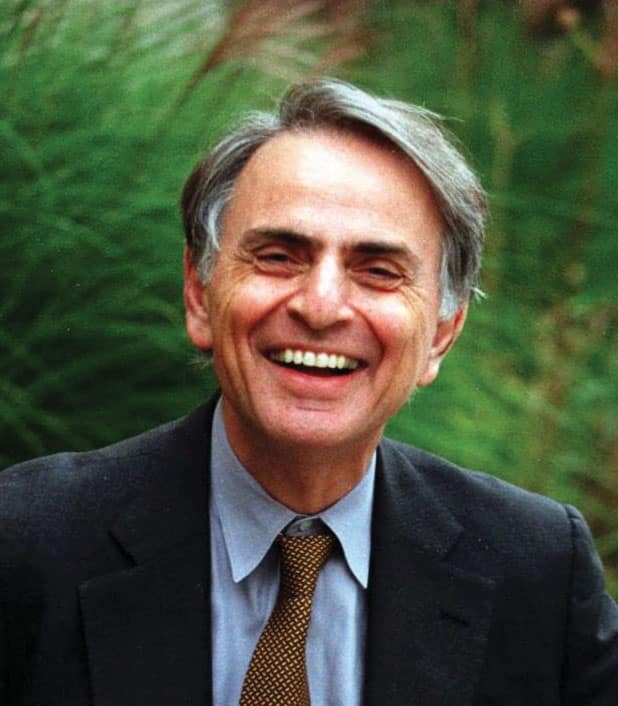 CARL SAGAN (1934-1996) b. Brooklyn, New York. An insatiable curiosity.