fbpx

June 6, 2020

Pelosi Accuses Trump of “Acquiescence” Amid the Rise in Anti-Semitism

U.S. Speaker of the House Nancy Pelosi (D-Calif.) warned on Thursday that if Israel were to apply sovereignty to parts of Judea and Samaria, that it would undermine U.S. national security and upend bipartisan support for the Jewish state.

During a virtual event with the Jewish Democratic Council of America, Pelosi said that “unilateral annexation puts [the] future at risk and undermines U.S. national security interests … and decades of bipartisan policy.”

Pelosi cited a U.S. House of Representatives resolution that passed mostly along party lines in December—with most Democrats voting for it, and most Republicans voting against it—reaffirming support for the two-state solution to the seven-decade-long Israeli-Palestinian conflict.

The resolution emphasized the U.S.-Israel relationship on issues from national security to shared values such as “democracy, human rights and the rule of law.”

At the same time, it also stated, “Whereas the United States has long sought a just and stable future for Palestinians, and an end to the occupation, including opposing settlement activity and moves toward unilateral annexation in Palestinian territory.”

Pelosi also accused President Donald Trump of “acquiescence” amid the rise in anti-Semitism in the United States and abroad.

“He has created a climate in which this has become more accept[able],” she said, citing Trump’s responses in the aftermath of the 2017 protests in Charlottesville, Va., where he stated that there were “fine people on both sides,” including the Unite the Right and neo-Nazi participants. Those protests led to the death of 32-year-old Heather Heyer after a 20-year-old man from Ohio rammed a crowd of people with his car.

In December, Trump signed an executive order combating anti-Semitism in the United States.

Pelosi Accuses Trump of “Acquiescence” Amid the Rise in Anti-Semitism Read More »

Netanyahu Criticizes Settlement Leaders for Anti-Trump Comments

Israeli Prime Minister Benjamin Netanyahu harshly criticized settlement leaders on Wednesday for their comments regarding what they see as problems with U.S. President Donald Trump’s “Peace to Prosperity” plan, which they claim will leave many settlements isolated.

“President Trump is a great friend of Israel’s. He has led historic moves for Israel’s benefit. It is regrettable that instead of showing gratitude, there are those who are denying his friendship,” Netanyahu said in a statement, according to the AP.

The settler leaders have voiced concern that the maps they have seen leave many settlements in Judea and Samaria as isolated enclaves. They also reject any recognition of a Palestinian state, as outlined in the American plan, and have pressed Netanyahu to make changes to the plan accordingly.

David Elhayani, chairman of the umbrella Yesha Council representing the settlers, told Haaretz on Wednesday that the U.S. plan demonstrated Trump was “not a friend of Israel.”

Knesset Speaker Yariv Levin, according to the report, called Elhayani’s remarks “rude and irresponsible,” and especially damaging at a time when “an important effort to advance the historic process of applying sovereignty” to parts of Judea and Samaria.

Netanyahu Criticizes Settlement Leaders for Anti-Trump Comments Read More »

Palestinians Accused of Piggybacking on Riots to Wreck Synagogues

The riots over the killing of George Floyd have turned Eyal Dahan’s Los Angeles neighborhood into “a war zone”—and according to Dahan, some Palestinians are taking advantage of the chaos to wreck synagogues.

A number of Los Angeles synagogues have been vandalized or even destroyed during the riots, including one in Beverly Hills. According to Dahan, an Israeli living in Los Angeles, the buildings were not targeted by any of the protesters demonstrating against Floyd’s death, but rather by Palestinians who “exploited the opportunity.”

“I saw a PLO flag and them shouting to ‘free Palestine.’ I don’t think it was black protesters who did this damage,” he said.

Dahan, a clothing supplier who has lived in the United States for 41 years, told Israel Hayom the chaos is “immense.”

“The army [National Guard] is in the streets. Businesses have been burned and torn apart. [Rioters] tore down pharmacies, stole all the medicine. All the electronics stores have been destroyed. It started bad, and because the police didn’t pressure them, it got worse,” he said.

The outside of Syd’s Pharmacy, vandalized during protests May 30 in Los Angeles.

According to Dahan, the businesses that haven’t yet managed to get back on their feet from the coronavirus crisis are crashing.

“It was terror on Saturday and Sunday, the entire city was engulfed. [Monday] there was some quiet, but that night the break-ins and looting started again. … Right now, 90 percent of the demonstrators are peaceful, but the 10 percent who come after them have been looting and causing huge damage,” he said.

The National Guard deployment, he added, has been only partially effective.

“They brought in the [National Guard] and they started to patrol the big shopping malls, but the small stores, which are barely hanging on, caught it. The [National Guard] can’t arrest civilians, they can only protect certain places,” he said.

While speaking with Israel Hayom, Dahan reported a new wave of rioting and looting: “Now the looting has started again. After eight or nine at night, they start their mess.”

Dahan, who was in Los Angeles during the Rodney King riots in 1992, said that “this time, it’s completely different. I didn’t think it would happen again, I thought that the police learned a lesson about how to handle it, but it was the rioters who learned. Social media helped them form groups, split people—like platoons in a war. It’s completely organized.”

This article first appeared in Israel Hayom.

Palestinians Accused of Piggybacking on Riots to Wreck Synagogues Read More »

Is Longtime Pro-Israel Congressman Eliot Engel in Trouble?

Longtime Rep. Eliot Engel (D-N.Y.) is having a rough week. First, the pro-Israel Jewish lawmaker was caught in a hot-mic moment on Tuesday, and on Wednesday fellow New York Democratic congresswoman Rep. Alexandria Ocasio-Cortez (D-N.Y.) endorsed his progressive primary opponent, Jamaal Bowman, who has questioned the U.S.-Israel relationship.

With comparisons already being made to Ocasio-Cortez’s stunning upset of former Rep. Joe Crowley in 2018, is Engel’s job in Congress in jeopardy as voters head to the polls on June 23 for primaries?

“Eliot Engel is a champion of the working people of New York and is one of the most effective members of Congress from any district when it comes to taking care of their constituents,” Josh Block, a former aide to President Bill Clinton and former head of The Israel Project, told JNS.

On Tuesday Engel came under fire for a hot-mic moment, saying: “If I didn’t have a primary, I wouldn’t care.”

The remark was made at a news conference with local and state officials in which Engel asked to speak about the instability in his Bronx district over the death of George Floyd, 46, who died on May 25 in the custody of Minneapolis police. Bronx Borough President Rubén Díaz Jr. told Engel that there wouldn’t be time for him to speak and, in response to Engel’s “I wouldn’t care” comment, said, “We’re not politicizing. Everybody’s got a primary, you know?”

In a statement later Tuesday, Engel said, “In the context of running for re-election, I thought it was important for people to know where I stand, that’s why I asked to speak. I would not have tried to impose on the Borough President if I didn’t think it was important.”
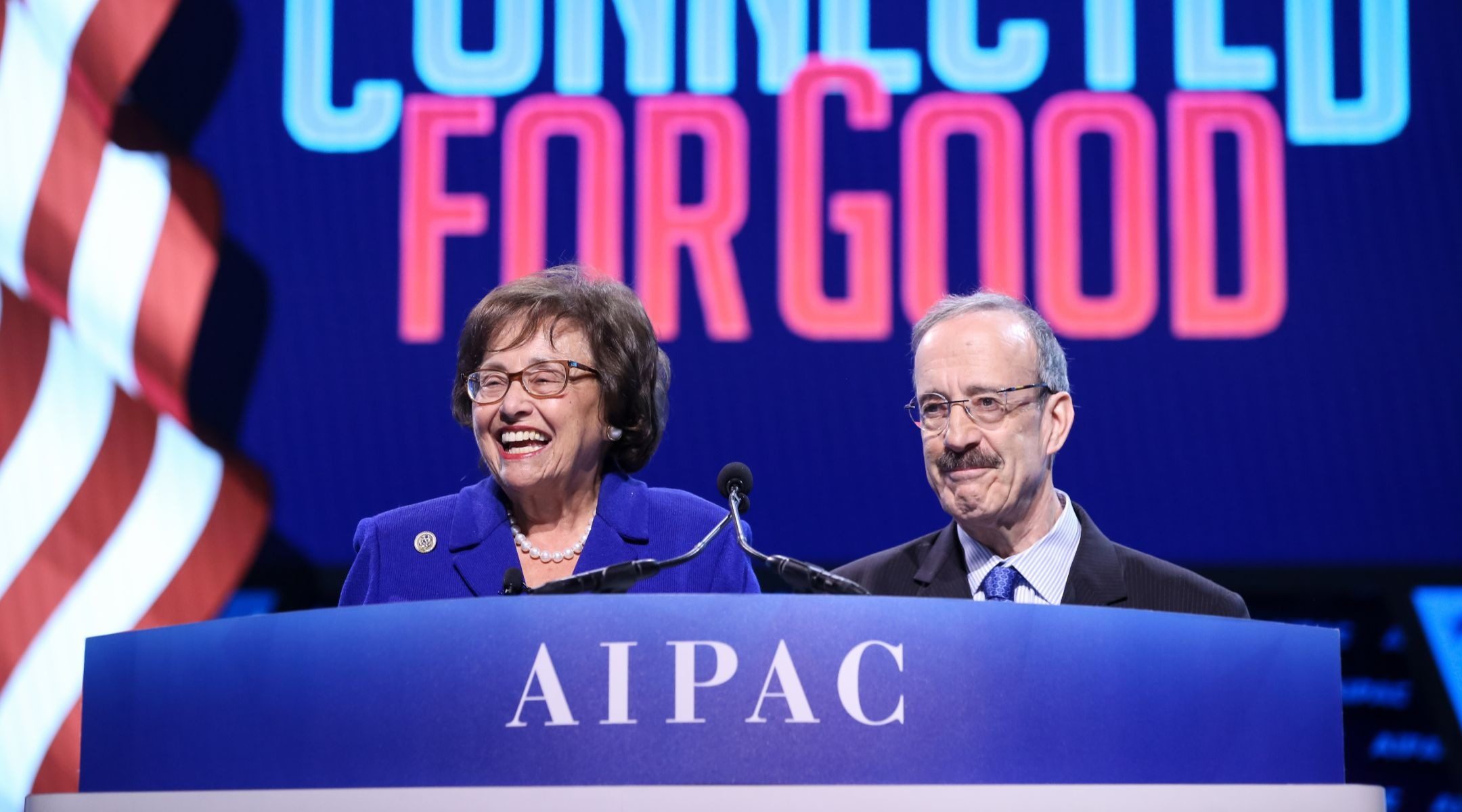
Reps. Nita Lowey (D-N.Y.) and Eliot Engel (D-N.Y.) at the annual AIPAC Policy Conference on March 25, 2019. Credit: AIPAC.

Engel, who heads the powerful House Foreign Affairs Committee, has served in Congress since 1989 and represents the heavily Democratic New York 16th congressional district, which currently contains parts of the Bronx and Westchester County. Yet over the decades that Engel has served, redistricting and demographics have led to significant changes in composition of Engel’s district, which today is minority-majority, with black and Hispanics making up over 55 percent of its residents.

Mark Mellman, president and CEO of Democratic Majority for Israel—whose political action committee, DMFI PAC, endorsed Engel—told JNS that while “the hot-mic moment was certainly unfortunate” and “not the kind of thing anybody would be sort of looking for,” the incident, which “was taken out of context by some,” won’t hurt Engel in the end.

“He is a well-liked and much-appreciated figure. He’s done a lot for New York, he’s done a lot for his district,” he said. “He got $5 billion for New York hospitals” during the coronavirus.

Mellman also dismissed concerns that Engel may be facing demographic challenges as well from his constituents, especially since his opponent is African-American.

Mellman noted that while the Jewish vote in Engel’s district, “is actually pretty small,” blacks and Latinos “in his district think very highly of Eliot Engel.”

He added that they “appreciate what he’s done for the district,” such as getting federal funds for “hospitals and other needs” and “his willingness to stand up to the evils of the Trump administration” that Mellman said include “attacks on a woman’s right to choose, attacks on immigrants, their attacks on health care” and “attacks on the rule of law.”

This is not about singling out Israel

At the same time, Engel is also one of the most prominent pro-Israel voices in the Democratic Party. At a time when there is concern over bipartisan support for Israel and the future direction of the Democratic Party, especially with the 2018 election of “the Squad” that includes Ocasio-Cortez, as well as anti-Israel Reps. Ilhan Omar (D-Minn.), Rashida Tlaib (D-Mich.) and Ayanna Pressley (D-Mass.), Engel has been viewed as a powerful and reassuring bulwark against them.

“He is also one of the strongest, most eloquent and reliable supporters of the special relationship between the U.S. and Israel, because he understands that a strong and secure Jewish state is the cheapest unsinkable battleship America could ever have in a part of the world that matters to our security and economy a great deal,” said Block.

While Bowman’s positions on the U.S.-Israel relationship include opposition to the anti-Israel BDS movement and a two-state solution to the Israeli-Palestinian conflict, it also includes conditioning U.S. assistance to Israel and calling Israel a country “that’s committing human-rights violations.”

Regarding conditioning U.S. assistance to the Jewish state, Bowman told Jewish Insider, “This is not about singling out Israel and targeting Israel. This is about any country that we provide aid to that’s committing human-rights violations. We need to have a conversation about conditioning some aid if those violations continue.”

Additionally, Bowman accused Israeli Prime Minister Benjamin Netanyahu of “aggressive policies toward the Palestinian people, particularly around occupation, annexation and the detaining of Palestinian children.”

“I may be just more open to having those conversations about the humanitarian crisis happening in Palestine than Eliot Engel has been all through his career,” he said.

Engel told Jewish Insider that Bowman is “anti-Israel” as “conditioning aid for Israel is one of the stupidest things I’ve ever heard. Foreign aid doesn’t only benefit the countries that we are giving it to; it benefits the United States.”

“This nonsense about conditioning aid is a bit arrogant because we’d essentially be telling Israel, if you don’t toe the mark, if when we crack the whip you don’t jump, we’re gonna pull it away from you,” said Engel. “That’s not how one ally treats another ally.”

“We need to maintain a quality relationship with Israel,” he said. “Israel has the right to exist. I think Israel has a right to be safe and secure. And I think Israel has a right to self-determination. I also think the people of Palestine have a right to exist, have a right to be safe and secure, and have a right to self-determination as well.”

Moreover, Bowman earlier this year touted an endorsement by the anti-Israel activists of the Jewish Vote, founded in 2018 as the electoral arm of Jews for Racial and Economic Justice, that has defended anti-Semitism on the left.

A critical leadership position

Democratic strategist Steve Rabinowitz told JNS that Engel is not “in particular danger,” though “it’s good and healthy that he’s running as though he is.”

Rabinowitz blamed “talk from political conservatives and some media” behind the hype that Engel may be in jeopardy of losing his seat.

“The gaffe was a gaffe, no matter what Elliot’s people say, but hardly a career-ending one after his substantial career,” he said. “He’s so much bigger than that.”

Nevertheless, an Engel loss would be devastating to the pro-Israel community, according to Jewish Democratic activists.

“He is a tremendous leader on America’s national security and foreign policy, and his loss would not only deprive his constituents of an amazing fighting champion, but it would also mean replacing one of the most pro-Israel members of Congress with one of the most anti-Israel members of Congress, who truly is out of step with this district in New York City,” said Block.

An Engel loss would be “a significant blow, there’s no question about it,” Mellman told JNS. “He occupies a critical leadership position as chairman of the House Foreign Affairs Committee. He is a strong advocate for the U.S.-Israel relationship and his opponent is not.”

“Chairman Engel is one of the strongest champions of the mutually beneficial U.S.-Israel relationship and he is an irreplaceable leader of the House Foreign Affairs Committee,” Democratic strategist Aaron Keyak told JNS. “Our party and our country are better with him in Congress.”

Is Longtime Pro-Israel Congressman Eliot Engel in Trouble? Read More »

Al Sharpton and the Painful Contradictions Between Fighting Racism and Anti-Semitism

Fighting racism doesn’t necessarily mean fighting anti-Semitism. Fighting racism can sometimes involve elements of anti-Semitism. And fighting anti-Semitism can sometimes lead to accusations of racism.

If you study the trajectory of racial politics in America in the last 50 years or so, it’s difficult to avoid those three conclusions, as depressing as they are.

Even so, my purpose in raising them here isn’t to discourage American Jews from participating in the new civil-rights movement that has coalesced in the wake of the sickening police murder of George Floyd in Minneapolis. Nor, with deep regret, am I raising them because I’ve come up with an ingenious proposal to resolve these contradictions once and for all. I am raising them only because we need to be clear-eyed about the challenges that lie ahead.

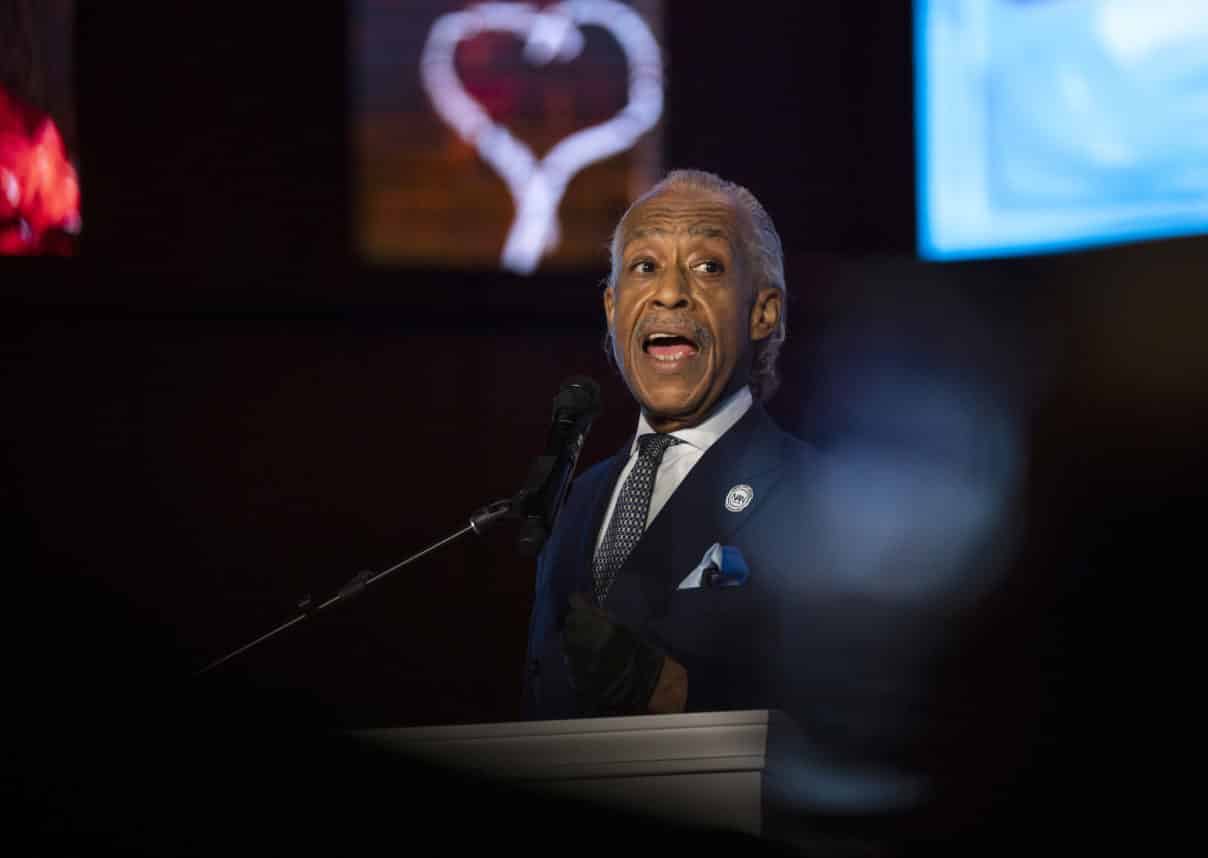
MINNEAPOLIS, MN – JUNE 04: Rev. Al Sharpton performs a eulogy during a memorial service for George Floyd at North Central University on June 4, 2020 in Minneapolis, Minnesota. A number of politicians and celebrities attended the service in Minneapolis as more are scheduled to be held in North Carolina and Texas. (Photo by Stephen Maturen/Getty Images)

“Get your knee off our necks,” the Rev. Al Sharpton exclaimed at Floyd’s funeral in Minneapolis on June 4, capturing the anger of black communities across the United States at the seemingly unending cycle of police brutality. It is a call to action that resonates powerfully with many Jews (myself included) on the emotional and moral levels.

The problem is the spoiling role that historical memory can play at charged moments such as these.

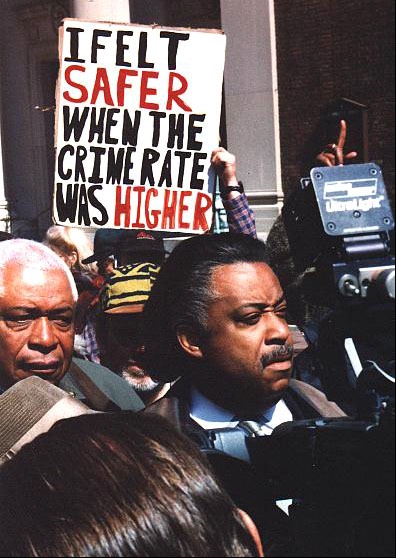
Rev. Al Sharpton outside of the New York City Police Department Headquarters in 1999. Credit: Robert Swanson via Wikimedia Commons.

The Al Sharpton who sounded this clarion call in the presence of George Floyd’s grieving family is the same Al Sharpton who goaded anti-Semitic rioters in the Crown Heights section of Brooklyn, N.Y., for three agonizing days during the summer of 1991.

“If the Jews want to get it on, tell them to pin their yarmulkes back and come over to my house,” he declared at a rally in Harlem before delivering a eulogy at the funeral of Gavin Cato—the 7-year-old African-American boy whose tragic death in a car accident sparked the rioting—where he invoked the most chilling anti-Semitic tropes. “All we want to say is what Jesus said: If you offend one of these little ones, you got to pay for it,” Sharpton told the mourners. “No compromise, no meetings, no coffee klatch, no skinnin’ and grinnin’.”

Sharpton has never offered genuine contrition for these grotesque remarks, perhaps because they reflect what he genuinely believes, and certainly because there was never any political cost attached to articulating them, Thirty years later, he’s still around, commanding the attention of a new generation of activists. In the struggle against racism in America, you can rest assured they will be told that Sharpton’s record of anti-Semitism is a subordinate concern—not to say an irritation—and those who raise it must be doing so to discredit the goals of the movement.

Sharpton is an apt example of the painful contradictions between fighting racism and fighting anti-Semitism that I outlined at the beginning. The sectarian politics he represents is the antithesis of that iconic image, much treasured by American Jews, of Rabbi Abraham Joshua Heschel marching alongside Dr. Martin Luther King in 1965 in Selma, Ala. But in the present political climate, it is the Sharpton approach to black-Jewish relations that has a much greater chance of prevailing.

So, and this is the question confronting the many Jews dedicated to rooting out the cancer of racism from our police departments and from our public institutions more generally, what are you supposed to think when you encounter anti-Semitism as an element in this very same struggle? And what do you do?

As I confessed earlier, I don’t have clear answers, partly because I think we are still diagnosing the nature of the problem. In the last five years, a campaign waged by anti-Zionist groups has pushed the false narrative that American police officers learned the methods of brutality from Israeli military personnel who tested them first on Palestinians. (The evidence provided is laughably flimsy. One claim I came across—that Minneapolis police were “trained” in crowd control by IDF officers—rested entirely on a link to a news report about a one-day anti-terrorism conference that was hosted by the Israeli Consulate in Chicago, which some Minneapolis officers apparently attended. In 2012.)

Most of the anti-Semitism encountered in black communities in America doesn’t have anything to do with Israel or Zionism.

Yet this readiness to embrace the demonology of Zionism speaks to a deeper problem. Most of the anti-Semitism encountered in black communities in America doesn’t have anything to do with Israel or Zionism. Instead, it is an Americanized version of the Christian anti-Semitism that was adapted by European nationalists and socialists of various stripes over the last two centuries. Its core message is that capitalist democracy is a system designed by Jews to benefit Jews, who then cry out “anti-Semitism!” to pull the wool over the eyes of the masses. Sharpton’s eulogy to Gavin Cato quoted above reflects the journey of those sentiments across the Atlantic.

In both American and Europe, racism against blacks and other communities of color has invariably been a feature of right-wing politics. Contrastingly, anti-Semitism has been a presence on left and right alike, who share the same prejudices about Jews even if they draw slightly different conclusions from them. Despite the preponderance of Jews on the left, raising anti-Semitism as a specific concern in these milieus has historically been treated with suspicion, as an implicit threat to divide the progressive movement over Jewish tribal complaints. In the context of the civil rights movement in the United States—a country where the historical role played by anti-Semitism has been negligible when compared with racism—complaints of anti-Semitism are frequently presented as a sinister attempt to legitimize the “white privilege” of the Jewish community with the cloak of discrimination.

American Jews are strong enough in their identities not to cast aside the injustices faced by African-Americans simply because anti-Semitism is a factor in the movement against racism in this country.

We are dealing with an old and stubborn formula here, capable of causing real mischief in situations like the one we face as a society now. American Jews are strong enough in their identities not to cast aside the injustices faced by African-Americans simply because anti-Semitism is a factor in the movement against racism in this country. By the same token, we have little choice in recognizing that anti-Semitism will continue to come at us from all sides—and that we should expect, especially when it comes from the left, to have to deal with it on our own.

Ben Cohen is a New York City-based journalist and author who writes a weekly column on Jewish and international affairs for JNS.

Al Sharpton and the Painful Contradictions Between Fighting Racism and Anti-Semitism Read More »

German Halle Synagogue Shooter Attempts Prison Escape

The gunman accused of attacking a synagogue in Halle, Germany, in 2019, was recaptured by German authorities after attempting a prison escape.

Stephan Balliet climbed an 11-foot fence during a walk through a prison courtyard on Saturday, but was caught shortly thereafter and taken back into custody. By Wednesday he had been transferred to a maximum-security prison.

“I’m really speechless,” Max Privorozki, the chairman of the Jewish Community in Halle, told the Jüdische Allgemeine. “For me, what happened yesterday was very evil and an unexpected surprise. It’s probably not surprising that the attacker would attempt to flee, but the fact that he would have been able to, that’s the problem.”

Anne-Marie Keding, the minister of justice in the state of Saxony-Anhalt, called the incident “horrible” in an interview with Deutschen Presse-Agentur. “There must be consequences.”

The escape attempt comes as the Halle Jewish community finds itself the target of a number of anti-Semitic incidents in recent days. Two swastikas were found drawn on the sidewalk in front of the community building on Grosse Markerstrasse. That came just days after the synagogue received a hate letter.

An investigation into the incidents is underway.

Balliet is scheduled to stand trial this summer for killing two people in the 2019 attack that began during Yom Kippur services. After failing to gain entry to the synagogue where more than 50 people were praying inside, he allegedly shot a woman dead near the entrance to the adjacent Jewish cemetery and subsequently killed a man at a kebab shop.

German Halle Synagogue Shooter Attempts Prison Escape Read More »

Nearly Half the Jewish Sites in Syria and a Quarter of the Sites in Iraq Have Been Destroyed

Nearly half the Jewish sites in Syria and a quarter of the sites in Iraq have been destroyed, according to a research project.

In Iraq, at least 68 out of 297 Jewish heritage sites have deteriorated to the point that they are beyond repair, the London-based Jewish Cultural Heritage Initiative said in its report, published earlier this week.

In Syria, at least 32 out of 71 such sites have crossed the point of no return, the report said.

The structures date from the second half of the first millennium BCE up to the present day. Most sites were built in the 19th or 20th centuries.

The condition of many sites is not known despite efforts by the research team. In Iraq, there is uncertainty about two-thirds of the sites. Only 11% of the 297 Iraqi sites are still standing. Of those, most are in poor or very bad condition.

In Syria, the fate of only 8% of Jewish sites is unclear, but 45% of them have been destroyed. Those that remain have fared better than the Iraqi ones, with most kept in fair condition, according to the report.

Among the most endangered structures are the Bandara Synagogue in Aleppo, Syria, and the Synagogue of the Prophet Elijah in Damascus, the researchers found.

In Iraq, the bulk of the destruction happened during the second half of the 20th century as a result of neglect, reuse for different purposes — shops, auto repair, etc. — and destruction for redevelopment in the aftermath of the emigration of the Jewish community and the seizure of Jewish property, Michael Mail, the chief executive of the Foundation for Jewish Heritage, told the Jewish Telegraphic Agency.

“Jewish heritage in Mosul was affected by the battle to liberate the city from ISIS, but was already in advanced decay prior to the group’s seizure of the city in 2014,” he said.

Mail said the Shrine of the Prophet Ezekiel in al-Kifl is now the Shiite Al-Nukhailah mosque. Hebrew inscriptions and other traces of the Jewish nature of the shrine remain in the room that houses the tomb of Ezekiel, he said.

In Syria, the rate of deterioration and destruction has increased in the past few decades, “although violence and seizure of Jewish property happened earlier,” Mail added, including “heavy damage to the Bandara Synagogue in Aleppo during anti-Jewish riots in 1947.”

Synagogues there are in the best condition among Jewish heritage sites.

The Synagogue of the Prophet Elijah in Jobar, a suburb of Damascus, has been “largely destroyed” and the condition and location of its archive are unclear as a consequence of the Syrian civil war, Mail said.

Baghdad alone had more than 120,000 Jews before a series of pogroms and persecutions caused them to leave.

Nearly Half the Jewish Sites in Syria and a Quarter of the Sites in Iraq Have Been Destroyed Read More »

For Orthodox Jews, George Floyd Protests Stir Complicated Feelings

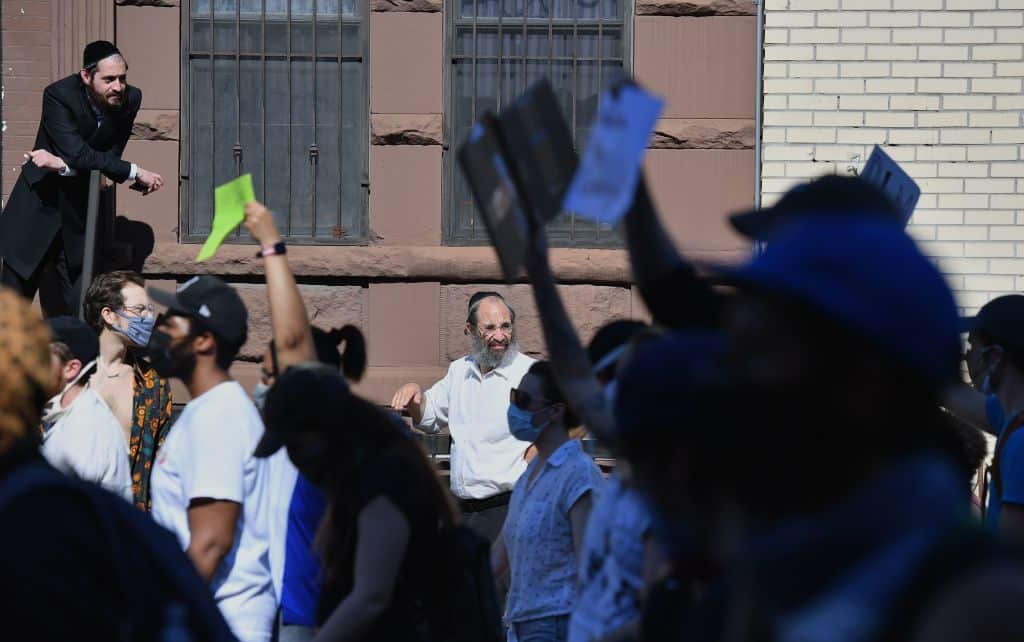
On Sunday night, Richard Altabe marched arm in arm with two black politicians protesting police brutality at a demonstration in Far Rockaway.

The next morning, Orthodox Jews in the same New York neighborhood showed up at the local police precinct to drop off pastries for the officers – 101 danishes for the 101st Precinct.

The principal of the Hebrew Academy of Long Beach’s lower school, Altabe sees no contradiction between Orthodox Jews participating in a march against police misconduct and their sugary goodwill gesture the next morning.

“We wanted them to know that even though we support the protests, we also supported the police and we’re grateful to the police and the work they do,” Altabe said.

The two gestures – opposing police misconduct while supporting the police more generally – are emblematic of the fine line Orthodox Jews have navigated in responding to sweeping protests sparked by the killing of George Floyd at the hands of white Minneapolis police officers.

“Many Orthodox Jews have had negative interactions personally with the police and have seen others who have and certainly understand and are sympathetic to the idea around police accountability and reform,” said David Greenfield, a former New York city councilman who now leads the Met Council, a Jewish nonprofit serving needy New Yorkers. “At the same time, however, they are generally supportive of the NYPD because they’re generally concerned about public safety and the looting.”

“Many Orthodox Jews have had negative interactions personally with the police and have seen others who have and certainly understand and are sympathetic to the idea around police accountability and reform,” said David Greenfield, a former New York city councilman who now leads the Met Council, a Jewish nonprofit serving needy New Yorkers. “At the same time, however, they are generally supportive of the NYPD because they’re generally concerned about public safety and the looting.”

Orthodox Jewish communities are both more politically conservative and more inward-focused than non-Orthodox Jewish communities in America. That dynamic was on display this week in the flood of statements from Jewish organizations weighing in on the protests and the societal conditions they aim to upset. While some organizations were quick to respond with detailed descriptions of proposed policy changes and pledges to work toward them, Orthodox organizations were slower to weigh in, vaguer in their visions and made a point of condemning the violence that unfolded at some of the protests.

In a statement yesterday, the National Council of Young Israel, an umbrella group of Orthodox synagogues, said Floyd’s killing showed that “racism is regrettably still alive and well in our country” and that it is critical that “the grave danger posed by systemic racism is duly addressed once and for all.” But the statement also noted that most law enforcement officers are “heroes” who risk their lives to protect ordinary citizens, regardless of skin color.

“These honorable officers should not be attacked or tarnished by the misconduct of others; however, it is essential that an effort be undertaken to remove any police officer that does in fact exhibit a degree of racial and ethnic bigotry,” the group said.

The Orthodox Union and the Rabbinical Council of America, the two principal national organizations representing Modern Orthodoxy, both condemned Floyd’s killing and expressed support for peaceful protests against racism while condemning the violence and looting. Agudath Israel, which represents haredi Orthodox communities, did much the same, though the Agudath statement did not use the word “racism.”

“Like all decent Americans, we are horrified by the senseless and ruthless killing of George Floyd, and we join in solidarity with the outpouring of hurt, anger and frustration expressed by responsible citizens protesting peacefully,” the group said. “We are also greatly saddened by the frightening scenes of innocent bystanders and store owners under siege, threatened by violence and mayhem, and facing the prospect of lost livelihoods and uncertain futures.”

The differing responses of Orthodox groups from their Reform and Conservative counterparts may be explained at least in part by politics. Unlike most American Jews, who tend to vote for Democrats, Orthodox Jews have leaned increasingly Republican in recent years. According to the most recent Pew Center study of American Jews, 57% of Orthodox Jews are Republican or lean Republican compared to just 22% of American Jews as a whole.

Several Orthodox politicians in New York put out statements to similar effect, supporting peaceful protests and condemning the death of George Floyd without directly criticizing the police. But some also spent several days questioning why protesters were allowed to gather en masse while religious gatherings are still restricted because of the coronavirus pandemic.

On Tuesday, Simcha Eichenstein, a state assemblyman representing two heavily Orthodox neighborhoods in Brooklyn, and Kalman Yeger, a New York City councilman, sent a letter to Governor Andrew Cuomo saying that the protests are evidence that the time for lockdown had passed.

“Protesters are gathering, perhaps well-meaning, but surely with little regard for social-distancing standards. It has also unfortunately brought out rioters who are destroying what is left of our economy, eviscerating the life’s work of our fellow New Yorkers,” they wrote. “The lockdown may not have formally ended, but the calls for mass peaceful marching without any regard for social-distancing have rendered a continual lockdown at this point ludicrous.”

Eichenstein also tweeted in frustration over the different rules regarding protests and religious gatherings.

“Sure, protesters have the right under the first amendment to march against racism, which needs to be confronted head on in this country, but the same first amendment guarantees religious people the right to practice their faith,” he wrote in response to a statement by the mayor at a press conference.

By Thursday, Eichenstein’s focus had shifted. He placed a sign in the window of his Borough Park office with the words George Floyd repeated before his death, “I can’t breathe,” in large print. He also expressed mourning and solidarity with the black community in a video Thursday. “As a Hasidic Orthodox Jew, my message is we, the Orthodox Jewish people, stand with you in solidarity, we must eliminate hate wherever it exists,” Eichenstein said.

The city council’s Jewish caucus, chaired by Orthodox city councilman Chaim Deutsch, put out a statement Monday expressing solidarity with the black community but without mentioning the police. And in a letter to constituents Thursday, State Senator Simcha Felder called George Floyd’s death an “act of pure evil,” saying that to ignore the message being sent by the black community about continued discrimination would be “unconscionable.”

But Felder also condemned the looting and violence against police officers.

“So let’s protest what we see is wrong and let’s inspire change without vilifying every member of the NYPD- they are people, too. Let’s not trade one evil for another,” he wrote.

Devorah Halberstam, an activist on anti-Semitism in Crown Heights who frequently speaks to new police recruits as part of their training, said the statements this week reflect the Orthodox community’s priorities.

“I think most people feel that people have a right to protest,” Halberstam said. “However, people are just concerned about safety and everyone wants to feel that they’re safe and that their stores are safe, their communities are safe.”

For Orthodox Jews, George Floyd Protests Stir Complicated Feelings Read More »

Knowledge, Will and Blessings – Thoughts on Torah Portion Naso

Rabbi Mordecai Finley

Knowledge, Will and Blessings
Thoughts on Torah Portion Naso 2020 (adapted from 2019)


I often meet with a person who is looking to change their life and it comes down to “the moment when.”  People want to give up anger or resentment, find courage or lose weight. All the pieces are in place, the skills are known, and the launch button awaits. When is the moment?


This is one of the mysteries of the will – that energy that seems to form somewhere deep in the unconscious. Oddly, we often can’t just will up the will. If I am resistant to doing something, I can sit and affirm all day long that “I have the will” and those affirmations might just tire me out. The will that forms in the unconscious is much more complex than affirmations. Affirmations have to register somewhere very deep, way below language.

I think the mystery of the will resides in some kind of knowledge. We know things in the mind, but then we know things in the area of the soul – another kind of knowledge altogether. When the soul knows something, it also knows its own calculus:  the inner life cost of doing something and the cost of not doing something else. The soul is the realm of our deepest values, our maxims, our starting places, our belief systems. We can subject our inner life beliefs to rational scrutiny, but those deep beliefs don’t start in the rational dimension.


For example, a young adult may have a belief, “Never makes my parents feel bad.”  Then someone makes a rational case that they “have to start living for themselves.”  The child has to weigh the suffering that letting the parents down will incur against the benefit of “living for herself.”  An outsider might say, “You are not being rational.”  The soul says, for better or worse, “my parents come first.”


Forcing yourself to do something before the soul is ready either produces nothing but frustration, or what it does produce comes at a great cost, a cost we pay later in guilt, for example.


I have seen well-intentioned friends persuading feuding people to “just talk to each other”, and I have also known of the ensuing reluctant encounters going very badly. They weren’t ready.


Hard battles go on deep within. Battles of working through fear, grief, anger and resentment, getting sober (staying sober), facing others and facing oneself. Fierce battles rage in the realm of the unconscious. In the “hero’s journey” this is the fight through the thicket. The hero knows the quest, has found the tools, has been given the map, but there is always the fight through the thicket.


For us, on the hero’s journey in our lives, there is always the temptation to take the inner war into the interpersonal space. Blame someone else or something else for our suffering.  Ultimately, you can only fix the outside world, even the system, so much. Ultimately, you have to repair the self.


If you have already read some story of the hero’s journey, you know whether the hero makes it through it or not. But in the story, the hero does not know the outcome.  The soul does not know of inevitable victory. Sometimes people say to each other, “It will all work out,” but that is a statement of faith, not fact – and maybe a false belief.


Once the hero’s journey truly begins, the soul only knows one thing – no willful turning back. If I am to suffer defeat, it is because there were just too many pterodactyls. The hero deserves to live, to succeed. This deserving of victory makes little difference to the forces of destruction.


When that moment of realization – that one can do no other – occurs in the soul, it shudders through the body. It is a singular knowledge, a heart firming and an opening into the vastness of a life of meaning. We all know, however, that the firm heart can weaken and the opening into the mystery of being can close up again.


A second kind of will is needed. The first will is the decision to move. The second will is to keep moving. The first one is related to courage, the second to resilience. Doubt has been overcome. Now one must accept the pain.


Where does prayer fit in?  What do prayers and blessings do? Perhaps they awaken unseen, supernatural forces to some good purpose. But perhaps a prayer or a blessing awakens the soul to a knowledge, a decision, a resilience – all circling in the realm of the will.


When our inner work has taken us down to a core question or insight, we see what has to be done. For example, a person once asked me for a prayer for prosperity. I asked him exactly what he wanted God to do. Several things came up: that his investors should overcome fear and suspicion. That his partners would be efficient. That, in general, good fortune would reign. “Prayers should be specific,” I advised. He ended up praying for his own good judgment, with some good fortune added.


Even if we appeal to the divine, however, with some laser point focus, it seems that the mere bringing of the laser light of the soul to bear on some question can have a transformative effect. It seems that once we bring the light of the soul to shine on some problem, we no longer need divine intervention, or the divine intervention has already just occurred.


It can be the same with the words of others. Sometimes another person can see into us with such precision that they can discern what the obstacle is, and then offer words that break through some obstacle. The words of others might not be phrased as a blessing, but that is their effect.


Prayers and blessings, at their finest, are the culmination of intensive introspective or empathetic effort. We can’t always determine what happens next, but whatever else we do, we are filling the world with will, insight and love. Those ripples never cease. Everything matters.


From our Torah portion:


May the Divine bless you and stand guard over you.

May the Divine bring illumination to you and be gracious to you.

May the Divine presence be borne toward you and grant you wholeness of being.

Knowledge, Will and Blessings – Thoughts on Torah Portion Naso Read More »