fbpx

April 28, 2020

Newsom Announces Plan to Reopen CA, Says Schools Could Reopen in July

California Gov. Gavin Newsom, a Democrat, announced a four-stage plan to start reopening California, including a suggestion that schools could reopen in July.

The state is currently in Stage 1, when the goal is to expand testing and contact tracing, ensure that hospitals and medical personnel have the resources necessary to handle a surge in COVID-19 patients and get businesses ready to have the capability of maintaining social distancing. In Stage 2, certain businesses would start to reopen, including retail, manufacturing and offices in which it’s not possible to work remotely. Environments deemed higher-risk would begin to reopen in Stage 3, including gyms, beauty salons, houses of worship and movie theaters. Sports could resume without audiences under Stage 3.

Stage 4, the final stage, is the full return to normalcy.

Newsom said that Stage 2 could happen in a few weeks, but Stage 4 likely wouldn’t occur for months.

“If we pull back too quickly and we walk away from our incredible commitment to not only bend this curve but to stop the spread and suppress the spread of this virus, it could start a second wave that could be even more damaging than the first and undo all of the good work and progress that you’ve made,” he warned.

He also suggested that schools could begin to reopen in early July or August, arguing that children in homes without internet access or whose parents are working essential jobs aren’t getting adequate access to education.

“If we can maybe start up the school year a little earlier, maybe we can help close that gap,” Newsom said.

Los Angeles Unified School District (LAUSD) Superintendent Austin Beutner said on April 27 that the district can’t reopen until it has enough testing equipment and contact tracing resources.

“Our 75,000-plus employees serve the needs of almost 700,000 students who live with another couple of million people,” he said. “Will testing be available for all of these individuals and who will pay for it? This is the sort of challenge which lies ahead.”

Newsom Announces Plan to Reopen CA, Says Schools Could Reopen in July Read More »

Coronavirus Infected Us With Romance, Dating Experts Say

Dating can be perilous at the best of times, but with COVID-19 shutdowns, finding romance has become even more difficult.

“I had been on three dates and it was going great, and then we got hit by this and it’s been reduced to texting,” Ariane Smith from Ann Arbor Michigan told the Journal

“While I am on the apps trying to talk to people, it feels really dry because we know there’s no possibility of meeting up,” Elisa Dickie, who is self-isolating in Buffalo, N.Y., said. “Skype dates are nice and all, but I don’t see any real connections coming from them because there’s no real connection or intimacy.”

However, Los-Angeles based Jewish cyber-dating expert Julie Spira believes the pandemic might actually be the perfect cure for dating woes. “This is actually a good thing,” Spira told the Journal. “We are looking at a slower process for dating, which prevents people from just ending up with a hookup and getting ghosted.”

As a dating coach, Spira said she finds that being intimate too quickly and being abandoned are the most common complaints among her clients. This outlook inspired her to launch “Dating in the Age of COVID-19,” a resource for singles who have given up on dating but not romance. She is even offering dress rehearsals for virtual dates.

“I’ve never seen dating become as creative as it is now. I’m watching people take on some really romantic gestures.” — Julie Spira

“The need right now to be connected is so heightened, whether that is with your friends or in romantic relationships,” Spira said. “People want to be in relationships, but they just can’t meet in person.”

Adam Rubin, who is social distancing in Los Angeles, is not throwing in the courtship towel just yet. “I was going to meet up with a girl from JSwipe, but now we’ve just been chatting,” he said. “It’s postponed our meet-up but we haven’t canceled it.”

For singles skeptical of uploading their dating life, Spira said, “They need to realize everyone is in a long-distance relationship now, regardless of where that other person’s ZIP code is.”

“They need to realize everyone is in a long-distance relationship now, regardless of where that other person’s ZIP code is.”

Nevertheless, she added she believes the coronavirus might unlock a romantic renaissance. “I’ve never seen dating become as creative as it is now,” Spira said. “I’m watching people take on some really romantic gestures: sending food deliveries so you can dine together on Zoom, talking about going on a vacation someday and each picking out a city as they explore virtual tours of museums in the locations, shared playlists on Spotify.”

Even dating services are getting more creative. “I was expecting lockdowns in the United States well before they were announced, so we launched a virtual dating initiative pretty early on. Now we’re shifting our resources to building video chat features,” Ben Rabizadeh, the CEO of JWed, a dating service for Jewish singles, told the Journal. “We are building right now something to be able to schedule a date, to make it more formal so people can build anticipation for dates.” He also envisions developing gaming and virtual gifting features.

Source: Flat Vector Illustration

For Steph Black, who works for the National Council of Jewish Women in Washington, D.C., the pandemic has seen her fast track her romantic relationship, with her girlfriend moving in. “Relationships are moving faster due to the crisis,” since singles now have fewer distractions from each other, Spira noted. To those who are sheltering-in and shacking up, Logan Levkoff, a sexuality and relationship guru, told the Journal, “It is hard to blend lives into one space, no matter how big or small that space is … If you’re doing it, you need to leave room for people to mess up and make mistakes.”

All-in-all, making mindful decisions in a pandemic could mean facing less personal judgment, Levkoff said. “Consenting adults get to make any decisions they want about when they want to have sex, how they want to have sex, whether it’s on the first date or 10th date or whatever. That being said, the inability to connect physically takes the pressure off the question of ‘When am I supposed to?’ and ‘Will I be judged for it?’

As COVID-19 cripples our world with restrictions, the virus appears to be doing the opposite for lovers.

As COVID-19 cripples our world with restrictions, the virus appears to be doing the opposite for lovers, according to Spira. “Virtual dating was something in the past that people really didn’t embrace, because they felt, ‘Oh, my lighting is not good’ or ‘I’m going to have a bad hair day’ or ‘I will look better in person.’ Well, right now, everyone is having a bad hair day,” she said, adding the pandemic has lifted deal breakers such as looks, age and physical distance.

Levkoff concurred. “This is an opportunity for us to date outside of our type, to push ourselves to connect with types of people that we wouldn’t have done earlier,” he said. “When we’re operating in big social circles, we often think we are supposed to want what the person next to us wants. Now, we get to be authentic.”


Ariel Sobel is the Journal’s social media editor.

Coronavirus Infected Us With Romance, Dating Experts Say Read More »

7 Tips to Make the Most of Your Home Office During Quarantine

If you’ve been working remotely from home, you know it can be a challenge. There are distractions, family members or roommates sharing the space and a refrigerator constantly calling your name.

But given many of us will continue to work from home in the name of social distancing, even as some businesses reopen in the upcoming weeks, let’s look at ways we can optimize our home office. Whether it’s a spare room, a dedicated corner of the living room or a place at the dining table, these tips can help you stay focused, productive and calm.

Define the space

If you don’t have a dedicated room for an office, it’s a good idea to delineate your work area to separate it from the rest of your home. Self-standing room dividers such as folding shoji screens can create an official “office zone,” so that when you cross that threshold, you’re in work mode. If all you have is a seat in front of a coffee table, make that an official work space by setting a placemat on it. When the placemat is on the table, that’s a signal that you’re “at work.”

Set boundaries

Even if you’re physically in the same space as members of your household, try to get them to act as if you are on the other side of town. This can be a challenge when there are children involved, but get them used to the idea that you require dedicated time at your workstation. You can even create a sign that says “I’m at work” so they know you can’t be bothered.

Wear headphones

One way to block out distractions is to wear noise-cancelling headphones. And even if your headphones aren’t tuned to anything, you can still pretend you can’t hear any household member who tries to bother you. For those joining meetings on Zoom, a headset is a great way to avoid disturbing everyone else with the teleconference.

Don’t face the wall

If you have the luxury of actually working at a desk, the tendency is to push it against a wall to maximize space. But that means you’re staring at a wall all day, which can lead to your feeling even more confined and claustrophobic in your home.

Turn the desk outward to face the room, or at least perpendicular to the wall. You’ll feel much better.

Welcome some nature

When we spend so much time indoors, we need visual cues of the outdoors more than ever. If you can, orient your workspace so a window is within your eye line. Bring the outdoors in with some houseplants. Even a little succulent plant next to your coffee cup will do wonders for your psyche.

Incorporate workplace reminders

You know how you display photos of family members at the office? In your home office, consider having photos of your friends from work. Admit it, you miss everyone. If you have a mug with your company logo, use that for drinks or a pencil holder. Notepads, pens and other office supplies with your company logo can actually be very comforting right now.

Move around

Wipe out those mental cobwebs by switching up your home workspace. If you work primarily from a desk, spend a little time with your laptop on the sofa. Invest in some faster Wi-Fi or some Ethernet cables so you can move around more easily while staying connected. And hopefully soon, the ultimate move will be the one back to the office.

7 Tips to Make the Most of Your Home Office During Quarantine Read More »

L.A. County COVID-19 Death Toll Reaches 1,000

Los Angeles County’s COVID-19 death toll hit the 1,000 mark on April 28.

There were 597 new cases and 59 deaths in the county, putting the totals at 20,976 and 1,000, respectively.

“L.A. County has hit the tragic milestone of 1,000 people dying from COVID-19,” County Public Heath Director Dr. Barbara Ferrer said in an April 28 press briefing. “Please know that if you are grieving the loss of loved ones who have died from COVID-19, our thoughts and prayers are with you, your family and your friends.”

Los Angeles Mayor Eric Garcetti said on April 27 that Los Angeles could begin to reopen in weeks but it would be a gradual process. He added that the “the curve really is beginning to flatten.”

COVID-19 testing also now is available to essential workers in the media and transportation industries, including food delivery and ridesharing.

An April 28 Los Angeles Times report stated that Los Angeles County has 9.3 COVID-19 deaths per 100,000 people, the highest urban county rate in the state. The county also accounts for around half of all COVID-19 hospitalizations in the state.

The Times report also stated that backlogs in testing have made it unclear if the county really has flattened the curve; however, Ferrer told the Times that come mid-May — when the county’s shelter-in-place order is scheduled to expire — the county’s COVID-19 cases and deaths likely will be on the decline. She added that officials expect to begin easing the shelter-in-place order when the county has widespread testing and contact tracing in place.

“I think as we put those systems in place, we can be at the point where we can relax,” Ferrer said.

L.A. County COVID-19 Death Toll Reaches 1,000 Read More »

Westside Family Health Center Helping Low-Income Community During Pandemic

On April 1, in the midst of the coronavirus pandemic, the Westside Family Health Center (WFHC) opened its doors at its new Culver City office. The center offers a wide range of medical services including family practice, pediatrics, prenatal, reproductive health services, flu shots, immunizations, behavioral health care as well as dental and vision services.

Community health centers like WFHC are crucial not only during pandemic times but year-round as they serve patients who are on or below the federal poverty level regardless if they are insured.

Celia Bernstein, director of development at WFHC, told the Journal there are approximately 188,000 residents who are low income or uninsured on L.A.’s Westside.

“Ninety-three percent of our patients are at 200% or below the federal poverty level and a little less than half have no health insurance,” she said. “When we say we help our patients regardless of their ability to pay, we mean that we try to see if a patient is eligible for insurance, and will help them enroll if they are. If the patient is not able to get health insurance, we ask them to make a donation on a sliding fee scale. We try very hard to get access to health care for all our patients.”

Although the nonprofit isn’t offering coronavirus testing at this time, it has changed its safety protocols to ensure its volunteer nurses and doctors are safe, as well as every patient that enters the building. The “team members” are dressed in full PPE gear and masks and practice social distancing as much as possible.

“WFHC has always had infection protocols in place. Due to the pandemic, we are not taking any walk-ins. We have been calling our patients on the phone and, if appropriate, conducting the visit on the phone as well,” Bernstein said.

 “Many [people] will become ill with preexisting conditions and have more risks to COVID-19 infection. All deserve affordable and accessible health care and they can find it at their local community health center.” — Celia Bernstein

Initially, WFHC didn’t need additional face masks. But it they ran low, the community stepped in to help deliver more than 125 homemade masks for team members and their families. The facility still is trying to access masks that will fit children.

Bernstein, who has worked in nonprofit organizations for over 25 years, said that last year WFHC treated more than 13,000 patients. Because of the coronavirus, the facility predicts a 65% visit drop in in-person patient visits. It still tries to see 10-12 patients a day in person.

Bernstein added that the longer the virus spreads and impacts families financially, the more people will need WFHC’s resources. While she is grateful many have offered assistance during this time, she said the best way to help keep WFHC afloat is with donations.

“We are learning that it is a privilege to keep our jobs and work from home safely to protect ourselves and our families. Those that do not have that privilege will become unemployed and more will become uninsured,” Bernstein said. “Many will become ill with preexisting conditions and have more risks to COVID-19 infection. All of these individuals and families deserve affordable and accessible health care and they can find it at their local community health center.”

For more information on how to help, visit the website.

Westside Family Health Center Helping Low-Income Community During Pandemic Read More »

‘You’re Constantly Preparing for the Peak’: Hospital Doctor Discusses Pandemic Frontlines

Dr. Anna Zvansky is a hospitalist in the Hollywood area working under incredibly stressful conditions in the midst of the coronavirus outbreak.

“Everyone is scared,” Zvansky told the Journal. “We’re trying to ration supplies. A lot of procedures are being cut back on that are non-emergent. We’re canceling elective cases. Everyone’s trying to prepare and do their best.”

Among the resources that are being rationed include masks, ventilators, gowns and protective shields. Zvansky said that many hospitals across the state is dealing with similar challenges due to the unknowns of the pandemic, as they’re having to prepare for the worst-case scenario.

The level of uncertainty surrounding the COVID-19 pandemic is what concerns everyone at the hospital, Zvansky said, because no one knows how long the pandemic will last and when the hospital will reach its peak of COVID-19 patients.

“Due to the early steps our local government took in keeping us safe by enacting the stay-at-home measures in the beginning, thousands of lives will likely be saved here. Thank you Mayor [Eric] Garcetti and Gov. [Gavin] Newsom.” — Anna Zvansky

“You’re constantly preparing for the peak,” she said. “It’s just hectic. It’s stressful and depressing.”

Zvansky praised organizations, such as the Burbank Dental Lab, which has donated supplies including reusable N95 masks to the hospital. She also credited her employer, Regal Medical Group and Lakeside Community Healthcare, for sending her weekly boxes of protective gear. “There’s been heroes assistance in this whole thing,” she said.

“Due to the early steps our local government took in keeping us safe by enacting the stay-at-home measures in the beginning, thousands of lives will likely be saved here,” Zvansky added. “Thank you Mayor [Eric] Garcetti and Gov. [Gavin] Newsom.”

‘You’re Constantly Preparing for the Peak’: Hospital Doctor Discusses Pandemic Frontlines Read More »

Why Did HIAS Move Away from Helping Jews?

After six weeks of writing only about the coronavirus, finally, I can sink my teeth into a good-old-fashioned Jewish controversy.

The controversy, as I see it, is this: For a Jewish organization such as HIAS, what is the appropriate balance between helping Jews versus non-Jews?

The issue caught my eye because of a related controversy: The nomination of HIAS immediate past Chair Dianne Lob as the new Chair of the Conference of Presidents of Major American Jewish Organizations.

The backlash against the nomination from some right-wing groups has been heated, with HIAS being accused, under Lob’s tenure, of associating with anti-Israel and anti-Semitic forces, prioritizing Muslim refugees and failing to advocate for Israel and Jews.

I’ll leave the controversy over Lob’s nomination to others.

When my family emigrated from the warm Mediterranean climate of Casablanca to the frigid winters of Montreal in the 1960s, it was HIAS who helped us with everything from lodging to furniture to winter coats.

I’m more interested in HIAS’s responsibility as a Jewish organization. As far as I’m concerned, HIAS has every right to assist non-Jewish refugees in any global hot spot, regardless of religion or ethnicity. The notion that most of the refugees they help are Muslim doesn’t faze me one bit.

What does faze me is this: What about the Jews?

I grew up with HIAS. When my family emigrated from the warm Mediterranean climate of Casablanca to the frigid winters of Montreal in the 1960s, it was HIAS who helped us with everything from lodging to furniture to winter coats. When stuff would just appear at our apartment, I would often ask my mother, “Where does this come from?” and she’d always answer: “La JIAS!” (JIAS was the Canadian equivalent).

This was my introduction to Jewish solidarity.

Years later, as I got more involved with the Jewish community, I came to recognize the unique power of Jewish peoplehood. I would imagine wealthy Ashkenazi Jews at some HIAS fundraiser in Beverly Hills in the 1960s, hearing this appeal: “Our Jewish brothers and sisters in Morocco need your help!”

All they needed to know was that we were Jewish, and they stepped up. Who cares if we looked nothing like them and had totally different customs and traditions? Jewish was enough. To this day, that idea still moves my heart: Jewish was enough.

In America, I came to value the ideal of Jews helping non-Jews. If we are to be a light unto the nations, it’s not enough to help our own. We were once struggling immigrants and refugees, so why not help the new ones? Every human being is created in the image of God.

Are there no persecuted Jews who’d love nothing better than to make a new life in America, Canada or, say, Israel?

That’s why I find it virtuous when a Jewish organization such as HIAS shows compassion for refugees of all races and religions.

I come back, though, to my earlier question: What about the Jews?

Have Jews succeeded so well that we no longer need assistance?

Have we run out of Jews throughout the world who are endangered by anti-Semitism, poverty, isolation or other hardships? Are there no persecuted Jews who’d love nothing better than to make a new life in America, Canada or, say, Israel?

I’m not suggesting HIAS has totally abandoned Jews. A January 2017 article in the Forward noted that during the previous year, HIAS assisted 4,188 people from 36 different countries— 169 of whom were Jewish, mainly from Ukraine and Iran.

That’s 4 percent.

I guess that’s better than zero, but, seriously, a Jewish organization can’t do more than that?

I get it. The world has changed. When HIAS was founded in 1881, there was no shortage of Jewish refugees who needed help, primarily those fleeing pogroms in Russia and Eastern Europe. This focus on Jews lasted for well over 100 years.

“Starting in the 2000s,” its website explains, “HIAS expanded our resettlement work to include assistance to non-Jewish refugees, meaning we became involved in the aftermath of conflicts from Afghanistan, Bosnia, Bulgaria, Czechoslovakia, Ethiopia, Haiti, Hungary, Iran, Morocco, Poland, Romania, Tunisia, Vietnam, and the successor states to the former Soviet Union.”

I applaud all that. But when HIAS uses language like “expanded” to “include,” it suggests that Jews are still very much in the picture. Are they? I went through the HIAS annual report and couldn’t find one program to help Jews. Why not?

The world may have changed, but it’s not as if there are no longer Jews in trouble, as any recent ADL report on the rise in anti-Semitism can attest. In fact, just this week, a bipartisan group of 28 senators asked for more funding to fight global anti-Semitism, writing: “Tragically, 75 years after the end of the Holocaust, [antisemitism] is on the rise around the world.”

I realize there are Jewish groups like the Jewish Agency and Nefesh B’ Nefesh that help Jews emigrate to Israel, and groups like the JDC (the “Joint”) that assist Jews throughout the world. But with its unique and deep expertise in the complex field of immigration and resettlement, HIAS can certainly add a valuable Jewish contribution.

I realize also that “immigrant” is not the same as “refugee” and that the great majority of refugees today are not Jewish. But why not “grandfather” in some immigration assistance to Jews who may not technically qualify as “refugees,” but who feel under siege by the growing anti-Semitism or are experiencing extraordinary hardships?

Aren’t they worth helping too?

Why not “grandfather” in some immigration assistance to Jews who may not technically qualify as “refugees,” but who feel under siege by the growing anti-Semitism or are experiencing extraordinary hardships?

In any case, while HIAS acknowledges that it is a Jewish organization, it’s worth noting that it has abandoned what its name stands for: Hebrew Immigrant Aid Society.

As its website explains: “As we expanded our mission to protect and assist refugees of all faiths and ethnicities, we realized our name no longer represented the organization.”

So, they kept the first letters, but lost the actual words. If a little kid in Kenya or Syria wonders what the acronym HIAS stands for, I guess they can just ask Google.

But regardless of who HIAS is helping, why downplay its “Hebrew” identity? After all, if Jews seek to be a light unto the nations, don’t we want to identify as Jews when we do, in fact, help those nations?

In its annual report, HIAS makes a big deal of its Jewish character and its pride in honoring Jewish values. If this Jewish pride and identity is good enough for donors, why not for the outside world?

I once asked the late Rabbi Harold Schulweis why he named his anti-genocide group Jewish World Watch, instead of something more universal, like Genocide Watch. I don’t remember his exact words, but I remember his point: He wanted the world to know that Jews were behind the initiative. That was as essential as anything else.

HIAS is a major Jewish organization, with an annual revenue of just over $50 million. I can’t see why they couldn’t allocate 4 percent of that budget– $2 million– to a “Jewish desk” dedicated solely to its century-old mission expressed in the first two letters of its acronym: “Hebrew Immigrant.” Will they find enough Jews who need assistance? I have little doubt.

In the meantime, HIAS can use some of its budget to fully reclaim its Jewish name. Jewish pride is not something we should hide.

I learned that a long time ago from an organization named Hebrew Immigrant Aid Society.

Why Did HIAS Move Away from Helping Jews? Read More »

Tallitot Designer Switches Gears By Creating Statement Face Masks

Before the coronavirus outbreak, Los Angeles tallis designer Wendy Light was creating intricate tallitot out of any fabric imaginable. Now she has switched her focus to making free, brightly patterned face-masks for anyone in need.

In late March, Light started with two masks, for herself and her husband, because they have a higher risk of being infected. Now she has made more than 300, using stylish patterns and fabrics — ranging from cow patterns, stripes, flowers and frogs to polka dots, jukeboxes and milkshakes. She even made Passover-themed masks using patterns that resembled the Ten Plagues.

“It was fun for me to revisit fabric that I used for various projects over the years,” Light said. “[The patterns] are fun and silly. We need to laugh. We need to set up the element of fun as we are doing what we are told to be doing.”

Self-quarantined since Purim, Light said she decided to make cloth masks so that more N95 masks are available for essential works and those on the front lines.

 “[The patterns] are fun and silly. We need to laugh. We need to set up the element of fun as we are doing what we are told to be doing.” — Wendy Light

“Initially, I got some backlash from people [after making a Facebook post with comments like]: ‘Well, that’s a stupid thing to do.’ ‘Why would you want to make that? They’re not N95.’ And I was like, ‘This is not the purpose. This is not for the health care workers. This is not for [those on] the front lines. This is to free up the N95 masks, and everyone should have a mask.”

Light has received requests for masks locally in Los Angeles and all around the country. Medical offices, JCCs and mutual friends have asked for masks in groups of pairs, 10s and 20s, she said.“It’s not like I’m cranking 50 to 100 at a time but I’m doing something.”

Shipping them, however, did cause some problems, Light said. She tried to send masks to an oncologist in San Francisco who had no supplies. Two weeks later, the package was returned with the message “No mailbox.” She also tried to send a package of 20 masks to a senior center in Philadelphia that needed masks when preparing food for the residents. Her neighbor said those also were returned twice, once for not putting enough postage on the package and another for being delivered to an address that didn’t exist.

“It was weighed and franked by the post office,” Light said. “It became expensive, sending them out and getting them back when obviously the post office was refusing the deliver packages.”

Angelenos still can obtain as many masks from Light as needed. All they have to do is request a number. When they’re ready, she leaves the package outside her door for easy and safe pickup.

She also has been leaving masks on a tree outside her house with a note that says, “Please take a mask if you need one.” Every day she replenishes the masks on the tree.

“[This is] how I can help,” Light said. “I think things are going to be different after this is all over. I’m hoping different for the better. That we’re really going to look at what we have [and ask], ‘How do we give people what they want and what they need, and not just what we want to give them?’ ”

Tallitot Designer Switches Gears By Creating Statement Face Masks Read More »

Judge Releases N.J. Suspect Who Authorities Say Plotted ‘Operation Kristallnacht’

A federal judge released a New Jersey man on bond who is suspected in a plot called Operation Kristallnacht.

The Associated Press (AP) reported that Richard Tobin, 19, was released on a $100,000 bond on April 16. The judge, Karen Williams, ordered Tobin to remain under house arrest and prohibited him from internet access.

Tobin was arrested in November for allegedly directing members of a neo-Nazi group called The Base to vandalize two synagogues in Michigan and Wisconsin in September with Nazi imagery as part of a plot called Operation Kristallnacht. Kristallnacht, also known as the Night of Broken Glass, is a reference to Nazis in 1938 inciting Germans to vandalize and burn down Jewish businesses, homes and synagogues.

Tobin allegedly told officials that he had fantasized about committing acts of violence; for instance, he became angry at seeing a crowd of black Americans at a New Jersey mall and wanted to use a machete he had in his car at the time against the African American shoppers.

Anti-Defamation League CEO Jonathan Greenblatt tweeted that Tobin’s release was “disturbing.”

According to the ADL, The Base aims to start a race war in the United States in order to establish a white ethno-state. Three members of The Base in Georgia were arrested in January for allegedly conspiring to commit murder and having involvement with a local gang.

On April 15, a Massachusetts judge released John Rathbun, 36, on bail after he was charged with attempting to firebomb a Jewish-sponsored assisted living facility. The release is believed to part of an effort to stem the spread of the COVID-19 in incarceration facilities.

Judge Releases N.J. Suspect Who Authorities Say Plotted ‘Operation Kristallnacht’ Read More »

Conference of Presidents Controversy Reveals Tensions Between Pro-Trump and Liberal Jews

The American Jewish community’s leading lobby coalition elected its next leader on Tuesday in a confirmation vote that was anything but routine, having followed a week of tumult over her selection.

So instead of beginning her term as board chair of the Conference of Presidents of Major American Jewish Organizations on June 1, as originally planned, Dianne Lob will take over in April 2021. Amid the change in the selection process, the members also opted to keep the current chair, Arthur Stark, in his post for another year.

The tensions informed the discussion ahead of the vote Tuesday afternoon, which was 31-8 among the 49 members eligible to vote, with five abstentions. Another five were absent from the meeting, which took place over Zoom.

“We are disappointed that we have to vote for a whole new process because of a few loud and harmful voices when we would have been proud to support Dianne taking this position now,” said Sheila Katz, the National Council of Jewish Woman chairwoman. “She is ready now. She’s the leader we need now.”

The delay appears to have short-circuited a fight over Trump-era immigration policy and cooperation with Muslim groups instigated by some of the umbrella organization’s more right-wing members.

The delay appears to have short-circuited a fight over Trump-era immigration policy and cooperation with Muslim groups instigated by some of the umbrella organization’s more right-wing members.

William Daroff, the Presidents Conference’s CEO, emphasized Lob’s background as a child of refugees in his first official statement.

“Dianne is a visionary leader whose personal history embodies the Jewish-American story,” he said. “As the child of refugees who fled Nazi Germany and the grandchild of family members murdered in the Holocaust, she understands the role of Jewish leadership during these uncertain times and the unique importance of the Jewish State of Israel in securing our survival.”

Lob is a Wall Street financier who recently finished a term as board chair of HIAS, the lead Jewish immigration advocacy group. Her selection earlier this month drew praise from across the Jewish world.

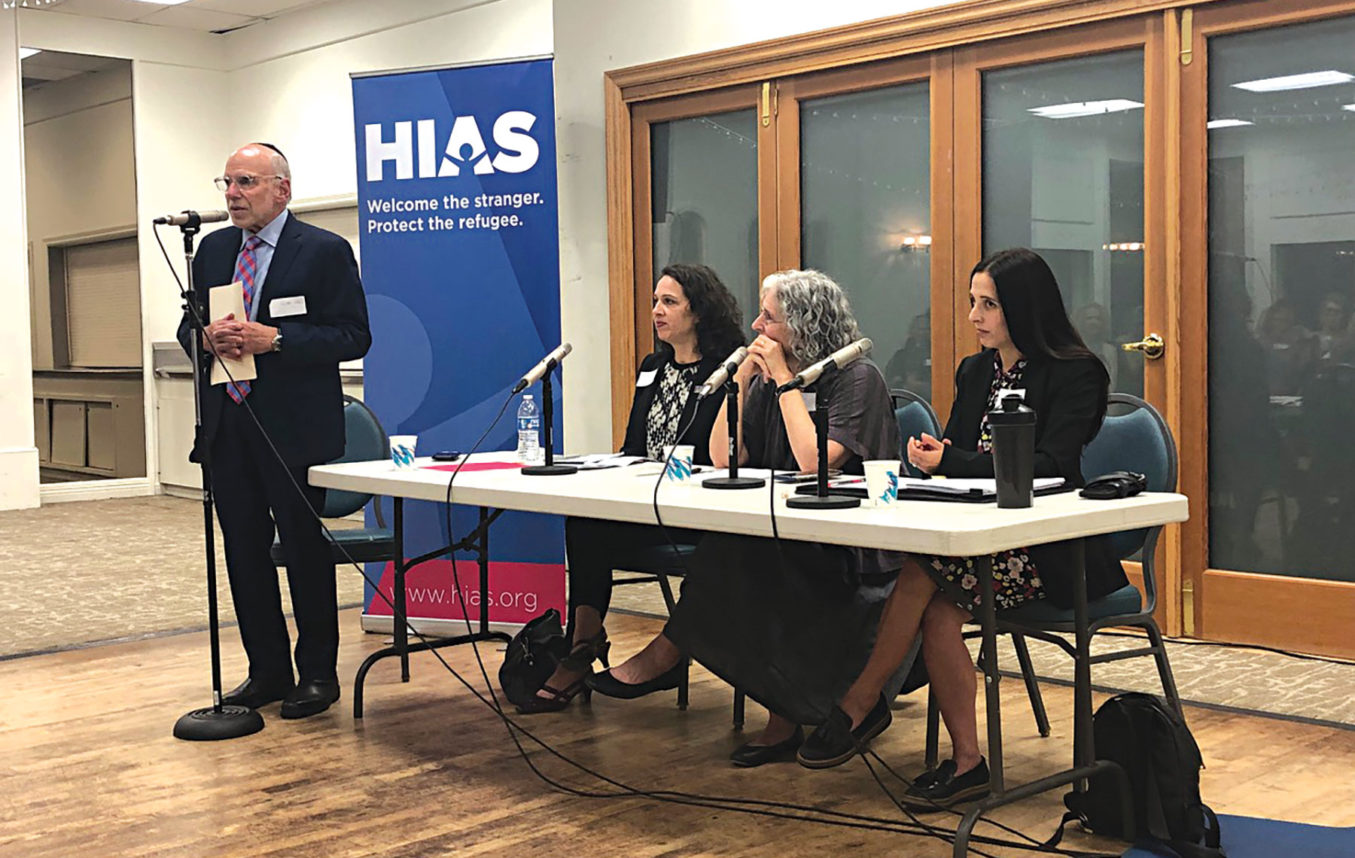
The panel discussion, “Welcoming the Stranger: A Jewish Call to Action for Refugees & Asylum Seekers,” was held at Beth Shir Shalom, on Sept. 18.

But over the past week, right-wingers within and outside the Presidents Conference launched a pressure campaign against the nomination, citing Lob’s involvement with HIAS, which has clashed with the Trump administration over immigration policy. Leading the charge was Morton Klein’s Zionist Organization of America, which has strongly opposed efforts to resettle Muslim refugees from Arab countries in the United States and Europe — something that has topped the HIAS agenda in recent years because of unrest in the Muslim world.

In an email to its more than 50 constituent organizations on Sunday evening, Stark and Lob blamed the disruption caused by the coronavirus pandemic for the proposed change.

“Given the extraordinary time in which we are living with the uncertainty caused by COVID-19 and its ramifications, this strategy is particularly relevant and impactful,” the statement said.

But others said they attributed the delay to the pressure campaign from Klein’s group, which spurred not just like-minded right-wing organizations to oppose Lob, but center-right groups to urge the Presidents Conference leadership to consider a compromise.

“I am appalled that Mort Klein, who is an extremist leader, has blocked a woman from becoming chair of the Conference of Presidents,” said Jennifer Laszlo Mizrahi, the co-founder of the Mizrahi Family Charitable Fund.

“I am appalled that Mort Klein, who is an extremist leader, has blocked a woman from becoming chair of the Conference of Presidents,” Jennifer Laszlo Mizrahi, the co-founder of the Mizrahi Family Charitable Fund and the former CEO of The Israel Project, a nonpartisan Israel lobby group that is now defunct, told JTA in an unsolicited email.

The nomination fight comes as the Presidents Conference is navigating its first professional leadership transition in more than three decades. It underscores major, longstanding fault lines in an organization founded in 1956 with the goal of bringing the Jewish community together to speak with one voice on Israel-related issues to the U.S. administration.

The injection of immigration politics into Presidents Conference deliberations underscores the degree to which the left-right divide in Jewish communal affairs has increasingly expanded beyond narrow Israel matters to reflect the country’s wider political discord.

The injection of immigration politics into Presidents Conference deliberations underscores the degree to which the left-right divide in Jewish communal affairs has increasingly expanded beyond narrow Israel matters to reflect the country’s wider political discord.

The group mostly lobbies the U.S. government’s executive branch, which is why Lob’s nomination was unusual, given the antagonistic relationship between HIAS and the Trump administration. HIAS has clashed repeatedly with the current administration on its immigration policy and has been lead plaintiff in at least two lawsuits against the administration.

One possible result of the delay in Lob becoming board chair is that Joe Biden, the presumptive Democratic nominee who is much more sympathetic to HIAS’ immigration posture, may be president when she does.

The White House, according to a Jewish organizational source, did not object to Lob as the conference chairwoman as long as immigration was not on the agenda — an easy ask, considering the Presidents Conference does not deal with domestic issues. A Trump administration official who deals with the Jewish community did not respond to requests for comment.

The vote leaves the Presidents Conference openly divided at a crucial moment. Lob has been forced into a defensive position, emphasizing in a letter to the group’s constituents her bona fides as the daughter of German refugees and her embrace of mainstream pro-Israel positions, including rejecting the boycott Israel movement as “reprehensible” and calling anti-Zionism “a modern form of Jew-hatred.”

Meanwhile Klein, who prides himself on confronting Israeli leaders over actions he feels endanger Israel and chides other Jewish officials for not following his lead, has burst into public view again. His organization has criticized HIAS for years, saying it allies itself with critics of Israel and claiming that its work makes Jews in America less safe. In fact, all recent terror attacks against Jewish Americans have been carried out by native-born Americans, including the deadly Tree of Life shooting in Pittsburgh whose perpetrator said he was motivated by hatred of HIAS.

Morton Klein (Mort Klein), President of the Zionist Organization of America, at the American Zionist Movement / AZM Washington Forum: Renewing the Bipartisan Commitment Standing with Israel and Zionism in the Capitol Visitor Center in Washington, DC on December 12, 2018. (Photo by Michael Brochstein/Sipa USA)

The rancor between Klein and HIAS erupted in 2018 with a complaint filed by HIAS against the ZOA, which accused the group of violating Presidents Conference rules by making ad hominem attacks. The complaint earned the ZOA a rare reprimand.

Klein’s campaign against Lob has unleashed a countervailing burst of criticism of the ZOA leader. And the resulting compromise sparked furious reactions from Jewish women leaders and from those on the left who see the Presidents Conference as overly cowed by the right wing. Lob would be only the third chairwoman in the umbrella group’s nearly 65-year history, and the Presidents Conference has been slammed on social media for group photos that are exclusively male.

On Twitter, Rabbi Jill Jacobs, who leads T’ruah, a rabbinical human rights advocacy group that is not a member of the Presidents Conference, said the decision “demonstrates that [the Presidents Conference] is held hostage by a small and loud group of right-wing extremists who do not at all represent the overwhelming views of the American Jewish community.”

Some 70 Jewish students at top universities wrote to the Presidents Conference this weekend urging it to impose “appropriate institutional consequences” on the ZOA for what the students called Klein’s “pattern of racist and Islamophobic behavior.”

The Presidents Conference leadership making the decisions included Stark; his immediate predecessor, Stephen Greenberg; and its two professional leaders, longtime executive vice president Malcolm Hoenlein and Daroff, who is newly installed as CEO.

The pandemic frustrated efforts to push back against Klein’s initiative. Lob, a financier, was unable to personally meet with the leaders of the groups to assuage concerns. She will also forgo the traditional immediate inaugural trip to Israel post-election. That trip would have provided photo ops of Lob with Israel’s right-wing government and gone some way to tamp down criticism of her Israel credentials.

Klein in an interview prior to the vote said the compromise was “somewhat positive, but minimal” because Lob’s election, once it occurs, appears irreversible, even if it is delayed for a year. One of Klein’s complaints was that Lob appeared to be uninvolved in Israel issues. But he said the leadership transition could stave off his criticism.

“We do have almost a year to get to know her and see if she can learn more,” Klein said.

Conference of Presidents Controversy Reveals Tensions Between Pro-Trump and Liberal Jews Read More »